❌

Reading view

There are new articles available, click to refresh the page.

Russian GRU hackers hit NATO shipbuilder, aircraft engine maker, law enforcement agency in espionage campaign

Russian government-connected hackers compromised two defense firms and a law enforcement agency in North Atlantic Treaty Organization countries as part of an espionage campaign, Symantec researchers said in a blog post Tuesday.

The infamous group behind hacks of the Democratic National Committee during the 2016 election cycle was behind the attacks that Symantec identified in recent months: Swallowtail, also known as APT28, Fancy Bear and Forest Blizzard, notorious for its links to the Russian military agency GRU.

The hackers apparently chose the targets of their attacks carefully, including a naval shipbuilder, a manufacturer of military aircraft engines and the law enforcement agency. In the attack on the shipbuilder, Symantec saw “hands-on-keyboard” activity as the hackers repeatedly returned to a compromised host over the course of a week to steal credentialed material.

“Hands-on-keyboard activity means a human operator is choosing what to do next, rather than malware running a fixed routine,” Dick O’Brien, principal intelligence analyst at the Symantec Threat Hunter Team, told CyberScoop. “It’s essentially confirmation that the organization is a genuine target for the operators, not an accidental infection. It also confirms that further exploitation beyond the initial infection was at least attempted.”

O’Brien said the campaign reflected broader intelligence collection aimed at European government and defense targets, but its motive wasn’t certain. He speculated that it could have been part of campaigns to target nations aiding Ukraine in its war against Russia.

The hackers made use of the Hookedge backdoor first identified in August by Recorded Future’s Insikt Group. That firm saw attacks dating back to September of last year by the same group using the same backdoor on defense and diplomatic targets in Romania, Spain and Turkey.

Symantec also observed the hackers deploying a previously undocumented loader.

“What surprised us was that the attackers then moved their most sensitive follow-up activity onto a dedicated server, when Recorded Future had expected them to keep hopping between free services,” O’Brien said. “The loader, ld.exe, hadn’t been publicly documented. It decrypts its payload in memory, and it needs a key supplied only at runtime on the command line. Without both the encrypted file and the key, the payload can’t be recovered. We didn’t recover it, so we don’t know its function.”

This spring, researchers and U.S. government agencies said they quashed a Forest Blizzard espionage campaign. Western governments warned last year about the group targeting companies supporting Ukraine.

The post Russian GRU hackers hit NATO shipbuilder, aircraft engine maker, law enforcement agency in espionage campaign appeared first on CyberScoop.

Russian hackers Star Blizzard expand targeting, change up tactics to reach Ukraine and beyond

A group of Russian government hackers is refining its attacks to make it easier to eavesdrop on victims and significantly expand its targets among governments, think tanks and nonprofits around the world, with an emphasis on Ukraine, Microsoft research published Tuesday concludes.

The company examined a change in the approach of a group it calls Star Blizzard, which is affiliated with the Russian Federal Security Service (FSB), and its novel malware, RedFlick.

“In 2026, Microsoft observed Star Blizzard shift from exclusively targeted spear-phishing operations to also conducting larger-scale phishing campaigns,” Microsoft wrote in a blog post. “The larger-scale phishing operations were observed at a scale not previously seen from the actor, ranging from tens to hundreds of email messages per campaign. This change likely reflects the actor’s adoption of a mass-mailing phishing platform to automate campaign execution and increase the likelihood of successful compromises by significantly expanding the initial targeting pool.”

Microsoft said the RedFlick campaigns have targeted Ukrainians, as well as financial institutions and governments that have supported Ukraine. It said it has seen the activity affect over 100 organizations that are primarily in the United States or United Kingdom.

One of the things that makes RedFlick effective isn’t just its pure volume, but the fact that its “infection flow only requires a single user interaction, reducing friction in the compromise process,” the company said in its blog post.

The most common phishing lure is inviting potential victims to exclusive events, but it also solicits its targets with information about supposed tax audits, payment notices and fines.

“Since January 2026, Microsoft observed at least 13 distinct large-scale phishing campaigns targeting primarily NGOs, think tanks, and government organizations worldwide,” the company wrote.

The initial targets were in Ukraine but by spring it was going after those outside the nation it invaded in 2022. “The actor’s shift from Ukraine-focused operations to global targets could indicate Star Blizzard initially targeted Ukraine to test their new capabilities,” Microsoft wrote.

RedFlick has been a key adaptation as “a malware delivery technique that helps evade detection by initiating a set of scheduled tasks to deploy the actor’s custom backdoor, CosmicPulse,” the company said.

This isn’t the first time that Microsoft has called out Star Blizzard, with past observations coming in 2023 and 2025 and takedown efforts coming in 2024.

Star Blizzard has been known by other names as well: SEABORGIUM, Callisto Group, TA446 and COLDRIVER.

The post Russian hackers Star Blizzard expand targeting, change up tactics to reach Ukraine and beyond appeared first on CyberScoop.

AI lets small actors run state-level hacking campaigns, Anthropic report finds

Artificial intelligence has removed the skill advantage that once set state-sponsored hackers apart from lone criminals, according to a threat report Anthropic published Thursday that documents misuse of its Claude models across seven areas of harm.

The report, which details activity observed between December 2025 and August 2026, covers cyber operations, influence operations, surveillance, scams and fraud, biological misuse, conventional weapons development and distillation. Anthropic said it disrupted each operation, strengthened safeguards and shared intelligence with authorities and industry partners where appropriate. 

“The cases we share here aren’t typical misuse, but rather examples of the most notable and novel threat activity we’ve identified to date,” the report reads. “We’re publishing this work because we believe we have a responsibility to disclose malicious misuse of our services. As models become increasingly capable, their risks will increase, unless AI developers and society’s defenders act to make them safer.”

The cyber operations the company detailed were a Russian-aligned espionage campaign that hit more than 20 government and defense organizations across Ukraine and Europe, two Chinese undergraduates who ran an automated exploit foundry that produced more than a dozen potential zero-days in a single month, affiliates of the ShinyHunters crime collective who dumped 2,100 cloud access tokens across 40 corporate tenants in 34 hours, and a lone hacktivist who targeted European political parties via stolen API keys. 

For decades, cybersecurity researchers and investigators have pointed to sophisticated operations as a signature of state-sponsored tradecraft, while crude intrusions suggested amateurs or petty criminals. Anthropic posits in the report that AI has erased that conventional thinking, especially since a “majority of the operations described in this report were enabled by AI via direct execution or orchestration.”

“For threat intelligence investigators, sophistication has stopped being a reliable signal of who is behind an operation,” the report said, adding that a hacktivist on stolen API keys, scattered criminals and a state espionage operator each ran campaigns that a year earlier “would have required many skilled operators and specialist knowledge.”

The most extensive case involved a malicious actor using the handle “JackPoterz” whose actions aligned with Russian state espionage, matching behaviors linked to Midnight Blizzard. 

According to the report, the actor employed a custom toolkit composed of two families of Windows-based implants, a mobile exploitation kit, a credential stealing tool that targets browser password stores, a phishing platform designed to mimic priority targets like government organizations, and an administrative console used to manage compromised accounts. Targets included military intelligence bodies in Ukrainian and European governments, diplomatic and defense organizations, and people connected to U.S. foreign policy.

According to the report, AI monitored whether security products flagged the actor’s malware. When a detection occurred, “agents would then set about the process of autonomously modifying and rebuilding the malware to evade the existing detections,” the report said.

The same actor bulk-exported mailboxes at drone component manufacturers and stole a complete software development kit for a drone vision system, then spent days recovering its architecture and details of an unannounced product. The actor also compromised hotel Wi-Fi vendors to reach guests through DNS hijacking, took over WhatsApp accounts with headless browsers, and stole more than 300,000 national identity records from a North African government agency, along with registry data on more than half a million companies.

The Chinese-speaking operators, which the company says were partly carried out by undergraduates at a Chinese university, put Claude to work on vulnerability research around the clock. One workflow iterating on network appliance firmware “yielded more than a dozen possible zero day findings in a single month.” It ran “agent swarms,” in which a lead agent divided work among parallel subagents, and kept campaign memory between sessions. 

Clusters linked to ShinyHunters showed how AI shortens criminal timelines. One supply-chain breach ended with a dump of more than 2,100 Azure access tokens spanning more than 40 corporate tenants in about 34 hours. “AI agents performed nearly all of the work,” the report said. Another compromise moved from a single stolen developer token to full control of a victim’s cloud environment in roughly three hours.

The report also has a section dedicated to distillation attacks that Anthropic claims were carried out since February by seven labs based in China, including Alibaba, DeepSeek, Moonshot AI, Xiaomi and Zhipu. Operators affiliated with Alibaba ran the largest attack Anthropic has measured, peaking “at nearly 3 million exchanges per day launched from more than 3,500 fraudulent accounts” to harvest the outputs of Claude Opus models for training its Qwen systems.

The outputs were culled from users who never knew they were involved. The report said Moonshot and DeepSeek silently forwarded their own customers’ requests to Claude and returned its answers as their own, exposing data users had not agreed to share, including surveillance footage of a tracked individual pulled by a user likely affiliated with the People’s Liberation Army. Those practices are “likely inconsistent with privacy laws and the labs’ own terms of service,” the report said.

Earlier this week, a joint cybersecurity advisory from the National Security Agency, the Cybersecurity and Infrastructure Security Agency and the FBI accused Chinese AI companies of engaging in a deliberate and “systematic” effort to illegally distill U.S. frontier AI models and their capabilities.

Anthropic said it published the cases to give outsiders a view of how these threats form, framing the disclosures as an early look at a shifting landscape. 

“As models become increasingly capable, their risks will increase, unless AI developers and society’s defenders act to make them safer,” the report said. The old idea of “security through obscurity,” it added, “is no longer viable in this new AI-assisted world: everything connected to the internet is a potential target for exploitation.”

You can read the full report on Anthropic’s website.

The post AI lets small actors run state-level hacking campaigns, Anthropic report finds appeared first on CyberScoop.

Europe strikes out against Russia’s Turla over espionage, ‘destructive attacks’

European governments sanctioned Russian individuals and organizations Monday over what they said was a years-long campaign of cyberespionage from Turla and other Russian government-led “destructive attacks” against the bloc.

Monday’s confrontation of Moscow included action from the European Union, its individual member governments and the United Kingdom. It mostly took aim at Center 16 of Russia’s Federal Security Service (FSB) over its control of the cyber threat group known by a list of names including Turla, Secret Blizzard and Waterbug.

“Cybercriminals, self-proclaimed hacktivists and private companies linked to Russia, including actors operating under its instructions, direction or control, have also carried out, enabled and facilitated a wide range of malicious activities,” European Union High Representative Kaja Kallas said in a statement.

The EU called out Russia for the Turla campaign that dated back to 2010 in France with targeting of the government there, and has also featured activity against Germany, Poland, Cyprus, the Netherlands, Austria, Slovakia, Romania and Finland. It made special mention of blaming the FSB for last December’s attacks on Poland’s energy grid, which left half a million people without heat.

In all, the European Union sanctioned nine Russian individuals and four entities. While the EU didn’t name them, Kallas’s statement said it also included officers of Russia’s Main Intelligence Directorate of the General Staff (GRU).

The United Kingdom’s cyber sanctions, the first it’s done in coordination with the EU, featured a longer list of 24 individuals and entities. The U.K. named GRU senior leadership figures Vyacheslav Stafeyev, Ivan Senin and Ivan Kasyanenko for their alleged hybrid cyberattacks in conjunction with cybercriminals and recruitment of hackers across Russian universities. The U.K. also sanctioned individuals behind Lumma Stealer, the target of an international takedown last year.

“These sanctions strike at the core of the cybercriminal networks propping up the Russian state’s aggression, and the UK and EU are sending a clear message that Russia cannot hide behind its use of these proxy groups,” Foreign Secretary, Yvette Cooper, said in a news release that mentioned “destructive attacks” by Russia. “From directing criminals to targeting businesses, and striking Poland’s energy grid in the depths of winter, the Russian state is sinking to new lows in its attempts to undermine European security.”

At least two European governments, Germany and France, said they would be summoning Russia’s ambassadors in their nations over the attacks.

Also Monday, the European Union announced sanctions against the company behind Russia’s messaging app, Max, citing its use of surveillance features to clamp down on dissent. And separately, 13 nations including the United States issued a warning on Monday about Russian government hackers targeting routers to carry out critical infrastructure attacks.

Russia routinely denies allegations of responsibility for any malicious cyber activity.

The post Europe strikes out against Russia’s Turla over espionage, ‘destructive attacks’ appeared first on CyberScoop.

Russia Hacked Routers to Steal Microsoft Office Tokens

Hackers linked to Russia’s military intelligence units are using known flaws in older Internet routers to mass harvest authentication tokens from Microsoft Office users, security experts warned today. The spying campaign allowed state-backed Russian hackers to quietly siphon authentication tokens from users on more than 18,000 networks without deploying any malicious software or code.

Microsoft said in a blog post today it identified more than 200 organizations and 5,000 consumer devices that were caught up in a stealthy but remarkably simple spying network built by a Russia-backed threat actor known as “Forest Blizzard.”

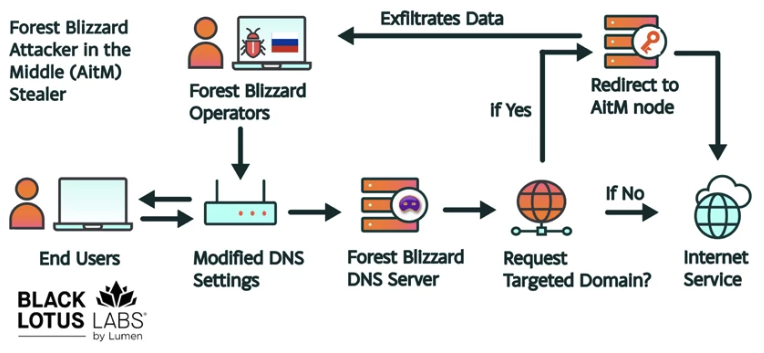
How targeted DNS requests were redirected at the router. Image: Black Lotus Labs.

Also known as APT28 and Fancy Bear, Forest Blizzard is attributed to the military intelligence units within Russia’s General Staff Main Intelligence Directorate (GRU). APT 28 famously compromised the Hillary Clinton campaign, the Democratic National Committee, and the Democratic Congressional Campaign Committee in 2016 in an attempt to interfere with the U.S. presidential election.

Researchers at Black Lotus Labs, a security division of the Internet backbone provider Lumen, found that at the peak of its activity in December 2025, Forest Blizzard’s surveillance dragnet ensnared more than 18,000 Internet routers that were mostly unsupported, end-of-life routers, or else far behind on security updates. A new report from Lumen says the hackers primarily targeted government agencies—including ministries of foreign affairs, law enforcement, and third-party email providers.

Black Lotus Security Engineer Ryan English said the GRU hackers did not need to install malware on the targeted routers, which were mainly older Mikrotik and TP-Link devices marketed to the Small Office/Home Office (SOHO) market. Instead, they used known vulnerabilities to modify the Domain Name System (DNS) settings of the routers to include DNS servers controlled by the hackers.

As the U.K.’s National Cyber Security Centre (NCSC) notes in a new advisory detailing how Russian cyber actors have been compromising routers, DNS is what allows individuals to reach websites by typing familiar addresses, instead of associated IP addresses. In a DNS hijacking attack, bad actors interfere with this process to covertly send users to malicious websites designed to steal login details or other sensitive information.

English said the routers attacked by Forest Blizzard were reconfigured to use DNS servers that pointed to a handful of virtual private servers controlled by the attackers. Importantly, the attackers could then propagate their malicious DNS settings to all users on the local network, and from that point forward intercept any OAuth authentication tokens transmitted by those users.

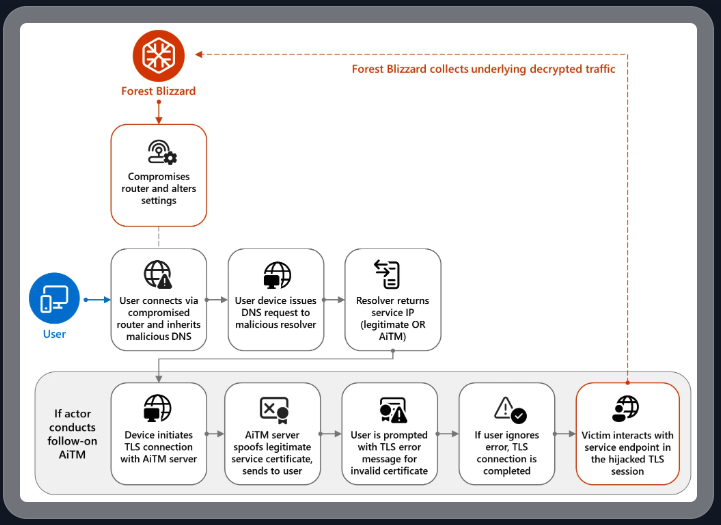
DNS hijacking through router compromise. Image: Microsoft.

Because those tokens are typically transmitted only after the user has successfully logged in and gone through multi-factor authentication, the attackers could gain direct access to victim accounts without ever having to phish each user’s credentials and/or one-time codes.

“Everyone is looking for some sophisticated malware to drop something on your mobile devices or something,” English said. “These guys didn’t use malware. They did this in an old-school, graybeard way that isn’t really sexy but it gets the job done.”

Microsoft refers to the Forest Blizzard activity as using DNS hijacking “to support post-compromise adversary-in-the-middle (AiTM) attacks on Transport Layer Security (TLS) connections against Microsoft Outlook on the web domains.” The software giant said while targeting SOHO devices isn’t a new tactic, this is the first time Microsoft has seen Forest Blizzard using “DNS hijacking at scale to support AiTM of TLS connections after exploiting edge devices.”

Black Lotus Labs engineer Danny Adamitis said it will be interesting to see how Forest Blizzard reacts to today’s flurry of attention to their espionage operation, noting that the group immediately switched up its tactics in response to a similar NCSC report (PDF) in August 2025. At the time, Forest Blizzard was using malware to control a far more targeted and smaller group of compromised routers. But Adamitis said the day after the NCSC report, the group quickly ditched the malware approach in favor of mass-altering the DNS settings on thousands of vulnerable routers.

“Before the last NCSC report came out they used this capability in very limited instances,” Adamitis told KrebsOnSecurity. “After the report was released they implemented the capability in a more systemic fashion and used it to target everything that was vulnerable.”

TP-Link was among the router makers facing a complete ban in the United States. But on March 23, the U.S. Federal Communications Commission (FCC) took a much broader approach, announcing it would no longer certify consumer-grade Internet routers that are produced outside of the United States.

The FCC warned that foreign-made routers had become an untenable national security threat, and that poorly-secured routers present “a severe cybersecurity risk that could be leveraged to immediately and severely disrupt U.S. critical infrastructure and directly harm U.S. persons.”

Experts have countered that few new consumer-grade routers would be available for purchase under this new FCC policy (besides maybe Musk’s Starlink satellite Internet routers, which are produced in Texas). The FCC says router makers can apply for a special “conditional approval” from the Department of War or Department of Homeland Security, and that the new policy does not affect any previously-purchased consumer-grade routers.

❌