Reading view

There are new articles available, click to refresh the page.

What the World Cup can teach us about cybersecurity resilience

With the World Cup now complete, its biggest cybersecurity story may be what didn’t happen. While no major public cyber disruption has been reported, that shouldn’t be mistaken for a lack of risk. 

In the run-up to the tournament, the FBI’s Internet Crime Complaint Center (IC3) issued a public service announcement warning organizations and fans about fraudulent, spoofed websites impersonating the FIFA event – a reminder that the absence of a headline-grabbing breach doesn’t mean bad actors weren’t trying. In many ways, it’s evidence of the planning, coordination, and resilience required to keep an event of this scale running securely.

A global event like the World Cup depends on far more than what happens inside the stadium. It relies on local governments, venues, transportation systems, telecom providers, payment platforms, hotels, vendors, public safety agencies, and law enforcement, all working together. 

When I worked at the FBI, I saw how fast major events test teamwork across agencies, regions, and businesses. The World Cup offered that test at a scale few events can match.

Successful resilience is built months before kickoff

Successful major-event security depends on what happens long before there is a visible incident: trusted relationships, clear roles, shared intelligence and response plans. Planning becomes even more important when an event is not limited to a single city or venue.

In the past, event security consisted of guards, gates, and stadium perimeters. Those still matter, but they’re only part of the picture. Today, an event this big that brings millions of people together depends on many systems working in concert. No single organization owns the full risk picture, which means resilience depends on how well these groups can share information, coordinate response plans, and keep essential services operating under pressure. This means security can’t be planned around one perimeter. The real perimeter is the full event ecosystem.

Resilience starts much earlier, with planning across organizations that may not normally operate as one team. The real test for major events is whether public- and private-sector partners know their roles before pressure hits. That includes who shares information, who validates threats, who communicates with the public, who has decision-making authority and how quickly partners can act if a system slows down or becomes unavailable.

Major events are only as resilient as the systems behind them

Attackers don’t need to compromise the most visible organization to create disruption. They can look for weaker points across the event ecosystem. A disruption may begin with a vendor, ticketing platform, transportation partner, payment provider, hotel, contractor or communications provider, but the impact can quickly become broader than any one organization.

Sports organizations now operate like large businesses, with ticketing systems, VIP data, sponsors, vendors, media partners, stadium operations, payment systems, and fan engagement platforms. They depend on networks of suppliers and partners, and that creates multiple possible entry points.

Operational technology (OT) deserves more attention than it typically gets in these conversations. A ransomware attack that disrupted stadium operations directly, rather than a ticketing site or a fan-facing app, would be one of the most damaging scenarios organizers could face. OT security has to sit alongside the more visible concerns like payment fraud and spoofed domains, not behind them.

Bad actors don’t let a good crisis go to waste. Fans are often an easy target. Excitement drives a fan to buy a last-minute ticket or check a score on an unknown site. That excitement is exactly what fraudsters count on.

This risk grows over time. As the event gets closer and attracts more eyes, it becomes a richer target. A fake FIFA ticket site is useless to a crook a month after the last game. Groups running these systems must act faster as opening day nears, and share threat intelligence without delay.

Threat intelligence turns planning into proactive defense

The World Cup may be over, but the work isn’t. Cities, governments, and private-sector organizations will continue supporting large-scale public events that depend on complex digital and physical ecosystems. The question isn’t whether another major event will face cyber threats, it’s whether the planning starts early enough.

Organizations involved in future major events should focus on resilience, not just prevention. That means planning for what happens if a critical system slows down, goes offline, or becomes unreliable, and ensuring partners know how to coordinate before an incident occurs.

Every major event forces defenders to prepare for known risks. The harder challenge is anticipating the ones that haven’t emerged yet.

The next major disruption may not come from the attack that organizations spent months preparing for. It could target a new dependency, exploit emerging technology, or capitalize on a moment when public attention is at its highest. That’s why resilience can’t be built around yesterday’s playbook. It has to be informed by continuous threat intelligence, regular coordination across public- and private-sector partners, and the flexibility to adapt as the threat landscape changes.

The World Cup demonstrated what’s possible when that preparation comes together. As cities, governments, and private organizations look ahead to future global events, success won’t be measured solely by the attacks they stop. It will be measured by how effectively they can maintain critical operations, share information, and adapt under pressure when the unexpected happens.

The post What the World Cup can teach us about cybersecurity resilience appeared first on CyberScoop.

Leading members of Scattered Spider sentenced in UK to 66 months in jail

A pair of young men were sentenced to 66 months in jail for committing a cyberattack on the Transport for London that brought the network’s operations to a standstill in 2024, the United Kingdom’s National Crime Agency said Thursday.

Thalha Jubair and Owen Flowers were arrested at their homes in September 2025, barely a year after the attack, and pleaded guilty last month just as their trials were set to begin. Flowers was previously arrested in connection with the attack in September, but was released after questioning by officers.

Jubair and Flowers were leading members and highly involved in Scattered Spider, a nebulous hacker subset of The Com, according to researchers. The 20-year-old Jubair was a prolific cybercriminal and core member of the unbound collective

U.S. authorities last year accused Jubair of direct, prominent involvement in at least 120 cyberattacks, including extortion of 47 U.S.-based organizations and the January 2025 attack on the federal court system. 

Officials said they traced a combined total of at least $89.5 million in cryptocurrency, at the time of payments, to Bitcoin addresses and servers controlled by Jubair. Two financial services firms paid Jubair $25 million and $36.2 million, respectively, in Bitcoin between June and November 2023, according to an unsealed criminal complaint against Jubair. 

At the time of Jubair’s arrest, “he was one of the four principal people that we associated with Scattered Spider,” and one of the two most core players, Adam Meyers, senior vice president of counter adversary operations at CrowdStrike, told CyberScoop. 

Jubair and Owens had significant resources and support, and “victim payments were reinvested back into the enterprise,” said Allison Nixon, chief research officer at Unit 221B. 

The lasting impact of Jubair and Owens’ capture and imprisonment remains hazy.

U.K. authorities insist Jubair and Owens’ arrests and punishment “effectively halted the group’s criminal activity,” yet they added that other cybercriminals continue to use the Scattered Spider brand in more recent attacks. 

Thursday’s announcement “represents a significant step in holding accountable two members of Scattered Spider, a group that has repeatedly relied on data extortion, SIM-swap attacks, and other social engineering techniques to infiltrate networks and undermine critical services,” Brett Leatherman, assistant director of the FBI Cyber Division, said in a statement. 

The FBI also noted, in a LinkedIn post, that members of Scattered Spider “continue to victimize organizations around the world and cause significant financial and operational harm.”

When Owens, now 18, was first arrested for the Transport for London attack in 2024, investigators said he was “in the process of hacking the systems of U.S. health care companies SSM Health Care Corporation and Sutter Health, which had been infiltrated and damaged.”

Officials also said Jubair and Owens failed to cooperate after their arrests. 

“This is the largest cybercrime prosecution ever brought before the U.K. courts and the culmination of nearly two years of painstaking work,” Paul Foster, head of the National Crime Center’s National Cybercrime Unit, said in a statement. 

“Scattered Spider has been the most significant cybercrime threat to the U.K. in recent years. Through this investigation, we have severely disrupted that threat and brought key offenders to justice,” Foster added.

Despite the upbeat reaction from U.K. officials, Nixon said the punishment for Jubair and Owens is “remarkably lenient considering the period of continuous reoffending lasted longer than the sentence.”

Nixon hopes the United States will eventually extradite the pair to face additional charges. “If that happens, they won’t be able to use mental illness as a loophole to get back to harming society as soon as possible,” she added.

“No one who worked on their case was surprised they would reoffend, and there seems to be no allowance in the law to protect the public from what everyone knew was going to happen,” Nixon said. “I know the narrative in the cybercriminal culture will glorify them, but they wouldn’t if they knew the full story.”

The post Leading members of Scattered Spider sentenced in UK to 66 months in jail appeared first on CyberScoop.

764 splinter group leader sentenced to 40 years in jail

A San Antonio man who sexually exploited children while leading 8884, an offshoot of the notorious violent extremist collective 764, was sentenced to 40 years in prison in federal court Wednesday, the Justice Department said. 

Alexis Aldair Chavez began associating with 764 as a child in 2022 when a co-conspirator introduced him to 7997, one of many 764 offshoots affiliated with the Com. The sprawling nihilistic network of thousands of people, typically between 11 and 25 years old, seek to foster social unrest by destroying civilized society through the corruption and exploitation of children and other vulnerable populations.

The 19-year-old, also known as “Zack” and “Zack8884,” attempted to coerce a girl to commit suicide and blackmailed another girl into self-mutiliation, animal torture and illicit content production in late 2023, according to court records. He later worked with multiple co-conspirators and blackmailed some of his victims to coerce other girls to degrade themselves on camera and produce child sexual abuse material (CSAM).

Chavez was arrested and has been detained without bail since October 2024. He pleaded guilty to multiple crimes involving the sexual exploitation of children in December 2025 and faced up to 60 years in prison for racketeering, distribution and possession of CSAM.

“Chavez’s crimes reveal the ruthless exploitation and manipulation at the core of nihilistic violent extremist groups,” John A. Eisenberg, assistant attorney general for national security, said in a statement. 

“These organizations target children as part of their broader mission to spread terror. These groups ultimately seek nothing less than the destruction of our society,” he added. “The National Security Division will use every resource at its disposal to identify and prosecute 764-linked criminality and to protect the most innocent among us from these predators.”

The indictment filed against Chavez in the U.S. District Court for the Western District of Texas details a series of horrifying crimes he committed with co-conspirators and some of his victims. 

Prosecutors said Chavez and a co-conspirator coerced a girl to cut her tongue, and torture and kill a cat on a live video call in late 2023. He and co-conspirators also, that same month, groomed and extorted several other girls to commit self harm and degrade themselves on camera.

Allison Nixon, chief research officer at Unit 221B, told CyberScoop the sentence is appropriate even if people understandably dislike imprisoning young people. 

“In this space, a certain personality profile is highly predictive of who will risk a prison sentence like this: an obsession with maximizing harm,” she said. 

“Reoffending after release is a huge problem. All major global hacking incidents from the Com are done by serial reoffenders — all obsessed with harmfulness, some graduated from the 764 sextortion space,” Nixon added.

Too many jurisdictions are naive in how they handle cases involving members or associates of the Com, allowing these criminals to go home to parents who won’t supervise them, she said.

Officials pressed on this in their reaction to Chavez’s sentencing as well. “Parents need to know what their children are doing online and must stay engaged, ask difficult questions, and not fall into the trap of believing their child is ‘just playing games’ or ‘just talking with their friends,’” Justin R. Simmons, U.S. attorney for the Western District of Texas, said in a statement. 

“There is darkness present within many people in this world that want nothing more than to see the United States and western civilization fail. There is no limit to the actions these individuals will take to accomplish that goal, including torturing and abusing children,” Simmons added.

Chavez, who was also ordered to pay $10,000 in restitution and serve lifetime supervised release, joins other 764 members already serving long sentences for similar crimes. Bradley Chance Cadenhed, who founded 764 as a 15-year-old in 2021, was arrested later that year and sentenced to 80 years in prison in 2023. 

When the FBI executed a search warrant at Chavez’s residence in July 2024, prosecutors said he came out the backdoor and threw his phone over a neighbor’s fence in an attempt to hide evidence.

Chavez’s sentencing follows a period of heightened law enforcement activity, which has netted arrests of multiple alleged 764 leaders and members. Some of the alleged 764 members arrested since 2025  include: Leonidas Varagiannis and Prasan Nepal, Baron Cain Martin, Tony Christopher Long, Erik Lee Madison, Zachary Sweeney and Aaron Corey

“True rehabilitation is the best outcome, but no one knows how,” Nixon said. 

“The total number of offenders who fit this harm-obsessed profile is vanishingly small. Giving them maximum sentences won’t overflow jails,” she added. 

Law enforcement and judges have to be realistic about what it takes to prevent the victimization of children, and handing down lifelong or lengthy prison sentences strikes the right balance between the rights of the offender and society, Nixon said.

FBI officials and agents who track these offenders and gather evidence on their crimes draw similar conclusions. 

“Nothing is more abhorrent than those who prey on children and other vulnerable members of our society and this defendant will pay a steep price for doing just that,” Coult Markovsky, acting assistant director of the FBI’s counterterrorism division, said in a statement.

“This sentencing demonstrates the FBI’s unwavering resolve to identify, hunt down, investigate, and prosecute criminals like Chavez who prey on children through violent online networks, including 764, and orchestrate horrific, unspeakable acts of exploitation and violence,” Daniel Faith, special agent in charge of the FBI San Antonio field office, said in a statement. 

“These predators use social media, messaging apps, gaming platforms, chat rooms, and video services to groom vulnerable children,” Faith added. “Staying engaged in your child’s online life, maintaining open communication, recognizing the warning signs, and reporting suspicious online activity to law enforcement are critical to stopping these offenders.”

The post 764 splinter group leader sentenced to 40 years in jail appeared first on CyberScoop.

FBI Seizes NetNut Proxy Platform, Popa Botnet

The Federal Bureau of Investigation (FBI) said today it worked with industry partners to seize hundreds of domains associated with NetNut, a sprawling residential proxy service operated by the publicly-traded Israeli company Alarum Technologies [NASDAQ: ALAR]. The action comes roughly two weeks after KrebsOnSecurity published findings from multiple security firms connecting NetNut to the Popa botnet, a collection of at least two million devices that have been compromised by malicious software with little or no consent from victims.

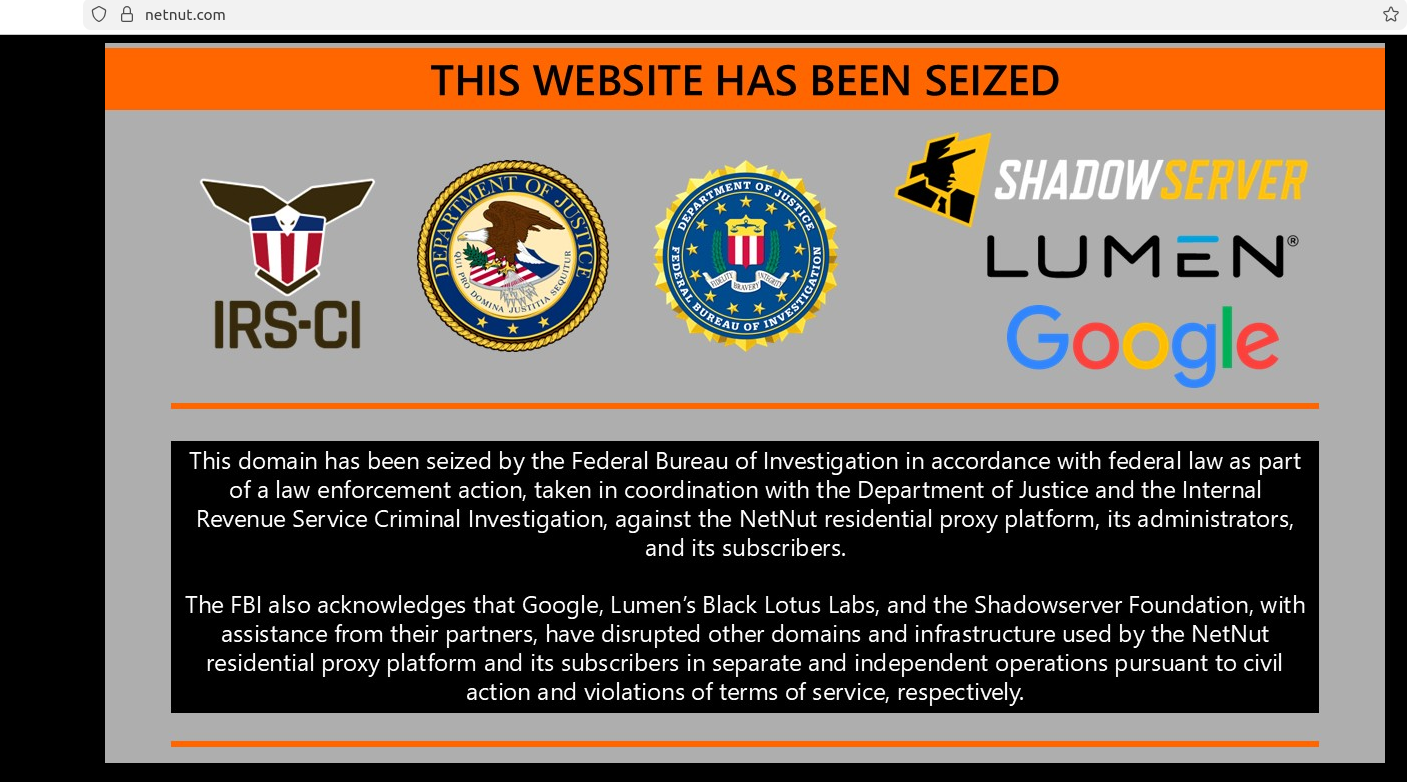
The NetNut homepage today was replaced by this seizure banner from the FBI.

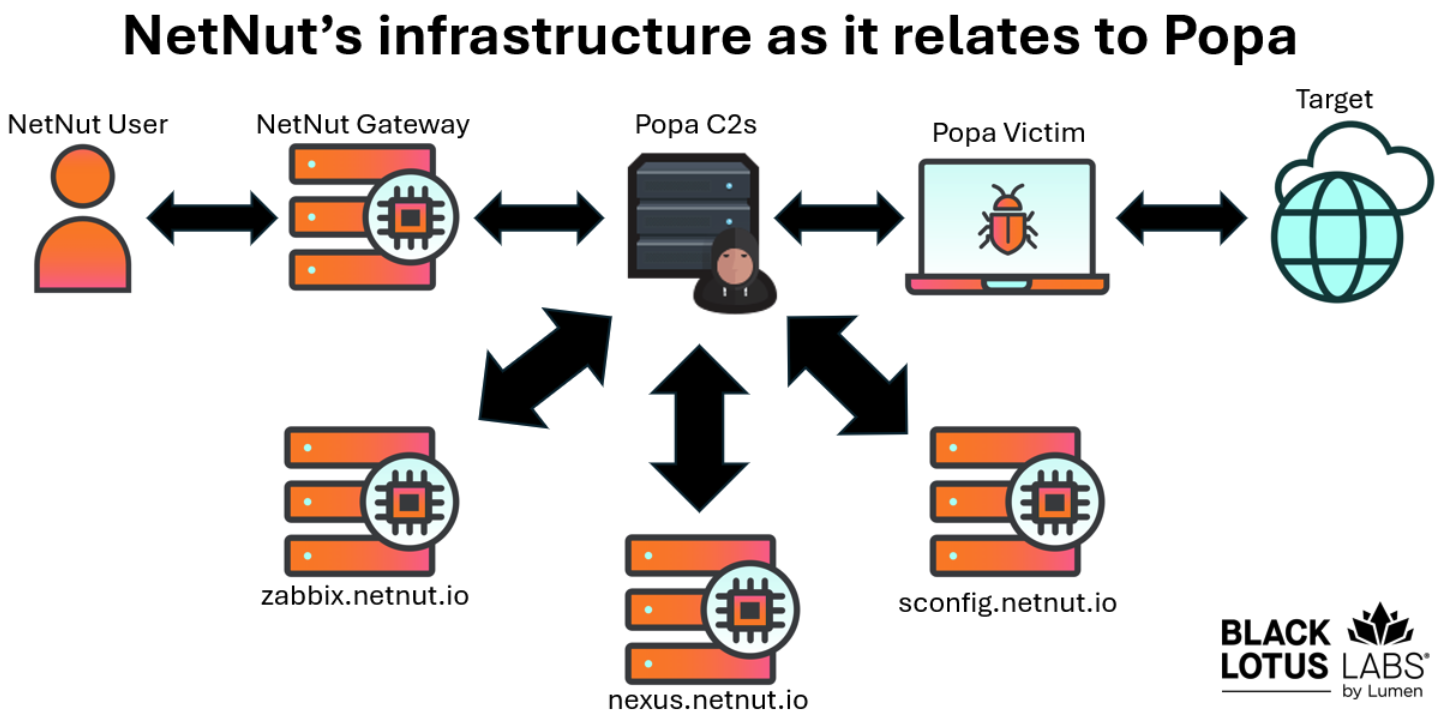
On June 19, three different security firms issued similar findings: That NetNut is a residential proxy network which populates a botnet called Popa, and distributes software for devices commonly found in homes, such as smart TVs and streaming boxes. NetNut’s software turns those systems into always-on residential proxy nodes that are rented to others, who predominantly use them to relay abusive and intrusive Internet traffic, such as mass content scraping, advertising fraud, and account takeover activity.

Earlier today, NetNut’s homepage was replaced with a seizure notice from the FBI and the Internal Revenue Service Criminal Investigation division. The seizure notice thanked Google, Lumen, Shadowserver and other industry partners for their help in dismantling hundreds of domains tied to the Popa botnet, which experts say has long been synonymous with NetNut’s residential proxy infrastructure.

In a blog post published today, the Google Threat Intelligence Group (GTIG) said NetNut’s proxy network is widely resold and white-labeled by a number of third-party proxy providers, and that its services are heavily sought out by cybercriminals seeking to obfuscate the source of their malicious traffic. The GTIG said that in a single week during June 2026, they observed 316 distinct clusters of threat actors using suspected NetNut exit nodes, including cybercriminal and espionage groups.

“These bad actors can use NetNut to mask their origin IP address when accessing victim environments, accessing their own infrastructure, and conducting password spray attacks,” Google’s GTIG wrote. “Furthermore, when a consumer device becomes an exit node, unauthorized network traffic passes through it. This means bad actors can access other private devices on the same home network, effectively exposing them to Internet threats.”

Google said it disabled Google accounts and services used by NetNut for malware command and control, and that it shared technical intelligence on NetNut’s software development kits (SDKs) and backend infrastructure with platform providers, law enforcement and research firms. The company also disabled apps known to bundle NetNut’s various SDKs.

Omer Weiss, legal counsel for NetNut parent Alarum Technologies, said the company was aware of the FBI seizure and cooperating with investigators.

“Alarum takes this matter seriously and will fully cooperate with law enforcement to ensure any misuse of its infrastructure is thoroughly investigated and those responsible are held to account,” Weiss said in a written statement.

Benjamin Brundage is founder of the proxy tracking service Synthient, one of the companies that published evidence last month linking the Popa botnet to NetNut and Alarum Technologies. Brundage said the domain seizures appear to have disrupted both the Popa botnet and the NetNut proxy network that rides on top of it.

Brundage said NetNut’s apparent demise is likely to be a great disadvantage for the cybercrime community, which was already reeling from legal actions by Google earlier this year that seized infrastructure for NetNut’s biggest competitor — IPIDEA.

“I think this takedown is going to have a big impact, because NetNut gained significant popularity after the IPIDEA takedown,” he said. “Also NetNut has been incredibly common among resellers, and they were on par with IPIDEA in terms of their daily traffic, quality, size, price per gigabyte, all of it.”

NetNut’s infrastructure, in a nutshell. Image: Black Lotus Labs, Lumen.

The NetNut and Popa botnet takedown may have another added benefit, Brundage said: Lessening the impact of large distributed denial-of-service botnets that have been built on the backs of poorly configured residential proxy services. In January, Synthient revealed how cybercriminals had built the world’s largest DDoS botnet (Kimwolf) by tunneling through IPIDEA proxy connections into the local networks of TV box owners, and infecting other Android-based devices behind the victim’s firewall.

While many of the bigger proxy providers took steps to block this activity, resellers of the major proxy networks have been far slower to respond to the threat, Brundage said.

“In terms of all these TV box devices getting compromised from the proxy network, it will have an impact on the DDoS botnets out there,” he said.

For its part, Google reckons today’s actions have caused “significant degradation to NetNut’s proxy network and its business operations, reducing the available pool of devices for the proxy operator by millions.” But the company warns that proxy networks can rebuild themselves by effectively reselling other proxy services, as IPIDEA has done over the past few months.

“Google has high confidence that many popular residential proxy brands are in fact whitelabeling the NetNut botnet,” the GTIG report concludes. “While we expect this disruption to have a larger ripple effect across the residential proxy ecosystem, observations after the disruption of IPIDEA proved that individual networks can appear resilient. What we have observed is that when faced with the degradation of their own botnet, proxy operators begin buying capacity from their competitors, effectively becoming a reseller. We recognize that creating a lasting disruption in this fluid ecosystem means we must scale our efforts to target the infrastructure of several interconnected providers.”

As KrebsOnSecurity has warned repeatedly, most of the no-name TV streaming boxes for sale on the major e-commerce websites either come pre-installed with residential proxy software, or require the installation of proxy SDKs in order to use the device for its stated purpose (streaming pirated movies, sporting events and TV shows). Google’s advice here is sound: When it comes to TV boxes, stick to name brands from reputable manufacturers, and then be sparing and judicious with any apps you choose to install.

The sketchy TV boxes that are being commandeered by the Popa botnet and other threats all come with or require the user to install unofficial Android operating systems that do not operate within the confines of Google’s Official Play Protect store. Google says consumers can confirm whether or not a device is built with the official Android TV OS and Play Protect certification by following these instructions.

Even people without TV streaming boxes can find their smart TVs enrolled in residential proxy networks, just by installing one of thousands of apps available for download on Samsung and LG smart TVs. In a report released last month, the proxy tracking company Spur found 42 percent of apps available for download via the webOS operating system on LG smart TVs include SDKs that turn one’s television into an always-on residential proxy node. More than a quarter of the apps made for Samsung’s Tizen operating system had similar residential proxy components, Spur found.

Image: Spur.us.

Update, 4:24 p.m. ET: Included a statement shared post-publication from an attorney representing NetNut parent Alarum Technologies.

Update, July 8, 2:34 p.m. ET: The website for Alarum Technologies — alarum[.]io — now also features a seizure notice from the FBI. The company’s stock has taken a beating since the FBI action, and is currently trading at $2.62 a share, a roughly 67 percent decline over the past week.

Authorities disrupt Evil Corp’s SocGholish botnet

Authorities on Thursday disrupted a botnet, a malware framework and seized infrastructure that Evil Corp and other cybercrime groups used to steal data and break into various networks.

The globally coordinated effort targeted SocGholish, multi-stage malware that has compromised websites, redirected users to traffic distribution systems (TDS) and slipped malware into their networks since 2017.

“The malware establishes an initial foothold into victim computers, collectively known as a botnet, and is then used by threat actors for further targeting with ransomware campaigns and espionage,” the FBI’s cyber division said in a statement. 

Cybersecurity firms, researchers and officials from the United States, Canada, Germany, the Netherlands and Europol took down 106 servers and remediated nearly 15,000 sites that were infected with the malware. Officials also disabled the botnet and notified victims.

Sites infected with SocGholish, which are primarily hosted on WordPress, were widespread and provided everyday services including restaurants and auto repair shops, according to the Dutch National Police

The botnet, also known as “FakeUpdates,” is linked to the Russian cybercrime group Evil Corp. It also provided initial access to other ransomware variants, including DoppelPaymer, WastedLoocker, Hades Ransomware, LockBit, RansomHub and others, according to Infoblox, which participated in the takedown. 

Proofpoint, which also participated in the disruption, described Evil Corp as one of the most prominent cybercrime groups in operation and the “grandfather” of a threat type that compromises websites and uses TDS to redirect users to malware.

Following the takedown, the FBI issued a public service announcement warning about cybercriminals using TDS to break into victim networks for ransomware or other financial scams. 

Cybercriminals redirect traffic from sites to bypass firewalls, obscure their activity, identify potential victims and send them to phishing pages to steal credentials, initiate financial scams, access networks, deliver other malware, and sell access to other cybercriminals, officials said.

The law enforcement action was part of Operation Endgame, a multinational effort targeting cybercrime since 2024, and more narrowly for the FBI part of Operation Riptide, an ongoing campaign targeting cybercriminals and the infrastructure and financial networks they use to commit fraud.

The post Authorities disrupt Evil Corp’s SocGholish botnet appeared first on CyberScoop.

FBI takes down massive China-based cybercrime network that caused $1.9B in losses

The FBI, along with Google and Lumen Technologies, took down a major cybercrime network based in China that was responsible for an estimated $1.9 billion in losses, officials said Friday. 

Outsider, which provided phishing kits and hosted infrastructure for cybercriminals since July 2023, facilitated a wave of phishing attacks against people and businesses in 55 countries, including the United States, the FBI said in a LinkedIn post.

The jointly coordinated effort dubbed “Operation Ghost Hook” netted the seizure of several domains of the group’s core admin servers, a Shopify storefront, roughly $100,000 from Outsider payment wallets and thousands of domains registered through U.S.-based providers, officials said.

The FBI said it also used an Outsider Telegram bot to access information on the cybercrime network’s customers.

“The criminals behind Outsider Enterprise built a business out of impersonating trusted brands to defraud hundreds of thousands of victims,” Brett Leatherman, assistant director of the FBI’s cyber division, said in a statement.

Authorities traced Outsider’s phishing domains to nearly 3.9 million stolen credit cards.

Google, one of the vendors impersonated by the phishing kits, described Outsider as a massive AI-powered operation. 

Outsider provided its phishing kit, which allowed cybercriminals to create fake sites and phishing campaigns to steal credit cards, bank account credentials and personal data, for a weekly subscription as low as $88 per week, the company said in a civil lawsuit it filed to dismantle the cybercrime network’s infrastructure. 

The China-based group behind the operation encouraged and provided step-by-step instructions for customers to use Gemini and other AI platforms to generate custom code for phishing lures and corresponding sites for illegitimate missed packages, overdue highway tolls, parking violations, issues with a brokerage account or wireless carrier rewards.

“The Outsider software allows scammers to request multiple types of verification from victims, including SMS, PIN, email and app verification,” Google wrote in the lawsuit filed in the U.S. District for the Southern District of New York. “This flexibility enables the enterprise to defeat various forms of authentication security.”

Google said it’s working with AT&T, T-Mobile and Verizon to intercept the spam messages before they reach customers, but these types of phishing attacks are prevalent and have been spreading for years. 

Google is also pushing for legislative action, including a series of bills, to combat these scams, General Counsel Halimah DeLaine Prado wrote in a blog post.

“Litigation alone won’t end this,” she wrote. “As threats evolve, our laws must, too.”

Google said it doesn’t know the real names of the people or entities involved in Outsider, but said the operation is supported by multiple cybercrime groups providing different roles with overlapping infrastructure.

The FBI said the takedown was part of Operation Riptide, an ongoing campaign targeting cybercriminals and the infrastructure and financial networks they use to commit fraud.

The post FBI takes down massive China-based cybercrime network that caused $1.9B in losses appeared first on CyberScoop.

CISA wants critical infrastructure to operate ‘weeks to months’ in isolation during conflict

The Cybersecurity and Infrastructure Security Agency is urging critical infrastructure owners and operators to plan for delivering essential services under emergency conditions – potentially for months at a time.

The federal government’s top cybersecurity agency warned that state-sponsored hackers, particularly two Chinese groups known as Salt Typhoon and Volt Typhoon, continue to threaten critical sectors like electricity, water, and internet. 

The agency is now working with the private sector to protect operational technology – the systems that control the heavy machinery and equipment that powers most critical infrastructure – from attacks that enter through business IT systems or third-party vendor products.

The initiative  — known as CI Fortify – will include CISA conducting targeted technical assessments of critical infrastructure entities and aims to create plans that “allow for safe operations for weeks to months while isolated” from IT networks and third-party tools, according to the agency’s website.

Nick Andersen, CISA’s acting director, told reporters that the goal is “service delivery [that] can still reach critical infrastructure after the asset owner has disconnected with IT and OT, disconnected from third party vendors and service provider connections and disconnected from third party telecommunications equipment.”

Over the past two years, wars in Ukraine, Gaza, Iran and elsewhere have seen water plants, power substations, data centers and other critical infrastructure targeted by kinetic or cyberattacks.

Andersen said the agency has already begun engaging with some companies to pilot the assessments and expects that work to ramp up considerably as CISA hires additional staff in the coming months.

He declined to name the entities involved in the pilot program, but said they will focus on organizations that support national security, defense, public health and safety and economic continuity. He added that CISA’s assessments will vary from sector to sector depending on their unique needs.

“Water isn’t necessarily designed to prioritize specific customer needs outside of recovery periods, while energy and transportation have more immediate tradeoffs for selecting one load or one set of cargo over another,” Andersen said as an example.

One pillar of CISA’s strategy is isolation: essentially turning off all third-party and business network connections to an OT network when facing an emergency or unknown vulnerability.

Organizations also need to develop an internal plan for what acceptable service levels look like under those conditions and reach understandings with their critical customers, like U.S. military installations and lifeline services.

The second pillar, recovery, involves best practices for organizations: backing up files, documenting systems and having manual backups for operations when normal computer systems are down.

In conversations with cybersecurity specialists who focus on critical infrastructure and operational technology, it is widely assumed that China is not the only nation to have broadly compromised Americans critical infrastructure. That hacking groups tied to other nations have almost surely noticed and exploited the same basic vulnerabilities and hygiene issues found by the Typhoons.

Agencies like the FBI and Federal Communications Commission have touted efforts to purge Chinese hackers and work voluntarily with telecoms to harden their network security. But U.S. national security officials and cybersecurity defenders have consistently said both Salt Typhoon and Volt Typhoon remain active threats to U.S. critical infrastructure.

The post CISA wants critical infrastructure to operate ‘weeks to months’ in isolation during conflict appeared first on CyberScoop.

❌