An anonymous reader shared this report from Phoronix:
A patch series that appears destined for the upcoming Linux 7.3 merge window is what's dubbed the "KVM Chainsaw" as a major code clean-up in dealing with the kvm_mmu "god data structure". Red Hat engineer and KVM maintainer Paolo Bonzini has merged the kvm-chainsaw branch to KVM's "next" Git branch. With this KVM Chainsaw work now in the next branch, it should be submitted for the upcoming Linux 7.3 cycle.
The KVM Chainsaw work deals with the kvm_mmu structure being overloaded with multiple uses and splits it down into three parts for better handling current KVM usage. Paolo explains of KVM Chainsaw with the merge to the KVM.git next branch:
"The kvm_mmu is a "god data structure" that includes three different tasks: describing the guest page table's format, walking the guest page tables and building the page tables. This means that the (already poorly named) nested_mmu is only used in part, since it has no page tables to construct. Furthermore, some parts are reused across guest and host page tables (such as the reserved bits detector) but others are not; for example permission_fault is replaced by simplified code such as is_executable_pte().
This series cleans this up by splitting kvm_mmu in three parts...
A nine-year-old race condition vulnerability in the Linux kernel's XFS filesystem, tracked as CVE-2026-64600, allows local attackers to overwrite protected files and gain root privileges. [...]
As AI-enabled hacking becomes a bigger threat for cybersecurity and national security, public attention has focused on mainly a few leading frontier AI companies developing more powerful large language models.
These models, and the billions of dollars behind them matter, but they’re only part of a larger shift. Enterprises are now building their own technology platforms that take these general-purpose LLMs and turn them into bespoke cybersecurity tools.
Industry professionals refer to these tools as a “harness.” They control the model’s behavior, limit its risks, and connect it to internal IT systems and networks so it can work reliably at scale.
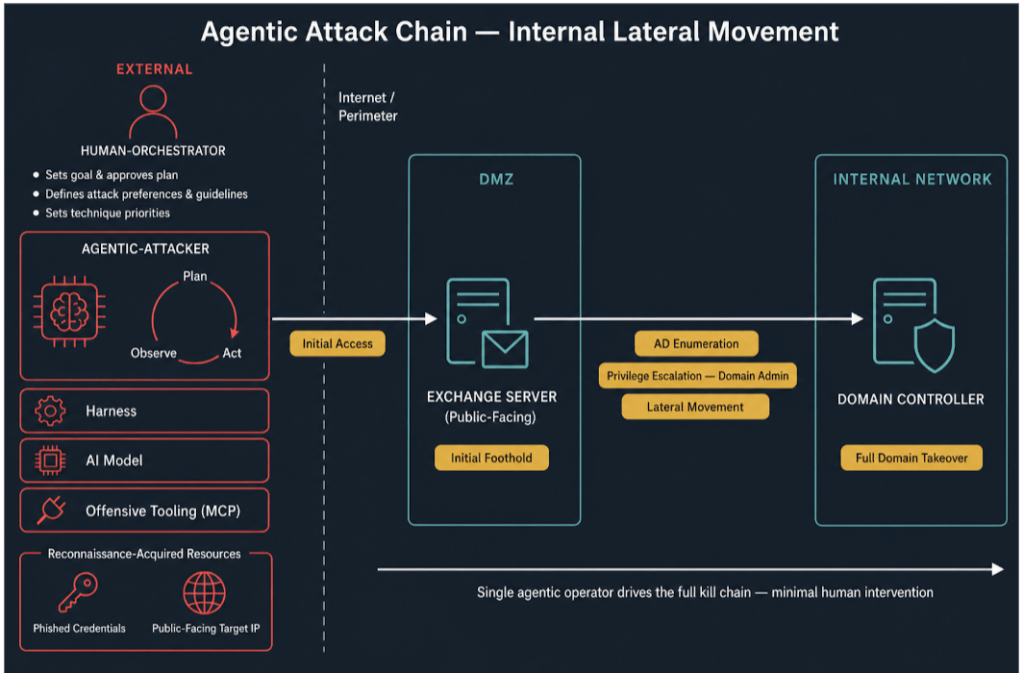
New research from Cato Networks shared exclusively with CyberScoop shows how much power can come from a harness. It paired OpenAI’s ChatGPT 5.5 and GPT 5.5-Cyber models with its own tool and tested the abilities of the agent to hack into a victim network with as little human direction as possible.
Across six different scenarios, the pairing achieved complete end-to-end attack chains, including domain administrator privileges and Active Directory access, sometimes in as little as 40 minutes.
“What was most surprising is that first we saw that it was capable of doing accelerated reasoning and attack, and interacting and doing all this by itself, like doing all of the stages of the attacks,” said Guy Waizel, a tech evangelist at Cato Networks and one of the authors behind the research.
Critically, the most successful scenarios happened when the model was given appropriate operational context from the technical harness developed by Cato Networks.
“It does support that it’s not just about the frontier model,” said Waizel. “We found that [our harness] really helps the reasoning” of the LLM.
An illustration of an agentic AI attack chain and lateral movement within victim networks. (Source: Cato Networks)
The agent was given some – but not abundant – resources to complete its tasks, including an external Kali Linux attack host, the simulated target’s public IP address and a set of low-level domain credentials acquired through phishing.
It was not provided with any other details, and had to probe further for key information, such as further knowledge of the server type (Microsoft Exchange), the target’s operating system, version, build number, internal network topology, access to higher privilege accounts and other critical assets, nor was agent given any predetermined attack paths.
The Cato Networks research uses OpenAI models, but only as an example. Waizel said he believes other models would likely achieve similar results. In any event, if current trends hold, the kind of capabilities provided by LLMs like GPT 5.5 are likely to be open-source within a year.
Cato Networks is far from alone. Most enterprises have their own AI harnesses, and executives tell CyberScoop they are playing an increasing role in more effectively steering the frontier model workflows.
While AI tools can struggle to duplicate human workflows in other areas, LLMs have long shown potential in cybersecurity and coding, improving greatly over the past few years. The Trump administration has set up a new federal clearinghouse for exchanging information between the public and private sectors on AI-discovered vulnerabilities, while European groups are setting up their own organizations to coordinate globally on AI cyber threats.
Eric Doerr, chief product officer at Tenable, told CyberScoop a harness used in the company called “Hexa” offers a defensive advantage: it can work with different commercial LLMs while delivering consistent results.
“One of the first things we do when we get a [new] model is say ‘Well, let’s run it through Hexa and see what we learn,’” said Doerr. “We have a whole bunch of benchmarks. Is it the same, is it better? Where is it better? Where is it worse?”
Hexa is meant to ensure that whichever model or models become dominant, Tenable will be able to integrate it into their tech stack and protect their most sensitive assets from unintended behaviors. That frees up the LLM to do what it does best: find vulnerable code and establish attacker pathways for exploiting them.
“For years, it has been true that there are way more potential issues that a company has to deal with: code vulnerabilities, things that are unpatched, misconfigurations,” said Doerr. “There’s way more than you can actually remediate, and you really need to understand the difference between what’s a theoretical problem and a real problem.”
Dan Rapp, chief AI and data officer at Proofpoint, said their harness, “Satori,” has become a critical tool for keeping their agentic AI on track while giving humans the ability to step in when things go awry.
“I think what you’re seeing in the foundation of frontier models is you have raw intelligence, raw reasoning power, but to get these systems to perform the way you want to, both context engineering – the content provided ensuring that its accurate and relevant – and the harness engineering are essential to actually get the systems to perform well,” Rapp told CyberScoop.
That was a common theme in interviews with companies. While frontier models come and go, or are overtaken by international competitors, there will always be the need for the model to operate with data and context that often only the organization can provide.
It suggests that while policymakers and cybersecurity experts have focused on the spread of newer and more powerful frontier models, industry – and likely soon the cybercriminal underground — has quickly developed the kind of technical infrastructure that is becoming far more important to AI cyber defensive and offensive tasks.
“We’ve had to bootstrap quite a few of these systems from first principles, and what it always boils down to is how effective you are with the tool calling… bringing in data, enriching the context,” said John Hopper, vice president of product engineering at SpecterOps.
Today, the Linux Foundation launched the x402 Foundation to standardize internet-native payments for AI agents, APIs, and applications, based on Coinbase's contributed x402 protocol. Backed by companies including AWS, American Express, Cloudflare, Google, Mastercard, Stripe, and Visa, the effort aims to make payments work directly over HTTP (assuming users are comfortable letting AI agents handle financial transactions).
"The whole idea is to give agents access to money and, through that financial independence, improve their set of capabilities to pretty much anything on the internet," Lincoln Murr, Coinbase's AI product lead, told CNBC last month when the company announced the protocol. "In the 2010s, every internet company dealt with the transition from desktop and web into a mobile environment. And now in the late 2020s, we're seeing the exact same thing happen where agents are going to be the new primary economic actors on the internet."
The 16-year-old Januscape flaw affects Linux's KVM hypervisor, allowing attackers to escape virtual machines and potentially execute code on the underlying host.
Have you ever needed a Linux application which only exists in the Windows world? Long-time Slashdot reader BrendaEM writes:
Windows does have a lot of useful app (but smaller than "power apps"). Some of these are closed source, some are open, but they're not all available in Linux yet.
My list would have to contain Gimp Tookit versions of: IrfanView image manager, which I think is unequaled in Linux (though it does work to some extent under Wine). I also miss the full version of 7-Zip, because of its better compression settings, which File-Roller does not provide, though the Linux port p7zip is available (though unnoticed by common distributions). Lastly, I think that Notepad++ would be a good addition to Linux.
That last one drew some pushback from long-time Slashdot reader jesco. "If there's one area where Linux shines, then it's the availability of high-quality text editors. Last time I looked Kate was still pretty nice, and there's Emacs, Vim and Neovim" if you're partial to command lines.
But are there any daily-drive apps you still find yourself needing? Share your own thoughts in the comments.
Which apps aren't available on Linux?
Kali Linux 2026.2, the second release of the year, is now available for download, featuring 9 new tools and numerous Kali NetHunter improvements. [...]
The blog Linuxiac reports:
A new systemd fork has appeared with a specific purpose: removing systemd's recently added support for storing a user's birth date in JSON user records.
The fork, called Liberated systemd, published its first tagged release as v261 shortly after the official systemd 261 release. In other words, the fork follows upstream systemd while reverting the change that added the new optional birthDate field.
Importantly, this is not a new init system, a wider redesign of systemd, or a general-purpose alternative to the upstream project. Its stated purpose is to remain close to upstream systemd while removing what the author describes as "surveillance enablement"... The author recommends testing the fork in a virtual machine before using it on real hardware and warns nightly builds are more likely to be unstable than named releases.
Tech Times reports:
Linux 7.2's merge window closed out a cleanup campaign on Friday that most kernel developers had stopped expecting to see end: the complete removal of strncpy(), a C string-copy function that the kernel's own documentation labels "actively dangerous," from every subsystem, driver, and architecture-specific file in the kernel source tree.
The merge landed June 20, 2026. After around 362 commits spread across six years of incremental work, no call site using the function remained, and the function itself — including the last per-CPU-architecture optimized implementations — was struck from the source. The removal matters beyond housekeeping. strncpy() is a persistent source of a specific class of memory error: kernel buffers that contain sensitive data can leak bytes past an unterminated string boundary, a pattern that enables memory disclosure vulnerabilities. Eliminating the function from the tree removes that entire class from the kernel's attack surface — and, critically, makes strncpy() unavailable to any future contributor, turning a best-practice suggestion into an enforced policy.
Phoronix notes it's replaced by five different functions:
In place of strncpy, Linux kernel code should use strscpy() for NUL terminated destinations, strscpy_pad() for NUl-terminated destinations with zero-padding, strtomem_pad() for non-NUL-terminated fixed-width fields, memcpy_and_pad() for bounded copies with explicit padding, or memcpy() for known-length memory copies.
"The reason five functions were needed," explains Tech Times, "is that different parts of the kernel were using strncpy() for five semantically distinct memory operations — each with a different intent, different termination requirement, and different padding behavior. "
The original function obscured all of those differences under a single ambiguous name. The 362-commit campaign to replace it was, in effect, a codebase-wide audit that forced every call site to declare its actual intent in code That is an engineering outcome with lasting value: the kernel's string-handling semantics are now explicit where they were previously implicit, and future maintainers can read a function name and understand what a copy operation actually does.
Microsoft announced today at its Build 2026 developer conference the release of Coreutils for Windows, bringing many commonly used Linux command-line utilities to Windows as native applications. [...]
A newly discovered local privilege escalation vulnerability dubbed 'CIFSwitch' in the Linux kernel could allow attackers to forge CIFS authentication key descriptions, abuse the kernel's key request mechanism, and gain root privileges. [...]
Flipper Devices, the maker of the Flipper Zero pentesting tool, is asking the community to help build Flipper One, an open Linux platform for connected devices. [...]
PinTheft, a recently patched Linux privilege escalation vulnerability, now has a publicly available proof-of-concept (PoC) exploit that allows local attackers to gain root privileges on Arch Linux systems. [...]
A recently patched local privilege escalation vulnerability in the Linux kernel's rxgk module now has a proof-of-concept exploit that allows attackers to gain root access on some Linux systems. [...]
During the second day of Pwn2Own Berlin 2026, competitors collected $385,750 in cash awards after exploiting 15 unique zero-day vulnerabilities in multiple products, including Windows 11, Microsoft Exchange, and Red Hat Enterprise Linux for Workstations. [...]

 Login
Login