❌

Reading view

There are new articles available, click to refresh the page.

PHP2Shell Attacks Root Palo Alto Firewalls but Fail Against WordPress

Over 22.6 million exposed instances are potentially affected by the critical PHP flaws that have been targeted for over a week.

The post PHP2Shell Attacks Root Palo Alto Firewalls but Fail Against WordPress appeared first on SecurityWeek.

Researchers uncover Volt Typhoon’s covert, ephemeral network

Volt Typhoon, a China-government backed hacking group that has infiltrated America’s critical infrastructure networks for years, has consistently built and dismantled ephemeral malicious infrastructure to burrow into hundreds of sensitive systems undetected, Lumen Technologies’ Black Lotus Labs said in a Wednesday report.

The covert access operation that researchers call “Silent Train” isn’t a standalone network, but rather a series of compromised small office home office (SOHO) routers, internet of things (IoT) devices and enterprise infrastructure that Volt Typhoon has rapidly rotated through since late 2023. 

The Chinese threat group has used this chain of short-lived compromised infrastructure to exploit additional vulnerabilities, including zero-days, in network edge devices and gain deeper, persistent access into victim networks, researchers said. 

“Individual chains are assembled and dismantled every day, with infrastructure continually refreshed,” Michael Horka, principal information security engineer at Black Lotus Labs, told CyberScoop. “Volt Typhoon demonstrated a repeatable capability to rebuild a new chain with different infrastructure in less than two minutes, making the number of nodes at any one moment effectively close to zero.”

Black Lotus Labs has notified hundreds of victims since it first identified Silent Train activity, including telecom providers, government entities, defense contractors, communication services, universities and IT firms. Other victims spanning critical infrastructure include organizations in the water, energy, transportation, maritime, rail, aviation and emergency services sectors.

“The ephemeral nature of the framework means our observations should not be interpreted as a complete census of Volt Typhoon activity,” said Horka, who also was the lead researcher on the report.

The nation-state group’s investment in operational security and preserving access is remarkable, according to Black Lotus Labs.

“We observed infrastructure assembled in under two minutes, sessions averaging roughly four hours, extensive cleanup, compartmentalization and continued development of new access vectors,” Horka said. “That is considerable effort devoted not even to get into their end targets, but purely to making important operations difficult to discover and trace.”

Volt Typhoon relied more heavily on Silent Train after the FBI and Justice Department disrupted the KV Botnet in early 2024, researchers said. Earlier this year, U.S. and global authorities warned about a widespread shift in Chinese hacking groups’ use of covert networks riding on compromised common devices.

The reach of those efforts is extensive and ongoing. Volt Typhoon has exploited and abused more than 27 device classes in Silent Train operations, including edge devices, enterprise management tools, identity and access management systems, networking infrastructure and other technologies. 

“The diversity matters, but the discipline matters even more,” Horka said. “Specific device types were consistently reserved for particular positions in the chain. It operated less like a collection of randomly compromised devices and more like an organized inventory of capabilities.”

The threat group has successfully compromised devices and technologies from Fortinet, Cisco, ManageEngine, Ivanti, F5, Check Point, Palo Alto Networks, ServiceNow, TP-Link, Netgear and ArcGIS, researchers said. Black Lotus Labs also observed confirmed zero-day campaigns targeting Versa Director, N-Able N-Central, Cisco Catalyst SD-WAN and VeloCloud Orchestrator. 

“The exploitation patterns, victimology, and geographic targeting observed throughout our investigation point to a sustained focus on communications, defense, government, and critical infrastructure environments of enduring strategic value,” Black Lotus Labs researchers wrote in the report. “Through repeated targeting of centralized management platforms and control-plane technologies, Silent Train shows how Volt Typhoon systematically pursues and preserves access to some of the most consequential networks in the United States.”

Silent Train’s ephemerality and operational discipline means it can’t be measured in size. These attributes also make it “fundamentally difficult to disrupt because there isn’t one network to take down,” Horka said. 

“What exists today will be completely different tomorrow,” he added. “You can try to remove individual pieces, but removing the actor’s ability to continuously rebuild them is a much harder problem to solve.”

The post Researchers uncover Volt Typhoon’s covert, ephemeral network appeared first on CyberScoop.

Citrix patches actively exploited NetScaler zero-days after a weekend of unofficial warnings

Citrix took most of the weekend to confirm that attackers were actively exploiting the newest round of NetScaler zero-days, leaving network defenders and threat hunters to react without official confirmation. 

Yet, behind the scenes, multiple CERTs, advisory firms, insurance providers, researchers and chatty security professionals warned their respective peers and communities of a live and serious threat. 

Nearly two days after the first unconfirmed rumors, Citrix published a security advisory Sunday disclosing the exploited zero-days, CVE-2026-88771 and CVE-2026-88772, releasing patches for them and six additional defects.

By then, criticism was at a fever pitch, and for some NetScaler customers the warning came too late. 

“The information vacuum was most striking. Customers were receiving warnings through unofficial channels while Citrix remained publicly silent,” Ben Harris, founder and CEO at watchTowr, told CyberScoop. 

“Customers were left without communication, guidance, or even acknowledgement that the vulnerability that was rumored to exist was real. Citrix could have warned customers that active exploitation was occurring and provided immediate defensive guidance without disclosing technical details that would help attackers,” he added. 

“When active exploitation is underway, hours matter,” Harris said.

Citrix did not directly answer questions about the lengthy communication delay. 

“We recently identified critical vulnerabilities in Citrix NetScaler ADC and Citrix NetScaler Gateway that led us to immediately develop and release a new version of the software that addresses the issues,” the company said in a prepared statement.

The critical defects are both rated 9.5 on the CVSS scale and allow attackers to achieve remote code execution. 

Researchers are particularly concerned about CVE-2026-88771, a command-injection vulnerability that affects all NetScaler appliances in a default configuration. That gives attackers a broad pool of targets and a better chance at successful exploitation. A proof-of-concept exploit for the vulnerability is also publicly available. 

Palo Alto Networks said it identified more than 50,000 publicly exposed instances of Citrix NetScaler devices potentially vulnerable to both of the zero-days as of Sunday. 

The earliest known exploitation attempt occurred Sept. 24 when GreyNoise said it observed an unsuccessful exploitation attempt against a Citrix NetScaler Gateway under its control for malicious activity scanning purposes. But researchers warn that exploitation likely started before then.

Citrix did not say how many customers have been compromised thus far and researchers are still assessing the fallout.

Citrix said it is making generic indicators of compromise available to customers in their user consoles, and the company referred to previously issued guidance for customers who suspect compromise. 

Attribution for the attacks is also still under investigation, yet NetScaler products are a common, recurring target for financially-motivated cybercriminals and state-sponsored espionage groups. 

The Cybersecurity and Infrastructure Security Agency issued an alert Sunday after Citrix publicly confirmed the attacks on its customers, and added CVE-2026-88771 and CVE-2026-88772 to its known exploited vulnerabilities catalog. The vendor has appeared on the agency’s list of vulnerabilities known to be exploited five times this year, and a total of 26 times since late 2021.

Security leaders across the industry — including Charles Carmakal, chief technology officer at Mandiant Consulting, and Wendi Whitmore, chief security intelligence officer at Palo Alto Networks — also sprung into action Sunday, with direct warnings on LinkedIn about the urgent threat. 

The information vacuum that persisted through most of the weekend put cybersecurity professionals in sometimes unique positions. Joe Toomey, vice president of underwriting security at insurance provider Coalition, said the company notified potentially vulnerable customers with limited official data and no confirmation from CISA or Citrix.

In a LinkedIn post Sunday, he called Citrix “unconscionably irresponsible” for remaining silent for more than 36 hours after word began circulating about in-the-wild exploitation.

“I fully understand a vendor embargoing specific details about a vulnerability when a patch has not yet been published, but once the vuln is exploited in the wild, some of those rules no longer apply,” Toomey wrote.

Citrix and its customers are in familiar territory. The vendor’s products have been widely targeted in previous attack sprees, often involving zero-day exploits and some infamously referred to as CitrixBleed and CitrixBleed 2.

“Citrix has a history of delaying the publication of vulnerabilities, even when they’re being exploited in the wild and affecting customers. Citrix eventually released patches and an advisory, but an adequate response also requires timely, clear communication,” Harris said. 

“Customers shouldn’t have to rely on unofficial warnings, security researchers, and third parties to learn that critical infrastructure may already be compromised,” he added. “This latest incident raises serious questions about whether Citrix has learned from previous crises and meaningfully improved how it protects and informs customers.”

The post Citrix patches actively exploited NetScaler zero-days after a weekend of unofficial warnings appeared first on CyberScoop.

‘Watershed 250’ test program in Texas looks to private sector for water cybersecurity help

The Trump administration rolled out a six-month test program in Texas on Monday that will draw on volunteer expertise and technology from cyber and artificial intelligence companies to protect the water sector.

“Project Watershed 250” is the first of the state-based, industry-centric pilot projects to cross the finish line that the Office of the National Cyber Director has previewed since the publication of its national cybersecurity strategy earlier this year. Water systems have long been viewed as among the most vulnerable and neediest critical infrastructure sectors, and in recent months the sector has been the victim of a spree of attacks.

“Project Watershed 250 is a commitment from the states, industry and federal government that we will continue to prioritize our nation’s safety and deliver on America-first policies for the American people,” National Cyber Director Sean Cairncross said at a rollout event in San Antonio Monday.

“U.S. companies are providing world-class cyber capabilities, red teaming that tests utilities’ current defenses, system hardening using the latest private sector cyber tools and AI tooling that helps utilities’ frontier cyber defenders to protect Texas water systems and scale proven solutions across the country,” he said. “This six-month pilot program is designed to make our water and wastewater critical infrastructure more resilient and resistant to cyber attacks by proactively finding and fixing system weaknesses.”

The pilot program, featuring collaboration between federal and state governments, stands in contrast to how the Biden administration tried to tackle the issue, with audit requirements that some GOP states challenged in court, forcing Biden’s Environmental Protection Agency to withdraw its rule.

“For too long, at least on the federal level, the government has admired the problem of cybersecurity in water systems,” Cairncross said. “We are going to find out what works. We’re going to target that, and we are going to scale off of this and learn lessons.”

A dozen companies — Parsons, Microsoft, Fortinet, Google Cloud, Palo Alto Networks, Amazon Web Services, Reflection AI, Cloudflare, Zscaler, Forescout, Abnormal AI and Dragos — appeared at the rollout Monday to praise the initiative and tout their contributions to it.

Not everyone praised the initiative elsewhere, however. One cyber professional who works on water security issues, speaking on condition of anonymity, said the program was “all smoke” and that “there’s no real money behind it.”

“The White House did what it always does — reached out to industry with their hands out asking for industry to pay for things the government should be doing, at least in part,” the person said.

Texas Gov. Greg Abbott said the program would be overseen by Cairncross’s office and Texas Cyber Command, which was established just last year. Abbott cited the need for the program by mentioning “an Iranian-backed cyberattack” on 30 water systems across 12 states and a 2024 attack on the water system in Muleshoe, Texas, suspected to be the work of Russian hackers.

“The need for cyber resilience is overwhelming,” Abbott said. “Many rural providers simply don’t have the resources they need to be able to protect themselves.”

Watershed 250 isn’t the only federal effort to bolster water cybersecurity, with lawmakers introducing legislation in the aftermath of the recent attacks. Past legislation that Congress has enacted also sought to tackle the problem.

Updated 8/31/26: with comment from cyber professional.

The post ‘Watershed 250’ test program in Texas looks to private sector for water cybersecurity help appeared first on CyberScoop.

Unit 42 warns AI has shifted balance of power from defenders to attackers

Unit 42’s top brass has seen enough from internal frontier AI model testing and malicious in-the-wild use of commercially available AI tools to be genuinely concerned.

“I can tell you without exaggeration that we believe that this is a generational shift in cybersecurity,” Sam Rubin, senior vice president of Palo Alto Networks’ threat intelligence arm, said in a media briefing Wednesday. 

A period of relative balance between security and exposure has been broken by frontier AI model capabilities that could allow attackers to find and exploit network weaknesses with speed, Rubin said.

Unit 42 warned that capabilities demonstrated by readily available agentic AI models, and those unlocked by frontier AI models that remain gated for defense, have shifted the balance of power from defenders to attackers.

“The defenses that we’ve had built up over years weren’t necessarily built for or prepared for these machine-speed attacks,” Rubin said. “Organizations are ill-equipped to detect and to respond quickly in the face of these attacks.

Back in April, when Anthropic brought Palo Alto Networks and other major technology companies together to form Project Glasswing, an initiative to find and address security defects with its Mythos model, Unit 42 estimated the same capabilities would be in the hands of attackers within a year. 

“Well, here we are five months later, and we’re starting to see the early waves of this threat in the wild,” Rubin said. 

Unit 42 is actively investigating an attack on one of its customers where an attacker used an agentic framework to exploit 50 applications and other weaknesses across the enterprise in less than 10 hours. Rubin estimates AI allowed the attacker to accomplish in 10 hours what would have taken at least 10 days in a pre-AI era. 

Attackers are already using AI across the entire attack chain, said Sherrod DeGrippo, vice president of threat intelligence at Unit 42. “We are not far from fully agentic attacks across all at once, but right now it’s piece by piece by piece,” she said. 

“AI has seeped into every part of what threat actors do,” including malware development at scale, delegation, social engineering and ransomware negotiations, DeGrippo added.

As such, she sees the threat landscape shifting in four areas. AI is a force multiplier, identity is the primary compromise vector, attackers are burrowing into foundational libraries and software supply chains “baked into the fabric of our digital world,” and nation-sponsored threat groups are learning more about points of weakness in enterprise systems, DeGrippo said.

Nobody is fully prepared for what’s coming and it would be naive or a bad defender mindset to think otherwise, she said. “This is a transformative period, and how organizations navigate that transformation is going to be make-or-break for a lot of them.”

The post Unit 42 warns AI has shifted balance of power from defenders to attackers appeared first on CyberScoop.

Iran-Backed Hackers Claim Wiper Attack on Medtech Firm Stryker

A hacktivist group with links to Iran’s intelligence agencies is claiming responsibility for a data-wiping attack against Stryker, a global medical technology company based in Michigan. News reports out of Ireland, Stryker’s largest hub outside of the United States, said the company sent home more than 5,000 workers there today. Meanwhile, a voicemail message at Stryker’s main U.S. headquarters says the company is currently experiencing a building emergency.

Based in Kalamazoo, Michigan, Stryker [NYSE:SYK] is a medical and surgical equipment maker that reported $25 billion in global sales last year. In a lengthy statement posted to Telegram, a hacktivist group known as Handala (a.k.a. Handala Hack Team) claimed that Stryker’s offices in 79 countries have been forced to shut down after the group erased data from more than 200,000 systems, servers and mobile devices.
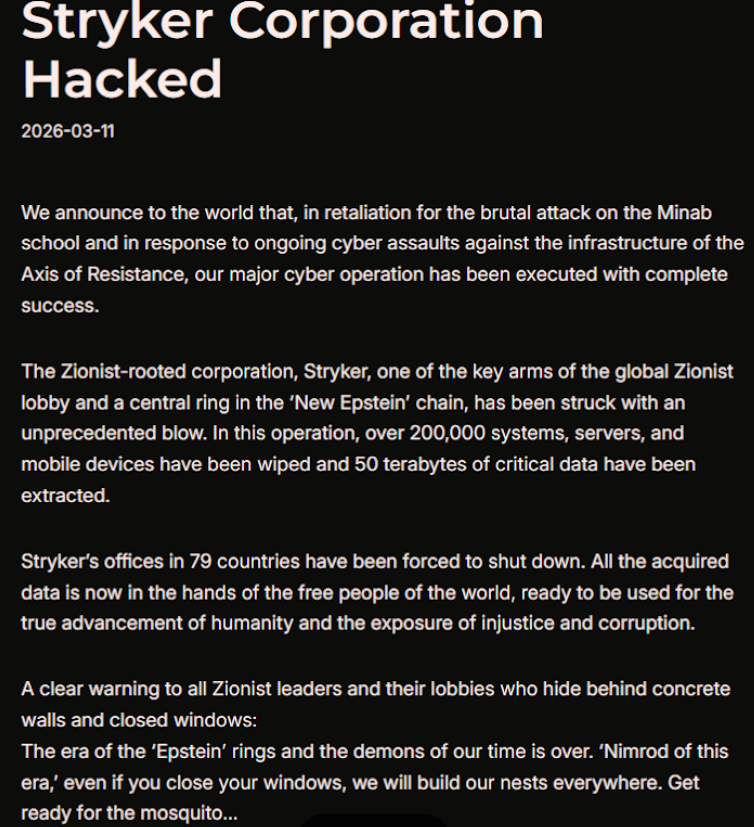
A manifesto posted by the Iran-backed hacktivist group Handala, claiming a mass data-wiping attack against medical technology maker Stryker.

A manifesto posted by the Iran-backed hacktivist group Handala, claiming a mass data-wiping attack against medical technology maker Stryker.

“All the acquired data is now in the hands of the free people of the world, ready to be used for the true advancement of humanity and the exposure of injustice and corruption,” a portion of the Handala statement reads.

The group said the wiper attack was in retaliation for a Feb. 28 missile strike that hit an Iranian school and killed at least 175 people, most of them children. The New York Times reports today that an ongoing military investigation has determined the United States is responsible for the deadly Tomahawk missile strike.

Handala was one of several hacker groups recently profiled by Palo Alto Networks, which links it to Iran’s Ministry of Intelligence and Security (MOIS). Palo Alto says Handala surfaced in late 2023 and is assessed as one of several online personas maintained by Void Manticore, a MOIS-affiliated actor.

Stryker’s website says the company has 56,000 employees in 61 countries. A phone call placed Wednesday morning to the media line at Stryker’s Michigan headquarters sent this author to a voicemail message that stated, “We are currently experiencing a building emergency. Please try your call again later.”

A report Wednesday morning from the Irish Examiner said Stryker staff are now communicating via WhatsApp for any updates on when they can return to work. The story quoted an unnamed employee saying anything connected to the network is down, and that “anyone with Microsoft Outlook on their personal phones had their devices wiped.”

“Multiple sources have said that systems in the Cork headquarters have been ‘shut down’ and that Stryker devices held by employees have been wiped out,” the Examiner reported. “The login pages coming up on these devices have been defaced with the Handala logo.”

Wiper attacks usually involve malicious software designed to overwrite any existing data on infected devices. But a trusted source with knowledge of the attack who spoke on condition of anonymity told KrebsOnSecurity the perpetrators in this case appear to have used a Microsoft service called Microsoft Intune to issue a ‘remote wipe’ command against all connected devices.

Intune is a cloud-based solution built for IT teams to enforce security and data compliance policies, and it provides a single, web-based administrative console to monitor and control devices regardless of location. The Intune connection is supported by this Reddit discussion on the Stryker outage, where several users who claimed to be Stryker employees said they were told to uninstall Intune urgently.

Palo Alto says Handala’s hack-and-leak activity is primarily focused on Israel, with occasional targeting outside that scope when it serves a specific agenda. The security firm said Handala also has taken credit for recent attacks against fuel systems in Jordan and an Israeli energy exploration company.

“Recent observed activities are opportunistic and ‘quick and dirty,’ with a noticeable focus on supply-chain footholds (e.g., IT/service providers) to reach downstream victims, followed by ‘proof’ posts to amplify credibility and intimidate targets,” Palo Alto researchers wrote.

The Handala manifesto posted to Telegram referred to Stryker as a “Zionist-rooted corporation,” which may be a reference to the company’s 2019 acquisition of the Israeli company OrthoSpace.

Stryker is a major supplier of medical devices, and the ongoing attack is already affecting healthcare providers. One healthcare professional at a major university medical system in the United States told KrebsOnSecurity they are currently unable to order surgical supplies that they normally source through Stryker.

“This is a real-world supply chain attack,” the expert said, who asked to remain anonymous because they were not authorized to speak to the press. “Pretty much every hospital in the U.S. that performs surgeries uses their supplies.”

John Riggi, national advisor for the American Hospital Association (AHA), said the AHA is not aware of any supply-chain disruptions as of yet.

“We are aware of reports of the cyber attack against Stryker and are actively exchanging information with the hospital field and the federal government to understand the nature of the threat and assess any impact to hospital operations,” Riggi said in an email. “As of this time, we are not aware of any direct impacts or disruptions to U.S. hospitals as a result of this attack. That may change as hospitals evaluate services, technology and supply chain related to Stryker and if the duration of the attack extends.”

According to a March 11 memo from the state of Maryland’s Institute for Emergency Medical Services Systems, Stryker indicated that some of their computer systems have been impacted by a “global network disruption.” The memo indicates that in response to the attack, a number of hospitals have opted to disconnect from Stryker’s various online services, including LifeNet, which allows paramedics to transmit EKGs to emergency physicians so that heart attack patients can expedite their treatment when they arrive at the hospital.

“As a precaution, some hospitals have temporarily suspended their connection to Stryker systems, including LIFENET, while others have maintained the connection,” wrote Timothy Chizmar, the state’s EMS medical director. “The Maryland Medical Protocols for EMS requires ECG transmission for patients with acute coronary syndrome (or STEMI). However, if you are unable to transmit a 12 Lead ECG to a receiving hospital, you should initiate radio consultation and describe the findings on the ECG.”

This is a developing story. Updates will be noted with a timestamp.

Update, 2:54 p.m. ET: Added comment from Riggi and perspectives on this attack’s potential to turn into a supply-chain problem for the healthcare system.

Update, Mar. 12, 7:59 a.m. ET: Added information about the outage affecting Stryker’s online services.

❌