
❌

Reading view

There are new articles available, click to refresh the page.

Army soldier sentenced for spree of attacks on AT&T, Snowflake and other major companies

A former Army soldier responsible for a series of attacks and extortion attempts on telecom companies, including AT&T, was sentenced to 70 months in prison, the Justice Department said Friday.

Cameron John Wagenius engaged in a cybercrime spree for years, including while he was on active duty on a base in Texas. Prior to his arrest in December 2024, Wagenius attempted to sell stolen sensitive data to a foreign intelligence service and sought information online about defecting to Russia.

“Cameron Wagenius spent more than a year and a half betraying the trust placed in him as an active duty soldier by carrying out a sweeping cybercrime campaign,” said A. Tysen Duva, assistant attorney general of the Justice Department’s Criminal Division, said in a statement.

Wagenius, who pleaded guilty in July 2025, leaked stolen call records of President Donald Trump as part of multiple failed attempts to extort $500,000 from AT&T, Allison Nixon, chief research officer at Unit 221B, previously told CyberScoop. 

Authorities did not name Wagenius’ alleged victims in court filings, but said he disclosed non-content call detail records belonging to a government official and family members of another former official. AT&T in July confirmed cybercriminals accessed the company’s Snowflake environment in April and stole six months of phone and text records of “nearly all” of its customers. 

Wagenius’ and one of his co-conspirators, Connor Moucka, attempted to extort more than 10 organizations after stealing credentials and breaking into cloud platforms used by AT&T and other major companies based in the United States and abroad. 

Moucka, a Canadian extradited to the United States in March 2025, pleaded guilty in August to playing a central role in one of the most far-reaching cyberattacks of 2024 — the widespread compromise of more than 165 Snowflake customer environments, resulting in massive data theft for extortion.

Wagenius, Moucka and their alleged co-conspirator John Erin Binns, who is not presently in U.S. custody, stole billions of sensitive records and received more than $2.5 million in extortion payments combined, according to prosecutors. Victims of the attack spree included AT&T, Ticketmaster, Advance Auto Parts and Santander.

Some of the records in Wagenius’ possession at the time of his arrest were stolen in the attack spree on Snowflake customer databases, according to cybercrime researchers. Officials said Wagenius was directly involved in attempted extortion attempts targeting multiple organizations for a combined total of more than $1 million. 

The 22-year-old was ordered to pay almost $295,000 in restitution for his crimes.

“His hacking schemes were not only aimed at getting rich, he was also motivated by a desire to achieve status within criminal hacking communities,” Charles Neil Floyd, first assistant attorney for the U.S. District Court for the Western District of Washington, said in a statement. “This sentence must impose real consequences to deter him, and hopefully other would-be hackers.”

Wagenius, who identified himself as “kiberphant0m” and “cyb3rph4nt0m” on online criminal forums, used a hacking tool he helped develop called SSH Brute to steal credentials while on active duty, officials said. Wagenius and his co-conspirators threatened the victim organizations privately and in public forms, officials added.

“It is especially shocking that a member of our armed forces, sworn to defend Americans and their constitutional rights, would engage in such a violation of privacy,” W. Mike Herrington, special agent in charge of the FBI Seattle field office, said in a statement.

When federal law enforcement seized Wagenius’ devices in December 2024, they found evidence indicating he had access to thousands of stolen identification documents and large amounts of cryptocurrency. Days later, Wagenius purchased a new laptop against his commanding officer’s order, according to officials, and used it every day over a five-day period in the barracks at Fort Cavazos in Texas with VPN software to hide his identity and location.

The post Army soldier sentenced for spree of attacks on AT&T, Snowflake and other major companies appeared first on CyberScoop.
McKesson copes with fallout from data theft extortion attack

McKesson said its business and distribution centers remain operational in the wake of a cyberattack it disclosed Friday that resulted in data theft and temporary service interruptions.

Attackers gained access to some of the health care vendor’s third-party applications and stole data associated with a subset of customers in the company’s oncology, multispecialty and medical-surgical business units, Francisco Fraga, chief information and technology officer at McKesson, said in a statement Saturday. 

McKesson is a major player in the healthcare sector, claiming it distributes about one-third of all pharmaceuticals used throughout North America. It reported $403.4 billion in revenue for the one-year period ending in March. 

The company’s size and critical role it serves also makes it a high-profile target for cybercriminals. McKesson did not identify the group behind the attack, but ShinyHunters, a cybercrime group known for targeting large organizations with extortion demands after stealing massive amounts of sensitive data, claimed responsibility.

The company declined to answer questions about ShinyHunter’s claims. Yet, on Friday, McKesson disclosed the attack in a regulatory filing while ShinyHunters added the company to its data-leak site. 

McKesson said it discovered the attack Aug. 25. A period of widespread data theft was over by then, following a four-day intrusion beginning Aug. 21, according to researchers.

“Upon discovery, we immediately activated our incident response protocols, launched an investigation, and engaged leading cybersecurity industry experts to support our response,” Fraga said in a statement. 

“We have reasonable assurance of no ongoing unauthorized activity in our systems. Customers can continue to connect to and use our systems and services as intended,” he added. 

While McKesson’s investigation continues, it faces a more urgent deadline of Sept. 1 from ShinyHunters, which is reportedly seeking a ransom demand in excess of $55 million. 

The company did not answer questions about any ransom demand or whether it responded to the alleged attackers. 

The circumstances of the attack against McKesson are similar to other recent victims of ShinyHunters. The threat group typically uses social engineering or abuses weaknesses in identity to gain access to cloud-hosted environments containing troves of sensitive or proprietary data, which it threatens to leak if the victim doesn’t pay a ransom. 

“Opportunistic data extortionists have been able to identify weaknesses within identity and access management, making these campaigns both cheap and scalable,” said Ian Gray, vice president of cyber threat intelligence at Flashpoint. 

“These attacks are particularly difficult to detect early because they often occur entirely within vendor-hosted environments using valid, socially-engineered credentials,” he added. “Since this activity mimics normal support or data-warehouse tasks, it typically doesn’t trip traditional malware alerts or show anomalies, meaning organizations often remain unaware of the breach until the extortionists make contact.”

Researchers have linked ShinyHunters to multiple attack sprees targeting major cloud platforms, including Oracle, Salesforce and Snowflake. The decentralized crew of cybercriminals was also linked to an expansive compromise last summer impacting hundreds of Salesloft Drift customers that put any platform integrated with the AI chat agent at risk as well. 

In April, ShinyHunters broke into the systems of Canvas — a central hub for K-12 and university coursework, exams, grades and communication — causing widespread outages and data theft. When an early deadline passed without payment, ShinyHunters escalated its pressure on Instructure, the company behind Canvas, by defacing the platform’s login pages with an extortion message that was visible to hundreds of schools.

Instructure ultimately relented and said it reached an agreement with the cybercriminals, insisting the stolen data was returned with assurances that other copies were destroyed.

The FBI issued a public service announcement about ShinyHunters days later, warning potential downstream victims of the threat group’s pressure tactics and claims.

In late July, less than a month before McKesson was hit, Health-ISAC warned organizations in the sector of an increase in successful attacks by ShinyHunters.

The post McKesson copes with fallout from data theft extortion attack appeared first on CyberScoop.

Canadian Man Pleads Guilty in Snowflake Extortions

A 26-year-old Canadian man once described as one of the most consequential cybercrime threat actors of 2024 has pleaded guilty to computer fraud and conspiracy to hack and extort more than 165 organizations that used the cloud provider Snowflake. Connor Riley Moucka, of Kitchener, Ontario, also admitted to stealing call and text history records of more than 100 million AT&T customers.

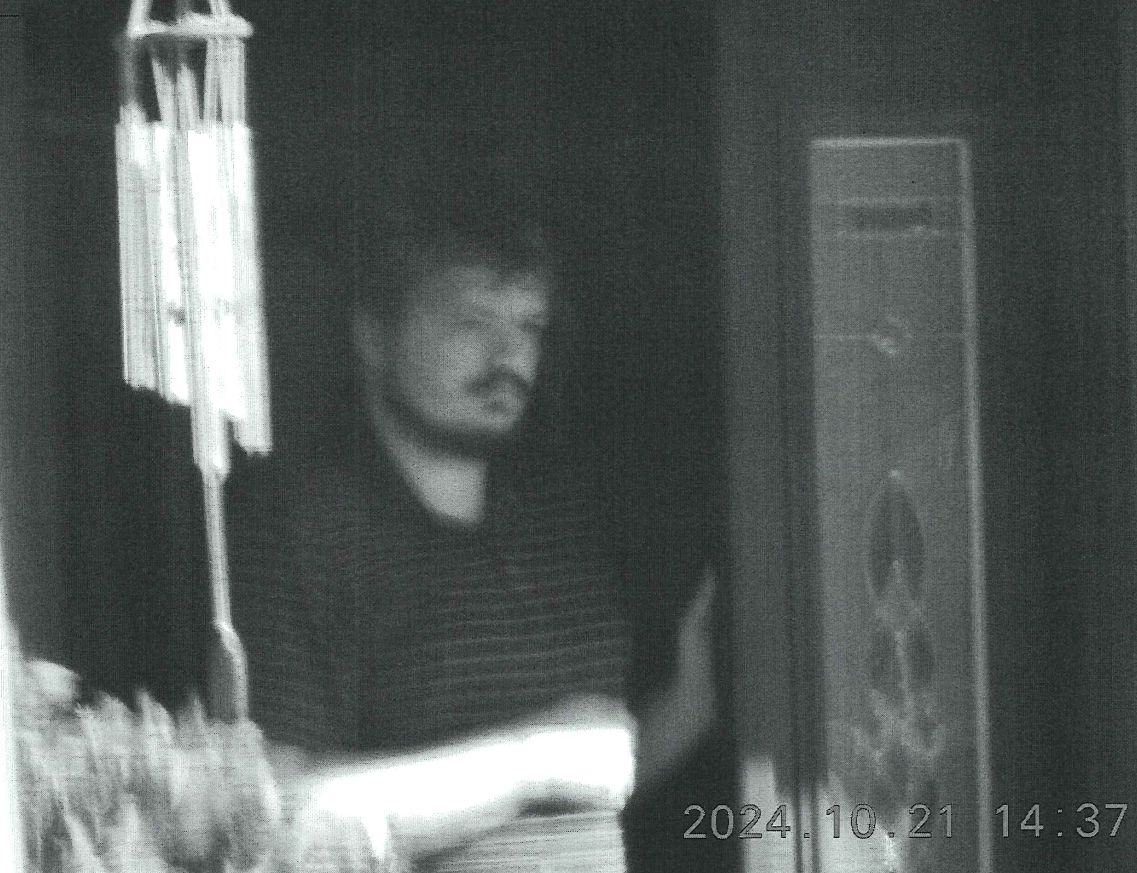
A surveillance photo of Connor Riley Moucka, a.k.a. “Judische” and “Waifu,” dated Oct 21, 2024, 9 days before Moucka’s arrest. This image was included in an affidavit filed by an investigator with the Royal Canadian Mounted Police (RCMP).

The U.S. Justice Department said between February and October 2024, Moucka and co-conspirators used stolen login credentials to steal cloud-hosted data belonging to at least 165 customers of a U.S.-based software-as-a-service company.

The hackers targeted stolen credentials for Snowflake customer accounts that did not enforce multi-factor authentication, and extorted or attempted to extort a host of well-known companies, including TicketMaster, Lending Tree, Advance Auto Parts and Neiman Marcus. Snowflake responded to the data thefts by increasing password complexity requirements and enforcing multi-factor authentication.

Moucka adopted new nicknames frequently — sometimes operating multiple identities concurrently — but two of his best-known monikers were “Judische” and “Waifu.” Judische’s admitted role in the Snowflake data thefts was first documented by KrebsOnSecurity in a September 2024 story about the overlap between Western, English-speaking cybercriminals and extremist groups that harass and extort minors into harming themselves or others.

That September 2024 story identified Judische as a software engineer from Ontario who has been involved in numerous data breaches and voice phishing attacks against U.S. companies since at least 2020. A little more than a month later, Canadian authorities arrested Moucka on a provisional warrant from the United States.

The government says Moucka and others used their unauthorized access to steal billions of sensitive customer records and download terabytes of information, “including individuals’ non-content call and text history records, banking and other financial information, payroll records, Drug Enforcement Administration (DEA) registration numbers, driver’s license numbers, passport numbers, social security numbers and other personally identifiable information. They then extorted victims by threatening to publish data online.”

Moucka also threatened and harassed government officials and security researchers who were helping to track him down. The Justice Department said the conspirators made over $2.5 million in ransom payments, and that in at least one instance, Moucka re-extorted a victim with threats of further disclosure of the victim’s stolen data.

“Moucka used the stolen data of a government officer and members of a then-former government officer’s immediate family in this re-extortion attempt,” reads a statement from the Justice Department.

One of Moucka’s admitted co-conspirators is Cameron “Kiberphant0m” Wagenius, a U.S. Army soldier who pleaded guilty in July 2025 to extorting AT&T and Verizon for their customer account data. Less than a month before Wagenius’s arrest, KrebsOnSecurity published a deep dive into Kiberphant0m’s various Telegram and Discord identities over the years, revealing how the owner of the accounts told others they were in the Army and stationed in South Korea.

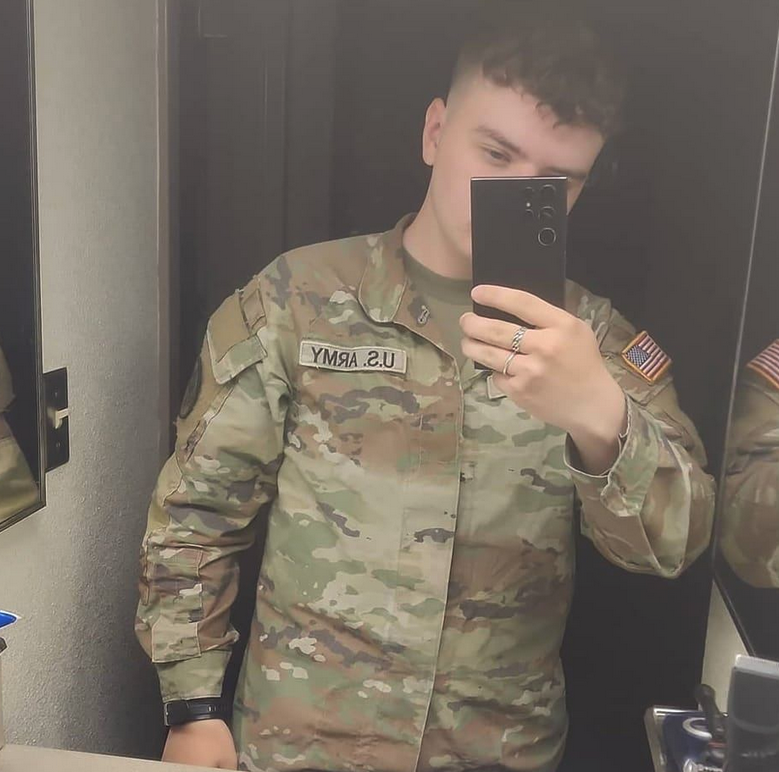
One of several selfies on the Facebook page of Cameron Wagenius.

Kiberphant0m also re-extorted victims. Immediately following Moucka’s arrest, Kiberphant0m posted on hacker forums what he claimed were the AT&T call logs for then President-elect Donald Trump and for then Vice President Kamala Harris, as well schematics allegedly stolen from the U.S. National Security Agency (NSA).

Wagenius is set to be sentenced on September 3, 2026. The government says he faces a maximum penalty of 20 years in prison for conspiracy to commit wire fraud, a maximum penalty of five years in prison for extortion in relation to computer fraud, and a mandatory two-year sentence consecutive to any other prison time for aggravated identity theft.

The third alleged co-conspirator is John Erin Binns, 26, an elusive American man who fled the United States after being indicted for his admitted role in a 2021 breach at T-Mobile that exposed the personal information of at least 76 million customers.

Sources close to the investigation said Binns, also known as “IRDev” and “IntelSecrets,” was until recently incarcerated in a Turkish prison, but that he has since been released and has resurfaced online. Those sources said Binns also recently obtained Turkish citizenship, and under Turkish law a citizen cannot be extradited to a foreign country.

An image of a passport that Binns shared in an email to KrebsOnSecurity in Feb. 2023.

Moucka pleaded guilty to four criminal counts, including computer fraud, wire fraud, aggravated identity theft, and conspiracy. He is slated to be sentenced on Oct. 27 and faces a mandatory minimum penalty of two years in prison on the aggravated identity theft count, as well as a maximum penalty of 30 years in prison on the remaining counts. Ultimately, it will be up the federal judge how much time Moucka actually serves for his extensive cybercriminal rap sheet.

For an interview with Moucka prior to his arrest and a deeper look at Binns, see our original report on Moucka’s arrest.

Snowflake hacker pleads guilty, faces up to 32 years in prison

A Canadian man pleaded guilty to playing a central role in one of the most far-reaching cyberattacks of 2024 — the widespread compromise of more than 165 Snowflake customer environments, resulting in massive data theft for extortion, the Justice Department said Wednesday. 

Connor Moucka earned $495,000 by extorting his victims, offering stolen data for sale online, and in one case re-extorted a victim with stolen data of a government official and members of a then-former government official’s immediate family, authorities said.

Moucka and his alleged co-conspirators John Binns and Cameron Wagenius stole billions of sensitive records and received more than $2.5 million in extortion payments combined, according to prosecutors. Victims of the attack spree included AT&T, Ticketmaster, Advance Auto Parts and Santander.

“Hiding behind a screen is no shield from justice,” Brett Leatherman, assistant director of the FBI’s Cyber Division, said in a statement. “Moucka learned that when he was arrested just months after he began targeting U.S. companies, stealing sensitive information, and extorting victims for millions of dollars.”

Authorities arrested Moucka relatively quickly because he caused significant damage, said Allison Nixon, chief research officer at Unit 221B. 

“His gang went on a spree of maximizing harm, which directly correlated to maximizing the resources devoted to stopping it,” she said. 

“His behavior was bizarre throughout. Even while stealing data and extorting victims, he did many unnecessary things like threatening me because he thought I was working on his case. I was not working on his case before he threatened me,” Nixon added.

Moucka, who used several aliases online, including “Waifu,” “Judische,” “Catist” and “Ellyel8,” was arrested Oct. 30, 2024, in Kitchener, a city in the Canadian province of Ontario, at the behest of U.S. authorities. He was extradited to the United States in March 2025.

Moucka and his co-conspirators used stolen credentials to access the data storage platform’s customers’ accounts en masse. Records of more than 100 million people were exposed by the data theft campaign, including call and text history records, banking and other financial information, payroll records, government ID numbers and other personally identifiable data. 

Officials said victim companies bore more than $9.5 million in losses combined, not including losses attributable to their respective customers. 

Moucka’s threats and re-extortion tactics were calculated and predatory, and his actions did real harm to his victims, be they companies targeted for theft and extortion or the millions of everyday people who are their customers,” W. Mike Herrington, special agent in charge of the FBI Seattle field office, said in a statement.

Researchers said Moucka and his co-conspirators are all associated with The Com, a sprawling cybercriminal network of minors and young adults who engage in violence, extortion, sextortion and various forms of cybercrime.

“His legacy is one of failure. He extorted and then scammed his victims by not deleting the data, casting doubt on all future pay-or-leak extortion gangs,” Nixon said. 

“The pay-or-leak business model was popularized by him and his gang,” and his claims of data deletion were a lie, she added. “With copycat gangs, defenders grapple with the uncertainty of whether the threat actors are honest.”

Moucka pleaded guilty to computer fraud, wire fraud, aggravated identity theft and a related conspiracy. He is scheduled for sentencing Oct. 27 and faces up to 32 years in prison.

The post Snowflake hacker pleads guilty, faces up to 32 years in prison appeared first on CyberScoop.

❌