Reading view

There are new articles available, click to refresh the page.

764 splinter group leader sentenced to 40 years in jail

A San Antonio man who sexually exploited children while leading 8884, an offshoot of the notorious violent extremist collective 764, was sentenced to 40 years in prison in federal court Wednesday, the Justice Department said. 

Alexis Aldair Chavez began associating with 764 as a child in 2022 when a co-conspirator introduced him to 7997, one of many 764 offshoots affiliated with the Com. The sprawling nihilistic network of thousands of people, typically between 11 and 25 years old, seek to foster social unrest by destroying civilized society through the corruption and exploitation of children and other vulnerable populations.

The 19-year-old, also known as “Zack” and “Zack8884,” attempted to coerce a girl to commit suicide and blackmailed another girl into self-mutiliation, animal torture and illicit content production in late 2023, according to court records. He later worked with multiple co-conspirators and blackmailed some of his victims to coerce other girls to degrade themselves on camera and produce child sexual abuse material (CSAM).

Chavez was arrested and has been detained without bail since October 2024. He pleaded guilty to multiple crimes involving the sexual exploitation of children in December 2025 and faced up to 60 years in prison for racketeering, distribution and possession of CSAM.

“Chavez’s crimes reveal the ruthless exploitation and manipulation at the core of nihilistic violent extremist groups,” John A. Eisenberg, assistant attorney general for national security, said in a statement. 

“These organizations target children as part of their broader mission to spread terror. These groups ultimately seek nothing less than the destruction of our society,” he added. “The National Security Division will use every resource at its disposal to identify and prosecute 764-linked criminality and to protect the most innocent among us from these predators.”

The indictment filed against Chavez in the U.S. District Court for the Western District of Texas details a series of horrifying crimes he committed with co-conspirators and some of his victims. 

Prosecutors said Chavez and a co-conspirator coerced a girl to cut her tongue, and torture and kill a cat on a live video call in late 2023. He and co-conspirators also, that same month, groomed and extorted several other girls to commit self harm and degrade themselves on camera.

Allison Nixon, chief research officer at Unit 221B, told CyberScoop the sentence is appropriate even if people understandably dislike imprisoning young people. 

“In this space, a certain personality profile is highly predictive of who will risk a prison sentence like this: an obsession with maximizing harm,” she said. 

“Reoffending after release is a huge problem. All major global hacking incidents from the Com are done by serial reoffenders — all obsessed with harmfulness, some graduated from the 764 sextortion space,” Nixon added.

Too many jurisdictions are naive in how they handle cases involving members or associates of the Com, allowing these criminals to go home to parents who won’t supervise them, she said.

Officials pressed on this in their reaction to Chavez’s sentencing as well. “Parents need to know what their children are doing online and must stay engaged, ask difficult questions, and not fall into the trap of believing their child is ‘just playing games’ or ‘just talking with their friends,’” Justin R. Simmons, U.S. attorney for the Western District of Texas, said in a statement. 

“There is darkness present within many people in this world that want nothing more than to see the United States and western civilization fail. There is no limit to the actions these individuals will take to accomplish that goal, including torturing and abusing children,” Simmons added.

Chavez, who was also ordered to pay $10,000 in restitution and serve lifetime supervised release, joins other 764 members already serving long sentences for similar crimes. Bradley Chance Cadenhed, who founded 764 as a 15-year-old in 2021, was arrested later that year and sentenced to 80 years in prison in 2023. 

When the FBI executed a search warrant at Chavez’s residence in July 2024, prosecutors said he came out the backdoor and threw his phone over a neighbor’s fence in an attempt to hide evidence.

Chavez’s sentencing follows a period of heightened law enforcement activity, which has netted arrests of multiple alleged 764 leaders and members. Some of the alleged 764 members arrested since 2025  include: Leonidas Varagiannis and Prasan Nepal, Baron Cain Martin, Tony Christopher Long, Erik Lee Madison, Zachary Sweeney and Aaron Corey

“True rehabilitation is the best outcome, but no one knows how,” Nixon said. 

“The total number of offenders who fit this harm-obsessed profile is vanishingly small. Giving them maximum sentences won’t overflow jails,” she added. 

Law enforcement and judges have to be realistic about what it takes to prevent the victimization of children, and handing down lifelong or lengthy prison sentences strikes the right balance between the rights of the offender and society, Nixon said.

FBI officials and agents who track these offenders and gather evidence on their crimes draw similar conclusions. 

“Nothing is more abhorrent than those who prey on children and other vulnerable members of our society and this defendant will pay a steep price for doing just that,” Coult Markovsky, acting assistant director of the FBI’s counterterrorism division, said in a statement.

“This sentencing demonstrates the FBI’s unwavering resolve to identify, hunt down, investigate, and prosecute criminals like Chavez who prey on children through violent online networks, including 764, and orchestrate horrific, unspeakable acts of exploitation and violence,” Daniel Faith, special agent in charge of the FBI San Antonio field office, said in a statement. 

“These predators use social media, messaging apps, gaming platforms, chat rooms, and video services to groom vulnerable children,” Faith added. “Staying engaged in your child’s online life, maintaining open communication, recognizing the warning signs, and reporting suspicious online activity to law enforcement are critical to stopping these offenders.”

The post 764 splinter group leader sentenced to 40 years in jail appeared first on CyberScoop.

Instructure claims hackers returned stolen Canvas data after an extortion standoff

Instructure, the company behind Canvas, said it reached an agreement with the cybercriminals who threatened to leak a trove of sensitive data they claim was stolen during a prolonged cyberattack on the widely used education tech platform.

Pressure was mounting on the company as widespread outages left schools, students and teachers temporarily unable to access critical data late last week when the company took Canvas offline after the attackers defaced the platform’s login page. By Friday, the company said Canvas — a central hub for K-12 and university coursework, exams, grades and communication — was back online and fully operational. 

ShinyHunters, a decentralized crew of prolific cybercriminals that researchers affiliate with The Com, claimed responsibility for the attack on its data leak site and was attempting to extort the company for an unknown ransom amount. 

Instructure didn’t outright say it paid a ransom, but insisted the agreement provided all necessary assurances. “The data was returned to us. We received digital confirmation of data destruction (shred logs),” the company said in an update Monday.

“We have been informed that no Instructure customers will be extorted as a result of this incident, publicly or otherwise,” the company added. “This agreement covers all impacted Instructure customers, and there is no need for individual customers to attempt to engage with the unauthorized actor.”

The threat group initially set a deadline of May 6 — four days after Instructure previously said the incident was contained — claiming it stole 3.65 terabytes of data spanning 275 million records across 8,809 school systems. 

When that deadline passed without payment, ShinyHunters escalated its pressure on the company by “injecting an extortion message directly into the Canvas login pages of roughly 330 institutions, and pivoted to school-by-school extortion with a current deadline of May 12,” Cynthia Kaiser, senior vice president of Halcyon’s Ransomware Research Center, told CyberScoop.

The additional public pressure prompted Infrastructure to take Canvas offline, disrupting schoolwork and access to critical systems nationwide. 

Instructure CEO Steve Daly apologized over the weekend for the company’s inconsistent communication and deficient public response to the cyberattack. 

“Over the past few days, many of you dealt with real disruption. Stress on your teams. Missed moments in the classroom. Questions you couldn’t get answered. You deserved more consistent communication from us, and we didn’t deliver it. I’m sorry for that,” he said in a statement.

Daly acknowledged that the attack, which remains under investigation aided by CrowdStrike, exposed usernames, email addresses, course names, enrollment information and messages. He insisted that course content, submissions and credentials were not compromised.

The temporary but widespread disruption has spurred broad concern across the education sector as ransomware experts and threat hunters continue to track developments. The cyberattack also caught the attention of lawmakers on Capitol Hill. 

The House Homeland Security Committee on Monday published a letter to Daly seeking a briefing with him or a senior leader at Instructure by May 21. 

“The recurrence of an intrusion within days of an initial breach disclosure, and Instructure’s apparent failure to fully remediate the underlying vulnerabilities during that window, raise serious questions about the company’s incident response capabilities and its obligations to the institutions and individuals whose data it holds,” House Homeland Security Chairman Andrew Garbarino, R-N.Y., wrote in the letter to Daly.

The committee wants to learn more about the “circumstances of both intrusions, the the nature and volume of data accessed, the steps Instructure has taken and is taking to contain the threat and notify affected institutions, and the adequacy of the company’s coordination with federal law enforcement and the Cybersecurity and Infrastructure Security Agency,” he added. 

CISA did not describe the extent of its involvement in Instructure’s response. “CISA is aware of a potential cyber incident affecting Canvas. As the nation’s cyber defense agency, we provide voluntary support and cybersecurity services to organizations in responding to and recovering from incidents,” Chris Butera, the agency’s acting executive assistant director for cybersecurity, said in a statement.

Instructure’s timeline of the attack has changed and remains incomplete. The company said it first detected unauthorized activity in Canvas on April 29 and immediately revoked the attacker’s access and initiated an incident response. Researchers not directly involved with the formal investigation said ShinyHunters gained access to Canvas at least a few days earlier.

The follow-on malicious activity on May 7 — the defacement of public login pages — was tied to the same incident, the company said. 

“We have since confirmed that the unauthorized actor carried out this activity by exploiting an issue related to our Free-For-Teacher accounts. This is the same issue that led to the unauthorized access the prior week. As a result, we have made the difficult decision to temporarily shut down Free-For-Teacher accounts,” the company said in an updated post about the incident.

Instructure did not answer questions about the vulnerability or explain how attackers intruded its systems. The company said it also revoked privileged credentials and access tokens for affected systems, rotated internal keys, restricted token creation pathways, and deployed additional security controls and monitoring.

Canvas is fully operational and safe to use, the company said, adding that CrowdStrike has reviewed known indicators of compromise and “found no evidence that the threat actor currently has access to the platform.”

Access still remains spotty and unavailable for some Canvas users as school districts restore the platform in phases after conducting their own internal checks.

Halcyon published an alert about the attack Friday, including a screenshot of the message that some school staff, guardians and students encountered before Instructure took the learning management system offline.

ShinyHunters is a notorious data theft extortion group that previously hit major cloud platforms, including Salesforce and Snowflake, via voice phishing, credential theft and supply-chain attacks. 

Education is a recurring and consistent target for cybercriminals, accounting for more than 250 ransomware attacks globally last year, according to Halcyon. 

Yet, the scope of the attack on Canvas “makes this one of the largest single education-sector exposures we’ve tracked,” Kaiser said.

“By compromising a shared platform used across thousands of schools, ShinyHunters hit the entire education sector in one move, which is the same playbook Clop ran against Oracle EBS customers last fall,” she added. “Among 2026 incidents against critical infrastructure, this is at or near the top for education-sector impact, and it highlights a trend of third-party software vendors now being part of an attack surface, and causing cascading effects across an entire sector.”

Cybersecurity professionals focused on ransomware and data theft extortion consistently encourage victims to not pay ransoms, but they also often acknowledge that companies have to make tough decisions based on their own interests and the security of their customers or users caught up in the aftermath.

Allison Nixon, chief research officer at Unit 221B, said the threat group claiming responsibility for the attack should not be trusted. 

“They are claiming they will delete the data after they are paid, and if they are not paid that they will leak the data,” she told CyberScoop. “This is in line with the past data extortion scams run by the same and related Com actors, who have made false statements to victims and to the public in the past.”

Instructure acknowledged that its agreement with the attackers isn’t ironclad. “While there is never complete certainty when dealing with cybercriminals, we believe it was important to take every step within our control to give customers additional peace of mind, to the extent possible,” the company said.

Daly — a longtime security executive who was previously CEO at Ivanti — ended his mea culpa with a pledge to improve communications and provide a summary of a forensics report soon.

“Last week, we made a call to get the facts right before speaking publicly. That instinct isn’t wrong, but we got the balance wrong. We focused on fact-finding and went quiet when you needed consistent updates. You’ve been clear about that, and it’s fair feedback. We will change that moving forward,” he said. 

“Rebuilding trust takes time,” Daly added. “We’re going to earn it back through consistent action and honest communication.”

Update: May 12, 11:00 am: This story has been updated to reflect that Instructure announced they have reached a deal with ShinyHunters.

The post Instructure claims hackers returned stolen Canvas data after an extortion standoff appeared first on CyberScoop.

Kimwolf Botnet Swamps Anonymity Network I2P

For the past week, the massive “Internet of Things” (IoT) botnet known as Kimwolf has been disrupting The Invisible Internet Project (I2P), a decentralized, encrypted communications network designed to anonymize and secure online communications. I2P users started reporting disruptions in the network around the same time the Kimwolf botmasters began relying on it to evade takedown attempts against the botnet’s control servers.

Kimwolf is a botnet that surfaced in late 2025 and quickly infected millions of systems, turning poorly secured IoT devices like TV streaming boxes, digital picture frames and routers into relays for malicious traffic and abnormally large distributed denial-of-service (DDoS) attacks.

I2P is a decentralized, privacy-focused network that allows people to communicate and share information anonymously.

“It works by routing data through multiple encrypted layers across volunteer-operated nodes, hiding both the sender’s and receiver’s locations,” the I2P website explains. “The result is a secure, censorship-resistant network designed for private websites, messaging, and data sharing.”

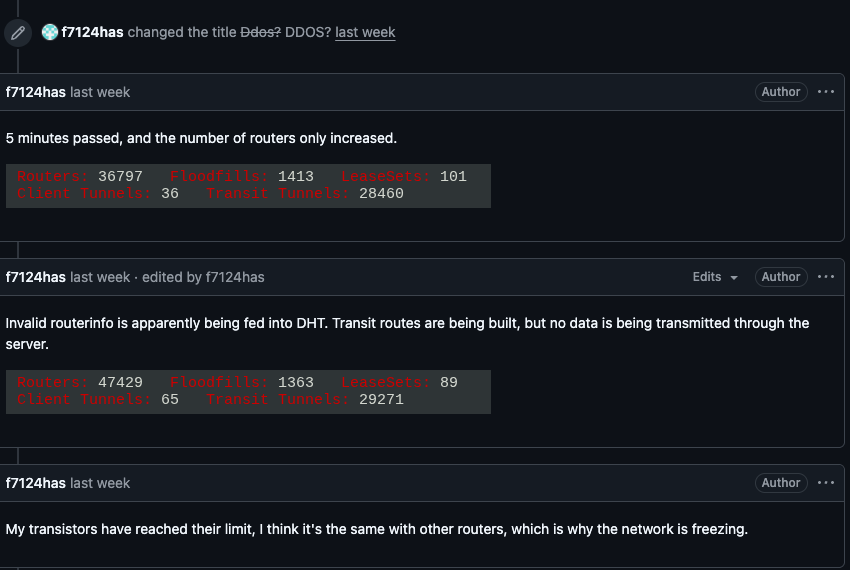
On February 3, I2P users began complaining on the organization’s GitHub page about tens of thousands of routers suddenly overwhelming the network, preventing existing users from communicating with legitimate nodes. Users reported a rapidly increasing number of new routers joining the network that were unable to transmit data, and that the mass influx of new systems had overwhelmed the network to the point where users could no longer connect.

I2P users complaining about service disruptions from a rapidly increasing number of routers suddenly swamping the network.

When one I2P user asked whether the network was under attack, another user replied, “Looks like it. My physical router freezes when the number of connections exceeds 60,000.”

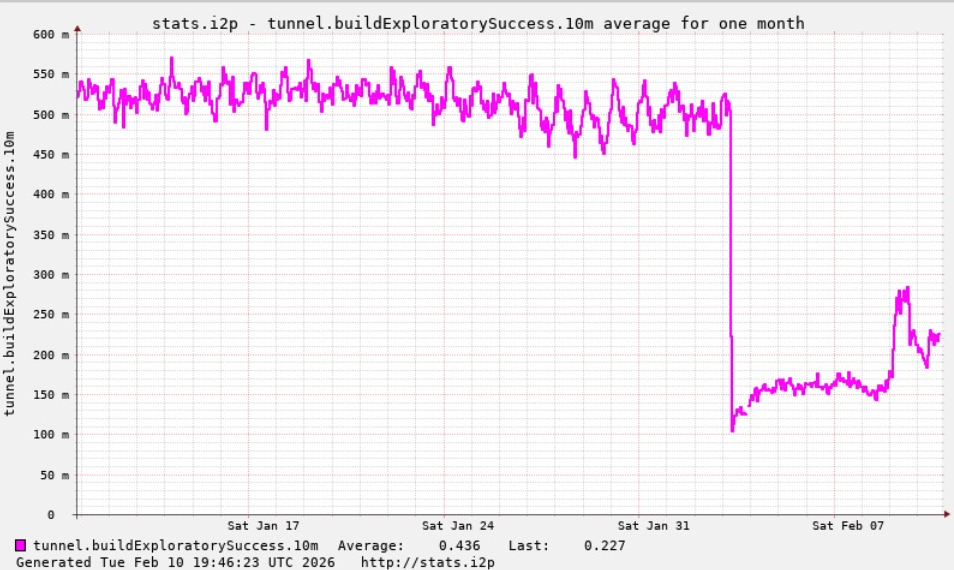
A graph shared by I2P developers showing a marked drop in successful connections on the I2P network around the time the Kimwolf botnet started trying to use the network for fallback communications.

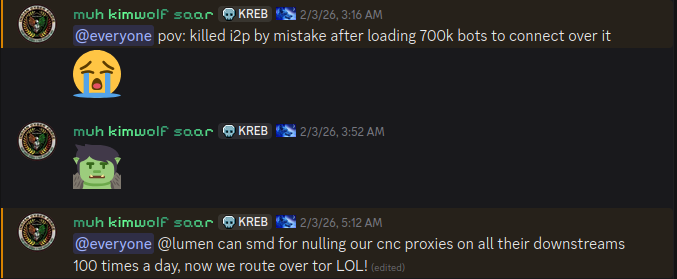
The same day that I2P users began noticing the outages, the individuals in control of Kimwolf posted to their Discord channel that they had accidentally disrupted I2P after attempting to join 700,000 Kimwolf-infected bots as nodes on the network.

The Kimwolf botmaster openly discusses what they are doing with the botnet in a Discord channel with my name on it.

Although Kimwolf is known as a potent weapon for launching DDoS attacks, the outages caused this week by some portion of the botnet attempting to join I2P are what’s known as a “Sybil attack,” a threat in peer-to-peer networks where a single entity can disrupt the system by creating, controlling, and operating a large number of fake, pseudonymous identities.

Indeed, the number of Kimwolf-infected routers that tried to join I2P this past week was many times the network’s normal size. I2P’s Wikipedia page says the network consists of roughly 55,000 computers distributed throughout the world, with each participant acting as both a router (to relay traffic) and a client.

However, Lance James, founder of the New York City based cybersecurity consultancy Unit 221B and the original founder of I2P, told KrebsOnSecurity the entire I2P network now consists of between 15,000 and 20,000 devices on any given day.

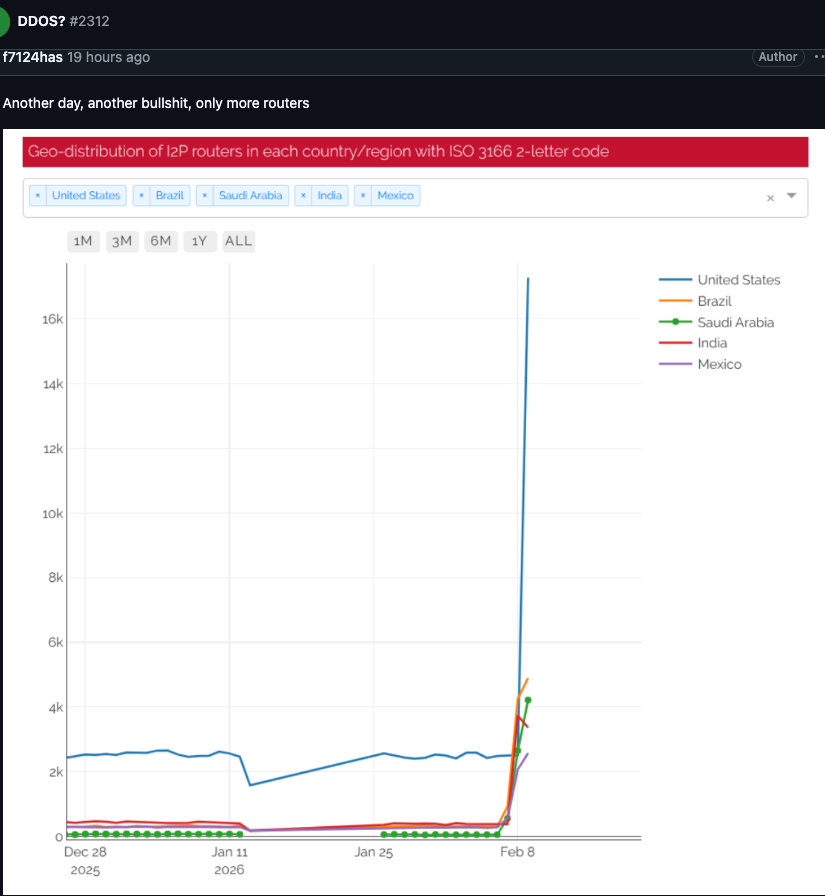
An I2P user posted this graph on Feb. 10, showing tens of thousands of routers — mostly from the United States — suddenly attempting to join the network.

Benjamin Brundage is founder of Synthient, a startup that tracks proxy services and was the first to document Kimwolf’s unique spreading techniques. Brundage said the Kimwolf operator(s) have been trying to build a command and control network that can’t easily be taken down by security companies and network operators that are working together to combat the spread of the botnet.

Brundage said the people in control of Kimwolf have been experimenting with using I2P and a similar anonymity network — Tor — as a backup command and control network, although there have been no reports of widespread disruptions in the Tor network recently.

“I don’t think their goal is to take I2P down,” he said. “It’s more they’re looking for an alternative to keep the botnet stable in the face of takedown attempts.”

The Kimwolf botnet created challenges for Cloudflare late last year when it began instructing millions of infected devices to use Cloudflare’s domain name system (DNS) settings, causing control domains associated with Kimwolf to repeatedly usurp AmazonAppleGoogle and Microsoft in Cloudflare’s public ranking of the most frequently requested websites.

James said the I2P network is still operating at about half of its normal capacity, and that a new release is rolling out which should bring some stability improvements over the next week for users.

Meanwhile, Brundage said the good news is Kimwolf’s overlords appear to have quite recently alienated some of their more competent developers and operators, leading to a rookie mistake this past week that caused the botnet’s overall numbers to drop by more than 600,000 infected systems.

“It seems like they’re just testing stuff, like running experiments in production,” he said. “But the botnet’s numbers are dropping significantly now, and they don’t seem to know what they’re doing.”

Please Don’t Feed the Scattered Lapsus ShinyHunters

A prolific data ransom gang that calls itself Scattered Lapsus ShinyHunters (SLSH) has a distinctive playbook when it seeks to extort payment from victim firms: Harassing, threatening and even swatting executives and their families, all while notifying journalists and regulators about the extent of the intrusion. Some victims reportedly are paying — perhaps as much to contain the stolen data as to stop the escalating personal attacks. But a top SLSH expert warns that engaging at all beyond a “We’re not paying” response only encourages further harassment, noting that the group’s fractious and unreliable history means the only winning move is not to pay.

Image: Shutterstock.com, @Mungujakisa

Unlike traditional, highly regimented Russia-based ransomware affiliate groups, SLSH is an unruly and somewhat fluid English-language extortion gang that appears uninterested in building a reputation of consistent behavior whereby victims might have some measure of confidence that the criminals will keep their word if paid.

That’s according to Allison Nixon, director of research at the New York City based security consultancy Unit 221B. Nixon has been closely tracking the criminal group and individual members as they bounce between various Telegram channels used to extort and harass victims, and she said SLSH differs from traditional data ransom groups in other important ways that argue against trusting them to do anything they say they’ll do — such as destroying stolen data.

Like SLSH, many traditional Russian ransomware groups have employed high-pressure tactics to force payment in exchange for a decryption key and/or a promise to delete stolen data, such as publishing a dark web shaming blog with samples of stolen data next to a countdown clock, or notifying journalists and board members of the victim company. But Nixon said the extortion from SLSH quickly escalates way beyond that — to threats of physical violence against executives and their families, DDoS attacks on the victim’s website, and repeated email-flooding campaigns.

SLSH is known for breaking into companies by phishing employees over the phone, and using the purloined access to steal sensitive internal data. In a January 30 blog post, Google’s security forensics firm Mandiant said SLSH’s most recent extortion attacks stem from incidents spanning early to mid-January 2026, when SLSH members pretended to be IT staff and called employees at targeted victim organizations claiming that the company was updating MFA settings.

“The threat actor directed the employees to victim-branded credential harvesting sites to capture their SSO credentials and MFA codes, and then registered their own device for MFA,” the blog post explained.

Victims often first learn of the breach when their brand name is uttered on whatever ephemeral new public Telegram group chat SLSH is using to threaten, extort and harass their prey. According to Nixon, the coordinated harassment on the SLSH Telegram channels is part of a well-orchestrated strategy to overwhelm the victim organization by manufacturing humiliation that pushes them over the threshold to pay.

Nixon said multiple executives at targeted organizations have been subject to “swatting” attacks, wherein SLSH communicated a phony bomb threat or hostage situation at the target’s address in the hopes of eliciting a heavily armed police response at their home or place of work.

“A big part of what they’re doing to victims is the psychological aspect of it, like harassing executives’ kids and threatening the board of the company,” Nixon told KrebsOnSecurity. “And while these victims are getting extortion demands, they’re simultaneously getting outreach from media outlets saying, ‘Hey, do you have any comments on the bad things we’re going to write about you.”

In a blog post today, Unit 221B argues that no one should negotiate with SLSH because the group has demonstrated a willingness to extort victims based on promises that it has no intention to keep. Nixon points out that all of SLSH’s known members hail from The Com, shorthand for a constellation of cybercrime-focused Discord and Telegram communities which serve as a kind of distributed social network that facilitates instant collaboration.

Nixon said Com-based extortion groups tend to instigate feuds and drama between group members, leading to lying, betrayals, credibility destroying behavior, backstabbing, and sabotaging each other.

“With this type of ongoing dysfunction, often compounding by substance abuse, these threat actors often aren’t able to act with the core goal in mind of completing a successful, strategic ransom operation,” Nixon wrote. “They continually lose control with outbursts that put their strategy and operational security at risk, which severely limits their ability to build a professional, scalable, and sophisticated criminal organization network for continued successful ransoms – unlike other, more tenured and professional criminal organizations focused on ransomware alone.”

Intrusions from established ransomware groups typically center around encryption/decryption malware that mostly stays on the affected machine. In contrast, Nixon said, ransom from a Com group is often structured the same as violent sextortion schemes against minors, wherein members of The Com will steal damaging information, threaten to release it, and “promise” to delete it if the victim complies without any guarantee or technical proof point that they will keep their word. She writes:

A key component of SLSH’s efforts to convince victims to pay, Nixon said, involves manipulating the media into hyping the threat posed by this group. This approach also borrows a page from the playbook of sextortion attacks, she said, which encourages predators to keep targets continuously engaged and worrying about the consequences of non-compliance.

“On days where SLSH had no substantial criminal ‘win’ to announce, they focused on announcing death threats and harassment to keep law enforcement, journalists, and cybercrime industry professionals focused on this group,” she said.

An excerpt from a sextortion tutorial from a Com-based Telegram channel. Image: Unit 221B.

Nixon knows a thing or two about being threatened by SLSH: For the past several months, the group’s Telegram channels have been replete with threats of physical violence against her, against Yours Truly, and against other security researchers. These threats, she said, are just another way the group seeks to generate media attention and achieve a veneer of credibility, but they are useful as indicators of compromise because SLSH members tend to name drop and malign security researchers even in their communications with victims.

“Watch for the following behaviors in their communications to you or their public statements,” Unit 221B’s advisory reads. “Repeated abusive mentions of Allison Nixon (or “A.N”), Unit 221B, or cybersecurity journalists—especially Brian Krebs—or any other cybersecurity employee, or cybersecurity company. Any threats to kill, or commit terrorism, or violence against internal employees, cybersecurity employees, investigators, and journalists.”

Unit 221B says that while the pressure campaign during an extortion attempt may be traumatizing to employees, executives, and their family members, entering into drawn-out negotiations with SLSH incentivizes the group to increase the level of harm and risk, which could include the physical safety of employees and their families.

“The breached data will never go back to the way it was, but we can assure you that the harassment will end,” Nixon said. “So, your decision to pay should be a separate issue from the harassment. We believe that when you separate these issues, you will objectively see that the best course of action to protect your interests, in both the short and long term, is to refuse payment.”

❌