❌

Reading view

There are new articles available, click to refresh the page.

PHP releases emergency fixes for 2 critical vulnerabilities

The PHP project released patches Wednesday for two critical vulnerabilities in a programming language used in an extremely large portion of the internet.

The patch addresses two flaws, catalogued as CVE-2026-109618 and CVE-2026-109619, both rated 9.2 on the CVSS v4.0 severity scale, which tops out at 10. Researchers describe them as remote code execution vulnerabilities, which could let an attacker run their own code on a server and potentially take control of it. 

The vulnerabilities have been dubbed “php2shell” by researchers. While the industry has spent the past 24 hours sounding the alarm over the vulnerabilities, there has been very little in terms of reported exploitation as of Wednesday afternoon.

In a release, the Cybersecurity and Infrastructure Security Agency said it wasn’t aware of any exploitation.

“While CISA has not observed exploitation of these vulnerabilities as of the time of publication, they pose a risk to organizations if left unpatched,” the release reads.

Multiple researchers have told CyberScoop that they have observed very little activity outside of reconnaissance that is probing to see what vulnerable systems are still connected to the internet.

“We see clear evidence attackers are actively probing and performing reconnaissance across PHP applications,” Kelly Shortridge, chief product officer at Fastly, told CyberScoop. “The gap between disclosure and widespread, repeatable exploitation is typically hours to a few days for vulnerabilities of this severity and attack ROI.”

“We have not observed, or independently confirmed, successful in-the-wild exploitation of these vulnerabilities on live customer systems,” Jon Semon, principal security operations analyst at Huntress, told CyberScoop.

“We have checked across the Linux web servers we have visibility into for the post-exploitation behavior shown in the public proof of concept, such as a web server process spawning a shell that runs recon commands or writes a file into the web root, and did not find activity matching it.”

Neither the technical cause nor a complete list of affected versions has been officially confirmed, with the PHP team saying full details will be published with the release. An advisory from CERT-EU, the European Union’s computer emergency response team, says the flaws could affect every version of PHP from 5 onward. 

The security firm watchTowr said Tuesday the vulnerabilities had been set for release Thursday under embargo. The PHP team moved the release up a day and said it could act sooner still if details became public or exploitation appeared.

A video demonstrating an exploit chain spread online overnight via researcher Kirill Firsov, who shared it and credited researchers known as LCFR and Calif.io. watchTowr said it had reproduced one of the flaws. Code claiming to exploit the flaws is circulating but has not been verified, and security firms caution such code is sometimes laced with malware.

The potential exposure is broad. PHP runs between 70-80% of websites whose server-side language is known, according to market research, and underpins platforms including WordPress, Drupal, Joomla and Laravel. Researchers estimated more than 1.3 million internet-exposed hosts could be vulnerable, and a Shodan search counted about 1.9 million. Among servers that disclose their version, most run branches are no longer receiving security updates: about 758,000 run versions from 5.4 through 8.1, compared with 272,000 on supported branches, according to VirusTotal.

CERT-EU and Britain’s National Cyber Security Centre advised organizations to prepare to update systems quickly and suggested isolating internet-facing applications where immediate patching was not feasible. PHP flaws have been exploited before: the U.S. Cybersecurity and Infrastructure Security Agency’s known-exploited vulnerability catalog lists three in PHP itself, two used in ransomware campaigns.

The vulnerability was discovered by AI cybersecurity firm Calif, using OpenAI’s cybersecurity-focused AI model GPT-5.6 Sol. Wiz, an AI security firm purchased by Google in March, also independently discovered and reported the flaw, according to a blog posted by OpenAI on Wednesday.

The discovery sparked a two-month collaborative effort between OpenAI, PHP maintainers, researchers and security providers to develop a long-term technical fix and prepare for public disclosure.

OpenAI said the priority for all organizations relying on PHP is to apply the new patches, and offered a free tool and other support to help identify vulnerable versions.

“To our knowledge, frontier AI found these vulnerabilities before attackers did, opening a Defender’s Window for maintainers and security providers to prepare fixes and protections ahead of disclosure,” OpenAI wrote in an unsigned blog.

OpenAI also said the PHP flaw is among “several significant vulnerabilities we’ve already found and are working to fix, and we expect similar findings to increase sharply in the coming months.”

In a blog posted the same day, researchers at Wiz said they had discovered “multiple critical vulnerabilities” in PHP, all related to memory safety using GPT-5.6 Sol, their own Wiz Atlas AI tool and Google’s Gemini 4 Argon to conduct their research.

Perhaps most concerning: The bug existed for decades prior to the emergence of modern AI tools, but it’s so complex and technically arduous that few attackers were likely capable of exploiting it.

According to Wiz, it required developing exploits for “notoriously complex” memory bugs that work across different PHP versions, configurations and application behaviors. It would also have to account for differences in PHP deployments that could render the exploit harmless, and each change would require more testing, analysis and debugging.

In the era of AI hacking, “this is no longer a barrier,” the Wiz researchers said.

Large language models can adapt exploits to different PHP versions, configurations or memory layouts, use third-party testing and debugging tools, and carry out a series of other functions for “reducing the specialist effort required for each target.”

“This changes the economics of both discovery and exploitation,” wrote Wiz researchers Sagi Tzadik, Shir Tamari, Nir Ohfeld and Tomer Schwartz. “As AI reduces the effort needed to develop and adapt complex exploits, vulnerabilities that once seemed impractical to exploit become viable targets.”

More information is expected over the course of the day. The PHP team is to publish the full advisory with the release, and security firms including Huntress and Tenable said they would update their analyses as technical details and proof-of-concept code emerge.

UPDATE: 10/21/2026, 3:00 p.m. ET: This article was updated to include infromation from CISA and from industry researchers.

The post PHP releases emergency fixes for 2 critical vulnerabilities appeared first on CyberScoop.
Microsoft drops an actively exploited zero-day among record high of 1,413 vulnerabilities

Microsoft’s streak of record-breaking vulnerability disclosures continued with a mega Patch Tuesday, containing 1,413 defects affecting the company’s various enterprise products and services. 

The monthly batch of patches surpassed the company’s previous annual record of 1,261 common vulnerabilities and exposures (CVEs) set in 2020. 

“Hundreds of CVEs in a single release used to be the exception — now it’s the baseline,” Dustin Childs, head of threat awareness at TrendAI’s Zero Day Initiative, wrote in an email. AI is partly to blame, he added, but it “isn’t creating these bugs out of thin air; it’s just shortening the time between a vulnerability existing and someone noticing it.”

Yet, for defenders understandably overwhelmed by the surge of defects found in Microsoft products, actively exploited zero-day vulnerabilities aren’t growing in kind.

“If there’s solace to be had, it’s in the fact that only one of these bugs is under active attack,” Childs wrote in a blog post. “If you go back to the hot 0-day summer of 2023, there were 17 Microsoft 0-days between January and October as opposed to 15 this year during the same period.”

Microsoft disclosed one actively exploited zero-day affecting Windows Shell — CVE-2026-96951 — that allows unauthorized attackers to bypass a security feature. The high-severity defect is the third Windows Shell vulnerability exploited this year, according to Satnam Narang, senior staff research engineer at Tenable. 

“There have been 26 Windows Shell vulnerabilities patched in 2026 through October, a staggering figure compared to previous years, with only 3 Windows Shell CVEs in 2025 and just one in 2024 and 2022,” he added.

The vast majority of defects Microsoft disclosed in this month’s security update affect Windows, its ubiquitous operating system , spanning 1,102 vulnerabilities combined. The update also included 134 vulnerabilities in Office, 61 in various developer tools and 36 in SharePoint Server. 

Microsoft tried to address the toll this monthly flood of vulnerabilities has on its customers by introducing “risk cohorts.” These groups of vulnerabilities don’t necessarily share a root cause or severity rating, but generally require a similar customer assessment that could guide prioritization efforts, the company said. 

“The volume isn’t the real story anymore,” Childs added. “What matters is that discovery is scaling faster than exploitation, so teams that triage by sheer CVE count instead of exploitability are burning cycles on the wrong bugs. Patch what’s proven, prioritized, and public, and treat everything else as this month’s new normal.”

The full list of vulnerabilities addressed this month is available in Microsoft’s Security Response Center.

The post Microsoft drops an actively exploited zero-day among record high of 1,413 vulnerabilities appeared first on CyberScoop.

Microsoft discloses two actively exploited zero-days among 974 vulnerabilities

Microsoft addressed 974 defects across its product suite, including two actively exploited zero-day vulnerabilities, in its monthly Patch Tuesday security program. 

The massive batch of patches, Microsoft’s largest ever, reflects a continuing trend for the vendor as it leans on artificial intelligence to discover more vulnerabilities at a faster rate. Yet, the recent period of record breaking vulnerability disclosures hasn’t resulted in a flood of actively exploited zero-days.

“AI-assisted vulnerability discovery shows no signs of slowing down,” Dustin Childs, head of threat awareness at Trend Micro’s Zero Day Initiative, wrote in a blog post Tuesday. “However, we have not seen a correlating spike in active exploits — yet.”

The vulnerabilities actively exploited prior to disclosure — CVE-2026-81963 affecting the Windows Update Stack and CVE-2026-85880 affecting Windows Advanced Local Procedure Call — both have CVSS ratings of 7.8 and allow attackers to escalate privileges. 

More than 1 in 10 defects Microsoft disclosed in this month’s security update are rated critical. The update included 723 vulnerabilities in Windows, 111 in Office, 111 in Office 2016, 62 in SQL and 22 spanning various developer tools.

Researchers encouraged security teams and customers to not get overwhelmed by the total number of defects, but instead focus on their specific areas of risk and exposure. 

“While the number of vulnerabilities being patched is rising, the number of vulnerabilities that can and will affect most organizations remains quite low. AI-assisted vulnerability discovery in 2026 is creating larger haystacks, but it isn’t finding more needles,” Satnam Narang, senior staff research engineer at Tenable, said in an email. 

“It’s critical that organizations understand which vulnerabilities actually apply to them, whether they pose a threat by being reachable and exploitable, and prioritize remediation based on this risk context,” he added. 

Jack Bicer, director of vulnerability research at Action1, drew a similar conclusion from the record-breaking Patch Tuesday. 

“At this scale, the challenge is not simply getting through the patch list but knowing what needs attention first,” he said. “With hundreds of updates landing at once, IT and security teams need to quickly separate the vulnerabilities that demand immediate action from those that can follow the normal deployment cycle.”

The full list of vulnerabilities addressed this month is available in Microsoft’s Security Response Center.

The post Microsoft discloses two actively exploited zero-days among 974 vulnerabilities appeared first on CyberScoop.

Forget the model. When it comes to cybersecurity, it’s all about the harness

As AI-enabled hacking becomes a bigger threat for cybersecurity and national security, public attention has focused on mainly a few leading frontier AI companies developing more powerful large language models.

These models, and the billions of dollars behind them matter, but they’re only part of a larger shift. Enterprises are now building their own technology platforms that take these general-purpose LLMs and turn them into bespoke cybersecurity tools.

Industry professionals refer to these tools as a “harness.” They control the model’s behavior, limit its risks, and connect it to internal IT systems and networks so it can work reliably at scale.

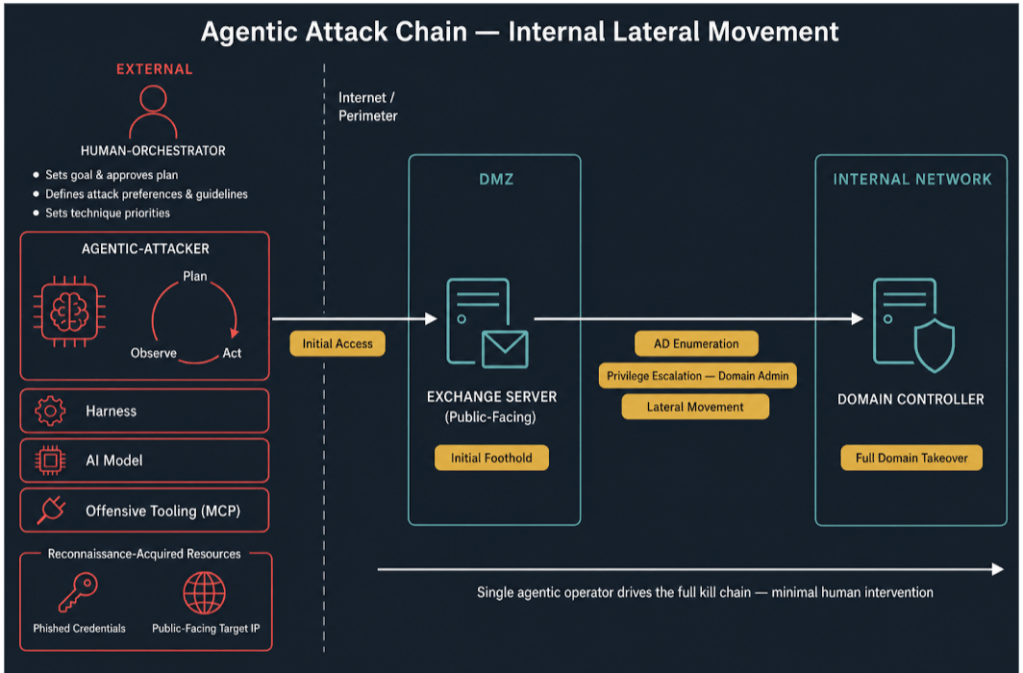
New research from Cato Networks shared exclusively with CyberScoop shows how much power can come from a harness. It paired OpenAI’s ChatGPT 5.5 and GPT 5.5-Cyber models with its own tool and tested the abilities of the agent to hack into a victim network with as little human direction as possible.

Across six different scenarios, the pairing achieved complete end-to-end attack chains, including domain administrator privileges and Active Directory access, sometimes in as little as 40 minutes.

“What was most surprising is that first we saw that it was capable of doing accelerated reasoning and attack, and interacting and doing all this by itself, like doing all of the stages of the attacks,” said Guy Waizel, a tech evangelist at Cato Networks and one of the authors behind the research.

Critically, the most successful scenarios happened when the model was given appropriate operational context from the technical harness developed by Cato Networks.

“It does support that it’s not just about the frontier model,” said Waizel. “We found that [our harness] really helps the reasoning” of the LLM.

An illustration of an agentic AI attack chain and lateral movement within victim networks. (Source: Cato Networks)

The agent was given some – but not abundant – resources to complete its tasks, including an external Kali Linux attack host, the simulated target’s public IP address and a set of low-level domain credentials acquired through phishing.

It was not provided with any other details, and had to probe further for key information, such as further knowledge of the server type (Microsoft Exchange), the target’s operating system, version, build number, internal network topology, access to higher privilege accounts and other critical assets, nor was agent given any predetermined attack paths.

The Cato Networks research uses OpenAI models, but only as an example. Waizel said he believes other models would likely achieve similar results. In any event, if current trends hold, the kind of capabilities provided by LLMs like GPT 5.5 are likely to be open-source within a year.

Cato Networks is far from alone. Most enterprises have their own AI harnesses, and  executives tell CyberScoop they are playing an increasing role in more effectively steering the frontier model workflows.

While AI tools can struggle to duplicate human workflows in other areas, LLMs have long shown potential in cybersecurity and coding, improving greatly over the past few years. The Trump administration has set up a new federal clearinghouse for exchanging information between the public and private sectors on AI-discovered vulnerabilities, while European groups are setting up their own organizations to coordinate globally on AI cyber threats.

Eric Doerr, chief product officer at Tenable, told CyberScoop a harness used in the company called “Hexa”  offers a defensive advantage:  it can work with different commercial LLMs while delivering consistent  results.

“One of the first things we do when we get a [new] model is say ‘Well, let’s run it through Hexa and see what we learn,’” said Doerr. “We have a whole bunch of benchmarks. Is it the same, is it better? Where is it better? Where is it worse?”

Hexa is meant to ensure that whichever model or models become dominant, Tenable will be able to integrate it into their tech stack and protect their most sensitive assets from unintended behaviors. That frees up the LLM to do what it does best: find vulnerable code and establish attacker pathways for exploiting them.

“For years, it has been true that there are way more potential issues that a company has to deal with: code vulnerabilities, things that are unpatched, misconfigurations,” said Doerr. “There’s way more than you can actually remediate, and you really need to understand the difference between what’s a theoretical problem and a real problem.”

Dan Rapp, chief AI and data officer at Proofpoint, said their harness, “Satori,” has become a critical tool for keeping their agentic AI on track while giving humans the ability to step in when things go awry.

“I think what you’re seeing in the foundation of frontier models is you have raw intelligence, raw reasoning power, but to get these systems to perform the way you want to, both context engineering – the content provided ensuring that its accurate and relevant – and the harness engineering are essential to actually get the systems to perform well,” Rapp told CyberScoop.

That was a common theme in interviews with companies. While frontier models come and go, or are overtaken by international competitors, there will always be the need for the model to operate with data and context that often only the organization can provide.  

It suggests that while policymakers and cybersecurity experts have focused on the spread of newer and more powerful frontier models, industry – and likely soon the cybercriminal underground — has quickly developed the kind of technical infrastructure that is becoming far more important to AI cyber defensive and offensive tasks.

“We’ve had to bootstrap quite a few of these systems from first principles, and what it always boils down to is how effective you are with the tool calling… bringing in data, enriching the context,” said John Hopper, vice president of product engineering at SpecterOps.

The post Forget the model. When it comes to cybersecurity, it’s all about the harness appeared first on CyberScoop.

Microsoft discloses ‘the mother of all’ vulnerability loads, tripling June’s previous record

Microsoft’s monthly Patch Tuesday security program reached an unrivaled pinnacle this month, as the vendor addressed 622 vulnerabilities across its suite of business products and systems. 

“The bug apocalypse has finally descended upon us,” Dustin Childs, head of threat awareness at Trend Micro’s Zero Day Initiative, wrote in a blog post Tuesday.

“The mother of all releases. To call this record-breaking is an understatement,” he added. “The CVE count year-to-date exceeds all other years’ totals.”

The startling increase in vulnerabilities reflects a compounding effect taking root across software as artificial intelligence plays a growing role in discovering and developing patches for defects lurking in error-riddled applications. 

Microsoft’s June Patch Tuesday update broke the previous all-time record with 206 vulnerabilities.

The company last week warned forewarned customers and defenders that a flood of defects would be uncovered as it applies its multi-model agentic scanning harness (MDASH) to discover and address vulnerabilities at greater speed and scale.

The monthly exponential rise in Microsoft vulnerabilities already puts the vendor on pace to break a full-year record, ending 2026 with the largest annual collection of defects, beating the previous record of 1,245 CVEs in 2020, Satnam Narang, senior staff research engineer at Tenable, said in an email. 

“It’s probable that we will not only exceed 2,000 CVEs in a calendar year, but potentially over 3,000 CVEs this year or more,” he added.

“The volume is striking, but it reflects how good these tools have become at finding bugs, not how many of those bugs actually pose a risk to organizations,” Narang said.

Microsoft disclosed two actively exploited zero-day vulnerabilities — CVE-2026-56155 and CVE-2026-56164, privilege escalation defects in Active Directory Federation Services and Microsoft SharePoint Server, respectively. 

The monthly batch of patches included 416 defects in Windows, 82 in Office and 46 in Microsoft Edge. More than 1 in 10 vulnerabilities the vendor disclosed — 63 total — were rated as critical.

“The products covered this month are also astonishing,” Childs said. “Just about everything you’ve ever heard of is getting patched.”

The full list of vulnerabilities addressed this month is available in Microsoft’s Security Response Center.

SAP also addressed a fresh assortment of vulnerabilities Tuesday, including critical defects CVE-2026-44747 in SAP NetWeaver Application Server and CVE-2026-27690 in SAP Approuter.

The post Microsoft discloses ‘the mother of all’ vulnerability loads, tripling June’s previous record appeared first on CyberScoop.

❌