❌

Reading view

There are new articles available, click to refresh the page.

Early Scattered Spider member pleads guilty to cybercrime spree

Another core member of the hacker subset of The Com involved in a spree of extortion attacks from at least 2021 to 2023 pleaded guilty to federal charges, according to court records released Tuesday.

Ahmed Hossam Eldin Elbadawy, a 24-year-old from Texas, pleaded guilty exactly one year ago to wire fraud conspiracy and aggravated identity theft. His guilty plea wasn’t shared publicly until prosecutors filed an order of forfeiture this week seeking proceeds from Elbadawy’s criminal activities. 

Elbadawy and his co-conspirators — Noah Michael Urban, a Florida man sentenced to 10 years in prison last year, and Tyler Robert Buchanan, a Scottish man who pleaded guilty to multiple cybercrimes in April and awaits sentencing — were part of an aggressive subset of The Com coined Scattered Spider. 

The financially-motivated crew obtained credentials via social engineering and stole sensitive company data to identify high net worth employees with virtual currency accounts containing millions of dollars, according to an indictment filed against Elbadawy and his co-conspirators in late 2024. 

Federal authorities filed charges against five individuals with links to the Scattered Spider cybercrime outfit, including Elbadawy, Urban, Buchanan, Evans Onyeaka Osiebo and Joel Martin Evans in 2024.

Elbadawy’s victims included large businesses in the entertainment, telecom, technology, business process outsourcing, IT, cloud and virtual currency sectors, officials said. Prosecutors linked Elbadawy and his co-conspirators to at least 12 victim companies in the indictment, including three businesses located in Southern California where he awaits sentencing. 

Authorities detailed 29 victims who were compromised by Elbadawy and his co-conspirators. The crew stole virtual currency from wallets controlled by many of those victims. The most high-value thefts included virtual currency worth nearly $6.35 million in September 2021, $571,000 in June 2022 and nearly $1.7 million in December 2022. 

Prosecutors are seeking significant property and asset forfeiture from Elbadawy, including Bitcoin valued at more than $14.19 million, Ethereum valued at more than $3.4 million and nearly $63,000 in cash. Officials also requested the forfeiture of a lifted golf cart, three luxury vehicles, a painting of Muhammad Ali, luxury watches, gold jewelry, a vast collection of designer bags and 150 pairs of shoes.

The terms of Elbadawy’s plea agreement haven’t been released. 

While early leaders of Scattered Spider have been arrested or sentenced for their crimes, others have filled those roles with even more exceptional impact.

The Com has grown to thousands of members, typically between 11 and 25 years old, splintered into three primary subsets the FBI describes as Hacker Com, In Real Life Com and Extortion Com.

Criminal acts committed by these multiple, interconnected networks include swatting, extortion and sextortion of minors, production and distribution of child sexual abuse material, violent crime and various other cybercrimes.

You can read the indictment against Elbadawy and some of his co-conspirators below.

The post Early Scattered Spider member pleads guilty to cybercrime spree appeared first on CyberScoop.

Russian national extradited to US for alleged involvement in bank-account takeover scheme

Authorities extradited a 36-year-old Russian national from the Republic of Georgia under accusations of widespread bank-account takeover attacks, including a scheme to defraud two banks of more than $6.3 million, the Justice Department said Tuesday.

Sergei Anatolyevich Filimonov and unnamed co-conspirators ran an extensive operation starting in November 2023 to spoof domains of banks, obtain credentials of legitimate customers and use those details to steal money from accounts with large balances, according to court records. 

Filimonov and his co-conspirators allegedly collected more than 5,000 victim login credentials to various banks, including those assigned to employees with access to a company headquartered in Atlanta and another business with offices in Cumming, Ga.

Authorities said Filimonov and his co-conspirators registered and maintained spoofed domains of banks, purchased sponsored links to direct unsuspecting victims to those domains, and stole credentials from those banks’ customers when they attempted to log into the fraudulent sites.

The alleged bank-account takeover crew also created infrastructure to store victim login credentials and tricked victims into providing additional details to bypass security controls.

Prosecutors said Filimonov and his co-conspirators caused and attempted to cause the unauthorized transfer of nearly $5.58 million from one unnamed bank in June 2024 and $735,000 from another bank in November 2024. Both banks have local branches in the Northern District of Georgia and maintain headquarters in North Carolina, according to the indictment. 

Officials previously seized the domain, which the co-conspirators allegedly used to store credentials harvested from the spoofed banking sites in December 2025. The FBI at the time said it identified at least 19 victims in the U.S. linked to the domain and put total attempted losses at about $28 million, including confirmed losses of about $14.6 million. 

Filimonov is charged with conspiracy to commit bank and wire fraud, access device fraud conspiracy, multiple counts of bank and wire fraud, possession of unauthorized access devices and aggravated identity theft. He faces up to 175 years in prison. 

He pleaded not guilty Sept. 4 and remains detained in the Northern District of Georgia.

The post Russian national extradited to US for alleged involvement in bank-account takeover scheme appeared first on CyberScoop.

The GTA VI leaks are breaking the internet. Security researchers have seen this before.

Grand Theft Auto VI, widely heralded as the game event of the decade, took a significant hit last week after a cybercriminal sent much of the internet into pandemonium after publishing gameplay footage a week before the game’s publisher planned to reveal core portions of the game to the public.  

The files posted by the online persona “CyberLeek” indicate either a hacker had direct access to Rockstar Games’ most sensitive systems or was given proprietary data by an insider, eventually becoming one of the highest-profile data extortion attacks of the year — a vexing, almost-daily occurrence hitting industries of all types.

While most data extortion attacks rattle companies due to regulatory or privacy concerns, this particular incident has caused an outsized response from Rockstar’s parent company, Take-Two Interactive Software, because it has an audience. While no lives are at risk, as they would be in an attack on critical infrastructure, the financial and reputational stakes are magnified precisely because people are watching every drip of stolen footage become a news story or a trending topic. 

“IP theft — whether it’s conducted by a cybercriminal, an insider, or even potentially [an artificial intelligence] model — rips away the hard work, passion, and livelihood among employees and companies that created the product in the first place,” Cynthia Kaiser, senior vice president of Halycon’s ransomware research center, told CyberScoop.

The game’s prior release, GTA V, along with its online component, has sold over 230 million copies and earned Take-Two over $11 billion since its release in 2013. Industry analysts say GTA VI is on pace to make between $3.3 billion to $5.2 billion in cumulative global sales by the end of its launch week in November. 

“The crown jewels of a company are whatever makes it differentiated and special,” said Kaiser, the former deputy assistant director of the FBI’s cyber division. “For some, that means customer data or source. For a studio in the final stretch before launch, the crown jewel is the surprise.”

While Take-Two hasn’t said anything publicly about the leaks, it has responded feverishly via its legal team. The company petitioned a federal court for subpoenas under the Digital Millennium Copyright Act against Discord, Google, Microsoft and X, seeking the identity of CyberLeeks and other user accounts it accuses of copyright infringement.

Federal judges granted the subpoenas against Discord, Microsoft and X, but the petition against Google remained unapproved as of Monday. Take-Two’s legal representatives also sent copyright notices to the four companies, informing them of the copyrighted material published on their platforms, but it’s unclear if any of the tech companies have been formally served with the signed subpoenas. 

Take-Two and Rockstar did not respond to a request for comment.

The subpoenas may have been enough to spook those responsible for the leaked footage. As of Monday, the websites where those behind CyberLeek were posting leaked information and links to a memecoin were offline.

Zach Edwards, staff threat researcher at Infoblox and a self-proclaimed fan of the series, initially thought the leaks were part of a Rockstar guerrilla marketing campaign. But the company’s response “confirms that this is a real investigation, and the content being shared is likely real to some degree,” he said. 

Take-Two’s actions thus far indicate the company is approaching the breach and leaks like an insider threat investigation, Edwards said. Whoever leaked the footage may have had access to an actual build of the game, he added. That could point to an insider, someone who could have saved a copy to a cloud service, uploaded it to a file-hosting site, or walked out with it on an external drive.

CyberLeek’s conflicting motivations

The hacker or group behind CyberLeek claim they are releasing the gameplay videos to protest Rockstar’s decision to not release physical copies of the game. Yet, watermarks on the leaked videos include addresses to crypto wallets, which indicate CyberLeek is also, and perhaps primarily, seeking a payout. 

“The persona behind the leaks, CyberLeek, published an anti-corporate manifesto targeting digital pre-orders and disc-less releases to frame the breach as hacktivism,” Ben Bernstein, manager of Huntress’ cybersecurity advisors team, told CyberScoop. “Yet behind the political posturing, there’s clear financial monetization and clout-chasing.”

Kaiser draws the same conclusion. “Let’s separate stated motive from observed behavior,” she said. “Threat actors who talk about principle while running a monetization channel are usually only telling you what they think will land with an audience, not actually what is driving them.”

Katie Moussouris said “this is what the alternative vulnerability economy looks like.” The founder and CEO at Luta Security has spent decades building legitimate channels for people who find security problems to get paid without turning to crime.

“The leaker launched a cryptocurrency token, watermarked stolen footage with a buy link, and offered to sell ad space on future leaks. Each of those pays out in proportion to how many people are watching. The manifesto is what keeps them watching,” Moussouris said. 

“That is a genuinely new monetization model for stolen pre-release content, and it means the usual playbook of negotiating a ransom payment quietly or paying to make it stop won’t work,” she added.

Different flavor, same crime

Despite its unique characteristics, the rhythm of the attack and its fallout is familiar territory for cybersecurity experts. 

“Steal, publish a sample, promise more, deliver, repeat. Just like ransomware attacks, in cases like these criminals use every lever of pressure they can against a company — including the fear of what is coming next — to profit from their actions,” Kaiser said. 

“The attackers are crowdsourcing their pressure tactics. A meaningful share of the player base is treating the leaks as free content and amplifying them,” she added.

Kaiser also sees some clear parallels with previous attacks targeting major entertainment companies, including the 2014 attack on Sony Pictures and the HBO hack in 2017. 

“The Sony comparison is useful for how these things escalate, but this incident reminds me more of the Iranian hackers’ leak of ‘Game of Thrones’ episodes a few years back,” she said. “North Korea attacked Sony for political purposes, destroying its data along the way; Iranian threat actors compromised HBO, along with hundreds of universities and over forty other companies, in a hacking-for-hire scheme stealing American intellectual property.”

Federal authorities earlier this month unsealed a second wave of indictments against 17 Iranians affiliated with the tech firm Mabna Institute who allegedly stole troves of data from government agencies and dozens of companies, including HBO.

This isn’t the first time Rockstar has been hit with a security incident. In 2022, an 18-year old British man who was a member of the Lapsus$ cybercriminal gang was sentenced to an indefinite hospital order after leaking gameplay footage. According to the BBC, the incident cost Rockstar, along with ridehauling company Uber and chipmaker Nvidia, over $10 million. 

The subpoena that worries security experts

Security professionals expect the situation to escalate on all sides. Leaks have hit the internet daily for the past eight days, including a series of leaks Tuesday morning. Meanwhile, Take-Two has not relented on its subpoenas. Its broadest move was a subpoena against Discord, seeking identifying data on CyberLeek, two other users and every member of three Discord servers where the copyrighted material was posted.  

Moussouris said the scope of that inquiry should worry people well beyond this case. 

“Take-Two asked for Windows device identifiers, login records, and cloud storage contents for every person who spoke in three Discord servers going back to June,” she said. “The people with the best chance of uncovering the culprits are those doing the unglamorous investigation forensics work of figuring out how the build may have leaked.”

Discord would not say whether it had been formally served or what it has done in response. A company spokesperson said it reviews and complies with valid subpoenas when they are received. 

While the breach and leak of ‘GTA VI’ material is a serious matter, Edwards noted that Take-Two is also benefiting from greater interest in the unreleased game on a daily basis. 

“The threat actor leaking these videos has failed by essentially creating a successful underground marketing campaign for the game while also putting themselves at serious risk of being eventually caught,” he said. 

“This incident is playing out like a classic insider threat exploitation scheme. Someone got access to sensitive data, they had a political agenda which clashed with the owner of the sensitive data, and they decided to do something stupid to try and force a change,” Edwards added. “This attack has done nothing but spread ‘GTA VI’ content further than it would have otherwise, and it’s creating ripples across other industries like cybersecurity who would have never covered ‘GTA 6’ issues previously.”

The post The GTA VI leaks are breaking the internet. Security researchers have seen this before. appeared first on CyberScoop.

The long tail of Clop’s PTC hack is just beginning to emerge

A notorious cybercrime group has once again exploited a critical zero-day vulnerability on a large scale, claiming it stole data from dozens of organizations, including some of the world’s largest publicly traded companies.

Clop, a prolific but calculated data theft extortion group that’s been active since 2020, began sending threatening emails to its alleged victims in mid-July, according to researchers. 

The fallout from the attack spree, which followed a familiar pattern for Clop and its targeted pool of victims, is still evolving as companies hunt for potential signs of compromise.

The vulnerability at the center of Clop’s latest campaign affects a pair of software products from PTC — Windchill and FlexPLM — which manufacturers and retailers, particularly in the manufacturing, aerospace, and automotive industries, use to automate supply chain systems and manage product lifecycles.

“This continues Clop’s trend of targeting SaaS logistics companies’ platforms with zero-days and carrying out mass-exploitation campaigns,” Allan Liska, field chief information security officer at Recorded Future, told CyberScoop.

PTC disclosed the vulnerability — CVE-2026-12569 — on June 17 and issued a patch and initial indicators of compromise the following day. 

Yet, that was too late for some of Clop’s known victims who were likely compromised by exploitation of the zero-day in early June, according to Ransom-ISAC.

The Cybersecurity and Infrastructure Security Agency added the defect, which allows unauthenticated attackers to execute code remotely, to its known exploited vulnerabilities catalog June 25.

PTC consistently added new indicators of compromise as they were discovered by researchers. But the company hasn’t said how it first became aware of the vulnerability and ensuing attacks, when the earliest known instance of exploitation occurred or how many customers are known to be compromised. 

PTC did not respond to a request for comment. 

Clop’s claimed victim set is diverse. The point-of-sale restaurant management platform Toast and software vendor Zebra both told CyberScoop they detected and contained system intrusions, but claimed limited impacts. Other alleged victims, including GE, Philips and Shell, did not respond to requests for comment. 

Researchers continue to uncover new details about the tools Clop used once it exploited and gained access to PTC customer systems. ReliaQuest said the group used a custom web shell that gave attackers a direct path to credential theft and large-scale data theft.

The fully equipped extortion platform, which was purpose-built for Windchill, decrypts credentials, delivers malware, and includes tools for sustained access, network traversal and data encryption, ReliaQuest researchers wrote in a report Tuesday.

The toolkit allows attackers to move quickly from initial access to data theft and additional post-exploitation activity without executing manual commands — a framework that mimics Windchill’s standard functions and limits defenders’ ability to detect any malicious activity.

“This campaign is another reminder that Clop remains a sleeping dragon, always looking and preparing to mass exploit vulnerabilities in software that holds sensitive data,” ReliaQuest researchers wrote in the report. “The group commonly goes inactive between campaigns but springs to life with custom-built web shells whenever there is another opportunity for mass extortion.” 

The drawn-out impact of Clop’s latest attack spree also mirrors some of its previous campaigns. The threat group has successfully exploited zero-days across multiple technology vendors’ systems, allowing it to steal sensitive data for weeks — sometimes months — from many downstream customers.

Clop targeted dozens of Oracle E-Business Suite customers for more than three months, beginning in the summer of 2025, before it started bombarding victims with extortion emails. The group also achieved mass exploitation as it infiltrated MOVEit environments in 2023, ultimately exposing data from more than 2,300 organizations, making it the largest and most significant cyberattack that year.

The post The long tail of Clop’s PTC hack is just beginning to emerge appeared first on CyberScoop.

Details emerge on BlackFile’s recent attacks on financial companies

A cybercrime group responsible for a string of recent attacks against private equity firms, law firms and financial rating agencies remains active and continued to target new victims as of late last week, according to researchers.

BlackFile, which Google Threat Intelligence Group tracks as UNC6671 and associates more broadly with The Com, has been active since the start of the year, shifting its focus from one sector to the next. 

“We have seen continued targeting against the financial sector with additional targeting of other organizations including in the med tech space,” Austin Larsen, principal threat analyst at GTIG, told CyberScoop.

The extortion group impersonates IT support in voice-phishing and social engineering attacks, and recently split its extortion operations across four brands with shared infrastructure: Redact, Pink, Helix and Falcon.

Several organizations received new extortion demands from Redact in the last week, according to Google. 

BlackFile and its various affiliates have impacted organizations in multiple industries, including healthcare, technology, transportation, logistics, wholesale, retail and hospitality.

“BlackFile does go after some of the largest organizations in the sectors that they go for. They’re not going after small companies,” Larsen said. “This is big-game hunting.”

The group’s extortion demands often start around $3 million and payments, including several in the past few weeks, have typically been negotiated down to less than $1 million, according to Google.

Flashpoint researchers told CyberScoop they have observed malicious infrastructure targeting Blackstone, Bain Capital, Moody’s, CME and Apollo, but it’s unclear if any of those firms were compromised. 

BlackFile’s steady pace of activity underscores the persistent threat it poses, as it targets an average of 1.5 new victims daily, researchers said.

Some of the group’s recent victims have been subject to threatening messages and other forms of escalation, including swatting incidents, a tactic adopted by several subsets of The Com, according to Google. 

The attackers use hundreds of callers, often lower-level people that are recruited for a small fee or an opportunity to earn goodwill with the group, who make the voice phishing calls to obtain initial access. Larsen estimates less than a dozen core operators run the different brands under the BlackFile umbrella.

“From the intrusion data that we’re seeing, this does appear to be essentially the same group,” he said, adding that different people may be operating the various brands, but they’re all linked back to the same threat cluster using shared infrastructure.

Mandiant incident responders encounter BlackFile often, having been engaged by more than two dozen organizations successfully compromised by the threat group since January. New victims in the financial sector were calling Mandiant in for help earlier this month.

Voice-based phishing attacks for data theft extortion aren’t sophisticated or novel, but BlackFile and other cybercrime groups consistently prove their continued effectiveness across virtually any sector or organization. “They’re really hitting on the human weakness element here,” Larsen said.

The post Details emerge on BlackFile’s recent attacks on financial companies appeared first on CyberScoop.

Lawmakers spring to save ID theft services for OPM breach victims, with expiration looming

With identity protection services for millions of victims of the 2015 Office of Personnel Management breach set to expire, a group of lawmakers is making a push to extend them forever.

Sen. Mark Warner, D-Va., and Del. Eleanor Holmes Norton, D-D.C., introduced legislation to give lifetime identity protection coverage to around 4.2 million federal employees exposed in the historic breach by alleged Chinese hackers, which affected 22.1 million people. Warner said “the threat remains,” necessitating lifetime coverage.

That coverage is due to end at the end of September, as set by a 10-year authorization from Congress. That prompted the pair of lawmakers to introduce Reducing the Effects of the Cyberattack on OPM Victims Enduring Response and Protecting Identifiable Information Act, or  RECOVER PII Act.

“The data stolen included workers’ most sensitive and personal information – from Social Security numbers to security clearance records – and once that information is in the hands of a bad actor, you don’t get it back,” Warner said in a news release Monday. “We have a responsibility to stand by the federal workers who were put at risk through no fault of their own. This legislation will ensure those affected continue to receive the identity protection they need, while helping better safeguard personal information from future exploitation.”

But the bill could have an uphill climb, given the makeup of Congress and stance of the Trump administration.

The Democratic co-sponsors in the Senate are Tim Kaine of Virginia, with Angela Alsobrooks of Chris Van Hollen, both of Maryland. The Democratic House cosponsors are Reps. Don Beyer and James Walkinshaw of Virginia, with Steny Hoyer of Maryland.

Warner and Norton listed no co-sponsors from the GOP, which controls both chambers of Congress and the White House.  And OPM has declared the program too expensive based on the cost relative to the number of claims.

Similar legislation to extend the coverage, including from Norton, has fallen short in recent years.

“Lifetime identity protection is the only solution that will give the workers whose data was compromised the peace of mind they deserve,” Norton said Monday. “Because there is no limit on how long personal information can be exploited, Congress must protect these federal employees and contractors in perpetuity.”

Some watchdog scrutiny of the OPM program has been critical, and while consumer advocates say identity theft protections are helpful, they nonetheless say they aren’t adequate.

The Warner-Norton legislation also would offer reimbursements to federal employees and contractors for privacy services.

The post Lawmakers spring to save ID theft services for OPM breach victims, with expiration looming appeared first on CyberScoop.

Alleged longstanding member of Scattered Spider extradited to US

A 19-year-old alleged member of the Scattered Spider extortion crew was extradited to the United States last week and remains in federal custody awaiting several cybercrime charges, the Justice Department said Wednesday. 

Peter Stokes, a dual citizen of the United States and Estonia, was allegedly involved in Scattered Spider since it formed in 2022 and boasted on social media about the luxurious globetrotting life he enjoyed while he was still a child. 

The cybercrime ring of young, native English-speaking people has infiltrated more than 100 businesses since 2022, and extorted more than $100 million from its victims around the world, officials said. 

“Scattered Spider has repeatedly targeted U.S. companies, extorting employees, inflicting millions of dollars in losses, and disrupting essential operations,” Brett Leatherman, assistant director of the FBI’s cyber division, said in a statement. “Through strong domestic and international partnerships, the FBI will continue to identify, disrupt, and hold cybercriminals accountable, no matter where they are located.”

Stokes, also known as “Bouquet” and “Jordan,” is accused of participating in multiple data theft and extortion attempts, but the FBI only provided specific details about some more recent attacks on a luxury jewelry retailer in May 2025 and a U.S.-based insurance company in June 2025.

Cybercrime researchers have been tracking Stokes’ online activity since 2022.  Microsoft determined his true identity and implicated Stokes as a member of Scattered Spider in a criminal referral in October 2024, according to court records.

He was still a child at that time, and authorities typically don’t arrest known cybercriminals until they reach adulthood. Stokes lived in Estonia and the United Arab Emirates while he allegedly committed some of his crimes. 

Police arrested Stokes in Finland as he attempted to board an April 10 flight to Japan, possessing two hard drives containing allegedly incriminating evidence. He made an initial court appearance in Chicago Tuesday and was ordered to remain in jail.

Stokes exhibited an opulent life before his capture, according to his social media activity and State Department travel records. This included trips and multiple stays in luxury hotels in Paris, Italy, Spain, Germany, New York, Florida, New Mexico, Thailand and Dubai between 2024 and 2025, according to a criminal complaint filed against him in the U.S. District Court for the Northern District of Illinois.

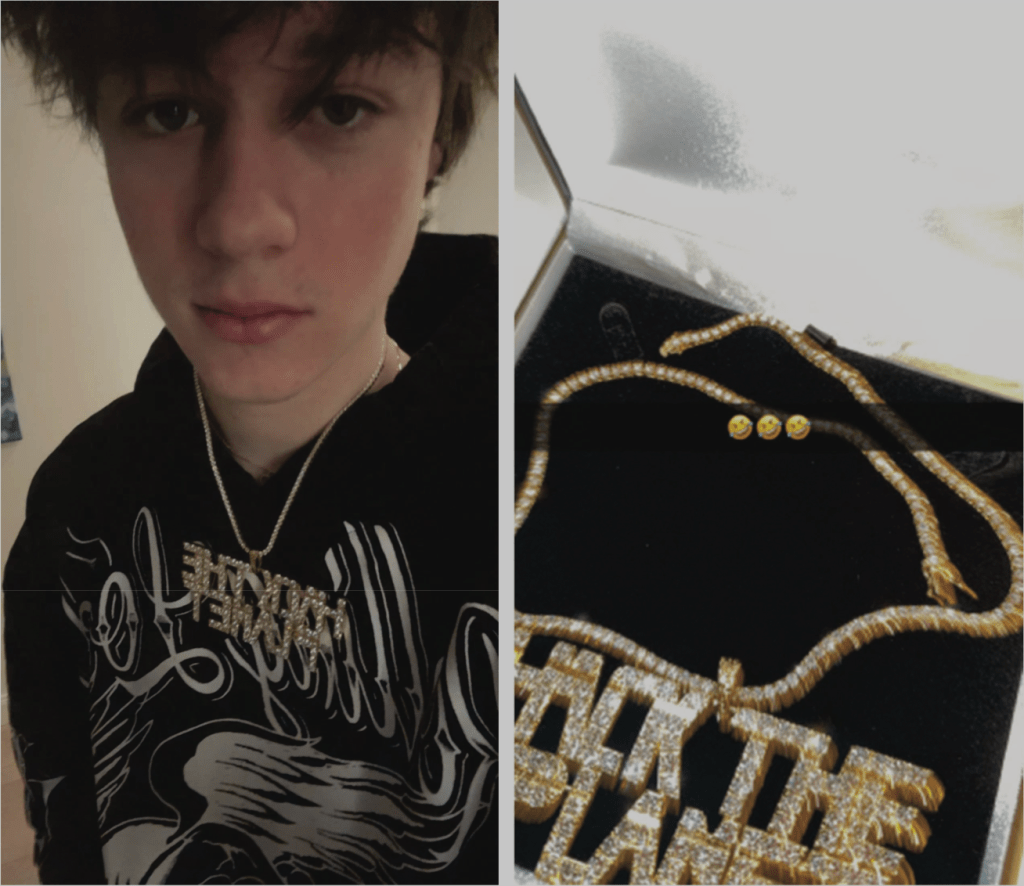
He also posted images of watches, substantial cash and an apparently diamond-encrusted chain depicting the words “Hack the Planet.”

Images from Peter Stokes’ Snapchat account in February 2025 and December 2024. Credit: Justice Department

Officials also noted that Stokes’ family appeared to be well off, as his father was a previous executive in two major European companies. 

Stokes was charged with conspiracy, cyber intrusion and fraud offenses.

“The malicious attacks from Scattered Spider caused widespread disruption to businesses and organizations throughout the United States,” Andrew Boutros, U.S. attorney for the Northern District of Illinois, said in a statement. “These charges underscore our unwavering commitment to keeping pace with technologically savvy criminal actors and holding accountable those who seek to profit from cyber intrusions, including those located in foreign jurisdictions who do harm to American businesses and victims.”

The post Alleged longstanding member of Scattered Spider extradited to US appeared first on CyberScoop.

❌