Security leaders rarely struggle to gather data, but they often struggle to turn that data into something clear and meaningful for the business. In a typical week, a CISO might receive a report listing hundreds or even thousands of vulnerabilities, most of them accompanied by CVSS scores that make the entire list look urgent, while also managing the wider set of operational, regulatory, and strategic demands that already come with the role.
That difficulty becomes more obvious when the same information has to be carried into the boardroom, where the questions are rarely about CVE IDs or exploit counts in isolation. What leadership wants to understand is whether the organization’s revenue, uptime, legal exposure, or broader resilience could be affected, and how quickly those risks need to be addressed.
This is where many security programs lose momentum, because the technical view of severity does not always line up neatly with the business view of consequence. Bridging that gap has traditionally been slow, manual work, which is one reason AI is starting to matter more in vulnerability management: it can help translate technical findings into business context that is clearer, faster to act on, and easier for leadership to understand.
Why CVSS alone does not reflect real-world business risk
For years, the industry has relied on CVSS as a quick way to judge urgency, and while the framework does account for factors such as attack vector, attack complexity, and other attack requirements, the score is still calculated in isolation and often misses the conditions that shape real risk inside an organization. A CVSS 9.8 vulnerability affecting a legacy printer in a segmented branch office may look critical on paper, but it is unlikely to carry the same business impact as a 7.5 vulnerability affecting an internet-facing database that holds sensitive customer data.
One of the long-standing weaknesses of static scoring is that it tells you how severe a flaw may be in theory, but not how much disruption it could cause in your own environment, how exposed the affected asset is, or how closely it is tied to a revenue-generating or business-critical process. That is where AI becomes more useful, because it can add the missing context that helps security teams judge not just how serious a vulnerability looks, but how much it matters in practice.
Machine learning models can now process a much broader set of inputs, including attacker activity, exploit availability, internal network topology, and the business value attached to the asset or process involved. Rather than leaving teams with a static queue of scores, that creates a live view of risk shaped by reachability, exposure, and business consequence, making it easier to separate technical severity from actual organizational risk.
How AI helps connect vulnerabilities to business impact
One of the more practical ways AI can improve vulnerability management is by helping security teams connect technical findings to the parts of the business they actually affect. A vulnerability tied to an obscure IP address may not mean much on its own, but the picture changes quickly when that asset is identified as part of a regional payment system, a customer-facing portal, or a supply chain application the business depends on. That kind of asset attribution has traditionally taken time, context, and manual investigation. AI can help shorten that process by linking technical findings to business function much more quickly.
Instead of relying only on severity scores or yesterday’s alerts, AI can weigh a broader set of signals, including exploit activity, attacker behavior, asset exposure, and internal topology, which gives security teams a more grounded way to judge where risk is most likely to become operationally significant. The benefit is not simply speed, but a clearer picture of which vulnerabilities are most likely to affect revenue, uptime, or business continuity if they are left unresolved.
At the leadership level, this same approach can help turn a large volume of technical output into something more usable. Rather than forcing CISOs to manually translate thousands of low-level alerts into board-facing language, AI can support that reporting by summarizing likely business impact, highlighting where exposure is growing, and making it easier to explain how remediation work is reducing financial and operational risk.
Two vulnerabilities, two very different business outcomes
To see how this plays out in practice, it helps to compare two vulnerabilities that might appear similarly urgent in a standard scanner, but look very different once business context is added.
Vulnerability A: The ghost in the machine
A scanner flags a CVSS 9.8 critical remote code execution flaw in an aging media server. On paper, that score suggests immediate attention. Once more context is added, the picture changes. The asset sits on a segmented guest Wi-Fi VLAN, has no path to the corporate core, and has not been linked to in-the-wild exploitation for more than two years. In practical terms, the business impact is low. The issue still needs to be addressed, but it is unlikely to justify urgent remediation ahead of higher-consequence exposures.
Vulnerability B: The quiet threat
A second finding carries a lower CVSS 7.2 high severity score, but affects a common web framework running on the organization’s primary customer portal. When AI correlates that vulnerability with asset and business context, the risk profile changes quickly. The portal is identified as a critical business process, estimated to support $250,000 in transactions per hour, while external signals point to growing exploit interest around the same framework. In that case, the business impact is far more serious. What looks like a lower-priority technical issue becomes a potential source of revenue disruption measured in millions per day.
This is where AI-assisted prioritization becomes useful. It helps teams move beyond the assumption that the highest score always deserves the fastest response and instead focus on the vulnerabilities most likely to create operational or financial harm. In practice, that means spending less time working through a queue in score order and more time reducing the exposures that matter most to the business.
How AI helps CISOs explain vulnerability risk in business terms
When security leaders can move beyond reporting how many patches were deployed and begin showing how exposure is changing in financial or operational terms, the conversation becomes much more useful. A reduction in mean time to remediate may matter to a security team, but it carries more weight at the leadership level when it is tied to a lower likelihood of downtime, reduced regulatory exposure, or less risk to a revenue-generating service.
When vulnerability data is tied to business context, it becomes easier to justify automation, tooling, or headcount based on their contribution to resilience, continuity, and measurable risk reduction, rather than on activity alone. At that level, the conversation is less about severity scores and more about what is exposed, what it could affect, and where action matters most.
One of the more practical benefits of AI is that it can help security teams explain risk in a way leadership can act on. Instead of adding another layer of technical output, it can support clearer reporting on why one issue matters more than another, what is most likely to affect the business, and where action should come first.
As attack surfaces expand and exploit timelines continue to shrink, the gap between technical findings and business understanding will only become harder to manage. Organizations that can connect those two views more effectively will be in a much stronger position to prioritize the right work, explain risk more clearly, and make vulnerability management a more meaningful part of business decision-making.
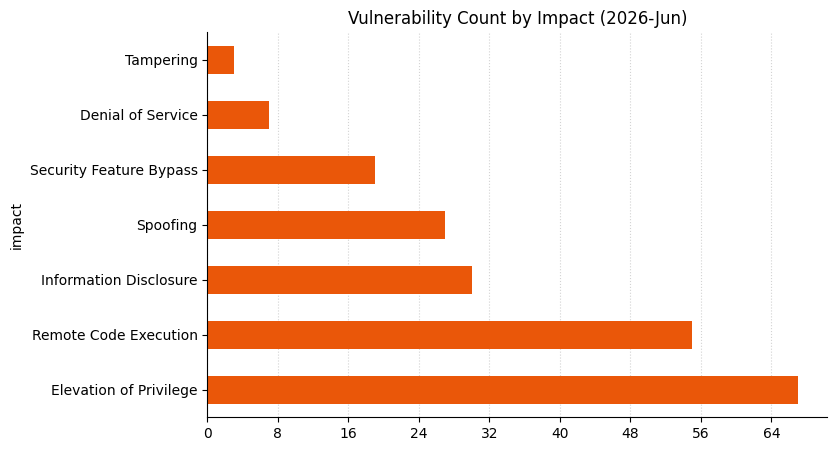
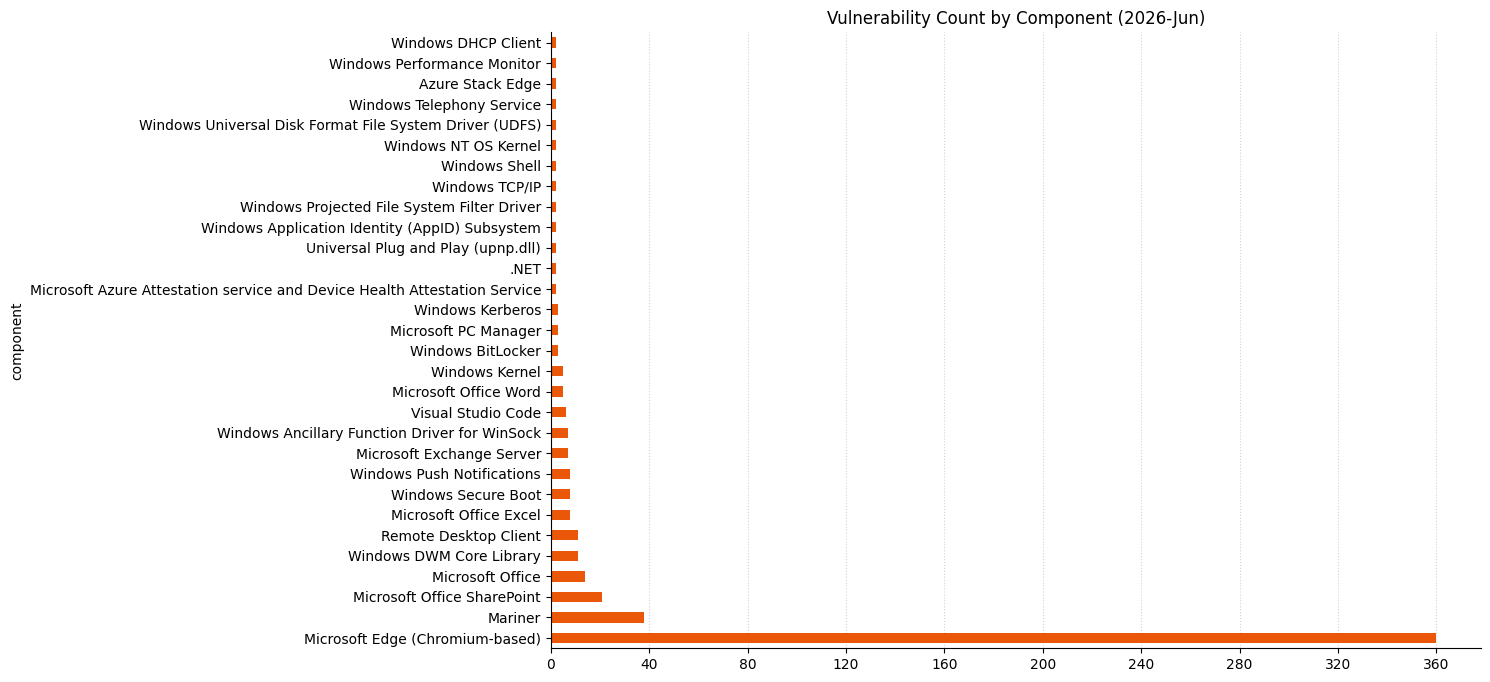
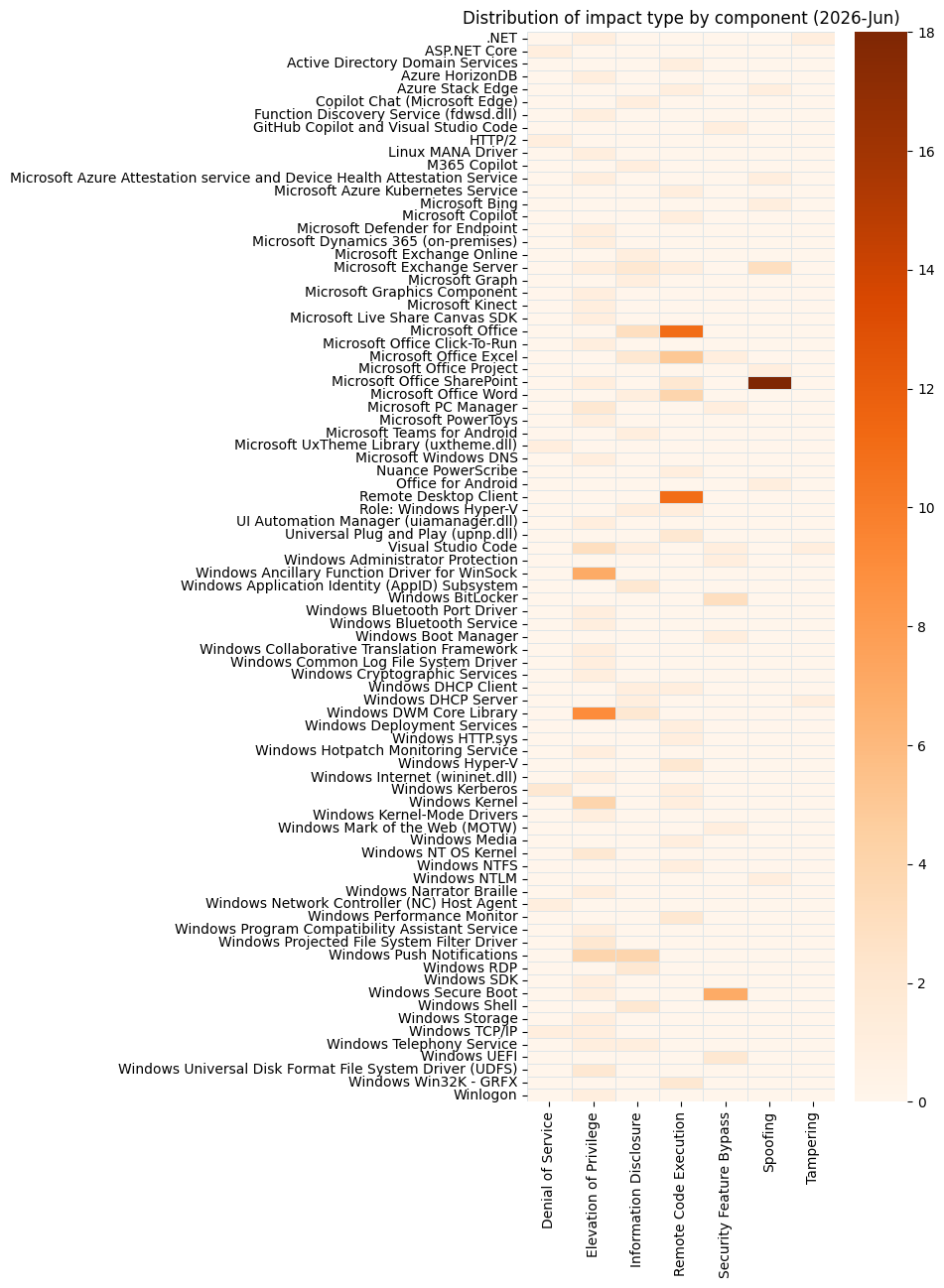
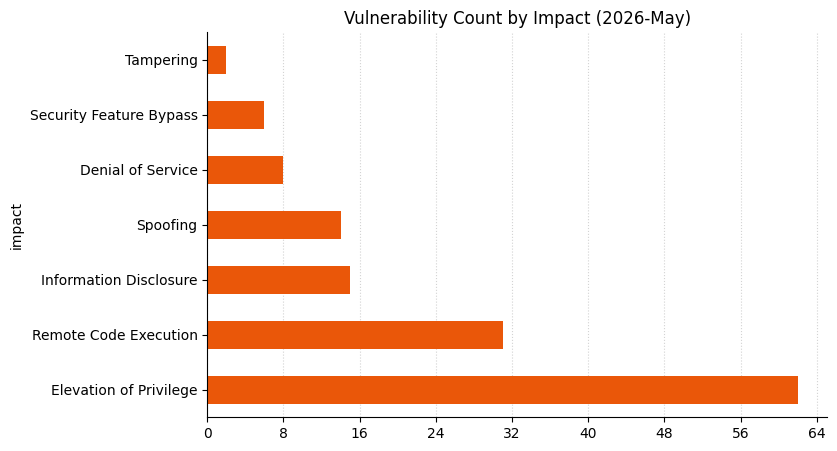
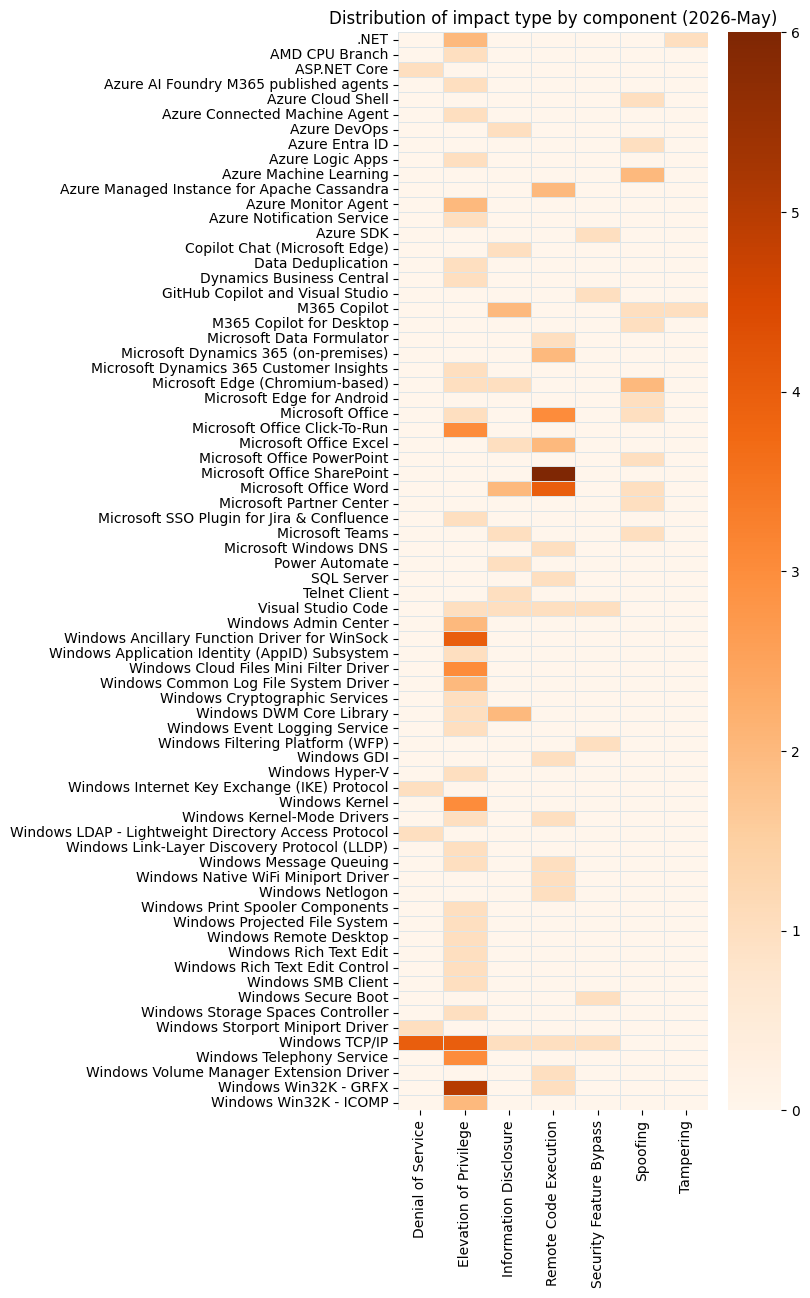
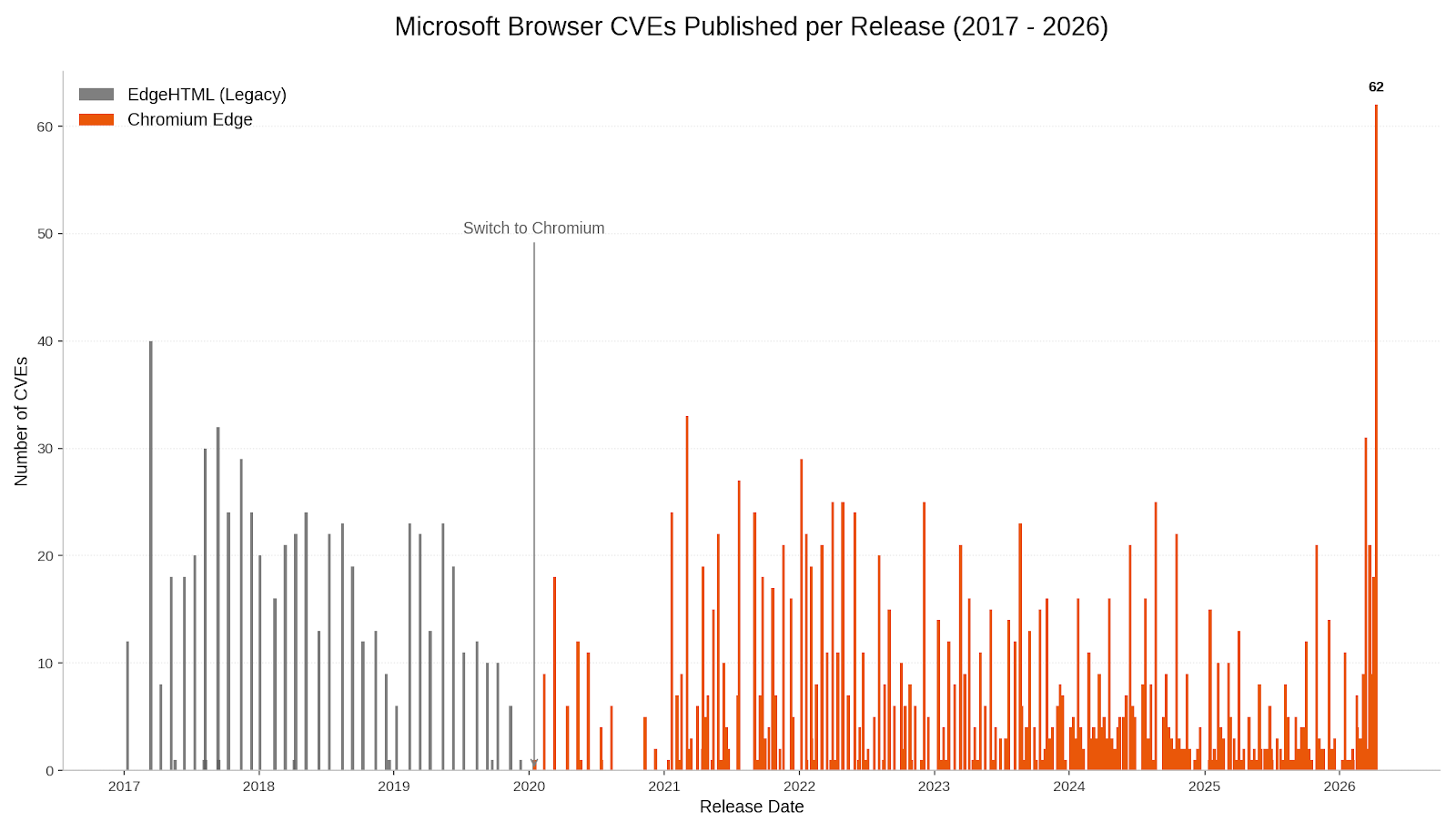
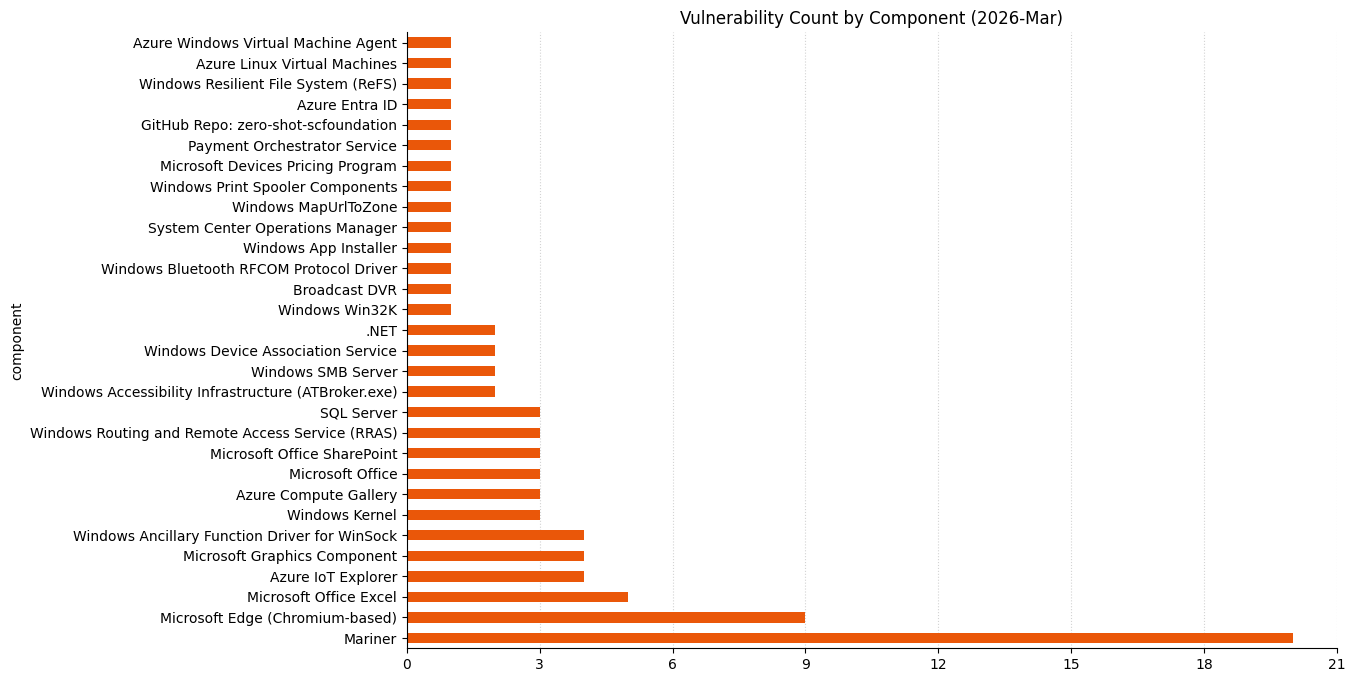
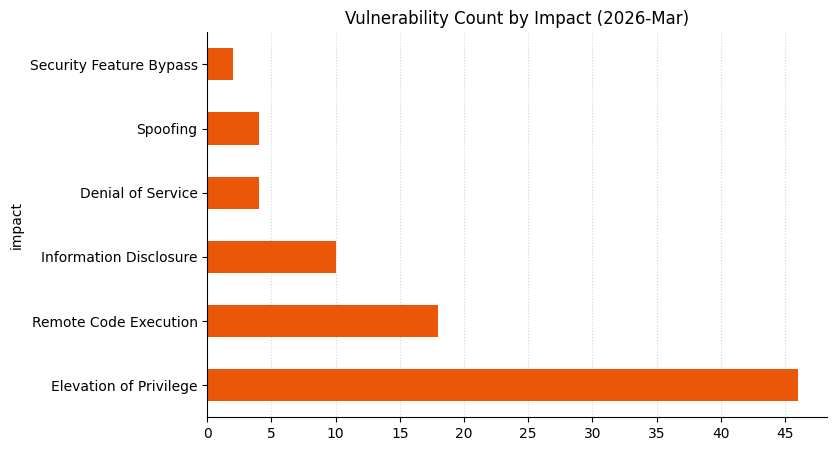
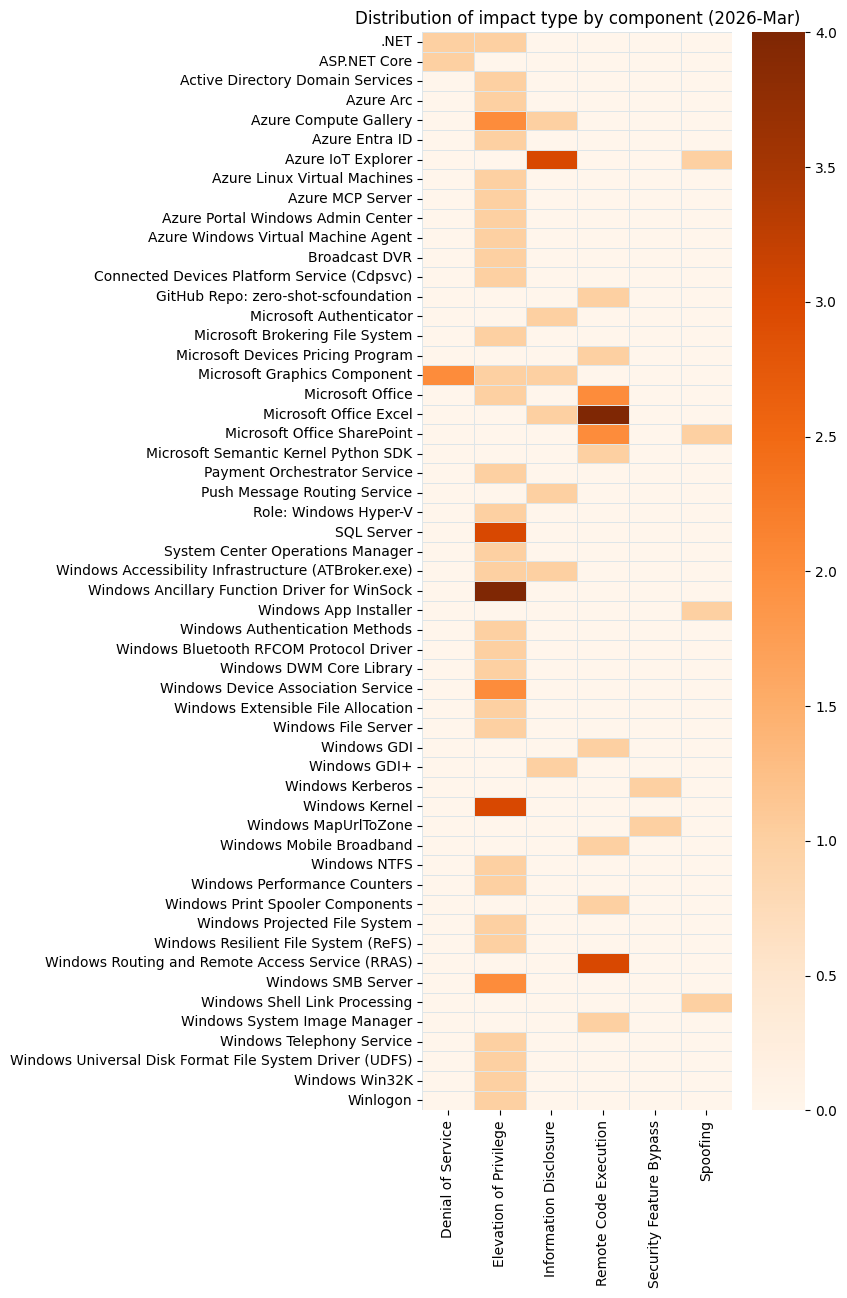
Microsoft is publishing 200 vulnerabilities on June 2026 Patch Tuesday. Microsoft is not aware of exploitation in the wild for any of these vulnerabilities, and is aware of public disclosure for three. This is similar to last month’s Patch Tuesday, however several of last month’s vulnerabilities ended up on CISA KEV in the days following their publication. So far this month, Microsoft has provided patches to address 360 browser vulnerabilities, which is an order of magnitude more than has been typical in any given month over the past few years. As usual, browser vulns are not included in the Patch Tuesday count above. Indeed, the vast, and presumably sustained, uptick in the number of browser vulnerabilities has led to Microsoft no longer enumerating Chromium CVEs in the Security Update Guide. Other vulnerability categories, especially Linux kernel vulnerabilities, are seeing a similar increase in AI-assisted vulnerability reports.
What's the opposite of coordinated disclosure?
In recent weeks, an independent vulnerability researcher going by the pseudonym Nightmare Eclipse has attracted significant attention by publishing details of six Microsoft vulnerabilities, including elevation of privilege vulnerabilities in Defender, and a Secure Boot disk encryption bypass. The researcher provided full proof-of-concept code for some, and provided significant-but-incomplete detail around the path to exploitation for others. Microsoft has confirmed that these disclosures were not coordinated, and it is clear that the relationship between this researcher and Microsoft is less than cordial. Two of the disclosures emerged in the hours after last month’s Patch Tuesday, which provides maximum visibility, while limiting Microsoft’s ability to respond without out-of-cycle patches.
At time of writing, Microsoft has provided mitigation advice and patches for CVE-2026-33825, CVE-2026-45585, CVE-2026-45498, and CVE-2026-41091, leaving only two elevation of privilege vulnerabilities unpatched, known as MiniPlasma and GreenPlasma. However, a recent blog post by Nightmare Eclipse with the title “7” has been widely interpreted to mean that there is at least one more vulnerability to come. The post contained no content other than an image of Albert Vesker, a character from the Resident Evil video game series who formerly worked as a researcher for a technology corporation before going rogue. Any inference around the possible meaning of the image is left as an exercise for the reader.
Given the timing of last month’s disclosures in the hours following Patch Tuesday, a further high-friction disclosure today would perhaps be unsurprising. Indeed, a new blog post and a new GitHub account from the same researcher have emerged in the hours following Microsoft’s publication of the June 2026 Patch Tuesday updates. The apparent seventh disclosure is nicknamed RoguePlanet, and appears to describe another elevation of privilege to SYSTEM in Defender.
It is not at all difficult to understand why Microsoft and many blue team practitioners are deeply alarmed by the partial or even full disclosure of proof-of-concept code for an ongoing series of vulnerabilities affecting fully-patched Windows systems. However, multiple leading voices in the broader vulnerability disclosure community have expressed concern that Microsoft’s invocation of the Digital Crimes Unit in a May 27, 2026 blog post may yet prove counterproductive, especially if it causes other researchers to back away from mutually beneficial engagements with MSRC. A few days later, MSRC issued a further statement clarifying that they have no intention of pursuing action against security researchers, but only those who break the law or engage in malicious activity causing real harm. For now, one safe conclusion is that this unusually sensational Microsoft vulnerability management story arc is far from over.
HTTP/2: denial of service
Every so often, a new round of denial of service vulnerabilities emerge which affect web servers implementing HTTP/2 and HTTP/3 standards. This class of vulnerabilities is likely to expand further as researchers, including the discoverers of CVE-2026-49160, use advances in LLM capability to probe not just specific software, but also the standards on which software rests. Microsoft warns that exploitation leads to uncontrolled resource consumption over a network, and expects that exploitation is more likely. The advisory credits both a third-party research firm and OpenAI’s Codex.
Microsoft has not yet directly addressed another HTTP/2 vulnerability which allows trivial denial-of-service against the default HTTP/2 configuration of multiple web server platforms, including Microsoft IIS. CVE-2026-49975, also known as HTTP/2 Bomb, became public knowledge a week ago. This denial of service works by exhausting memory on the target server, and unlike a distributed denial of service attack, there is no requirement that an attacker control a large amount of bandwidth. Patches are available for NGINX and Apache, with IIS presumably to follow at some point. If practically possible, disabling HTTP/2 is a valid mitigation.
PowerToys: SYSTEM EoP
The Microsoft PowerToys utility provides a wide variety of useful control and configuration options for Windows power users which aren’t otherwise easily accessible. It turns out that PowerToys also offers an undocumented extra: local elevation of privilege to SYSTEM via successful exploitation of CVE-2026-42902. It is worth noting that the fix was included in PowerToys v0.99.1 on April 29, 2026, without any apparent mention in the release notes. Attackers with patch-diffing toolkits may well take note of this discrepancy.
Microsoft lifecycle update
There are no significant Microsoft product lifecycle changes this month. SQL Server 2016 moves beyond regular extended support and into the pay-to-play Extended Security Updates (ESU) phase after July 14, 2026. On that same date, SharePoint 2016 and 2019 will also move past extended support, but since there’s no ESU available, the only remaining option for fully-supported self-hosted SharePoint after the middle of next month will be SharePoint Subscription Edition.
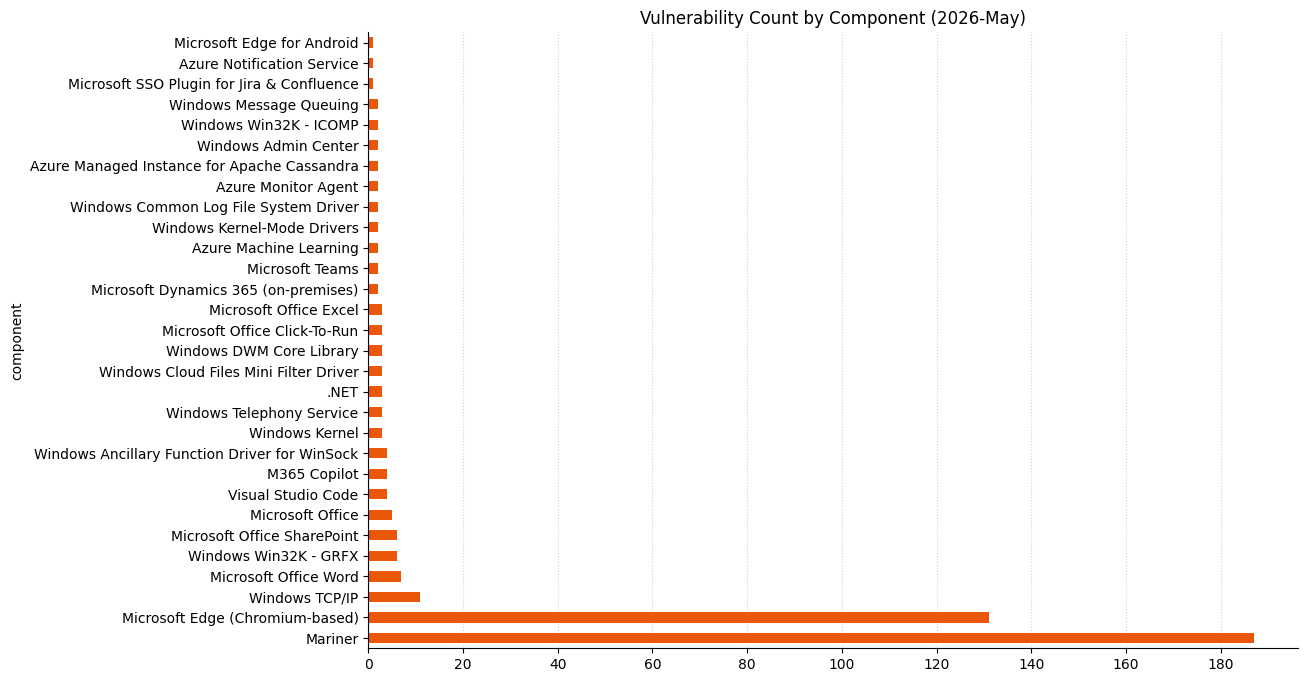
Microsoft is publishing 137 vulnerabilities on May 2026 Patch Tuesday. Microsoft is not aware of exploitation in the wild or public disclosure for any of these vulnerabilities. So far this month, Microsoft has provided patches to address 133 browser vulnerabilities, which are not included in the Patch Tuesday count above.
Windows Netlogon: critical RCE
Anyone responsible for securing a domain controller should prioritize remediation of CVE-2026-41089, which is a critical stack-based buffer overflow in Windows Netlogon with a CVSS v3 base score of 9.8. Exploitation leads to execution in the context of the Netlogon service, so that’s SYSTEM privileges on the domain controller. For most pentesters, that’s the point at which the customer report more or less writes itself. No privileges or user interaction are required, and attack complexity is low, which suggests that creation of a reliable exploit might not be especially difficult for anyone with knowledge of the specific mechanism.
Microsoft assesses exploitation as less likely, but since those exploitability assessments are provided without an accompanying explanation, it’s not clear how much reassurance defenders should take. Anyone who remembers the much-discussed CVE-2020-1472 (aka ZeroLogon) back in 2020 will note that CVE-2026-41089 offers an attacker more immediate control of a domain controller. Patches are available for all versions of Windows Server from 2012 onwards.
Windows DNS Client: critical RCE
An attacker looking for a master key for Windows assets will pay attention to CVE-2026-41096, a critical RCE in the Windows DNS client implementation. A modern computer talks to DNS the way a child in the back of a car asks “are we there yet?” The variable and complex structure of DNS responses means that DNS client implementations are also complex and thus prone to flaws. Microsoft assesses exploitation as less likely, and we can hope that modern mitigations such as heap address randomization and optional-but-recommended encrypted channel DNS will make weaponization significantly more challenging by putting barriers across specific paths to exploitation. The DNS client on Windows runs as the NetworkService role, rather than SYSTEM, but a foothold is a foothold, and skilled attackers expect to chain exploits together.
JIRA/Confluence Entra ID auth plugin: critical EoP
If you’re still self-hosting Atlassian JIRA or Confluence and relying on the Microsoft Entra ID authentication plugin, you’ll want to know about CVE-2026-41103. This critical elevation of privilege vulnerability allows an unauthorized attacker to impersonate an existing user by presenting forged credentials, thus bypassing Entra ID. Microsoft expects that exploitation is more likely. Even if you can’t always find what you want on the corporate Confluence, a motivated attacker probably will. Curiously, the patch links on the advisory lead to older versions of the plugins published in 2024.
Microsoft WARP team
Microsoft’s WARP team is credited with multiple critical vulnerabilities today, after making their first appearance in MSRC advisory acknowledgements in last month’s Patch Tuesday. We can speculate that they likely know a great deal about the current state of AI-powered vulnerability research as it applies to Microsoft products.
Microsoft lifecycle update
There are no significant Microsoft product lifecycle changes this month. Microsoft .NET 9 STS (Standard Term Support, as distinct from Long Term Support) was originally scheduled to move past the end of support in May 2026, but late last year, Microsoft granted a six-month extension, so that .NET 9 STS now reaches end of support on November 10, 2026.
Anthropic’s Project Glasswing has sparked plenty of discussion about what AI might soon do for vulnerability discovery, but the more useful question for most security teams is how to prepare for, and more importantly seize the opportunity of, what comes next.
As we wrote in our earlier blog, What Project Glasswing Means for Security Leaders, AI is becoming more capable of finding software flaws. The pressure that follows lands on the teams responsible for deciding what matters, validating risk, assigning ownership, and getting remediation moving across environments that were already hard to manage. We believe that the organizations that will benefit most from the next wave of AI will be the ones that understand their environment well enough to use these emerging AI models with intent, rather than layering them onto immature processes and hoping that speed alone will solve the backlog.
What this moment means for security teams
The number of publicly tracked software vulnerabilities has broken records almost every year over the last decade, while supply chain risk has continued to rise. Most teams were already feeling the strain of more findings than they could process cleanly. The Common Vulnerabilities and Exposures (CVE) program, the standard system for identifying and tracking known vulnerabilities, recorded 48,185 disclosures in 2025, a 20% increase over 2024, with roughly 40% of those disclosed vulnerabilities rated high or critical.
The pace in 2026 was already working out to hundreds of new CVEs per day when those figures were cited. That tells you something important about the current environment: the challenge has not necessarily been a lack of findings, but instead converting a growing stream of findings into measurable risk reduction.
The reality is that very few organizations are going to hand a model free rein over their most sensitive environments the minute those capabilities become more widely available. Trust will be built in stages: early adoption is much more likely to focus on backlog reduction, triage support, patch testing, and repetitive lower-tier remediation work that consumes time without carrying the same level of operational risk as the most critical systems in the business. That is a more realistic starting point, and it leads to a more useful question. Before teams apply AI more broadly, they need to understand their environment well enough to use it intentionally.
Establish the foundation before layering in AI
The promise from Project Glasswing and almost every other AI-powered security initiative is quite similar: leverage AI to identify patterns, summarize risk, suggest fixes, and speed up repetitive work. Regardless of technology, success still depends on how well an organization understands its environment, the context around each finding, and the process used to act on it.
A model can generate more output than a team ever could on its own, but that output becomes noise if the organization cannot answer basic questions about scope, ownership, criticality, and exposure. Teams need a clear, continuously updated picture of the environment before they can decide where AI should be applied, what should remain human-led, and which parts of the backlog are safe to push through more automated workflows.
The AI landscape is already shifting fast, and it will keep shifting, which is why this moment should prompt a more preemptive and resilient strategy rather than another round of tooling hype. Chasing each new capability as it arrives will inevitably force teams to keep reorganizing around the latest announcement. A stronger path is to get the foundation right first - understand the environment, the attack paths, and the assets that matter most; but most importantly, establishing the process and the people behind making these decisions. Then use AI where it meaningfully improves speed, consistency, and focus.
Why Attack Surface Management should be part of that foundation
A strong foundation starts with visibility. Security teams need a live picture of what exists in the environment, what is exposed, how assets connect to one another, and which systems carry the greatest business impact if something goes wrong. That is where Attack Surface Management becomes central. Rapid7’s approach through Surface Command is built around a continuous view of the attack surface across the digital estate, which helps teams understand where exposures sit and how they relate to internet-facing, business-critical, or otherwise high-impact systems.
That matters for AI adoption just as much as it matters for day-to-day security operations. Teams cannot apply AI strategically if they are guessing about which parts of the environment are lower priority, which assets belong to which owners, or where a newly disclosed flaw could create real business risk. A better view of the attack surface gives organizations the context they need to segment the problem properly. That makes it far easier to start with the right use cases, whether that is backlog reduction in lower-impact systems, targeted prioritization of exposed assets, or faster triage where the risk picture is already well understood.
Ownership is part of that foundation too. Remediation slows down when no one can quickly identify who owns the affected application, environment, or workflow. Security teams already lose time there today, and AI will only make that bottleneck more visible if it starts surfacing issues faster than organizations can assign them. Attack Surface Management helps turn that ambiguity into something more actionable by tying exposure to environment context and likely ownership.
How Vulnerability and Exposure Management turns visibility into action
Once the environment is understood, teams still need a way to move from findings to outcomes. That is where Vulnerability and Exposure Management becomes the operating layer that keeps the work grounded.
The biggest value here is not simply collecting more vulnerability data. It is targeted prioritization and validation. When a disclosure lands, teams need to know whether the issue affects an exposed asset, whether there is evidence of exploitation or attacker interest, whether the impacted system is business-critical, and whether existing controls already reduce some of the risk. That is the kind of context that helps organizations decide what deserves immediate attention and what can be handled through a normal remediation cycle.
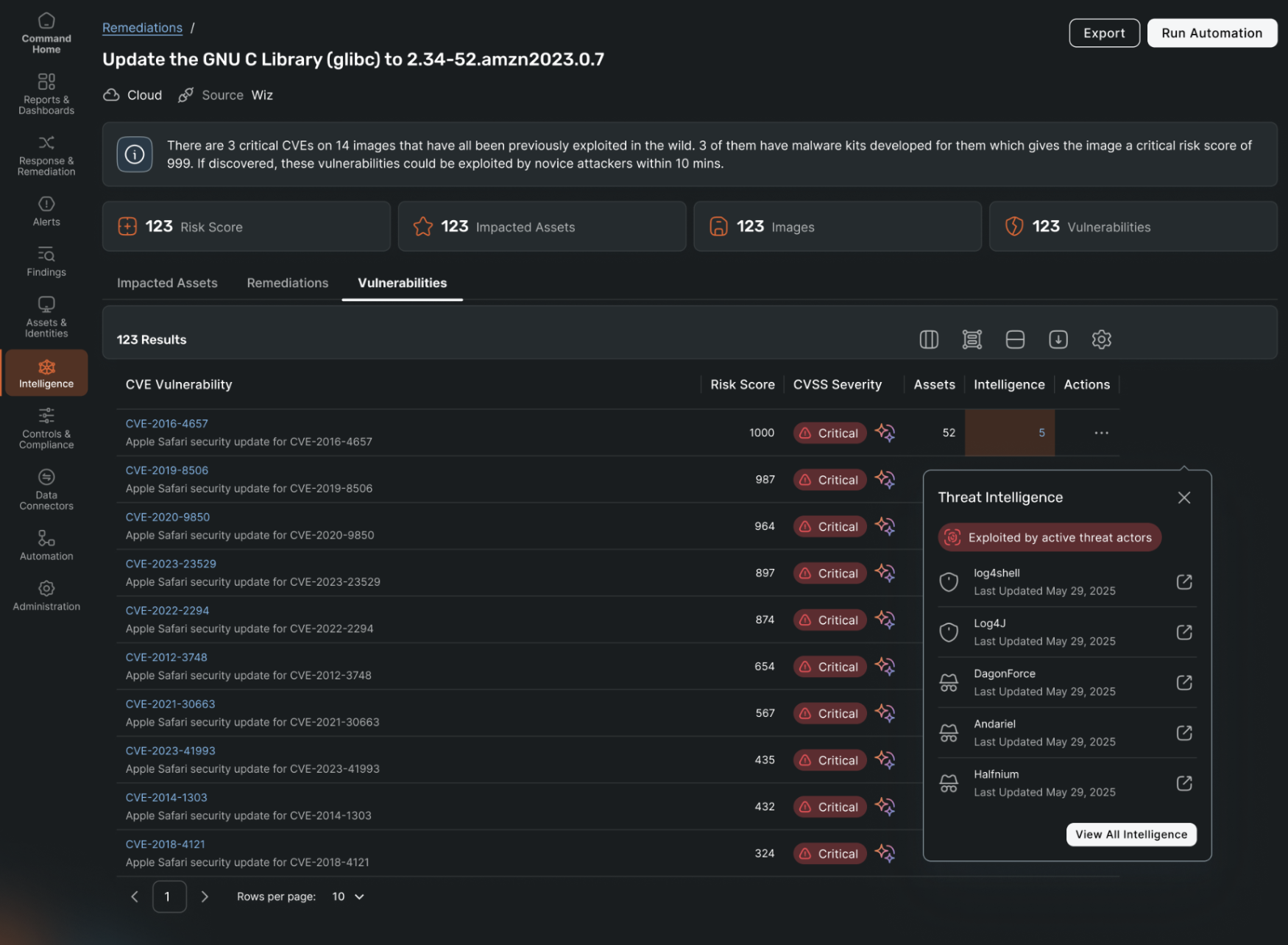
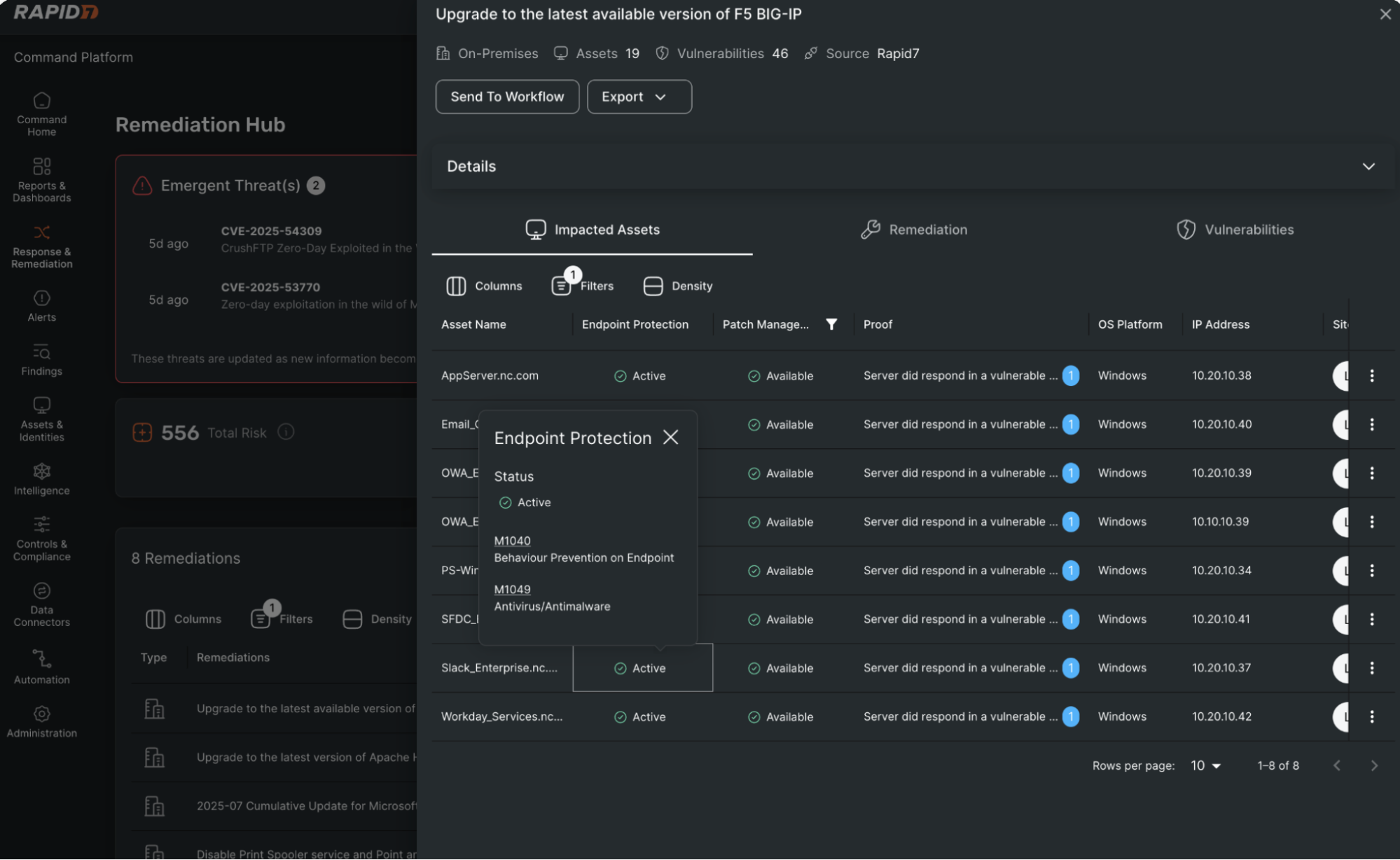
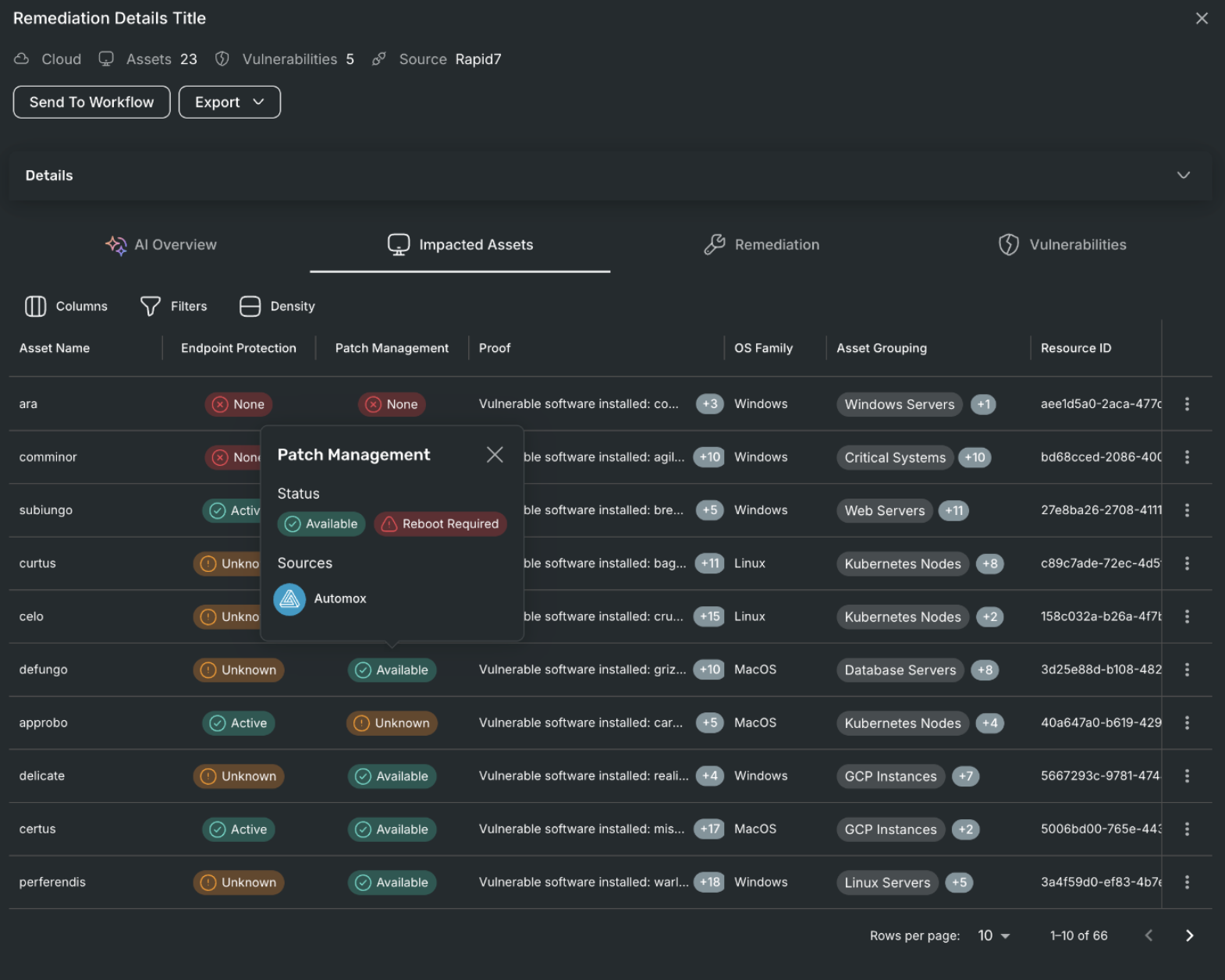
This is where artificial intelligence can help move remediation forward faster. Instead of asking teams to manually connect exploit signals, asset criticality, and vulnerability intelligence on their own, AI can distill that context directly in the remediation workflow. That makes it easier to understand why an issue matters, what the likely impact is, and what to do next, which shortens the gap between discovery and a confident decision on how to respond.
We expect most organizations to use AI to assist with, or in some cases take over, lower-tier triage, backlog cleanup, summary generation, and patch support in areas where the workflow is already established and the blast radius is more manageable. Human experts still stay closest to the most critical business logic, the most sensitive environments, and the most complex remediation paths. That is a practical adoption model, and it only works when the organization already has enough structure in place to know where those boundaries are.
Curated vulnerability intelligence changes the quality of decisions
That kind of deliberate adoption only works when teams can make better decisions, faster. Security teams need more than severity scores and a long list of CVEs. They need enough context to understand what matters, what can wait, and where action will reduce real risk fastest. As Rapid7 outlined in The Power of Curated Vulnerability Intelligence, the goal is to identify the vulnerabilities that actually matter and give teams enough context to act with confidence.
That intelligence provides a form of validation that most teams need badly as disclosure volume rises. It helps answer whether a finding is tied to active attacker interest, whether proof-of-concept activity is public, whether the asset is exposed, and whether delaying a patch creates unacceptable risk. It also supports the decisions that happen in the gap between discovery and full remediation. When a patch is delayed because of change controls, testing constraints, or lack of a vendor fix, teams still need to reduce exposure. Curated intelligence helps them decide whether to use segmentation, access restrictions, configuration changes, added monitoring, or virtual patching while the longer-term fix is being worked through.
That is one of the clearest ways Rapid7 helps customers move from data to outcomes. Intelligence is fused into the workflow so teams can prioritize with more precision and validate their actions against real threat context, not just generalized scores.
How runtime and remediation fit into the broader AI story
There is another part of this story that matters as organizations think more seriously about AI-driven security operations. As AI shapes the way teams handle exposures earlier in the lifecycle, context of application at runtime matters more too.
To make that foundation complete, organizations need to look beyond static posture and bring runtime validation into the picture. When teams can identify which vulnerabilities and misconfigurations are actively exploitable in production, and map sensitive data and identity access to real-world attack paths, they get a much clearer view of actual risk. Security teams need to understand what is vulnerable, how systems behave when live, and where unusual activity may suggest a problem is moving toward exploitation. With that runtime context in place, teams can spend less time chasing theoretical vulnerabilities and more time focusing on the exposures that are actively creating risk in live environments.
That connection between exposure, intelligence, remediation, and runtime behavior is where AI starts to become genuinely useful rather than simply impressive. It supports a more intentional model of security decision-making, one that narrows the gap between what is found, what matters, and what happens next.
What security leaders should do now
This is a good time for security leaders to step back and ask a more disciplined set of questions.
Do we understand our environment well enough to direct AI toward the right problems?
Can we clearly separate higher-risk, higher-impact assets from the parts of the backlog that are mostly operational drag?
Is threat intelligence embedded in how we interpret findings, or are we still depending too heavily on raw severity?
Can we identify ownership fast enough for AI-assisted triage to result in meaningful action?
Are compensating controls part of the plan when remediation cannot happen immediately?
Those questions shape the quality of everything that follows.
Glasswing creates a real opportunity for security teams that are ready to use AI with more intention. AI can move work forward faster, reduce manual drag, and absorb classes of issues that currently consume time without improving outcomes. The teams that benefit most will not be the ones that rush to apply new models everywhere. They will be the ones that understand their environment, have a clear view of their attack surface, have mature enough workflows to apply AI where it makes sense, and can measure whether the actions taken actually reduced exposure.
Rapid7’s approach to building resilience is grounded in those same needs. Attack Surface Management provides the environmental foundation, Vulnerability Management drives prioritization and action, curated vulnerability intelligence strengthens validation and decision-making, AI-generated remediation insights compress the time from discovery to the next step, and runtime security adds context where live behavior matters. Together, those pieces help customers build a security program that is ready for AI rather than constantly reacting to it.
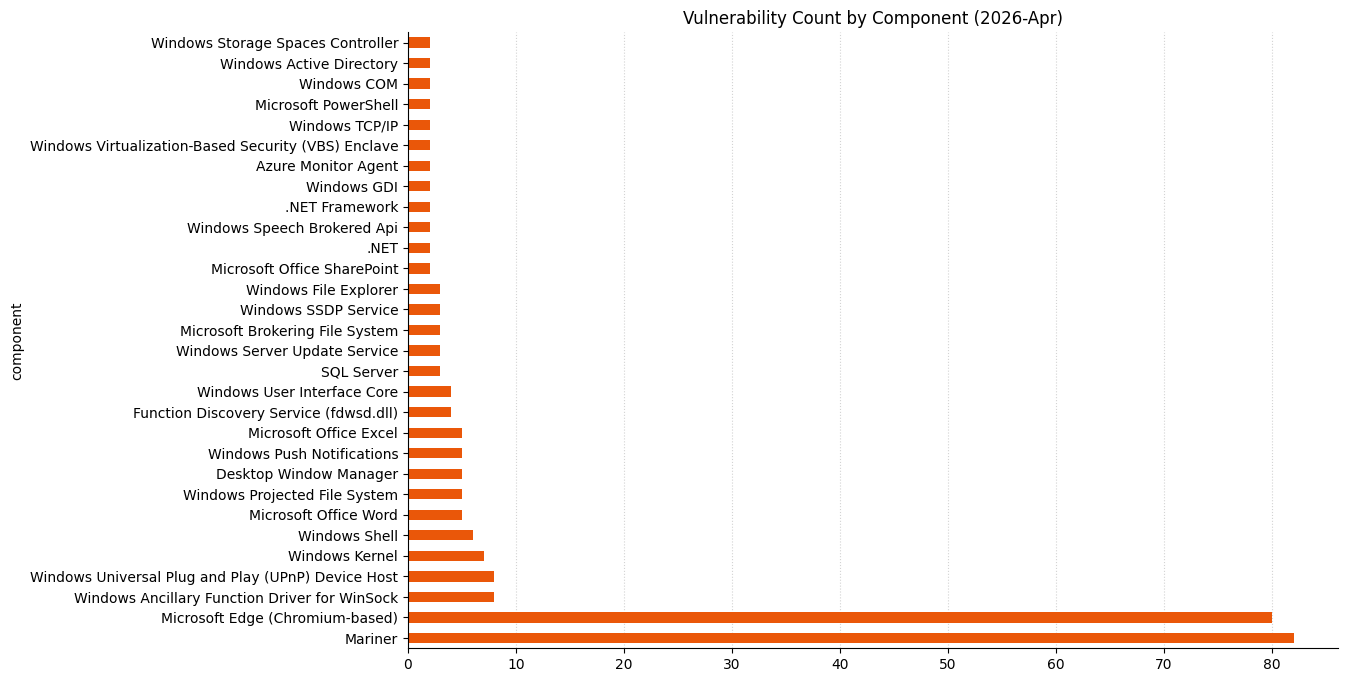
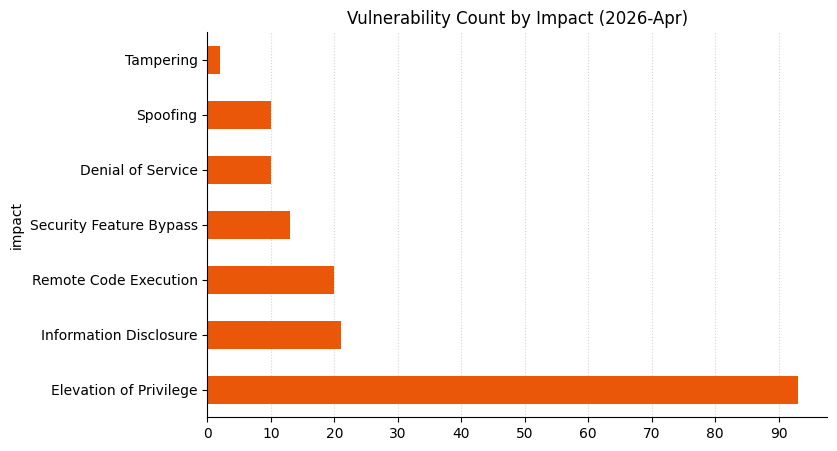
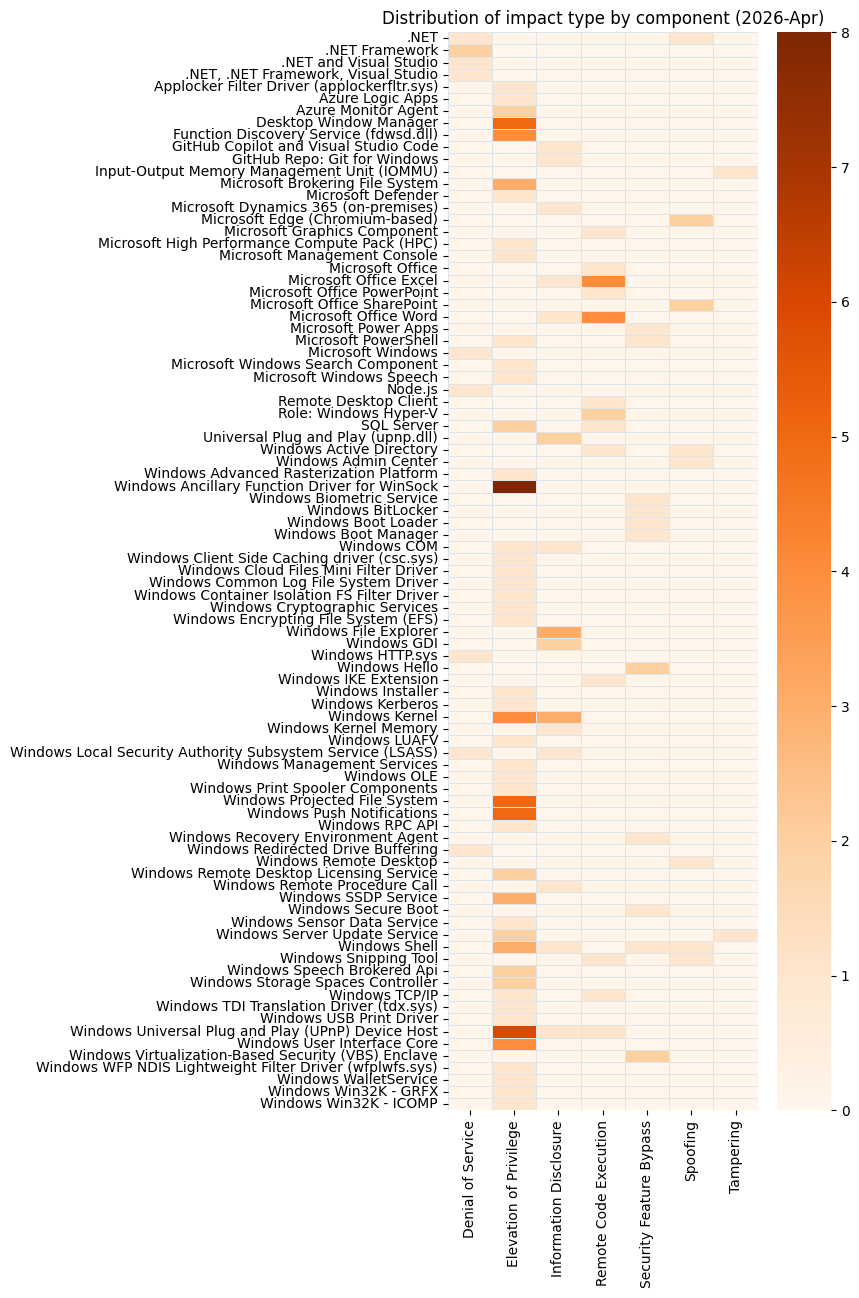
Microsoft is publishing 167 vulnerabilities on April 2026 Patch Tuesday. Microsoft is aware of exploitation in the wild for one of today’s vulnerabilities, and public disclosure for one other. Microsoft evaluates 19 of the vulnerabilities published today as more likely to see future exploitation. So far this month, Microsoft has provided patches to address 80 browser vulnerabilities, which are not included in the Patch Tuesday count above.
Increasing volumes of vulnerabilities
Regular Patch Tuesday watchers will know that these vulnerability totals are significantly higher than usual, especially the browser numbers. Late last week, Microsoft published patches to resolve more than 60 browser vulnerabilities in a single day, which is a new record in that very specific category.
It might be tempting to imagine that this sudden spike was tied to the buzz around the announcement a week ago today of Project Glasswing, but this is not the case. Edge is based on the Chromium engine, and the Chromium maintainers acknowledge a wide range of researchers for the vulnerabilities which Microsoft republished last Friday. This reflects a significant industry-wide uptick in the volume of vulnerability reports over the past few weeks. A safe conclusion is that this increase in volume is driven by ever-expanding AI capabilities. We should expect to see further increases in vulnerability reporting volume as the impact of AI models extend further, both in terms of capability and availability.
SharePoint: zero-day spoofing
When everything is changing rapidly, it can be tempting to look to familiar things for comfort. SharePoint admins should start by addressing CVE-2026-32201, an exploited-in-the-wild spoofing vulnerability. The advisory doesn’t offer much detail, but does mention CWE-20: Improper Input Validation and low impact to confidentiality and integrity, with no impact to availability. Of course, the greatest attacker impact is typically achieved by chaining together multiple vulnerabilities that by themselves might not seem so bad.
Ever-increasing novel AI capabilities in offensive cybersecurity now appear to provide real competition for all but the most elite human researchers; if it was ever valid to suppose that a vulnerability with a CVSS v3 base score of 6.5 was unlikely to cause much pain, it’s certainly not a safe defensive assumption in 2026. Patches are available for all supported versions of SharePoint, including SharePoint 2016, which moves beyond extended support on July 14, 2026.
Defender: zero-day elevation of privilege
Microsoft Defender receives a patch today for CVE-2026-33825, a local privilege escalation vulnerability for which Microsoft is aware of public disclosure. Successful exploitation leads to SYSTEM privileges, so this is certainly worth patching sooner rather than later. Microsoft points out that no action should be required to install this update, since the Microsoft Defender Antimalware Platform automatically updates by default. A further silver lining is that systems that have disabled Microsoft Defender are not in an exploitable state. Hopefully, any such system is running a suitable third-party replacement for Defender’s capabilities.
Windows [I don’t like] IKE: zero-day pre-auth RCE
The Windows Internet Key Exchange (IKE) Services Extensions is the site of CVE-2026-33824, a critical unauthenticated remote code execution vulnerability. Exploitation requires an attacker to send specially crafted packets to a Windows machine with IKE v2 enabled, which could enable remote code execution. Vulnerabilities leading to unauthenticated RCE against modern Windows assets are relatively rare, or we’d see more wormable vulnerabilities self-propagating across the internet. However, since IKE provides secure tunnel negotiation services, for instance for VPNs, it is necessarily exposed to untrusted networks and reachable in a pre-authorization context. It’s hard to imagine this turning into a rampaging internet-wide worm, but there’s plenty of scope for initial access abuse, so this IKE vulnerability is still yikes.
The advisory does contain a section with potential mitigations for anyone unable to patch immediately, which center on least-privilege restriction of relevant UDP traffic. This same portion of the advisory also furnishes a helpful link to the definition of the word “mitigations” in the MSDN glossary. All versions of Windows back as far as Server 2016 and Windows 10 1607 LTSC receive patches.
The advisory credits both the WARP and MORSE (Microsoft Offensive Research & Security Engineering) teams at Microsoft. MORSE appears in Acknowledgements over the past few years, but today marks the first explicit mention of WARP in a Microsoft security advisory Acknowledgements section; we can speculate that WARP is an internal designator for the Microsoft Windows Enterprise Security Team.
Security teams are flooded with logs, yet every alert demands fast, accurate context. In Verizon’s 2025 Data Breach Investigations Report [1], they analyzed 22,052 security incidents, of which 12,195 (55%) were confirmed breaches, underscoring how much activity teams must sift through to find what matters.
In practice, that means dozens of investigations per shift, each requiring fast judgment with incomplete context. A 2024 SANS survey shows that SOC teams report alert volume, limited context, and lack of automation continue to slow investigation and response [2].
Speed suffers. So does consistency.
Turn raw logs into a clear narrative
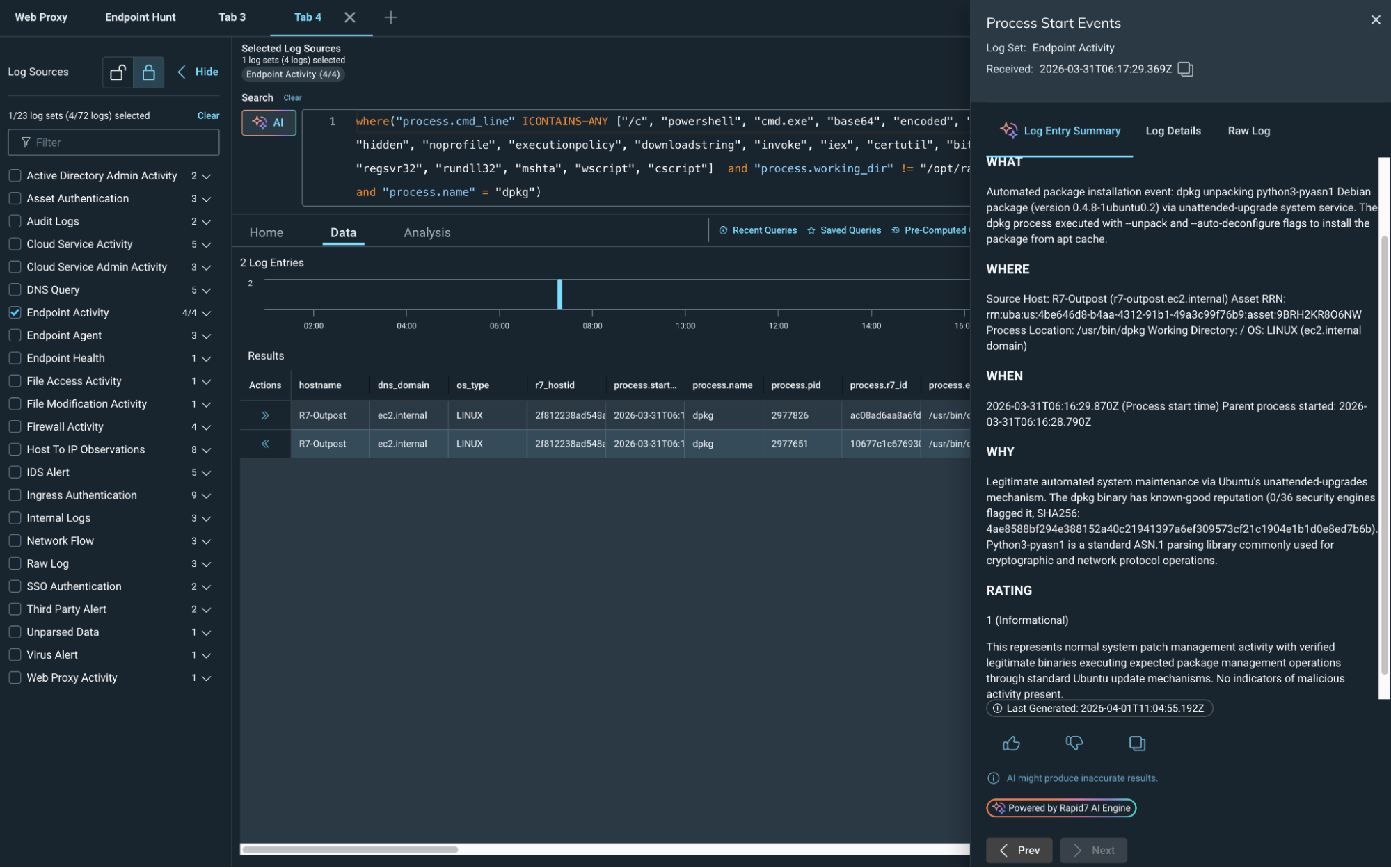
AI-Powered Log Summary in Rapid7 Incident Command transforms raw log data into a clear, concise narrative directly within the investigation workflow. Analysts see what happened, why it matters, and what to do next in seconds, not minutes.
Instead of decoding logs line by line, analysts get:
Instant identification of who initiated the activity.
Fast understanding of exactly which actions occurred.
Clarity into when and where events unfolded.
Connectivity into why that behavior matters.
Analysts stay grounded in the original data, but they no longer have to fight through it to find answers. The summary provides immediate orientation and focus, keeping their focus on what to do next.
AI-Powered Log Summary is embedded directly into the log search workflow. No pivoting, and no context switching. With a single action, analysts generate a contextual summary tailored to their results in seconds. That means faster investigations without breaking flow.
Summaries can be shared with teammates or leadership to communicate findings quickly, without rewriting technical details into plain language. Everyone stays aligned on what happened and what comes next.
AI integration in action
Rapid7 leverages the best available technology to protect our customers' attack surfaces. Our mission drives us to keep abreast of the latest AI advancements to deliver optimal value to customers while effectively managing the inherent risks of the technology. Integrating AI into our core processes enhances our operational security and underscores our commitment to ethical innovation.
At Rapid7, we are dedicated to leading responsibly in the AI space, ensuring that our technological advancements positively contribute to our customers, company, and society. Read more about how our TRiSM (Trust, Risk, and Security Management) is a foundational strategy that guides us in navigating the intricate landscape of AI with confidence and security.
Less noise, more impact
By reducing time spent parsing logs, teams can focus on what matters: containment, remediation, and proactive threat hunting.
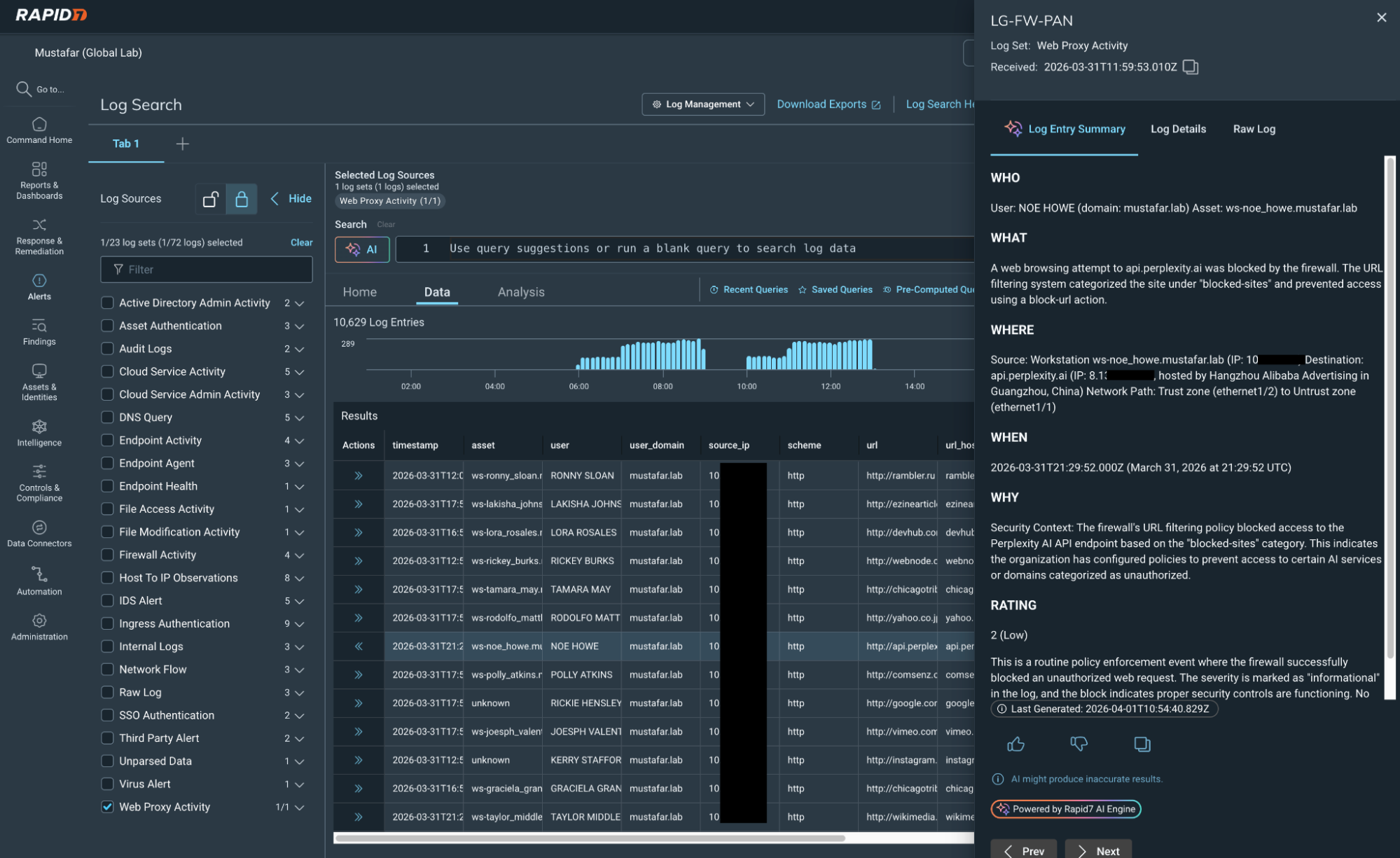
Figure 2: AI-Powered Log Summary Web Proxy Detail
⠀
This brings analysts:
Faster triage and investigations.
More consistent analysis across shifts.
Lower cognitive load during high-volume periods.
Clear communication to stakeholders.
Rapid7 is at the vanguard of integrating AI into its products to accelerate outcomes for our customers, with a particular focus on amplifying analyst impact and bringing speed and clarity to SOC operations throughout the threat detection and response lifecycle.
That is how modern SOC teams move faster. Visit the Incident Command page for more information.
This article explains why many breaches are driven by gaps in visibility rather than advanced exploits, how attackers move through modern environments, and what changes when organizations start connecting assets, identities, and attack paths into a single view.
What is a visibility problem in cybersecurity?
A visibility problem exists when security teams cannot clearly answer three basic questions: what assets exist, who or what can access them, and how those elements connect. When those answers are incomplete, decisions are made based on assumptions – and that creates conditions where risk can grow, unnoticed.
As environments expand across cloud, SaaS, and hybrid infrastructure, the number of systems and identities grows quickly. What often falls behind is a clear understanding of how they relate to each other, and that gap is where attackers tend to operate.
How visibility gaps turn into breaches
A large medical technology organization experienced a breach driven by a series of compounding gaps rather than a single exploit. Internet-exposed assets created the initial entry point, while inconsistencies in device posture and identity enforcement, including gaps in platforms like Intune, weakened the security boundary. Attackers leveraged exposed or reused credentials and over-permissioned access to move laterally across systems. Without unified visibility across assets, identities, and managed devices, the attack path remained invisible until critical systems were reached.
Each of these conditions is common on its own, but what makes them dangerous is how they connect.
Why most attacks are not about flashy exploits
This breach did not rely on a zero-day vulnerability or an advanced technique. It depended on an exposed asset, valid credentials, and inconsistent enforcement across identity and devices. Those elements exist in most environments, but without visibility into how they overlap, they can be combined into a viable attack path.
Security teams often evaluate vulnerabilities individually, while attackers focus on how those weaknesses can be chained together. The risk is not just in what is vulnerable, but in how exposure allows movement.
What a visibility-first approach looks like
Improving outcomes depends on understanding how exposure exists across the environment and how different elements relate to each other.
Asset visibility is the starting point. Many organizations cannot confidently identify everything that is externally accessible, and attackers often find assets that were never intended to be exposed. Continuously mapping assets across cloud and on-prem environments reduces that uncertainty and limits entry points.
Identity is just as critical. Once access is established, movement depends on credentials and permissions. Stolen credentials, over-permissioned accounts, and weak authentication paths allow attackers to move beyond initial entry. Treating identity exposure as part of the attack surface helps identify these risks earlier, especially when leaked credentials can be tied to active accounts and privileges.
Attack path visibility connects these elements. Instead of evaluating findings in isolation, it shows how exposures can be combined into realistic attack scenarios. Through adversarial simulation, organizations can observe how an attacker could move from an exposed system to internal resources, which shifts focus toward removing viable paths rather than addressing isolated issues.
External signals, such as credential leaks, only become meaningful when tied back to internal systems. Monitoring for exposed credentials is useful, but correlating those credentials with active accounts and access levels is what turns that signal into something actionable.
Controls such as least privilege and multi-factor authentication remain essential, but they are only effective when applied consistently. Without visibility into where access exists, enforcement gaps are difficult to detect.
Why visibility changes the security outcome
The difference in a scenario like this is not simply better tooling. It is a shift in how exposure is understood and prioritized.
Attackers look for the easiest path through an environment. A visibility-first approach identifies those paths earlier, reduces them, and then examines why they existed. That changes how teams prioritize work, moving from reacting to individual findings toward removing viable attack paths.
How this works in practice
This is where platforms like Rapid7 support a more complete view of exposure. Surface Command aggregates telemetry from over 190 sources, helping organizations unify fragmented views of assets and identities. InsightCloudSec extends that visibility into cloud environments by enforcing best practices and least privilege without relying on manual processes. Vector Command focuses on how attackers move, using continuous testing and simulation to show how attacks would unfold across an environment.
On the intelligence side, integrating threat data with identity systems allows external signals, such as credential leaks, to be mapped to active accounts and validated in real time. That makes it possible to act before those credentials are used.
Together, these capabilities provide a clearer understanding of how exposure translates into risk.
Putting visibility at the center of security
Zero trust depends on more than policy. It requires visibility, identity, validation, and enforcement to work together continuously.
Without visibility, zero trust becomes difficult to apply in practice. With it, security decisions can be based on how systems actually behave rather than how they are expected to behave, which shifts organizations away from reacting to incidents and toward preventing them from forming.
For years, cybersecurity professionals have relied on a familiar metric to dictate their day-to-day priorities: the Common Vulnerability Scoring System (CVSS). In today’s hyper-connected, sprawling IT environments, utilizing a static severity score as the ultimate arbiter of risk creates opportunities for threat actors. While defenders chase down theoretical, high-scoring alerts, adversaries are quietly targeting the truly exploitable, business-critical exposures that slip through the cracks.
In a recent report, Gartner® highlighted a projection:
"By 2028, organizations that prioritize exposures using threat intelligence, asset context, exploitability modeling and security control validation will reduce breach likelihood by at least 70% compared to peers relying primarily on CVSS-based vulnerability prioritization." [1]
This affirms what many seasoned practitioners have suspected for years: there’s an abundance of vulnerability findings, but a lack of actionable context.
Static scores. Reactive security.
Most vulnerability management programs evolved during a time when the attack surface was relatively static, adversary tooling was rudimentary, and remediation capacity generally exceeded the volume of new disclosures. Today, enterprises are confronted with vulnerabilities scattered across complex cloud architectures, SaaS applications, and intricate supply chains.
In this modern threat landscape, CVSS alone is insufficient because it measures theoretical severity, does not factor in whether an attacker is actually using the vulnerability in the wild, or consider the business value of any affected assets. According to Gartner®, fewer than 10% of vulnerabilities are exploited, yet most are treated as urgent [1]. This all leads to prioritization paralysis, where security teams spend countless hours patching vulnerabilities that pose low material risk to the business. The legacy approach rewards what is auditable rather than what is genuinely impactful.
The path toward smarter prioritization
To break free from endless patching and ineffective risk reduction practices, security professionals are shifting toward a context-driven model. As Gartner notes, strong exposure prioritization requires integrating four critical elements: threat intelligence, asset context, data science, and security control validation. Organizations are approaching these elements in a few practical ways:
Threat intelligence to establish relevance
Instead of just asking how severe a vulnerability is, modern exposure management asks whether an exposure is relevant to a threat actor who is capable of exploiting it right now. By embedding threat intelligence into each vulnerability finding, teams shift the focus from theoretical to risk active exploitation. It introduces the adversary's perspective by identifying known exploited vulnerabilities, public or private exploit availability, and targeted campaigns. By filtering out exposures with no evidence of attacker interest, organizations can instantly collapse large vulnerability backlogs and focus only on relevant threats.
Asset context and business criticality to define impact
Not all assets are created equal. A critical vulnerability on an isolated, internal test server is vastly different from the same vulnerability on a public-facing cloud workload processing customer sensitive data. Asset context enriches exposure data with crucial business information: what the asset is, its external accessibility, and its relationship to core business functions. Without this context, security teams waste disproportionate effort on low-impact systems, treating every critical alert as an equal emergency.
Exploitability modeling for predicting breach likelihood
Security analysts often struggle to assess exploitability given the overwhelming volume of vulnerabilities. By using predictive models like the Exploit Prediction Scoring System (EPSS), organizations can analyze large datasets of historical exploitation to identify latent risks. Exposure assessment platforms should display this data alongside each exposure finding to make it easier to predict the vulnerabilities most likely to become attacks.
Security control validation
An exposure that appears highly exploitable in theory might be neutralized by existing defenses. By integrating security and policy controls, you can evaluate exposures in the context of endpoint protection and identity management. This passive validation confirms whether an attacker can realistically exploit the exposure in your specific environment.
Unified exposure management
Individually, each element highlighted above provides incremental value, but when integrated, they fundamentally transform how prioritization decisions are made. This integrated model ensures that remediation efforts are mobilized only after priorities have been validated in the context of the business and the current threat landscape. It transitions vulnerability management from a purely technical, tool-centric exercise into a strategic, process-driven risk decision.
Security leaders must measure success not by the sheer number of vulnerabilities closed, but by the demonstrable reduction of exploitable exposures and the alignment of remediation efforts with actual attacker behavior. Operationalizing these four elements requires a unified platform that eliminates the silos between vulnerability management, cloud security, and threat intelligence. You cannot manually stitch together disconnected spreadsheets and hope to outpace modern adversaries. This is where forward-thinking organizations are leaning on comprehensive, end-to-end solutions like Rapid7 Exposure Command that seamlessly aggregate visibility across on-premises and dynamic cloud environments. With deep, native integration of Rapid7 Cloud Security capabilities, teams can instantly map asset criticality and external accessibility within complex, ephemeral cloud architectures. Furthermore, by infusing world-class threat intelligence and active exploit data directly into exposure findings, Rapid7 enables security teams to cut through the noise, validate security controls, and pinpoint the exact exposures that matter most—all with minimal friction.
[1] Gartner, Prioritize What Attackers Will Exploit: 4 Elements of Strong Exposure Prioritization, Jonathan Nunez, 5 March 2026.
Security leaders rarely struggle to produce data. The challenge is turning that data into something the board can use to make decisions.
Walk into a board meeting with a slide showing 1,200 critical vulnerabilities and 44 internet-facing assets, and you will likely see polite acknowledgment rather than meaningful discussion. The question that follows tends to cut through quickly: what does this mean for the business?
Boards allocate capital based on financial exposure, not vulnerability counts. A list of findings describes workload, but directors are responsible for revenue protection, liability, and risk to the balance sheet. When security reporting remains technical, it sits outside the way investment decisions are made elsewhere in the organization. The issue is less about communication and more about framing the problem in terms the business already understands.
From severity to risk
CVSS measures theoretical severity, but it does not measure business risk. A high score indicates that a flaw could be dangerous, yet it does not tell you whether the vulnerability is reachable in your environment, whether exploit code exists, or whether it is likely to affect revenue in the near term. It answers a useful engineering question, but it does not answer the question the board is asking.
That question is about likelihood and impact. Most enterprise risk frameworks define risk in those terms, and that is how financial decisions are made. The gap becomes clear when two vulnerabilities appear similar on a dashboard but carry very different consequences. A high-CVSS issue on a segmented lab system may present little business risk, while a moderately severe vulnerability on an internet-facing production system with active exploit activity can expose regulated data and revenue streams.
What is often missing in that comparison is threat context. Understanding how attackers behave, which vulnerabilities they are exploiting, and where access paths actually exist changes how risk is interpreted. Active Risk in InsightVM brings those elements together by combining exploit telemetry, attacker behavior, and asset context to estimate the likelihood that a vulnerability will be used. When that likelihood is paired with business impact, the conversation shifts toward exposure rather than severity.
From CVSS scores to financial exposure
Prioritization alone does not translate into board-level decisions. Knowing what is most likely to be exploited is necessary, but it is not sufficient when the goal is to justify investment.
FAIR provides a way to bridge that gap. The model defines risk as a combination of how often a loss event is likely to occur and how much that event would cost. In practical terms:
Annualized Loss Exposure (ALE) = Loss Event Frequency × Probable Loss Magnitude
Active Risk informs the likelihood side of that equation by grounding it in observed attacker behavior and exploit activity. FAIR converts that likelihood into financial terms, allowing security teams to describe exposure in a way that aligns with how capital is allocated.
Instead of reporting that a set of vulnerabilities is “high risk,” the discussion becomes more concrete. A team might say that a group of issues represents several million dollars in annualized exposure across systems tied to revenue. That is a number that can be evaluated alongside other business risks, rather than interpreted as a technical signal.
A practical example
Consider two vulnerabilities identified during a scan. The first is a CVSS 9.8 issue on a segmented guest Wi-Fi router. It is severe from a technical standpoint, but it has no access to sensitive data, no path into production systems, and no evidence of active exploitation.
The second is a vulnerability with a moderate CVSS score on an internet-facing customer database. Public exploit code exists, and the system stores regulated data tied directly to revenue and compliance obligations.
On a scanner dashboard, the first may appear more urgent. When viewed through a financial lens, the second carries greater risk.
Assume an annual probability of exploitation of 20 percent for the database scenario. If the potential impact includes $750,000 in incident response, $1.2 million from several days of business interruption, $600,000 in legal and regulatory costs, and $1 million in customer churn and reputational damage, the total loss for a single event is $3.55 million.
Applying the FAIR model results in approximately $710,000 in annualized exposure. That figure reflects the risk carried by that single vulnerability on a production system.
By contrast, even if the Wi-Fi router vulnerability had a 5 percent probability of exploitation and a $50,000 impact, the resulting exposure would be around $2,500. Both findings may appear critical in a technical report, but only one represents a material financial concern.
This is where Active Risk and FAIR work together. One identifies where attackers are likely to act, and the other expresses the consequence in financial terms. The combination changes how vulnerabilities are evaluated and how priorities are set.
Visualizing exposure across your environment
Once risk is expressed in financial terms, the next step is to understand how that exposure is distributed. Boards tend to think in terms of portfolios rather than individual issues, and the same principle applies to cybersecurity.
In most environments, exposure is not evenly spread. A relatively small number of systems and vulnerabilities account for a large portion of potential loss. Internet-facing services, systems tied to revenue, and assets with known exploit activity often sit at the higher end of that distribution.
This creates a practical way to focus effort. Rather than attempting to address every vulnerability equally, teams can identify where exposure is concentrated and reduce risk in those areas first. In many cases, addressing a small number of issues can significantly reduce overall exposure, particularly when those issues sit on systems that are both reachable and business-critical.
A before-and-after view helps make this visible. If an organization reduces modeled exposure from several million dollars to a substantially lower figure through targeted remediation, the result can be explained in terms of reduced downside risk rather than increased patching activity. Over time, tracking that change shows whether investments are producing measurable outcomes.
Making risk actionable
By the time exposure is expressed in financial terms, the discussion in the boardroom has already shifted. The focus moves away from counts and severity toward risk, trade-offs, and acceptable levels of exposure.
One of the first issues that arises in that context is the assumption that risk should be driven to zero. In practice, eliminating all exposure is neither achievable nor economically sensible. Reducing risk always involves trade-offs, and those trade-offs become clearer when expressed in financial terms.
If an organization has already reduced exposure significantly, but further reduction requires a disproportionate increase in cost, the decision becomes one of balance. The question is no longer why risk still exists, but whether the remaining exposure aligns with the organization’s tolerance.
The same logic applies when discussing budget. Requests framed in operational terms, such as additional headcount or tooling, are difficult to evaluate in isolation. When those requests are tied to measurable reductions in exposure, the relationship between cost and benefit becomes clearer.
For example, if additional resources reduce several million dollars of modeled exposure at a fraction of that cost, the investment can be assessed alongside other initiatives using the same financial lens. At that point, the discussion is no longer about capacity. It is about risk reduction.
Putting security in business terms
Reducing exposure also affects how the organization is perceived externally. Cyber insurance underwriting, for example, increasingly considers factors such as attack surface, exploit availability, and remediation speed. Demonstrating that exposure is measured and reduced over time can influence how risk is priced.
The same applies during customer due diligence. Being able to explain where risk exists, how it is prioritized, and how it has been reduced provides evidence of maturity. It shows that security is being managed deliberately rather than reactively.
Aligning to risk tolerance
Productive board discussions tend to end with agreement on acceptable levels of exposure. Without a financial view, every issue can appear urgent. With it, prioritization becomes more grounded.
Leadership can evaluate whether the level of risk being carried is consistent with business objectives, and whether further investment is warranted. That shifts vulnerability management from a process focused on volume to one focused on where exposure is concentrated and how it can be reduced most effectively.
Clear exposure, clearer decisions
Vulnerability management has often been treated as an operational activity centered on patching and scanning. When combined with threat context and financial modeling, it becomes part of enterprise risk management.
Instead of reporting how many vulnerabilities exist, security leaders can describe how much exposure the organization carries. Instead of focusing on activity, they can show how targeted actions reduce risk over time. That framing aligns cybersecurity with the same decision-making process used across the rest of the business.
When exposure is clear, decisions become clearer. Leadership can determine where to accept risk, where to transfer it, and where to invest in reduction. The conversation with the board moves away from technical detail and toward measurable impact, which is where security becomes part of strategy rather than an isolated function.
Following our recent published advisories, this publication is intended to outline a summary of the cyber activities associated with the tension. Based on the available information, we believe the conflict is beginning to show signs of expanding beyond a strictly regional crisis. Initial threat reporting pointed to a measurable increase in cyber activity linked to the crisis predominantly focused on hacktivist mobilization, with reports of phishing campaigns, and claims of data theft and disruptive operations. For a companion piece focused around our customers, dive into Rapid7 Detection Coverage for Iran-Linked Cyber Activity.
Cyber activity by groups associated with Iran and their affiliated ecosystems have begun to surface. Much of the visible activity currently appears to have limited immediate operational impact as it consists primarily of website defacements, distributed denial-of-service (DDoS) attacks, coordinated messaging campaigns, phishing attempts, and reconnaissance against exposed digital infrastructure. While these incidents may appear opportunistic or symbolic, historical patterns of such behavior suggest that this activity can represent early-stage signaling, pressure, and preparatory shaping operations rather than isolated disruption.
Iran’s cyber ecosystem operates through a layered structure that includes state-linked advanced persistent threat (APT) groups, proxy actors, hacktivist personas, and sympathetic foreign collectives. Even when not centrally coordinated, these actors often converge on the same narratives and target sets during geopolitical crises, enabling simultaneous visible disruption and covert intelligence-driven intrusion activity. As the conflict evolves, this ecosystem provides a scalable and deniable tool for retaliation that can gradually intensify.
It is very likely that the cyber risk will widen accordingly as the current conflict continues. Governments and organizations located in regions hosting U.S. military infrastructure or closely aligned with U.S. and Israeli positions may face increased exposure, particularly across sectors such as logistics, critical infrastructure, public administration, energy, and telecommunications.
Strategic context and operational trends
Iran does not operate according to a single publicly articulated cyberwarfare doctrine. Instead, its cyber strategy has evolved pragmatically as part of the country’s broader asymmetric security model. Since 2010, there has been an expansion of its cyber capabilities as instruments for intelligence gathering, internal control, retaliation, coercive messaging, and regional influence. Cyber operations are therefore best understood not as a separate military domain with a fully transparent doctrine, but as an adaptable component of the regime’s survival and strategic competition against outsiders.
Broadly speaking, Iranian cyber activity tends to serve three overlapping strategic objectives. The first is regime security and domestic control, in which cyber tools support surveillance, information control, and disruption of dissident or opposition networks. The second is strategic intelligence collection, in which state-linked actors target governments, defense organizations, technology providers, telecommunications firms, and critical infrastructure to gather political, military, and economic intelligence. The third is coercive signaling and regional influence, in which cyber operations impose costs on adversaries, shape perceptions, and demonstrate retaliatory capability while remaining below the threshold of overt interstate war.
A key feature of this regime’s approach is the development of long-term access. Iranian APT groups often conduct sustained intrusion campaigns focused not only on immediate collection but also on access persistence, credential harvesting, and network familiarity. In a crisis environment, these pre-existing footholds can become strategically important, supporting either intelligence collection or later disruptive operations. This is one reason current low-visibility intrusions deserve as much analytical attention as public hacktivist claims. The visible DDoS or defacement campaign may dominate headlines, but the more significant strategic risk often lies in covert access established inside other targets.
Another defining feature of Iran’s cyber strategy is its layered operational model. State-linked APT groups frequently operate alongside contractors, proxies, persona-driven influence actors, and hacktivist collectives. This structure offers several advantages: it creates deniability, increases operational tempo; broadens the range of possible targets; and allows Iran-aligned ecosystems to combine disruptive spectacle with intelligence-driven depth. During periods of heightened tension, this blended model enables visible pressure operations to coexist with quieter espionage or pre-positioning campaigns. Current reporting on the conflict strongly supports this interpretation, with activist and proxy campaigns surging in parallel to concern over state-linked phishing, malware, wipers, and infrastructure-focused targeting.
Iran’s threat actor landscape
State sponsored
Iran’s cyber capabilities are distributed across a hybrid ecosystem of state institutions, intelligence services, military structures, and semi-official operators. Rather than relying on a single centralized cyber command, Tehran appears to allocate responsibilities across different organs, primarily the Islamic Revolutionary Guard Corps and the Ministry of Intelligence and Security, with support from contractors, front entities, and affiliated personas. Strategic coordination of the cyber domain is overseen by the Supreme Council of Cyberspace, while operational activities are carried out through a mix of official and semi-official channels.
IRGC-linked actors
The Islamic Revolution Guard Corp (IRGC) maintains one of Iran’s most visible offensive cyber capabilities and has been associated with cyber espionage, influence operations, credential theft, and politically aligned disruptive activity. Among the principal IRGC-linked actors are APT35 (also known as Charming Kitten or Mint Sandstorm), which has long conducted spear-phishing and credential-harvesting operations against diplomats, journalists, researchers, and policy communities; APT42 is an actor particularly associated with surveillance and social engineering targeting dissidents, activists, journalists, and policy experts. Cotton Sandstorm (also known as Holy Souls and Emennet Pasargad), meanwhile, has been linked to both espionage and influence-oriented operations targeting regional adversaries and Western institutions. Recent reporting also highlights continued concern around malware associated with this broader actor set, including infostealing and espionage tooling used in phishing-led operations.
MOIS-linked actors
The Ministry of Intelligence and Security (MOIS) operates parallel cyber capabilities that tend to emphasize intelligence collection, long-term access, and strategic espionage. The most prominent groups in this cluster include MuddyWater and OilRig (also known as APT34). CISA has previously described MuddyWater as an Iranian government-sponsored actor conducting cyber espionage and malicious cyber operations across multiple sectors, while current reporting continues to place the group among the most operationally relevant Iranian state-linked threats in the present crisis environment. OilRig remains a longstanding espionage actor focused on governments, financial institutions, energy entities, and other strategic organizations.
These actors illustrate Iran’s distributed cyber-operational model: Intelligence-driven access development, influence, psychological pressure, and opportunistic disruptive action are not separate lines of effort but parts of a broader strategic continuum.
Parallel hacktivist and proxies
Beginning in June 2025, a noticeable surge in hacktivist and proxy cyber activity accompanied the broader escalation of tensions in the Middle East. This reflects a recurring pattern observed during previous geopolitical crises, in which ideologically aligned non-state cyber actors mobilize alongside, or in parallel with, state-linked cyber operations. In the current confrontation, this dynamic has again expanded the cyber landscape beyond traditional state-directed espionage or sabotage.
By early March 2026, several dozen hacktivists or proxy collectives emerged related to the conflict. These groups vary significantly in capability and reliability. Some focus on distributed denial-of-service (DDoS) attacks, while others conduct website defacements or hack-and-leak campaigns. Some primarily amplify claims of compromise that are exaggerated or only partially verifiable. Their significance, therefore, lies less in technical sophistication than in the cumulative pressure they place on defenders and the broader information environment.
In crisis situations, this activity can produce strategic effects. Numerous low-impact incidents can consume defensive resources, complicate attribution, and obscure more sophisticated intrusions occurring simultaneously. Hacktivist campaigns may therefore function as distractions, signals, or psychological pressure while more capable actors pursue quieter access to high-value networks. For this reason, the analytical distinction between advanced persistent threat (APT) activity and hacktivism can become blurred during periods of geopolitical confrontation.
Several collectives active in the current environment publicly position themselves as ideologically aligned with Iran or with members of the so-called “Axis of Resistance.” Among the more visible groups are Handala Hack Team, Dienet, FAD Team, APT IRAN, Cyber Islamic Resistance, and Fatimion cyber team.These actors frequently frame their operations as retaliatory cyber campaigns targeting Israeli, Western, or allied regional entities, claiming responsibility for activities such as website defacements, DDoS attacks, and hack-and-leak operations targeting mainly government, telecommunications, energy, and financial entities. Although many claims remain difficult to verify independently, their messaging strategy often emphasizes their psychological and reputational impact.
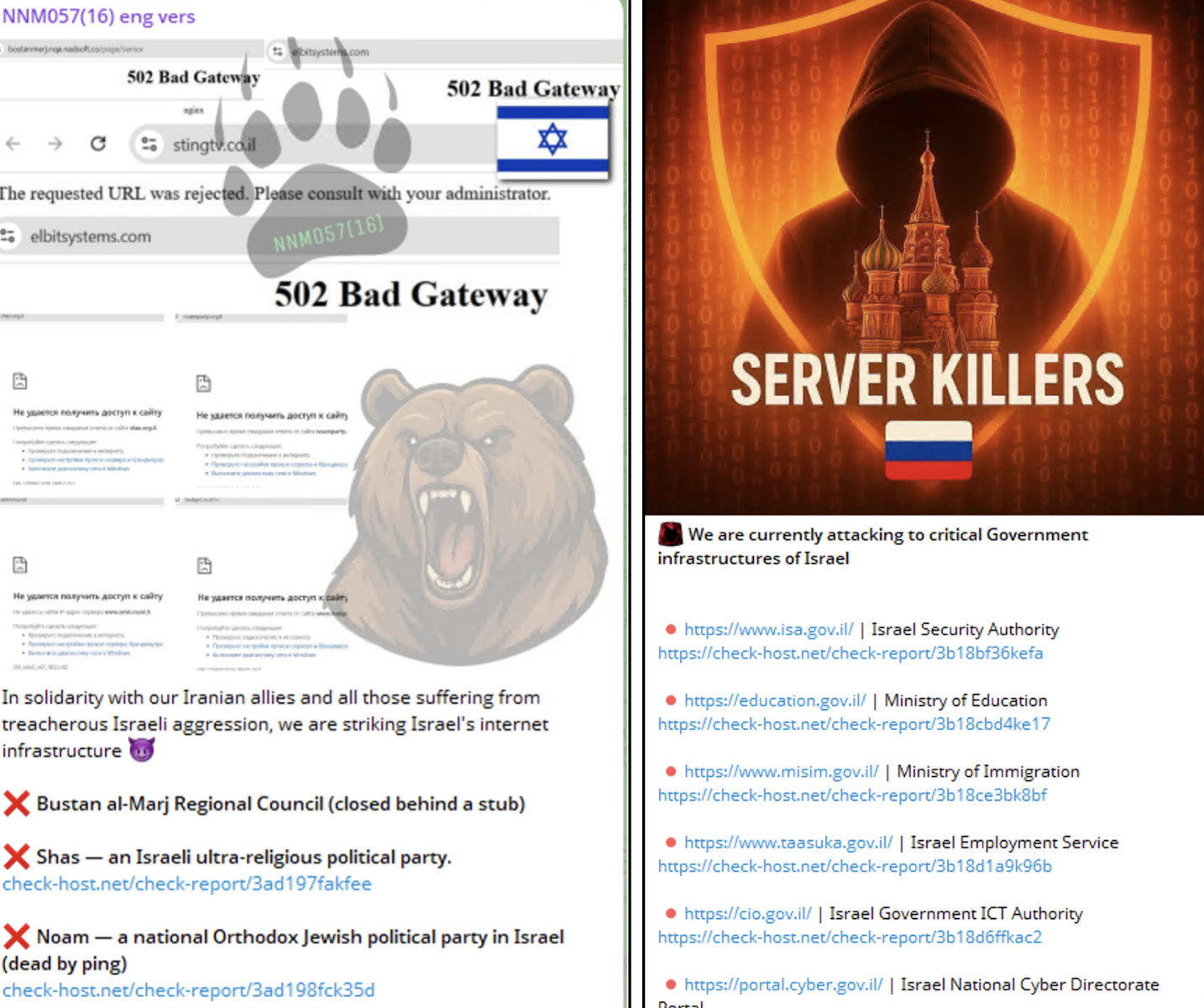
In parallel, several pro-Russia hacktivist groups have also engaged in operations linked to the confrontation, including NoName057(16), Sever Killer, and Russian Legion. These groups typically conduct large-scale DDoS campaigns targeting government portals, financial services, and transportation or telecommunications infrastructure in states perceived as supporting Israel or broader Western policy positions. Their participation illustrates how regional conflicts can attract cyber actors from outside the immediate theater when ideological alignment or strategic narratives converge.
Cyber activities linked to the ongoing conflict
Iranian APT group operations
Beyond the highly visible hacktivist activity circulating on social media, defacement platforms, and Telegram channels, a quieter but more strategically significant layer of cyber operations is unfolding through Iranian state-linked APT groups. These operations appear ongoing and aligned with broader geopolitical objectives tied to the current conflict environment.
Recent threat reporting indicates continued operations by the Iranian APT group, MuddyWater, which is widely assessed to be linked to MOIS. Since at least early February 2026, reporting has suggested potential compromises or attempted intrusions targeting organizations associated with the United States and allied interests.
According to public reporting, activity linked to the group was reportedly observed within the networks of a United States–based bank, a United States airport, a nonprofit organization operating across the United States and Canada, and a software company with operations in Israel. In several of these incidents, threat actors reportedly deployed a previously undocumented backdoorknown as Dindoor, suggesting a coordinated, ongoing campaign rather than isolated compromise events.
Hacktivist and proxy disruption activities
The most visible form of cyber activity so far remains hacktivist and proxy-led disruption.
DDoS attacks are among the most common tactics employed by hacktivist groups. Pro-Russia groups such as NoName057(16) and Server Killers, along with other pro-Iran collectives affiliated with them, have been linked to waves of coordinated DDoS attacks against Israel, Qatar, Bahrain, and other politically symbolic targets. These attacks are generally inexpensive and cause only short-term technical damage, but they remain strategically useful because they disrupt public services, tie up defense resources, generate media coverage, and fuel the narrative of a sustained cyber response.
Figure 1: Telegram post from pro-Russia hacktivist groups claiming responsibility for targeting an Israeli website in support of Iran
⠀
Website defacement also remains a common tactic. Groups such as FAD Team, 313, and Cyber Islamic Resistance have been associated with claims of attacks on several websites. Although defacements are technically simple to execute, they remain analytically significant: They are highly visible, rapidly disseminated, and psychologically impactful, often creating an exaggerated perception of widespread systemic compromise.
Data breaches represent a far more significant dimension of cyber operations. The Iranian-aligned group Handala, in particular, continues to blend political messaging with claims of data theft and the selective release of allegedly compromised information. The group recently asserted that it had infiltrated a Saudi energy company and exfiltrated internal documents, framing the operation as a combination of data exfiltration, coercive pressure, and psychological warfare targeting the energy sector. Even when the full authenticity of released datasets cannot be independently verified, the publication of partially credible material can still generate substantial reputational damage and potential operational disruption for affected organizations.
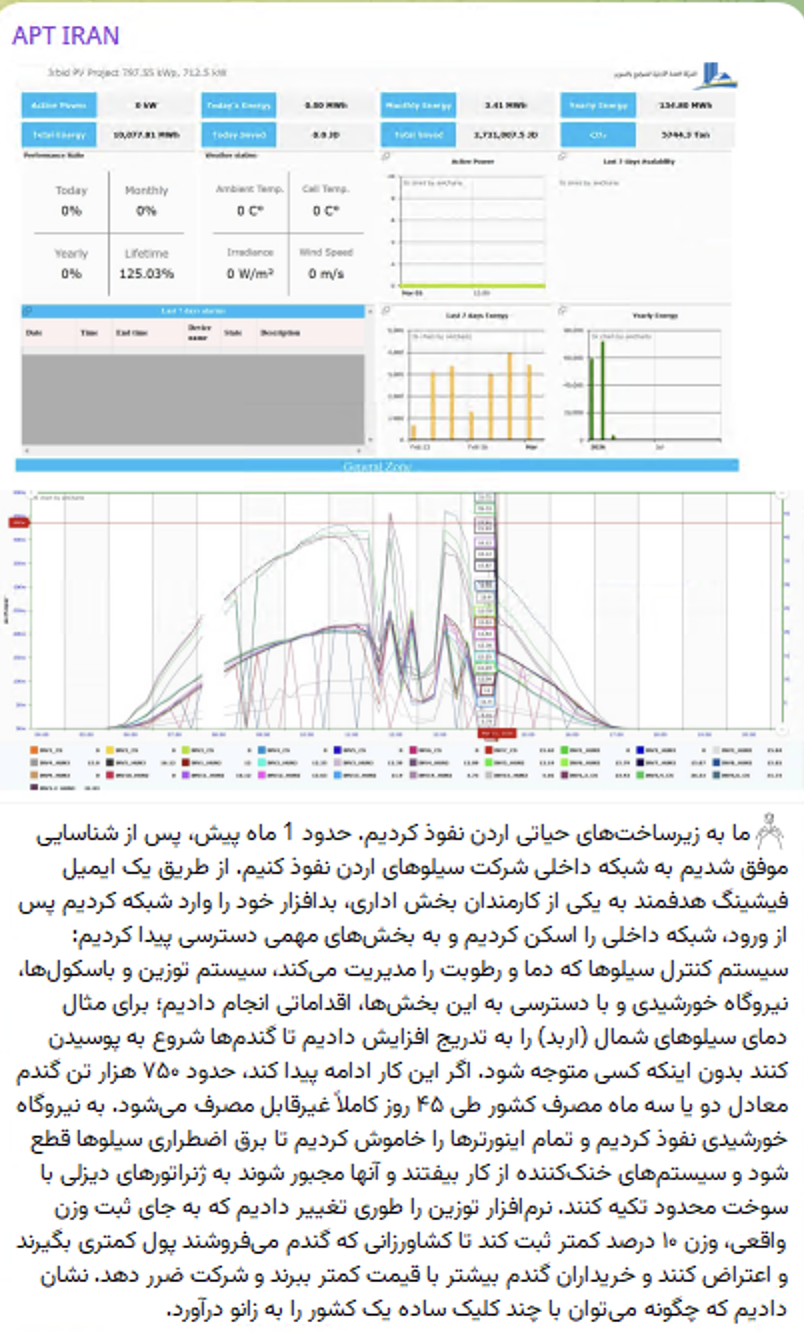
Targeting critical infrastructure has emerged as one of the most concerning aspects of the current cyber activity by pro-Iran hacktivists and proxy collectives. Groups operating in this ecosystem, including Iranian APTs, Handala, and networks associated with the Cyber Islamic Resistance umbrella, have publicly claimed operations targeting infrastructure across the region. Recent Telegram posts indicate that an Iranian APT group claimed responsibility for attempts to sabotage Jordanian critical infrastructure, while other Iran-aligned hacktivist personas have asserted access to sectors including fuel systems, water utilities, and other operational technology environments.
In a separate case, the Handala Hack Team has alleged that it compromised both Oil and gas companies in the United Arab Emirates and Israel, claiming to have exfiltrated more than 1.3 TB of sensitive data from oil and gas sector networks. These claims, which would represent a significant intrusion into Middle Eastern energy infrastructure if confirmed, have circulated primarily through hacktivist communication channels and social media reporting and have not been independently verified.
Figure 2: IRAN APT group claimed attempts to target Jordanian critical infrastructure
⠀
Although many of these claims remain difficult to independently verify, the recurring focus on industrial control systems and essential services is analytically significant. Hacktivist collectives aligned with Iranian geopolitical narratives frequently leverage infrastructure-related claims as part of information operations designed to amplify perceived impact, generate psychological pressure, and signal the potential for escalation into operational technology environments. Even when technical disruption is limited or exaggerated, the persistent narrative around infrastructure compromise can shape defensive priorities and highlight potential escalation pathways within the broader cyber conflict.
Sectoral exposure and risk landscape
In the current geopolitical context, cyberattacks extend far beyond military networks and defense institutions. Modern cyber operations increasingly aim to affect the broader ecosystem that supports government activity, economic stability, and public trust. Consequently, adversaries seek not only technically vulnerable targets but also organizations whose compromise or disruption can increase visibility, influence public perception, or create cascading effects across interconnected systems.
A successful intrusion into a widely used service provider, a major infrastructure operator, or a publicly accessible institution can quickly produce consequences that extend far beyond the initial target, affecting supply chains, service availability, and public confidence. In this context, cyber operations often serve multiple purposes simultaneously: intelligence gathering, strategic positioning within critical networks, and generating disruption or exerting influence during periods of heightened geopolitical tension.
At present, several sectors appear particularly exposed:
Government institutions and public administration
Defense and aerospace industry
Energy sector, including oil, gas, and electricity
Telecommunications providers
Financial services
Transportation systems
However, the risk landscape extends beyond these sectors themselves. Organizations that form part of the broader digital supply chain supporting these industries may also represent attractive entry points. This includes cloud service providers, managed service providers, technology vendors, and other third-party platforms that maintain privileged access to client environments. Compromising such intermediaries can allow adversaries to reach high-value targets indirectly. By gaining access to a supplier or service provider, attackers may obtain pathways into multiple networks simultaneously, access sensitive information, or move laterally across interconnected operational systems. Supply chain compromise, therefore, offers both scale and stealth, making it an increasingly common tactic in sophisticated cyber campaigns.
Geopolitical alignment can also influence targeting decisions. Organizations based in countries that host United States military assets or are publicly aligned with United States or Israeli policy positions may attract additional attention from adversaries. In these cases, targeting can carry symbolic, political, or strategic value beyond the immediate technical impact of the intrusion. Within this environment, cyber exposure can generally be understood through three overlapping targeting dynamics.
Symbolic targets include municipalities, universities, media outlets, and public institutions. These organizations may be targeted primarily for visibility, messaging, or propaganda purposes. Even limited disruption or data exposure can generate headlines and amplify the perceived reach of the attackers.
Operational targets include sectors that support everyday economic and social activity, such as telecommunications providers, transportation systems, payment networks, and fuel distribution infrastructure. Disruptions in these areas can quickly affect daily life, creating public anxiety and increasing pressure on authorities to respond.
Strategic targets consist of entities whose compromise offers long-term intelligence or operational value. This category includes defense contractors, major financial institutions, government networks, and operators of critical infrastructure. In these cases, adversaries may prioritize persistence and stealth to collect intelligence, monitor decision-making processes, or maintain access that could be leveraged during future crises.
Taken together, these targeting patterns illustrate a broader shift in cyber operations: Attackers are increasingly selecting targets not only for their intrinsic value, but for the broader political, economic, and societal effects that disruption or compromise can produce.
What should organizations monitor?
In the current phase of the conflict, organizations should continue to monitor for indicators that activity is shifting from opportunistic disruption toward deliberate intrusion or access preparation.
Internet-facing infrastructure is often the initial entry point. Elevated scanning or probing of public websites, VPN gateways, remote access portals, cloud services, and email authentication infrastructure may indicate early reconnaissance. While some scanning is routine, sudden increases in probing activity or authentication attempts should be treated as potential precursors to intrusion.
Phishing and social engineering campaigns are also likely to intensify. Threat actors may exploit developments in the conflict by using lures that reference civil defense alerts, battlefield updates, humanitarian messaging, or urgent requests that appear to originate from leadership or trusted partners. In some cases, malicious applications or replicas of legitimate services may be used to harvest credentials or deploy malware.
Credential misuse remains a primary access vector. Security teams should monitor for abnormal authentication patterns, including logins from unusual geographic locations, access at unexpected hours, repeated failed logins followed by success, changes to multi-factor authentication settings, or the creation of new privileged accounts.
Organizations operatingcritical infrastructure should closely monitor activities within their operational environments. Suspicious access to remote management platforms, unusual connectivity between IT and OT networks, or unexpected activity involving engineering workstations or vendor access channels may signal reconnaissance within sensitive systems.
Finally, monitoring the broader information environment can provide early warning and signal the need to increase monitoring. Hacktivist groups frequently use platforms such as Telegram and X to circulate target lists, claim attacks, or release fragments of allegedly stolen data tied to geopolitical events. Tracking these channels can help organizations identify potential targets and strengthen their defensive posture before malicious activity reaches their networks.
Microsoft is publishing 77 vulnerabilities this March 2026 Patch Tuesday. Microsoft is aware of public disclosure of two of today’s vulnerabilities, but without evidence of exploitation in the wild for any (yet), so there are no Microsoft additions to CISA KEV today. Earlier in the month, Microsoft provided patches to address nine browser vulnerabilities, which are not included in the Patch Tuesday count above.
SQL Server: zero-day remote EoP
SQL Server often goes several months in a row without any mention on Patch Tuesday. Today, however, all versions from the latest and greatest SQL Server 2025 back as far as SQL Server 2016 SP3 receive patches for CVE-2026-21262, a SQL Server elevation of privilege vulnerability. This isn’t just any elevation of privilege vulnerability, either; the advisory notes that an authorized attacker can elevate privileges to sysadmin over a network. The CVSS v3 base score of 8.8 is just below the threshold for critical severity, since low-level privileges are required.
Microsoft is aware of public disclosure, so while they assess the likelihood of exploitation as less likely, it would be a courageous defender who shrugged and deferred the patches for this one. Most SQL Server admins and security teams concluded many years ago that exposing SQL Server directly to the internet was not a good idea. Then again, popular search engines for internet-connected devices describe tens of thousands of SQL Server instances, and they can’t all be honeypots.
What could an attacker do as SQL Server sysadmin? Beyond exfiltrating or interfering with the database itself, the obvious target is xp_cmdshell, which allows direct callouts to the underlying OS. The good news is that xp_cmdshell is disabled by default as far back as SQL Server 2005; the bad news is that anyone acting as SQL Server sysadmin can enable it in seconds. At that point, the attacker is acting with the full privileges of the security context under which SQL Server runs, which is ideally a purpose-built account designed with least privilege in mind. If you want to hear some hair-raising stories, you have only to ask any incident response veteran if they’ve ever seen it set up differently.
Anyone paying for Extended Security Updates (ESU) for SQL Server 2014 or SQL Server 2012 may be forgiven for wondering why there’s no security update for those venerable versions of the world’s most widely deployed closed-source database product. We can hope that the vulnerability described by CVE-2026-21262 was introduced in newer codebases only.
.NET: zero-day DoS
Attackers fond of low-effort denial of service attacks against .NET applications will be checking out CVE-2026-26127 today. Microsoft is aware of public disclosure. While the immediate impact of exploitation is likely contained to denial of service by triggering a crash, opportunities for other types of attacks might emerge during a service reboot. Alternatively, if a log forwarder or security agent is impacted, even for a brief period of time, an attacker might carry out an attack in that moment hoping to evade detection under cover of this artificial darkness. Even if a low-skilled attacker simply causes downtime, in some contexts that could be enough to cause an SLA breach or loss of revenue, or at the very least cause a bleary-eyed defender to get paged in the middle of the night.
Authenticator: QR code impersonation
Microsoft Authenticator mobile app users on both iOS and Android should update to the latest version to prevent exploitation of CVE-2026-26123, which involves a malicious app disguising itself as Microsoft Authenticator. Exploitation succeeds when the malicious app receives enough information to impersonate the user.
Authenticator-type apps are often installed on a personal device, but it's not unusual for them to provide multi-factor authentication (MFA) codes for production services in a bring-your-own-device context. This is as good a time as any for defenders to consider how well their mobile device management policy covers app choice enforcement and patching for MFA apps.
The CVSS v3 base score of 5.5 might appear unremarkable, and exploitation requires user interaction, since the user must install the malicious app in the first place. However, exploitation could begin via an attacker-controlled link, or even a malicious QR code that drives users to the malicious app, and a motivated attacker with a physical presence near the user base might well consider this option.
According to Khaled Mohamed, the researcher who discovered this vulnerability, the legitimate Microsoft Authenticator app did not previously register itself as the handler for deep links into its own custom URL scheme. A malicious app could exploit this gap by simply registering itself as the default handler. He further notes that in this scenario, a user of a mobile device with a malicious app installed only needs to click a generic “Open link” dialog, rather than expressly selecting the malicious app each time. This means that the Microsoft advisory is perhaps too optimistic about how much user interaction is required to trigger exploitation.
Microsoft ranks this vulnerability as important on their proprietary severity scale. The advisory also provides a brief peek behind the curtain, since the executive summary notes that “Cwe is not in rca”. The weakness listed on the advisory is CWE-939: Improper Authorization in Handler for Custom URL Scheme.
Microsoft lifecycle update
There are no significant Microsoft product lifecycle changes this month, unless you are responsible for a Microsoft SQL Server 2012 Parallel Data Warehouse instance, which moves beyond extended support as of March 31st. It would be wise not to count on a last-minute extension, since Microsoft has already granted a six month reprieve.

 Login
Login