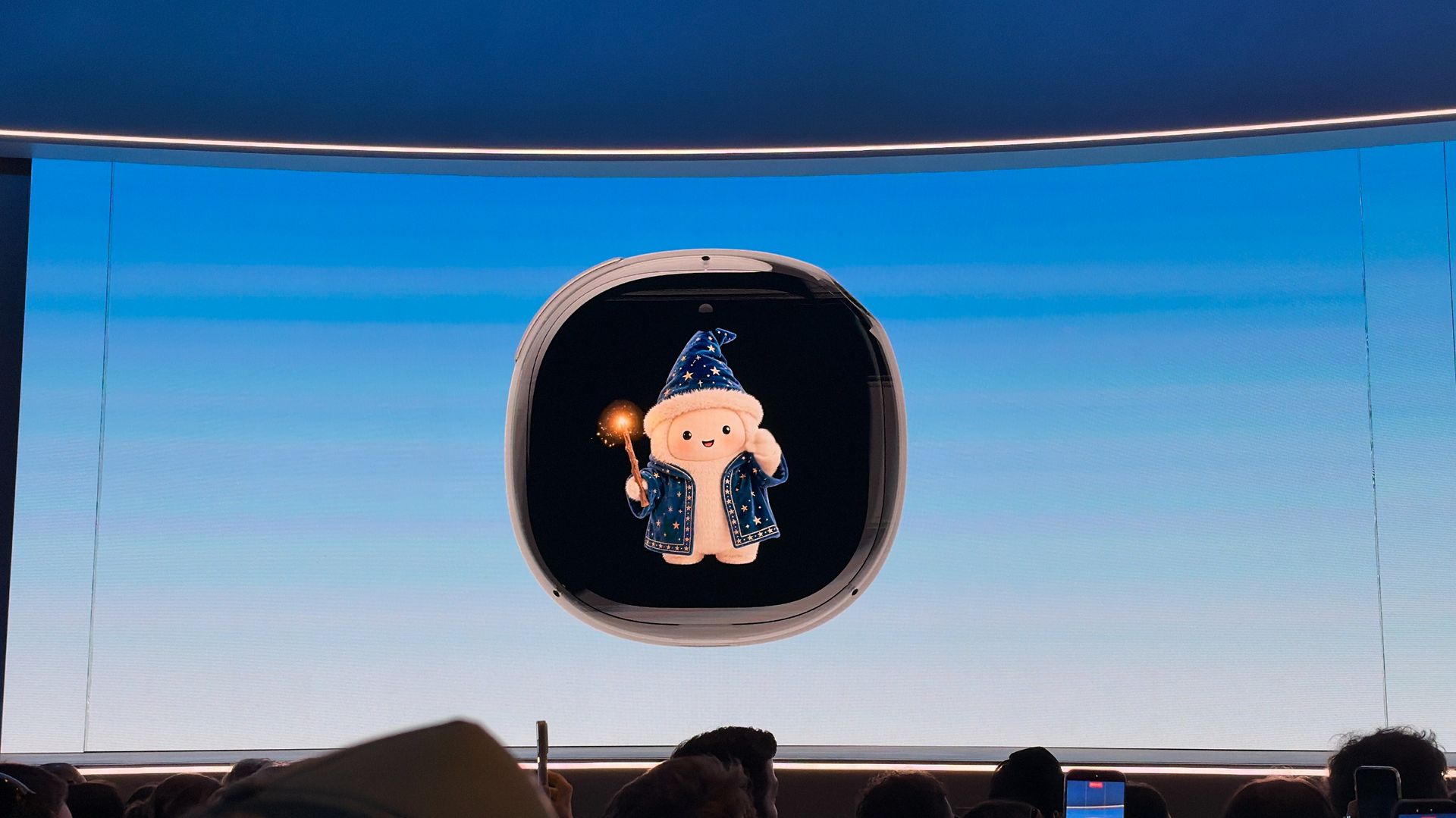
It’s not a Tamagotchi, but Mark Zuckerberg’s one more thing is just as cute and hopefully much more functional. Announced at the very end of Meta Connect 26 keynote — after the Meta VR Glasses and Meta Ray-Ban Audio — was Muse Charm.
A tiny silver square with a screen on the front and thicker black bezels, central to the experience is the display that shows off your custom Muse. It’s probably more of a squircle and had what looks like a wrist strap dangling from the bottom, seemingly showing off easy portability. Distinctly, you don't wear it, and since we didn't see buttons, it's a touchscreen, maybe an OLED or AMOLED.
Judging from the on-screen renders, it had a microphone on top, so you could communicate with your Muse from anywhere, essentially putting the already very popular Muse assistant quite literally in the palm of your hand.
Mark Zuckerberg was quick to note that Muse Charm is not ready just yet, but the hope is it will ship by the holidays. It’s also a brand-new device category for Meta: a true AI wearable distinct from glasses, focused entirely on Muse's capabilities and future roadmap.
Will it follow the Rabbit R1 or the Humane AI Pin and fail? That remains to be seen, but Muse is already proving powerful as a software-only, ultra-customizable personal AI assistant. Packaging that into a wearable, hopefully an affordable one, maybe cheaper than glasses, could be a winning package.
(Image credit: Jacob Krol/Future)
It was announced shortly after the news that Muse would be arriving on Meta Glasses, affording it multi-modal capabilities of both voice and seeing the world around you. Additionally, the Muse App for macOS will be getting computer use and that will allow the AI that you can name whatever you like to complete tasks for you.
The Muse Charm doesn’t appear to be multimodal and, apparently, avoids the Looki route, as it lacks a camera.
Much more to come, but for now, stick with TechRadar for all the news from Meta Connect.
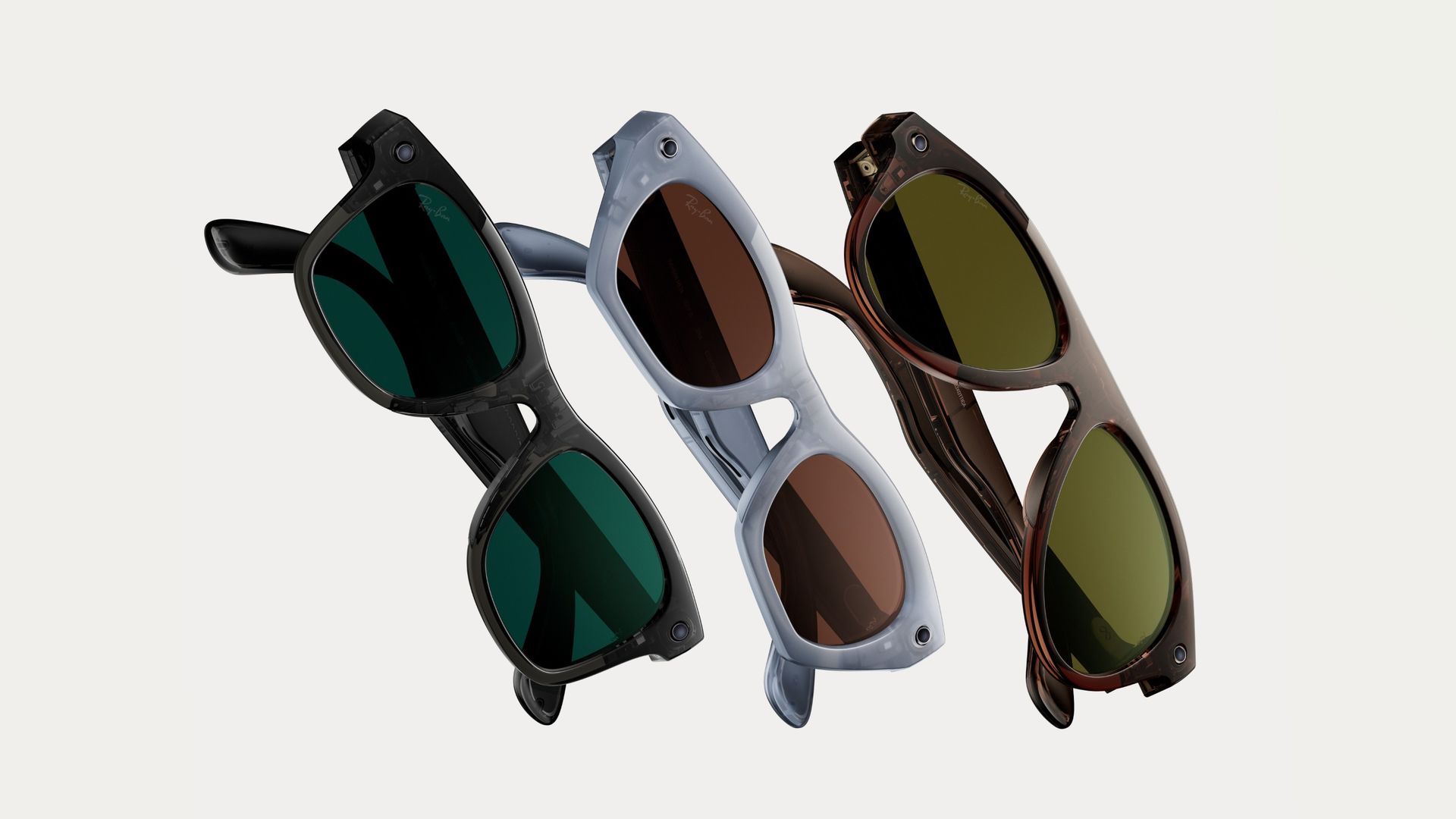
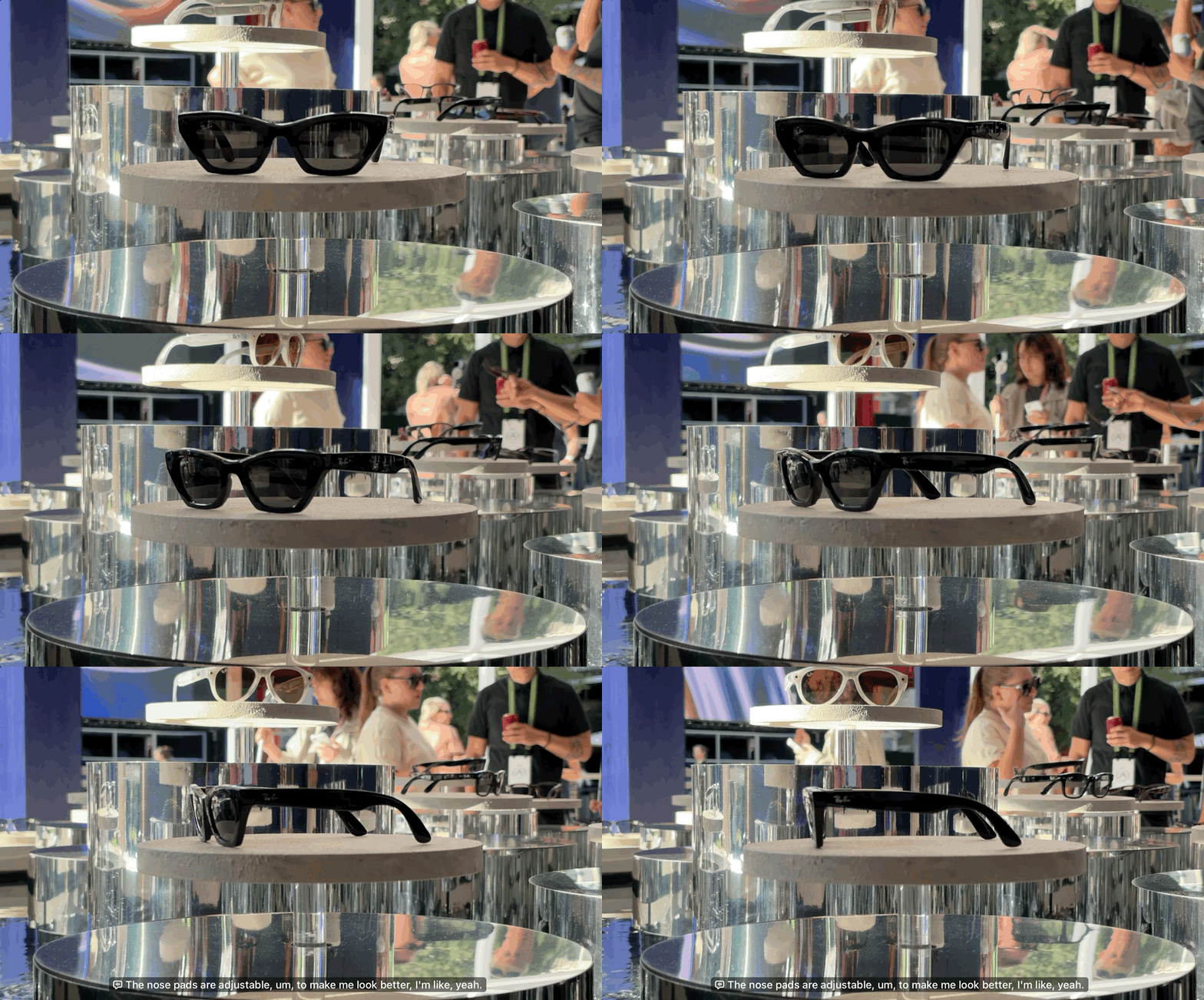
Even as public opinion turns against camera-equipped smart glasses, Meta is pushing forward with its generally well-received and quite popular Ray-Ban Meta line. Alongside the much-anticipated Meta Ray-Ban Audio glasses, which skip cameras entirely and come in two styles, Clubmaster and Burbank, there's also the next generation of the Ray-Ban Meta glasses.
Like the previous generation, the Ray-Ban Meta (Gen 3) still features onboard cameras with the all-important glowing LED ring that alerts you when a photo is being taken or a video is being recorded. It's an important safeguard, and Meta has added more protections against folks who try to disable or conceal it, but concerns remain.
Meta's pushing forward with the Gen 3, even if the audio-only models prove more popular. They're launching today in three styles: Ray-Ban Meta Aviator, Ray-Ban Meta Zena, and a new version of the Ray-Ban Meta Wayfarer. Pricing starts at $449 in the United States; we're working to confirm UK and Australia pricing.
(Image credit: Meta)
The story across the board is better hardware, all tucked into smart glasses that more closely resemble real glasses, with lighter and thinner builds where possible. The Aviators are particularly exciting to see adopted for the AI and smart era. The frames are thicker than the classic wire ones, but they still frame the face well. Zena is decidedly modern and sleek as a cat's eye, while Wayfarer is still the iconic, cool frame that Ray-Ban introduced years ago.
I'm testing the Ray-Ban Meta Aviator in a brown shade, and you can see my unboxing video embedded below. I like this color, especially compared with my speckled brown Gen 1 Ray-Ban Meta Wayfarers.
There are 27 total combinations when you account for colors and lens types, and if you're willing to pay for it, you can fit these with transition lenses and even prescription lenses.
Regardless of frame style or lens type, you benefit from improved tech onboard. For starters, the cameras — if you choose to use them, and as mentioned, the ring will glow when you do — can take 12-megapixel photos and record 3K Ultra HD video, with Dolby Atmos support for a more cinematic audio experience during playback. There's also a Dynamic Photo mode, similar to Live Photos on iOS, which snaps a few shots so you can pick the best one.
Battery life is also improved. It isn't quite at the 12 hours of the new Meta Ray-Ban Audio models, but the Gen 3s last up to nine hours on a full charge. That's an hour longer than the Gen 2s, and the included charging case lets you recharge on the go.
Finally, just like the Meta Glasses — including the Kylie edition — that launched earlier in 2026, the Gen 3s get more microphones. Six of them improve voice pickup, whether you're drafting a message, asking Meta AI a question, or on a call. Meta promises they cut over 90% of background noise, and we look forward to putting that to the test.
(Image credit: Future/Jacob Krol)
While it's not a night-and-day difference over the second generation, the Ray-Ban Meta (Gen 3) shows that Meta has settled on the core feature set it wants for its AI glasses. Now, in a move likely to broaden their appeal, it's focusing on offering more styles, and its partnership with Ray-Ban is clearly still evolving. The Gen 3s continue the quest for smart glasses that feel closer to the regular versions of these frames, while adding the latest tech for a compelling experience.
(Image credit: Future/Jacob Krol)
Just how compelling will be weighed against the added privacy concerns, but let's hope Meta keeps adding more privacy features and keeps cracking down on those who try to block out the LEDs.
We'll be back soon with our full thoughts — and if you ask us, the Aviators look pretty, pretty nice — but if you're already sold, the Ray-Ban Meta (Gen 3) are up for order right now, starting at $449 in the US, from Meta, Ray-Ban, and other authorized sellers.
Meta Connect 2026 is busy. Alongside the next-generation Meta Glasses, a camera-free version of the Ray-Ban Meta Glasses, and a new collaboration with Korean pop star Lisa, Meta is adding a significant new capability to its glasses: hearing enhancement.
The US Food and Drug Administration (FDA) has cleared the feature, which turns a pair of Meta Glasses into a hearing aid for people with mild to moderate hearing loss. It amplifies sound based on your hearing profile and uses machine learning to boost voices and suppress background noise.
It's not free, though. The feature launches with a free 30-day trial, after which it costs a one-time payment of $149.99, or comes as part of a Meta One subscription. In the US, it's also FSA/HSA eligible, with Meta saying it will share more details closer to the launch, which in the US is set for later in 2026. Even including the price of compatible glasses, Meta says it's significantly cheaper than traditional hearing aids.
The feature is launching in the US first, with Meta planning to expand to other countries as it works through each region's medical device regulations.
I spoke with Ravish Mehra, Director of Research Science at Meta, about why Meta thinks glasses are the right home for hearing enhancement. Mehra, who has spent nearly 12 years at the company, says the work started more than five years ago.
"We have a very unique audio platform that has microphone arrays, that has glasses, is socially acceptable in terms of people wearing glasses, and we have onboard compute," he says.
According to Mehra, one in six Americans have mild to moderate hearing loss, yet only around 15% of them do anything about it. He notes that hearing aids are expensive, uncomfortable to wear all day, and signal to others that you have a hearing impairment. So people "put the issue under the rug," Mehra says, telling themselves, "Okay, it's just people are mumbling, and that's why I'm not able to hear."
Glasses sidestep the stigma in his view: "Nobody else can tell just by looking at your glasses that you have hearing impairment.”
A hearing test at home
"Every person's hearing loss is slightly different," Mehra says. Instead of a clinic visit and multiple fittings, Meta's hearing test takes around one to two minutes with your phone, through the Meta AI app, and your glasses. You listen to sounds at different frequencies, indicate when you can barely hear them, and the system builds a hearing profile showing where you need amplification.
"You don't have to go anywhere to get these glasses fit for your hearing profile," Mehra says. "You just do a very simple test at home, and whenever your hearing needs change, you just redo the test."
That test was central to the FDA clearance. Meta tested the feature with a group of people with mild to moderate hearing loss, and its results showed the phone-based test was equivalent in performance to a professional fitting, within an acceptable margin.
"We are actually the first self-fitting hearing aid on glasses in the market," Mehra says.
How it works
The glasses' six microphones capture sound around you — currently being used on Meta Glasses — which is then amplified where your profile shows a deficit. That also amplifies noise, so a machine learning model trained to recognize voices brings the background down. It all runs on-device, and speed is critical. "All of this has to happen in a very short latency, because otherwise you start hearing echoes or start hearing distortions," Mehra says.
There are two modes: 360 mode amplifies sound all around you, while Focus mode suits environments like a restaurant, where you want to hear the person across the table.
"We actually use the microphones to first do beamforming, which is like focusing in the forward direction more," Mehra explains. "And then […] we train the system to enhance the voices while not enhancing or suppressing the noise."
The frame helps, too. "Because the glasses have a much wider baseline, you can put the microphones much farther away," says Mehra. This makes it easier to isolate speech from noise than with microphones placed millimeters apart in the ear.
I got a brief demo: Meta had us put in earplugs to simulate hearing loss, then wear the glasses. They did properly amplify the people directly around me, and even those a bit farther away. Focus mode noticeably singles out the person in front of you, but it wasn't perfect, and of course earplugs are no substitute for real hearing loss.
The feedback problem
Amplifying sound isn't the hardest part, though. "One of the issues that any kind of real-time amplification feature faces is called feedback," Mehra says. "When you amplify something through the speakers, they feed back into the microphones."
On glasses, with their open-ear design, nothing separates the speakers from the microphones. Meta's system has to detect feedback before it builds, suppress it, and still deliver enough amplification. "If you're not able to cancel that feedback, then you hear these very sharp noises," Mehra says.
Then there's processing, which is added on top of a broader feature set the glasses offer, so Meta had to squeeze the feature into what Mehra calls "a very small envelope" of onboard compute power.
Meta hasn't confirmed which glasses will support it, only that they must meet a minimum performance bar, or confirmed a rollout schedule other than late 2026. Given the processing involved, I'd be surprised to see it on older models like the first-gen Ray-Ban Meta glasses; all of the demos at Meta Connect have been on the more recently released Meta Glasses.
Meta isn't just trying to make its glasses hear for you; it's trying to help you hear, too. It's a new category for the company, but Mehra is in no doubt about the bet, telling me: "We strongly feel like glasses is the ideal form factor."
Beats has been making over-ear headphones since 2008, when the original Beats Studio launched, and the Studio line has remained central to the brand ever since. The Studio Pro aren't going anywhere, but the new Beats 360 are something different entirely.
Beats calls them "the next chapter" of its headphones story — and after spending the past few weeks with the 360, that confidence doesn't feel misplaced. These aren't just the Studio Pro with a new coat of paint; instead, they represent an entirely new direction for the brand.
"We wanted to create a new ID, a new look, and a new over-ear headphone for a different purpose," Oliver Schusser, Apple's VP of Music, Sports, and Beats, told me.
That idea is baked into practically every part of the 360. Beats set out to build much more streamlined headphones that are designed to move with you throughout the day, and feel at home everywhere from the gym to the office to an airplane.
And the first thing you notice is just how light they are.
Weighing in at 295.4 grams, they're super-cozy, and after about 20 to 30 minutes of breaking them in, you might forget they're on your head. Compared to the AirPods Max at about 386.2 grams or Sony's WH-1000XM6 at 254 grams, these fall somewhere in the middle, but they actually feel far more streamlined than the number suggests.
The profile itself is remarkably thin, too. The drivers sit slightly farther from the ear than you'd expect on headphones this size — they're custom-built for the 360 — but the overall design feels compact, and balanced on your head.
The controls are split between the two sides, too. The left earcup houses the power button and lets you cycle through listening modes, while the right handles volume and playback. There's also a USB-C port on the left for charging.
It's a simple setup, and after a few weeks, it becomes second nature.
(Image credit: Beats)
That lightness wasn't an accident — it was the whole brief. Schusser told me the 360 came out of watching how people actually live with their headphones.
"We wanted to create a new ID, a new look, and a new over-ear headphone for a different purpose. And that purpose is for people who live a very active lifestyle who are on the go," Schusser said. "We wanted to build the perfect headphone for an active lifestyle. And of course, we wanted it to have all the great ingredients of Beats. We wanted it to look cool, sound amazing, but also be really light, be really comfortable, be water and sweat resistant."
And that's where the rest of the design starts to make sense.
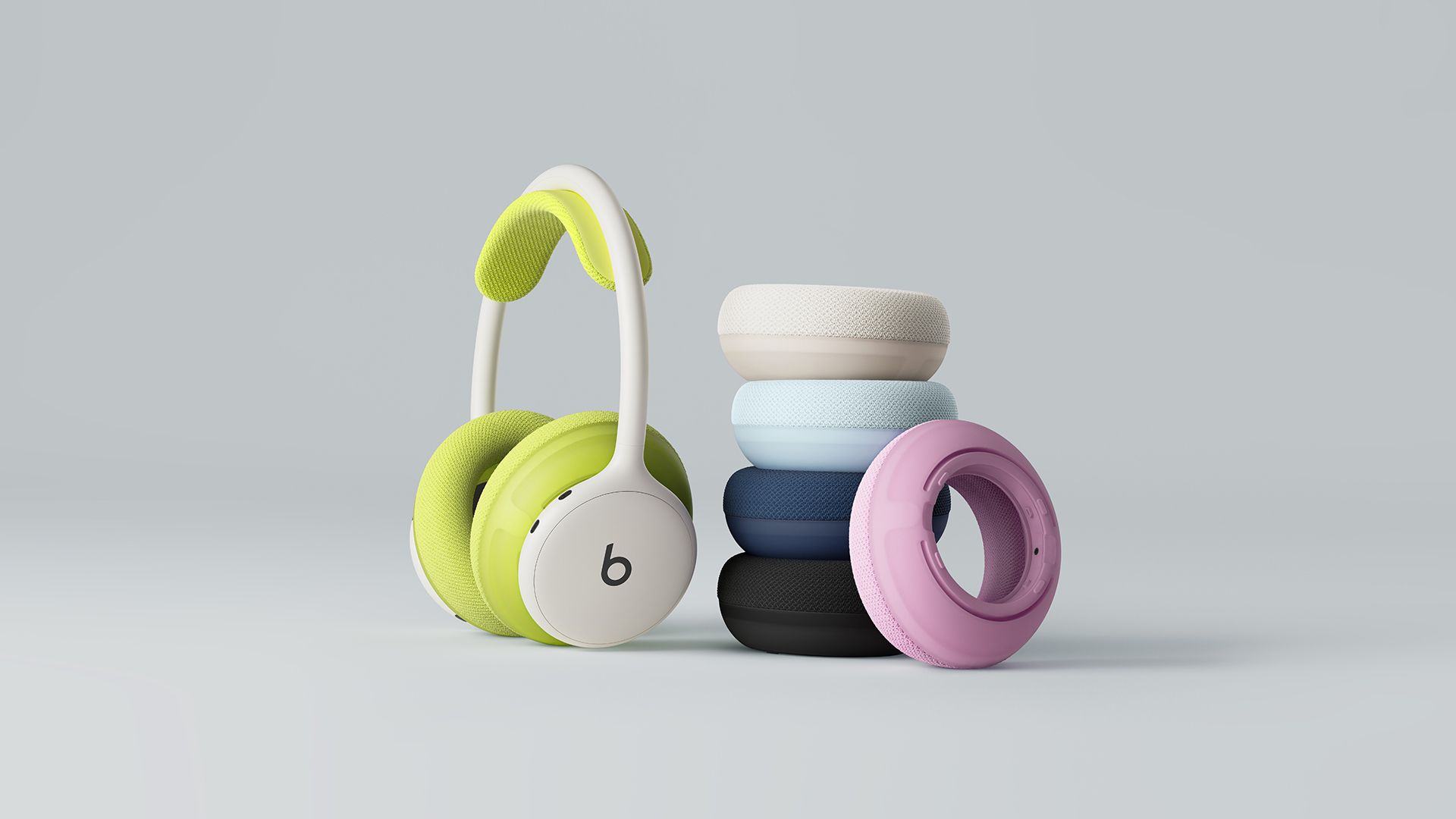
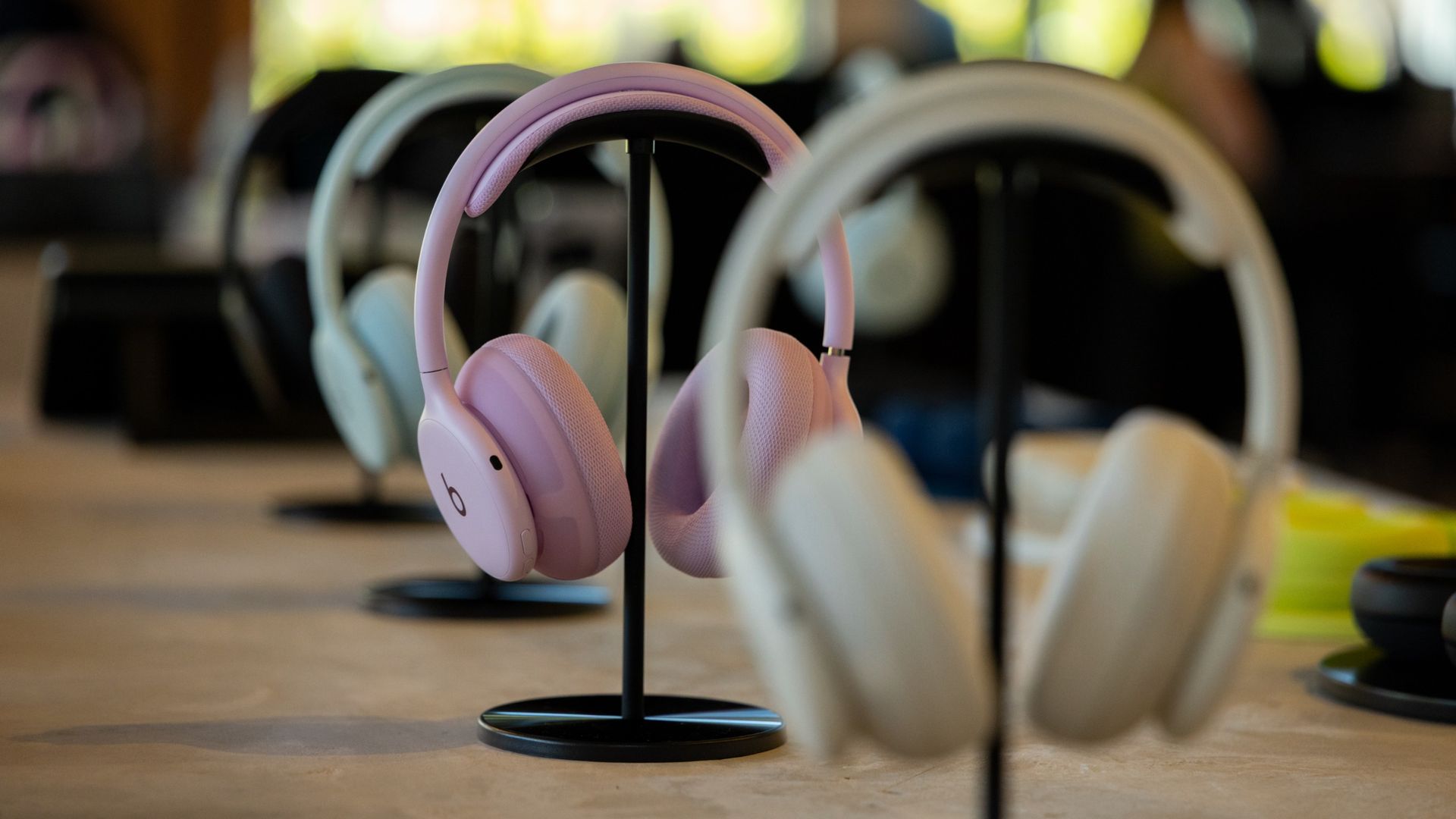
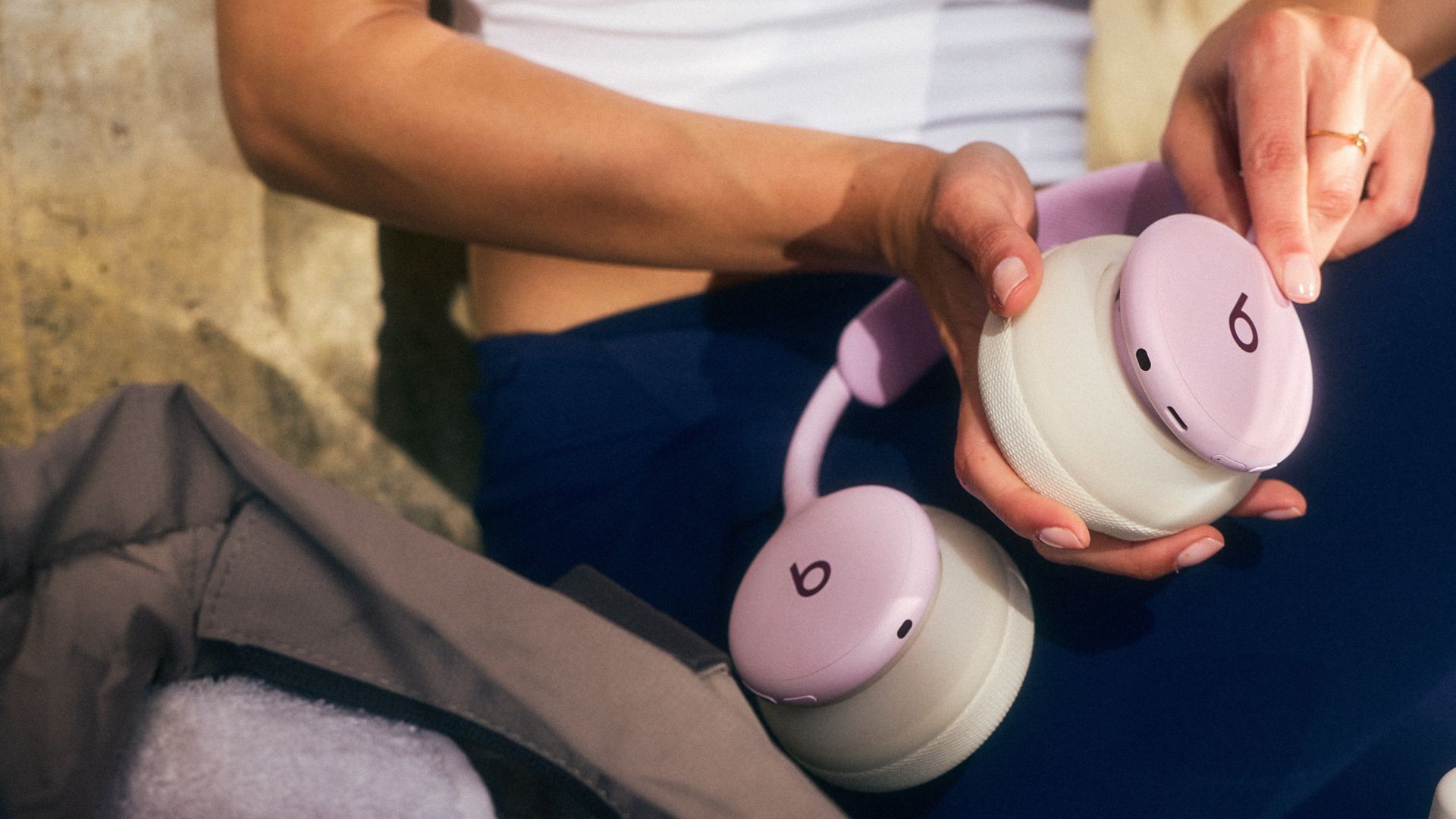
The earcups and headband are fully customizable — swappable across the four launch colors (Black, Cloud, Pink, and Sky) and two distinct cushion materials: Performance Knit, built for workouts and noticeably more breathable, and UltraPlush, the more classic Beats feel with a tighter seal, using the same engineered leather found on the Studio Pro and Solo 4.
The Performance Knit cushion makes a real difference when you're moving around, while UltraPlush gives you that more traditional over-ear headphone feel. You can also pull either cushion off entirely to wipe them down or toss them in the washer.
Then there's the IPX4 sweat and water resistance, a first for Beats over-ear headphones, and not super common in the wider market. It's a small detail that reinforces the whole idea behind the 360: these are headphones you can take to the gym, rather than ones you have to leave at home or risk damaging.
None of that customization happened by accident. Schusser said the swap mechanism was one of the more satisfying engineering wins on the whole project.
"Our engineers have come up with this really cool, simple way to sort of swap out the cushions, and it takes literally seconds, and it just makes the headphones so versatile and so flexible, and you can customize and personalize, and it's amazing," he told me.
He's right about the versatility, as swapping earcups takes seconds, and the difference between the two cushion materials is noticeable. It's a genuinely useful bit of modularity, not just something that looks good on a spec sheet, when you consider wearing these to a workout class, getting sweaty, and the swapping earcups as you head into the office.
A new sound for a new Beats
(Image credit: Beats)
On the sound side, Beats built a bespoke acoustic platform for the 360, with custom drivers using three-layer diaphragms and dual neodymium ring magnets in each earcup — a purpose-built audio setup rather than a carryover from the Studio.
Beats says that architecture, paired with its most advanced ANC to date, delivers up to 1.75x more total noise cancellation than the Studio Pro, alongside Adaptive EQ, Personalized Spatial Audio with dynamic head tracking, and Dolby Atmos support.
Previous Beats headphones have delivered a hefty low end, but that signature has evolved, and comes into real focus with the 360. There's less bass-heavy weight than on the Studio, but the payoff is that at practically any listening volume distortion is nearly nonexistent, and separation stays excellent across genres.
Take Further On Up the Road by Bruce Springsteen — I listened to this while on a plane with Active Noise Cancellation engaged, at about 70% volume, and couldn't hear any engine noise. The track opens with a strong, crisp snare and bass drum before Springsteen's vocals come in over the guitar, with background vocals filling in behind. It's a great showcase for what the onboard audio can do.
For a modern pop test, Olivia Rodrigo's Expectations pairs low end and high end almost from the first bar, as synth and drums kick in before her vocal takes center stage. Spatially, the head-tracked playback is genuinely impressive here, both indoors and while walking around outside.
Transparency mode is strong, too. It's a little behind the AirPods Max in terms of how much outside sound it lets through, but what comes through the 360 sounds very natural. Voices don't have that overly processed or artificial quality you can sometimes get from transparency modes, and for 349.99 / £299.99 / AU$499.99 headphones, they punch above their weight.
Talking of weight, the 360 aren't the lightest headphones out there, but the ergonomics carry it — an even distribution between the earcups keeps the headband thin, and makes these feel far cozier than the spec sheet suggests.
The Beats chip is a bigger deal than it sounds
(Image credit: Beats)
Connectivity comes from a custom-designed Beats chip, which is built off Apple's own silicon work, and which is now in its fourth generation. As I've reported previously, that's a significant unlock for the Beats team, letting it appeal equally to Apple and Android users rather than picking a side.
Just like AirPods and past Beats products, the 360 pair quickly and sync across your Apple devices via iCloud, so you can go from listening on an iPhone or iPad to jumping into a meeting on a MacBook Pro almost instantly. On Android, you get Fast Pair support through Google's standard, and the Beats app for Android mirrors most of the same controls.
Each earcup functions as its own self-contained unit, housing its own audio, connectivity, and battery components. It's another example of Beats rethinking the architecture around this new purpose.
There are nine onboard microphones in total: eight dedicated to active noise cancellation and three for voice pickup, with two shared between the systems. They work alongside an onboard AI model to handle voice detection, voice-assistant requests, and the handoff between ANC, Transparency mode, and Adaptive Audio.
Battery life is rated at up to 32 hours with Adaptive EQ when ANC and Transparency mode are off, and still up to 32 hours with ANC and Personalized Spatial Audio switched on. That's a claim I've been testing throughout my time with the 360, including travel, and so far the battery life has held up well.
Beats has always leaned into limited-edition drops and collaborations, and the 360's whole design seems built for exactly that kind of expansion — and Schusser didn't hide the intent. "We're going to do a lot of drops," he said.
As mentioned, these headphones cost $349.99 in the US, £299.95 in the UK, and $499.95 in Australia, and rather than positioning the 360 as a replacement, Beats is keeping the Studio Pro around too, now at a reduced $299.99 / £249.95 / AU$479.95.
Beyond the four core colorways, Beats also sells standalone cushion kits in six Performance Knit colors — adding Navy and Volt — plus two UltraPlush options. These are priced at $49.99 / £49.95 / AU$49.95, but are available at an introductory price of $9.99 / £9.95 / AU$14.95 through October 31.
Asked where the color strategy could go next, Schusser pointed straight at sports: "This is actually a perfect product for [...] team colors."
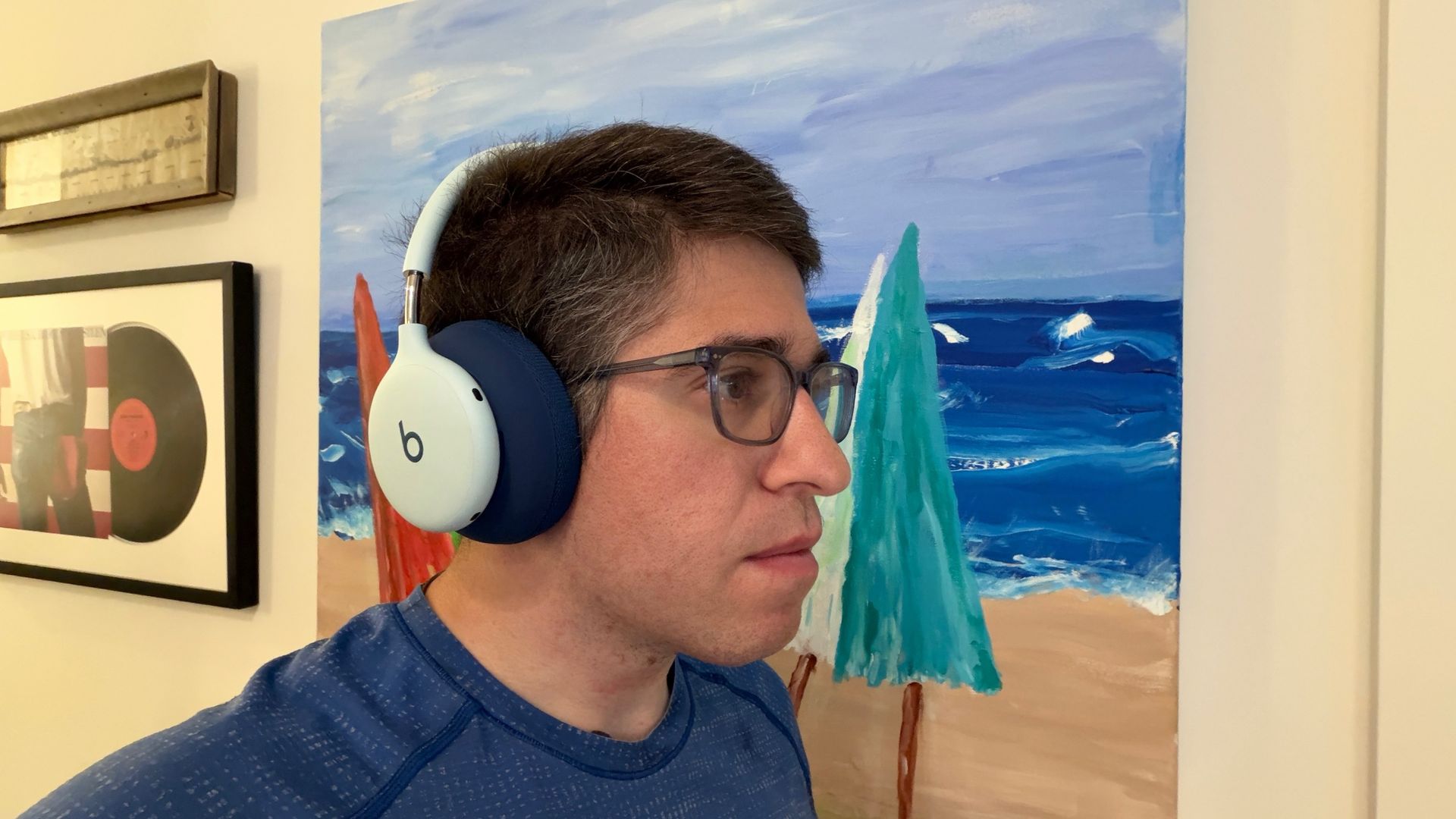
It all makes the customization options more interesting than simply picking a color when you buy them. Right now, I have the Sky — light blue — 360 with a darker blue Performance Knit cushion and a black UltraPlush, and I swap the headband cushion to match whichever earcup I'm wearing that day. The 360 can change with you, whether that's a different material for a workout, a new color for a season, or eventually one of the team-color drops Schusser hinted at.
I've really enjoyed my first few weeks with the Beats 360 — traveling back from Apple's September event, testing them at home, then putting them through their paces on flights — and I'm impressed with the overall premium nature and this new direction for Beats.
(Image credit: Beats)
The Beats 360 pair full sweat and water resistance with a thin, lightweight build and customizable earcups that let you land on a look you're happy with — and one that can evolve, rather than feeling dated.
The sound is a modern take on the Beats signature — plenty of energy, but with clear separation and basically no distortion across the genres I've thrown at it — and paired with strong ANC, a natural-feeling Transparency mode, and a battery that's held up through testing, there's a lot packed into this new design.
There are a few misses. There's no on-ear detection, so you have to turn these on and off manually, and there's no support for wired playback.
Still, those omissions don't really change what Beats is trying to do here. The 360 aren't supposed to be another Studio Pro. This is Beats taking the over-ear headphone somewhere new — lighter, more customizable, more resistant to sweat and water, and built around an active, on-the-go lifestyle.
And after a few weeks with them, I can see the new ID Beats was talking about.

 Login
Login