Reading view

There are new articles available, click to refresh the page.

Medtech giant Stryker says it’s back up after Iranian cyberattack

Medtech company Stryker says it’s back to being “fully operational,” three weeks after it became the most prominent victim to date of Iranian hackers, who said they attacked the Michigan-based company in retaliation over the conflict with the United States and Israel.

A March 11 wiper attack from the pro-Palestinian, Iranian government-connected group Handala damaged the company’s order processing, manufacturing and shipping. More recently, Handala claimed to compromise the data of FBI Director Kash Patel, although the FBI said no government information was taken.

“Production is moving rapidly toward peak capacity with discipline and stability, supported by restored commercial, ordering and distribution systems,” the company wrote in an update on its website Wednesday. “Overall product supply remains healthy, with strong availability across most product lines, as we continue to meet customer demand and support patient care.”

Stryker said it continues to work with outside cyber experts, government agencies and industry partners on its investigation and recovery.

“Patient care remains our highest priority, with a continued focus on supporting healthcare providers and the patients they serve,” it said. “This remains a 24/7 effort and the first priority of our entire organization.”

Iranian hackers have been busy since the U.S.-Israel strikes began, but have claimed few successes in the United States. Handala boasted this week about an attack on St. Joseph County, Indiana, where officials said they were investigating a hack of its external fax service.

This week, Handala also claimed to have penetrated the systems of Israel’s air defense systems and leaked documents about it. But Handala also has been accused of overselling its deeds.

The FBI seized some websites associated with Handala last month, and the State Department has offered a reward for information on the hacking group.

The post Medtech giant Stryker says it’s back up after Iranian cyberattack appeared first on CyberScoop.

Iranian hackers, Handala, claim to compromise FBI Director Kash Patel’s personal data

Iranian hackers claimed Friday to have compromised the personal data of FBI Director Kash Patel, and the bureau confirmed that it knew of the targeting of Patel’s personal email.

The government-connected hacking group, Handala, previously claimed credit for hacking medical device maker Stryker, a boast that threat researchers considered credible.

“All personal and confidential email of Kash Patel, including emails, conversations, documents, and even classified files, is now available for public download,” Handala — also known as Handala Hack — said.

The group said it did so in response to the FBI seizing its domains and the U.S. government offering a $10 million reward for information on members of the group.

The FBI noted that Handala frequently targets government officials, and challenged elements of Handala’s claims, such as that it had brought the FBI’s systems “to its knees,” rather than Patel’s own email.

“The FBI is aware of malicious actors targeting Director Patel’s personal email information, and we have taken all necessary steps to mitigate potential risks associated with this activity,” the FBI said in response to questions from CyberScoop. “The information in question is historical in nature and involves no government information.”

The activist group Distributed Denial of Secrets published what it said was Patel’s email cache.

The FBI pointed to the State Department’s reward program seeking information on members of Handala.

“Consistent with President Trump’s Cyber Strategy for America, the FBI will continue to pursue the actors responsible, support victims, and share actionable intelligence in defense of networks,” it said. “We encourage anyone who experiences a cyber breach, or has information related to malicious cyber activity, to contact their local FBI field office.”

The post Iranian hackers, Handala, claim to compromise FBI Director Kash Patel’s personal data appeared first on CyberScoop.

Treasury asks whether terrorism risk insurance program should bolster cyber coverage

The Treasury Department is soliciting public feedback on whether it should change a terrorism risk insurance program to address cyber-related losses.

In a Federal Register notice set for publication Wednesday, Treasury seeks comment from the public for a mandatory report it must deliver to Congress this summer on the effectiveness of the terrorism risk insurance program (TRIP) created by the 2002 Terrorism Risk Insurance Act. That law arose from the Sept. 11 terror attacks and provided a federal backstop to make terrorism risk insurance more available and affordable.

Some experts have suggested that the cyber insurance industry should also get a federal backstop as the industry struggles to develop fully. With the law set to expire at the end of 2027, tying it to the reauthorization of the terrorism risk insurance law could be one way to get Congress to create such a cyber backstop.

Among the topics Treasury hopes commenters will address before it sends the report to Congress in June is the interaction between the terrorism risk insurance law and program, and cybersecurity. The agency will accept comments until May 8.

That includes: “Any potential changes to TRIA or TRIP that would encourage the take up of insurance for cyber-related losses arising from acts of terrorism as defined under TRIA, including, but not limited to the potential modification of the lines of insurance covered by TRIP and revisions to any of the current sharing mechanisms for cyber-related losses, such as, for example, the individual insurer deductible or the federal share percentage.”

In 2021, Treasury issued a rule making it clear that TRIP could cover cyber losses when written in a TRIP-eligible line of insurance. However, a Government Accountability Office report last year outlined some of the limitations there.

“Because TRIA was designed specifically as a federal backstop for losses from acts of terrorism, only losses from cyberattacks certified by Treasury as acts of terrorism would have TRIA coverage,” it states. “As a result, even large cyberattacks that result in catastrophic losses would not be covered under TRIA if they were not certified as acts of terrorism.”

Treasury said in its Federal Register notice that it wants feedback on cyber-related terrorism losses within TRIP and losses outside of it.

Cyberattacks would need to meet definitions under the terrorism risk insurance law to be certified. They need to be violent or otherwise dangerous to life, property or infrastructure, and designed to influence the U.S. population or government. Damage to U.S. organizations outside the United States still might not qualify.

Medical device maker Stryker recently suffered a wiper attack, with the pro-Palestinian, Iranian government-linked group Handala taking credit. It said the attack was in retaliation for U.S. and Israel military strikes against Iran, specifically a U.S. missile strike on a school that killed 175 people, according to Iran’s government.

The post Treasury asks whether terrorism risk insurance program should bolster cyber coverage appeared first on CyberScoop.

FBI: Iranian hackers targeting opponents with Telegram malware

Iranian government-connected groups are deploying malware via the Telegram messaging app, taking aim at dissidents and other opponents of Tehran around the world, the FBI said in an alert Friday.

The FBI said attackers linked to the Ministry of Intelligence and Security are behind the campaign, which stretches back to 2023. The bureau is escalating the alert now, though, because of the conflict between Iran and a U.S.-Israel alliance, it states.

“The observed victim profile included Iranian dissidents, journalists opposed to Iran, members of organizations with beliefs counter to Government of Iran narratives, and other individuals Iran perceives as a threat to the Iranian government, However, the malware could be used to target any individual of interest to Iran.” the alert reads. “This malware resulted in intelligence collection, data leaks, and reputational harm against the targeted parties.” 

Handala — an Iranian pro-Palestinian group that claimed credit for the hack on medical device maker Stryker this month — used information it gathered from hacking dissidents to carry out a hack-and-leak campaign in 2025, the FBI assesses. (Stryker sent a notice to the Securities and Exchange Commission Monday that provides an update on the incident.)

While U.S. officials say they haven’t seen any major increase in cyberattacks out of Iran since the conflict began, experts have noted it could be weeks before patterns emerge.

Telegram is a popular communications channel in Iran. Iranian hackers frequent Telegram to discuss planned attacks. On the other hand, the Islamic Revolutionary Guard Corps has also issued warnings to its populace that they could face prosecution if they’re members of Telegram-based opposition channels, IranWire reported last week.

The FBI said from the malware samples it examined, the scheme begins with hackers masquerading as apps like Pictory, KeePass and Telegram. The hackers configure command and control using a Telegram bot.

To gain initial access, the hackers seek to manipulate victims by posing as someone they know or as tech support for a social media platform. They then trick the victims into accepting a file transfer, which then launches the malware.

“Based on multiple observations, stage 1 of the malware appeared to be tailored to the victim’s pattern of life to increase likelihood of victim downloading the malware, which indicates the Iranian cyber actors likely performed target reconnaissance prior to engaging with the victim,” the FBI said.

The FBI alert is the latest in a series of government warnings about attackers using messaging apps to carry out their objectives.

Telegram spokesperson Remi Vaughn said in an emailed response: “Bad actors can and do use any available channel to control malware, including other messengers, email or even direct web connections. While there is nothing unique about the use of Telegram to control software, moderators routinely remove any accounts found to be involved with malware.”

The post FBI: Iranian hackers targeting opponents with Telegram malware appeared first on CyberScoop.

Stryker attack highlights nebulous nature of Iranian cyber activity amid joint U.S.-Israel conflict

A cyberattack that an Iranian hacking group said it carried out against medical device manufacturer Stryker might mark Tehran’s first significant cyber action since the start of the joint U.S.-Israel conflict.

But even that may have been a happy accident for Iranian hackers in what has been a low buzz of activity during that timeframe, with the attackers striking paydirt by happenstance rather than on purpose.

Cybersecurity firms, threat intelligence trackers and critical infrastructure owners have been fighting to separate the noise about proclaimed attacks out of Iran, and the warnings and threats related to the conflict, from what is actually happening and poses any significant danger.

“Everybody is scrambling right now,” said Alex Orleans, a long-time Iran threat analyst and head of threat intelligence at Sublime Security. Others said the nascent nature of the conflict is making assessments difficult.

“What we see is quite difficult to quantify or characterize about whether there’s been an increase or decrease,” said Saher Naumaan, senior threat researcher at Proofpoint. “I think since we’re only a couple weeks into the conflict, and the regular cadence of Iranian actors isn’t very consistent, necessarily, we don’t have enough data points or enough time to really judge.”

Signs of activity

In the early days of the conflict, there were indications that physical attacks on Iran might have hampered Iranian retaliatory efforts or other cyber activity, as those who would carry out cyberattacks were probably “hiding in bunkers,” Orleans said, and as Iran suffered internet outages.

In recent days, however, the Stryker attack and other indicators suggest that Iranian cyber activity could be heating up.

“For several days following the outbreak of the conflict, there was a noted decrease in cyber threat activity emanating from Iran,” a group of industry information and sharing analysis centers warned Wednesday. “However, there are signs of life in Iranian offensive cyber operations.”

The Stryker attack stands out for both the size and location of the target, a Michigan-based medical device manufacturer with more than $25 billion in revenue in 2025.

But both Orleans and Sergey Shykevich, threat intelligence group manager at Check Point Research, said the attack has the hallmarks of an opportunistic one rather than a deliberate, focused one. The group claiming credit for the attack, Handala — a Ministry of Intelligence-linked outfit — is known more for seizing advantage of weaknesses they happen upon rather than doggedly pursuing particular targets.

Notably, Stryker is also the class of a military vehicle used by U.S. forces. That military connection, even if confused with the medical device manufacturer, could possibly explain why the company was a target.

Still, “it was a much higher-profile attack than we expected from Handala,” Shykevich said. “Unfortunately, it’s possible to define it as a relatively big success for them.”

There have been reports of other cyber activity that might be connected to the conflict. Albania said the email system of its parliament had been targeted, with Iranian hackers taking credit. There was the targeting of cameras from Iran-linked infrastructure in countries that Iran then launched missiles into. Poland said it was looking into whether Iran was behind an attempted cyberattack on a nuclear research facility.

Some of the claims don’t match reality. “There are many hacktivist groups that are very active in Telegram, but actually they don’t have any significant successes,” Shykevich said.

There are other cyber-related developments in the conflict, too, like espionage, the proliferation of artificial intelligence-fueled misinformation and the possibility of Russia or China helping out in cyberspace on Iran’s behalf, even if some experts doubt the likelihood of the latter.

How effective any of it has been is still unclear. Stryker, for instance, said the attack mainly affected its internal networks, although there were signs it might be affecting communications at hospitals, too.

But the damage might be beside the point. Orleans said the attacks could be psychological in nature, aimed at producing fear abroad and affirming hackers’ standing with domestic leaders in Iran during the conflict.

Even low-level defacement or distributed denial-of-service attacks can play a role.

“Coming into work and finding an Iranian flag on your workstation would be a little bit  disconcerting, because they’re letting you know that, ‘I can reach out and touch you,’” said Sarah Cleveland, senior director of federal strategy at ExtraHop and a former cyber officer in the U.S. Air Force.

Possible follow-up impacts

While primarily known as a medical supply company, Stryker has received sizable contracts with the military for hospital equipment and surgical supplies, for example. It is unclear whether the hackers intended to use Stryker’s military connection to exploit government systems.

The Pentagon has long warned of increased, complex cyberattacks against the defense industrial base, a vast network of companies — with disparate levels of cybersecurity — that the military relies on for advanced weaponry to basic stretchers. The DIB is often seen by adversaries as a backdoor into military systems.

While he did not directly address the Stryker hack, the Army’s principal cyber adviser, Brandon Pugh, outlined some of the challenges to the DIB and the service’s part in trying to protect it during a webinar Thursday in response to a question on the topic.

He said adversaries “right or wrong” see companies “as an extension of the military” and that they believe an attack on private industry would have a secondary impact on the armed forces.

“Some are very large, sophisticated multinational companies,” he said, noting that security needs across the DIB aren’t universal. “Others are very small companies that are lucky to have a director of IT, let alone a sophisticated cyber team, and I think that’s where it’s really important to lean into.”

Pugh said that agencies across the federal government have been working with the DIB to boost its resilience to attacks, and that the Army’s cyber effort emphasizes entrenching cybersecurity from the beginning of the acquisition process.

“Cyber can’t be an afterthought — not saying it is,” Pugh added. “I’d say the Army does a great job here, but making sure it’s never forgotten and is always considered along that way.”

Matt Tait, the CEO and president of MANTECH, said in response to a question about the Stryker attack and DIB protections that defending against such incidents includes leveraging government agreements and access, such as with the NSA, and quickly sharing information following an attack.

“To me, it’s about real time information sharing,” he said. “You need real time information sharing when you’re getting attacked to be able to actually share that information with the rest of industry, as well as with government, because they can actually share that information across” federal cybersecurity entities.

“If you want to do mission focused technology work, this is the world you have to live in, and that you should be sharing this information on a real time basis,” he added. “24 hours later, 48 hours later, I call that ambulance chasing. That’s too far after the fact from a cyber perspective.”

The post Stryker attack highlights nebulous nature of Iranian cyber activity amid joint U.S.-Israel conflict appeared first on CyberScoop.

Iran-Backed Hackers Claim Wiper Attack on Medtech Firm Stryker

A hacktivist group with links to Iran’s intelligence agencies is claiming responsibility for a data-wiping attack against Stryker, a global medical technology company based in Michigan. News reports out of Ireland, Stryker’s largest hub outside of the United States, said the company sent home more than 5,000 workers there today. Meanwhile, a voicemail message at Stryker’s main U.S. headquarters says the company is currently experiencing a building emergency.

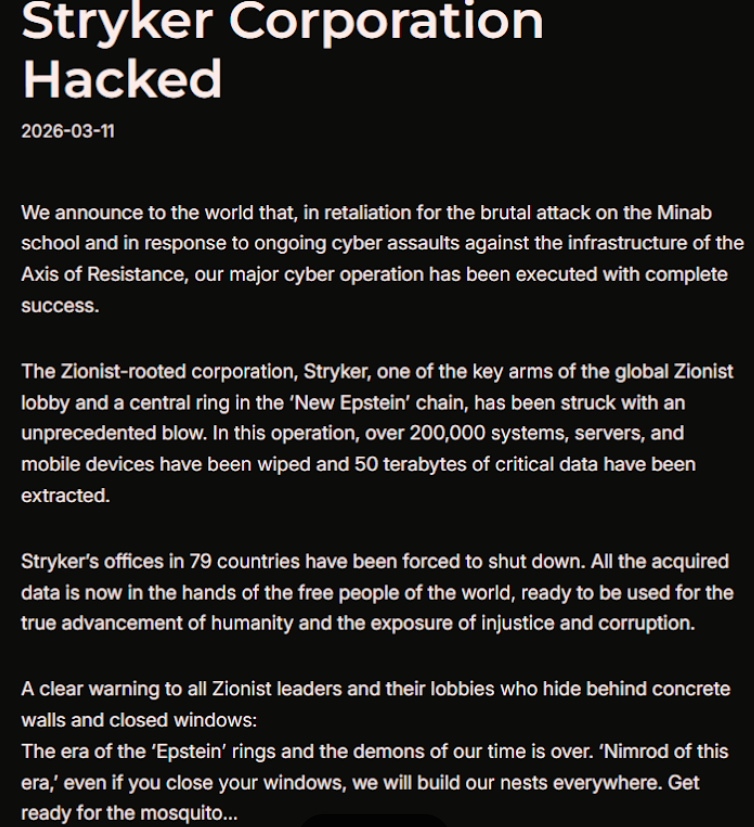
Based in Kalamazoo, Michigan, Stryker [NYSE:SYK] is a medical and surgical equipment maker that reported $25 billion in global sales last year. In a lengthy statement posted to Telegram, a hacktivist group known as Handala (a.k.a. Handala Hack Team) claimed that Stryker’s offices in 79 countries have been forced to shut down after the group erased data from more than 200,000 systems, servers and mobile devices.

A manifesto posted by the Iran-backed hacktivist group Handala, claiming a mass data-wiping attack against medical technology maker Stryker.

A manifesto posted by the Iran-backed hacktivist group Handala, claiming a mass data-wiping attack against medical technology maker Stryker.

“All the acquired data is now in the hands of the free people of the world, ready to be used for the true advancement of humanity and the exposure of injustice and corruption,” a portion of the Handala statement reads.

The group said the wiper attack was in retaliation for a Feb. 28 missile strike that hit an Iranian school and killed at least 175 people, most of them children. The New York Times reports today that an ongoing military investigation has determined the United States is responsible for the deadly Tomahawk missile strike.

Handala was one of several hacker groups recently profiled by Palo Alto Networks, which links it to Iran’s Ministry of Intelligence and Security (MOIS). Palo Alto says Handala surfaced in late 2023 and is assessed as one of several online personas maintained by Void Manticore, a MOIS-affiliated actor.

Stryker’s website says the company has 56,000 employees in 61 countries. A phone call placed Wednesday morning to the media line at Stryker’s Michigan headquarters sent this author to a voicemail message that stated, “We are currently experiencing a building emergency. Please try your call again later.”

A report Wednesday morning from the Irish Examiner said Stryker staff are now communicating via WhatsApp for any updates on when they can return to work. The story quoted an unnamed employee saying anything connected to the network is down, and that “anyone with Microsoft Outlook on their personal phones had their devices wiped.”

“Multiple sources have said that systems in the Cork headquarters have been ‘shut down’ and that Stryker devices held by employees have been wiped out,” the Examiner reported. “The login pages coming up on these devices have been defaced with the Handala logo.”

Wiper attacks usually involve malicious software designed to overwrite any existing data on infected devices. But a trusted source with knowledge of the attack who spoke on condition of anonymity told KrebsOnSecurity the perpetrators in this case appear to have used a Microsoft service called Microsoft Intune to issue a ‘remote wipe’ command against all connected devices.

Intune is a cloud-based solution built for IT teams to enforce security and data compliance policies, and it provides a single, web-based administrative console to monitor and control devices regardless of location. The Intune connection is supported by this Reddit discussion on the Stryker outage, where several users who claimed to be Stryker employees said they were told to uninstall Intune urgently.

Palo Alto says Handala’s hack-and-leak activity is primarily focused on Israel, with occasional targeting outside that scope when it serves a specific agenda. The security firm said Handala also has taken credit for recent attacks against fuel systems in Jordan and an Israeli energy exploration company.

“Recent observed activities are opportunistic and ‘quick and dirty,’ with a noticeable focus on supply-chain footholds (e.g., IT/service providers) to reach downstream victims, followed by ‘proof’ posts to amplify credibility and intimidate targets,” Palo Alto researchers wrote.

The Handala manifesto posted to Telegram referred to Stryker as a “Zionist-rooted corporation,” which may be a reference to the company’s 2019 acquisition of the Israeli company OrthoSpace.

Stryker is a major supplier of medical devices, and the ongoing attack is already affecting healthcare providers. One healthcare professional at a major university medical system in the United States told KrebsOnSecurity they are currently unable to order surgical supplies that they normally source through Stryker.

“This is a real-world supply chain attack,” the expert said, who asked to remain anonymous because they were not authorized to speak to the press. “Pretty much every hospital in the U.S. that performs surgeries uses their supplies.”

John Riggi, national advisor for the American Hospital Association (AHA), said the AHA is not aware of any supply-chain disruptions as of yet.

“We are aware of reports of the cyber attack against Stryker and are actively exchanging information with the hospital field and the federal government to understand the nature of the threat and assess any impact to hospital operations,” Riggi said in an email. “As of this time, we are not aware of any direct impacts or disruptions to U.S. hospitals as a result of this attack. That may change as hospitals evaluate services, technology and supply chain related to Stryker and if the duration of the attack extends.”

According to a March 11 memo from the state of Maryland’s Institute for Emergency Medical Services Systems, Stryker indicated that some of their computer systems have been impacted by a “global network disruption.” The memo indicates that in response to the attack, a number of hospitals have opted to disconnect from Stryker’s various online services, including LifeNet, which allows paramedics to transmit EKGs to emergency physicians so that heart attack patients can expedite their treatment when they arrive at the hospital.

“As a precaution, some hospitals have temporarily suspended their connection to Stryker systems, including LIFENET, while others have maintained the connection,” wrote Timothy Chizmar, the state’s EMS medical director. “The Maryland Medical Protocols for EMS requires ECG transmission for patients with acute coronary syndrome (or STEMI). However, if you are unable to transmit a 12 Lead ECG to a receiving hospital, you should initiate radio consultation and describe the findings on the ECG.”

This is a developing story. Updates will be noted with a timestamp.

Update, 2:54 p.m. ET: Added comment from Riggi and perspectives on this attack’s potential to turn into a supply-chain problem for the healthcare system.

Update, Mar. 12, 7:59 a.m. ET: Added information about the outage affecting Stryker’s online services.

❌