Reading view

There are new articles available, click to refresh the page.

Scottish man pleads guilty to attack spree that created Scattered Spider’s notoriety

A core leader of the hacker subset of The Com responsible for a series of high-profile phishing attacks and cryptocurrency thefts from September 2021 to April 2023 pleaded guilty to federal charges, the Justice Department said Friday. 

Tyler Robert Buchanan of Dundee, Scotland, pleaded guilty to conspiracy to commit wire fraud and aggravated identity theft. The 24-year-old was arrested by Spanish police in Palma in 2024 as he attempted to board a charter flight to Naples, Italy. 

Buchanan has been in federal custody since April 2025 and faces up to 22 years in federal prison at his sentencing, which is scheduled for August 21. 

The British national and his co-conspirators, including Noah Michael Urban, who was sentenced to a 10-year federal prison sentence last year, harvested thousands of credentials via phishing and stole more than $8 million in cryptocurrency from U.S. residents via SIM-swapping attacks.

Victims included high net worth individuals and businesses in the entertainment, telecom, technology, business process outsourcing, IT, cloud and virtual currency sectors, officials said.

Buchanan and his co-conspirators were part of an aggressive subset of The Com coined Scattered Spider. While The Com and its offshoots don’t operate with formal leaders in the traditional sense, Buchanan played a crucial role in the operation, according to Allison Nixon, chief research officer at Unit 221B.

“[Buchanan] was the glue that held this gang together. His success at wiping out victims’ savings made him a target for both law enforcement and rival Com gangs,” Nixon told CyberScoop.

“[Buchanan] is part of an older generation that came from certain toxic gaming servers before the pandemic. People from this generation learned hacking in order to steal vanity usernames and bully kids before using it to steal peoples’ savings,” she added.

Federal authorities filed charges against five individuals with links to the Scattered Spider cybercrime outfit in 2024. Buchanan and Urban’s alleged co-conspirators — Ahmed Hossam Eldin Elbadawy, Evans Onyeaka Osiebo and Joel Martin Evans — still face charges in the case, officials said. 

Nixon lauded law enforcement for acting decisively to arrest Buchanan during a brief window of opportunity while he was traveling internationally. 

“Com members are obsessed with private jets and foreign vacations, and the feds took that dream away with one arrest,” she said. 

The tactic, which U.S. officials also use against Russian cybercriminals, works because most countries are willing to support in the arrest of foreign criminals, thereby keeping them out of their respective jurisdictions, Nixon said. 

“As a foreigner, he was caught in a weaker legal position than if he was arrested at home, and cases following this tactic tend to have very long sentences,” she added. “The takeaway for Com members watching this case is that criminal foreigners associated with violence are the lowest class in every country. And that’s what Com members are when they travel.”

The Justice Department said Buchanan and his co-conspirators defrauded at least a dozen companies and their employees throughout the United States. A digital device police found at his residence in April 2023 contained personal data on numerous individuals and victim companies, according to his plea agreement.

It’s unclear what transpired between that search in April 2023 in Scotland and his June 2024 arrest at a resort city on the Spanish island of Mallorca. Moreover, his plea agreement doesn’t include the entirety of his alleged crimes. 

Buchanan attracted a lot of attention and successfully coordinated many attacks before a rival Com gang allegedly broke into his home and used a blowtorch on him to extract crypto keys in his possession, according to Nixon. 

Following his arrest, Spanish police said Buchanan had gained control of bitcoin worth more than $27 million at that time. 

While early leaders of Scattered Spider have been arrested or sentenced for their crimes, others have filled those roles with even more exceptional impact. 

The Com has grown to thousands of members, typically between 11 and 25 years old, splintered into three primary subsets the FBI describes as Hacker Com, In Real Life Com and Extortion Com.

Criminal acts committed by these multiple, interconnected networks include swatting, extortion and sextortion of minors, production and distribution of child sexual abuse material, violent crime and various other cybercrimes. 

You can read the indictment against Buchanan and some of his co-conspirators below.

The post Scottish man pleads guilty to attack spree that created Scattered Spider’s notoriety appeared first on CyberScoop.

‘Scattered Spider’ Member ‘Tylerb’ Pleads Guilty

A 24-year-old British national and senior member of the cybercrime group “Scattered Spider” has pleaded guilty to wire fraud conspiracy and aggravated identity theft. Tyler Robert Buchanan admitted his role in a series of text-message phishing attacks in the summer of 2022 that allowed the group to hack into at least a dozen major technology companies and steal tens of millions of dollars worth of cryptocurrency from investors.

Buchanan’s hacker handle “Tylerb” once graced a leaderboard in the English-language criminal hacking scene that tracked the most accomplished cyber thieves. Now in U.S. custody and awaiting sentencing, the Dundee, Scotland native is facing the possibility of more than 20 years in prison.

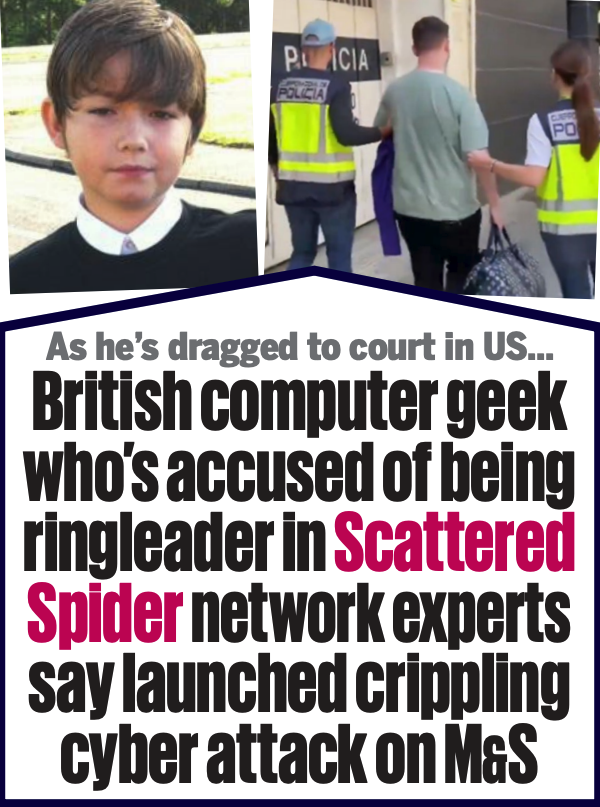
A screenshot of two photos of Buchanan that appeared in a Daily Mail story dated May 3, 2025.

Two photos published in a Daily Mail story dated May 3, 2025 show Buchanan as a child (left) and as an adult being detained by airport authorities in Spain. “M&S” in this screenshot refers to Marks & Spencer, a major U.K. retail chain that suffered a ransomware attack last year at the hands of Scattered Spider.

Scattered Spider is the name given to a prolific English-speaking cybercrime group known for using social engineering tactics to break into companies and steal data for ransom, often impersonating employees or contractors to deceive IT help desks into granting access.

As part of his guilty plea, Buchanan admitted conspiring with other Scattered Spider members to launch tens of thousands of SMS-based phishing attacks in 2022 that led to intrusions at a number of technology companies, including Twilio, LastPass, DoorDash, and Mailchimp.

The group then used data stolen in those breaches to carry out SIM-swapping attacks that siphoned funds from individual cryptocurrency investors. In an unauthorized SIM-swap, crooks transfer the target’s phone number to a device they control and intercept any text messages or phone calls to the victim’s device — such as one-time passcodes for authentication and password reset links sent via SMS. The U.S. Justice Department said Buchanan admitted to stealing at least $8 million in virtual currency from individual victims throughout the United States.

FBI investigators tied Buchanan to the 2022 SMS phishing attacks after discovering the same username and email address was used to register numerous phishing domains seen in the campaign. The domain registrar NameCheap found that less than a month before the phishing spree, the account that registered those domains logged in from an Internet address in the U.K. FBI investigators said the Scottish police told them the address was leased to Buchanan throughout 2022.

As first reported by KrebsOnSecurity, Buchanan fled the United Kingdom in February 2023, after a rival cybercrime gang hired thugs to invade his home, assault his mother, and threaten to burn him with a blowtorch unless he gave up the keys to his cryptocurrency wallet. That same year, U.K. investigators found a device at Buchanan’s Scotland residence that included data stolen from SMS phishing victims and seed phrases from cryptocurrency theft victims.

Buchanan was arrested by Spanish authorities in June 2024 while trying to board a flight to Italy. He was extradited to the United States and has remained in U.S. federal custody since April 2025.

Buchanan is the second known Scattered Spider member to plead guilty. Noah Michael Urban, 21, of Palm Coast, Fla., was sentenced to 10 years in federal prison last year and ordered to pay $13 million in restitution. Three other alleged co-conspirators — Ahmed Hossam Eldin Elbadawy, 24, a.k.a. “AD,” of College Station, Texas; Evans Onyeaka Osiebo, 21, of Dallas, Texas; and Joel Martin Evans, 26, a.k.a. “joeleoli,” of Jacksonville, North Carolina – still face criminal charges.

Two other alleged Scattered Spider members will soon be tried in the United Kingdom. Owen Flowers, 18, and Thalha Jubair, 20, are facing charges related to the hacking and extortion of several large U.K. retailers, the London transit system, and healthcare providers in the United States. Both have pleaded not guilty, and their trial is slated to begin in June.

Investigators say the Scattered Spider suspects are part of a sprawling cybercriminal community online known as “The Com,” wherein hackers from different cliques boast publicly on Telegram and Discord about high-profile cyber thefts that almost invariably begin with social engineering — tricking people over the phone, email or SMS into giving away credentials that allow remote access to corporate internal networks.

One of the more popular SIM-swapping channels on Telegram has long maintained a leaderboard of the most rapacious SIM-swappers, indexed by their supposed conquests in stealing cryptocurrency. That leaderboard previously listed Buchanan’s hacker alias Tylerb at #65 (out of 100 hackers), with Urban’s moniker “Sosa” coming in at #24.

Buchanan’s sentencing hearing is scheduled for August 21, 2026. According to the Justice Department, he faces a statutory maximum sentence of 22 years in federal prison. However, any sentence the judge hands down in this case may be significantly tempered by a number of mitigating factors in the U.S. Sentencing Guidelines, including the defendant’s age, criminal history, time already served in U.S. custody, and the degree to which they cooperated with federal authorities.

Cybercrime losses jumped 26% to $20.9 billion in 2025

Cybercrime remains a booming business. 

Annual cybercrime losses amounted to almost $20.9 billion last year, reflecting a 26% increase from 2024, the FBI’s Internet Crime Complaint Center (IC3) said in its annual report Tuesday.

The comprehensive study exposes a worsening digital crime environment that is driving financial losses, with momentum moving in the wrong direction and compounding at an alarming rate. Annual cybercrime losses have jumped almost 400% from $4.2 billion in 2020, and cumulative losses in that five-year period surpassed $71.3 billion.

The FBI’s IC3, which formed as the country’s central hub for cybercrime reporting in 2000, is busier than ever. “We now average almost 3,000 complaints per day,” Jose Perez, the FBI’s operations director for its criminal and cyber branch, wrote in the report. 

The annual internet crime report highlights growing and sustaining trends. Yet, the scope of the study is limited and relies entirely on cybercrime incidents submitted to the FBI. 

The full impact of cybercrime remains murky, as an unknown number of victims suffer in the shadows and never report the crimes they endure.

The FBI received more than 1 million complaints last year, with victims aged over 60 reporting the largest amount of crimes that also resulted in the greatest amount of total losses by age group. Victims at least 60 years old filed 201,000 complaints with losses totaling nearly $7.75 billion, or about 37% of all cybercrime-related losses last year.

Investment-related fraud remained the largest component of cybercrime losses in 2025, reaching almost $8.65 billion. Business email compromise took the No. 2 spot with almost $3.05 billion in losses, followed by tech support scams at more than $2.1 billion. 

Cryptocurrency was the primary conduit for fraud linked to investment and tech support scams last year, while wire transfers composed the bulk of fraud resulting from business email compromise, according to the report.

Phishing was the most commonly reported type of cybercrime last year, followed by extortion, investment scams and personal data breaches. The FBI tallied losses amounting to $122.5 million from extortion and $32.3 million from ransomware last year.

The FBI also received more than 75,000 reports of sextortion last year, including more than 5,700 submissions that were referred to the National Center for Missing and Exploited Children.

The top five cyber threats reported to IC3 in 2025 included data breaches at 39%, ransomware at 36%, SIM swapping at 10%, malware at 9% and botnets at 7%. 

The FBI received more than 3,600 complaints reporting ransomware last year. The five most reported variants included Akira, Qilin, INC, BianLian and Play.

Each of the 16 critical infrastructure sectors reported ransomware attacks last year, and the most heavily targeted included health care, manufacturing, financial services, government and IT.

The IC3 primarily receives complaints from U.S. residents and businesses, but it also received complaints from more than 200 countries last year, which accounted for nearly $1.6 billion in total losses. 

While losses and the sheer amount of cybercrime continued to climb last year, “the FBI continues to disrupt and deter malicious cyber actors — and shift the cost from victims to our adversaries,” Perez wrote in the report.

“It has never been more important to be diligent with your cybersecurity, social media footprint, and electronic interactions,” he added. “Cyber threats and cyber-enabled crime will continue to evolve as the world embraces emerging technologies such as artificial intelligence.”

The post Cybercrime losses jumped 26% to $20.9 billion in 2025 appeared first on CyberScoop.

SIM-Swapper, Scattered Spider Hacker Gets 10 Years

A 20-year-old Florida man at the center of a prolific cybercrime group known as “Scattered Spider” was sentenced to 10 years in federal prison today, and ordered to pay roughly $13 million in restitution to victims.

Noah Michael Urban of Palm Coast, Fla. pleaded guilty in April 2025 to charges of wire fraud and conspiracy. Florida prosecutors alleged Urban conspired with others to steal at least $800,000 from five victims via SIM-swapping attacks that diverted their mobile phone calls and text messages to devices controlled by Urban and his co-conspirators.

A booking photo of Noah Michael Urban released by the Volusia County Sheriff.

Although prosecutors had asked for Urban to serve eight years, Jacksonville news outlet News4Jax.com reports the federal judge in the case today opted to sentence Urban to 120 months in federal prison, ordering him to pay $13 million in restitution and undergo three years of supervised release after his sentence is completed.

In November 2024 Urban was charged by federal prosecutors in Los Angeles as one of five members of Scattered Spider (a.k.a. “Oktapus,” “Scatter Swine” and “UNC3944”), which specialized in SMS and voice phishing attacks that tricked employees at victim companies into entering their credentials and one-time passcodes at phishing websites. Urban pleaded guilty to one count of conspiracy to commit wire fraud in the California case, and the $13 million in restitution is intended to cover victims from both cases.

The targeted SMS scams spanned several months during the summer of 2022, asking employees to click a link and log in at a website that mimicked their employer’s Okta authentication page. Some SMS phishing messages told employees their VPN credentials were expiring and needed to be changed; other missives advised employees about changes to their upcoming work schedule.

That phishing spree netted Urban and others access to more than 130 companies, including Twilio, LastPass, DoorDash, MailChimp, and Plex. The government says the group used that access to steal proprietary company data and customer information, and that members also phished people to steal millions of dollars worth of cryptocurrency.

For many years, Urban’s online hacker aliases “King Bob” and “Sosa” were fixtures of the Com, a mostly Telegram and Discord-based community of English-speaking cybercriminals wherein hackers boast loudly about high-profile exploits and hacks that almost invariably begin with social engineering. King Bob constantly bragged on the Com about stealing unreleased rap music recordings from popular artists, presumably through SIM-swapping attacks. Many of those purloined tracks or “grails” he later sold or gave away on forums.

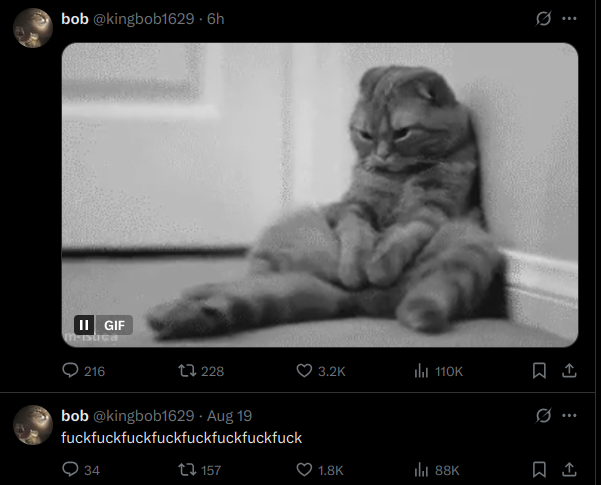
Noah “King Bob” Urban, posting to Twitter/X around the time of his sentencing today.

Sosa also was active in a particularly destructive group of accomplished criminal SIM-swappers known as “Star Fraud.” Cyberscoop’s AJ Vicens reported in 2023 that individuals within Star Fraud were likely involved in the high-profile Caesars Entertainment and MGM Resorts extortion attacks that same year.

The Star Fraud SIM-swapping group gained the ability to temporarily move targeted mobile numbers to devices they controlled by constantly phishing employees of the major mobile providers. In February 2023, KrebsOnSecurity published data taken from the Telegram channels for Star Fraud and two other SIM-swapping groups showing these crooks focused on SIM-swapping T-Mobile customers, and that they collectively claimed internal access to T-Mobile on 100 separate occasions over a 7-month period in 2022.

Reached via one of his King Bob accounts on Twitter/X, Urban called the sentence unjust, and said the judge in his case discounted his age as a factor.

“The judge purposefully ignored my age as a factor because of the fact another Scattered Spider member hacked him personally during the course of my case,” Urban said in reply to questions, noting that he was sending the messages from a Florida county jail. “He should have been removed as a judge much earlier on. But staying in county jail is torture.”

A court transcript (PDF) from a status hearing in February 2025 shows Urban was telling the truth about the hacking incident that happened while he was in federal custody. It involved an intrusion into a magistrate judge’s email account, where a copy of Urban’s sealed indictment was stolen. The judge told attorneys for both sides that a co-defendant in the California case was trying to find out about Mr. Urban’s activity in the Florida case.

“What it ultimately turned into a was a big faux pas,” Judge Harvey E. Schlesinger said. “The Court’s password…business is handled by an outside contractor. And somebody called the outside contractor representing Judge Toomey saying, ‘I need a password change.’ And they gave out the password change. That’s how whoever was making the phone call got into the court.”

❌