Reading view

There are new articles available, click to refresh the page.

DarkSword’s GitHub leak threatens to turn elite iPhone hacking into a tool for the masses

Leaked iOS spyware has some cybersecurity professionals raising urgent alarms about potential mass iPhone compromises, a development that pairs ominously with the recent discovery of two sophisticated iOS exploit kits.

At the same time, some other experts say Apple’s defensive features for iPhones remain elite. But several factors have created unprecedented circumstances: the public accessibility of a version of DarkSword, shortly after the discovery of the original version of DarkSword and the earlier discovery of a similar kit known as  Coruna, and a  growing market for iPhone exploits driven by their high value as targets.

Allan Liska, field chief information security officer at Recorded Future, said he was worried about what the leaked DarkSword version could do to “democratize” iPhone exploits.

“Right now, iPhone exploitations are among the most expensive to research/implement so they have been, largely, the realm of nation-states,” he said. “If anyone can exploit an iPhone, suddenly something that has managed to be relatively secure now is a much bigger attack surface.”

Google, iVerify and Lookout released research last week on DarkSword’s discovery, centered on Ukraine. Google also said it saw targeting in Saudi Arabia, Turkey and Malaysia. And that was before a version turned up on GitHub, a development TechCrunch first reported and Google and iVerify have analyzed. (The week before, iVerify and Google uncovered Coruna. Google declined to comment further for this story.)

“It’s extremely alarming that this leaked out on GitHub,” said Rocky Cole, co-founder of iVerify. “I would assume that it’s being used all around the world, and including here in the United States.”

Hundreds of millions of iPhones running iOS 18 could be vulnerable to DarkSword.

“I think that the top line issues here are pretty clear: people who have devices that are vulnerable should upgrade ASAP,” said Eva Galperin, director of cybersecurity at the Electronic Frontier Foundation. “It is very likely that these vulnerabilities are being used right now to exploit vulnerable devices at scale, which is unusual for Apple products.”

The propagation problem

Coruna was concerning enough for Apple that it took the rare step of backporting security updates to still older versions of iOS, Cole said. The fear, he said, was that it might be wormable — capable of spreading from one device via text message to everyone in a phone’s contact list.

But Cole said Apple hasn’t released similar security-focused updates to iOS 18, for reasons he doesn’t know.

Apple has emphasized the patches it has issued, urged users to update their phones and touted Lockdown Mode as a defense against spyware.

“Apple devices are designed with multiple layers of security in order to protect against a wide range of potential threats, and every day Apple’s security teams around the world work tirelessly to protect users’ devices and data,” said Apple spokesperson Sarah O’Rourke. “Keeping your software up to date is the single most important thing you can do to maintain the security of your Apple products, and devices with updated software were not at risk from these reported attacks.”

IPhones’ widespread use makes them high-value targets, fueling a thriving market for exploits. Coruna and DarkSword are indicators of this growing demand. 

“It’s time for organizations to start thinking of mobile security the way they think about desktop security, which is to say everyone knows how to secure their laptop,” Cole said. And for iPhone exploit hunting in particular, “you’re starting to see people do it at a mass level.” Furthermore, the resale market is such that exploits that once were exclusive are no longer, and AI makes it even easier to customize them in the code, he said. 

DarkSword has drawn federal attention: The Cybersecurity and Infrastructure Security Agency this week added vulnerabilities that DarkSword exploits to the list that federal agencies must patch.

The number of people still using iOS 18 is large, up to 25% of all iPhones. Cole said several factors are contributing to that, such as users being leery of iOS 26’s onboard artificial intelligence or the Liquid Glass interface.

Said Galperin: “There are many reasons why people do not keep their devices up to date, so when I tell people ‘just patch your stuff’ I think it is important to realize that there are circumstances under which this is easier said than done.”

Proven defenses despite expanding risks

Despite the concerns, Cole credited iPhone for its high security standards, in particular for its app store.

For Natalia Krapiva, senior tech-legal counsel at Access Now, a key takeaway is the worrisome proliferation of commercial spyware and cyber intrusion capabilities.

“This is exactly what human rights activists and digital security researchers have been warning governments and companies about: In the absence of effective regulation for the industry, these exploits will get out and end up in the hands of adversaries like Russia, China, Iran, or, as in the case of DarkSword, leaked online for any criminal to use,” she said.

On the other hand, Apple’s Lockdown Mode and Memory Integrity Enforcement are top-notch defensive measures, Krapiva said. We’ve yet to see a Lockdown Mode-enabled iPhone being infected with spyware, she said.

“I think we’ll keep seeing more attempts to exploit both Apple and Android devices as they improve their software and hardware security,” she said. “It’s the old cat-and-mouse game.”

Adam Boynton, senior enterprise strategy manager at Jamf, said what’s happened with Coruna and DarkSword is evidence of Apple’s success.

“What’s encouraging here is that Apple’s security model works,” he said. “Coruna skips devices running the latest iOS versions and avoids those with Lockdown Mode enabled entirely. That’s a strong validation of the defences Apple has built.

“DarkSword reinforces the same principle,” he continued. “Where Coruna targeted older iOS versions, DarkSword demonstrates that even relatively current releases can be targeted by determined actors. Apple moved quickly to patch the vulnerabilities involved, and devices running the latest iOS are protected.”

The post DarkSword’s GitHub leak threatens to turn elite iPhone hacking into a tool for the masses appeared first on CyberScoop.

‘CanisterWorm’ Springs Wiper Attack Targeting Iran

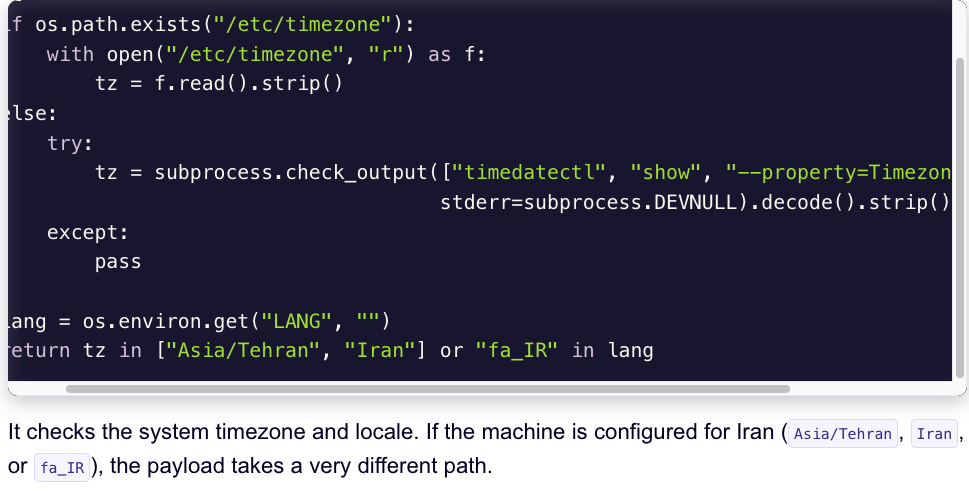
A financially motivated data theft and extortion group is attempting to inject itself into the Iran war, unleashing a worm that spreads through poorly secured cloud services and wipes data on infected systems that use Iran’s time zone or have Farsi set as the default language.

Experts say the wiper campaign against Iran materialized this past weekend and came from a relatively new cybercrime group known as TeamPCP. In December 2025, the group began compromising corporate cloud environments using a self-propagating worm that went after exposed Docker APIs, Kubernetes clusters, Redis servers, and the React2Shell vulnerability. TeamPCP then attempted to move laterally through victim networks, siphoning authentication credentials and extorting victims over Telegram.

A snippet of the malicious CanisterWorm that seeks out and destroys data on systems that match Iran’s timezone or have Farsi as the default language. Image: Aikido.dev.

In a profile of TeamPCP published in January, the security firm Flare said the group weaponizes exposed control planes rather than exploiting endpoints, predominantly targeting cloud infrastructure over end-user devices, with Azure (61%) and AWS (36%) accounting for 97% of compromised servers.

“TeamPCP’s strength does not come from novel exploits or original malware, but from the large-scale automation and integration of well-known attack techniques,” Flare’s Assaf Morag wrote. “The group industrializes existing vulnerabilities, misconfigurations, and recycled tooling into a cloud-native exploitation platform that turns exposed infrastructure into a self-propagating criminal ecosystem.”

On March 19, TeamPCP executed a supply chain attack against the vulnerability scanner Trivy from Aqua Security, injecting credential-stealing malware into official releases on GitHub actions. Aqua Security said it has since removed the harmful files, but the security firm Wiz notes the attackers were able to publish malicious versions that snarfed SSH keys, cloud credentials, Kubernetes tokens and cryptocurrency wallets from users.

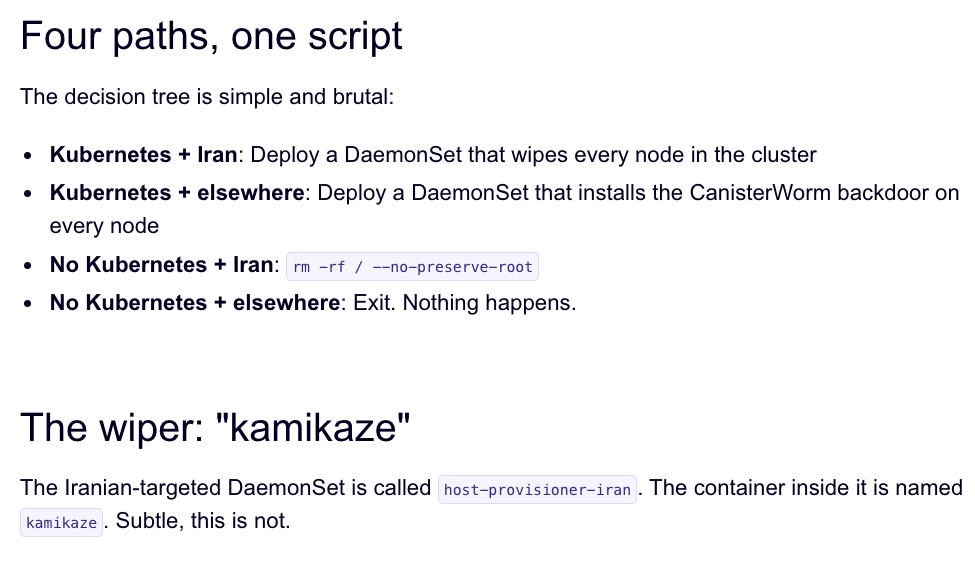
Over the weekend, the same technical infrastructure TeamPCP used in the Trivy attack was leveraged to deploy a new malicious payload which executes a wiper attack if the user’s timezone and locale are determined to correspond to Iran, said Charlie Eriksen, a security researcher at Aikido. In a blog post published on Sunday, Eriksen said if the wiper component detects that the victim is in Iran and has access to a Kubernetes cluster, it will destroy data on every node in that cluster.

“If it doesn’t it will just wipe the local machine,” Eriksen told KrebsOnSecurity.

Image: Aikido.dev.

Aikido refers to TeamPCP’s infrastructure as “CanisterWorm” because the group orchestrates their campaigns using an Internet Computer Protocol (ICP) canister — a system of tamperproof, blockchain-based “smart contracts” that combine both code and data. ICP canisters can serve Web content directly to visitors, and their distributed architecture makes them resistant to takedown attempts. These canisters will remain reachable so long as their operators continue to pay virtual currency fees to keep them online.

Eriksen said the people behind TeamPCP are bragging about their exploits in a group on Telegram and claim to have used the worm to steal vast amounts of sensitive data from major companies, including a large multinational pharmaceutical firm.

“When they compromised Aqua a second time, they took a lot of GitHub accounts and started spamming these with junk messages,” Eriksen said. “It was almost like they were just showing off how much access they had. Clearly, they have an entire stash of these credentials, and what we’ve seen so far is probably a small sample of what they have.”

Security experts say the spammed GitHub messages could be a way for TeamPCP to ensure that any code packages tainted with their malware will remain prominent in GitHub searches. In a newsletter published today titled GitHub is Starting to Have a Real Malware Problem, Risky Business reporter Catalin Cimpanu writes that attackers often are seen pushing meaningless commits to their repos or using online services that sell GitHub stars and “likes” to keep malicious packages at the top of the GitHub search page.

This weekend’s outbreak is the second major supply chain attack involving Trivy in as many months. At the end of February, Trivy was hit as part of an automated threat called HackerBot-Claw, which mass exploited misconfigured workflows in GitHub Actions to steal authentication tokens.

Eriksen said it appears TeamPCP used access gained in the first attack on Aqua Security to perpetrate this weekend’s mischief. But he said there is no reliable way to tell whether TeamPCP’s wiper actually succeeded in trashing any data from victim systems, and that the malicious payload was only active for a short time over the weekend.

“They’ve been taking [the malicious code] up and down, rapidly changing it adding new features,” Eriksen said, noting that when the malicious canister wasn’t serving up malware downloads it was pointing visitors to a Rick Roll video on YouTube.

“It’s a little all over the place, and there’s a chance this whole Iran thing is just their way of getting attention,” Eriksen said. “I feel like these people are really playing this Chaotic Evil role here.”

Cimpanu observed that supply chain attacks have increased in frequency of late as threat actors begin to grasp just how efficient they can be, and his post documents an alarming number of these incidents since 2024.

“While security firms appear to be doing a good job spotting this, we’re also gonna need GitHub’s security team to step up,” Cimpanu wrote. “Unfortunately, on a platform designed to copy (fork) a project and create new versions of it (clones), spotting malicious additions to clones of legitimate repos might be quite the engineering problem to fix.”

Update, 2:40 p.m. ET: Wiz is reporting that TeamPCP also pushed credential stealing malware to the KICS vulnerability scanner from Checkmarx, and that the scanner’s GitHub Action was compromised between 12:58 and 16:50 UTC today (March 23rd).

Second iOS exploit kit now in use by suspected Russian hackers

Researchers have discovered a second instance of suspected Russian hackers using iOS exploits, pointing to what they say are several foreboding trends.

iVerify, Lookout and Google collaborated on the research published Wednesday, a follow-up to earlier revelations about a similar exploit kit, Coruna. While the second kit — dubbed DarkSword — also targeted users in Ukraine, the scale is significant: iVerify estimated up to 270 million iPhone users could be susceptible, while Lookout told CyberScoop roughly 15% of all iOS devices currently in use are running iOS 18 or earlier versions and could be vulnerable to the exploit kit.

The research reveals a range of new details, as well as interesting patterns:

  • Whereas Russian and Chinese hackers used Coruna with financial gain in mind, there are signs DarkSword could serve both financial and surveillance purposes, and/or could be used to inflict harm.
  • Lookout observed that someone used a large language model to customize both Coruna and DarkSword.
  • The discovery of DarkSword reinforces earlier concerns about a secondary exploit market, Lookout and iVerify said.
  • DarkSword is the second “mass” iOS campaign discovered this month, with the first known one to be Coruna.
  • Both kits suggest cyberattacks are migrating toward mobile phones as they make up a bigger portion of internet traffic, Rocky Cole, iVerify’s co-founder and chief operating officer, told CyberScoop.
  • Google also found that DarkSword was used against targets in Saudi Arabia, Turkey, and Malaysia

DarkSword can exfiltrate saved passwords, crypto wallets, text messages and more, researchers found. Attackers are leveraging the exploit kit by first compromising Apple’s WebKit and then using WebGPU as a pivot point for sandbox escapes, according to Justin Albrecht, Lookout’s global director for mobile threat intelligence.

What’s less clear is who, exactly, is behind the exploit kit, other than the links to Russia. Cole said DarkSword is hosted on the same command and control infrastructure as Coruna, but is an entirely separate kit made by entirely separate people. Google has attributed the campaigns to a group it tracks as UNC6353, which it describes as a Russian-backed espionage group, as well as UNC6748 and Turkish commercial surveillance vendor PARS Defense. 

The attackers’ motives are also a bit opaque, mixing what appears to be both espionage and financial objectives. Albrecht noted there is precedent for this: Russian threat groups have targeted cryptocurrency in Ukraine before, notably with Infamous Chisel, an Android exploit kit deployed by Sandworm

“They’re probably well-funded, probably well-connected, but it’s confirmed that they’re stealing crypto. There is definitely a financial motivation,” Albrecht told CyberScoop. “Now, I think the big question is, depending on who the group is, is the financial motivation in this just to do damage to Ukrainians, or is it to steal crypto?”

Russia has been under heavy sanctions for a long time and is starting to have budget problems due to the ongoing war in Ukraine, he noted. “Why not start to fund their operations with stolen funds? It wouldn’t be outside the norm, although it would be a potential shift in their TTPs for Russian APTs in general,” Albrecht said. 

The kit could be handy for someone trying to do a “pattern of life” analysis, Cole said, and thus useful for surveillance and intelligence purposes.

He said a commercial spyware vendor might have made the kit with no target audience in mind, thus the “Swiss Army knife”-like quality of it. The major concern for Cole is that there’s apparently a growing market for these kinds of tools, and people may be lulled into a false sense of security about iPhones not being vulnerable.

Despite the sophistication of the exploits themselves, the threat actors behind DarkSword may not be particularly experienced, Albrecht said. None of the JavaScript or HTML code was obfuscated in any way, and the server-side component was labeled “Dark sword file receiver” — poor operational security for a seasoned Russian threat actor.

“Your experienced Russian threat actors, your APT29’s of the world, I would expect them to have better OPSEC,” Albrecht said.

One of the more unusual findings in the research is the clear presence of large language model-generated code. The server-side component of DarkSword, for instance, includes telltale signs of AI-generated code, complete with detailed notes and comments characteristic of LLM output.  It’s a development that effectively lowers the barrier to entry for deploying advanced mobile exploits, even among state-sponsored actors, Albrecht said.

All three research teams have been in contact with Apple about the findings, according to Albrecht, with Google likely in closest contact since they began investigating the threat in late 2025. In its blog, Google said it reported the vulnerabilities used in DarkSword to Apple in late 2025, and all vulnerabilities were patched with the release of iOS 26.3, although most were patched prior.

CLARIFICATION 3/18/26: Clarified the suspected origins of the DarkSword exploit kit and any links to tools developed for the U.S. government.

The post Second iOS exploit kit now in use by suspected Russian hackers appeared first on CyberScoop.

Amazon warns that Russia’s Sandworm has shifted its tactics

Attackers associated with Russia’s Main Intelligence Directorate (GRU) have targeted Western-based critical infrastructure with a special focus on the energy sector as part of an ongoing campaign dating back to 2021, Amazon Threat Intelligence said in a report Monday. 

The threat group simplified operations earlier this year by shifting away from vulnerability exploitation to focus on misconfigured network edge devices hosted on Amazon Web Services as the primary initial access vector, CJ Moses, chief information security officer of Amazon Integrated Security, said in a blog post. 

Researchers said malicious infrastructure used by the attackers overlaps with operations linked to Sandworm, also known as APT44 and Seashell Blizzard, a detail that gives them confidence the activity is associated with Russia’s GRU. 

Amazon did not say how many attacks it’s attributed to the campaign, nor how the pace of activity has changed since the first wave of attacks occurred in 2021. The company said it has notified customers affected by the intrusions, remediated compromised EC2 instances and shared intelligence with partners and affected vendors to aid further investigations.

The Russia state-sponsored threat group has continued to target multiple Western-based organizations in the energy sector including electric utilities, energy providers and managed security service providers specializing in the industry, according to Amazon. 

Researchers said the threat group has also targeted collaboration platforms, source code repositories, organizations with cloud-based network infrastructure, critical infrastructure providers in North America and Europe, and telecom providers across multiple regions. 

Attacks typically begin with a compromised customer network edge device hosted on AWS, followed by attempts to capture data traversing the network in a bid to steal credentials and reuse those credentials against victim organizations’ other services and infrastructure to maintain access, according to Amazon.

Moses insists the compromise of network edge devices hosted on AWS is not due to a weakness in its  infrastructure, but rather improper device setup from customers. Attackers associated with Russia’s GRU have targeted enterprise routers and routing infrastructure, virtual private networks for large organizations, remote-access gateways and network-management appliances. 

The campaign initially relied on vulnerability exploitation from 2021 to 2024, including CVE-2022-26318 affecting WatchGuard, CVE-2021-26084 and CVE-2023-22518 affecting Confluence and CVE-2023-27532 affecting Veeam, researchers said.

Yet, targeting shifted to misconfigured network edge devices this year, which allowed attackers to achieve the same strategic goals at a lower cost. 

“While customer misconfiguration targeting has been ongoing since at least 2022, the actor maintained sustained focus on this activity in 2025 while reducing investment in zero-day and N-day exploitation,” Moses said in the blog post. “The actor accomplishes this while significantly reducing the risk of exposing their operations through more detectable vulnerability exploitation activity.”

Sandworm is one of the most notorious state-sponsored threat groups of the past decade. The group primarily targets government, defense, transportation, energy, media and civil society organizations in Russia’s near abroad. It has repeatedly targeted Western electoral systems and institutions, including in NATO member countries. On three separate occasions, the group has succeeded in using a cyberattack to disrupt electricity distribution in Ukraine.

The post Amazon warns that Russia’s Sandworm has shifted its tactics appeared first on CyberScoop.

Self-Replicating Worm Hits 180+ Software Packages

At least 187 code packages made available through the JavaScript repository NPM have been infected with a self-replicating worm that steals credentials from developers and publishes those secrets on GitHub, experts warn. The malware, which briefly infected multiple code packages from the security vendor CrowdStrike, steals and publishes even more credentials every time an infected package is installed.

Image: https://en.wikipedia.org/wiki/Sandworm_(Dune)

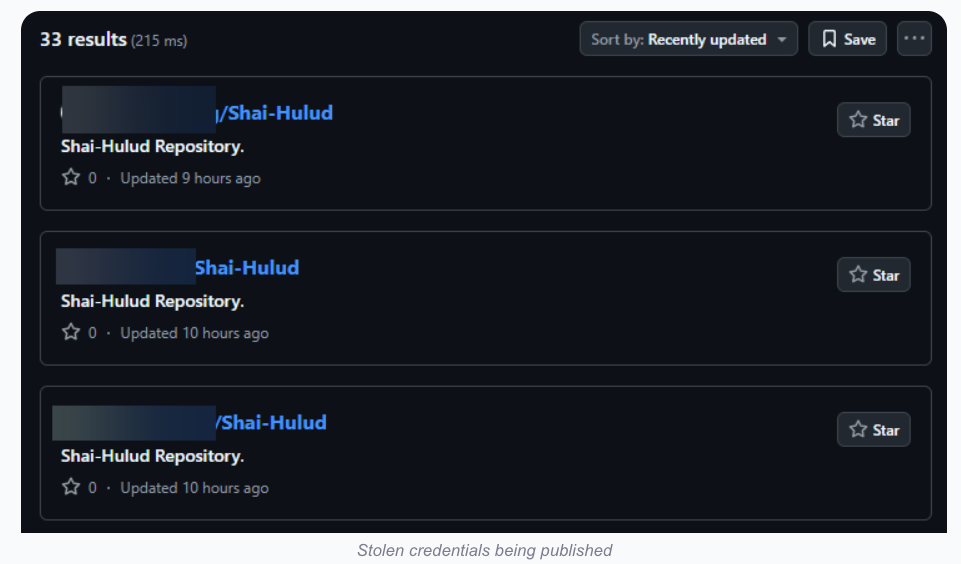
The novel malware strain is being dubbed Shai-Hulud — after the name for the giant sandworms in Frank Herbert’s Dune novel series — because it publishes any stolen credentials in a new public GitHub repository that includes the name “Shai-Hulud.”

“When a developer installs a compromised package, the malware will look for a npm token in the environment,” said Charlie Eriksen, a researcher for the Belgian security firm Aikido. “If it finds it, it will modify the 20 most popular packages that the npm token has access to, copying itself into the package, and publishing a new version.”

At the center of this developing maelstrom are code libraries available on NPM (short for “Node Package Manager”), which acts as a central hub for JavaScript development and provides the latest updates to widely-used JavaScript components.

The Shai-Hulud worm emerged just days after unknown attackers launched a broad phishing campaign that spoofed NPM and asked developers to “update” their multi-factor authentication login options. That attack led to malware being inserted into at least two-dozen NPM code packages, but the outbreak was quickly contained and was narrowly focused on siphoning cryptocurrency payments.

Image: aikido.dev

In late August, another compromise of an NPM developer resulted in malware being added to “nx,” an open-source code development toolkit with as many as six million weekly downloads. In the nx compromise, the attackers introduced code that scoured the user’s device for authentication tokens from programmer destinations like GitHub and NPM, as well as SSH and API keys. But instead of sending those stolen credentials to a central server controlled by the attackers, the malicious nx code created a new public repository in the victim’s GitHub account, and published the stolen data there for all the world to see and download.

Last month’s attack on nx did not self-propagate like a worm, but this Shai-Hulud malware does and bundles reconnaissance tools to assist in its spread. Namely, it uses the open-source tool TruffleHog to search for exposed credentials and access tokens on the developer’s machine. It then attempts to create new GitHub actions and publish any stolen secrets.

“Once the first person got compromised, there was no stopping it,” Aikido’s Eriksen told KrebsOnSecurity. He said the first NPM package compromised by this worm appears to have been altered on Sept. 14, around 17:58 UTC.

The security-focused code development platform socket.dev reports the Shai-Halud attack briefly compromised at least 25 NPM code packages managed by CrowdStrike. Socket.dev said the affected packages were quickly removed by the NPM registry.

In a written statement shared with KrebsOnSecurity, CrowdStrike said that after detecting several malicious packages in the public NPM registry, the company swiftly removed them and rotated its keys in public registries.

“These packages are not used in the Falcon sensor, the platform is not impacted and customers remain protected,” the statement reads, referring to the company’s widely-used endpoint threat detection service. “We are working with NPM and conducting a thorough investigation.”

A writeup on the attack from StepSecurity found that for cloud-specific operations, the malware enumerates AWS, Azure and Google Cloud Platform secrets. It also found the entire attack design assumes the victim is working in a Linux or macOS environment, and that it deliberately skips Windows systems.

StepSecurity said Shai-Hulud spreads by using stolen NPM authentication tokens, adding its code to the top 20 packages in the victim’s account.

“This creates a cascading effect where an infected package leads to compromised maintainer credentials, which in turn infects all other packages maintained by that user,” StepSecurity’s Ashish Kurmi wrote.

Eriksen said Shai-Hulud is still propagating, although its spread seems to have waned in recent hours.

“I still see package versions popping up once in a while, but no new packages have been compromised in the last ~6 hours,” Eriksen said. “But that could change now as the east coast starts working. I would think of this attack as a ‘living’ thing almost, like a virus. Because it can lay dormant for a while, and if just one person is suddenly infected by accident, they could restart the spread. Especially if there’s a super-spreader attack.”

For now, it appears that the web address the attackers were using to exfiltrate collected data was disabled due to rate limits, Eriksen said.

Nicholas Weaver is a researcher with the International Computer Science Institute, a nonprofit in Berkeley, Calif. Weaver called the Shai-Hulud worm “a supply chain attack that conducts a supply chain attack.” Weaver said NPM (and all other similar package repositories) need to immediately switch to a publication model that requires explicit human consent for every publication request using a phish-proof 2FA method.

“Anything less means attacks like this are going to continue and become far more common, but switching to a 2FA method would effectively throttle these attacks before they can spread,” Weaver said. “Allowing purely automated processes to update the published packages is now a proven recipe for disaster.”

❌