
Reading view

There are new articles available, click to refresh the page.

Microsoft drops its second-largest monthly batch of defects on record

Microsoft addressed 165 vulnerabilities affecting its various products and underlying systems, including one actively exploited vulnerability in Microsoft Office SharePoint, in this month’s Patch Tuesday update

“By my count, this is the second-largest monthly release in Microsoft’s history,” Dustin Childs, head of threat awareness at Trend Micro’s Zero Day Initiative, wrote in a blog post Tuesday.

Microsoft didn’t explain why its monthly batch of patches grew so large this month, but Childs noted that many vulnerability programs are experiencing a significant increase in submissions found by artificial intelligence tools. “For us, our incoming rate has essentially tripled, making triage a challenge, to say the least,” he added. 

The zero-day vulnerability — CVE-2026-32201 — has a CVSS rating of 6.5 and allows attackers to view sensitive information and make changes to disclosed information. Microsoft said the improper input validation defect in Microsoft Office SharePoint allows unauthenticated attackers to perform spoofing over a network.

The Cybersecurity and Infrastructure Security Agency added the zero-day to its known exploited vulnerabilities catalog shortly after Microsoft’s disclosure. 

Microsoft also addressed a high-severity vulnerability — CVE-2026-33825 — that was publicly known at the time of release. The vendor said the defect in Microsoft Defender is more likely to be exploited and could allow unauthorized attackers to elevate privileges locally.

“What starts as a foothold can quickly become full system domination,” Jack Bicer, director of vulnerability research at Action1, said in a blog post about the vulnerability. 

“Once exploited, it allows full control over endpoints, enabling data exfiltration, disabling security tools and lateral movement across networks,” Bicer said.

Proof-of-concept exploit code for the defect is publicly available, which increases the likelihood of exploitation in the wild, he added.

Microsoft disclosed two critical vulnerabilities this month — CVE-2026-33824 affecting Windows IKE Extension and CVE-2026-26149 affecting Microsoft Power Apps — but designated both of the defects as less likely to be exploited.

More than three-quarters of the vulnerabilities disclosed this month are less likely to be exploited, according to Microsoft. Meanwhile, the company designated 19 vulnerabilities as more likely to be exploited.

The full list of vulnerabilities addressed this month is available in Microsoft’s Security Response Center.

The post Microsoft drops its second-largest monthly batch of defects on record appeared first on CyberScoop.
Patch Tuesday, April 2026 Edition

Microsoft today pushed software updates to fix a staggering 167 security vulnerabilities in its Windows operating systems and related software, including a SharePoint Server zero-day and a publicly disclosed weakness in Windows Defender dubbed “BlueHammer.” Separately, Google Chrome fixed its fourth zero-day of 2026, and an emergency update for Adobe Reader nixes an actively exploited flaw that can lead to remote code execution.

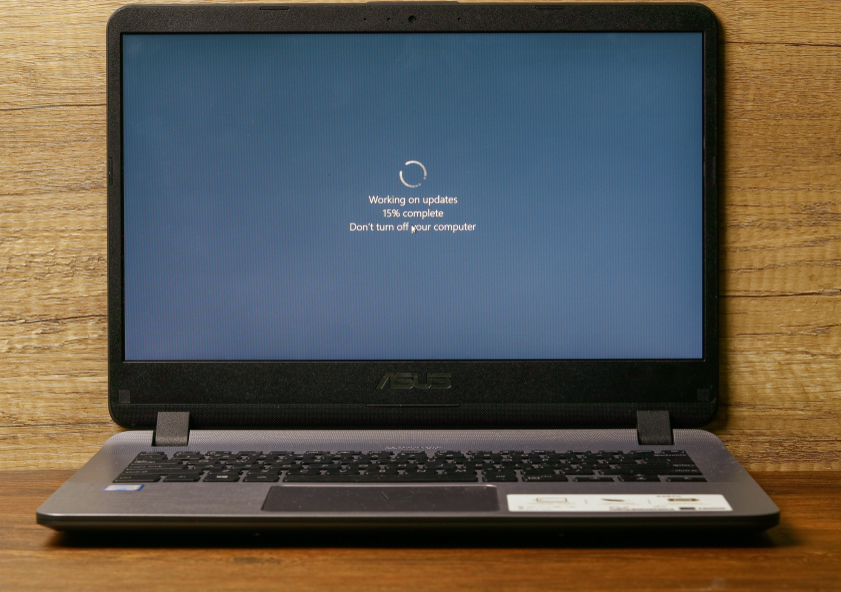
A picture of a windows laptop in its updating stage, saying do not turn off the computer.

Redmond warns that attackers are already targeting CVE-2026-32201, a vulnerability in Microsoft SharePoint Server that allows attackers to spoof trusted content or interfaces over a network.

Mike Walters, president and co-founder of Action1, said CVE-2026-32201 can be used to deceive employees, partners, or customers by presenting falsified information within trusted SharePoint environments.

“This CVE can enable phishing attacks, unauthorized data manipulation, or social engineering campaigns that lead to further compromise,” Walters said. “The presence of active exploitation significantly increases organizational risk.”

Microsoft also addressed BlueHammer (CVE-2026-33825), a privilege escalation bug in Windows Defender. According to BleepingComputer, the researcher who discovered the flaw published exploit code for it after notifying Microsoft and growing exasperated with their response. Will Dormann, senior principal vulnerability analyst at Tharros, says he confirmed that the public BlueHammer exploit code no longer works after installing today’s patches.

Satnam Narang, senior staff research engineer at Tenable, said April marks the second-biggest Patch Tuesday ever for Microsoft. Narang also said there are indications that a zero-day flaw Adobe patched in an emergency update on April 11 — CVE-2026-34621 — has seen active exploitation since at least November 2025.

Adam Barnett, lead software engineer at Rapid7, called the patch total from Microsoft today “a new record in that category” because it includes nearly 60 browser vulnerabilities. Barnett said it might be tempting to imagine that this sudden spike was tied to the buzz around the announcement a week ago today of Project Glasswing — a much-hyped but still unreleased new AI capability from Anthropic that is reportedly quite good at finding bugs in a vast array of software.

But he notes that Microsoft Edge is based on the Chromium engine, and the Chromium maintainers acknowledge a wide range of researchers for the vulnerabilities which Microsoft republished last Friday.

“A safe conclusion is that this increase in volume is driven by ever-expanding AI capabilities,” Barnett said. “We should expect to see further increases in vulnerability reporting volume as the impact of AI models extend further, both in terms of capability and availability.”

Finally, no matter what browser you use to surf the web, it’s important to completely close out and restart the browser periodically. This is really easy to put off (especially if you have a bajillion tabs open at any time) but it’s the only way to ensure that any available updates get installed. For example, a Google Chrome update released earlier this month fixed 21 security holes, including the high-severity zero-day flaw CVE-2026-5281.

For a clickable, per-patch breakdown, check out the SANS Internet Storm Center Patch Tuesday roundup. Running into problems applying any of these updates? Leave a note about it in the comments below and there’s a decent chance someone here will pipe in with a solution.

Microsoft’s monthly Patch Tuesday is first in 6 months with no actively exploited zero-days

Microsoft addressed 83 vulnerabilities that cut across its broad portfolio of enterprise software and underlying services in its latest security update. The company’s Patch Tuesday release contained no actively exploited zero-day vulnerabilities and six defects it described as more likely to be exploited. 

The vendor’s batch of patches marks the first monthly update without an actively exploited zero-day in six months.

The “lack of bugs under active attack is a nice change from last month,” when Microsoft reported six actively exploited vulnerabilities, Dustin Childs, head of threat awareness at Trend Micro’s Zero Day Initiative, said in a blog post Tuesday. 

Two vulnerabilities addressed this month — CVE-2026-21262 and CVE-2026-26127 — were listed as publicly known at the time of release. “These bugs are more bark than bite,” said Satnam Narang, senior staff research engineer at Tenable. 

More than half of the defects in this month’s update can trigger escalated privileges, and six of those vulnerabilities — CVE-2026-23668, CVE-2026-24289, CVE-2026-24291, CVE-2026-24294, CVE-2026-25187 and CVE-2026-26132 — were rated as more likely to be exploited, Narang added.

An information-disclosure defect in Microsoft Excel — CVE-2026-26144 — showcases an attack scenario that’s likely to occur more often, according to Childs. “An attacker could use it to cause the Copilot Agent to exfiltrate data off the target,” essentially making it a zero-click operation, he wrote.

Researchers also focused on a pair of defects in Microsoft Office with CVSS ratings of 8.4 — CVE-2026-26110 and CVE-2026-26113 — that attackers can trigger to execute arbitrary code. The preview plane in Microsoft Office can serve as the attack vector for both vulnerabilities.

“Remote-code execution vulnerabilities in Office applications pose significant risks for organizations, as documents are widely shared via email, file shares, and collaboration platforms,” Mike Walters, president and co-founder of Action1, said in an email. 

“If exploited, attackers could gain control of user systems, deploy ransomware, steal corporate data, or move laterally across internal networks,” he added. “Even a single malicious document could compromise an endpoint and give attackers a foothold inside the organization.”

The full list of vulnerabilities addressed this month is available in Microsoft’s Security Response Center.

The post Microsoft’s monthly Patch Tuesday is first in 6 months with no actively exploited zero-days appeared first on CyberScoop.

Microsoft Patch Tuesday matches last year’s zero-day high with six actively exploited vulnerabilities

Microsoft’s latest security update is littered with zero-day vulnerabilities, actively exploited defects that account for more than 10% of the total CVEs the vendor addressed in this month’s Patch Tuesday update.

The vendor addressed 59 vulnerabilities affecting its various products for business operations and underlying systems, including six defects that were actively exploited prior to Microsoft’s release of its monthly batch of patches. Microsoft said three of the exploited vulnerabilities were publicly known, suggesting attackers already had details about the defects prior to Tuesday’s release.

“The number of bugs under active attack is extraordinarily high,” Dustin Childs, head of threat awareness at Trend Micro’s Zero Day Initiative, said in a blog post.

Microsoft’s February security update matched the high it reached last March when it disclosed six actively exploited zero-days.

The highest rated zero-days, a pair of defects with CVSS ratings of 8.8, include CVE-2026-21510 affecting Windows Shell 8.8 and CVE-2026-21513 affecting Internet Explorer. Both vulnerabilities require user interaction and could allow attackers to execute code.

Mike Walters, president and co-founder of Action1, said CVE-2026-21510 is caused by a protection mechanism failure that allows an attacker to bypass Windows protections by tricking a user to click on a single malicious link.

“Functional exploit techniques exist, demonstrating reliable bypass of Windows Shell and SmartScreen security prompts through crafted links or shortcut files. No privileges are required by the attacker, making this vulnerability highly attractive for phishing-based attacks,” Walters said in a blog post.

The remaining zero-days include three defects with CVSS ratings of 7.8: CVE-2026-21514 affecting Microsoft Office Word, CVE-2026-21519 affecting Desktop Window Manager, and CVE-2026-21533 affecting Windows Remote Desktop. CVE-2026-21525, which affects Windows Remote Access Connection Manager, has a CVSS rating of 6.2.

The Cybersecurity and Infrastructure Security Agency added all six of the zero-days to its known exploited vulnerabilities catalog Tuesday.

Three of the vulnerabilities — CVE-2026-21510, CVE-2026-21513 and CVE-2026-21514 — bear strong similarities as security feature bypasses, Satnam Narang, senior staff research engineer at Tenable, said in an email.

These security features protect users from opening malicious files, he said. “Users have grown accustomed to receiving these alerts, so when vulnerabilities can bypass those protection mechanisms, users are more at risk of compromise.”

Microsoft disclosed two critical vulnerabilities with CVSS ratings of 9.8 this month, including CVE-2026-21531 affecting Azure SDK and CVE-2026-24300 affecting Azure Front Door.

The vast majority of defects Microsoft addressed this month fell into the high-severity category, accounting for 43 vulnerabilities total. The vendor described five of those vulnerabilities as more likely to be exploited.

The full list of vulnerabilities addressed this month is available in Microsoft’s Security Response Center.

The post Microsoft Patch Tuesday matches last year’s zero-day high with six actively exploited vulnerabilities appeared first on CyberScoop.

Microsoft Patch Tuesday addresses 112 defects, including one actively exploited zero-day

Microsoft’s first security update of 2026 addressed 112 vulnerabilities affecting its products and underlying systems, including one actively exploited zero-day in Desktop Window Manager. 

The company’s latest Patch Tuesday update marks the second consecutive month with no critical vulnerabilities disclosed. The batch of patches also contains more than 110 CVEs for the second January in a row. 

The zero-day vulnerability — CVE-2026-20805 — is an information disclosure defect with a CVSS rating of 5.5 that can be exploited by an unauthorized attacker to expose sensitive information. The Cybersecurity and Infrastructure Security Agency added the defect to its known exploited vulnerabilities catalog Tuesday.

Information disclosure vulnerabilities are sporadically exploited in the wild, but not often, according to Dustin Childs, head of threat awareness at Trend Micro’s Zero Day Initiative. “This shows how memory leaks can be as important as code execution bugs since they make the remote code executions reliable,” he wrote in a blog post.

Jack Bicer, director of vulnerability research at Action1, concurred, added that the memory exposed by exploitation of CVE-2026-20805 can undermine defenses and bolster additional exploits. 

“This vulnerability increases the risk of successful multi-stage attacks,” Bicer said in an email. “Leaked memory details can be combined with other vulnerabilities to achieve privilege escalation or data theft, potentially leading to broader system compromise, regulatory exposure and loss of trust.”

Microsoft did not say how many attacks are linked to the zero-day. Yet, exploitation requires an attacker to have local access on the targeted system, Satnam Narang, senior staff research engineer at Tenable, said in an email.

“While Desktop Window Manager is a frequent flyer on Patch Tuesday with 20 CVEs patched in this library since 2022, this is the first time we’ve seen an information disclosure bug in this component exploited in the wild,” he added. “Attackers have historically used it to climb the ladder of privileges.”

The most severe defects disclosed by Microsoft this month include CVE-2026-20947 and CVE-2026-20963 affecting Microsoft Office SharePoint, CVE-2026-20868 affecting Windows Routing and Remote Access Service, CVE-2026-20952 and CVE-2026-20955 affecting Microsoft Office, and CVE-2026-20944 affecting Microsoft Office Word. 

Microsoft also flagged eight vulnerabilities, each with a CVSS rating of 7.8, as more likely to be exploited this month. 

The full list of vulnerabilities addressed this month is available in Microsoft’s Security Response Center.

The post Microsoft Patch Tuesday addresses 112 defects, including one actively exploited zero-day appeared first on CyberScoop.

Microsoft Patch Tuesday, November 2025 Edition

Microsoft this week pushed security updates to fix more than 60 vulnerabilities in its Windows operating systems and supported software, including at least one zero-day bug that is already being exploited. Microsoft also fixed a glitch that prevented some Windows 10 users from taking advantage of an extra year of security updates, which is nice because the zero-day flaw and other critical weaknesses affect all versions of Windows, including Windows 10.

Affected products this month include the Windows OS, Office, SharePoint, SQL Server, Visual Studio, GitHub Copilot, and Azure Monitor Agent. The zero-day threat concerns a memory corruption bug deep in the Windows innards called CVE-2025-62215. Despite the flaw’s zero-day status, Microsoft has assigned it an “important” rating rather than critical, because exploiting it requires an attacker to already have access to the target’s device.

“These types of vulnerabilities are often exploited as part of a more complex attack chain,” said Johannes Ullrich, dean of research for the SANS Technology Institute. “However, exploiting this specific vulnerability is likely to be relatively straightforward, given the existence of prior similar vulnerabilities.”

Ben McCarthy, lead cybersecurity engineer at Immersive, called attention to CVE-2025-60274, a critical weakness in a core Windows graphic component (GDI+) that is used by a massive number of applications, including Microsoft Office, web servers processing images, and countless third-party applications.

“The patch for this should be an organization’s highest priority,” McCarthy said. “While Microsoft assesses this as ‘Exploitation Less Likely,’ a 9.8-rated flaw in a ubiquitous library like GDI+ is a critical risk.”

Microsoft patched a critical bug in OfficeCVE-2025-62199 — that can lead to remote code execution on a Windows system. Alex Vovk, CEO and co-founder of Action1, said this Office flaw is a high priority because it is low complexity, needs no privileges, and can be exploited just by viewing a booby-trapped message in the Preview Pane.

Many of the more concerning bugs addressed by Microsoft this month affect Windows 10, an operating system that Microsoft officially ceased supporting with patches last month. As that deadline rolled around, however, Microsoft began offering Windows 10 users an extra year of free updates, so long as they register their PC to an active Microsoft account.

Judging from the comments on last month’s Patch Tuesday post, that registration worked for a lot of Windows 10 users, but some readers reported the option for an extra year of updates was never offered. Nick Carroll, cyber incident response manager at Nightwing, notes that Microsoft has recently released an out-of-band update to address issues when trying to enroll in the Windows 10 Consumer Extended Security Update program.

“If you plan to participate in the program, make sure you update and install KB5071959 to address the enrollment issues,” Carroll said. “After that is installed, users should be able to install other updates such as today’s KB5068781 which is the latest update to Windows 10.”

Chris Goettl at Ivanti notes that in addition to Microsoft updates today, third-party updates from Adobe and Mozilla have already been released. Also, an update for Google Chrome is expected soon, which means Edge will also be in need of its own update.

The SANS Internet Storm Center has a clickable breakdown of each individual fix from Microsoft, indexed by severity and CVSS score. Enterprise Windows admins involved in testing patches before rolling them out should keep an eye on askwoody.com, which often has the skinny on any updates gone awry.

As always, please don’t neglect to back up your data (if not your entire system) at regular intervals, and feel free to sound off in the comments if you experience problems installing any of these fixes.

[Author’s note: This post was intended to appear on the homepage on Tuesday, Nov. 11. I’m still not sure how it happened, but somehow this story failed to publish that day. My apologies for the oversight.]

Microsoft Patch Tuesday addresses 63 defects, including one actively exploited zero-day

Microsoft addressed 63 vulnerabilities affecting its underlying systems and core products, including one actively exploited zero-day, the company said in its latest monthly security update

The zero-day vulnerability — CVE-2025-62215 — affects the Windows Kernel and has a CVSS rating of 7.0 due to a high attack complexity, according to Microsoft. Exploitation, which could allow an attacker to gain system privileges, requires an attacker to win a race condition, the company said. Microsoft did not provide any further details about the scope of exploitation. 

The race condition is notable because it indicates some race conditions are more reliable than others, Dustin Childs, head of threat awareness at Trend Micro’s Zero Day Initiative, said in a blog post. Race conditions in vulnerabilities, which involve multiple simultaneous processes designed to trigger errors, often impede exploitation.

“Bugs like these are often paired with a code execution bug by malware to completely take over a system,” Childs added.

Mike Walters, president and co-founder at Action1, said a functional exploit for CVE-2025-62215 exists, but no public proof-of-concept has been released. “Exploitation is complex, but a functional exploit seen in the wild raises urgency, since skilled actors can reliably weaponize this in targeted campaigns,” he said in an email.

An attacker with low-privilege local access can trigger the race condition by running a specially crafted application, according to Ben McCarthy, lead cyber security engineer at Immersive. “The goal is to get multiple threads to interact with a shared kernel resource in an unsynchronized way, confusing the kernel’s memory management and causing it to free the same memory block twice,” he said in an email.

The most severe defect disclosed this month — CVE-2025-60724 — is a remote-code execution vulnerability affecting Microsoft Graphics Component with a CVSS rating of 9.8, but Microsoft designated the flaw as less likely to be exploited. 

Microsoft flagged five defects as more likely to be exploited this month, including three vulnerabilities — CVE-2025-60719, CVE-2025-62213 and CVE-2025-62217 — affecting Windows Ancillary Function Driver for WinSock with CVSS ratings of 7.0. 

The kernel-mode driver is fundamental to Windows, making defects in the component inherently high-risk, according to McCarthy. 

“Due to it being so intertwined with network-related functionality of Windows, it has the potential to be a way in for many applications in the Windows ecosystem. There have been many vulnerabilities in the past that have been weaponized in this kernel-mode driver,” he added.

The full list of vulnerabilities addressed this month is available in Microsoft’s Security Response Center.

The post Microsoft Patch Tuesday addresses 63 defects, including one actively exploited zero-day appeared first on CyberScoop.

❌