Reading view

There are new articles available, click to refresh the page.

Metasploit Wrap-Up 05/08/2026

Spring cleanup

This week’s Metasploit updates focused on foundational improvements and expanded target reach. Key enhancements were made to the recently released Copy Fail exploit module, which now benefits from payload fixes in linux/x64/exec and linux/armle/exec. These changes expand its capability, enabling the use of the cmd/unix/python/meterpreter/reverse_tcp payload on x64 targets and introducing support for ARMLE Linux. Additionally, the exploit/multi/http/shiro_rememberme_v124_deserialize module has been improved to allow operators to adjust the deserialization chain, enabling exploitation of a broader set of targets. Finally, several critical utility modules, including the FTP anonymous scanner and other FTP modules, received general fixes and updates.

New module content (1)

Anonymous FTP Access Detection

Authors: Matteo Cantoni goony@nothink.org and g0tmi1k

Type: Auxiliary

Pull request: #21372 contributed by g0tmi1k

Path: scanner/ftp/ftp_anonymous

AttackerKB reference: CVE-1999-0497

Description: This updates the FTP anonymous scanner module. Key changes include moving the module to align with other generic FTP modules, adding and updating CVE references and documentation notes, and cleaning up the output to be more verbose. Additionally, the module now reports service and vulnerability data to the database and stores proof-of-exploitation info in the loot upon a successful run.

Enhanced Modules (2)

Modules which have either been enhanced, or renamed:

  • #21410 from inkognitobo - This improves the exploit/multi/http/shiro_rememberme_v124_deserialize module by adding a JAVA_GADGET_CHAIN datastore option that allows the operator to adjust the chain used for deserialization. This enables the module to exploit additional targets.
  • #21404 from zeroSteiner - This extends the support of Copy Fail to ARMLE Linux targets.

Enhancements and features (4)

  • #21342 from adfoster-r7 - Defers the loading of some dependencies to improve console boot time.
  • #21372 from g0tmi1k - This updates the FTP anonymous scanner module. Key changes include moving the module to align with other generic FTP modules, adding and updating CVE references and documentation notes, and cleaning up the output to be more verbose. Additionally, the module now reports service and vulnerability data to the database and stores proof-of-exploitation info in the loot upon a successful run.
  • #21380 from g0tmi1k - Updates multiple FTP modules to now register FTP service information in the database when successfully connecting to an FTP service.
  • #21418 from kx7m2qd - This improves the platform-agnostic library used to obtain the OS architecture with support for shell sessions on Linux, BSD and Mac OSX.

Bugs fixed (5)

  • #21314 from g0tmi1k - Fixes a crash when running the scanner/http/trace module with the database enabled and a vulnerability was reported.
  • #21411 from zeroSteiner - This fixes a bug in the linux/x64/exec payload that was caused by the CMD datastore option being placed in the assembly source without being escaped.
  • #21413 from tart0ru5 - Fixes a logic error in the exploits/linux/http/projectsend_unauth_rce module that incorrectly checked if a new user has been created.
  • #21421 from adfoster-r7 - This adds extra validation to report_vuln and delete_vuln in Msf::DBManager::Vuln to make sure required fields are present and avoid a crash.
  • #21425 from g0tmi1k - Fixes a bug when parsing FTP server responses.

Documentation

You can find the latest Metasploit documentation on our docsite at docs.metasploit.com.

Get it

As always, you can update to the latest Metasploit Framework with msfupdate and you can get more details on the changes since the last blog post from GitHub:

If you are a git user, you can clone the Metasploit Framework repo (master branch) for the latest. To install fresh without using git, you can use the open-source-only Nightly Installers or the commercial edition Metasploit Pro

Metasploit Wrap-Up 05/01/2026

MCP server

This release our very own cdelafuente-r7 finished implementing the Metasploit MCP Server (msfmcpd), bringing Model Context Protocol support to Metasploit Framework. MCP lets AI applications like Claude, Cursor, or your own custom agents query Metasploit data. Think of it as a middleware layer that exposes 8 standardized tools for searching modules and pulling reconnaissance data, all built on the official Ruby MCP SDK.

This first iteration is read-only, covering modules, hosts, services, vulnerabilities, and more. Tools for module execution, session interaction, and database modifications are on the roadmap for a future release. Full details are available in the documentation.

Copy Fail

Earlier this week, details of a new and high profile Linux LPE were released alongside a public PoC. The bug, nicknamed Copy Fail and identified by CVE-2026-31431, is a logic flaw in the cryptographic APIs exposed by the Linux Kernel. Metasploit has shipped a local exploit this week to leverage the flaw on AMD64 and AARCH64 targets with additional architectures planned for future releases. The exploit, which replaces the ‘su’ binary in the page cache with a small ELF file, allows users to specify command payloads for execution and will automatically determine the appropriate target architecture.

New module content (3)

Microsoft Windows HTTP to LDAP Relay

Author: jheysel-r7

Type: Auxiliary

Pull request: #21323 contributed by jheysel-r7

Path: server/relay/http_to_ldap

Description: This adds a new NTLM relay module that relays from HTTP to LDAP. On success, an authenticated LDAP session is opened which allows the operator to interact with the LDAP service in the context of the relayed identity.

Copy Fail AF_ALG + authencesn Page-Cache Write

Authors: Diego Ledda, Spencer McIntyre, Xint Code, and rootsecdev

Type: Exploit

Pull request: #21395 contributed by zeroSteiner

Path: linux/local/cve_2026_31431_copy_fail

AttackerKB reference: CVE-2026-31431

Description: Adds a module for CVE-2026-31431 (The Copy Fail LPE for Linux), a local privilege escalation affecting almost every Linux Kernel since 2017.

Linux Execute Command

Author: Spencer McIntyre

Type: Payload (Single)

Pull request: #21395 contributed by zeroSteiner

Path: linux/aarch64/exec

Description: Adds a module for CVE-2026-31431 (The Copy Fail LPE for Linux), a local privilege escalation affecting almost every Linux Kernel since 2017.

Enhancements and features (5)

Bugs fixed (0)

None

Documentation

You can find the latest Metasploit documentation on our docsite at docs.metasploit.com.

Get it

As always, you can update to the latest Metasploit Framework with msfupdate and you can get more details on the changes since the last blog post from GitHub:

If you are a git user, you can clone the Metasploit Framework repo (master branch) for the latest. To install fresh without using git, you can use the open-source-only Nightly Installers or the commercial edition Metasploit Pro

Metasploit Wrap-Up 04/25/2026

Check Method Visibility

Metasploit has supported check methods for many years now. It’s not always desirable to jump straight into exploiting a vulnerability but instead to determine if the target is vulnerable. Metasploit tries to be very conservative with classifying a target as “vulnerable” unless the vulnerability is leveraged as part of the check method, reserving the “appears” status for version checks. The different check codes a module is capable of returning and the logic to select among them varies from exploit to exploit and is not always the easiest to understand. Aligning with the consistent feedback that Metasploit has received that module actions should be more transparent, adfoster-r7 has been adding reasoning information en masse to the check codes returned by a variety of exploits. This information will help users understand why a particular vulnerability status was determined, making troubleshooting efforts easier and increasing confidence in the results.

Legacy SMB Improvements

This week, community member g0tm1lk made multiple improvements for legacy and non-Windows SMB targets. Version information is now more reliably extracted from targets running SMB 1, and a variety of minor bugs were fixed across multiple modules that would have affected users targeting systems the module was not intended to target as is often the case when the module is used to scan an entire network.

New module content (4)

Camaleon CMS Directory Traversal CVE-2024-46987

Authors: Goultarde, Peter Stockli, and bootstrapbool

Type: Auxiliary

Pull request: #21122 contributed by bootstrapbool

Path: gather/camaleon_download_private_file

AttackerKB reference: CVE-2024-46987

Description: This adds an auxiliary module to exploit an arbitrary file vulnerability, CVE-2024-46987, on Camaleon CMS >= 2.8.0 as well as 2.9.0.

Langflow RCE

Authors: Takahiro Yokoyama and weblover12

Type: Exploit

Pull request: #21260 contributed by Takahiro-Yoko

Path: multi/http/langflow_rce_cve_2026_27966

AttackerKB reference: CVE-2026-27966

Description: Adds exploit module for CVE-2026-27966, a prompt injection RCE vulnerability in Langflow < 1.8.0. By creating and sending a specially-crafted flow containing python code, the LangChain will execute that code because LangChain's Read-Eval-Print Loop (REPL) is exposed by default and runs any Python code it is given.

WebDAV PHP Upload

Authors: g0tmi1k and theLightCosine theLightCosine@metasploit.com

Type: Exploit

Pull request: #21256 contributed by g0tmi1k

Path: multi/http/webdav_upload_php

AttackerKB reference: CVE-2012-10062

Description: Updates code and adds features: Linux support, check() method, and cleanup after exploit.

Linux Chmod

Author: bcoles bcoles@gmail.com

Type: Payload (Single)

Pull request: #21238 contributed by bcoles

Path: linux/loongarch64/chmod

Description: Adds a new linux/loongarch64/chmod payload to change the permissions of a specified file.

Enhancements and features (11)

  • #21019 from g0tmi1k - This adds support for phpMyAdmin v3.1.x to the phpMyAdmin Config File Code Injection module (CVE-2009-1285). This also adds a check method.
  • #21230 from bcoles - Reduces the memory footprint of the module metadata cache in Metasploit.
  • #21231 from bcoles - Improves the performance of the module metadata cache as well as bug fixes.
  • #21232 from bcoles - Add a method to discover writable directories on Unix targets using the find command.
  • #21256 from g0tmi1k - Updates code and adds features: Linux support, check() method, and cleanup after exploit.
  • #21347

Bugs fixed (4)

  • #21327 from tair-m - Fixes a crash when loading HTTP modules.
  • #21341 from g0tmi1k - This fixes multiple issues related to various SMB modules when targeting Samba.
  • #21344 from adfoster-r7 - Fixes a bug when running the check method for scanner/http/elasticsearch_traversal against non-vulnerable targets.
  • #21346 from adfoster-r7 - Fixes a false positive that was present in auxiliary/scanner/couchdb/couchdb_enum.

Documentation

You can find the latest Metasploit documentation on our docsite at docs.metasploit.com.

Get it

As always, you can update to the latest Metasploit Framework with msfupdate and you can get more details on the changes since the last blog post from GitHub:

If you are a git user, you can clone the Metasploit Framework repo (master branch) for the latest. To install fresh without using git, you can use the open-source-only Nightly Installers or the commercial edition Metasploit Pro

Metasploit Wrap-Up 04/17/2026

Happy Friday - Seven New Metasploit Modules

We’re happy to announce that Metasploit Framework had a big week, landing seven new modules alongside various bug fixes and enhancements. This week’s highlights include RCE modules targeting AVideo, openDCIM, Selenium Grid/Selenoid, and ChurchCRM. On the post-exploitation side, Windows saw three new persistence techniques added as modules, targeting Telemetry scheduled tasks, PowerShell profiles, and Microsoft BITS.

What a time to be alive as a Metasploit user! We wish you all a wonderful weekend and happy hacking.

New module content (7)

AVideo Unauthenticated SQL Injection Credential Dump

Authors: Valentin Lobstein chocapikk@leakix.net and arkmarta

Type: Auxiliary

Pull request: #21075 contributed by Chocapikk

Path: gather/avideo_catname_sqli

AttackerKB reference: CVE-2026-28501

Description: Adds an auxiliary module for CVE-2026-28501, an unauthenticated SQL injection in AVideo <= 22.0, along with a new BenchmarkBasedBlind SQLi mixin class and blind extraction improvements.

openDCIM install.php SQL Injection to RCE

Author: Valentin Lobstein chocapikk@leakix.net

Type: Exploit

Pull request: #21034 contributed by Chocapikk

Path: linux/http/opendcim_install_sqli_rce

AttackerKB reference: CVE-2026-28517

Description: This PR adds a new exploit module for openDCIM that chains three vulnerabilities (https://github.com/advisories/GHSA-mg2w-x76x-59h8https://github.com/advisories/GHSA-prmh-rp39-qc4mhttps://github.com/advisories/GHSA-428h-8xhf-g3cw) to achieve remote code execution.

Selenium Grid/Selenoid Unauthenticated RCE

Authors: Jon Stratton, Takahiro Yokoyama, Valentin Lobstein chocapikk@leakix.net, and Wiz Research

Type: Exploit

Pull request: #21003 contributed by Chocapikk

Path: linux/http/selenium_greed_rce

Description: This replaces the two separate Selenium Grid RCE modules (Chrome and Firefox) with a single unified module that auto-detects available browsers and selects the best attack vector. The module targets unauthenticated Selenium Grid and Selenoid instances, supporting two techniques: a Firefox profile handler injection that works on all Grid versions including the latest (never patched since 2021), and a Chrome binary override for Grid versions prior to 4.11.0 and all Selenoid versions. No authentication is required.

ChurchCRM Database Restore RCE 6.2.0

Author: LucasCsmt

Type: Exploit

Pull request: #21095 contributed by LucasCsmt

Path: multi/http/churchcrm_db_restore_rce

AttackerKB reference: CVE-2025-68109

Description: Adds a new exploit module for CVE-2025-68109, targeting a file upload vulnerability inside ChurchCRM leading to an RCE. This module will work on version 6.2.0 of ChurchCRM and earlier.

Windows Persistence Bits Job

Author: h00die

Type: Exploit

Pull request: #20839 contributed by h00die

Path: windows/persistence/bits

Description: This adds a new persistence module that uses Microsoft Bits to maintain access to the system.

Powershell Profile Persistence

Author: madefourit

Type: Exploit

Pull request: #20933 contributed by madefourit

Path: windows/persistence/powershell_profile

Description: This adds a new persistence module that uses powershell profiles to maintain access.

Windows Telemetry Persistence

Author: h00die

Type: Exploit

Pull request: #20843 contributed by h00die

Path: windows/persistence/telemetry

Description: Adds a new persistence module, exploit/windows/persistence/telemetry, that abuses the Windows Telemetry scheduled task (Microsoft Compatibility Appraiser / CompatTelRunner) to establish persistence. The module writes a payload to disk and configures the telemetry task to execute it, resulting in a SYSTEM-level Meterpreter session either on the next scheduled run or immediately on demand. Requires an admin-level Meterpreter session on the target.

Enhancements and features (11)

  • #21078 from Chocapikk - Adds multiple improvements to the multi/http/churchcrm_install_unauth_rce module.
  • #21085 from dledda-r7 - This refactors the Block API code used by Windows payloads to leverage a new version of the hashing algorithm. This also fixes a bug whereby the MaximumLength field was used when calculating UNICODE_STRING names when it should have been the Length field.
  • #21236 from bcoles - Add riscv64le and riscv32le architecture support to the fileless fetch payload adapter. This enables in-memory ELF execution via memfd_create on RISC-V Linux targets without writing to disk.
  • #21252 from zeroSteiner - Adds a new with_adcs_certificate_request method that now used by both the MsIcpr and WebEnrollment mixins that abstracts away the enrollment process and takes a block that performs the actual request. The result is consolidation of messages, post-processing of the successfully issued certificate.
  • #21255 from mxnvel - This updates two Python payloads (cmd/unix/reverse_python and cmd/unix/reverse_python_ssl) to make the PythonPath option optional. When omitted, it defaults to a shim that will determine the appropriate version of Python at runtime using a small bash expression.
  • #21275 from adfoster-r7 - Adds multiple improvements to the cve_2025_14847_mongobleed module, such as adding new a dedicated check method, improved compression support detection as only zlib can be exploited, and resolving other false positives.
  • #21286 from Hemang360 - Adds a cleanup keyword argument to Msf::Post::File#mkdir so callers can skip automatic directory cleanup registration. It is very useful for when we create directories in persistence modules and want the directory to remain.
  • #21289 from sjanusz-r7 - Updates the db.hosts RPC call to now additionally include the comments associated with the host.
  • #21291 from sjanusz-r7 - Updates the module.info RPC call to now additionally include the notes associated with the module.
  • #21304 from adfoster-r7 - Improves multiple auxiliary module check code messages and statuses.

Bugs fixed (4)

  • #21027 from SilentSobs - Fixes ELF shared object (elf-so) payload generation failing on 32-bit ARM Linux and RISC-V 32-bit LE targets. The _start entry point in the ARM LE template was landing at a non-word-aligned offset, which violates the architecture's 4-byte alignment requirement and caused the shared object to fail to load. The templates now use proper NASM align directives to ensure correct entry point alignment, and a similar fix is applied to the RISC-V 32-bit LE template.
  • #21268 from adfoster-r7 - Fixes a crash with a small number of auxiliary modules when the check method was run and the vulnerability wasn't present.
  • #21287 from zeroSteiner - Fixes the EXE templates that were rebuilt in https://github.com/rapid7/metasploit-framework/pull/20502 to work on legacy Windows targets like Server 2000 in case you find yourself in a combination hacking and time-travelling movie.
  • #21309 from sfewer-r7 - Fixes a false positive in the fortinet_fortiweb_create_admin module when detecting the presence of an authentication bypass via path traversal vulnerability in the Fortinet FortiWeb management interface.

Documentation added (1)

  • #20843 from h00die - Adds a new persistence module, exploit/windows/persistence/telemetry, that abuses the Windows Telemetry scheduled task (Microsoft Compatibility Appraiser / CompatTelRunner) to establish persistence. The module writes a payload to disk and configures the telemetry task to execute it, resulting in a SYSTEM-level Meterpreter session either on the next scheduled run or immediately on demand. Requires an admin-level Meterpreter session on the target.

You can always find more documentation on our docsite at docs.metasploit.com.

Get it

As always, you can update to the latest Metasploit Framework with msfupdate and you can get more details on the changes since the last blog post from GitHub:

If you are a git user, you can clone the Metasploit Framework repo (master branch) for the latest. To install fresh without using git, you can use the open-source-only Nightly Installers or the commercial edition Metasploit Pro

Metasploit Wrap-Up 04/10/2026

Speedup Improvements of MSFVenom & New Modules

This week, we have added new modules to Metasploit Framework targeting Cisco Catalyst SD-WAN controllers and osTicket as well as updates and improvements to Windows service-for-user persistence, and LDAP/ADCS-related modules to automatically report related services resulting in an improved data stream, which can be queried by using the services command.

We also landed an improvement to msfvenom’s bootup time, thanks to bcoles, resulting in an approximate two-times speedup.

New module content (4)

AD/CS Authenticated Web Enrollment Services Module

Authors: Spencer McIntyre, bwatters-r7, and jhicks-r7

Type: Auxiliary

Pull request: #20752 contributed by bwatters-r7

Path: admin/http/web_enrollment_cert

Description: This adds a new auxiliary/admin/http/web_enrollment_cert modules that allows certificates to be issued from an Active Directory Certificate Services Web Enrollment portal. Its usage is the same as the auxiliary/admin/http/icpr_cert module but enables operators to issue certificates when the web enrollment portal is accessible but the MS-ICPR service is not.

Cisco Catalyst SD-WAN Controller Authentication Bypass

Author: sfewer-r7

Type: Auxiliary

Pull request: #21158 contributed by sfewer-r7

Path: admin/networking/cisco_sdwan_auth_bypass

AttackerKB reference: CVE-2026-20127

Description: This adds an auxiliary module to exploit an authentication bypass vulnerability, CVE-2026-20127, affecting Cisco Catalyst SD-WAN Controller. Recently exploited in the wild as a zero-day.

osTicket Arbitrary File Read via PHP Filter Chains in mPDF

Authors: Arkaprabha Chakraborty <@t1nt1nsn0wy> and HORIZON3.ai Team

Type: Auxiliary

Pull request: #20948 contributed by ArkaprabhaChakraborty

Path: gather/osticket_arbitrary_file_read

AttackerKB reference: CVE-2026-22200

Description: This adds an auxiliary module to exploit, CVE-2026-22200, an authenticated file read vulnerability in osTicket.

Windows Service for User (S4U) Scheduled Task Persistence - Event Trigger

Authors: Brandon McCann "zeknox" bmccann@accuvant.com, Thomas McCarthy "smilingraccoon" smilingraccoon@gmail.com, and h00die

Type: Exploit

Pull request: #20814 contributed by h00die

Path: windows/persistence/service_for_user/event

Description: Updates the Windows service-for-user persistence technique.

Enhancements and features (7)

  • #20814 from h00die - Updates the Windows service-for-user persistence technique.

  • #20973 from bitstr3m-48 - This release enables command execution for non-interactive HWBridge sessions via the sessions -c flag. Additionally, the hwbridge/connect module now preserves parsed JSON error bodies from failed HTTP responses, which improves error messaging.
  • #20977 from g0tmi1k - This updates the exploit/unix/webapp/php_eval module to have a FORMDATA datastore option, which adds HTTP POST-request support and makes the HEADERS datastore option consistent with other modules.
  • #20979 from g0tmi1k - This updates the exploit/unix/webapp/php_include module with additional datastore options and make its usage more consistent with the similar exploit/unix/webapp/php_eval module.
  • #21031 from zeroSteiner - Enhances the Metasploit’s LDAP/ADCS-related modules to automatically report related services (LDAP, DCERPC/ICertPassage/ADCS CA) and to improve vulnerability reporting by associating findings with the affected LDAP object’s DN (and, for ADCS template findings, the template name) so results are uniquely keyed and easier to interpret.
  • #21143 from SaiSakthidar - This bumps the Metasploit payloads to include changes that enable the PHP Meterpreter to open TCP server sockets. This enables operators to listen for inbound connections on compromised hosts and closes a feature gap between PHP and the other Meterpreters.
  • #21229 from bcoles - This updates the msfvenom utility to use the metadata cache. The result is roughly 2x faster execution times when listing modules

Bugs fixed (1)

  • #21153 from Nayeraneru - This fixes an issue with some mutable constant datastore options. Using shared options like CHOST or CPORT are not changing visibility across modules anymore.

Documentation added (1)

  • #21221 from cgranleese-r7 - This PR improves module_doc_template.md with examples to better guide contributors.

You can always find more documentation on our docsite at docs.metasploit.com.

Get it

As always, you can update to the latest Metasploit Framework with msfupdate and you can get more details on the changes since the last blog post from GitHub:

If you are a git user, you can clone the Metasploit Framework repo (master branch) for the latest. To install fresh without using git, you can use the open-source-only Nightly Installers or the commercial edition Metasploit Pro

Metasploit Wrap-Up 04/03/2026

Additional Adapters and More Modules

This week, we added a whole new bunch of HTTP/HTTPS-based CMD payloads for X64 and X86 versions of Windows. The additional breadth of selectable payloads and delivery techniques allows users new options to tailor the attack workflow for their environment. This was contributed by bwatters-r7. Adding new architectures for adapted payloads is surprisingly easy and something a first-time contributor might want to look into!

New modules added to Metasploit Framework also allow for targeting FreeScout and Grav CMS, both of which result in remote code execution. These modules were contributed by Chocapikk and x1o3 respectively. Thanks!

Thanks to g0tmi1k, Metasploit Framework now also includes an exploit module, multi/http/os_cmd_exec, which allows for targeting generic HTTP command execution vulnerabilities where user-supplied input is directly passed to system execution functions via an HTTP request. This can result in a Meterpreter shell on the remote target.

To round this week off, we have a new persistence technique on Windows, thanks to Nayeraneru, which abuses the HKCU\Environment\UserInitMprLogonScript registry value to execute a payload at user logon.

New module content (5)

FreeScout Unauthenticated RCE via ZWSP .htaccess Bypass

Authors: Moses Bhardwaj (MosesOX) , Nir Zadok (nirzadokox) , Valentin Lobstein chocapikk@leakix.net, and offensiveee

Type: Exploit

Pull request: #21069 contributed by Chocapikk

Path: multi/http/freescout_htaccess_rce

AttackerKB reference: CVE-2026-27636

Description: This adds an exploit module for CVE-2026-28289, an unauthenticated remote code execution vulnerability in FreeScout versions prior or equal to 1.8.206.

Grav CMS Admin Direct Install Authenticated Plugin Upload RCE

Authors: binneko and x1o3

Type: Exploit

Pull request: #21029 contributed by x1o3

Path: multi/http/grav_admin_direct_install_rce_cve_2025_50286

AttackerKB reference: CVE-2025-50286

Description: This adds a new exploit module for CVE-2025-50286, an authenticated RCE vulnerability in Grav CMS 1.1.x–1.7.x with Admin Plugin 1.2.x–1.10.x. The module exploits the Direct Install feature to upload a malicious plugin ZIP and execute an arbitrary PHP payload as the web server user.

Generic HTTP Command Execution

Authors: egypt egypt@metasploit.com and g0tmi1k

Type: Exploit

Pull request: #21023 contributed by g0tmi1k

Path: multi/http/os_cmd_exec

Description: Adds a new exploits/multi/http/os_cmd_exec module that targets generic HTTP command execution vulnerabilities where user-supplied input is directly passed to system execution functions via an HTTP request.

Windows Persistence via UserInitMprLogonScript

Author: Nayera

Type: Exploit

Pull request: #21032 contributed by Nayeraneru

Path: windows/persistence/userinit_mpr_logon_script

Description: This adds a new Windows persistence module that abuses the HKCU\Environment\UserInitMprLogonScript registry value to execute a payload at user logon.

HTTP and HTTPS Fetch

Authors: Brendan Watters, Chris John Riley, hdm x@hdm.io, sf stephen_fewer@harmonysecurity.com, and vlad902 vlad902@gmail.com

Type: Payload (Adapter)

Pull request: #21172 contributed by bwatters-r7

Description: This adds HTTP and HTTPS fetch payloads for 32-bit Windows targets.

Enhancements and features (8)

  • #20999 from Aaditya1273 - Removes the legacy windows/local/persistence module, which has been superseded by the modernized windows/persistence/registry module. A moved_from alias ensures that existing scripts and workflows referencing the old module path are automatically redirected to the new one with a deprecation warning.
  • #21090 from g0tmi1k - Updates multiple modules to make use of report_service().
  • #21097 from g0tmi1k - Updates auxiliary/scanner/ftp/anonymous.rb to report the FTP service regardless of anonymous being enabled.
  • #21144 from Nayeraneru - Improves YARD documentation for lib/msf/core/auxiliary/web/http.rb by documenting the Request and Response helpers, the public HTTP request APIs, and the internal custom-404/request-handling flow.
  • #21145 from Nayeraneru - Adds YARD docs to lib/msf/core/auxiliary/auth_brute.rb, focusing on the AuthBrute mixin’s credential-building, brute-force state, logging, and cleanup helpers.
  • #21150 from Nayeraneru - Adds YARD documentation to lib/msf/core/payload/adapter/fetch.rb to improve consistency and clarify how the fetch adapter generates URIs, builds fetch commands, and resolves platform-specific execution behavior.
  • #21194 from bcoles - This updates the post/linux/gather/enum_protections module by adding documentation and additional checks for modern protections and applications.
  • #21214 from adfoster-r7 - Adds additional validation to db_import before attempting to import values.
  • #21048 from zeroSteiner - Not written - add release notes directly to the pull request, then regenerate. Do not edit manually without ensuring the pull request has the release note present.

Bugs fixed (6)

  • #21004 from EclipseAditya - This fixes a bug in the #normalize_key method provided by the Windows Registry mixin. The result is correct behavior when using shell sessions to check for keys with trailing \ characters.
  • #21138 from g0tmi1k - Fixes a bug that stopped the auxiliary/server/dhcp module from running as a background job when RHOSTS had been set.
  • #21188 from adfoster-r7 - Fixes a crash on older Ruby versions when scanning binary files.
  • #21199 from Hemang360 - Fixes crash in auxiliary/scanner/http/wp_perfect_survey_sqli when run against invalid or unreachable targets.
  • #21207 from zeroSteiner - Fixes warning when running the linux/gather/enum_protections module.
  • #21208 from adfoster-r7 - Fixes multiple warnings in modules that reported notes incorrectly.
  • #21073 from Hemang360 - Fixes a bug where running exploit/multi/handler with a reverse HTTP/HTTPS payload multiple times on the same port caused cleanup issues.

Documentation added (6)

  • #21149 from Adithyadspawar - Adds documentation to the following login scanners: ftp/bison_ftp_traversal, http/apache_activemq_traversal, http/coldfusion_version, http/drupal_views_user_enum and http/elasticsearch_traversal.
  • #21186 from Devansh7006 - Adds documentation for the wordpress_pingback_access module.
  • #21187 from Devansh7006 - Updates documentation for auxiliary/scanner/http/http_put.
  • #21200 from dineshg0pal - Updates the example code snippet for writing Metasploit Go modules.
  • #21201 from aryan9190 - Adds YARD documentation for Rex::Post::IO class.
  • #21217 from dineshg0pal - Fixes minor errors in documentation files.

You can always find more documentation on our docsite at docs.metasploit.com.

Get it

As always, you can update to the latest Metasploit Framework with msfupdate and you can get more details on the changes since the last blog post from GitHub:

If you are a git user, you can clone the Metasploit Framework repo (master branch) for the latest. To install fresh without using git, you can use the open-source-only Nightly Installers or the commercial edition Metasploit Pro

Metasploit Wrap-Up 03/27/2026

Better NTLM Relaying Functionality

This week’s release brings an improvement to the SMB NTLM relay server. In the past, it’s support has been expanded with modules for relaying to HTTP (ESC8), MSSQL and LDAP while still receiving connections over the humble SMB service. Prior to this release, clients required a key behavior in how they handled SMB’s STATUS_NETWORK_SESSION_EXPIRED error code, in order to relay a single authentication attempt to multiple targets. Most clients other than Window’s “net use” do not handle these errors and were thus incompatible with Metasploit SMB NTLM relaying capabilities. Now, when a single target is specified, Metasploit alters its relaying strategy to forward the Net-NTLM messages immediately, making it compatible with a broader range of clients including Linux’s smbclient. In addition, the client in RubySMB was updated to mimic the behaviour of “net use” allowing authentication attempts from RubySMB to be relayed to multiple targets successfully.

New module content (3)

ESC/POS Printer Command Injector

Author: FutileSkills

Type: Auxiliary

Pull request: #20478 contributed by futileskills

Path: admin/printer/escpos_tcp_command_injector

Description: Adds a new auxiliary module that exploits CVE-2026-23767, an unauthenticated ESC/POS command vulnerability in networked Epson-compatible printers. The vulnerability allows an attacker to send crafted commands over the network to inject custom ESC/POS print commands, which are used in various receipt printers.

Eclipse Che machine-exec Unauthenticated RCE

Authors: Greg Durys gregdurys.security@proton.me and Richard Leach

Type: Exploit

Pull request: #20835 contributed by GregDurys

Path: linux/http/eclipse_che_machine_exec_rce

AttackerKB reference: CVE-2025-12548

Description: This adds a module for CVE-2025-12548, an unauthenticated RCE in the Eclipse Che machine-exec service. The vulnerability allows attackers to connect over WebSocket on port 3333 and execute commands via JSON-RPC without authentication. This affects Red Hat OpenShift DevSpaces environments.

Barracuda ESG TAR Filename Command Injection

Authors: Curt Hyvarinen, Mandiant, and cfielding-r7

Type: Exploit

Pull request: #21033 contributed by Alpenlol

Path: linux/smtp/barracuda_esg_tarfile_rce AttackerKB reference: CVE-2023-2868

Description: Adds exploit module for CVE-2023-2868, a command injection vulnerability in Barracuda Email Security Gateway (ESG) appliances. Filenames in TAR attachments are passed to shell commands without sanitization, allowing RCE via backtick injection.

Enhancements and features (1)

  • #21049 from h00die - This updates post modules to use an API that will expand multiple environment variables when set within the WritableDir option.

Bugs fixed (5)

  • #20967 from jheysel-r7 - This fix an issue that prevents successful authentication relay from Ruby SMB Client and smbclient. These clients are now compatible with Msf::Exploit::Remote::SMB::RelayServer.
  • #21148 from adfoster-r7 - Fixes a bug where setting VERBOSE logging as false globally would still cause verbose logging to occur.
  • #21169 from SaiSakthidar - This fixes a bug that was preventing Mach-O binaries from being identified due to a Ruby string encoding compatibility problem.
  • #21173 from msutovsky-r7 - Fixes a crash when attempting to generate a vbs payload with msfvenom -p windows/meterpreter/reverse_tcp LHOST=192.168.1.1 LPORT=44 -f vbs.
  • #21174 from adfoster-r7 - Fixes a bug when parsing msfconsole's -x flag when additional semicolons are present that are not meant to separate commands. i.e. msfconsole -x 'set option_name "a;b"'.

Documentation

You can find the latest Metasploit documentation on our docsite at docs.metasploit.com.

Get it

As always, you can update to the latest Metasploit Framework with msfupdate and you can get more details on the changes since the last blog post from GitHub:

If you are a git user, you can clone the Metasploit Framework repo (master branch) for the latest. To install fresh without using git, you can use the open-source-only Nightly Installers or the commercial edition Metasploit Pro

Metasploit Wrap-Up 03/20/2026

♫ I Just Called ♫ To Say ♫ 7f45 4c46 0201 0100 0000 0000 0000 0000 0300 3e00 0100♫

This release contains 2 new exploit modules, 2 enhancements, and 7 bug fixes. Community contributor Chocapikk submitted both exploit modules this release: one targeting AVideo-Encoder’s getImage.php file and another targeting FreePBX. Leading the enhancements is a granularization for LDAP queries allowing the omission of SACL data on security descriptors, as without the proper permissions the entire query of the security descriptor will fail if the SACL data is even just a part of the query.

New module content (2)

AVideo Encoder getImage.php Unauthenticated Command Injection

Authors: Valentin Lobstein chocapikk@leakix.net and arkmarta

Type: Exploit

Pull request: #21076 contributed by Chocapikk

Path: linux/http/avideo_encoder_getimage_cmd_injection

AttackerKB reference: CVE-2026-29058

Description: Adds an exploit module for CVE-2026-29058, an unauthenticated OS command injection in AVideo Encoder's getImage.php endpoint.

FreePBX filestore authenticated command injection

Authors: Cory Billington and Valentin Lobstein chocapikk@leakix.net

Type: Exploit

Pull request: #20719 contributed by Chocapikk

Path: unix/http/freepbx_filestore_cmd_injection

AttackerKB reference: CVE-2025-64328

Description: Adds a new Metasploit exploit module for FreePBX filestore authenticated command injection (CVE-2025-64328) with automatic vulnerable-version detection and full documentation, and renames the XorcomCompletePbx HTTP mixin to CompletePBX updating affected modules accordingly.

Enhancements and features (2)

  • #20730 from zeroSteiner - This update modifies the ldap_query module to skip querying the SACL (System Access Control List) on security descriptors by default. This behavior is now controlled by a new option, LDAP::QuerySacl. This change is necessary when using a non-privileged user to query security descriptors via LDAP; otherwise, querying the SACL will cause the entire query to be blocked, resulting in no security descriptors being returned.
  • #20997 from Nayeraneru - This adds a new OptTimedelta datastore option type. It enables module authors to specify a time duration and users to set it with a human-friendly syntax.

Bugs fixed (7)

  • #20960 from g0tmi1k - This adds a DHCPINTERFACE option to the DHCP server mixin, allowing modules that start that server to specify a particular interface to bind to.
  • #21020 from g0tmi1k - This makes a small change to the docs by removing two lines that were previously duplicated.
  • #21024 from Aaditya1273 - Fixes a bug in the JSON-RPC msfrpcd functionality that incorrectly required SSL certificates to be present even when disabled with msfrpcd -S.
  • #21025 from Hemang360 - Fixes a crash when calling the HTTP cookie jar with non-string values.
  • #21028 from SilentSobs - Fixes a crash when using the reload_all command no module is present.
  • #21081 from Hemang360 - Fixes a crash when using the windows/exec with non-ascii characters.
  • #21139 from jheysel-r7 - This fixes a bug in the ldap_esc_vulnerable_cert_finder module that was preventing authentication from working when making a WinRM connection.

Documentation added (1)

  • #21074 from jeanmtr - Adds documentation for the pop3_login module.

You can always find more documentation on our docsite at docs.metasploit.com.

Get it

As always, you can update to the latest Metasploit Framework with msfupdate and you can get more details on the changes since the last blog post from GitHub:

If you are a git user, you can clone the Metasploit Framework repo (master branch) for the latest. To install fresh without using git, you can use the open-source-only Nightly Installers or the commercial edition Metasploit Pro

Metasploit Wrap-Up 03/13/2026

No bad luck here: Friday the 13th brings new modules and a Metasploit Pro milestone

This week’s Metasploit Framework release delivers three new modules across reconnaissance, evasion, and exploitation: LeakIX-powered discovery for exposed services and leaked data, a Linux x64 RC4 payload packer for more flexible evasive delivery, and an unauthenticated RCE module for SPIP Saisies (CVE-2025-71243). Alongside those additions, we shipped practical quality-of-life improvements including a smaller configurable bind_netcat payload path, and automatic WordPress service reporting in the WordPress mixin.

Finally, we’re also excited to share the new Metasploit Pro 5.0.0 release with an updated UI and SSO support amongst other changes, check out the announcement here: Announcing Metasploit Pro 5: Penetration Testing, Evolving.

New module content (3)

LeakIX Search

Authors: LeakIX support@leakix.net and Valentin Lobstein chocapikk@leakix.net

Type: Auxiliary

Pull request: #21002 contributed by Chocapikk

Path: gather/leakix_search

Description: Adds a new module auxiliary/gather/leakix_search, a new module for LeakIX API - a search engine focused on indexing internet-exposed services and leaked credentials/databases.

Linux RC4 Encrypted Payload Generator

Author: Massimo Bertocchi

Type: Evasion

Pull request: #20966 contributed by litemars

Path: linux/x64/rc4_packer

Description: Adds a new module evasion/linux/x64/rc4_packer packer that encrypts the generated payload with RC4, prepends an optional sleep-based delay (nanosleep), and decrypts/executes the payload at runtime via a compact precompiled stub.

SPIP Saisies Plugin Unauthenticated RCE

Authors: OpenStudio and Valentin Lobstein chocapikk@leakix.net

Type: Exploit

Pull request: #21001 contributed by Chocapikk

Path: multi/http/spip_saisies_rce

AttackerKB reference: CVE-2025-71243

Description: This adds a new module for CVE-2025-71243, an unauthenticated PHP code-injection vulnerability in the SPIP Saisies plugin. The injection takes place through _anciennes_valeurs, which allows an attacker to inject a PHP payload.

Enhancements and features (2)

  • #20885 from dledda-r7 - Updates the bind_netcat payload to allow it to be smaller by selecting either default or BSD-style netcat command syntax. Previously, the payload ran both command syntaxes combined by an OR operator so wherever it was executed, the payload worked. The default behavior remains to run both, but in the event a user needs a significantly shorter payload, they can select a single netcat syntax and adjust the filenames.
  • #20961 from Nayeraneru - This adds service reporting to Wordpress mixin. Now, when you use a Wordpress module, it will automatically report the target as Wordpress if detected.

Documentation

You can find the latest Metasploit documentation on our docsite at docs.metasploit.com.

Get it

As always, you can update to the latest Metasploit Framework with msfupdate and you can get more details on the changes since the last blog post from GitHub:

If you are a git user, you can clone the Metasploit Framework repo (master branch) for the latest. To install fresh without using git, you can use the open-source-only Nightly Installers or the commercial edition Metasploit Pro

The Face of Penetration Testing is Changing: Announcing Metasploit Pro 5.0.0

The role and demand for red-teaming capabilities are growing, as more exploitable CVEs make their way into criminal hands. Being proactive is no longer a capability that can be reserved for annual tests, but a continuous assessment to determine exposure and even through the validation of an organization's security posture. With this in mind, we are delighted to announce the long awaited availability of Metasploit Pro 5.0.0 which is not just an update, but a fundamentally new approach to red-teaming, designed with the sole intention of staying ahead of ever-increasingly capable threat actors. 

Amongst the multitude of changes, Metasploit 5.0.0 offers an intuitive testing workflow that removes the ever evolving complexity of testing, as well as a suite of powerful new modules and critical enhancements. This is the version you can't afford to miss. For all the technical details, the granular release notes can be viewed here.

So what’s new?

Intuitive testing workflow

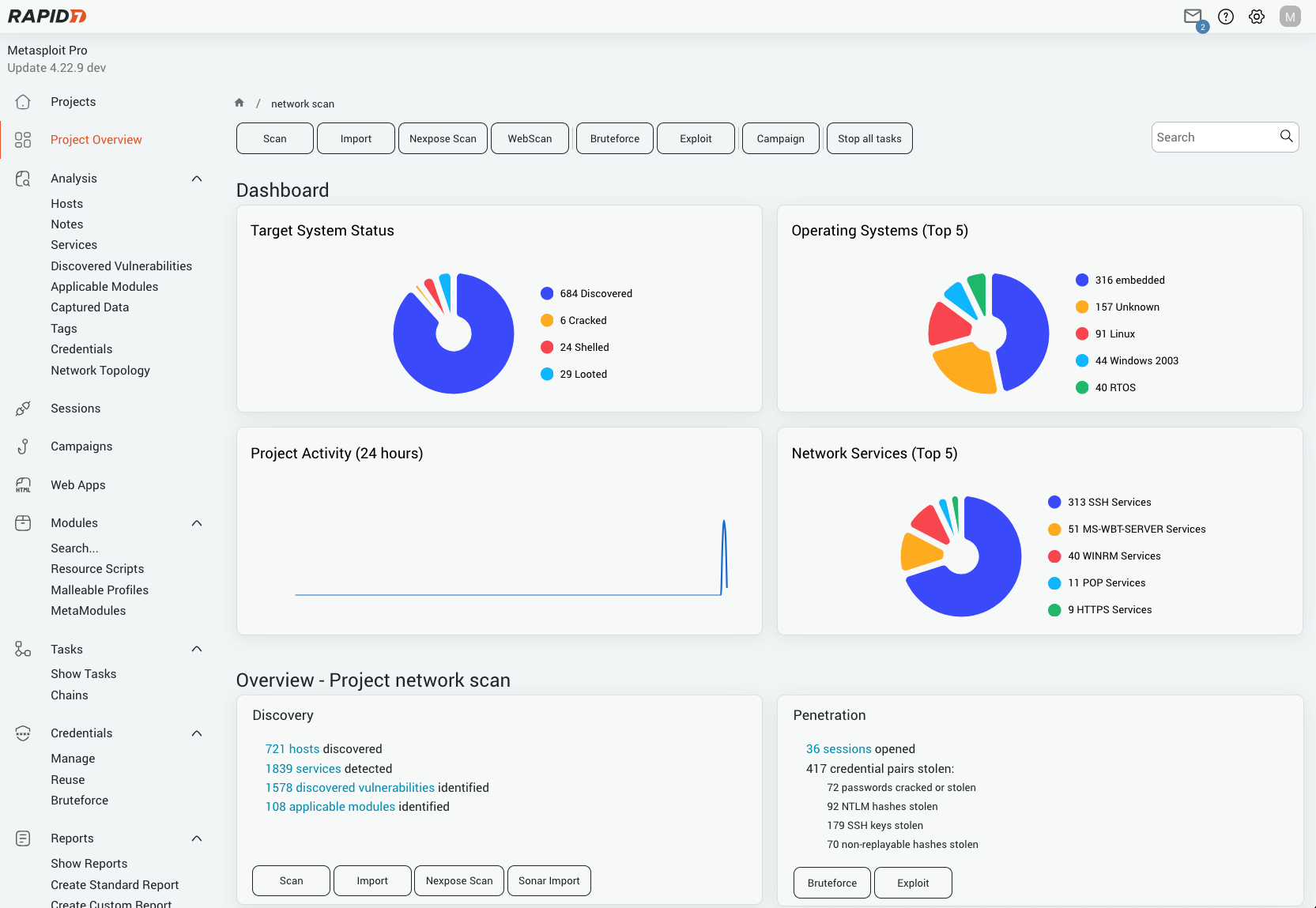
Say goodbye to complexity, as Metasploit Pro has completely overhauled the testing workflow. Updates are highlighted by an intuitive user interface, ensuring that your focus remains on high-value penetration testing and vulnerability validation, not fighting the interface. These changes are the foundation for the future, preserving the core functionality you rely on while enabling even more powerful features down the road.

image2.png

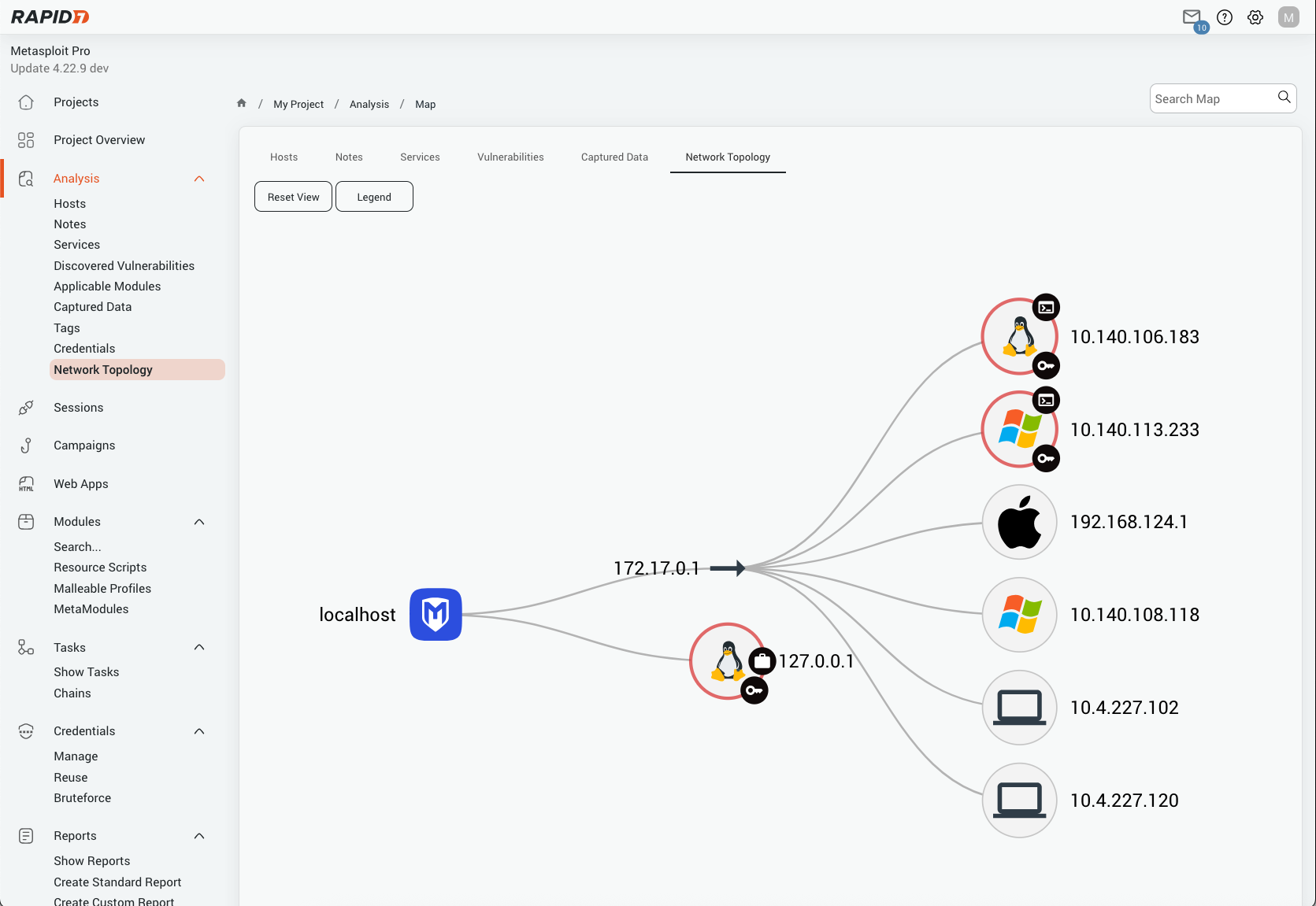
Stop guessing and start seeing. The new implementation of Network Topology support provides instant, crystal-clear clarity on hosts that have been compromised, have associated cracked credentials, or captured data. For enterprise environments with vast, complex surfaces, we’ve invested in performance improvements, giving you the power to zoom and pan through hundreds of available hosts with zero lag. This is actionable visualization that transforms data into defense.

image6.png

Vulnerability detection improvements

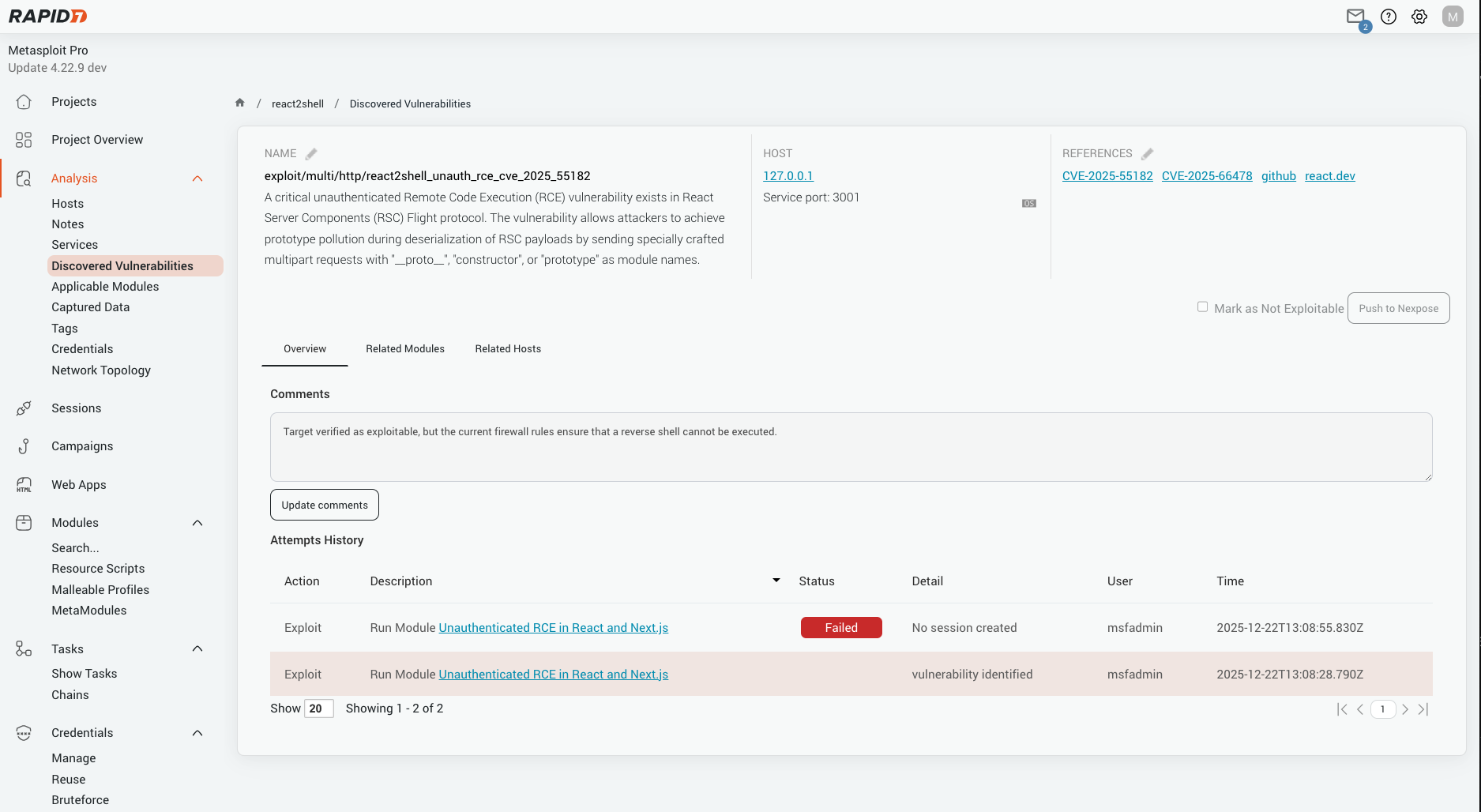
Get the necessary assurance before you click 'run.' Metasploit modules can now register crucial vulnerability detection details as part of running. This means that modules capable of running pre-check detection logic give you the full intelligence picture before you attempt exploitation. This new level of transparency and detail empowers you to make smarter, faster decisions, saving you precious time and minimizing the chance of failed module runs and adverse side effects.

image4.png

Advanced workflow improvements

Unleash your inner expert with unprecedented control and efficiency. Advanced users of Metasploit Pro will immediately benefit from multiple UX improvements to the single module run page. Tired of manually configuring options? Users now receive intelligent suggestions for applicable values, including network targets, Kerberos credential cache files, and more –  streamlining ADCS workflows.

image3.png

Furthermore, you now have the ability to manually choose and configure individual payloads, giving you the final word on how you exploit targets. Metasploit Pro will continue to default to the most common payload for each exploit.

Plus, new quality-of-life improvements for replaying module runs ensure that verifying remediation and re-exploiting targets is a seamless, one-click process. Gone are the days of reconfiguring an entire module run to change a single option. The old list view has also been updated to include the ability to view the module option details that a module was run with. These capabilities can additionally be leveraged by advanced users who are interacting with Metasploit Pro in a programmatic fashion or through the command line interface to see exactly how Metasploit Pro is running modules.

image1.png

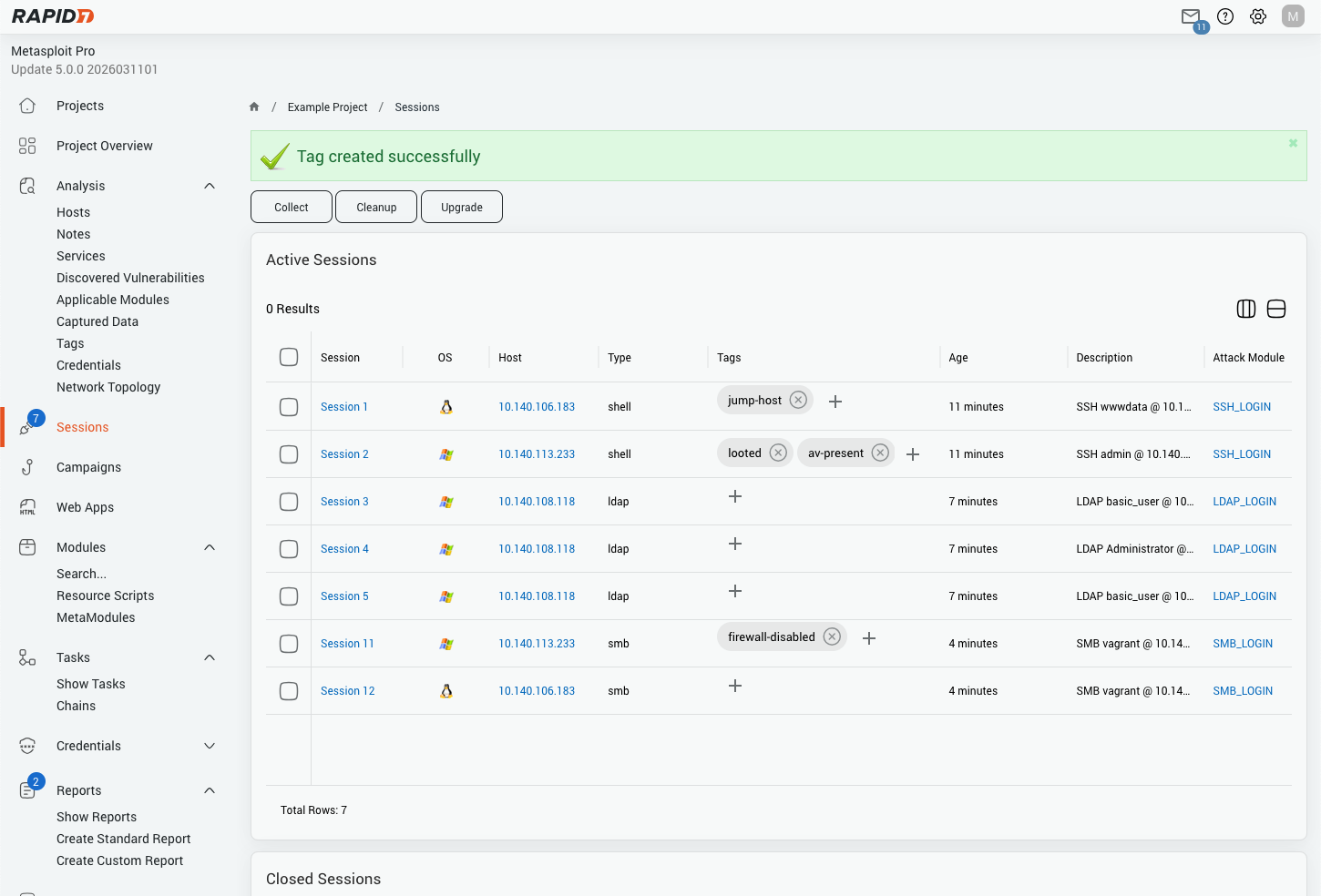
Finally, boost your team's collaboration with the new session tagging feature. Sessions can now be tagged to facilitate advanced and coordinated post-exploitation workflows. Team members can apply instant, custom tags to track status and flag arbitrary qualities, which significantly improves coordination and organization across multi-person engagements.

AD CS exploitation

Tackle one of the most critical attack vectors in modern networks: Metasploit continues its relentless investment in modern exploitation techniques with the groundbreaking updates to the AD CS Workflows Metamodule. This powerful new feature is a significant advancement, providing security professionals with an automated, comprehensive approach to identifying and leveraging nine common AD CS vulnerabilities. 

Now we’ve taken it even further, with new support for the latest and most dangerous ESC flaws: ESC9, ESC10, and ESC16. Take back control of your Active Directory environment and neutralize these threats with surgical precision. For detailed configuration instructions and comprehensive feature documentation, visit our AD CS Workflows MetaModule documentation.

image5.png

Session tags

In fast-moving operations, context can disappear quickly as new sessions come online and analysts shift between tasks. Session tagging brings clarity back to your workflow by letting you attach meaningful labels to every open session. Instead of relying on IPs or hostnames alone, you can tag sessions with identifiers that matter to your team - such as priority, environment, or role - making it easy to group related systems and instantly recognize high-value targets.

Metasploit-pro-5-session-tagging.png

SAML Single Sign On

Metasploit Pro now incorporates SAML Single Sign-On (SSO) authentication, providing your team with a simple, unified login experience. By connecting to your centralized directory, users can access Metasploit Pro with the same credentials they use for all other major applications. Administrators can easily configure their identity provider (IDP) to enable a passwordless workflow and utilize existing Multi-Factor Authentication (MFA) services, making access quick, consistent, and part of your standard corporate flow.

These features are available in Metasploit Pro 5.0.0 onwards. We’re also proud to collaborate with our customers, who are often the source of inspiration for product evolution. Ideas for improvements or enhancements can be shared with our Support team to help you refine the idea, then submit it to our Product team on your behalf.

Related viewing

Rapid7 Labs launched a podcast today! Episode 1 of 'Hacktics & Telemetry' is now live on Rapid7's YouTube page. Alongside some expert commentary on emergent threats and an exciting guest spot, the final segment is all about Metasploit Pro 5.0.0. Dive into our official companion blog here, and find the full episode embedded below.

Metasploit Wrap-Up 03/06/2026

Encoder exposed!

Some of our releases add new ways in; this one adds new ways to stay in.   There are, of course, still new RCE toys in the box (Tactical RMM via Jinja2 SSTI and an unauthenticated MajorDoMo exploit). Still, the underlying theme is payloads: more control over how they are packaged and delivered, and fewer "why did it die instantly?" moments. We, like our community of module authors, grew tired of having to do everything by hand. You can now pick encoders (and tweak their options) directly for exploit and payload modules without extra glue code. Less plumbing, more choosing-the-right-badchar-killer-at-runtime.

2026-03-06-meme.png

New module content (3)

Linux RC4 Packer with In-Memory Execution (x86)

Author: Massimo Bertocchi

Type: Evasion

Pull request: #20965 contributed by litemars

Path: linux/x86/rc4_packer

Description: Adds a new module evasion/linux/x86/rc4_packer that encrypts the generated payload with RC4, prepends an optional sleep-based delay (nanosleep), and decrypts/executes the payload at runtime via a compact precompiled stub.

Tactical RMM Jinja2 SSTI Remote Code Execution

Authors: Gabriel Gomes and Valentin Lobstein chocapikk@leakix.net

Type: Exploit

Pull request: #21017 contributed by Chocapikk

Path: linux/http/tacticalrmm_ssti_rce_cve_2025_69516

AttackerKB reference: CVE-2025-69516

Description: This adds an exploit module for CVE-2025-69516, a Jinja2 SSTI in Tactical RMM < 1.4.0 where the reporting template preview endpoint evaluates user-controlled templates without sandboxing, enabling authenticated RCE. The module logs in via the Knox API, auto-detects the API host from /env-config.js, and exploits the template preview feature.

MajorDoMo Remote Command Injection via cycle_execs Race Condition

Author: Valentin Lobstein chocapikk@leakix.net

Type: Exploit

Pull request: #21000 contributed by Chocapikk

Path: multi/http/majordomo_cmd_injection_rce

AttackerKB reference: CVE-2026-27175

Description: Adds three exploit modules for MajorDoMo, an open-source home automation platform. All three vulnerabilities are unauthenticated.

Enhancements and features (2)

  • #20852 from dledda-r7 - This adds encoder options for exploit and payload modules. It allows the user to select the encoder and modify its options when using exploit or payload without the need of adding additional code into the module.

  • #20987 from sjanusz-r7 - Allows AS-REP and Kerberoast modules to be ran against a pre-existing LDAP session as well as RHOST values.

Bugs fixed (5)

  • #20740 from Chocapikk - This adds a new SRVSSL option to the HttpServer library, allowing SSL to be enabled for the HTTP server independently from the HTTP client.

  • #20830 from SilentSobs - This fixes a portability issue in Msf::Post::File.stat where the code incorrectly assumed a GNU stat output format.

  • #20940 from g0tmi1k - Fixes an issue where the > (file Redirect operator) causes the exploit to fail.  This updates the exploit to use tee to avoid that problematic operator and also increases debug verbosity, simplifies code, adds documentation, and adds support for fetch payloads to gain Linux Meterpreter sessions.

  • #20946 from g0tmi1k - Corrects issue where the revision value provided in the http requests can be  outside the subset of revision id/value/numbers; a revision value that is not an actual revision value may result in a failed exploit.  Also, cleaned up logic and increased debugging verbosity.

  • #21044 from adfoster-r7 - Fixes a crash when using db_import on a nessus with protocols other than tcp or udp.

Documentation

You can find the latest Metasploit documentation on our docsite at docs.metasploit.com.

Get it

As always, you can update to the latest Metasploit Framework with msfupdate and you can get more details on the changes since the last blog post from GitHub:

If you are a git user, you can clone the Metasploit Framework repo (master branch) for the latest. To install fresh without using git, you can use the open-source-only Nightly Installers or the commercial edition Metasploit Pro

Metasploit Wrap-Up 02/27/2026

No Prob-ollama

This release brings some serious firepower with multiple new exploit modules and critical vulnerability support! The standout additions are the Ollama path traversal RCE (CVE-2024-37032), a sophisticated exploit chaining arbitrary file writes into unauthenticated root RCE, and the Grandstream GXP1600 stack overflow (CVE-2026-2329), which targets VoIP devices with accompanying credential harvesting and SIP interception post-modules. 

The BeyondTrust PRA/RS module got upgraded with support for the new CVE-2026-1731 command injection vulnerability along with legacy CVE support. On the evasion front, there's fresh ARM64 RC4 encryption support with sleep-based detection bypass. Classic vulnerability modules like Unreal IRCd and vsftpd backdoors got quality-of-life improvements with proper check methods and multiple exploitation targets. Several auxiliary scanners (LDAP ESC, GraphQL introspection) also received critical bugfix updates eliminating false positives and crashes.

New module content (7)

Linux RC4 Packer with In-Memory Execution

Author: Massimo Bertocchi

Type: Evasion

Pull request: #20964 contributed by litemars

Path: linux/aarch64/rc4_packer

Description: First Linux evasion module for arm64, a packer using rc4 encryption, in memory execution of the elf binary, and sleep evasion.

BeyondTrust Privileged Remote Access (PRA) and Remote Support (RS) unauthenticated Remote Code Execution

Authors: Harsh Jaiswal and Jonah Burgess (CryptoCat)

Type: Exploit

Pull request: #20978 contributed by jburgess-r7

Path: linux/http/beyondtrust_pra_rs_command_injection

AttackerKB reference: CVE-2026-1731

Description: This adds a new module for unauthenticated command injection in BeyondTrust PRA/RS (CVE-2026-1731). This change also introduces a new library for BeyondTrust familiar helper functions; existing modules have been ported to use it.

GrandStream GXP1600 Unauthenticated Remote Code Execution

Author: sfewer-r7

Type: Exploit

Pull request: #20983 contributed by sfewer-r7

Path: linux/http/grandstream_gxp1600_unauth_rce

AttackerKB reference: CVE-2026-2329

Description: Adds three new modules: one exploit and two post modules, all targeting the Grandstream GXP1600 series of VoIP devices.  The exploit module uses CVE-2026-2329 to gain a root session, and the post modules leverage that access to perform credential stealing and packet capture.

Ollama Model Registry Path Traversal RCE

Authors: Sagi Tzadik sagitz@wiz.io and Valentin Lobstein chocapikk@leakix.net

Type: Exploit

Pull request: #21006 contributed by Chocapikk

Path: linux/http/ollama_rce_cve_2024_37032

AttackerKB reference: CVE-2024-37032

Description: This adds a new exploit module for Ollama (CVE-2024-37032). Ollama's pull mechanism accepts arbitrary path traversal sequences, allowing an attacker to load a rogue OCI registry and write arbitrary files. The exploit does this by writing .so files into the target, then forcing Ollama to spawn a new process where the malicious library is loaded.

Linux WSL via Startup Folder Persistence

Author: h00die

Type: Exploit

Pull request: #20819 contributed by h00die

Path: linux/persistence/wsl/startup_folder

Description: This adds a new persistence module for WSL that writes a payload to the user's startup folder. The module creates a persistence for Windows; however, the initial access needs to be in Linux.

Windows Registry Active Setup Persistence

Author: h00die

Type: Exploit

Pull request: #20841 contributed by h00die

Path: windows/persistence/registry_active_setup

Description: This adds new persistence for Windows, which uses the Windows feature Active Setup. The module abuse is used to launch our payload, with 2 caveats. 1) You downgrade from admin to user permissions, 2) it only launches the payload once per user.

GrandStream GXP1600 proxy SIP traffic

Author: sfewer-r7

Type: Post

Pull request: #20983 contributed by sfewer-r7

Path: linux/capture/grandstream_gxp1600_sip

Description: Adds three new modules: one exploit and two post modules, all targeting the Grandstream GXP1600 series of VoIP devices.  The exploit module uses CVE-2026-2329 to gain a root session, and the post modules leverage that access to perform credential stealing and packet capture.

Enhancements and features (9)

  • #20859 from dledda-r7 - Splits the exe.rb into separate, more consistent files. Each file responds to a combination of platform and architecture, offering a better granular approach.

  • #20938 from Chocapikk - Improves the check method in the beyondtrust_pra_rs_unauth_rrce to properly detect older versions that are also vulnerable but report the version in a different way.

  • #20950 from g0tmi1k - Updates the vsftp_234_backdoor module to add shell and Meterpreter payloads, improves vulnerability detection, and improves the output for better troubleshooting.

  • #20951 from g0tmi1k - Moves default payload into DefaultOptions in Remote for Mac module. This makes it more consistent with other existing modules.

  • #20952 from g0tmi1k - Enhances the unix/irc/unreal_ircd_3281_backdoor module to increase payload options, including adding a native Meterpreter session, adds debugging logic inside the module, and more verbose output.

  • #20988 from adfoster-r7 - Improved SolarWinds exploit module to automatically pick the correct SRVHOST value.

  • #20992 from adfoster-r7 - Adds a check method to the ms17-010 scanner module to improve the metadata associated with automation workflows.

  • #21010 from Nayeraneru - This adds reporting for GitLab services.

  • #21014 from adfoster-r7 - Fixes a crash when running the ldap esc vulnerable cert finder against a target when LDAP binding fails.

Bugs fixed (1)

  • #21012 from adfoster-r7 - Improves the GraphQL Introspection Scanner module to correctly handle invalid responses and false positives.

Documentation added (3)

  • #20832 from DataExplorerX - Adds comprehensive documentation for the linux/samba/chain_reply module targeting CVE-2010-2063.

  • #20990 from jheysel-r7 - This adds and an AI Usage Policy to GSoC Ideas Page as requested by GSoC.

  • #21005 from h00die - This adds example of GNU inetutils auth bypass module against a Synology NAS to existing documentation.

You can always find more documentation on our docsite at docs.metasploit.com.

Get it

As always, you can update to the latest Metasploit Framework with msfupdate and you can get more details on the changes since the last blog post from GitHub:

If you are a git user, you can clone the Metasploit Framework repo (master branch) for the latest. To install fresh without using git, you can use the open-source-only Nightly Installers or the commercial edition Metasploit Pro

Metasploit Wrap-Up 02/20/2026

Hacking Churches and Backdooring Emacs

This release packs some solid exploit module additions! Two new unauthenticated RCE modules are a major win: the StoryChief WordPress plugin exploit (CVE-2025-7441) targets a webhook validation flaw allowing arbitrary file uploads, while the ChurchCRM exploit (CVE-2025-62521) abuses the installation wizard to inject PHP code for persistent access. Both establish Meterpreter sessions. On the persistence front, there's a creative Emacs extension module that plants malicious Lisp code for shell callbacks whenever Emacs launches; a fun take on an unconventional attack surface. Along with Emacs, a new Windows persistence using the old, gold registry; this time the UserInit one, to get Administrator shells when any user logs in. To wrap-up, now you can spread automation nightmares with the new n8n auxiliary module, allowing you to extract sessions of other logged users (even admins).

New module content (5)

n8n arbitrary file read

Authors: dor attias and msutovsky-r7

Type: Auxiliary

Pull request: #20856 contributed by msutovsky-r7

Path: gather/ni8mare_cve_2026_21858

Description: This adds an exploit module for n8n. The vulnerability, known as Ni8mare, allows arbitrary file read and session extraction of other users allowing privilege escalation on the WebApp context.

Emacs Extension Persistence

Author: h00die

Type: Exploit

Pull request: #20919 contributed by h00die

Path: linux/persistence/emacs_extension

Description: This adds a persistence module compatible with emacs for Linux, the emacs extension will trigger a session creation as the compromised user.

ChurchCRM Unauthenticated RCE 6.8.0

Author: LucasCsmt

Type: Exploit

Pull request: #20947 contributed by LucasCsmt

Path: multi/http/churchcrm_install_unauth_rce

AttackerKB reference: CVE-2025-62521

Description: This PR adds a new exploit module for CVE-2025-62521, targeting an unauthenticated Remote Code Execution (RCE) vulnerability in ChurchCRM versions 6.8.0 and earlier.

WordPress StoryChief Plugin Unauthenticated RCE

Authors: Nayera and xpl0dec

Type: Exploit

Pull request: #20976 contributed by Nayeraneru

Path: multi/http/wp_plugin_story_chef_file_upload

AttackerKB reference: CVE-2025-7441

Description: Adds a new exploit module targeting CVE-2025-7441, an unauthenticated RCE in the WordPress plugin StoryChief versions <= 1.0.45.

Windows Registry Persistence via Userinit

Authors: h00die and joel

Type: Exploit

Pull request: #20844 contributed by 6a6f656c

Path: windows/persistence/registry_userinit

Description: This adds a persistence module for Windows. Using the UserInit registry key the target machine will create a session with Admin privileges every time any user logs in.

Enhancements and features (2)

  • #20807 from webbsssss - Allow Acunetix vulnerabilities to be imported without complete web page data.
  • #20969 from sjanusz-r7 - Updates Metasploit's logic when importing Acunetix XML files to now also include items that are less than High severity.

Bugs fixed (1)

  • #20972 from adfoster-r7 - Fixes false positives on lg simple editor check methods.

Documentation

You can find the latest Metasploit documentation on our docsite at docs.metasploit.com.

Get it

As always, you can update to the latest Metasploit Framework with msfupdate and you can get more details on the changes since the last blog post from GitHub:

If you are a git user, you can clone the Metasploit Framework repo (master branch) for the latest. To install fresh without using git, you can use the open-source-only Nightly Installers or the commercial edition Metasploit Pro
Metasploit Wrap-Up 02/13/2026

SolarWinds Web Help Desk

Our very own sfewer-r7 has developed an exploit module for the SolarWinds Web Help Desk vulnerabilities CVE-2025-40536 and CVE-2025-40551. On successful exploitation the session will be as running as NT AUTHORITY\SYSTEM. For more information see the Rapid7’s SolarWinds Web Help Desk Vulnerabilities guidance.

Contributions

A big thanks to our contributors who have been adding some great content this release. rudraditya21 has added MITRE ATT&CK metadata to lots of our existing modules. Chocapikk has added support for GHSA (GitHub Security Advisory) references support in Metasploit modules. rudraditya21 also added a change which adds negative caching to the LDAP entry cache, which will now mean missing objects are recorded. It also introduces a missing-entry sentinel, tracks misses per identifier type, and updates AD lookup helpers to short‑circuit on cached misses and record misses when a lookup returns no entry.

New module content (5)

FreeBSD rtsold/rtsol DNSSL Command Injection

Authors: Kevin Day and Lukas Johannes Möller

Type: Exploit

Pull request: #20798 contributed by JohannesLks

Path: freebsd/misc/rtsold_dnssl_cmdinject

AttackerKB reference: CVE-2025-14558

Description: This adds a new command-injection exploit in the FreeBDS rtsol/rtsold daemons (CVE-2025-14558). The vulnerability can be triggered by the Domain Name Search List (DNSSL) option in IPv6 Router Advertisement (RA) messages, which is passed to the resolvconf script without sanitization. It requires elevated privilege as it needs to send IPv6 packets. The injected commands are executed as root.

Ivanti Endpoint Manager Mobile (EPMM) unauthenticated RCE

Authors: sfewer-r7 and watchTowr

Type: Exploit

Pull request: #20932 contributed by sfewer-r7

Path: linux/http/ivanti_epmm_rce

AttackerKB reference: CVE-2026-1340

Description: Adds an exploit module for the recent command injection vulnerability, CVE-2026-1281, affecting Ivanti Endpoint Manager Mobile (EPMM), formerly known as MobileIron. Exploited in-the-wild as a zero-day by an unknown threat actor.

GNU Inetutils Telnet Authentication Bypass Exploit CVE-2026-24061

Authors: Kyu Neushwaistein and jheysel-r7

Type: Exploit

Pull request: #20929 contributed by jheysel-r7

Path: linux/telnet/gnu_inetutils_auth_bypass

AttackerKB reference: CVE-2026-24061

Description: This adds an exploit module for the authentication bypass in GNU Inetutils telnetd tracked as CVE-2026-24061. During negotiation, if the USER environment variable is passed in with a value of "-f root" authentication can be bypassed resulting in command execution as the root user.

SolarWinds Web Help Desk unauthenticated RCE

Authors: Jimi Sebree and sfewer-r7

Type: Exploit

Pull request: #20917 contributed by sfewer-r7

Path: multi/http/solarwinds_webhelpdesk_rce

AttackerKB reference: CVE-2025-40551

Description: This adds an exploit module for SolarWinds Web Help Desk vulnerable to CVE-2025-40536 and CVE-2025-40551. The exploit triggers session opening as NT AUTHORITY\SYSTEM and root.

Xerte Online Toolkits Arbitrary File Upload - Upload Image

Author: Brandon Lester

Type: Exploit

Pull request: #20849 contributed by haicenhacks

Path: multi/http/xerte_authenticated_rce_uploadimage

Description: This adds three RCE modules for Xerte Online Toolkits affecting versions 3.14.0 and <= 3.13.7. Two are unauthenticated while one is authenticated.

Enhancements and features (10)

  • #20710 from Chocapikk - Adds support for GHSA (GitHub Security Advisory) and OSV (Open Source Vulnerabilities) references in Metasploit modules.
  • #20886 from cdelafuente-r7 - Updates services to now also have child services. This allows for more detailed reporting for the services and vulns commands which can now report parent -> child services e.g. SSL -> HTTPS.
  • #20895 from rudraditya21 - Adds negative caching to the LDAP entry cache so missing objects are recorded and subsequent lookups by DN, sAMAccountName, or SID return nil without re-querying the directory.
  • #20934 from rudraditya21 - This adds MITRE ATT&CK tags to modules related to LDAP and AD CS. This enables users to find this content using Metasploit's search functionality and the att&ck keyword.
  • #20935 from rudraditya21 - Adds the MITRE ATT&CK tag T1558.003 to the kerberoast modules. This enables users to find this content using Metasploit's search functionality and the att&ck keyword.
  • #20936 from rudraditya21 - This adds MITRE ATT&CK tags to SMB modules related to accounts. This enables users to find the content by using Metasploit's search capability and the att&ck keyword.
  • #20937 from rudraditya21 - This adds MITRE ATT&CK tags to the two existing SCCM modules that fetch NAA credentials using different techniques. This enables users to find this content using Metasploit's search functionality and the att&ck keyword.
  • #20941 from rudraditya21 - Adds a MITRE ATT&CK technique reference to the Windows password cracking module to support ATT&CK‑driven discovery.
  • #20942 from rudraditya21 - Adds MITRE ATT&CK technique references to getsystem, cve_2020_1472_zerologon, and atlassian_confluence_rce_cve_2023_22527 modules to support ATT&CK‑driven discovery.
  • #20943 from g0tmi1k - Adds affected versions the description in the ‎exploits/unix/webapp/twiki_maketext module.

Bugs fixed (7)

  • #20599 from BenoitDePaoli - Fixes an issue where running services -p <ports> -u -R to set RHOSTS with values from the database could lead to a silently failing file not found error.
  • #20775 from rmtsixq - Fixes a database initialization failure when using msfdb init with the --connection-string option to connect to PostgreSQL 15+ instances (e.g., Docker containers).
  • #20817 from randomstr1ng - Adds a fix to ensure the output of sap_router_portscanner no longer causes module crashes.
  • #20903 from jheysel-r7 - Fixes an issue so #enum_user_directories no longer returns duplicate directories.
  • #20906 from rudraditya21 - Implements a fix for SSH command shells dying on cmd_exec when a trailing newline was present.
  • #20953 from zeroSteiner - Improves the stability of socket channeling support for SSH sessions opened via scanner/ssh/ssh_login.
  • #20955 from adfoster-r7 - Ensures the cleanup of temporarily created RHOST files when using the services -p <ports> -u -R command to set RHOST values from the database.

Documentation

You can find the latest Metasploit documentation on our docsite at docs.metasploit.com.

Get it

As always, you can update to the latest Metasploit Framework with msfupdate and you can get more details on the changes since the last blog post from GitHub:

If you are a git user, you can clone the Metasploit Framework repo (master branch) for the latest. To install fresh without using git, you can use the open-source-only Nightly Installers or the commercial edition Metasploit Pro
Metasploit Wrap-Up 02/06/2026

Google Summer of Code 2026

Our very own Jack Heysel has added some documentation which outlines the Metasploit Framework project ideas for GSoC 2026. For anyone interested in applying please see GSoC-How-To-Apply documentation, or reach out on slack to any of the following GSoC mentors on Slack via the Metasploit Slack:

  • @jheysel
  • @zeroSteiner
  • @h00die

Gladinet

This week Chocapikk has added some Gladinet CentreStack/Triofox exploitation capabilities. Adding two auxiliary modules and updating an existing exploit. The updated exploit module now accepts a custom MACHINEKEY option to leverage newly discovered vulnerabilities that allow the extraction of machineKeys from Web.config files. The gladinet_storage_path_traversal_cve_2025_11371 module exploits path traversal to read arbitrary files and extract machineKeys, while gladinet_storage_access_ticket_forge forges access tickets using hardcoded cryptographic keys.

New module content (1)

Gladinet CentreStack/Triofox Access Ticket Forge

Authors: Huntress Team, Julien Voisin, and Valentin Lobstein chocapikk@leakix.net

Type: Auxiliary

Pull request: #20768 contributed by Chocapikk 

Path: gather/gladinet_storage_access_ticket_forge

Description: This adds two auxiliary modules for Gladinet CentreStack/Triofox. Both modules can read arbitrary files and extract the machineKey, which is used to secure ASP.NET ViewState data. Furthermore, this change also includes a new mixin for Gladinet.

Enhancements and features (3)

  • #20739 from cdelafuente-r7 - This adds MITRE ATT&CK metadata tags to modules relating to Kerberos and unconstrained delegation. This enables users to search for the content based on the ATT&CK technique ID.
  • #20882 from karanabe - Adds the RSAKeySize advanced option and uses it when generating the CSR key pair, allowing users to increase key size to meet certificate template minimums and avoid CERTSRV_E_KEY_LENGTH errors when 2048-bit keys are rejected.
  • #20883 from jheysel-r7 - Updates Kerberos modules to present a user friendly message when the user specifies the IMPERSONATE option when running a module but also forgets to specify IMPERSONATION_TYPE.

Bugs fixed (5)

  • #20368 from isaac-app-dev - Fixes an issue that caused msfvenom to break if it were run from alternative directories.
  • #20680 from cdelafuente-r7 - Improves the RPC API with multiple fixes and enhancements.
  • #20834 from kuklycs - This fixes the NoMethodError in the team_viewer post module, caused by misuse of the each_key method. The keys array has been updated to a 1-D array to simplify the logic.
  • #20916 from Chepycou - Fixes a crash when running the SAP modules sap_soap_rfc_system_info or sap_icf_public_info.
  • #20920 from rudraditya21 - This fixes a bug in password cracking modules where the auto action would crash even when the path to a compatible executable was specified in CRACKER_PATH.

Documentation added (1)

  • #20910 from jheysel-r7 - This adds documentation regarding the projects for which we are soliciting submissions for as part of the Google Summer of Code program.

You can always find more documentation on our docsite at docs.metasploit.com.

Get it

As always, you can update to the latest Metasploit Framework with msfupdate and you can get more details on the changes since the last blog post from GitHub:

If you are a git user, you can clone the Metasploit Framework repo (master branch) for the latest. To install fresh without using git, you can use the open-source-only Nightly Installers or the commercial edition Metasploit Pro
Metasploit Wrap-Up 01/30/2026

FreeBPX Content Galore

This week brings 3 new pieces of module content for targeting FreePBX. All three chain multiple vulnerabilities together, starting with CVE-2025-66039. This initial vulnerability allows unauthenticated users to bypass the authentication process to interact with FreePBX. From this point, the different modules leverage either a SQL injection vulnerability (CVE-2025-61675) or a file upload vulnerability (CVE-2025-61678) to obtain remote code execution.

New module content (7)

FreePBX endpoint SQLi to RCE

Authors: Noah King and msutovsky-r7 Type: Exploit Pull request: #20857 contributed by msutovsky-r7 Path: unix/http/freepbx_custom_extension_rce AttackerKB reference: CVE-2025-61675

Description: This adds exploit module for FreePBX which chains an authentication bypass, CVE-2025-66039, with a SQLi, CVE-2025-61675, which allows for a cron job to be added to the cron_job table of the database to allow for Remote Code Execution.

FreePBX firmware file upload

Authors: Noah King and msutovsky-r7 Type: Exploit Pull request: #20858 contributed by msutovsky-r7 Path: unix/http/freepbx_firmware_file_upload AttackerKB reference: CVE-2025-61678

Description: This adds exploit module for FreePBX which chains an authentication bypass, CVE-2025-66039, with an unrestricted file upload (via firmware upload), CVE-2025-61678, which allows for a webshell to be uploaded to the webserver resulting in remote code execution.

FreePBX Custom Extension SQL Injection

Authors: Noah King and msutovsky-r7 Type: Auxiliary Pull request: #20846 contributed by msutovsky-r7 Path: gather/freepbx_custom_extension_injection AttackerKB reference: CVE-2025-61675

Description: This adds an exploit module for FreePBX which chains an authentication bypass, (CVE-2025-66039) with an SQLi (CVE-2025-61675) to create an admin user in the database.

Cacti Graph Template authenticated RCE versions prior to 1.2.29

Authors: Jack Heysel and chutchut Type: Exploit Pull request: #20799 contributed by jheysel-r7 Path: multi/http/cacti_graph_template_rce AttackerKB reference: CVE-2025-24367

Description: This adds an exploit for CVE-2025-24367 which is an unauthenticated RCE in Cacti.

SmarterTools SmarterMail GUID File Upload Vulnerability

Authors: Piotr Bazydlo, Sina Kheirkhah, and jheysel-r7 Type: Exploit Pull request: #20866 contributed by jheysel-r7 Path: multi/http/smartermail_guid_file_upload AttackerKB reference: CVE-2025-52691

Description: This adds a module for unauthenticated file upload in SmarterTools SmaterMail (CVE-2025-52691). The vulnerability allows an unauthenticated user to upload a file to any location on the system using path traversal using the guid variable. The module will either drop a webshell in the webroot directory (if the target is Windows) or create a cron job by dropping a file in /etc/cron.d (if the target is Linux).

Burp Extension Persistence

Author: h00die Type: Exploit Pull request: #19821 contributed by h00die Path: multi/persistence/burp_extension

Description: This adds a new persistence module for BurpSuite. The module adds a malicious extension to both the Pro and Community versions, which is triggered when the user starts BurpSuite.

SSH Key Persistence

Authors: Dean Welch dean_welch@rapid7.com and h00die mike@shorebreaksecurity.com Type: Exploit Pull request: #20778 contributed by h00die Path: multi/persistence/ssh_key

Description: Combines the Windows and Linux ssh key persistence modules.

Enhancements and features (1)

  • #20778 from h00die - Combines the Windows and Linux ssh key persistence modules.

Bugs fixed (3)

  • #20897 from h00die - This fixes a bug that was preventing collected hash data from being formatted as input for the John the Ripper cracker. The result is that users can now once again crack passwords using John.
  • #20902 from rudraditya21 - This fixes a bug in the auxiliary/scanner/ssh/ssh_login module that would incorrectly state that a login failed when it in fact succeeded but the module was unable to open a session. This was only an issue when the CreateSession option is true.
  • #20909 from adfoster-r7 - Fixes a bug in Metasploit Pro that reported false positives for HTTP bruteforcing.

Documentation

You can find the latest Metasploit documentation on our docsite at docs.metasploit.com.

Get it

As always, you can update to the latest Metasploit Framework with msfupdate and you can get more details on the changes since the last blog post from GitHub:

If you are a git user, you can clone the Metasploit Framework repo (master branch) for the latest. To install fresh without using git, you can use the open-source-only Nightly Installers or the commercial edition Metasploit Pro
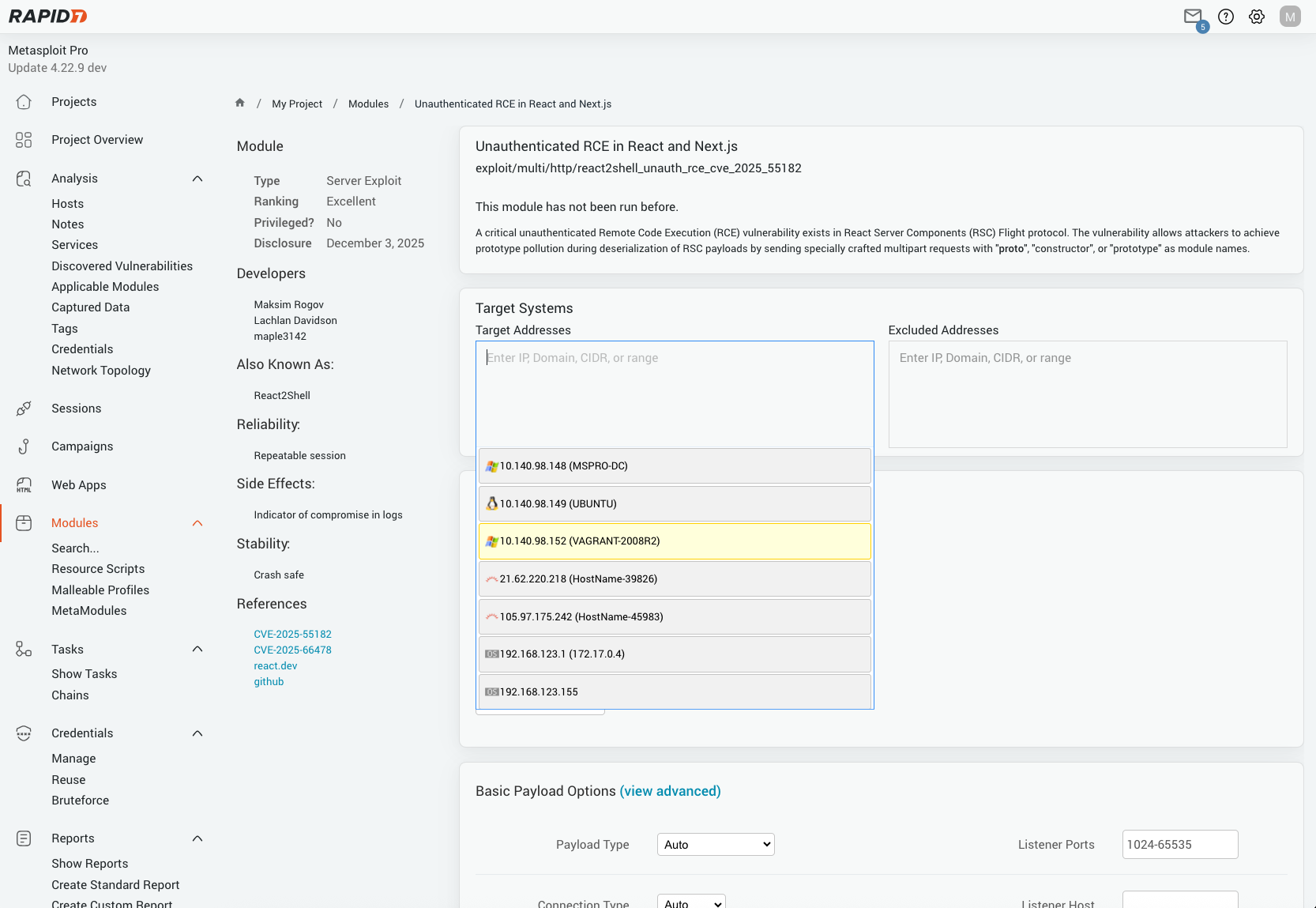
Metasploit Wrap-Up 01/23/2026

Oracle E-Business Suite Unauth RCE

This week, we are pleased to announce the addition of a module that exploits CVE-2025-61882, a pre-authentication remote code execution vulnerability in Oracle E-Business Suite versions 12.2.3 through 12.2.14. The exploit chains multiple flaws—including SSRF, path traversal, HTTP request smuggling, and XSLT injection—to coerce the target into fetching and executing a malicious XSL file hosted by the attacker. Successful exploitation results in arbitrary command execution and an interactive shell on both Linux/Unix and Windows targets. The module is reliable, repeatable, and we here at Metasploit hope you enjoy it, happy hacking!

New module content (3)

Authenticated RCE in Splunk (splunk_archiver app)

Authors: Alex Hordijk, Maksim Rogov, and psytester Type: Exploit Pull request: #20770 contributed by vognik Path: linux/http/splunk_auth_rce_cve_2024_36985 AttackerKB reference: CVE-2024-36985

Description: This adds two separate Metasploit exploit modules targeting Remote Code Execution (RCE) vulnerabilities in Splunk Enterprise. CVE-2024-36985 exploits unsafe use of the "copybuckets" lookup function within the splunk_archiver application, resulting in execution of the sudobash helper script with attacker-controlled arguments. Affected versions: All releases prior to 9.0.10, 9.1.2 through 9.1.5, 9.2.0 through 9.2.2 CVE-2022-43571, exploits a Python code injection vulnerability in Splunk SimpleXML dashboards by injecting malicious code into sparkline style parameters. Malicious code is executed when a user exports the dashboard to PDF. Affected versions: All releases prior to 8.1.12, 8.2.0 through 8.2.9, 9.0.0 through 9.0.2.

Oracle E-Business Suite CVE-2025-61882 RCE

Authors: Mathieu Dupas and watchTowr (Sonny, Sina Kheirkhah, Jake Knott) Type: Exploit Pull request: #20750 contributed by MatDupas Path: multi/http/oracle_ebs_cve_2025_61882_exploit_rce AttackerKB reference: CVE-2025-61882

Description: This adds an exploit for CVE-2025-61882, a critical Remote Code Execution (RCE) vulnerability in Oracle E-Business Suite (EBS). The flaw allows unauthenticated attackers to execute arbitrary code by leveraging a combination of SSRF, HTTP request smuggling and XSLT injection. Affected Versions: Oracle E-Business Suite, 12.2.3-12.2.14.

Authenticated RCE in Splunk (SimpleXML dashboard PDF generation)

Authors: Danylo Dmytriiev, Maksim Rogov, and psytester Type: Exploit Pull request: #20770 contributed by vognik Path: multi/http/splunk_auth_rce_cve_2022_43571 AttackerKB reference: CVE-2022-43571

Description: This adds two separate Metasploit exploit modules targeting Remote Code Execution (RCE) vulnerabilities in Splunk Enterprise. CVE-2024-36985 exploits unsafe use of the "copybuckets" lookup function within the splunk_archiver application, resulting in execution of the sudobash helper script with attacker-controlled arguments. Affected versions: All releases prior to 9.0.10, 9.1.2 through 9.1.5, 9.2.0 through 9.2.2 CVE-2022-43571, exploits a Python code injection vulnerability in Splunk SimpleXML dashboards by injecting malicious code into sparkline style parameters. Malicious code is executed when a user exports the dashboard to PDF. Affected versions: All releases prior to 8.1.12, 8.2.0 through 8.2.9, 9.0.0 through 9.0.2.

Enhancements and features (3)

  • #20755 from rudraditya21 - This adds an advanced datastore option, KrbClockSkew, to modules that use Kerberos authentication, allowing operators to adjust the Kerberos clock from the Metasploit side to fix clock skew errors.
  • #20840 from xaitax - This updates the MongoBleed auxiliary module and adds new options. The module can now use Wiz Magic Packet to detect the vulnerability quickly; it can detect compression libraries used by MongoDB (and warns or stops the user if zlib is not enabled). The module can also reuse the MongoDB socket connection during memory scanning, which significantly improves performance. Finally, it can better leak secrets, either by pattern matching or by storing the extracted information in raw or JSON format.
  • #20861 from bcoles - Adds multiple improvements to get_hostname resolution logic for post exploitation modules.

Bugs fixed (1)

  • #20888 from jheysel-r7 - Fixes an issue that caused dMSA kerberos authentication to fail.

Documentation

You can find the latest Metasploit documentation on our docsite at docs.metasploit.com.

Get it

As always, you can update to the latest Metasploit Framework with msfupdate and you can get more details on the changes since the last blog post from GitHub:

If you are a git user, you can clone the Metasploit Framework repo (master branch) for the latest. To install fresh without using git, you can use the open-source-only Nightly Installers or the commercial edition Metasploit Pro
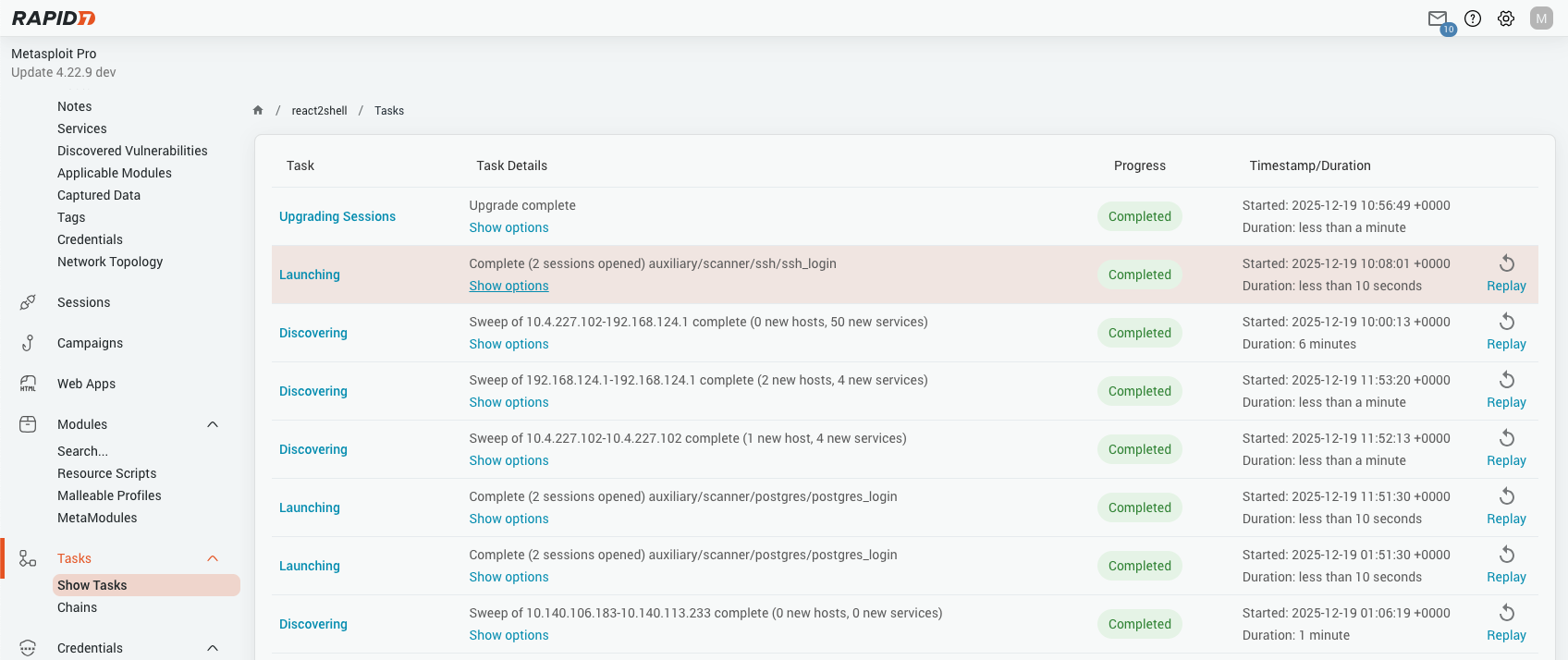
Metasploit Wrap-Up 01/16/2026

Persistence, dMSA Abuse & RCE Goodies

This week, we have received a lot of contributions from the community, such as h00dieChocapikk and countless others, which is greatly appreciated. This week’s modules and improvements in Metasploit Framework range from new modules, such as dMSA Abuse (resulting in escalation of privilege in Windows Active Directory environments), authenticated and unauthenticated RCE modules, as well as many improvements and additions to the persistence modules and techniques.

New module content (13)

BadSuccessor: dMSA abuse to Escalate Privileges in Windows Active Directory

Authors: AngelBoy, Spencer McIntyre, and jheysel-r7

Type: Auxiliary

Pull request: #20472 contributed by jheysel-r7 

Path: admin/ldap/bad_successor

Description: This adds an exploit for "BadSuccessor" which is a vulnerability whereby a user with permissions to an Organizational Unit (OU) in Active Directory can create a Delegated Managed Service Account (dMSA) account in such a way that it can lead to the issuance of a Kerberos ticket for an arbitrary user.

Control Web Panel /admin/index.php Unauthenticated RCE

Authors: Egidio Romano and Lukas Johannes Möller

Type: Exploit

Pull request: #20806 contributed by JohannesLks 

Path: linux/http/control_web_panel_api_cmd_exec 

AttackerKB reference: CVE-2025-67888

Description: This adds a new module for Control Web Panel (CVE-2025-67888). The vulnerability is unauthenticated OS command injection through an exposed API. The modules require Softaculous to be installed.

Prison Management System 1.0 Authenticated RCE via Unrestricted File Upload

Author: Alexandru Ionut Raducu

Type: Exploit

Pull request: #20811 contributed by Xorriath 

Path: linux/http/prison_management_rce 

AttackerKB reference: CVE-2024-48594

Description: This adds a new module for Prison Management System 1.0 (CVE-2024-48594). The module requires admin credentials, which are subsequently used to exploit unrestricted file upload to upload a webshell.

udev Persistence

Author: Julien Voisin

Type: Exploit

Pull request: #20796 contributed by h00die 

Path: linux/persistence/udev

Description: This moves the udev persistence module into the persistence category and adds the persistence mixin.

n8n Workflow Expression Remote Code Execution

Author: Lukas Johannes Möller

Type: Exploit

Pull request: #20810 contributed by JohannesLks 

Path: multi/http/n8n_workflow_expression_rce

AttackerKB reference: CVE-2025-68613

Description: This adds a new module for n8n (CVE-2025-68613). The vulnerability is authenticated remote code execution in the workflow expression evaluation engine. The module requires credentials to create a malicious workflow that executes system commands via a JavaScript payload.

Web-Check Screenshot API Command Injection RCE

Author: Valentin Lobstein chocapikk@leakix.net 

Type: Exploit

Pull request: #20791 contributed by Chocapikk 

Path: multi/http/web_check_screenshot_rce 

AttackerKB reference: CVE-2025-32778

Description: Adds an exploit module for CVE-2025-32778, a command injection vulnerability in Web-Check's screenshot API endpoint which allows unauthenticated remote code execution by injecting shell commands via URL query parameters in the /api/screenshot endpoint.

Accessibility Features (Sticky Keys) Persistence via Debugger Registry Key

Authors: OJ Reeves and h00die

Type: Exploit

Pull request: #20751 contributed by h00die 

Path: windows/persistence/accessibility_features_debugger

Description: This updates the Windows sticky keys post persistence module to use the new persistence mixin.

WMI Event Subscription Event Log Persistence

Authors: Nick Tyrer <@NickTyrer> and h00die

Type: Exploit

Pull request: #20706 contributed by h00die 

Path: windows/persistence/wmi/wmi_event_subscription_event_log

Description: Updated the Windows WMI to use a new way of managing persistence modules in Metasploit Framework. The Windows WMI module has been split into four modules, each representing their own technique.

WMI Event Subscription Interval Persistence

Authors: Nick Tyrer <@NickTyrer> and h00die

Type: Exploit

Pull request: #20706 contributed by h00die 

Path: windows/persistence/wmi/wmi_event_subscription_interval

Description: Updated the Windows WMI to use a new way of managing persistence modules in Metasploit Framework. The Windows WMI module has been split into four modules, each representing their own technique.

WMI Event Subscription Process Persistence

Authors: Nick Tyrer <@NickTyrer> and h00die

Type: Exploit

Pull request: #20706 contributed by h00die 

Path: windows/persistence/wmi/wmi_event_subscription_process

Description: Updated the Windows WMI to use a new way of managing persistence modules in Metasploit Framework. The Windows WMI module has been split into four modules, each representing their own technique.

WMI Event Subscription Logon Timer Persistence

Authors: Nick Tyrer <@NickTyrer> and h00die

Type: Exploit

Pull request: #20706 contributed by h00die 

Path: windows/persistence/wmi/wmi_event_subscription_uptime

Description: Updated the Windows WMI to use a new way of managing persistence modules in Metasploit Framework. The Windows WMI module has been split into four modules, each representing their own technique.

Linux Chmod

Author: bcoles bcoles@gmail.com 

Type: Payload (Single)

Pull request: #20845 contributed by bcoles 

Path: linux/armle/chmod and linux/aarch64/chmod

Description: Adds Linux ARM 32-bit / 64-bit Little Endian chmod payloads.

Enhancements and features (7)

  • #20706 from h00die - Updated the Windows WMI to use a new way of managing persistence modules in Metasploit Framework. The Windows WMI module has been split into four modules, each representing their own technique.
  • #20751 from h00die - This updates the Windows sticky keys post persistence module to use the new persistence mixin.
  • #20785 from Chocapikk - This adds Waku framework support to the existing react2shell module. Waku is a minimal React framework which differs slightly compared to Node.js. The module maintains backward compatibility with existing Next.js targets while adding Waku support through a modular framework configuration system.
  • #20786 from zeroSteiner - This updates the module code to merge the target Arch and Platform entries into the module's top level data. Prior to this change module developers had to define Arch and Platform entries twice, once at the module level and again per individual target. This updates over 500 modules and removes that duplication.
  • #20796 from h00die - This moves the udev persistence into the persistence category and adds the persistence mixin.
  • #20853 from zeroSteiner - Bumps metapsloit-payloads to 2.0.239.
  • #20855 from h00die - Adds additional ATT&CK references to persistence modules.

Bugs fixed (2)

  • #20738 from Shubham0699 - This fixes an issue in the bailiwicked DNS modules that was causing the module to fail with a stack trace due to a programming error.
  • #20847 from dwelch-r7 - This updates the auxiliary/scanner/ssh/ssh_login module to remove stale documentation, remove unnecessary characters that were printed in the output and update the correct documentation with the new information about key usage.

Documentation added (1)

You can always find more documentation on our docsite at docs.metasploit.com.

Get it

As always, you can update to the latest Metasploit Framework with msfupdate and you can get more details on the changes since the last blog post from GitHub:

If you are a git user, you can clone the Metasploit Framework repo (master branch) for the latest. To install fresh without using git, you can use the open-source-only Nightly Installers or the commercial edition Metasploit Pro
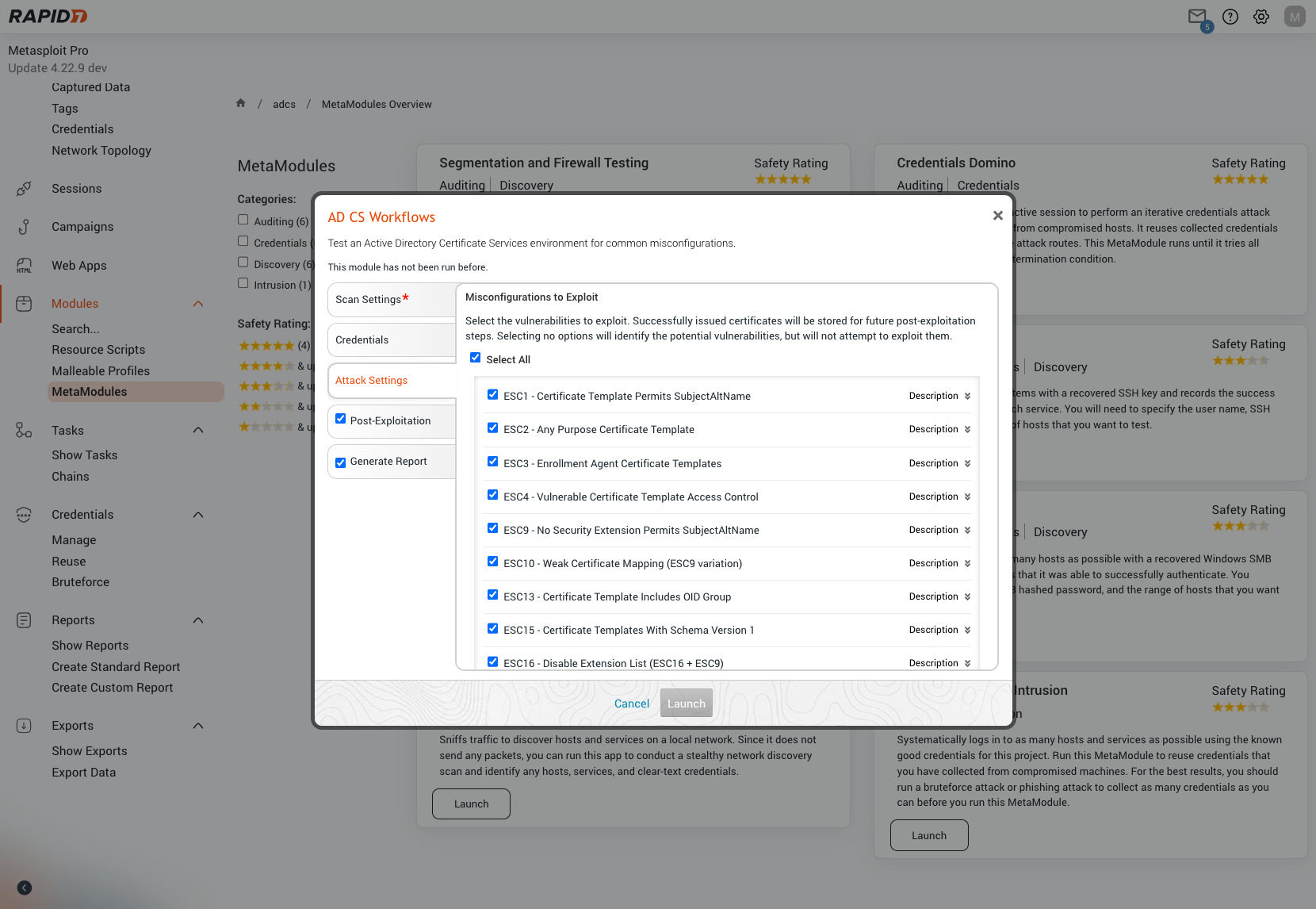
How to Use Nmap with Meterpreter

Brian Fehrman // You’ve sent your phishing ruse, the target has run the Meterpreter payload, and you have shell on their system. Now what? If you follow our blogs, you […]

The post How to Use Nmap with Meterpreter appeared first on Black Hills Information Security, Inc..

❌