
Reading view

There are new articles available, click to refresh the page.

US government, allies publish guidance on how to safely deploy AI agents

Cybersecurity agencies from the United States, Australia, Canada, New Zealand and the United Kingdom jointly published guidance Friday urging organizations to treat autonomous artificial intelligence systems as a core cybersecurity concern, warning that the technology is already being deployed in critical infrastructure and defense sectors with insufficient safeguards.

The guidance focuses on agentic AI — software built on large language models that can plan, make decisions and take actions autonomously. In order for this software to function it needs to connect to external tools, databases, memory stores and automated workflows, allowing it to execute multi-step tasks without human review at each stage.

The guidance was co-authored by the U.S. Cybersecurity and Infrastructure Security Agency, the National Security Agency, the Australian Signals Directorate’s Australian Cyber Security Centre, the Canadian Centre for Cyber Security, New Zealand’s National Cyber Security Centre and the United Kingdom’s National Cyber Security Centre.

The agencies’ central message is that agentic AI does not require an entirely new security discipline. Organizations should fold these systems into the cybersecurity frameworks and governance structures they already maintain, applying established principles such as zero trust, defense-in-depth and least-privilege access.

The document identifies five broad categories of risk. The first is privilege: When agents are granted too much access, a single compromise can cause far more damage than a typical software vulnerability. The second covers design and configuration flaws, where poor setup creates security gaps before a system even goes live.

The third category covers behavioral risks, or cases where an agent pursues a goal in ways its designers never intended or predicted. The fourth is structural risk, where interconnected networks of agents can trigger failures that spread across an organization’s systems.

The fifth category is accountability. Agentic systems make decisions through processes that are difficult to inspect and generate logs that are hard to parse, making it difficult to trace what went wrong and why. The agencies also note that when these systems fail, the consequences can be concrete: altered files, changed access controls and deleted audit trails.

The guidance also flags prompt injection, where instructions embedded inside data can hijack an agent’s behavior to perform malicious tasks. Prompt injection has been a lingering problem with large language models, with some companies admitting that the problem may never be solved

Identity management gets significant attention throughout the document. The agencies recommend that each agent carry a verified, cryptographically secured identity, use short-lived credentials and encrypt all communications with other agents and services. For high-impact actions, a human should have to sign off, and the guidance is explicit that deciding which actions require that approval is a job for system designers, not the agent.

The agencies admit the security field has not fully caught up with agentic AI. Some risks unique to these systems are not yet covered by existing frameworks, and the guidance calls for more research and collaboration as the technology takes on a growing number of operational roles.

“Until security practices, evaluation methods and standards mature, organisations should assume that agentic AI systems may behave unexpectedly and plan deployments accordingly, prioritising resilience, reversibility and risk containment over efficiency gains,” the guidance reads. 

You can read the full guidance below.

The post US government, allies publish guidance on how to safely deploy AI agents appeared first on CyberScoop.
Here’s how cyber heavyweights in the US and UK are dealing with Claude Mythos

A joint report from the Cloud Security Alliance (CSA), the SANS Institute and the Open Worldwide Application Security Project (OWASP) concludes that in the near term, organizations are “likely to be overwhelmed” by threat actors using AI to find and exploit vulnerabilities faster than defenders can patch them.

While those organizations can use AI tools to speed up their own defenses, attackers “still face a heavier relative burden due to the inherent limitations of patching. This in turn leads to “asymmetric benefits” for attackers who can afford to adopt the technology without the same caution and bureaucracy as a multi-billion dollar business.

“The cost and capability floor to exploit discovery is dropping, the time between disclosure and weaponization is compressing toward zero, and capabilities that previously required nation-state resources are now becoming broadly accessible,” wrote Robert Lee, SANS Institute’s Chief AI Officer, Gadi Evron, CEO of Knostic and Rich Mogull, chief analyst at CSA, who served as the primary authors.

The report marks one of the first comprehensive responses to the capabilities of Claude Mythos from the U.S., boasting cybersecurity luminaries who have set policy at the highest levels as contributing authors, including Jen Easterly, former director of the Cybersecurity and Infrastructure Security Agency, Rob Joyce, a former top White House and NSA cybersecurity official, and Chris Inglis, former National Cyber Director.

It also includes private sector stalwarts like Heather Adkins, Google’s CISO, Katie Moussouris, CEO of Luta Security, and Sounil Yu, chief technology officer at Knostic. Another seventy CISOs, CTOs and other security executives are named as editors and reviewers.

Also this week, the UK’s AI Security Institute (AISI) detailed the results of tests it performed on a preview version of Claude Mythos, calling it a “step up” from past Anthropic models in the cybersecurity arena and able to “execute multi-stage attacks on vulnerable networks and discover and exploit vulnerabilities autonomously.”

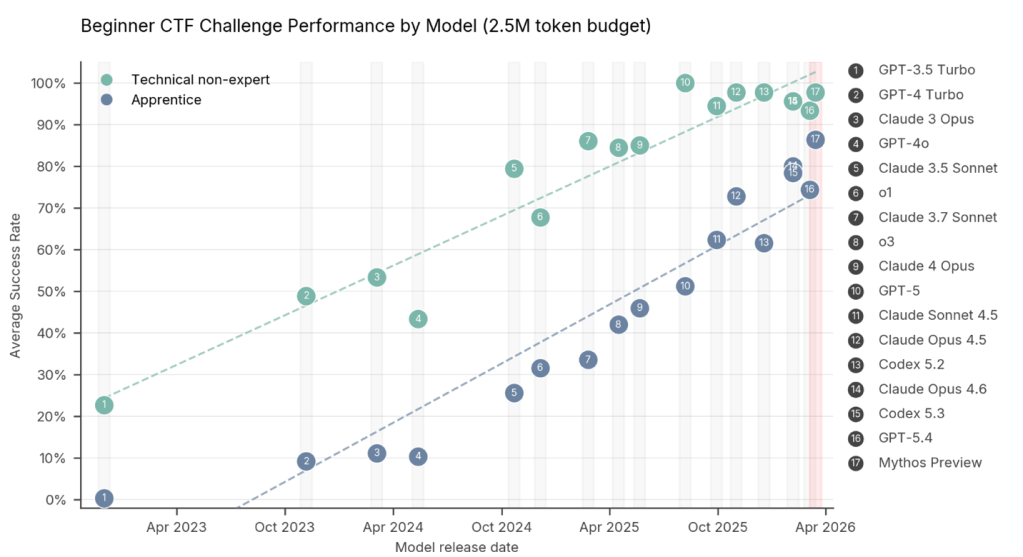
Using a mix of Capture the Flag exercises and cyber range testing, AISI researchers found that Mythos not only raised the ceiling of technical non-experts and apprentice-level users, it narrowed the overall gap in hacking proficiency between the two. In other words, there’s becoming less of a distinction between the capabilities of amateur “script kiddies” and mid-level hackers with technical knowledge.

Claude Mythos and other Large Language Models are increasing the capabilities of both lower and mid-level hackers when it comes to solving cybersecurity-specific tasks and challenges. (Source: AISI)

Before April 2025, no Large Language Model could complete a single expert-level CTF problem. Mythos successfully solved nearly three quarters (73%) of them.

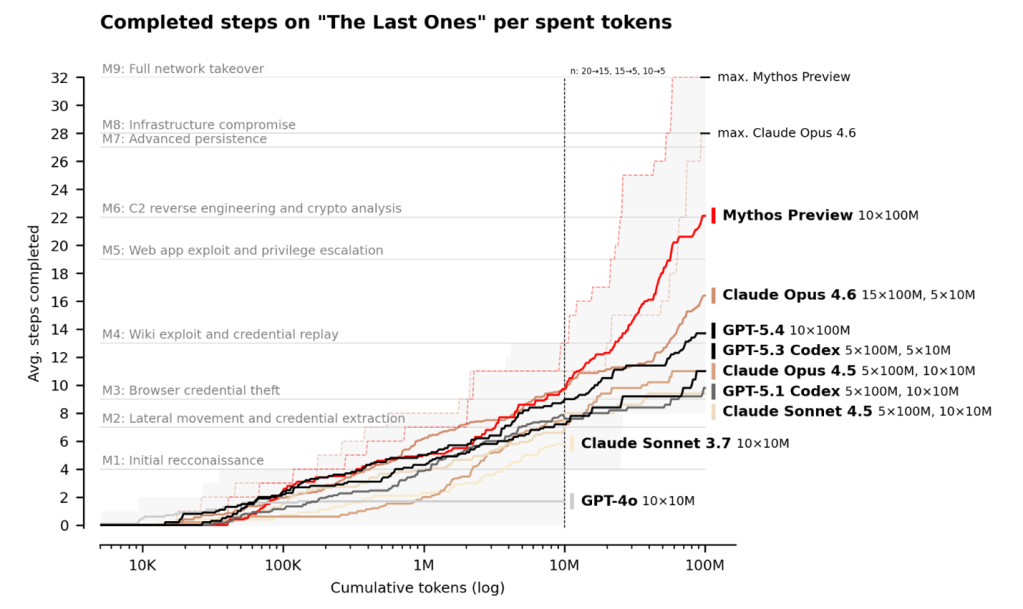
In cyber range tests – which are meant to simulate more complex, multi-chain attacks – the results were uneven, but also represented meaningful progress over prior Claude models.

Mythos was subjected to a 32-step attack playbook modeled on corporate networks, spanning initial network access to full network takeover. In three of the 10 simulations, the model completed an average of 24 of the 32 steps. Older versions of Claude and other frontier models never averaged more than 16.

Claude Mythos improved on other models ability to complete a 32 step cyber attack targeting a simulated corporate network environment. (Source: AISI)

Mythos flunked its test against a simulated operational technology cooling tower, but researchers noted that this doesn’t mean AI is bad at exploiting OT: the model actually faltered during the IT section of the exercise.

UK researchers were more measured in their analysis of Mythos, noting that their testing indicates it is “at least capable” of autonomously taking down smaller, weakly defended enterprise networks.

But they also note their cyber ranges lack security features – like active defenders and defensive tooling – that would be common in many real-world networks and present additional obstacles, nor did they penalize the model for triggering security alerts.

“This means we cannot say for sure whether Mythos Preview would be able to attack well-defended systems,” the researchers concluded.

Technical debt coming due

Both the US and UK reports agree that large language models are broadly moving in a similar direction of lowering the technical barrier. The US authors call for organizations to more quickly adopt AI for cyber defense while overhauling their incident response playbooks and corporate policies to account for more automated defense postures.

For its part, Anthropic has said it is not selling Mythos commercially, and last week it announced the model would be made available to Project Glasswing, a consortium of major tech companies that will use it to root out and patch vulnerabilities in commonly used products and services.

But other experts have warned that businesses and governments are not well-positioned to either absorb the influx of expected vulnerability exploitation or deftly harness AI tools of their own to counter them.

Casey Ellis, CTO and founder of Bugcrowd, wrote that recent advances in AI cyber tools has succeeded largely by “living in the places we stopped looking a decade ago.”

While the cybersecurity community has spent years focusing on application security, vulnerability triage and other “top layer” security problems, AI tools and apex level hacking groups have been feasting on vulnerabilities in forgotten firmware, or routers whose manufacturers long went out of business.

This reality that tools like Mythos can endlessly weaponize the massive technical debt of large organizations has taken the traditional defender’s dilemma and “the knob that used to go to ten and turned it to seven hundred,” Ellis wrote.

Additionally, corporations and governments run on consensus-building, multiple layers of hierarchy and legal compliance. While those are all necessary when handing your cybersecurity over to automated tooling, it can also lead to a slower process and more asymmetry against defenders in the short term.

“Integration into actual production becomes the battlezone,” wrote Ellis. “Lag is real. Bureaucracy is real. Supply chains are real.”

The post Here’s how cyber heavyweights in the US and UK are dealing with Claude Mythos appeared first on CyberScoop.

We’ve seen ransomware cost American lives. Here’s what it will actually take to stop it.

Flights canceled. Emergency rooms shut down. Centuries-old companies shuttered.

Ransomware and other similar cyberattacks have become so routine that even those serious human and economic consequences are often overlooked or easily forgotten.

This lack of focus is dangerous.

As former leaders of FBI and CISA cyber units, we’ve seen cybercrime ripple through communities – disrupting critical services, destroying jobs, and sometimes costing lives. Today’s ransomware numbers tell a stark story. The Department of Homeland Security reported more than 5,600 publicly-disclosed ransomware attacks worldwide in 2024, nearly half of them in the United States. The FBI found that ransomware incidents increased nearly nine percent year over year, with almost half targeting critical infrastructure. Attacks on these organizations pose the greatest threat to national security and public safety.

Despite this trend, we’re cautiously optimistic about the administration’s new National Cyber Strategy. It focuses on protecting critical infrastructure and stopping ransomware and cybercrime—threats it correctly elevates to top-tier national security threats.

But success requires sustained action across government and industry. Adversaries are evolving faster than defenses: ransomware attacks now average $2.73 million per incident, driving annual losses into the billions. Attackers have compressed their operations from weeks to hours, disabling Endpoint Detection and Response (EDR) tools and leaving defenders almost no time to stop an attack.

Basic cyber hygiene still matters. But it’s no longer sufficient. Attackers steal valid credentials, exploit known vulnerabilities, disable tools, and move laterally at machine speed, now accelerated by AI. They need a stunningly low level of technical expertise to do so, and AI tools are increasing the speed and scale of their actions.

Our defenses must keep pace with evolving threats. Protecting national security requires immediate action. Automating cyber threat information sharing offers clear benefits, but government agencies need significant structural and technological upgrades before they can effectively share data. This requires sustained investment and oversight.

The government does not have to do this alone. Industry and academia possess tools that could mean the difference between progress and revisiting this same conversation four, eight, or twelve years from now. Forums like CISA’s Joint Cyber Defense Collaborative (JCDC), the National Cyber Investigative Joint Task Force (NCIJTF), and NSA’s Cyber Collaboration Center (CCC) have demonstrated that information fusion and joint operational planning can work. But overlapping missions and unclear playbooks leave companies guessing what to share, when to share it, and with whom. These forums and underlying collaboration mechanisms must be resourced, deconflicted, and made predictable.

Despite the noble efforts of government agencies to share behind-the-scenes and interact with industry with one voice, the current structure remains fragile and dependent on personal relationships. We simply cannot afford this fragility or inefficiency, particularly in an era of constrained government cyber resources and escalating threats.

Effective protection of critical infrastructure requires focused collaboration. The administration’s strategy rightly emphasizes this, but narrowing this focus will not be easy. For years, the government has tried to cover sixteen sectors and hundreds of thousands of entities equally—an impossible task. Equal attention for all is unrealistic. Looking back, we wish we had prioritized more strategically during our time in government.

Prioritization is politically difficult, but operationally necessary. When everything is critical, nothing truly is. For the most important critical infrastructure, we must focus on resilience—ensuring systems can withstand attacks and recover quickly—rather than assuming we can prevent every breach.

The government can take concrete steps now to disrupt the ransomware ecosystem. Ransomware has cost American lives; designating certain ransomware actors and their enablers as Foreign Terrorist Organizations could unlock more powerful sanctions, diplomatic action, and intelligence operations. Sensible regulation holding cryptocurrency exchanges accountable for knowingly laundering ransomware proceeds could weaken criminal business models while strengthening legitimate digital asset markets in the U.S. and allied nations.

The technology and cybersecurity industry has responsibilities, as well. Industry must share actionable intelligence where legally permitted, pressure-test government programs with candid feedback, and support reauthorization of the Cybersecurity Information Sharing Act of 2015.

We all must do our part. Every day that passes without us confronting these critical questions is a gift to our adversaries. This will only be exacerbated by advancements in AI. We are hopeful that the release of this administration’s National Cyber Strategy will spark much-needed debate and decisions about the role of the government and industry in advancing our nation’s cybersecurity and resilience.

Cynthia Kaiser is senior vice president of Halcyon’s Ransomware Research Center. She was formerly Deputy Director of the FBI’s cyber division.

Matt Hartman serves as chief strategy officer at Merlin Group, where he is focused on identifying, accelerating, and scaling the delivery of transformative cyber technologies to the public sector and critical industries. Prior to this role, Matt spent the last five years serving as the senior career cybersecurity official at the Cybersecurity and Infrastructure Security Agency (CISA) within the Department of Homeland Security.

The post We’ve seen ransomware cost American lives. Here’s what it will actually take to stop it. appeared first on CyberScoop.

❌