โŒ

Reading view

There are new articles available, click to refresh the page.

The AI era demands a different kind of CISO

Many security leaders are still operating with frameworks built for a different era. For years, success was measured by fixed checkpoints, such as passing audits, closing vulnerabilities, and maintaining compliance. Those markers still have value, but they were designed for a threat landscape that moved in predictable, linear ways.

Today, that landscape is shifting in real time. AI is accelerating how attackers can identify and exploit weaknesses, while cloud environments and autonomous systems are constantly changing the terrain. The result is a gap between how risk is measured and how it actually unfolds, where static signals canโ€™t keep up with dynamic threats.

CISOs are under pressure from two directions: risk is growing, and the tools meant to measure it are struggling to keep up. Traditional indicators often reflect yesterdayโ€™s threat landscape, leaving security leaders with an incomplete picture of where they actually stand.

The Mythos signal

Recent reports about Anthropicโ€™s Claude Mythos Preview, described as so effective at vulnerability discovery that access has been restricted, offer a clear signal of where cybersecurity is headed. AI models like this one demonstrate that the speed and scale of exploitation have fundamentally changed. What once took skilled attackers days or weeks can now happen in minutes, and increasingly without human intervention.

That shift matters because attacker capabilities are accelerating faster than most organizations can measure them. The gap between how risk unfolds and how security teams track it is widening. A โ€œpassedโ€ audit tells you where youโ€™ve been, not where you are. A posture dashboard reflects a moment in time, not a continuously changing environment. And a pen test is a snapshot, in a world where conditions evolve constantly.

Sharpening the conversation this quarter

If your conversations havenโ€™t evolved to match this new reality, your organization has a significant blind spot. Here are five questions CISOs should be using to turn the current shift into action:

What can we see at runtime without waiting for a report?
Configuration tools tell you what should be true. Runtime visibility tells you what is true right now. (Follow up: If an attacker starts moving laterally in our cloud environment today, how fast do we know, in minutes or days?)

Do we have a complete inventory of identities, including non-human?
Business environments are full of identities beyond employees. Vendors, contractors, service accounts, API keys, automations, machine identities, and cloud principals sprawl across systems. Attackers love that sprawl because stealing credentials is often easier than writing malware.
(Follow up: How many human and non-human identities do we have, and which ones can access sensitive data or modify critical infrastructure?)

Where are we over-permissioned, and how quickly can we reduce it?
Over-permissioned accounts act like master keys: convenient until theyโ€™re compromised. Least privilege must be measurable, not aspirational. (Follow up: Can you show me the highest-risk access paths and what we can remove or tighten in 30 days?)

Are we using AI to reduce noise and speed decisions or just adding another screen?
Many teams are drowning in alerts. AI can help by adding context (connecting a risky identity + vulnerable workload + exposed secret) so responders can act quickly, instead of chasing disconnected warnings. (Follow up: Whatโ€™s our alert volume, what percentage is actionable, and whatโ€™s improved response time?)

Can you walk me through a realistic incident end to end, with decision points?
Prevention matters, but resilience is what separates organizations when something gets through. Incidents are inevitable. What matters is detection speed, containment, recovery, and communications. (Follow up: Pick a scenario โ€” credential theft, ransomware, vendor compromise โ€” What happens here, who decides what, and when does executive leadership need to know? What do customers need to know?)

What to do with the answers

If these questions surface gaps, the path forward is usually practical. Start by prioritizing runtime visibility on systems that support critical services and sensitive resident data. Treat identity like infrastructure โ€” inventory it, right-size permissions, and monitor continuously. Shift measurement toward outcomes like time to detect, contain, and restore, rather than activity metrics like tickets closed or controls checked. And rehearse the hard day with both technical teams and leadership, including communications.

In an era where threats move at AI speed, the advantage belongs to teams that can see clearly and act immediately. The defining question now is how quickly you can identify a risk, understand its impact, and respond before it escalates.

Rinki Sethi is the chief security & strategy officer at Upwind Security, holding over two decades of cybersecurity leadership experience from roles at Twitter, Rubrik, BILL, Palo Alto Networks, IBM, and eBay. She is a founding partner at Lockstep Ventures, serves on the boards of ForgeRock and Vaultree, and is widely recognized for her contributions to the cybersecurity community, including developing the first national cybersecurity curriculum for the Girl Scouts of USA.

The post The AI era demands a different kind of CISO appeared first on CyberScoop.

The Hidden ROI of Visibility: Better Decisions, Better Behavior, Better Security

Beyond monitoring and compliance, visibility acts as a powerful deterrent, shaping user behavior, improving collaboration, and enabling more accurate, data-driven security decisions.

The post The Hidden ROI of Visibility: Better Decisions, Better Behavior, Better Security appeared first on SecurityWeek.

You Donโ€™t Have a Security Problem, You Have a Visibility Problem

What youโ€™ll learn in this article

This article explains why many breaches are driven by gaps in visibility rather than advanced exploits, how attackers move through modern environments, and what changes when organizations start connecting assets, identities, and attack paths into a single view.

What is a visibility problem in cybersecurity?

A visibility problem exists when security teams cannot clearly answer three basic questions: what assets exist, who or what can access them, and how those elements connect. When those answers are incomplete, decisions are made based on assumptions โ€“ and that creates conditions where risk can grow, unnoticed.

As environments expand across cloud, SaaS, and hybrid infrastructure, the number of systems and identities grows quickly. What often falls behind is a clear understanding of how they relate to each other, and that gap is where attackers tend to operate.

How visibility gaps turn into breaches

A large medical technology organization experienced a breach driven by a series of compounding gaps rather than a single exploit. Internet-exposed assets created the initial entry point, while inconsistencies in device posture and identity enforcement, including gaps in platforms like Intune, weakened the security boundary. Attackers leveraged exposed or reused credentials and over-permissioned access to move laterally across systems. Without unified visibility across assets, identities, and managed devices, the attack path remained invisible until critical systems were reached.

Each of these conditions is common on its own, but what makes them dangerous is how they connect.

Why most attacks are not about flashy exploits

This breach did not rely on a zero-day vulnerability or an advanced technique. It depended on an exposed asset, valid credentials, and inconsistent enforcement across identity and devices. Those elements exist in most environments, but without visibility into how they overlap, they can be combined into a viable attack path.

Security teams often evaluate vulnerabilities individually, while attackers focus on how those weaknesses can be chained together. The risk is not just in what is vulnerable, but in how exposure allows movement.

What a visibility-first approach looks like

Improving outcomes depends on understanding how exposure exists across the environment and how different elements relate to each other.

Asset visibility is the starting point. Many organizations cannot confidently identify everything that is externally accessible, and attackers often find assets that were never intended to be exposed. Continuously mapping assets across cloud and on-prem environments reduces that uncertainty and limits entry points.

Identity is just as critical. Once access is established, movement depends on credentials and permissions. Stolen credentials, over-permissioned accounts, and weak authentication paths allow attackers to move beyond initial entry. Treating identity exposure as part of the attack surface helps identify these risks earlier, especially when leaked credentials can be tied to active accounts and privileges.

Attack path visibility connects these elements. Instead of evaluating findings in isolation, it shows how exposures can be combined into realistic attack scenarios. Through adversarial simulation, organizations can observe how an attacker could move from an exposed system to internal resources, which shifts focus toward removing viable paths rather than addressing isolated issues.

External signals, such as credential leaks, only become meaningful when tied back to internal systems. Monitoring for exposed credentials is useful, but correlating those credentials with active accounts and access levels is what turns that signal into something actionable.

Controls such as least privilege and multi-factor authentication remain essential, but they are only effective when applied consistently. Without visibility into where access exists, enforcement gaps are difficult to detect.

Why visibility changes the security outcome

The difference in a scenario like this is not simply better tooling. It is a shift in how exposure is understood and prioritized.

Attackers look for the easiest path through an environment. A visibility-first approach identifies those paths earlier, reduces them, and then examines why they existed. That changes how teams prioritize work, moving from reacting to individual findings toward removing viable attack paths.

How this works in practice

This is where platforms like Rapid7 support a more complete view of exposure. Surface Command aggregates telemetry from over 190 sources, helping organizations unify fragmented views of assets and identities. InsightCloudSec extends that visibility into cloud environments by enforcing best practices and least privilege without relying on manual processes. Vector Command focuses on how attackers move, using continuous testing and simulation to show how attacks would unfold across an environment.

On the intelligence side, integrating threat data with identity systems allows external signals, such as credential leaks, to be mapped to active accounts and validated in real time. That makes it possible to act before those credentials are used.

Together, these capabilities provide a clearer understanding of how exposure translates into risk.

Putting visibility at the center of security

Zero trust depends on more than policy. It requires visibility, identity, validation, and enforcement to work together continuously.

Without visibility, zero trust becomes difficult to apply in practice. With it, security decisions can be based on how systems actually behave rather than how they are expected to behave, which shifts organizations away from reacting to incidents and toward preventing them from forming.

Why CVSS is No Longer Enough for Exposure Management

For years, cybersecurity professionals have relied on a familiar metric to dictate their day-to-day priorities: the Common Vulnerability Scoring System (CVSS). In todayโ€™s hyper-connected, sprawling IT environments, utilizing a static severity score as the ultimate arbiter of risk creates opportunities for threat actors. While defenders chase down theoretical, high-scoring alerts, adversaries are quietly targeting the truly exploitable, business-critical exposures that slip through the cracks.

In a recent report, Gartnerยฎ highlighted a projection:ย 

"By 2028, organizations that prioritize exposures using threat intelligence, asset context, exploitability modeling and security control validation will reduce breach likelihood by at least 70% compared to peers relying primarily on CVSS-based vulnerability prioritization." [1]

This affirms what many seasoned practitioners have suspected for years: thereโ€™s an abundance of vulnerability findings, but a lack of actionable context.

Static scores. Reactive security.

Most vulnerability management programs evolved during a time when the attack surface was relatively static, adversary tooling was rudimentary, and remediation capacity generally exceeded the volume of new disclosures. Today, enterprises are confronted with vulnerabilities scattered across complex cloud architectures, SaaS applications, and intricate supply chains.

In this modern threat landscape, CVSS alone is insufficient because it measures theoretical severity, does not factor in whether an attacker is actually using the vulnerability in the wild, or consider the business value of any affected assets. According to Gartnerยฎ, fewer than 10% of vulnerabilities are exploited, yet most are treated as urgent [1]. This all leads to prioritization paralysis, where security teams spend countless hours patching vulnerabilities that pose low material risk to the business. The legacy approach rewards what is auditable rather than what is genuinely impactful.

The path toward smarter prioritization

To break free from endless patching and ineffective risk reduction practices, security professionals are shifting toward a context-driven model. As Gartner notes, strong exposure prioritization requires integrating four critical elements: threat intelligence, asset context, data science, and security control validation. Organizations are approaching these elements in a few practical ways:

Threat intelligence to establish relevance

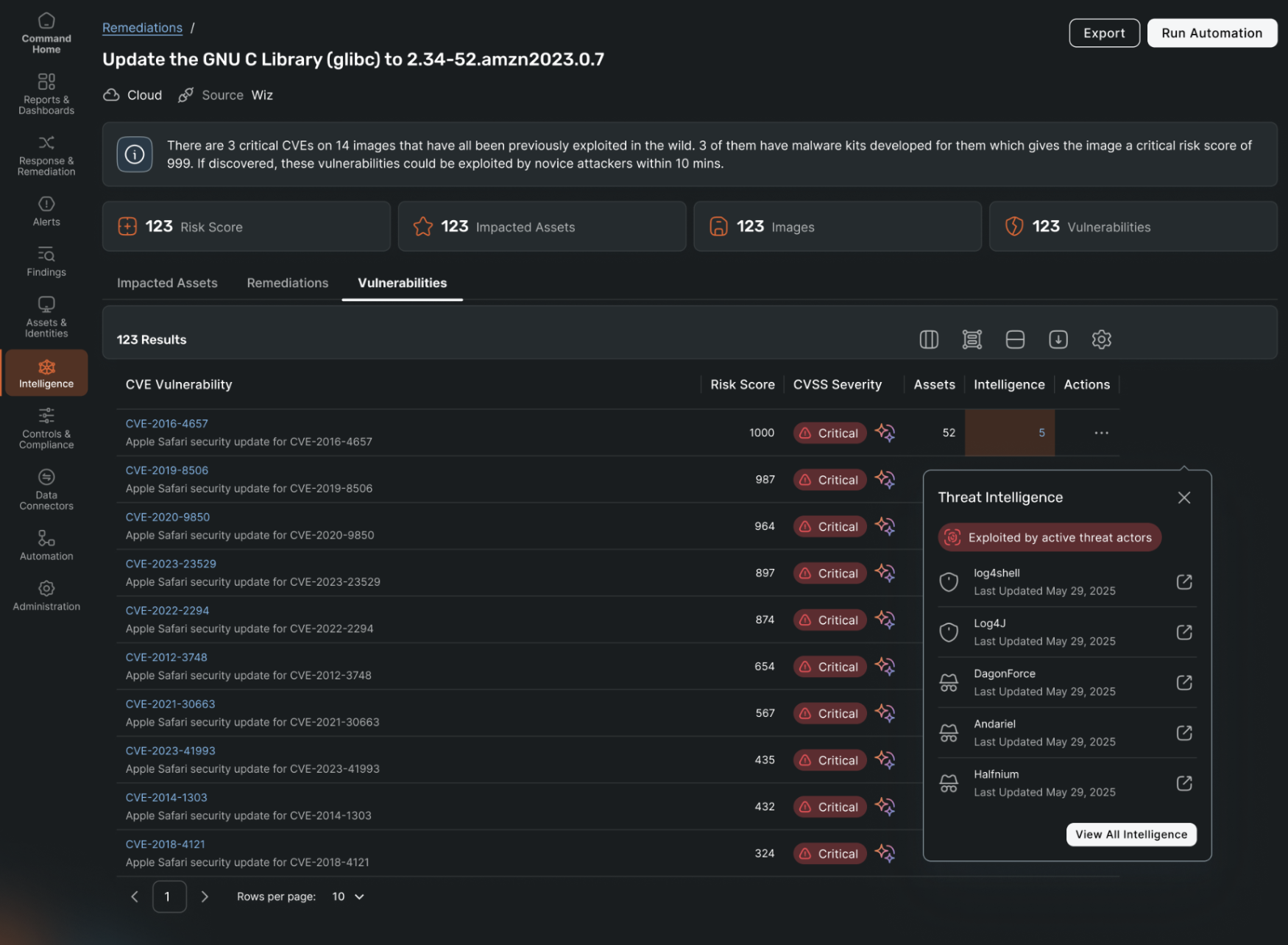
Instead of just asking how severe a vulnerability is, modern exposure management asks whether an exposure is relevant to a threat actor who is capable of exploiting it right now. By embedding threat intelligence into each vulnerability finding, teams shift the focus from theoretical to risk active exploitation. It introduces the adversary's perspective by identifying known exploited vulnerabilities, public or private exploit availability, and targeted campaigns. By filtering out exposures with no evidence of attacker interest, organizations can instantly collapse large vulnerability backlogs and focus only on relevant threats.

Rapid7-threat-intelligence-remediation-hub.png

Asset context and business criticality to define impact

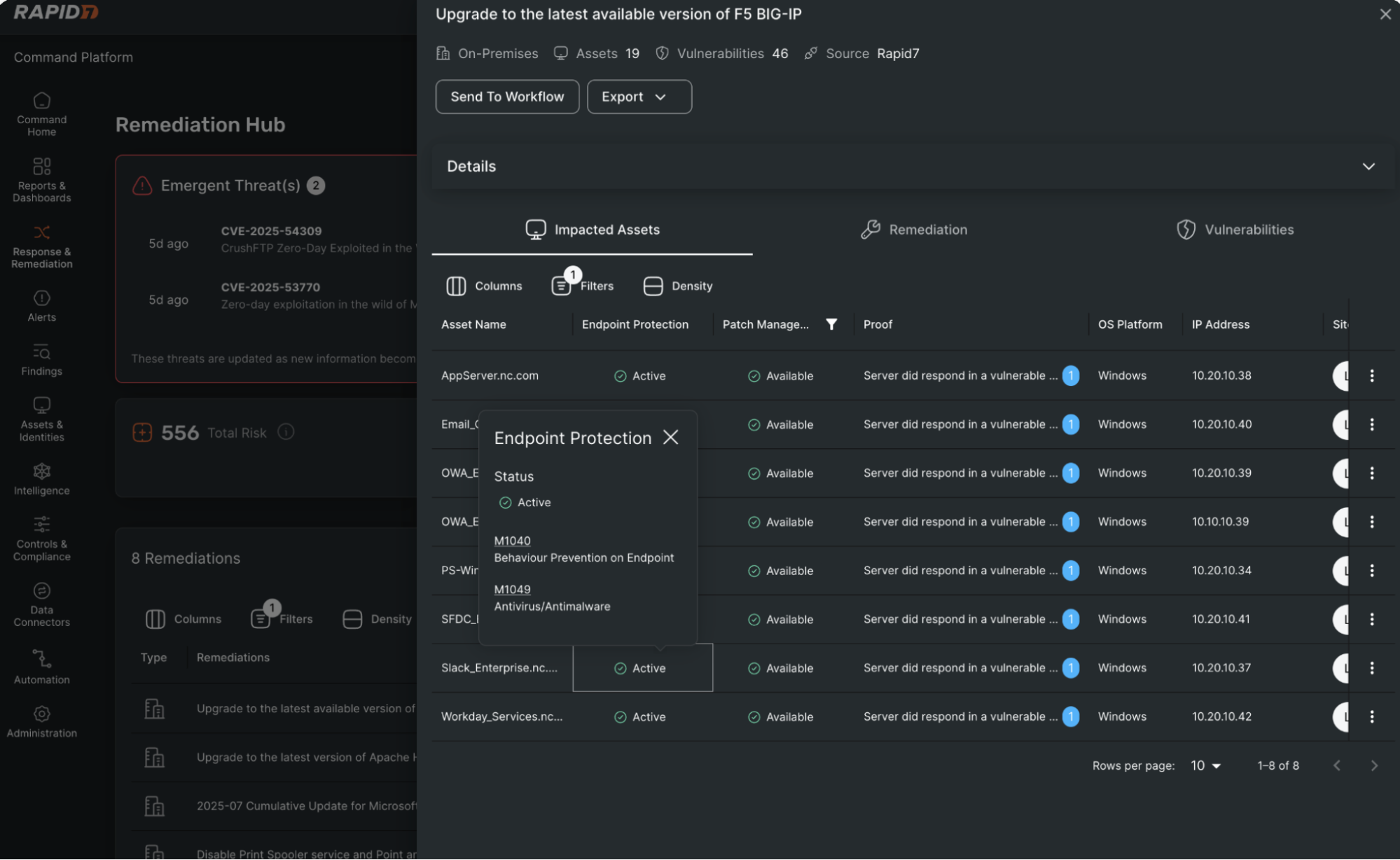
Not all assets are created equal. A critical vulnerability on an isolated, internal test server is vastly different from the same vulnerability on a public-facing cloud workload processing customer sensitive data. Asset context enriches exposure data with crucial business information: what the asset is, its external accessibility, and its relationship to core business functions. Without this context, security teams waste disproportionate effort on low-impact systems, treating every critical alert as an equal emergency.

Endpoint-protection-Rapid7-remediation-hub.png

Exploitability modeling for predicting breach likelihood

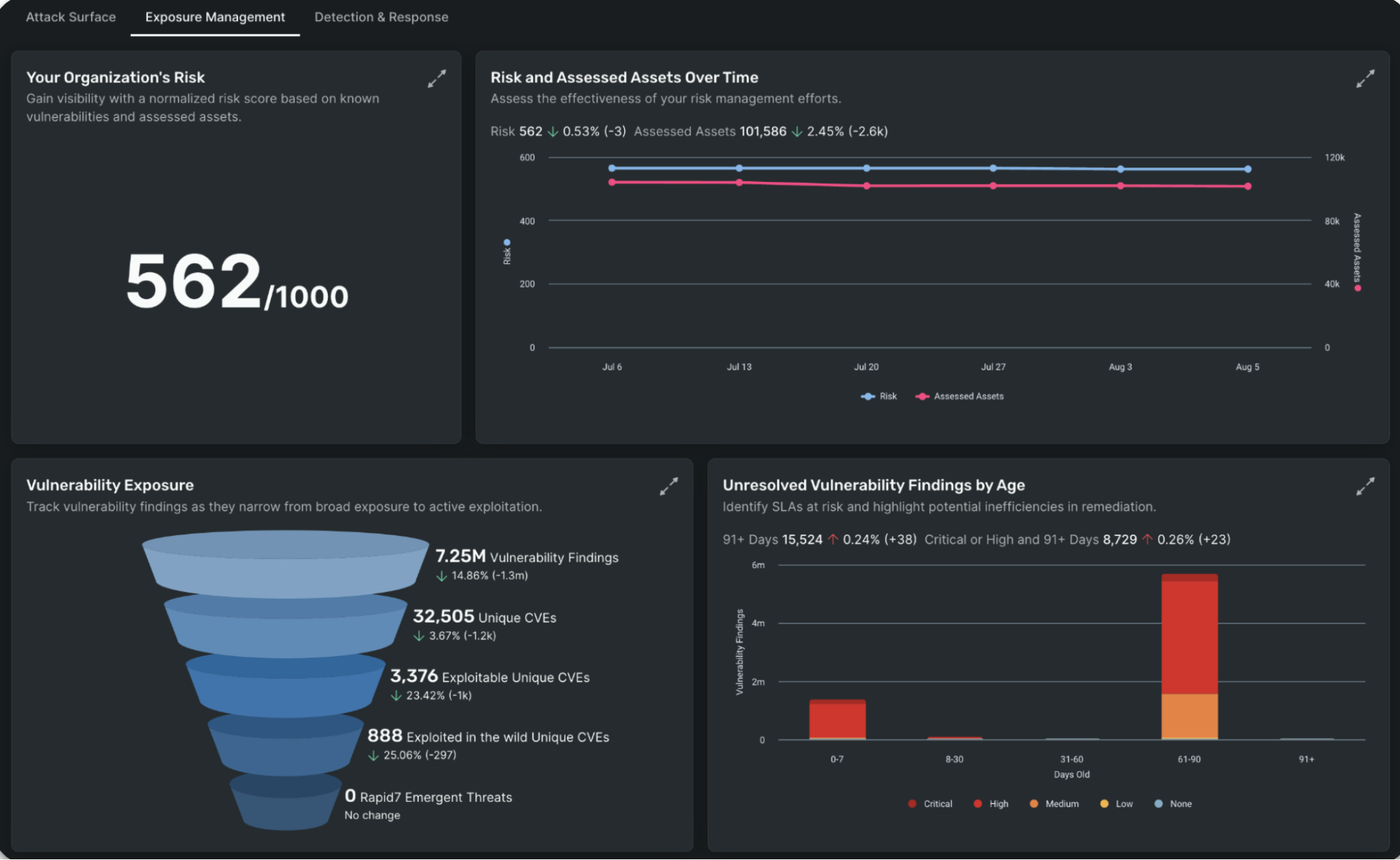
Security analysts often struggle to assess exploitability given the overwhelming volume of vulnerabilities. By using predictive models like the Exploit Prediction Scoring System (EPSS), organizations can analyze large datasets of historical exploitation to identify latent risks. Exposure assessment platforms should display this data alongside each exposure finding to make it easier to predict the vulnerabilities most likely to become attacks.

Rapid7-vulnerability-risk-score-exposure.png

Security control validation

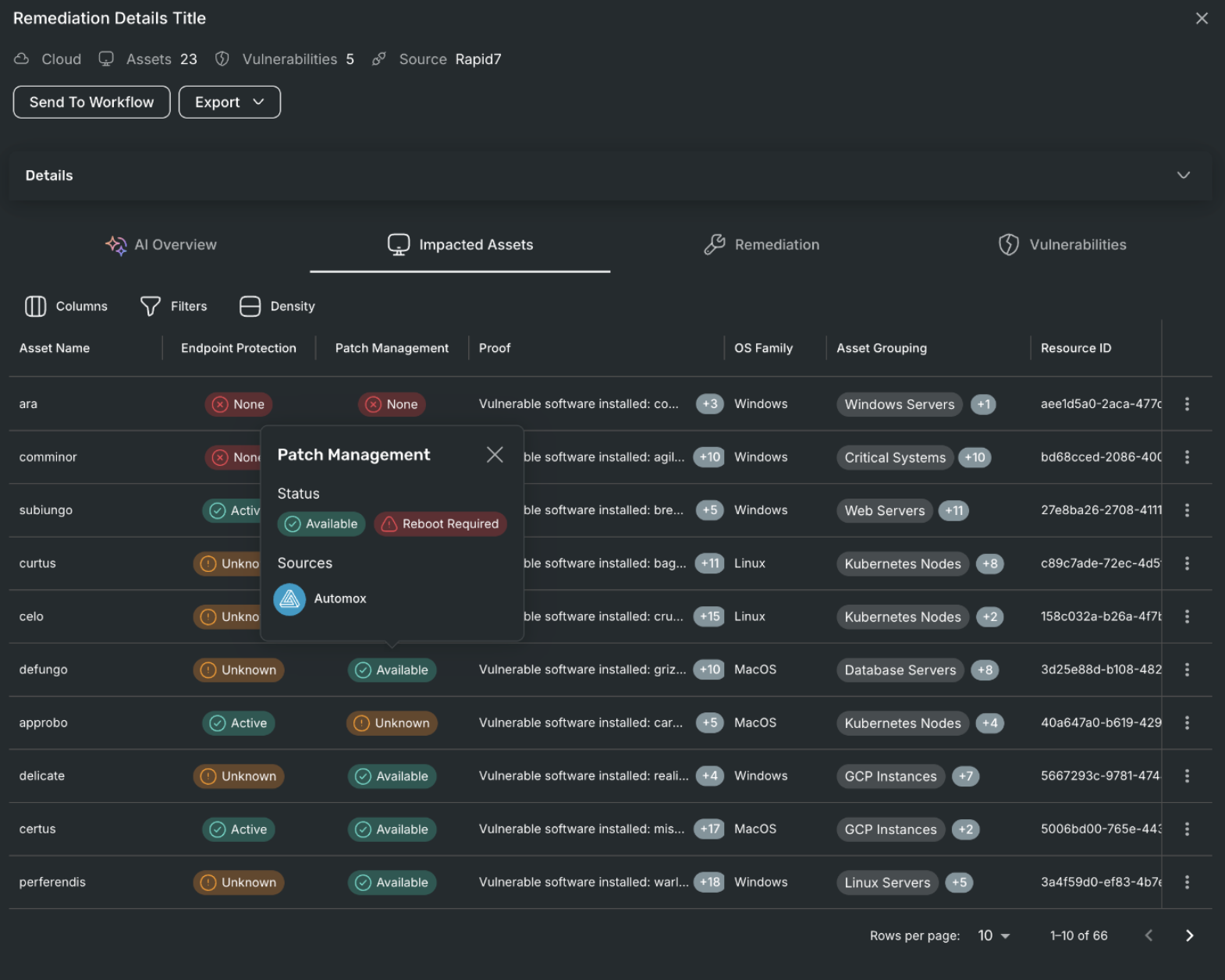
An exposure that appears highly exploitable in theory might be neutralized by existing defenses. By integrating security and policy controls, you can evaluate exposures in the context of endpoint protection and identity management. This passive validation confirms whether an attacker can realistically exploit the exposure in your specific environment.

Rapid7-remediation-details.png

Unified exposure management

Individually, each element highlighted above provides incremental value, but when integrated, they fundamentally transform how prioritization decisions are made. This integrated model ensures that remediation efforts are mobilized only after priorities have been validated in the context of the business and the current threat landscape. It transitions vulnerability management from a purely technical, tool-centric exercise into a strategic, process-driven risk decision.

Security leaders must measure success not by the sheer number of vulnerabilities closed, but by the demonstrable reduction of exploitable exposures and the alignment of remediation efforts with actual attacker behavior. Operationalizing these four elements requires a unified platform that eliminates the silos between vulnerability management, cloud security, and threat intelligence. You cannot manually stitch together disconnected spreadsheets and hope to outpace modern adversaries. This is where forward-thinking organizations are leaning on comprehensive, end-to-end solutions like Rapid7 Exposure Command that seamlessly aggregate visibility across on-premises and dynamic cloud environments. With deep, native integration of Rapid7 Cloud Security capabilities, teams can instantly map asset criticality and external accessibility within complex, ephemeral cloud architectures. Furthermore, by infusing world-class threat intelligence and active exploit data directly into exposure findings, Rapid7 enables security teams to cut through the noise, validate security controls, and pinpoint the exact exposures that matter mostโ€”all with minimal friction.

[1] Gartner, Prioritize What Attackers Will Exploit: 4 Elements of Strong Exposure Prioritization, Jonathan Nunez, 5 March 2026.

Unlocking the Power of Amazon Security Lake for Proactive Security

Security is a central challenge in modern application development and maintenance, requiring not just traditional practices but also a deep understanding of application architecture and data flow. While organizations now have access to rich data like logs and telemetry, the real challenge lies in translating this information into actionable insights. This article explores how leveraging those insights can help detect genuine security incidents and prevent their recurrence.

Communicating Security to the C-Suite: A Strategic Approachย 

Engaging with the C-suite is not just about addressing security concerns or defending budget requests. It's about establishing and maintaining an ongoing discussion that aims to align security objectives with the interests of the business.ย ย 

The post Communicating Security to the C-Suite: A Strategic Approachย  appeared first on Black Hills Information Security, Inc..

Cyber Risk Lessons We Can Learn From Hurricane Preparedness

Risk is real. To better understand cybersecurity risk, letโ€™s compare cyber risks to risks in the natural world from hurricanes. We can learn lessons from hurricanes and unnamed storms in [โ€ฆ]

The post Cyber Risk Lessons We Can Learn From Hurricane Preparedness appeared first on Black Hills Information Security, Inc..

โŒ