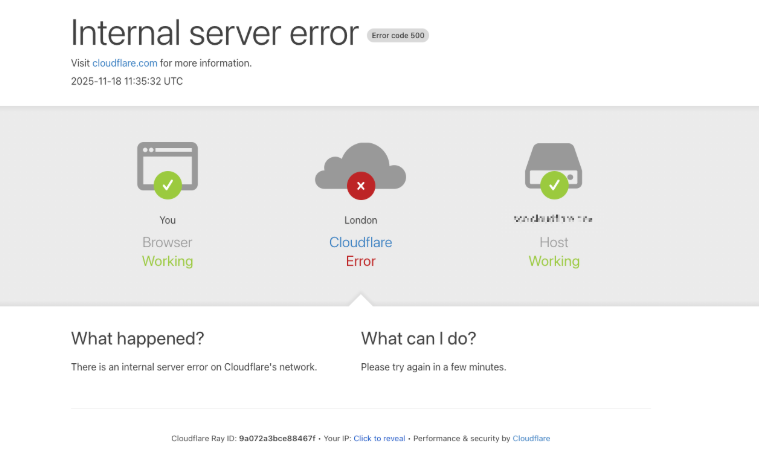
Reading view

There are new articles available, click to refresh the page.

Justice Department disrupts botnet networks that hijacked 3 million devices

Authorities seized infrastructure powering four botnets that hijacked a combined three million devices and launched more than 300,000 DDoS attacks collectively, the Justice Department said Thursday.

The botnets — Aisuru, Kimwolf, JackSkid and Mossad — enabled operators to sell access to the infected devices for various cybercrimes. The aftermath spanned thousands of attacks, including some demanding extortion payments from victims, officials said.

The globally coordinated operation, aided by law enforcement actions targeting the botnets’ operators in Canada and Germany, disrupted the command-and-control infrastructure for all four botnets. Two of the botnets set records before the takedown, attracting widespread attention from security researchers and vendors.

The Kimwolf botnet, an Android variant of Aisuru, spread like wildfire after its operators figured out how to abuse residential-proxy networks for local control, according to Sythient. It eventually took over more than 2 million Android TV devices by January. In September, just as Kimwolf was forming, Cloudflare clocked the Aisuru botnet hitting a record-breaking 29.7 terabits-per-second DDoS attack that lasted 69 seconds.

Officials ultimately attributed roughly 200,000 DDoS attacks to Aisuru, 90,000 to JackSkid, 25,000 to Kimwolf and about 1,000 DDoS attack commands to the Mossad botnet. Yet, DDoS attacks from financially-motivated attackers are typically a distraction or misdirection.

“Oftentimes a DDoS attack is just advertising for the size of an operator’s botnet,” Zach Edwards, staff threat researcher at Infoblox, told CyberScoop. Botnet operators cash out by renting these controlled devices to cybercriminals for account abuse, password reset attacks, ad fraud schemes and residential proxy nodes, he added.

Devices infected by the four botnets include digital video recorders, web cameras, Wi-Fi routers and TV boxes. Hundreds of thousands of these devices are located in the United States, federal prosecutors said. 

Authorities did not name the people involved or formally announce any arrests. Yet, they describe the operation in nearly conclusive terms, claiming the action disrupted the botnets’ communications infrastructure — domains, virtual servers and other systems — to prevent further infection and limit or eliminate the botnets’ ability to launch future attacks.

“Cybercriminals infiltrate infrastructure beyond physical borders and Defense Criminal Investigative Service participates in international operations to help safeguard the Department’s global footprint,” Kenneth DeChellis, special agent in charge at the Defense Department’s DCIS cyber field office, said in a statement. Some of the DDoS attacks attributed to these botnets reached IP’s owned by the Department of Defense Information Network.

Botnets often compete for devices to infect and opportunities to scale. As Kimwolf spread and hit those objectives, it captured sweeping interest from researchers, authorities and vendors in a position to help stop it. 

Kimwolf was the largest DDoS botnet ever detected, according to Tom Scholl, vice president at Amazon Web Services, which assisted the operation. “The scale of this botnet is staggering,” he said in a LinkedIn post

“Kimwolf represented a fundamental shift in how botnets operate and scale,” Scholl added. “Unlike traditional botnets that scan the open internet for vulnerable devices, Kimwolf exploited a novel attack vector: residential proxy networks.”

Under this mechanism, any organization with vulnerable devices connected to the internet could unwittingly have those devices turned into a node for a botnet or a foothold for a targeted attack.

“This isn’t just some problem that your cousin has because he bought some cheap TV box that promised him free TV channels,” Edwards said. Infoblox previously said nearly 25% of customers had at least one endpoint device in a residential proxy service targeted by Kimwolf.

While it’s intellectually interesting whenever a botnet scales to extraordinary size, it’s also a “sad reminder that oftentimes security takes a back seat to convenience and cost,” Edwards said. 

“The botnets are growing because more and more people are buying weird internet-connected stuff,” he added. “Nothing in this world is free.”

The takedowns mark a continuation of a consistent, ongoing crackdown targeting large-scale botnets, cybercrime marketplaces, malware, infostealers and other cybercrime tools. Some of the malicious networks hampered or rendered nonoperational by disruptions and arrests during the past year include: DanaBot, Rapper Bot, Lumma Stealer, AVCheck and SocksEscort.

More than 20 companies and organizations assisted with the coordinated disruption, including law enforcement from the Netherlands and Europol. Efforts to stop botnets will continue as these malicious networks proliferate in new places and new ways. 

“We’re living in a device-compromise–DDOS-botnet-merry-go-round and while many of us wish something could slow it down, the challenges continue to grow,” Edwards said. “This is still a bad day for serious threat actors, and any day like that is something we should all celebrate.”

The post Justice Department disrupts botnet networks that hijacked 3 million devices appeared first on CyberScoop.

Global coalition dismantles Tycoon 2FA phishing kit

Tycoon 2FA, a major phishing kit and platform that allowed low-skilled cybercriminals to bypass multifactor authentication and conduct large-scale adversary-in-the-middle attacks, was dismantled Wednesday by a global coalition of security companies and law enforcement agencies.

Microsoft, which led the effort alongside Europol and authorities from six countries and 11 security firms or organizations, said it seized 330 domains that powered Tycoon 2FA’s core infrastructure, including control panels and fraudulent login pages.

The platform, which emerged in August 2023, was responsible for tens of millions of phishing messages that reached more than 500,000 organizations globally each month, according to Microsoft Threat Intelligence. Thousands of cybercriminals used Tycoon 2FA to break into email and online services, including Microsoft 365, Outlook, SharePoint, OneDrive and Google services.

“By mid‑2025, Tycoon 2FA accounted for approximately 62% of all phishing attempts Microsoft blocked, including more than 30 million emails in a single month. That placed Tycoon 2FA among the largest phishing operations globally,” Steven Masada, assistant general counsel at Microsoft’s Digital Crimes Unit, said in a blog post about the takedown. 

“Despite extensive defenses, the service is linked to an estimated 96,000 distinct phishing victims worldwide since 2023, including more than 55,000 Microsoft customers,” Masada added. 

The phishing kit, which was developed and advertised by a group Microsoft tracks as Storm-1747, was sold to cybercriminals on Telegram and Signal for $350 a month. The platform provided core components for phishing on a single dashboard that allowed cybercriminals to configure, track and refine their campaigns.

The platform also provided cybercriminals with pre-built templates, attachment files for common phishing lures, domain and hosting configuration and redirect logic, Microsoft said. The monthly volume of phishing messages attributed to Tycoon 2FA peaked at more than 30 million messages in November 2025.

Organizations in education and health care were hit hardest by phishing attacks enabled by Tycoon 2FA. More than 100 members of Health-ISAC, a co-plaintiff in the court case filed in the U.S. District Court for the Southern District of New York, were successfully phished, Masada said. 

Two hospitals, six schools and three universities in New York confronted attempts or successful compromises via Tycoon 2FA, resulting in incidents that disrupted operations, diverted resources and delayed patient care, he added. 

Microsoft and Health-ISAC filed a civil complaint against alleged creator Saad Fridi and four unnamed associates, demanding a $10 million injunction, for developing, running and selling Tycoon 2FA. The court order allowed Microsoft to dismantle and take ownership of Tycoon 2FA’s technical infrastructure.

Authorities from Latvia, Lithuania, Portugal, Poland, Spain and the United Kingdom assisted with the operation alongside Cloudflare, Coinbase, Crowell & Moring, eSentire, Intel 471, Proofpoint, Resecurity, Shadowserver, SpyCloud and Trend Micro. 

Selena Larson, staff threat researcher at Proofpoint who provided a formal declaration in support of the court order, said Tycoon 2FA was responsible for the highest volume of adversary-in-the-middle phishing attacks observed by Proofpoint. 

“Tycoon was the biggest MFA phishing threat in our data, and we anticipate seeing a significant decrease after this operation,” she told CyberScoop.

“Many customers will find their hacking tool is no longer working, and even if Tycoon 2FA is able to create new domains and infrastructure, the brand will be significantly harmed, with customers either purchasing less effective phishing kit, or potentially rethinking their life choices and getting out of the game,” Larson added.

Tycoon 2FA’s easy-to-use and robust capabilities contributed to its popularity, researchers said. The platform’s codebase was updated regularly and operators generated a high volume of subdomains for brief periods before abandoning them and moving on to new domains.

Researchers said the rapid turnover and shifts to temporary infrastructure complicated efforts to detect and block new campaigns.

The Tycoon 2FA takedown follows a recent wave of cybercrime crackdowns, including actions against Racoon0365 and the Lumma Stealer infostealer operation, which infected about 10 million systems.

The post Global coalition dismantles Tycoon 2FA phishing kit appeared first on CyberScoop.

Attackers are using your network against you, according to Cloudflare

Cloudflare’s inaugural threat intelligence report identifies a series of weaknesses in technology that attackers have abused and industrialized into professional “attack factories,” leaving most organizations unprepared to respond. 

Attackers are turning the very services victims deploy and pay for into tools for launching large-scale attacks. Researchers say the barrier to entry has vanished, as identities and tokens allow attackers to weaponize gaps in cloud-based systems.

Organizations’ environments are riddled with potential entry points. As the everything-as-a-service model spreads, systems become more interconnected and dependent on one another, and  many software components are reachable in ways that make them nearly as accessible to attackers as to legitimate users.

“When one of those interconnections goes bad, all of a sudden everything’s gone south,” Blake Darché, head of Cloudflare’s threat intelligence unit Cloudforce One, told CyberScoop.

“Data is more accessible than ever, which is good for a lot of cases, but the threat actors are using that easy access to that data as a way to exploit people, systems and organizations,” he added. “It’s only going to get harder. I think some of the AI tools will make this even worse.”

Attackers have turned “the connective tissue of the modern enterprise into its primary vulnerability,” researchers wrote in the report.

Cloudflare expects attackers to routinely exploit platforms as a standard tactic this year. Cybercriminals, nation-states and others routinely use public cloud resources to blend in with legitimate traffic, provision infrastructure for operations and cast link-based phishing lures into emails that bypass or slip through ineffective protections, researchers wrote in the report.

Weaknesses in the seams of complex cloud environments are abundant and consequential, allowing identity-based attacks to achieve the same outcome as complex malware or zero-day exploits. 

These blind spots make the traditional barometers for danger — an attackers’ demonstrated sophistication through elegant code or novel zero-days — effectively trivial, researchers wrote in the report. 

“If you’re a business that just lost a million records, it doesn’t matter if the threat actor was sophisticated, unsophisticated, or a child,” Darché said.

Cloudflare argues the industry should reframe how it categorizes risk and take a more pragmatic approach: focus on “effectiveness,” measured by the ratio of an attacker’s effort to the operational outcome they achieve. 

“It turns out, you don’t need to be sophisticated to be successful,” Darché said. “In the industry, we’re overly focused on sophistication of threats and that’s probably not what it’s about anymore, and it’ll become less about sophistication level over time.”

The far-reaching attack spree originating at Salesloft Drift last summer, which impacted Cloudflare and more than 700 additional companies through the third-party AI agent’s connection with Salesforce, exemplified the risks lurking in unexpected places in the supply chain. 

The trusted relationships that these interconnected services rely on need to be further scrutinized, Darché said. “You as the data owner don’t even know where their data is going, and your exposure is just almost infinite.”

The post Attackers are using your network against you, according to Cloudflare appeared first on CyberScoop.

React2Shell fallout spreads to sensitive targets as public exploits hit all-time high

Fallout from React2Shell — a stubborn vulnerability that impacts wide swaths of the internet’s scaffolding — continues to spread as public exploits and stealth backdoors proliferate and worrying details emerge about the targets attackers are pursuing. 

Threat researchers and incident responders are reacting to swift-moving developments on React2Shell with mounting concern. Cybercriminals, ransomware gangs and nation-state threat groups are all swarming to exploit the maximum-severity vulnerability.

Palo Alto Networks’ Unit 42 puts the latest victim count at more than 60 organizations, which have been impacted by attacks involving exploitation of CVE-2025-55182, which Meta and the React team publicly disclosed Dec. 3.

Microsoft said it found “several hundred machines across a diverse set of organizations” that were compromised via exploitation resulting in remote-code execution. Post-exploitation activity in those attacks includes reverse shell implants, lateral movement, data theft and steps that allowed attackers to maintain access to targeted networks, Microsoft said in a research blog Tuesday. 

The full scope of attacker interest in the vulnerability is magnified by an unparalleled number of publicly available exploits — underscoring the relative ease and myriad ways unauthenticated attackers can trigger the defect to elevate privileges and pivot into other parts of targeted networks. 

VulnCheck confirmed nearly 200 valid public exploits for React2Shell as of Thursday. “React2Shell CVE-2025-55182 now has the highest verified public exploit count of any CVE,” Caitlin Condon, vice president of research at VulnCheck, told CyberScoop.

Ongoing clean-up efforts for React2Shell also led to the discovery of three new defects affecting React Server Components last week, including CVE-2025-55183 and CVE-2025-67779, which fixes an apparent bypass for CVE-2025-55184, she said. 

“The worst-case scenario on many defenders’ minds presently is that a true patch bypass for CVE-2025-55182 might arise. So far, this hasn’t come to pass,” Condon added. 

Researchers continue to urge organizations to apply the patch for CVE-2025-55182, but note that the additional CVEs are not addressed in some early versions of the patch. And, of course, patching won’t evict attackers that already gained access to systems. 

Attacks of different origins and motivations continue to spread globally. 

Google Threat Intelligence said it has observed financially motivated attackers and at least five Chinese espionage threat groups exploiting the defect across multiple regions and industries. GTIG said it also identified attacks attributed to Iran, but it did not provide more information. 

Amazon previously said its threat intelligence teams observed active exploitation attempts by Earth Lamia and Jackpot Panda within hours of the vulnerability’s public disclosure.

Cybersecurity firm S-RM said it responded to a ransomware attack Dec. 5 that involved React2Shell exploitation as an initial access vector. Attackers executed Weaxor ransomware within a minute of gaining access to the victim’s network, the company said in a blog post Tuesday.

Evidence of spiking malicious activity, including exploitation attempts, is showing up across the threat intelligence landscape. 

Cloudflare said multiple Asia-based threat groups have been meticulous in targeting networks in Taiwan, the autonomous region of Xinjiang Uygur, Vietnam, Japan and New Zealand, yet other selective targets were observed, including U.S. government websites, academic research institutions and critical infrastructure operators. 

“These infrastructure operators specifically included a national authority responsible for the import and export of uranium, rare metals and nuclear fuel,” Cloudflare’s threat intelligence team wrote in a blog post.

Several U.S.-based state and federal government agencies have been targeted, but there’s no confirmed exploitation, Blake Darché, head of threat intelligence at Cloudflare, told CyberScoop. The Cybersecurity and Infrastructure Security Agency declined to comment on attempted attacks against government agencies. 

“Victimology has now evolved to be universal, with critical infrastructure targets just a small slice of all organizations and industries under attack,” Darché added.

While successful compromises are outside of GreyNoise’s visibility, malicious activity spotted by its sensors are continuing to pop off, according to Andrew Morris, the company’s founder and chief architect.

“Exploitation is still very high with the number of cumulative networks exploiting this vulnerability reaching all-time highs almost every single day since disclosure,” he wrote in a LinkedIn post Tuesday. 

React2Shell has prompted widespread alarm in the two weeks since the vulnerability was first disclosed in the widely used application framework, and researchers expect the defect to have long-lasting impacts.

Austin Larsen, principal analyst at GTIG, said the critical vulnerability will likely be one of the more consequential defects it observed under active exploitation this year.

A debate that initially ensued in some industry circles over the seriousness and viable impact of the defect has effectively ended. 

“Exploitation timelines are shrinking from weeks to hours,” Dan Perez, technology lead at GTIG, told CyberScoop. “Every new vulnerability presents a race against time. Every minute that a system remains unpatched is a minute that a threat actor can use to their advantage, which gives organizations a razor-thin margin for error.”

The post React2Shell fallout spreads to sensitive targets as public exploits hit all-time high appeared first on CyberScoop.

Yesterday’s Cloudflare outage

ISSUE 22.46.1 • 2025-11-19 ON SECURITY By Susan Bradley Cloudflare experienced a significant outage in the early hours of Tuesday, November 18. The outage was not limited to the United States. ZDNET stated that there were more than 330,000 reports from around the world about Cloudflare being down. Unfortunately, AskWoody was offline, too. I guess […]

The Cloudflare Outage May Be a Security Roadmap

An intermittent outage at Cloudflare on Tuesday briefly knocked many of the Internet’s top destinations offline. Some affected Cloudflare customers were able to pivot away from the platform temporarily so that visitors could still access their websites. But security experts say doing so may have also triggered an impromptu network penetration test for organizations that have come to rely on Cloudflare to block many types of abusive and malicious traffic.

At around 6:30 EST/11:30 UTC on Nov. 18, Cloudflare’s status page acknowledged the company was experiencing “an internal service degradation.” After several hours of Cloudflare services coming back up and failing again, many websites behind Cloudflare found they could not migrate away from using the company’s services because the Cloudflare portal was unreachable and/or because they also were getting their domain name system (DNS) services from Cloudflare.

However, some customers did manage to pivot their domains away from Cloudflare during the outage. And many of those organizations probably need to take a closer look at their web application firewall (WAF) logs during that time, said Aaron Turner, a faculty member at IANS Research.

Turner said Cloudflare’s WAF does a good job filtering out malicious traffic that matches any one of the top ten types of application-layer attacks, including credential stuffing, cross-site scripting, SQL injection, bot attacks and API abuse. But he said this outage might be a good opportunity for Cloudflare customers to better understand how their own app and website defenses may be failing without Cloudflare’s help.

“Your developers could have been lazy in the past for SQL injection because Cloudflare stopped that stuff at the edge,” Turner said. “Maybe you didn’t have the best security QA [quality assurance] for certain things because Cloudflare was the control layer to compensate for that.”

Turner said one company he’s working with saw a huge increase in log volume and they are still trying to figure out what was “legit malicious” versus just noise.

“It looks like there was about an eight hour window when several high-profile sites decided to bypass Cloudflare for the sake of availability,” Turner said. “Many companies have essentially relied on Cloudflare for the OWASP Top Ten [web application vulnerabilities] and a whole range of bot blocking. How much badness could have happened in that window? Any organization that made that decision needs to look closely at any exposed infrastructure to see if they have someone persisting after they’ve switched back to Cloudflare protections.”

Turner said some cybercrime groups likely noticed when an online merchant they normally stalk stopped using Cloudflare’s services during the outage.

“Let’s say you were an attacker, trying to grind your way into a target, but you felt that Cloudflare was in the way in the past,” he said. “Then you see through DNS changes that the target has eliminated Cloudflare from their web stack due to the outage. You’re now going to launch a whole bunch of new attacks because the protective layer is no longer in place.”

Nicole Scott, senior product marketing manager at the McLean, Va. based Replica Cyber, called yesterday’s outage “a free tabletop exercise, whether you meant to run one or not.”

“That few-hour window was a live stress test of how your organization routes around its own control plane and shadow IT blossoms under the sunlamp of time pressure,” Scott said in a post on LinkedIn. “Yes, look at the traffic that hit you while protections were weakened. But also look hard at the behavior inside your org.”

Scott said organizations seeking security insights from the Cloudflare outage should ask themselves:

1. What was turned off or bypassed (WAF, bot protections, geo blocks), and for how long?
2. What emergency DNS or routing changes were made, and who approved them?
3. Did people shift work to personal devices, home Wi-Fi, or unsanctioned Software-as-a-Service providers to get around the outage?
4. Did anyone stand up new services, tunnels, or vendor accounts “just for now”?
5. Is there a plan to unwind those changes, or are they now permanent workarounds?
6. For the next incident, what’s the intentional fallback plan, instead of decentralized improvisation?

In a postmortem published Tuesday evening, Cloudflare said the disruption was not caused, directly or indirectly, by a cyberattack or malicious activity of any kind.

“Instead, it was triggered by a change to one of our database systems’ permissions which caused the database to output multiple entries into a ‘feature file’ used by our Bot Management system,” Cloudflare CEO Matthew Prince wrote. “That feature file, in turn, doubled in size. The larger-than-expected feature file was then propagated to all the machines that make up our network.”

Cloudflare estimates that roughly 20 percent of websites use its services, and with much of the modern web relying heavily on a handful of other cloud providers including AWS and Azure, even a brief outage at one of these platforms can create a single point of failure for many organizations.

Martin Greenfield, CEO at the IT consultancy Quod Orbis, said Tuesday’s outage was another reminder that many organizations may be putting too many of their eggs in one basket.

“There are several practical and overdue fixes,” Greenfield advised. “Split your estate. Spread WAF and DDoS protection across multiple zones. Use multi-vendor DNS. Segment applications so a single provider outage doesn’t cascade. And continuously monitor controls to detect single-vendor dependency.”

Cloudflare Scrubs Aisuru Botnet from Top Domains List

For the past week, domains associated with the massive Aisuru botnet have repeatedly usurped Amazon, Apple, Google and Microsoft in Cloudflare’s public ranking of the most frequently requested websites. Cloudflare responded by redacting Aisuru domain names from their top websites list. The chief executive at Cloudflare says Aisuru’s overlords are using the botnet to boost their malicious domain rankings, while simultaneously attacking the company’s domain name system (DNS) service.
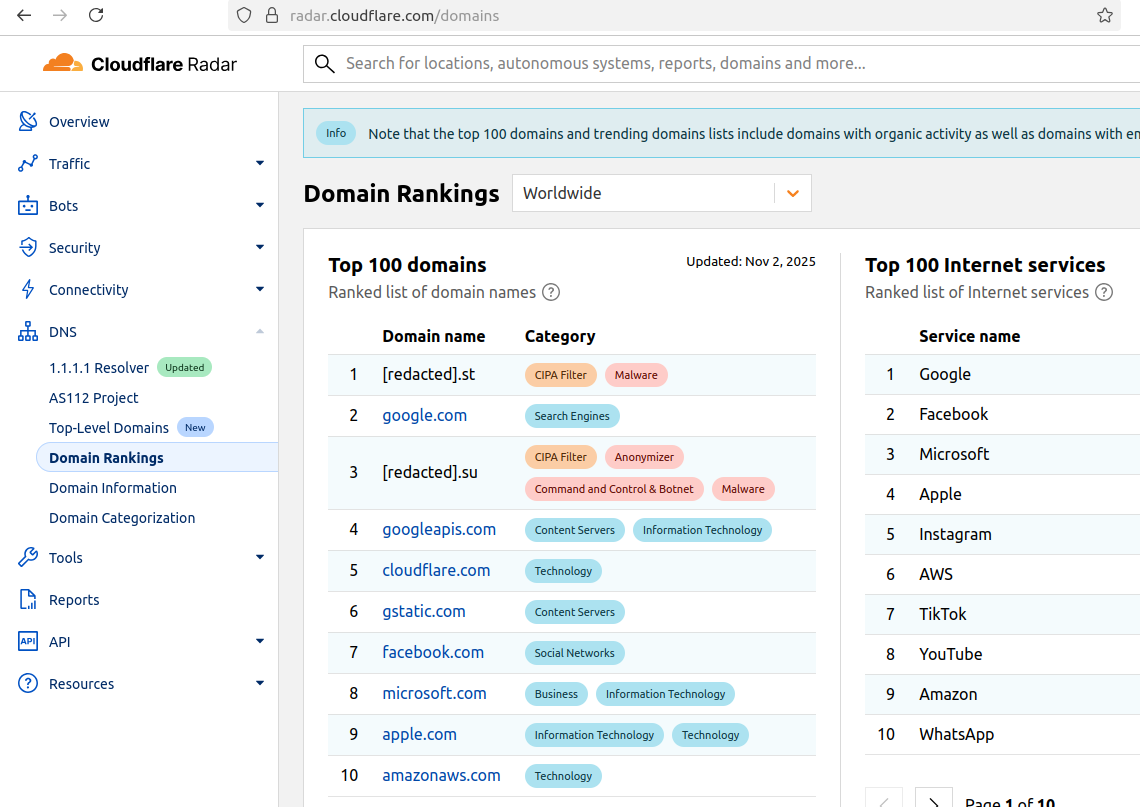
The #1 and #3 positions in this chart are Aisuru botnet controllers with their full domain names redacted. Source: radar.cloudflare.com.

Aisuru is a rapidly growing botnet comprising hundreds of thousands of hacked Internet of Things (IoT) devices, such as poorly secured Internet routers and security cameras. The botnet has increased in size and firepower significantly since its debut in 2024, demonstrating the ability to launch record distributed denial-of-service (DDoS) attacks nearing 30 terabits of data per second.

Until recently, Aisuru’s malicious code instructed all infected systems to use DNS servers from Google — specifically, the servers at 8.8.8.8. But in early October, Aisuru switched to invoking Cloudflare’s main DNS server — 1.1.1.1 — and over the past week domains used by Aisuru to control infected systems started populating Cloudflare’s top domain rankings.

As screenshots of Aisuru domains claiming two of the Top 10 positions ping-ponged across social media, many feared this was yet another sign that an already untamable botnet was running completely amok. One Aisuru botnet domain that sat prominently for days at #1 on the list was someone’s street address in Massachusetts followed by “.com”. Other Aisuru domains mimicked those belonging to major cloud providers.

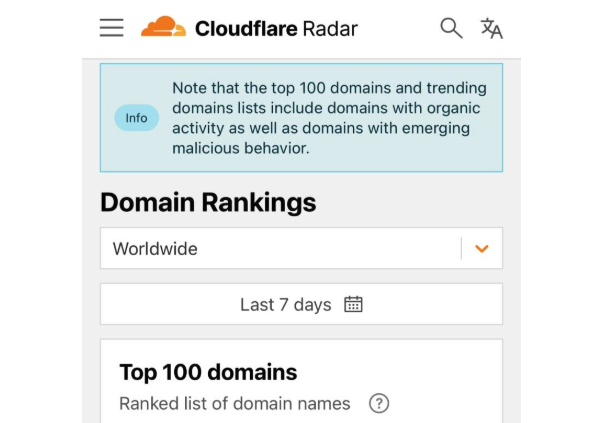
Cloudflare tried to address these security, brand confusion and privacy concerns by partially redacting the malicious domains, and adding a warning at the top of its rankings:

“Note that the top 100 domains and trending domains lists include domains with organic activity as well as domains with emerging malicious behavior.”
Cloudflare CEO Matthew Prince told KrebsOnSecurity the company’s domain ranking system is fairly simplistic, and that it merely measures the volume of DNS queries to 1.1.1.1.

“The attacker is just generating a ton of requests, maybe to influence the ranking but also to attack our DNS service,” Prince said, adding that Cloudflare has heard reports of other large public DNS services seeing similar uptick in attacks. “We’re fixing the ranking to make it smarter. And, in the meantime, redacting any sites we classify as malware.”

Renee Burton, vice president of threat intel at the DNS security firm Infoblox, said many people erroneously assumed that the skewed Cloudflare domain rankings meant there were more bot-infected devices than there were regular devices querying sites like Google and Apple and Microsoft.

“Cloudflare’s documentation is clear — they know that when it comes to ranking domains you have to make choices on how to normalize things,” Burton wrote on LinkedIn. “There are many aspects that are simply out of your control. Why is it hard? Because reasons. TTL values, caching, prefetching, architecture, load balancing. Things that have shared control between the domain owner and everything in between.”

Alex Greenland is CEO of the anti-phishing and security firm Epi. Greenland said he understands the technical reason why Aisuru botnet domains are showing up in Cloudflare’s rankings (those rankings are based on DNS query volume, not actual web visits). But he said they’re still not meant to be there.

“It’s a failure on Cloudflare’s part, and reveals a compromise of the trust and integrity of their rankings,” he said.

Greenland said Cloudflare planned for its Domain Rankings to list the most popular domains as used by human users, and it was never meant to be a raw calculation of query frequency or traffic volume going through their 1.1.1.1 DNS resolver.

“They spelled out how their popularity algorithm is designed to reflect real human use and exclude automated traffic (they said they’re good at this),” Greenland wrote on LinkedIn. “So something has evidently gone wrong internally. We should have two rankings: one representing trust and real human use, and another derived from raw DNS volume.”

Why might it be a good idea to wholly separate malicious domains from the list? Greenland notes that Cloudflare Domain Rankings see widespread use for trust and safety determination, by browsers, DNS resolvers, safe browsing APIs and things like TRANCO.

“TRANCO is a respected open source list of the top million domains, and Cloudflare Radar is one of their five data providers,” he continued. “So there can be serious knock-on effects when a malicious domain features in Cloudflare’s top 10/100/1000/million. To many people and systems, the top 10 and 100 are naively considered safe and trusted, even though algorithmically-defined top-N lists will always be somewhat crude.”

Over this past week, Cloudflare started redacting portions of the malicious Aisuru domains from its Top Domains list, leaving only their domain suffix visible. Sometime in the past 24 hours, Cloudflare appears to have begun hiding the malicious Aisuru domains entirely from the web version of that list. However, downloading a spreadsheet of the current Top 200 domains from Cloudflare Radar shows an Aisuru domain still at the very top.

According to Cloudflare’s website, the majority of DNS queries to the top Aisuru domains — nearly 52 percent — originated from the United States. This tracks with my reporting from early October, which found Aisuru was drawing most of its firepower from IoT devices hosted on U.S. Internet providers like AT&T, Comcast and Verizon.

Experts tracking Aisuru say the botnet relies on well more than a hundred control servers, and that for the moment at least most of those domains are registered in the .su top-level domain (TLD). Dot-su is the TLD assigned to the former Soviet Union (.su’s Wikipedia page says the TLD was created just 15 months before the fall of the Berlin wall).

A Cloudflare blog post from October 27 found that .su had the highest “DNS magnitude” of any TLD, referring to a metric estimating the popularity of a TLD based on the number of unique networks querying Cloudflare’s 1.1.1.1 resolver. The report concluded that the top .su hostnames were associated with a popular online world-building game, and that more than half of the queries for that TLD came from the United States, Brazil and Germany [it’s worth noting that servers for the world-building game Minecraft were some of Aisuru’s most frequent targets].

A simple and crude way to detect Aisuru bot activity on a network may be to set an alert on any systems attempting to contact domains ending in .su. This TLD is frequently abused for cybercrime and by cybercrime forums and services, and blocking access to it entirely is unlikely to raise any legitimate complaints.

❌