
Reading view

There are new articles available, click to refresh the page.

Active attack: Dirty Frag Linux vulnerability expands post-compromise risk

A newly disclosed Linux local privilege escalation vulnerability known as “Dirty Frag” enables escalation from an unprivileged user to root through vulnerable kernel networking and memory-fragment handling components, including esp4, esp6 (CVE-2026-43284), and rxrpc (CVE-2026-43500). Public reporting and proof-of-concept activity indicate the exploit is designed to provide more reliable privilege escalation than traditional race-condition-dependent Linux local privilege escalation techniques.

Dirty Frag may be leveraged after initial compromise through SSH access, web-shell execution, container escape, or compromise of a low-privileged account. Affected environments may include Ubuntu, RHEL, CentOS Stream, AlmaLinux, Fedora, openSUSE, and OpenShift deployments. Microsoft Defender is actively monitoring related activity and investigating additional detections and protections.


This article details an ongoing investigation into active campaign. We will update this report as new details emerge.


Why Dirty Frag matters

Local privilege escalation vulnerabilities are frequently used by threat actors after initial access to expand control over a compromised environment. Once root access is obtained, attackers can disable security tooling, access sensitive credentials, tamper with logs, pivot laterally, and establish persistent access.

Dirty Frag is notable because it introduces multiple kernel attack paths involving rxrpc and esp/xfrm networking components to improve exploitation reliability. Rather than relying on narrow timing windows or unstable corruption conditions often associated with Linux local privilege escalation exploits, Dirty Frag appears designed to increase consistency across vulnerable environments.

This increases operational risk in environments where threat actors already possess limited local execution capability through compromised accounts, vulnerable applications, containers, or exposed administrative interfaces.

Technical overview

Dirty Frag abuses Linux kernel networking and memory-fragment handling behavior involving esp4, esp6, and rxrpc components. Similar to the previously disclosed CopyFail vulnerability (CVE-2026-31431), the exploit attempts to manipulate Linux page cache behavior to achieve privilege escalation. However, Dirty Frag introduces additional attack paths that expand exploitation opportunities and improve reliability.

The vulnerability affects systems where vulnerable modules are present and accessible. In many enterprise environments, these components may already be enabled to support IPsec, VPN functionality, or other networking workloads.

Exploitation scenarios

Threat actors may leverage Dirty Frag after obtaining local code execution through several common intrusion paths, including:

  • Compromised SSH accounts
  • Web-shell access on internet-facing applications
  • Container escapes into the host environment
  • Abuse of low-privileged service accounts
  • Post-exploitation activity following phishing or remote access compromise

Once local access is established, successful exploitation may allow attackers to escalate privileges to root and gain broad control over the affected Linux host.

Limited In-The-Wild Exploitation

Microsoft Defender is currently seeing limited in-the-wild activity where privilege escalation involving ‘su’ is observed, and which may be indicative of techniques associated with either “Dirty Frag” or “Copy Fail”.
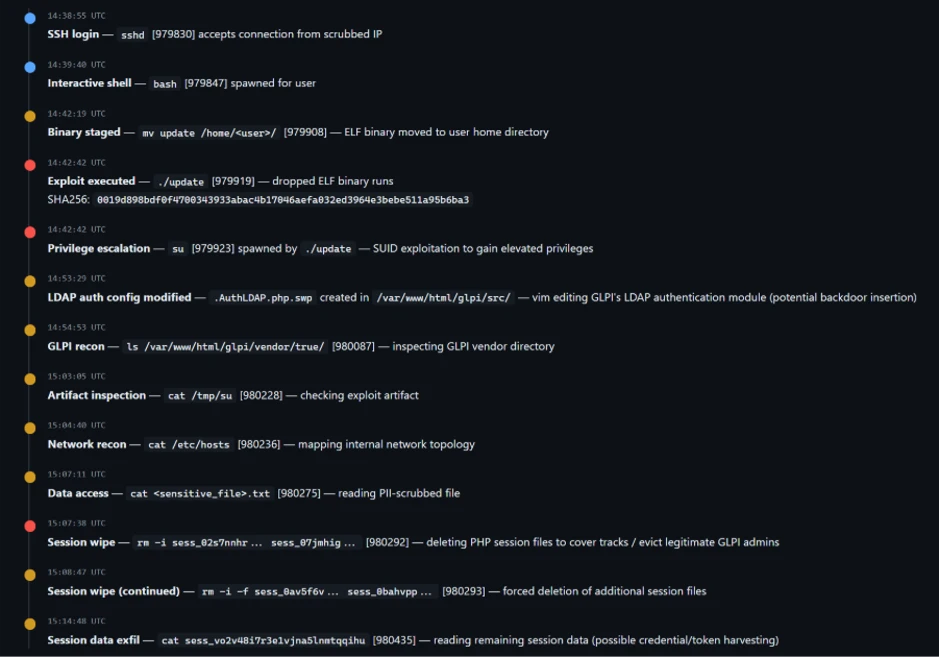
The campaign shows a sequential attack timeline where an external connection gains SSH access and spawns an interactive shell, followed by staging and execution of an ELF binary (./update) that immediately triggers a privilege escalation via ‘su’.

After gaining elevated access, the actor modifies a GLPI LDAP authentication file (evidenced by a .swp file from vim), performs reconnaissance of the GLPI directory and system configuration, and inspects an exploit artifact. The activity then shifts to accessing sensitive data and interacting with PHP session files — first deleting multiple session files and then forcefully wiping additional ones — before reading remaining session data, indicating both disruption of active sessions and access to session contents.

Mitigation guidance

The Linux Kernel Organization released patches, which are linked at the National Vulnerability Database (NVD), to fix CVE-2026-43284 on May 8, 2026. Customers who have not applied these patches are urged to do so as soon as possible. As of May 8, 2026, patches for CVE-2026-43500 are not available. CVE-2026-43500 is reportedly reserved for the RxRPC issue but is not yet published in NVD.

While comprehensive remediation guidance continues to evolve, organizations should evaluate interim mitigations immediately.

Recommended actions include:

  • Disable unused rxrpc kernel modules where operationally possible
  • Assess whether esp4, esp6, and related xfrm/IPsec functionality can be temporarily disabled safely
  • Restrict unnecessary local shell access
  • Harden containerized workloads
  • Increase monitoring for abnormal privilege escalation activity
  • Prioritize kernel patch deployment once vendor advisories are released

The following example prevents vulnerable modules from loading and unloads active modules where possible:

cat /dev/null

These mitigations should be carefully evaluated before deployment, particularly in environments relying on IPsec VPNs or RxRPC functionality.

Post-mitigation integrity verification

Mitigation alone may not reverse changes already introduced through successful exploitation attempts.

If exploitation occurred prior to mitigation, malicious modifications may persist in memory or cached file content even after vulnerable modules are disabled. Organizations should validate the integrity of critical files and assess whether cache clearing is appropriate for their environment.

echo 3 | sudo tee /proc/sys/vm/drop_caches

Cache clearing can temporarily increase disk I/O and impact production performance and should be evaluated carefully before deployment.

Microsoft Defender coverage

Microsoft Defender XDR customers can refer to the following list of applicable detections below that provides coverage for behaviors surrounding “Dirty Flag” exploitation.

Microsoft Defender XDR coordinates detection, prevention, investigation, and response across endpoints, identities, email, and apps to provide integrated protection against attacks like the threat discussed in this blog. 

Customers with provisioned access can also use Microsoft Security Copilot in Microsoft Defender to investigate and respond to incidents, hunt for threats, and protect their organization with relevant threat intelligence. 

Tactic Observed activity Microsoft Defender coverage 
Execution Exploitation of “Dirty Frag” Microsoft Defender Antivirus  
-  Exploit:Linux/DirtyFrag.A 
– Trojan:Linux/DirtyFrag.Z!MTB 
– Trojan:Linux/DirtyFrag.ZA!MTB 
– Trojan:Linux/DirtyFrag.ZC!MTB 
– Trojan:Linux/DirtyFrag.DA!MTB 
– Exploit:Linux/DirtyFrag.B 

Microsoft Defender for Endpoint 
– Suspicious SUID/SGID process launch 

Microsoft Defender for Cloud 
– Potential exploitation of dirtyfrag vulnerability detected 

Microsoft Defender Vulnerability Management
– Microsoft Defender Vulnerability Management surfaces devices vulnerable to “Dirty Frag” which are linked to the following CVEs:
CVE-2026-43284
CVE-2026-43500

Microsoft Defender Threat Intelligence

Microsoft Defender Threat Intelligence published a threat analytics article and a vulnerability profile for this vulnerability

Microsoft Defender Antivirus

  • Exploit:Linux/DirtyFrag.A
  • Exploit:Linux/DirtyFrag.B
  • Trojan:Linux/DirtyFrag.Z!MTB
  • Trojan:Linux/DirtyFrag.ZA!MTB
  • Trojan:Linux/DirtyFrag.ZC!MTB
  • Trojan:Linux/DirtyFrag.DA!MTB

Microsoft Defender for Cloud

  • Potential exploitation of dirtyfrag vulnerability detected

Microsoft continues investigating additional detections, telemetry correlations, and posture guidance related to Dirty Frag activity.

Further investigation is being conducted by Microsoft Defender towards providing stronger protection and posture recommendations is in progress.

References

Read about CopyFail (CVE-2026-31431), including mitigation and detection guidance here: https://www.microsoft.com/en-us/security/blog/2026/05/01/cve-2026-31431-copy-fail-vulnerability-enables-linux-root-privilege-escalation/

The post Active attack: Dirty Frag Linux vulnerability expands post-compromise risk appeared first on Microsoft Security Blog.
Preparing for the worst

PATCH WATCH By Susan Bradley We might be a bit busy in the next few months. Not with updates, but dealing with headlines. Why? Because AI tools are now turning to the task of reviewing a lot of code that hasn’t been looked at in a long time. First up? No, not Windows. Not Apple. […]

Active attack: Dirty Frag Linux vulnerability expands post-compromise risk

A newly disclosed Linux local privilege escalation vulnerability known as “Dirty Frag” enables escalation from an unprivileged user to root through vulnerable kernel networking and memory-fragment handling components, including esp4, esp6 (CVE-2026-43284), and rxrpc (CVE-2026-43500). Public reporting and proof-of-concept activity indicate the exploit is designed to provide more reliable privilege escalation than traditional race-condition-dependent Linux local privilege escalation techniques.

Dirty Frag may be leveraged after initial compromise through SSH access, web-shell execution, container escape, or compromise of a low-privileged account. Affected environments may include Ubuntu, RHEL, CentOS Stream, AlmaLinux, Fedora, openSUSE, and OpenShift deployments. Microsoft Defender is actively monitoring related activity and investigating additional detections and protections.


This article details an ongoing investigation into active campaign. We will update this report as new details emerge.


Why Dirty Frag matters

Local privilege escalation vulnerabilities are frequently used by threat actors after initial access to expand control over a compromised environment. Once root access is obtained, attackers can disable security tooling, access sensitive credentials, tamper with logs, pivot laterally, and establish persistent access.

Dirty Frag is notable because it introduces multiple kernel attack paths involving rxrpc and esp/xfrm networking components to improve exploitation reliability. Rather than relying on narrow timing windows or unstable corruption conditions often associated with Linux local privilege escalation exploits, Dirty Frag appears designed to increase consistency across vulnerable environments.

This increases operational risk in environments where threat actors already possess limited local execution capability through compromised accounts, vulnerable applications, containers, or exposed administrative interfaces.

Technical overview

Dirty Frag abuses Linux kernel networking and memory-fragment handling behavior involving esp4, esp6, and rxrpc components. Similar to the previously disclosed CopyFail vulnerability (CVE-2026-31431), the exploit attempts to manipulate Linux page cache behavior to achieve privilege escalation. However, Dirty Frag introduces additional attack paths that expand exploitation opportunities and improve reliability.

The vulnerability affects systems where vulnerable modules are present and accessible. In many enterprise environments, these components may already be enabled to support IPsec, VPN functionality, or other networking workloads.

Exploitation scenarios

Threat actors may leverage Dirty Frag after obtaining local code execution through several common intrusion paths, including:

  • Compromised SSH accounts
  • Web-shell access on internet-facing applications
  • Container escapes into the host environment
  • Abuse of low-privileged service accounts
  • Post-exploitation activity following phishing or remote access compromise

Once local access is established, successful exploitation may allow attackers to escalate privileges to root and gain broad control over the affected Linux host.

Limited In-The-Wild Exploitation

Microsoft Defender is currently seeing limited in-the-wild activity where privilege escalation involving ‘su’ is observed, and which may be indicative of techniques associated with either “Dirty Frag” or “Copy Fail”.

The campaign shows a sequential attack timeline where an external connection gains SSH access and spawns an interactive shell, followed by staging and execution of an ELF binary (./update) that immediately triggers a privilege escalation via ‘su’.

After gaining elevated access, the actor modifies a GLPI LDAP authentication file (evidenced by a .swp file from vim), performs reconnaissance of the GLPI directory and system configuration, and inspects an exploit artifact. The activity then shifts to accessing sensitive data and interacting with PHP session files — first deleting multiple session files and then forcefully wiping additional ones — before reading remaining session data, indicating both disruption of active sessions and access to session contents.

Mitigation guidance

The Linux Kernel Organization released patches, which are linked at the National Vulnerability Database (NVD), to fix CVE-2026-43284 on May 8, 2026. Customers who have not applied these patches are urged to do so as soon as possible. As of May 8, 2026, patches for CVE-2026-43500 are not available. CVE-2026-43500 is reportedly reserved for the RxRPC issue but is not yet published in NVD.

While comprehensive remediation guidance continues to evolve, organizations should evaluate interim mitigations immediately.

Recommended actions include:

  • Disable unused rxrpc kernel modules where operationally possible
  • Assess whether esp4, esp6, and related xfrm/IPsec functionality can be temporarily disabled safely
  • Restrict unnecessary local shell access
  • Harden containerized workloads
  • Increase monitoring for abnormal privilege escalation activity
  • Prioritize kernel patch deployment once vendor advisories are released

The following example prevents vulnerable modules from loading and unloads active modules where possible:

cat /dev/null

These mitigations should be carefully evaluated before deployment, particularly in environments relying on IPsec VPNs or RxRPC functionality.

Post-mitigation integrity verification

Mitigation alone may not reverse changes already introduced through successful exploitation attempts.

If exploitation occurred prior to mitigation, malicious modifications may persist in memory or cached file content even after vulnerable modules are disabled. Organizations should validate the integrity of critical files and assess whether cache clearing is appropriate for their environment.

echo 3 | sudo tee /proc/sys/vm/drop_caches

Cache clearing can temporarily increase disk I/O and impact production performance and should be evaluated carefully before deployment.

Microsoft Defender coverage

Microsoft Defender XDR customers can refer to the following list of applicable detections below that provides coverage for behaviors surrounding “Dirty Flag” exploitation.

Microsoft Defender XDR coordinates detection, prevention, investigation, and response across endpoints, identities, email, and apps to provide integrated protection against attacks like the threat discussed in this blog. 

Customers with provisioned access can also use Microsoft Security Copilot in Microsoft Defender to investigate and respond to incidents, hunt for threats, and protect their organization with relevant threat intelligence. 

Tactic Observed activity Microsoft Defender coverage 
Execution Exploitation of “Dirty Frag” Microsoft Defender Antivirus  
-  Exploit:Linux/DirtyFrag.A 
– Trojan:Linux/DirtyFrag.Z!MTB 
– Trojan:Linux/DirtyFrag.ZA!MTB 
– Trojan:Linux/DirtyFrag.ZC!MTB 
– Trojan:Linux/DirtyFrag.DA!MTB 
– Exploit:Linux/DirtyFrag.B 

Microsoft Defender for Endpoint 
– Suspicious SUID/SGID process launch 

Microsoft Defender for Cloud 
– Potential exploitation of dirtyfrag vulnerability detected 

Microsoft Defender Vulnerability Management
– Microsoft Defender Vulnerability Management surfaces devices vulnerable to “Dirty Frag” which are linked to the following CVEs:
CVE-2026-43284
CVE-2026-43500

Microsoft Defender Threat Intelligence

Microsoft Defender Threat Intelligence published a threat analytics article and a vulnerability profile for this vulnerability

Microsoft Defender Antivirus

  • Exploit:Linux/DirtyFrag.A
  • Exploit:Linux/DirtyFrag.B
  • Trojan:Linux/DirtyFrag.Z!MTB
  • Trojan:Linux/DirtyFrag.ZA!MTB
  • Trojan:Linux/DirtyFrag.ZC!MTB
  • Trojan:Linux/DirtyFrag.DA!MTB

Microsoft Defender for Cloud

  • Potential exploitation of dirtyfrag vulnerability detected

Microsoft continues investigating additional detections, telemetry correlations, and posture guidance related to Dirty Frag activity.

Further investigation is being conducted by Microsoft Defender towards providing stronger protection and posture recommendations is in progress.

References

Read about CopyFail (CVE-2026-31431), including mitigation and detection guidance here: https://www.microsoft.com/en-us/security/blog/2026/05/01/cve-2026-31431-copy-fail-vulnerability-enables-linux-root-privilege-escalation/

The post Active attack: Dirty Frag Linux vulnerability expands post-compromise risk appeared first on Microsoft Security Blog.

CVE-2026-31431: Copy Fail vulnerability enables Linux root privilege escalation across cloud environments

Microsoft Defender is investigating a high-severity local privilege escalation vulnerability (CVE-2026-31431) affecting multiple major Linux distributions including Red Hat, SUSE, Ubuntu, and AWS Linux. This vulnerability allows unauthorized escalation of privileges to root, impacting a significant portion of cloud Linux workloads and millions of Kubernetes clusters. Although active exploitation has been limited and primarily observed in proof-of-concept testing, the vulnerability’s broad applicability has caused widespread concern.

Given the availability of a fully working exploit proof-of-concept (PoC) and the race to patch systems, Microsoft Defender is seeing preliminary testing activity that might result most likely in increased threat actor exploitation over the next few days, as also confirmed by the recent addition of this vulnerability to the Cybersecurity and Infrastructure Security Agency (CISA) Known Exploited Vulnerability (KEV) catalog.

In this report, Microsoft Defender shares detailed analyses and detection insights for this vulnerability, as well as mitigation recommendations and hunting guidance for customers to act on. Further investigation towards providing stronger protection measures is in progress, and this report will be updated when more information becomes available.

Vulnerability details

Technical elementDetails
Vulnerability typeLocal privilege escalation
Attack vectorCode execution from unprivileged user
Prerequisites for exploitationLocal access to the machine as non-privileged user
Brief technical explanation A bug in the Linux kernel’s crypto-subsystem can be abused by an attacker to corrupt the cache of any readable file, including setuid binaries. This corruption could be carried out by unprivileged users and could result in code execution with root privilege, effectively escalating the unprivileged user to root in an unauthorized way.

The vulnerability affects virtually all Linux distributions running kernels released from 2017 until patched versions are applied, including but not limited to Ubuntu (for example, 24.04 LTS), Amazon Linux 2023, Red Hat Enterprise Linux (RHEL 10.1), and SUSE 16, as well as other distributions like Debian, Fedora, and Arch Linux. The CVSS score is 7.8 (High), reflecting its significant impact.

From an impact assessment standpoint, successful exploitation leads to full root privilege escalation (high impact to confidentiality, integrity, and availability) and could facilitate container breakout, multi-tenant compromise, and lateral movement within shared environments. Its reliability, stealth (in-memory-only modification), and cross-platform applicability make it particularly dangerous in cloud, CI/CD, and Kubernetes environments where untrusted code execution is common.

CVE-2026-31431 (also known as “Copy Fail”) is a high‑severity local privilege escalation (LPE) vulnerability affecting the Linux kernel’s cryptographic subsystem. The vulnerability type is a logic flaw within the algif_aead module of the AF_ALG (userspace crypto API), which results in improper handling of memory during in-place operations.

The attack vector is local (AV:L) and requires low privileges with no user interaction, meaning any unprivileged user on a vulnerable system can attempt exploitation. Critically, this vulnerability is not remotely exploitable in isolation, but becomes highly impactful when chained with an initial access vector such as Secure Shell (SSH) access, malicious CI job execution, or container footholds. The primary prerequisite for exploitation is the ability to execute code as a local non-privileged user on a system running a vulnerable Linux kernel with the affected crypto module enabled.

From a technical perspective, the flaw originates from an in-place optimization introduced in 2017, where the kernel reuses source memory as the destination during cryptographic operations. By abusing the interaction between the AF_ALG socket interface and the splice() system call, an attacker can perform a controlled 4-byte write into the kernel’s page cache of any readable file. This enables corruption of in-memory representations of privileged binaries (for example, /usr/bin/su) without modifying the on-disk file.

When executed, the modified binary yields root privileges, effectively breaking the system’s privilege boundary. Notably, the exploit is deterministic, does not rely on race conditions, and could be implemented in a very small (~732‑byte) script that works across distributions. Because the page cache is shared across containers and the host , the vulnerability also enables cross-container impacts and container escape scenarios.

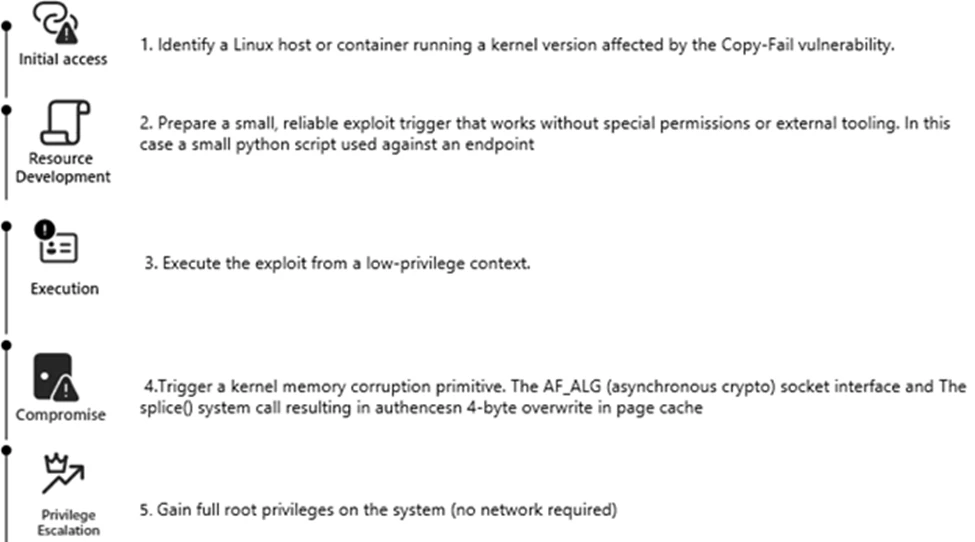
The following is one possible exploitation attack chain.

Phase 1: The attacker begins with reconnaissance. This may occur after gaining limited visibility into an environment (for example, a compromised CI runner, web container, or multi‑tenant host). Kernel version information is easily obtainable from within containers and user namespaces and does not require elevated privileges.

Because containers share the host kernel, a single vulnerable kernel version immediately expands the impact radius from one container to the entire node.

Phase 2: The attacker leverages a compact Python script that interacts only with standard kernel interfaces exposed to unprivileged users. The script does not rely on networking, compilation, or third‑party libraries, making it ideal for execution in restricted containers and hardened environments.

Phase 3: The attacker runs the script as either a regular Linux user on a host, or a compromised container process with no special capabilities. Crucially, the vulnerability does not require root inside the container, Kernel modules, or network access.  This makes it ideal for post‑exploitation scenarios where the attacker already has any foothold at all.

Phase 4: The exploit abuses an interaction between the AF_ALG (asynchronous crypto) socket interface, the splice() system call and improper error handling during a failed copy operation. This results in a controlled 4‑byte overwrite in the kernel page cache, allowing the attacker to corrupt sensitive kernel‑managed data even though they are unprivileged. This corruption occurs entirely within the kernel, bypassing traditional user‑space protections.

Phase 5: By corrupting kernel structures associated with credentials or execution context, the attacker escalates their process to UID 0. This completes the transition from unprivileged user to full root without touching the network. At this point, kernel trust boundaries are broken, SELinux/AppArmor protections are effectively neutralized, and local security controls are bypassed.

Mitigation and protection guidance

Immediate actions (0-24 hours):

  • Identify all instances of affected products/versions in your environment.
  • Apply mitigation based on patch availability:
    • If patches exist, apply immediately. Links to security bulletins and vendor patches are available at NVD – CVE-2026-31431.
    • If no patches exist, choose one of these interim mitigations:

○ Disable affected feature

○ Implement network isolation

○ Apply access controls

  • Review logs for signs of exploitation.

Because this vulnerability impacts a large swath of Linux devices, it is strongly recommended to do the following:

  • Patch or update your distribution’s kernel packages or to block AF_ALG socket creation.
  • Treat any container RCE as potential host compromise and enforce rapid node recycling after compromise indicators.

Microsoft Defender XDR detections

Microsoft Defender XDR customers can refer to the following list of applicable detections. Microsoft Defender XDR coordinates detection, prevention, investigation, and response across endpoints, identities, email, and apps to provide integrated protection against attacks like the threat discussed in this blog.

Customers with provisioned access can also use Microsoft Security Copilot in Microsoft Defender to investigate and respond to incidents, hunt for threats, and protect their organization with relevant threat intelligence.

TacticObserved activityMicrosoft Defender coverage
ExecutionExploitation of CVE-2026-31431Microsoft Defender Antivirus
– Exploit:Linux/CopyFailExpDl.A
– Exploit:Python/CopyFail.A
– Exploit:Linux/CVE-2026-31431.A
– Behavior:Linux/CVE-2026-31431

Microsoft Defender for Endpoint
Possible CVE-2026-31431 (“Copy Fail”) vulnerability exploitation

Microsoft Defender for Cloud
Potential exploitation of copy-fail vulnerability detected 

Microsoft Defender Vulnerability Management (MDVM) also surfaces devices in customer environments that might be vulnerable to CVE-2026-31431.

References

This research is provided by Microsoft Defender Security Research with contributions from Andrea Lelli, Dietrich Nembhard, Nir Avnery, Ori Glassman, and  members of Microsoft Threat Intelligence.

Learn more

For the latest security research from the Microsoft Threat Intelligence community, check out the Microsoft Threat Intelligence Blog.

To get notified about new publications and to join discussions on social media, follow us on LinkedInX (formerly Twitter), and Bluesky.

To hear stories and insights from the Microsoft Threat Intelligence community about the ever-evolving threat landscape, listen to the Microsoft Threat Intelligence podcast.

Review our documentation to learn more about our real-time protection capabilities and see how to enable them within your organization.   

The post CVE-2026-31431: Copy Fail vulnerability enables Linux root privilege escalation across cloud environments appeared first on Microsoft Security Blog.

‘Copy Fail’ is a real Linux security crisis wrapped in AI slop

Attackers are actively exploiting a Linux vulnerability in the wild, and researchers warn that the fallout could be broad — anyone with authenticated local access can leverage it to gain total control of a system. 

But the story behind CVE-2026-31431 is almost as interesting as the bug itself. Theori, the company that discovered the bug, leaned heavily on AI to find and initially disclose it. The result is a case study that  underscores the challenges that occur when the relentless hunt for defects collides with marketing impulses and inflated AI-generated language that was long on bluster but lacked technical details. 

Theori dubbed the high-severity vulnerability “Copy Fail” with a vanity domain containing AI-generated content, and warned that every mainstream Linux kernel built since 2017 is in scope of potential exploitation resulting in root access. 

Theori’s AI-powered penetration testing platform, Xint, discovered the local privilege-escalation flaw in a Linux kernel module and reported it to the Linux kernel security team March 23. Major Linux distributions affected by the vulnerability had issued patches prior to Theori’s disclosure, which it published alongside a proof-of-concept exploit. 

The Cybersecurity and Infrastructure Security Agency added CVE-2026-31431 to its known exploited vulnerabilities catalog Friday.

Researchers have yet to determine how many organizations have been impacted by the flaw, but they noted that critical requirements for exploitation, specifically local access achieved through a separate exploit or pathway to unauthorized access, should limit potential exposure.

“The attacker would need to have already established a foothold on the target system either through some means of legitimate access or another exploit,” Spencer McIntyre, secure researcher at Rapid7, told CyberScoop. “That’s a large limiting factor since this vulnerability would therefore need to be paired with another.”

Theori’s disclosure turned heads among other vulnerability researchers who noted the defect’s broad potential impact, but also for lacking details about the proof-of-concept exploit. 

“The exploit is real, there is something to worry about, but understandably, teams now have to do additional validation to know how to parse the extreme AI FUD (fear, uncertainty and doubt) from [Theori’s] blog post,” Caitlin Condon, vice president of security research at VulnCheck, told CyberScoop. 

“It’s not helpful that the blog is AI slop, because it detracts from technical reality,” she added. 

Theori acknowledges it used AI to discover and describe the vulnerability, explaining that it’s focusing on finding and fixing a large amount of defects. 

“We used AI to help craft the disclosure site and the blog post to help speed things up, but all material was thoroughly reviewed by our internal teams for accuracy,” said Tim Becker, senior security researcher at Theori. 

Theori is intentionally withholding additional details until the patch is broadly applied, he added.

“We stand by our technical description of the vulnerability. Helping downstream users to understand the impact of a security bug has always been a challenge for security researchers,” Becker said. “Copy Fail allows for trivial privilege escalation on most desktop and server Linux distributions. It also has implications for containerization including Kubernetes.”

Other researchers have drawn similar conclusions, noting that exploitation can be automated and doesn’t require specialization. 

Meanwhile, hundreds of additional proof-of-concept exploits have surfaced since the vulnerability was disclosed five days ago. “As expected, the majority of these appear to be copycat AI PoCs that do nothing but add banners or different colors to the command-line interface. Many new PoCs are simply ports of the original AI PoC to a different programming language,” Condon said. 

“Organizations should exercise caution when running untested research artifacts, including AI-generated exploit code that isn’t fully explained,” she added. 

Becker said Theori is aware of the burden defenders confront, and insists the company’s reports contain enough information for organizations to quickly triage and validate its findings.

The post ‘Copy Fail’ is a real Linux security crisis wrapped in AI slop appeared first on CyberScoop.

Linux Percentage of Steam Users Doubled in One Year

Steam on Linux use in March "had skyrocketed to 5.33%..." reports Phoronix, "easily the highest level we've seen Steam on Linux at since its inception more than a decade ago." So what happened in April? [April's results] point to Linux having a 4.52% marketshare on Steam, a drop of 0.81% compared to March. Year-over-year it's roughly double with Steam on Linux in April 2025 being at 2.27%. Or two years ago for April 2024, Steam on Linux was at 1.9%.

Read more of this story at Slashdot.

CVE-2026-31431: Copy Fail vulnerability enables Linux root privilege escalation across cloud environments

Microsoft Defender is investigating a high-severity local privilege escalation vulnerability (CVE-2026-31431) affecting multiple major Linux distributions including Red Hat, SUSE, Ubuntu, and AWS Linux. This vulnerability allows unauthorized escalation of privileges to root, impacting a significant portion of cloud Linux workloads and millions of Kubernetes clusters. Although active exploitation has been limited and primarily observed in proof-of-concept testing, the vulnerability’s broad applicability has caused widespread concern.

Given the availability of a fully working exploit proof-of-concept (PoC) and the race to patch systems, Microsoft Defender is seeing preliminary testing activity that might result most likely in increased threat actor exploitation over the next few days, as also confirmed by the recent addition of this vulnerability to the Cybersecurity and Infrastructure Security Agency (CISA) Known Exploited Vulnerability (KEV) catalog.

In this report, Microsoft Defender shares detailed analyses and detection insights for this vulnerability, as well as mitigation recommendations and hunting guidance for customers to act on. Further investigation towards providing stronger protection measures is in progress, and this report will be updated when more information becomes available.

Vulnerability details

Technical elementDetails
Vulnerability typeLocal privilege escalation
Attack vectorCode execution from unprivileged user
Prerequisites for exploitationLocal access to the machine as non-privileged user
Brief technical explanation A bug in the Linux kernel’s crypto-subsystem can be abused by an attacker to corrupt the cache of any readable file, including setuid binaries. This corruption could be carried out by unprivileged users and could result in code execution with root privilege, effectively escalating the unprivileged user to root in an unauthorized way.

The vulnerability affects virtually all Linux distributions running kernels released from 2017 until patched versions are applied, including but not limited to Ubuntu (for example, 24.04 LTS), Amazon Linux 2023, Red Hat Enterprise Linux (RHEL 10.1), and SUSE 16, as well as other distributions like Debian, Fedora, and Arch Linux. The CVSS score is 7.8 (High), reflecting its significant impact.

From an impact assessment standpoint, successful exploitation leads to full root privilege escalation (high impact to confidentiality, integrity, and availability) and could facilitate container breakout, multi-tenant compromise, and lateral movement within shared environments. Its reliability, stealth (in-memory-only modification), and cross-platform applicability make it particularly dangerous in cloud, CI/CD, and Kubernetes environments where untrusted code execution is common.

CVE-2026-31431 (also known as “Copy Fail”) is a high‑severity local privilege escalation (LPE) vulnerability affecting the Linux kernel’s cryptographic subsystem. The vulnerability type is a logic flaw within the algif_aead module of the AF_ALG (userspace crypto API), which results in improper handling of memory during in-place operations.

The attack vector is local (AV:L) and requires low privileges with no user interaction, meaning any unprivileged user on a vulnerable system can attempt exploitation. Critically, this vulnerability is not remotely exploitable in isolation, but becomes highly impactful when chained with an initial access vector such as Secure Shell (SSH) access, malicious CI job execution, or container footholds. The primary prerequisite for exploitation is the ability to execute code as a local non-privileged user on a system running a vulnerable Linux kernel with the affected crypto module enabled.

From a technical perspective, the flaw originates from an in-place optimization introduced in 2017, where the kernel reuses source memory as the destination during cryptographic operations. By abusing the interaction between the AF_ALG socket interface and the splice() system call, an attacker can perform a controlled 4-byte write into the kernel’s page cache of any readable file. This enables corruption of in-memory representations of privileged binaries (for example, /usr/bin/su) without modifying the on-disk file.

When executed, the modified binary yields root privileges, effectively breaking the system’s privilege boundary. Notably, the exploit is deterministic, does not rely on race conditions, and could be implemented in a very small (~732‑byte) script that works across distributions. Because the page cache is shared across containers and the host , the vulnerability also enables cross-container impacts and container escape scenarios.

The following is one possible exploitation attack chain.

Phase 1: The attacker begins with reconnaissance. This may occur after gaining limited visibility into an environment (for example, a compromised CI runner, web container, or multi‑tenant host). Kernel version information is easily obtainable from within containers and user namespaces and does not require elevated privileges.

Because containers share the host kernel, a single vulnerable kernel version immediately expands the impact radius from one container to the entire node.

Phase 2: The attacker leverages a compact Python script that interacts only with standard kernel interfaces exposed to unprivileged users. The script does not rely on networking, compilation, or third‑party libraries, making it ideal for execution in restricted containers and hardened environments.

Phase 3: The attacker runs the script as either a regular Linux user on a host, or a compromised container process with no special capabilities. Crucially, the vulnerability does not require root inside the container, Kernel modules, or network access.  This makes it ideal for post‑exploitation scenarios where the attacker already has any foothold at all.

Phase 4: The exploit abuses an interaction between the AF_ALG (asynchronous crypto) socket interface, the splice() system call and improper error handling during a failed copy operation. This results in a controlled 4‑byte overwrite in the kernel page cache, allowing the attacker to corrupt sensitive kernel‑managed data even though they are unprivileged. This corruption occurs entirely within the kernel, bypassing traditional user‑space protections.

Phase 5: By corrupting kernel structures associated with credentials or execution context, the attacker escalates their process to UID 0. This completes the transition from unprivileged user to full root without touching the network. At this point, kernel trust boundaries are broken, SELinux/AppArmor protections are effectively neutralized, and local security controls are bypassed.

Mitigation and protection guidance

Immediate actions (0-24 hours):

  • Identify all instances of affected products/versions in your environment.
  • Apply mitigation based on patch availability:
    • If patches exist, apply immediately. Links to security bulletins and vendor patches are available at NVD – CVE-2026-31431.
    • If no patches exist, choose one of these interim mitigations:

○ Disable affected feature

○ Implement network isolation

○ Apply access controls

  • Review logs for signs of exploitation.

Because this vulnerability impacts a large swath of Linux devices, it is strongly recommended to do the following:

  • Patch or update your distribution’s kernel packages or to block AF_ALG socket creation.
  • Treat any container RCE as potential host compromise and enforce rapid node recycling after compromise indicators.

Microsoft Defender XDR detections

Microsoft Defender XDR customers can refer to the following list of applicable detections. Microsoft Defender XDR coordinates detection, prevention, investigation, and response across endpoints, identities, email, and apps to provide integrated protection against attacks like the threat discussed in this blog.

Customers with provisioned access can also use Microsoft Security Copilot in Microsoft Defender to investigate and respond to incidents, hunt for threats, and protect their organization with relevant threat intelligence.

TacticObserved activityMicrosoft Defender coverage
ExecutionExploitation of CVE-2026-31431Microsoft Defender Antivirus
– Exploit:Linux/CopyFailExpDl.A
– Exploit:Python/CopyFail.A
– Exploit:Linux/CVE-2026-31431.A
– Behavior:Linux/CVE-2026-31431

Microsoft Defender for Endpoint
Possible CVE-2026-31431 (“Copy Fail”) vulnerability exploitation

Microsoft Defender for Cloud
Potential exploitation of copy-fail vulnerability detected 

Microsoft Defender Vulnerability Management (MDVM) also surfaces devices in customer environments that might be vulnerable to CVE-2026-31431.

References

This research is provided by Microsoft Defender Security Research with contributions from Andrea Lelli, Dietrich Nembhard, Nir Avnery, Ori Glassman, and  members of Microsoft Threat Intelligence.

Learn more

For the latest security research from the Microsoft Threat Intelligence community, check out the Microsoft Threat Intelligence Blog.

To get notified about new publications and to join discussions on social media, follow us on LinkedInX (formerly Twitter), and Bluesky.

To hear stories and insights from the Microsoft Threat Intelligence community about the ever-evolving threat landscape, listen to the Microsoft Threat Intelligence podcast.

Review our documentation to learn more about our real-time protection capabilities and see how to enable them within your organization.   

The post CVE-2026-31431: Copy Fail vulnerability enables Linux root privilege escalation across cloud environments appeared first on Microsoft Security Blog.

Linux Drops ISDN Subsystem and Other Old Network Drivers

"Old code like amateur radio and NFC have long been a burden to core networking developers," reads the pull request. And so Thursday Linus Torvald merged the pull request "to rid the Linux kernel of the old Integrated Services Digital Network (ISDN) subsystem," reports Phoronix, "and various other old network drivers largely for PCMCIA era network adapters." This was the code suggested for removal given the recent influx of AI/LLM-generated bug reports against this dated code that likely has no active upstream users remaining... [W]ith the large language models and increased code fuzzing finding potential issues with these drivers for obsolete hardware, it's easier to just get rid of these drivers if no one is actively using the hardware from decades ago... This merge lightens the kernel by 138,161 lines of code with ISDN gone and numerous old network adapters and also getting rid of legacy ATM device drivers as well as the amateur ham radio support. The main networking drivers removed affect the 3com 3c509 / 3c515 / 3c574 / 3c589, AMD Lance, AMD NMCLAN, SMSC SMC9194 / SMC91C92, Fujitsu FMVJ18X, and 8390 AX88190 / Ultra / WD80X3. Linux 7.1 also has removed the long-obsolete bus mouse support as well as beginning to phase out Intel 486 CPU support and removing support for Russia's Baikal CPUs.

Read more of this story at Slashdot.

Tech giants launch AI-powered ‘Project Glasswing’ to identify critical software vulnerabilities

Major technology companies have joined forces in an effort to use advanced artificial intelligence to identify and address security flaws in the world’s most critical software systems, marking a significant shift in how the industry approaches cybersecurity threats.

Anthropic announced Project Glasswing on Tuesday, bringing together Amazon, Apple, Broadcom, Cisco, CrowdStrike, the Linux Foundation, Microsoft, and Palo Alto Networks. The initiative centers on Claude Mythos Preview, an unreleased AI model that Anthropic will make available exclusively to project partners and approximately 40 additional organizations responsible for critical software infrastructure.

The model has already identified thousands of previously unknown vulnerabilities in its initial testing phase, including security flaws that have existed in widely used systems for decades, according to Anthropic. Among the discoveries is a 27-year-old bug in OpenBSD, an operating system known primarily for its security focus, and a 16-year-old vulnerability in FFmpeg, a widely used video software program that automated testing tools had failed to detect despite running the affected code line five million times. The company has been in contact with the maintainers of the relevant software, and all found vulnerabilities have been patched. 

Anthropic will commit up to $100 million in usage credits for the project, along with $4 million in direct donations to open-source security organizations. The company has stated it does not plan to make Mythos Preview available to the general public, citing concerns about the model’s potential misuse.

The initiative reflects growing concerns within the technology sector about the dual-use nature of advanced AI systems. While Mythos Preview was not trained specifically for cybersecurity purposes, its coding and reasoning capabilities have proven effective at identifying subtle security flaws that have eluded human analysts and conventional automated tools.

“Although the risks from AI-augmented cyberattacks are serious, there is reason for optimism: the same capabilities that make AI models dangerous in the wrong hands make them invaluable for finding and fixing flaws in important software—and for producing new software with far fewer security bugs,” the company said in a blog post. “Project Glasswing is an important step toward giving defenders a durable advantage in the coming AI-driven era of cybersecurity.”

The project comes as the industry has predicted that similar AI capabilities will soon become more widespread. Anthropic executives have indicated that without coordinated action, such tools could eventually reach actors who might deploy them for malicious purposes rather than defensive security work.

Participating organizations will be required to share their findings with the broader industry. The project places particular emphasis on open-source software, which forms the foundation of most modern systems, including critical infrastructure, yet whose maintainers have historically lacked access to sophisticated security resources.

“Open source software constitutes the vast majority of code in modern systems, including the very systems AI agents use to write new software. By giving the maintainers of these critical open source codebases access to a new generation of AI models that can proactively identify and fix vulnerabilities at scale, Project Glasswing offers a credible path to changing that equation,” said Jim Zemlin, CEO of the Linux Foundation. “This is how AI-augmented security can become a trusted sidekick for every maintainer, not just those who can afford expensive security teams.” 

Additionally, Anthropic says it has engaged in ongoing discussions with U.S. government officials regarding Mythos Preview’s capabilities. The company has framed the project in national security terms, arguing that maintaining leadership in AI technology represents a strategic priority for the United States and its allies. Anthropic has been locked in a high-stakes dispute with the Department of Defense about the U.S. military’s use of the startup’s Claude AI model in real-world operations. 

The project’s success will depend partly on whether the collaborative approach can keep pace with rapid advances in AI capabilities. Anthropic has indicated that frontier AI systems are likely to advance substantially within months, potentially creating a dynamic environment where defensive and offensive capabilities evolve in parallel.

“Project Glasswing is a starting point,” Anthropic wrote in a blog post. “No one organization can solve these cybersecurity problems alone: frontier AI developers, other software companies, security researchers, open-source maintainers, and governments across the world all have essential roles to play. The work of defending the world’s cyber infrastructure might take years; frontier AI capabilities are likely to advance substantially over just the next few months. For cyber defenders to come out ahead, we need to act now.”

The post Tech giants launch AI-powered ‘Project Glasswing’ to identify critical software vulnerabilities appeared first on CyberScoop.

❌