Reading view

There are new articles available, click to refresh the page.

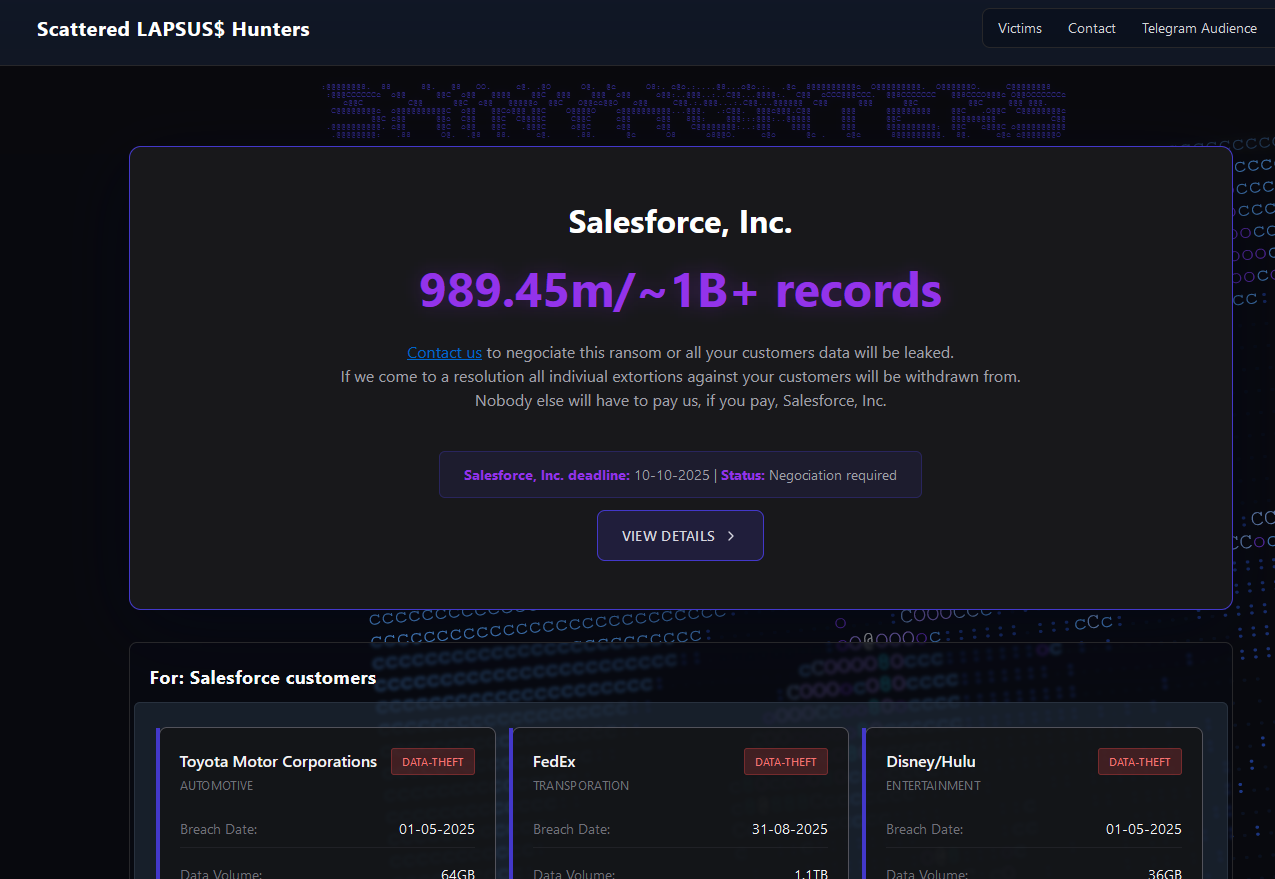
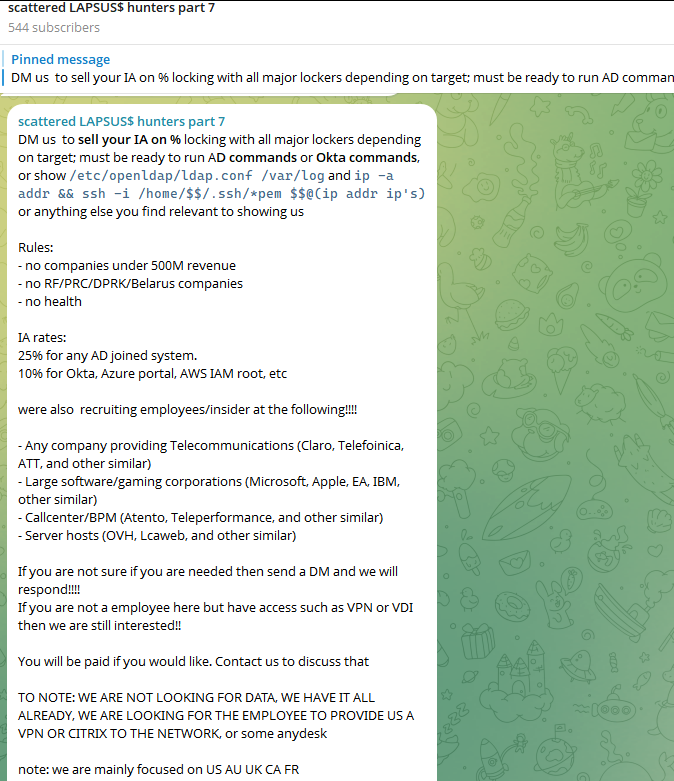
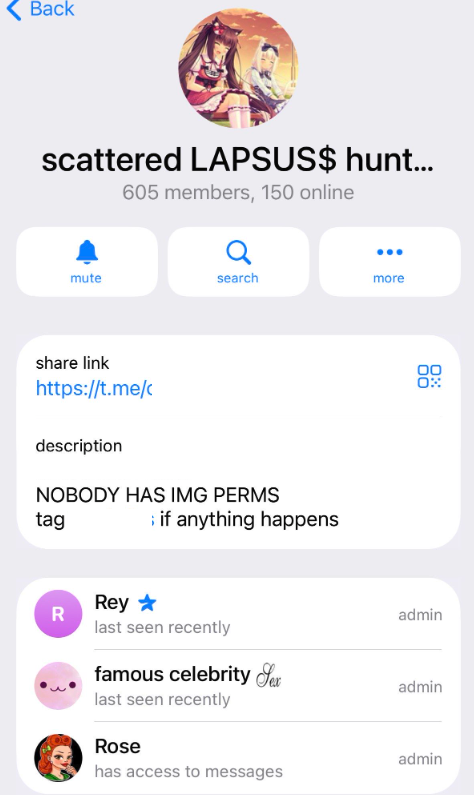
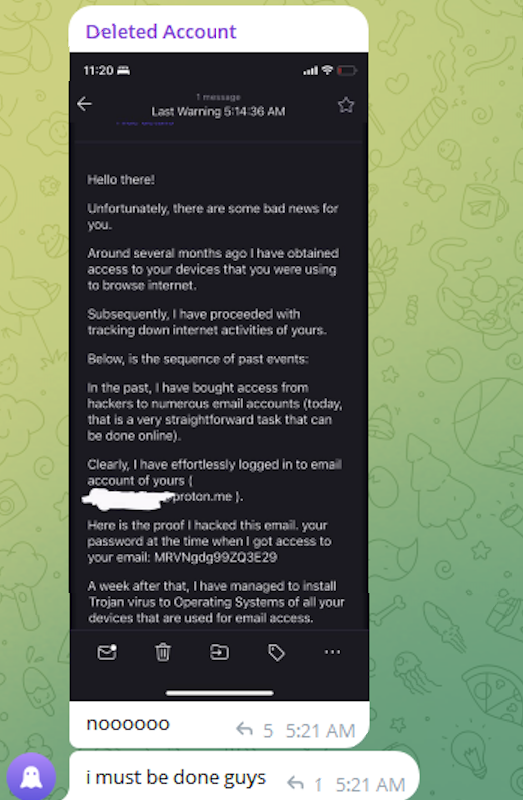
Another BreachForums Clone Shuts Down, Citing Fears of ShinyHunters

If there were a soundtrack for this post, it would be Queen’s “Another One Bites the Dust.” There’s another chapter in the ongoing drama that is “BreachForums.” Yesterday,  the BreachForums clone at breached[.hn]  was listed for sale for $3k USD. By today, they had dropped the price to $ 1,500 USD and still couldn’t seem...

Source

How software development’s speed obsession enabled TeamPCP’s chaos crusade

TeamPCP is on a rampage through open-source software.

In less than four months, the threat actor has compromised and injected malicious code into more than 1,000 software packages. The extraordinary spree has transformed how software developers and maintainers distribute and manage their code, as their dependencies and repositories have become one of the most effective and prevalent attack vectors this year.

While there has been a host of technical exploits, TeamPCP’s greatest attack has been the uprooting of trust — repeatedly proving that most organizations fail to verify the code they ingest into their systems is legitimate, abusing a nearly blind faith that much of the software development industry relies on to power today’s modern economy.

Starting with Trivy in February, TeamPCP’s attacks have shaken that trust many times over.

The scale of TeamPCP’s attacks lies partly in the automated systems companies use to deploy code, like CI/CD pipelines. It is also capitalizing on new security gaps created by developers’ increasing reliance on AI. Yet, with relatively low effort and unoriginal tactics, TeamPCP is wrecking open-source frameworks and underlying systems at levels the technology community has rarely reckoned with.

“Developers didn’t do a great job of analyzing the security of their open-source dependencies before but, now with AI, there’s in some cases virtually no human in the loop or any kind of sanity check on what these tools are doing,” Feross Aboukhadijeh, founder and CEO at Socket, told CyberScoop.

“You have agents installing packages that haven’t been vetted,” he said. “When an attacker gets in, the impact is even broader because there’s less checks and balances to stop it from affecting everybody.”

TeamPCP hasn’t identified a new problem or proved anything novel. The crux of these attacks hinge on a central theme — defensive vulnerabilities the entire software industry has known about for years. Researchers and developers know the open source trust model is broken and susceptible to sabotage. Yet, the software industry has not fixed this problem. 

“The speed and scale of these attacks is what makes it most notable, not necessarily the methodology behind it, because at the core it is really about exploiting third-party trusts that we have,” said Kimberly Goody, senior manager at Google Threat Intelligence Group.

Software packages are typically subjected to intensive security monitoring to test for vulnerabilities and poisoned updates before they are released to live environments. 

Yet, the real vulnerability highlighted by TeamPCP lies further up the chain of command with the organizations or individuals that publish these packages to the wider market, according to Nathaniel Quist, manager of cloud threat intelligence at Palo Alto Networks.

“It is their responsibility to secure their credentials and not provide a jump off point to trigger a supply-chain event,” he said. “Everything that interacts with or crosses through that zone must be highly monitored and controlled to ensure a compromise can be contained quickly and easily.”

TeamPCP’s motivation

TeamPCP, like any prolific cybercriminal, has captured significant attention from threat hunters since it emerged in late 2025. Google attributes the activity to one core operator.

The company said it traced TeamPCP’s residential and mobile IP address connections to South Africa, indicating the primary operator was located there during at least some of its attacks.

“We don’t believe that there’s an established core group, at least not yet, and that a lot of this has been conducted by an individual,” Goody said. Google declined to name the core operator or confirm it knows the person’s true identity. 

Palo Alto Networks said the core manager of TeamPCP uses the “ResoluteXBF” handle on multiple platforms. The cybersecurity firm is also tracking two additional core members: “diencracked” and “Shinigami.”

If TeamPCP is primarily run by one person, law enforcement has a rare opportunity to make a lasting impact with a single arrest.

TeamPCP has collaborated with other cybercriminals, but most of those partnerships were short-lived and ended in a public feud or otherwise failed to get off the ground in any meaningful way, Goody said.

Researchers have linked TeamPCP to extortion crews, dark web forums and affiliates including Lapsus$, ShinyHunters, Vect, DragonForce, BreachForums and “HasanBroker.” TeamPCP listed about 4,000 private code repositories on a dark web forum with an asking price of $95,000.

The actions to date, including unpredictable behavior, indicate motivations beyond financial gain and a “clear desire for notoriety,” Goody said. “They seem to like to make chaos.”

Quist draws the same conclusion from his months-long investigation, noting that it encourages other cybercriminals to get in on the action, at one point offering financial rewards for the largest software supply-chain attack. 

TeamPCP isn’t in the game for extortion payments, he said. “These actors are more interested in the underground street cred they are gaining” and “causing as much damage and mayhem as possible.”

Victims abound, but exposure limited

TeamPCP has been remarkably noisy, opportunistically injecting malware into open-source software for the purpose of stealing credentials for Kubernetes environments, Amazon Web Services, Microsoft Azure, Google Cloud and many other connected services.

The group’s claimed victim list is staggering: Checkmarx, Bitwarden, LiteLLM, Telnyx, Mercor AI, PyTorch Lightning, AntV, SAP, GitHub, TanStack, UiPath, MistralAI, Microsoft DurableTask, Red Hat and Nx Console.

The full collection of packages compromised or poisoned by TeamPCP to date accounts for roughly 500 million weekly downloads combined, according to Quist.

While the breadth of potential downstream compromise flowing from those downloads is substantial, many endpoints infected with those malware-riddled packages aren’t exposed to the internet and less susceptible to attack, he added.

“I don’t think there’s going to be a very extremely large number of victims,” Quist said. “There’s going to be a lot of people who potentially could be compromised and have potentially vulnerable packages in their environment, but that doesn’t necessarily mean they’re in an exploitable position.”

While these incidents have grabbed headlines, TeamPCP hasn’t accumulated payouts nearly as large as other cybercriminals. The broader reputational impact it has wrought, however, is massive.

TeamPCP has publicly claimed more than 10,000 victims and about $90,000 in extortions, according to Quist.

“They might not be making a lot of money, but they are causing a lot of impact,” Goody said. “Their campaigns have been very disruptive.”

How TeamPCP’s operating model targets development

TeamPCP’s victim list has grown as its hijacked open-source repositories on npm, PyPI, GitHub and other outsourced developer tools that are incorporated into upstream code running in production environments.

Developer laptops and other endpoints that are assigned to install, build and publish software widely contain keys and access to source code that create incredibly valuable supply-chain targets for attackers, Amitai Cohen, head of the attack vector intel team at Wiz, explained during a June presentation on TeamPCP at SleuthCon in Arlington, Va. 

The group targets CI runners, which are automated systems that build, test, and publish code. TeamPCP injects malware into the code repositories these runners maintain. When other developers pull that code into their own systems, they unknowingly download the malware alongside it. 

Some of these artifacts, including Python libraries, npm registries and GitHub Actions, are downloaded almost immediately by thousands or millions of developers who’ve set their runners up to consistently pull the latest version, according to Cohen. “We as a security industry have taught them that that is the right thing to do. You want to use the latest version because you want to be protected against vulnerabilities, and obviously you want to benefit from all the latest features.”

That instinct is exactly what TeamPCP exploits. By compromising one company’s CI/CD workflow, the group gains access to every downstream user who automatically pulls that infected code. “This is what allows [TeamPCP] to leverage initial access to some patient zero, some company that had a vulnerability in their CI/CD workflow, in order to gain access to their downstream users,” Cohen said. “That’s just how the software supply chain works. Everything has dependencies upon dependencies upon dependencies.”

Some of the packages compromised by TeamPCP were live for almost 13 hours, but security practitioners have responded by identifying code-injection attacks much quicker now, pulling some compromised repositories within 15 minutes, said Ben Read, director of strategic intelligence at Wiz.

The threat group’s operations remain high-tempo. TeamPCP infects new software packages almost daily, validates compromises and captures sensitive data within 24 hours, according to Wiz researchers.

The threat group has consistently evolved its tactics, developing payloads in JavaScript and Python while spreading from local files to Kubernetes application programming interfaces and bundled software development kits. Most recently, it’s been stealing credentials via custom protocols. 

The group’s ambitions have expanded beyond its own attacks. TeamPCP is also responsible for a self-replicating piece of malware known as Mini Shai-Hulud, which infected hundreds of software packages across open-source registries in back-to-back attack sprees last month. A TeamPCP affiliate published the full source code for the malware on GitHub last month and encouraged other cybercriminals to use it for their own campaigns.

“TeamPCP is going for volume. They are not being discriminating, they’re not necessarily trying to be stealthy or trying to maximize ROI. They’re going for an all-of-the-above strategy,” Read said during the Sleuthcon presentation.

Defensive gaps create openings for attack

TeamPCP’s attack spree has also underscored how difficult it is for organizations to revoke compromised secrets. Multiple victims have experienced recurring infections, sometimes falling prey to TeamPCP three times within a month, because they didn’t rotate secrets properly, Cohen said. 

At its core, these attacks highlight a direct trade-off organizations accept when they update software quickly to fix vulnerabilities, but learn that doing so too quickly could expose them to illegitimate registries containing malware.

TeamPCP has targeted what Aboukhadijeh describes as a “public good,” open-source registries that were never perfect but widely trusted and rarely turned into a point of entry for supply-chain attacks. 

Rapid open source software installation is one of the most dangerous things an organization can do right now, he said, adding that there’s a roughly 1 in 10 chance that any package installed by an organization could trigger an active attack. 

TeamPCP has compromised security scanners, password managers, automation tools, data visualization software, and CI/CD infrastructure across various environments.

And it’s lifted a trove of credentials and other sensitive data from victims.

Researchers like Cohen at Wiz, who have been tracking this attack spree since the beginning, are nearing a breaking point. 

“This is also too hard on us. We’re very tired. I’m sure a lot of people working on this problem space are very tired, and it’s just kind of become untenable,” Cohen said.

“You can’t keep existing in a world where you wake up every morning and some super prevalent package is compromised and everybody’s just going to be using it like nothing,” he added. “We need to start taking this a bit more seriously.”

The post How software development’s speed obsession enabled TeamPCP’s chaos crusade appeared first on CyberScoop.

ShinyHunters is actively extorting universities after exploiting an unpatched Oracle flaw

Researchers are warning that cybercriminals exploited an Oracle PeopleSoft zero-day vulnerability and potentially infiltrated the networks of more than 100 organizations in an attack spree that largely impacted higher education.

Mandiant and Google Threat Intelligence Group said it became aware of the attacks earlier this month as part of its ongoing monitoring of ShinyHunters operations. The notorious cybercrime group claims it hacked more than 100 organizations and started naming victims and publishing allegedly stolen data Tuesday.

University of Nottingham, one of ShinyHunters’ alleged victims, on Wednesday confirmed a significant amount of student data was stolen during a cyberattack after the threat group leaked some of the school’s data.

The attacks date back to at least May 27, according to Mandiant, and involve the exploitation of CVE-2026-35273, a defect in Oracle PeopleSoft PeopleTools that allows unauthenticated attackers to execute remote code and takeover affected servers.

Oracle disclosed the vulnerability and recommended some steps for mitigation Wednesday, weeks after the attacks were already underway. The vendor hasn’t released a patch to address the defect and did not respond to a request for comment.

Google said it alerted more than 100 organizations of potentially vulnerable endpoints in their environments, but it declined to confirm how many victims are compromised. 

“This campaign is still active. We have observed ShinyHunters sending extortions as recently as today,” Charles Carmakal, chief technology officer at Mandiant Consulting, told CyberScoop Thursday evening. He added that more victims, beyond Google’s visibility, may be impacted.

Most of the potential victim pool is based in the United States and 68% are in the higher education sector, according to Google.

“We have previously observed ShinyHunters target the education sector this year, however it’s possible this targeting is representative of the majority of exposed PeopleSoft instances belonging to the sector,” Carmakal said. 

Oracle PeopleSoft PeopleTools includes more than 40 tools for human resources and customer relationship management.

The attacks come less than a year after the Clop ransomware group exploited a zero-day in Oracle E-Business Suite that affected dozens of victims. The data theft extortion campaign that followed those attacks, which began in August, didn’t get underway until October.

The post ShinyHunters is actively extorting universities after exploiting an unpatched Oracle flaw appeared first on CyberScoop.

ShinyHunters Targets Education Sector with Oracle PeopleSoft Exploit

From Mandiant and Google Threat Intelligence Group, an advisory: Mandiant and Google Threat Intelligence Group (GTIG) have identified an active compromise and extortion campaign attributed to UNC6240 (ShinyHunters) targeting Oracle PeopleSoft application infrastructure. The activity was observed between May 27, 2026, and June 9, 2026 and is consistent with the exploitation of CVE-2026-35273, a critical remote...

Source

Deal Reached With Hackers to Delete Data Stolen From the Canvas Educational Platform

The company that operates online learning system Canvas said it struck a deal with hackers to delete the data they pilfered in a cyberattack that created chaos for students, many of them in the middle of finals.

The post Deal Reached With Hackers to Delete Data Stolen From the Canvas Educational Platform appeared first on SecurityWeek.

Canvas System Is Online After a Cyberattack Disrupted Thousands of Schools

Tens of thousands of students studying for final exams around the world have regained access to a key online learning system after a cyberattack had earlier knocked it offline.

The post Canvas System Is Online After a Cyberattack Disrupted Thousands of Schools appeared first on SecurityWeek.

Developing: ShinyHunters Hacks Instructure Again; Canvas Down (1)

When Instructure did not contact ShinyHunters to negotiate any payment after ShinyHunters attacked them for a second time in April,  the threat actors threatened to leak every school’s data, and posted a notice telling schools how to contact them directly to avoid having their data leaked. When Instructure still didn’t contact them after that escalation, ...

Source

Canvas Breach Disrupts Schools & Colleges Nationwide

An ongoing data extortion attack targeting the widely-used education technology platform Canvas disrupted classes and coursework at school districts and universities across the United States today, after a cybercrime group defaced the service’s login page with a ransom demand that threatened to leak data from 275 million students and faculty across nearly 9,000 educational institutions.

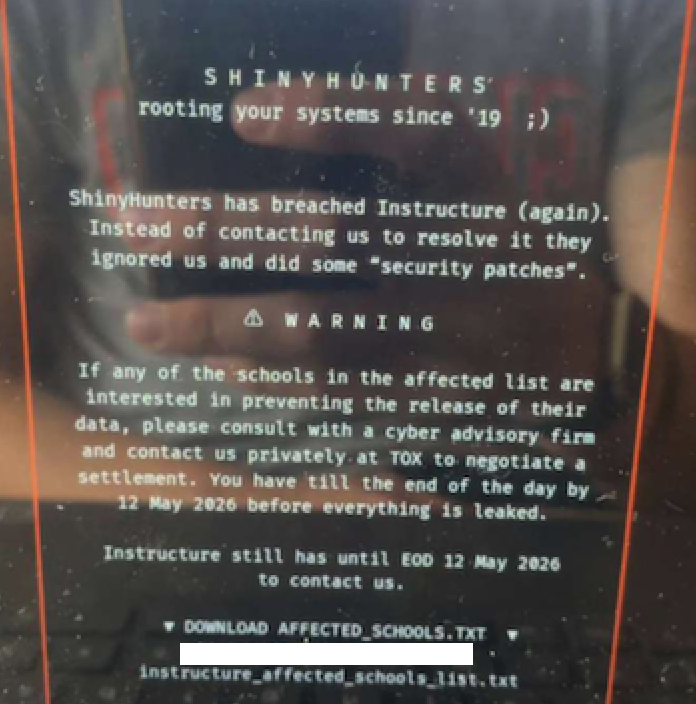
A screenshot shared by a reader showing the extortion message that was shown on the Canvas login page today.

Canvas parent firm Instructure responded to today’s defacement attacks by disabling the platform, which is used by thousands of schools, universities and businesses to manage coursework and assignments, and to communicate with students.

Instructure acknowledged a data breach earlier this week, after the cybercrime group ShinyHunters claimed responsibility and said they would leak data on tens of millions of students and faculty unless paid a ransom. The stated deadline for payment was initially set at May 6, but it was later pushed back to May 12.

In a statement on May 6, Instructure said the investigation so far shows the stolen information includes “certain identifying information of users at affected institutions, such as names, email addresses, and student ID numbers, as well as as messages among users.” The company said it found no evidence the breached data included more sensitive information, such as passwords, dates of birth, government identifiers or financial information.

The May 6 update stated that Canvas was fully operational, and that Instructure was not seeing any ongoing unauthorized activity on their platform. “At this stage, we believe the incident has been contained,” Instructure wrote.

However, by mid-day on Thursday, May 7, students and faculty at dozens of schools and universities were flooding social media sites with comments saying that a ransom demand from ShinyHunters had replaced the usual Canvas login page. Instructure responded by pulling Canvas offline and replacing the portal with the message, “Canvas is currently undergoing scheduled maintenance. Check back soon.”

“We anticipate being up soon, and will provide updates as soon as possible,” reads the current message on Instructure’s status page.

While the data stolen by ShinyHunters may or may not contain particularly sensitive information (ShinyHunters claims it includes several billion private messages among students and teachers, as well as names, phone numbers and email addresses), this attack could hardly have come at a worse time for Instructure: Many of the affected schools and universities are in the middle of final exams, and a prolonged outage could be highly damaging for the company.

The extortion message that greeted countless Canvas users today advised the affected schools to negotiate their own ransom payments to prevent the publication of their data — regardless of whether Instructure decides to pay.

“ShinyHunters has breached Instructure (again),” the extortion message read. “Instead of contacting us to resolve it they ignored us and did some ‘security patches.'”

A source close to the investigation who was not authorized to speak to the press told KrebsOnSecurity that a number of universities have already approached the cybercrime group about paying. The same source also pointed out that the ShinyHunters data leak blog no longer lists Instructure among its current extortion victims, and that the samples of data stolen from Canvas customers were removed as well. Data extortion groups like ShinyHunters will typically only remove victims from their leak sites after receiving an extortion payment or after a victim agrees to negotiate.

Dipan Mann, founder and CEO of the security firm Cloudskope, slammed Instructure for referring to today’s outage as a “scheduled maintenance” event on its status page. Mann said Shiny Hunters first demonstrated they’d breached Instructure on May 1, prompting Instructure’s Chief Information Security Officer Steve Proud to declare the following day that the incident had been contained. But Mann said today’s attack is at least the third time in the past eight months that Instructure has been breached by ShinyHunters.

In a blog post today, Mann noted that in September 2025, ShinyHunters released thousands of internal University of Pennsylvania files — donor records, internal memos, and other confidential materials — through what the Daily Pennsylvanian and other outlets later determined was, in part, a Canvas/Instructure-mediated access path.

“Penn was the named victim,” Mann wrote. “Instructure was the mechanism. The incident was treated as a Penn-specific story by most of the national press and quietly handled by Instructure as a customer-specific matter. That framing was wrong then. It is dramatically more wrong in light of the May 2026 events, which now look like the planned escalation of an attack pattern that ShinyHunters had been working against Instructure’s environment for at least eight months prior. The September 2025 Penn breach was the proof of concept. The May 1, 2026 incident was the production run. The May 7, 2026 recompromise was ShinyHunters demonstrating publicly that the May 2 ‘containment’ did not happen.”

In February, a ShinyHunters spokesperson told The Daily Pennsylvanian that Penn failed to pay a $1 million ransom demand. On March 5, ShinyHunters published 461 megabytes worth of data stolen from Penn, including thousands of files such as donor records and internal memos.

ShinyHunters is a prolific and fluid cybercriminal group that specializes in data theft and extortion. They typically gain access to companies through voice phishing and social engineering attacks that often involve impersonating IT personnel or other trusted members of a targeted organization.

Last month, ShinyHunters relieved the home security giant ADT of personal information on 5.5 million customers. The extortion group told BleepingComputer they breached the company by compromising an employee’s Okta single sign-on account in a voice phishing attack that enabled access to ADT’s Salesforce instance. BleepingComputer says ShinyHunters recently has taken credit for a number of extortion attacks against high-profile organizations, including Medtronic, Rockstar Games, McGraw Hill, 7-Eleven and the cruise line operator Carnival.

The attack on Canvas customers is just one of several major cybercrime campaigns being launched by ShinyHunters at the moment, said Charles Carmakal, chief technology officer at the Google-owned Mandiant Consulting. Carmakal declined to comment specifically on the Canvas breach, but said “there are multiple concurrent and discrete ShinyHunters intrusion and extortion campaigns happening right now.”

Cloudskope’s Mann said what happens next depends largely on whether Instructure’s customers — the universities, K-12 districts, and education ministries paying for Canvas — choose to apply pressure or absorb the breach quietly.

“The history of education-vendor incidents suggests the path of least resistance is the second one,” he concluded.

Update, May 8, 11:05 a.m. ET: Instructure has published an incident update page that includes more information about the breach. Instructure said its Canvas portal is functioning normally again, and that the hackers exploited an issue related to Free-for-Teacher accounts.

“This is the same issue that led to the unauthorized access the prior week,” Instructure wrote. “As a result, we have made the difficult decision to temporarily shut down Free-for-Teacher accounts. These accounts have been a core part of our platform, and we’re committed to resolving the issues with these accounts.”

Instructure said affected organizations were notified on May 6.

“If your organization is affected, Instructure will contact your organization’s primary contacts directly,” the update states. “Please don’t rely on third-party lists or social media posts naming potentially affected organizations as those lists aren’t verified. Instructure will confirm validated information through direct outreach to all affected organizations.”

Update, May 11, 10:16 p.m. ET: Instructure posted an update saying they paid their extortionists in exchange for a promise to destroy the stolen data. “The data was returned to us,” the update reads. “We received digital confirmation of data destruction (shred logs). We have been informed that no Instructure customers will be extorted as a result of this incident, publicly or otherwise.”

Vercel attack fallout expands to more customers and third-party systems

Vercel said the fallout from an attack on its internal systems hit more customers than previously known, as ongoing analysis uncovered additional evidence of compromise

The company, which makes tools and hosts cloud infrastructure for developers, maintains a “small number” of accounts were impacted, but it has yet to share a number or range of known incidents linked to the attack. Vercel created and maintains Next.js, a platform supporting AI agents that’s downloaded more than 9 million times per week, and other popular open-source projects. 

Vercel CEO Guillermo Rauch said the company and partners have analyzed nearly a petabyte of logs across the Vercel network and API, and learned malicious activity targeting the company and its customers extends beyond an initial attack that originated at Context.ai. 

“Threat intel points to the distribution of malware to computers in search of valuable tokens like keys to Vercel accounts and other providers,” Rauch said in a post on X

“Once the attacker gets ahold of those keys, our logs show a repeated pattern: rapid and comprehensive API usage, with a focus on enumeration of non-sensitive environment variables,” he added.

The attack exemplifies the widespread and compounded risk posed by interconnected systems that rely on OAuth tokens, trusted relationships and overly privileged permissions linking multiple services together.

“The real vulnerability was trust, not technology,” Munish Walther-Puri, head of critical digital infrastructure at TPO Group, told CyberScoop. “OAuth turned a productivity app into a backdoor. Every AI tool an employee connects to their work account is now a potential attack surface.”

An attacker traversed Vercel’s internal systems to steal and decrypt customer data, including environment variables it stored, posing significant downstream risk. 

The company insists the breach originated at Context.ai, a third-party AI tool used by one of its employees. Researchers at Hudson Rock previously said the seeds of that attack were planted in February when a Context.ai employee’s computer was infected with Lumma Stealer malware after they searched for Roblox game exploits, a common vector for infostealer deployments. 

Vercel has not specified the systems and customers data compromised, nor has it described the threat eradicated or contained. The company said it’s found no evidence of tampering across the software packages it publishes, concluding “we believe the supply chain remains safe.” 

The company fueled further intrigue in its updated security bulletin, noting that it also identified a separate “small number of customers” that were compromised in attacks unrelated to the breach of its systems. 

“These compromises do not appear to have originated on Vercel systems,” the company said. “This activity does not appear to be a continuation or expansion of the April incident, nor does it appear to be evidence of an earlier Vercel security incident.”

It’s unclear how Vercel became aware of those attacks and why it’s disclosing them publicly. 

Vercel declined to answer questions, and Mandiant, which is running incident response and an investigation into the attack, referred questions back to Vercel. 

Vercel has not attributed the breach to any named threat group or described the attackers’ objectives. 

An online persona identifying themselves as ShinyHunters took responsibility for the attack and is attempting to sell the stolen data, which they claim includes access keys, source code and databases. Austin Larsen, principal threat analyst at Google Threat Intelligence Group, said the attacker is “likely an imposter,” but emphasized the risk of exposure is real.

Walther-Puri warned that the downstream blast radius from the attack on its systems remains undefined. “Stolen API keys and source code snippets from internal views are potentially keys to customer production environments,” he said.

The stolen data attackers claim to have “sounds almost boring … but it’s infrastructure intelligence,” Walther-Puri added. “The right environment variable doesn’t just unlock a system — it lets adversaries become that system, silently, from the inside.”

The post Vercel attack fallout expands to more customers and third-party systems appeared first on CyberScoop.

❌