❌

Reading view

There are new articles available, click to refresh the page.

Officials seize domain of top bulletproof hosting provider Virtualine

Authorities seized the domain of Virtualine, a bulletproof hosting provider that cybercriminals used to commit a large-scale sextortion scheme, ransomware, data theft, malware hosting and money laundering, the Justice Department said Tuesday. 

Virtualine facilitated prolific criminal activity, including the distribution of child sexual abuse material (CSAM), the Justice Department said. The Russian-speaking bulletproof hosting provider was among the most active this year in crypto-related crime in particular, researchers said. 

The site and its associated infrastructure stands out among the dozens of bulletproof hosting providers currently tracked by TRM Labs. “It was not among the largest by total inflows, but it received the most illicit-attributed value in 2026 to date,” the blockchain and cryptocrime research firm wrote in a blog post.

Virtualine received almost one-fifth of all illicit-attributed inflow among bulletproof hosting providers tracked by TRM this year to date.

A Russian drug marketplace accounted for nearly 44% of the direct payments Virtualine received from customers and attributed counterparties so far this year, according to TRM. A sextortion scheme accounted for nearly 17% of direct payments to Virtualine, followed by a cryptocurrency mixer at almost 13%, ransomware at nearly 5%, cybercrime services at 3% and malware at 2%.

“Virtualine is another example of Russia’s illicit economy at work: darknet markets, ransomware groups, non-compliant exchanges, and brokers all feeding the same ecosystem,” Ari Redbord, global head of policy at TRM Labs, said in a prepared statement. 

“Bulletproof hosting is the connective tissue. Seizing a domain matters, but the blockchain record doesn’t disappear with it. It shows who is paying, who is getting paid, and where they go next,” he added. 

Virtualine attracted many criminals as customers. Ransomware groups, including Coinbase Cartel, The Gentlemen, INC, DragonForce and Qilin all paid the site’s operators, according to TRM. The bulletproof hosting provider also received payments from the StealC infostealer, the Matanbuchu loader, bot and malware-distribution services and sites linked to CSAM. 

The FBI and prosecutors got a court order to seize Virtualine’s primary domain, which was also known as Secury, Massgod, Spamhouse, Lanedo and Omegatech.

Officials said Virtualine continued hosting services for a customer that distributed CSAM and a hack-for-hire service after it received numerous notices from law enforcement in Germany, Canada, Australia, the National Center for Missing and Exploited Children and a victim’s attorney.

TRM underscores that Virtualine was disrupted, but not completely shut down. “A domain seizure disrupts how customers find and access a service,” researchers wrote. “It does not, by itself, establish that the operator has stopped working, or that customers have lost access to all underlying infrastructure.”

The post Officials seize domain of top bulletproof hosting provider Virtualine appeared first on CyberScoop.

U.K. Sanctions Cryptomus for RU Money Laundering

The United Kingdom has issued economic sanctions against Cryptomus, a chameleonic cryptocurrency platform that experts say serves as a major conduit for payments related to ransomware, narcotics, darknet markets, fraud and cybercrime services that are helping Russia circumvent existing financial restrictions.

Heleket’s support agent on Telegram claims, despite all evidence to the contrary, that it is not affiliated with Cryptomus. Image: Richard Sanders.

On October 8, the U.K. issued sanctions (PDF) against Cryptomus — previously known as Certa Payments and Xeltox Enterprises — for processing payments that benefit the Russian government and its financial institutions. The sanctions freeze any Cryptomus assets at U.K. banks, and bar British companies from offering it any business, virtual or otherwise. Also targeted in these sanctions were the virtual payment platforms VexPay, TokenSpot, and the Tsunami Payments service.

As explained in our December 2024 investigation, “How Cryptocurrency Turns to Cash in Russian Banks,” Cryptomus has been a key payment processor for dozens of Russian cryptocurrency exchanges and websites hawking cybercrime services. The company has changed its name several times since emerging in 2022, most recently to “Heleket” last year after Canada levied a record CAD $176 million fine against the platform for anti-money laundering violations.

The blockchain data-crunching firm Chainalysis said the U.K. sanctions target the broader infrastructure supporting Russia’s wartime economy.

“Cryptomus and Heleket have emerged as major payment hubs for illicit activity,” Chainalysis wrote in an October 8 blog post. “Together, these services received more illicit funds across tracked categories than the mixers in our dataset and the number of illicit counterparties surged to more than 900 in a single month in late 2025.”

The Cryptomus support bot on Telegram, responding on Oct. 8 to an inquiry by saying the platform was suddenly unable to process transactions.

In April 2026, the blockchain analysis firm TRM Labs found Cryptomus had processed more than $7 billion in transactions since its inception in 2022, including transactions associated with child sexual abuse material vendors, terrorist financing networks, and human trafficking operations.

TRM noted that Cryptomus’s transaction volume cratered after the platform instituted new “know your customer” or KYC rules, and that the cryptocurrency platform responded to the Canadian fines by launching Heleket as a parallel service that continued to offer no-KYC payment processing.

Richard Sanders is a blockchain analyst and investigator who spent months mapping out Cryptomus’s payment infrastructure and transacting with its customers. Sanders said the U.K. sanctions on Cryptomus are important because Canada’s fine against the platform was ultimately unenforceable and uncollectible.

“A fine doesn’t stop a cryptocurrency payment processor from processing payments,” Sanders wrote on LinkedIn. “Sanctions kill the operation. The distinction matters.”

As our 2024 investigation noted, Cryptomus shared a Vancouver address with dozens of other foreign currency dealers and money transfer businesses — none of which appeared to be physically located there. Following the CAD $176 million fine for alleged money laundering violations, Cryptomus appealed the penalty, launched Heleket as a parallel service, and kept on processing large volumes of sketchy transactions, Sanders said.

Sanders said the sanctions also are notable because they are the first known instance of a “Five Eyes” country (referring to the Australia, Canada, New Zealand, the U.K. and the U.S.) sanctioning a cryptocurrency operation incorporated in another Five Eyes jurisdiction.

Where do entities like Cryptomus and Heleket derive their authority to offer international financial services? The answer appears to involve fake financial institutions overseen by a phony regulatory body positioned in a country that is not widely recognized as a sovereign nation.

Our 2024 investigation found the sole shareholder of Cryptomus’s parent company Certa Payments was a 25-year-old Ukrainian woman who also headed several other firms, including the WS Management and Advisory Corporation, which bills itself as the regulatory body that exclusively oversees licenses for cryptocurrency, foreign exchange and online gaming businesses incorporated in the disputed region in northwest Africa known as the Western Sahara.

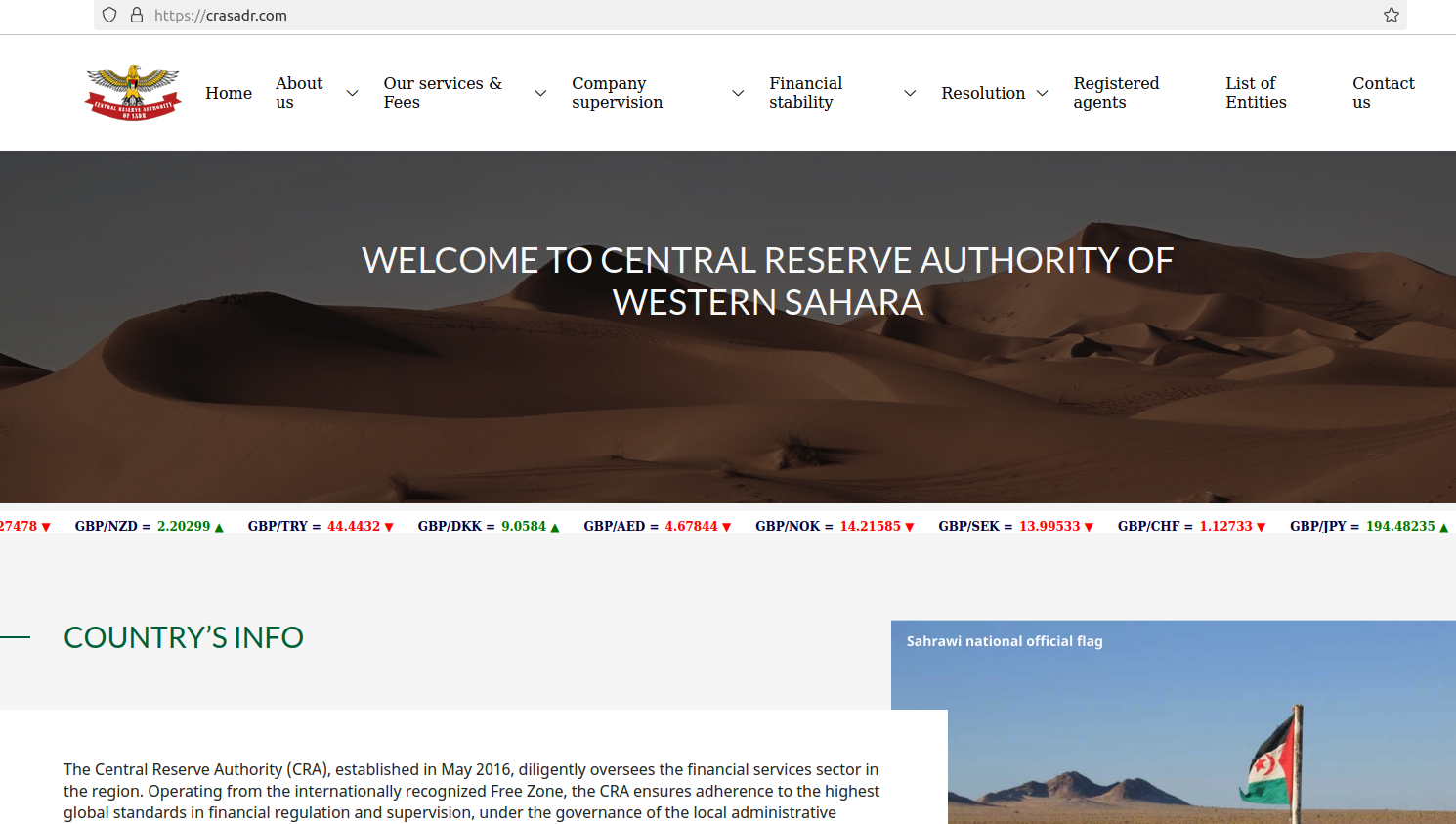
That entity’s website — crasadr.com — says it assists applicants with bank setup and formation, online gaming licenses, and the creation and licensing of foreign exchange brokers. One of Certa Payments’ former sites — certa[.]website — also shared a server with 12 other domains, including rasd-state[.]ws, a website for the Central Reserve Authority of the Western Sahara.

The website crasadr dot com, the official website of the Central Reserve Authority of Western Sahara, which lists the entities awarded licenses for cryptocurrencies, gaming and foreign exchange services.

Microsoft and partners disrupt vast Chinese-language phishing kit ecosystem

Microsoft collaborated with Japanese authorities, Health-ISAC and several cybersecurity companies to dismantle an expansive, seemingly disconnected ecosystem of Chinese-language cybercrime tools and services, the company announced Wednesday.

Since the start of the year, a vast collection of customized phishing kits developed and sold by Chinese-speaking threat actors — a cluster Microsoft tracks as Storm-2990 — have delivered more than 1 billion phishing emails and SMS messages to more than 75,000 organizations globally. More than three-quarters of those malicious messages targeted Microsoft customers, the company said.

Cybercriminals purchased the phishing kits, tools and infrastructure from an interconnected network Microsoft and Japanese authorities started investigating in early 2025. The kits were used to target individuals and organizations in healthcare, financial services, logistics and IT predominantly in the United States and Japan.

Microsoft said it and Health-ISAC, working with a federal court order, seized and redirected domains that powered the underlying infrastructure of these cybercrime tools and services known as YAM Store, CoGUI and Iron Man. 

The company said it also disabled more than 20,000 accounts connected to YAM Store and continues to disrupt the operation by removing infrastructure hosted on its services and blocking more than 100,000 domains used for impersonation and fraud.

“Most people have opened their messages to find a suspicious alert urgently telling them that a package cannot be delivered, a toll remains unpaid, a bank account needs attention, or a tax bill is overdue. The details may change, but the goal is the same: to get someone to click, share personal information, or pay,” Steven Masada, general counsel and general manager of Microsoft’s Digital Crimes Unit, wrote in a blog post.

“These messages are relentless,” he added. “Delete and block one, and another takes its place. Ignore them, and more will follow. Fall for one, and the floodgates open. What appears to be a simple scam message is often the visible end of a much larger transnational cybercriminal operation.”

The phishing kids included templates impersonating legitimate brands that cybercriminals used to facilitate high-volume campaigns. Researchers said similar infrastructure and overlapping activity suggested the tools shared development origins, code reuse or close collaboration among developers.

Microsoft said cybercriminals used the phishing kits to steal credentials, financial data and abuse the device code authentication process to obtain authentication tokens and access compromised accounts. Researchers said cybercriminals primarily used the tools for financial fraud, typically using stolen payment data to make fraudulent purchases of high-end goods or transactions on legitimate financial platforms. 

Resecurity, which aided the investigation, gained access to Iron Man’s infrastructure and found 2,360 phishing templates impersonating banks, retailers, healthcare providers, transportation authorities, police departments and government agencies across 130 countries. Cloudflare, Oracle, Proofpoint and TRM Labs also provided research and investigative support.

“What began with scam activity targeting people and organizations in Japan led investigators to an underground service economy supplying criminals around the world,” Masada wrote. 

“YAM Store, CoGUI and Iron Man are only part of that larger criminal network, but disrupting them makes it harder for criminals to obtain the accounts, tools and infrastructure they rely on,” he added. “The scam message is often the only part victims see. The businesses behind it are what make it possible.”

The post Microsoft and partners disrupt vast Chinese-language phishing kit ecosystem appeared first on CyberScoop.

West African scammers targeted in joint international government-industry operation

A joint international law enforcement and industry operation against scammers netted 28 arrests, rescued 117 trafficking victims and led to the takedown of more than 3.7 million accounts, the Justice Department announced Tuesday.

The crackdown, billed as “Joint Disruption Week,” focused on West Africa and also identified more than $11 million in freezable funds and led to the seizure of hundreds of electronic devices. The range of scams involved included law enforcement impersonation scams, digital arrest extortion schemes, pig butchering and other online fraud operations targeting victims around the world.

Participants heralded it as the largest joint scam operation to date, and the first focused on West Africa.

“For so long, the problem of international scams seemed impossible to tackle,” Kelly Milliron, acting chief of staff and counselor to the Assistant Attorney General leading the Criminal Division, told reporters. “But now, because of collaborations like Joint Disruption Week, we have a plan, a consolidated approach, bringing together people that can bring solutions and, most of all, safety for our citizens.”

It’s the latest effort in the Trump administration’s ongoing bid to make countering scam operations a theme of his term, and to make disrupting cyber adversaries and criminals a central focus of its cyber strategy. 

Participating agencies in the London-hosted operation beyond the Justice Department were the Scam Center Strike Force under the U.S. Attorney’s Office for the District of Columbia, the FBI, the Secret Service, the Treasury Department, Homeland Security Investigations, the Homeland Security Task Force, the United Kingdom’s National Crime Agency, the Nigerian Joint Case Team on Cybercrimes, the Nigeria Police Force’s National Cybercrime Center and the Ghanaian Cyber Security Authority, INTERPOL and agencies from Australia, Canada, India and New Zealand also were involved. 

Adobe, Binance, Coinbase, Cyjax, Elliptic, Chainalysis, Flashpoint, Google, Meta, Microsoft, OpenAI, Silent Push, Starlink and TRM Labs were companies that participated in the operation. Meta said it removed more than 3.7 million accounts, groups and pages from Facebook and Instagram based in West Africa, a majority of which targeted people in the United States and United Kingdom.

Some on Capitol Hill have raised concerns about whether U.S. operations to counter scams are coordinated enough.

The operation actually began in September, with a series of raids in Ghana before last week’s designated action. Jeanine Pirro, U.S. Attorney for the District of Columbia, said Disruption Week occurred not long after a new partnership with the United Kingdom.

“The aim is to bring cases in parallel and also to combat fraud together through joint targeting,” she said. “This was the perfect time to continue that partnership.”

It’s not clear how many of the potentially freezable funds will actually be frozen as a result of the operation.

“Identifying the assets is the easy part, and tracing them, going after and developing probable cause within our investigations so that we can legally seize them does require a little bit of work,” said Matthew Floyd, deputy assistant director of the FBI’s Criminal Investigative Division. “So at this point, that’s why it’s much easier in these efforts to identify assets initially, and then they’ll fold into our investigations as we move forward.”

Disruption Week was the culmination of agencies meeting to combine forces, something that will happen on a regular basis, Floyd said, but at an interval to be determined going forward. The operation led to the sharing of more than 30 leads on scam centers, participants said.

The post West African scammers targeted in joint international government-industry operation appeared first on CyberScoop.

Microsoft and partners disrupt EvilTokens, a comprehensive cybercrime service for financial fraud

Microsoft, along with a group of industry partners, disrupted EvilTokens, a short-lived but highly consequential cybercrime platform that investigators linked to more than 12,000 compromised Microsoft customer email inboxes across more than 10,000 organizations globally, the company said Tuesday.

Acting on federal court order Sept. 15, Microsoft and partners seized 50 websites the phishing-as-a-service used for operations and disabled more than 175 domains linked to EvilTokens’ supporting infrastructure. 

EvilTokens, launched in February 2026, was “a powerful cybercrime platform that used AI at every step of the attack chain — from compromising email accounts to designing intricate roadmaps for financial fraud and scams,” Steven Masada, associate general counsel and general manager of Microsoft’s Digital Crimes Unit, wrote in a blog post.

About 1,000 cybercriminals used EvilTokens over the course of its operation, a Microsoft spokesperson told CyberScoop.

The service was centered on an AI-style chatbot that cybercriminals used to analyze victims’ inboxes, identify trusted relationships, payment authorizations and other sensitive details that could facilitate fraud.

“AI was not simply helping attackers write more convincing messages. It helped them decide who to target, who to impersonate, and how to most effectively exploit the relationship to extract as much money as possible,” Masada wrote. 

EvilTokens was one of the most widely used phishing-as-a-service platforms prior to its takedown. It facilitated business-email compromise campaigns by stealing session tokens that allowed cybercriminals to sift through a victim’s inbox and maintain persistent access.

“We cannot estimate the total fraud attributable to all EvilTokens activity. However, we were able to correlate at least 13 complaints filed with the FBI’s Internet Crime Complaint Center to EvilTokens-linked activity, representing approximately $1.7 million in reported losses,” a Microsoft spokesperson said. “Because many incidents go unreported and not all victims can be definitively linked to specific campaigns, we believe this is a conservative estimate.”

Victims of EvilTokens were largely concentrated in the United States, Canada, the United Kingdom, Australia, India and France, according to Microsoft. SpyCloud, which supported the takedown, identified compromised email domains spanning 79 countries.

Microsoft said it also identified two men behind EvilTokens — Felix Utomi and Waidi Segun Adams — and attributes the development and support of the platform to Storm-2992, a threat actor unaffiliated with any other known cybercrime groups.

The United Kingdom’s Metropolitan Police acted on that information Sept. 18 when it served warrants in the greater London area, arrested the men accused of making articles for use in fraud and money laundering and seized their digital devices.

The Metropolitan Police said it received information from Microsoft about EvilTokens’ administrators in August. Utomi and Adams were released on bail as the investigation continues. 

“The two primary operators identified in our investigation were residing in the U.K.,” a spokesperson for Microsoft told CyberScoop. “While our investigation focused on those individuals, we believe others may have supported the operation in various capacities.”

Microsoft’s legal filing in the U.S. District Court for the Eastern District of Virginia refers to five additional unidentified people allegedly acting as support personnel and users.

Microsoft and others involved in the EvilTokens takedown, including Health-ISAC, Cloudflare, OpenAI, Shadowserver and TRM Labs, didn’t fully quantify how much fraud the service enabled, but it gained popularity quickly among cybercriminals and was lucrative for its operators.

Coinbase, which also aided the investigation into EvilTokens, said it traced about $1.1 million in revenue for EvilTokens from its paying customers. The virtual currency company’s threat researchers found more than 1,000 deposits to EvilTokens from more than 700 distinct addresses through June 2026. 

Operators sold access to the service through Telegram for a $1,500 initiation fee and a recurring $500 subscription. EvilTokens significantly lowered the barrier to entry for cybercriminals by including specialized tools for identity attacks, cloud systems, social engineering and financial fraud in a single interface.

The service allowed cybercriminals to map organizational structure and permissions in Microsoft Graph, which enabled lateral movement, researchers said. With active tokens gained through a collection of highly-targeted phishing lures, cybercriminals consistently bypassed multi-factor authentication, email gateways and endpoint security tools.

Microsoft said the platform’s creators developed portions of the platform with AI and it uncovered capabilities from multiple AI models. 

“It packaged much of the criminal process into a commercially run service, complete with subscription pricing, customer support, management dashboards and tools designed to move customers from account access toward financial exploitation,” Masada added.

The companies and organizations involved in the globally-coordinated takedown identified and notified potential victims, shared indicators of compromise and shared intelligence with law enforcement about EvilToken’s operators and some of its customers.

Experts advised organizations and employees to treat unsolicited device codes as a red flag, assume compromised accounts are fully cataloged in minutes, and independently verify requests to change payment information or redirect funds.

“The infrastructure supporting EvilTokens has been disrupted, but the model it demonstrated will not disappear with it,” Masada warned.

The post Microsoft and partners disrupt EvilTokens, a comprehensive cybercrime service for financial fraud appeared first on CyberScoop.

Treasury sanctions First VPN Service, others for abetting ransomware gangs

The Treasury Department is slapping sanctions on First VPN and its administrator for allegedly selling services to ransomware operators, as well as another person aiding ransomware gangs.

First VPN Services, or 1VPNS, was “deeply embedded in the cybercriminal ecosystem” and appeared in virtually every Europol investigation in recent years, the law enforcement body said after a sting targeting the service in May.

Treasury’s Office of Foreign Assets Control (OFAC) sanctioned 1VPNS as well as its alleged administrator, Ukrainian citizen Dmytro Rashevskyi, Monday in conjunction with the United Kingdom. The outfit provided anonymity services that could be legitimate in some instances, but 1VPNS advertised itself in online cybercrime forums for more than a decade, touting its refusal to cooperate with law enforcement, the office said.

“Numerous ransomware groups have purchased infrastructure from 1VPNS, which they have leveraged in attacks on U.S. companies and institutions — including to hide the origins of their attacks, deploy malware, and manage exfiltrated data,” OFAC said. “Victims of ransomware attacks that involved the use of 1VPNS infrastructure have included U.S. businesses, financial services companies, hospitals, and municipal governments.”

Treasury also sanctioned Belarus national Yegeniy Vladimirovich Silayev for allegedly selling “cryptors,” tools used to disguise ransomware and other malware, to ransomware operators.

“Unlike legitimate encryption tools, which are designed to protect data and the privacy of the people that own it, cryptors are built specifically to make malware stealthier and more effective by disguising it as harmless files,” OFAC said.

Treasury’s sanctions designations dovetail with separate, unrelated cyber sanctions that European governments from Monday. The FBI has previously issued an alert about First VPN Service. 

Blockchain intelligence firm TRM Labs said it has seen 1VPNS selling its services to ransomware operators for prices ranging from $723 for Anubis to $58 Sinobi.

“The amounts are small because infrastructure subscriptions are small,” Ari Redbord, global head of policy and government affairs for the company, wrote on LinkedIn. “A named ransomware group paying a named enabler on public chains still leaves a trail investigators can follow after the fact.”

Victims tied to First VPN Service infrastructure include U.S. municipalities, hospitals and financial services companies.

Europol said it had arrested the administrator of 1VPNS in its May sting, but did not name them. 

The Treasury Department did not immediately respond to a question about whether its sanctions targeted that same arrested person.

The post Treasury sanctions First VPN Service, others for abetting ransomware gangs appeared first on CyberScoop.

❌