The side bar has always been a bit messy. Rather than having a long “Recent topics” list, I’ve collapsed it into a single link to the shorter “Latest Topics” section of the forum. It presents the same list, but with more detail and in a larger font that is easier to read. I also moved […]
You may recall that at the start of this year, the Microslop nickname came about after a comment from Microsoft's CEO – relating to 'AI slop' – and the company cracked down on the word by blocking posts that used it on the Copilot Discord channel.
Windows Latest noticed that this is no longer the case, and the term is now being openly used in the general chat channel. Searching for 'Microslop' produces over 200 results in posts that go back weeks.
In short, Microsoft has moderated its moderation, come to its senses, and realized that cracking down and censoring in this manner is only going to inflame passions against AI, if it achieves anything.
I should make it clear that Microsoft has never said anything official on this matter, in terms of admitting any ban in the first place, let alone the lifting of it. Windows Latest reports that it did hear from Microsoft back at the time, though, and was told that the filtering was a "temporary anti-spam measure" rather than a permanent policy. It seems this is indeed the case.
Analysis: Streisand effect
(Image credit: Microsoft)
The writer of the Windows Latest article further observes that they've noticed that on Reddit, X, and Windows forums, there are fewer mentions of the Microslop term these days. It happens "much less often" we're told.
I'm not so sure about that. I still see Microslop mentioned with some regularity, although I concede that the popularity of the term has diminished. This is a subjective matter, of course, and it may reflect that I visit more negative posts about Windows 11 than the Windows Latest writer has done in the past few months – who can say?
The writer acknowledges that the "criticism is still very much there" in terms of 'AI slop' in Windows 11, but that it has died down since Microsoft started fixing the OS, and made some moves to minimize the presence of AI in certain areas.
I think what Microsoft has done so far is more about not mentioning or actively pushing AI, rather than stripping it out of Windows 11, although it's true some work has been done on the latter front. It doesn't amount to a whole lot, though, in the grand scheme of things.
There has been a change of attitude, yes, but that was absolutely necessary considering the whole 'fix Windows 11 campaign' was embarked upon after Microsoft was blasted for focusing on adding AI trimmings to the system rather than getting the fundamentals right with the OS.
I still see a lot of chorusing of 'Microslop' particularly when a Windows 11 bug emerges. Commenters are very quick to jump on Microsoft and fire criticisms along the lines of 'this is what you get when AI does your coding', and the term Microslop is inevitably included in these kinds of threads. (Microsoft has admitted that it uses AI for coding to a substantial extent, and Windows 11 users won't let the firm forget that in a hurry).
I personally don't think the term Microslop is going anywhere, and it'll be hanging around Microsoft's neck for the rest of the company's existence in all likelihood. While it's obviously a positive step that any 'temporary' censorship has been rescinded, it's a bit late now. Any attempt to curtail negative talk about AI was always only going to further highlight grievances, cause more bad feeling, and yet more damaging chatter.
Epic Games Launcher has been identified as the culprit behind mysterious chimes on users' PCs
Epic has confirmed it's planning to update the launcher to reduce the frequency of its 'party chimes'
Users have requested a feature that turns off the chimes altogether
Multiple PC users have recently noticed mysterious sounds playing at random, and it appears the Epic Games Launcher is the culprit.
As reported by TweakTown, a Fortnite news page on X discovered the Epic Games Launcher randomly playing sounds on their PC, as several audio files matching them were found in the Epic Games 'social chimes' folder.
Each sound represents actions in a game party, such as a party user leaving, push-to-talk activation or deactivation, and message notifications, which sounds bizarre as this occurs even when users aren't in Epic Games parties.
Epic has since confirmed (via a FortniteStatus X page) that the 'party chimes' were playing more frequently than necessary, and it is now updating the Epic Games Launcher to 'narrow which events play a sound while the launcher is in the background'.
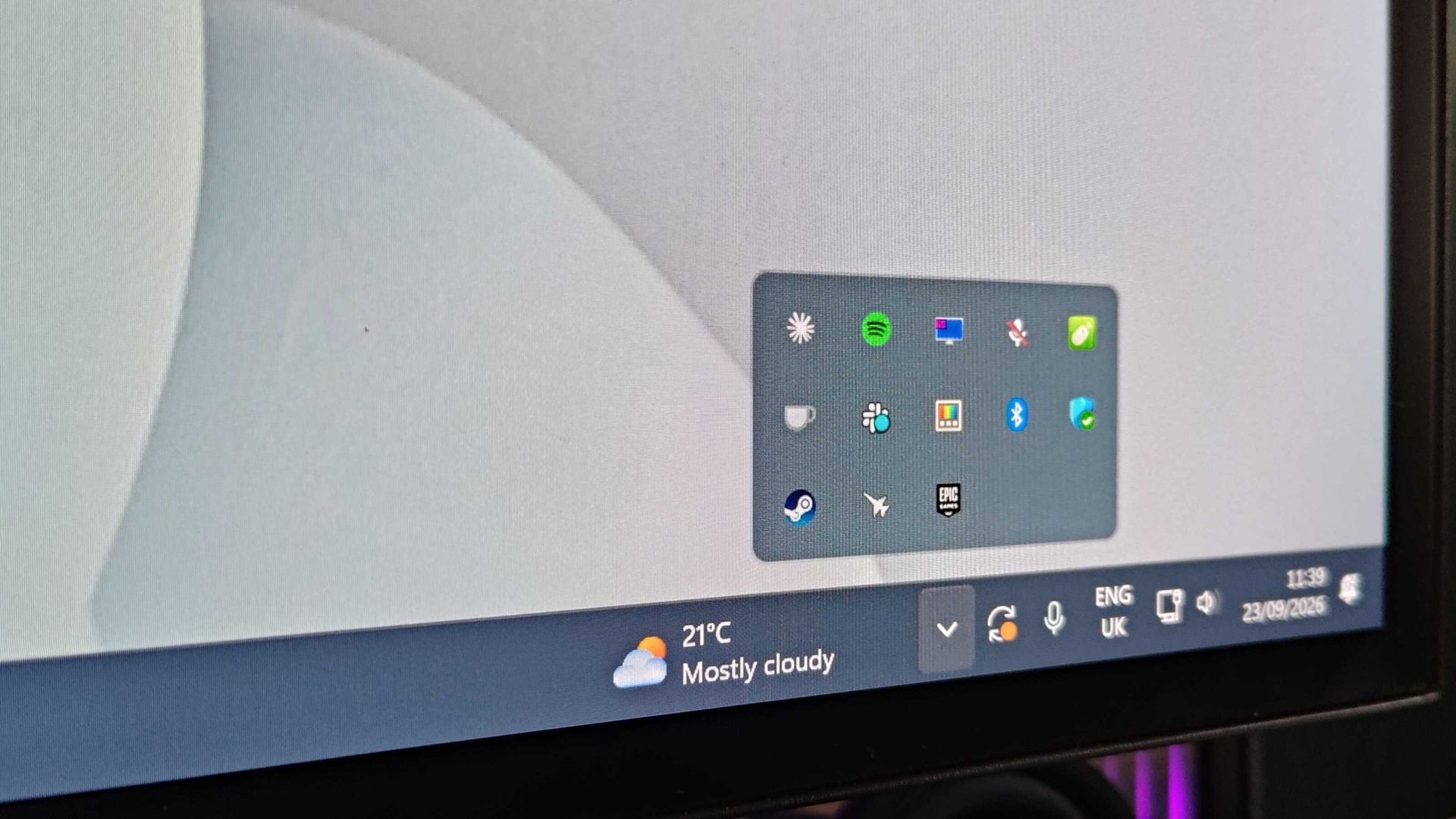
These party chimes are sounds I've noticed on my Windows 11 system, playing at very random intervals, and sometimes even when the launcher isn't visibly open. The sounds aren't accompanied by pop-up notifications either, which only added to the confusion for me and many other PC users previously trying to pinpoint the source.
Thanks for providing feedback about this, @FireMonkey!After taking a look, these party chimes are triggering more often than we intended. We're updating the Epic Games Launcher to narrow which events play a sound while the launcher is in the background, so you'll hear fewer of them when you're not actively using it.September 19, 2026
(Image credit: Future)
TweakTown states that Epic plans to introduce an option to toggle the chimes on or off in the future, but, surprisingly, a toggle option isn't a top priority as of now — especially since user replies berate Epic for not including an option to remove the sounds altogether.
For now, at least, a quick workaround is to delete the files from the directory as follows: Program Files (or Program Files x86)\Epic Games\Launcher\Portal\Extras\SocialChimes. It's worth noting that this is only a temporary fix, as Epic Games Launcher updates will likely overwrite this and place the files back into the directory.
Perhaps this entire case serves as yet another reason to use Steam for many users, where bugs are rare occurrences — but at the very least, PC users can rest knowing there isn't some unwanted or unknown application running on their system.
A Vladimir Putin press call showed the Russian president casting an online vote for the country’s parliamentary elections
The short clip has revealed that not only is Putin using a US-built Dell PC, it is running Windows 10 – and the license has not been activated
Putin’s example of voting online is intended to encourage voters to take part, but has instead raised eyebrows and launched memes
Parliamentary elections in Russia took place on Friday, September 18 2026, with online voting for positions in the State Duma open to the public for the first time. To demonstrate the ease of online voting, a press call highlighted Russian President Vladimir Putin casting his vote – but this hasn’t gone quite as planned.
While the president appeared to have difficulty reading the display, the real challenge seems to be that the Russian leader is using a version of Windows 10 that has not been activated. Furthermore, the PC is a Dell, rather than a Russian-built system.
The Putin publicity stunt has already launched memes, but the it also raises questions about his ability to use a computer, not to mention the suitability of the hardware for voting.
“You can’t go wrong”
With 73-year-old President Putin lined up for the cameras with the Dell PC set up on his desk, he goes through the motions of “voting online,” presumably to demonstrate how easy it is. (In person and mail voting options were also available.)
The press call has all the authenticity of an unlicensed copy of Windows 10. Ironically, this is exactly what is in use, as you can see toward the end of the video.
Watch to the end:
Although an initial reaction might be “Russian state IT is pretty weak,” it seems more likely that the state-controlled hardware overseeing infrastructure, networks, and military systems is far more up-to-date. What is more likely is that that PC was pulled out of a back room and an old copy of Windows quickly installed simply to provide President Putin with his short encouragement to vote.
Dell vs. Aquarius
The use of a Dell PC is curious, however. While Russia and the US have cordial relations, it seems strange for the Russian president to use a foreign PC. Sanctions aside, Russia has a policy of forcing the use of home-grown brands (such as Aquarius) over those from overseas.
After voting, the five-times elected Russian leader uttered the memorable line “you can’t go wrong,” in his native language, perhaps highlighting the futility of voting for any candidates not in his favoured party, United Russia.
While it is difficult to assess the legitimacy of the elections in Russia itself, the governments of Australia, Canada, New Zealand, Norway, and the United Kingdom have challenged the elections in occupied Ukraine territories. The nations have described the them as “sham elections” that violate “Ukraine’s sovereignty and independence, and the UN Charter.”
Artificial intelligence has removed the skill advantage that once set state-sponsored hackers apart from lone criminals, according to a threat report Anthropic published Thursday that documents misuse of its Claude models across seven areas of harm.
The report, which details activity observed between December 2025 and August 2026, covers cyber operations, influence operations, surveillance, scams and fraud, biological misuse, conventional weapons development and distillation. Anthropic said it disrupted each operation, strengthened safeguards and shared intelligence with authorities and industry partners where appropriate.
“The cases we share here aren’t typical misuse, but rather examples of the most notable and novel threat activity we’ve identified to date,” the report reads. “We’re publishing this work because we believe we have a responsibility to disclose malicious misuse of our services. As models become increasingly capable, their risks will increase, unless AI developers and society’s defenders act to make them safer.”
The cyber operations the company detailed were a Russian-aligned espionage campaign that hit more than 20 government and defense organizations across Ukraine and Europe, two Chinese undergraduates who ran an automated exploit foundry that produced more than a dozen potential zero-days in a single month, affiliates of the ShinyHunters crime collective who dumped 2,100 cloud access tokens across 40 corporate tenants in 34 hours, and a lone hacktivist who targeted European political parties via stolen API keys.
For decades, cybersecurity researchers and investigators have pointed to sophisticated operations as a signature of state-sponsored tradecraft, while crude intrusions suggested amateurs or petty criminals. Anthropic posits in the report that AI has erased that conventional thinking, especially since a “majority of the operations described in this report were enabled by AI via direct execution or orchestration.”
“For threat intelligence investigators, sophistication has stopped being a reliable signal of who is behind an operation,” the report said, adding that a hacktivist on stolen API keys, scattered criminals and a state espionage operator each ran campaigns that a year earlier “would have required many skilled operators and specialist knowledge.”
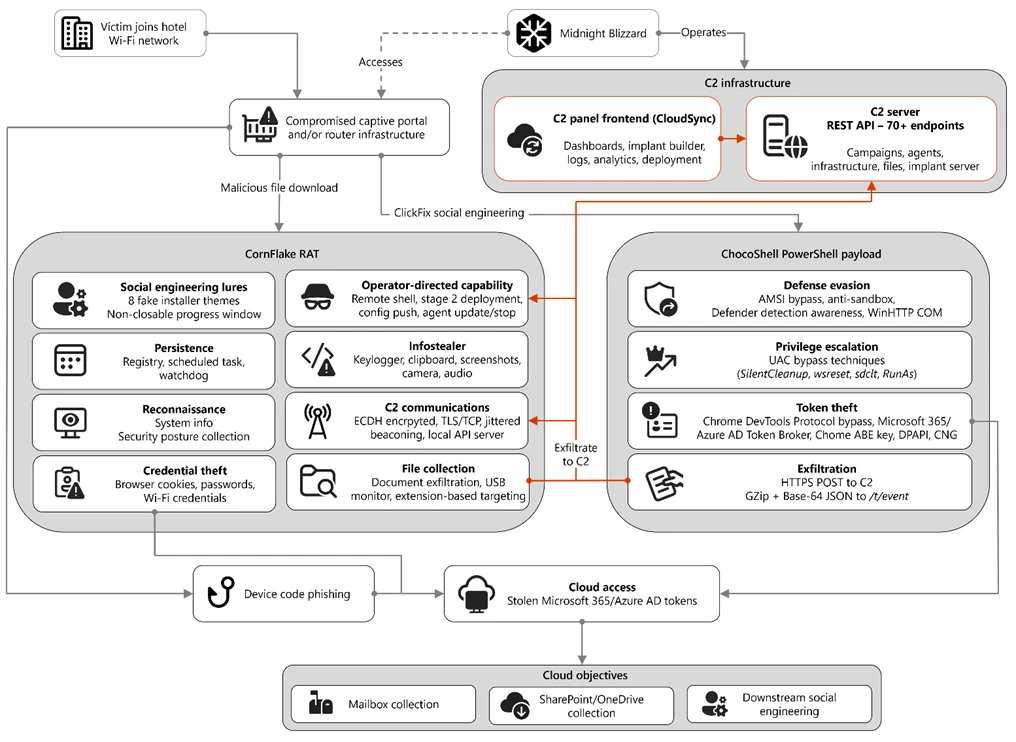
The most extensive case involved a malicious actor using the handle “JackPoterz” whose actions aligned with Russian state espionage, matching behaviors linked to Midnight Blizzard.
According to the report, the actor employed a custom toolkit composed of two families of Windows-based implants, a mobile exploitation kit, a credential stealing tool that targets browser password stores, a phishing platform designed to mimic priority targets like government organizations, and an administrative console used to manage compromised accounts. Targets included military intelligence bodies in Ukrainian and European governments, diplomatic and defense organizations, and people connected to U.S. foreign policy.
According to the report, AI monitored whether security products flagged the actor’s malware. When a detection occurred, “agents would then set about the process of autonomously modifying and rebuilding the malware to evade the existing detections,” the report said.
The same actor bulk-exported mailboxes at drone component manufacturers and stole a complete software development kit for a drone vision system, then spent days recovering its architecture and details of an unannounced product. The actor also compromised hotel Wi-Fi vendors to reach guests through DNS hijacking, took over WhatsApp accounts with headless browsers, and stole more than 300,000 national identity records from a North African government agency, along with registry data on more than half a million companies.
The Chinese-speaking operators, which the company says were partly carried out by undergraduates at a Chinese university, put Claude to work on vulnerability research around the clock. One workflow iterating on network appliance firmware “yielded more than a dozen possible zero day findings in a single month.” It ran “agent swarms,” in which a lead agent divided work among parallel subagents, and kept campaign memory between sessions.
Clusters linked to ShinyHunters showed how AI shortens criminal timelines. One supply-chain breach ended with a dump of more than 2,100 Azure access tokens spanning more than 40 corporate tenants in about 34 hours. “AI agents performed nearly all of the work,” the report said. Another compromise moved from a single stolen developer token to full control of a victim’s cloud environment in roughly three hours.
The report also has a section dedicated to distillation attacks that Anthropic claims were carried out since February by seven labs based in China, including Alibaba, DeepSeek, Moonshot AI, Xiaomi and Zhipu. Operators affiliated with Alibaba ran the largest attack Anthropic has measured, peaking “at nearly 3 million exchanges per day launched from more than 3,500 fraudulent accounts” to harvest the outputs of Claude Opus models for training its Qwen systems.
The outputs were culled from users who never knew they were involved. The report said Moonshot and DeepSeek silently forwarded their own customers’ requests to Claude and returned its answers as their own, exposing data users had not agreed to share, including surveillance footage of a tracked individual pulled by a user likely affiliated with the People’s Liberation Army. Those practices are “likely inconsistent with privacy laws and the labs’ own terms of service,” the report said.
Earlier this week, a joint cybersecurity advisory from the National Security Agency, the Cybersecurity and Infrastructure Security Agency and the FBI accused Chinese AI companies of engaging in a deliberate and “systematic” effort to illegally distill U.S. frontier AI models and their capabilities.
Anthropic said it published the cases to give outsiders a view of how these threats form, framing the disclosures as an early look at a shifting landscape.
“As models become increasingly capable, their risks will increase, unless AI developers and society’s defenders act to make them safer,” the report said. The old idea of “security through obscurity,” it added, “is no longer viable in this new AI-assisted world: everything connected to the internet is a potential target for exploitation.”
It's not just RAM prices that are going up, writes CNET. "Reports suggest the cost of Windows licenses for manufacturers is rising by up to 10%."
Several sites that closely follow Microsoft news, including Windows Central and Windows Latest, have published articles citing a report from Taiwan's Economic Daily News that claims some PC manufacturers are seeing a 7% to 10% increase in the cost of Windows 11 licenses...
Because they buy licenses in bulk, they get a sizeable discount over what a consumer would pay for a new copy of Windows 11. But given the existing cost pressures from other components, a big Windows 11 price hike could lead them to pass on some of the added cost to PC buyers. According to the EDN story, PC makers could raise prices by about 5% over the next quarter due to the reported Windows price hike. .. A translated version of the Economic Daily News article contains information from an unnamed PC brand executive. It says that while Microsoft typically raises licensing costs every year by single-digit percentages, that hike has reached 7% to 10% this year, a significant increase.
"A representative for Microsoft declined to comment on the report," according to the article.
But it also notes that three weeks ago laptop maker Framework blamed price hikes and reconfigurations for some of their models on processor, memory, storage, "and other silicon costs — but also "an increase in Windows license costs."
Thanks to Slashdot reader joshuark for sharing the article.
Microsoft Threat Intelligence tracks DeadLock ransomware as an emerging financially motivated operation distinguished by its use of decentralized infrastructure to support victim communications and data leak operations. Its recovery ecosystem combines the Session messaging network with blockchain-backed services that store and deliver resources used throughout the extortion process. This architecture likely increases the resilience of portions of its communication, leak-hosting, and negotiation infrastructure, allowing DeadLock operators to recover from some disruption efforts while maintaining continuity for victims. Microsoft has observed DeadLock ransomware being deployed by multiple groups including an affiliate of the Lynx and INC ransomware ecosystems.
First observed in July 2025, DeadLock operators employ double extortion tactics, encrypting victim environments while threatening to publicly release exfiltrated data. As of July 2026, the operators have published more than 80 compromised organizations on their data leak site, called the DeadLock blog, with more than half of the claimed victims in Europe. Microsoft identified DeadLock ransomware impacting organizations across information technology (IT), mining, transportation and logistics, manufacturing, hospitality, consumer goods, and other sectors in Europe, Asia, North America, South America, and Africa.
The DeadLock encryptor includes a resource-aware throttling mechanism designed to maintain system responsiveness during encryption. In addition to its encryption capabilities, the ransomware also appears to implement language or country-based geofencing designed to avoid running in environments associated with former Soviet and Commonwealth of Independent States (CIS)-linked countries as well as select Middle Eastern countries, a pattern commonly observed among ransomware operators believed to operate from those regions. Together, these capabilities demonstrate how DeadLock combines established ransomware tradecraft with decentralized infrastructure designed to improve operational resilience.
In this blog, we present a technical analysis of the DeadLock ransomware encryptor, covering its execution flow, defense evasion techniques, encryption design, and post-encryption behaviors, including a decentralized recovery chat system. We also provide indicators of compromise (IOCs), Microsoft Defender detections, and mitigation guidance to help organizations defend against this threat and similar ransomware activity.
Pre-encryption
Configuration parsing
Before performing any malicious activity, the DeadLock encryptor decrypts an embedded configuration blob using XOR decoding with an 8-byte key.
Below are the malware’s configuration fields and their values.
As an early exit check, the malware queries the system’s default and user interface (UI) languages. If either language matches the exclude list in the configuration, the malware self-deletes immediately without performing any encryption.
The following languages trigger this exit behavior:
LANGID
Language
Country
1049
Russian
Russia
1058
Ukrainian
Ukraine
1059
Belarusian
Belarus
1064
Tajik (Cyrillic)
Tajikistan
1065
Persian
Iran
1067
Armenian
Armenia
1068
Azeri (Latin)
Azerbaijan
1079
Georgian
Georgia
1087
Kazakh
Kazakhstan
1088
Kyrgyz
Kyrgyzstan
1090
Turkmen
Turkmenistan
1114
Syriac
Syria
2072
Romanian (Moldova)
Moldova
2092
Azeri (Cyrillic)
Azerbaijan
2115
Uzbek (Cyrillic)
Uzbekistan
8193
Arabic
Oman
9217
Arabic (Yemen)
Yemen
Command-line processing and privilege elevation
The encryptor’s behavior branches based on command-line arguments and the current privilege level. If a target directory path is provided as the command-line argument, the malware skips all preparation steps and jumps directly to encryption. This feature allows the operator to invoke the encryptor with specific targets for focused encryption. If no sub-commands are provided and the process is already elevated, the malware proceeds normally through all execution phases.
The more interesting case occurs when no command-line argument is provided while the process is not elevated. In this scenario, the malware attempts to gain administrator privileges through a batch-script-based elevation technique. It generates a randomly named .cmd file (8 uppercase characters, such as ESYEKQSY.cmd) and executes it using ShellExecuteW with the RunAs verb, which triggers the Windows User Account Control (UAC) consent dialog. If the user denies the prompt, the malware retries up to 10 times before giving up and exiting.
During dynamic analysis, the sample did not successfully relaunch itself with elevated privileges. As a result, full pre-encryption preparation appears to require execution from an already elevated context. When invoked with a target path, the malware bypasses preparation and proceeds directly to encrypt accessible files. This behavior is specific to the analyzed sample and may change in later variants.
Token privilege escalation
When running with administrator privileges, the malware further expands its access by enabling SeDebugPrivilege, SeRestorePrivilege, SeBackupPrivilege, SeTakeOwnershipPrivilege, SeAuditPrivilege, and SeSecurityPrivilege. These privileges increase the malware’s ability to interact with system processes, protected files, and security-related settings, helping it overcome common access restrictions and maximize the scope of files and resources it can target during the encryption phase.
Recycle bin emptying
The malware silently empties the recycle bin on all drives without any UI or confirmation dialog, eliminating a potential source of file recovery for victims.
Custom icon registration
To visually brand encrypted files, the malware writes an embedded .ico file to C:\ProgramData\<UID>.ico and registers it as the default icon for files with the extension .dlock.
To associate the custom icon with encrypted files, the ransomware creates the HKLM\SOFTWARE\Classes\.dlock\DefaultIcon registry key and sets its (Default) value to the path of the dropped icon file.
Below is the malware’s embedded .ico file.
Figure 1. DeadLock icon for encrypted files
Process and service termination
Before starting encryption, the malware terminates processes and disables services that could interfere with file access or provide defensive capabilities. This approach ensures that locked files become accessible for encryption while simultaneously disrupting the environment’s ability to detect, respond to, or recover from the attack.
For services, the malware enumerates all active Win32 services and compares them against the stop list in the configuration. For each matching service, DeadLock sets its start type to DISABLED and sends a stop command to terminate that service. Notable targets include windefend (Windows Defender), vss/swprv/wbengine (Volume Shadow Copy and Backup services), mssearch, Hyper-V services (vmcompute, vmms), and Active Directory services (adws, ntds, kdc). Below is the full service stop list in the malware configuration:
Figure 2. Service stop list
For processes, the malware enumerates all running processes and terminates any matching its stop list while skipping its own process ID. Targeted processes include security tools (msmpeng, securityhealthservice, smartscreen), backup and cloud sync applications (onedrive, dropbox, googledrivefs, owncloud), remote access tools (anydesk, putty, mstsc, rustdesk), shell and system processes (explorer, powershell, taskmgr, cmd), and search/indexing services. Below is the full process stop list in the malware configuration:
Figure 3. Process stop list
Event log clearing
To eliminate forensic evidence, the malware employs three complementary methods that collectively ensure every event log channel on the system is cleared of existing entries, disabled from recording future events, and has its access permissions locked down:
Direct clearing: Clears the following log channels via the classic Event Log API: Application, Security, Setup, Servicing, Eventlog, Forwarded Events, Windows PowerShell, and System.
Registry-based disabling: Enumerates every sub-key under HKLM\SOFTWARE\Microsoft\Windows\CurrentVersion\WINEVT\Channels. For each channel, sets Enabled to 0 (disabling all future logging) and overwrites ChannelAccess with a restrictive Security Descriptor Definition Language (SDDL) string that limits access to SYSTEM, built-in administrators, and local admin.
Modern API enumeration: Uses wevtapi.dll to enumerate all registered event log channel paths (including custom application channels not in the hardcoded list) before clearing each one.
By combining API-based clearing, registry manipulation, and full channel enumeration, the malware covers multiple log sources, including third-party application logs and custom diagnostic channels, to minimize existing forensic evidence on the infected device.
Directory traversal
To maintain system stability and ensure the victim can access ransom instructions, the malware excludes specific directories, file extensions, and file names from encryption. This selective encryption model is a common ransomware design pattern where the system must remain operational enough for the victim to receive instructions and facilitate payment.
Extensions and file names from the configuration’s file exclude list are skipped during encryption:
Figure 4. List of skipped extensions and file names
For directory processing, the malware uses a two-tier directory exclusion system applied at different stages of the encryption pipeline. Tier 1 provides rough filtering that saves significant time by avoiding traversal overhead, while tier 2 provides granular path-specific exclusions within directories that are traversed. Both prevent encryption, but they operate at different stages of the traversal pipeline.
In its pre-traversal phase (tier 1), the malware checked at the drive batch level before threads are spawned for traversal. If a top-level directory matches against the configured directory exclude list (\users\*\appdata, program files (x86)\, program files\, and programdata\), the entire tree is skipped without being walked.
In its during-traversal phase (tier 2), the malware checked the file name during recursive directory enumeration and applied to both subdirectories and files as they are encountered. In this tier, the directory and file names are checked against the configured sub-path exclude list below.
Figure 5. Sub-path exclude list
Encryption
Resource-aware throttling
One of the more distinctive aspects of the DeadLock encryptor is its resource-aware throttling mechanism, designed to keep the infected system responsive during encryption. The malware spawns a dedicated monitoring/dispatch thread per drive batch that acts as a gatekeeper for file encryption dispatch. Before dispatching each new file to be encrypted, this thread polls system resource utilization and checks against hardcoded thresholds:
Polls memory and CPU idle before each file dispatch
Calculates memory usage percentage and CPU idle percentage
If memory usage exceeds 29% or CPU load exceeds 70% (idle < 30%), the dispatch thread pauses via a waitable timer and retries until resources return below thresholds
Once thresholds are within limits, atomically sets a dispatch flag on the work queue and signals waiting encrypting worker threads
With this mechanism, worker threads already encrypting files are not interrupted, and only the dispatch of new files is gated. This means partially encrypted files are expected to complete, and the throttling manifests as reduced parallelism rather than stop/start behavior. This approach can prevent system hangs that would alert the user and reduce the likelihood of behavioral detection by maintaining normal-looking resource consumption patterns.
Thread architecture
For the encryption work itself, the malware spawns directory processing threads, with the thread count being 2 times the CPU core number. Each thread recursively traverses directories, dropping ransom notes and dispatching files for encryption. Individual file encryption threads are tasked with handling the actual cryptographic operations.
Cryptographic scheme
The DeadLock ransomware implements a hybrid cryptographic design that combines Curve25519 elliptic-curve cryptography with the XChaCha20 stream cipher for file encryption. Key encapsulation uses the Networking and Cryptography Library (NaCl) crypto_box construction, which pairs an asymmetric key exchange with authenticated encryption to securely wrap each file’s symmetric key.
The configuration’s operator public key 03bf50bbf97c4e951e66ff12b689a37a3ce675b4921e254eae76da77573843e4a9 is 33 bytes. The leading 03 byte is a SEC1 compressed point format prefix borrowed from Bitcoin/secp256k1. The malware validates this prefix byte against a lookup table that accepts 00, 02, 03, 04, and 05, mapping each to an expected key length.
After format validation, only the remaining 32 bytes are used in the actual Curve25519 ECDH scalar multiplication. This SEC1 prefix is non-standard for Curve25519, which natively uses bare 32-byte keys, and the malware author has likely adopted it for format versioning across their builder and decryptor tooling.
Per-file encryption process
For each target file, the malware performs the following sequence of operations:
Rename the target file from <filename> to <filename>.<UID>.dlock
Open the renamed file and retrieve file size/attributes
Clear the system attribute if FILE_ATTRIBUTE_SYSTEM is set
24-byte random XChaCha20 nonce (first 16 bytes for HChaCha20 subkey derivation, last 8 bytes as stream nonce)
32-byte random ephemeral Curve25519 private key
12-byte random file tag (only the first byte is functionally referenced by the encryptor to derive padding length; the remaining 11 bytes serve as a random file identifier written to the cleartext footer, likely used by the decryptor for file correlation/tracking)
Perform Curve25519 ECDH: Multiply the ephemeral private key by the attacker’s embedded public key to derive a shared secret
Build metadata plaintext: XChaCha20 key + 24-byte XChaCha20 nonce + random padding + dDlK magic + optional FA flag + chunk parameters
Encrypt metadata using crypto_box (XSalsa20-Poly1305) with the ECDH shared secret and a zero nonce
Encrypt file content using XChaCha20 with the generated key and 24-byte nonce
Append the encrypted footer/metadata to the end of the file
The use of a zero crypto_box nonce is worth noting. This is cryptographically safe because each file generates a unique ephemeral Curve25519 keypair, which produces a unique ECDH shared secret per file. With this, a constant zero nonce never repeats with the same key.
The entire design ensures that each file is encrypted with a distinct key derived from a per-file ephemeral key exchange, eliminating any possibility of key reuse across files. Overall, the cryptographic construction is sound and does not present a practical path to decryption without the attacker’s private key.
File size-based encryption strategy
To balance encryption thoroughness with speed, the malware implements a tiered encryption policy based on file size. The encryption rule in the configuration 1000,05052429880,025124288000,010524288000,F991114288000 encodes this policy. Each comma-separated entry is parsed by splitting at position 3: the first 3 characters represent the encryption percentage (decimal), and the remaining characters represent the file size threshold (decimal bytes). The special prefix F replaces the percentage field with a chunked-full mode.
Rule
Encryption percent
File size threshold
Behavior
1000
100%
≥ 0 bytes
Default: encrypt entire file
05052429880
50%
≥ ~50 MB
Encrypt 50% of file in distributed chunks
025124288000
25%
≥ ~118 MB
Encrypt 25% in distributed chunks
010524288000
10%
≥ ~500 MB
Encrypt 10% in distributed chunks
F991114288000
Chunked
≥ ~1 GB
Special full-chunk mode with calculated intervals
Rules are evaluated in order, and the last matching rule wins. For example, when the malware processes a 2 GB file, all rules match, but the final F99… entry will determine the encryption behavior.
For partial encryption, the malware calculates:
Total bytes to encrypt = ceil(file_size × (percentage / 100))
This creates an intermittent encryption pattern where 512-byte blocks are encrypted at regular intervals throughout the file. The result is a file that is rendered unusable while requiring only a fraction of the time needed for full encryption. This is a crucial optimization for the ransomware when targeting large files such as databases, virtual machine images, and backups.
File footer
After encryption, the malware appends a structured metadata blob to the end of each file. This footer contains all the information the decryptor needs to reverse the encryption, along with markers for format validation:
Figure 6. DeadLock file footer
The footer serves several important functions:
Key and nonce reconstruction: The cleartext ephemeral Curve25519 public key (33 bytes) at the end of the footer allows the decryptor to recompute the ECDH shared secret and open the crypto_box to recover the XChaCha20 key and nonce used for file content encryption.
Inner dDlK magic (decryption validation): After the decryptor opens the crypto_box, it checks for the dDlK marker at the expected offset (32 + 24 + padding_length bytes into the plaintext) to confirm the correct private key was used and that decryption succeeded. While the Poly1305 Message Authentication Code (MAC) already provides cryptographic integrity verification, this marker offers a fast format-level sanity check.
FA flag (decryption mode indicator): This flag is used by the decryptor to determine which read strategy to use when reversing the encryption. It is present when the file was encrypted using sequential/contiguous block encryption, and absent when intermittent/skip encryption was used. Specifically, FA is appended in two cases:
F-prefix rule matched: When the file size triggers the F991114288000 config entry (the special chunked-full mode), the FA flag is always set.
Percentage rule with zero skip interval: When a percentage-based rule matches but the calculated skip interval between encrypted chunks works out to zero (meaning the percentage effectively covers the entire file), FA is also set.
Without this flag, the 8-byte chunk parameters in the footer would be ambiguous as they could represent either a block count or a skip interval. The FA flag resolves this ambiguity and enables the decryptor to correctly reconstruct the original file.
File identifier/format tag: The 12-byte random value in the cleartext footer serves as a file identifier (with the first byte used to derive the padding length inside the encrypted payload).
Post-encryption
Wallpaper
As an immediate visual indicator of compromise, the malware generates a custom BMP wallpaper file at runtime using the victim’s screen resolution. Below is an example of the generated BMP wallpaper:
Figure 7. DeadLock wallpaper
The wallpaper is written to C:\ProgramData\<UID>.bmp (on Vista and later) or C:\Documents and Settings\All Users\Application Data\<UID>.bmp (on XP), set as the desktop background, and persisted in the registry at HKLM\SOFTWARE\Microsoft\Windows\CurrentVersion\Policies\System\Wallpaper.
Ransom notes deployment
After encrypting files, the malware deploys two types of ransom notes, each with distinct deployment logic and purpose:
Text note (HOW_RECOVER.<UID>.txt): The text note is dropped into every encrypted directory, but with a notable timing behavior: it is only deployed during the second pass of the directory processing loop. The malware iterates over drive batches multiple times, and the text note drop is gated by an iteration counter. On the first pass, the text note is suppressed, likely to prioritize encryption speed before littering the file system with ransom note files. For defenders and analysts, this has a practical implication: if testing with a minimal drive configuration that only triggers a single iteration, the text note will never appear.
Below is the text note content from the malware’s configuration.
Figure 8. DeadLock text ransom note
HTML note (RECOVERY_CHAT.<UID>.html): This file is dropped to all drive root directories and all Desktop folders. Unlike the text note, the HTML note is a full interactive web application with a self-contained single-page application that implements end-to-end encrypted chat, a paginated data leak blog, and a file browser, all without requiring a traditional backend server. The technical architecture of this recovery chat system is detailed in Recovery chat: Technical architecture.
Recovery chat: Technical architecture
The most distinctive feature of the DeadLock ransomware is its recovery chat system. The RECOVERY_CHAT.<UID>.html file is a self-contained HTML application that implements a full end-to-end encrypted chat system, a paginated data leak blog, and a file browser, all without requiring a traditional backend server.
Figure 9. HTML application “About” page UI
The architecture is designed with three decentralized components.
Polygon blockchain as configuration store
Rather than relying on traditional domain-based infrastructure that can be seized or taken offline, the DeadLock operators store configuration data on the Polygon blockchain. Two smart contracts serve as censorship-resistant infrastructure:
Contract
Address
Function selector
Purpose
Chat proxy
0x8EF7c3e531d871D3B9D559722DE77EB1dEc19dAe
0x933a9ce8
Stores the proxy server URL
Blog
0x757984507c82c8dA1d3969c535dB5706eEE6426C
0xd4070542
Stores actor’s blog posts
The HTML page issues eth_call requests to public Polygon Remote Procedure Call (RPC) endpoints (no wallet required with read-only calls) to obtain the proxy server address. The blog contract takes offset and limit parameters (for pagination) and returns structured data including post titles, bodies, timestamps, image URLs, and file attachment links.
On-chain storage provides several strategic advantages for the threat actor: the proxy URL can be updated by modifying the smart contract without changing any victim-facing infrastructure, and no domain registration or DNS infrastructure is required. This represents a notable evolution in ransomware infrastructure design.
The HTML recovery chat cycles through six public RPC endpoints for redundancy: polygon-bor-rpc.publicnode[.]com, polygon.drpc[.]org, polygon-pokt.nodies[.]app, polygon-rpc[.]com, 1rpc[.]io/matic, and polygon.meowrpc[.]com.
Session network for end-to-end encrypted chat
For victim-operator communication, chat messages are routed through the Session decentralized messenger network, which is an onion-routed, swarm-based messaging protocol that provides anonymity for both parties. The proxy server (whose URL is retrieved from the blockchain) acts as a relay between the victim’s browser and Session swarm nodes.
Figure 10. HTML application ”Chat” page UI
Key generation: DeadLock’s design choice is that the victim’s Session identity is derived deterministically from their sign-in credentials. When the victim enters their credentials on the HTML page, the following derivation occurs:
Figure 11. Derivation after victim entered credentials
This deterministic derivation means the same credentials always produce the same keypair, and no account registration is needed as the victim’s Session identity exists only when they enter the correct credentials. If the victim forgets their credentials, the identity is unrecoverable (as stated by the actor in the chat UI). The 05 prefix is Session’s standard network identifier for user accounts.
Sending a message: The following sequence occurs when a message is sent:
Encode the body and timestamp as protobuf
Create an actor message and a self-sync copy
Pad plaintext to 160-byte boundary
Sign the padded content and key context with Ed25519
Append the sender public key and signature
Seal each payload with the recipient’s Curve25519 key
Wrap in Session’s onion request protobuf format (verb: PUT, path: /api/v1/message)
Ask the proxy to submit both copies to their respective swarms
Receiving a message: The following sequence occurs when a message is received:
Sign “retrieve” + timestamp with the victim’s Ed25519 key
Select a node associated with the victim’s own swarm
Ask the proxy to poll for messages addressed to that identity
Open each sealed box with the victim’s Curve25519 keypair
Remove the appended public key and signature
Strip padding, decode protobuf, and extract the message body
Data leak blog and Wasabi file hosting
The recovery chat page also provides access to a data leak blog whose content is stored on the Polygon blockchain.
Figure 12. Redacted HTML app “Blog” page UI
Blog posts retrieved from the smart contract support BBCode formatting, image galleries, and file attachments using either direct URLs or Wasabi protocol links that open an in-browser file explorer. The HTML application contains a full Amazon Web Services (AWS) S3-compatible file browser that parses the Wasabi credentials from the URI, generates AWS4-HMAC-SHA256 signed requests, lists bucket contents with folder navigation, and generates pre-signed download URLs for individual files. This allows the attacker to host stolen data on Wasabi and provide victims or the public with browsable access to the leaked files without running a web server.
Infrastructure resilience summary
Figure 13. HTML recovery chat infrastructure summary
The architecture is significantly more resilient to takedown and censorship efforts, but it is not independent of off-chain infrastructure:
Proxy replacement: The actor can update the on-chain proxy URL without changing the HTML
On-chain persistence: Contract-stored blog data is resistant to conventional hosting takedowns
RPC dependency: The page still requires access to at least one public Polygon RPC endpoint
Proxy dependency: Chat access depends on the current custom proxy remaining reachable
Storage dependency: Images and leaked files can be removed from CDN or Wasabi hosting
Session resilience: Distributed swarm storage reduces reliance on a single messaging server
This infrastructure model represents a meaningful evolution from traditional ransomware communication channels and poses new challenges for takedown efforts.
Self-deletion
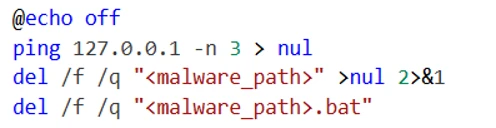
As a final cleanup step after encryption completes, the malware creates a batch to delete its own binary from disk. The cleanup batch loops until it successfully deletes the malware binary, then removes itself:
Figure 14. Self-deleting batch loop
Defending against DeadLock ransomware
Microsoft recommends the following mitigations to reduce the impact of this threat.
Read the human-operated ransomware threat overview for advice on developing a holistic security posture to prevent ransomware, including credential hygiene and hardening recommendations.
Turn on cloud-delivered protection in Microsoft Defender Antivirus or the equivalent for your antivirus product to cover rapidly evolving attacker tools and techniques. Cloud-based machine learning protections block a huge majority of new and unknown variants.
Run endpoint detection and response (EDR) in block mode so that Microsoft Defender for Endpoint can block malicious artifacts, even when your non-Microsoft antivirus does not detect the threat or when Microsoft Defender Antivirus is running in passive mode. EDR in block mode works behind the scenes to remediate malicious artifacts that are detected post-breach.
Configure investigation and remediation in full automated mode to let Microsoft Defender for Endpoint take immediate action on alerts to resolve breaches, significantly reducing alert volume.
Configure automatic attack disruption in Microsoft Defender XDR. Automatic attack disruption is designed to contain attacks in progress, limit the impact on an organization’s assets, and provide more time for security teams to remediate the attack fully.
To help preserve existing systems in the event of a ransomware attack, configure a Controlled Folder Access (CFA) policy to be as strict as possible. CFA protects valuable data from threats like ransomware by preventing write access to common system folders; more folders can also be added. Establishing this policy ahead of a ransomware event can enable organizations to respond quickly to ransomware signals, deploying the CFA policy to limit the destructive impact of an active attack. In certain instances, a CFA policy can also be leveraged proactively on specific sensitive assets that will not be negatively impacted by restrictive protections. Use audit mode to evaluate the impact to your organization in these cases.
Microsoft Defender XDR customers can turn on attack surface reduction rules to prevent several of the infection vectors of this threat. These rules, which can be configured by any user, offer significant hardening against targeted attacks. In observed attacks, Microsoft customers who had the following rules turned on could mitigate the attack in the initial stages and prevent hands-on-keyboard activity:
Block process creations originating from PSExec and WMI commands (Some organizations might experience compatibility issues with this rule on certain server systems but should deploy it to other systems to prevent lateral movement originating from PsExec and WMI)
You can assess how an attack surface reduction rule might impact your network by opening the security recommendation for that rule in Vulnerability management. In the Recommendation details pane, check the user impact to determine what percentage of your devices can accept a new policy enabling the rule in blocking mode without adverse impact to user productivity.
Microsoft Defender detections
Microsoft Defender customers can refer to the list of applicable detections below. Microsoft Defender coordinates detection, prevention, investigation, and response across endpoints, identities, email, apps to provide integrated protection against attacks like the threat discussed in this blog.
Microsoft Defender Antivirus
Microsoft Defender Antivirus detects threat components as the following malware:
The following alerts might indicate threat activity associated with this threat. These alerts, however, can be triggered by unrelated threat activity and are not monitored in the status cards provided with this report.
Ransomware-linked threat actor detected
Ransomware behavior detected in the file system
Possible ransomware activity
File backups were deleted
Potential human-operated malicious activity
Possible data exfiltration
Suspicious wallpaper change
The following alerts might indicate threat activity associated with DeadLock ransomware if Defender for Endpoint is set to block mode.
‘DeadLock’ ransomware was detected
‘DeadLock’ ransomware was prevented
Microsoft Defender for Cloud Apps
The following alert might indicate threat activity associated with this threat. This alert, however, can be triggered by unrelated threat activity and are not monitored in the status cards provided with this report.
Ransomware activity
Microsoft Security Copilot
Microsoft Security Copilot is embedded in Microsoft Defender and provides security teams with AI-powered capabilities to summarize incidents, analyze files and scripts, summarize identities, use guided responses, and generate device summaries, hunting queries, and incident reports.
Security Copilot is also available as a standalone experience where customers can perform specific security-related tasks, such as incident investigation, user analysis, and vulnerability impact assessment. In addition, Security Copilot offers developer scenarios that allow customers to build, test, publish, and integrate AI agents and plugins to meet unique security needs.
Threat intelligence reports
Microsoft Defender XDR customers can use the following threat analytics reports in the Defender portal (requires license for at least one Defender XDR product) to get the most up-to-date information about the threat actor, malicious activity, and techniques discussed in this blog. These reports provide the intelligence, protection information, and recommended actions to prevent, mitigate, or respond to associated threats found in customer environments.
Microsoft Security Copilot customers can also use the Microsoft Security Copilot integration in Microsoft Defender Threat Intelligence, either in the Security Copilot standalone portal or in the embedded experience in the Microsoft Defender portal to get more information about this threat actor.
To hear stories and insights from the Microsoft Threat Intelligence community about the ever-evolving threat landscape, listen to the Microsoft Threat Intelligence podcast.
Microsoft Threat Intelligence tracks DeadLock ransomware as an emerging financially motivated operation distinguished by its use of decentralized infrastructure to support victim communications and data leak operations. Its recovery ecosystem combines the Session messaging network with blockchain-backed services that store and deliver resources used throughout the extortion process. This architecture likely increases the resilience of portions of its communication, leak-hosting, and negotiation infrastructure, allowing DeadLock operators to recover from some disruption efforts while maintaining continuity for victims. Microsoft has observed DeadLock ransomware being deployed by multiple groups including an affiliate of the Lynx and INC ransomware ecosystems.
First observed in July 2025, DeadLock operators employ double extortion tactics, encrypting victim environments while threatening to publicly release exfiltrated data. As of July 2026, the operators have published more than 80 compromised organizations on their data leak site, called the DeadLock blog, with more than half of the claimed victims in Europe. Microsoft identified DeadLock ransomware impacting organizations across information technology (IT), mining, transportation and logistics, manufacturing, hospitality, consumer goods, and other sectors in Europe, Asia, North America, South America, and Africa.
The DeadLock encryptor includes a resource-aware throttling mechanism designed to maintain system responsiveness during encryption. In addition to its encryption capabilities, the ransomware also appears to implement language or country-based geofencing designed to avoid running in environments associated with former Soviet and Commonwealth of Independent States (CIS)-linked countries as well as select Middle Eastern countries, a pattern commonly observed among ransomware operators believed to operate from those regions. Together, these capabilities demonstrate how DeadLock combines established ransomware tradecraft with decentralized infrastructure designed to improve operational resilience.
In this blog, we present a technical analysis of the DeadLock ransomware encryptor, covering its execution flow, defense evasion techniques, encryption design, and post-encryption behaviors, including a decentralized recovery chat system. We also provide indicators of compromise (IOCs), Microsoft Defender detections, and mitigation guidance to help organizations defend against this threat and similar ransomware activity.
Pre-encryption
Configuration parsing
Before performing any malicious activity, the DeadLock encryptor decrypts an embedded configuration blob using XOR decoding with an 8-byte key.
Below are the malware’s configuration fields and their values.
As an early exit check, the malware queries the system’s default and user interface (UI) languages. If either language matches the exclude list in the configuration, the malware self-deletes immediately without performing any encryption.
The following languages trigger this exit behavior:
LANGID
Language
Country
1049
Russian
Russia
1058
Ukrainian
Ukraine
1059
Belarusian
Belarus
1064
Tajik (Cyrillic)
Tajikistan
1065
Persian
Iran
1067
Armenian
Armenia
1068
Azeri (Latin)
Azerbaijan
1079
Georgian
Georgia
1087
Kazakh
Kazakhstan
1088
Kyrgyz
Kyrgyzstan
1090
Turkmen
Turkmenistan
1114
Syriac
Syria
2072
Romanian (Moldova)
Moldova
2092
Azeri (Cyrillic)
Azerbaijan
2115
Uzbek (Cyrillic)
Uzbekistan
8193
Arabic
Oman
9217
Arabic (Yemen)
Yemen
Command-line processing and privilege elevation
The encryptor’s behavior branches based on command-line arguments and the current privilege level. If a target directory path is provided as the command-line argument, the malware skips all preparation steps and jumps directly to encryption. This feature allows the operator to invoke the encryptor with specific targets for focused encryption. If no sub-commands are provided and the process is already elevated, the malware proceeds normally through all execution phases.
The more interesting case occurs when no command-line argument is provided while the process is not elevated. In this scenario, the malware attempts to gain administrator privileges through a batch-script-based elevation technique. It generates a randomly named .cmd file (8 uppercase characters, such as ESYEKQSY.cmd) and executes it using ShellExecuteW with the RunAs verb, which triggers the Windows User Account Control (UAC) consent dialog. If the user denies the prompt, the malware retries up to 10 times before giving up and exiting.
During dynamic analysis, the sample did not successfully relaunch itself with elevated privileges. As a result, full pre-encryption preparation appears to require execution from an already elevated context. When invoked with a target path, the malware bypasses preparation and proceeds directly to encrypt accessible files. This behavior is specific to the analyzed sample and may change in later variants.
Token privilege escalation
When running with administrator privileges, the malware further expands its access by enabling SeDebugPrivilege, SeRestorePrivilege, SeBackupPrivilege, SeTakeOwnershipPrivilege, SeAuditPrivilege, and SeSecurityPrivilege. These privileges increase the malware’s ability to interact with system processes, protected files, and security-related settings, helping it overcome common access restrictions and maximize the scope of files and resources it can target during the encryption phase.
Recycle bin emptying
The malware silently empties the recycle bin on all drives without any UI or confirmation dialog, eliminating a potential source of file recovery for victims.
Custom icon registration
To visually brand encrypted files, the malware writes an embedded .ico file to C:\ProgramData\<UID>.ico and registers it as the default icon for files with the extension .dlock.
To associate the custom icon with encrypted files, the ransomware creates the HKLM\SOFTWARE\Classes\.dlock\DefaultIcon registry key and sets its (Default) value to the path of the dropped icon file.
Below is the malware’s embedded .ico file.
Figure 1. DeadLock icon for encrypted files
Process and service termination
Before starting encryption, the malware terminates processes and disables services that could interfere with file access or provide defensive capabilities. This approach ensures that locked files become accessible for encryption while simultaneously disrupting the environment’s ability to detect, respond to, or recover from the attack.
For services, the malware enumerates all active Win32 services and compares them against the stop list in the configuration. For each matching service, DeadLock sets its start type to DISABLED and sends a stop command to terminate that service. Notable targets include windefend (Windows Defender), vss/swprv/wbengine (Volume Shadow Copy and Backup services), mssearch, Hyper-V services (vmcompute, vmms), and Active Directory services (adws, ntds, kdc). Below is the full service stop list in the malware configuration:
Figure 2. Service stop list
For processes, the malware enumerates all running processes and terminates any matching its stop list while skipping its own process ID. Targeted processes include security tools (msmpeng, securityhealthservice, smartscreen), backup and cloud sync applications (onedrive, dropbox, googledrivefs, owncloud), remote access tools (anydesk, putty, mstsc, rustdesk), shell and system processes (explorer, powershell, taskmgr, cmd), and search/indexing services. Below is the full process stop list in the malware configuration:
Figure 3. Process stop list
Event log clearing
To eliminate forensic evidence, the malware employs three complementary methods that collectively ensure every event log channel on the system is cleared of existing entries, disabled from recording future events, and has its access permissions locked down:
Direct clearing: Clears the following log channels via the classic Event Log API: Application, Security, Setup, Servicing, Eventlog, Forwarded Events, Windows PowerShell, and System.
Registry-based disabling: Enumerates every sub-key under HKLM\SOFTWARE\Microsoft\Windows\CurrentVersion\WINEVT\Channels. For each channel, sets Enabled to 0 (disabling all future logging) and overwrites ChannelAccess with a restrictive Security Descriptor Definition Language (SDDL) string that limits access to SYSTEM, built-in administrators, and local admin.
Modern API enumeration: Uses wevtapi.dll to enumerate all registered event log channel paths (including custom application channels not in the hardcoded list) before clearing each one.
By combining API-based clearing, registry manipulation, and full channel enumeration, the malware covers multiple log sources, including third-party application logs and custom diagnostic channels, to minimize existing forensic evidence on the infected device.
Directory traversal
To maintain system stability and ensure the victim can access ransom instructions, the malware excludes specific directories, file extensions, and file names from encryption. This selective encryption model is a common ransomware design pattern where the system must remain operational enough for the victim to receive instructions and facilitate payment.
Extensions and file names from the configuration’s file exclude list are skipped during encryption:
Figure 4. List of skipped extensions and file names
For directory processing, the malware uses a two-tier directory exclusion system applied at different stages of the encryption pipeline. Tier 1 provides rough filtering that saves significant time by avoiding traversal overhead, while tier 2 provides granular path-specific exclusions within directories that are traversed. Both prevent encryption, but they operate at different stages of the traversal pipeline.
In its pre-traversal phase (tier 1), the malware checked at the drive batch level before threads are spawned for traversal. If a top-level directory matches against the configured directory exclude list (\users\*\appdata, program files (x86)\, program files\, and programdata\), the entire tree is skipped without being walked.
In its during-traversal phase (tier 2), the malware checked the file name during recursive directory enumeration and applied to both subdirectories and files as they are encountered. In this tier, the directory and file names are checked against the configured sub-path exclude list below.
Figure 5. Sub-path exclude list
Encryption
Resource-aware throttling
One of the more distinctive aspects of the DeadLock encryptor is its resource-aware throttling mechanism, designed to keep the infected system responsive during encryption. The malware spawns a dedicated monitoring/dispatch thread per drive batch that acts as a gatekeeper for file encryption dispatch. Before dispatching each new file to be encrypted, this thread polls system resource utilization and checks against hardcoded thresholds:
Polls memory and CPU idle before each file dispatch
Calculates memory usage percentage and CPU idle percentage
If memory usage exceeds 29% or CPU load exceeds 70% (idle < 30%), the dispatch thread pauses via a waitable timer and retries until resources return below thresholds
Once thresholds are within limits, atomically sets a dispatch flag on the work queue and signals waiting encrypting worker threads
With this mechanism, worker threads already encrypting files are not interrupted, and only the dispatch of new files is gated. This means partially encrypted files are expected to complete, and the throttling manifests as reduced parallelism rather than stop/start behavior. This approach can prevent system hangs that would alert the user and reduce the likelihood of behavioral detection by maintaining normal-looking resource consumption patterns.
Thread architecture
For the encryption work itself, the malware spawns directory processing threads, with the thread count being 2 times the CPU core number. Each thread recursively traverses directories, dropping ransom notes and dispatching files for encryption. Individual file encryption threads are tasked with handling the actual cryptographic operations.
Cryptographic scheme
The DeadLock ransomware implements a hybrid cryptographic design that combines Curve25519 elliptic-curve cryptography with the XChaCha20 stream cipher for file encryption. Key encapsulation uses the Networking and Cryptography Library (NaCl) crypto_box construction, which pairs an asymmetric key exchange with authenticated encryption to securely wrap each file’s symmetric key.
The configuration’s operator public key 03bf50bbf97c4e951e66ff12b689a37a3ce675b4921e254eae76da77573843e4a9 is 33 bytes. The leading 03 byte is a SEC1 compressed point format prefix borrowed from Bitcoin/secp256k1. The malware validates this prefix byte against a lookup table that accepts 00, 02, 03, 04, and 05, mapping each to an expected key length.
After format validation, only the remaining 32 bytes are used in the actual Curve25519 ECDH scalar multiplication. This SEC1 prefix is non-standard for Curve25519, which natively uses bare 32-byte keys, and the malware author has likely adopted it for format versioning across their builder and decryptor tooling.
Per-file encryption process
For each target file, the malware performs the following sequence of operations:
Rename the target file from <filename> to <filename>.<UID>.dlock
Open the renamed file and retrieve file size/attributes
Clear the system attribute if FILE_ATTRIBUTE_SYSTEM is set
24-byte random XChaCha20 nonce (first 16 bytes for HChaCha20 subkey derivation, last 8 bytes as stream nonce)
32-byte random ephemeral Curve25519 private key
12-byte random file tag (only the first byte is functionally referenced by the encryptor to derive padding length; the remaining 11 bytes serve as a random file identifier written to the cleartext footer, likely used by the decryptor for file correlation/tracking)
Perform Curve25519 ECDH: Multiply the ephemeral private key by the attacker’s embedded public key to derive a shared secret
Build metadata plaintext: XChaCha20 key + 24-byte XChaCha20 nonce + random padding + dDlK magic + optional FA flag + chunk parameters
Encrypt metadata using crypto_box (XSalsa20-Poly1305) with the ECDH shared secret and a zero nonce
Encrypt file content using XChaCha20 with the generated key and 24-byte nonce
Append the encrypted footer/metadata to the end of the file
The use of a zero crypto_box nonce is worth noting. This is cryptographically safe because each file generates a unique ephemeral Curve25519 keypair, which produces a unique ECDH shared secret per file. With this, a constant zero nonce never repeats with the same key.
The entire design ensures that each file is encrypted with a distinct key derived from a per-file ephemeral key exchange, eliminating any possibility of key reuse across files. Overall, the cryptographic construction is sound and does not present a practical path to decryption without the attacker’s private key.
File size-based encryption strategy
To balance encryption thoroughness with speed, the malware implements a tiered encryption policy based on file size. The encryption rule in the configuration 1000,05052429880,025124288000,010524288000,F991114288000 encodes this policy. Each comma-separated entry is parsed by splitting at position 3: the first 3 characters represent the encryption percentage (decimal), and the remaining characters represent the file size threshold (decimal bytes). The special prefix F replaces the percentage field with a chunked-full mode.
Rule
Encryption percent
File size threshold
Behavior
1000
100%
≥ 0 bytes
Default: encrypt entire file
05052429880
50%
≥ ~50 MB
Encrypt 50% of file in distributed chunks
025124288000
25%
≥ ~118 MB
Encrypt 25% in distributed chunks
010524288000
10%
≥ ~500 MB
Encrypt 10% in distributed chunks
F991114288000
Chunked
≥ ~1 GB
Special full-chunk mode with calculated intervals
Rules are evaluated in order, and the last matching rule wins. For example, when the malware processes a 2 GB file, all rules match, but the final F99… entry will determine the encryption behavior.
For partial encryption, the malware calculates:
Total bytes to encrypt = ceil(file_size × (percentage / 100))
This creates an intermittent encryption pattern where 512-byte blocks are encrypted at regular intervals throughout the file. The result is a file that is rendered unusable while requiring only a fraction of the time needed for full encryption. This is a crucial optimization for the ransomware when targeting large files such as databases, virtual machine images, and backups.
File footer
After encryption, the malware appends a structured metadata blob to the end of each file. This footer contains all the information the decryptor needs to reverse the encryption, along with markers for format validation:
Figure 6. DeadLock file footer
The footer serves several important functions:
Key and nonce reconstruction: The cleartext ephemeral Curve25519 public key (33 bytes) at the end of the footer allows the decryptor to recompute the ECDH shared secret and open the crypto_box to recover the XChaCha20 key and nonce used for file content encryption.
Inner dDlK magic (decryption validation): After the decryptor opens the crypto_box, it checks for the dDlK marker at the expected offset (32 + 24 + padding_length bytes into the plaintext) to confirm the correct private key was used and that decryption succeeded. While the Poly1305 Message Authentication Code (MAC) already provides cryptographic integrity verification, this marker offers a fast format-level sanity check.
FA flag (decryption mode indicator): This flag is used by the decryptor to determine which read strategy to use when reversing the encryption. It is present when the file was encrypted using sequential/contiguous block encryption, and absent when intermittent/skip encryption was used. Specifically, FA is appended in two cases:
F-prefix rule matched: When the file size triggers the F991114288000 config entry (the special chunked-full mode), the FA flag is always set.
Percentage rule with zero skip interval: When a percentage-based rule matches but the calculated skip interval between encrypted chunks works out to zero (meaning the percentage effectively covers the entire file), FA is also set.
Without this flag, the 8-byte chunk parameters in the footer would be ambiguous as they could represent either a block count or a skip interval. The FA flag resolves this ambiguity and enables the decryptor to correctly reconstruct the original file.
File identifier/format tag: The 12-byte random value in the cleartext footer serves as a file identifier (with the first byte used to derive the padding length inside the encrypted payload).
Post-encryption
Wallpaper
As an immediate visual indicator of compromise, the malware generates a custom BMP wallpaper file at runtime using the victim’s screen resolution. Below is an example of the generated BMP wallpaper:
Figure 7. DeadLock wallpaper
The wallpaper is written to C:\ProgramData\<UID>.bmp (on Vista and later) or C:\Documents and Settings\All Users\Application Data\<UID>.bmp (on XP), set as the desktop background, and persisted in the registry at HKLM\SOFTWARE\Microsoft\Windows\CurrentVersion\Policies\System\Wallpaper.
Ransom notes deployment
After encrypting files, the malware deploys two types of ransom notes, each with distinct deployment logic and purpose:
Text note (HOW_RECOVER.<UID>.txt): The text note is dropped into every encrypted directory, but with a notable timing behavior: it is only deployed during the second pass of the directory processing loop. The malware iterates over drive batches multiple times, and the text note drop is gated by an iteration counter. On the first pass, the text note is suppressed, likely to prioritize encryption speed before littering the file system with ransom note files. For defenders and analysts, this has a practical implication: if testing with a minimal drive configuration that only triggers a single iteration, the text note will never appear.
Below is the text note content from the malware’s configuration.
Figure 8. DeadLock text ransom note
HTML note (RECOVERY_CHAT.<UID>.html): This file is dropped to all drive root directories and all Desktop folders. Unlike the text note, the HTML note is a full interactive web application with a self-contained single-page application that implements end-to-end encrypted chat, a paginated data leak blog, and a file browser, all without requiring a traditional backend server. The technical architecture of this recovery chat system is detailed in Recovery chat: Technical architecture.
Recovery chat: Technical architecture
The most distinctive feature of the DeadLock ransomware is its recovery chat system. The RECOVERY_CHAT.<UID>.html file is a self-contained HTML application that implements a full end-to-end encrypted chat system, a paginated data leak blog, and a file browser, all without requiring a traditional backend server.
Figure 9. HTML application “About” page UI
The architecture is designed with three decentralized components.
Polygon blockchain as configuration store
Rather than relying on traditional domain-based infrastructure that can be seized or taken offline, the DeadLock operators store configuration data on the Polygon blockchain. Two smart contracts serve as censorship-resistant infrastructure:
Contract
Address
Function selector
Purpose
Chat proxy
0x8EF7c3e531d871D3B9D559722DE77EB1dEc19dAe
0x933a9ce8
Stores the proxy server URL
Blog
0x757984507c82c8dA1d3969c535dB5706eEE6426C
0xd4070542
Stores actor’s blog posts
The HTML page issues eth_call requests to public Polygon Remote Procedure Call (RPC) endpoints (no wallet required with read-only calls) to obtain the proxy server address. The blog contract takes offset and limit parameters (for pagination) and returns structured data including post titles, bodies, timestamps, image URLs, and file attachment links.
On-chain storage provides several strategic advantages for the threat actor: the proxy URL can be updated by modifying the smart contract without changing any victim-facing infrastructure, and no domain registration or DNS infrastructure is required. This represents a notable evolution in ransomware infrastructure design.
The HTML recovery chat cycles through six public RPC endpoints for redundancy: polygon-bor-rpc.publicnode[.]com, polygon.drpc[.]org, polygon-pokt.nodies[.]app, polygon-rpc[.]com, 1rpc[.]io/matic, and polygon.meowrpc[.]com.
Session network for end-to-end encrypted chat
For victim-operator communication, chat messages are routed through the Session decentralized messenger network, which is an onion-routed, swarm-based messaging protocol that provides anonymity for both parties. The proxy server (whose URL is retrieved from the blockchain) acts as a relay between the victim’s browser and Session swarm nodes.
Figure 10. HTML application ”Chat” page UI
Key generation: DeadLock’s design choice is that the victim’s Session identity is derived deterministically from their sign-in credentials. When the victim enters their credentials on the HTML page, the following derivation occurs:
Figure 11. Derivation after victim entered credentials
This deterministic derivation means the same credentials always produce the same keypair, and no account registration is needed as the victim’s Session identity exists only when they enter the correct credentials. If the victim forgets their credentials, the identity is unrecoverable (as stated by the actor in the chat UI). The 05 prefix is Session’s standard network identifier for user accounts.
Sending a message: The following sequence occurs when a message is sent:
Encode the body and timestamp as protobuf
Create an actor message and a self-sync copy
Pad plaintext to 160-byte boundary
Sign the padded content and key context with Ed25519
Append the sender public key and signature
Seal each payload with the recipient’s Curve25519 key
Wrap in Session’s onion request protobuf format (verb: PUT, path: /api/v1/message)
Ask the proxy to submit both copies to their respective swarms
Receiving a message: The following sequence occurs when a message is received:
Sign “retrieve” + timestamp with the victim’s Ed25519 key
Select a node associated with the victim’s own swarm
Ask the proxy to poll for messages addressed to that identity
Open each sealed box with the victim’s Curve25519 keypair
Remove the appended public key and signature
Strip padding, decode protobuf, and extract the message body
Data leak blog and Wasabi file hosting
The recovery chat page also provides access to a data leak blog whose content is stored on the Polygon blockchain.
Figure 12. Redacted HTML app “Blog” page UI
Blog posts retrieved from the smart contract support BBCode formatting, image galleries, and file attachments using either direct URLs or Wasabi protocol links that open an in-browser file explorer. The HTML application contains a full Amazon Web Services (AWS) S3-compatible file browser that parses the Wasabi credentials from the URI, generates AWS4-HMAC-SHA256 signed requests, lists bucket contents with folder navigation, and generates pre-signed download URLs for individual files. This allows the attacker to host stolen data on Wasabi and provide victims or the public with browsable access to the leaked files without running a web server.
Infrastructure resilience summary
Figure 13. HTML recovery chat infrastructure summary
The architecture is significantly more resilient to takedown and censorship efforts, but it is not independent of off-chain infrastructure:
Proxy replacement: The actor can update the on-chain proxy URL without changing the HTML
On-chain persistence: Contract-stored blog data is resistant to conventional hosting takedowns
RPC dependency: The page still requires access to at least one public Polygon RPC endpoint
Proxy dependency: Chat access depends on the current custom proxy remaining reachable
Storage dependency: Images and leaked files can be removed from CDN or Wasabi hosting
Session resilience: Distributed swarm storage reduces reliance on a single messaging server
This infrastructure model represents a meaningful evolution from traditional ransomware communication channels and poses new challenges for takedown efforts.
Self-deletion
As a final cleanup step after encryption completes, the malware creates a batch to delete its own binary from disk. The cleanup batch loops until it successfully deletes the malware binary, then removes itself:
Figure 14. Self-deleting batch loop
Defending against DeadLock ransomware
Microsoft recommends the following mitigations to reduce the impact of this threat.
Read the human-operated ransomware threat overview for advice on developing a holistic security posture to prevent ransomware, including credential hygiene and hardening recommendations.
Turn on cloud-delivered protection in Microsoft Defender Antivirus or the equivalent for your antivirus product to cover rapidly evolving attacker tools and techniques. Cloud-based machine learning protections block a huge majority of new and unknown variants.
Run endpoint detection and response (EDR) in block mode so that Microsoft Defender for Endpoint can block malicious artifacts, even when your non-Microsoft antivirus does not detect the threat or when Microsoft Defender Antivirus is running in passive mode. EDR in block mode works behind the scenes to remediate malicious artifacts that are detected post-breach.
Configure investigation and remediation in full automated mode to let Microsoft Defender for Endpoint take immediate action on alerts to resolve breaches, significantly reducing alert volume.
Configure automatic attack disruption in Microsoft Defender XDR. Automatic attack disruption is designed to contain attacks in progress, limit the impact on an organization’s assets, and provide more time for security teams to remediate the attack fully.
To help preserve existing systems in the event of a ransomware attack, configure a Controlled Folder Access (CFA) policy to be as strict as possible. CFA protects valuable data from threats like ransomware by preventing write access to common system folders; more folders can also be added. Establishing this policy ahead of a ransomware event can enable organizations to respond quickly to ransomware signals, deploying the CFA policy to limit the destructive impact of an active attack. In certain instances, a CFA policy can also be leveraged proactively on specific sensitive assets that will not be negatively impacted by restrictive protections. Use audit mode to evaluate the impact to your organization in these cases.
Microsoft Defender XDR customers can turn on attack surface reduction rules to prevent several of the infection vectors of this threat. These rules, which can be configured by any user, offer significant hardening against targeted attacks. In observed attacks, Microsoft customers who had the following rules turned on could mitigate the attack in the initial stages and prevent hands-on-keyboard activity:
Block process creations originating from PSExec and WMI commands (Some organizations might experience compatibility issues with this rule on certain server systems but should deploy it to other systems to prevent lateral movement originating from PsExec and WMI)
You can assess how an attack surface reduction rule might impact your network by opening the security recommendation for that rule in Vulnerability management. In the Recommendation details pane, check the user impact to determine what percentage of your devices can accept a new policy enabling the rule in blocking mode without adverse impact to user productivity.
Microsoft Defender detections
Microsoft Defender customers can refer to the list of applicable detections below. Microsoft Defender coordinates detection, prevention, investigation, and response across endpoints, identities, email, apps to provide integrated protection against attacks like the threat discussed in this blog.
Microsoft Defender Antivirus
Microsoft Defender Antivirus detects threat components as the following malware:
The following alerts might indicate threat activity associated with this threat. These alerts, however, can be triggered by unrelated threat activity and are not monitored in the status cards provided with this report.
Ransomware-linked threat actor detected
Ransomware behavior detected in the file system
Possible ransomware activity
File backups were deleted
Potential human-operated malicious activity
Possible data exfiltration
Suspicious wallpaper change
The following alerts might indicate threat activity associated with DeadLock ransomware if Defender for Endpoint is set to block mode.
‘DeadLock’ ransomware was detected
‘DeadLock’ ransomware was prevented
Microsoft Defender for Cloud Apps
The following alert might indicate threat activity associated with this threat. This alert, however, can be triggered by unrelated threat activity and are not monitored in the status cards provided with this report.
Ransomware activity
Microsoft Security Copilot
Microsoft Security Copilot is embedded in Microsoft Defender and provides security teams with AI-powered capabilities to summarize incidents, analyze files and scripts, summarize identities, use guided responses, and generate device summaries, hunting queries, and incident reports.
Security Copilot is also available as a standalone experience where customers can perform specific security-related tasks, such as incident investigation, user analysis, and vulnerability impact assessment. In addition, Security Copilot offers developer scenarios that allow customers to build, test, publish, and integrate AI agents and plugins to meet unique security needs.
Threat intelligence reports
Microsoft Defender XDR customers can use the following threat analytics reports in the Defender portal (requires license for at least one Defender XDR product) to get the most up-to-date information about the threat actor, malicious activity, and techniques discussed in this blog. These reports provide the intelligence, protection information, and recommended actions to prevent, mitigate, or respond to associated threats found in customer environments.
Microsoft Security Copilot customers can also use the Microsoft Security Copilot integration in Microsoft Defender Threat Intelligence, either in the Security Copilot standalone portal or in the embedded experience in the Microsoft Defender portal to get more information about this threat actor.
To hear stories and insights from the Microsoft Threat Intelligence community about the ever-evolving threat landscape, listen to the Microsoft Threat Intelligence podcast.
Microsoft's cloud storage app OneDrive got a new Photos app in the worst possible way, reports the blog Neowin . "The app is reportedly showing up even on Windows 11 Enterprise machines, despite apparently being a beta application aimed at consumer functionality."
One admin questioned why a beta app was appearing on an Enterprise SKU in the first place, while another described the situation as yet another consumer-oriented feature being forced onto corporate PCs. Things get even more frustrating for IT departments because there does not appear to be a straightforward Microsoft-provided way to disable the app... Enterprise administrators generally need to know what is being installed on their managed devices, particularly when a software is labeled as beta. Quietly adding another application and leaving admins to clean it up themselves is therefore unlikely to win Microsoft many fans.
But there's another problem, according to the blog Windows Latest. "OneDrive Photos automatically scans your system storage for photos," and apparently "doesn't need a Microsoft account to work, as it can also detect your local files."
There's also a People section that groups similar faces in your photos. Microsoft asks for permission before turning it on and explicitly warns that facial data could be considered biometric data in some regions. The company says only you can see the grouped faces, that the data isn't shared with third parties, and that you can delete it by disabling the feature.
In a statement to Neowin,
Microsoft admitted this new photos "experience" they're "incubating" had gone "more broadly than it should have," and then promised that "We're fixing that." The spokesperson also said the Windows Photos app will "always give you the option of local and cloud photos" and, also a choice of whether or not to use it OneDrive."
But there's another "awkward catch," notes the blog Digital Trends. "Users currently can't uninstall OneDrive Photos without removing the main OneDrive app too."
Because OneDrive Photos is tied to the main OneDrive sync client, Windows 11 doesn't currently offer a separate uninstall option. The only straightforward way to get rid of OneDrive Photos right now is to uninstall OneDrive itself... Removing the main client can also affect its File Explorer integration and shortcuts...
Microsoft says this will change. The company is working on controls that will let users remove OneDrive Photos separately from the main OneDrive app. On enterprise PCs managed through Intune, Microsoft says the app will automatically disappear where it isn't supported.
Since early May 2026, Microsoft Threat Intelligence has observed Storm-2945, a sub-cluster of Midnight Blizzard, conducting widespread but targeted traffic manipulation attacks involving hospitality sector networks served by captive portals worldwide. Despite some tactic, technique, and procedure (TTP) similarities to the Forest Blizzard DNS hijacking operation that we publicly disclosed in April 2026, we attribute this campaign, which we call CaptiveCrunch, to Storm-2945. As reported by ReliaQuest on July 23, a portion of this activity leverages doppelganger domains mimicking Microsoft online services to conduct follow-on adversary-in-the-middle (AitM) phishing operations that abuse the device code authentication flow in Microsoft Entra ID. Microsoft Threat Intelligence has also identified active traffic manipulation attacks leading to the delivery of malware on impacted systems. Microsoft has observed Storm-2945 leveraging AI to support a significant portion of these operations.
Today, we are sharing our findings on these ongoing intrusions to raise awareness of this threat and enable customers to protect their devices, especially while traveling. We provide our assessment of Storm-2945’s relationship to Midnight Blizzard and analysis of the CaptiveCrunch campaign, detailing the malware and tradecraft used in these operations. We also provide mitigation, detection, and hunting guidance to help organizations identify and defend against Storm-2945 and related activity.
Microsoft Threat Intelligence would like to thank our partners at Anthropic and OpenAI for their collaboration and support during this investigation.
The CaptiveCrunch campaign
Since February 2026, Storm-2945 has conducted AI-augmented operations including targeted device code and OAuth code phishing campaigns leading to Entra device registration and subsequent data collection from Microsoft 365. Since early May 2026, Microsoft Threat Intelligence has observed Storm-2945 manipulating DNS and HTTP traffic from networks served by captive portals to redirect user traffic through actor-controlled infrastructure. Although our investigation into the initial compromise vector for the captive portal networks is ongoing, we have observed notable commonalities in the equipment and management systems used across multiple affected networks. These similarities suggest that the activity might not be limited to isolated compromises of individual venues and could reflect access to shared services within portions of the captive portal ecosystem.
Figure 1. Overview of the CaptiveCrunch attack flow
As part of the CaptiveCrunch campaign, Storm-2945 has leveraged their AitM position to redirect users through actor-controlled phishing infrastructure and has also delivered malware purporting to be browser or operating system updates in response to automated connectivity checks issued by users’ browsers. Multiple variants have been delivered, including fully-featured Windows remote access trojans (RAT) in compiled Golang, with functionality to conduct system enumeration, collect files and keystrokes, steal credentials and session tokens, conduct audio and video surveillance, monitor for removable media, and provide the threat actor a remote shell on infected systems.
The threat actor infrastructure leverages a variety of ClickFix techniques to elicit the user into downloading and executing the malware:
Figure 2. ClickFix prompt with manual user instructionsFigure 3. ClickFix prompt with additional user instructions after verification failure
In addition to variants of malware targeting Windows systems, Microsoft Threat Intelligence is also aware of indications that the threat actor might be targeting Android devices with similar techniques as the ClickFix landings also include instructions for Android devices to download and install an APK file.
To date, Microsoft has identified widespread compromise of Wi-Fi networks at hospitality-related organizations and other networks serviced by captive portal equipment in several countries. ReliaQuest has identified this activity not only at hotels, but also conference centers and other shared venues, and assesses that the goal of this activity is to access the accounts of corporate travelers.
Storm-2945 and Midnight Blizzard
Microsoft Threat Intelligence assesses that Storm-2945 is an operational sub-cluster of Midnight Blizzard based on distinctive technical and operational overlaps. These include technical similarities to Storm-2372, a Midnight Blizzard initial access operations sub-cluster, also notable for their device code and OAuth code phishing operations tracked throughout 2025, Microsoft Graph-based email exfiltration, social engineering delivered via commercial messaging apps, and significant similarities in victimology.
Midnight Blizzard is a Russia-based threat actor attributed by the US and UK governments to the Foreign Intelligence Service of the Russian Federation, also known as the SVR. This threat actor is known to primarily target governments, diplomatic entities, non-governmental organizations (NGOs), and information technology (IT) service providers, primarily in the US and Europe. Midnight Blizzard is consistent and persistent in their operational targeting, and their objectives rarely change. Their focus is to collect intelligence through longstanding and dedicated espionage in support of Russian foreign policy interests.
Midnight Blizzard operations often involve compromise of valid accounts and, in some highly targeted cases, advanced techniques to compromise authentication mechanisms within an organization to expand access and evade detection. They utilize diverse initial access methods, and Midnight Blizzard is also adept at identifying and abusing OAuth applications to move laterally across cloud environments and for post-compromise activity, such as email collection.
CaptiveCrunch tradecraft and tooling
CornFlake: Remote access and infostealer implant
CornFlake is a full-featured Windows RAT written in Go that serves as Storm-2945’s primary persistent implant. Microsoft has observed the threat actor rapidly iterating on this malware layer, which features customizable capabilities from the social engineering user interface and data collection capabilities to anti-detection and evasion techniques.
On initial execution, CornFlake operates in dropper mode: it displays a convincing fake progress window designed to occupy the victim’s attention while the binary copies itself to %APPDATA%\svchost32\svchost32.exe and establishes persistence.
Fake window options configurable by the threat actor at build time:
winupdate — A Windows Update screen displaying “Working on updates… Don’t turn off your computer”
defender — A Windows Security virus scan
directx — A DirectX End-User Runtime Web Installer
vcredist — A Microsoft Visual C++ 2015-2022 Redistributable installer
sysopt — A disk optimization utility
netfix — A Windows Network Diagnostics tool
browser — A browser update prompt
pdfview — A document viewer installer
Figure 4. False update window
CornFlake registers as a Windows service named svchost32 with the display name “Cloud Sync Service” and description “Synchronizes files with the cloud storage provider”, deliberately mimicking the legitimate svchost.exe process. It establishes redundant persistence mechanisms: Windows service registrations, Registry Run keys, named scheduled tasks, and a persistence watchdog routine that runs continuously to restore any persistence mechanism that is removed by defenders or endpoint protection.
For command and control (C2), CornFlake performs an Elliptic Curve Diffie-Hellman (ECDH) P-256 ephemeral key exchange with the C2 server, derives a session key via SHA-256, and communicates over a custom JSON protocol framed within the encrypted channel. This provides an encrypted channel to the C2 server, with each C2 session using a unique ephemeral key, making decryption of captured traffic impossible without the session-specific private key. The runtime configuration file sync.dat supports hot reconfiguration of C2 servers, watched directories, file targeting patterns, and Transport Layer Security (TLS) settings without requiring redeployment.
Once established on a victim system, CornFlake provides the operator with a comprehensive collection toolkit, gated by configuration flags that allow selective activation post-deployment:
Capability
Description
Keylogging
Raw input API-based keylogger capturing all keystrokes, including password fields
Clipboard monitoring
Captures clipboard changes with SHA-256 deduplication and records the active window title at time of capture
Screenshot capture
Idle-triggered and on-demand screenshots with configurable idle threshold
Audio surveillance
Windows Audio Session API (WASAPI)-based microphone capture, encoded as WAV files
Video surveillance
Media Foundation-based webcam capture, encoded as JPEG
Browser credential theft
ChromeKatz-derived module supporting live cookie extraction from process memory (Chromium browsers) and stored password extraction from on-disk databases, including Chrome App-Bound Encryption (ABE) bypass and Firefox NSS/SDR decryption
File exfiltration
Targets files based on file extensions with real-time file system monitoring and an upload throttle (1,000 files or 500 MB per cycle). File extensions are categorized as Documents, Archives, Images, Code, Data, Emails, and Keys
USB drive monitoring
Detects and scans removable media when inserted
Security posture sweep
Collects 18 categories of host intelligence including installed software, antivirus (AV)/endpoint detection and response (EDR) products, Defender exclusions, User Account Control (UAC) level, Remote Desktop Protocol (RDP) history, Office most recently used (MRU) files, and credential hints
Remote shell
Arbitrary command execution via cmd.exe or PowerShell (with -NoP flag to suppress profile-based detection)
CornFlake also exposes a localhost HTTP API server (/upload, /reload, /status) that transforms the RAT into a modular platform: companion or next-stage payloads such as ChocoShell could task file exfiltration, trigger configuration hot reloads or check C2 connectivity using the pre-established secure C2 channel for communication.
ChocoShell: PowerShell infostealer
ChocoShell is the campaign’s Powershell-based infostealer, delivered and executed entirely in-memory. Its primary objective is the high-volume theft of browser session cookies, saved passwords, Microsoft 365 Single Sign-On (SSO) tokens, and Wi-Fi credentials from compromised systems. Where CornFlake provides the operator with a persistent, long-running foothold on the device, ChocoShell is designed to extract the most operationally valuable credentials, giving the operator access to victim cloud environments.
The ChocoShell script was authored with full developer comments that reveal the operator’s intent behind each code decision, including explicit references to Microsoft detection signatures and the reasoning behind specific evasion choices. The consistent coding standard and descriptive commentary suggest the author might have leveraged AI-assisted code generation.
Defense evasion. Upon execution, ChocoShell beacons to a hardcoded C2 server at 213.145.86[.]112 and implements several evasion techniques in sequence. It disables the Antimalware Scan Interface (AMSI) via .NET reflection to prevent ScriptBlock scanning and evades Microsoft behavioral detection that triggers on suspicious PowerShell web request cmdlets. A timing-based sandbox detection check is also employed as a virtual machine (VM) detection mechanism, silently exiting without performing any collection if detected.
C2 communication. ChocoShell communicates with its C2 server using HTTPS with URI paths designed to blend in with legitimate web traffic. Beacons use /t/pixel.gif?m=<status>, mimicking an image tracking pixel. Additional tooling is fetched from /cdn/chunks/polyfill-7e2b.min.js, disguised as a JavaScript polyfill file. This downloaded module is Base64-decoded and executed in memory via [ScriptBlock]::Create(), providing browser encryption key extraction capabilities, SYSTEM token impersonation, and Defender signature locking. Exfiltrated data is sent by POST to /t/event as GZip-compressed, Base64-wrapped JSON.
Privilege escalation. ChocoShell requires administrative privileges for its most impactful capabilities: SYSTEM token impersonation for Chrome ABE decryption, Volume Shadow Copy Service (VSS) shadow copy creation, Defender signature locking. It implements three silent UAC bypass techniques with ordered fallback:
SilentCleanup task hijack: Writes a malicious command to HKCU\Environment\windir, then triggers the built-in SilentCleanup scheduled task, which resolves %windir% from the user’s environment, executing the threat actor’s command at elevated privilege. The registry value is cleaned up after two seconds to avoid cloud detection.
wsreset.exe COM hijack: Creates a COM handler key in HKCU\Software\Classes and launches the auto-elevating Windows Store reset tool.
sdclt.exe folder hijack: Hijacks HKCU\Software\Classes\Folder\shell\open\command and launches the Windows Backup utility with the /KickOffElev flag.
If none of the silent bypasses succeed (for example, the user is not a local administrator), ChocoShell falls back to a visible UAC prompt via Start-Process -Verb RunAs. Notably, the script also contains a variant designed to execute within the WinGet Desired State Configuration (DSC) host process (ConfigurationRemotingServer), suggesting an attack vector through malicious WinGet DSC configuration used in Windows machine provisioning.
Credential and session theft. Once running with elevated permissions, ChocoShell locks Defender signature updates and systematically harvests data from multiple sources. For Chromium-based browsers (Chrome, Edge, Brave, Opera, Opera GX, Vivaldi), it extracts the master encryption key from the browser’s Local State file, handling both the modern ABE scheme (Chrome v127+) and the legacy data protection API (DPAPI)-only scheme. ABE decryption requires SYSTEM-level DPAPI access, which the malware obtains by impersonating a SYSTEM process token borrowed from winlogon.exe, wininit.exe, or services.exe. Locked browser SQLite databases are accessed through three strategies: shared file access, Volume Shadow Service snapshots, and direct copy as a fallback.
As a parallel collection path, ChocoShell launches Chrome, Edge, and Brave with the –remote-debugging-port flag and issues Network.getAllCookies through the Chrome DevTools Protocol (CDP). This completely bypasses ABE, enabling the browser to perform its own internal decryption and returns plaintext cookie values. To handle privilege issues (SYSTEM-launched browsers inherit the wrong token), the malware creates transient scheduled tasks with TASK_LOGON_INTERACTIVE_TOKEN to launch the browser under the signed-in user’s session. After extraction, the browser is stopped and relaunched with –restore-last-session to avoid alerting the user.
For Firefox family browsers (Firefox, Waterfox, LibreWolf, Floorp, Zen), the malware copies unencrypted cookies.sqlite databases from each profile. Additionally, ChocoShell collects Microsoft 365 and Azure Active Directory (AD) access tokens, refresh tokens, and Web Account Manager (WAM) tokens from .tbres files in the Token Broker cache. Collection of these tokens represents a significant threat to enterprise environments, as threat actors could replay SSO sessions without browser cookies. Additionally, Wi-Fi credentials are harvested via netsh wlan show profile with key=clear.
Exfiltration and cleanup. All collected data is aggregated into a JSON structure, GZip-compressed, Base64-encoded, and sent by POST to the C2’s /t/event endpoint. After exfiltration, all collected data variables are nulled, garbage collection is forced, VSS shadow copies are deleted via Windows Management Instrumentation (WMI), temporary elevation scripts are removed, and all UAC bypass registry keys (already cleaned during escalation) are verified removed.
FruitStone: Operator C2 panel
FruitStone is the web-based C2 panel that Storm-2945 operators use to manage the entire CaptiveCrunch campaign infrastructure. Implemented as a single-page application (HTML and JavaScript) serving as the front-end of the C2 server with all functionality exposed without authentication, FruitStone provides a centralized dashboard for managing compromised endpoints, building and deploying new campaign payloads, and reviewing all collected data (such as screenshots, keystrokes, browser credentials).
Operational cover. The panel is branded as “CloudSync Console” with a footer reading “Acuity Systems, Inc. — Cloud Infrastructure Portal v3.2.1,” designed to appear as legitimate enterprise cloud management software if the panel URL is discovered by defenders or hosting providers. This masquerading extends to the CornFlake agent’s service name (Cloud Sync Service) and description (“Synchronizes files with the cloud storage provider”), creating a consistent cover story across the toolchain.
Figure 5. CloudSync Console panel masquerade
Session management and multi-operator support. FruitStone uses JSON Web Token (JWT)-based authentication, session revocation, and rate limiting with IP blocking to prevent brute force attacks against the panel sign in. Multiple operators could be provisioned with individual accounts, and all active sessions are visible with IP address, user-agent, and creation time to enable operational security awareness across the operators.
Agent management. The panel displays all registered CornFlake agents in a dashboard with real-time status updates via Server-Sent Events (SSE). Each agent card shows comprehensive system information including hostname, username, OS version, CPU, RAM, disk usage, screen resolution, timezone, domain membership, and camera/microphone presence, all collected during the CornFlake posture sweep. Agents are grouped by country and subnet, with geographic distribution visualized on a map.
Operators could interact with individual agents through:
Remote shell — Interactive cmd.exe or PowerShell command execution with command history
File system browser — Live directory traversal and arbitrary file download from compromised hosts
Collection tasking — On-demand screenshot, process list, keylog buffer flush, clipboard dump, security posture survey, ChromeKatz cookie/password extraction, camera capture, and audio recording
Configuration push — Live runtime reconfiguration of C2 servers, watch paths, and C2 beacon timing
Agent update — In-place implant update by pushing a new CornFlake build to a running agent
Agent kill — Remote termination of the CornFlake implant
Campaign builder. A step-by-step wizard enables operators to configure and build new CornFlake payloads directly from the panel:
Identity — Campaign ID, C2 host and port, HTTP base URL, executable file name (svchost32.exe by default), and dropper type (C dropper at ~19 KB, Go stub at ~8 MB, or standalone self-installer)
File Paths — Configure targeted directories and file extensions by category (documents, archives, images, code, data, emails, encryption keys)
Figure 8. File paths tab
Evasion — Enable garble symbol randomization (for GoLang payloads), XOR string encoding, GZip upload compression, and debug mode
Figure 9. Evasion tab
Infrastructure management. FruitStone provides management interfaces for three layers of supporting infrastructure:
Proxy relays — Multi-proxy C2 relay architecture with TLS certificate tracking (fingerprint, expiry), health checks, connection counts, bytes forwarded, and rotation capabilities that push updated server lists to all online agents
Beacon profiles — Configurable timing profiles controlling agent sleep intervals, reconnection delays, TLS Server Name Indication (SNI) spoofing (like teams.microsoft.com), and DNS fallback domains
Staging servers — External payload hosting infrastructure with push-to-deploy, file listing, and health monitoring
Figure 10. View of the CloudSync staging servers interface
Device code abuse for cloud access
Since July 16, Microsoft has observed a portion of CaptiveCrunch landing pages redirecting users to device code authentication flow experiences. In these cases, users served these landings might be instructed to enter a device code into a legitimate Microsoft sign-in page, a technique commonly referred to as device code phishing.
Device code authentication is a legitimate OAuth workflow designed for devices that cannot support a traditional sign-in experience. However, threat actors could abuse this flow by initiating an authentication request on behalf of a user then convincing the user to enter an actor-controlled device code into a legitimate Microsoft authentication page. When successful, the victim authenticates the threat actor’s session rather than their own.
This activity is consistent with previously reported device code phishing operations conducted by Midnight Blizzard since August 2024. The observed technique does not appear fundamentally novel; however, integrating device code phishing into captive portal and traffic manipulation operations might increase the likelihood that users perceive the authentication request as legitimate. For additional details on Midnight Blizzard-related device code phishing techniques, see: Storm-2372 conducts device code phishing campaign. To understand other threat actors’ use of device code phishing and associated mitigations, see Inside an AI‑enabled device code phishing campaign.
How to protect against CaptiveCrunch activity
Minimize trust in hospitality and guest networks
When traveling, users should treat hotel, conference, airport, and other guest wireless networks as untrustworthy.
Prefer private connectivity (including mobile hotspots, satellite, and eSIM-based cellular data connections) over public Wi‑Fi whenever practical.
Consider using enterprise-managed travel routers or hotspot devices that establish encrypted tunnels back to trusted corporate infrastructure before accessing sensitive resources.
Avoid downloading software updates, certificates, browser updates, network troubleshooting tools, or security utilities presented through captive portals or other unexpected web prompts.
Verify update requests through trusted operating system mechanisms rather than pop-up messages or website prompts.
Strengthen identity and access controls
Organizations should assume that public and hospitality network infrastructure might not be trustworthy and should adopt controls that limit exposure to traffic manipulation, credential theft, and device code phishing.
Educate users to recognize ClickFix-style prompts, fake verification checks, and paste-and-run instructions as malicious, especially when they invoke command interpreters or script hosts such as cmd.exe, PowerShell, rundll32.exe, or mshta.exe.
Use passwordless solutions like passkeys and implement multifactor authentication (MFA).
Only allow device code flow where necessary. Microsoft recommends blocking device code flow wherever possible. Where necessary, configure Microsoft Entra ID’s device code flow in your Conditional Access policies.
Implement a sign-in risk policy to automate response to risky sign-ins. A sign-in risk represents the probability that a given authentication request is not authorized by the identity owner. A sign-in risk-based policy can be implemented by adding a sign-in risk condition to Conditional Access policies that evaluates the risk level of a specific user or group. Based on the risk level (high/medium/low), a policy can be configured to block access or force MFA.
When a user is a high risk and Conditional access evaluation is enabled, the user’s access is revoked, and they are forced to re-authenticate.
For regular activity monitoring, use Risky sign-in reports, which surface attempted and successful user access activities where the legitimate owner might not have performed the sign-in.
Use a Security Service Edge (SSE) solution like Global Secure Access to secure access to any app or resource using network, identity, and endpoint access controls.
Reduce exposure during captive portal registration
Organizations should review what information employees provide to hospitality providers when connecting to guest networks.
Do not reuse corporate credentials on hotel, conference, or guest-network registration pages.
Where possible, organizations should evaluate whether venue-provided wireless is required for corporate events and conferences.
Organizations should minimize unnecessary disclosure of employee identities, organizational affiliations, and travel details when booking accommodations or registering for guest network access, consistent with corporate policy and applicable local requirements.
Microsoft Defender detections and hunting guidance
Microsoft Defender customers can refer to the list of applicable detections below. Microsoft Defender coordinates detection, prevention, investigation, and response across endpoints, identities, email, apps to provide integrated protection against attacks like the threat discussed in this blog.
Microsoft Defender for Endpoint detects Storm-2945 activity under the detection Suspicious activity linked to a Russian state-sponsored threat actor has been detected. However, these alerts might be triggered by unrelated threat actor activity. The following chart lists Microsoft Defender detections specific to the TTPs utilized by Storm-2945 in this attack.
CornFlake registers a Windows service, a Registry Run key, a scheduled task
Microsoft Defender for Endpoint – Suspicious Scheduled Task Process Launched – Suspicious scheduled task – Suspicious file added to run key – Suspicious service registration
Microsoft Defender XDR – User account compromise via OAuth device code phishing – Malicious sign in from an IP address associated with recognized attacker infrastructure – Suspicious Azure authentication through possible device code phishing
Microsoft Security Copilot is embedded in Microsoft Defender and provides security teams with AI-powered capabilities to summarize incidents, analyze files and scripts, summarize identities, use guided responses, and generate device summaries, hunting queries, and incident reports.
Security Copilot is also available as a standalone experience where customers can perform specific security-related tasks, such as incident investigation, user analysis, and vulnerability impact assessment. In addition, Security Copilot offers developer scenarios that allow customers to build, test, publish, and integrate AI agents and plugins to meet unique security needs.
Threat intelligence reports
Microsoft Defender XDR customers can use the following threat analytics reports in the Defender portal (requires license for at least one Defender XDR product) to get the most up-to-date information about the threat actor, malicious activity, and techniques discussed in this blog. These reports provide the intelligence, protection information, and recommended actions to prevent, mitigate, or respond to associated threats found in customer environments.
Microsoft Security Copilot customers can also use the Microsoft Security Copilot integration in Microsoft Defender Threat Intelligence, either in the Security Copilot standalone portal or in the embedded experience in the Microsoft Defender portal to get more information about this threat actor.
Hunting queries
Microsoft Defender XDR
Microsoft Defender XDR customers can run the following advanced hunting queries to find related activity in their networks:
Detect file creation after Wi-Fi connectivity test on devices
The following query checks for a file creation on a device within two minutes of the device performing built‑in Network Connectivity Status Indicator (NCSI) test, which occurs when network connectivity is established to a Wi-Fi network with a captive portal. This activity might indicate an attacker’s initial access file presence on a device.
Please note that not all files discovered through this query might be malicious or related to this threat activity.
let ncsi_endpoints = dynamic(["msftconnecttest.com","edge-http.microsoft.com","msftncsi.com","captive.apple.com","clients1.google.com",
    "clients3.google.com","clients4.google.com","clients6.google.com","connectivitycheck.gstatic.com","connectivitycheck.android.com",
    "android.clients.google.com","www.gstatic.com","detectportal.firefox.com","detectportal.brave-http-only.com","cloudflareportal.com",
    "cloudflarecp.com","cloudflareok.com","connectivity-check.warp-svc","connectivity.cloudflareclient.com","spectrum.s3.amazonaws.com",
    "nmcheck.gnome.org"]);
let NCSIEvents = DeviceNetworkEvents
    | where Timestamp > ago(7d)
    | where RemoteUrl has_any (ncsi_endpoints)
    | project NCSI_Timestamp = Timestamp, DeviceId, DeviceName, RemoteUrl, NCSI_ReportId = ReportId, NCSI_InitiatingProcessFileName = InitiatingProcessFileName, NCSI_InitiatingProcessCommandLine = InitiatingProcessCommandLine, NCSI_AccountName = InitiatingProcessAccountName;
let FileDownloadEvents = DeviceFileEvents
    | where Timestamp > ago(7d)
    | where ActionType == "FileCreated"
    | where FileName has_any (".exe",".msi",".zip",".rar",".7z")
    | project Download_Timestamp = Timestamp, DeviceId, FileName, FolderPath, Download_ReportId = ReportId, Download_InitiatingProcessFileName = InitiatingProcessFileName, Download_InitiatingProcessCommandLine = InitiatingProcessCommandLine, Download_AccountName = InitiatingProcessAccountName;
NCSIEvents
| join kind=inner (
    FileDownloadEvents
) on DeviceId
| where Download_Timestamp >= NCSI_Timestamp and Download_Timestamp
Detect connectivity to Storm-2945 infrastructure
The following query checks for connectivity to Storm-2945 infrastructure observed in this attack activity.
let target_domains = dynamic(["ms365-device.com", "ms365-live.com", "m365-owa.com", "owa-ms365.com"]);
let target_ips = dynamic(["31.57.243.154", "38.146.28.75", "38.146.28.132", "104.194.159.150", "107.189.26.194", "213.145.86.112"]);
DeviceNetworkEvents
| where RemoteUrl has_any(target_domains) or RemoteIP in (target_ips)
| project
    Timestamp,
    DeviceName,
    DeviceId,
    RemoteUrl,
    RemoteIP,
    LocalIP,
    InitiatingProcessFileName,
    InitiatingProcessCommandLine,
    AccountName = InitiatingProcessAccountName,
    ReportId
Detect CornFlake RAT presence on affected systems
The following query checks for the presence of the CornFlake RAT binary.
The following query checks for the CornFlake RAT Windows service registration.
DeviceRegistryEvents
| where RegistryKey has @"\SYSTEM\CurrentControlSet\Services\svchost32"
| where ActionType == "RegistryValueSet"
| where (RegistryValueName == "DisplayName" and RegistryValueData == "Cloud Sync Service")
    or (RegistryValueName == "Description" and RegistryValueData == "Synchronizes files with the cloud storage provider")
| project
    Timestamp,
    DeviceName,
    DeviceId,
    RegistryKey,
    RegistryValueName,
    RegistryValueData,
    ActionType,
    InitiatingProcessFileName,
    InitiatingProcessCommandLine,
    InitiatingProcessAccountName,
    ReportId
Microsoft Sentinel
Microsoft Sentinel customers can use the TI Mapping analytics (a series of analytics all prefixed with ‘TI map’) to automatically match the malicious domain indicators mentioned in this blog post with data in their workspace. If the TI Map analytics are not currently deployed, customers can install the Threat Intelligence solution from the Microsoft Sentinel Content Hub to have the analytics rule deployed in their Sentinel workspace.
Detect network IP and domain indicators of compromise using ASIM
The following query checks IP addresses and domain IOCs across data sources supported by ASIM network session parser:
//IP list and domain list- _Im_NetworkSession
let lookback = 30d;
let ioc_ip_addr = dynamic(["213.145.86.112"]);
let ioc_domains = dynamic(["213.145.86.112/t/pixel.gif", "213.145.86.112/cdn/chunks/polyfill-7e2b.min.js", "213.145.86.112/t/event"]);
_Im_NetworkSession(starttime=todatetime(ago(lookback)), endtime=now())
| where DstIpAddr in (ioc_ip_addr) or DstDomain has_any (ioc_domains)
| summarize imNWS_mintime=min(TimeGenerated), imNWS_maxtime=max(TimeGenerated),
  EventCount=count() by SrcIpAddr, DstIpAddr, DstDomain, Dvc, EventProduct, EventVendor
Detect web sessions IP and file hash indicators of compromise using ASIM
The following query checks IP addresses, domains, and file hash IOCs across data sources supported by ASIM web session parser:
//IP list - _Im_WebSession
let lookback = 30d;
let ioc_ip_addr = dynamic(["213.145.86.112"]);
let ioc_sha_hashes =dynamic([“918fa52ae45ed60ba7cc8bdc99c3cbe9ab92e0375ec31fc05d0d4513be11c593”, “be99857449d2856dd5a84e21c8a3d5e0e01456adb44062ddec5a6b4970d8d42c”]);
_Im_WebSession(starttime=todatetime(ago(lookback)), endtime=now())
| where DstIpAddr in (ioc_ip_addr) or FileSHA256 in (ioc_sha_hashes)
| summarize imWS_mintime=min(TimeGenerated), imWS_maxtime=max(TimeGenerated),
  EventCount=count() by SrcIpAddr, DstIpAddr, Url, Dvc, EventProduct, EventVendor
Detect domain and URL indicators of compromise using ASIM
The following query checks domain and URL IOCs across data sources supported by ASIM web session parser:
// file hash list - imFileEvent
// Domain list - _Im_WebSession
let ioc_domains = dynamic(["https://213.145.86.112/t/pixel.gif", "https://213.145.86.112/cdn/chunks/polyfill-7e2b.min.js", "https://213.145.86.112/t/event"]);
_Im_WebSession (url_has_any = ioc_domains)
ChocoShell C2 communications
The following query detects ChocoShell communications with its C2 server using HTTPS with URI paths designed to blend in with legitimate web traffic. Beacons use /t/pixel.gif?m=<status>, mimicking an image tracking pixel.
let lookback = 30d;
let ioc_url_artifacts = dynamic(["/t/pixel.gif?m="]);
_Im_WebSession(starttime=todatetime(ago(lookback)), endtime=now())
| where DstDomain  in (ioc_url_artifacts)
| summarize imWS_mintime=min(TimeGenerated), imWS_maxtime=max(TimeGenerated),
  EventCount=count() by SrcIpAddr, DstIpAddr, Url, Dvc, EventProduct, EventVendor
To hear stories and insights from the Microsoft Threat Intelligence community about the ever-evolving threat landscape, listen to the Microsoft Threat Intelligence podcast.
Since early May 2026, Microsoft Threat Intelligence has observed Storm-2945, a sub-cluster of Midnight Blizzard, conducting widespread but targeted traffic manipulation attacks involving hospitality sector networks served by captive portals worldwide. Despite some tactic, technique, and procedure (TTP) similarities to the Forest Blizzard DNS hijacking operation that we publicly disclosed in April 2026, we attribute this campaign, which we call CaptiveCrunch, to Storm-2945. As reported by ReliaQuest on July 23, a portion of this activity leverages doppelganger domains mimicking Microsoft online services to conduct follow-on adversary-in-the-middle (AitM) phishing operations that abuse the device code authentication flow in Microsoft Entra ID. Microsoft Threat Intelligence has also identified active traffic manipulation attacks leading to the delivery of malware on impacted systems. Microsoft has observed Storm-2945 leveraging AI to support a significant portion of these operations.
Today, we are sharing our findings on these ongoing intrusions to raise awareness of this threat and enable customers to protect their devices, especially while traveling. We provide our assessment of Storm-2945’s relationship to Midnight Blizzard and analysis of the CaptiveCrunch campaign, detailing the malware and tradecraft used in these operations. We also provide mitigation, detection, and hunting guidance to help organizations identify and defend against Storm-2945 and related activity.
Microsoft Threat Intelligence would like to thank our partners at Anthropic and OpenAI for their collaboration and support during this investigation.
The CaptiveCrunch campaign
Since February 2026, Storm-2945 has conducted AI-augmented operations including targeted device code and OAuth code phishing campaigns leading to Entra device registration and subsequent data collection from Microsoft 365. Since early May 2026, Microsoft Threat Intelligence has observed Storm-2945 manipulating DNS and HTTP traffic from networks served by captive portals to redirect user traffic through actor-controlled infrastructure. Although our investigation into the initial compromise vector for the captive portal networks is ongoing, we have observed notable commonalities in the equipment and management systems used across multiple affected networks. These similarities suggest that the activity might not be limited to isolated compromises of individual venues and could reflect access to shared services within portions of the captive portal ecosystem.
Figure 1. Overview of the CaptiveCrunch attack flow
As part of the CaptiveCrunch campaign, Storm-2945 has leveraged their AitM position to redirect users through actor-controlled phishing infrastructure and has also delivered malware purporting to be browser or operating system updates in response to automated connectivity checks issued by users’ browsers. Multiple variants have been delivered, including fully-featured Windows remote access trojans (RAT) in compiled Golang, with functionality to conduct system enumeration, collect files and keystrokes, steal credentials and session tokens, conduct audio and video surveillance, monitor for removable media, and provide the threat actor a remote shell on infected systems.
The threat actor infrastructure leverages a variety of ClickFix techniques to elicit the user into downloading and executing the malware:
Figure 2. ClickFix prompt with manual user instructionsFigure 3. ClickFix prompt with additional user instructions after verification failure
In addition to variants of malware targeting Windows systems, Microsoft Threat Intelligence is also aware of indications that the threat actor might be targeting Android devices with similar techniques as the ClickFix landings also include instructions for Android devices to download and install an APK file.
To date, Microsoft has identified widespread compromise of Wi-Fi networks at hospitality-related organizations and other networks serviced by captive portal equipment in several countries. ReliaQuest has identified this activity not only at hotels, but also conference centers and other shared venues, and assesses that the goal of this activity is to access the accounts of corporate travelers.
Storm-2945 and Midnight Blizzard
Microsoft Threat Intelligence assesses that Storm-2945 is an operational sub-cluster of Midnight Blizzard based on distinctive technical and operational overlaps. These include technical similarities to Storm-2372, a Midnight Blizzard initial access operations sub-cluster, also notable for their device code and OAuth code phishing operations tracked throughout 2025, Microsoft Graph-based email exfiltration, social engineering delivered via commercial messaging apps, and significant similarities in victimology.
Midnight Blizzard is a Russia-based threat actor attributed by the US and UK governments to the Foreign Intelligence Service of the Russian Federation, also known as the SVR. This threat actor is known to primarily target governments, diplomatic entities, non-governmental organizations (NGOs), and information technology (IT) service providers, primarily in the US and Europe. Midnight Blizzard is consistent and persistent in their operational targeting, and their objectives rarely change. Their focus is to collect intelligence through longstanding and dedicated espionage in support of Russian foreign policy interests.
Midnight Blizzard operations often involve compromise of valid accounts and, in some highly targeted cases, advanced techniques to compromise authentication mechanisms within an organization to expand access and evade detection. They utilize diverse initial access methods, and Midnight Blizzard is also adept at identifying and abusing OAuth applications to move laterally across cloud environments and for post-compromise activity, such as email collection.
CaptiveCrunch tradecraft and tooling
CornFlake: Remote access and infostealer implant
CornFlake is a full-featured Windows RAT written in Go that serves as Storm-2945’s primary persistent implant. Microsoft has observed the threat actor rapidly iterating on this malware layer, which features customizable capabilities from the social engineering user interface and data collection capabilities to anti-detection and evasion techniques.
On initial execution, CornFlake operates in dropper mode: it displays a convincing fake progress window designed to occupy the victim’s attention while the binary copies itself to %APPDATA%\svchost32\svchost32.exe and establishes persistence.
Fake window options configurable by the threat actor at build time:
winupdate — A Windows Update screen displaying “Working on updates… Don’t turn off your computer”
defender — A Windows Security virus scan
directx — A DirectX End-User Runtime Web Installer
vcredist — A Microsoft Visual C++ 2015-2022 Redistributable installer
sysopt — A disk optimization utility
netfix — A Windows Network Diagnostics tool
browser — A browser update prompt
pdfview — A document viewer installer
Figure 4. False update window
CornFlake registers as a Windows service named svchost32 with the display name “Cloud Sync Service” and description “Synchronizes files with the cloud storage provider”, deliberately mimicking the legitimate svchost.exe process. It establishes redundant persistence mechanisms: Windows service registrations, Registry Run keys, named scheduled tasks, and a persistence watchdog routine that runs continuously to restore any persistence mechanism that is removed by defenders or endpoint protection.
For command and control (C2), CornFlake performs an Elliptic Curve Diffie-Hellman (ECDH) P-256 ephemeral key exchange with the C2 server, derives a session key via SHA-256, and communicates over a custom JSON protocol framed within the encrypted channel. This provides an encrypted channel to the C2 server, with each C2 session using a unique ephemeral key, making decryption of captured traffic impossible without the session-specific private key. The runtime configuration file sync.dat supports hot reconfiguration of C2 servers, watched directories, file targeting patterns, and Transport Layer Security (TLS) settings without requiring redeployment.
Once established on a victim system, CornFlake provides the operator with a comprehensive collection toolkit, gated by configuration flags that allow selective activation post-deployment:
Capability
Description
Keylogging
Raw input API-based keylogger capturing all keystrokes, including password fields
Clipboard monitoring
Captures clipboard changes with SHA-256 deduplication and records the active window title at time of capture
Screenshot capture
Idle-triggered and on-demand screenshots with configurable idle threshold
Audio surveillance
Windows Audio Session API (WASAPI)-based microphone capture, encoded as WAV files
Video surveillance
Media Foundation-based webcam capture, encoded as JPEG
Browser credential theft
ChromeKatz-derived module supporting live cookie extraction from process memory (Chromium browsers) and stored password extraction from on-disk databases, including Chrome App-Bound Encryption (ABE) bypass and Firefox NSS/SDR decryption
File exfiltration
Targets files based on file extensions with real-time file system monitoring and an upload throttle (1,000 files or 500 MB per cycle). File extensions are categorized as Documents, Archives, Images, Code, Data, Emails, and Keys
USB drive monitoring
Detects and scans removable media when inserted
Security posture sweep
Collects 18 categories of host intelligence including installed software, antivirus (AV)/endpoint detection and response (EDR) products, Defender exclusions, User Account Control (UAC) level, Remote Desktop Protocol (RDP) history, Office most recently used (MRU) files, and credential hints
Remote shell
Arbitrary command execution via cmd.exe or PowerShell (with -NoP flag to suppress profile-based detection)
CornFlake also exposes a localhost HTTP API server (/upload, /reload, /status) that transforms the RAT into a modular platform: companion or next-stage payloads such as ChocoShell could task file exfiltration, trigger configuration hot reloads or check C2 connectivity using the pre-established secure C2 channel for communication.
ChocoShell: PowerShell infostealer
ChocoShell is the campaign’s Powershell-based infostealer, delivered and executed entirely in-memory. Its primary objective is the high-volume theft of browser session cookies, saved passwords, Microsoft 365 Single Sign-On (SSO) tokens, and Wi-Fi credentials from compromised systems. Where CornFlake provides the operator with a persistent, long-running foothold on the device, ChocoShell is designed to extract the most operationally valuable credentials, giving the operator access to victim cloud environments.
The ChocoShell script was authored with full developer comments that reveal the operator’s intent behind each code decision, including explicit references to Microsoft detection signatures and the reasoning behind specific evasion choices. The consistent coding standard and descriptive commentary suggest the author might have leveraged AI-assisted code generation.
Defense evasion. Upon execution, ChocoShell beacons to a hardcoded C2 server at 213.145.86[.]112 and implements several evasion techniques in sequence. It disables the Antimalware Scan Interface (AMSI) via .NET reflection to prevent ScriptBlock scanning and evades Microsoft behavioral detection that triggers on suspicious PowerShell web request cmdlets. A timing-based sandbox detection check is also employed as a virtual machine (VM) detection mechanism, silently exiting without performing any collection if detected.
C2 communication. ChocoShell communicates with its C2 server using HTTPS with URI paths designed to blend in with legitimate web traffic. Beacons use /t/pixel.gif?m=<status>, mimicking an image tracking pixel. Additional tooling is fetched from /cdn/chunks/polyfill-7e2b.min.js, disguised as a JavaScript polyfill file. This downloaded module is Base64-decoded and executed in memory via [ScriptBlock]::Create(), providing browser encryption key extraction capabilities, SYSTEM token impersonation, and Defender signature locking. Exfiltrated data is sent by POST to /t/event as GZip-compressed, Base64-wrapped JSON.
Privilege escalation. ChocoShell requires administrative privileges for its most impactful capabilities: SYSTEM token impersonation for Chrome ABE decryption, Volume Shadow Copy Service (VSS) shadow copy creation, Defender signature locking. It implements three silent UAC bypass techniques with ordered fallback:
SilentCleanup task hijack: Writes a malicious command to HKCU\Environment\windir, then triggers the built-in SilentCleanup scheduled task, which resolves %windir% from the user’s environment, executing the threat actor’s command at elevated privilege. The registry value is cleaned up after two seconds to avoid cloud detection.
wsreset.exe COM hijack: Creates a COM handler key in HKCU\Software\Classes and launches the auto-elevating Windows Store reset tool.
sdclt.exe folder hijack: Hijacks HKCU\Software\Classes\Folder\shell\open\command and launches the Windows Backup utility with the /KickOffElev flag.
If none of the silent bypasses succeed (for example, the user is not a local administrator), ChocoShell falls back to a visible UAC prompt via Start-Process -Verb RunAs. Notably, the script also contains a variant designed to execute within the WinGet Desired State Configuration (DSC) host process (ConfigurationRemotingServer), suggesting an attack vector through malicious WinGet DSC configuration used in Windows machine provisioning.
Credential and session theft. Once running with elevated permissions, ChocoShell locks Defender signature updates and systematically harvests data from multiple sources. For Chromium-based browsers (Chrome, Edge, Brave, Opera, Opera GX, Vivaldi), it extracts the master encryption key from the browser’s Local State file, handling both the modern ABE scheme (Chrome v127+) and the legacy data protection API (DPAPI)-only scheme. ABE decryption requires SYSTEM-level DPAPI access, which the malware obtains by impersonating a SYSTEM process token borrowed from winlogon.exe, wininit.exe, or services.exe. Locked browser SQLite databases are accessed through three strategies: shared file access, Volume Shadow Service snapshots, and direct copy as a fallback.
As a parallel collection path, ChocoShell launches Chrome, Edge, and Brave with the –remote-debugging-port flag and issues Network.getAllCookies through the Chrome DevTools Protocol (CDP). This completely bypasses ABE, enabling the browser to perform its own internal decryption and returns plaintext cookie values. To handle privilege issues (SYSTEM-launched browsers inherit the wrong token), the malware creates transient scheduled tasks with TASK_LOGON_INTERACTIVE_TOKEN to launch the browser under the signed-in user’s session. After extraction, the browser is stopped and relaunched with –restore-last-session to avoid alerting the user.
For Firefox family browsers (Firefox, Waterfox, LibreWolf, Floorp, Zen), the malware copies unencrypted cookies.sqlite databases from each profile. Additionally, ChocoShell collects Microsoft 365 and Azure Active Directory (AD) access tokens, refresh tokens, and Web Account Manager (WAM) tokens from .tbres files in the Token Broker cache. Collection of these tokens represents a significant threat to enterprise environments, as threat actors could replay SSO sessions without browser cookies. Additionally, Wi-Fi credentials are harvested via netsh wlan show profile with key=clear.
Exfiltration and cleanup. All collected data is aggregated into a JSON structure, GZip-compressed, Base64-encoded, and sent by POST to the C2’s /t/event endpoint. After exfiltration, all collected data variables are nulled, garbage collection is forced, VSS shadow copies are deleted via Windows Management Instrumentation (WMI), temporary elevation scripts are removed, and all UAC bypass registry keys (already cleaned during escalation) are verified removed.
FruitStone: Operator C2 panel
FruitStone is the web-based C2 panel that Storm-2945 operators use to manage the entire CaptiveCrunch campaign infrastructure. Implemented as a single-page application (HTML and JavaScript) serving as the front-end of the C2 server with all functionality exposed without authentication, FruitStone provides a centralized dashboard for managing compromised endpoints, building and deploying new campaign payloads, and reviewing all collected data (such as screenshots, keystrokes, browser credentials).
Operational cover. The panel is branded as “CloudSync Console” with a footer reading “Acuity Systems, Inc. — Cloud Infrastructure Portal v3.2.1,” designed to appear as legitimate enterprise cloud management software if the panel URL is discovered by defenders or hosting providers. This masquerading extends to the CornFlake agent’s service name (Cloud Sync Service) and description (“Synchronizes files with the cloud storage provider”), creating a consistent cover story across the toolchain.
Figure 5. CloudSync Console panel masquerade
Session management and multi-operator support. FruitStone uses JSON Web Token (JWT)-based authentication, session revocation, and rate limiting with IP blocking to prevent brute force attacks against the panel sign in. Multiple operators could be provisioned with individual accounts, and all active sessions are visible with IP address, user-agent, and creation time to enable operational security awareness across the operators.
Agent management. The panel displays all registered CornFlake agents in a dashboard with real-time status updates via Server-Sent Events (SSE). Each agent card shows comprehensive system information including hostname, username, OS version, CPU, RAM, disk usage, screen resolution, timezone, domain membership, and camera/microphone presence, all collected during the CornFlake posture sweep. Agents are grouped by country and subnet, with geographic distribution visualized on a map.
Operators could interact with individual agents through:
Remote shell — Interactive cmd.exe or PowerShell command execution with command history
File system browser — Live directory traversal and arbitrary file download from compromised hosts
Collection tasking — On-demand screenshot, process list, keylog buffer flush, clipboard dump, security posture survey, ChromeKatz cookie/password extraction, camera capture, and audio recording
Configuration push — Live runtime reconfiguration of C2 servers, watch paths, and C2 beacon timing
Agent update — In-place implant update by pushing a new CornFlake build to a running agent
Agent kill — Remote termination of the CornFlake implant
Campaign builder. A step-by-step wizard enables operators to configure and build new CornFlake payloads directly from the panel:
Identity — Campaign ID, C2 host and port, HTTP base URL, executable file name (svchost32.exe by default), and dropper type (C dropper at ~19 KB, Go stub at ~8 MB, or standalone self-installer)
File Paths — Configure targeted directories and file extensions by category (documents, archives, images, code, data, emails, encryption keys)
Figure 8. File paths tab
Evasion — Enable garble symbol randomization (for GoLang payloads), XOR string encoding, GZip upload compression, and debug mode
Figure 9. Evasion tab
Infrastructure management. FruitStone provides management interfaces for three layers of supporting infrastructure:
Proxy relays — Multi-proxy C2 relay architecture with TLS certificate tracking (fingerprint, expiry), health checks, connection counts, bytes forwarded, and rotation capabilities that push updated server lists to all online agents
Beacon profiles — Configurable timing profiles controlling agent sleep intervals, reconnection delays, TLS Server Name Indication (SNI) spoofing (like teams.microsoft.com), and DNS fallback domains
Staging servers — External payload hosting infrastructure with push-to-deploy, file listing, and health monitoring
Figure 10. View of the CloudSync staging servers interface
Device code abuse for cloud access
Since July 16, Microsoft has observed a portion of CaptiveCrunch landing pages redirecting users to device code authentication flow experiences. In these cases, users served these landings might be instructed to enter a device code into a legitimate Microsoft sign-in page, a technique commonly referred to as device code phishing.
Device code authentication is a legitimate OAuth workflow designed for devices that cannot support a traditional sign-in experience. However, threat actors could abuse this flow by initiating an authentication request on behalf of a user then convincing the user to enter an actor-controlled device code into a legitimate Microsoft authentication page. When successful, the victim authenticates the threat actor’s session rather than their own.
This activity is consistent with previously reported device code phishing operations conducted by Midnight Blizzard since August 2024. The observed technique does not appear fundamentally novel; however, integrating device code phishing into captive portal and traffic manipulation operations might increase the likelihood that users perceive the authentication request as legitimate. For additional details on Midnight Blizzard-related device code phishing techniques, see: Storm-2372 conducts device code phishing campaign. To understand other threat actors’ use of device code phishing and associated mitigations, see Inside an AI‑enabled device code phishing campaign.
How to protect against CaptiveCrunch activity
Minimize trust in hospitality and guest networks
When traveling, users should treat hotel, conference, airport, and other guest wireless networks as untrustworthy.
Prefer private connectivity (including mobile hotspots, satellite, and eSIM-based cellular data connections) over public Wi‑Fi whenever practical.
Consider using enterprise-managed travel routers or hotspot devices that establish encrypted tunnels back to trusted corporate infrastructure before accessing sensitive resources.
Avoid downloading software updates, certificates, browser updates, network troubleshooting tools, or security utilities presented through captive portals or other unexpected web prompts.
Verify update requests through trusted operating system mechanisms rather than pop-up messages or website prompts.
Strengthen identity and access controls
Organizations should assume that public and hospitality network infrastructure might not be trustworthy and should adopt controls that limit exposure to traffic manipulation, credential theft, and device code phishing.
Educate users to recognize ClickFix-style prompts, fake verification checks, and paste-and-run instructions as malicious, especially when they invoke command interpreters or script hosts such as cmd.exe, PowerShell, rundll32.exe, or mshta.exe.
Use passwordless solutions like passkeys and implement multifactor authentication (MFA).
Only allow device code flow where necessary. Microsoft recommends blocking device code flow wherever possible. Where necessary, configure Microsoft Entra ID’s device code flow in your Conditional Access policies.
Implement a sign-in risk policy to automate response to risky sign-ins. A sign-in risk represents the probability that a given authentication request is not authorized by the identity owner. A sign-in risk-based policy can be implemented by adding a sign-in risk condition to Conditional Access policies that evaluates the risk level of a specific user or group. Based on the risk level (high/medium/low), a policy can be configured to block access or force MFA.
When a user is a high risk and Conditional access evaluation is enabled, the user’s access is revoked, and they are forced to re-authenticate.
For regular activity monitoring, use Risky sign-in reports, which surface attempted and successful user access activities where the legitimate owner might not have performed the sign-in.
Use a Security Service Edge (SSE) solution like Global Secure Access to secure access to any app or resource using network, identity, and endpoint access controls.
Reduce exposure during captive portal registration
Organizations should review what information employees provide to hospitality providers when connecting to guest networks.
Do not reuse corporate credentials on hotel, conference, or guest-network registration pages.
Where possible, organizations should evaluate whether venue-provided wireless is required for corporate events and conferences.
Organizations should minimize unnecessary disclosure of employee identities, organizational affiliations, and travel details when booking accommodations or registering for guest network access, consistent with corporate policy and applicable local requirements.
Microsoft Defender detections and hunting guidance
Microsoft Defender customers can refer to the list of applicable detections below. Microsoft Defender coordinates detection, prevention, investigation, and response across endpoints, identities, email, apps to provide integrated protection against attacks like the threat discussed in this blog.
Microsoft Defender for Endpoint detects Storm-2945 activity under the detection Suspicious activity linked to a Russian state-sponsored threat actor has been detected. However, these alerts might be triggered by unrelated threat actor activity. The following chart lists Microsoft Defender detections specific to the TTPs utilized by Storm-2945 in this attack.
CornFlake registers a Windows service, a Registry Run key, a scheduled task
Microsoft Defender for Endpoint – Suspicious Scheduled Task Process Launched – Suspicious scheduled task – Suspicious file added to run key – Suspicious service registration
Microsoft Defender XDR – User account compromise via OAuth device code phishing – Malicious sign in from an IP address associated with recognized attacker infrastructure – Suspicious Azure authentication through possible device code phishing
Microsoft Security Copilot is embedded in Microsoft Defender and provides security teams with AI-powered capabilities to summarize incidents, analyze files and scripts, summarize identities, use guided responses, and generate device summaries, hunting queries, and incident reports.
Security Copilot is also available as a standalone experience where customers can perform specific security-related tasks, such as incident investigation, user analysis, and vulnerability impact assessment. In addition, Security Copilot offers developer scenarios that allow customers to build, test, publish, and integrate AI agents and plugins to meet unique security needs.
Threat intelligence reports
Microsoft Defender XDR customers can use the following threat analytics reports in the Defender portal (requires license for at least one Defender XDR product) to get the most up-to-date information about the threat actor, malicious activity, and techniques discussed in this blog. These reports provide the intelligence, protection information, and recommended actions to prevent, mitigate, or respond to associated threats found in customer environments.
Microsoft Security Copilot customers can also use the Microsoft Security Copilot integration in Microsoft Defender Threat Intelligence, either in the Security Copilot standalone portal or in the embedded experience in the Microsoft Defender portal to get more information about this threat actor.
Hunting queries
Microsoft Defender XDR
Microsoft Defender XDR customers can run the following advanced hunting queries to find related activity in their networks:
Detect file creation after Wi-Fi connectivity test on devices
The following query checks for a file creation on a device within two minutes of the device performing built‑in Network Connectivity Status Indicator (NCSI) test, which occurs when network connectivity is established to a Wi-Fi network with a captive portal. This activity might indicate an attacker’s initial access file presence on a device.
Please note that not all files discovered through this query might be malicious or related to this threat activity.
let ncsi_endpoints = dynamic(["msftconnecttest.com","edge-http.microsoft.com","msftncsi.com","captive.apple.com","clients1.google.com",
    "clients3.google.com","clients4.google.com","clients6.google.com","connectivitycheck.gstatic.com","connectivitycheck.android.com",
    "android.clients.google.com","www.gstatic.com","detectportal.firefox.com","detectportal.brave-http-only.com","cloudflareportal.com",
    "cloudflarecp.com","cloudflareok.com","connectivity-check.warp-svc","connectivity.cloudflareclient.com","spectrum.s3.amazonaws.com",
    "nmcheck.gnome.org"]);
let NCSIEvents = DeviceNetworkEvents
    | where Timestamp > ago(7d)
    | where RemoteUrl has_any (ncsi_endpoints)
    | project NCSI_Timestamp = Timestamp, DeviceId, DeviceName, RemoteUrl, NCSI_ReportId = ReportId, NCSI_InitiatingProcessFileName = InitiatingProcessFileName, NCSI_InitiatingProcessCommandLine = InitiatingProcessCommandLine, NCSI_AccountName = InitiatingProcessAccountName;
let FileDownloadEvents = DeviceFileEvents
    | where Timestamp > ago(7d)
    | where ActionType == "FileCreated"
    | where FileName has_any (".exe",".msi",".zip",".rar",".7z")
    | project Download_Timestamp = Timestamp, DeviceId, FileName, FolderPath, Download_ReportId = ReportId, Download_InitiatingProcessFileName = InitiatingProcessFileName, Download_InitiatingProcessCommandLine = InitiatingProcessCommandLine, Download_AccountName = InitiatingProcessAccountName;
NCSIEvents
| join kind=inner (
    FileDownloadEvents
) on DeviceId
| where Download_Timestamp >= NCSI_Timestamp and Download_Timestamp
Detect connectivity to Storm-2945 infrastructure
The following query checks for connectivity to Storm-2945 infrastructure observed in this attack activity.
let target_domains = dynamic(["ms365-device.com", "ms365-live.com", "m365-owa.com", "owa-ms365.com"]);
let target_ips = dynamic(["31.57.243.154", "38.146.28.75", "38.146.28.132", "104.194.159.150", "107.189.26.194", "213.145.86.112"]);
DeviceNetworkEvents
| where RemoteUrl has_any(target_domains) or RemoteIP in (target_ips)
| project
    Timestamp,
    DeviceName,
    DeviceId,
    RemoteUrl,
    RemoteIP,
    LocalIP,
    InitiatingProcessFileName,
    InitiatingProcessCommandLine,
    AccountName = InitiatingProcessAccountName,
    ReportId
Detect CornFlake RAT presence on affected systems
The following query checks for the presence of the CornFlake RAT binary.
The following query checks for the CornFlake RAT Windows service registration.
DeviceRegistryEvents
| where RegistryKey has @"\SYSTEM\CurrentControlSet\Services\svchost32"
| where ActionType == "RegistryValueSet"
| where (RegistryValueName == "DisplayName" and RegistryValueData == "Cloud Sync Service")
    or (RegistryValueName == "Description" and RegistryValueData == "Synchronizes files with the cloud storage provider")
| project
    Timestamp,
    DeviceName,
    DeviceId,
    RegistryKey,
    RegistryValueName,
    RegistryValueData,
    ActionType,
    InitiatingProcessFileName,
    InitiatingProcessCommandLine,
    InitiatingProcessAccountName,
    ReportId
Microsoft Sentinel
Microsoft Sentinel customers can use the TI Mapping analytics (a series of analytics all prefixed with ‘TI map’) to automatically match the malicious domain indicators mentioned in this blog post with data in their workspace. If the TI Map analytics are not currently deployed, customers can install the Threat Intelligence solution from the Microsoft Sentinel Content Hub to have the analytics rule deployed in their Sentinel workspace.
Detect network IP and domain indicators of compromise using ASIM
The following query checks IP addresses and domain IOCs across data sources supported by ASIM network session parser:
//IP list and domain list- _Im_NetworkSession
let lookback = 30d;
let ioc_ip_addr = dynamic(["213.145.86.112"]);
let ioc_domains = dynamic(["213.145.86.112/t/pixel.gif", "213.145.86.112/cdn/chunks/polyfill-7e2b.min.js", "213.145.86.112/t/event"]);
_Im_NetworkSession(starttime=todatetime(ago(lookback)), endtime=now())
| where DstIpAddr in (ioc_ip_addr) or DstDomain has_any (ioc_domains)
| summarize imNWS_mintime=min(TimeGenerated), imNWS_maxtime=max(TimeGenerated),
  EventCount=count() by SrcIpAddr, DstIpAddr, DstDomain, Dvc, EventProduct, EventVendor
Detect web sessions IP and file hash indicators of compromise using ASIM
The following query checks IP addresses, domains, and file hash IOCs across data sources supported by ASIM web session parser:
//IP list - _Im_WebSession
let lookback = 30d;
let ioc_ip_addr = dynamic(["213.145.86.112"]);
let ioc_sha_hashes =dynamic([“918fa52ae45ed60ba7cc8bdc99c3cbe9ab92e0375ec31fc05d0d4513be11c593”, “be99857449d2856dd5a84e21c8a3d5e0e01456adb44062ddec5a6b4970d8d42c”]);
_Im_WebSession(starttime=todatetime(ago(lookback)), endtime=now())
| where DstIpAddr in (ioc_ip_addr) or FileSHA256 in (ioc_sha_hashes)
| summarize imWS_mintime=min(TimeGenerated), imWS_maxtime=max(TimeGenerated),
  EventCount=count() by SrcIpAddr, DstIpAddr, Url, Dvc, EventProduct, EventVendor
Detect domain and URL indicators of compromise using ASIM
The following query checks domain and URL IOCs across data sources supported by ASIM web session parser:
// file hash list - imFileEvent
// Domain list - _Im_WebSession
let ioc_domains = dynamic(["https://213.145.86.112/t/pixel.gif", "https://213.145.86.112/cdn/chunks/polyfill-7e2b.min.js", "https://213.145.86.112/t/event"]);
_Im_WebSession (url_has_any = ioc_domains)
ChocoShell C2 communications
The following query detects ChocoShell communications with its C2 server using HTTPS with URI paths designed to blend in with legitimate web traffic. Beacons use /t/pixel.gif?m=<status>, mimicking an image tracking pixel.
let lookback = 30d;
let ioc_url_artifacts = dynamic(["/t/pixel.gif?m="]);
_Im_WebSession(starttime=todatetime(ago(lookback)), endtime=now())
| where DstDomain  in (ioc_url_artifacts)
| summarize imWS_mintime=min(TimeGenerated), imWS_maxtime=max(TimeGenerated),
  EventCount=count() by SrcIpAddr, DstIpAddr, Url, Dvc, EventProduct, EventVendor
To hear stories and insights from the Microsoft Threat Intelligence community about the ever-evolving threat landscape, listen to the Microsoft Threat Intelligence podcast.
One of the side effects of changing the US daylight savings time (DST) rules is that your computer systems must be adjusted. Recently, British Columbia changed its rules and, as of yet, Windows hasn’t been adjusted to reflect it. As a workaround, BC residents can select Arizona. It does not participate in DST, so its […]
In a normal world, I would say “absolutely not for workstations” and “absolutely yes for servers.” But should I be rethinking that stance given our chip and hard drive situation? For consumer PCs, the question may be made for you. Some PC vendors do not offer warranties other than the initial year for consumer systems. […]
Ransomware that combines robust encryption with rapid lateral movement significantly increases the risk and impact of an attack. The Gentlemen ransomware is a ransomware-as-a-service (RaaS) threat that is distinguished by its ability to pair its strong per-file encryption with an aggressive self-propagation capability designed to enable broad network compromise. In addition to using per-file ephemeral Curve25519 keys with XChaCha20 stream cipher, The Gentlemen ransomware attempts to spread across an environment using series of simultaneous, distinct lateral movement methods, increasing the likelihood of widespread impact once initial access is achieved.
Microsoft Threat Intelligence tracks the operators behind the ransomware as Storm-2697, a financially motivated threat actor that manages the RaaS platform known as “The Gentlemen” while affiliates carry out attacks. Emerging around mid-2025, The Gentlemen initially started as a closed ransomware group then began offering its RaaS to affiliates in September 2025. More recently, The Gentlemen operators established an official partnership with BreachForums, a popular cybercriminal marketplace, to recruit affiliates including penetration testers and initial access brokers. Given that The Gentlemen is already a widely adopted RaaS platform, this partnership may lead to increased activity as the program becomes accessible to a broader pool of threat actors.
The operators behind the ransomware use double extortion tactics, encrypting data while also exfiltrating sensitive information to pressure victims through the threat of public release if the ransom is not paid. The ransomware is written in Go and obfuscated with Garble to target the Windows environment. Microsoft has observed The Gentlemen ransomware impacting organizations across education, transportation, healthcare, and financial industries in North America, South America, Europe, Africa, and Asia.
In this blog, we present a detailed analysis of the Gentlemen ransomware encryptor, including its execution flow, defense evasion behaviors, encryption design, and lateral movement techniques. This research is intended to provide defenders, incident responders, and the broader security community with a better understanding of how the threat operates, from initial argument parsing and defense evasion, through its file encryption internals, to the full lateral movement that enables it to propagate across the network. We also provide mitigation guidance, Microsoft Defender detections, hunting queries, and indicators of compromise (IOCs) to help organizations defend against this threat and similar ransomware activity.
Pre-encryption
Command-line argument processing
The ransomware operator can control The Gentlemen encryptor through command-line arguments. A password is required for execution, and optional arguments allow the operator to specify encryption scope, speed, lateral movement, and post-encryption behaviors.
The binary accepts the following arguments:
Command-line argument
Description
--password <password>
Required access password (build-specific)
--path <list of paths>
Comma-separated list of target directories or file paths
--T <minutes>
Delay in minutes before file encryption begins
--silent
Silent mode. Disable renaming files, changing timestamps after encryption, and setting the desktop wallpaper
--system
Encrypt files as SYSTEM, targeting only local drives
--shares
Encrypt only mapped network drives and available Universal Naming Convention (UNC) shares
--full
Two-phase encryption by relaunching itself as two separate processes, one with --system for local drives and one with --shares for network shares
--spread <domain/user:password>
Enable self-propagation. Accept credentials for lateral movement. If no credential is provided, the current session token is used for lateral movement.
--ultrafast
Encrypt 0.3% per chunk (~0.9% total for large files)
--superfast
Encrypt 1% per chunk (~3% total for large files)
--fast
Encrypt 3% per chunk (~9% total for large files)
--keep
Disable self-delete after file encryption completes
--wipe
Wipe free disk space after encryption
The --full command-line argument appears to be the intended mode of operation for comprehensive file encryption on the infected device. When this argument is provided, the malware spawns two child processes of itself: one appended with the argument --system to encrypt local volumes under a SYSTEM-privileged scheduled task, and one appended with the argument --shares to encrypt network shares. This separation ensures that the malware can reach both local drives (which might require SYSTEM privileges) and mapped network shares (which are only visible in the user’s session).
Figure 1. Encryption mode command-line arguments
The speed arguments (--fast, --superfast, --ultrafast) are mutually exclusive and control how much of each large file is encrypted. When no speed flag is specified, the default per-chunk percentage is 9%. These flags only affect files that are larger than 1 MB, and small files are fully encrypted regardless of the speed setting.
Usage prompt
When the encryptor is executed with no command-line argument, the malware prints a branded usage banner to the console.
It first executes the following PowerShell commands to render a console header:
This is followed by a detailed usage prompt provided by the malware author that documents all available flags with descriptions and examples:
Figure 2. The Gentlemen ransomware’s usage prompt
It is worth noting that the file size percentages listed in the usage prompt refer to the total file encryption amount. Internally, the malware encrypts three separate chunks, and the per-chunk percentage used in the code is: fast=3%, superfast=1%, ultrafast=0.3%, default=9%.
Password check
Before executing its primary functionality, the malware validates the --password argument against a hardcoded value embedded within the binary. For the sample analyzed in this blog, the expected password is “9VoAvR7G”. If the provided password does not match, the malware outputs bad args and terminates execution.
This password check is a simple operator authentication mechanism, with each build containing a unique embedded password. Its purpose is to restrict execution to authorized operators and reduce the risk of accidental or unauthorized detonation if the binary is recovered or intercepted. However, because this validation relies on a static comparison, it can be easily identified and bypassed through static analysis techniques.
System encryption: Privilege escalation
When the --system argument is provided (either directly or via the --full argument), the malware creates a scheduled task to re-execute itself as SYSTEM. If a delay value is also specified through the --T argument, the scheduled execution time is adjusted accordingly.
To relaunch itself as SYSTEM, it issues the following sequence of commands:
The malware can only perform this task if it’s executed from an account with administrator privilege. It first deletes any existing task named gentlemen_system to avoid conflicts, creates a new one-time task that runs its binary under the SYSTEM account, and finally triggers that task.
This sequence ensures a clean state by first removing any existing task with the same name (gentlemen_system), creating a new scheduled task that executes the ransomware binary with SYSTEM-level privileges before finally triggering its immediate execution.
When running within this scheduled task context, the malware sets the environment variable LOCKER_BACKGROUND=1. This variable functions as an internal execution flag, indicating that the process is operating as a background encryption worker with elevated privileges, rather than as the original operator-invoked instance.
Defense evasion
Before starting file encryption, the malware executes a sequence of commands to disable defensive controls and remove potential forensic artifacts.
Disable Microsoft Defender
The PowerShell commands disable Microsoft Defender real-time monitoring to remove active protection on the infected device. The malware then adds its own executable to the Defender exclusion list to avoid detection. Finally, it excludes the entire C:\ volume from scanning, reducing the likelihood of subsequent detection during file encryption.
Delete shadow copies and event logs
To further impede recovery efforts, the malware deletes all Volume Shadow Copies using both vssadmin and wmic (Windows Management Instrumentation command-line utility). It then clears the System, Application, and Security event logs using wevtutil to remove key audit trails.
Delete forensics artifacts
These commands remove a variety of forensic artifacts, including prefetch files that track program execution, Defender diagnostic and support logs, and Remote Desktop Protocol (RDP) logs.
Additionally, the malware manually deletes PowerShell command history across all user profiles by removing the following file:
This action eliminates evidence of previously executed PowerShell commands, further reducing the visibility of execution history and threat actor activity.
Process and service termination
Process termination
The malware stops a list of running processes using the command:
The table below summarizes the different categories and processes being targeted:
Terminating these processes and services serves two primary objectives:
File access and encryption reliability: Many targeted processes/services, such as databases, Office applications, and backup agents, maintain active file locks. By forcibly terminating these processes, the ransomware ensures that locked files become accessible for encryption.
Defense and recovery disruption: By stopping backup services, endpoint protection agents, and remote access tools, the malware reduces the likelihood of real-time detection and data restoration from backups.
Collectively, these behaviors maximize encryption coverage while hindering the environment’s ability to detect, respond to, or recover from the attack.
Persistence
The encryptor can establish persistence for itself through two mechanisms: scheduled tasks and registry keys.
Figure 3. The Gentlemen ransomware’s persistence mechanism
Scheduled tasks persistence
For establishing persistence with scheduled tasks, the malware executes the following sequence of commands:
These commands first remove any pre-existing tasks with the same names, then create two persistence mechanisms that execute automatically at system startup. The UpdateSystem task launches the payload in the SYSTEM security context, while the UpdateUser task launches it in the currently signed-in user’s context. This design increases the likelihood that the ransomware will run after reboot regardless of privilege level or sign-in state.
Registry keys persistence
For establishing persistence with the registry, the malware executes the following sequence of commands:
The GupdateS value under HKEY_LOCAL_MACHINE (HKLM) provides device-wide persistence that allows the malware to run at startup for all users, while the GupdateU value under HKEY_CURRENT_USER (HKCU) provides user-scoped persistence within the current profile. By writing to both registry hives, the malware establishes redundant autorun paths across both system-level and user-level execution contexts.
Together, the scheduled tasks and Run key modifications create layered persistence, ensuring that the encryptor is re-executed after a reboot in both privileged and user-context scenarios.
Network share traversal
When the command-line argument --shares is provided, the malware initiates network share discovery and enumeration. It begins by probing all drive letters A through Z to identify mapped network drives using the following commands:
This sequence discovers any drives that are already mapped in the current user’s session, which are then added to the encryption target list.
To further enhance visibility into the network environment, the malware enables multiple Windows network discovery services and their associated firewall rules using the following commands:
The services enabled as part of this process include:
Function Discovery Resource Publication (fdrespub): Publishes the host’s resources to the network, allowing other systems to detect it.
Function Discovery Provider Host (fdPHost): Hosts provider components responsible for discovering network resources.
Simple Service Discovery Protocol (SSDP) Discovery (SSDPSRV): Enables discovery of Universal Plug and Play (UPnP) devices.
UPnP Device Host (upnphost): Supports the hosting and management of UPnP devices.
Finally, the malware reinforces this configuration by enabling the Network Discovery firewall rule group. This redundancy ensures that firewall restrictions do not limit its network visibility, further maximizing the number of reachable targets for encryption and propagation.
Volume and directory traversal
To enumerate all available volumes on the system, the malware executes the following PowerShell command sequence:
This command queries Windows Management Instrumentation (WMI) for all mounted volumes with drive letter paths and attempts to enumerate Cluster Shared Volumes (CSVs).
Additionally, the malware performs a secondary enumeration routine by iterating through drive letters A through Z while verifying their existence on disk. This brute-force method ensures broader coverage by identifying volumes that might not be retrieved through WMI queries to maximize visibility into all potential encryption targets.
Directory exclusion list
To maintain system stability and avoid disrupting critical operating system components, the malware excludes a predefined set of directories from traversal and encryption. These directories include core Windows system paths, application directories, and locations commonly associated with security and system management:
Extension exclusion list
The ransomware also excludes a set of file extensions associated with system-critical binaries, configuration files, and executable content:
By avoiding executable files, libraries, scripts, and other system-relevant formats, the malware preserves the integrity of the operating environment. This selective encryption model is a common ransomware design pattern, ensuring that the system remains operational enough for the victim to receive instructions and facilitate ransom payment.
File name exclusion list
The specific file names below are also excluded:
The inclusion of README-GENTLEMEN.txt, the ransomware’s ransom note, prevents it from being encrypted during execution. This ensures that the ransom instructions remain accessible to the victim, which is critical for the operator’s monetization workflow.
Ransom note
During directory traversal, the malware drops a ransom note named README-GENTLEMEN.txt in each scanned directory to provide victim-facing instructions.
The note contains identifiers assigned to the victim, communication channels, and guidance on how to initiate contact with the operators.
Figure 4. Ransom note content
File encryption
File ownership
Before encrypting a file, the ransomware modifies the file ownership and access control settings to ensure it has unrestricted write access to the target. This is achieved through the following sequence of commands:
The takeown command recursively transfers ownership of the specified file or directory to the executing user, overriding existing ownership constraints. The icacls command then grants full control permissions to the Everyone security identifier (SID S-1-1-0), applying inheritance flags to propagate these permissions to all child objects. Finally, the attrib command removes the read-only attributes.
Cryptographic scheme
The Gentlemen ransomware implements a hybrid cryptographic design that combines Curve25519 elliptic-curve cryptography with the XChaCha20 stream cipher to achieve efficient and secure per-file encryption.
For each file, the malware performs the following sequence of operations:
Generates a unique ephemeral Curve25519 key pair, consisting of a randomly generated private key and its corresponding public key
Computes the Elliptic-curve Diffie–Hellman (ECDH) shared secret between the ephemeral private key and the operator’s embedded public key
Uses the resulting shared secret as the XChaCha20 key, and derives the nonce from the first 24 bytes of the ephemeral public key
Encrypts the file contents using XChaCha20 with this key and nonce combination
Appends the Base64-encoded ephemeral public key to the file footer to enable subsequent key reconstruction during decryption
Figure 5. The Gentlemen ransomware’s file encryption mechanism
In this sample, the operator’s public key is hard-coded within the binary as a Base64-encoded value:
This design ensures that each file is encrypted with a distinct key and nonce derived from a per-file ephemeral key exchange, eliminating any possibility of key or nonce reuse across files.
During decryption, the decryptor can use the operator’s Curve25519 private key together with the stored ephemeral public key to reconstruct the ECDH shared secret and recover the XChaCha20 key. The nonce is deterministically reconstructed by extracting the first 24 bytes of the recovered ephemeral public key, making separate nonce storage unnecessary.
Overall, this approach provides strong cryptographic isolation between encrypted files while maintaining operational simplicity and efficiency for the threat actor during both encryption and decryption.
Size-based encryption
The malware uses different encryption strategies based on file size:
File size
Encryption behavior
≤ 1 MB (0x100000 bytes)
The entire file content is encrypted
> 1 MB (0x100000 bytes)
Three chunks are encrypted at distributed offsets
Small files that are less than 1MB in size are fully encrypted. This ensures that documents, configuration files, and other small but critical data are completely corrupted. For larger files such as databases, virtual disk images, archives, full encryption would be time-consuming. Instead, the malware encrypts three data chunks distributed across the file, which is sufficient to corrupt the file structure while dramatically reducing encryption time.
After encryption, each affected file is renamed with the appended extension .umc16h. This extension serves as a quick indicator of files already encrypted by the ransomware.
Large file chunking logic
For files larger than 1 MB, the malware performs partial encryption by dividing the file into three non-contiguous chunks distributed across its contents:
The first chunk begins at the start of the file, the second is positioned near the midpoint, and the third is located toward the end. This distribution ensures that even limited encryption is sufficient to corrupt the file structure while minimizing processing time.
Each chunk is encrypted in 64 KB (0x10000) blocks using XChaCha20. To maintain cryptographic separation between chunks, the malware modifies the nonce on a per-chunk basis. Specifically, the last byte of the 24-byte XChaCha20 nonce is XOR-ed with the chunk index (0, 1, or 2), and a new cipher instance is initialized for each chunk using the modified nonce. As a result, chunk 0 uses the original nonce, while subsequent chunks use deterministically altered variants.
Although all chunks for a given file share the same derived encryption key, this nonce mutation ensures that each chunk is processed under a unique keystream, preventing keystream reuse across different regions of the file.
The encryption percentage for each file is determined by the provided speed command-line arguments:
Argument
Per-chunk percent
Total encrypted percent (3 chunks)
(default)
9%
~27%
--fast
3%
~9%
--superfast
1%
~3%
--ultrafast
0.3%
~0.9%
File footer
After encrypting each file, the malware appends a structured footer containing metadata required for identification and decryption. The footer format differs slightly depending on whether the file was fully or partially encrypted.
Small file encryption (files ≤ 1 MB):
Figure 6. Small file footer example
Large file encryption (files > 1 MB):
Figure 7. Large file footer example
The footer serves three primary functions:
Key and nonce reconstruction: The Base64-encoded ephemeral public key, located after --eph--, allows the decryptor to recompute both the XChaCha20 key (using ECDH shared secret) and the nonce (first 24 bytes of the ephemeral public key).
Identification: The GENTLEMEN marker, located after--marker--, serves as a unique identifier, allowing encryptors/decryptors to quickly determine that the file has been encrypted by The Gentlemen ransomware.
Decryption mode: The optional speed flag marker (only present on large files) tells the decryptor which chunking percentage was used.
Notably, the speed marker is only present for large-file encryption. Files that are ≤ 1 MB do not include a speed marker, and its absence signals that the file was fully encrypted. This implicit encoding in the footer allows the decryptor to distinguish between full and partial encryption modes without requiring additional metadata fields.
Post-encryption
Wallpaper setup
If the --silent argument is not provided, the malware drops the following bitmap image file to %TEMP%\gentlemen.bmp and sets it as the system’s desktop wallpaper.
Figure 8. The Gentlemen ransomware’s wallpaper
This behavior serves as an immediate visual indicator of compromise, signaling to the victim that encryption has completed.
Self-propagation
The self-propagation module is the more distinctive component of The Gentlemen ransomware. When enabled with the --spread argument, it turns the malware from a single-host encryptor into a self-propagating worm that attempts to deploy its encryptor to every reachable system on the network.
The --spread argument accepts either explicit credentials in domain/user:password format for authenticated lateral movement, or an empty string to reuse the current session’s authentication token.
Placeholder legend
The executed commands in this section use the following placeholders:
Placeholder
Meaning
<self>
Host name of the infected device running the malware
<target>
Remote host discovered during network enumeration
<malware_path>
Full local path to the malware executable
<payload_name>
The malware file name
<ps_blob>
PowerShell defense evasion command executed on the remote target
<user>
Username parsed from the provided credentials
<pass>
Password parsed from the provided credentials
<time>
Current time plus two minutes, formatted as HH:MM
Phase 1: Local staging setup
The malware prepares the infected host to act as a distribution point for its binary by executing the following command sequence:
The commands copy the malware executable into C:\Temp, creates a hidden Server Message Block (SMB) share named share$ pointing to that directory, and modifies registry settings to allow anonymous access. With this setup, other systems on the network can retrieve the payload from \\<self>\share$, even when valid credentials are not available.
Phase 2: PsExec drop
The malware binary carries an embedded copy of PsExec and drops it to C:\Temp\psexec.exe on the infected device.
If the embedded PsExec payload cannot be extracted successfully, the malware falls back to downloading PsExec directly from Microsoft’s Sysinternals Live service using the following PowerShell command:
Phase 3: Network enumeration
After dropping PsExec, the malware attempts to enumerate and discover remote systems on the network, including workstations, servers, and domain controllers. Each discovered host becomes a candidate target for propagation.
Phase 4: PowerShell defense evasion blob
Before attempting to run the payload on a remote system, the malware executes the following PowerShell command on the remote target to weaken local defenses and make payload execution more reliable:
This command disables Microsoft Defender real-time monitoring, adds broad Defender exclusions, turns off Windows Firewall across all profiles, shares local drives, grants permissive New Technology File System (NTFS) access, enables SMB1, and loosens anonymous-access restrictions through Local Security Authority (LSA) registry settings. Together, these changes make the remote system significantly more exposed and ready for the payload deployment step.
Phase 5: Payload deployment
For each discovered remote host, the malware attempts a series of independent lateral movement techniques to execute its payload. Notably, these techniques are executed without dependency on prior success, and each method is attempted regardless of whether earlier attempts fail. This execution model of The Gentlemen’s propagation logic can significantly increase the likelihood that at least one execution path succeeds even in secured environments.
5.1: Remote file copy
The malware first stages its payload on the remote system by copying the encryptor binary over the administrative C$ share:
This operation ensures a local copy of the payload is available on the target host, allowing subsequent execution methods to reference a path that does not depend on network shares.
5.2: PsExec-based execution
If PsExec is successfully dropped or downloaded, the malware leverages it to perform a multi-stage execution sequence on the remote host.
First, the malware executes the PowerShell defense evasion payload to weaken host protections:
After a delay to allow defenses to be disabled, the malware executes the payload from the locally staged path C:\Temp under SYSTEM privileges:
After another sleep period, the malware executes the final command to run the payload with the –h flag for elevated token and –c -f to copy and force execution:
5.3: WMIC process creation
The malware uses WMI via wmic.exe to create remote processes:
The first command executes the defense evasion blob, the second runs the payload from the infected host’s SMB share, and the third runs the pre-staged copy from the target’s local C:\Temp directory.
5.4: Scheduled tasks (user)
The malware creates three scheduled tasks under the target user’s context, each running two minutes after the time when they are created:
The scheduled task DefU is set to run the defense evasion blob, UpdateGU executes the payload from the infected host’s SMB share, and UpdateGU2runs the pre-staged copy from the target’s local C:\Temp directory.
5.5: Scheduled tasks (system)
The same three tasks are repeated, running under the SYSTEM account:
By attempting both user-context and SYSTEM-context task creation, the ransomware can improve its chance of propagation across environments with different permission boundaries.
5.6: Service-based execution
The malware executes the following command sequence to create three Windows services on the target host:
Similar to the scheduled tasks, the service DefSvc is set to run the defense evasion blob, UpdateSvc executes the payload from the infected host’s SMB share, and UpdateSvc2 runs the pre-staged copy from the target’s local C:\Temp directory. These services run as SYSTEM by default, which provides another high-privilege execution path for the ransomware payload on the remote system.
5.7: Payload deployment: PowerShell remoting
Using PowerShell remoting, the malware executes commands directly on the target using Invoke-Command:
This method leverages Windows Remote Management (WinRM), providing an alternative execution channel when PsExec or WMIC are unavailable or blocked.
5.8: PowerShell WMI execution
Finally, the malware uses the PowerShell WMI class interface directly to create remote processes with the following command sequence.
This provides functionality equivalent to wmic.exe, but through a different execution path. As a result, it might succeed in environments where the WMIC binary is restricted but WMI access remains available.
Self-propagation summary
Across all techniques, the malware attempts 21 remote execution operations per target host, spanning multiple APIs, privilege levels, and execution contexts. Each method attempts to launch the payload from:
The infected host’s SMB share:\\<self>\share$\<payload_name>
The target host’s locally staged path:C:\Temp\<payload_name>
This redundancy is central to The Gentlemen’s propagation strategy. In secured environments where most lateral movement techniques are mitigated, a single successful execution on a single additional host is sufficient to continue the propagation.
Free space wipe
If the --wipe argument is provided, The Gentlemen ransomware performs an additional post-encryption routine to eliminate recoverable artifacts from disk.
The malware first enumerates all available volume paths on the system. For each volume, it creates a temporary file named wipefile.tmp at the root directory and determines the amount of available free space. It then writes random data to this file in 64 MB blocks until the volume is completely filled. Once the disk space has been exhausted, the temporary file is deleted.
This process effectively overwrites all unallocated disk space with random data, preventing forensic tools from recovering remnants of previously deleted files. This includes cached or temporary versions of original unencrypted data that might still reside on disk. When combined with earlier actions such as Volume Shadow Copy deletion, this behavior reduces the likelihood of data recovery without access to the threat actor’s decryption key.
Self-delete
If the --keep flag is not provided, the malware attempts to remove its executable from disk after completing encryption.
Since a running process cannot directly delete its own binary, the ransomware generates and executes a temporary batch script at <malware_path>.batwith the following contents:
The batch script introduces a short delay by sending three Internet Control Message Protocol (ICMP) echo requests to the local host, pausing execution long enough for the main malware process to terminate. After this delay, the script deletes the original ransomware executable before removing itself. This mechanism helps reduce on-disk artifacts and hinders post-incident forensic analysis by eliminating the ransomware binary from the compromised system.
Defending against The Gentlemen ransomware
Microsoft recommends the following mitigations to reduce the impact of this threat.
Read the human-operated ransomware threat overview for advice on developing a holistic security posture to prevent ransomware, including credential hygiene and hardening recommendations.
Turn on cloud-delivered protection in Microsoft Defender Antivirus or the equivalent for your antivirus product to cover rapidly evolving threat actor tools and techniques. Cloud-based machine learning protections block a huge majority of new and unknown variants.
Enable controlled folder access. Controlled folder access helps protect your valuable data from malicious apps and threats, such as ransomware. Controlled folder access works by only allowing trusted apps to access protected folders. Protected folders are specified when controlled folder access is configured. Apps that aren’t included in the trusted apps list are prevented from making any changes to files inside protected folders.
Run endpoint detection and response (EDR) in block mode so that Microsoft Defender for Endpoint can block malicious artifacts, even when your non-Microsoft antivirus does not detect the threat or when Microsoft Defender Antivirus is running in passive mode. EDR in block mode works behind the scenes to remediate malicious artifacts that are detected post-breach.
Configure investigation and remediation in full automated mode to let Microsoft Defender for Endpoint take immediate action on alerts to resolve breaches, significantly reducing alert volume.
Configure automatic attack disruption in Microsoft Defender XDR. Automatic attack disruption is designed to contain attacks in progress, limit the impact on an organization’s assets, and provide more time for security teams to remediate the attack fully.
Microsoft Defender XDR customers can turn on attack surface reduction rules to prevent several of the infection vectors of this threat. These rules, which can be configured by any user, offer significant hardening against targeted attacks. In observed attacks, Microsoft customers who had the following rules turned on could mitigate the attack in the initial stages and prevent hands-on-keyboard activity:
Microsoft Defender detections and hunting guidance
Microsoft Defender customers can refer to the list of applicable detections below. Microsoft Defender coordinates detection, prevention, investigation, and response across endpoints, identities, email, apps to provide integrated protection against attacks like the threat discussed in this blog.
Microsoft Defender Antivirus
Microsoft Defender Antivirus detects threat components as the following malware:
The following alerts might indicate threat activity associated with this threat. These alerts, however, can be triggered by unrelated threat activity and are not monitored in the status cards provided with this report.
Ransomware-linked threat actor detected
Ransomware behavior detected in the file system
Possible ransomware activity
File backups were deleted
Potential human-operated malicious activity
Possible data exfiltration
Suspicious wallpaper change
The following alerts might indicate threat activity associated with The Gentlemen ransomware if Defender for Endpoint is set to block mode.
‘Gentlemen’ ransomware was detected
‘Gentlemen’ ransomware was prevented
Microsoft Defender for Cloud Apps
The following alert might indicate threat activity associated with this threat. This alert, however, can be triggered by unrelated threat activity and are not monitored in the status cards provided with this report.
Ransomware activity
Microsoft Security Copilot
Microsoft Security Copilot is embedded in Microsoft Defender and provides security teams with AI-powered capabilities to summarize incidents, analyze files and scripts, summarize identities, use guided responses, and generate device summaries, hunting queries, and incident reports.
Security Copilot is also available as a standalone experience where customers can perform specific security-related tasks, such as incident investigation, user analysis, and vulnerability impact assessment. In addition, Security Copilot offers developer scenarios that allow customers to build, test, publish, and integrate AI agents and plugins to meet unique security needs.
Threat intelligence reports
Microsoft Defender XDR customers can use the following threat analytics reports in the Defender portal (requires license for at least one Defender XDR product) to get the most up-to-date information about the threat actor, malicious activity, and techniques discussed in this blog. These reports provide the intelligence, protection information, and recommended actions to prevent, mitigate, or respond to associated threats found in customer environments.
Microsoft Security Copilot customers can also use the Microsoft Security Copilot integration in Microsoft Defender Threat Intelligence, either in the Security Copilot standalone portal or in the embedded experience in the Microsoft Defender portal to get more information about this threat actor.
Hunting queries
Microsoft Defender XDR
Microsoft Defender XDR customers can run the following advanced hunting queries to find related activity in their networks:
Known The Gentlemen ransomware files
Search for the file hashes associated with The Gentlemen ransomware activity identified in this report.
let fileHashes = dynamic(["22b38dad7da097ea03aa28d0614164cd25fafeb1383dbc15047e34c8050f6f67"]);
union
(
   DeviceFileEvents
   | where SHA256 in (fileHashes)
   | project Timestamp, DeviceId, DeviceName, FileName, InitiatingProcessFileName, FileHash = SHA256, SourceTable = "DeviceFileEvents"
),
(
   DeviceEvents
   | where SHA256 in (fileHashes)
   | project Timestamp, DeviceId, DeviceName, FileName, InitiatingProcessFileName, FileHash =
SHA256, SourceTable = "DeviceEvents"
),
(
   DeviceImageLoadEvents
   | where SHA256 in (fileHashes)
   | project Timestamp, DeviceId, DeviceName, FileName, InitiatingProcessFileName, FileHash = SHA256, SourceTable = "DeviceImageLoadEvents"
),
(
   DeviceProcessEvents
   | where SHA256 in (fileHashes)
   | project Timestamp, DeviceId, DeviceName, FileName, InitiatingProcessFileName, FileHash = SHA256, SourceTable = "DeviceProcessEvents"
)
| order by Timestamp desc
Microsoft Sentinel
Microsoft Sentinel customers can use the TI Mapping analytics (a series of analytics all prefixed with ‘TI map’) to automatically match the malicious domain indicators mentioned in this blog post with data in their workspace. If the TI Map analytics are not currently deployed, customers can install the Threat Intelligence solution from the Microsoft Sentinel Content Hub to have the analytics rule deployed in their Sentinel workspace.
Detect web sessions IP and file hash indicators of compromise using Advanced Security Information Model (ASIM)
The following query checks IP addresses, domains, and file hash IOCs across data sources supported by ASIM web session parser:
//IP list - _Im_WebSession
let lookback = 30d;
let ioc_ip_addr = dynamic([]);
let ioc_sha_hashes =dynamic(["22b38dad7da097ea03aa28d0614164cd25fafeb1383dbc15047e34c8050f6f67"]);
_Im_WebSession(starttime=todatetime(ago(lookback)), endtime=now())
| where DstIpAddr in (ioc_ip_addr) or FileSHA256 in (ioc_sha_hashes)
| summarize imWS_mintime=min(TimeGenerated), imWS_maxtime=max(TimeGenerated),
  EventCount=count() by SrcIpAddr, DstIpAddr, Url, Dvc, EventProduct, EventVendor
Detect files hashes indicators of compromise using ASIM
The following query checks IP addresses and file hash IOCs across data sources supported by ASIM file event parser:
// file hash list - imFileEvent
let ioc_sha_hashes = dynamic(["22b38dad7da097ea03aa28d0614164cd25fafeb1383dbc15047e34c8050f6f67"]);
imFileEvent
| where SrcFileSHA256 in (ioc_sha_hashes) or
TargetFileSHA256 in (ioc_sha_hashes)
| extend AccountName = tostring(split(User, @'')[1]),
  AccountNTDomain = tostring(split(User, @'')[0])
| extend AlgorithmType = "SHA256"
To hear stories and insights from the Microsoft Threat Intelligence community about the ever-evolving threat landscape, listen to the Microsoft Threat Intelligence podcast.
Ransomware that combines robust encryption with rapid lateral movement significantly increases the risk and impact of an attack. The Gentlemen ransomware is a ransomware-as-a-service (RaaS) threat that is distinguished by its ability to pair its strong per-file encryption with an aggressive self-propagation capability designed to enable broad network compromise. In addition to using per-file ephemeral Curve25519 keys with XChaCha20 stream cipher, The Gentlemen ransomware attempts to spread across an environment using series of simultaneous, distinct lateral movement methods, increasing the likelihood of widespread impact once initial access is achieved.
Microsoft Threat Intelligence tracks the operators behind the ransomware as Storm-2697, a financially motivated threat actor that manages the RaaS platform known as “The Gentlemen” while affiliates carry out attacks. Emerging around mid-2025, The Gentlemen initially started as a closed ransomware group then began offering its RaaS to affiliates in September 2025. More recently, The Gentlemen operators established an official partnership with BreachForums, a popular cybercriminal marketplace, to recruit affiliates including penetration testers and initial access brokers. Given that The Gentlemen is already a widely adopted RaaS platform, this partnership may lead to increased activity as the program becomes accessible to a broader pool of threat actors.
The operators behind the ransomware use double extortion tactics, encrypting data while also exfiltrating sensitive information to pressure victims through the threat of public release if the ransom is not paid. The ransomware is written in Go and obfuscated with Garble to target the Windows environment. Microsoft has observed The Gentlemen ransomware impacting organizations across education, transportation, healthcare, and financial industries in North America, South America, Europe, Africa, and Asia.
In this blog, we present a detailed analysis of the Gentlemen ransomware encryptor, including its execution flow, defense evasion behaviors, encryption design, and lateral movement techniques. This research is intended to provide defenders, incident responders, and the broader security community with a better understanding of how the threat operates, from initial argument parsing and defense evasion, through its file encryption internals, to the full lateral movement that enables it to propagate across the network. We also provide mitigation guidance, Microsoft Defender detections, hunting queries, and indicators of compromise (IOCs) to help organizations defend against this threat and similar ransomware activity.
Pre-encryption
Command-line argument processing
The ransomware operator can control The Gentlemen encryptor through command-line arguments. A password is required for execution, and optional arguments allow the operator to specify encryption scope, speed, lateral movement, and post-encryption behaviors.
The binary accepts the following arguments:
Command-line argument
Description
--password <password>
Required access password (build-specific)
--path <list of paths>
Comma-separated list of target directories or file paths
--T <minutes>
Delay in minutes before file encryption begins
--silent
Silent mode. Disable renaming files, changing timestamps after encryption, and setting the desktop wallpaper
--system
Encrypt files as SYSTEM, targeting only local drives
--shares
Encrypt only mapped network drives and available Universal Naming Convention (UNC) shares
--full
Two-phase encryption by relaunching itself as two separate processes, one with --system for local drives and one with --shares for network shares
--spread <domain/user:password>
Enable self-propagation. Accept credentials for lateral movement. If no credential is provided, the current session token is used for lateral movement.
--ultrafast
Encrypt 0.3% per chunk (~0.9% total for large files)
--superfast
Encrypt 1% per chunk (~3% total for large files)
--fast
Encrypt 3% per chunk (~9% total for large files)
--keep
Disable self-delete after file encryption completes
--wipe
Wipe free disk space after encryption
The --full command-line argument appears to be the intended mode of operation for comprehensive file encryption on the infected device. When this argument is provided, the malware spawns two child processes of itself: one appended with the argument --system to encrypt local volumes under a SYSTEM-privileged scheduled task, and one appended with the argument --shares to encrypt network shares. This separation ensures that the malware can reach both local drives (which might require SYSTEM privileges) and mapped network shares (which are only visible in the user’s session).
Figure 1. Encryption mode command-line arguments
The speed arguments (--fast, --superfast, --ultrafast) are mutually exclusive and control how much of each large file is encrypted. When no speed flag is specified, the default per-chunk percentage is 9%. These flags only affect files that are larger than 1 MB, and small files are fully encrypted regardless of the speed setting.
Usage prompt
When the encryptor is executed with no command-line argument, the malware prints a branded usage banner to the console.
It first executes the following PowerShell commands to render a console header:
This is followed by a detailed usage prompt provided by the malware author that documents all available flags with descriptions and examples:
Figure 2. The Gentlemen ransomware’s usage prompt
It is worth noting that the file size percentages listed in the usage prompt refer to the total file encryption amount. Internally, the malware encrypts three separate chunks, and the per-chunk percentage used in the code is: fast=3%, superfast=1%, ultrafast=0.3%, default=9%.
Password check
Before executing its primary functionality, the malware validates the --password argument against a hardcoded value embedded within the binary. For the sample analyzed in this blog, the expected password is “9VoAvR7G”. If the provided password does not match, the malware outputs bad args and terminates execution.
This password check is a simple operator authentication mechanism, with each build containing a unique embedded password. Its purpose is to restrict execution to authorized operators and reduce the risk of accidental or unauthorized detonation if the binary is recovered or intercepted. However, because this validation relies on a static comparison, it can be easily identified and bypassed through static analysis techniques.
System encryption: Privilege escalation
When the --system argument is provided (either directly or via the --full argument), the malware creates a scheduled task to re-execute itself as SYSTEM. If a delay value is also specified through the --T argument, the scheduled execution time is adjusted accordingly.
To relaunch itself as SYSTEM, it issues the following sequence of commands:
The malware can only perform this task if it’s executed from an account with administrator privilege. It first deletes any existing task named gentlemen_system to avoid conflicts, creates a new one-time task that runs its binary under the SYSTEM account, and finally triggers that task.
This sequence ensures a clean state by first removing any existing task with the same name (gentlemen_system), creating a new scheduled task that executes the ransomware binary with SYSTEM-level privileges before finally triggering its immediate execution.
When running within this scheduled task context, the malware sets the environment variable LOCKER_BACKGROUND=1. This variable functions as an internal execution flag, indicating that the process is operating as a background encryption worker with elevated privileges, rather than as the original operator-invoked instance.
Defense evasion
Before starting file encryption, the malware executes a sequence of commands to disable defensive controls and remove potential forensic artifacts.
Disable Microsoft Defender
The PowerShell commands disable Microsoft Defender real-time monitoring to remove active protection on the infected device. The malware then adds its own executable to the Defender exclusion list to avoid detection. Finally, it excludes the entire C:\ volume from scanning, reducing the likelihood of subsequent detection during file encryption.
Delete shadow copies and event logs
To further impede recovery efforts, the malware deletes all Volume Shadow Copies using both vssadmin and wmic (Windows Management Instrumentation command-line utility). It then clears the System, Application, and Security event logs using wevtutil to remove key audit trails.
Delete forensics artifacts
These commands remove a variety of forensic artifacts, including prefetch files that track program execution, Defender diagnostic and support logs, and Remote Desktop Protocol (RDP) logs.
Additionally, the malware manually deletes PowerShell command history across all user profiles by removing the following file:
This action eliminates evidence of previously executed PowerShell commands, further reducing the visibility of execution history and threat actor activity.
Process and service termination
Process termination
The malware stops a list of running processes using the command:
The table below summarizes the different categories and processes being targeted:
Terminating these processes and services serves two primary objectives:
File access and encryption reliability: Many targeted processes/services, such as databases, Office applications, and backup agents, maintain active file locks. By forcibly terminating these processes, the ransomware ensures that locked files become accessible for encryption.
Defense and recovery disruption: By stopping backup services, endpoint protection agents, and remote access tools, the malware reduces the likelihood of real-time detection and data restoration from backups.
Collectively, these behaviors maximize encryption coverage while hindering the environment’s ability to detect, respond to, or recover from the attack.
Persistence
The encryptor can establish persistence for itself through two mechanisms: scheduled tasks and registry keys.
Figure 3. The Gentlemen ransomware’s persistence mechanism
Scheduled tasks persistence
For establishing persistence with scheduled tasks, the malware executes the following sequence of commands:
These commands first remove any pre-existing tasks with the same names, then create two persistence mechanisms that execute automatically at system startup. The UpdateSystem task launches the payload in the SYSTEM security context, while the UpdateUser task launches it in the currently signed-in user’s context. This design increases the likelihood that the ransomware will run after reboot regardless of privilege level or sign-in state.
Registry keys persistence
For establishing persistence with the registry, the malware executes the following sequence of commands:
The GupdateS value under HKEY_LOCAL_MACHINE (HKLM) provides device-wide persistence that allows the malware to run at startup for all users, while the GupdateU value under HKEY_CURRENT_USER (HKCU) provides user-scoped persistence within the current profile. By writing to both registry hives, the malware establishes redundant autorun paths across both system-level and user-level execution contexts.
Together, the scheduled tasks and Run key modifications create layered persistence, ensuring that the encryptor is re-executed after a reboot in both privileged and user-context scenarios.
Network share traversal
When the command-line argument --shares is provided, the malware initiates network share discovery and enumeration. It begins by probing all drive letters A through Z to identify mapped network drives using the following commands:
This sequence discovers any drives that are already mapped in the current user’s session, which are then added to the encryption target list.
To further enhance visibility into the network environment, the malware enables multiple Windows network discovery services and their associated firewall rules using the following commands:
The services enabled as part of this process include:
Function Discovery Resource Publication (fdrespub): Publishes the host’s resources to the network, allowing other systems to detect it.
Function Discovery Provider Host (fdPHost): Hosts provider components responsible for discovering network resources.
Simple Service Discovery Protocol (SSDP) Discovery (SSDPSRV): Enables discovery of Universal Plug and Play (UPnP) devices.
UPnP Device Host (upnphost): Supports the hosting and management of UPnP devices.
Finally, the malware reinforces this configuration by enabling the Network Discovery firewall rule group. This redundancy ensures that firewall restrictions do not limit its network visibility, further maximizing the number of reachable targets for encryption and propagation.
Volume and directory traversal
To enumerate all available volumes on the system, the malware executes the following PowerShell command sequence:
This command queries Windows Management Instrumentation (WMI) for all mounted volumes with drive letter paths and attempts to enumerate Cluster Shared Volumes (CSVs).
Additionally, the malware performs a secondary enumeration routine by iterating through drive letters A through Z while verifying their existence on disk. This brute-force method ensures broader coverage by identifying volumes that might not be retrieved through WMI queries to maximize visibility into all potential encryption targets.
Directory exclusion list
To maintain system stability and avoid disrupting critical operating system components, the malware excludes a predefined set of directories from traversal and encryption. These directories include core Windows system paths, application directories, and locations commonly associated with security and system management:
Extension exclusion list
The ransomware also excludes a set of file extensions associated with system-critical binaries, configuration files, and executable content:
By avoiding executable files, libraries, scripts, and other system-relevant formats, the malware preserves the integrity of the operating environment. This selective encryption model is a common ransomware design pattern, ensuring that the system remains operational enough for the victim to receive instructions and facilitate ransom payment.
File name exclusion list
The specific file names below are also excluded:
The inclusion of README-GENTLEMEN.txt, the ransomware’s ransom note, prevents it from being encrypted during execution. This ensures that the ransom instructions remain accessible to the victim, which is critical for the operator’s monetization workflow.
Ransom note
During directory traversal, the malware drops a ransom note named README-GENTLEMEN.txt in each scanned directory to provide victim-facing instructions.
The note contains identifiers assigned to the victim, communication channels, and guidance on how to initiate contact with the operators.
Figure 4. Ransom note content
File encryption
File ownership
Before encrypting a file, the ransomware modifies the file ownership and access control settings to ensure it has unrestricted write access to the target. This is achieved through the following sequence of commands:
The takeown command recursively transfers ownership of the specified file or directory to the executing user, overriding existing ownership constraints. The icacls command then grants full control permissions to the Everyone security identifier (SID S-1-1-0), applying inheritance flags to propagate these permissions to all child objects. Finally, the attrib command removes the read-only attributes.
Cryptographic scheme
The Gentlemen ransomware implements a hybrid cryptographic design that combines Curve25519 elliptic-curve cryptography with the XChaCha20 stream cipher to achieve efficient and secure per-file encryption.
For each file, the malware performs the following sequence of operations:
Generates a unique ephemeral Curve25519 key pair, consisting of a randomly generated private key and its corresponding public key
Computes the Elliptic-curve Diffie–Hellman (ECDH) shared secret between the ephemeral private key and the operator’s embedded public key
Uses the resulting shared secret as the XChaCha20 key, and derives the nonce from the first 24 bytes of the ephemeral public key
Encrypts the file contents using XChaCha20 with this key and nonce combination
Appends the Base64-encoded ephemeral public key to the file footer to enable subsequent key reconstruction during decryption
Figure 5. The Gentlemen ransomware’s file encryption mechanism
In this sample, the operator’s public key is hard-coded within the binary as a Base64-encoded value:
This design ensures that each file is encrypted with a distinct key and nonce derived from a per-file ephemeral key exchange, eliminating any possibility of key or nonce reuse across files.
During decryption, the decryptor can use the operator’s Curve25519 private key together with the stored ephemeral public key to reconstruct the ECDH shared secret and recover the XChaCha20 key. The nonce is deterministically reconstructed by extracting the first 24 bytes of the recovered ephemeral public key, making separate nonce storage unnecessary.
Overall, this approach provides strong cryptographic isolation between encrypted files while maintaining operational simplicity and efficiency for the threat actor during both encryption and decryption.
Size-based encryption
The malware uses different encryption strategies based on file size:
File size
Encryption behavior
≤ 1 MB (0x100000 bytes)
The entire file content is encrypted
> 1 MB (0x100000 bytes)
Three chunks are encrypted at distributed offsets
Small files that are less than 1MB in size are fully encrypted. This ensures that documents, configuration files, and other small but critical data are completely corrupted. For larger files such as databases, virtual disk images, archives, full encryption would be time-consuming. Instead, the malware encrypts three data chunks distributed across the file, which is sufficient to corrupt the file structure while dramatically reducing encryption time.
After encryption, each affected file is renamed with the appended extension .umc16h. This extension serves as a quick indicator of files already encrypted by the ransomware.
Large file chunking logic
For files larger than 1 MB, the malware performs partial encryption by dividing the file into three non-contiguous chunks distributed across its contents:
The first chunk begins at the start of the file, the second is positioned near the midpoint, and the third is located toward the end. This distribution ensures that even limited encryption is sufficient to corrupt the file structure while minimizing processing time.
Each chunk is encrypted in 64 KB (0x10000) blocks using XChaCha20. To maintain cryptographic separation between chunks, the malware modifies the nonce on a per-chunk basis. Specifically, the last byte of the 24-byte XChaCha20 nonce is XOR-ed with the chunk index (0, 1, or 2), and a new cipher instance is initialized for each chunk using the modified nonce. As a result, chunk 0 uses the original nonce, while subsequent chunks use deterministically altered variants.
Although all chunks for a given file share the same derived encryption key, this nonce mutation ensures that each chunk is processed under a unique keystream, preventing keystream reuse across different regions of the file.
The encryption percentage for each file is determined by the provided speed command-line arguments:
Argument
Per-chunk percent
Total encrypted percent (3 chunks)
(default)
9%
~27%
--fast
3%
~9%
--superfast
1%
~3%
--ultrafast
0.3%
~0.9%
File footer
After encrypting each file, the malware appends a structured footer containing metadata required for identification and decryption. The footer format differs slightly depending on whether the file was fully or partially encrypted.
Small file encryption (files ≤ 1 MB):
Figure 6. Small file footer example
Large file encryption (files > 1 MB):
Figure 7. Large file footer example
The footer serves three primary functions:
Key and nonce reconstruction: The Base64-encoded ephemeral public key, located after --eph--, allows the decryptor to recompute both the XChaCha20 key (using ECDH shared secret) and the nonce (first 24 bytes of the ephemeral public key).
Identification: The GENTLEMEN marker, located after--marker--, serves as a unique identifier, allowing encryptors/decryptors to quickly determine that the file has been encrypted by The Gentlemen ransomware.
Decryption mode: The optional speed flag marker (only present on large files) tells the decryptor which chunking percentage was used.
Notably, the speed marker is only present for large-file encryption. Files that are ≤ 1 MB do not include a speed marker, and its absence signals that the file was fully encrypted. This implicit encoding in the footer allows the decryptor to distinguish between full and partial encryption modes without requiring additional metadata fields.
Post-encryption
Wallpaper setup
If the --silent argument is not provided, the malware drops the following bitmap image file to %TEMP%\gentlemen.bmp and sets it as the system’s desktop wallpaper.
Figure 8. The Gentlemen ransomware’s wallpaper
This behavior serves as an immediate visual indicator of compromise, signaling to the victim that encryption has completed.
Self-propagation
The self-propagation module is the more distinctive component of The Gentlemen ransomware. When enabled with the --spread argument, it turns the malware from a single-host encryptor into a self-propagating worm that attempts to deploy its encryptor to every reachable system on the network.
The --spread argument accepts either explicit credentials in domain/user:password format for authenticated lateral movement, or an empty string to reuse the current session’s authentication token.
Placeholder legend
The executed commands in this section use the following placeholders:
Placeholder
Meaning
<self>
Host name of the infected device running the malware
<target>
Remote host discovered during network enumeration
<malware_path>
Full local path to the malware executable
<payload_name>
The malware file name
<ps_blob>
PowerShell defense evasion command executed on the remote target
<user>
Username parsed from the provided credentials
<pass>
Password parsed from the provided credentials
<time>
Current time plus two minutes, formatted as HH:MM
Phase 1: Local staging setup
The malware prepares the infected host to act as a distribution point for its binary by executing the following command sequence:
The commands copy the malware executable into C:\Temp, creates a hidden Server Message Block (SMB) share named share$ pointing to that directory, and modifies registry settings to allow anonymous access. With this setup, other systems on the network can retrieve the payload from \\<self>\share$, even when valid credentials are not available.
Phase 2: PsExec drop
The malware binary carries an embedded copy of PsExec and drops it to C:\Temp\psexec.exe on the infected device.
If the embedded PsExec payload cannot be extracted successfully, the malware falls back to downloading PsExec directly from Microsoft’s Sysinternals Live service using the following PowerShell command:
Phase 3: Network enumeration
After dropping PsExec, the malware attempts to enumerate and discover remote systems on the network, including workstations, servers, and domain controllers. Each discovered host becomes a candidate target for propagation.
Phase 4: PowerShell defense evasion blob
Before attempting to run the payload on a remote system, the malware executes the following PowerShell command on the remote target to weaken local defenses and make payload execution more reliable:
This command disables Microsoft Defender real-time monitoring, adds broad Defender exclusions, turns off Windows Firewall across all profiles, shares local drives, grants permissive New Technology File System (NTFS) access, enables SMB1, and loosens anonymous-access restrictions through Local Security Authority (LSA) registry settings. Together, these changes make the remote system significantly more exposed and ready for the payload deployment step.
Phase 5: Payload deployment
For each discovered remote host, the malware attempts a series of independent lateral movement techniques to execute its payload. Notably, these techniques are executed without dependency on prior success, and each method is attempted regardless of whether earlier attempts fail. This execution model of The Gentlemen’s propagation logic can significantly increase the likelihood that at least one execution path succeeds even in secured environments.
5.1: Remote file copy
The malware first stages its payload on the remote system by copying the encryptor binary over the administrative C$ share:
This operation ensures a local copy of the payload is available on the target host, allowing subsequent execution methods to reference a path that does not depend on network shares.
5.2: PsExec-based execution
If PsExec is successfully dropped or downloaded, the malware leverages it to perform a multi-stage execution sequence on the remote host.
First, the malware executes the PowerShell defense evasion payload to weaken host protections:
After a delay to allow defenses to be disabled, the malware executes the payload from the locally staged path C:\Temp under SYSTEM privileges:
After another sleep period, the malware executes the final command to run the payload with the –h flag for elevated token and –c -f to copy and force execution:
5.3: WMIC process creation
The malware uses WMI via wmic.exe to create remote processes:
The first command executes the defense evasion blob, the second runs the payload from the infected host’s SMB share, and the third runs the pre-staged copy from the target’s local C:\Temp directory.
5.4: Scheduled tasks (user)
The malware creates three scheduled tasks under the target user’s context, each running two minutes after the time when they are created:
The scheduled task DefU is set to run the defense evasion blob, UpdateGU executes the payload from the infected host’s SMB share, and UpdateGU2runs the pre-staged copy from the target’s local C:\Temp directory.
5.5: Scheduled tasks (system)
The same three tasks are repeated, running under the SYSTEM account:
By attempting both user-context and SYSTEM-context task creation, the ransomware can improve its chance of propagation across environments with different permission boundaries.
5.6: Service-based execution
The malware executes the following command sequence to create three Windows services on the target host:
Similar to the scheduled tasks, the service DefSvc is set to run the defense evasion blob, UpdateSvc executes the payload from the infected host’s SMB share, and UpdateSvc2 runs the pre-staged copy from the target’s local C:\Temp directory. These services run as SYSTEM by default, which provides another high-privilege execution path for the ransomware payload on the remote system.
5.7: Payload deployment: PowerShell remoting
Using PowerShell remoting, the malware executes commands directly on the target using Invoke-Command:
This method leverages Windows Remote Management (WinRM), providing an alternative execution channel when PsExec or WMIC are unavailable or blocked.
5.8: PowerShell WMI execution
Finally, the malware uses the PowerShell WMI class interface directly to create remote processes with the following command sequence.
This provides functionality equivalent to wmic.exe, but through a different execution path. As a result, it might succeed in environments where the WMIC binary is restricted but WMI access remains available.
Self-propagation summary
Across all techniques, the malware attempts 21 remote execution operations per target host, spanning multiple APIs, privilege levels, and execution contexts. Each method attempts to launch the payload from:
The infected host’s SMB share:\\<self>\share$\<payload_name>
The target host’s locally staged path:C:\Temp\<payload_name>
This redundancy is central to The Gentlemen’s propagation strategy. In secured environments where most lateral movement techniques are mitigated, a single successful execution on a single additional host is sufficient to continue the propagation.
Free space wipe
If the --wipe argument is provided, The Gentlemen ransomware performs an additional post-encryption routine to eliminate recoverable artifacts from disk.
The malware first enumerates all available volume paths on the system. For each volume, it creates a temporary file named wipefile.tmp at the root directory and determines the amount of available free space. It then writes random data to this file in 64 MB blocks until the volume is completely filled. Once the disk space has been exhausted, the temporary file is deleted.
This process effectively overwrites all unallocated disk space with random data, preventing forensic tools from recovering remnants of previously deleted files. This includes cached or temporary versions of original unencrypted data that might still reside on disk. When combined with earlier actions such as Volume Shadow Copy deletion, this behavior reduces the likelihood of data recovery without access to the threat actor’s decryption key.
Self-delete
If the --keep flag is not provided, the malware attempts to remove its executable from disk after completing encryption.
Since a running process cannot directly delete its own binary, the ransomware generates and executes a temporary batch script at <malware_path>.batwith the following contents:
The batch script introduces a short delay by sending three Internet Control Message Protocol (ICMP) echo requests to the local host, pausing execution long enough for the main malware process to terminate. After this delay, the script deletes the original ransomware executable before removing itself. This mechanism helps reduce on-disk artifacts and hinders post-incident forensic analysis by eliminating the ransomware binary from the compromised system.
Defending against The Gentlemen ransomware
Microsoft recommends the following mitigations to reduce the impact of this threat.
Read the human-operated ransomware threat overview for advice on developing a holistic security posture to prevent ransomware, including credential hygiene and hardening recommendations.
Turn on cloud-delivered protection in Microsoft Defender Antivirus or the equivalent for your antivirus product to cover rapidly evolving threat actor tools and techniques. Cloud-based machine learning protections block a huge majority of new and unknown variants.
Enable controlled folder access. Controlled folder access helps protect your valuable data from malicious apps and threats, such as ransomware. Controlled folder access works by only allowing trusted apps to access protected folders. Protected folders are specified when controlled folder access is configured. Apps that aren’t included in the trusted apps list are prevented from making any changes to files inside protected folders.
Run endpoint detection and response (EDR) in block mode so that Microsoft Defender for Endpoint can block malicious artifacts, even when your non-Microsoft antivirus does not detect the threat or when Microsoft Defender Antivirus is running in passive mode. EDR in block mode works behind the scenes to remediate malicious artifacts that are detected post-breach.
Configure investigation and remediation in full automated mode to let Microsoft Defender for Endpoint take immediate action on alerts to resolve breaches, significantly reducing alert volume.
Configure automatic attack disruption in Microsoft Defender XDR. Automatic attack disruption is designed to contain attacks in progress, limit the impact on an organization’s assets, and provide more time for security teams to remediate the attack fully.
Microsoft Defender XDR customers can turn on attack surface reduction rules to prevent several of the infection vectors of this threat. These rules, which can be configured by any user, offer significant hardening against targeted attacks. In observed attacks, Microsoft customers who had the following rules turned on could mitigate the attack in the initial stages and prevent hands-on-keyboard activity:
Microsoft Defender detections and hunting guidance
Microsoft Defender customers can refer to the list of applicable detections below. Microsoft Defender coordinates detection, prevention, investigation, and response across endpoints, identities, email, apps to provide integrated protection against attacks like the threat discussed in this blog.
Microsoft Defender Antivirus
Microsoft Defender Antivirus detects threat components as the following malware:
The following alerts might indicate threat activity associated with this threat. These alerts, however, can be triggered by unrelated threat activity and are not monitored in the status cards provided with this report.
Ransomware-linked threat actor detected
Ransomware behavior detected in the file system
Possible ransomware activity
File backups were deleted
Potential human-operated malicious activity
Possible data exfiltration
Suspicious wallpaper change
The following alerts might indicate threat activity associated with The Gentlemen ransomware if Defender for Endpoint is set to block mode.
‘Gentlemen’ ransomware was detected
‘Gentlemen’ ransomware was prevented
Microsoft Defender for Cloud Apps
The following alert might indicate threat activity associated with this threat. This alert, however, can be triggered by unrelated threat activity and are not monitored in the status cards provided with this report.
Ransomware activity
Microsoft Security Copilot
Microsoft Security Copilot is embedded in Microsoft Defender and provides security teams with AI-powered capabilities to summarize incidents, analyze files and scripts, summarize identities, use guided responses, and generate device summaries, hunting queries, and incident reports.
Security Copilot is also available as a standalone experience where customers can perform specific security-related tasks, such as incident investigation, user analysis, and vulnerability impact assessment. In addition, Security Copilot offers developer scenarios that allow customers to build, test, publish, and integrate AI agents and plugins to meet unique security needs.
Threat intelligence reports
Microsoft Defender XDR customers can use the following threat analytics reports in the Defender portal (requires license for at least one Defender XDR product) to get the most up-to-date information about the threat actor, malicious activity, and techniques discussed in this blog. These reports provide the intelligence, protection information, and recommended actions to prevent, mitigate, or respond to associated threats found in customer environments.
Microsoft Security Copilot customers can also use the Microsoft Security Copilot integration in Microsoft Defender Threat Intelligence, either in the Security Copilot standalone portal or in the embedded experience in the Microsoft Defender portal to get more information about this threat actor.
Hunting queries
Microsoft Defender XDR
Microsoft Defender XDR customers can run the following advanced hunting queries to find related activity in their networks:
Known The Gentlemen ransomware files
Search for the file hashes associated with The Gentlemen ransomware activity identified in this report.
let fileHashes = dynamic(["22b38dad7da097ea03aa28d0614164cd25fafeb1383dbc15047e34c8050f6f67"]);
union
(
   DeviceFileEvents
   | where SHA256 in (fileHashes)
   | project Timestamp, DeviceId, DeviceName, FileName, InitiatingProcessFileName, FileHash = SHA256, SourceTable = "DeviceFileEvents"
),
(
   DeviceEvents
   | where SHA256 in (fileHashes)
   | project Timestamp, DeviceId, DeviceName, FileName, InitiatingProcessFileName, FileHash =
SHA256, SourceTable = "DeviceEvents"
),
(
   DeviceImageLoadEvents
   | where SHA256 in (fileHashes)
   | project Timestamp, DeviceId, DeviceName, FileName, InitiatingProcessFileName, FileHash = SHA256, SourceTable = "DeviceImageLoadEvents"
),
(
   DeviceProcessEvents
   | where SHA256 in (fileHashes)
   | project Timestamp, DeviceId, DeviceName, FileName, InitiatingProcessFileName, FileHash = SHA256, SourceTable = "DeviceProcessEvents"
)
| order by Timestamp desc
Microsoft Sentinel
Microsoft Sentinel customers can use the TI Mapping analytics (a series of analytics all prefixed with ‘TI map’) to automatically match the malicious domain indicators mentioned in this blog post with data in their workspace. If the TI Map analytics are not currently deployed, customers can install the Threat Intelligence solution from the Microsoft Sentinel Content Hub to have the analytics rule deployed in their Sentinel workspace.
Detect web sessions IP and file hash indicators of compromise using Advanced Security Information Model (ASIM)
The following query checks IP addresses, domains, and file hash IOCs across data sources supported by ASIM web session parser:
//IP list - _Im_WebSession
let lookback = 30d;
let ioc_ip_addr = dynamic([]);
let ioc_sha_hashes =dynamic(["22b38dad7da097ea03aa28d0614164cd25fafeb1383dbc15047e34c8050f6f67"]);
_Im_WebSession(starttime=todatetime(ago(lookback)), endtime=now())
| where DstIpAddr in (ioc_ip_addr) or FileSHA256 in (ioc_sha_hashes)
| summarize imWS_mintime=min(TimeGenerated), imWS_maxtime=max(TimeGenerated),
  EventCount=count() by SrcIpAddr, DstIpAddr, Url, Dvc, EventProduct, EventVendor
Detect files hashes indicators of compromise using ASIM
The following query checks IP addresses and file hash IOCs across data sources supported by ASIM file event parser:
// file hash list - imFileEvent
let ioc_sha_hashes = dynamic(["22b38dad7da097ea03aa28d0614164cd25fafeb1383dbc15047e34c8050f6f67"]);
imFileEvent
| where SrcFileSHA256 in (ioc_sha_hashes) or
TargetFileSHA256 in (ioc_sha_hashes)
| extend AccountName = tostring(split(User, @'')[1]),
  AccountNTDomain = tostring(split(User, @'')[0])
| extend AlgorithmType = "SHA256"
To hear stories and insights from the Microsoft Threat Intelligence community about the ever-evolving threat landscape, listen to the Microsoft Threat Intelligence podcast.
Noah Heckman // Windows Vista didn’t have many fans in the Windows community (to put it lightly). It beaconed in a new user interface, file structure, and a bunch of […]
Sally Vandeven // We have all heard people talk about how much cooler Linux is than Windows, so much easier to use, etc. Well, they are not necessarily wrong… but we […]
Click on the timecodes to jump to that part of the video (on YouTube) Slides for this webcast can be found here: https://www.blackhillsinfosec.com/wp-content/uploads/2020/09/SLIDES_WindowsLogginSysmonELK.pdf 4:36 Problem Statement and Executive Problem Statement 9:00 […]

 Login
Login