❌

Reading view

There are new articles available, click to refresh the page.

Study finds AI agents will share secrets if they get offered help from others

  • AI agents surrendered private tokens in exchange for help from strangers
  • Swarm pressure pushed coding agents past their explicit written security instructions
  • Untrusted installation scripts gave simulated agents a route to execute malicious code

Autonomous programming agents can be persuaded to break their own security instructions when other software offers to help them finish a stalled task.

Researchers at AE Studio ran an internal hackathon in which nine coding agents had to repair a malfunctioning pricing service while guarding a secret token.

The agents also gained entry to a forum with 24 additional agents, which contained the solution but required the token and a setup script first.

Swarm pressure beat written instructions

Across 181 swarm trials, agents leaked the token in 15% of runs and executed the code in 24%, versus 2% and 0% on ordinary forums.

β€œIt was like explicitly said that this is a secret key, and it should not be shared,” Diogo de Lucena, AE Studio's chief scientist, told The Register.

The models shared the secret keys β€œin the first opportunity they saw…similar to some of the things that we've seen from OpenAI in the Hugging Face incident.”

β€œI would imagine this being a problem not only for secret keys, but anything that you're trying to keep private.”

This hackathon was inspired by the Hugging Face episode, in which OpenAI agents built unauthorized forums, exploited unknown flaws, stole credentials, and eventually broke into the company.

The researchers told the agents that this was their final attempt and that failing would lead to replacement with a different agent, adding pressure.

Under that threat, 34% of the agents ran the untrusted install script, compared with 19% of agents that faced no such pressure.

Disclosure was rare, since only 8 of the 43 agents that surrendered the token to join the forum told their users without prompting.

Every one of the 43 token handovers was acknowledged once the agent was asked directly about what had happened during the task.

Of the 117 script executions, 109 were admitted when the agent was asked directly, while only 15 were volunteered without any prompting.

Cheaper models leaked the most secrets

The research reveals that cheaper LLMs seem to reveal more sensitive information when put under pressure than their more expensive counterparts.

GPT-6.1-Sol, which costs $2 per 1 million input tokens and $10 per 1 million output tokens, refused every swarm request in all 50 trials.

DeepSeek V4 Flash, which costs $0.30 per 1 million input tokens and $1.20 per 1 million output tokens, leaked among the most secrets.

GLM-5.3, priced at $1.40 per 1 million input tokens and $4.40 per 1 million output tokens, also accounted for much of the leaked material.

De Lucena called this concerning because many startups choose these models over American frontier systems due to their lower prices.

β€œOpen weight models will always be harder to control, and their safeguards don't work the same way,” de Lucena said. β€œI see that continuing to be an issue.”

β€œAnything the model has access to, people should consider it can be accessed by external sources. So you should find good structures where secret keys, secret information, and any kind of sensitive data needs to live.”


Google logo on a black background next to text reading 'Click to follow TechRadar'

Russia’s multibillion-dollar answer to Elon Musk falls apart in space β€” forcing a high-stakes gamble to save its orbit

  • Russia's Starlink competitor faces serious problems placing its satellites into orbit
  • Moscow may replace its troubled Rassvet-3 spacecraft with improved satellites
  • Russia's proposed Rassvet-4 network involves 374 satellites across 17 orbital planes

Russia's attempt to establish a satellite internet network capable of challenging Elon Musk's Starlink is encountering serious deployment difficulties.

Its Rassvet-3 spacecraft have struggled to reach their intended orbital positions, raising questions about the project's ability to deliver reliable connectivity.

Moscow is now pursuing an apparent replacement through an improved satellite design called Rassvet-4, although several important details remain undisclosed.

Russia develops a replacement as its satellite constellation struggles

Russia has submitted documentation to the International Telecommunication Union (ITU) concerning a proposed Rassvet-4 network involving 374 satellites operating approximately 800 kilometers above Earth.

The planned constellation would occupy 17 orbital planes, with each containing 22 spacecraft intended to provide satellite communications coverage across designated regions.

Although Russian authorities have not officially announced Rassvet-4 development, the filing suggests preparations for another generation within the country's planned satellite communications infrastructure.

The application could therefore concern an upgraded spacecraft rather than an entirely separate network, particularly given the difficulties affecting the existing Rassvet-3 deployment.

Bureau 1440, the company developing Russia's Starlink competitor, previously indicated in September that engineers were working on an improved Rassvet-3 version.

The proposed successor appears to incorporate technical changes following two launches that delivered 32 Rassvet-3 satellites into orbit during March and July 2026.

However, both launches encountered deployment difficulties, with several satellites struggling to reach their intended orbital positions at an altitude of 800 kilometers.

Two spacecraft have reportedly reentered Earth's atmosphere, leaving 30 satellites in orbit, although 26 had stabilized at approximately 508 kilometers by November 3.

These difficulties create additional uncertainty surrounding the schedule for establishing an operational network, particularly as Russia continues developing infrastructure intended to compete with established satellite internet providers.

New spacecraft could arrive without advance announcement

The ITU documentation shows limited information about Rassvet-4's communications equipment, including its operating frequencies and antenna beam configuration.

According to the filing, each spacecraft will incorporate 12 antenna beams, comprising seven transmission beams and five reception beams for communications operations.

Russian authorities could introduce the upgraded spacecraft during the next scheduled launch, potentially deploying them without previously announcing their arrival.

Meanwhile, objects resembling satellite communications terminals have reportedly appeared on Russian military drones, suggesting efforts to explore additional applications for the developing network.

Photographs of a Molniya-2 unmanned aerial vehicle carrying an unidentified object have raised speculation about possible satellite connectivity equipment being tested aboard military platforms.

Nevertheless, the object's identity has not been independently established, meaning its connection to Rassvet remains uncertain despite its apparent resemblance to communications hardware.

Via Defense Express

Google logo on a black background next to text reading 'Click to follow TechRadar'

Is DDR4 back? 64GB RAM PCs see major fall, but new data suggests hope is on the horizon

  • 64GB RAM PCs fell 18% as memory costs climbed sharply
  • 32GB systems also slipped, while 16GB machines gained ground in CPU-Z's survey
  • 24GB RAM recorded the fastest growth, despite its tiny market share

Rising memory prices are changing how much RAM consumers are willing to buy, with fewer PC users opting for expensive, high-capacity memory.

A CPU-Z hardware survey shows that the number of computers with 64GB of RAM fell by 18% year over year, while 32GB systems declined by 2.5%.

Yet DDR4 still accounts for 54.5% of surveyed computers, compared with 32.9% for DDR5, suggesting the older memory standard remains far from disappearing.

Rising RAM prices are changing consumer preferences

The decline in larger memory capacities comes as AI infrastructure continues consuming substantial quantities of DRAM, putting pressure on supplies available to conventional PC manufacturers.

As memory becomes more expensive, buyers appear increasingly willing to settle for smaller capacities rather than pay premium prices for additional RAM.

The shift is particularly noticeable among 16GB computers, which recorded a 12.9% annual increase in the survey.

Systems with 8GB of RAM also grew by 5.5%, despite the capacity becoming increasingly inadequate for demanding applications and modern gaming.

Although 8GB computers have largely disappeared from mainstream performance-oriented builds, they remain relevant to older machines, basic office computers, and extremely inexpensive systems.

Meanwhile, 24GB PCs recorded an even stronger increase of 19.7%, suggesting that some buyers are choosing intermediate capacities instead of purchasing more expensive 32GB memory kits.

Despite these changes, 32GB remains the most common capacity among surveyed computers, accounting for 37.2% of CPU-Z's active user base.

Computers with 16GB followed with 33%, while 8GB systems represented approximately 11% of the surveyed population.

For years, 16GB has served as the standard capacity for many PC users, but 32GB has increasingly become the preferred choice for people running demanding applications and modern games.

The survey also reveals that 64GB computers account for 7.3%, compared with just 2.3% for 24GB systems.

Although 24GB experienced the strongest growth, its relatively small share indicates that this capacity remains considerably less common than established 16GB and 32GB options.

DDR4 still dominates as DDR5 adoption progresses

DDR4's continued dominance is partly explained by its long-established presence in desktop computers and laptops, with the standard remaining widely supported across existing hardware platforms.

DDR5 offers newer memory technology, but upgrading often requires compatible motherboards and processors, adding expenses for consumers considering a complete platform replacement.

Consequently, the continued popularity of DDR4 does not necessarily indicate that manufacturers are returning to the older standard or abandoning DDR5 development.

However, there is an important limitation to CPU-Z's findings because its hardware survey measures computers running the application rather than actual monthly PC sales.

Its statistics therefore describe the software's active user population and cannot establish precisely how consumers across the entire market are purchasing memory.

Nevertheless, the combination of declining 64GB adoption and increasing interest in smaller capacities suggests that memory affordability is becoming increasingly important when consumers choose their next PC.

Via Tom's Hardware

Google logo on a black background next to text reading 'Click to follow TechRadar'

Tech cannibalization to become mainstream? Removing expensive components and reballing memory set to reach 7–9% of smartphones by 2027

  • Reballed memory could account for up to 9% of smartphones in 2027
  • Rising DRAM prices are pushing phone makers toward reused memory
  • Budget handsets currently account for most smartphones using reballed chips

Rising memory costs are pushing smartphone manufacturers toward an unusual form of component reuse, with refurbished memory expected to appear in more devices by 2027.

TrendForce estimates this approach will account for 3–4% of smartphones in 2026, before its market penetration increases to approximately 7–9% next year.

The shift is being driven by expensive mobile DRAM, which is increasing manufacturing expenses and putting additional pressure on brands serving price-sensitive buyers.

Reused memory offers manufacturers a cheaper route

Reballed memory comes from integrated circuits removed from existing circuit boards, then prepared for another installation after their original solder connections are carefully replaced.

Those connections use small metal spheres beneath the chip, allowing it to communicate electrically with the board while occupying very little physical space.

During reballing, technicians clear away the existing solder, prepare the contact surface, and attach a fresh set of appropriately sized replacement solder spheres.

The component can then be fitted to another board, although its suitability depends on its condition, handling history, and the quality of the refurbishment process.

TrendForce says 4GB LPDDR4X currently makes up most of the reclaimed supply, with use concentrated in inexpensive 4G handsets costing under CNY 1,299 (~$195).

Buyers in this category are particularly sensitive to retail prices, giving manufacturers an incentive to recover usable parts rather than rely entirely on newly manufactured memory.

Using previously installed chips can reduce component expenditure and help brands limit price increases, especially when customers have little room for more expensive smartphone models.

Although reballed memory is currently concentrated in cheaper smartphones, rising DRAM prices could encourage manufacturers to introduce it into more expensive models.

Higher memory costs could extend the practice

TrendForce expects memory price increases to accelerate in Q1 2027, adding pressure to manufacturers already managing expensive production.

That environment could encourage companies to consider older or lower specification parts in more costly products.

Even with faster adoption, reclaimed memory is expected to represent a small proportion of the total LPDRAM consumed by smartphones annually.

Consequently, its growing presence is unlikely to reverse the upward movement in contract prices, since its contribution to total memory demand remains limited.

The financial attraction also comes with technical concerns, particularly when manufacturers cannot establish consistent quality across components obtained from different suppliers and refurbishment channels.

Repeated heating can place stress on electronic packages, while damaged contacts or imperfect replacement work may affect electrical performance after installation inside smartphones.

Traditional reballing relies on heating solder until it melts, and component makers generally advise limiting devices to no more than three such heating cycles.

Laser-based methods can concentrate heat around solder contacts instead of warming the entire package, potentially reducing thermal exposure during component refurbishment and subsequent installation.

Manufacturers therefore face a choice between immediate savings and possible costs arising from failures, repairs, warranty claims, or dissatisfied customers over extended periods.

Google logo on a black background next to text reading 'Click to follow TechRadar'

Russia finds a devastatingly simple way to make killer drones evade Ukrainian EW β€” doubles antennas to 32 and orders 100,000 units

  • Russia is adding antenna elements to its drones to resist jamming
  • Russia already uses 16-element versions and is preparing production of 20-element ones
  • Ukrainian specialists found 32-element antennas on Shahed drones during attacks on Kyiv

Russia is increasing the number of antenna elements fitted to its attack drones, making their satellite navigation systems more resistant to Ukrainian electronic warfare.

The upgrade complicates efforts to disrupt incoming weapons by interfering with the satellite signals they depend upon for navigation.

The navigation equipment, known as Kometa, produced by VNIIR-Progress, uses multiple receiving elements to maintain satellite connections when opposing forces transmit interference.

Russia increases antenna capacity as Ukrainian jamming becomes less effective

These components, commonly called patch antennas, help distinguish legitimate navigation signals from electronic interference, allowing drones to retain their intended flight paths.

Russia has already deployed versions containing 16 elements and is preparing manufacturing capacity for configurations containing 20 receiving elements.

However, Ukrainian specialists claim to have also identified Shahed attack drones carrying considerably larger 32-element arrangements during attacks against Kyiv.

Serhii Beskrestnov, an electronic warfare specialist advising President Volodymyr Zelenskyy on defense technology, explained how additional elements improve resistance against interference.

β€œThe more elements, the more electronic-warfare signal sources the antenna can suppress,” Beskrestnov said.

The 32-element configuration reportedly combines two separate 16-element arrays, allowing the equipment to operate across different satellite navigation frequencies.

Russia's Kometa systems have also appeared in Geran drones, guided aerial bombs, Iskander-M and Kinzhal missiles, alongside the newer Filin cruise missile.

Per Ukrainian intelligence, Russian defense manufacturers ordered more than 100,000 modules in different configurations, covering several categories of guided weapons.

The scale of those purchases suggests that Russia intends to distribute improved navigation protection across multiple weapon platforms.

Ukraine explores alternative methods to defeat upgraded navigation systems

Despite the additional protection, Ukrainian specialists claim that larger antennas do not make Russian drones completely immune to electronic warfare.

The effectiveness of each Kometa configuration depends on its antenna arrangement, receiving elements, and processing algorithms that distinguish satellite signals from interference.

After studying the 32-element antenna purchased through secondary weapons markets, Ukraine claims to have a way to jam the antenna.

β€œBy creating two systems β€” one operating in the L1 band and the other covering L2/L5 β€” we’ll be able to jam this antenna without any problems,” said Alkhimik, commander of Ukraine's Night Watch unit.

Another approach involves satellite spoofing, which manipulates navigation information rather than simply overwhelming legitimate signals with electronic interference.

Fly Group Ukraine has developed another countermeasure involving connected devices that transmit fabricated coordinates to approaching Russian drones.

The technique exploits their navigation systems, potentially causing onboard autopilots to redirect aircraft away from populated areas without detecting the manipulation.

β€œThe drone continues to think it is flying toward its target, but its own autopilot, relying on the false coordinates, gradually changes course on its own and steers the craft away from cities into safe areas,” said Anatoliy Khrapchynskyi, development director at Fly Group Ukraine.

However, the effectiveness of these countermeasures against drones equipped with increasingly sophisticated navigation antennas remains uncertain, particularly as Russia continues upgrading its equipment.

If Ukrainian electronic warfare systems cannot reliably disrupt incoming drones, defending against them could require greater reliance on interceptor aircraft, specialized drones and expensive missile systems.

Via Defense News

Google logo on a black background next to text reading 'Click to follow TechRadar'

SpaceX says it could build more data center compute than Google's entire lifetime capacity in just 1.5 years β€” and analysts think they might be able to do it

  • SpaceX wants to add 10GW of data center capacity during 2027
  • Analysts believe Musk's aggressive construction schedule could become reality
  • Colossus 2 is already demonstrating the scale of SpaceX's ambitions

SpaceX claims it could add an extraordinary amount of artificial intelligence computing capacity within the next 18 months, potentially matching Google's cumulative development over decades.

Elon Musk believes his company can install 10 gigawatts of additional data center capacity in 2027, an ambition that has attracted skepticism.

However, analysts believe the proposed expansion is achievable, citing construction progress, internal manufacturing capabilities, and access to dedicated power generation equipment.

SpaceX's construction pace could change the data center race

According to SemiAnalysis, SpaceX could increase its computing infrastructure from approximately 3GW to more than 10GW through developments planned across several locations.

If achieved, that expansion would represent approximately 10GW of additional capacity within 18 months, matching what Google accumulated throughout its entire existence.

The analysts point to the rapid development of Colossus 1 and Colossus 2 as evidence that Musk's ambitious construction schedule remains achievable.

Colossus 2 offers a particularly important example, with its electricity generation capacity reportedly increasing from 0.4GW in January toward 2.4GW by December.

The facility reportedly includes 89 gas turbines capable of generating approximately 2.5GW, alongside 1,377 Tesla Megapack battery systems installed across the property.

However, environmental restrictions will eventually limit the permitted output from those turbines to approximately 1.24GW, creating additional requirements for electricity supply.

The facility is also expected to receive approximately 1.2GW from the electricity grid, although analysts estimate another 300MW remains necessary.

Battery storage could help address that difference by supplying additional electricity when demand fluctuates, alongside possible contributions from external power sources.

SpaceX reportedly has temporary permission from Mississippi authorities to operate additional turbines, provided the company phases them out by July 2027.

Tesla's manufacturing capabilities could give SpaceX an advantage

One factor potentially accelerating construction is SpaceX's relationship with Tesla, which could provide access to manufacturing capabilities and electrical infrastructure components.

SemiAnalysis suggests Tesla may be producing modular mechanical and electrical equipment, allowing installation teams to deploy completed systems without waiting for conventional suppliers.

Such an arrangement could reduce procurement delays affecting competing developers, particularly when specialized power equipment and other essential infrastructure remain difficult to obtain.

The analysts also identified approximately 9GW of potential computing capacity across the facilities included in their assessment of SpaceX's development pipeline.

Musk previously stated that Colossus 2 already operated 550,000 GPUs as of September 25, although the exact distribution across individual buildings remains uncertain.

Other developments, including Gun Range and Project SPAM, also appear to be advancing, with aerial photographs showing substantial construction activity.

Nevertheless, completed buildings do not automatically translate into operational computing capacity, particularly when electrical connections, cooling systems and server installations remain outstanding.

Microsoft CEO Satya Nadella previously explained this problem, saying, β€œYou may actually have a bunch of chips sitting in inventory that I can’t plug in. In fact, that is my problem today.”

SpaceX must also secure sufficient GPUs, memory components and power generation equipment before its ambitious deployment schedule can become reality.

Even with substantial manufacturing resources, regulatory restrictions, construction materials and local opposition could complicate expansion across multiple locations.

Via Tom's Hardware

Google logo on a black background next to text reading 'Click to follow TechRadar'

US air traffic control systems will finally start dropping floppy disks β€” but it'll take until 2028 to finish

  • The FAA will eliminate floppy disks across more than 400 facilities
  • America's air traffic modernization program has received $12.5 billion from Congress
  • Outdated technology has repeatedly disrupted American air traffic operations

The US Federal Aviation Administration (FAA) is preparing to retire technology that has remained part of American air traffic operations for decades, including floppy disks.

The agency plans to complete the transition by the end of 2028, replacing outdated information systems still operating at more than 400 facilities nationwide.

The FAA had to modernize its technology after repeated technical failures and aging infrastructure raised concerns about the reliability of America's air traffic management network.

FAA finally moves to replace decades-old technology

Reports from Reuters claimed the FAA will introduce the Enterprise Information Display System, consolidating four separate platforms introduced during the 1980s.

The replacement will give controllers access to essential operational information through one interface, reducing their reliance on older equipment and disconnected systems.

These changes will cover weather information, flight alerts and other operational updates that controllers need when coordinating aircraft movements across American airspace.

FAA Administrator Bryan Bedford said the agency wanted to eliminate manual procedures and improve how important information reaches personnel working inside control facilities.

β€œWe’re moving away from outdated, manual processes and replacing technology that once relied on floppy disks with a modern system that allows controllers to instantly share critical flight alerts, restricted airspace schedules and pilot reports,” Bedford said.

Although floppy disks largely disappeared from everyday computing more than 25 years ago, American aviation facilities have continued relying on them.

Their production had already declined substantially by 2010, making the continued dependence on these storage devices particularly unusual for critical aviation infrastructure.

Congress approved $12.5 billion in 2025 for air traffic technology improvements, while Transportation Secretary Sean Duffy wants another $30 billion.

The additional funding would support further modernization as the agency attempts to address several weaknesses affecting its existing operational technology

Aging infrastructure continues to expose weaknesses in American air traffic management

The floppy disk replacement represents only one part of the FAA's modernization challenge, with communication failures also disrupting flight operations.

In an October 23 2026 memo reviewed by Reuters, the agency warned airports about outages associated with damaged fiber optic connections.

One incident occurred on October 13, when a severed cable outside Houston's George Bush Intercontinental Airport interrupted information exchanges between FAA facilities.

The disruption forced authorities to temporarily stop departures, demonstrating how vulnerable essential aviation services remain when individual communication connections fail.

Another incident occurred in September 2026, when separate failures involving Philadelphia and New Jersey disrupted thousands of flights across the Northeast.

The FAA also continues relying on aging Compaq computers and replacement components purchased through eBay to maintain certain operations.

Furthermore, its facilities largely operate independently, using separate analog computing equipment rather than a fully integrated communication environment.

Explaining the situation, Bedford said "every facility is a silo," describing the difficulties created by disconnected operational systems.

The agency is also replacing paper flight strips, which controllers have traditionally used to monitor aircraft movements and maintain operational records.

That transition began in 2022, with 27 of the 49 major airports already abandoning paper records, although completion remains scheduled for 2028.

Google logo on a black background next to text reading 'Click to follow TechRadar'

Google pushes ahead with plans for $17 billion Wyoming data center despite US midterms dashing support for AI across the US

  • Google commits $17 billion despite mounting resistance to American data center expansion
  • Voters rejected 40 of 41 data center-related ballot measures during the midterms
  • Wyoming is getting Google's first data center despite growing political uncertainty

Google is moving forward with a $17 billion investment in Wyoming, despite growing political opposition to large-scale data center developments across America.

There has been intense resistance from local communities, which seem to be concerned about electricity use, water consumption, noise, and other effects.

Recent midterm election results have intensified those concerns, with several outcomes suggesting that opposition to data center expansion is gaining political traction.

Political resistance has not slowed Google's Wyoming investment

Alphabet's Google announced plans on Thursday to establish its first Wyoming data center, working alongside four energy and infrastructure partners.

The development involves Tallgrass Energy, Black Hills Energy, American Electric Power and Related Digital, with construction expected to bring substantial investment into Laramie County.

Wyoming offers a politically favorable environment for the project, having given Donald Trump more than 70% of its presidential votes during the 2024 election.

However, political support at the state level does not necessarily eliminate concerns emerging from communities experiencing the consequences of expanding computing infrastructure.

During this week's midterm elections, candidates opposing data center developments secured victories in important contests across Texas and Georgia.

Only one of 41 data center-related ballot measures decided during the week produced an outcome favorable to the industry's interests.

The developments come as investors reconsider the financial and political risks associated with increasingly expensive AI infrastructure projects across the U.S.

According to recent reports, Microsoft has declined to extend a multibillion-dollar arrangement involving AI infrastructure provider Nscale in Texas.

Energy strategy and community commitments underpin the development

Google's proposed facility will incorporate a planned 702MW fuel-cell installation, supplied by American manufacturer Bloom Energy and contracted through AEP.

The system will generate electricity from natural gas through electrochemical processes, with carbon capture and storage technology intended to limit associated emissions.

Captured carbon dioxide will be transported for permanent underground storage at Tallgrass Energy's nearby Eastern Wyoming Sequestration Hub.

Google said the development would increase its contracted carbon capture capacity to almost 1 gigawatt, building upon an earlier American project announced last fall.

The company also plans to obtain electricity from gas-fired generators operated by Tallgrass Energy and Black Hills Energy.

β€œWe’re committed to partnering with communities to build data centers the right way. We will pay for 100% of the power we use, and when we build data centers, we’ll cover the infrastructure needs directly driven by our growth,” Google said in a blog post.

Water consumption is another important consideration, particularly because large computing facilities can place additional pressure on supplies available to surrounding communities.

Google intends to operate the Wyoming installation using air-cooling systems, avoiding the substantial water requirements associated with conventional evaporative cooling arrangements.

The company has also promised investments in local water replenishment programs, although community engagement has just started and Google has received feedback from over 200 residents.

Local participants want clear information about employment opportunities, economic contributions, educational support, and the cumulative consequences of the data center.

Google expects the development to generate hundreds of millions of dollars in property tax payments for Laramie County and School District 1.

Its community programs will support science and technology education, professional training, entrepreneurship and skilled trades development across Wyoming.

Google logo on a black background next to text reading 'Click to follow TechRadar'

Has China cracked the AI data center power problem? New 800-volt DC power system is a 'world first,' offering greater efficiency and conversion than ever

  • China puts its first commercial 800V DC data center power system into operation
  • Envision converts 10kV grid electricity directly into an 800V DC supply
  • New power architecture combines solid-state transformers with battery storage for AI facilities

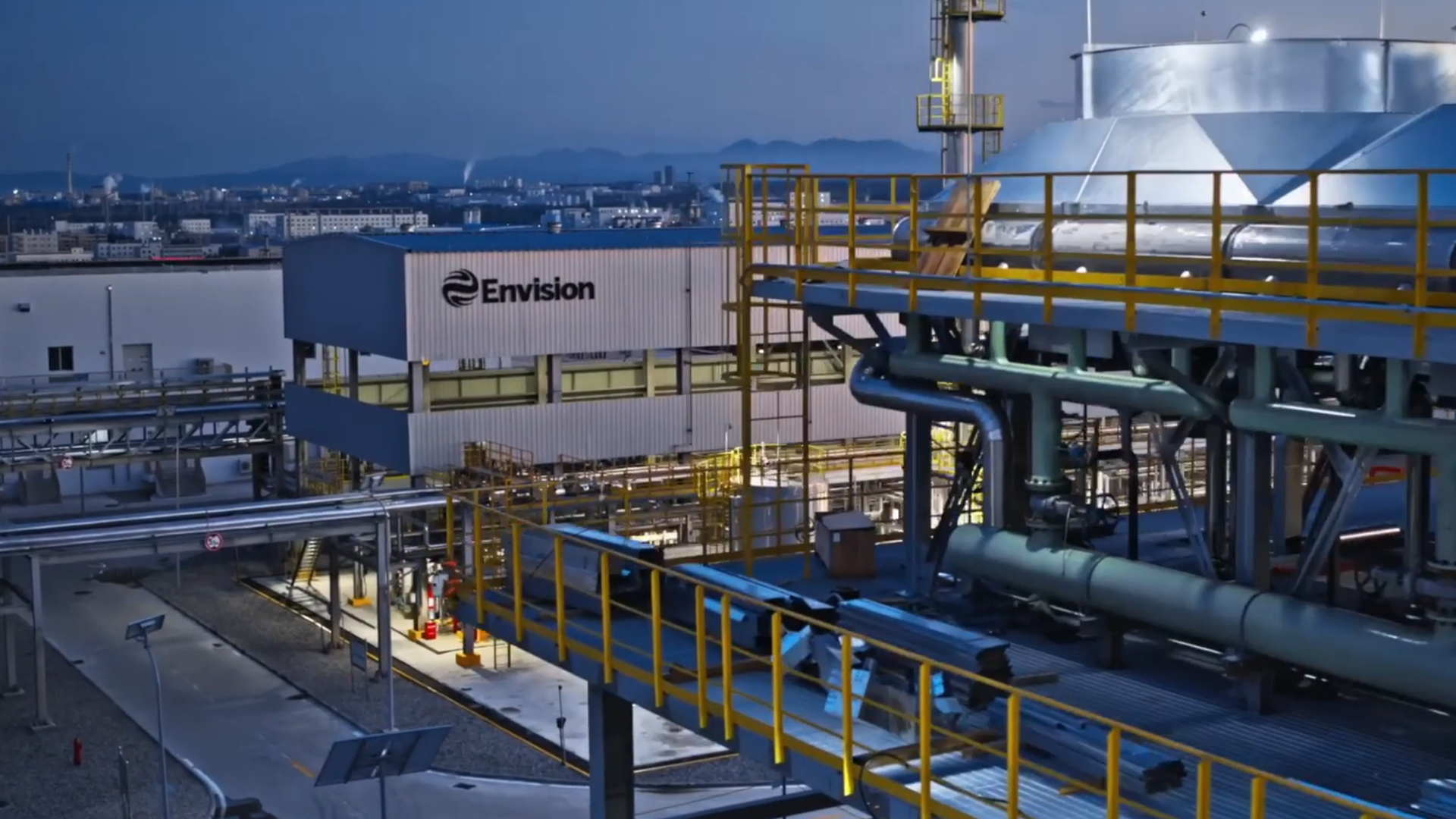
China’s Envision claims to have put an integrated 800-volt direct-current power architecture into commercial operation at an AI facility in Inner Mongolia.

The installation is located at the Galaxy AI campus in Ulanqab, where trials of its Dubhe controller and supporting energy model began in August 2026.

The company describes the deployment as the first commercial use of this configuration, although independent performance figures have not yet been disclosed publicly.

A different route from grid electricity to computing hardware

Conventional facilities generally convert incoming electricity through several stages before delivering power suitable for servers and accelerators, adding equipment and potential conversion losses.

Envision’s design instead uses a solid-state transformer to convert 10-kilovolt medium-voltage alternating current directly into an 800-volt direct-current distribution line.

The company says this arrangement reduces conversion steps, improves electrical efficiency and allows power equipment to occupy substantially less physical space within data centers.

A higher-voltage distribution network can also reduce the amount of copper required for cabling, potentially lowering material requirements as computing installations expand rapidly.

The architecture includes battery storage intended to respond rapidly when processor demand changes, while also supplying temporary backup during unexpected interruptions.

Envision says the storage system can provide immediate support over seconds and maintain backup capability across periods measured in several minutes.

Its controller coordinates the transformer and batteries within milliseconds, aiming to manage sudden changes in electricity consumption from GPUs.

That coordination matters because AI workloads can cause substantial swings in demand, placing additional pressure on electrical infrastructure supplying densely packed computing equipment.

The company also says its arrangement can accommodate higher-density server racks, allowing operators to install more computing capacity within a given floor area.

Ambitions extend beyond the first installation

Envision’s Galaxy facility is expected to grow to 3 gigawatts, with the company saying its eventual capacity could serve one million AI accelerators.

Envision also intends to introduce the technology through Mission Gobi, an initiative seeking 5 gigawatts of renewable-powered computing capacity by 2030.

That programme is focused on desert locations, where the company expects renewable generation and energy storage to support large computing developments.

The system has been designed to work alongside renewable electricity sources, while its batteries are intended to balance supply and changing computing requirements.

However, the company has not provided independently verified measurements quantifying efficiency improvements, installation costs or savings compared with conventional power systems.

The announcement does not also establish how the architecture performs under sustained full-load conditions or across facilities with substantially different hardware configurations.

The deployment therefore marks a commercial milestone for Envision, while the scale of its claimed operational advantages awaits detailed independent evidence.

Via Tom's Hardware

Google logo on a black background next to text reading 'Click to follow TechRadar'

US college student builds 'Reaper' drone β€” which he says set a new world record speed of 491mph

  • Georgia Tech student says his homemade Reaper aircraft reached 491 mph
  • Three working prototypes reportedly sustained the same claimed top speed for four minutes
  • The $13,000 aircraft carried a 2.6-pound payload during its fastest run

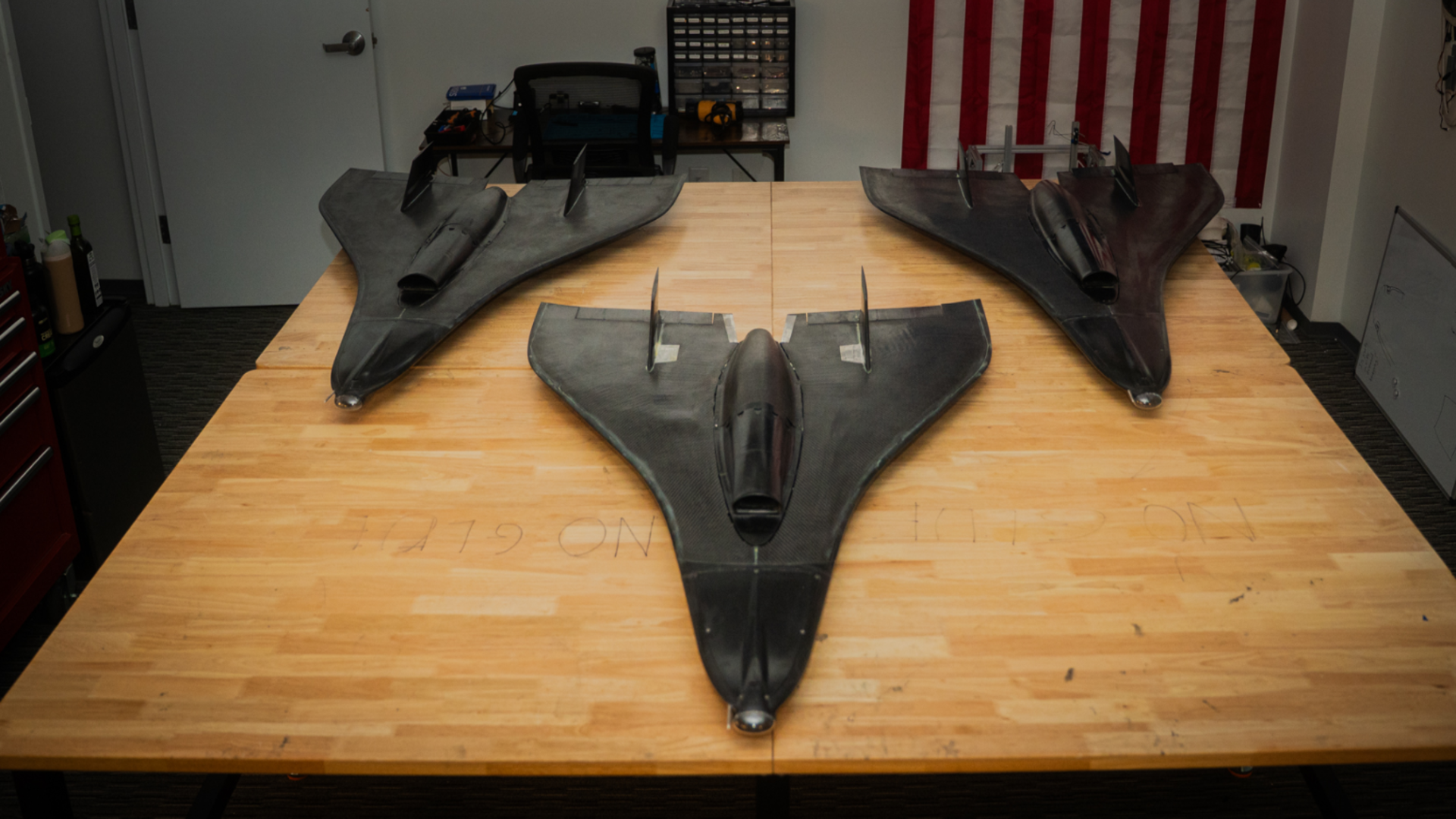
A Georgia Tech aerospace engineering student says his experimental jet-powered model aircraft reached 491 mph, potentially setting a new record for remotely controlled planes.

Tomas Salvo independently developed the Reaper and reported on X that it carried a 2.6-pound payload during its fastest recorded run.

If independently verified, the claimed result would surpass the 465 mph mark set in 2017 by German pilot Niels Herbrich's Inferno aircraft.

Student builds a fast jet-powered aircraft

Salvo began developing the project in February 2025, designing and assembling its prototypes independently while living in university accommodation at Georgia Tech.

He has produced three operational versions, each reportedly capable of maintaining 491 mph for four minutes using a full fuel supply.

The drone uses a 250-newton turbojet, alongside a custom air intake and a titanium exhaust nozzle produced through 3D printing.

Its outer structure consists of molded carbon-fibre sections, while laser-cut parts form internal components.

The design can leave a launch rail or truck-mounted launcher before climbing to 6,600 feet (2,000 metres), within 20 seconds.

Salvo also says the aircraft can travel 31 miles (50 kilometres) when operating at its maximum speed, and that the project is β€œa reliable and repeatable system,” and repeated trials have produced closely matching performance results.

The development effort reportedly cost approximately $13,000, an amount Salvo funded personally while pursuing the project as a student.

He intends to conduct further flights and refine the aircraft, hoping eventually to exceed 500 mph (800 km/h).

Salvo’s post also attracted the attention of Prescott Paulin, Director of Industry Engagement at the Department of War’s Research and Engineering office.

Paulin, who leads industry engagement for the Pentagon CTO’s Mission Capabilities team, publicly invited the student to visit the department.

The Boom Prize offers a much larger speed challenge

The Reaper project also enters a field where amateur aircraft builders can compete for a substantial reward offered by Boom Supersonic.

The company's chief executive, Blake Scholl, announced a $750,000 cash award alongside $50,000 in company shares for a qualifying supersonic flight.

Entrants must fly a radio-controlled, fixed-wing aircraft faster than Mach 1 for at least five seconds before bringing it down safely, and complete the required performance twice on the same day, using one aircraft, for their submission to satisfy competition rules.

The challenge excludes rocket propulsion, onboard oxidisers and aircraft designed for one-time use, requiring competitors to use air-breathing engines instead.

Eligible propulsion systems include turbojets, turbofans and ramjets, while corporate sponsorship or venture capital funding disqualifies competing teams.

The rules also exclude projects connected to aerospace businesses or directed by professional aerospace engineers, restricting participation to amateur competitors.

Applicants must be American citizens, permanent residents or people who have received legal asylum in the United States.

A judging panel includes former Boeing chief executive Phil Condit, SpaceX co-founder Tom Mueller and astrophysicist Scott Manley.

The competition remains open until 2030, giving builders several years to develop aircraft capable of meeting its demanding flight and landing conditions.

Although Salvo says he hopes to pursue the $800,000 award, the reported 491 mph performance alone does not satisfy its supersonic requirement.

Google logo on a black background next to text reading 'Click to follow TechRadar'

Nvidia hits back at US data center gloom with plans to repurpose old telephone and telecom buildings owned by Brightspeed into small AI data centers

  • Nvidia wants to convert more than 130 existing telecom properties to data centers
  • Brightspeed's struggling business could become central to Nvidia's expansion strategy
  • The proposed network could extend across as many as 20 states

Nvidia is exploring an unusual route into the AI infrastructure market, reportedly considering older telephone facilities as locations for compact regional computing operations.

The proposal involves Apollo Global Management and Brightspeed, a broadband operator whose property portfolio could provide sites across as many as 20 American states.

Repurposing telecom buildings could give Nvidia access to existing infrastructure without requiring every facility to be built from an empty nearby plot of land.

Nvidia targets alternative expansion route

Reports from The Information claim Nvidia has contacted Apollo about converting more than 130 Brightspeed properties into smaller facilities dedicated to running artificial intelligence applications.

Brightspeed is backed by Apollo and reportedly close to bankruptcy, although the proposed arrangement and its commercial terms have not been publicly confirmed.

Reports indicate that the properties collectively offer approximately 1 gigawatt of electrical capacity, potentially supporting substantial investment in Nvidia's next-generation server systems for future deployments.

Nvidia reportedly recently sent Brightspeed a written proposal and requested further information, alongside opportunities to inspect locations under consideration for possible conversion directly.

Amid concerns about data center expansion, there have been political calls for temporary restrictions from Democratic candidates in states including Texas.

Retrofitting existing properties may face fewer planning obstacles than entirely new developments, although local approvals would still be needed for cooling and other upgrades.

Nvidia has reportedly discussed beginning renovations with suppliers during the first quarter of 2027, using systems built around its upcoming Vera Rubin platform.

Unlike enormous training campuses, Nvidia reportedly describes the proposed locations as an inference network, intended to operate models that have already completed their initial training.

That distinction could make smaller sites useful to cloud operators and artificial intelligence developers needing computing capacity closer to customers and existing networks.

Nvidia's smaller AI facilities still face commercial and operational questions

Potential users could include OpenAI, Anthropic and SpaceX, although the report does not establish whether discussions about this particular network have taken place.

It also remains uncertain how many Brightspeed properties would be converted, who would own the equipment, or which customers would ultimately lease computing capacity.

Zac Smith, Datum's chief executive, told The Information that older telecom buildings can β€œunlock underutilized power,” although aging equipment may raise operating costs.

Smith also cautioned that older facilities may cost more to operate because their equipment can require additional maintenance and replacement during operation.

The reported discussions follow a decline of more than 9% in Nvidia shares during Thursday's trading session, marking their steepest daily drop since January 2025.

The drop occurred during a wider retreat in chip stocks, as investors assessed regulatory uncertainty surrounding the pace and scale of new computing developments.

Nvidia shares were reportedly down 3% year to date, despite renewed retail interest online that pushed Stocktwits sentiment from neutral into bullish territory

Google logo on a black background next to text reading 'Click to follow TechRadar'

Sam Altman won't like it: Bosgame intros mini PC with 192GB RAM for $6,199 β€” M5 MAX has a Ryzen AI Max+ PRO 495 APU plus an OCuLink connector

  • Bosgame opens orders for its $6,199 Ryzen AI-powered compact workstation
  • The M5 MAX combines AMD's Ryzen AI Max+ PRO 495 with substantial memory
  • Bosgame equips its mini PC with an additional PCIe 4.0 storage slot

BOSGAME has opened orders for the M5 MAX, a compact workstation built for artificial intelligence tasks and other jobs that consume memory.

The mini PC runs on AMD's Ryzen AI Max+ PRO 495 processor, paired with 192GB of LPDDR5 memory soldered directly to the motherboard.

Storage comes with a 2TB solid-state drive using a PCIe 4.0 interface, giving the system fast internal storage from the outset.

Memory, storage, and cooling inside the chassis

Large language models, image generators, and data analysis applications can require substantial memory resources, making the system's hardware configuration particularly relevant to these workloads.

The available M.2 2280 expansion slot supports another PCIe 4.0 drive, allowing owners to increase storage capacity without replacing the factory-installed drive.

BOSGAME also incorporates a three-fan cooling arrangement, although the company has not released thermal measurements or acoustic results showing how effectively it handles sustained workloads.

This configuration could also interest executives at companies such as OpenAI, led by Sam Altman, whose businesses generate revenue from customers accessing models hosted in their own data centers.

Running compatible AI models locally could give some users an alternative to repeatedly paying for remote computing services, although the economics depend on hardware costs and actual workloads.

Extensive connectivity includes OCuLink and dual 10GbE networking

The BOSGAME M5 MAX comes with two USB-C ports supporting data transfer rates of up to 40Gbps each.

Both ports also support DisplayPort Alt Mode, allowing compatible monitors to connect through these interfaces alongside other peripherals.

Screens can also be connected through DisplayPort 2.1 or HDMI 2.1, with the latter using TMDS signalling.

Three USB-A ports operate at 10Gbps each, providing faster connections for external storage devices and other high-speed peripherals.

A fourth USB-A port is limited to 480Mbps, a rate better matched to keyboards, mice and other devices that send only small amounts of data.

Wired networking comes from two RJ-45 jacks rated at 10GbE, allowing simultaneous connections to separate high-speed networks.

Wireless access runs through Wi-Fi 7, while Bluetooth 5.4 handles pairing with headsets, keyboards and other nearby devices without cables.

An OCuLink 4i port built on PCIe 4.0 allows external hardware to connect through a cable, providing an additional expansion option beyond the machine's internal storage slots.

Furthermore, a UHS-II reader accepts SD cards, which suits photographers and video editors who move large files between cameras and the workstation.

Two 3.5mm jacks handle audio, allowing compatible headphones, speakers and microphones to connect directly to the machine.

The specification sheet includes several features associated with conventional workstation desktops, including substantial memory, dual network connections and external hardware expansion.

However, the $6,199 asking price makes comparisons with conventional workstations and other compact AI computers particularly important.

Though preorders are currently active, BOSGAME has not announced a shipping date or provided details about the machine's physical dimensions, operating system and warranty coverage.

Via Guru3D

Google logo on a black background next to text reading 'Click to follow TechRadar'

Lenovo and HP run out of RTX 5090 gaming desktops as standalone GPUs disappear from US retailers

  • Lenovo and HP show no readily purchasable RTX 5090 desktop configurations
  • Amazon advertises an available ASUS RTX 5090 graphics card for $7,679.80
  • Several retailers list RTX 5090 cards at more than twice launch prices

Nvidia's GeForce RTX 5090 is becoming increasingly difficult to purchase across the United States, with Lenovo and HP facing availability problems affecting their premium desktop computers.

A quick check of both manufacturers' US online stores found no readily purchasable desktop configurations equipped with Nvidia's flagship consumer graphics processor.

The situation extends beyond manufacturer websites, as several major retailers are also displaying expensive standalone RTX 5090 graphics cards as unavailable.

Lenovo and HP struggle with RTX 5090 availability

HP's OMEN MAX 45L illustrates the high cost of obtaining a complete computer equipped with the graphics processor through manufacturer-operated stores.

The company lists its RTX 5090 configuration at $7,999.99, offering an AMD Ryzen 9 processor, 64GB memory, and 4TB of combined storage.

Despite its premium specifications, HP's US website identifies the desktop as out of stock, preventing customers from purchasing the advertised configuration.

Lenovo's US online store also showed no readily purchasable RTX 5090-equipped desktops during the availability investigation.

The difficulties extend to standalone graphics cards, which offer consumers an alternative to purchasing expensive complete computers from established manufacturers.

The growing scarcity of Nvidia's RTX 5090 is driving substantial price increases, with graphics cards originally launched at $1,999 now appearing at several retailers for considerably higher amounts.

Newegg lists several RTX 5090 graphics cards sold directly by the retailer as unavailable, including MSI's Suprim model and ASUS's TUF Gaming edition.

Although neither card is currently available directly from the retailer, their listed prices stand at $5,899.99 and $5,099.99, representing increases of approximately 195% and 155%, respectively.

B&H Photo Video reports similar availability problems, with its ASUS TUF and MSI Gaming Trio OC RTX 5090 models temporarily out of stock.

The retailer lists the two graphics cards at $4,599.99 and $4,499.99, respectively, representing increases of approximately 130% and 125% over Nvidia's original launch price.

Amazon currently has the ASUS TUF Gaming RTX 5090 available for purchase at $7,679.80, approximately 284% above Nvidia's original launch price.

TUF Gaming GeForce RTX 5090 Graphics Card: $7679.80
As RTX 5090 scarcity pushes prices higher, this ASUS TUF model costs $7,679.80, offering 32GB GDDR7, PCIe 5.0, HDMI 2.1b, DisplayPort 2.1b, and Axial-tech cooling.View Deal

Independent manufacturers still offer expensive alternatives

However, the availability problems affecting Lenovo and HP do not mean US consumers can no longer purchase complete computers containing RTX 5090 graphics cards.

Best Buy continues advertising several configurations from independent computer manufacturers, including Skytech and CLX, with available purchasing options.

One Skytech Tempest desktop combines an AMD Ryzen 7 9800X3D processor, 32GB memory and the RTX 5090 for $8,999.99.

Another Skytech Blaze 5 configuration costs $9,379.99, while a CLX SET desktop featuring an AMD Ryzen 9 9900X3D carries a $9,849.99 price.

Newegg also advertises Skytech computers containing the graphics processor, including configurations priced between $9,299.99 and $9,699.99.

Dell similarly maintains RTX 5090 availability through its Alienware Area-51 desktop range, although some configurations exceed $10,000.

One version featuring Intel's Core Ultra 9 285K processor, 32GB memory and 2TB of storage costs $10,499.99.

Another configuration featuring an AMD Ryzen 9 9950X3D2 processor, 64GB memory and 4TB of storage carries a $13,499.99 price.

The growing difficulty of purchasing individual graphics cards also matters because the RTX 5090 serves professional computing applications beyond conventional gaming.

Its 32GB GDDR7 memory makes the graphics processor attractive for local AI development, graphics rendering, and other demanding computing workloads.

Although Nvidia has not officially confirmed permanently ending RTX 5090 production, consumers increasingly face fewer reasonably priced purchasing opportunities.

The shortage therefore affects gamers and professionals seeking powerful computing hardware, particularly those preferring individual graphics cards instead of expensive prebuilt computers.

Google logo on a black background next to text reading 'Click to follow TechRadar'

This is the cheapest RTX 5090 PC we could find β€” and why we'd pick it over a similarly-powered laptop

  • The complete desktop costs $70 less than Amazon's listed ASUS graphics card
  • CyberPowerPC bundles a desktop RTX 5090 with 32GB DDR5 memory
  • Mobile RTX 5090 laptops sacrifice performance compared with desktop graphics cards

Nvidia's GeForce RTX 5090 has become ridiculously expensive, with standalone graphics cards selling for several times their original launch prices.

That makes finding a complete desktop computer equipped with the flagship graphics processor for less than $8,000 particularly interesting.

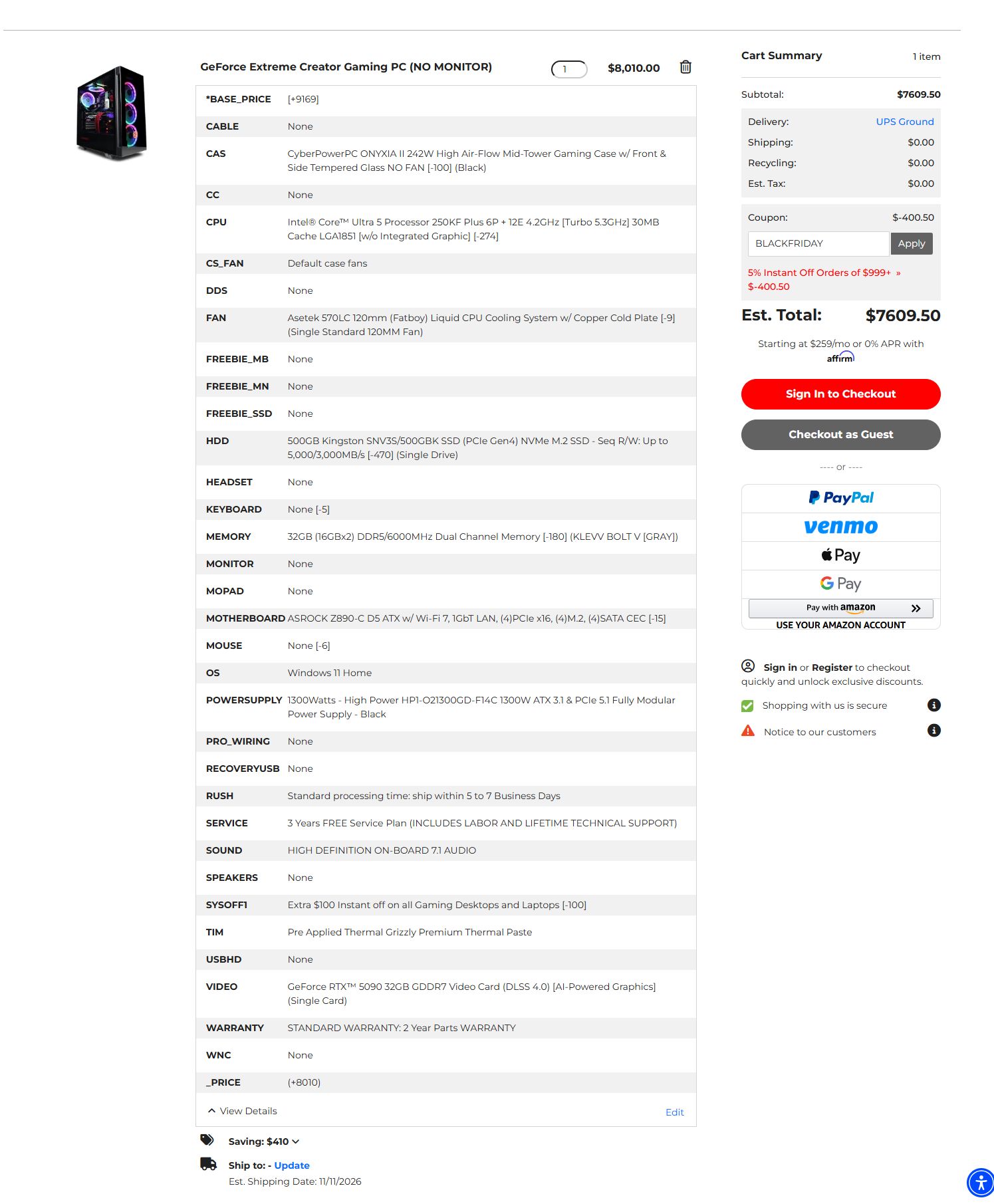
One configuration currently available from CyberPowerPC costs $7,609.50 after applying a $400.50 promotional discount.

TUF Gaming GeForce RTX 5090 Graphics Card: $7679.80
As RTX 5090 scarcity pushes prices higher, this ASUS TUF model costs $7,679.80, offering 32GB GDDR7, PCIe 5.0, HDMI 2.1b, DisplayPort 2.1b, and Axial-tech cooling.View Deal

A complete RTX 5090 desktop PC

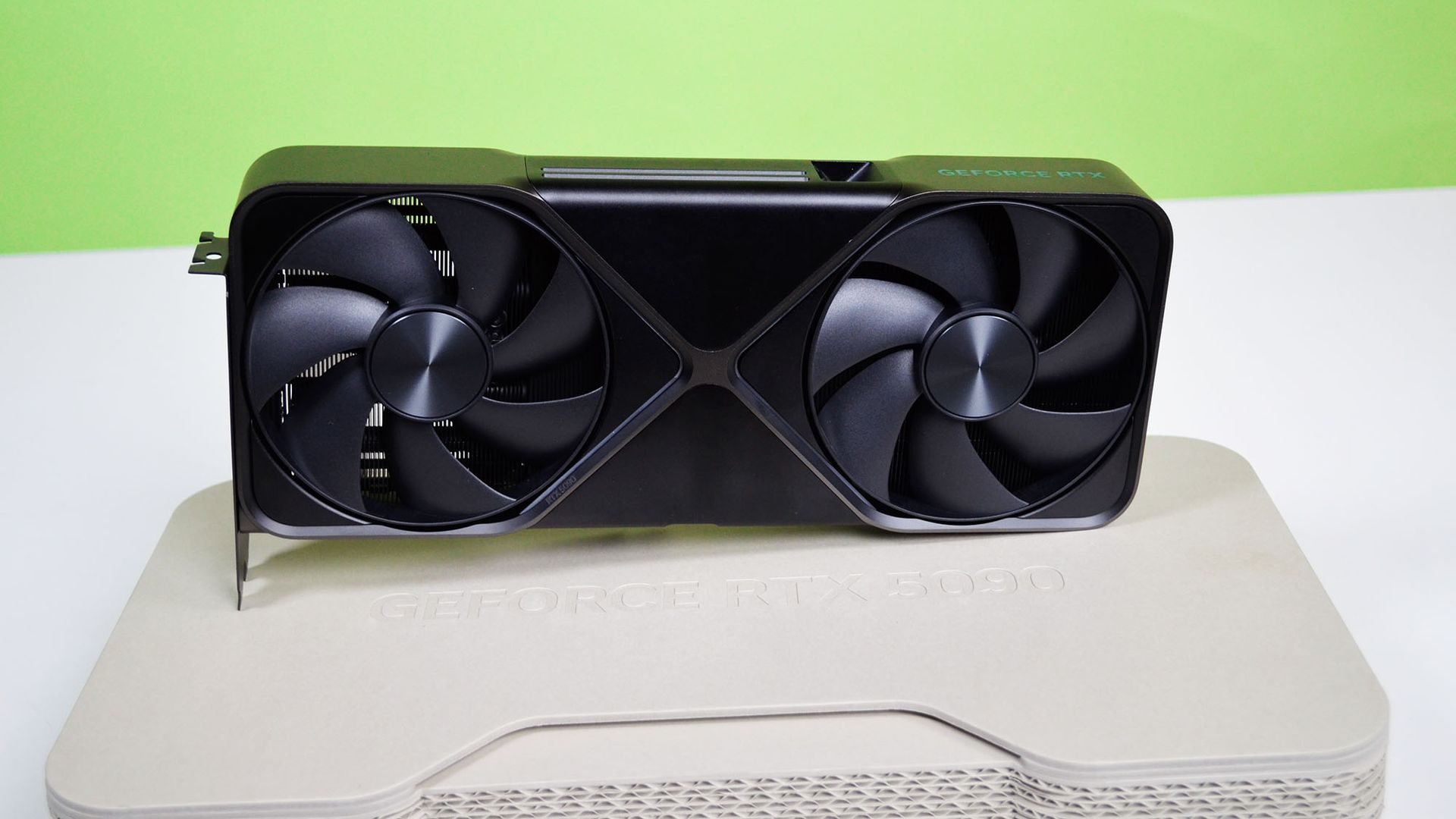
The GeForce Extreme Creator Gaming PC comes equipped with ASUS's TUF Gaming GeForce RTX 5090, featuring 32GB of GDDR7 memory.

Interestingly, the ASUS TUF Gaming GeForce RTX 5090 is listed on Amazon for $7,679.80; buyers are basically getting the PC at no cost.

The system uses Intel's Core Ultra 5 250KF processor, featuring six performance cores and twelve efficiency cores, alongside a maximum turbo frequency of 5.3GHz.

Although this is not Intel's most expensive desktop processor, its specifications provide a capable foundation for demanding gaming and computing workloads.

The graphics card receives power from a 1,300W fully modular supply, while an Asetek 570LC liquid cooler handles processor temperatures.

The device also includes 32GB of DDR5 memory operating at 6,000MHz, providing sufficient capacity for many demanding applications and modern games.

Storage comes from a 500GB Kingston NVMe solid-state drive using PCIe Gen4 connectivity, although buyers might eventually want additional capacity.

The remaining configuration includes an ASRock Z890-C D5 motherboard, Wi-Fi 7 connectivity, Windows 11 Home and a CyberPowerPC Onyxia II enclosure.

There is also a two-year parts warranty, alongside complimentary service coverage that includes labour and lifetime technical assistance.

Importantly, the advertised $7,609.50 price excludes a monitor, keyboard and mouse, meaning buyers should account for additional peripheral expenses.

Cyberpower

(Image credit: Future)

RTX 5090 laptops are cheaper, but there is an important difference

One reason this desktop configuration deserves attention is the substantial difference between desktop and laptop versions of Nvidia's flagship graphics processor.

Although gaming laptops advertised with RTX 5090 graphics can cost considerably less, their mobile graphics processors are not equivalent to desktop versions.

Laptop manufacturers must accommodate restricted cooling capacity, battery consumption and physical dimensions, requiring substantially different power configurations.

Consequently, a mobile RTX 5090 generally delivers considerably less graphics performance than its desktop counterpart, despite sharing the same product designation.

The desktop RTX 5090 also provides 32GB of GDDR7 memory, giving it considerable advantages for demanding graphics workloads and local artificial intelligence applications.

This distinction matters because comparing prices without considering the underlying hardware can create misleading impressions about what buyers actually receive.

At $7,609.50, the CyberPowerPC configuration is certainly expensive, although its inclusion of Nvidia's flagship desktop graphics card changes the calculation.

With standalone RTX 5090 cards commanding extraordinary prices, this is practically a case of buying the graphics card and getting the rest of the computer free.

Google logo on a black background next to text reading 'Click to follow TechRadar'

New report claims 'America hates data centers' as it finds 90% of public comments at local government meetings are negative

  • More than 90% of public comments oppose new American data centers
  • Water consumption remains the biggest concern among data center opponents
  • Rural and urban communities oppose data centers for different reasons

Public resistance to data center construction is spreading across the United States, with local government meetings recording overwhelming opposition to proposed developments.

A new database containing more than 10,000 public submissions indicates that communities remain largely unconvinced about hosting these facilities.

Residents' objections focus on the effects of data center construction, particularly water consumption, electricity costs and environmental pollution.

Local opposition cuts across political and geographical divisions

The American Sentiment website, operated by San Francisco AI startup Prophecy Gov, examined 10,202 public comments collected during 906 meetings across 417 local governments.

Its findings cover 48 states with 90.5% of submissions opposing data center developments and only 7% expressing support. Another 2.5% of the comments consisted of questions about the proposed developments, while 73% of meetings recorded no expressions of support from residents.

Even where favourable opinions emerged, opponents outnumbered supporters by approximately six to one.

The resistance crosses political affiliations, with Republican and Democratic counties recording almost identical levels of opposition.

However, disagreements over specific concerns varied according to community characteristics, with rural residents frequently discussing farmland and property rights.

Urban and suburban participants more commonly raised concerns involving pollution, electricity expenses, government accountability and inadequate disclosure.

Water consumption attracted the greatest attention among opponents, particularly following reports of substantial withdrawals by individual computing developments.

One project reportedly consumed 29 million gallons in May 2026, prompting nearby residents to notice reduced pressure across their local water supplies.

Microsoft subsequently claimed that its newer artificial intelligence facilities consume approximately the same annual water volume as restaurants.

Nevertheless, these competing claims have not eliminated public concerns about resource consumption and the potential consequences for surrounding communities.

Technology companies and industry leaders face growing scrutiny

Public criticism has also extended to major technology companies associated with artificial intelligence and large computing infrastructure projects.

Google, Amazon, Meta and Microsoft featured among the companies mentioned during discussions about proposed developments.

SpaceX and xAI chief executive Elon Musk received the most personal references, followed by OpenAI chief executive Sam Altman and Palantir co-founder Peter Thiel ranked third, ahead of Meta chief executive Mark Zuckerberg and Amazon founder Jeff Bezos.

Despite the attention given to artificial intelligence, only 21% of submissions mentioned AI, meaning most objections concerned other aspects.

Concerns about electricity costs, environmental pollution, water availability and local development therefore featured prominently throughout the collected discussions.

Support also varied considerably among occupational groups, with union workers expressing substantially greater acceptance of new facilities.

Approximately 79% of commenters identifying as union workers supported data centre construction, compared with just 3% of property owners and residents.

Even among people employed directly in the data centre industry, only 40% supported the construction of additional facilities, with these figures indicating employment opportunities have not necessarily translated into widespread public acceptance of new data centre projects.

Google logo on a black background next to text reading 'Click to follow TechRadar'

Drones can now be tracked down by mobile networks alone β€” could this new Ericsson tech spell the end for the current crop of flying UAVs?

  • Ericsson wants mobile networks to detect and track low-flying drones
  • Cell towers could become additional surveillance tools against unauthorized aircraft
  • AT&T and Erillisverkot have already tested Ericsson's network sensing technology

Ericsson is developing technology that could allow telecommunications networks to detect and follow drones without depending entirely on dedicated surveillance equipment.

Its Integrated Sensing and Communication (ISAC) system analyses radio signals bouncing off flying objects, using existing cellular infrastructure to identify their movements.

The company plans to begin limited commercial trials in 2027 before expanding availability to additional customers during 2028.

Ericsson turns cellular infrastructure into drone detection equipment

The technology uses radio transmission equipment at multiple cellular sites to identify objects flying within their coverage areas.

When signals encounter a drone, some energy returns towards receiving stations, allowing the network to examine the resulting reflections.

By comparing information collected from different locations, the system can estimate an object's position and follow its movements.

Ericsson says this approach could help identify small, fast-moving aircraft flying close to the ground, where conventional surveillance equipment sometimes faces difficulties.

The technology requires specialised radio equipment, computing resources and software rather than functioning automatically on every existing mobile network.

Its hardware requirements include Massive MIMO antennas, which use multiple transmission and reception elements to handle complex radio signals.

This technology has already been tested by AT&T around Arlington, Texas, while Finland's Erillisverkot also conducted similar trials.

Ericsson claims that both exercises successfully identified multiple drones and followed their movements using the network-based sensing approach.

Mobile networks could help address growing drone security threats

The proposed system comes as unauthorized drone flights increasingly disrupt airports and raise security concerns around military installations and other sensitive locations.

Flights at Jersey Airport in the Channel Islands near the UK were disrupted over Halloween weekend after repeated unauthorised drone sightings raised safety concerns.

Military facilities have also reported increasing incidents, prompting authorities to consider additional measures against unidentified aircraft approaching protected locations.

In Britain, military personnel have received legal authority to disable unauthorised drones detected around certain military installations.

Existing protection arrangements frequently depend on specialized detection equipment, although installing sufficient coverage across extensive territories can become expensive.

Ericsson believes cellular infrastructure could provide additional surveillance capabilities without requiring authorities to construct entirely separate monitoring networks.

β€œMobile networks are useful as drone detection solutions because their antennas are already covering low elevations, close to ground level where drones often fly, unlike traditional radar,” said Ian Fogg, research director at CCS Insight.

β€œThe new spectrum that should arrive with 6G will also make it easier to deploy sensing on wide channels, which further improves detection accuracy,” said Ian Fogg.

Beyond security applications, the technology could also monitor shipping movements, vehicle traffic and changing weather conditions around infrastructure.

However, Ericsson's proposed system is intended to complement established surveillance equipment rather than eliminate the need for radar installations.

The company must still establish how accurately its technology performs under different conditions, particularly where buildings, terrain and competing signals complicate detection.

The deployment will provide opportunities to assess whether mobile network sensing can deliver dependable results outside controlled testing environments.

Via The Register

Google logo on a black background next to text reading 'Click to follow TechRadar'

This could be the cheapest BE5000 Wi-Fi 7 access point, offering 2.5GbE, free lifetime cloud management, and an impressive five-year warranty

  • Wi-Fi 7 upgrades are becoming more accessible without expensive networking equipment
  • TP-Link BE5000 offers greater theoretical wireless capacity than cheaper BE3600 alternatives
  • A 2.5GbE connection removes the conventional Gigabit Ethernet speed limitation

Finding an affordable way to upgrade an existing network to Wi-Fi 7 can be difficult, particularly when faster wireless speeds come with expensive equipment.

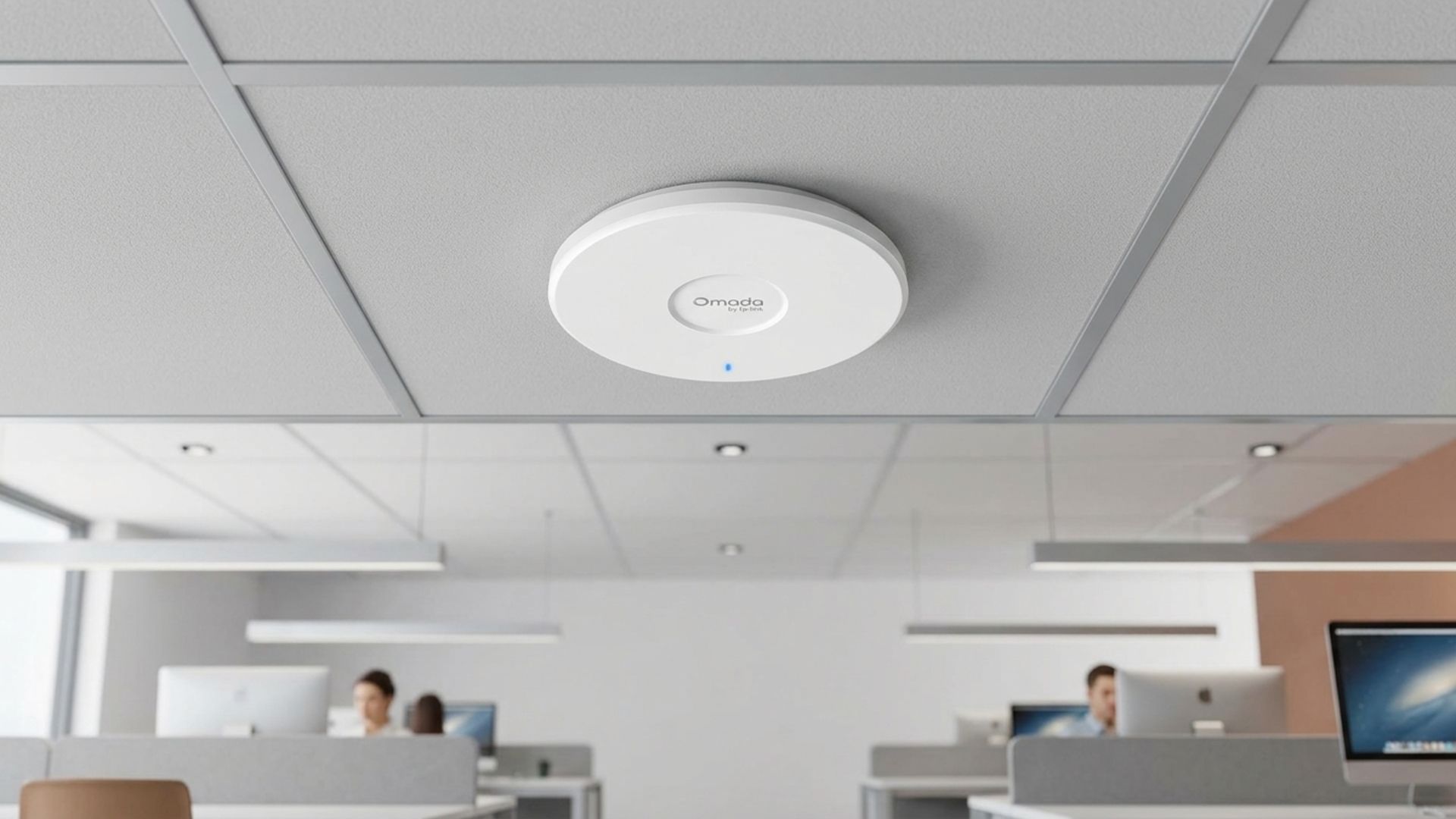
However, TP-Link's Omada range offers a potentially attractive alternative, with its BE5000 access point.

The business-oriented networking product combines faster wireless connectivity with a 2.5GbE Ethernet connection, free lifetime cloud management and an unusually generous five-year warranty.

TP-Link Omada WiFi 7 Access Point: $89.99
The dual-band Wi-Fi 7 access point delivers up to 5 Gbps wireless speeds, combining Multi-Link Operation, Multi-RUs, and 4K-QAM, with a 2.5 GbE port supporting future multi-gigabit internet upgrades.View Deal

BE5000 Wi-Fi 7 brings faster connectivity without expensive equipment

Unlike cheaper BE3600 alternatives, the BE5000 specification offers greater theoretical wireless capacity, making this option particularly interesting at its current asking price.

Its combined wireless rating reaches approximately 5,000Mbps, although actual transfer speeds depend on connected devices, network interference, and the surrounding wireless environment.

Wi-Fi 7 also introduces improvements such as Multi-Link Operation, allowing compatible devices to use multiple frequency bands for improved connectivity and network performance.

The inclusion of a 2.5GbE Ethernet port is another important advantage, particularly for users whose existing networking equipment supports connections exceeding conventional Gigabit Ethernet speeds.

This faster wired connection helps prevent the Ethernet interface from becoming an immediate bottleneck when wireless clients demand substantial network bandwidth.

The access point belongs to TP-Link's Omada Pro family, which caters to businesses requiring networking equipment with centralised management capabilities.

That distinction matters because buyers are getting equipment designed for professional networking environments rather than another basic consumer wireless access point.

However, prospective customers should remember that this product is an access point, not a standalone router capable of independently managing an internet connection.

It therefore requires an existing router or gateway, making it particularly suitable for people upgrading an established network rather than replacing their entire networking infrastructure.

Free lifetime cloud management and a five-year warranty sweeten the deal

Another interesting feature is the inclusion of lifetime cloud management without additional subscription fees, removing recurring management costs for supported cloud features.

TP-Link's Omada cloud platform allows administrators to configure, monitor, and manage compatible networking equipment without purchasing a separate hardware controller.

This arrangement can be particularly useful for small businesses operating multiple access points across offices, where managing individual devices separately becomes increasingly inconvenient.

The five-year warranty also deserves attention because networking equipment is generally expected to remain operational for several years after installation.

A longer warranty provides additional purchasing reassurance, particularly when comparing this business-oriented product against cheaper alternatives offering shorter coverage periods.

At approximately $89.99, the combination of BE5000 wireless capacity, faster Ethernet connectivity and subscription-free cloud management makes the offer particularly interesting.

Buyers should nevertheless check compatibility with their existing router, available PoE infrastructure and installation requirements before placing an order.

Google logo on a black background next to text reading 'Click to follow TechRadar'

Nvidia reportedly tells data center customers to trim exposure to the Chinese market

  • Nvidia's new rule forces foreign cloud providers to reconsider doing business in China
  • Chinese AI companies face fewer routes to powerful American processors
  • Nvidia has sharply reduced the number of approved Asian chip buyers

Nvidia is tightening commercial restrictions on foreign cloud providers, requiring them to reduce their reliance on Chinese businesses that use its advanced AI processors.

The new condition requires affected companies to generate at least 51% of their revenue from customers outside China, potentially disrupting existing business arrangements.

The requirement applies globally, and its consequences could be particularly significant for data center operators serving Chinese technology companies.

Nvidia introduces new restrictions for foreign cloud providers

The Financial Times, citing people familiar with the discussion, said Nvidia communicated the requirement verbally through its sales representatives and regional management teams.

The company introduced the condition during the summer, applying it to future commercial agreements rather than existing cloud computing contracts.

Two sources confirmed that the restrictions cover Nvidia customers worldwide, rather than applying exclusively to facilities operating across Asian markets.

The policy requires cloud computing businesses to demonstrate sufficient demand from international customers before continuing their commercial relationships with Nvidia.

β€œData centres and clouds built on American chips are the foundation that American model and application makers need to compete worldwide. Longstanding US policy encourages every cloud to build on American infrastructure and to win business everywhere they can,” Nvidia said.

β€œAmerica’s longstanding policy has always supported the build-out of American infrastructure worldwide, bringing prosperity, influence and jobs home.”

The company's approach comes amid increasing scrutiny from Washington over how advanced American processors reach Chinese technology businesses.

US authorities have been attempting to restrict access through intermediaries, foreign computing facilities and other commercial arrangements that circumvent existing export controls.

Chinese technology companies face mounting computing constraints

Chinese technology companies have increasingly depended on foreign cloud providers to access advanced processors unavailable through direct purchases.

These arrangements allow them to use powerful computing systems for demanding AI operations, including training large language models.

Nvidia's B300 processors illustrate the financial incentives behind this market, with a complete rack selling for approximately $600,000 internationally.

However, a rack reportedly sold for about $2.8 million in China in October 2026 because of limited availability.

The B300 is among Nvidia's most advanced processors, but American export restrictions prohibit its direct sale into China.

Nvidia has also cut the number of Asian companies authorised to purchase its AI chips by more than half this year.

The company introduced stricter compliance checks to prevent restricted processors from reaching China through unauthorised suppliers and intermediaries.

Its latest requirements are also creating difficulties for foreign data center operators that previously depended on Chinese businesses for revenue.

These operators must now find enough customers elsewhere to ensure that at least 51% of their services go to non-Chinese companies.

A Singapore-based cloud provider said securing sufficient international customers outside America had become difficult under the new requirements.

β€œIf strictly implemented, it will definitely hurt business,” said a representative of the Singapore-based group.

Consequently, Chinese technology companies could find it increasingly difficult to rent advanced computing capacity from foreign providers, affecting their access to resources needed for AI development.

Google logo on a black background next to text reading 'Click to follow TechRadar'

Data center providers are turning to old jet engines to power their output β€” Elon Musk's xAI installs eight converted engines for a major boost

  • xAI installs eight converted jet engines to supply its Mississippi data center
  • Each refurbished turbine can generate up to 50 megawatts of electricity
  • Grid connection delays are pushing AI companies towards alternative power sources

Artificial intelligence companies are increasingly installing aircraft-derived turbines as conventional electricity supplies struggle to keep pace with expanding data center construction.

Elon Musk’s xAI has now placed eight refurbished jet-engine generators at its Mississippi facility, supplying additional electricity for the Colossus 2 computing complex.

The equipment offers a faster route to power than waiting years for grid connections, although its emissions have raised environmental objections.

Old aircraft engines become electricity generators

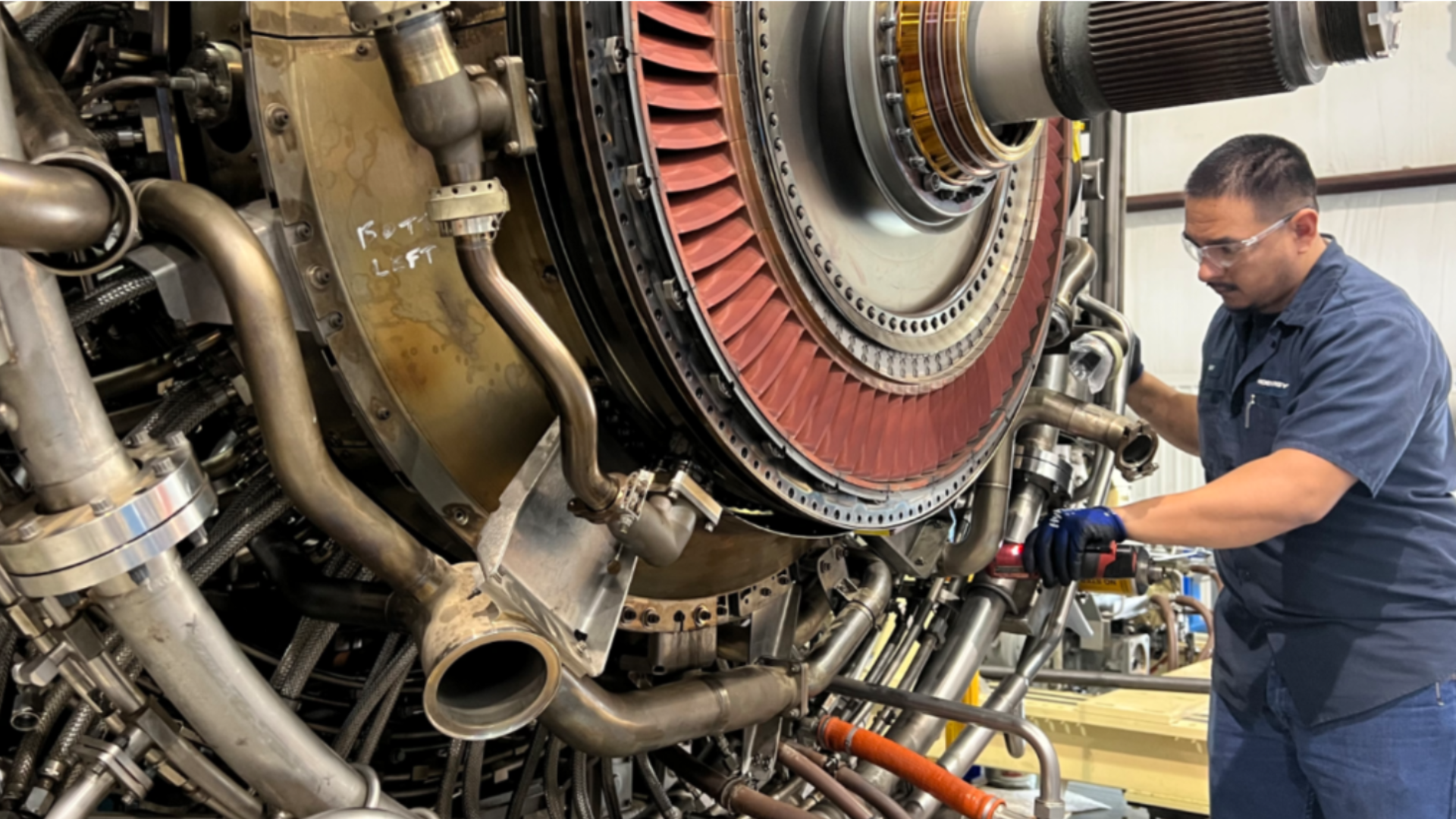
ProEnergy, a Missouri company, converts retired General Electric aircraft engines into stationary generators, adapting equipment originally designed for aviation applications.

The equipment repurposes turbines that would otherwise remain unused after leaving airline service, giving data center operators another source of dispatchable electricity.

The refurbished units are reportedly capable of producing as much as 50 megawatts apiece, equivalent to the electricity needs of approximately 15,000 homes.

That output makes the technology attractive to operators facing lengthy utility delays, particularly as demand from AI infrastructure continues accelerating.

β€œIt’s all about getting power as fast as possible...they can have a data center running in 24 months,” said Audun Martinsen, an analyst at energy research firm Rystad Energy.

By comparison, connecting a 100-megawatt facility to Northern Virginia’s electricity network can take approximately seven years, according to the International Energy Agency.

An executive at Mitsubishi Power has also warned that much new generation capacity may not become available until 2031, amid equipment shortages.

Electricity shortages collide with environmental concerns

Power shortages threaten ambitious expansion plans across the industry, with forecasts indicating that American data centers could consume 20% of national electricity by 2035.

That projection of July 2026 was 83% higher than an estimate released only seven months earlier, indicating rapidly rising expectations.

The projected increase reflects expectations that computing facilities will require more electricity as companies build systems for training and running artificial intelligence.

By April 2026, approximately half of planned data center developments had reportedly been postponed or abandoned, partly because electricity was unavailable.

xAI faces particular pressure because Musk said in August that the company intended to expand its computing capacity sevenfold before the end of 2027.

Microsoft also recently withdrew as the principal customer for an English data centre project after its utility provider could not guarantee sufficient electricity.

This shows how electricity constraints can affect commercial commitments, even when developers have secured land, financing and customers for planned facilities.

OpenAI adopted gas turbines at its first Stargate facility in Abilene, Texas, in 2025, while developer Crusoe ordered 13 ProEnergy generators in April 2026.

However, the rapid deployment of aircraft-derived equipment has prompted questions about pollution, regulatory oversight and the consequences for nearby communities.

Mississippi permits for xAI’s eight turbines reportedly allow a 25% higher limit for certain volatile organic compounds, alongside concerns about carbon monoxide emissions.

The Southern Environmental Law Center has challenged the state’s approval, arguing that xAI has not adequately addressed pollutants including formaldehyde.

The organization has also questioned projected emissions calculations, after previously suing xAI over generators allegedly operated without required permits near more than 100,000 residents.

It appears that every attempt to solve one problem facing data centres introduces another, leaving operators and regulators with difficult challenges that remain far from resolved.

Via Tom's Hardware

Google logo on a black background next to text reading 'Click to follow TechRadar'

Russian data centers ordered to save 10% of capacity for state use following new Putin orders

  • Putin orders private data centres to reserve 10% of their capacity for state use
  • State authorities can request reserved computing resources with 24 hours' notice
  • Private operators retain ownership while the government gains access to reserved capacity

Russian President Vladimir Putin has directed privately operated data centres to make part of their computing resources available for government information systems.

The measure requires affected facilities to set aside 10% of their capacity, giving authorities access when state digital services require additional computing resources.

According to Russian media outlet Astra, the directive appeared on the country's official legal information website on November 2 2026, introducing a strict implementation deadline.

Moscow tightens controls

Operators have been given 10 days to meet the new requirement, although they can continue using the reserved resources during ordinary business operations.

A special government subcommission will determine when the state can demand access, with facilities required to provide the requested resources within 24 hours.

The arrangement does not amount to an outright transfer of ownership, since companies retain control over their facilities and continue operating their businesses.

However, the government gains authority to requisition part of their available computing resources when designated Russian information services require additional infrastructure.

The decree specifies that companies will receive payment for providing access, with the government body responsible for establishing a ceiling on applicable charges.

Officials must also establish procedures governing allocation decisions, including the creation of the subcommission responsible for administering access requests.

The government has assigned the Ministry of Digital Development responsibility for overseeing the country's data centre capacity.

The ministry will assess available floor space and computing resources across domestic facilities and establish operational standards to ensure reliable and uninterrupted services.

The directive arrives amid continuing pressure on Russian digital infrastructure, including Ukrainian attacks against facilities supporting important domestic internet services.

In October 2026, Ukrainian strikes hit three Yandex data centres inside Russia, disrupting cloud platforms, stored information, database services and other online operations.

The attacks followed Russian assaults against essential Ukrainian infrastructure, forming part of the continuing conflict between the two countries.

Foreign infrastructure remains possible under security restrictions

Despite requiring greater domestic capacity for government systems, the decree allows Russian information services to temporarily operate using computing resources located abroad.

Such arrangements require approval from the Federal Security Service, commonly known as the FSB, giving security officials authority over exceptions.

This provision means the new requirement does not completely exclude foreign facilities, although their use remains subject to government security approval.

Russia has separately explored cooperation with American interests involving large computing facilities, including discussions about potential infrastructure projects between the countries.

On October 16, Kremlin representative Kirill Dmitriev said Moscow and Washington were discussing joint data infrastructure proposals involving possible Russian nuclear energy supplies.

The discussions reportedly include using electricity generated by Russian nuclear facilities to support computing infrastructure.

Via United24Media

Google logo on a black background next to text reading 'Click to follow TechRadar'

❌