Reading view

There are new articles available, click to refresh the page.

How AI is Rewriting the Zero-Day Playbook for Preemptive Security

The scenario is all too familiar for any cybersecurity professional: It’s late in the day, and a critical zero-day vulnerability is disclosed. When this happens, CISOs from every industry immediately turn to their Security Operations Centers (SOC) with the single most important, and often most difficult, question: "Are we exposed?”

Answering questions like these when zero-days drop tends to trigger a frantic, high-stress fire drill. Analysts scramble to cross-reference outdated Configuration Management Databases (CMDBs), query disparate endpoint detection tools, and ping IT administrators. The data is siloed, context is missing, and time rapidly slips away. 

Today, the window between a vulnerability’s disclosure and its active exploitation in the wild has essentially collapsed, making predictive lead time a thing of the past. As adversaries integrate AI into their playbooks to automate attacks, defending against them requires us to operate at machine speed.

We believe preemptive security is the most effective way to close this window. You cannot wait for every alert to fire to understand your environment. You need an architecture that constantly tracks emerging risks and threats, coupled with AI-accelerated discovery that brings your attack surface into sharp focus before the adversary does. Rapid7 is previewing a series of new features at Black Hat USA 2026 designed to transform the way security teams navigate the chaos of a zero-day threat to identify and close attack paths before they are exploited.  

The foundation: Continuous Software Visibility

You cannot secure what you cannot see, and in highly distributed, AI-enabled environments, absolute visibility has traditionally been a gap. To achieve true preemptive security, you need a complete, continuous view of emerging risks. When a zero-day drops, your platform should already be tracking it via an Emerging Threat Response (ETR) process. But knowing the threat exists is only step one; you must correlate that threat with your specific environment. This is where Rapid7 Software Visibility (in-preview) becomes important.
Software-Visibility.png
Software Visibility: Depicts details of installed vulnerable software across the technology stack.

Instead of initiating massive, disruptive network scans, security teams can drill directly into the ETR to view key details of the vulnerability, pinpointing relevant assets and software versions in real-time. For example, if a new zero-day dictates that versions of Safari earlier than 18 are vulnerable, Software Visibility allows you to instantly map that criteria against your entire technology stack. That expansive view into your attack surface allows you to uncover whether this newly discovered exposure exists within your environment, shifting your posture from reactive investigation to proactive defense.

Calculating the blast radius: Decoding toxic combinations

Once you know that you have vulnerable instances of Safari running in your environment, the CISO’s initial question evolves. It is no longer just "Are we exposed?" but rather, "How exposed are we?"

Answering this requires breaking down the traditional silos of security data. A vulnerable service running on an isolated sandbox is a minor blip. That same vulnerable service hosted on a production machine where a highly privileged service account recently left a cached credential in memory is a direct path to domain compromise.

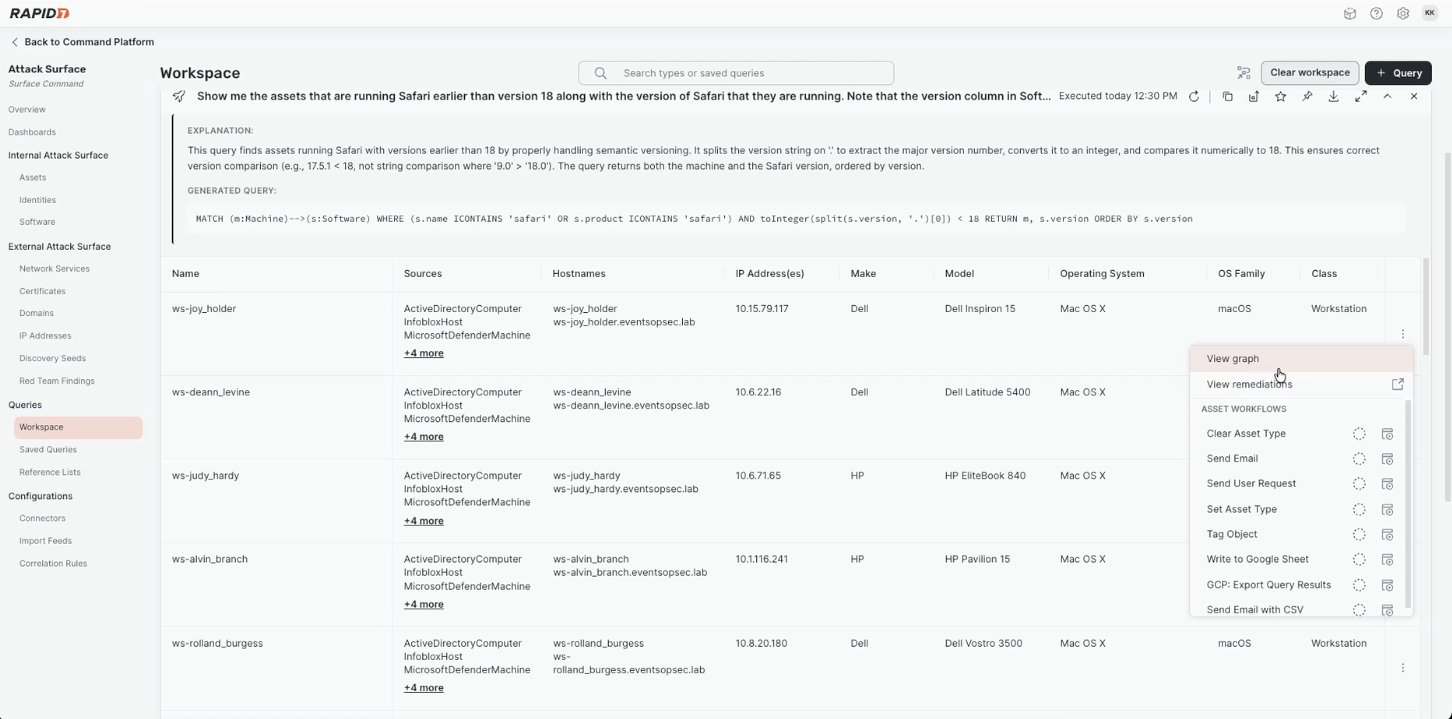
To accurately gauge risk, you need a unified view of your attack surface that pulls together both internal and external telemetry, and lets teams find the information easily. Rapid7’s Exposure Command accelerates this level of exposure discovery with natural language queries (in preview), so that instead of writing complex syntax, plain-English questions will uncover shadow AI models, pinpoint insecure assets, or identify overprivileged users. A SOC analyst can simply ask the platform in plain English: "Show me all assets running Safari earlier than version 18."
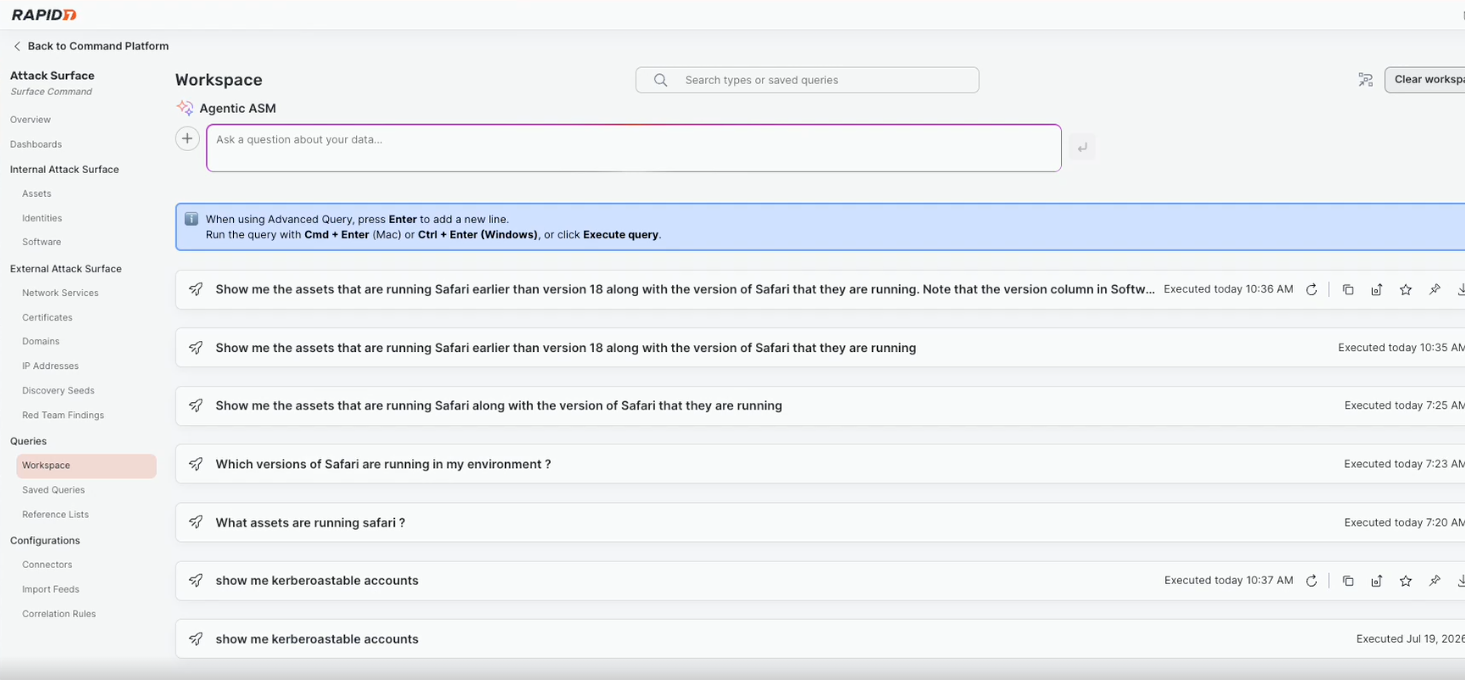
Natural-language-queries.png
Natural language queries: Displays a quick, intuitive way to reveal valuable information about the attack surface.

The platform reveals the total footprint, but more importantly, it also uncovers toxic combinations. It highlights not just the vulnerable assets and software, but can also highlight the specific users associated with those systems. By illuminating these connections, security teams can prioritize their response based on actual business risk rather than generic CVSS scores.

Bridging the SecOps / ITOps divide: Actionable remediation

Identifying the risk is a security function, but fixing it almost always falls to IT Operations. The friction between these two departments usually goes something like this: the SOC demands immediate patching to stop a breach; ITOps demands testing to ensure the patch does not break critical business services.

To achieve preemptive security, we help streamline this important handoff between teams. For instance, when a critical zero-day hits, a patch is often unavailable for days. In the interim, Rapid7 Exposure Command can provide mitigation guidance to help organizations minimize their risk using existing security controls, even when a formal patch does not exist.

Once a patch is released or a formal CVE number is assigned, the challenge shifts to rapid, safe deployment. To accelerate this, Rapid7 leverages AI-Generated Remediation Summaries (available now). Rather than tossing a massive spreadsheet of vulnerable IP addresses over to IT, these AI summaries provide highly tailored, environment-specific guidance.
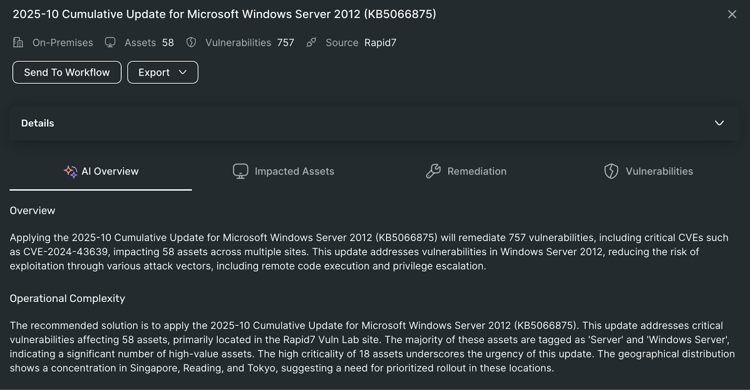
Remediation-summaries.png
Remediation summaries: AI-powered summary of remediation guidance.

The AI contextualizes the vulnerability findings based on your existing security controls, established asset ownership, and the unique makeup of your attack surface. It translates raw vulnerability data into clear, actionable narratives, empowering ITOps to quickly understand not just what needs to be patched, but how to securely and efficiently deploy those patches with minimal disruption to the business.

Communicating up: Translating data into cross-functional narratives

While the SOC and IT are working to remediate the threat, the business demands constant updates. The CISO, the executive team, and the board of directors need to know the organization's real-time risk posture.

Historically, translating deeply technical security metrics into executive-ready reports meant a security analyst would spend hours manually interpreting data, formatting charts, and building slide decks. These are valuable hours that should have been spent actively hunting threats.

To address this, Rapid7 is introducing AI Dashboard Summaries (in preview). This capability automatically transforms dense, data-heavy dashboards into plain-text, actionable narratives. The platform generates a powerful, easy-to-digest summary of the active risk posture, allowing security leaders to give leadership and cross-functional partners exactly what they need: clear, confident answers, delivered immediately.

We also recognize that security telemetry doesn't exist in a vacuum. Organizations need complete control over their data. If you want to integrate this vulnerability intelligence with broader enterprise risk models, you can seamlessly export this data to your AI analytics engine of choice via a Model Context Protocol (MCP) server. This flexibility ensures you can add context or perform secondary risk analysis exactly as your business requires.

The preemptive future

The scenario described above is just a snapshot of how AI-enabled capabilities are fundamentally changing the defensive landscape. By leveraging continuous software visibility, AI-accelerated discovery, and automated remediation guidance, we can stay ahead of the ever-narrowing window between vulnerability disclosures and active exploits.

Preemptive security is about building an environment so visible, so well-understood, and so seamlessly integrated that when the inevitable zero-day drops, panic is replaced by precision. Whether it is navigating complex toxic combinations, securing ephemeral cloud workloads, or implementing robust mitigations when no patch is available, these Rapid7 AI-enabled capabilities lay the groundwork for teams to outpace the adversary.

Visit us at BlackHat to see these capabilities in action!

Why CVSS is No Longer Enough for Exposure Management

For years, cybersecurity professionals have relied on a familiar metric to dictate their day-to-day priorities: the Common Vulnerability Scoring System (CVSS). In today’s hyper-connected, sprawling IT environments, utilizing a static severity score as the ultimate arbiter of risk creates opportunities for threat actors. While defenders chase down theoretical, high-scoring alerts, adversaries are quietly targeting the truly exploitable, business-critical exposures that slip through the cracks.

In a recent report, Gartner® highlighted a projection: 

"By 2028, organizations that prioritize exposures using threat intelligence, asset context, exploitability modeling and security control validation will reduce breach likelihood by at least 70% compared to peers relying primarily on CVSS-based vulnerability prioritization." [1]

This affirms what many seasoned practitioners have suspected for years: there’s an abundance of vulnerability findings, but a lack of actionable context.

Static scores. Reactive security.

Most vulnerability management programs evolved during a time when the attack surface was relatively static, adversary tooling was rudimentary, and remediation capacity generally exceeded the volume of new disclosures. Today, enterprises are confronted with vulnerabilities scattered across complex cloud architectures, SaaS applications, and intricate supply chains.

In this modern threat landscape, CVSS alone is insufficient because it measures theoretical severity, does not factor in whether an attacker is actually using the vulnerability in the wild, or consider the business value of any affected assets. According to Gartner®, fewer than 10% of vulnerabilities are exploited, yet most are treated as urgent [1]. This all leads to prioritization paralysis, where security teams spend countless hours patching vulnerabilities that pose low material risk to the business. The legacy approach rewards what is auditable rather than what is genuinely impactful.

The path toward smarter prioritization

To break free from endless patching and ineffective risk reduction practices, security professionals are shifting toward a context-driven model. As Gartner notes, strong exposure prioritization requires integrating four critical elements: threat intelligence, asset context, data science, and security control validation. Organizations are approaching these elements in a few practical ways:

Threat intelligence to establish relevance

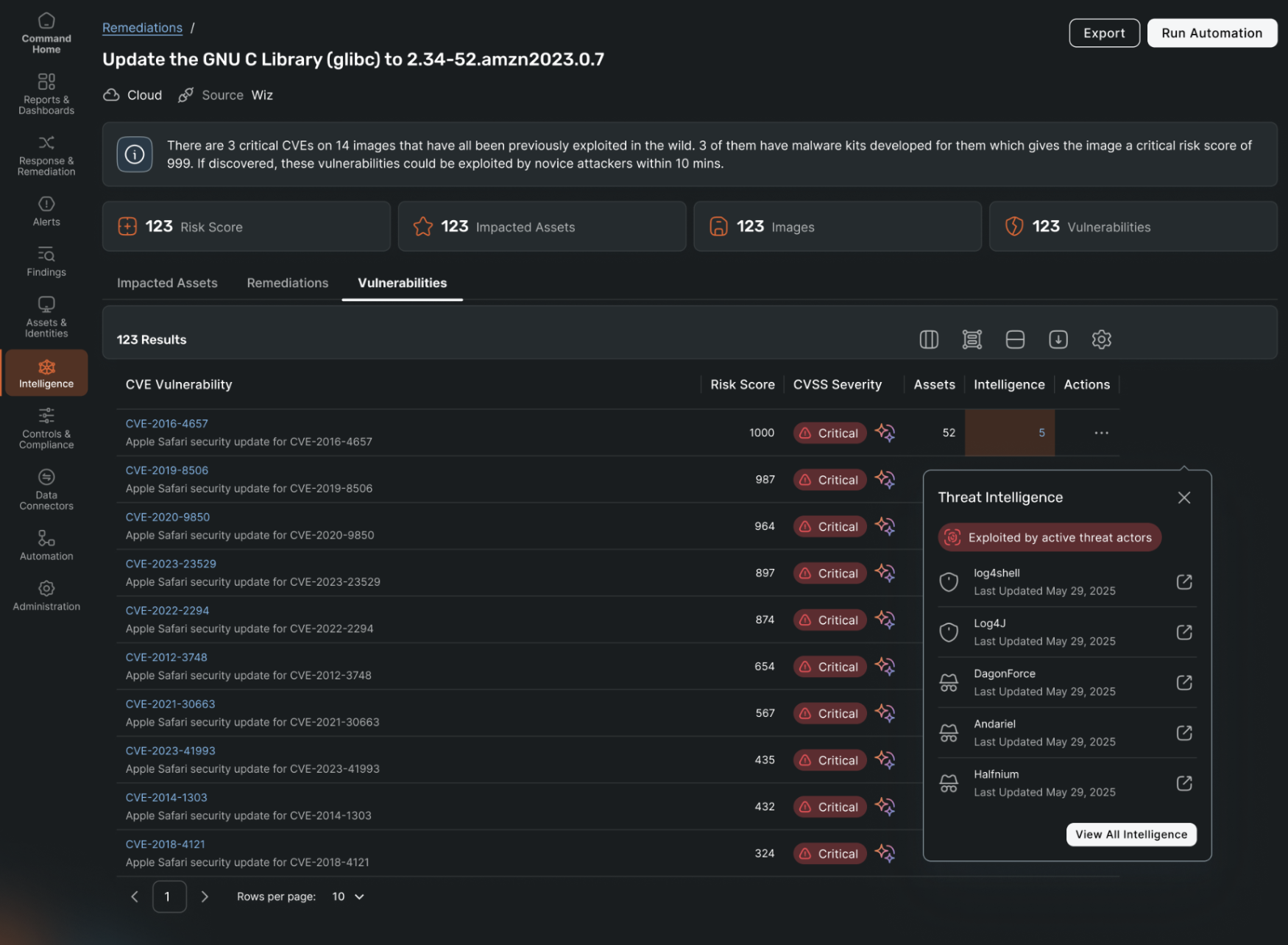
Instead of just asking how severe a vulnerability is, modern exposure management asks whether an exposure is relevant to a threat actor who is capable of exploiting it right now. By embedding threat intelligence into each vulnerability finding, teams shift the focus from theoretical to risk active exploitation. It introduces the adversary's perspective by identifying known exploited vulnerabilities, public or private exploit availability, and targeted campaigns. By filtering out exposures with no evidence of attacker interest, organizations can instantly collapse large vulnerability backlogs and focus only on relevant threats.

Rapid7-threat-intelligence-remediation-hub.png

Asset context and business criticality to define impact

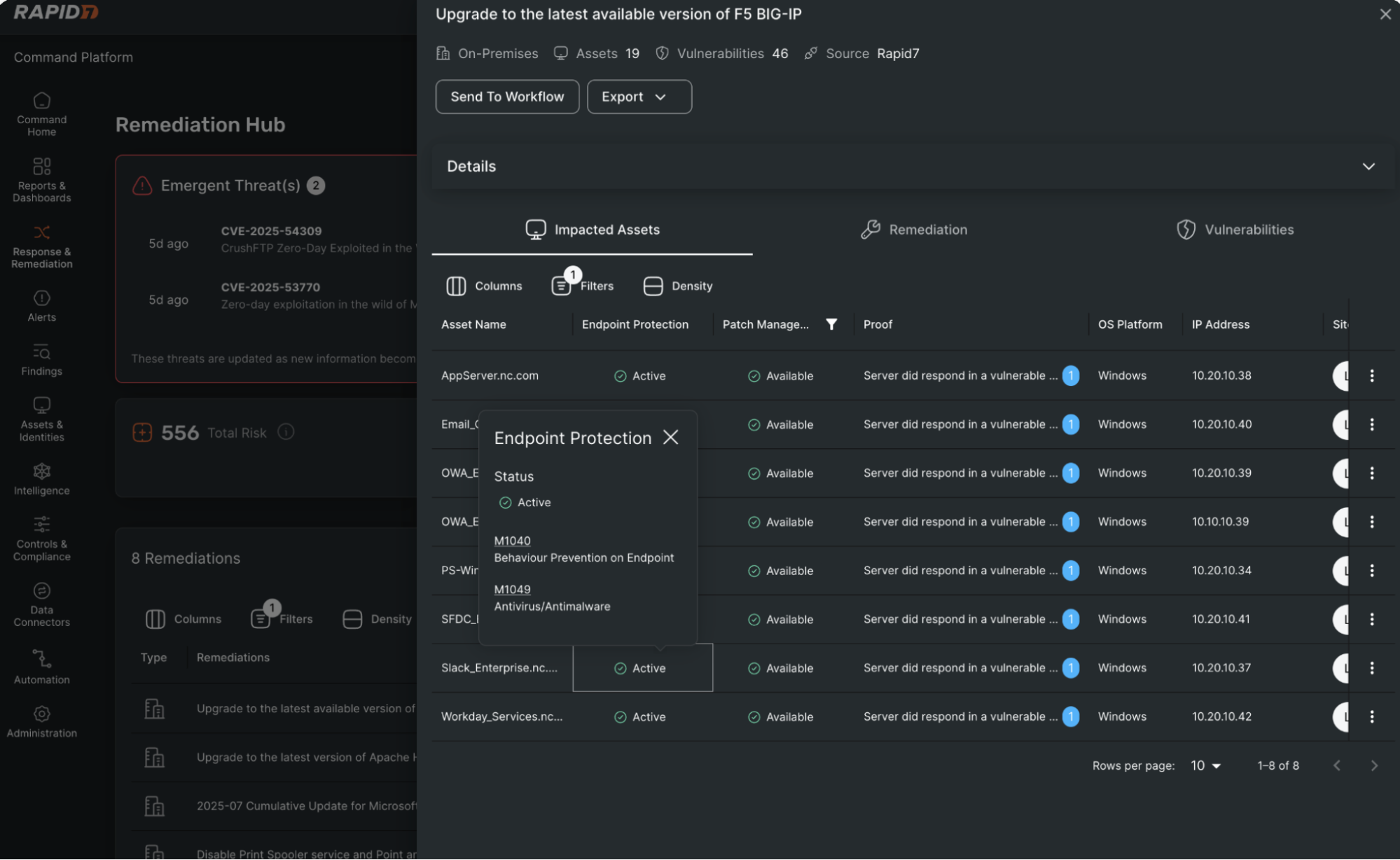
Not all assets are created equal. A critical vulnerability on an isolated, internal test server is vastly different from the same vulnerability on a public-facing cloud workload processing customer sensitive data. Asset context enriches exposure data with crucial business information: what the asset is, its external accessibility, and its relationship to core business functions. Without this context, security teams waste disproportionate effort on low-impact systems, treating every critical alert as an equal emergency.

Endpoint-protection-Rapid7-remediation-hub.png

Exploitability modeling for predicting breach likelihood

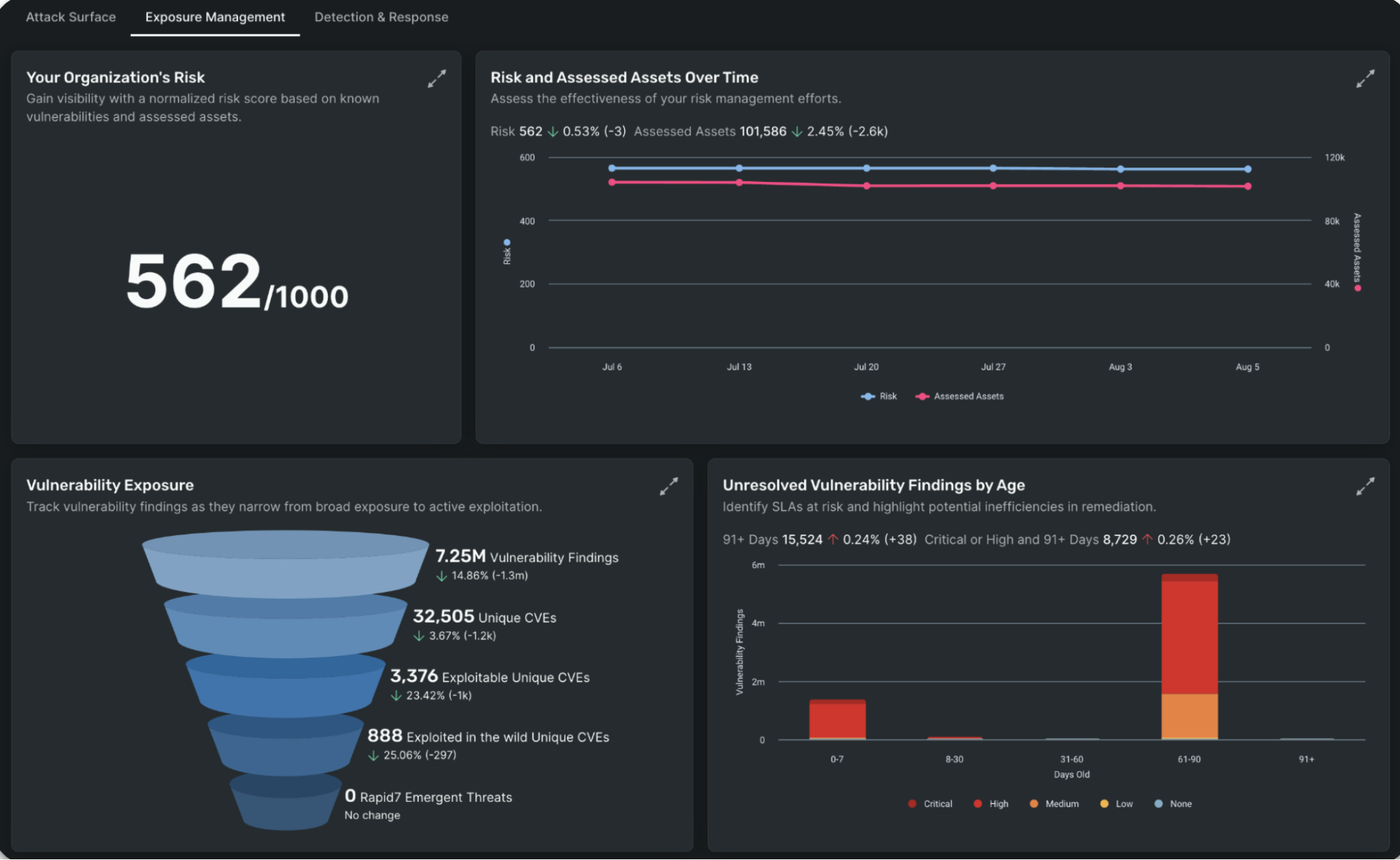
Security analysts often struggle to assess exploitability given the overwhelming volume of vulnerabilities. By using predictive models like the Exploit Prediction Scoring System (EPSS), organizations can analyze large datasets of historical exploitation to identify latent risks. Exposure assessment platforms should display this data alongside each exposure finding to make it easier to predict the vulnerabilities most likely to become attacks.

Rapid7-vulnerability-risk-score-exposure.png

Security control validation

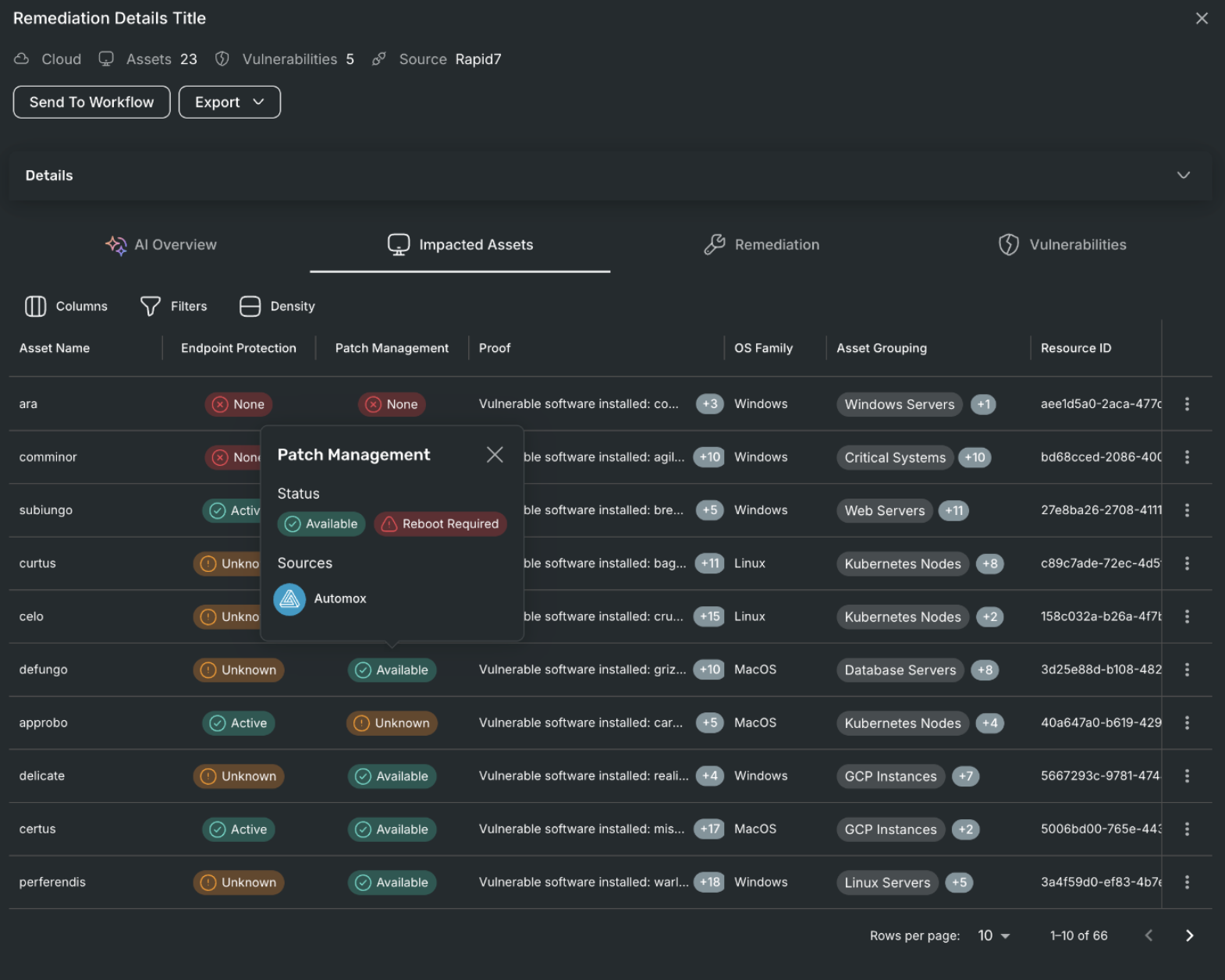
An exposure that appears highly exploitable in theory might be neutralized by existing defenses. By integrating security and policy controls, you can evaluate exposures in the context of endpoint protection and identity management. This passive validation confirms whether an attacker can realistically exploit the exposure in your specific environment.

Rapid7-remediation-details.png

Unified exposure management

Individually, each element highlighted above provides incremental value, but when integrated, they fundamentally transform how prioritization decisions are made. This integrated model ensures that remediation efforts are mobilized only after priorities have been validated in the context of the business and the current threat landscape. It transitions vulnerability management from a purely technical, tool-centric exercise into a strategic, process-driven risk decision.

Security leaders must measure success not by the sheer number of vulnerabilities closed, but by the demonstrable reduction of exploitable exposures and the alignment of remediation efforts with actual attacker behavior. Operationalizing these four elements requires a unified platform that eliminates the silos between vulnerability management, cloud security, and threat intelligence. You cannot manually stitch together disconnected spreadsheets and hope to outpace modern adversaries. This is where forward-thinking organizations are leaning on comprehensive, end-to-end solutions like Rapid7 Exposure Command that seamlessly aggregate visibility across on-premises and dynamic cloud environments. With deep, native integration of Rapid7 Cloud Security capabilities, teams can instantly map asset criticality and external accessibility within complex, ephemeral cloud architectures. Furthermore, by infusing world-class threat intelligence and active exploit data directly into exposure findings, Rapid7 enables security teams to cut through the noise, validate security controls, and pinpoint the exact exposures that matter most—all with minimal friction.

[1] Gartner, Prioritize What Attackers Will Exploit: 4 Elements of Strong Exposure Prioritization, Jonathan Nunez, 5 March 2026.

Preemptive and Proactive: An enhanced CNAPP available with Exposure Command

Earlier this year, we made a significant announcement: Rapid7 partnered with ARMO to add AI-powered cloud application detection and response (CADR) – or cloud runtime security – to our cloud security portfolio. At the time, I published a blog highlighting this two-part approach for modern cloud security that combines preemptive exposure management (understanding the threats that could exist) with proactive runtime security (detecting the threats that are happening).

Today, we are thrilled to announce that this vision is fully realized and integrated with Rapid7 Exposure Command. For our customers, this milestone represents our ability to deliver on the promise of a complete Cloud-Native Application Protection Platform (CNAPP) that helps security teams preemptively identify and proactively thwart attacks.

Exploring the possibilities of this unified CNAPP

At Rapid7, we believe that a CNAPP is unified if it operates from a single, objective source of truth. By integrating cloud runtime security directly into Exposure Command, we are seamlessly merging the preemptive (posture, configurations, identities, and vulnerabilities) with the proactive (runtime behavior and active threats). The table below summarizes this enhancement:


Today’s Rapid7 Cloud Security solution

What cloud runtime adds

Primary Focus

Prevention, risk reduction, and preemptive response

Real-time exposure detection and proactive response

Core Question

"What is vulnerable and could be attacked?"

"Is an attacker exploiting our environment now?"

Lifecycle Stage 

Pre-deployment, continuous scanning, or periodic intervals

Continuous monitoring of live (in-production) workloads

What It Finds

Misconfigurations, exposed secrets, software CVEs, missing patches

Active exploits, lateral movement, unauthorized process execution, SQL injection

The true power of this unified architecture is best understood through the lens of a security practitioner’s daily battle against cloud threats. The previous blog post discussed this in theory; let’s use this blog to talk about the reality.

The baseline

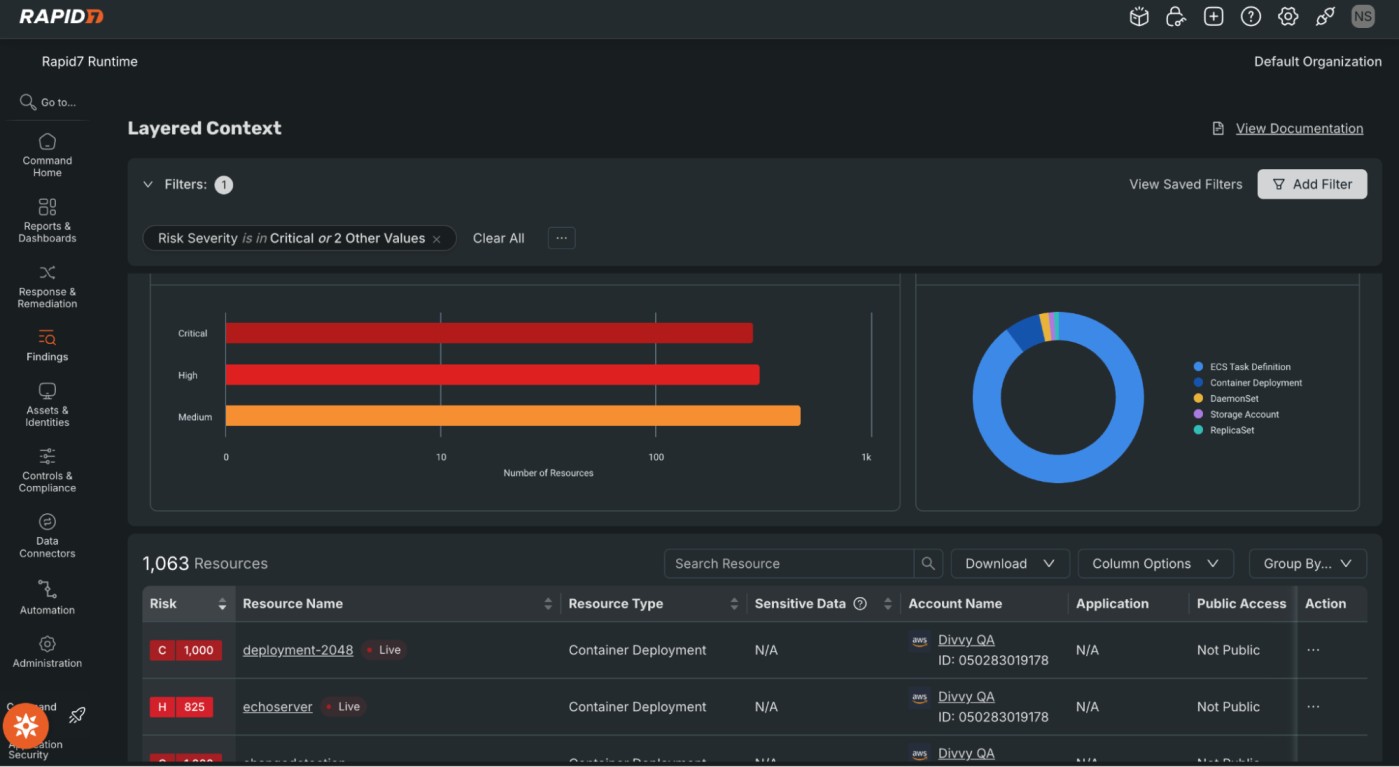
Exposure Command continuously scans and assesses your cloud posture to identify whether a container exposure exists in a production cluster. Traditional scanners would stop here, leaving you to prioritize this vulnerability against others. In Exposure Command, this detection is not just part of a static score, but instead it is part of an attack path. Our preemptive security platform tells you, for instance, whether this specific container has internet access and an over-privileged IAM role, making it highly reachable and exploitable. This means that you are not just looking at a CVE; you are looking at the potential blueprint behind a major breach.

Layered-Context-Dashboard-Rapid7-Exposure-Command-CNAPP.jpg

The proactive validation

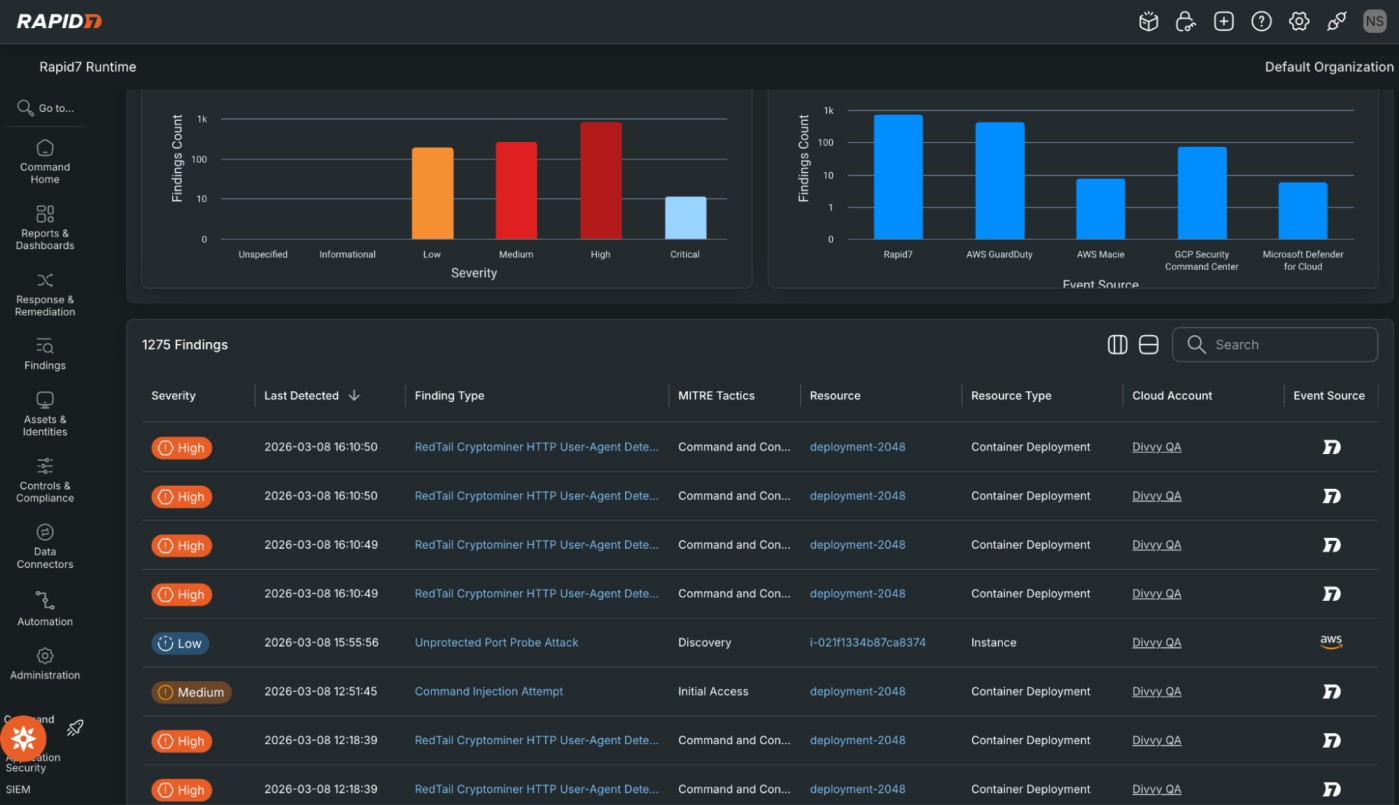
This is where cloud runtime security turns theory into reality. Instead of treating the vulnerability as just a potential risk, the platform utilizes eBPF sensors to provide continuous, direct kernel-level observability and application L7 visibility. Exposure Command analyzes this sensor data, uses AI to establish baseline workload behavior, and uncovers anomalies in real time. For example, security analysts gain instant visibility when that vulnerable container suddenly spawns a reverse shell and initiates an external connection to a known malicious IP, rather than executing its standard database queries.

Runtime-Security-Rapid7-Exposure-Command-CNAPP.jpg

The response

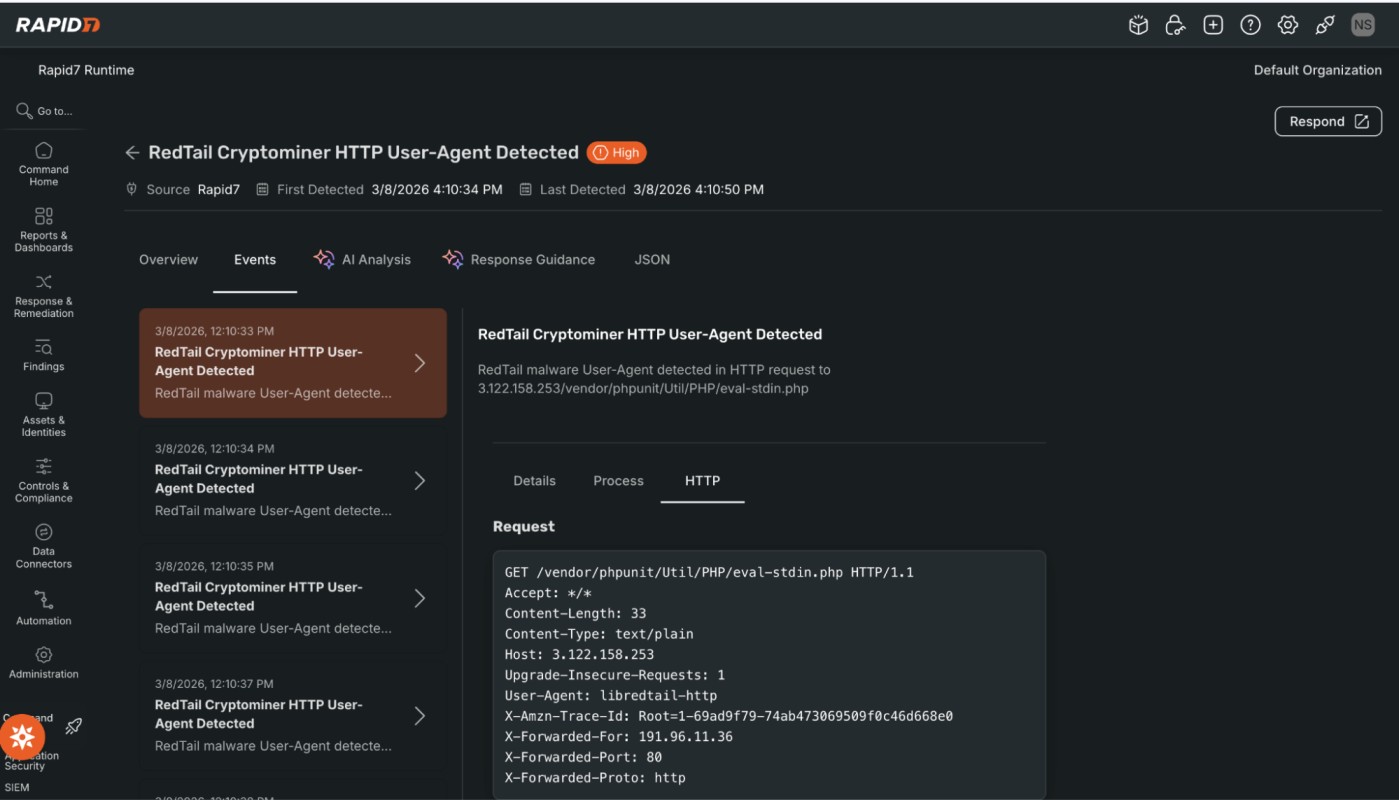
When a runtime anomaly is detected on a high-priority asset, the platform instantly aggregates these events into streamlined alerts. It links the initial application-layer exploit to the infrastructure-level change, such as the attacker attempting a container escape using that over-privileged IAM role. More importantly, the platform can trigger an automated response. By automatically terminating the malicious process, pausing the compromised container, or isolating the namespace, Exposure Command effectively stops an attacker's lateral movement in seconds.

Malicious-process-alert-Rapid7-Exposure-Command-CNAPP.jpg

The investigation

Stopping the threat, understanding how it happened, and proving you resolved it, is what creates a truly resilient security program. Rapid7 Exposure Command does not just initially block the attack and leave you sifting through raw kernel logs to truly remediate the threat. Instead, it uses AI-generated remediation summaries to translate complex runtime telemetry into a clear, actionable remediation narrative. It explains exactly how the attacker bypassed initial defenses, what lateral movement they attempted, and the precise root-cause misconfigurations that allowed it. This empowers security teams to confidently report to leadership on the active threats they've neutralized, while providing developers with the exact context and code-level recommendations they need to patch the underlying exposure.

Amplifying signal vs. noise

When you combine predictive exposure analytics with deep application-layer and kernel-level visibility, you fundamentally change your operational efficiency. You stop chasing every theoretical risk and start focusing on what matters most. Exposure Command is a unified solution that eliminates the noisy alerts that tend to overwhelm security operations teams. Teams are able to prioritize remediation not just by CVSS score, but by real-time validation of what is actively loaded into memory and what is currently being exploited (i.e., risk and exposure). This means your developers spend less time patching vulnerabilities that fail to pose an immediate risk, and SecOps spends less time investigating benign container behavior.

With the general availability of cloud runtime security as part of Exposure Command, Rapid7 delivers a strategic, engineering-driven platform that achieves the mission of true CNAPP. We provide the precise answer to, "Could I be compromised?" through preemptive exposure management, and the definitive answer to, "Am I currently compromised?" through proactive runtime security. By closing the loop between these two questions, we allow enterprises to secure their cloud environments with accuracy, speed, and confidence. This is a great example of the wider approach to preemptive security that Rapid7 is delivering across different use cases through the Command Platform’s comprehensive exposure management and threat detection & response capabilities.

Visit Rapid7's CNAPP hub page to learn more about how the fully integrated Rapid7 Exposure Command with cloud runtime security can transform your cloud defense.

❌