President Trump has unveiled his latest plan to combat concerns around AI by appointing a new "czar" to oversee the technology, and also establish an "AI force" to help enforce this.
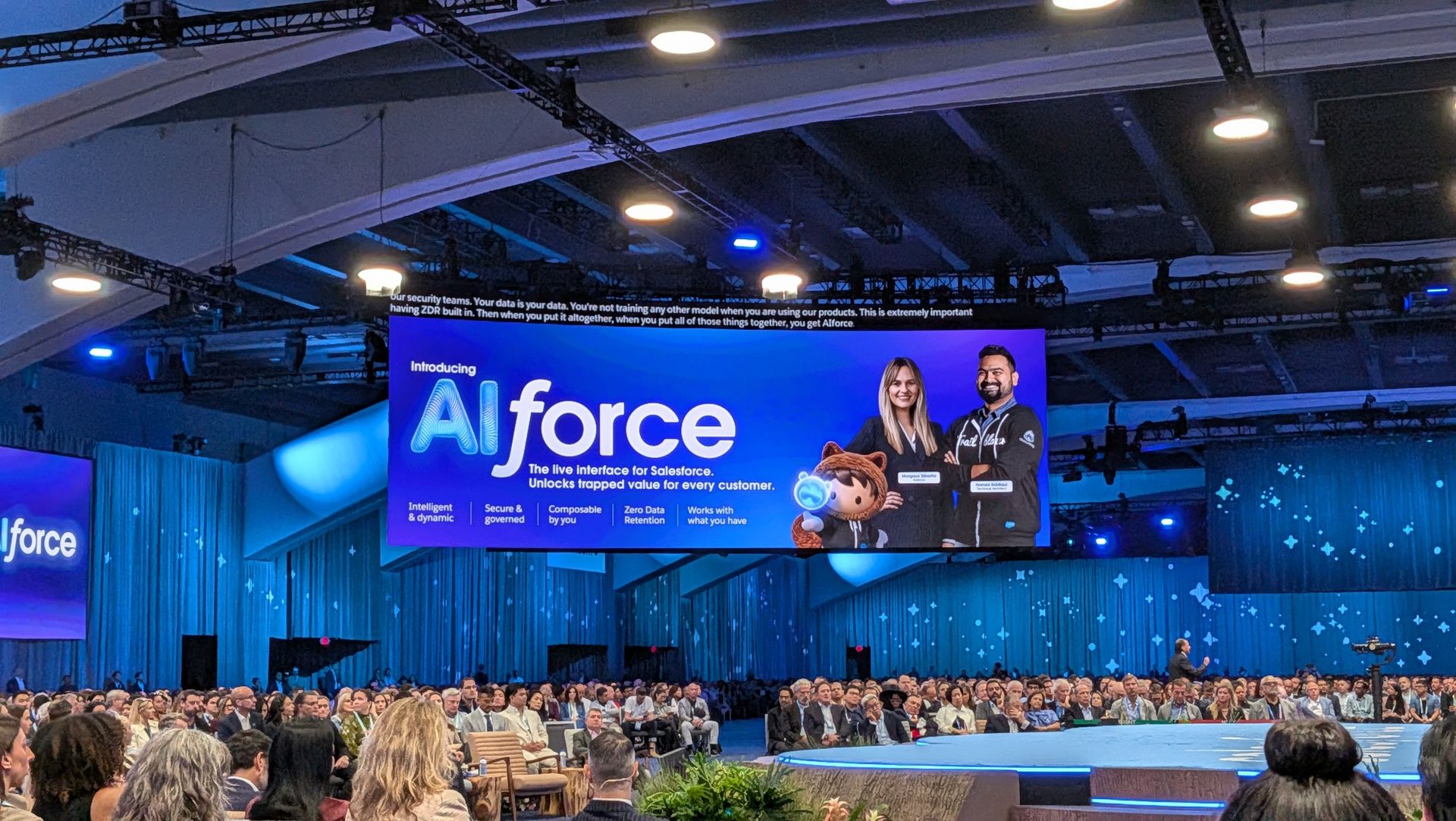
However there's just one problem - as anyone who actually pays attention to the technology industry news cycle will be well aware of, Salesforce recently revealed its latest interface platform for AI.
Its name...AIforce.
Which AIforce is best AIforce?
Unveiled at its recent Dreamforce 2026 event, AIforce was the headline announcement for the company, promising no less than a new way of interfacing with the data and AI together to help unlock productivity and efficiency in the workplace like never before.
Described by Salesforce CEO and Chair Marc Benioff as "really the most exciting thing I've ever seen for Salesforce," AIforce was a huge presence at the show, one of the biggest technology conferences on the calendar, with posters and displays splashed around the venue.
The problem is, no-one seems to have told President Trump.
Let's be honest, the man is hardly a master of coming up with good names for anything ("Space Force"/"Big Beautiful Bill"/"Gulf of America") - and is currently seeking out views on an alternative name for the concept of Artificial Intelligence itself.
In a typically rambling post on his Truth Social site, the President noted that his administration “will not in any way hinder or stifle the Growth of this incredible Industry. Rather, we will cherish it, help it, and watch over it, as it grows!”
He also linked the idea of the AI Force to his creation of the Space Force, which he claimed was a “tremendous SUCCESS.”
The President gave no further details about the AI Force, such as when it might be announced or launched, nor who he had in mind to lead it. Luckily for all of us know, Trump has insisted that “Only High I.Q. individuals need apply!” for the position of AI Czar.
Mr Benioff - maybe it's time to give the President a call and avoid a copyright issue?
As AI continues to take over more and more everyday tasks, there's an increasing amount of people looking to enjoy experiences with more of a human touch.
AI can undoubtedly be useful great at sifting through large amounts of data, and taking away the drudgery of reporting and admin work - but what about areas which require the senses?
So can AI perform in matters of taste, smell and touch?
tAIster steps up
Salesforce has been a leader in pushing forward AI-enabled experiences in recent years, with its wide range of AI agents helping customers from all around the world.
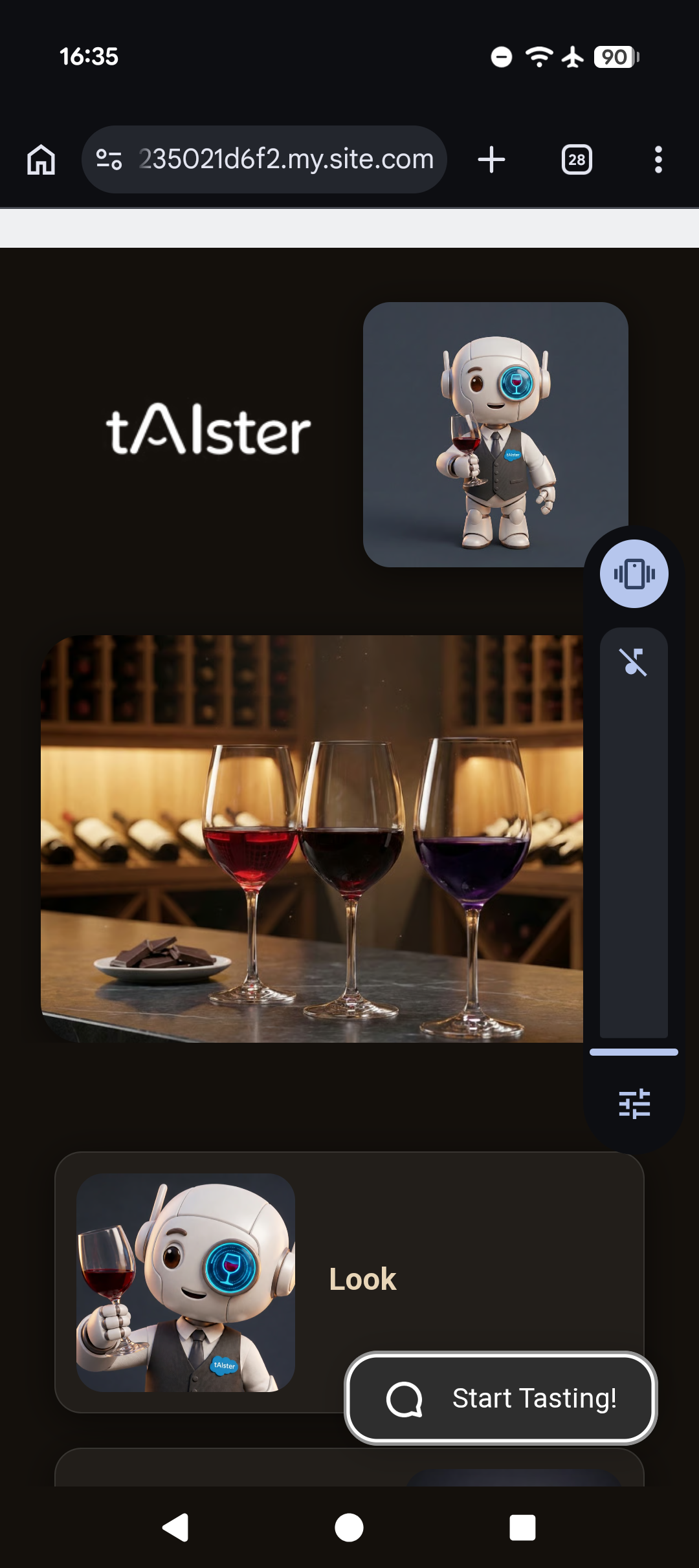
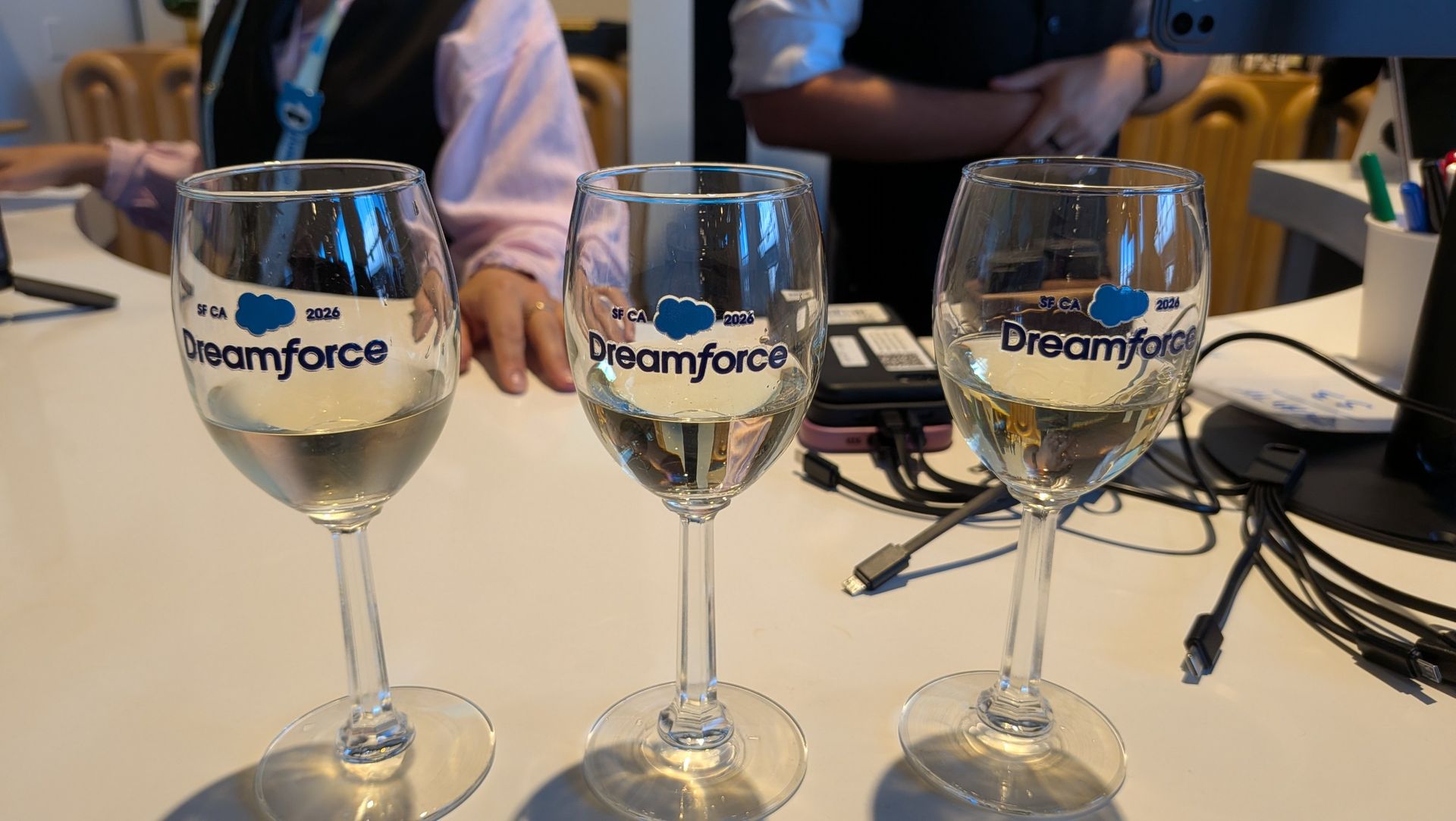
At its recent Dreamforce 2026, I took part in an AI sommelier session powered by an AI agent to see if the technology could be applied to wine tasting.
In a plush executive lounge away from the madness of Dreamforce's campgrounds, we were given three glasses of mystery wines, and then connected to an AI agent by scanning a QR code with a smartphone.
Future / Mike MooreFuture / Mike MooreFuture / Mike Moore
This hooked us up with tAIster, an AI agent which had been educated on around 400,000 different types of wines, including their taste, feel, aroma and other attributes.
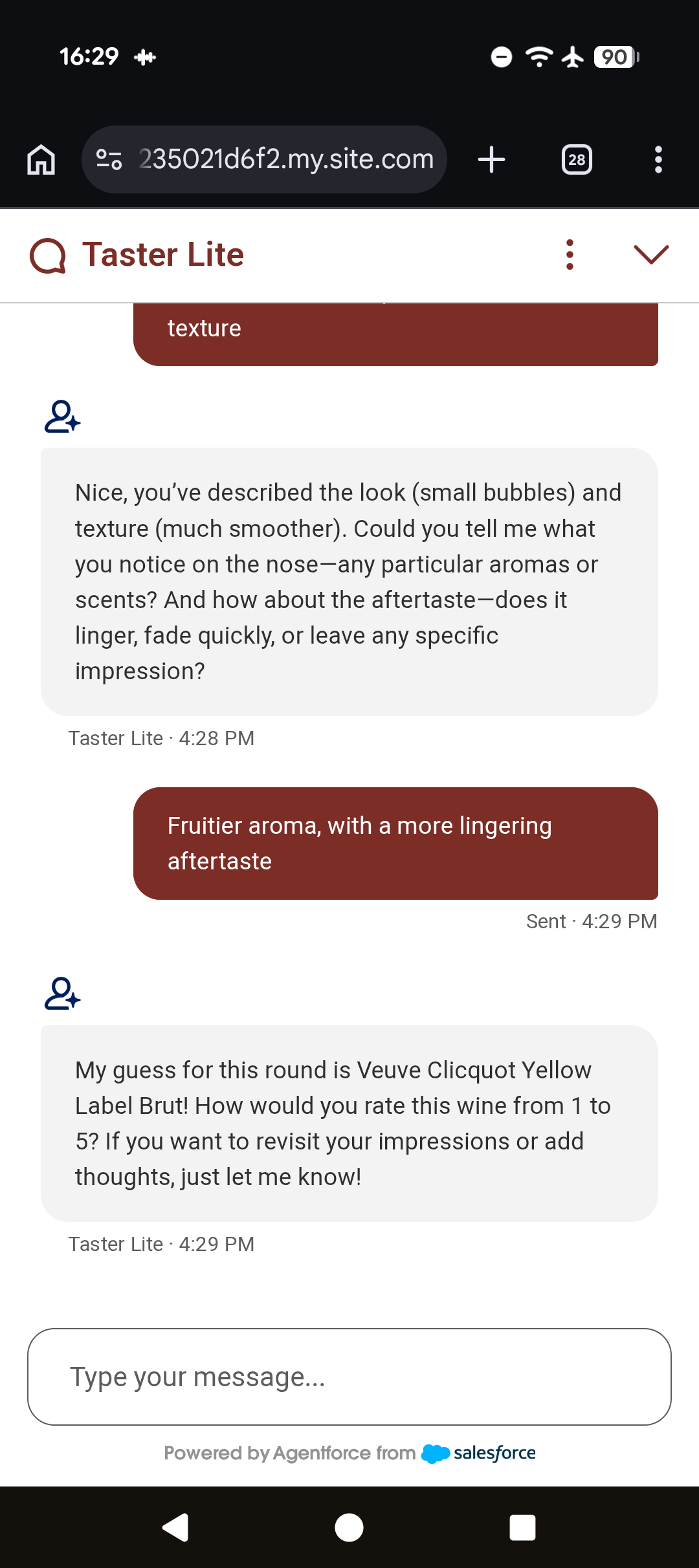
Before tasting a wine, the agent asked us to use a few keywords to describe how it looked, and how grippy it was in the glass. We were then asked to describe the wine's aroma, and finally, the taste - with the aim of being as descriptive as we could, so the agent could guess which wine we had been given.
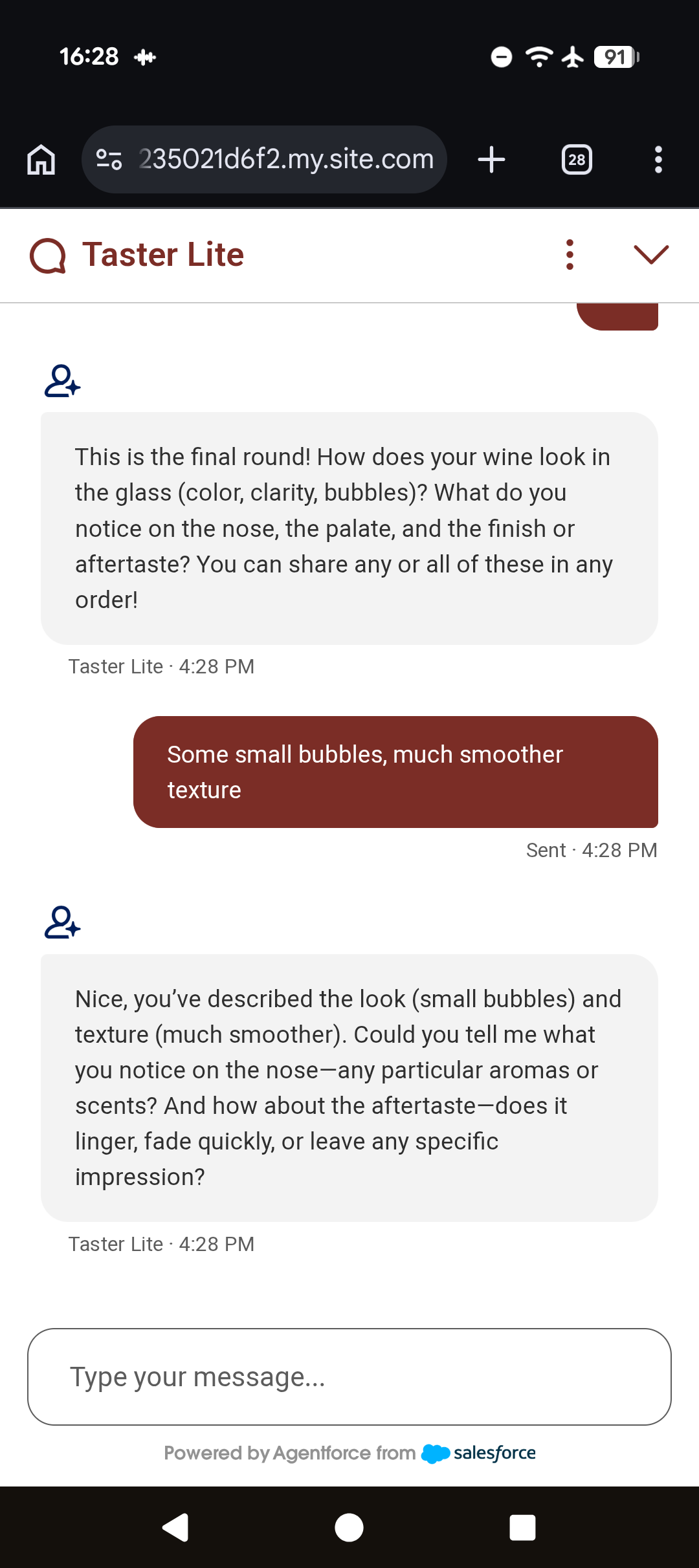
So did it work? I'm not a massive wine buff, but I tried to be as descriptive as possible, with the hope if giving the agent what it needed. Ultimately, it guessed my first two samples correctly, but got the third hopelessly wrong - guessing it was Veuve Cliquot champagne rather than Chardonnay due to me mentioning the glass had some small bubbles in.
So all in all, a fun example of what AI agents could do in previously unexpected areas - and although it's just a proof of concept right now, I don't think any real-world sommeliers will be quaking in their boots just yet.
As AI becomes an ever-present in many businesses, most will now be looking to determine not just when AI will genuinely make a difference - as opposed to when it might just add cost and complexity.
So does every business process really need AI, or should companies be focusing on specific needs which will help them the most?
We spoke to Gregg Aldana, Senior Vice President, Head of Global Solutions Consulting at Appian, to find out more.
There’s a growing assumption that if AI can be applied to a business process, it should be. Is that the wrong starting point? How should businesses decide where AI genuinely adds value - and where it’s simply adding complexity?
The wrong starting point is asking, ‘Where can we use AI?’ because that puts the technology before the business problem. Organisations should start by asking what they are actually trying to solve and where the biggest bottlenecks or inefficiencies sit.
That means looking closely at which decisions they are trying to improve, what data those decisions rely on and where human oversight needs to sit. That discovery should involve the people who understand the process and its challenges, from IT and business teams through to executive leadership.
Only then can businesses judge whether AI is genuinely going to make a difference. The test isn’t whether AI can do something. It’s whether it can make the process measurably better.
How do you distinguish between a process that actually needs AI and one that can be handled more effectively with traditional automation, rules or workflow?
The key distinction is whether the task follows predictable rules and has a clearly defined outcome. If it does, traditional automation or business rules can often get you there faster and more cheaply. In those cases, adding AI may not improve the outcome and can introduce complexity that simply isn’t needed.
For example, an insurance company would use business rules to review and classify incoming online claims based on what the claimant selected from a drop-down list in a form. Automotive claims go to one department and home insurance claims go to another.
AI agents become more valuable when the work requires adaptive reasoning, complex context or handling variable inputs. In this case, an AI agent could analyse claims from web and mobile forms with structured data, as well as incoming emails with unstructured content. Based on keywords such as ‘motorway,’ ‘clash,’ and ‘passenger,’ a trained AI agent would deduce that the claim is probably about an automotive accident and route it to the appropriate department.
The mistake is assuming that because an AI agent can perform a task, it should. Businesses need to look at what each part of a process actually requires and use the technology that best fits that need, rather than replacing conventional automation with AI for the sake of it. A balanced portfolio approach is essential – use rules for high-volume, repeatable logic and agents for dynamic triage or investigation.
What’s the hidden cost of putting AI into every process? Beyond the cost of the model itself, are businesses underestimating the costs around data, integration, monitoring, governance, security and managing exceptions?
One of the highest hidden costs lies in the operational infrastructure required around the AI model to make it work effectively and safely. The cost isn’t just the model. Agents need access to the right data and systems, but businesses also need monitoring, security and governance around what they can access and what actions they can take.
There is then the question of accountability. Organisations need to understand why an action was taken, trace what happened if something goes wrong and have a clear way of dealing with situations an agent cannot handle confidently. Without a unified platform to orchestrate data and enforce policy, the overhead of managing exceptions and audit trails will outpace the AI’s productivity gains.
That overhead can absolutely be worthwhile when AI is delivering meaningful value. But every additional agent introduces complexity, so businesses need to be confident the improvement to the process justifies it.
Where do you think human judgement remains irreplaceable in enterprise processes - particularly when decisions affect customers, employees, finances or regulatory outcomes? And how should organisations decide when a human needs to remain “in the loop” rather than simply being notified after an AI agent has acted?
Human judgement remains critical where the cost or consequence of getting a decision wrong is high, particularly in regulated industries such as financial services, insurance, life sciences and the public sector. AI can accelerate areas such as client onboarding, insurance, underwriting or clinical trials, but there will still be decisions where the consequences mean a person needs to be involved.
That doesn’t mean a human has to approve every action an AI agent takes. The important thing is understanding the level of risk attached to the decision. Routine activities may proceed autonomously, while sensitive, unusual or more consequential tasks and decisions should be escalated for human review.
Those risk assessments and boundaries need to be designed into the process from the start. Organisations should know which decisions an agent is authorised to make on its own and which require human judgement before an action is taken.
Is the more realistic future one where people, AI and conventional automation work together, rather than one where AI agents eventually take over entire end-to-end processes?
End-to-end automation isn't about giving an entire process to a single AI agent. The future is orchestration. A more realistic future is one where people, AI agents and conventional automation work together, because tasks vary within a process that require different skills.
Complex processes require a combination of predictable business rules, adaptive AI agents and human expertise. The goal is to build an integrated process where each component handles what it does best. The key is to understand which parts are best handled by an agent, where a simple rule or workflow will work better and where a person needs to be involved.
The aim isn’t to maximise the amount of AI being used. It’s to build the most effective process around the business outcome you want to achieve.
Could the pursuit of autonomous AI actually make some business processes less efficient? For instance, if you introduce an AI agent into a process that was previously handled by a simple rule, are you potentially adding latency, uncertainty and governance overhead without creating much additional value?
Absolutely. Putting AI into the wrong part of a process can make it less efficient, not more. Replacing a deterministic rule with a probabilistic AI model introduces unnecessary latency, cost and unpredictability. If a task can already be completed quickly and reliably through a simple rule, introducing an AI agent may not materially improve the outcome.
That doesn’t mean businesses should be overly cautious about AI. It means being selective. Agents are incredibly valuable where a task requires unstructured reasoning, extensive research or adapting to changing information. But they shouldn’t replace conventional automation simply because AI is newer or more sophisticated.”
Sometimes the smartest AI decision is deciding you don’t need AI at all. Using them where a simple process rule already works reliably creates technical debt.
What should a business ask itself before introducing AI into a process? Is it the business outcomes, the nature of the decision, the cost of failure and the availability of human expertise, rather than simply asking where AI can be inserted?
The most important question is very simple: ‘What problem are we trying to solve?’ Too often, organisations start by asking where they can use AI and then look for processes to apply it to. That puts the technology before the business need.
Instead, businesses should look at where their biggest challenges and bottlenecks really are. Which processes are taking too long? Where is there too much manual intervention? Which decisions could be improved, what data are they based on, and where does human oversight need to sit?
That discovery needs to happen upfront and involve the people who understand the process, from IT to business users to executive leadership. Identify where processes stall or manual handoffs create errors. Map out the required data and processes, regulatory requirements and risk parameters.
Ultimately, AI should be driven by business pull rather than technology push. Once you understand the problem and the outcome you want, you can decide whether AI is genuinely the best way to achieve it – or whether rules, automation or human judgement supported by AI would work better.
How should companies think about risk when an AI system moves from making recommendations to actually taking action?
The move from recommending an action to actually taking one is where bounded autonomy becomes critical. The goal should be to give AI agents freedom to reason and act, but within clearly defined process guardrails and risk parameters.
That means being explicit about what an agent is allowed to do, what information it can access and when it needs to escalate to a person. An agent shouldn’t operate in isolation; it should sit within governed operational processes with relevant business rules and data security. All AI agent actions should be traceable and auditable within the governance framework.
Human oversight remains particularly important for exceptions, outliers and higher-risk decisions. Ultimately, businesses need to know what an agent did, why it did it and who is accountable for the outcome.
Do you think businesses are at risk of measuring AI success by how many processes they’ve “AI-enabled”, rather than by whether those processes actually became better? What metrics should executives use instead?
The number of processes using AI tells you very little about whether an organisation is actually getting value from it. If anything, focusing on AI adoption as the metric risks encouraging exactly the wrong behaviour, putting AI into processes simply to say they have been AI-enabled.
Businesses should measure AI in the same way they would any other operational and technology investment: by the outcomes it delivers. Has it reduced cycle times? Lowered the cost of running a process? Improved the quality of decisions?
We’ve seen how significant those gains can be. Processes such as client onboarding for a bank that once took up to two weeks being reduced to just a few minutes. (That bank also automated 96% of onboarding processes whilst growing their new customers by 900%.) The cost of running an end-to-end process can fall tenfold or even more. That’s the test that matters. The goal isn’t to have AI everywhere, it’s to make the business work better.
If you were advising a CEO who had been told they need an “AI strategy” for every part of their organisation, what would you tell them to stop doing, and what would you tell them to prioritise instead?
Stop mandating AI everywhere for the sake of adoption. I’d tell them to stop asking, ‘Where can we use AI?’ and start asking, ‘What problems are we trying to solve?’ Pressure to have an AI strategy everywhere can quickly become technology for technology’s sake.
Start with the biggest bottlenecks in the organisation. Which processes take too long? Where is there too much manual intervention? Which decisions could be improved? Identify your three highest-value operational bottlenecks and orchestrate the right mix of rules, agents and human judgement to resolve them.
Importantly, CEOs should prioritise business value over AI volume. A successful AI strategy isn’t one that puts an agent in every process; it’s one that makes those processes measurably better.
Slack users will soon be able to talk to the program's Slackbot AI agent
Slackbot will look to help you with all kinds of business tasks
There's no release date yet, just "coming soon"
Slack has revealed a host of new features and upgrades as it looks to help users around the world be more productive and effective.
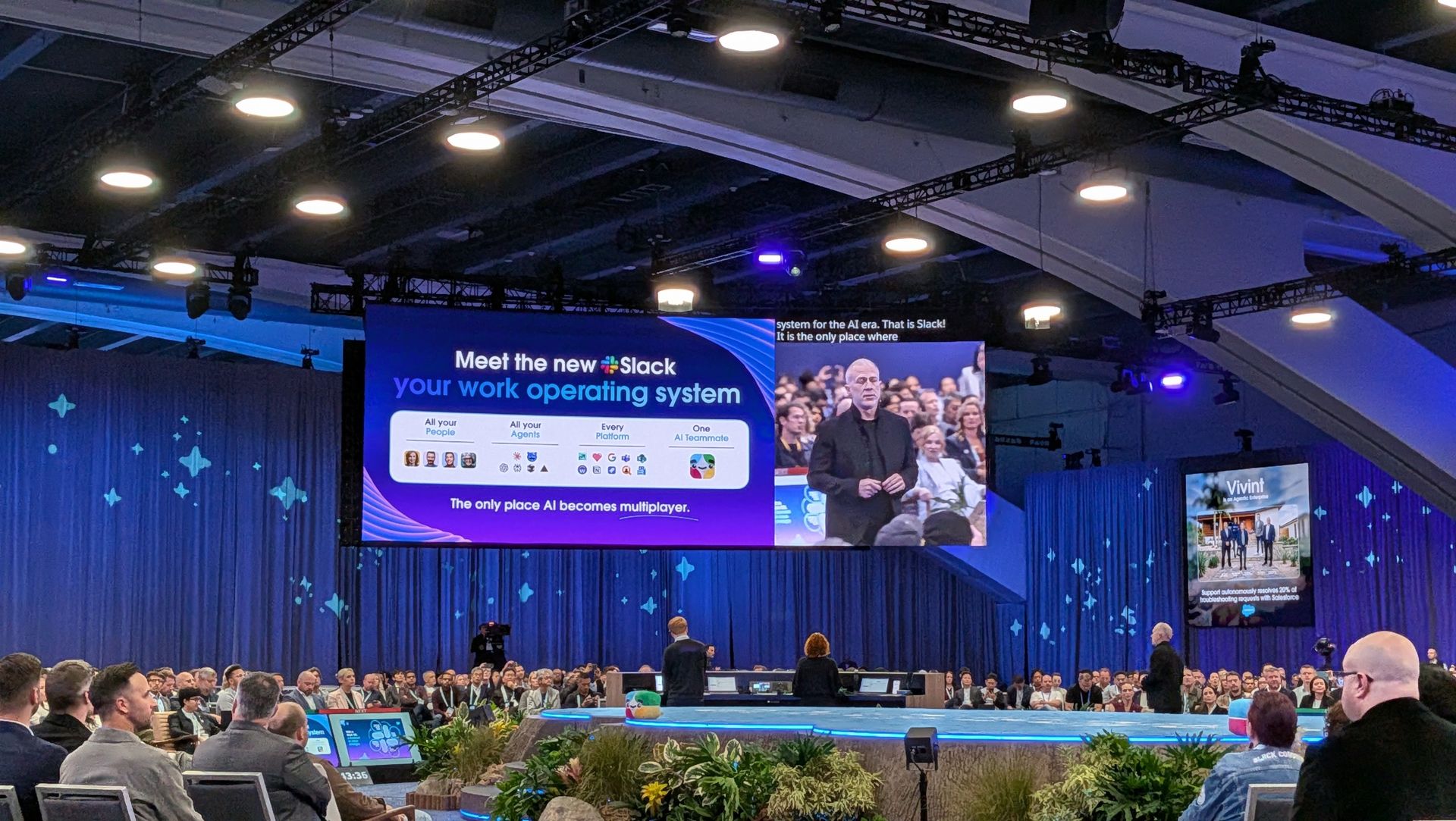
Speaking at parent company Salesforce's Dreamforce 2026, Rob Seaman: EVP & GM at Slack unveiled new tools to allow the platform to be "the front door to the agentic enteprise".
This includes new upgrades to its Slackbot AI program - with users soon set to be able to have a two-way conversation with the platform.
Slackbot speaks
Ask Slackbot a natural language question, and it should then talk back, including the ability to trigger real actions, like updating a record or kicking off an automation.
For example, a worker travelling to a meeting could ask Slackbot to move a deal to the next stage, and hear the confirmation back, no typing required.
A demo shown onstage at Dreamforce 2026 was not without its teething issues, with Slackbot taking its time to gather the required information and present a solution, but the feature is still listed as "coming soon", suggesting there is still ample time to iron out the kinks.
Voice chat wasn't the only new feature coming to Slack, as the company also revealed Surface - a new way to create interfaces for your workflows.
Users simply need to tell Slackbot what they need, and it will build a Slackforce Surface, what the company describes as "a live, interactive interface your team can filter, explore, comment on, and act on together".
Slackbot is also adding video and deck generation, meaning users will be able to create assets for presentations, pitches and more, all without leaving Slack.
Finally, users will now be able to tag Slackbot into a channel - meaning everyone in the group can act on the replies, hopefully making it quicker and easier to get the solution your team needs.
Salesforce UK&I CEO pushes her skilling "mission" across the country
Salesforce doubles down on UK&I recruitment and upskilling goals
Jobs could be repatriated back to the UK from abroad
Salesforce’s UK&I CEO has doubled down on her company’s commitment to investing in skills training and upskilling of young people.
With the UK recently seeing a change in Prime Minister, Zahra Bahroloumi was asked in a media roundtable attended by TechRadar Pro what her outlook for the future looked like.
“Irrespective of government, we are committed to, and very active to the skilling of people,” Bahroloumi said, “we're not stopping, we remain true to our mission, and we remain active and true to our customers, irrespective of government”.
Closing the AI literacy gap
Bahrololoumi has long been a key voice in promoting skills training in the UK, using her company’s influence and scale across the country to push a number of key initiatives.
In June 2026, she outlined the Salesforce’s “incredibly bold” vision for the UK, which includes $6 billion investment committed to the country through 2030, and its role in backing the UK government’s aim to train 10 million UK workers by 2030.
Alongside Bahrololoumi, Paul O’Sullivan, SVP Solution Engineering and Salesforce UKI CTO also looked to outline how Salesforce’s future Trailblazer program is “closing the AI literacy gap”.
O’Sullivan noted how Salesforce is going through “a surge of hiring”, including doubling the size of its forward-deployed engineer team in the UK.
“We are not just looking to attract the best possible talent to come and join Salesforce, we’re also heavily investing in our apprenticeship scheme, doubling down on our graduate opportunities, and aiming to double the size of the team in the next six months,” he noted.
“This is our opportunity to reinvest in the next generation.”
Looking forward, Bahrololoumi was keen to promote the role of the UK in the AI-enabled and augmented future, noting that while the country was, “an empowered market”, there was still potential for more growth.
“We need more talent,” she added, “I feel so confident, and we’ve got the evidence and the proof points that this technology and our platform can work and automate jobs, and augment jobs, and expand human capacity in an organisation effectively.
“But I would like to see more jobs being repatriated from offshore and low-cost locations and jobs being created back in the UK - so I would like to see a stronger drive around automation and repatriation.”
Bahrololoumi gave the example of when there 300 jobs in a low-cost location, outside of the UK - “why can I not create a hundred jobs in the UK and still do 300 plus worth of capacity?”
“That’s something we’re really focused on, because we’ve got the capability to do that now… but I think we've got the opportunity now to create jobs in the UK,” she concluded, “we're on a mission.”
Salesforce expands Missionforce defense AI agent program
Missionforce will now add in models from OpenAI and Nvidia
Missionforce is now one year old, with big plans going forward
Salesforce is expanding its defense AI model program to help bring extra intelligent to critical government missions.
The company revealed its Missionforce program will now be partnering with OpenAI and Nvidia to bring in the former's frontier models, and also adding the latter's models and accelerated computing capabilities.
Salesforce says this expansion will allow Missionforce to deliver "new, specialized AI capabilities and agents designed for the government’s toughest challenges."
Missionforce gets smarter
“Government agencies want tailored AI that runs everywhere they operate while staying within the secure environments their missions demand.” said Kendall Collins, CEO of Missionforce & Government Cloud.
“Missionforce enables this at scale, with purpose-built AI that executes the mission and enables agencies to solve their hardest problems while maintaining operational control.”
This includes Operations capabilities such as turning manual, paper-bound processes such as procurement, supplier management, and invoice audits into digital workflows in just a few minutes, with specialized AI agents automatically running tasks, track status, and flagging exceptions in real time, all running entirely within private cloud or air-gapped environments.
Elsewhere, the company's Missionforce Field Operations & Asset Management tool means government agencies can now use AI agents to automate scheduling, work orders, and asset maintenance — all supported by native offline mobile capabilities for remote environments.
The news comes as Salesforce marked one year of Missionforce, with the company noting that the public sector has become its fastest-growing industry business at scale, and that its defense sector business has grown 80% year over year as demand accelerates.
Salesforce CEO Marc Benioff harked to the partnership in his opening keynote at Dreamforce 2026, noting that the company was "deeply committed to America".
Having already worked with government customers for more than two decades, the expansion means Salesforce now supports some of the US government’s "most complex and consequential missions" across more than 30 countries, working with 60 federal agencies, all 15 US Cabinet departments, all 50 states, and all six branches of the US military.
“One year in, the momentum behind Missionforce shows how quickly government agencies are moving from AI ambition to operational deployment,” Collins said.
“Our defense business is a critically important part of that progress, with trusted data and actionable intelligence essential to readiness and mission success. With new capabilities and partnerships, we’re helping agencies equip their people and put AI to work — with the security, accountability, and control their most critical missions demand.”

 Login
Login