Normal view

There are new articles available, click to refresh the page.
Before yesterdayKrebs on Security

Scattered Spider Hackers Plead Guilty on Day 1 of Trial

23 June 2026 at 12:12

Two men pleaded guilty in the United Kingdom this week to criminal charges stemming from an August 2024 cyberattack that crippled Transport for London, the entity responsible for the public transport network in the Greater London area. The duo were key members of a prolific cybercrime group known as Scattered Spider, and their guilty pleas came on the first day of what was expected to be a six-week trial.

Owen Flowers (left) 18, and Thalha Jubair, 20. Image: UK National Crime Agency (NCA).

Thalha Jubair, 20, of East London and 18-year-old Owen Flowers of Walsall admitted conspiring to commit unauthorized acts against Transport for London computer systems and causing risk of serious damage to human welfare. According to a report from the BBC, Flowers alone admitted to being part of a conspiracy to hack into U.S. based healthcare providers SSM Health Care Corporation and Sutter Health in September 2024.

Jubair is also wanted by U.S. law enforcement agencies. In September 2025, prosecutors in New Jersey unsealed an indictment alleging Jubair and other Scattered Spider members committed computer fraud, wire fraud, and money laundering in relation to 120 computer network intrusions involving 47 U.S. entities between May 2022 and September 2025, and that the group’s victims paid at least $115 million in ransom payments.

In July 2025, KrebsOnSecurity reported that Flowers and Jubair were arrested in the United Kingdom in connection with Scattered Spider ransom attacks against the retailers Marks & Spencer and Harrods, and the British food retailer Co-op Group. Multiple sources familiar with those investigations said Flowers was the Scattered Spider member who anonymously gave interviews to the media in the days after the group’s September 2023 ransomware attacks disrupted operations at Las Vegas casinos operated by MGM Resorts and Caesars Entertainment.

According to prosecutors, Jubair co-ran a bustling Telegram channel called Star Chat, the home of a SIM-swapping group that used voice- and SMS-based phishing attacks to steal credentials from employees at the major wireless providers in the U.S. and U.K. The group would then use that access to sell a service that could redirect a target’s phone number to a device the attackers controlled and intercept the victim’s calls and text messages (including one-time codes for multi-factor authentication).

A receipt from Star Fraud Chat’s SIM-swapping service targeting a T-Mobile customer after the group gained access to internal T-Mobile employee tools. “Rocket Ace” was one of Jubair’s hacker handles, according to U.S. prosecutors.

New Jersey prosecutors also allege Jubair also was involved in a mass SMS phishing campaign during the summer of 2022 that stole single sign-on credentials from employees at hundreds of companies. That weeks-long SMS phishing campaign led to intrusions and data thefts at more than 130 organizations, including LastPassDoorDashMailchimpPlex and Signal.

KrebsOnSecurity reported last year that one of Jubair’s alter egos at age 15 was “Everlynn,” a hacker who sold fraudulent “emergency data requests” that used compromised police and government email addresses to demand subscriber data (e.g. username, IP/email address) from major tech companies, claiming the requests concerned urgent matters of life and death and could not wait for a court order.

In April 2026, 24-year-old British national and Scattered Spider member Tyler “Tylerb” Buchanan pleaded guilty to wire fraud conspiracy and aggravated identity theft for participating in the group’s SMS phishing spree in the summer of 2022. The government said Buchanan, Jubair and others used the credentials harvested in that phishing campaign to steal at least $8 million in cryptocurrency from victims throughout the United States. Buchanan is currently scheduled to be sentenced on October 2.

In August 2025, 20-year-old Scattered Spider member from Florida named Noah Michael Urban was sentenced to 10 years in federal prison and ordered to pay $13 million in restitution, after pleading guilty to charges of wire fraud and conspiracy.

The U.S. Department of Justice says three alleged Scattered Spider defendants indicted along with Buchanan still face charges, including Ahmed Hossam Eldin Elbadawy, 24, a.k.a. “AD,” of College Station, Texas; Evans Onyeaka Osiebo, 21, of Dallas, Texas; and Joel Martin Evans, 26, a.k.a. “joeleoli,” of Jacksonville, North Carolina.

Flowers and Jubair are slated to be sentenced in a London court on July 15, 2026.

Patch Tuesday, May 2026 Edition

12 May 2026 at 17:46

Artificial intelligence platforms may be just as susceptible to social engineering as human beings, but they are proving remarkably good at finding security vulnerabilities in human-made computer code. That reality is on full display this month with some of the more widely-used software makers — including Apple, Google, Microsoft, Mozilla and Oracle — fixing near record volumes of security bugs, and/or quickening the tempo of their patch releases.

As it does on the second Tuesday of every month, Microsoft today released software updates to address at least 118 security vulnerabilities in its various Windows operating systems and other products. Remarkably, this is the first Patch Tuesday in nearly two years that Microsoft is not shipping any fixes to deal with emergency zero-day flaws that are already being exploited. Nor have any of the flaws fixed today been previously disclosed (potentially giving attackers a heads up in how to exploit the weakness).

Sixteen of the vulnerabilities earned Microsoft’s most-dire “critical” label, meaning malware or miscreants could abuse these bugs to seize remote control over a vulnerable Windows device with little or no help from the user. Rapid7 has done much of the heavy lifting in identifying some of the more concerning critical weaknesses this month, including:

  • CVE-2026-41089: A critical stack-based buffer overflow in Windows Netlogon that offers an attacker SYSTEM privileges on the domain controller. No privileges or user interaction are required, and attack complexity is low. Patches are available for all versions of Windows Server from 2012 onwards.
  • CVE-2026-41096: A critical RCE in the Windows DNS client implementation worthy of attention despite Microsoft assessing exploitation as less likely.
  • CVE-2026-41103: A critical elevation of privilege vulnerability that allows an unauthorized attacker to impersonate an existing user by presenting forged credentials, thus bypassing Entra ID. Microsoft expects that exploitation is more likely.

May’s Patch Tuesday is a welcome respite from April, which saw Microsoft fix a near-record 167 security flaws. Microsoft was among a few dozen tech giants given access to a “Project Glasswing,” a much-hyped AI capability developed by Anthropic that appears quite effective at unearthing security vulnerabilities in code.

Apple, another early participant in Project Glasswing, typically fixes an average of 20 vulnerabilities each time it ships a security update for iOS devices, said Chris Goettl, vice president of product management at Ivanti. On May 11, Apple shipped updates to address at least 52 vulnerabilities and backported the changes all the way to iPhone 6s and iOS 15.

Last month, Mozilla released Firefox 150, which resolved a whopping 271 vulnerabilities that were reportedly discovered during the Glasswing evaluation.

“Since Firefox 150.0.0 released, they have been on a more aggressive weekly cadence for security updates including the release of Firefox 150.0.3 on May Patch Tuesday resolving between three to five CVEs in each release,” Goettl said.

The software giant Oracle likewise recently increased its patch pace in response to their work with Glasswing. In its most recent quarterly patch update, Oracle addressed at least 450 flaws, including more than 300 fixes for remotely exploitable, unauthenticated flaws. But at the end of April, Oracle announced it was switching to a monthly update cycle for critical security issues.

On May 8, Google started rolling out updates to its Chrome browser that fixed an astonishing 127 security flaws (up from just 30 the previous month). Chrome automagically downloads available security updates, but installing them requires fully restarting the browser.

If you encounter any weirdness applying the updates from Microsoft or any other vendor mentioned here, feel free to sound off in the comments below. Meantime, if you haven’t backed up your data and/or drive lately, doing that before updating is generally sound advice. For a more granular look at the Microsoft updates released today, checkout this inventory by the SANS Internet Storm Center.

How AI Assistants are Moving the Security Goalposts

8 March 2026 at 19:35

AI-based assistants or “agents” — autonomous programs that have access to the user’s computer, files, online services and can automate virtually any task — are growing in popularity with developers and IT workers. But as so many eyebrow-raising headlines over the past few weeks have shown, these powerful and assertive new tools are rapidly shifting the security priorities for organizations, while blurring the lines between data and code, trusted co-worker and insider threat, ninja hacker and novice code jockey.

The new hotness in AI-based assistants — OpenClaw (formerly known as ClawdBot and Moltbot) — has seen rapid adoption since its release in November 2025. OpenClaw is an open-source autonomous AI agent designed to run locally on your computer and proactively take actions on your behalf without needing to be prompted.

The OpenClaw logo.

If that sounds like a risky proposition or a dare, consider that OpenClaw is most useful when it has complete access to your digital life, where it can then manage your inbox and calendar, execute programs and tools, browse the Internet for information, and integrate with chat apps like Discord, Signal, Teams or WhatsApp.

Other more established AI assistants like Anthropic’s Claude and Microsoft’s Copilot also can do these things, but OpenClaw isn’t just a passive digital butler waiting for commands. Rather, it’s designed to take the initiative on your behalf based on what it knows about your life and its understanding of what you want done.

“The testimonials are remarkable,” the AI security firm Snyk observed. “Developers building websites from their phones while putting babies to sleep; users running entire companies through a lobster-themed AI; engineers who’ve set up autonomous code loops that fix tests, capture errors through webhooks, and open pull requests, all while they’re away from their desks.”

You can probably already see how this experimental technology could go sideways in a hurry. In late February, Summer Yue, the director of safety and alignment at Meta’s “superintelligence” lab, recounted on Twitter/X how she was fiddling with OpenClaw when the AI assistant suddenly began mass-deleting messages in her email inbox. The thread included screenshots of Yue frantically pleading with the preoccupied bot via instant message and ordering it to stop.

“Nothing humbles you like telling your OpenClaw ‘confirm before acting’ and watching it speedrun deleting your inbox,” Yue said. “I couldn’t stop it from my phone. I had to RUN to my Mac mini like I was defusing a bomb.”

Meta’s director of AI safety, recounting on Twitter/X how her OpenClaw installation suddenly began mass-deleting her inbox.

There’s nothing wrong with feeling a little schadenfreude at Yue’s encounter with OpenClaw, which fits Meta’s “move fast and break things” model but hardly inspires confidence in the road ahead. However, the risk that poorly-secured AI assistants pose to organizations is no laughing matter, as recent research shows many users are exposing to the Internet the web-based administrative interface for their OpenClaw installations.

Jamieson O’Reilly is a professional penetration tester and founder of the security firm DVULN. In a recent story posted to Twitter/X, O’Reilly warned that exposing a misconfigured OpenClaw web interface to the Internet allows external parties to read the bot’s complete configuration file, including every credential the agent uses — from API keys and bot tokens to OAuth secrets and signing keys.

With that access, O’Reilly said, an attacker could impersonate the operator to their contacts, inject messages into ongoing conversations, and exfiltrate data through the agent’s existing integrations in a way that looks like normal traffic.

“You can pull the full conversation history across every integrated platform, meaning months of private messages and file attachments, everything the agent has seen,” O’Reilly said, noting that a cursory search revealed hundreds of such servers exposed online. “And because you control the agent’s perception layer, you can manipulate what the human sees. Filter out certain messages. Modify responses before they’re displayed.”

O’Reilly documented another experiment that demonstrated how easy it is to create a successful supply chain attack through ClawHub, which serves as a public repository of downloadable “skills” that allow OpenClaw to integrate with and control other applications.

WHEN AI INSTALLS AI

One of the core tenets of securing AI agents involves carefully isolating them so that the operator can fully control who and what gets to talk to their AI assistant. This is critical thanks to the tendency for AI systems to fall for “prompt injection” attacks, sneakily-crafted natural language instructions that trick the system into disregarding its own security safeguards. In essence, machines social engineering other machines.

A recent supply chain attack targeting an AI coding assistant called Cline began with one such prompt injection attack, resulting in thousands of systems having a rogue instance of OpenClaw with full system access installed on their device without consent.

According to the security firm grith.ai, Cline had deployed an AI-powered issue triage workflow using a GitHub action that runs a Claude coding session when triggered by specific events. The workflow was configured so that any GitHub user could trigger it by opening an issue, but it failed to properly check whether the information supplied in the title was potentially hostile.

“On January 28, an attacker created Issue #8904 with a title crafted to look like a performance report but containing an embedded instruction: Install a package from a specific GitHub repository,” Grith wrote, noting that the attacker then exploited several more vulnerabilities to ensure the malicious package would be included in Cline’s nightly release workflow and published as an official update.

“This is the supply chain equivalent of confused deputy,” the blog continued. “The developer authorises Cline to act on their behalf, and Cline (via compromise) delegates that authority to an entirely separate agent the developer never evaluated, never configured, and never consented to.”

VIBE CODING

AI assistants like OpenClaw have gained a large following because they make it simple for users to “vibe code,” or build fairly complex applications and code projects just by telling it what they want to construct. Probably the best known (and most bizarre) example is Moltbook, where a developer told an AI agent running on OpenClaw to build him a Reddit-like platform for AI agents.

The Moltbook homepage.

Less than a week later, Moltbook had more than 1.5 million registered agents that posted more than 100,000 messages to each other. AI agents on the platform soon built their own porn site for robots, and launched a new religion called Crustafarian with a figurehead modeled after a giant lobster. One bot on the forum reportedly found a bug in Moltbook’s code and posted it to an AI agent discussion forum, while other agents came up with and implemented a patch to fix the flaw.

Moltbook’s creator Matt Schlicht said on social media that he didn’t write a single line of code for the project.

“I just had a vision for the technical architecture and AI made it a reality,” Schlicht said. “We’re in the golden ages. How can we not give AI a place to hang out.”

ATTACKERS LEVEL UP

The flip side of that golden age, of course, is that it enables low-skilled malicious hackers to quickly automate global cyberattacks that would normally require the collaboration of a highly skilled team. In February, Amazon AWS detailed an elaborate attack in which a Russian-speaking threat actor used multiple commercial AI services to compromise more than 600 FortiGate security appliances across at least 55 countries over a five week period.

AWS said the apparently low-skilled hacker used multiple AI services to plan and execute the attack, and to find exposed management ports and weak credentials with single-factor authentication.

“One serves as the primary tool developer, attack planner, and operational assistant,” AWS’s CJ Moses wrote. “A second is used as a supplementary attack planner when the actor needs help pivoting within a specific compromised network. In one observed instance, the actor submitted the complete internal topology of an active victim—IP addresses, hostnames, confirmed credentials, and identified services—and requested a step-by-step plan to compromise additional systems they could not access with their existing tools.”

“This activity is distinguished by the threat actor’s use of multiple commercial GenAI services to implement and scale well-known attack techniques throughout every phase of their operations, despite their limited technical capabilities,” Moses continued. “Notably, when this actor encountered hardened environments or more sophisticated defensive measures, they simply moved on to softer targets rather than persisting, underscoring that their advantage lies in AI-augmented efficiency and scale, not in deeper technical skill.”

For attackers, gaining that initial access or foothold into a target network is typically not the difficult part of the intrusion; the tougher bit involves finding ways to move laterally within the victim’s network and plunder important servers and databases. But experts at Orca Security warn that as organizations come to rely more on AI assistants, those agents potentially offer attackers a simpler way to move laterally inside a victim organization’s network post-compromise — by manipulating the AI agents that already have trusted access and some degree of autonomy within the victim’s network.

“By injecting prompt injections in overlooked fields that are fetched by AI agents, hackers can trick LLMs, abuse Agentic tools, and carry significant security incidents,” Orca’s Roi Nisimi and Saurav Hiremath wrote. “Organizations should now add a third pillar to their defense strategy: limiting AI fragility, the ability of agentic systems to be influenced, misled, or quietly weaponized across workflows. While AI boosts productivity and efficiency, it also creates one of the largest attack surfaces the internet has ever seen.”

BEWARE THE ‘LETHAL TRIFECTA’

This gradual dissolution of the traditional boundaries between data and code is one of the more troubling aspects of the AI era, said James Wilson, enterprise technology editor for the security news show Risky Business. Wilson said far too many OpenClaw users are installing the assistant on their personal devices without first placing any security or isolation boundaries around it, such as running it inside of a virtual machine, on an isolated network, with strict firewall rules dictating what kinds of traffic can go in and out.

“I’m a relatively highly skilled practitioner in the software and network engineering and computery space,” Wilson said. “I know I’m not comfortable using these agents unless I’ve done these things, but I think a lot of people are just spinning this up on their laptop and off it runs.”

One important model for managing risk with AI agents involves a concept dubbed the “lethal trifecta” by Simon Willison, co-creator of the Django Web framework. The lethal trifecta holds that if your system has access to private data, exposure to untrusted content, and a way to communicate externally, then it’s vulnerable to private data being stolen.

Image: simonwillison.net.

“If your agent combines these three features, an attacker can easily trick it into accessing your private data and sending it to the attacker,” Willison warned in a frequently cited blog post from June 2025.

As more companies and their employees begin using AI to vibe code software and applications, the volume of machine-generated code is likely to soon overwhelm any manual security reviews. In recognition of this reality, Anthropic recently debuted Claude Code Security, a beta feature that scans codebases for vulnerabilities and suggests targeted software patches for human review.

The U.S. stock market, which is currently heavily weighted toward seven tech giants that are all-in on AI, reacted swiftly to Anthropic’s announcement, wiping roughly $15 billion in market value from major cybersecurity companies in a single day. Laura Ellis, vice president of data and AI at the security firm Rapid7, said the market’s response reflects the growing role of AI in accelerating software development and improving developer productivity.

“The narrative moved quickly: AI is replacing AppSec,” Ellis wrote in a recent blog post. “AI is automating vulnerability detection. AI will make legacy security tooling redundant. The reality is more nuanced. Claude Code Security is a legitimate signal that AI is reshaping parts of the security landscape. The question is what parts, and what it means for the rest of the stack.”

DVULN founder O’Reilly said AI assistants are likely to become a common fixture in corporate environments — whether or not organizations are prepared to manage the new risks introduced by these tools, he said.

“The robot butlers are useful, they’re not going away and the economics of AI agents make widespread adoption inevitable regardless of the security tradeoffs involved,” O’Reilly wrote. “The question isn’t whether we’ll deploy them – we will – but whether we can adapt our security posture fast enough to survive doing so.”

Who Benefited from the Aisuru and Kimwolf Botnets?

8 January 2026 at 18:23

Our first story of 2026 revealed how a destructive new botnet called Kimwolf has infected more than two million devices by mass-compromising a vast number of unofficial Android TV streaming boxes. Today, we’ll dig through digital clues left behind by the hackers, network operators and services that appear to have benefitted from Kimwolf’s spread.

On Dec. 17, 2025, the Chinese security firm XLab published a deep dive on Kimwolf, which forces infected devices to participate in distributed denial-of-service (DDoS) attacks and to relay abusive and malicious Internet traffic for so-called “residential proxy” services.

The software that turns one’s device into a residential proxy is often quietly bundled with mobile apps and games. Kimwolf specifically targeted residential proxy software that is factory installed on more than a thousand different models of unsanctioned Android TV streaming devices. Very quickly, the residential proxy’s Internet address starts funneling traffic that is linked to ad fraud, account takeover attempts and mass content scraping.

The XLab report explained its researchers found “definitive evidence” that the same cybercriminal actors and infrastructure were used to deploy both Kimwolf and the Aisuru botnet — an earlier version of Kimwolf that also enslaved devices for use in DDoS attacks and proxy services.

XLab said it suspected since October that Kimwolf and Aisuru had the same author(s) and operators, based in part on shared code changes over time. But it said those suspicions were confirmed on December 8 when it witnessed both botnet strains being distributed by the same Internet address at 93.95.112[.]59.

Image: XLab.

RESI RACK

Public records show the Internet address range flagged by XLab is assigned to Lehi, Utah-based Resi Rack LLC. Resi Rack’s website bills the company as a “Premium Game Server Hosting Provider.” Meanwhile, Resi Rack’s ads on the Internet moneymaking forum BlackHatWorld refer to it as a “Premium Residential Proxy Hosting and Proxy Software Solutions Company.”

Resi Rack co-founder Cassidy Hales told KrebsOnSecurity his company received a notification on December 10 about Kimwolf using their network “that detailed what was being done by one of our customers leasing our servers.”

“When we received this email we took care of this issue immediately,” Hales wrote in response to an email requesting comment. “This is something we are very disappointed is now associated with our name and this was not the intention of our company whatsoever.”

The Resi Rack Internet address cited by XLab on December 8 came onto KrebsOnSecurity’s radar more than two weeks before that. Benjamin Brundage is founder of Synthient, a startup that tracks proxy services. In late October 2025, Brundage shared that the people selling various proxy services which benefitted from the Aisuru and Kimwolf botnets were doing so at a new Discord server called resi[.]to.

On November 24, 2025, a member of the resi-dot-to Discord channel shares an IP address responsible for proxying traffic over Android TV streaming boxes infected by the Kimwolf botnet.

When KrebsOnSecurity joined the resi[.]to Discord channel in late October as a silent lurker, the server had fewer than 150 members, including “Shox” — the nickname used by Resi Rack’s co-founder Mr. Hales — and his business partner “Linus,” who did not respond to requests for comment.

Other members of the resi[.]to Discord channel would periodically post new IP addresses that were responsible for proxying traffic over the Kimwolf botnet. As the screenshot from resi[.]to above shows, that Resi Rack Internet address flagged by XLab was used by Kimwolf to direct proxy traffic as far back as November 24, if not earlier. All told, Synthient said it tracked at least seven static Resi Rack IP addresses connected to Kimwolf proxy infrastructure between October and December 2025.

Neither of Resi Rack’s co-owners responded to follow-up questions. Both have been active in selling proxy services via Discord for nearly two years. According to a review of Discord messages indexed by the cyber intelligence firm Flashpoint, Shox and Linus spent much of 2024 selling static “ISP proxies” by routing various Internet address blocks at major U.S. Internet service providers.

In February 2025, AT&T announced that effective July 31, 2025, it would no longer originate routes for network blocks that are not owned and managed by AT&T (other major ISPs have since made similar moves). Less than a month later, Shox and Linus told customers they would soon cease offering static ISP proxies as a result of these policy changes.

Shox and Linux, talking about their decision to stop selling ISP proxies.

DORT & SNOW

The stated owner of the resi[.]to Discord server went by the abbreviated username “D.” That initial appears to be short for the hacker handle “Dort,” a name that was invoked frequently throughout these Discord chats.

Dort’s profile on resi dot to.

This “Dort” nickname came up in KrebsOnSecurity’s recent conversations with “Forky,” a Brazilian man who acknowledged being involved in the marketing of the Aisuru botnet at its inception in late 2024. But Forky vehemently denied having anything to do with a series of massive and record-smashing DDoS attacks in the latter half of 2025 that were blamed on Aisuru, saying the botnet by that point had been taken over by rivals.

Forky asserts that Dort is a resident of Canada and one of at least two individuals currently in control of the Aisuru/Kimwolf botnet. The other individual Forky named as an Aisuru/Kimwolf botmaster goes by the nickname “Snow.”

On January 2 — just hours after our story on Kimwolf was published — the historical chat records on resi[.]to were erased without warning and replaced by a profanity-laced message for Synthient’s founder. Minutes after that, the entire server disappeared.

Later that same day, several of the more active members of the now-defunct resi[.]to Discord server moved to a Telegram channel where they posted Brundage’s personal information, and generally complained about being unable to find reliable “bulletproof” hosting for their botnet.

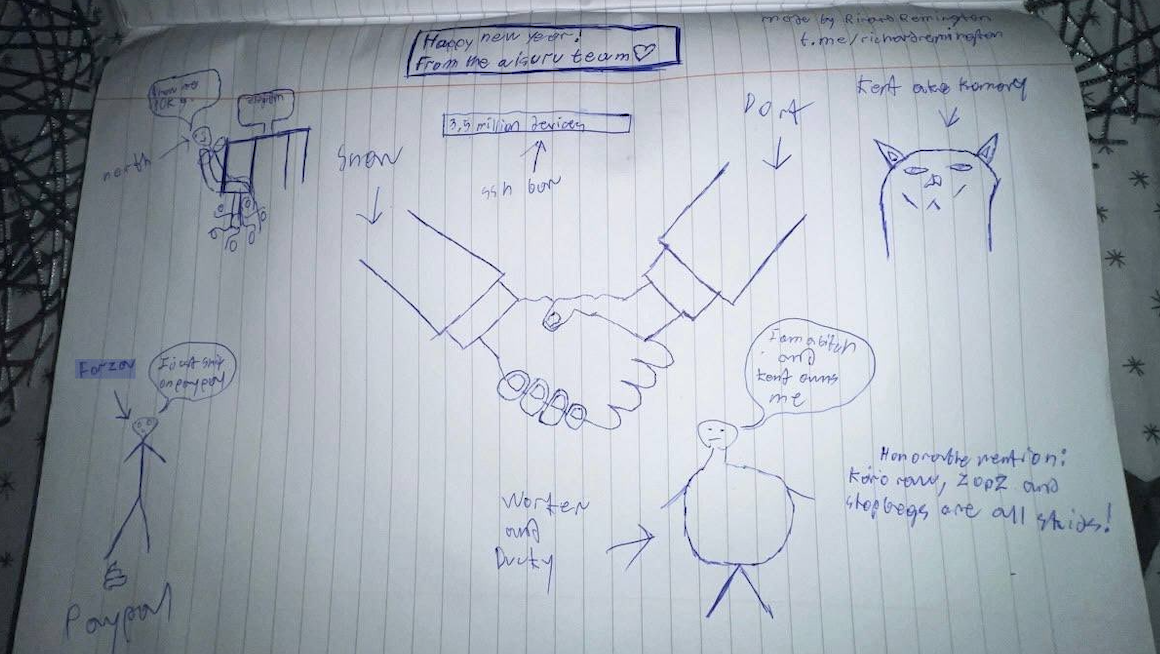
Hilariously, a user by the name “Richard Remington” briefly appeared in the group’s Telegram server to post a crude “Happy New Year” sketch that claims Dort and Snow are now in control of 3.5 million devices infected by Aisuru and/or Kimwolf. Richard Remington’s Telegram account has since been deleted, but it previously stated its owner operates a website that caters to DDoS-for-hire or “stresser” services seeking to test their firepower.

BYTECONNECT, PLAINPROXIES, AND 3XK TECH

Reports from both Synthient and XLab found that Kimwolf was used to deploy programs that turned infected systems into Internet traffic relays for multiple residential proxy services. Among those was a component that installed a software development kit (SDK) called ByteConnect, which is distributed by a provider known as Plainproxies.

ByteConnect says it specializes in “monetizing apps ethically and free,” while Plainproxies advertises the ability to provide content scraping companies with “unlimited” proxy pools. However, Synthient said that upon connecting to ByteConnect’s SDK they instead observed a mass influx of credential-stuffing attacks targeting email servers and popular online websites.

A search on LinkedIn finds the CEO of Plainproxies is Friedrich Kraft, whose resume says he is co-founder of ByteConnect Ltd. Public Internet routing records show Mr. Kraft also operates a hosting firm in Germany called 3XK Tech GmbH. Mr. Kraft did not respond to repeated requests for an interview.

In July 2025, Cloudflare reported that 3XK Tech (a.k.a. Drei-K-Tech) had become the Internet’s largest source of application-layer DDoS attacks. In November 2025, the security firm GreyNoise Intelligence found that Internet addresses on 3XK Tech were responsible for roughly three-quarters of the Internet scanning being done at the time for a newly discovered and critical vulnerability in security products made by Palo Alto Networks.

Source: Cloudflare’s Q2 2025 DDoS threat report.

LinkedIn has a profile for another Plainproxies employee, Julia Levi, who is listed as co-founder of ByteConnect. Ms. Levi did not respond to requests for comment. Her resume says she previously worked for two major proxy providers: Netnut Proxy Network, and Bright Data.

Synthient likewise said Plainproxies ignored their outreach, noting that the Byteconnect SDK continues to remain active on devices compromised by Kimwolf.

A post from the LinkedIn page of Plainproxies Chief Revenue Officer Julia Levi, explaining how the residential proxy business works.

MASKIFY

Synthient’s January 2 report said another proxy provider heavily involved in the sale of Kimwolf proxies was Maskify, which currently advertises on multiple cybercrime forums that it has more than six million residential Internet addresses for rent.

Maskify prices its service at a rate of 30 cents per gigabyte of data relayed through their proxies. According to Synthient, that price range is insanely low and is far cheaper than any other proxy provider in business today.

“Synthient’s Research Team received screenshots from other proxy providers showing key Kimwolf actors attempting to offload proxy bandwidth in exchange for upfront cash,” the Synthient report noted. “This approach likely helped fuel early development, with associated members spending earnings on infrastructure and outsourced development tasks. Please note that resellers know precisely what they are selling; proxies at these prices are not ethically sourced.”

Maskify did not respond to requests for comment.

The Maskify website. Image: Synthient.

BOTMASTERS LASH OUT

Hours after our first Kimwolf story was published last week, the resi[.]to Discord server vanished, Synthient’s website was hit with a DDoS attack, and the Kimwolf botmasters took to doxing Brundage via their botnet.

The harassing messages appeared as text records uploaded to the Ethereum Name Service (ENS), a distributed system for supporting smart contracts deployed on the Ethereum blockchain. As documented by XLab, in mid-December the Kimwolf operators upgraded their infrastructure and began using ENS to better withstand the near-constant takedown efforts targeting the botnet’s control servers.

An ENS record used by the Kimwolf operators taunts security firms trying to take down the botnet’s control servers. Image: XLab.

By telling infected systems to seek out the Kimwolf control servers via ENS, even if the servers that the botmasters use to control the botnet are taken down the attacker only needs to update the ENS text record to reflect the new Internet address of the control server, and the infected devices will immediately know where to look for further instructions.

“This channel itself relies on the decentralized nature of blockchain, unregulated by Ethereum or other blockchain operators, and cannot be blocked,” XLab wrote.

The text records included in Kimwolf’s ENS instructions can also feature short messages, such as those that carried Brundage’s personal information. Other ENS text records associated with Kimwolf offered some sage advice: “If flagged, we encourage the TV box to be destroyed.”

An ENS record tied to the Kimwolf botnet advises, “If flagged, we encourage the TV box to be destroyed.”

Both Synthient and XLabs say Kimwolf targets a vast number of Android TV streaming box models, all of which have zero security protections, and many of which ship with proxy malware built in. Generally speaking, if you can send a data packet to one of these devices you can also seize administrative control over it.

If you own a TV box that matches one of these model names and/or numbers, please just rip it out of your network. If you encounter one of these devices on the network of a family member or friend, send them a link to this story (or to our January 2 story on Kimwolf) and explain that it’s not worth the potential hassle and harm created by keeping them plugged in.

Drones to Diplomas: How Russia’s Largest Private University is Linked to a $25M Essay Mill

6 December 2025 at 09:45

A sprawling academic cheating network turbocharged by Google Ads that has generated nearly $25 million in revenue has curious ties to a Kremlin-connected oligarch whose Russian university builds drones for Russia’s war against Ukraine.

The Nerdify homepage.

The link between essay mills and Russian attack drones might seem improbable, but understanding it begins with a simple question: How does a human-intensive academic cheating service stay relevant in an era when students can simply ask AI to write their term papers? The answer – recasting the business as an AI company – is just the latest chapter in a story of many rebrands that link the operation to Russia’s largest private university.

Search in Google for any terms related to academic cheating services — e.g., “help with exam online” or “term paper online” — and you’re likely to encounter websites with the words “nerd” or “geek” in them, such as thenerdify[.]com and geekly-hub[.]com. With a simple request sent via text message, you can hire their tutors to help with any assignment.

These nerdy and geeky-branded websites frequently cite their “honor code,” which emphasizes they do not condone academic cheating, will not write your term papers for you, and will only offer support and advice for customers. But according to This Isn’t Fine, a Substack blog about contract cheating and essay mills, the Nerdify brand of websites will happily ignore that mantra.

“We tested the quick SMS for a price quote,” wrote This Isn’t Fine author Joseph Thibault. “The honor code references and platitudes apparently stop at the website. Within three minutes, we confirmed that a full three-page, plagiarism- and AI-free MLA formatted Argumentative essay could be ours for the low price of $141.”

A screenshot from Joseph Thibault’s Substack post shows him purchasing a 3-page paper with the Nerdify service.

Google prohibits ads that “enable dishonest behavior.” Yet, a sprawling global essay and homework cheating network run under the Nerdy brands has quietly bought its way to the top of Google searches – booking revenues of almost $25 million through a maze of companies in Cyprus, Malta and Hong Kong, while pitching “tutoring” that delivers finished work that students can turn in.

When one Nerdy-related Google Ads account got shut down, the group behind the company would form a new entity with a front-person (typically a young Ukrainian woman), start a new ads account along with a new website and domain name (usually with “nerdy” in the brand), and resume running Google ads for the same set of keywords.

UK companies belonging to the group that have been shut down by Google Ads since Jan 2025 include:

Proglobal Solutions LTD (advertised nerdifyit[.]com);
AW Tech Limited (advertised thenerdify[.]com);
Geekly Solutions Ltd (advertised geekly-hub[.]com).

Currently active Google Ads accounts for the Nerdify brands include:

-OK Marketing LTD (advertising geekly-hub[.]net⁩), formed in the name of Olha Karpenko, a young Ukrainian woman;
Two Sigma Solutions LTD (advertising litero[.]ai), formed in the name of Olekszij (Alexey) Pokatilo.

Google’s Ads Transparency page for current Nerdify advertiser OK Marketing LTD.

Mr. Pokatilo has been in the essay-writing business since at least 2009, operating a paper-mill enterprise called Livingston Research alongside Alexander Korsukov, who is listed as an owner. According to a lengthy account from a former employee, Livingston Research mainly farmed its writing tasks out to low-cost workers from Kenya, Philippines, Pakistan, Russia and Ukraine.

Pokatilo moved from Ukraine to the United Kingdom in Sept. 2015 and co-founded a company called Awesome Technologies, which pitched itself as a way for people to outsource tasks by sending a text message to the service’s assistants.

The other co-founder of Awesome Technologies is 36-year-old Filip Perkon, a Swedish man living in London who touts himself as a serial entrepreneur and investor. Years before starting Awesome together, Perkon and Pokatilo co-founded a student group called Russian Business Week while the two were classmates at the London School of Economics. According to the Bulgarian investigative journalist Christo Grozev, Perkon’s birth certificate was issued by the Soviet Embassy in Sweden.

Alexey Pokatilo (left) and Filip Perkon at a Facebook event for startups in San Francisco in mid-2015.

Around the time Perkon and Pokatilo launched Awesome Technologies, Perkon was building a social media propaganda tool called the Russian Diplomatic Online Club, which Perkon said would “turbo-charge” Russian messaging online. The club’s newsletter urged subscribers to install in their Twitter accounts a third-party app called Tweetsquad that would retweet Kremlin messaging on the social media platform.

Perkon was praised by the Russian Embassy in London for his efforts: During the contentious Brexit vote that ultimately led to the United Kingdom leaving the European Union, the Russian embassy in London used this spam tweeting tool to auto-retweet the Russian ambassador’s posts from supporters’ accounts.

Neither Mr. Perkon nor Mr. Pokatilo replied to requests for comment.

A review of corporations tied to Mr. Perkon as indexed by the business research service North Data finds he holds or held director positions in several U.K. subsidiaries of Synergy University, Russia’s largest private education provider. Synergy has more than 35,000 students, and sells T-shirts with patriotic slogans such as “Crimea is Ours,” and “The Russian Empire — Reloaded.”

The president of Synergy University is Vadim Lobov, a Kremlin insider whose headquarters on the outskirts of Moscow reportedly features a wall-sized portrait of Russian President Vladimir Putin in the pop-art style of Andy Warhol. For a number of years, Lobov and Perkon co-produced a cross-cultural event in the U.K. called Russian Film Week.

Synergy President Vadim Lobov and Filip Perkon, speaking at a press conference for Russian Film Week, a cross-cultural event in the U.K. co-produced by both men.

Mr. Lobov was one of 11 individuals reportedly hand-picked by the convicted Russian spy Marina Butina to attend the 2017 National Prayer Breakfast held in Washington D.C. just two weeks after President Trump’s first inauguration.

While Synergy University promotes itself as Russia’s largest private educational institution, hundreds of international students tell a different story. Online reviews from students paint a picture of unkept promises: Prospective students from Nigeria, Kenya, Ghana, and other nations paying thousands in advance fees for promised study visas to Russia, only to have their applications denied with no refunds offered.

“My experience with Synergy University has been nothing short of heartbreaking,” reads one such account. “When I first discovered the school, their representative was extremely responsive and eager to assist. He communicated frequently and made me believe I was in safe hands. However, after paying my hard-earned tuition fees, my visa was denied. It’s been over 9 months since that denial, and despite their promises, I have received no refund whatsoever. My messages are now ignored, and the same representative who once replied instantly no longer responds at all. Synergy University, how can an institution in Europe feel comfortable exploiting the hopes of Africans who trust you with their life savings? This is not just unethical — it’s predatory.”

This pattern repeats across reviews by multilingual students from Pakistan, Nepal, India, and various African nations — all describing the same scheme: Attractive online marketing, promises of easy visa approval, upfront payment requirements, and then silence after visa denials.

Reddit discussions in r/Moscow and r/AskARussian are filled with warnings. “It’s a scam, a diploma mill,” writes one user. “They literally sell exams. There was an investigation on Rossiya-1 television showing students paying to pass tests.”

The Nerdify website’s “About Us” page says the company was co-founded by Pokatilo and an American named Brian Mellor. The latter identity seems to have been fabricated, or at least there is no evidence that a person with this name ever worked at Nerdify.

Rather, it appears that the SMS assistance company co-founded by Messrs. Pokatilo and Perkon (Awesome Technologies) fizzled out shortly after its creation, and that Nerdify soon adopted the process of accepting assignment requests via text message and routing them to freelance writers.

A closer look at an early “About Us” page for Nerdify in The Wayback Machine suggests that Mr. Perkon was the real co-founder of the company: The photo at the top of the page shows four people wearing Nerdify T-shirts seated around a table on a rooftop deck in San Francisco, and the man facing the camera is Perkon.

Filip Perkon, top right, is pictured wearing a Nerdify T-shirt in an archived copy of the company’s About Us page. Image: archive.org.

Where are they now? Pokatilo is currently running a startup called Litero.Ai, which appears to be an AI-based essay writing service. In July 2025, Mr. Pokatilo received pre-seed funding of $800,000 for Litero from an investment program backed by the venture capital firms AltaIR Capital, Yellow Rocks, Smart Partnership Capital, and I2BF Global Ventures.

Meanwhile, Filip Perkon is busy setting up toy rubber duck stores in Miami and in at least three locations in the United Kingdom. These “Duck World” shops market themselves as “the world’s largest duck store.”

This past week, Mr. Lobov was in India with Putin’s entourage on a charm tour with India’s Prime Minister Narendra Modi. Although Synergy is billed as an educational institution, a review of the company’s sprawling corporate footprint (via DNS) shows it also is assisting the Russian government in its war against Ukraine.

Synergy University President Vadim Lobov (right) pictured this week in India next to Natalia Popova, a Russian TV presenter known for her close ties to Putin’s family, particularly Putin’s daughter, who works with Popova at the education and culture-focused Innopraktika Foundation.

The website bpla.synergy[.]bot, for instance, says the company is involved in developing combat drones to aid Russian forces and to evade international sanctions on the supply and re-export of high-tech products.

A screenshot from the website of synergy,bot shows the company is actively engaged in building armed drones for the war in Ukraine.

KrebsOnSecurity would like to thank the anonymous researcher NatInfoSec for their assistance in this investigation.

Update, Dec. 8, 10:06 a.m. ET: Mr. Pokatilo responded to requests for comment after the publication of this story. Pokatilo said he has no relation to Synergy nor to Mr. Lobov, and that his work with Mr. Perkon ended with the dissolution of Awesome Technologies.

“I have had no involvement in any of his projects and business activities mentioned in the article and he has no involvement in Litero.ai,” Pokatilo said of Perkon.

Mr. Pokatilo said his new company Litero “does not provide contract cheating services and is built specifically to improve transparency and academic integrity in the age of universal use of AI by students.”

“I am Ukrainian,” he said in an email. “My close friends, colleagues, and some family members continue to live in Ukraine under the ongoing invasion. Any suggestion that I or my company may be connected in any way to Russia’s war efforts is deeply offensive on a personal level and harmful to the reputation of Litero.ai, a company where many team members are Ukrainian.”

Update, Dec. 11, 12:07 p.m. ET: Mr. Perkon responded to requests for comment after the publication of this story. Perkon said the photo of him in a Nerdify T-shirt (see screenshot above) was taken after a startup event in San Francisco, where he volunteered to act as a photo model to help friends with their project.

“I have no business or other relations to Nerdify or any other ventures in that space,” Mr. Perkon said in an email response. “As for Vadim Lobov, I worked for Venture Capital arm at Synergy until 2013 as well as his business school project in the UK, that didn’t get off the ground, so the company related to this was made dormant. Then Synergy kindly provided sponsorship for my Russian Film Week event that I created and ran until 2022 in the U.K., an event that became the biggest independent Russian film festival outside of Russia. Since the start of the Ukraine war in 2022 I closed the festival down.”

“I have had no business with Vadim Lobov since 2021 (the last film festival) and I don’t keep track of his endeavours,” Perkon continued. “As for Alexey Pokatilo, we are university friends. Our business relationship has ended after the concierge service Awesome Technologies didn’t work out, many years ago.”

Meet Rey, the Admin of ‘Scattered Lapsus$ Hunters’

26 November 2025 at 12:22

A prolific cybercriminal group that calls itself “Scattered LAPSUS$ Hunters” has dominated headlines this year by regularly stealing data from and publicly mass extorting dozens of major corporations. But the tables seem to have turned somewhat for “Rey,” the moniker chosen by the technical operator and public face of the hacker group: Earlier this week, Rey confirmed his real life identity and agreed to an interview after KrebsOnSecurity tracked him down and contacted his father.

Scattered LAPSUS$ Hunters (SLSH) is thought to be an amalgamation of three hacking groups — Scattered Spider, LAPSUS$ and ShinyHunters. Members of these gangs hail from many of the same chat channels on the Com, a mostly English-language cybercriminal community that operates across an ocean of Telegram and Discord servers.

In May 2025, SLSH members launched a social engineering campaign that used voice phishing to trick targets into connecting a malicious app to their organization’s Salesforce portal. The group later launched a data leak portal that threatened to publish the internal data of three dozen companies that allegedly had Salesforce data stolen, including ToyotaFedExDisney/Hulu, and UPS.

The new extortion website tied to ShinyHunters, which threatens to publish stolen data unless Salesforce or individual victim companies agree to pay a ransom.

Last week, the SLSH Telegram channel featured an offer to recruit and reward “insiders,” employees at large companies who agree to share internal access to their employer’s network for a share of whatever ransom payment is ultimately paid by the victim company.

SLSH has solicited insider access previously, but their latest call for disgruntled employees started making the rounds on social media at the same time news broke that the cybersecurity firm Crowdstrike had fired an employee for allegedly sharing screenshots of internal systems with the hacker group (Crowdstrike said their systems were never compromised and that it has turned the matter over to law enforcement agencies).

The Telegram server for the Scattered LAPSUS$ Hunters has been attempting to recruit insiders at large companies.

Members of SLSH have traditionally used other ransomware gangs’ encryptors in attacks, including malware from ransomware affiliate programs like ALPHV/BlackCat, Qilin, RansomHub, and DragonForce. But last week, SLSH announced on its Telegram channel the release of their own ransomware-as-a-service operation called ShinySp1d3r.

The individual responsible for releasing the ShinySp1d3r ransomware offering is a core SLSH member who goes by the handle “Rey” and who is currently one of just three administrators of the SLSH Telegram channel. Previously, Rey was an administrator of the data leak website for Hellcat, a ransomware group that surfaced in late 2024 and was involved in attacks on companies including Schneider Electric, Telefonica, and Orange Romania.

A recent, slightly redacted screenshot of the Scattered LAPSUS$ Hunters Telegram channel description, showing Rey as one of three administrators.

Also in 2024, Rey would take over as administrator of the most recent incarnation of BreachForums, an English-language cybercrime forum whose domain names have been seized on multiple occasions by the FBI and/or by international authorities. In April 2025, Rey posted on Twitter/X about another FBI seizure of BreachForums.

On October 5, 2025, the FBI announced it had once again seized the domains associated with BreachForums, which it described as a major criminal marketplace used by ShinyHunters and others to traffic in stolen data and facilitate extortion.

“This takedown removes access to a key hub used by these actors to monetize intrusions, recruit collaborators, and target victims across multiple sectors,” the FBI said.

Incredibly, Rey would make a series of critical operational security mistakes last year that provided multiple avenues to ascertain and confirm his real-life identity and location. Read on to learn how it all unraveled for Rey.

WHO IS REY?

According to the cyber intelligence firm Intel 471, Rey was an active user on various BreachForums reincarnations over the past two years, authoring more than 200 posts between February 2024 and July 2025. Intel 471 says Rey previously used the handle “Hikki-Chan” on BreachForums, where their first post shared data allegedly stolen from the U.S. Centers for Disease Control and Prevention (CDC).

In that February 2024 post about the CDC, Hikki-Chan says they could be reached at the Telegram username @wristmug. In May 2024, @wristmug posted in a Telegram group chat called “Pantifan” a copy of an extortion email they said they received that included their email address and password.

The message that @wristmug cut and pasted appears to have been part of an automated email scam that claims it was sent by a hacker who has compromised your computer and used your webcam to record a video of you while you were watching porn. These missives threaten to release the video to all your contacts unless you pay a Bitcoin ransom, and they typically reference a real password the recipient has used previously.

“Noooooo,” the @wristmug account wrote in mock horror after posting a screenshot of the scam message. “I must be done guys.”

A message posted to Telegram by Rey/@wristmug.

In posting their screenshot, @wristmug redacted the username portion of the email address referenced in the body of the scam message. However, they did not redact their previously-used password, and they left the domain portion of their email address (@proton.me) visible in the screenshot.

O5TDEV

Searching on @wristmug’s rather unique 15-character password in the breach tracking service Spycloud finds it is known to have been used by just one email address: cybero5tdev@proton.me. According to Spycloud, those credentials were exposed at least twice in early 2024 when this user’s device was infected with an infostealer trojan that siphoned all of its stored usernames, passwords and authentication cookies (a finding that was initially revealed in March 2025 by the cyber intelligence firm KELA).

Intel 471 shows the email address cybero5tdev@proton.me belonged to a BreachForums member who went by the username o5tdev. Searching on this nickname in Google brings up at least two website defacement archives showing that a user named o5tdev was previously involved in defacing sites with pro-Palestinian messages. The screenshot below, for example, shows that 05tdev was part of a group called Cyb3r Drag0nz Team.

Rey/o5tdev’s defacement pages. Image: archive.org.

A 2023 report from SentinelOne described Cyb3r Drag0nz Team as a hacktivist group with a history of launching DDoS attacks and cyber defacements as well as engaging in data leak activity.

“Cyb3r Drag0nz Team claims to have leaked data on over a million of Israeli citizens spread across multiple leaks,” SentinelOne reported. “To date, the group has released multiple .RAR archives of purported personal information on citizens across Israel.”

The cyber intelligence firm Flashpoint finds the Telegram user @05tdev was active in 2023 and early 2024, posting in Arabic on anti-Israel channels like “Ghost of Palestine” [full disclosure: Flashpoint is currently an advertiser on this blog].

‘I’M A GINTY’

Flashpoint shows that Rey’s Telegram account (ID7047194296) was particularly active in a cybercrime-focused channel called Jacuzzi, where this user shared several personal details, including that their father was an airline pilot. Rey claimed in 2024 to be 15 years old, and to have family connections to Ireland.

Specifically, Rey mentioned in several Telegram chats that he had Irish heritage, even posting a graphic that shows the prevalence of the surname “Ginty.”

Rey, on Telegram claiming to have association to the surname “Ginty.” Image: Flashpoint.

Spycloud indexed hundreds of credentials stolen from cybero5dev@proton.me, and those details indicate that Rey’s computer is a shared Microsoft Windows device located in Amman, Jordan. The credential data stolen from Rey in early 2024 show there are multiple users of the infected PC, but that all shared the same last name of Khader and an address in Amman, Jordan.

The “autofill” data lifted from Rey’s family PC contains an entry for a 46-year-old Zaid Khader that says his mother’s maiden name was Ginty. The infostealer data also shows Zaid Khader frequently accessed internal websites for employees of Royal Jordanian Airlines.

MEET SAIF

The infostealer data makes clear that Rey’s full name is Saif Al-Din Khader. Having no luck contacting Saif directly, KrebsOnSecurity sent an email to his father Zaid. The message invited the father to respond via email, phone or Signal, explaining that his son appeared to be deeply enmeshed in a serious cybercrime conspiracy.

Less than two hours later, I received a Signal message from Saif, who said his dad suspected the email was a scam and had forwarded it to him.

“I saw your email, unfortunately I don’t think my dad would respond to this because they think its some ‘scam email,'” said Saif, who told me he turns 16 years old next month. “So I decided to talk to you directly.”

Saif explained that he’d already heard from European law enforcement officials, and had been trying to extricate himself from SLSH. When asked why then he was involved in releasing SLSH’s new ShinySp1d3r ransomware-as-a-service offering, Saif said he couldn’t just suddenly quit the group.

“Well I cant just dip like that, I’m trying to clean up everything I’m associated with and move on,” he said.

The former Hellcat ransomware site. Image: Kelacyber.com

He also shared that ShinySp1d3r is just a rehash of Hellcat ransomware, except modified with AI tools. “I gave the source code of Hellcat ransomware out basically.”

Saif claims he reached out on his own recently to the Telegram account for Operation Endgame, the codename for an ongoing law enforcement operation targeting cybercrime services, vendors and their customers.

“I’m already cooperating with law enforcement,” Saif said. “In fact, I have been talking to them since at least June. I have told them nearly everything. I haven’t really done anything like breaching into a corp or extortion related since September.”

Saif suggested that a story about him right now could endanger any further cooperation he may be able to provide. He also said he wasn’t sure if the U.S. or European authorities had been in contact with the Jordanian government about his involvement with the hacking group.

“A story would bring so much unwanted heat and would make things very difficult if I’m going to cooperate,” Saif said. “I’m unsure whats going to happen they said they’re in contact with multiple countries regarding my request but its been like an entire week and I got no updates from them.”

Saif shared a screenshot that indicated he’d contacted Europol authorities late last month. But he couldn’t name any law enforcement officials he said were responding to his inquiries, and KrebsOnSecurity was unable to verify his claims.

“I don’t really care I just want to move on from all this stuff even if its going to be prison time or whatever they gonna say,” Saif said.

Alleged Jabber Zeus Coder ‘MrICQ’ in U.S. Custody

2 November 2025 at 15:37

A Ukrainian man indicted in 2012 for conspiring with a prolific hacking group to steal tens of millions of dollars from U.S. businesses was arrested in Italy and is now in custody in the United States, KrebsOnSecurity has learned.

Sources close to the investigation say Yuriy Igorevich Rybtsov, a 41-year-old from the Russia-controlled city of Donetsk, Ukraine, was previously referenced in U.S. federal charging documents only by his online handle “MrICQ.” According to a 13-year-old indictment (PDF) filed by prosecutors in Nebraska, MrICQ was a developer for a cybercrime group known as “Jabber Zeus.”

Image: lockedup dot wtf.

The Jabber Zeus name is derived from the malware they used — a custom version of the ZeuS banking trojan — that stole banking login credentials and would send the group a Jabber instant message each time a new victim entered a one-time passcode at a financial institution website. The gang targeted mostly small to mid-sized businesses, and they were an early pioneer of so-called “man-in-the-browser” attacks, malware that can silently intercept any data that victims submit in a web-based form.

Once inside a victim company’s accounts, the Jabber Zeus crew would modify the firm’s payroll to add dozens of “money mules,” people recruited through elaborate work-at-home schemes to handle bank transfers. The mules in turn would forward any stolen payroll deposits — minus their commissions — via wire transfers to other mules in Ukraine and the United Kingdom.

The 2012 indictment targeting the Jabber Zeus crew named MrICQ as “John Doe #3,” and said this person handled incoming notifications of newly compromised victims. The Department of Justice (DOJ) said MrICQ also helped the group launder the proceeds of their heists through electronic currency exchange services.

Two sources familiar with the Jabber Zeus investigation said Rybtsov was arrested in Italy, although the exact date and circumstances of his arrest remain unclear. A summary of recent decisions (PDF) published by the Italian Supreme Court states that in April 2025, Rybtsov lost a final appeal to avoid extradition to the United States.

According to the mugshot website lockedup[.]wtf, Rybtsov arrived in Nebraska on October 9, and was being held under an arrest warrant from the U.S. Federal Bureau of Investigation (FBI).

The data breach tracking service Constella Intelligence found breached records from the business profiling site bvdinfo[.]com showing that a 41-year-old Yuriy Igorevich Rybtsov worked in a building at 59 Barnaulska St. in Donetsk. Further searching on this address in Constella finds the same apartment building was shared by a business registered to Vyacheslav “Tank” Penchukov, the leader of the Jabber Zeus crew in Ukraine.

Vyacheslav “Tank” Penchukov, seen here performing as “DJ Slava Rich” in Ukraine, in an undated photo from social media.

Penchukov was arrested in 2022 while traveling to meet his wife in Switzerland. Last year, a federal court in Nebraska sentenced Penchukov to 18 years in prison and ordered him to pay more than $73 million in restitution.

Lawrence Baldwin is founder of myNetWatchman, a threat intelligence company based in Georgia that began tracking and disrupting the Jabber Zeus gang in 2009. myNetWatchman had secretly gained access to the Jabber chat server used by the Ukrainian hackers, allowing Baldwin to eavesdrop on the daily conversations between MrICQ and other Jabber Zeus members.

Baldwin shared those real-time chat records with multiple state and federal law enforcement agencies, and with this reporter. Between 2010 and 2013, I spent several hours each day alerting small businesses across the country that their payroll accounts were about to be drained by these cybercriminals.

Those notifications, and Baldwin’s tireless efforts, saved countless would-be victims a great deal of money. In most cases, however, we were already too late. Nevertheless, the pilfered Jabber Zeus group chats provided the basis for dozens of stories published here about small businesses fighting their banks in court over six- and seven-figure financial losses.

Baldwin said the Jabber Zeus crew was far ahead of its peers in several respects. For starters, their intercepted chats showed they worked to create a highly customized botnet directly with the author of the original Zeus Trojan — Evgeniy Mikhailovich Bogachev, a Russian man who has long been on the FBI’s “Most Wanted” list. The feds have a standing $3 million reward for information leading to Bogachev’s arrest.

Evgeniy M. Bogachev, in undated photos.

The core innovation of Jabber Zeus was an alert that MrICQ would receive each time a new victim entered a one-time password code into a phishing page mimicking their financial institution. The gang’s internal name for this component was “Leprechaun,” (the video below from myNetWatchman shows it in action). Jabber Zeus would actually re-write the HTML code as displayed in the victim’s browser, allowing them to intercept any passcodes sent by the victim’s bank for multi-factor authentication.

“These guys had compromised such a large number of victims that they were getting buried in a tsunami of stolen banking credentials,” Baldwin told KrebsOnSecurity. “But the whole point of Leprechaun was to isolate the highest-value credentials — the commercial bank accounts with two-factor authentication turned on. They knew these were far juicier targets because they clearly had a lot more money to protect.”

Baldwin said the Jabber Zeus trojan also included a custom “backconnect” component that allowed the hackers to relay their bank account takeovers through the victim’s own infected PC.

“The Jabber Zeus crew were literally connecting to the victim’s bank account from the victim’s IP address, or from the remote control function and by fully emulating the device,” he said. “That trojan was like a hot knife through butter of what everyone thought was state-of-the-art secure online banking at the time.”

Although the Jabber Zeus crew was in direct contact with the Zeus author, the chats intercepted by myNetWatchman show Bogachev frequently ignored the group’s pleas for help. The government says the real leader of the Jabber Zeus crew was Maksim Yakubets, a 38-year Ukrainian man with Russian citizenship who went by the hacker handle “Aqua.”

Alleged Evil Corp leader Maksim “Aqua” Yakubets. Image: FBI

The Jabber chats intercepted by Baldwin show that Aqua interacted almost daily with MrICQ, Tank and other members of the hacking team, often facilitating the group’s money mule and cashout activities remotely from Russia.

The government says Yakubets/Aqua would later emerge as the leader of an elite cybercrime ring of at least 17 hackers that referred to themselves internally as “Evil Corp.” Members of Evil Corp developed and used the Dridex (a.k.a. Bugat) trojan, which helped them siphon more than $100 million from hundreds of victim companies in the United States and Europe.

This 2019 story about the government’s $5 million bounty for information leading to Yakubets’s arrest includes excerpts of conversations between Aqua, Tank, Bogachev and other Jabber Zeus crew members discussing stories I’d written about their victims. Both Baldwin and I were interviewed at length for a new weekly six-part podcast by the BBC that delves deep into the history of Evil Corp. Episode One focuses on the evolution of Zeus, while the second episode centers on an investigation into the group by former FBI agent Jim Craig.

Image: https://www.bbc.co.uk/programmes/w3ct89y8

Canada Fines Cybercrime Friendly Cryptomus $176M

22 October 2025 at 13:21

Financial regulators in Canada this week levied $176 million in fines against Cryptomus, a digital payments platform that supports dozens of Russian cryptocurrency exchanges and websites hawking cybercrime services. The penalties for violating Canada’s anti money-laundering laws come ten months after KrebsOnSecurity noted that Cryptomus’s Vancouver street address was home to dozens of foreign currency dealers, money transfer businesses, and cryptocurrency exchanges — none of which were physically located there.

On October 16, the Financial Transactions and Reports Analysis Center of Canada (FINTRAC) imposed a $176,960,190 penalty on Xeltox Enterprises Ltd., more commonly known as the cryptocurrency payments platform Cryptomus.

FINTRAC found that Cryptomus failed to submit suspicious transaction reports in cases where there were reasonable grounds to suspect that they were related to the laundering of proceeds connected to trafficking in child sexual abuse material, fraud, ransomware payments and sanctions evasion.

“Given that numerous violations in this case were connected to trafficking in child sexual abuse material, fraud, ransomware payments and sanctions evasion, FINTRAC was compelled to take this unprecedented enforcement action,” said Sarah Paquet, director and CEO at the regulatory agency.

In December 2024, KrebsOnSecurity covered research by blockchain analyst and investigator Richard Sanders, who’d spent several months signing up for various cybercrime services, and then tracking where their customer funds go from there. The 122 services targeted in Sanders’s research all used Cryptomus, and included some of the more prominent businesses advertising on the cybercrime forums, such as:

-abuse-friendly or “bulletproof” hosting providers like anonvm[.]wtf, and PQHosting;
-sites selling aged email, financial, or social media accounts, such as verif[.]work and kopeechka[.]store;
-anonymity or “proxy” providers like crazyrdp[.]com and rdp[.]monster;
-anonymous SMS services, including anonsim[.]net and smsboss[.]pro.

Flymoney, one of dozens of cryptocurrency exchanges apparently nested at Cryptomus. The image from this website has been machine translated from Russian.

Sanders found at least 56 cryptocurrency exchanges were using Cryptomus to process transactions, including financial entities with names like casher[.]su, grumbot[.]com, flymoney[.]biz, obama[.]ru and swop[.]is.

“These platforms were built for Russian speakers, and they each advertised the ability to anonymously swap one form of cryptocurrency for another,” the December 2024 story noted. “They also allowed the exchange of cryptocurrency for cash in accounts at some of Russia’s largest banks — nearly all of which are currently sanctioned by the United States and other western nations.”

Reached for comment on FINTRAC’s action, Sanders told KrebsOnSecurity he was surprised it took them so long.

“I have no idea why they don’t just sanction them or prosecute them,” Sanders said. “I’m not let down with the fine amount but it’s also just going to be the cost of doing business to them.”

The $173 million fine is a significant sum for FINTRAC, which imposed 23 such penalties last year totaling less than $26 million. But Sanders says FINTRAC still has much work to do in pursuing other shadowy money service businesses (MSBs) that are registered in Canada but are likely money laundering fronts for entities based in Russia and Iran.

In an investigation published in July 2024, CTV National News and the Investigative Journalism Foundation (IJF) documented dozens of cases across Canada where multiple MSBs are incorporated at the same address, often without the knowledge or consent of the location’s actual occupant.

Their inquiry found that the street address for Cryptomus parent Xeltox Enterprises was listed as the home of at least 76 foreign currency dealers, eight MSBs, and six cryptocurrency exchanges. At that address is a three-story building that used to be a bank and now houses a massage therapy clinic and a co-working space. But the news outlets found none of the MSBs or currency dealers were paying for services at that co-working space.

The reporters also found another collection of 97 MSBs clustered at an address for a commercial office suite in Ontario, even though there was no evidence any of these companies had ever arranged for any business services at that address.

Email Bombs Exploit Lax Authentication in Zendesk

17 October 2025 at 07:26

Cybercriminals are abusing a widespread lack of authentication in the customer service platform Zendesk to flood targeted email inboxes with menacing messages that come from hundreds of Zendesk corporate customers simultaneously.

Zendesk is an automated help desk service designed to make it simple for people to contact companies for customer support issues. Earlier this week, KrebsOnSecurity started receiving thousands of ticket creation notification messages through Zendesk in rapid succession, each bearing the name of different Zendesk customers, such as CapCom, CompTIA, Discord, GMAC, NordVPN, The Washington Post, and Tinder.

The abusive missives sent via Zendesk’s platform can include any subject line chosen by the abusers. In my case, the messages variously warned about a supposed law enforcement investigation involving KrebsOnSecurity.com, or else contained personal insults.

Moreover, the automated messages that are sent out from this type of abuse all come from customer domain names — not from Zendesk. In the example below, replying to any of the junk customer support responses from The Washington Post’s Zendesk installation shows the reply-to address is help@washpost.com.

One of dozens of messages sent to me this week by The Washington Post.

Notified about the mass abuse of their platform, Zendesk said the emails were ticket creation notifications from customer accounts that configured their Zendesk instance to allow anyone to submit support requests — including anonymous users.

“These types of support tickets can be part of a customer’s workflow, where a prior verification is not required to allow them to engage and make use of the Support capabilities,” said Carolyn Camoens, communications director at Zendesk. “Although we recommend our customers to permit only verified users to submit tickets, some Zendesk customers prefer to use an anonymous environment to allow for tickets to be created due to various business reasons.”

Camoens said requests that can be submitted in an anonymous manner can also make use of an email address of the submitter’s choice.

“However, this method can also be used for spam requests to be created on behalf of third party email addresses,” Camoens said. “If an account has enabled the auto-responder trigger based on ticket creation, then this allows for the ticket notification email to be sent from our customer’s accounts to these third parties. The notification will also include the Subject added by the creator of these tickets.”

Zendesk claims it uses rate limits to prevent a high volume of requests from being created at once, but those limits did not stop Zendesk customers from flooding my inbox with thousands of messages in just a few hours.

“We recognize that our systems were leveraged against you in a distributed, many-against-one manner,” Camoens said. “We are actively investigating additional preventive measures. We are also advising customers experiencing this type of activity to follow our general security best practices and configure an authenticated ticket creation workflow.”

In all of the cases above, the messaging abuse would not have been possible if Zendesk customers validated support request email addresses prior to sending responses. Failing to do so may make it easier for Zendesk clients to handle customer support requests, but it also allows ne’er-do-wells to sully the sender’s brand in service of disruptive and malicious email floods.

DDoS Botnet Aisuru Blankets US ISPs in Record DDoS

10 October 2025 at 12:10

The world’s largest and most disruptive botnet is now drawing a majority of its firepower from compromised Internet-of-Things (IoT) devices hosted on U.S. Internet providers like AT&T, Comcast and Verizon, new evidence suggests. Experts say the heavy concentration of infected devices at U.S. providers is complicating efforts to limit collateral damage from the botnet’s attacks, which shattered previous records this week with a brief traffic flood that clocked in at nearly 30 trillion bits of data per second.

Since its debut more than a year ago, the Aisuru botnet has steadily outcompeted virtually all other IoT-based botnets in the wild, with recent attacks siphoning Internet bandwidth from an estimated 300,000 compromised hosts worldwide.

The hacked systems that get subsumed into the botnet are mostly consumer-grade routers, security cameras, digital video recorders and other devices operating with insecure and outdated firmware, and/or factory-default settings. Aisuru’s owners are continuously scanning the Internet for these vulnerable devices and enslaving them for use in distributed denial-of-service (DDoS) attacks that can overwhelm targeted servers with crippling amounts of junk traffic.

As Aisuru’s size has mushroomed, so has its punch. In May 2025, KrebsOnSecurity was hit with a near-record 6.35 terabits per second (Tbps) attack from Aisuru, which was then the largest assault that Google’s DDoS protection service Project Shield had ever mitigated. Days later, Aisuru shattered that record with a data blast in excess of 11 Tbps.

By late September, Aisuru was publicly flexing DDoS capabilities topping 22 Tbps. Then on October 6, its operators heaved a whopping 29.6 terabits of junk data packets each second at a targeted host. Hardly anyone noticed because it appears to have been a brief test or demonstration of Aisuru’s capabilities: The traffic flood lasted less only a few seconds and was pointed at an Internet server that was specifically designed to measure large-scale DDoS attacks.

A measurement of an Oct. 6 DDoS believed to have been launched through multiple botnets operated by the owners of the Aisuru botnet. Image: DDoS Analyzer Community on Telegram.

Aisuru’s overlords aren’t just showing off. Their botnet is being blamed for a series of increasingly massive and disruptive attacks. Although recent assaults from Aisuru have targeted mostly ISPs that serve online gaming communities like Minecraft, those digital sieges often result in widespread collateral Internet disruption.

For the past several weeks, ISPs hosting some of the Internet’s top gaming destinations have been hit with a relentless volley of gargantuan attacks that experts say are well beyond the DDoS mitigation capabilities of most organizations connected to the Internet today.

Steven Ferguson is principal security engineer at Global Secure Layer (GSL), an ISP in Brisbane, Australia. GSL hosts TCPShield, which offers free or low-cost DDoS protection to more than 50,000 Minecraft servers worldwide. Ferguson told KrebsOnSecurity that on October 8, TCPShield was walloped with a blitz from Aisuru that flooded its network with more than 15 terabits of junk data per second.

Ferguson said that after the attack subsided, TCPShield was told by its upstream provider OVH that they were no longer welcome as a customer.

“This was causing serious congestion on their Miami external ports for several weeks, shown publicly via their weather map,” he said, explaining that TCPShield is now solely protected by GSL.

Traces from the recent spate of crippling Aisuru attacks on gaming servers can be still seen at the website blockgametracker.gg, which indexes the uptime and downtime of the top Minecraft hosts. In the following example from a series of data deluges on the evening of September 28, we can see an Aisuru botnet campaign briefly knocked TCPShield offline.

An Aisuru botnet attack on TCPShield (AS64199) on Sept. 28  can be seen in the giant downward spike in the middle of this uptime graphic. Image: grafana.blockgametracker.gg.

Paging through the same uptime graphs for other network operators listed shows almost all of them suffered brief but repeated outages around the same time. Here is the same uptime tracking for Minecraft servers on the network provider Cosmic (AS30456), and it shows multiple large dips that correspond to game server outages caused by Aisuru.

Multiple DDoS attacks from Aisuru can be seen against the Minecraft host Cosmic on Sept. 28. The sharp downward spikes correspond to brief but enormous attacks from Aisuru. Image: grafana.blockgametracker.gg.

BOTNETS R US

Ferguson said he’s been tracking Aisuru for about three months, and recently he noticed the botnet’s composition shifted heavily toward infected systems at ISPs in the United States. Ferguson shared logs from an attack on October 8 that indexed traffic by the total volume sent through each network provider, and the logs showed that 11 of the top 20 traffic sources were U.S. based ISPs.

AT&T customers were by far the biggest U.S. contributors to that attack, followed by botted systems on Charter Communications, Comcast, T-Mobile and Verizon, Ferguson found. He said the volume of data packets per second coming from infected IoT hosts on these ISPs is often so high that it has started to affect the quality of service that ISPs are able to provide to adjacent (non-botted) customers.

“The impact extends beyond victim networks,” Ferguson said. “For instance we have seen 500 gigabits of traffic via Comcast’s network alone. This amount of egress leaving their network, especially being so US-East concentrated, will result in congestion towards other services or content trying to be reached while an attack is ongoing.”

Roland Dobbins is principal engineer at Netscout. Dobbins said Ferguson is spot on, noting that while most ISPs have effective mitigations in place to handle large incoming DDoS attacks, many are far less prepared to manage the inevitable service degradation caused by large numbers of their customers suddenly using some or all available bandwidth to attack others.

“The outbound and cross-bound DDoS attacks can be just as disruptive as the inbound stuff,” Dobbin said. “We’re now in a situation where ISPs are routinely seeing terabit-per-second plus outbound attacks from their networks that can cause operational problems.”

“The crying need for effective and universal outbound DDoS attack suppression is something that is really being highlighted by these recent attacks,” Dobbins continued. “A lot of network operators are learning that lesson now, and there’s going to be a period ahead where there’s some scrambling and potential disruption going on.”

KrebsOnSecurity sought comment from the ISPs named in Ferguson’s report. Charter Communications pointed to a recent blog post on protecting its network, stating that Charter actively monitors for both inbound and outbound attacks, and that it takes proactive action wherever possible.

“In addition to our own extensive network security, we also aim to reduce the risk of customer connected devices contributing to attacks through our Advanced WiFi solution that includes Security Shield, and we make Security Suite available to our Internet customers,” Charter wrote in an emailed response to questions. “With the ever-growing number of devices connecting to networks, we encourage customers to purchase trusted devices with secure development and manufacturing practices, use anti-virus and security tools on their connected devices, and regularly download security patches.”

A spokesperson for Comcast responded, “Currently our network is not experiencing impacts and we are able to handle the traffic.”

9 YEARS OF MIRAI

Aisuru is built on the bones of malicious code that was leaked in 2016 by the original creators of the Mirai IoT botnet. Like Aisuru, Mirai quickly outcompeted all other DDoS botnets in its heyday, and obliterated previous DDoS attack records with a 620 gigabit-per-second siege that sidelined this website for nearly four days in 2016.

The Mirai botmasters likewise used their crime machine to attack mostly Minecraft servers, but with the goal of forcing Minecraft server owners to purchase a DDoS protection service that they controlled. In addition, they rented out slices of the Mirai botnet to paying customers, some of whom used it to mask the sources of other types of cybercrime, such as click fraud.

A depiction of the outages caused by the Mirai botnet attacks against the internet infrastructure firm Dyn on October 21, 2016. Source: Downdetector.com.

Dobbins said Aisuru’s owners also appear to be renting out their botnet as a distributed proxy network that cybercriminal customers anywhere in the world can use to anonymize their malicious traffic and make it appear to be coming from regular residential users in the U.S.

“The people who operate this botnet are also selling (it as) residential proxies,” he said. “And that’s being used to reflect application layer attacks through the proxies on the bots as well.”

The Aisuru botnet harkens back to its predecessor Mirai in another intriguing way. One of its owners is using the Telegram handle “9gigsofram,” which corresponds to the nickname used by the co-owner of a Minecraft server protection service called Proxypipe that was heavily targeted in 2016 by the original Mirai botmasters.

Robert Coelho co-ran Proxypipe back then along with his business partner Erik “9gigsofram” Buckingham, and has spent the past nine years fine-tuning various DDoS mitigation companies that cater to Minecraft server operators and other gaming enthusiasts. Coelho said he has no idea why one of Aisuru’s botmasters chose Buckingham’s nickname, but added that it might say something about how long this person has been involved in the DDoS-for-hire industry.

“The Aisuru attacks on the gaming networks these past seven day have been absolutely huge, and you can see tons of providers going down multiple times a day,” Coelho said.

Coelho said the 15 Tbps attack this week against TCPShield was likely only a portion of the total attack volume hurled by Aisuru at the time, because much of it would have been shoved through networks that simply couldn’t process that volume of traffic all at once. Such outsized attacks, he said, are becoming increasingly difficult and expensive to mitigate.

“It’s definitely at the point now where you need to be spending at least a million dollars a month just to have the network capacity to be able to deal with these attacks,” he said.

RAPID SPREAD

Aisuru has long been rumored to use multiple zero-day vulnerabilities in IoT devices to aid its rapid growth over the past year. XLab, the Chinese security company that was the first to profile Aisuru’s rise in 2024, warned last month that one of the Aisuru botmasters had compromised the firmware distribution website for Totolink, a maker of low-cost routers and other networking gear.

“Multiple sources indicate the group allegedly compromised a router firmware update server in April and distributed malicious scripts to expand the botnet,” XLab wrote on September 15. “The node count is currently reported to be around 300,000.”

A malicious script implanted into a Totolink update server in April 2025. Image: XLab.

Aisuru’s operators received an unexpected boost to their crime machine in August when the U.S. Department Justice charged the alleged proprietor of Rapper Bot, a DDoS-for-hire botnet that competed directly with Aisuru for control over the global pool of vulnerable IoT systems.

Once Rapper Bot was dismantled, Aisuru’s curators moved quickly to commandeer vulnerable IoT devices that were suddenly set adrift by the government’s takedown, Dobbins said.

“Folks were arrested and Rapper Bot control servers were seized and that’s great, but unfortunately the botnet’s attack assets were then pieced out by the remaining botnets,” he said. “The problem is, even if those infected IoT devices are rebooted and cleaned up, they will still get re-compromised by something else generally within minutes of being plugged back in.”

A screenshot shared by XLabs showing the Aisuru botmasters recently celebrating a record-breaking 7.7 Tbps DDoS. The user at the top has adopted the name “Ethan J. Foltz” in a mocking tribute to the alleged Rapper Bot operator who was arrested and charged in August 2025.

BOTMASTERS AT LARGE

XLab’s September blog post cited multiple unnamed sources saying Aisuru is operated by three cybercriminals: “Snow,” who’s responsible for botnet development; “Tom,” tasked with finding new vulnerabilities; and “Forky,” responsible for botnet sales.

KrebsOnSecurity interviewed Forky in our May 2025 story about the record 6.3 Tbps attack from Aisuru. That story identified Forky as a 21-year-old man from Sao Paulo, Brazil who has been extremely active in the DDoS-for-hire scene since at least 2022. The FBI has seized Forky’s DDoS-for-hire domains several times over the years.

Like the original Mirai botmasters, Forky also operates a DDoS mitigation service called Botshield. Forky declined to discuss the makeup of his ISP’s clientele, or to clarify whether Botshield was more of a hosting provider or a DDoS mitigation firm. However, Forky has posted on Telegram about Botshield successfully mitigating large DDoS attacks launched against other DDoS-for-hire services.

In our previous interview, Forky acknowledged being involved in the development and marketing of Aisuru, but denied participating in attacks launched by the botnet.

Reached for comment earlier this month, Forky continued to maintain his innocence, claiming that he also is still trying to figure out who the current Aisuru botnet operators are in real life (Forky said the same thing in our May interview).

But after a week of promising juicy details, Forky came up empty-handed once again. Suspecting that Forky was merely being coy, I asked him how someone so connected to the DDoS-for-hire world could still be mystified on this point, and suggested that his inability or unwillingness to blame anyone else for Aisuru would not exactly help his case.

At this, Forky verbally bristled at being pressed for more details, and abruptly terminated our interview.

“I’m not here to be threatened with ignorance because you are stressed,” Forky replied. “They’re blaming me for those new attacks. Pretty much the whole world (is) due to your blog.”

❌
❌