Normal view

There are new articles available, click to refresh the page.
Before yesterdayKrebs on Security

Patch Tuesday, May 2026 Edition

12 May 2026 at 17:46

Artificial intelligence platforms may be just as susceptible to social engineering as human beings, but they are proving remarkably good at finding security vulnerabilities in human-made computer code. That reality is on full display this month with some of the more widely-used software makers — including Apple, Google, Microsoft, Mozilla and Oracle — fixing near record volumes of security bugs, and/or quickening the tempo of their patch releases.

As it does on the second Tuesday of every month, Microsoft today released software updates to address at least 118 security vulnerabilities in its various Windows operating systems and other products. Remarkably, this is the first Patch Tuesday in nearly two years that Microsoft is not shipping any fixes to deal with emergency zero-day flaws that are already being exploited. Nor have any of the flaws fixed today been previously disclosed (potentially giving attackers a heads up in how to exploit the weakness).

Sixteen of the vulnerabilities earned Microsoft’s most-dire “critical” label, meaning malware or miscreants could abuse these bugs to seize remote control over a vulnerable Windows device with little or no help from the user. Rapid7 has done much of the heavy lifting in identifying some of the more concerning critical weaknesses this month, including:

  • CVE-2026-41089: A critical stack-based buffer overflow in Windows Netlogon that offers an attacker SYSTEM privileges on the domain controller. No privileges or user interaction are required, and attack complexity is low. Patches are available for all versions of Windows Server from 2012 onwards.
  • CVE-2026-41096: A critical RCE in the Windows DNS client implementation worthy of attention despite Microsoft assessing exploitation as less likely.
  • CVE-2026-41103: A critical elevation of privilege vulnerability that allows an unauthorized attacker to impersonate an existing user by presenting forged credentials, thus bypassing Entra ID. Microsoft expects that exploitation is more likely.

May’s Patch Tuesday is a welcome respite from April, which saw Microsoft fix a near-record 167 security flaws. Microsoft was among a few dozen tech giants given access to a “Project Glasswing,” a much-hyped AI capability developed by Anthropic that appears quite effective at unearthing security vulnerabilities in code.

Apple, another early participant in Project Glasswing, typically fixes an average of 20 vulnerabilities each time it ships a security update for iOS devices, said Chris Goettl, vice president of product management at Ivanti. On May 11, Apple shipped updates to address at least 52 vulnerabilities and backported the changes all the way to iPhone 6s and iOS 15.

Last month, Mozilla released Firefox 150, which resolved a whopping 271 vulnerabilities that were reportedly discovered during the Glasswing evaluation.

“Since Firefox 150.0.0 released, they have been on a more aggressive weekly cadence for security updates including the release of Firefox 150.0.3 on May Patch Tuesday resolving between three to five CVEs in each release,” Goettl said.

The software giant Oracle likewise recently increased its patch pace in response to their work with Glasswing. In its most recent quarterly patch update, Oracle addressed at least 450 flaws, including more than 300 fixes for remotely exploitable, unauthenticated flaws. But at the end of April, Oracle announced it was switching to a monthly update cycle for critical security issues.

On May 8, Google started rolling out updates to its Chrome browser that fixed an astonishing 127 security flaws (up from just 30 the previous month). Chrome automagically downloads available security updates, but installing them requires fully restarting the browser.

If you encounter any weirdness applying the updates from Microsoft or any other vendor mentioned here, feel free to sound off in the comments below. Meantime, if you haven’t backed up your data and/or drive lately, doing that before updating is generally sound advice. For a more granular look at the Microsoft updates released today, checkout this inventory by the SANS Internet Storm Center.

Most Parked Domains Now Serving Malicious Content

16 December 2025 at 09:14

Direct navigation — the act of visiting a website by manually typing a domain name in a web browser — has never been riskier: A new study finds the vast majority of “parked” domains — mostly expired or dormant domain names, or common misspellings of popular websites — are now configured to redirect visitors to sites that foist scams and malware.

A lookalike domain to the FBI Internet Crime Complaint Center website, returned a non-threatening parking page (left) whereas a mobile user was instantly directed to deceptive content in October 2025 (right). Image: Infoblox.

When Internet users try to visit expired domain names or accidentally navigate to a lookalike “typosquatting” domain, they are typically brought to a placeholder page at a domain parking company that tries to monetize the wayward traffic by displaying links to a number of third-party websites that have paid to have their links shown.

A decade ago, ending up at one of these parked domains came with a relatively small chance of being redirected to a malicious destination: In 2014, researchers found (PDF) that parked domains redirected users to malicious sites less than five percent of the time — regardless of whether the visitor clicked on any links at the parked page.

But in a series of experiments over the past few months, researchers at the security firm Infoblox say they discovered the situation is now reversed, and that malicious content is by far the norm now for parked websites.

“In large scale experiments, we found that over 90% of the time, visitors to a parked domain would be directed to illegal content, scams, scareware and anti-virus software subscriptions, or malware, as the ‘click’ was sold from the parking company to advertisers, who often resold that traffic to yet another party,” Infoblox researchers wrote in a paper published today.

Infoblox found parked websites are benign if the visitor arrives at the site using a virtual private network (VPN), or else via a non-residential Internet address. For example, Scotiabank.com customers who accidentally mistype the domain as scotaibank[.]com will see a normal parking page if they’re using a VPN, but will be redirected to a site that tries to foist scams, malware or other unwanted content if coming from a residential IP address. Again, this redirect happens just by visiting the misspelled domain with a mobile device or desktop computer that is using a residential IP address.

According to Infoblox, the person or entity that owns scotaibank[.]com has a portfolio of nearly 3,000 lookalike domains, including gmai[.]com, which demonstrably has been configured with its own mail server for accepting incoming email messages. Meaning, if you send an email to a Gmail user and accidentally omit the “l” from “gmail.com,” that missive doesn’t just disappear into the ether or produce a bounce reply: It goes straight to these scammers. The report notices this domain also has been leveraged in multiple recent business email compromise campaigns, using a lure indicating a failed payment with trojan malware attached.

Infoblox found this particular domain holder (betrayed by a common DNS server — torresdns[.]com) has set up typosquatting domains targeting dozens of top Internet destinations, including Craigslist, YouTube, Google, Wikipedia, Netflix, TripAdvisor, Yahoo, eBay, and Microsoft. A defanged list of these typosquatting domains is available here (the dots in the listed domains have been replaced with commas).

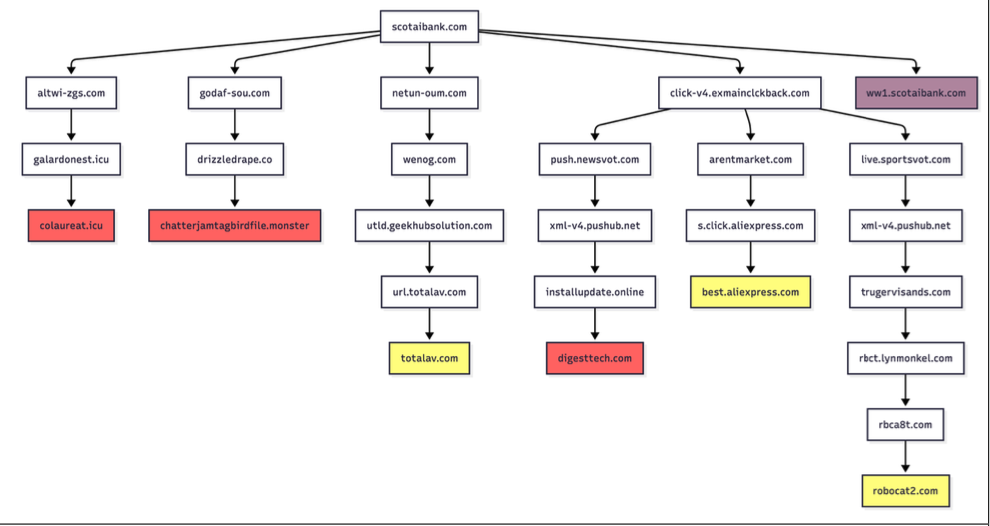
David Brunsdon, a threat researcher at Infoblox, said the parked pages send visitors through a chain of redirects, all while profiling the visitor’s system using IP geolocation, device fingerprinting, and cookies to determine where to redirect domain visitors.

“It was often a chain of redirects — one or two domains outside the parking company — before threat arrives,” Brunsdon said. “Each time in the handoff the device is profiled again and again, before being passed off to a malicious domain or else a decoy page like Amazon.com or Alibaba.com if they decide it’s not worth targeting.”

Brunsdon said domain parking services claim the search results they return on parked pages are designed to be relevant to their parked domains, but that almost none of this displayed content was related to the lookalike domain names they tested.

Samples of redirection paths when visiting scotaibank dot com. Each branch includes a series of domains observed, including the color-coded landing page. Image: Infoblox.

Infoblox said a different threat actor who owns domaincntrol[.]com — a domain that differs from GoDaddy’s name servers by a single character — has long taken advantage of typos in DNS configurations to drive users to malicious websites. In recent months, however, Infoblox discovered the malicious redirect only happens when the query for the misconfigured domain comes from a visitor who is using Cloudflare’s DNS resolvers (1.1.1.1), and that all other visitors will get a page that refuses to load.

The researchers found that even variations on well-known government domains are being targeted by malicious ad networks.

“When one of our researchers tried to report a crime to the FBI’s Internet Crime Complaint Center (IC3), they accidentally visited ic3[.]org instead of ic3[.]gov,” the report notes. “Their phone was quickly redirected to a false ‘Drive Subscription Expired’ page. They were lucky to receive a scam; based on what we’ve learnt, they could just as easily receive an information stealer or trojan malware.”

The Infoblox report emphasizes that the malicious activity they tracked is not attributed to any known party, noting that the domain parking or advertising platforms named in the study were not implicated in the malvertising they documented.

However, the report concludes that while the parking companies claim to only work with top advertisers, the traffic to these domains was frequently sold to affiliate networks, who often resold the traffic to the point where the final advertiser had no business relationship with the parking companies.

Infoblox also pointed out that recent policy changes by Google may have inadvertently increased the risk to users from direct search abuse. Brunsdon said Google Adsense previously defaulted to allowing their ads to be placed on parked pages, but that in early 2025 Google implemented a default setting that had their customers opt-out by default on presenting ads on parked domains — requiring the person running the ad to voluntarily go into their settings and turn on parking as a location.

Google Sues to Disrupt Chinese SMS Phishing Triad

13 November 2025 at 09:47

Google is suing more than two dozen unnamed individuals allegedly involved in peddling a popular China-based mobile phishing service that helps scammers impersonate hundreds of trusted brands, blast out text message lures, and convert phished payment card data into mobile wallets from Apple and Google.

In a lawsuit filed in the Southern District of New York on November 12, Google sued to unmask and disrupt 25 “John Doe” defendants allegedly linked to the sale of Lighthouse, a sophisticated phishing kit that makes it simple for even novices to steal payment card data from mobile users. Google said Lighthouse has harmed more than a million victims across 120 countries.

A component of the Chinese phishing kit Lighthouse made to target customers of The Toll Roads, which refers to several state routes through Orange County, Calif.

Lighthouse is one of several prolific phishing-as-a-service operations known as the “Smishing Triad,” and collectively they are responsible for sending millions of text messages that spoof the U.S. Postal Service to supposedly collect some outstanding delivery fee, or that pretend to be a local toll road operator warning of a delinquent toll fee. More recently, Lighthouse has been used to spoof e-commerce websites, financial institutions and brokerage firms.

Regardless of the text message lure or brand used, the basic scam remains the same: After the visitor enters their payment information, the phishing site will automatically attempt to enroll the card as a mobile wallet from Apple or Google. The phishing site then tells the visitor that their bank is going to verify the transaction by sending a one-time code that needs to be entered into the payment page before the transaction can be completed.

If the recipient provides that one-time code, the scammers can link the victim’s card data to a mobile wallet on a device that they control. Researchers say the fraudsters usually load several stolen wallets onto each mobile device, and wait 7-10 days after that enrollment before selling the phones or using them for fraud.

Google called the scale of the Lighthouse phishing attacks “staggering.” A May 2025 report from Silent Push found the domains used by the Smishing Triad are rotated frequently, with approximately 25,000 phishing domains active during any 8-day period.

Google’s lawsuit alleges the purveyors of Lighthouse violated the company’s trademarks by including Google’s logos on countless phishing websites. The complaint says Lighthouse offers over 600 templates for phishing websites of more than 400 entities, and that Google’s logos were featured on at least a quarter of those templates.

Google is also pursuing Lighthouse under the Racketeer Influenced and Corrupt Organizations (RICO) Act, saying the Lighthouse phishing enterprise encompasses several connected threat actor groups that work together to design and implement complex criminal schemes targeting the general public.

According to Google, those threat actor teams include a “developer group” that supplies the phishing software and templates; a “data broker group” that provides a list of targets; a “spammer group” that provides the tools to send fraudulent text messages in volume; a “theft group,” in charge of monetizing the phished information; and an “administrative group,” which runs their Telegram support channels and discussion groups designed to facilitate collaboration and recruit new members.

“While different members of the Enterprise may play different roles in the Schemes, they all collaborate to execute phishing attacks that rely on the Lighthouse software,” Google’s complaint alleges. “None of the Enterprise’s Schemes can generate revenue without collaboration and cooperation among the members of the Enterprise. All of the threat actor groups are connected to one another through historical and current business ties, including through their use of Lighthouse and the online community supporting its use, which exists on both YouTube and Telegram channels.”

Silent Push’s May report observed that the Smishing Triad boasts it has “300+ front desk staff worldwide” involved in Lighthouse, staff that is mainly used to support various aspects of the group’s fraud and cash-out schemes.

An image shared by an SMS phishing group shows a panel of mobile phones responsible for mass-sending phishing messages. These panels require a live operator because the one-time codes being shared by phishing victims must be used quickly as they generally expire within a few minutes.

Google alleges that in addition to blasting out text messages spoofing known brands, Lighthouse makes it easy for customers to mass-create fake e-commerce websites that are advertised using Google Ads accounts (and paid for with stolen credit cards). These phony merchants collect payment card information at checkout, and then prompt the customer to expect and share a one-time code sent from their financial institution.

Once again, that one-time code is being sent by the bank because the fake e-commerce site has just attempted to enroll the victim’s payment card data in a mobile wallet. By the time a victim understands they will likely never receive the item they just purchased from the fake e-commerce shop, the scammers have already run through hundreds of dollars in fraudulent charges, often at high-end electronics stores or jewelers.

Ford Merrill works in security research at SecAlliance, a CSIS Security Group company, and he’s been tracking Chinese SMS phishing groups for several years. Merrill said many Lighthouse customers are now using the phishing kit to erect fake e-commerce websites that are advertised on Google and Meta platforms.

“You find this shop by searching for a particular product online or whatever, and you think you’re getting a good deal,” Merrill said. “But of course you never receive the product, and they will phish that one-time code at checkout.”

Merrill said some of the phishing templates include payment buttons for services like PayPal, and that victims who choose to pay through PayPal can also see their PayPal accounts hijacked.

A fake e-commerce site from the Smishing Triad spoofing PayPal on a mobile device.

“The main advantage of the fake e-commerce site is that it doesn’t require them to send out message lures,” Merrill said, noting that the fake vendor sites have more staying power than traditional phishing sites because it takes far longer for them to be flagged for fraud.

Merrill said Google’s legal action may temporarily disrupt the Lighthouse operators, and could make it easier for U.S. federal authorities to bring criminal charges against the group. But he said the Chinese mobile phishing market is so lucrative right now that it’s difficult to imagine a popular phishing service voluntarily turning out the lights.

Merrill said Google’s lawsuit also can help lay the groundwork for future disruptive actions against Lighthouse and other phishing-as-a-service entities that are operating almost entirely on Chinese networks. According to Silent Push, a majority of the phishing sites created with these kits are sitting at two Chinese hosting companies: Tencent (AS132203) and Alibaba (AS45102).

“Once Google has a default judgment against the Lighthouse guys in court, theoretically they could use that to go to Alibaba and Tencent and say, ‘These guys have been found guilty, here are their domains and IP addresses, we want you to shut these down or we’ll include you in the case.'”

If Google can bring that kind of legal pressure consistently over time, Merrill said, they might succeed in increasing costs for the phishers and more frequently disrupting their operations.

“If you take all of these Chinese phishing kit developers, I have to believe it’s tens of thousands of Chinese-speaking people involved,” he said. “The Lighthouse guys will probably burn down their Telegram channels and disappear for a while. They might call it something else or redevelop their service entirely. But I don’t believe for a minute they’re going to close up shop and leave forever.”

Aisuru Botnet Shifts from DDoS to Residential Proxies

28 October 2025 at 20:51

Aisuru, the botnet responsible for a series of record-smashing distributed denial-of-service (DDoS) attacks this year, recently was overhauled to support a more low-key, lucrative and sustainable business: Renting hundreds of thousands of infected Internet of Things (IoT) devices to proxy services that help cybercriminals anonymize their traffic. Experts say a glut of proxies from Aisuru and other sources is fueling large-scale data harvesting efforts tied to various artificial intelligence (AI) projects, helping content scrapers evade detection by routing their traffic through residential connections that appear to be regular Internet users.

Image credit: vxdb

First identified in August 2024, Aisuru has spread to at least 700,000 IoT systems, such as poorly secured Internet routers and security cameras. Aisuru’s overlords have used their massive botnet to clobber targets with headline-grabbing DDoS attacks, flooding targeted hosts with blasts of junk requests from all infected systems simultaneously.

In June, Aisuru hit KrebsOnSecurity.com with a DDoS clocking at 6.3 terabits per second — the biggest attack that Google had ever mitigated at the time. In the weeks and months that followed, Aisuru’s operators demonstrated DDoS capabilities of nearly 30 terabits of data per second — well beyond the attack mitigation capabilities of most Internet destinations.

These digital sieges have been particularly disruptive this year for U.S.-based Internet service providers (ISPs), in part because Aisuru recently succeeded in taking over a large number of IoT devices in the United States. And when Aisuru launches attacks, the volume of outgoing traffic from infected systems on these ISPs is often so high that it can disrupt or degrade Internet service for adjacent (non-botted) customers of the ISPs.

“Multiple broadband access network operators have experienced significant operational impact due to outbound DDoS attacks in excess of 1.5Tb/sec launched from Aisuru botnet nodes residing on end-customer premises,” wrote Roland Dobbins, principal engineer at Netscout, in a recent executive summary on Aisuru. “Outbound/crossbound attack traffic exceeding 1Tb/sec from compromised customer premise equipment (CPE) devices has caused significant disruption to wireline and wireless broadband access networks. High-throughput attacks have caused chassis-based router line card failures.”

The incessant attacks from Aisuru have caught the attention of federal authorities in the United States and Europe (many of Aisuru’s victims are customers of ISPs and hosting providers based in Europe). Quite recently, some of the world’s largest ISPs have started informally sharing block lists identifying the rapidly shifting locations of the servers that the attackers use to control the activities of the botnet.

Experts say the Aisuru botmasters recently updated their malware so that compromised devices can more easily be rented to so-called “residential proxy” providers. These proxy services allow paying customers to route their Internet communications through someone else’s device, providing anonymity and the ability to appear as a regular Internet user in almost any major city worldwide.

From a website’s perspective, the IP traffic of a residential proxy network user appears to originate from the rented residential IP address, not from the proxy service customer. Proxy services can be used in a legitimate manner for several business purposes — such as price comparisons or sales intelligence. But they are massively abused for hiding cybercrime activity (think advertising fraud, credential stuffing) because they can make it difficult to trace malicious traffic to its original source.

And as we’ll see in a moment, this entire shadowy industry appears to be shifting its focus toward enabling aggressive content scraping activity that continuously feeds raw data into large language models (LLMs) built to support various AI projects.

‘INSANE’ GROWTH

Riley Kilmer is co-founder of spur.us, a service that tracks proxy networks. Kilmer said all of the top proxy services have grown substantially over the past six months.

“I just checked, and in the last 90 days we’ve seen 250 million unique residential proxy IPs,” Kilmer said. “That is insane. That is so high of a number, it’s unheard of. These proxies are absolutely everywhere now.”

Today, Spur says it is tracking an unprecedented spike in available proxies across all providers, including;

LUMINATI_PROXY    11,856,421
NETNUT_PROXY    10,982,458
ABCPROXY_PROXY    9,294,419
OXYLABS_PROXY     6,754,790
IPIDEA_PROXY     3,209,313
EARNFM_PROXY    2,659,913
NODEMAVEN_PROXY    2,627,851
INFATICA_PROXY    2,335,194
IPROYAL_PROXY    2,032,027
YILU_PROXY    1,549,155

Reached for comment about the apparent rapid growth in their proxy network, Oxylabs (#4 on Spur’s list) said while their proxy pool did grow recently, it did so at nowhere near the rate cited by Spur.

“We don’t systematically track other providers’ figures, and we’re not aware of any instances of 10× or 100× growth, especially when it comes to a few bigger companies that are legitimate businesses,” the company said in a written statement.

Bright Data was formerly known as Luminati Networks, the name that is currently at the top of Spur’s list of the biggest residential proxy networks. Bright Data likewise told KrebsOnSecurity that Spur’s current estimates of its proxy network are dramatically overstated and inaccurate.

“We did not actively initiate nor do we see any 10x or 100x expansion of our network, which leads me to believe that someone might be presenting these IPs as Bright Data’s in some way,” said Rony Shalit, Bright Data’s chief compliance and ethics officer. “In many cases in the past, due to us being the leading data collection proxy provider, IPs were falsely tagged as being part of our network, or while being used by other proxy providers for malicious activity.”

“Our network is only sourced from verified IP providers and a robust opt-in only residential peers, which we work hard and in complete transparency to obtain,” Shalit continued. “Every DC, ISP or SDK partner is reviewed and approved, and every residential peer must actively opt in to be part of our network.”

HK NETWORK

Even Spur acknowledges that Luminati and Oxylabs are unlike most other proxy services on their top proxy providers list, in that these providers actually adhere to “know-your-customer” policies, such as requiring video calls with all customers, and strictly blocking customers from reselling access.

Benjamin Brundage is founder of Synthient, a startup that helps companies detect proxy networks. Brundage said if there is increasing confusion around which proxy networks are the most worrisome, it’s because nearly all of these lesser-known proxy services have evolved into highly incestuous bandwidth resellers. What’s more, he said, some proxy providers do not appreciate being tracked and have been known to take aggressive steps to confuse systems that scan the Internet for residential proxy nodes.

Brundage said most proxy services today have created their own software development kit or SDK that other app developers can bundle with their code to earn revenue. These SDKs quietly modify the user’s device so that some portion of their bandwidth can be used to forward traffic from proxy service customers.

“Proxy providers have pools of constantly churning IP addresses,” he said. “These IP addresses are sourced through various means, such as bandwidth-sharing apps, botnets, Android SDKs, and more. These providers will often either directly approach resellers or offer a reseller program that allows users to resell bandwidth through their platform.”

Many SDK providers say they require full consent before allowing their software to be installed on end-user devices. Still, those opt-in agreements and consent checkboxes may be little more than a formality for cybercriminals like the Aisuru botmasters, who can earn a commission each time one of their infected devices is forced to install some SDK that enables one or more of these proxy services.

Depending on its structure, a single provider may operate hundreds of different proxy pools at a time — all maintained through other means, Brundage said.

“Often, you’ll see resellers maintaining their own proxy pool in addition to an upstream provider,” he said. “It allows them to market a proxy pool to high-value clients and offer an unlimited bandwidth plan for cheap reduce their own costs.”

Some proxy providers appear to be directly in league with botmasters. Brundage identified one proxy seller that was aggressively advertising cheap and plentiful bandwidth to content scraping companies. After scanning that provider’s pool of available proxies, Brundage said he found a one-to-one match with IP addresses he’d previously mapped to the Aisuru botnet.

Brundage says that by almost any measurement, the world’s largest residential proxy service is IPidea, a China-based proxy network. IPidea is #5 on Spur’s Top 10, and Brundage said its brands include ABCProxy (#3), Roxlabs, LunaProxy, PIA S5 Proxy, PyProxy, 922Proxy, 360Proxy, IP2World, and Cherry Proxy. Spur’s Kilmer said they also track Yilu Proxy (#10) as IPidea.

Brundage said all of these providers operate under a corporate umbrella known on the cybercrime forums as “HK Network.”

“The way it works is there’s this whole reseller ecosystem, where IPidea will be incredibly aggressive and approach all these proxy providers with the offer, ‘Hey, if you guys buy bandwidth from us, we’ll give you these amazing reseller prices,'” Brundage explained. “But they’re also very aggressive in recruiting resellers for their apps.”

A graphic depicting the relationship between proxy providers that Synthient found are white labeling IPidea proxies. Image: Synthient.com.

Those apps include a range of low-cost and “free” virtual private networking (VPN) services that indeed allow users to enjoy a free VPN, but which also turn the user’s device into a traffic relay that can be rented to cybercriminals, or else parceled out to countless other proxy networks.

“They have all this bandwidth to offload,” Brundage said of IPidea and its sister networks. “And they can do it through their own platforms, or they go get resellers to do it for them by advertising on sketchy hacker forums to reach more people.”

One of IPidea’s core brands is 922S5Proxy, which is a not-so-subtle nod to the 911S5Proxy service that was hugely popular between 2015 and 2022. In July 2022, KrebsOnSecurity published a deep dive into 911S5Proxy’s origins and apparent owners in China. Less than a week later, 911S5Proxy announced it was closing down after the company’s servers were massively hacked.

That 2022 story named Yunhe Wang from Beijing as the apparent owner and/or manager of the 911S5 proxy service. In May 2024, the U.S. Department of Justice arrested Mr Wang, alleging that his network was used to steal billions of dollars from financial institutions, credit card issuers, and federal lending programs. At the same time, the U.S. Treasury Department announced sanctions against Wang and two other Chinese nationals for operating 911S5Proxy.

The website for 922Proxy.

DATA SCRAPING FOR AI

In recent months, multiple experts who track botnet and proxy activity have shared that a great deal of content scraping which ultimately benefits AI companies is now leveraging these proxy networks to further obfuscate their aggressive data-slurping activity. That’s because by routing it through residential IP addresses, content scraping firms can make their traffic far trickier to filter out.

“It’s really difficult to block, because there’s a risk of blocking real people,” Spur’s Kilmer said of the LLM scraping activity that is fed through individual residential IP addresses, which are often shared by multiple customers at once.

Kilmer says the AI industry has brought a veneer of legitimacy to residential proxy business, which has heretofore mostly been associated with sketchy affiliate money making programs, automated abuse, and unwanted Internet traffic.

“Web crawling and scraping has always been a thing, but AI made it like a commodity, data that had to be collected,” Kilmer said. “Everybody wanted to monetize their own data pots, and how they monetize that is different across the board.”

Kilmer said many LLM-related scrapers rely on residential proxies in cases where the content provider has restricted access to their platform in some way, such as forcing interaction through an app, or keeping all content behind a login page with multi-factor authentication.

“Where the cost of data is out of reach — there is some exclusivity or reason they can’t access the data — they’ll turn to residential proxies so they look like a real person accessing that data,” Kilmer said of the content scraping efforts.

Aggressive AI crawlers increasingly are overloading community-maintained infrastructure, causing what amounts to persistent DDoS attacks on vital public resources. A report earlier this year from LibreNews found some open-source projects now see as much as 97 percent of their traffic originating from AI company bots, dramatically increasing bandwidth costs, service instability, and burdening already stretched-thin maintainers.

Cloudflare is now experimenting with tools that will allow content creators to charge a fee to AI crawlers to scrape their websites. The company’s “pay-per-crawl” feature is currently in a private beta, and it lets publishers set their own prices that bots must pay before scraping content.

On October 22, the social media and news network Reddit sued Oxylabs (PDF) and several other proxy providers, alleging that their systems enabled the mass-scraping of Reddit user content even though Reddit had taken steps to block such activity.

“Recognizing that Reddit denies scrapers like them access to its site, Defendants scrape the data from Google’s search results instead,” the lawsuit alleges. “They do so by masking their identities, hiding their locations, and disguising their web scrapers as regular people (among other techniques) to circumvent or bypass the security restrictions meant to stop them.”

Denas Grybauskas, chief governance and strategy officer at Oxylabs, said the company was shocked and disappointed by the lawsuit.

“Reddit has made no attempt to speak with us directly or communicate any potential concerns,” Grybauskas said in a written statement. “Oxylabs has always been and will continue to be a pioneer and an industry leader in public data collection, and it will not hesitate to defend itself against these allegations. Oxylabs’ position is that no company should claim ownership of public data that does not belong to them. It is possible that it is just an attempt to sell the same public data at an inflated price.”

As big and powerful as Aisuru may be, it is hardly the only botnet that is contributing to the overall broad availability of residential proxies. For example, on June 5 the FBI’s Internet Crime Complaint Center warned that an IoT malware threat dubbed BADBOX 2.0 had compromised millions of smart-TV boxes, digital projectors, vehicle infotainment units, picture frames, and other IoT devices.

In July, Google filed a lawsuit in New York federal court against the Badbox botnet’s alleged perpetrators. Google said the Badbox 2.0 botnet “compromised more than 10 million uncertified devices running Android’s open-source software, which lacks Google’s security protections. Cybercriminals infected these devices with pre-installed malware and exploited them to conduct large-scale ad fraud and other digital crimes.”

A FAMILIAR DOMAIN NAME

Brundage said the Aisuru botmasters have their own SDK, and for some reason part of its code tells many newly-infected systems to query the domain name fuckbriankrebs[.]com. This may be little more than an elaborate “screw you” to this site’s author: One of the botnet’s alleged partners goes by the handle “Forky,” and was identified in June by KrebsOnSecurity as a young man from Sao Paulo, Brazil.

Brundage noted that only systems infected with Aisuru’s Android SDK will be forced to resolve the domain. Initially, there was some discussion about whether the domain might have some utility as a “kill switch” capable of disrupting the botnet’s operations, although Brundage and others interviewed for this story say that is unlikely.

A tiny sample of the traffic after a DNS server was enabled on the newly registered domain fuckbriankrebs dot com. Each unique IP address requested its own unique subdomain. Image: Seralys.

For one thing, they said, if the domain was somehow critical to the operation of the botnet, why was it still unregistered and actively for-sale? Why indeed, we asked. Happily, the domain name was deftly snatched up last week by Philippe Caturegli, “chief hacking officer” for the security intelligence company Seralys.

Caturegli enabled a passive DNS server on that domain and within a few hours received more than 700,000 requests for unique subdomains on fuckbriankrebs[.]com.

But even with that visibility into Aisuru, it is difficult to use this domain check-in feature to measure its true size, Brundage said. After all, he said, the systems that are phoning home to the domain are only a small portion of the overall botnet.

“The bots are hardcoded to just spam lookups on the subdomains,” he said. “So anytime an infection occurs or it runs in the background, it will do one of those DNS queries.”

Caturegli briefly configured all subdomains on fuckbriankrebs dot com to display this ASCII art image to visiting systems today.

The domain fuckbriankrebs[.]com has a storied history. On its initial launch in 2009, it was used to spread malicious software by the Cutwail spam botnet. In 2011, the domain was involved in a notable DDoS against this website from a botnet powered by Russkill (a.k.a. “Dirt Jumper”).

Domaintools.com finds that in 2015, fuckbriankrebs[.]com was registered to an email address attributed to David “Abdilo” Crees, a 27-year-old Australian man sentenced in May 2025 to time served for cybercrime convictions related to the Lizard Squad hacking group.

Update, Nov. 1, 2025, 10:25 a.m. ET: An earlier version of this story erroneously cited Spur’s proxy numbers from earlier this year; Spur said those numbers conflated residential proxies — which are rotating and attached to real end-user devices — with “ISP proxies” located at AT&T. ISP proxies, Spur said, involve tricking an ISP into routing a large number of IP addresses that are resold as far more static datacenter proxies.

Microsoft Patch Tuesday, September 2025 Edition

9 September 2025 at 17:21

Microsoft Corp. today issued security updates to fix more than 80 vulnerabilities in its Windows operating systems and software. There are no known “zero-day” or actively exploited vulnerabilities in this month’s bundle from Redmond, which nevertheless includes patches for 13 flaws that earned Microsoft’s most-dire “critical” label. Meanwhile, both Apple and Google recently released updates to fix zero-day bugs in their devices.

Microsoft assigns security flaws a “critical” rating when malware or miscreants can exploit them to gain remote access to a Windows system with little or no help from users. Among the more concerning critical bugs quashed this month is CVE-2025-54918. The problem here resides with Windows NTLM, or NT LAN Manager, a suite of code for managing authentication in a Windows network environment.

Redmond rates this flaw as “Exploitation More Likely,” and although it is listed as a privilege escalation vulnerability, Kev Breen at Immersive says this one is actually exploitable over the network or the Internet.

“From Microsoft’s limited description, it appears that if an attacker is able to send specially crafted packets over the network to the target device, they would have the ability to gain SYSTEM-level privileges on the target machine,” Breen said. “The patch notes for this vulnerability state that ‘Improper authentication in Windows NTLM allows an authorized attacker to elevate privileges over a network,’ suggesting an attacker may already need to have access to the NTLM hash or the user’s credentials.”

Breen said another patch — CVE-2025-55234, a 8.8 CVSS-scored flaw affecting the Windows SMB client for sharing files across a network — also is listed as privilege escalation bug but is likewise remotely exploitable. This vulnerability was publicly disclosed prior to this month.

“Microsoft says that an attacker with network access would be able to perform a replay attack against a target host, which could result in the attacker gaining additional privileges, which could lead to code execution,” Breen noted.

CVE-2025-54916 is an “important” vulnerability in Windows NTFS — the default filesystem for all modern versions of Windows — that can lead to remote code execution. Microsoft likewise thinks we are more than likely to see exploitation of this bug soon: The last time Microsoft patched an NTFS bug was in March 2025 and it was already being exploited in the wild as a zero-day.

“While the title of the CVE says ‘Remote Code Execution,’ this exploit is not remotely exploitable over the network, but instead needs an attacker to either have the ability to run code on the host or to convince a user to run a file that would trigger the exploit,” Breen said. “This is commonly seen in social engineering attacks, where they send the user a file to open as an attachment or a link to a file to download and run.”

Critical and remote code execution bugs tend to steal all the limelight, but Tenable Senior Staff Research Engineer Satnam Narang notes that nearly half of all vulnerabilities fixed by Microsoft this month are privilege escalation flaws that require an attacker to have gained access to a target system first before attempting to elevate privileges.

“For the third time this year, Microsoft patched more elevation of privilege vulnerabilities than remote code execution flaws,” Narang observed.

On Sept. 3, Google fixed two flaws that were detected as exploited in zero-day attacks, including CVE-2025-38352, an elevation of privilege in the Android kernel, and CVE-2025-48543, also an elevation of privilege problem in the Android Runtime component.

Also, Apple recently patched its seventh zero-day (CVE-2025-43300) of this year. It was part of an exploit chain used along with a vulnerability in the WhatsApp (CVE-2025-55177) instant messenger to hack Apple devices. Amnesty International reports that the two zero-days have been used in “an advanced spyware campaign” over the past 90 days. The issue is fixed in iOS 18.6.2, iPadOS 18.6.2, iPadOS 17.7.10, macOS Sequoia 15.6.1, macOS Sonoma 14.7.8, and macOS Ventura 13.7.8.

The SANS Internet Storm Center has a clickable breakdown of each individual fix from Microsoft, indexed by severity and CVSS score. Enterprise Windows admins involved in testing patches before rolling them out should keep an eye on askwoody.com, which often has the skinny on wonky updates.

AskWoody also reminds us that we’re now just two months out from Microsoft discontinuing free security updates for Windows 10 computers. For those interested in safely extending the lifespan and usefulness of these older machines, check out last month’s Patch Tuesday coverage for a few pointers.

As ever, please don’t neglect to back up your data (if not your entire system) at regular intervals, and feel free to sound off in the comments if you experience problems installing any of these fixes.

❌
❌