
Normal view

There are new articles available, click to refresh the page.
Before yesterdayMain stream

CISA credential leak raises alarms, and Capitol Hill demands answers

19 May 2026 at 19:28

Congress wants answers from the Cybersecurity and Infrastructure Security Agency about the reported public exposure of sensitive agency credential data on GitHub in an incident that the security researcher who discovered it called one of the worst leaks he’s ever seen.

Other security professionals also voiced concern Tuesday about the leak and the potential for abuse by any malicious parties who got a hold of the information.

Security firm GitGuardian said it discovered a public GitHub repository last week that exposed credentials for privileged AWS GovCloud accounts and internal CISA systems dating back to November. The repository, apparently maintained by a contractor, was named “Private-CISA.” 

Krebs on Security first reported the incident.

“My main fear … is that a state actor will get the data and might be able to do bad stuff,” GitGuardian security researcher Guillaume Valadon told CyberScoop that he thought to himself upon discovering the leak, after concluding it was real; he initially thought it looked fake.

State-based attackers who obtained the credentials “might be able to gain persistence,” Valadon said, “so for me it’s even worse than an attacker destroying everything, having someone in a governmental system — it’s really, really bad.”

A House Homeland Security Committee aide said the panel is seeking a staff-level briefing from CISA on the matter.

Mississippi Rep. Bennie Thompson, the top Democrat on the Homeland Security Committee, and Delia Ramirez, the top Democrat on the panel’s cyber subcommittee, had separately demanded a briefing Tuesday in a letter to CISA’s acting director, Nick Andersen. 

They said they wanted to learn “how this serious security lapse occurred, any potential security consequences, remediation activities, corrective actions related to the contractor personnel involved, and efforts to monitor for and prevent similar activity from occurring in the future.”

Sen. Maggie Hassan, D-N.H., also sent a letter Tuesday to Andersen, seeking a classified briefing to answer questions about which systems were exposed, what forensic work CISA did to evaluate potential damage and what corrective action it has taken.

“This reported incident raises serious questions about how such a security lapse could occur at the very agency charged with helping to prevent cyber breaches,” Hassan wrote in the missive first reported by Axios, particularly “regarding CISA’s internal policies and procedures at a time of significant cybersecurity threats against U.S. critical infrastructure.”

Both letters pointed to personnel and budget cutbacks at the agency as a potential contributor to the incident.

CISA said it was looking into what happened.

“The Cybersecurity and Infrastructure Security Agency is aware of the reported exposure and is continuing to investigate the situation,” a spokesperson said. “Currently, there is no indication that any sensitive data was compromised as a result of this incident. While we hold our team members to the highest standards of integrity and operational awareness, we are working to ensure additional safeguards are implemented to prevent future occurrences.” 

The repository was reportedly maintained by a contractor at Nightwing. A Nightwing spokesperson referred questions to CISA.

The kind of exposure that happened for CISA “is an unfortunately painful, but common and repeated, if not relentless, way that we see organizations inadvertently leak very sensitive credentials to the wider web,” said Ben Harris, founder of WatchTowr, a company that helps organizations detect such exposures.

Harris told CyberScoop he didn’t want to speculate on what attackers who obtained the credentials might be able to do with it, but he said that it would be “terrifying” if the contractor was transferring information from work to home, as one researcher theorized.

Dave Mitchell, senior director of threat intelligence at Infoblox, told CyberScoop the incident showed the importance of teams having controls and audits in place across their repositories.

“Of all the things that keep me up at night, misconfigurations in GitHub are a recurring nightmare. It’s critical for so many organizations — all it takes is one accidental upload or misconfiguration and you’ve signed yourself up for a major incident,” he said in a written statement. “No need for a threat actor to use advanced techniques to compromise you if the keys are already sitting on the counter.”

Travis Rosiek, public sector chief technology officer at Rubrik, noted that the timing of the issue aligned with the government shutdown that only recently resolved for DHS. He said the incident showed the federal government needs to prioritize resilience.

“A persistent shortage of cybersecurity talent, combined with funding lapses, high workforce turnover, and an increasingly complex threat landscape, created the perfect storm for this scenario,” he said in a written statement to CyberScoop. “No organization is immune, and we must ensure that the federal government, which is responsible for helping protect the nation’s critical infrastructure and enhancing our cybersecurity posture, remains fully operational 24-7, 365 days a year.”

Without minimizing the severity of the incident, some researchers who have looked at the leak said there are mitigating circumstances that make elements of it defensible or, at least, understandable.

CISA acted very swiftly to remove the repository, Valadon said, once he alerted them to the leak.

And even if CISA has the right policies in place, human error still can make it difficult to entirely avoid incidents like this, Harris said.

“The reality is this happens every single day to different organizations, including cybersecurity companies,” he said, noting it would be different if it was a pattern. “This is not exclusive to CISA. I don’t really think it reflects well if we saw this every single day with CISA. … It’s not ideal that it’s even happened once, but the reality is that cybersecurity is people, process, technology.”

CISA has had other security incidents in the past, including recently. The former acting director of the agency endured criticism for uploading sensitive contract data to ChatGPT last year. In 2024 the agency notified Congress of a breach of a chemical plant security tool.

Updated 5/20/26: to include more information on a House Homeland Security Committee briefing request.

The post CISA credential leak raises alarms, and Capitol Hill demands answers appeared first on CyberScoop.

CISA Admin Leaked AWS GovCloud Keys on Github

18 May 2026 at 16:48

Until this past weekend, a contractor for the Cybersecurity & Infrastructure Security Agency (CISA) maintained a public GitHub repository that exposed credentials to several highly privileged AWS GovCloud accounts and a large number of internal CISA systems. Security experts said the public archive included files detailing how CISA builds, tests and deploys software internally, and that it represents one of the most egregious government data leaks in recent history.

On May 15, KrebsOnSecurity heard from Guillaume Valadon, a researcher with the security firm GitGuardian. Valadon’s company constantly scans public code repositories at GitHub and elsewhere for exposed secrets, automatically alerting the offending accounts of any apparent sensitive data exposures. Valadon said he reached out because the owner in this case wasn’t responding and the information exposed was highly sensitive.
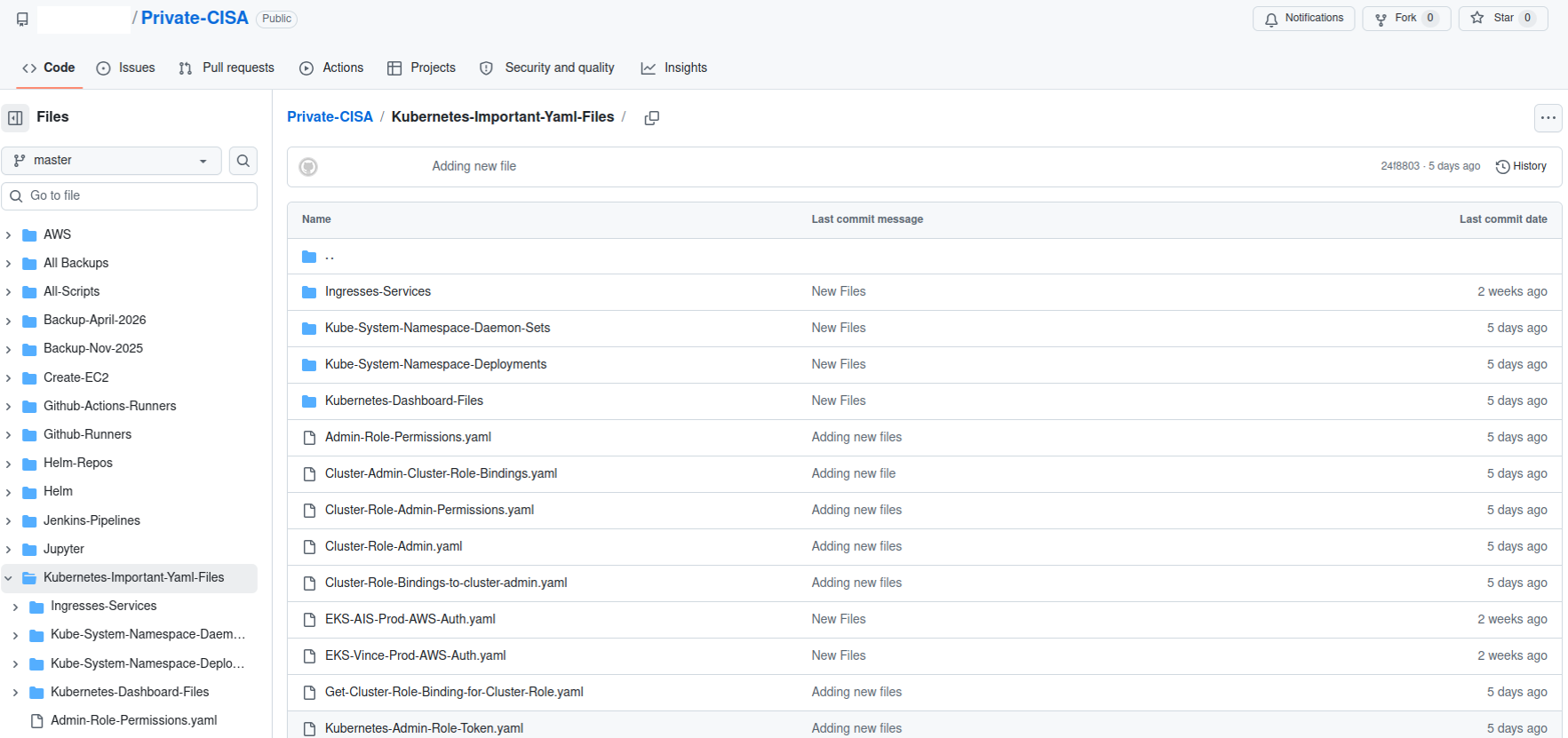
A redacted screenshot of the now-defunct “Private CISA” repository maintained by a CISA contractor.

The GitHub repository that Valadon flagged was named “Private-CISA,” and it harbored a vast number of internal CISA/DHS credentials and files, including cloud keys, tokens, plaintext passwords, logs and other sensitive CISA assets.

Valadon said the exposed CISA credentials represent a textbook example of poor security hygiene, noting that the commit logs in the offending GitHub account show that the CISA administrator disabled the default setting in GitHub that blocks users from publishing SSH keys or other secrets in public code repositories.

“Passwords stored in plain text in a csv, backups in git, explicit commands to disable GitHub secrets detection feature,” Valadon wrote in an email. “I honestly believed that it was all fake before analyzing the content deeper. This is indeed the worst leak that I’ve witnessed in my career. It is obviously an individual’s mistake, but I believe that it might reveal internal practices.”

One of the exposed files, titled “importantAWStokens,” included the administrative credentials to three Amazon AWS GovCloud servers. Another file exposed in their public GitHub repository — “AWS-Workspace-Firefox-Passwords.csv” — listed plaintext usernames and passwords for dozens of internal CISA systems. According to Caturegli, those systems included one called “LZ-DSO,” which appears short for “Landing Zone DevSecOps,” the agency’s secure code development environment.

Philippe Caturegli, founder of the security consultancy Seralys, said he tested the AWS keys only to see whether they were still valid and to determine which internal systems the exposed accounts could access. Caturegli said the GitHub account that exposed the CISA secrets exhibits a pattern consistent with an individual operator using the repository as a working scratchpad or synchronization mechanism rather than a curated project repository.

“The use of both a CISA-associated email address and a personal email address suggests the repository may have been used across differently configured environments,” Caturegli observed. “The available Git metadata alone does not prove which endpoint or device was used.”

The Private CISA GitHub repo exposed dozens of plaintext credentials for important CISA GovCloud resources.

Caturegli said he validated that the exposed credentials could authenticate to three AWS GovCloud accounts at a high privilege level. He said the archive also includes plain text credentials to CISA’s internal “artifactory” — essentially a repository of all the code packages they are using to build software — and that this would represent a juicy target for malicious attackers looking for ways to maintain a persistent foothold in CISA systems.

“That would be a prime place to move laterally,” he said. “Backdoor in some software packages, and every time they build something new they deploy your backdoor left and right.”

In response to questions, a spokesperson for CISA said the agency is aware of the reported exposure and is continuing to investigate the situation.

“Currently, there is no indication that any sensitive data was compromised as a result of this incident,” the CISA spokesperson wrote. “While we hold our team members to the highest standards of integrity and operational awareness, we are working to ensure additional safeguards are implemented to prevent future occurrences.”

A review of the GitHub account and its exposed passwords show the “Private CISA” repository was maintained by an employee of Nightwing, a government contractor based in Dulles, Va. Nightwing declined to comment, directing inquiries to CISA.

CISA has not responded to questions about the potential duration of the data exposure, but Caturegli said the Private CISA repository was created on November 13, 2025. The contractor’s GitHub account was created back in September 2018.

The GitHub account that included the Private CISA repo was taken offline shortly after both KrebsOnSecurity and Seralys notified CISA about the exposure. But Caturegli said the exposed AWS keys inexplicably continued to remain valid for another 48 hours.

CISA is currently operating with only a fraction of its normal budget and staffing levels. The agency has lost nearly a third of its workforce since the beginning of the second Trump administration, which forced a series of early retirements, buyouts, and resignations across the agency’s various divisions.

The now-defunct Private CISA repo showed the contractor also used easily-guessed passwords for a number of internal resources; for example, many of the credentials used a password consisting of each platform’s name followed by the current year. Caturegli said such practices would constitute a serious security threat for any organization even if those credentials were never exposed externally, noting that threat actors often use key credentials exposed on the internal network to expand their reach after establishing initial access to a targeted system.

“What I suspect happened is [the CISA contractor] was using this GitHub to synchronize files between a work laptop and a home computer, because he has regularly committed to this repo since November 2025,” Caturegli said. “This would be an embarrassing leak for any company, but it’s even more so in this case because it’s CISA.”

Microsoft Patch Tuesday, November 2025 Edition

16 November 2025 at 16:47

Microsoft this week pushed security updates to fix more than 60 vulnerabilities in its Windows operating systems and supported software, including at least one zero-day bug that is already being exploited. Microsoft also fixed a glitch that prevented some Windows 10 users from taking advantage of an extra year of security updates, which is nice because the zero-day flaw and other critical weaknesses affect all versions of Windows, including Windows 10.

Affected products this month include the Windows OS, Office, SharePoint, SQL Server, Visual Studio, GitHub Copilot, and Azure Monitor Agent. The zero-day threat concerns a memory corruption bug deep in the Windows innards called CVE-2025-62215. Despite the flaw’s zero-day status, Microsoft has assigned it an “important” rating rather than critical, because exploiting it requires an attacker to already have access to the target’s device.

“These types of vulnerabilities are often exploited as part of a more complex attack chain,” said Johannes Ullrich, dean of research for the SANS Technology Institute. “However, exploiting this specific vulnerability is likely to be relatively straightforward, given the existence of prior similar vulnerabilities.”

Ben McCarthy, lead cybersecurity engineer at Immersive, called attention to CVE-2025-60274, a critical weakness in a core Windows graphic component (GDI+) that is used by a massive number of applications, including Microsoft Office, web servers processing images, and countless third-party applications.

“The patch for this should be an organization’s highest priority,” McCarthy said. “While Microsoft assesses this as ‘Exploitation Less Likely,’ a 9.8-rated flaw in a ubiquitous library like GDI+ is a critical risk.”

Microsoft patched a critical bug in OfficeCVE-2025-62199 — that can lead to remote code execution on a Windows system. Alex Vovk, CEO and co-founder of Action1, said this Office flaw is a high priority because it is low complexity, needs no privileges, and can be exploited just by viewing a booby-trapped message in the Preview Pane.

Many of the more concerning bugs addressed by Microsoft this month affect Windows 10, an operating system that Microsoft officially ceased supporting with patches last month. As that deadline rolled around, however, Microsoft began offering Windows 10 users an extra year of free updates, so long as they register their PC to an active Microsoft account.

Judging from the comments on last month’s Patch Tuesday post, that registration worked for a lot of Windows 10 users, but some readers reported the option for an extra year of updates was never offered. Nick Carroll, cyber incident response manager at Nightwing, notes that Microsoft has recently released an out-of-band update to address issues when trying to enroll in the Windows 10 Consumer Extended Security Update program.

“If you plan to participate in the program, make sure you update and install KB5071959 to address the enrollment issues,” Carroll said. “After that is installed, users should be able to install other updates such as today’s KB5068781 which is the latest update to Windows 10.”

Chris Goettl at Ivanti notes that in addition to Microsoft updates today, third-party updates from Adobe and Mozilla have already been released. Also, an update for Google Chrome is expected soon, which means Edge will also be in need of its own update.

The SANS Internet Storm Center has a clickable breakdown of each individual fix from Microsoft, indexed by severity and CVSS score. Enterprise Windows admins involved in testing patches before rolling them out should keep an eye on askwoody.com, which often has the skinny on any updates gone awry.

As always, please don’t neglect to back up your data (if not your entire system) at regular intervals, and feel free to sound off in the comments if you experience problems installing any of these fixes.

[Author’s note: This post was intended to appear on the homepage on Tuesday, Nov. 11. I’m still not sure how it happened, but somehow this story failed to publish that day. My apologies for the oversight.]

❌
❌