Microsoft, along with a group of industry partners, disrupted EvilTokens, a short-lived but highly consequential cybercrime platform that investigators linked to more than 12,000 compromised Microsoft customer email inboxes across more than 10,000 organizations globally, the company said Tuesday.
Acting on federal court order Sept. 15, Microsoft and partners seized 50 websites the phishing-as-a-service used for operations and disabled more than 175 domains linked to EvilTokens’ supporting infrastructure.
EvilTokens, launched in February 2026, was “a powerful cybercrime platform that used AI at every step of the attack chain — from compromising email accounts to designing intricate roadmaps for financial fraud and scams,” Steven Masada, associate general counsel and general manager of Microsoft’s Digital Crimes Unit, wrote in a blog post.
About 1,000 cybercriminals used EvilTokens over the course of its operation, a Microsoft spokesperson told CyberScoop.
The service was centered on an AI-style chatbot that cybercriminals used to analyze victims’ inboxes, identify trusted relationships, payment authorizations and other sensitive details that could facilitate fraud.
“AI was not simply helping attackers write more convincing messages. It helped them decide who to target, who to impersonate, and how to most effectively exploit the relationship to extract as much money as possible,” Masada wrote.
EvilTokens was one of the most widely used phishing-as-a-service platforms prior to its takedown. It facilitated business-email compromise campaigns by stealing session tokens that allowed cybercriminals to sift through a victim’s inbox and maintain persistent access.
“We cannot estimate the total fraud attributable to all EvilTokens activity. However, we were able to correlate at least 13 complaints filed with the FBI’s Internet Crime Complaint Center to EvilTokens-linked activity, representing approximately $1.7 million in reported losses,” a Microsoft spokesperson said. “Because many incidents go unreported and not all victims can be definitively linked to specific campaigns, we believe this is a conservative estimate.”
Victims of EvilTokens were largely concentrated in the United States, Canada, the United Kingdom, Australia, India and France, according to Microsoft. SpyCloud, which supported the takedown, identified compromised email domains spanning 79 countries.
Microsoft said it also identified two men behind EvilTokens — Felix Utomi and Waidi Segun Adams — and attributes the development and support of the platform to Storm-2992, a threat actor unaffiliated with any other known cybercrime groups.
The United Kingdom’s Metropolitan Police acted on that information Sept. 18 when it served warrants in the greater London area, arrested the men accused of making articles for use in fraud and money laundering and seized their digital devices.
The Metropolitan Police said it received information from Microsoft about EvilTokens’ administrators in August. Utomi and Adams were released on bail as the investigation continues.
“The two primary operators identified in our investigation were residing in the U.K.,” a spokesperson for Microsoft told CyberScoop. “While our investigation focused on those individuals, we believe others may have supported the operation in various capacities.”
Microsoft’s legal filing in the U.S. District Court for the Eastern District of Virginia refers to five additional unidentified people allegedly acting as support personnel and users.
Microsoft and others involved in the EvilTokens takedown, including Health-ISAC, Cloudflare, OpenAI, Shadowserver and TRM Labs, didn’t fully quantify how much fraud the service enabled, but it gained popularity quickly among cybercriminals and was lucrative for its operators.
Coinbase, which also aided the investigation into EvilTokens, said it traced about $1.1 million in revenue for EvilTokens from its paying customers. The virtual currency company’s threat researchers found more than 1,000 deposits to EvilTokens from more than 700 distinct addresses through June 2026.
Operators sold access to the service through Telegram for a $1,500 initiation fee and a recurring $500 subscription. EvilTokens significantly lowered the barrier to entry for cybercriminals by including specialized tools for identity attacks, cloud systems, social engineering and financial fraud in a single interface.
The service allowed cybercriminals to map organizational structure and permissions in Microsoft Graph, which enabled lateral movement, researchers said. With active tokens gained through a collection of highly-targeted phishing lures, cybercriminals consistently bypassed multi-factor authentication, email gateways and endpoint security tools.
Microsoft said the platform’s creators developed portions of the platform with AI and it uncovered capabilities from multiple AI models.
“It packaged much of the criminal process into a commercially run service, complete with subscription pricing, customer support, management dashboards and tools designed to move customers from account access toward financial exploitation,” Masada added.
The companies and organizations involved in the globally-coordinated takedown identified and notified potential victims, shared indicators of compromise and shared intelligence with law enforcement about EvilToken’s operators and some of its customers.
Experts advised organizations and employees to treat unsolicited device codes as a red flag, assume compromised accounts are fully cataloged in minutes, and independently verify requests to change payment information or redirect funds.
“The infrastructure supporting EvilTokens has been disrupted, but the model it demonstrated will not disappear with it,” Masada warned.
Another core member of the hacker subset of The Com involved in a spree of extortion attacks from at least 2021 to 2023 pleaded guilty to federal charges, according to court records released Tuesday.
Ahmed Hossam Eldin Elbadawy, a 24-year-old from Texas, pleaded guilty exactly one year ago to wire fraud conspiracy and aggravated identity theft. His guilty plea wasn’t shared publicly until prosecutors filed an order of forfeiture this week seeking proceeds from Elbadawy’s criminal activities.
The financially-motivated crew obtained credentials via social engineering and stole sensitive company data to identify high net worth employees with virtual currency accounts containing millions of dollars, according to an indictment filed against Elbadawy and his co-conspirators in late 2024.
Federal authorities filed charges against five individuals with links to the Scattered Spider cybercrime outfit, including Elbadawy, Urban, Buchanan, Evans Onyeaka Osiebo and Joel Martin Evans in 2024.
Elbadawy’s victims included large businesses in the entertainment, telecom, technology, business process outsourcing, IT, cloud and virtual currency sectors, officials said. Prosecutors linked Elbadawy and his co-conspirators to at least 12 victim companies in the indictment, including three businesses located in Southern California where he awaits sentencing.
Authorities detailed 29 victims who were compromised by Elbadawy and his co-conspirators. The crew stole virtual currency from wallets controlled by many of those victims. The most high-value thefts included virtual currency worth nearly $6.35 million in September 2021, $571,000 in June 2022 and nearly $1.7 million in December 2022.
Prosecutors are seeking significant property and asset forfeiture from Elbadawy, including Bitcoin valued at more than $14.19 million, Ethereum valued at more than $3.4 million and nearly $63,000 in cash. Officials also requested the forfeiture of a lifted golf cart, three luxury vehicles, a painting of Muhammad Ali, luxury watches, gold jewelry, a vast collection of designer bags and 150 pairs of shoes.
The terms of Elbadawy’s plea agreement haven’t been released.
While early leaders of Scattered Spider have been arrested or sentenced for their crimes, others have filled those roles with even more exceptional impact.
The Com has grown to thousands of members, typically between 11 and 25 years old, splintered into three primary subsets the FBI describes as Hacker Com, In Real Life Com and Extortion Com.
Criminal acts committed by these multiple, interconnected networks include swatting, extortion and sextortion of minors, production and distribution of child sexual abuse material, violent crime and various other cybercrimes.
You can read the indictment against Elbadawy and some of his co-conspirators below.
Five alleged leaders of the South African wing of Black Axe, a global cybercrime group with operations spanning dozens of countries, were extradited to the United States Friday to face multiple charges, the Justice Department said.
Officials accuse the five people, all originally from Nigeria, of running romance scams and advance fee scams from at least 2011 until they were all arrested in South Africa in 2021. The defendants were due Monday for initial court appearances and arraignments in a federal court in Trenton, N.J.
“Black Axe is a notoriously violent transnational criminal organization that also happens to dabble in romance scams to make money,” Stefanie Roddy, special agent in charge of the FBI Newark field office, said in a statement. “The ability of FBI Newark and our partner agencies to reach into South Africa illustrates our resolve to hold accountable any and every type of fraudster who preys on innocent victims here in the United States.”
The accused include Perry Osagiede, founder and leader of the Cape Town Zone of Black Axe; Franklyn Edosa Osagiede, the zone’s “chief ihaza” Osariemen Eric Clement, “assistant eye of the zone,” Collins Owhofasa Otughwor, the zone’s “chief eye,” and Musa Mudashiru, one of the group’s “assistant butchers.”
Prosecutors said the five defendants and their co-conspirators used fake identities to pose as a love interest, relatives, business partners or friends to trick victims into sending them money.
Many of the scams involved claims that the alleged cybercriminals needed money for work travel or to hold them over financially following a series of unfortunate events. This included requests for loans, often involving issues with a construction site, delayed inheritance, or expensive health costs for claimed relatives, according to an unsealed indictment filed in the U.S. District Court of New Jersey in 2021.
Prosecutors said the co-conspirators also used business entities and gained access to the financial accounts of some victims to conceal the funds illegally obtained from other victims. In some cases, the alleged Black Axe members threatened to distribute sensitive photos of victims when they hesitated to send money, officials added.
The extradition follows a heightened period of law enforcement activity targeting Black Axe in multiple countries.
Authorities arrested 34 alleged cybercriminals in Spain, including some Black Axe leaders, for adversary-in-the-middle scams such as business email compromise, money laundering and vehicle trafficking in January.
Officials seized millions in assets, arrested 58 individuals and identified 263 suspects, including members of Black Axe, in a multi-country sting operation in August.
Black Axe is a highly structured, hierarchical group that generates billions of dollars in criminal proceeds annually from many small-scale operations spanning dozens of countries.
All five of the extradited individuals are charged with conspiracy to commit wire fraud and money laundering. Perry Osagiede and Franklyn Osagiede are also charged with wire fraud and aggravated identity theft. Officials also charged Clement with wire fraud and Otughwor with aggravated identity theft. The combined charges carry up to 62 years in prison.
“This case reflects the result of a years-long effort by the U.S. Secret Service and our law enforcement partners to identify, investigate, and bring to justice those who allegedly preyed on victims through sophisticated online fraud and money laundering schemes,” Craig Marech, special agent in charge of the U.S. Secret Service’s Newark field office, said in a statement.
The Justice Department published additional information about the Cape Town Zone wing of Black Axe, including multiple aliases and business entities used by the group’s members, and encouraged potential victims to contact the FBI.
Attackers are targeting prominent, high-profile people, their family members and acquaintances on a commercial messaging application to gain long-term access to their accounts containing sensitive data, the FBI warned in an alert Tuesday.
Officials did not describe the objectives or origins of the attackers, which have more recently impersonated government officials, journalists and publicly known personalities. Attackers are tricking victims into granting them access to a legitimate cloud service, such as Microsoft or Google, under the guise of reviewing a draft article or document.
The ongoing threat, which the FBI has been tracking since late 2025, showcases a “deceptive, sophisticated approach to access user accounts without requiring a password,” the FBI wrote in the public service announcement. The malicious links, which enable OAuth consent phishing, provide attackers with persistent access to a targeted victim’s account.
“Once permission is obtained, it can only be revoked by the victim invalidating the token in their application security settings — not by changing the password,” the FBI wrote.
Authorities did not provide any details about the victims targeted by the campaign or how many people have already been compromised by these attacks. Threat actors previously impersonated event coordinators and planners, using invitations and identity verification requests as lures to gain access to their accounts.
By social engineering unsuspecting victims via OAuth consent phishing, attackers gain full visibility into the target’s configured permissions, allowing them to access emails, files and other sensitive data.
“If the user approves the request, they unwittingly grant high-level access to a malicious application controlled by the cyber actor,” the FBI added. “By registering malicious applications through legitimate authorization protocols and using social engineering tactics, cyber actors can bypass both passwords and multi-factor authentication, which makes consent phishing especially dangerous.”
OAuth is a standardized and widely adopted protocol for authorizing access to applications and other services, including APIs. The standard uses tokens to establish and maintain authorized access to separate resources or services.
The FBI encouraged people to scrutinize communications from unfamiliar phone numbers or accounts, independently verify the identity of the sender and only grant access to trusted applications.
Authorities arrested more than 5,800 alleged cybercriminals and seized $293 million in a global operation targeting social-engineering scams and money laundering across 97 countries, Interpol said Thursday.
The anti-fraud crackdown, dubbed Operation First Light, identified more than 142,000 victims, including people, businesses and governments, officials said.
“Social engineering scams continue to pose a significant threat to our society. Criminal syndicates exploit human psychology to manipulate their targets, and no nation can stay safe unless all countries are equipped and committed to jointly fighting back,” Tomonobu Kaya, director of Interpol’s Financial Crime and Anti-Corruption Centre, said in a statement.
Police identified more than 15,500 cybercrime suspects during the operation, which spanned more than three months ending in late April, according to Interpol. Officials also analyzed more than 152,800 cases of cybercrime, including business email compromise, sextortion, romance scams, impersonation and investment schemes.
Interpol said nearly 24,000 cases of cybercrime were solved and investigators blocked more than 31,000 bank accounts linked to malicious activity during the crackdown.
Authorities involved in the globally coordinated operation seized a high volume of devices and other equipment used to allegedly facilitate cybercrime.
In Eswatini, police seized a replica of a Brazilian police station, including fake uniforms, signage and equipment that cybercriminals allegedly used to deceive targets into thinking they were victims of a crime, duping them into transferring funds.
While uncovering a romance scam money laundering operation in Thailand, investigators identified a 20-year-old suspect that allegedly processed more than $122.5 million in 10 months, according to Interpol. Officials in Palau identified and deported 22 people allegedly involved in a pair of scam centers operating from hotels.
“Interpol is dedicated to supporting member countries in building a comprehensive, coordinated strategy to tackle cyber-enabled financial crimes, organized criminal networks and the money laundering that fuels them,” Kaya said.
He walked into the lobby with a fake badge clipped to his shirt. He had bought it online the week before. It was not perfect, and it did not need to be. From a few feet away, it looked close enough: a logo, a name, a photo, and a lanyard. The kind of thing most people glance at for half a second before their brain decides, “Looks fine.”
For years, organizations have prioritized strengthening technical defenses, including hardening networks, accelerating patch management, and expanding endpoint detection and response capabilities. Defensive systems have become more adaptive, identity has moved to the center of security architectures, and zero-trust has emerged as a foundational design principle.
Despite these advances, successful intrusions continue to occur in environments that appear technically mature. While traditional attack vectors like vulnerability exploitation, misconfigurations, and malware-based intrusions show no sign of decline, modern attacks are increasingly preceded or materially enabled by extensive reconnaissance conducted beyond the victim’s technical perimeter.
Organizations and their employees expose substantial volumes of data online, both intentionally and unintentionally. This includes professional and personal information shared through corporate websites, SaaS platforms, social media, developer repositories, marketing materials, and third-party services, as well as data exposed through breaches, misconfigured cloud assets, and shadow IT.
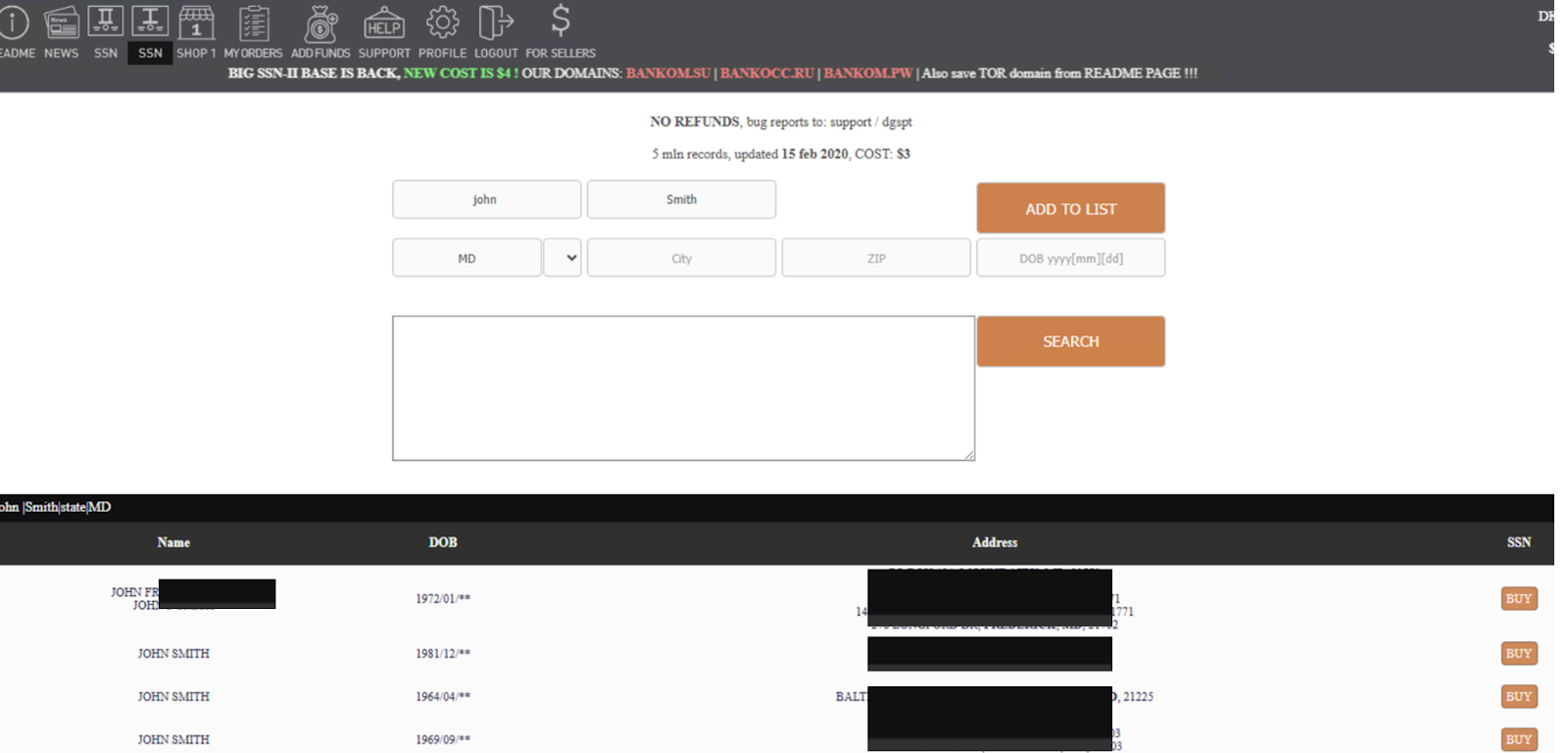
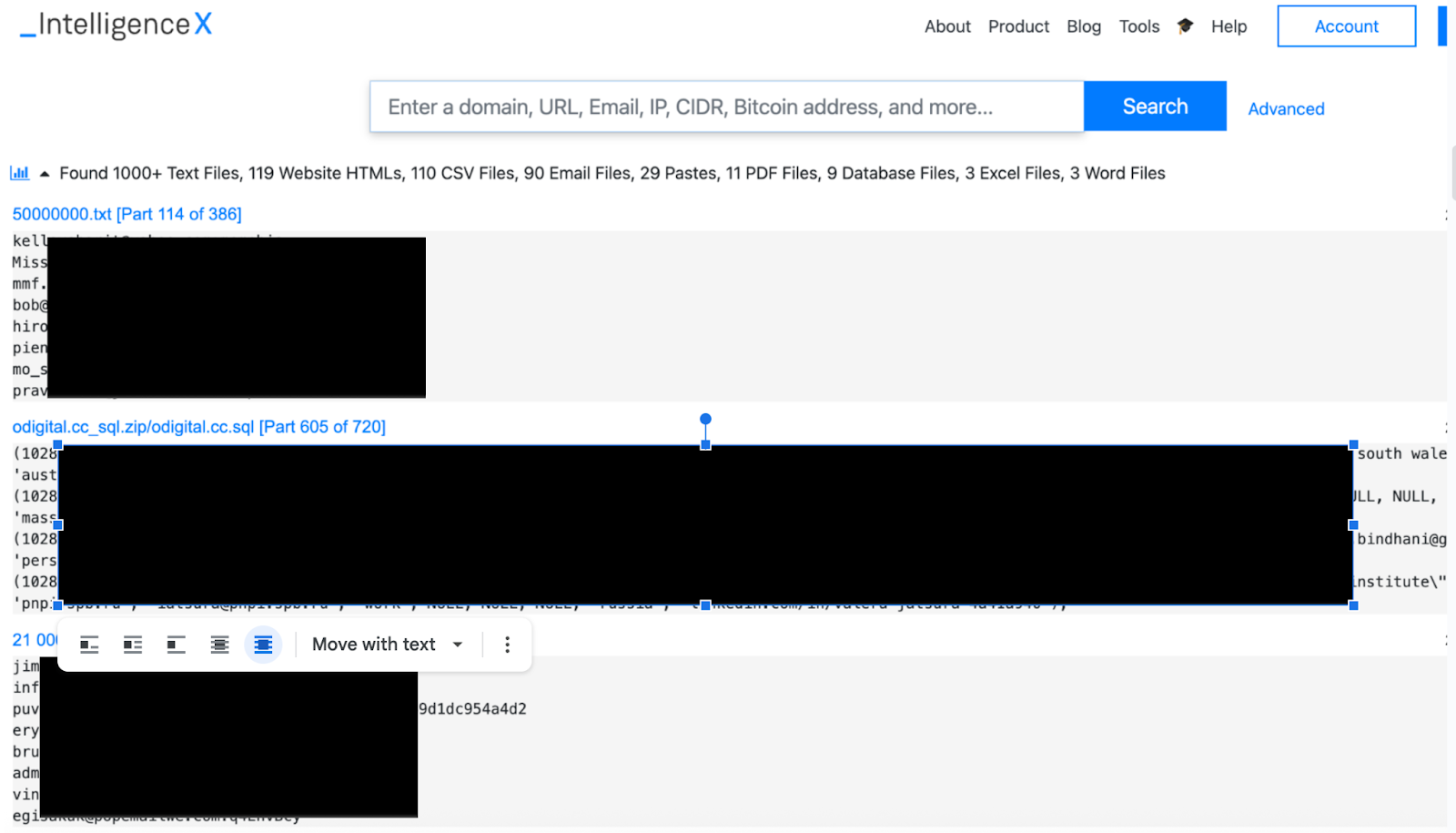
As seen in the following screenshots, vast amounts of historical information, credential leaks, personally identifiable information (PII) persist in exposed databases, as well as on dark web marketplaces and cybercrime forums.
⠀
Figure 1: A dark web marketplace offering US SSNs for sale.
⠀
Figure 2: A compromised database search engine exposes leaked credentials.
⠀
Figure 3: Multiple citizenship databases exposed on a cybercriminal forum
⠀
Threat actors increasingly leverage this layered digital footprint as a core component of their operational planning. While such exposure may not always constitute the initial access vector itself, it significantly influences attacker decision-making, targeting precision, and the likelihood of success.
Breach data and open-source intelligence are utilized to map organizational structures, identify privileged or high-value identities, correlate reused credentials, infer security controls, and tailor phishing or social engineering campaigns with high contextual credibility. In many cases, this intelligence determines which vulnerability, account, or trust relationship is exploited, rather than whether exploitable weaknesses exist. As a result, the boundary between “technical” and “human” attack vectors continues to erode. Infrastructure security remains necessary, but it is no longer sufficient in isolation. The effective attack surface now extends beyond networks and endpoints to encompass identity exposure, employee digital behavior, third-party data ecosystems, and long-lived data traces that persist outside traditional security tooling and governance models.
What is digital footprint exposure?
A digital footprint refers to all the information about an organization and/or an individual that is publicly, semi-publicly, or commercially available online. This information is often scattered across numerous platforms, but aggregating it enables the creation of detailed, actionable profiles of individuals and institutions.
Typical elements of a digital footprint include:
Corporate and personal email addresses
Passwords and authentication data leaked through breaches
Public social media profiles and historical activity
Personally Identifiable Information (e.g., name, SSN, phone number, email address).
Employment history, job titles, role descriptions, and annual reports
Online behavior, interests, affiliations, and routines
Metadata collected and sold by third-party data brokers
The acquisition of this data does not require hacking, system intrusion, or the deployment of malware. Instead, attackers collect, correlate, and exploit information that exists beyond the organization’s security perimeter, making it inherently unreachable by conventional security controls such as firewalls, EDR, or internal monitoring systems. Because these digital assets reside outside direct organizational ownership and technical control, they cannot be effectively protected by traditional defensive mechanisms. In this context, threat intelligence monitoring plays a critical role by providing visibility into external data exposure, tracking adversarial collection and misuse of such information, and enabling organizations to detect, assess, and respond to risks that would otherwise remain invisible to perimeter-based security architectures.
Digital footprint exposure: A growing security threat
The modern threat landscape no longer rewards attackers who are simply skilled at exploiting systems; it rewards those who are best at understanding people, relationships, and behavior. Publicly accessible data, semi-private platforms, and commercially available datasets collectively form a digital footprint that can be mapped, enriched, and weaponized well before any technical intrusion attempt. This exposure shifts the initial battleground away from firewalls and endpoints toward employees’ online presence and the organization’s external data shadow.
Organizations that continue to define their perimeter in terms of IP ranges, devices, or cloud assets are defending yesterday’s battlefield. In many cases, the first stage of compromise occurs months before an alert is raised, within public forums, social networks, breached datasets, and data broker platforms, entirely outside traditional security monitoring and response processes. Adversaries use this information to identify key personnel, ascertain internal structures, map trusted relationships, and assess security maturity without ever touching corporate infrastructure.
Attackers collect specific external data to identify valid users, authentication systems, and internal dependencies. They extract employee names, roles, and corporate email formats from LinkedIn, conference materials, and public breach datasets. They identify authentication portals, VPN gateways, and cloud services using passive DNS records, Certificate Transparency logs, and internet scanning platforms such as Shodan or Censys. Public GitHub repositories and technical documentation may reveal internal domain names, API endpoints, identity providers, and technology stacks.
These elements allow attackers to identify valid corporate accounts, target employees with privileged access, register impersonation domains that match internal naming conventions, and send phishing emails that reference real vendors, systems, or workflows. This preparation increases the likelihood of credential theft and unauthorized access because the attacker is targeting real users and real systems rather than relying on generic phishing or random scanning.
For employees, digital footprint exposure translates into personal risk that directly impacts corporate security. Leaked credentials, reused passwords, overshared professional information, or historical data breaches can be exploited to impersonate staff, coerce access, or establish credibility during pretexting operations. Senior leaders, IT staff, and individuals with privileged access are particularly vulnerable, as attackers can leverage publicly available information to craft convincing narratives that exploit trust and authority.
Uncontrolled exposure of employee information allows attackers to move from targeting individuals to compromising the organization. This enables them to identify employees with access to key systems, administrative privileges, or sensitive organizational platforms through public work profiles and data obtained from data breaches. They then test exposed credentials on corporate login portals, send phishing emails impersonating trusted internal or external entities, or attempt to intercept authentication codes by targeting exposed phone numbers. Once a single employee account is compromised, attackers can gain access to internal systems, escalate their privileges, and move laterally within the organization.
Threat actor exploitation of digital footprints
Threat actors, whether cybercriminal groups or state-sponsored operators, have always relied heavily on digital footprints in their operations. Publicly available information, leaked data, social media activity, and professional networks provide valuable insight into people, organizations, technologies, and trust relationships, making attacks more targeted and believable.
With the rise of AI-powered tools, this exploitation has intensified. What once required time-consuming manual research can now be automated, enriched, and scaled almost instantly. AI enables adversaries to turn fragmented online traces into compelling narratives, lures, and impersonations, significantly increasing the speed, precision, and overall impact of attack vectors driven by digital footprints.
Cybercriminals
Cybercriminals typically exploit online exposure to establish rapid, monetizable intrusion paths without requiring deep internal access. Public profiles, leaked credentials, exposed servers, misconfigured cloud resources, and operational metadata are aggregated to identify where access already exists or can be obtained with minimal resistance. The focus is on converting exposed data directly into usable access, validating it quickly, and either exploiting or reselling it.
Tactical attack vectors derived from exposed digital footprints include:
Leaked credential exploitation: Abuse of credentials harvested from data breaches, stealer logs, and infostealer marketplaces, correlated with corporate email domains to gain unauthorized access to VPNs, SSO portals, cloud consoles, SaaS platforms, and legacy authentication endpoints
Identity and account surface expansion: Leveraging open professional and social network profiles to enumerate valid usernames, email address formats, job roles, seniority levels, and likely privilege tiers, enabling targeted credential testing and account takeover attempts
Email signature and metadata harvesting: Exploitation of email signatures, contact blocks, and publicly shared correspondence to identify internal naming conventions, phone extensions, third-party services, and technology stack indicators useful for impersonation and lateral access
Document-driven reconnaissance: Mining publicly exposed or leaked company documents (policies, PDFs, presentations, contracts, org. charts, etc.) to infer internal systems, authentication workflows, directory structures, cloud providers, and security controls
Infrastructure targeting via exposure leakage: Identification and exploitation of externally exposed servers, admin panels, APIs, and management interfaces through search engines, passive DNS, certificate transparency logs, and open indexing platforms
Banner, certificate, and service fingerprinting: Abuse of SSL/TLS certificates, HTTP headers, API responses, and service banners to fingerprint software versions, cloud services, authentication mechanisms, and unpatched or end-of-life systems
Cloud asset exploitation: Targeting publicly exposed storage buckets, orphaned cloud tenants, misconfigured IAM roles, stale API keys, and secrets discovered via open repositories, leaked configuration files, or documentation artifacts
Access brokerage: Enabling the validation, packaging, and resale of footprint-derived access (credentials, VPN sessions, cloud console access, shells) within cybercriminal marketplaces, based on assessed business impact and network reach
Low-noise privilege escalation and lateral movement: Exploitation of weak segmentation, excessive trust relationships, and overexposed directory or identity services inferred from public documentation, leaked internal diagrams, or misconfigured federation endpoints
State-Sponsored Actors
State-sponsored actors treat exposed digital footprints as long-term intelligence and access-enabling infrastructure. Voluntarily shared information, institutional transparency, technical disclosures, and accidental leaks are fused to build high-fidelity models of people, systems, and dependencies. These actors exploit exposure selectively, prioritizing vectors that support persistent access, intelligence collection, and operational survivability.
Tactical attack vectors derived from exposed digital footprints include:
Identity and role mapping: Use of social networks, publications, and organizational disclosures to identify privileged users, trust relationships, and lateral movement paths
Credential and token reuse: Reuse of leaked credentials, API keys, and tokens over long periods to regain access without new exploits or tooling
Perimeter exploitation via transparency: Targeting of publicly documented architectures, exposed technologies, and known integration points
Exposed service exploitation: Compromise of internet-facing edge devices, management planes, update services, and CI/CD endpoints
Supply-chain leverage: Exploitation of disclosed vendors, SaaS platforms, and cloud dependencies as indirect access paths
Persistence through legacy exposure: Abuse of forgotten accounts, test systems, and undercommissioned services still reachable externally
Defensive evasion through disclosure awareness: Tailoring operations based on publicly revealed security controls, tooling, and incident history
Advice for reducing digital footprint risk
A structured technical approach is imperative to effectively reduce the risk of employees’ digital footprint exposure. It must aim to close identity security gaps, eliminate unknown external resources, and proactively monitor for leaks of sensitive data. First, organizations must strengthen their identity infrastructure by implementing phishing-resistant multi-factor authentication (MFA) for all privileged accounts and by integrating credential exposure monitoring directly at the identity provider (IdP) level to detect and block authentication attempts using compromised credentials.
In addition, external attack surface management (EASM) must be implemented to identify and remediate internet-exposed, unknown, overlooked, or misconfigured resources, including servers, API endpoints, and storage resources that could expose configuration or sensitive organizational data. Digital risk protection (DRP) programs must prioritize monitoring the personally identifiable information (PII) of executives and board members, privileged credentials, and sensitive intellectual property on dark web forums, data breach datasets, and social media platforms to detect and disrupt adversary reconnaissance and targeting activities in the early stages of an attack lifecycle.
To reduce the risk of credential exposure, organizations should also continuously monitor for leaked or compromised credentials associated with corporate domains, limit the public disclosure of internal technical information, implement strong authentication methods resistant to credential theft, and respond rapidly when exposed accounts or infrastructure are identified.
It is equally important to consider employees as an integral part of the extended security perimeter. Technical controls must remain the primary means of mitigation. Measures such as strict access restrictions, centralized logging and analysis, and automated detection and response mechanisms should form the core of the defense. At the same time, it is critical to raise employee awareness about how their personal online activities and digital presence can directly affect the organization’s security posture.
Organizations that implement these measures will see their digital footprint exposure transformed from a silent risk into a managed, measurable security domain, significantly reducing the likelihood of identity theft, targeted intrusions, and the leakage of critical intelligence.
Conclusion
Today’s threat actors are no longer limited to exploiting technical vulnerabilities; they increasingly weaponize digital footprints as a primary enabler of their operations. For organizations, this means the attack surface extends well beyond networks and endpoints to include all externally exposed information. Any data available online about systems, infrastructure, or employees can be collected, correlated, and exploited to support reconnaissance, targeting, and intrusion planning, often without generating a single security alert or triggering traditional detection mechanisms. As a result, organizations that actively identify, monitor, and manage their external assets and digital footprint are better positioned to detect exposure early, reduce opportunities for adversaries, and strengthen their overall security posture before threats materialize.
This scenario simultaneously tests identity confirmation tooling (SSPR, MFA, Conditional Access), how users act under pressure, and the organization's ability to detect and follow-up on social engineering attacks.
Social engineering is the manipulation of individuals into divulging confidential information, granting unauthorized access, or performing actions that benefit the attacker, all without the victim realizing they are being tricked.
GoPhish provides a nice platform for creating and running phishing campaigns. This blog will guide you through installing GoPhish and creating a campaign.
This article was originally published in the second edition of the InfoSec Survival Guide. Find it free online HERE or order your $1 physical copy on the Spearphish General Store. […]
This article originally featured in the very first issue of our PROMPT# zine — Choose Wisely. You can find that issue (and all the others) here: https://www.blackhillsinfosec.com/prompt-zine/ I remember a […]
Human Trust Most people associated with information technology roles understand the application of technical controls like the use of firewalls, encryption, and security products for defenses against digital threats. Proper […]
I previously blogged about spoofing Microsoft 365 using the direct send feature enabled by default when creating a business 365 Exchange Online instance (https://www.blackhillsinfosec.com/spoofing-microsoft-365-like-its-1995/). Using the direct send feature, it […]
rvrsh3ll // Introduction This blog post is intended to give a light overview of device codes, access tokens, and refresh tokens. Here, I focus on the technical how-to for standing […]
Hannah Cartier // Social engineering, especially phishing, is becoming increasingly prevalent in red team engagements as well as real-world attacks. As security awareness improves and systems become more locked down, […]
Beau Bullock & Mike Felch// Strategically targeting a corporation requires deep knowledge of their technologies and employees. Successfully compromising an organization can depend on the quality of reconnaissance a tester […]
Beau Bullock & Mike Felch// Strategically targeting a corporation requires deep knowledge of their technologies and employees. Successfully compromising an organization can depend on the quality of reconnaissance a tester […]

 Login
Login