Reading view

There are new articles available, click to refresh the page.

Former DigitalMint ransomware negotiator pleads guilty to extortion scheme

A South Florida man pleaded guilty to conspiring with multiple ransomware affiliates to commit attacks against and extort payments from the same U.S. companies he represented as a ransomware negotiator for DigitalMint in 2023, the Justice Department said Monday.

Angelo John Martino III shared confidential information about victim organizations’ internal negotiating positions and insurance policy limits he gained from his work as a ransomware negotiator to extract the maximum ransom payment for himself and other BlackCat affiliates, according to his plea agreement.

Five of Martino’s victims hired DigitalMint, which assigned the 41-year-old to conduct ransomware negotiations on their clients’ behalf — a rare position he exploited to play both sides. DigitalMint, which is not accused of any knowledge or involvement in the crimes, fired Martino the day after the Justice Department informed the company they were investigating him in April 2025. 

The five U.S.-based victims that hired DigitalMint and unwittingly tapped Martino to allegedly conduct ransomware negotiations with himself and his co-conspirators include a nonprofit and companies in the hospitality, financial services, retail and medical industries. All five of those victims paid a ransom.

Prosecutors previously said Martino helped accomplices extort a combined $75.3 million in ransom payments, including a nearly $26.8 million payment from the unnamed nonprofit, and a nearly $25.7 million payment from the unnamed financial services company. 

Martino also admitted to conspiring with Kevin Tyler Martin, another former ransomware negotiator at DigitalMint, and Ryan Clifford Goldberg, a former manager of incident response at Sygnia, to deploy BlackCat ransomware, also known as ALPHV, against five additional U.S. companies between April and November 2023. 

Goldberg and Martin pleaded guilty in December to participating in a series of ransomware attacks and are scheduled for sentencing April 30.

“Angelo Martino’s clients trusted him to respond to ransomware threats and help thwart and remedy them on behalf of victims,” A. Tysen Duva, assistant attorney general at the Justice Department’s Criminal Division, said in a statement. “Instead, he betrayed them and began launching ransomware attacks himself by assisting cybercriminals and harming victims, his own employer, and the cyber incident response industry itself.”

The case against Martino showcases an extreme, albeit rare, example of the dark underbelly of ransomware negotiation as a practice. The pitfalls of ransomware negotiation are excessive and these backchannel negotiations, which remain largely unscrutinized, can go awry for various reasons. 

Officials shared a series of chats Martino held with co-conspirators and his victims that exemplify the lengths he went to betray DigitalMint’s clients and empower his accomplices with crucial tips for a successful negotiation strategy.

DigitalMint did not respond to a request for comment on Martino’s guilty plea.

Negotiation chats exemplify Martino’s crimes

During an incident response with one of his victims, Martino told a BlackCat affiliate the company’s insurance carrier “was only approving small accounts,” according to his plea agreement. “Keep denying our offers and I will let you know once I find out the max the[y] want to pay,” he added.

“We don’t know how you came up with your demand but we are losing money operationally and all of our loans are going to turnover on us this year at double the interest rates,” Martino said in a negotiation chat visible to DigitalMint and the victim organization in the hospitality industry. “We are able to give you $1 million now, which is a very serious offer.”

Following Martino’s instructions, the BlackCat accomplice responded: “Well, you can keep that for the penalties and lawsuits which are coming your way in case we expose you. Time is ticking — we know how much you can pay. Contact your insurance. We know about them also. Stop wasting time.”

That victim company ultimately paid a ransom worth nearly $16.5 million at the time to receive a decryptor and the BlackCat affiliate’s commitment to not publish stolen data. The two other victims Martino represented via DigitalMint at the time paid $6.1 million and $213,000 ransoms for similar commitments.

“Ransomware victims turned to this defendant for help, and he sold them out from the inside,” Jason A. Reding Quiñones, U.S. attorney for the Southern District of Florida, said in a statement.

Martino received a portion of the ransomware payments for his involvement in the conspiracy.

Authorities have seized $10 million in assets and cryptocurrency wallets controlled by Martino. Law enforcement seized multiple vehicles, a food truck and a 29-foot luxury fishing boat that he obtained using proceeds from his crimes.

Officials also seized two properties owned by Martino in Nokomis, Florida, including a bayfront home with an estimated value of $1.68 million and a second single-family home with an estimated value of $396,000. 

Martino surrendered in March to the U.S. Marshals in Miami and was released on a $500,000 bond.

“The FBI works every day to dismantle the ransomware ecosystem,” Brett Leatherman, assistant director of the FBI’s Cyber Division, said in a statement. “That includes apprehending key facilitators like Angelo Martino, who abused the trust placed in him as a private sector negotiator by collaborating with ransomware criminals.”

ALPHV/BlackCat was a notorious ransomware and extortion group linked to a series of attacks on critical infrastructure providers. The ransomware variant first appeared in late 2021, and was later used in dozens of attacks on organizations in the health care sector.

The group behind the ransomware strain also claimed responsibility for the February 2024 attack on UnitedHealth Group subsidiary Change Healthcare, which paid a $22 million ransom and became the largest health care data breach on record, compromising data on about 190 million people.

Martino pleaded guilty to conspiracy to obstruct, delay or affect commerce or the movement of any article or commodity in commerce by extortion. He faces up to 20 years in federal prison and is scheduled for sentencing July 9.

You can read Martino’s plea agreement below.

The post Former DigitalMint ransomware negotiator pleads guilty to extortion scheme appeared first on CyberScoop.

OpenAI’s Mac apps need updates thanks to the Axios hack

OpenAI updated its security certificates and is requiring all macOS users to update to the latest versions after determining its products, along with many others, were impacted by a widespread supply-chain attack that briefly infected a popular open-source library in late March, the company said in a blog post Friday.

The artificial intelligence vendor said it “found no evidence that OpenAI user data was accessed, that our systems or intellectual property was compromised, or that our software was altered.”

Yet, because a GitHub workflow the company uses to sign certificates for macOS applications downloaded and executed a malicious version of Axios, the company is treating the soon-to-be defunct certificate as compromised.

A North Korean hacking group injected malware into two versions of Axios after it compromised the lead maintainer’s computer via social engineering and took over his npm and GitHub accounts. Jason Saayman, the lead maintainer for Axios, said the malicious versions of the software were live for about three hours before removal. 

Google Threat Intelligence Group, which tracks the threat group as UNC1069, said the impact of the attack was broad with ripple effects potentially exposing other popular packages. The JavaScript libraries flow into dependent downstream software through more than 100 million and 83 million downloads weekly. 

The attack was discovered just weeks after a series of other open-source tools, including Trivy, were compromised by UNC6780, also known as TeamPCP, resulting in aggressive extortion attempts. 

OpenAI insists the malware that infected Axios did not directly impact its certificate, which is designed to help customers confirm they are downloading legitimate software. 

“The signing certificate present in this workflow was likely not successfully exfiltrated by the malicious payload due to the timing of the payload execution, certificate injection into the job, sequencing of the job itself, and other mitigating factors,” the company said in the blog post. “Nevertheless, out of an abundance of caution we are treating the certificate as compromised, and are revoking and rotating it.”

Older versions of OpenAI’s macOS apps may lose functionality and will no longer be supported when the certificate is fully revoked May 8, the company said.

OpenAI, which hired a third-party digital forensics and incident response firm to aid its investigation and response, pinned the root cause of the security issue on a misconfiguration in its GitHub workflow. The company said it corrected that error and worked with Apple to ensure fraudulent apps posing as OpenAI cannot use the impacted certificate.

The 30-day window is designed to minimize disruption for users, but OpenAI said it will speed up the revocation deadline if it identifies any malicious activity. The company did not immediately respond to a request for comment.

The post OpenAI’s Mac apps need updates thanks to the Axios hack appeared first on CyberScoop.

Justice Department disrupts botnet networks that hijacked 3 million devices

Authorities seized infrastructure powering four botnets that hijacked a combined three million devices and launched more than 300,000 DDoS attacks collectively, the Justice Department said Thursday.

The botnets — Aisuru, Kimwolf, JackSkid and Mossad — enabled operators to sell access to the infected devices for various cybercrimes. The aftermath spanned thousands of attacks, including some demanding extortion payments from victims, officials said.

The globally coordinated operation, aided by law enforcement actions targeting the botnets’ operators in Canada and Germany, disrupted the command-and-control infrastructure for all four botnets. Two of the botnets set records before the takedown, attracting widespread attention from security researchers and vendors.

The Kimwolf botnet, an Android variant of Aisuru, spread like wildfire after its operators figured out how to abuse residential-proxy networks for local control, according to Sythient. It eventually took over more than 2 million Android TV devices by January. In September, just as Kimwolf was forming, Cloudflare clocked the Aisuru botnet hitting a record-breaking 29.7 terabits-per-second DDoS attack that lasted 69 seconds.

Officials ultimately attributed roughly 200,000 DDoS attacks to Aisuru, 90,000 to JackSkid, 25,000 to Kimwolf and about 1,000 DDoS attack commands to the Mossad botnet. Yet, DDoS attacks from financially-motivated attackers are typically a distraction or misdirection.

“Oftentimes a DDoS attack is just advertising for the size of an operator’s botnet,” Zach Edwards, staff threat researcher at Infoblox, told CyberScoop. Botnet operators cash out by renting these controlled devices to cybercriminals for account abuse, password reset attacks, ad fraud schemes and residential proxy nodes, he added.

Devices infected by the four botnets include digital video recorders, web cameras, Wi-Fi routers and TV boxes. Hundreds of thousands of these devices are located in the United States, federal prosecutors said. 

Authorities did not name the people involved or formally announce any arrests. Yet, they describe the operation in nearly conclusive terms, claiming the action disrupted the botnets’ communications infrastructure — domains, virtual servers and other systems — to prevent further infection and limit or eliminate the botnets’ ability to launch future attacks.

“Cybercriminals infiltrate infrastructure beyond physical borders and Defense Criminal Investigative Service participates in international operations to help safeguard the Department’s global footprint,” Kenneth DeChellis, special agent in charge at the Defense Department’s DCIS cyber field office, said in a statement. Some of the DDoS attacks attributed to these botnets reached IP’s owned by the Department of Defense Information Network.

Botnets often compete for devices to infect and opportunities to scale. As Kimwolf spread and hit those objectives, it captured sweeping interest from researchers, authorities and vendors in a position to help stop it. 

Kimwolf was the largest DDoS botnet ever detected, according to Tom Scholl, vice president at Amazon Web Services, which assisted the operation. “The scale of this botnet is staggering,” he said in a LinkedIn post

“Kimwolf represented a fundamental shift in how botnets operate and scale,” Scholl added. “Unlike traditional botnets that scan the open internet for vulnerable devices, Kimwolf exploited a novel attack vector: residential proxy networks.”

Under this mechanism, any organization with vulnerable devices connected to the internet could unwittingly have those devices turned into a node for a botnet or a foothold for a targeted attack.

“This isn’t just some problem that your cousin has because he bought some cheap TV box that promised him free TV channels,” Edwards said. Infoblox previously said nearly 25% of customers had at least one endpoint device in a residential proxy service targeted by Kimwolf.

While it’s intellectually interesting whenever a botnet scales to extraordinary size, it’s also a “sad reminder that oftentimes security takes a back seat to convenience and cost,” Edwards said. 

“The botnets are growing because more and more people are buying weird internet-connected stuff,” he added. “Nothing in this world is free.”

The takedowns mark a continuation of a consistent, ongoing crackdown targeting large-scale botnets, cybercrime marketplaces, malware, infostealers and other cybercrime tools. Some of the malicious networks hampered or rendered nonoperational by disruptions and arrests during the past year include: DanaBot, Rapper Bot, Lumma Stealer, AVCheck and SocksEscort.

More than 20 companies and organizations assisted with the coordinated disruption, including law enforcement from the Netherlands and Europol. Efforts to stop botnets will continue as these malicious networks proliferate in new places and new ways. 

“We’re living in a device-compromise–DDOS-botnet-merry-go-round and while many of us wish something could slow it down, the challenges continue to grow,” Edwards said. “This is still a bad day for serious threat actors, and any day like that is something we should all celebrate.”

The post Justice Department disrupts botnet networks that hijacked 3 million devices appeared first on CyberScoop.

Cisco’s latest vulnerability spree has a more troubling pattern underneath

Cisco customers have confronted a flood of actively exploited vulnerabilities affecting the vendor’s network edge software since late February, and researchers say that five of the nine vulnerabilities Cisco disclosed in its firewalls and SD-WAN systems over the past three weeks have already been exploited in the wild. 

Attackers exploited a pair of these defects — zero-day vulnerabilities in Cisco SD-WANs — for at least three years before the vendor and authorities discovered and issued warnings about the threat. Cisco disclosed an additional five SD-WAN vulnerabilities that same day, and three of those defects have since been confirmed actively exploited as well.

Weaknesses lurking in Cisco security products don’t end there. Amazon Threat Intelligence on Wednesday said one of the two max-severity defects Cisco reported in its firewall management software earlier this month has been actively exploited by Interlock ransomware since Jan. 26, more than a month before those vulnerabilities were publicly disclosed.

Some organizations, officials and members of the security community at large have missed widening risks as more of the defects come under attack. The flurry of Cisco SD-WAN and firewall vulnerabilities includes defects with low CVSS ratings, zero-days and others that were determined actively exploited after disclosure.

“These are not random bugs in low-value software. These are management-plane and control-plane weaknesses in devices at the network edge, which often function as trust anchors in enterprise environments,” Douglas McKee, director of vulnerability intelligence at Rapid7, told CyberScoop.

“If you compromise SD-WAN or firewall management, you’re landing on policy, visibility, routing, segmentation, and, in many cases, administrative trust over a large swath of the environment,” he added. “Attackers know that and, when they find a pre-auth path into those systems, especially one that can be chained to root, that’s about as attractive as it gets.”

The full slate of recently disclosed Cisco vulnerabilities affecting these systems include:

Researchers from multiple firms and Cisco have observed or been notified of active exploitation of CVE-2026-20127, CVE-2022-20775, CVE-2026-20122, CVE-2026-20128 and CVE-2026-20131.

The Cybersecurity and Infrastructure Security Agency has only added two of the defects — CVE-2022-20775 and CVE-2026-20127 — to its known exploited vulnerabilities catalog thus far. The agency, which last week added new hunting and reporting requirements to an emergency directive it issued for the defects in late February, did not answer questions about the updated order or explain why other actively exploited Cisco vulnerabilities haven’t been added to the catalog. The agency has been operating under a funding shutdown since February.

Interlock ransomware hits Cisco firewalls

The ongoing ransomware campaign Amazon Threat Intelligence spotted involving CVE-2026-20131 confirmed “Interlock had a zero-day in their hands, giving them a week’s head start to compromise organizations before defenders even knew to look,” researchers said Wednesday.

Interlock’s observed attack path and operations are extensive, including post-compromise reconnaissance scripts, custom remote access trojans, a webshell and legitimate tool abuse. Amazon did not identify specific victims, and said the group threatens organizations with data encryption, regulatory fines and compliance valuations.

“Interlock has historically targeted specific sectors where operational disruption creates maximum pressure for payment,” Amazon Threat Intelligence researchers said in the blog post. These sectors include education, engineering, architecture, construction, manufacturing, industrial, health care and government entities. 

4 Cisco SD-WAN defects under attack

The swarm of vulnerabilities in Cisco SD-WANs poses additional risk for customers. Cisco Talos previously attributed long-running attacks involving CVE-2026-20127 and CVE-2022-20775 to UAT-8616, but it’s unclear if the same threat group is responsible for all of the Cisco SD-WAN exploits. 

“Other threat groups are likely to pick up public research in order to weaponize or adapt it opportunistically, so we may see follow-on attempts by additional threat actors, including low-skilled attackers,” Caitlin Condon, vice president of security research at VulnCheck, told CyberScoop.

Researchers said vulnerabilities are often disclosed in clusters after a meaningful defect is identified in a specific product, such as Cisco’s SD-WAN systems.

Cisco declined to answer questions and said customers can find the latest information on its security advisories page.

Condon and McKee both noted that Cisco has been responsive in releasing software fixes, threat-hunting intelligence and, in the case of the SD-WAN zero-days, coordinated government guidance. 

“This is what a good crisis response is supposed to look like once exploitation is identified,” McKee said. 

“The harder question is whether the industry is getting early-enough visibility into the defects in edge-management software that sophisticated actors are clearly prioritizing,” he added. “Are our organizations equipped with the right people and tools to perform this level of exposure management?”

The expanding exploits Cisco customers are combating on firewalls and SD-WANs is a reminder that organizations shouldn’t deprioritize less notorious vulnerabilities or those with lower CVSS scores, Condon said. 

“Several of the exploited vulnerabilities in this tranche of Cisco SD-WAN bugs don’t have critical CVSS scores, meaning teams using CVSS as a prioritization mechanism might miss medium- or high-scored flaws that still have real-world adversary utility,” she added.

The attacks also collectively reflect a persistent pattern of attackers targeting network edge systems from multiple vendors, including Cisco.

“Attackers continue to treat network edge and management infrastructure as prime real estate, and when defenders see pre-authentication, management-plane flaws with evidence of pre-disclosure exploitation, they need to assume compromise, not just exposure,” McKee said. 

“Attackers are investing time and capability into finding and operationalizing previously unknown defects in Cisco edge and management infrastructure because the payoff is enormous,” he added. “These platforms give you a privileged position, broad visibility, and a path to durable access inside high-value organizations. That’s exactly why they keep getting hit.”

The post Cisco’s latest vulnerability spree has a more troubling pattern underneath appeared first on CyberScoop.

Zero lessons learned: Convicted scammer allegedly ran another athlete-focused phishing scam from federal prison

Professional NBA and NFL athletes were allegedly deceived and victimized by a 34-year-old Georgia man’s sneaky social-engineering scheme that he ran while impersonating a well-known adult film star, the Justice Department said Monday.

Kwamaine Jerell Ford allegedly initiated and committed some of the crimes while incarcerated in federal prison for a similar, widespread phishing scam that also targeted college and professional athletes and musical artists starting in 2015. 

“While serving time for stealing credit card numbers from athletes and celebrities to fund his lifestyle, Ford allegedly engaged in the same conduct again,” Theodore S. Hertzberg, U.S. attorney for the Northern District of Georgia, said in a statement.

The alleged repeat offender, while adopting the persona of an adult film model, tricked professional athletes into providing him their iCloud login credentials and multifactor authentication codes for those accounts to steal financial and personally identifiable information to pay for personal expenses.

Ford is accused of executing more than 2,000 unauthorized transactions on professional athletes’ debit and credit cards from November 2020 to September 2024, according to an unsealed indictment. He was in federal custody for the first 14 months of the conspiracy and released on probation for prior crimes in January 2022.

Prosecutors did not name victims, divulge how many athletes Ford allegedly victimized during his latest scheme, or how much money he obtained through the conspiracy. 

He pleaded not guilty Friday to 22 charges for crimes including wire fraud, obtaining information by computer from a protected computer, access device fraud, aggravated identity theft and sex trafficking. Ford is being held without bail pending a trial. 

Using the adult film model’s identity, Ford allegedly enticed his high-profile victims to communicate with him on social media by falsely claiming he would send them adult film content through iCloud.

When a professional athlete responded, Ford allegedly sent phishing messages to the victim designed to look like legitimate Apple customer service text messages. Officials said Ford spoofed legitimate Apple customer service accounts and posed as an Apple customer support representative to request victims’ login details via text messages.

Prosecutors said Ford told his victims the messages contained a video file shared through an iCloud link that required them to reply with an MFA code. Ford allegedly attempted to access his victims’ iCloud accounts at the same time, triggering an MFA code delivery to the victim’s device.

Professional athletes who provided their iCloud MFA codes to Ford were ultimately tricked into giving him complete access to their iCloud accounts, officials said. Ford allegedly used that access to steal sensitive data, driver’s licenses and credit card information that he used for personal spending.

Ford also, while impersonating the adult film star, allegedly victimized an OnlyFans model by claiming he would advance their career. Prosecutors said Ford enticed the OnlyFans model to engage in and record commercial sex acts with professional athletes without their consent. 

“Ford clearly did not learn from his prior conviction for a similar scheme. This time, he allegedly escalated his criminal activity — stealing identities and money while also moving into coercion and sex trafficking,” Peter Ellis, acting special agent in charge at the FBI Atlanta office, said in a statement. 

Ford allegedly advertised the victim to targeted athletes, coordinated their travel to coincide with athletes’ known locations, and negotiated payments from the athletes for sex with the victim. Prosecutors said Ford took a financial cut from those commercial sex acts, many of which the victim was coerced into filming without the athletes’ knowledge. 

Ford is also accused of using these videos from the OnlyFans model to engage with additional athletes under false pretenses. When the OnlyFans model resisted filming the sex acts, Ford allegedly coerced them to send him money in lieu of the videos.

In 2019, Ford was sentenced to three years in prison and ordered to pay restitution of almost $700,000 after he pleaded guilty to computer fraud and aggravated identity theft. That scheme, which also ran for about four years, allowed Ford to hack into more than 100 Apple accounts belonging to high-profile professional athletes and rappers. 

Ford was still in prison for those crimes when he allegedly established a new scheme targeting similar victims on some of the same technology platforms.

You can read the indictment below.

The post Zero lessons learned: Convicted scammer allegedly ran another athlete-focused phishing scam from federal prison appeared first on CyberScoop.

Introducing Hacktics and Telemetry, a Podcast from Rapid7 Labs

If you spend your days building, shipping, defending, or fixing systems, you already know how this goes. A new technique shows up in a research thread, someone drops a “has anyone checked if we’re exposed?” comment, and suddenly you’re juggling risk, patches, logging gaps, and whatever tool is in the blast radius this week.

That day-to-day reality is why Rapid7 Labs is launching Hacktics and Telemetry, a bi-weekly video and audio podcast with episodes built to fit into a lunch break or a commute. It’s hosted by Rapid7's Douglas McKee, bringing to the pod years of deep technical and leadership experience, then co-hosted by Jonah ‘CryptoCat’ Burgess – a strong researcher with a solid pulse on the cybersecurity community.

The format stays consistent on purpose. Each episode starts with a scan of what’s emerging, shifts into a guest conversation, then closes with a short segment that ties the story back to mitigation and tooling. The goal is simple: move past theory, show what’s happening with real examples, and leave you with something you can act on.

Episode 1: OpenClaw Risks, RCEs, and Metasploit Pro Updates

Doug and Jonah open by digging into two AI-centric stories from the past week. The first is PhoneLeak, described as data exfiltration in Gemini via phone call. It’s the kind of uncomfortable example that forces practical questions: how do you defend against mobile clickjacking when it's disguised as a routine CAPTCHA? When an AI assistant has deep extensions into a user's workspace, how do you prevent malicious prompts from quietly accessing sensitive data like 2FA codes? And perhaps most importantly, how do defenders anticipate and monitor for bizarre, out-of-the-box exfiltration methods—like an AI bypassing SMS confirmations to leak data via DTMF tones on a phone call?

The second story comes from the other side of the AI conversation: an AI agent reportedly identifying an RCE in BeyondTrust remote support, plus discussion of older privileged remote access versions. More automation can mean faster discovery, which shrinks the window between “interesting finding” and “you need to patch this.” That changes how defenders think about exposure, patch prioritization, and what “good enough” means (and looks like) when it comes to monitoring.

In the guest segment, Greg Richardson (Global Advisory CISO & AI Thought Leader, 6 Levers AI) walks through how he uses AI agents in his workflow while keeping control tight. He talks about setting tasks while he sleeps, but the constraints are the point: access is locked down, the agent only touches files he explicitly provides, communication is limited, and token limits help cap the size of any mistake. He also makes a strong case for starting small, with one task at a time, instead of trying to automate dozens of things on day one.

To close out this inaugural episode, the team hits on a SolarWinds Help Desk vulnerability, then shares a quick look at Metasploit Pro 5.0 updates – including more granular payload selection and a walkthrough of the new UI.

If your idea of useful content includes threat trade-offs, concrete mitigations, and a bit of candid “how this actually plays out,” you’re in the right place.

Catch the full episode below:

Iran’s Cyber Playbook in the Escalating Regional Conflict

Following our recent published advisories, this publication is intended to outline a summary of the cyber activities associated with the tension. Based on the available information, we believe the conflict is beginning to show signs of expanding beyond a strictly regional crisis. Initial threat reporting pointed to a measurable increase in cyber activity linked to the crisis predominantly focused on hacktivist mobilization, with reports of phishing campaigns, and claims of data theft and disruptive operations. For a companion piece focused around our customers, dive into Rapid7 Detection Coverage for Iran-Linked Cyber Activity.

Cyber activity by groups associated with Iran and their affiliated ecosystems have begun to surface. Much of the visible activity currently appears to have limited immediate operational impact as it consists primarily of website defacements, distributed denial-of-service (DDoS) attacks, coordinated messaging campaigns, phishing attempts, and reconnaissance against exposed digital infrastructure. While these incidents may appear opportunistic or symbolic, historical patterns of such behavior suggest that this activity can represent early-stage signaling, pressure, and preparatory shaping operations rather than isolated disruption.

Iran’s cyber ecosystem operates through a layered structure that includes state-linked advanced persistent threat (APT) groups, proxy actors, hacktivist personas, and sympathetic foreign collectives. Even when not centrally coordinated, these actors often converge on the same narratives and target sets during geopolitical crises, enabling simultaneous visible disruption and covert intelligence-driven intrusion activity. As the conflict evolves, this ecosystem provides a scalable and deniable tool for retaliation that can gradually intensify.

It is very likely that the cyber risk will widen accordingly as the current conflict continues. Governments and organizations located in regions hosting U.S. military infrastructure or closely aligned with U.S. and Israeli positions may face increased exposure, particularly across sectors such as logistics, critical infrastructure, public administration, energy, and telecommunications.

Strategic context and operational trends

Iran does not operate according to a single publicly articulated cyberwarfare doctrine. Instead, its cyber strategy has evolved pragmatically as part of the country’s broader asymmetric security model. Since 2010, there has been an expansion of its cyber capabilities as instruments for intelligence gathering, internal control, retaliation, coercive messaging, and regional influence. Cyber operations are therefore best understood not as a separate military domain with a fully transparent doctrine, but as an adaptable component of the regime’s survival and strategic competition against outsiders.

Broadly speaking, Iranian cyber activity tends to serve three overlapping strategic objectives. The first is regime security and domestic control, in which cyber tools support surveillance, information control, and disruption of dissident or opposition networks. The second is strategic intelligence collection, in which state-linked actors target governments, defense organizations, technology providers, telecommunications firms, and critical infrastructure to gather political, military, and economic intelligence. The third is coercive signaling and regional influence, in which cyber operations impose costs on adversaries, shape perceptions, and demonstrate retaliatory capability while remaining below the threshold of overt interstate war.

A key feature of this regime’s approach is the development of long-term access. Iranian APT groups often conduct sustained intrusion campaigns focused not only on immediate collection but also on access persistence, credential harvesting, and network familiarity. In a crisis environment, these pre-existing footholds can become strategically important, supporting either intelligence collection or later disruptive operations. This is one reason current low-visibility intrusions deserve as much analytical attention as public hacktivist claims. The visible DDoS or defacement campaign may dominate headlines, but the more significant strategic risk often lies in covert access established inside other targets. 

Another defining feature of Iran’s cyber strategy is its layered operational model. State-linked APT groups frequently operate alongside contractors, proxies, persona-driven influence actors, and hacktivist collectives. This structure offers several advantages: it creates deniability, increases operational tempo; broadens the range of possible targets; and allows Iran-aligned ecosystems to combine disruptive spectacle with intelligence-driven depth. During periods of heightened tension, this blended model enables visible pressure operations to coexist with quieter espionage or pre-positioning campaigns. Current reporting on the conflict strongly supports this interpretation, with activist and proxy campaigns surging in parallel to concern over state-linked phishing, malware, wipers, and infrastructure-focused targeting.

Iran’s threat actor landscape

State sponsored 

Iran’s cyber capabilities are distributed across a hybrid ecosystem of state institutions, intelligence services, military structures, and semi-official operators. Rather than relying on a single centralized cyber command, Tehran appears to allocate responsibilities across different organs, primarily the Islamic Revolutionary Guard Corps and the Ministry of Intelligence and Security, with support from contractors, front entities, and affiliated personas. Strategic coordination of the cyber domain is overseen by the Supreme Council of Cyberspace, while operational activities are carried out through a mix of official and semi-official channels.

IRGC-linked actors

The Islamic Revolution Guard Corp (IRGC) maintains one of Iran’s most visible offensive cyber capabilities and has been associated with cyber espionage, influence operations, credential theft, and politically aligned disruptive activity. Among the principal IRGC-linked actors are APT35 (also known as Charming Kitten or Mint Sandstorm), which has long conducted spear-phishing and credential-harvesting operations against diplomats, journalists, researchers, and policy communities; APT42 is an actor particularly associated with surveillance and social engineering targeting dissidents, activists, journalists, and policy experts. Cotton Sandstorm (also known as Holy Souls and Emennet Pasargad), meanwhile, has been linked to both espionage and influence-oriented operations targeting regional adversaries and Western institutions. Recent reporting also highlights continued concern around malware associated with this broader actor set, including infostealing and espionage tooling used in phishing-led operations.

MOIS-linked actors

The Ministry of Intelligence and Security (MOIS) operates parallel cyber capabilities that tend to emphasize intelligence collection, long-term access, and strategic espionage. The most prominent groups in this cluster include MuddyWater and OilRig (also known as APT34). CISA has previously described MuddyWater as an Iranian government-sponsored actor conducting cyber espionage and malicious cyber operations across multiple sectors, while current reporting continues to place the group among the most operationally relevant Iranian state-linked threats in the present crisis environment. OilRig remains a longstanding espionage actor focused on governments, financial institutions, energy entities, and other strategic organizations.

These actors illustrate Iran’s distributed cyber-operational model: Intelligence-driven access development, influence, psychological pressure, and opportunistic disruptive action are not separate lines of effort but parts of a broader strategic continuum.

Parallel hacktivist and proxies

Beginning in June 2025, a noticeable surge in hacktivist and proxy cyber activity accompanied the broader escalation of tensions in the Middle East. This reflects a recurring pattern observed during previous geopolitical crises, in which ideologically aligned non-state cyber actors mobilize alongside, or in parallel with, state-linked cyber operations. In the current confrontation, this dynamic has again expanded the cyber landscape beyond traditional state-directed espionage or sabotage.

By early March 2026, several dozen hacktivists or proxy collectives emerged related to the conflict. These groups vary significantly in capability and reliability. Some focus on distributed denial-of-service (DDoS) attacks, while others conduct website defacements or hack-and-leak campaigns. Some primarily amplify claims of compromise that are exaggerated or only partially verifiable. Their significance, therefore, lies less in technical sophistication than in the cumulative pressure they place on defenders and the broader information environment.

In crisis situations, this activity can produce strategic effects. Numerous low-impact incidents can consume defensive resources, complicate attribution, and obscure more sophisticated intrusions occurring simultaneously. Hacktivist campaigns may therefore function as distractions, signals, or psychological pressure while more capable actors pursue quieter access to high-value networks. For this reason, the analytical distinction between advanced persistent threat (APT) activity and hacktivism can become blurred during periods of geopolitical confrontation.

Several collectives active in the current environment publicly position themselves as ideologically aligned with Iran or with members of the so-called “Axis of Resistance.” Among the more visible groups are Handala Hack Team, Dienet, FAD Team, APT IRAN, Cyber Islamic Resistance, and Fatimion cyber team. These actors frequently frame their operations as retaliatory cyber campaigns targeting Israeli, Western, or allied regional entities, claiming responsibility for activities such as website defacements, DDoS attacks, and hack-and-leak operations targeting mainly government, telecommunications, energy, and financial entities. Although many claims remain difficult to verify independently, their messaging strategy often emphasizes their psychological and reputational impact.

In parallel, several pro-Russia hacktivist groups have also engaged in operations linked to the confrontation, including NoName057(16), Sever Killer, and Russian Legion. These groups typically conduct large-scale DDoS campaigns targeting government portals, financial services, and transportation or telecommunications infrastructure in states perceived as supporting Israel or broader Western policy positions. Their participation illustrates how regional conflicts can attract cyber actors from outside the immediate theater when ideological alignment or strategic narratives converge.

Cyber activities linked to the ongoing conflict

Iranian APT group operations 

Beyond the highly visible hacktivist activity circulating on social media, defacement platforms, and Telegram channels, a quieter but more strategically significant layer of cyber operations is unfolding through Iranian state-linked APT groups. These operations appear ongoing and aligned with broader geopolitical objectives tied to the current conflict environment.

Recent threat reporting indicates continued operations by the Iranian APT group, MuddyWater, which is widely assessed to be linked to MOIS. Since at least early February 2026, reporting has suggested potential compromises or attempted intrusions targeting organizations associated with the United States and allied interests. 

According to public reporting, activity linked to the group was reportedly observed within the networks of a United States–based bank, a United States airport, a nonprofit organization operating across the United States and Canada, and a software company with operations in Israel. In several of these incidents, threat actors reportedly deployed a previously undocumented backdoor known as Dindoor, suggesting a coordinated, ongoing campaign rather than isolated compromise events.

Hacktivist and proxy disruption activities

The most visible form of cyber activity so far remains hacktivist and proxy-led disruption.

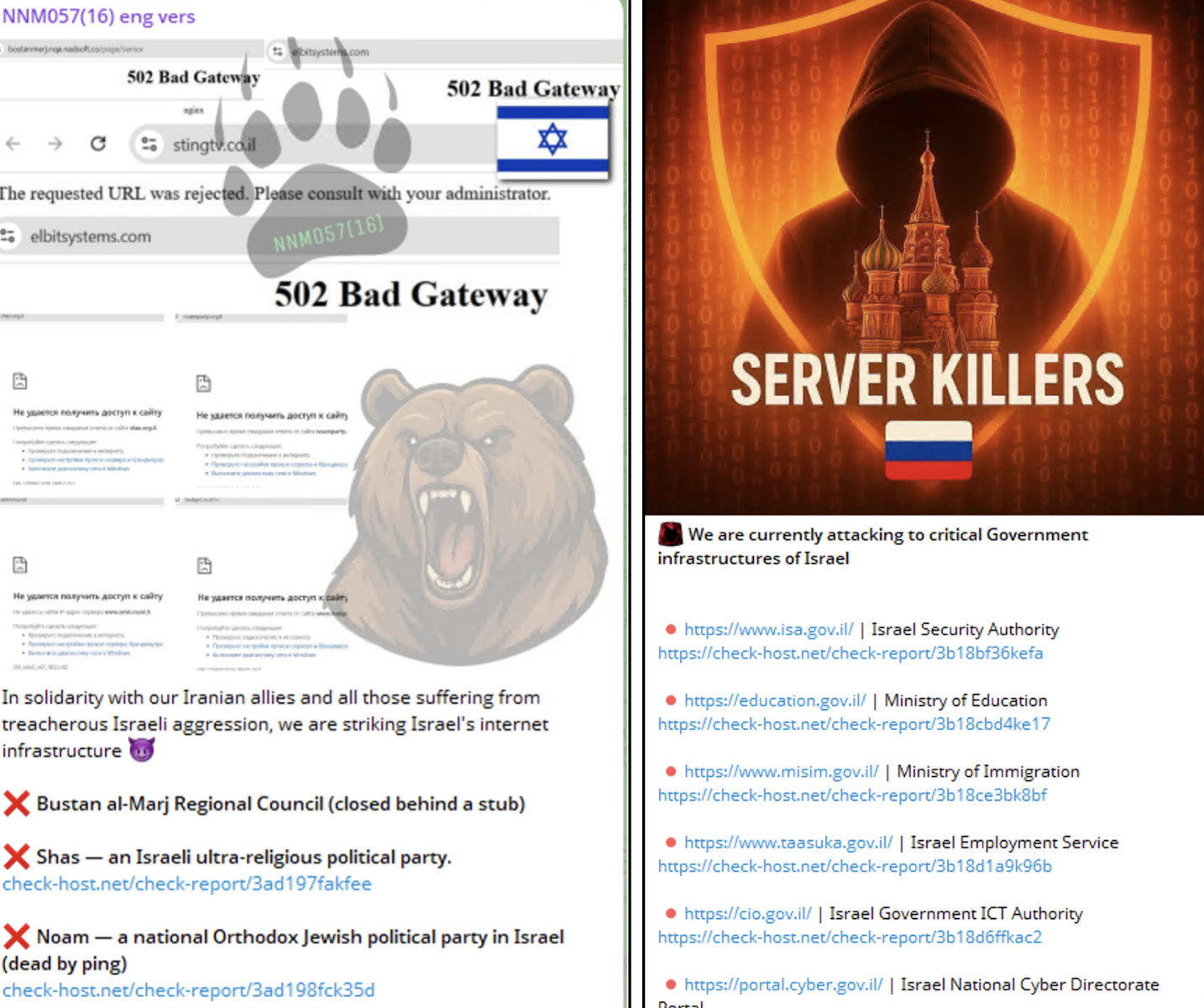
DDoS attacks are among the most common tactics employed by hacktivist groups. Pro-Russia groups such as NoName057(16) and Server Killers, along with other pro-Iran collectives affiliated with them, have been linked to waves of coordinated DDoS attacks against Israel, Qatar, Bahrain, and other politically symbolic targets. These attacks are generally inexpensive and cause only short-term technical damage, but they remain strategically useful because they disrupt public services, tie up defense resources, generate media coverage, and fuel the narrative of a sustained cyber response.

Telegram-Russian-hacktivist-targets-Israeli-website.png
Figure 1: Telegram post from pro-Russia hacktivist groups claiming responsibility for targeting an Israeli website in support of Iran

Website defacement also remains a common tactic. Groups such as FAD Team, 313, and Cyber Islamic Resistance have been associated with claims of attacks on several websites. Although defacements are technically simple to execute, they remain analytically significant: They are highly visible, rapidly disseminated, and psychologically impactful, often creating an exaggerated perception of widespread systemic compromise.

Data breaches represent a far more significant dimension of cyber operations. The Iranian-aligned group Handala, in particular, continues to blend political messaging with claims of data theft and the selective release of allegedly compromised information. The group recently asserted that it had infiltrated a Saudi energy company and exfiltrated internal documents, framing the operation as a combination of data exfiltration, coercive pressure, and psychological warfare targeting the energy sector. Even when the full authenticity of released datasets cannot be independently verified, the publication of partially credible material can still generate substantial reputational damage and potential operational disruption for affected organizations.

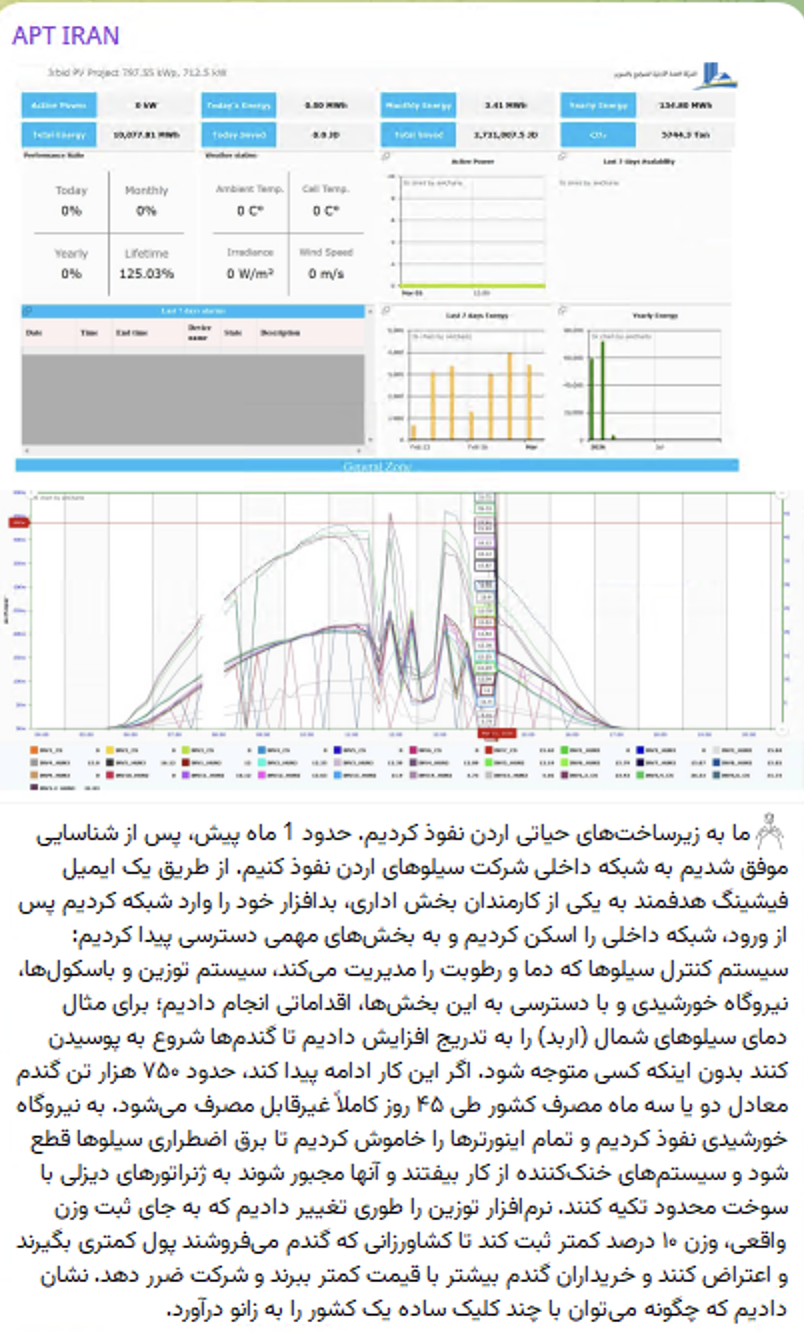
Targeting critical infrastructure has emerged as one of the most concerning aspects of the current cyber activity by pro-Iran hacktivists and proxy collectives. Groups operating in this ecosystem, including Iranian APTs, Handala, and networks associated with the Cyber Islamic Resistance umbrella, have publicly claimed operations targeting infrastructure across the region. Recent Telegram posts indicate that an Iranian APT group claimed responsibility for attempts to sabotage Jordanian critical infrastructure, while other Iran-aligned hacktivist personas have asserted access to sectors including fuel systems, water utilities, and other operational technology environments.

In a separate case, the Handala Hack Team has alleged that it compromised both Oil and gas companies in the United Arab Emirates and Israel, claiming to have exfiltrated more than 1.3 TB of sensitive data from oil and gas sector networks. These claims, which would represent a significant intrusion into Middle Eastern energy infrastructure if confirmed, have circulated primarily through hacktivist communication channels and social media reporting and have not been independently verified.

Iran-APT-group-claims-targeting-Jordanian-critical-infrastructure.png
Figure 2: IRAN APT group claimed attempts to target Jordanian critical infrastructure

Although many of these claims remain difficult to independently verify, the recurring focus on industrial control systems and essential services is analytically significant. Hacktivist collectives aligned with Iranian geopolitical narratives frequently leverage infrastructure-related claims as part of information operations designed to amplify perceived impact, generate psychological pressure, and signal the potential for escalation into operational technology environments. Even when technical disruption is limited or exaggerated, the persistent narrative around infrastructure compromise can shape defensive priorities and highlight potential escalation pathways within the broader cyber conflict.

Sectoral exposure and risk landscape

In the current geopolitical context, cyberattacks extend far beyond military networks and defense institutions. Modern cyber operations increasingly aim to affect the broader ecosystem that supports government activity, economic stability, and public trust. Consequently, adversaries seek not only technically vulnerable targets but also organizations whose compromise or disruption can increase visibility, influence public perception, or create cascading effects across interconnected systems.

A successful intrusion into a widely used service provider, a major infrastructure operator, or a publicly accessible institution can quickly produce consequences that extend far beyond the initial target, affecting supply chains, service availability, and public confidence. In this context, cyber operations often serve multiple purposes simultaneously: intelligence gathering, strategic positioning within critical networks, and generating disruption or exerting influence during periods of heightened geopolitical tension.

At present, several sectors appear particularly exposed:

  • Government institutions and public administration

  • Defense and aerospace industry

  • Energy sector, including oil, gas, and electricity

  • Telecommunications providers

  • Financial services

  • Transportation systems

However, the risk landscape extends beyond these sectors themselves. Organizations that form part of the broader digital supply chain supporting these industries may also represent attractive entry points. This includes cloud service providers, managed service providers, technology vendors, and other third-party platforms that maintain privileged access to client environments. Compromising such intermediaries can allow adversaries to reach high-value targets indirectly. By gaining access to a supplier or service provider, attackers may obtain pathways into multiple networks simultaneously, access sensitive information, or move laterally across interconnected operational systems. Supply chain compromise, therefore, offers both scale and stealth, making it an increasingly common tactic in sophisticated cyber campaigns.

Geopolitical alignment can also influence targeting decisions. Organizations based in countries that host United States military assets or are publicly aligned with United States or Israeli policy positions may attract additional attention from adversaries. In these cases, targeting can carry symbolic, political, or strategic value beyond the immediate technical impact of the intrusion. Within this environment, cyber exposure can generally be understood through three overlapping targeting dynamics.

Symbolic targets include municipalities, universities, media outlets, and public institutions. These organizations may be targeted primarily for visibility, messaging, or propaganda purposes. Even limited disruption or data exposure can generate headlines and amplify the perceived reach of the attackers.

Operational targets include sectors that support everyday economic and social activity, such as telecommunications providers, transportation systems, payment networks, and fuel distribution infrastructure. Disruptions in these areas can quickly affect daily life, creating public anxiety and increasing pressure on authorities to respond.

Strategic targets consist of entities whose compromise offers long-term intelligence or operational value. This category includes defense contractors, major financial institutions, government networks, and operators of critical infrastructure. In these cases, adversaries may prioritize persistence and stealth to collect intelligence, monitor decision-making processes, or maintain access that could be leveraged during future crises.

Taken together, these targeting patterns illustrate a broader shift in cyber operations: Attackers are increasingly selecting targets not only for their intrinsic value, but for the broader political, economic, and societal effects that disruption or compromise can produce.

What should organizations monitor?

In the current phase of the conflict, organizations should continue to monitor for indicators that activity is shifting from opportunistic disruption toward deliberate intrusion or access preparation.

Internet-facing infrastructure is often the initial entry point. Elevated scanning or probing of public websites, VPN gateways, remote access portals, cloud services, and email authentication infrastructure may indicate early reconnaissance. While some scanning is routine, sudden increases in probing activity or authentication attempts should be treated as potential precursors to intrusion.

Phishing and social engineering campaigns are also likely to intensify. Threat actors may exploit developments in the conflict by using lures that reference civil defense alerts, battlefield updates, humanitarian messaging, or urgent requests that appear to originate from leadership or trusted partners. In some cases, malicious applications or replicas of legitimate services may be used to harvest credentials or deploy malware.

Credential misuse remains a primary access vector. Security teams should monitor for abnormal authentication patterns, including logins from unusual geographic locations, access at unexpected hours, repeated failed logins followed by success, changes to multi-factor authentication settings, or the creation of new privileged accounts.

Organizations operating critical infrastructure should closely monitor activities within their operational environments. Suspicious access to remote management platforms, unusual connectivity between IT and OT networks, or unexpected activity involving engineering workstations or vendor access channels may signal reconnaissance within sensitive systems.

Finally, monitoring the broader information environment can provide early warning and signal the need to increase monitoring. Hacktivist groups frequently use platforms such as Telegram and X to circulate target lists, claim attacks, or release fragments of allegedly stolen data tied to geopolitical events. Tracking these channels can help organizations identify potential targets and strengthen their defensive posture before malicious activity reaches their networks.

Additional reading from Rapid7 Labs, for Rapid7 customers: Rapid7 Detection Coverage for Iran-Linked Cyber Activity

CrowdStrike says attackers are moving through networks in under 30 minutes

Cyberattacks reached victims faster and came from a wider range of threat groups than ever last year, CrowdStrike said in its annual global threat report released Tuesday, adding that cybercriminals and nation-states increasingly relied on predictable tactics to evade detection by exploiting trusted systems.

The average breakout time — how long it took financially-motivated attackers to move from initial intrusion to other network systems — dropped to 29 minutes in 2025, a 65% increase in speed from the year prior. “The fastest breakout time a year ago was 51 seconds. This year it’s 27 seconds,” Adam Meyers, head of counter adversary operations at CrowdStrike, told CyberScoop.

Defenders are falling behind because attackers are refining their techniques, using social engineering to access high-privilege systems faster and move through victims’ cloud infrastructure undetected.

“Threat actors are exploiting those cross-domain gaps to gain access to environments, so they’re wriggling in between the seams in cloud, identity, enterprise and unmanaged network devices,” Meyers said. 

Starting from an already disadvantaged position — made worse by faster attacks and living-off-the-land techniques — defenders face burnout, stress and other factors that can lead to mistakes, he added. 

The myriad sources of these problems are spreading, too. 

CrowdStrike tracked 281 threat groups at the end of 2025, including 24 new threats it named throughout the year. Researchers at the cybersecurity firm are also tracking 150 active malicious activity clusters and emerging threat groups.

Cybercriminals seeking a payout and nation states committing espionage or implanting footholds into critical infrastructure for prolonged access are increasingly seizing on security weaknesses in cloud-based environments to break into victim networks. 

These cloud-focused attacks have seen a reported 37% year-over-year increase, with a 266% surge in this activity from nation-state threat groups.

The vast majority of attacks detected last year, 82%, were free of malware — highlighting attackers’ enduring shift toward hands-on-keyboard operations and the abuse of legitimate tools and credentials, CrowdStrike said in the report. More than 1 in 3 incident response cases involving cloud intrusions last year were linked back to a valid or abused credential that granted attackers access, according to CrowdStrike. 

Attacks originating from or sponsored by North Korea increased 130% last year, while incidents linked to China jumped 38% during the same period.

Chinese threat groups achieved immediate system access with two-thirds of the vulnerabilities they exploited last year, and 40% of those exploits targeted edge devices.

Zero-day exploits — especially defects in edge devices such as firewalls, routers and virtual private networks — allowed nation-state and cybercrime threat groups to break into systems, execute code and escalate privileges undetected.

CrowdStrike said it observed a 42% year-over-year increase in the number of zero-day vulnerabilities exploited prior to public disclosure last year. 

Meyers said he expects that number to grow further, predicting an explosion of activity from attackers using artificial intelligence to find and exploit zero-day vulnerabilities in various products during the next three to nine months.

CrowdStrike’s annual global threat report is full of figures moving in the wrong direction, yet the most worrying finding for Meyers comes down to attacker speed.

“The speed at which we’re seeing these breakout times accelerate is one of the markers,” he said, adding that it’s only a matter of time before the fastest attacks drop down to seconds, if not milliseconds.

The post CrowdStrike says attackers are moving through networks in under 30 minutes appeared first on CyberScoop.

Hacktivism and the Winter Olympics 2026: What We’re Seeing and What it Signals

The 2026 Winter Olympics have been live for several weeks, and the cyber activity many predicted is already unfolding.

Threat intelligence reporting from Intel471 highlights a surge in hacktivist chatter and mobilization tied to protests and geopolitical tensions surrounding the Games. At the same time, Google’s Threat Intelligence Group has warned that hacktivists, state actors, and cybercriminal groups are actively targeting the global defense industry, including organizations that overlap with Olympic infrastructure and supply chains. This is not a coincidence. Major global events concentrate visibility, political symbolism, and digital dependency. That combination attracts actors who want attention as much as disruption.

What is hacktivism in 2026?

Hacktivism today is ideologically motivated cyber activity designed to influence perception, apply pressure, or advance political narratives, often through disruption, data leaks, or public messaging. Recent reporting shows that hacktivist groups are not operating in isolation. In some cases, their campaigns run alongside state-aligned or criminal activity. The targeting of defense contractors, aerospace suppliers, and industrial entities reflects this convergence.

During the Olympics, those same sectors intersect with event logistics, telecommunications, aviation, energy, and security technology.

What has happened since the Winter Games began?

According to Intel471, online communities aligned with hacktivist causes have escalated messaging and operational coordination in the lead-up to and during the Winter Games. Threat actors have referenced Olympic-related targets in forums and social channels, including infrastructure tied to transportation and sponsors.

SecurityWeek and OODA Loop, citing Google’s intelligence, note continued targeting of defense industry entities through phishing and exploitation of exposed services. While not every campaign is explicitly labeled “Olympics-related,” the overlap in sectors matters.

Defense contractors often provide technology, logistics, surveillance, or communications capabilities that support major international events. Attacks against them, even if framed around geopolitical grievances, can have ripple effects.

The pattern is consistent: high-visibility events amplify the impact of even limited cyber incidents.

Why global events amplify hacktivist activity

The Olympics function as a global amplifier. Billions are watching, media cycles move faster, and political narratives are intensified. In that environment, even relatively low-complexity attacks can produce outsized consequences. A distributed denial-of-service campaign against a broadcaster can interrupt coverage at a critical moment. A data leak involving a sponsor can dominate headlines for days. A website defacement tied to a political cause can circulate globally within minutes. In many cases, the objective is not technical devastation but psychological and reputational impact. Undermining confidence in organizers or projecting instability can advance the strategic goals of ideologically aligned groups without requiring sophisticated or destructive techniques.

What security teams should focus on, now and in the future

With the Games underway, the priority is not speculation. It is monitoring and preparedness. Security leaders supporting global events should:

  • Review third-party dependencies that connect to core event operations

  • Increase monitoring of public-facing systems during peak broadcast windows

  • Track hacktivist messaging that references sponsors, infrastructure, or host nations

  • Ensure executive and communications teams are aligned on rapid response planning

The risk is not confined to stadium control systems. It spans broadcasters, payment providers, logistics partners, and digital platforms. High-visibility events attract ideologically motivated actors, but they also create opportunities for financially driven cybercrime. As we’ve previously examined in our research on carding-as-a-service and stolen credit card fraud, periods of high transaction volume often coincide with increased fraud activity and exploitation of payment infrastructure.

Security leaders should prepare for both disruption and monetization. While hacktivist activity may generate headlines, financial exploitation often causes quieter but longer-lasting operational damage.

Hacktivism in 2026: A warning for high-visibility events

The Winter Olympics provide a live case study in how hacktivism operates within today’s geopolitical environment. Threat actors understand timing. They understand symbolism. They understand that a small disruption during a global event carries disproportionate weight.

The activity seen so far reinforces a broader shift. Hacktivism has matured into a persistent and visible component of the threat landscape. It intersects with state and criminal ecosystems and targets sectors that carry political and economic symbolism.

For organizations tied to high-visibility events, the lesson is clear. Cyber risk during global moments is not only technical - it is reputational, geopolitical, and amplified by attention and preparation must account for all three.

Nigerian man sentenced to 8 years in prison for running phony tax refund scheme

A 37-year-old Nigerian man was sentenced to eight years in prison for participating in a five-year cybercrime spree to steal money from the U.S. government through fraudulent tax returns, the Justice Department said Wednesday.

Matthew Abiodun Akande was living in Mexico when he and at least three co-conspirators broke into the networks of tax preparation firms, stole sensitive data on their clients and filed fraudulent tax returns, claiming tax refunds with victims’ personal data, according to court records. 

Akande and his co-conspirators filed more than 1,000 fraudulent tax returns seeking more than $8.1 million in phony tax refunds during a five-year period ending in June 2021, prosecutors said. The crew collectively obtained more than $1.3 million in fraudulent tax refunds.

Officials said Akande also advanced the scheme by sending phishing emails to five Massachusetts-based tax preparation firms that were designed to trick employees into downloading remote access trojan malware, including Warzone RAT. Four of those firms were listed as victims in the indictment.

Akande has been in detention since he was arrested at Heathrow Airport in the United Kingdom in October 2024 and extradited to the United States in March 2025. A month later, Akande pleaded guilty to all 33 counts in the indictment prosecutors filed against him in July 2022.

His crimes include conspiracy to obtain unauthorized access to protected computers, wire fraud, unauthorized access to protected computers, theft of government money, and aggravated identity theft.

Akande and his alleged co-conspirators — Kehinde Hussein Oyetunji, a Nigerian national living in North Dakota, and two people that prosecutors declined to name — directed the fraudulent tax refunds to be deposited in U.S. bank accounts. Co-conspirators living in the United States withdrew some of the stolen money in cash then, at Akande’s direction, transferred a portion of the funds to third parties in Mexico, officials said.

In a sentencing memo submitted to the court, Akande’s lawyer insisted his client was not living an extravagant lifestyle in Mexico. Yet, he was ordered to pay almost $1.4 million in restitution as part of his sentencing.

You can read the full indictment below.

The post Nigerian man sentenced to 8 years in prison for running phony tax refund scheme appeared first on CyberScoop.

Chinese hackers exploited a Dell zero-day for 18 months before anyone noticed

Researchers uncovered more worrying details about a long-running cyber espionage campaign suspected to be backed by the Chinese government, exemplifying how such attacks often go undetected until they’ve already caused significant damage.

Google Threat Intelligence Group and Mandiant said the Chinese threat group UNC6201 has been exploiting a zero-day vulnerability in Dell RecoverPoint for Virtual Machines since at least mid-2024. The group overlaps with UNC5221, also known as Silk Typhoon, which has been burrowing into critical infrastructure and government agency networks undetected since at least 2022.

The zero-day exploitation marks an escalation from this particular cluster of actors.  State-sponsored attackers spent years implanting Brickstorm malware into networks before the campaign was finally detected last summer. By September, however, the attackers had replaced Brickstorm with Grimbolt, a more advanced malware that’s harder to detect, Google security researchers said Tuesday.

The zero-day vulnerability — CVE-2026-22769 — hinges on a hardcoded administrator password in Dell RecoverPoint for Virtual Machines that was pulled from Apache Tomcat. It carries a 10/10 CVSS rating. The Chinese threat group has been using the hardcoded password, which triggers the vulnerability and allows unauthenticated remote attackers to gain full system access with root-level persistence for at least 18 months, Google said. 

Dell Technologies disclosed and released a patch for the vulnerability Tuesday. A company spokesperson urged customers to follow guidance in its security advisory.

“We are aware of less than a dozen impacted organizations, but because the full scale of this campaign is unknown we recommend that organizations previously targeted by Brickstorm look out for Grimbolt in their environments,” Austin Larsen, principal analyst at GTIG, told CyberScoop.

When the Cybersecurity and Infrastructure Security Agency unveiled new details about the campaign in December, Google said dozens of U.S. organizations, not including downstream victims, had already been impacted by Brickstorm. 

“The actor is likely still active in unpatched and remediated environments, and because exploitation has been occurring since mid-2024, they have had significant time to establish persistence and carry out long-term espionage,” Larsen added.

The campaign — one of many concurrent efforts by China state-sponsored groups to embed themselves into networks for long-term access, disruptions and potential sabotage — remains a top area of concern for national security.

CISA, the National Security Agency and Canadian Centre for Cyber Security released new analysis on Brickstorm last week to share indicators and compromise that could help potential victims detect malicious activity on their networks.

Yet, the China-linked groups involved in this campaign have already moved on to Grimbolt, in some cases replacing older Brickstorm binaries with the new backdoor that’s more difficult to reverse engineer, according to Google.

Marci McCarthy, director of public affairs at CISA, told CyberScoop the agency will share further information on Wednesday.

Google’s fresh research on the China state-sponsored campaign demonstrates how the threat group’s tenacity, and ability to dwell undetected in networks longer than 400 days, keeps defenders and cyber authorities at a disadvantage.

The threat groups typically target edge applications and devices running on systems without endpoint detection and response, but researchers don’t know how attackers broke into the networks of the most recently discovered victims. 

Researchers only have a narrow view of the threat groups’ activities at large. 

“We suspect a significant portion of UNC5221 and UNC6201’s activity likely remains unknown, and there is a strong probability that they are developing or using undiscovered zero-days and malware,” Larsen said. “The most concerning aspect of this campaign is that additional organizations were likely compromised as part of this campaign and do not know it yet.”

The post Chinese hackers exploited a Dell zero-day for 18 months before anyone noticed appeared first on CyberScoop.

Google finds state-sponsored hackers use AI at ‘all stages’ of attack cycle 

A new report from Google found evidence that state-sponsored hacking groups have leveraged AI tool Gemini at nearly every stage of the cyber attack cycle.

The research underscores how AI tools have matured in their cyber offensive capabilities, even as it doesn’t reveal novel or paradigm shifting uses of the technology.

John Hultquist, chief analyst at Google’s Threat Intelligence Group, told CyberScoop that many countries still appear to be experimenting with AI tools, determining where they best fit into the attack chain and provide more benefit than friction.

“Nobody’s got everything completely worked out,” Hultquist said. “They’re all trying to figure this out and that goes for attacks on AI, too.”

But the report also reveals that frontier AI models can build speed, scale and sophistication into a myriad of hacking tasks, and state-sponsored hacking groups are taking advantage.

Gemini was a useful, dynamic and convenient tool for many tasks, helping threat actors in a variety of different ways. In nearly all cases, Google’s reporting suggests that state-sponsored actors relied on Gemini as one tool among many, using it for specific purposes such as automating routine processes, conducting research or reconnaissance and experimenting with malware.

One North Korean group used it to synthesize open-source intelligence about job roles and salary information at cybersecurity and defense companies. Another North Korean group consulted it “multiple days a week” for technical support, using it to troubleshoot problems and generate new malware code when they got stuck during an operation. One Iranian APT used Gemini to “significantly augment reconnaissance” techniques against targeted victims. China, Russia, Iran and North Korea all also used Gemini to create fake articles, personas, and other assets for information operations.

“What’s so interesting about this capability is it’s going to have an effect across the entire intrusion cycle,” Hultquist said.

There are no instances of state groups using Gemini to automate large portions of a cyber attack, like a Chinese-government backed campaign identified by Anthropic last year. It suggests threat actors may still be struggling to implement fully or mostly-automated hacks using AI.

Hultquist said that some state groups, particularly those focused on espionage, may not find the speed and scale advantages of agentic AI useful if it results in louder, more detectable operations. In fact, while state actors continue to experiment with AI models, he believes on average these developments will help smaller cybercriminal outfits more than state-sponsored hackers.

But that could change in the future. Frontier AI companies like Anthropic and cybersecurity startups like XBOW have already developed models with powerful defensive cybersecurity capabilities in vulnerability scanning, reconnaissance and automation. Foreign governments with similar technology could use those same features for offensive hacking, as Chinese actors did with Claude before being discovered.

In December, the UK AI Security Institute’s inaugural report on frontier AI trends found that Al capabilities are improving rapidly across all tested domains, and particularly in cybersecurity.

And the gap between frontier and free, open-source models is shrinking. According to the institute, open-source AI models can now catch up and provide similar capabilities within 4-8 months of a frontier model release.

“The duration of cyber tasks that Al systems can complete without human direction is also rising steeply, from less than 10 minutes in early 2023 to over an hour by mid-2025,” the institute said in its Frontier AI Trends Report in December.

The post Google finds state-sponsored hackers use AI at ‘all stages’ of attack cycle  appeared first on CyberScoop.

Ivanti’s EPMM is under active attack, thanks to two critical zero-days

Attackers are again focusing on a familiar target in the network edge space, actively exploiting two critical zero-day vulnerabilities in Ivanti software that allows administrators to set mobile device and application controls. 

The vulnerabilities — CVE-2026-1281 and CVE-2026-1340 — each carry a CVSS rating of 9.8 and allow unauthenticated users to execute code remotely in Ivanti Endpoint Manager Mobile (EPMM). Ivanti did not say when the earliest known date of exploitation occurred but warned that a “very limited number of customers” were attacked before it disclosed and addressed the defects Thursday.

Ivanti’s post-attack warning marks a frequent occurrence for its customers, involving yet again highly destructive defects in its code that attackers exploited before the vendor caught or fixed the errors. 

The Cybersecurity and Infrastructure Security Agency has flagged 31 Ivanti defects on its known exploited vulnerabilities catalog since late 2021. At least 19 defects across Ivanti products have been exploited in the past two years. 

The agency added CVE-2026-1281 to the catalog Thursday, but not CVE-2026-1340. Both defects have been exploited, according to watchTowr. Yet, a spokesperson for Ivanti said the vulnerabilities have not been chained together for exploitation.

The latest code-injection vulnerabilities demonstrate attackers are focusing on EPMM in particular of late. Ivanti disclosed a separate pair of vulnerabilities in the same product in May 2025. 

Ivanti declined to say how many customers have been impacted by the recent zero-day attacks, but researchers warn a recurring pattern is emerging with mass exploitation observed shortly after public disclosure and the release of exploit code.

“This started as tightly scoped zero-day exploitation,” Ryan Dewhurst, head of proactive threat intelligence at watchTowr, told CyberScoop. “It has since devolved into global mass exploitation by a wide mix of opportunistic actors. That arc is depressingly predictable.”

Shadowserver said it observed a spike in CVE-2026-1281 exploitation attempts from at least 13 source IPs by Saturday. More than 1,400 instances of Ivanti EPMM are still exposed to the internet, according to Shadowserver scans, but it’s unknown how many of those are vulnerable or already compromised. 

“It’s important to remember that exposure does not equal exploitation,” Dewhurst said. “But any organization exposing vulnerable instances to the internet must consider them compromised, tear down infrastructure and instigate incident response processes.”

Ivanti advised all on-premises EPMM customers to apply patches, but warned that the script is temporary and will be overridden when customers upgrade software to a new version. The software packages that address the defects “takes only seconds to apply, does not cause downtime and significantly increases adoption and protection rates for customers,” a company spokesperson said. 

Ivanti said it will issue a permanent fix for the vulnerability in a future update that it plans to release by April.

The new Ivanti zero-days share many similarities to previous EPMM vulnerabilities, said Ryan Emmons, staff security researcher at Rapid7. “The line between attacker input and trusted code is blurred, resulting in the ability to execute malicious payloads.”

Remotely exploitable vulnerabilities in network edge devices are an appealing and effective attack vector for hackers looking to break into targeted networks. Multiple threat groups last year, including some linked to China, exploited another zero-day defect in Ivanti EPMM — CVE-2025-4428 — and a string of vulnerabilities in other Ivanti products.

“State-sponsored adversaries have generally made strong use of remotely exploitable vulnerabilities in Ivanti kit, which isn’t surprising,” said Caitlin Condon, vice president of security research at VulnCheck.

The latest actively exploited defects affecting Ivanti products reflect a continuation of a years-long battle between the vendor and threat groups that poses a consistent risk for customers. 

Some security researchers are more inclined to pin the blame for this sustained security problem on Ivanti itself, yet there is broad agreement these vulnerabilities were not easy for the company to discover prior to exploitation. 

Emmons described the defects as nuanced with an odd path to code injection. “With these vulnerable code patterns now known, the vendor’s security teams can more effectively hunt for these sorts of bugs in the future,” he added.

Dewhurst concurred the vulnerabilities were not easy to spot, but said that does not excuse the outcome. “Defensive engineering needs to assume attackers will find the non-obvious paths eventually, because they always do,” he said. 

Ivanti’s spokesperson said these types of vulnerabilities are difficult to find, and insisted the company’s security and engineering teams acted quickly to address the defects once they were identified.

The post Ivanti’s EPMM is under active attack, thanks to two critical zero-days appeared first on CyberScoop.

China-based espionage group compromised Notepad++ for six months

A China-based threat group operating for almost two decades broke into the internal systems of Notepad++, an extremely popular open source-code editor, to spy on a select group of targeted users, researchers at Rapid7 said Monday.

Don Ho, the author and maintainer of the open-source tool, said independent security researchers confirmed a China state-sponsored group compromised Notepad++’s server for a six-month period starting in June 2025. Ho, who did not respond to a request for comment, released a software update Dec. 9 claiming to address authentication weaknesses that allowed attackers to hijack the Notepad++ updater client and user traffic.

The Chinese APT group Lotus Blossom, which has been active since at least 2009, gained recurring access and deployed various payloads — including a custom backdoor — to snoop on some users’ activities, according to Rapid7. The espionage group is also known as Billbug, Thrip and Raspberry Typhoon. 

“We have no evidence of bulk data exfiltration,” Christiaan Beek, senior director of threat intelligence and analytics at Rapid7, told CyberScoop. “The tooling observed is consistent with post-compromise reconnaissance, command execution, and selective data access, rather than broad data harvesting.”

The attacks, which showcased resilience and stealth tradecraft, did not result in a mass compromise of all Notepad++ users, but rather a limited number of affected environments, according to Rapid7.

“Post-compromise behavior included system profiling, persistence mechanisms, and remote command execution consistent with long-term espionage access rather than immediate disruption or monetization,” Beek added. “The objective appears aligned with strategic intelligence collection, consistent with Lotus Blossom’s historical operations.”

The former hosting provider for Notepad++ said the attackers lost access to the tool’s server on Sept. 2, but maintained legitimate credentials to internal services until Dec. 2, which allowed the attackers to redirect Notepad++ update traffic to malicious servers, Ho said in a blog post. 

Ho did not say when or how they first became aware of unauthorized access to Notepad++’s systems. The website, which attackers targeted to exploit “insufficient update verification controls that existed in older versions of Notepad++,” was moved to a new hosting provider with stronger security practices, Ho said in the blog post.

Beek confirmed that Lotus Blossom’s unauthorized access appears to have been disrupted, noting that its known infrastructure linked to the months-long campaign is no longer active. Some security researchers started surfacing reports of incidents linked to Notepad++ in November.

While Notepad++’s internal system improvements appear to have halted the malicious activity, users running older versions of the software should still update as a precaution, Beek said. “We are not seeing ongoing active exploitation tied to this campaign.”

Lotus Blossom targeted software that provided potential access to many sensitive targets. The Windows-based tool, which was first released in 2003 and typically used as an alternative to Windows Notepad, is widely used by developers, IT administrators, engineers and analysts, including some working in government, telecom, critical infrastructure and media, Beek said.

Many security researchers, analysts and users have taken their concerns to social media to warn about the potential risk of the long-term intrusion and share worries about the ultimate impact of the campaign.

“Observed activity suggests selective, targeted follow-on exploitation,” Beek added, “not opportunistic mass infection.”

The post China-based espionage group compromised Notepad++ for six months appeared first on CyberScoop.

Cybercriminals and nation-state groups are exploiting a six-month old WinRAR defect

Google Threat Intelligence Group warned that a diverse and growing collection of attackers, including nation-state groups and financially motivated cybercriminals, are exploiting a path-traversal vulnerability affecting WinRAR that was disclosed and patched six months ago.

The high-severity vulnerability — CVE-2025-8088 — was exploited in the wild almost two weeks before RARLAB, the vendor behind the file archiver tool, addressed the vulnerability in a software update in late July. 

Active exploitation of the vulnerability has consistently extended to more threat groups during the past six months and remains ongoing. Google threat hunters have attributed attacks to at least three financially motivated attackers, four Russia state-sponsored groups and one attacker based in China. 

“Government-backed threat actors linked to Russia and China as well as financially motivated threat actors continue to exploit this n-day across disparate operations,” Google said in a threat intelligence report Tuesday. Researchers did not say how many attacks are linked to the vulnerability but described the activity as widespread.

Nation-state groups are consistently exploiting the defect to target victims in military, government and technology for espionage, researchers said. Groups backed by Russia are targeting Ukrainian military and government entities while the China-based attacker’s targets remain unknown. 

Cybercriminals are swarming to exploit the vulnerability, too. Google traced campaigns back to groups that previously targeted victims in Indonesia, Latin America and Brazil. Cybercrime groups exploited the vulnerability in December and January to deploy malware, including remote access trojans and infostealers.

Google published a timeline of observed exploitation depicting a broad set of attackers involved through October, but the majority of malicious activity since late 2025 is attributed to cybercriminals. 

Attacks share a common method of exploitation, which was rapidly adopted by a range of threat groups. 

“We are seeing both government-backed groups and financially motivated actors use the same exploitation method to achieve successful execution on target devices,” GTIG said in an email. “This mechanism of crafting a malicious RAR archive makes it more difficult for victims to determine they’ve been impacted, as they are shown a benign decoy file while in the background it silently drops a malicious payload into a critical system location such as Windows Startup folder.”

The malware requires no user interaction and because there are no obvious indicators of compromise, the malicious activity is very difficult to spot, researchers said.

Attackers of various objectives are flocking to the vulnerability, reminiscent of widespread exploitation of a previous WinRAR defectCVE-2023-38831 — that Google’s Threat Analysis Group warned about in October 2023. 

“The barrier to entry for threat actors to abuse WinRAR vulnerabilities is low, as there are public ready-to-use tools to quickly craft and test malicious archives,” researchers said. Google urged organizations to install security updates for WinRAR and published indicators of compromise to help defenders hunt for malicious activity on their systems.

The post Cybercriminals and nation-state groups are exploiting a six-month old WinRAR defect appeared first on CyberScoop.

A new wave of ‘vishing’ attacks is breaking into SSO accounts in real time

Threat hunters and researchers are racing to contain a wave of voice-phishing attacks targeting single sign-on tools, already leading to data theft and extortion attempts. Multiple cybercrime groups are combining voice calls and advanced phishing kits to trick victims into handing over access — including a group identifying itself as ShinyHunters, which has publicly named alleged targets and posted samples of stolen data.

The attacks share common characteristics with previous campaigns attributed to ShinyHunters, which has abused third-party vendors to gain initial access to multiple company networks, including the attack spree that impacted more than 700 Salesforce customer environments last fall.

“Mandiant is tracking a new, ongoing ShinyHunters-branded campaign using evolved voice phishing techniques to successfully compromise SSO credentials from victim organizations, and enroll threat actor controlled devices into victim multifactor authentication solutions,” Charles Carmakal, chief technology officer at Mandiant Consulting, said in an email to CyberScoop.

“This is an active and ongoing campaign,” Carmakal added. “After gaining initial access, these actors pivot into SaaS environments to exfiltrate sensitive data. An actor that identifies as ShinyHunters has approached some of the victim organizations with an extortion demand.”

Cybercriminals are registering custom domains that mimic legitimate single sign-on portals used by targeted companies, then deploying tailored voice-phishing kits to call victims while remotely controlling which pages appear in the victim’s browser. This lets the attackers sync their spoken prompts with multifactor-authentication requests in real time, increasing the likelihood the victim approves or enters the needed codes on cue.

Okta, one of the single sign-on providers targeted by this campaign, released threat intelligence on phishing kits observed in this campaign and others Thursday. Attackers appearing to be aligned with ShinyHunters have attempted to extort targeted organizations on behalf of a specific initial access broker that used one of these phishing kits.

Brett Winterford, vice president at Okta Threat Intelligence, said researchers have observed at least two phishing kits that demonstrate the real-time capability to mimic the authentication flows of identity providers. 

“This creates a more compelling pretext for asking the user to share credentials and accept multifactor authentication challenges,” he told CyberScoop.

“Okta Threat Intelligence has observed multiple phishing kits developed for the needs of voice phishing operators, each with dedicated panels for impersonation of Google, Microsoft and Okta sign-in flows, as well as cryptocurrency providers,” Winterford added.

A spokesperson for Microsoft said the company has nothing to share on the campaign. Meanwhile, a Google spokesperson said: “At this time, we have no indication that Google itself or its products are affected by this campaign.”

Security experts noted the attacks don’t involve a vulnerability in single sign-on vendors’ products or infrastructure, but rather a persistent weak point in identity and access management. Targeted victims are once again being duped into sharing their credentials with attackers.

These phishing kits allow cybercriminals without deep technical skills to buy the tooling and focus on targeting people and processes, said Cynthia Kaiser, senior vice president of Halcyon’s ransomware research center. 

“While these campaigns occur often, the difference here is the amount of success in the recent campaign is slightly higher. That’s likely because of the believable content and the use of voice phishing versus just phishing,” she said.

“If you’re getting a call and it’s personalized and it’s changing in real time — that feels believable, that’s a different element that people don’t necessarily have their guard up for.”

Investigation ongoing into scope

It’s unclear how many organizations have been impacted by the campaign. A ShinyHunters-branded data leak site, which is currently down, previously listed at least three victims, including two companies that publicly confirmed they were impacted by recent attacks.

SoundCloud said some personally identifiable data on about 20% of its user base, roughly 36 million people, was compromised by an attack it first discovered in mid-December. The company insists sensitive data wasn’t exposed and did not name the attackers, but said users, employees and partners have been flooded with threatening emails. 

“We are aware that a threat actor group has published data online allegedly taken from our organization,” Sade Ayodele, senior director of communications at SoundCloud, said in an email. “Our security team — supported by leading third-party cybersecurity experts — is actively reviewing the claim and published data.”

Betterment, a financial services company, said an attacker gained access to some of its systems via social engineering on Jan. 9. The company said customer data was stolen, but no accounts were accessed and customer credentials weren’t compromised.

The attacker also quickly used access to Betterment’s systems to send a fraudulent cryptocurrency offer to some customers. Betterment did not respond to a request for comment.

Threat intelligence suggests additional victims have been targeted and potentially impacted. Sophos researchers are tracking a cluster of about 150 malicious domains established starting last month, including some used in voice phishing campaigns resulting in data theft and ransom notes demanding a payment, said Rafe Pilling, director of threat intelligence at Sophos Counter Threat Unit.

“We can’t confirm that they have all been used but the threat actors are creating target-specific domains, themed to reflect single-sign on services and impersonating authentication providers like Okta,” Pilling said. The fake domains impersonate organizations in the education, real estate, energy, financial services and retail sectors.

While one of the groups behind this campaign identifies itself as ShinyHunters, researchers have yet to confirm that claim or formally attribute the attacks to a specific group or person. 

“ShinyHunters typically has a mix of real victims and recycled information or exaggerated claims,” Kaiser said. 

Moreover, the names adopted or reused by some cybercriminals has lost relevance, said Ian Gray, vice president of intelligence at Flashpoint. 

A cybercriminal or group can use any username they choose and apply that to a data-leak site, but that doesn’t prove a direct link. 

“While ShinyHunters have claimed credibility for the campaign,” Gray said, “it is equally important that we examine the tactics, techniques and procedures being employed and how they relate to previous campaigns.”

The post A new wave of ‘vishing’ attacks is breaking into SSO accounts in real time appeared first on CyberScoop.

The thin line between saving a company and funding a crime

Ransomware negotiation is a dark but widely acknowledged reality in the cybersecurity industry — one that many argue is a necessary practice, even if it largely occurs out of sight. Brokering payments and terms with cybercriminals who hold organizations’ data and operations hostage places security professionals in a fraught position that requires them to balance a responsibility to meet their clients’ needs without fueling the spread of financially-motivated crime.

The pitfalls of ransomware negotiation are excessive — pinning the goals of cybercrime against victims and incident response firms that typically face no good options. Negotiators are charged with ensuring their clients don’t break any laws by financially supporting sanctioned criminals, but they also have to consider the lines they won’t cross without betraying their moral compass.

These backchannel negotiations can go awry for various reasons. Many people involved in ransomware negotiation prefer to share very little about what transpires in these discussions, a decision that ensures the terms of ransomware payments remain largely unscrutinized. 

Yet, many security companies and professionals spoke to CyberScoop about the challenges and benefits of ransomware negotiation after two of their own became turncoats. The former incident responders, Ryan Clifford Goldberg and Kevin Tyler Martin, were moonlighting as ransomware operators and pleaded guilty last month to a series of ransomware attacks in 2023.

“There’s no structured community of practice, no peer review, and no recognized body to certify or hold negotiators accountable,” Jon DiMaggio, principal at XFIL Cyber, told CyberScoop. “It’s one of the few areas of cybersecurity with no real standards, an unregulated tradecraft that still operates like the Wild West.”

This uneven approach manifests across the landscape, particularly among the top incident response firms, which have varying levels of comfort with ransomware negotiations. CrowdStrike and Mandiant draw a firm line, refraining from providing ransomware negotiation services to clients. 

If a client is considering paying a ransomware group, Mandiant will explain the options and let the client decide. The Google-owned company will also share what it knows about the group’s reputation for honoring terms and provide a list of third-party vendors that specialize in ransomware negotiation.

Adam Meyers, head of counter adversary operations at CrowdStrike, is firmly in the don’t-pay-ransoms camp. But he, too, recognizes it’s not always that simple. 

“No good comes from paying them,” but sometimes in extreme cases when the choice is between a business’s downfall or potentially putting the people you serve at risk of significant harm, victims don’t have a choice but to pay the ransom, Meyers said.

Palo Alto Networks Unit 42 takes things to the finish line, but stops before payment. “The boundary for us is we don’t perform ransomware payments. That’s actually an intentional decision on our end to separate those out,” Steve Elovitz, vice president of consulting at Unit 42, told CyberScoop.

“We will perform negotiations when requested by our clients, but we will not perform the payments,” he added. “There’s the complexity side of it, but there’s also just the moral side of it — not wanting to be involved, really, in the transaction itself.”

The red lines in ransomware response — viewing stolen or illegal data on dark web forums, collecting that information, engaging with cybercriminals, negotiating and, ultimately, submitting payment — can push those involved beyond their comfort zones, said Sean Nikkel, lead cyber intelligence analyst at Bitdefender.

Lack of transparency engenders isolation

These self-imposed limits highlight how secretive ransomware negotiations tend to be, which creates a vacuum in which criminals thrive, DiMaggio said. 

“The lack of transparency isolates everyone,” he said. “Victims don’t know what’s normal or fair, law enforcement is often left guessing, and the criminals use that silence to control the narrative and drive up their prices.”

Nikkel asserts some secrecy is necessary, yet ransomware negotiators are “operating without a license and it kind of freaks me out a little bit,” he said.

Professional certifications exist for many lines of intelligence work, but there’s nothing for ransomware negotiation, he added.

DiMaggio, who has infiltrated ransomware groups to investigate their operations, dox their leaders and chronicle stories that would otherwise go untold, said victim organizations constantly make the same mistakes because lessons from these attacks are rarely shared. 

“Until the industry finds a responsible way to collect and analyze anonymized negotiation data, we’ll keep fighting each case in the dark,” he said. “Transparency isn’t about shaming victims — it’s about denying criminals the advantage of secrecy.”

Open sharing of ransomware negotiations is a non-starter for many important reasons, experts said. These communications contain privileged information that could tip attackers off to counterstrategies or empower them with information they can use as leverage to further compromise victims. 

“It would be difficult to do that in a way that doesn’t compromise the practice,” said Kurtis Minder, the co-founder and former CEO of GroupSense who published a book in July about his experiences as a ransomware negotiator.

Cynthia Kaiser, who joined Halcyon’s ransomware research center as senior vice president after 20 years with the FBI, shares that view. 

“You don’t want to do anything that re-victimizes the victim,” she said. “If that information goes out, that should be their choice.”

The “darkness” about negotiations doesn’t merit the same emphasis as the need to better understand “how insidious and gross all these ransomware attacks are, and who they’re attacking,” Kaiser added. 

“That’s the only way we can really grapple with the actual extent of the threat, and that’s not happening right now,” she said. “That information doesn’t get out there enough.”

Key negotiation skills and considerations

Minder got pulled into his first ransomware negotiation in 2019 by accident and against his best intentions. “Somewhat reluctantly, I agreed to do more and then it sort of snowballed on us,” he said. “We didn’t really want to do this.”

Since then, Minder has been involved in hundreds of ransomware negotiations for major companies and small businesses who he volunteered to help in his personal time. 

There is no litmus test for what makes a good negotiator, but soft skills and emotional intelligence are critical, he said. 

“Empathy is one of the most important things,” Minder added. “Not sympathy — empathy — being able to effectively put yourself in the bad guys’ shoes is super powerful.”

As ransomware attacks have grown, so too has the mixed motivations of attackers attempting to extort victims for payment. 

Attacker volatility has increased in the past four years and complicated the considerations negotiators must heed in their response, said Lizzie Cookson, senior director of incident response at Coveware by Veeam. 

Some attackers are “eager to get paid, but they’re also in it for the notoriety, for the bragging rights, for the media attention,” said Cookson, who’s worked as ransomware negotiator for more than a decade. “That’s where we start to encounter more concerning behavior — more hostility, threat actors threatening violence, making threats against people’s family members.”

These cases, which occur much more often now, are more likely to result in broken promises — data leaks after a ransom was paid to avoid such an outcome or follow-on extortion demands, she said.

Indeed, cybercriminals consistently pull new threads to amplify the pressure they place on victims. This includes elements of physical extortion wherein ransomware groups call and threaten executives, claiming they know where the executives’ kids go to school, where they live and how they get to work, said Flashpoint CEO Josh Lefkowitz.

These threats put business leaders in precarious, unexpected positions that challenge their preconceived notions about how they’d respond to a cyberattack, Lefkowitz said. 

Ransomware negotiation requires practitioners to navigate between doing what’s necessary and what’s right, DiMaggio said. “The key is to treat every negotiation as a crisis with human consequences, not just a transaction.”

Negotiators reflect on previous cases

Ransomware negotiators tend to run through common checklists based on patterns they’ve experienced, but each incident is unique and requires some level of improvisation. 

Matt Dowling, senior director of digital forensic and incident response at Surefire Cyber, said ransomware operators, on the whole, are more trustworthy now than when he first got involved in negotiations in 2019. The practice, he said, has also improved because threat intelligence is more useful, making negotiations a data- driven effort.

Dowling separates ransomware operators into two groups: named and unnamed. Named groups are more trustworthy because they have a reputation to uphold, while unnamed groups are more likely to re-extort victims and deviate from the standards of ransomware negotiation, such as not providing proof of their claims.

Still, he said, most payments result in positive outcomes for the victims. The lowest payment Dowling has facilitated came in around $6,000, and the largest was about $8 million, he said. 

Some negotiations end abruptly without further incident. These cases typically involve charities or non-profits, according to Minder.

One case he worked on involved a charity that provided free screenings for breast cancer. In that incident, he simply asked the attackers: “Why are you doing this? These people don’t have any extra money.”

The attackers walked away after the organization agreed to pay a $5,000 ransom to cover what the ransomware group claimed amounted to costs it incurred to conduct the attack — a significant discount from their initial demand of $2 million.

When cases involving data extortion come to a close, negotiators will ask for proof the data was deleted, which is impossible to confirm. Some attackers, who are especially proud of their work will provide detailed reports about how they gained access — information that helps the victim and incident responders understand how and what occurred. 

Experts said the number of people involved in ransomware negotiations can be quite large when lawyers, insurance providers and law enforcement is involved. The duration of these back-and-forth compromises can last for a couple hours or up to three months.

Tactics define process for negotiation

Negotiators also employ generally similar strategies to achieve their client’s objectives at the lowest possible payment.

Threat intelligence on ransomware groups can guide negotiators toward a more gentle or aggressive approach, but in all cases “the threat actor, at the outset, has all the leverage,” Dowling said. 

“The leverage that you have is the threat actor wants to get paid. The only way they’re going to get paid is if you come to an agreement,” he added. 

Every ransomware negotiator CyberScoop spoke with remarked on the importance of delay. “Time is always our friend,” Cookson said. “Every day that passes after the initial incident is an opportunity for us to get more visibility so that they can make those decisions with a lot more confidence and make those decisions based on actual data, not based on fear and emotion.”

Initial outreach from negotiators working on behalf of a victim should be short and simple, allowing attackers to do most of the talking up front, Minder said. Negotiators should also avoid discussion of any financial numbers or positional bargaining as long as possible, he said.

Cursing or adopting combative language is a hard no-no for Minder as well. “There are ways to convey disappointment in the messages that aren’t fighting words,” he said. “They’re humans. They have egos, so you have to keep that in mind.”

Delay tactics are designed to get the attackers to question their own demand before the negotiator ever puts a number in writing, Minder said. 

Moreover, it’s not just about the money — ransomware operators are seeking validation, and a sense that they’re in control and winning, he said.

The worst outcomes involve victims that rush to make a payment, assuming that will make all the pain go away, Cookson said. 

Financial incentives present ethical challenges

Ransomware is a thriving criminal enterprise, amounting to a combined $2.1 billion in payments during the three-year period ending in December 2024 and about 3,000 total attacks in 2023 and 2024, according to the Treasury Department’s Financial Crimes Enforcement Network.

Businesses, of course, see opportunity in all of that activity and boutique firms have assembled teams to support victim organizations by engaging in ransomware negotiations on their behalf in the wake of attacks. 

This ancillary industry fosters additional ethical challenges, especially when there’s a built-in financial incentive for ransomware negotiations to occur and, in some cases, result in payments.

A general lack of transparency in billing puts the practices of some of these firms under heavier scrutiny. Some firms charge a flat fee or hourly rate, while others use a contingency model based on the percentage of the ransom reduction they’re able to achieve, DiMaggio said. 

“It’s not the norm across the industry, but it happens, and it introduces a clear conflict of interest,” he added. “When a negotiator’s income depends on the ransom outcome, it blurs the line between representing the victim and profiting from the crime.”

While some ransomware negotiation providers do, indeed, charge a small percentage off the ransom payment, victim organizations should avoid hiring any firm that employs that model, Elovitz said. 

“If you’re making a percentage of the payment, then at least there’s some financial incentive to not negotiate it down as far as you might otherwise,” he added. 

DiMaggio would like to see more clarity around how service providers set prices for ransomware negotiation. Absent that, he said, “the industry will keep living in a moral gray zone, one where good intentions can unintentionally sustain the very ecosystem we’re trying to dismantle.”

Rules of engagement don’t apply

Ransomware negotiation remains an ill-defined, largely unrestricted practice, absent any collective industrywide agreement on rules of engagement.

Any effort to define rules upon which the industry can coalesce could potentially pit competitors against one another, leaving room for those more willing to bend the norms an opportunity to win business by providing less scrupulous services.

Negotiators are effectively unfettered once they ensure they’re not breaking any laws by engaging with or sending money to sanctioned criminals.

Still, there’s an unmet need for checks and balances, oversight, transparency and a standardized set of rules for negotiators to follow without crossing any professional or personal lines. 

Part of the challenge with external oversight lies in the act of negotiation, an art that requires intermediaries to build limited trust with attackers spanning conversations that may not play well in the public sphere, Elovitz said. 

“Putting that under a microscope could inhibit the good guys more than the bad,” he said. Payments themselves, however, could benefit from more scrutiny, Elovitz added. 

Clarity in purpose should prevail above all of these factors. 

Protecting victims without empowering criminals is the first principle of ransomware negotiation, but that balance can’t be managed in the dark, DiMaggio said. 

“I’ve seen firsthand how the lack of oversight allows abuse from both sides of the table,” he said.

To prevent manipulation, DiMaggio called for a standardized framework, vetted negotiators, recorded and auditable communications and anonymized after-action reviews.

“Without accountability, the victims end up paying twice,” he said. “Once to the criminals, and again to the people who claim to save them.”

The scars from years spent as a ransomware negotiator brought Minder back to where his intuition was before he ever got involved. “I don’t believe this should be a business. I say that having been paid to do this,” he said. 

“It’s almost like a parasitic industry,” Minder said. “You’re profiting from victims.”

The post The thin line between saving a company and funding a crime appeared first on CyberScoop.

Opexus claims background checks missed red flags on twins accused of insider breach

Opexus admits it missed key red flags when it hired twins Muneeb and Sohaib Akhter, as it failed to learn about crimes the brothers pleaded guilty to in 2015, including wire fraud and conspiring to hack into the State Department — offenses committed while they were contractors for federal agencies. The federal government contractor nonetheless maintains it conducted seven-year background checks before hiring the brothers in 2023 and 2024.

Opexus fired them in February, minutes before they allegedly stole and destroyed government data in retaliation. The background checks were “consistent with prevailing government and industry standards with additional requirements for more sensitive work. That said, we fully acknowledge that additional diligence should have been applied,” a spokesperson for Opexus told CyberScoop. 

Muneeb and Sohaib Akhter were arrested in Alexandria, Va., Dec. 3 for allegedly committing a series of insider attack crimes during a weeklong window in February that ultimately compromised data from multiple federal agencies, including the Department of Homeland Security, Internal Revenue Service and the Equal Employment Opportunity Commission. 

Opexus said it decided to terminate the twins’ employment upon learning of their prior criminal history, but it did not explain how it became aware of their previous crimes nor what prompted a deeper look into their past. The brothers’ previous crimes were widely reported at the time, including details that are readily available via search engine queries on their respective names.

The Washington-based company, which provides services and hosts data for more than 45 federal agencies, admits it made multiple mistakes in the hiring and termination of Muneeb and Sohaib Akhter.

“As with the onboarding, the terminations were not handled in an appropriate manner,” the company spokesperson said. 

“While these individuals passed background checks at the time, this incident made clear that our screening protocols needed to be even more robust,” the spokesperson added. “We have since enhanced our vetting processes and implemented additional safeguards designed to strengthen the protection of the systems and information we manage.”

Muneeb Akhter allegedly accessed Opexus’ computer network five minutes after he was fired. Within an hour, he allegedly deleted approximately 96 databases storing U.S. government information hosted by Opexus, including sensitive investigative files and records related to Freedom of Information Act matters, prosecutors said in an indictment. 

Muneeb Akhter also that evening allegedly deleted a Homeland Security production database, copied more than 1,800 files belonging to EEOC and stole copies of IRS records including personally identifiable information on at least 450 people.

Opexus said it later addressed errors it made, which failed to ensure the twins could no longer access company computers and systems under its care immediately upon their termination. The spokesperson said the company took “appropriate corrective actions and reinforced training across the human resources function to ensure strict adherence to our standard operating procedures going forward.”

The company said it took other measures in response to these insider attacks that are designed to prevent similar outcomes.

“The individuals responsible for hiring the twins are no longer employed by Opexus, and we have since strengthened our screening protocols across the organization,” the spokesperson said. “These enhancements include expanding our standard background check to 10 years, along with additional safeguards that are now embedded into our standard hiring process.”

Opexus also said it supported customers impacted by the internal breach by helping them restore data and providing resources and subject matter expertise for their internal reviews. “The security of our customers’ information is our No. 1 priority, and we remain committed to continuous improvement in our hiring, compliance and internal controls,” the spokesperson said. 

The company said it’s grateful for law enforcement’s actions on this matter, adding that it appreciates that Muneeb and Sohaib Akhter are being held accountable for their alleged crimes. 

Sohaib Akhter faces up to six years in prison for password trafficking and conspiracy to commit computer fraud and destroy records. 

Muneeb Akhter is charged with conspiracy to commit computer fraud and destroy records, two counts of computer fraud, theft of U.S. government records and two counts of aggravated identity theft. He faces a mandatory minimum penalty of four years in prison for identity theft and up to 45 years in prison for the other charges.

The post Opexus claims background checks missed red flags on twins accused of insider breach appeared first on CyberScoop.

Attacks pinned to critical React2Shell defect surge, surpass 50 confirmed victims

Security experts have observed a steady increase in malicious activity from a widening pool of attackers seeking to exploit React2Shell, a critical vulnerability disclosed last week in React Server Components.

Authorities are also responding to heightened concern about the defect, with the Cybersecurity and Infrastructure Security Agency shortening the deadline for agencies to patch the vulnerability to Friday. The agency previously set a deadline of Dec. 26 when it added CVE-2025-55182 to its known exploited vulnerabilities catalog last week.

Palo Alto Networks Unit 42 said more than 50 organizations are impacted by attacks involving exploitation of the vulnerability with victims observed in the United States, Asia, South America and the Middle East. 

Evidence to back up widening concern about the defect is abundant, coming from many corners of the threat research community. Attackers of various types are flocking to the opportunity, including nation-state attackers, cybercriminals, botnets, and threat groups seeking to steal cryptocurrency and deploy cryptojacking malware.

Shadowserver scans concluded the scope of potential impact is much greater than previously thought. On Monday, the organization found more than 165,000 IPs and 644,000 domains with vulnerable code placing those instances at risk of exploitation. Nearly two-thirds of those vulnerable instances are based in the United States.

“This is a one click — game over — kind of vulnerability and corresponding exploit,” Kelly Shortridge, chief product officer at Fastly, told CyberScoop. “We see it basically hitting everyone,” she said, with attackers targeting any organization with valuable data, sensitive records or business-critical applications that can be stolen or knocked down for extortion efforts. 

“Security teams are, surprisingly, not all taking this seriously. It’s pretty uneven,” and “surprising to see that kind of dismissiveness from security teams,” Shortridge said.

Half of the public resources exposed to CVE-2025-55182 remain unpatched, and in-the-wild exploitation has expanded rapidly since early Tuesday, Alon Schindel, vice president of AI and threat research at Wiz, wrote in a LinkedIn post. Wiz Research has observed more than 15 distinct intrusion clusters to date. 

Christiaan Beek, senior director of threat intelligence and analytics at Rapid7, described this as a “patch-now situation” as simultaneous exploitation is coming from across the entire threat landscape. 

“Our telemetry shows a surge in attacks, from low-skill opportunistic abuse, like Mirai bot deployments and coin-miners, to nation-state actors adapting this into their attack stack. We’re also seeing indicators linking this vulnerability exploitation to tooling previously used by ransomware groups,” he added.

Unit 42 on Tuesday said it uncovered activity that overlaps with previous attacks attributed to the North Korea threat group it tracks as Contagious Interview, which has deployed malware on the devices of people seeking jobs in the tech industry. 

Researchers at the incident response firm found evidence of compromise across many sectors, including financial services, business services, higher education, technology, government, management consulting, media and entertainment, legal services, telecom and retail.

Attempted attacks are also coming from China state-backed threat groups, according to Amazon and Unit 42. Amazon said its threat intelligence teams observed active exploitation attempts by Earth Lamia and Jackpot Panda within hours of the vulnerability’s public disclosure.

Attackers are pursuing sweeping potential impact because the vulnerability affects multiple React frameworks and bundlers that depend on React Server Components, including Next.js, React Router, Waku, Parcel RSC plugin, Vite RSC plugin, RedwoodJS and possibly others. 

VulnCheck said it has observed nearly 100 public proof-of-concepts for the vulnerability, adding that most of the current variants target Next.js. 

GreyNoise said it has observed more than 360 unique IP addresses attempting to exploit the vulnerability, and roughly two-fifths of those malicious IPs contained active payload data revealing widespread attention from automated botnets to more capable attackers, the company said. 

The malware used in these attacks is broad, highlighting the myriad objectives and techniques afoot. Unit 42 said it has observed Snowlight, Vshell, NoodlerRat, XMRIG, BPFDoor, Autocolor, Mirai and Supershell malware. 

Some researchers are comparing the React defect to Log4Shell, an exploit in Apache Log4j’s software library that drew widespread concern in 2021 that continues to bear a long-tail impact in the software supply chain. 

While React and Next.js aren’t as widely deployed as Log4Shell, according to Shortridge, the potential impact is worse and the React vulnerability is easier to weaponize as well. 

“The delivery vector is the command-and-control channel, which means once they’re in, it’s going to be really difficult to spot them, and they’re probably going to be able to blend into your normal traffic, and they’ll be able to do whatever they want,” she said. 

“You’re probably not going to know that it’s happened to you,” Shortridge said. “We are seeing some companies that didn’t think they were vulnerable are surprised to discover that, in fact, they are.”

The post Attacks pinned to critical React2Shell defect surge, surpass 50 confirmed victims appeared first on CyberScoop.

❌