Reading view

There are new articles available, click to refresh the page.

Pressure mounts on Canvas as data leak extortion deadline looms

Pressure is mounting on Instructure, the company behind Canvas, as cybercriminals threaten to leak a trove of sensitive data they claim was stolen during a prolonged cyberattack on the widely used education tech platform.

Widespread outages left schools, students and teachers temporarily unable to access critical data late last week after the company took Canvas offline following additional malicious activity, including a defacement of the platform’s login page. By Friday, the company said Canvas — a central hub for K-12 and university coursework, exams, grades and communication — was back online and fully operational. 

ShinyHunters, a decentralized crew of prolific cybercriminals affiliated with The Com, claimed responsibility for the attack on its data leak site and is attempting to extort the company for an unknown ransom amount. Instructure hasn’t confirmed the existence of a ransom demand and declined to answer questions about its response.

The threat group initially set a deadline of May 6 — four days after Instructure previously said the incident was contained soon after it disclosed the attack — claiming it stole 3.65 terabytes of data spanning 275 million records across 8,809 school systems. 

When that deadline passed without payment, ShinyHunters escalated its pressure on the company by “injecting an extortion message directly into the Canvas login pages of roughly 330 institutions, and pivoted to school-by-school extortion with a current deadline of May 12,” Cynthia Kaiser, senior vice president of Halcyon’s Ransomware Research Center, told CyberScoop.

“The scope makes this one of the largest single education-sector exposures we’ve tracked,” she added.

The additional public pressure prompted Infrastructure to take Canvas offline, disrupting schoolwork and access to critical systems nationwide. 

Instructure CEO Steve Daly apologized over the weekend for the company’s inconsistent communication and deficient public response to the cyberattack. 

“Over the past few days, many of you dealt with real disruption. Stress on your teams. Missed moments in the classroom. Questions you couldn’t get answered. You deserved more consistent communication from us, and we didn’t deliver it. I’m sorry for that,” he said in a statement.

Daly acknowledged that the attack, which remains under investigation aided by CrowdStrike, exposed usernames, email addresses, course names, enrollment information and messages. He insisted that course content, submissions and credentials were not compromised.

The temporary but widespread disruption caused has spurred broad concern across the education sector as ransomware experts and threat hunters continue to track developments. The cyberattack also caught the attention of lawmakers on Capitol Hill. 

The House Homeland Security Committee on Monday published a letter to Daly seeking a briefing with him or a senior leader at Instructure by May 21. 

“The recurrence of an intrusion within days of an initial breach disclosure, and Instructure’s apparent failure to fully remediate the underlying vulnerabilities during that window, raise serious questions about the company’s incident response capabilities and its obligations to the institutions and individuals whose data it holds,” House Homeland Security Chairman Andrew Garbarino, R-N.Y., wrote in the letter to Daly.

The committee wants to learn more about the “circumstances of both intrusions, the the nature and volume of data accessed, the steps Instructure has taken and is taking to contain the threat and notify affected institutions, and the adequacy of the company’s coordination with federal law enforcement and the Cybersecurity and Infrastructure Security Agency,” he added. 

CISA did not describe the extent of its involvement in Instructure’s response. “CISA is aware of a potential cyber incident affecting Canvas. As the nation’s cyber defense agency, we provide voluntary support and cybersecurity services to organizations in responding to and recovering from incidents,” Chris Butera, the agency’s acting executive assistant director for cybersecurity, said in a statement.

Instructure’s timeline of the attack has changed and remains incomplete. The company said it first detected unauthorized activity in Canvas on April 29 and immediately revoked the attacker’s access and initiated an incident response. Researchers not directly involved with the formal investigation said ShinyHunters gained access to Canvas at least a few days earlier.

The follow-on malicious activity on May 7 — the defacement of public login pages — was tied to the same incident, the company said. 

“We have since confirmed that the unauthorized actor carried out this activity by exploiting an issue related to our Free-For-Teacher accounts. This is the same issue that led to the unauthorized access the prior week. As a result, we have made the difficult decision to temporarily shut down Free-For-Teacher accounts,” the company said in an updated post about the incident.

Instructure did not answer questions about the vulnerability or explain how attackers intruded its systems. The company said it also revoked privileged credentials and access tokens for affected systems, rotated internal keys, restricted token creation pathways, and deployed additional security controls and monitoring.

Canvas is fully operational and safe to use, the company said, adding that CrowdStrike has reviewed known indicators of compromise and “found no evidence that the threat actor currently has access to the platform.”

Access still remains spotty and unavailable for some Canvas users as school districts restore the platform in phases after conducting their own internal checks.

Halcyon published an alert about the attack Friday, including a screenshot of the message that some school staff, guardians and students encountered before Instructure took the learning management system offline.

ShinyHunters threatened Instructure and all affected schools to contact the threat group and reach a resolution by end of day Tuesday. The cybercrime group, which has a “known pattern of removing victim entries once communications and negotiations have started,” removed Instructure from its data leak site after it defaced the Canvas login pages, Halcyon said. 

ShinyHunters is a notorious data theft extortion group that previously hit major cloud platforms, including Salesforce and Snowflake, via voice phishing, credential theft and supply-chain attacks. 

“Historically, their claims of compromise typically hold up, but they often exaggerate the impact, scale, and type of data stolen,” Kaiser said.

Education is a recurring and consistent target for cybercriminals. Researchers at Halcyon tracked more than 250 ransomware attacks on education institutions globally last year. Yet, the attack on Canvas stands apart from most of these attacks because of its widespread use and downstream impact.

“This is student, parent, and staff data, including minors, which creates downstream phishing and impersonation risk that will outlast the immediate incident,” Kaiser said. 

“By compromising a shared platform used across thousands of schools, ShinyHunters hit the entire education sector in one move, which is the same playbook Clop ran against Oracle EBS customers last fall,” she added. “Among 2026 incidents against critical infrastructure, this is at or near the top for education-sector impact, and it highlights a trend of third-party software vendors now being part of an attack surface, and causing cascading effects across an entire sector.”

Cybersecurity professionals focused on ransomware and data theft extortion consistently encourage victims to not pay ransoms, but they also often acknowledge that companies have to make tough decisions based on their own interests and the security of their customers or users caught up in the aftermath.

Allison Nixon, chief research officer at Unit 221B, said the threat group claiming responsibility for the attack should not be trusted. 

“They are claiming they will delete the data after they are paid, and if they are not paid that they will leak the data,” she told CyberScoop. “This is in line with the past data extortion scams run by the same and related Com actors, who have made false statements to victims and to the public in the past.”

Instructure hasn’t indicated what it plans to do as part of any effort to prevent the leak of stolen data. 

Daly — a longtime security executive who was previously CEO at Ivanti — ended his mea culpa with a pledge to improve communications and provide a summary of a forensics report soon.

“Last week, we made a call to get the facts right before speaking publicly. That instinct isn’t wrong, but we got the balance wrong. We focused on fact-finding and went quiet when you needed consistent updates. You’ve been clear about that, and it’s fair feedback. We will change that moving forward,” he said. 

“Rebuilding trust takes time,” Daly added. “We’re going to earn it back through consistent action and honest communication.”

The post Pressure mounts on Canvas as data leak extortion deadline looms appeared first on CyberScoop.
Two new extortion crews are speedrunning the Scattered Spider playbook

A pair of persistent and problematic threat groups affiliated with The Com are actively targeting organizations across multiple critical infrastructure sectors for rapid data theft and extortion attacks, according to CrowdStrike.

The financially-motivated attackers, which CrowdStrike tracks as Cordial Spider and Snarky Spider, have used voice-phishing and social engineering attacks to break into victims’ identity platforms and traverse SaaS environments since at least October 2025, the company said in a report Thursday, which it shared exclusively with CyberScoop prior to release. 

Adam Meyers, senior vice president of counter adversary operations at CrowdStrike, said the subgroups composed of native English speakers primarily target U.S.-based organizations in the academic, aviation, retail, hospitality, automotive, financial services, legal and technology sectors.

This “new wave of ecrime threat actors” are closely aligned with Scattered Spider and linked to other subsets of The Com, including SLSH and ShinyHunters, Meyers said. 

Because these attacks target identity systems and can expose data in other connected services beyond the initial breach point, it’s difficult to determine how many victims have been caught up in these campaigns. 

CrowdStrike’s warning closely follows research Palo Alto Networks’ Unit 42 and the Retail & Hospitality Information Sharing and Analysis Center shared last week about Cordial Spider’s string of attacks targeting organizations in the retail and hospitality industry, among others. 

Cordial and Snarky Spider have set lures via voice calls, text messages and emails directing targeting employees to phishing pages posing as their employer’s legitimate single sign-on page or primary identity provider, researchers said. 

These phishing pages, which capture credentials, session keys or tokens, depending on the workflow, provide attackers an entry point into systems, which they exploit for widespread access across victims’ entire SaaS ecosystems.

Attackers use these initial hooks to remove and establish multi-factor authentication devices, then delete emails and other alerts that would otherwise warn organizations of potential malicious activity, researchers said. 

The data theft for extortion campaigns share striking similarities, but CrowdStrike said the tactics, techniques and procedures for each subgroup are distinct. These variances include hours of operation, different phishing domain providers, preferred operating systems, data leak sites, and the tools or devices they used to register for multi-factor authentication. 

The domain for BlackFile, Cordial Spider’s data-leak site, was offline as of Wednesday, according to Meyers.

CrowdStrike declined to put a range on the groups’ extortion demands, but Unit 42 previously said Cordial Spider, which is also tracked as CL-CRI-1116 and UNC6671, are typically in the seven-figure range.

Some victims that didn’t pay extortion demands have been subjected to DDoS attacks, and Snarky Spider has used more aggressive follow-on harassment tactics, including the swatting of victim organizations’ employees, Meyers said. 

CrowdStrike said Cordial and Snarky Spider also use residential proxy networks — including Mullvad, Oxylabs, NetNut, 9Proxy, Infatica and NSOCKS — to evade IP-based detection and blend in with typical traffic. 

Residential proxy networks, which rely on IP addresses assigned to real home users, can serve a legitimate purpose, but researchers have been warning that unethical or outright criminal operators are abusing these networks to build and support botnets, cybercrime campaigns, espionage and other malicious activity.

Cordial and Snarky Spider haven’t achieved the impact or technical capability of Scattered Spider, but the groups share many commonalities and objectives, Meyers said. 

“They’ve kind of taken their playbook and they’re using a lot of their techniques, but we haven’t really seen the technical sophistication demonstrated by them that we saw from Scattered Spider,” he said. “It’s kind of the new generation of Scattered Spider.”

The post Two new extortion crews are speedrunning the Scattered Spider playbook appeared first on CyberScoop.

Vercel’s security breach started with malware disguised as Roblox cheats

Vercel customers are at risk of compromise after an attacker hopped through multiple internal systems to steal credentials and other sensitive data, the company said in a security bulletin Sunday. 

The attack, which didn’t originate at Vercel, showcases the pitfalls of interconnected cloud applications and SaaS integrations with overly privileged permissions. 

An attacker traversed third-party systems and connections left exposed by employees before it hit the San Francisco-based company that created and maintains Next.js and other popular open-source libraries. 

Researchers at Hudson Rock said the seeds of the attack were planted in February when a Context.ai employee’s computer was infected with Lumma Stealer malware after they searched for Roblox game exploits, a common vector for infostealer deployments.

Each of the companies are pinning at least some blame for the attack on the other vendor.

Context.ai on Sunday said that breach allowed the attacker to access its AWS environment and OAuth tokens for some users, including a token for a Vercel employee’s Google Workspace account. Vercel is not a Context customer, but the Vercel employee was using Context AI Office Suite and granted it full access, the artificial intelligence agent company said. 

“The attacker used that access to take over the employee’s Vercel Google Workspace account, which enabled them to gain access to some Vercel environments and environment variables that were not marked as sensitive,” Vercel said in its bulletin. 

The company said a limited number of its customers are impacted and were immediately advised to rotate credentials. Vercel, which declined to answer questions, did not specify which internal systems were accessed or fully explain how the attacker gained access to Vercel customers’ credentials. 

Vercel CEO Guillermo Rauch said customer data stored by the company is fully encrypted, yet the attacker got further access through enumeration, or by counting and inventorying specific variables. 

“We believe the attacking group to be highly sophisticated and, I strongly suspect, significantly accelerated by AI,” he said in a post on X. “They moved with surprising velocity and in-depth understanding of Vercel.”

A threat group identifying itself as ShinyHunters took responsibility for the attack in a post on Telegram and is attempting to sell the stolen data, which they claim includes access keys, source code and databases.

The attacker “is likely an imposter attempting to use an established name to inflate their notoriety,” Austin Larsen, principal threat analyst at Google Threat Intelligence, wrote in a LinkedIn post. “Regardless of the threat actor involved, the exposure risk is real.”

Vercel also warned that the attack on Context’s Google Workspace OAuth app “was the subject of a broader compromise, potentially affecting its hundreds of users across many organizations.” It published indicators of compromise and encouraged customers to review activity logs, review and rotate variables containing secrets.

Context and Vercel said their separate and coordinated investigations into the attack aided by CrowdStrike and Mandiant remain underway.

The post Vercel’s security breach started with malware disguised as Roblox cheats appeared first on CyberScoop.

Tech giants launch AI-powered ‘Project Glasswing’ to identify critical software vulnerabilities

Major technology companies have joined forces in an effort to use advanced artificial intelligence to identify and address security flaws in the world’s most critical software systems, marking a significant shift in how the industry approaches cybersecurity threats.

Anthropic announced Project Glasswing on Tuesday, bringing together Amazon, Apple, Broadcom, Cisco, CrowdStrike, the Linux Foundation, Microsoft, and Palo Alto Networks. The initiative centers on Claude Mythos Preview, an unreleased AI model that Anthropic will make available exclusively to project partners and approximately 40 additional organizations responsible for critical software infrastructure.

The model has already identified thousands of previously unknown vulnerabilities in its initial testing phase, including security flaws that have existed in widely used systems for decades, according to Anthropic. Among the discoveries is a 27-year-old bug in OpenBSD, an operating system known primarily for its security focus, and a 16-year-old vulnerability in FFmpeg, a widely used video software program that automated testing tools had failed to detect despite running the affected code line five million times. The company has been in contact with the maintainers of the relevant software, and all found vulnerabilities have been patched. 

Anthropic will commit up to $100 million in usage credits for the project, along with $4 million in direct donations to open-source security organizations. The company has stated it does not plan to make Mythos Preview available to the general public, citing concerns about the model’s potential misuse.

The initiative reflects growing concerns within the technology sector about the dual-use nature of advanced AI systems. While Mythos Preview was not trained specifically for cybersecurity purposes, its coding and reasoning capabilities have proven effective at identifying subtle security flaws that have eluded human analysts and conventional automated tools.

“Although the risks from AI-augmented cyberattacks are serious, there is reason for optimism: the same capabilities that make AI models dangerous in the wrong hands make them invaluable for finding and fixing flaws in important software—and for producing new software with far fewer security bugs,” the company said in a blog post. “Project Glasswing is an important step toward giving defenders a durable advantage in the coming AI-driven era of cybersecurity.”

The project comes as the industry has predicted that similar AI capabilities will soon become more widespread. Anthropic executives have indicated that without coordinated action, such tools could eventually reach actors who might deploy them for malicious purposes rather than defensive security work.

Participating organizations will be required to share their findings with the broader industry. The project places particular emphasis on open-source software, which forms the foundation of most modern systems, including critical infrastructure, yet whose maintainers have historically lacked access to sophisticated security resources.

“Open source software constitutes the vast majority of code in modern systems, including the very systems AI agents use to write new software. By giving the maintainers of these critical open source codebases access to a new generation of AI models that can proactively identify and fix vulnerabilities at scale, Project Glasswing offers a credible path to changing that equation,” said Jim Zemlin, CEO of the Linux Foundation. “This is how AI-augmented security can become a trusted sidekick for every maintainer, not just those who can afford expensive security teams.” 

Additionally, Anthropic says it has engaged in ongoing discussions with U.S. government officials regarding Mythos Preview’s capabilities. The company has framed the project in national security terms, arguing that maintaining leadership in AI technology represents a strategic priority for the United States and its allies. Anthropic has been locked in a high-stakes dispute with the Department of Defense about the U.S. military’s use of the startup’s Claude AI model in real-world operations. 

The project’s success will depend partly on whether the collaborative approach can keep pace with rapid advances in AI capabilities. Anthropic has indicated that frontier AI systems are likely to advance substantially within months, potentially creating a dynamic environment where defensive and offensive capabilities evolve in parallel.

“Project Glasswing is a starting point,” Anthropic wrote in a blog post. “No one organization can solve these cybersecurity problems alone: frontier AI developers, other software companies, security researchers, open-source maintainers, and governments across the world all have essential roles to play. The work of defending the world’s cyber infrastructure might take years; frontier AI capabilities are likely to advance substantially over just the next few months. For cyber defenders to come out ahead, we need to act now.”

The post Tech giants launch AI-powered ‘Project Glasswing’ to identify critical software vulnerabilities appeared first on CyberScoop.

CrowdStrike says attackers are moving through networks in under 30 minutes

Cyberattacks reached victims faster and came from a wider range of threat groups than ever last year, CrowdStrike said in its annual global threat report released Tuesday, adding that cybercriminals and nation-states increasingly relied on predictable tactics to evade detection by exploiting trusted systems.

The average breakout time — how long it took financially-motivated attackers to move from initial intrusion to other network systems — dropped to 29 minutes in 2025, a 65% increase in speed from the year prior. “The fastest breakout time a year ago was 51 seconds. This year it’s 27 seconds,” Adam Meyers, head of counter adversary operations at CrowdStrike, told CyberScoop.

Defenders are falling behind because attackers are refining their techniques, using social engineering to access high-privilege systems faster and move through victims’ cloud infrastructure undetected.

“Threat actors are exploiting those cross-domain gaps to gain access to environments, so they’re wriggling in between the seams in cloud, identity, enterprise and unmanaged network devices,” Meyers said. 

Starting from an already disadvantaged position — made worse by faster attacks and living-off-the-land techniques — defenders face burnout, stress and other factors that can lead to mistakes, he added. 

The myriad sources of these problems are spreading, too. 

CrowdStrike tracked 281 threat groups at the end of 2025, including 24 new threats it named throughout the year. Researchers at the cybersecurity firm are also tracking 150 active malicious activity clusters and emerging threat groups.

Cybercriminals seeking a payout and nation states committing espionage or implanting footholds into critical infrastructure for prolonged access are increasingly seizing on security weaknesses in cloud-based environments to break into victim networks. 

These cloud-focused attacks have seen a reported 37% year-over-year increase, with a 266% surge in this activity from nation-state threat groups.

The vast majority of attacks detected last year, 82%, were free of malware — highlighting attackers’ enduring shift toward hands-on-keyboard operations and the abuse of legitimate tools and credentials, CrowdStrike said in the report. More than 1 in 3 incident response cases involving cloud intrusions last year were linked back to a valid or abused credential that granted attackers access, according to CrowdStrike. 

Attacks originating from or sponsored by North Korea increased 130% last year, while incidents linked to China jumped 38% during the same period.

Chinese threat groups achieved immediate system access with two-thirds of the vulnerabilities they exploited last year, and 40% of those exploits targeted edge devices.

Zero-day exploits — especially defects in edge devices such as firewalls, routers and virtual private networks — allowed nation-state and cybercrime threat groups to break into systems, execute code and escalate privileges undetected.

CrowdStrike said it observed a 42% year-over-year increase in the number of zero-day vulnerabilities exploited prior to public disclosure last year. 

Meyers said he expects that number to grow further, predicting an explosion of activity from attackers using artificial intelligence to find and exploit zero-day vulnerabilities in various products during the next three to nine months.

CrowdStrike’s annual global threat report is full of figures moving in the wrong direction, yet the most worrying finding for Meyers comes down to attacker speed.

“The speed at which we’re seeing these breakout times accelerate is one of the markers,” he said, adding that it’s only a matter of time before the fastest attacks drop down to seconds, if not milliseconds.

The post CrowdStrike says attackers are moving through networks in under 30 minutes appeared first on CyberScoop.

Long-running North Korea threat group splits into 3 distinct operations

A North Korea-backed threat group operating since 2009 has splintered into three distinct groups with specialized malware and objectives, CrowdStrike said in a report released Thursday.

Labeled “Labyrinth Chollima” by the company, the group follows a divergence pattern CrowdStrike observed previously. Labyrinth Chollima has spawned two additional groups: Golden Chollima and Pressure Chollima. The spin-offs, which have been operating since 2020, allow Labyrinth Chollima to narrow its focus on espionage, targeting victims in the manufacturing, logistics, defense and aerospace industries. 

Golden Chollima and Pressure Chollima are squarely focused on stealing cryptocurrency, which funnels money back to the regime, with some of the proceeds funding North Korea’s cyber operations. Pressure Chollima, which was responsible for last year’s record-breaking $1.46 billion cryptocurrency theft, targets high-payout opportunities and has evolved into one of North Korea’s most technically advanced threat groups, according to CrowdStrike.

The groups, which share lineage with the more broadly defined Lazarus Group, share some tools and infrastructure, which indicates centralized coordination, but they’ve also developed more specialized capabilities for their specific objectives, researchers said.

As North Korea’s threat groups continue to branch out, the rogue nation is developing more capabilities and expanding its reach and impact, Adam Meyers, head of counter adversary operations at CrowdStrike, told CyberScoop.

“What we’re seeing down range is now aligned with what we’ve seen from a bureaucratic perspective up range,” Meyers said. 

“Over time, as their mission was successful, the bureaucracy grew and the scope of the mission grew, and obviously the organization grew,” he added. “They’ve been operating a resistance economy for many, many years and cyber gives them the ability to do this deniably and at a distance.” 

CrowdStrike currently tracks eight distinct North Korea-backed threat groups, with the addition of Golden Chollima and Pressure Chollima. The cybersecurity firm expects the groups focused on cryptocurrency theft to scale their operations as international sanctions impair North Korea’s economy.

Labyrinth Chollima has more recently targeted European aerospace companies, defense manufacturers, logistics and shipping companies, and U.S.-based critical infrastructure providers, including those involved in hydroelectric power. The threat group, which other firms track as Diamond Sleet and Operation Dream Job, has also developed a knack for employment-themed social engineering, researchers said.

“North Korea is probably one of the top-notch actors out there. A lot of people don’t give them credit for that,” Meyers said.

CrowdStrike’s research on Labyrinth Chollima’s spin-offs aims to help organizations defend against these distinct threats by also providing indicators of compromise and malware samples observed in various attacks.

“You need to know who the threats are to your specific industry and geolocation, because you can’t defend against all the threats all the time,” Meyers said. “You can’t boil the ocean.”

The post Long-running North Korea threat group splits into 3 distinct operations appeared first on CyberScoop.

The thin line between saving a company and funding a crime

Ransomware negotiation is a dark but widely acknowledged reality in the cybersecurity industry — one that many argue is a necessary practice, even if it largely occurs out of sight. Brokering payments and terms with cybercriminals who hold organizations’ data and operations hostage places security professionals in a fraught position that requires them to balance a responsibility to meet their clients’ needs without fueling the spread of financially-motivated crime.

The pitfalls of ransomware negotiation are excessive — pinning the goals of cybercrime against victims and incident response firms that typically face no good options. Negotiators are charged with ensuring their clients don’t break any laws by financially supporting sanctioned criminals, but they also have to consider the lines they won’t cross without betraying their moral compass.

These backchannel negotiations can go awry for various reasons. Many people involved in ransomware negotiation prefer to share very little about what transpires in these discussions, a decision that ensures the terms of ransomware payments remain largely unscrutinized. 

Yet, many security companies and professionals spoke to CyberScoop about the challenges and benefits of ransomware negotiation after two of their own became turncoats. The former incident responders, Ryan Clifford Goldberg and Kevin Tyler Martin, were moonlighting as ransomware operators and pleaded guilty last month to a series of ransomware attacks in 2023.

“There’s no structured community of practice, no peer review, and no recognized body to certify or hold negotiators accountable,” Jon DiMaggio, principal at XFIL Cyber, told CyberScoop. “It’s one of the few areas of cybersecurity with no real standards, an unregulated tradecraft that still operates like the Wild West.”

This uneven approach manifests across the landscape, particularly among the top incident response firms, which have varying levels of comfort with ransomware negotiations. CrowdStrike and Mandiant draw a firm line, refraining from providing ransomware negotiation services to clients. 

If a client is considering paying a ransomware group, Mandiant will explain the options and let the client decide. The Google-owned company will also share what it knows about the group’s reputation for honoring terms and provide a list of third-party vendors that specialize in ransomware negotiation.

Adam Meyers, head of counter adversary operations at CrowdStrike, is firmly in the don’t-pay-ransoms camp. But he, too, recognizes it’s not always that simple. 

“No good comes from paying them,” but sometimes in extreme cases when the choice is between a business’s downfall or potentially putting the people you serve at risk of significant harm, victims don’t have a choice but to pay the ransom, Meyers said.

Palo Alto Networks Unit 42 takes things to the finish line, but stops before payment. “The boundary for us is we don’t perform ransomware payments. That’s actually an intentional decision on our end to separate those out,” Steve Elovitz, vice president of consulting at Unit 42, told CyberScoop.

“We will perform negotiations when requested by our clients, but we will not perform the payments,” he added. “There’s the complexity side of it, but there’s also just the moral side of it — not wanting to be involved, really, in the transaction itself.”

The red lines in ransomware response — viewing stolen or illegal data on dark web forums, collecting that information, engaging with cybercriminals, negotiating and, ultimately, submitting payment — can push those involved beyond their comfort zones, said Sean Nikkel, lead cyber intelligence analyst at Bitdefender.

Lack of transparency engenders isolation

These self-imposed limits highlight how secretive ransomware negotiations tend to be, which creates a vacuum in which criminals thrive, DiMaggio said. 

“The lack of transparency isolates everyone,” he said. “Victims don’t know what’s normal or fair, law enforcement is often left guessing, and the criminals use that silence to control the narrative and drive up their prices.”

Nikkel asserts some secrecy is necessary, yet ransomware negotiators are “operating without a license and it kind of freaks me out a little bit,” he said.

Professional certifications exist for many lines of intelligence work, but there’s nothing for ransomware negotiation, he added.

DiMaggio, who has infiltrated ransomware groups to investigate their operations, dox their leaders and chronicle stories that would otherwise go untold, said victim organizations constantly make the same mistakes because lessons from these attacks are rarely shared. 

“Until the industry finds a responsible way to collect and analyze anonymized negotiation data, we’ll keep fighting each case in the dark,” he said. “Transparency isn’t about shaming victims — it’s about denying criminals the advantage of secrecy.”

Open sharing of ransomware negotiations is a non-starter for many important reasons, experts said. These communications contain privileged information that could tip attackers off to counterstrategies or empower them with information they can use as leverage to further compromise victims. 

“It would be difficult to do that in a way that doesn’t compromise the practice,” said Kurtis Minder, the co-founder and former CEO of GroupSense who published a book in July about his experiences as a ransomware negotiator.

Cynthia Kaiser, who joined Halcyon’s ransomware research center as senior vice president after 20 years with the FBI, shares that view. 

“You don’t want to do anything that re-victimizes the victim,” she said. “If that information goes out, that should be their choice.”

The “darkness” about negotiations doesn’t merit the same emphasis as the need to better understand “how insidious and gross all these ransomware attacks are, and who they’re attacking,” Kaiser added. 

“That’s the only way we can really grapple with the actual extent of the threat, and that’s not happening right now,” she said. “That information doesn’t get out there enough.”

Key negotiation skills and considerations

Minder got pulled into his first ransomware negotiation in 2019 by accident and against his best intentions. “Somewhat reluctantly, I agreed to do more and then it sort of snowballed on us,” he said. “We didn’t really want to do this.”

Since then, Minder has been involved in hundreds of ransomware negotiations for major companies and small businesses who he volunteered to help in his personal time. 

There is no litmus test for what makes a good negotiator, but soft skills and emotional intelligence are critical, he said. 

“Empathy is one of the most important things,” Minder added. “Not sympathy — empathy — being able to effectively put yourself in the bad guys’ shoes is super powerful.”

As ransomware attacks have grown, so too has the mixed motivations of attackers attempting to extort victims for payment. 

Attacker volatility has increased in the past four years and complicated the considerations negotiators must heed in their response, said Lizzie Cookson, senior director of incident response at Coveware by Veeam. 

Some attackers are “eager to get paid, but they’re also in it for the notoriety, for the bragging rights, for the media attention,” said Cookson, who’s worked as ransomware negotiator for more than a decade. “That’s where we start to encounter more concerning behavior — more hostility, threat actors threatening violence, making threats against people’s family members.”

These cases, which occur much more often now, are more likely to result in broken promises — data leaks after a ransom was paid to avoid such an outcome or follow-on extortion demands, she said.

Indeed, cybercriminals consistently pull new threads to amplify the pressure they place on victims. This includes elements of physical extortion wherein ransomware groups call and threaten executives, claiming they know where the executives’ kids go to school, where they live and how they get to work, said Flashpoint CEO Josh Lefkowitz.

These threats put business leaders in precarious, unexpected positions that challenge their preconceived notions about how they’d respond to a cyberattack, Lefkowitz said. 

Ransomware negotiation requires practitioners to navigate between doing what’s necessary and what’s right, DiMaggio said. “The key is to treat every negotiation as a crisis with human consequences, not just a transaction.”

Negotiators reflect on previous cases

Ransomware negotiators tend to run through common checklists based on patterns they’ve experienced, but each incident is unique and requires some level of improvisation. 

Matt Dowling, senior director of digital forensic and incident response at Surefire Cyber, said ransomware operators, on the whole, are more trustworthy now than when he first got involved in negotiations in 2019. The practice, he said, has also improved because threat intelligence is more useful, making negotiations a data- driven effort.

Dowling separates ransomware operators into two groups: named and unnamed. Named groups are more trustworthy because they have a reputation to uphold, while unnamed groups are more likely to re-extort victims and deviate from the standards of ransomware negotiation, such as not providing proof of their claims.

Still, he said, most payments result in positive outcomes for the victims. The lowest payment Dowling has facilitated came in around $6,000, and the largest was about $8 million, he said. 

Some negotiations end abruptly without further incident. These cases typically involve charities or non-profits, according to Minder.

One case he worked on involved a charity that provided free screenings for breast cancer. In that incident, he simply asked the attackers: “Why are you doing this? These people don’t have any extra money.”

The attackers walked away after the organization agreed to pay a $5,000 ransom to cover what the ransomware group claimed amounted to costs it incurred to conduct the attack — a significant discount from their initial demand of $2 million.

When cases involving data extortion come to a close, negotiators will ask for proof the data was deleted, which is impossible to confirm. Some attackers, who are especially proud of their work will provide detailed reports about how they gained access — information that helps the victim and incident responders understand how and what occurred. 

Experts said the number of people involved in ransomware negotiations can be quite large when lawyers, insurance providers and law enforcement is involved. The duration of these back-and-forth compromises can last for a couple hours or up to three months.

Tactics define process for negotiation

Negotiators also employ generally similar strategies to achieve their client’s objectives at the lowest possible payment.

Threat intelligence on ransomware groups can guide negotiators toward a more gentle or aggressive approach, but in all cases “the threat actor, at the outset, has all the leverage,” Dowling said. 

“The leverage that you have is the threat actor wants to get paid. The only way they’re going to get paid is if you come to an agreement,” he added. 

Every ransomware negotiator CyberScoop spoke with remarked on the importance of delay. “Time is always our friend,” Cookson said. “Every day that passes after the initial incident is an opportunity for us to get more visibility so that they can make those decisions with a lot more confidence and make those decisions based on actual data, not based on fear and emotion.”

Initial outreach from negotiators working on behalf of a victim should be short and simple, allowing attackers to do most of the talking up front, Minder said. Negotiators should also avoid discussion of any financial numbers or positional bargaining as long as possible, he said.

Cursing or adopting combative language is a hard no-no for Minder as well. “There are ways to convey disappointment in the messages that aren’t fighting words,” he said. “They’re humans. They have egos, so you have to keep that in mind.”

Delay tactics are designed to get the attackers to question their own demand before the negotiator ever puts a number in writing, Minder said. 

Moreover, it’s not just about the money — ransomware operators are seeking validation, and a sense that they’re in control and winning, he said.

The worst outcomes involve victims that rush to make a payment, assuming that will make all the pain go away, Cookson said. 

Financial incentives present ethical challenges

Ransomware is a thriving criminal enterprise, amounting to a combined $2.1 billion in payments during the three-year period ending in December 2024 and about 3,000 total attacks in 2023 and 2024, according to the Treasury Department’s Financial Crimes Enforcement Network.

Businesses, of course, see opportunity in all of that activity and boutique firms have assembled teams to support victim organizations by engaging in ransomware negotiations on their behalf in the wake of attacks. 

This ancillary industry fosters additional ethical challenges, especially when there’s a built-in financial incentive for ransomware negotiations to occur and, in some cases, result in payments.

A general lack of transparency in billing puts the practices of some of these firms under heavier scrutiny. Some firms charge a flat fee or hourly rate, while others use a contingency model based on the percentage of the ransom reduction they’re able to achieve, DiMaggio said. 

“It’s not the norm across the industry, but it happens, and it introduces a clear conflict of interest,” he added. “When a negotiator’s income depends on the ransom outcome, it blurs the line between representing the victim and profiting from the crime.”

While some ransomware negotiation providers do, indeed, charge a small percentage off the ransom payment, victim organizations should avoid hiring any firm that employs that model, Elovitz said. 

“If you’re making a percentage of the payment, then at least there’s some financial incentive to not negotiate it down as far as you might otherwise,” he added. 

DiMaggio would like to see more clarity around how service providers set prices for ransomware negotiation. Absent that, he said, “the industry will keep living in a moral gray zone, one where good intentions can unintentionally sustain the very ecosystem we’re trying to dismantle.”

Rules of engagement don’t apply

Ransomware negotiation remains an ill-defined, largely unrestricted practice, absent any collective industrywide agreement on rules of engagement.

Any effort to define rules upon which the industry can coalesce could potentially pit competitors against one another, leaving room for those more willing to bend the norms an opportunity to win business by providing less scrupulous services.

Negotiators are effectively unfettered once they ensure they’re not breaking any laws by engaging with or sending money to sanctioned criminals.

Still, there’s an unmet need for checks and balances, oversight, transparency and a standardized set of rules for negotiators to follow without crossing any professional or personal lines. 

Part of the challenge with external oversight lies in the act of negotiation, an art that requires intermediaries to build limited trust with attackers spanning conversations that may not play well in the public sphere, Elovitz said. 

“Putting that under a microscope could inhibit the good guys more than the bad,” he said. Payments themselves, however, could benefit from more scrutiny, Elovitz added. 

Clarity in purpose should prevail above all of these factors. 

Protecting victims without empowering criminals is the first principle of ransomware negotiation, but that balance can’t be managed in the dark, DiMaggio said. 

“I’ve seen firsthand how the lack of oversight allows abuse from both sides of the table,” he said.

To prevent manipulation, DiMaggio called for a standardized framework, vetted negotiators, recorded and auditable communications and anonymized after-action reviews.

“Without accountability, the victims end up paying twice,” he said. “Once to the criminals, and again to the people who claim to save them.”

The scars from years spent as a ransomware negotiator brought Minder back to where his intuition was before he ever got involved. “I don’t believe this should be a business. I say that having been paid to do this,” he said. 

“It’s almost like a parasitic industry,” Minder said. “You’re profiting from victims.”

The post The thin line between saving a company and funding a crime appeared first on CyberScoop.

Hill warning: Don’t put cyber offense before defense

Amid budding sentiment in the Trump administration and Congress to expand offensive cyber operations, some lawmakers and experts are warning that the United States needs to get its defenses in order before going too far down that road.

A House Homeland Security subcommittee on Tuesday examined how to deter foreign cyberattacks, with an emphasis on the role U.S. attacks could play in countering them. One long-running concern about improving U.S. offense is how it might provoke further attacks.

“I’m concerned we’re putting the cart before the horse, when we have not had a hearing on why the [Cybersecurity and Infrastructure Security] Agency has lost one-third of its workforce in the last year,” the top Democrat on the full committee, Bennie Thompson of Mississippi, said. “We ought to be cautious about pursuing an approach involving the use of offensive cyber tools that could result in retaliation or escalation if we’re not in a position to help defend U.S. networks.”

Other panel Democrats invoked a sentiment from sports about the importance of defense over offense. “Both are still important,” Rep. James Walkinshaw, D-Va., said during the hearing of the Cybersecurity and Infrastructure Protection Subcommittee.

Emily Harding with the Center for Strategic and International Studies, a D.C.-based think tank, testified that as the United States takes steps toward a more aggressive posture in cyberspace, it also needs to fund important defensive upgrades for federal government networks.

The chair of the subcommittee, Andy Ogles, R-Tenn., said that while defense was important, “defense alone is not sufficient,” and that “deterrence in cyberspace doesn’t exist without operational cyber offensive capabilities.”

The private sector could have a bigger role to play in boosting the country’s offense, since cybersecurity companies, tech providers and other businesses often have the best vantage point on attacks as both victims and investigators, Ogles said.

But much of the kind of things companies could do to bolster offense “exists in legal and policy gray space,” he said. “Companies face uncertainty about liability, retaliation and regulatory risk.”

A hybrid approach with private sector companies supporting government offensive operations rather than directly carrying them out generated the broadest support at the hearing. Harding said Congress could provide legal protections to companies in those circumstances.

CISA should play a key role in coordinating any public and private sector offensive activity, said Drew Bagley, chief privacy officer at CrowdStrike.

“This committee can ensure that CISA is properly focused and resourced to perform this mission,” he said in written remarks. “From an oversight perspective, you can ensure it has authorities, talent and capabilities to maximize its impact.”

The post Hill warning: Don’t put cyber offense before defense appeared first on CyberScoop.

CrowdStrike is buying Seraphic Security to lock down the browser, where work actually happens

CrowdStrike announced Tuesday an agreement to acquire Seraphic Security, a browser runtime security provider, in a move that signals growing recognition among cybersecurity firms that traditional protective measures have failed to keep pace with how employees actually work.

The acquisition, expected to close during CrowdStrike’s first fiscal quarter of 2027, will integrate Seraphic’s browser-level protection into CrowdStrike’s Falcon platform. Financial terms were not disclosed, but a source tells CyberScoop that the deal is worth $420 million, to be paid predominantly in cash with a portion in stock subject to vesting conditions.

The deal reflects an emerging challenge in enterprise security: while browsers have become the primary workspace for most employees, they remain largely unmonitored by existing security infrastructure. CrowdStrike cited data indicating 85% of the workday is now spent in web browsers, yet traditional security models have treated browsers as peripheral rather than central to threat detection.

Current approaches to browser security typically force users into specific enterprise browsers or route traffic through network monitoring systems that can slow performance. Seraphic’s technology operates within the browser runtime itself, working across Chrome, Edge, Safari, and Firefox on both company-managed and personal devices without requiring users to switch platforms.

The acquisition arrives as enterprises grapple with security implications of generative AI tools and autonomous AI agents that increasingly operate through browser interfaces. CrowdStrike specifically highlighted concerns about unauthorized AI applications potentially extracting corporate data, an issue the company refers to as “shadow AI.”

The deal continues CrowdStrike’s expansion beyond its core endpoint detection business into adjacent security domains. Last week, the company announced its intention to buy identity management startup SGNL for $740 million. CrowdStrike plans to combine Seraphic’s browser monitoring with technology from SGNL in order to enable dynamic access controls that adjust permissions based on real-time risk signals rather than static credentials.

This approach represents a departure from perimeter-based security models that dominated enterprise cybersecurity for decades. By monitoring activity at the session level within browsers, the combined technology aims to detect threats that occur after initial authentication, including session hijacking and sophisticated phishing attempts.

The strategy also addresses a persistent challenge in enterprise security: protecting data accessed by contractors, temporary workers, and employees using personal devices. Seraphic’s browser-level approach provides monitoring capabilities without requiring full endpoint security software installation.

CrowdStrike CEO George Kurtz characterized the acquisition as part of a broader strategy around “Zero Standing Privilege,” a security model that grants minimum necessary access for specific tasks rather than maintaining permanent permission levels.

The post CrowdStrike is buying Seraphic Security to lock down the browser, where work actually happens appeared first on CyberScoop.

CrowdStrike to buy identity startup SGNL for nearly $740M

CrowdStrike is buying identity management startup SGNL, a move that underscores how identity security has become a central battleground in enterprise cybersecurity as companies add cloud services and deploy AI-driven tools.

The cybersecurity firm did not disclose financial terms in a Thursday announcement, but CrowdStrike CEO George Kurtz told CNBC the deal is valued at nearly $740 million.

The acquisition targets a growing problem for large organizations: Access is no longer limited to employees logging into a handful of internal systems. Modern environments include contractors, automated scripts, cloud workloads and an expanding set of non-human identities, such as service accounts and machine credentials. More recently, companies have begun experimenting with AI agents that can take actions across multiple systems, sometimes with broad privileges.

Kurtz framed that shift as a security challenge, saying AI agents can operate with “superhuman speed and access,” effectively turning each agent into a privileged identity. The company argues that older models built around static policies and “standing privileges” can leave gaps because access rights may remain in place even as conditions change, such as with a compromised device, suspicious behavior or a new threat signal.

The bet behind the SGNL purchase is that access decisions can be made more dynamic and more automated. CrowdStrike said SGNL functions as a runtime enforcement layer between identity providers and the software and cloud infrastructure, including SaaS applications and major cloud platforms. In practice, that implies shifting controls closer to the moment an account tries to access a resource, allowing permissions to be continuously reevaluated and, if necessary, revoked.

The company is also positioning the deal as an expansion of its identity security portfolio within the Falcon platform, which it says spans privileged access management, identity threat detection and response, SaaS identity security, and protections aimed at AI-driven identities. It said SGNL would extend “just-in-time” access controls beyond Microsoft Active Directory and Entra ID to additional identity systems, including AWS Identity and Access Management and Okta.

The announcement points to a broader industry trend: Identity has become a primary attack path, particularly as organizations connect more cloud services and integrate them with single sign-on systems. Even when organizations harden endpoints and networks, a stolen credential can offer a direct route into business applications and data. The rise of automated identities adds another layer of complexity, because these accounts are often created for operational convenience and may be poorly tracked or overprivileged.

SGNL CEO Scott Kriz said the company was founded to connect access decisions with “business reality,” describing standing privileges as a persistent risk. The companies have not detailed how SGNL will be integrated operationally, but the rationale centers on using real-time signals about identity, device and behavior to determine whether access should continue.

The deal also reflects the industry’s focus on artificial intelligence, which is increasingly seen both as a defensive tool and as a source of new security risks.

In the latter half of 2025 alone:

  • Palo Alto Networks announced it will acquire Chronosphere, a cloud observability platform, for $3.35 billion in cash and equity.
  • Cloud security company Zscaler announced it has acquired SplxAI, an artificial intelligence security platform.
  • Veeam acquired Securiti AI for $1.7 billion.
  • Check Point acquired AI security firm Lakera.

The proposed acquisition is expected to close during CrowdStrike’s first quarter of fiscal 2027.

The post CrowdStrike to buy identity startup SGNL for nearly $740M appeared first on CyberScoop.

Officials warn about expansive, ongoing China espionage threat riding on Brickstorm malware

Cybersecurity authorities and threat analysts unveiled alarming details Thursday about a suspected China state-sponsored espionage and data theft campaign that Google previously warned about in September. The outlook based on their limited visibility into China’s sustained ability to burrow into critical infrastructure and government agency networks undetected, dating back to at least 2022, is grim.

“State-sponsored actors are not just infiltrating networks, they are embedding themselves to enable long-term access, disruptions and potential sabotage,” Nick Andersen, executive assistant director for cybersecurity at the Cybersecurity and Infrastructure Security Agency, said during a media briefing.

Brickstorm, a backdoor which Andersen described as a “terribly sophisticated piece of malware,” has allowed the attackers to achieve persistent access with an average duration of 393 days to support immediate data theft and follow-on pivots to other malicious activity, Austin Larsen, principal analyst at Google Threat Intelligence Group, told CyberScoop.

“We believe dozens of organizations in the United States have been impacted by Brickstorm, not including downstream victims,” Larsen said.

CISA, the National Security Agency and the Canadian Centre for Cyber Security released an analysis report on Brickstorm, which targets VMware vSphere and Windows environments to conceal activity, achieve lateral movement and tunnel into victim networks while also automatically reinstalling or restarting the malware if disrupted. CISA provided indicators of compromise based on eight Brickstorm samples it obtained from victim organizations.

China state-sponsored attackers are primarily implanting Brickstorm into the networks of organizations in government, IT and legal services, and targeting edge devices, software as a service providers and business process outsourcers to gain access to downstream targets, according to officials and researchers.

Andersen declined to say how many government agencies have been impacted or the type of data stolen, but the scope of assumed impact is far greater than what’s been uncovered to date. “I think it’s a logical conclusion to assume that there are additional victims out there that we have not yet had the opportunity to communicate with,” he said.

CrowdStrike, which attributes the attacks to Warp Panda, and GTIG, which attributes the activity to UNC5221, both said the Brickstorm campaign goes back to at least 2022. Yet, the intrusions involving Brickstorm weren’t detected until last summer.

“Their infrastructure expansion, evolution of their tooling, and continued ability to exploit cloud misconfigurations all point to a campaign that remains highly active,” said Adam Meyers, senior vice president of counter adversary operations at CrowdStrike.

CrowdStrike said it also observed Warp Panda deploy two previously unobserved implants called Junction and GuestConduit. All of the malware is written in Golang. 

The threat group has stolen configuration data, identity metadata, documents and emails on topics that align with China’s government interest, Meyers said.

“While we haven’t observed destructive follow-on actions, the intelligence value alone is significant. Access to this kind of cloud-resident data gives a state actor the ability to map infrastructure, study dependencies, and position themselves for future operations,” he added. “That’s what makes this campaign so dangerous, it’s espionage with strategic depth.”

CISA provided details about a 2024 attack on an unnamed organization’s internal network as an example of the threat group’s operations, but much remains unknown. Authorities still don’t know key details about how attackers obtained initial access in that incident, when the webshell was implanted or how they obtained credentials for a second account to move laterally to a domain controller using remote desktop protocol.

Attackers involved in that incident copied the organization’s Active Directory database, obtained credentials for a managed service provider account and used those credentials to move from the internal domain controller to the VMware vCenter server. Officials said the attackers also jumped multiple servers to steal cryptographic keys and elevated privileges, which allowed them to deploy Brickstorm malware in the server’s directory. 

The attacks revive and amplify enduring concerns about China’s cyberespionage activity, mirroring other campaigns with similar objectives based on living-off-the-land techniques attributed to other prominent China state-sponsored threat groups.

“Compared to past China-nexus efforts, this campaign represents an evolution of tradecraft,” Meyers said. “It shows a deep understanding of multi-cloud environments and the identity fabrics that tie them together.”

A sustained lack of insight into China’s already achieved goals and what these persistent backdoors might ultimately allow attackers to accomplish down the line is startling.

The Brickstorm campaign effectively blends objectives spanning espionage, intellectual property theft and persistent access that attackers could use for follow-on malicious activity, Larsen said.

The nation-state attackers are also remarkably stealth, exploiting gaps in networks where detection tools can’t be deployed and prioritizing the compromise of perimeter and remote access infrastructure where log retention is often insufficient to determine the initial access vector, he added. 

“Identifying this activity is exceptionally difficult because it targets appliances and edge devices that are often poorly inventoried and unmonitored,” Larsen said. “This level of operational security and the focus on ‘unmanageable’ devices places it among some of the most evasive nation-state activities we track.”

The post Officials warn about expansive, ongoing China espionage threat riding on Brickstorm malware appeared first on CyberScoop.

Meet Rey, the Admin of ‘Scattered Lapsus$ Hunters’

A prolific cybercriminal group that calls itself “Scattered LAPSUS$ Hunters” has dominated headlines this year by regularly stealing data from and publicly mass extorting dozens of major corporations. But the tables seem to have turned somewhat for “Rey,” the moniker chosen by the technical operator and public face of the hacker group: Earlier this week, Rey confirmed his real life identity and agreed to an interview after KrebsOnSecurity tracked him down and contacted his father.

Scattered LAPSUS$ Hunters (SLSH) is thought to be an amalgamation of three hacking groups — Scattered Spider, LAPSUS$ and ShinyHunters. Members of these gangs hail from many of the same chat channels on the Com, a mostly English-language cybercriminal community that operates across an ocean of Telegram and Discord servers.

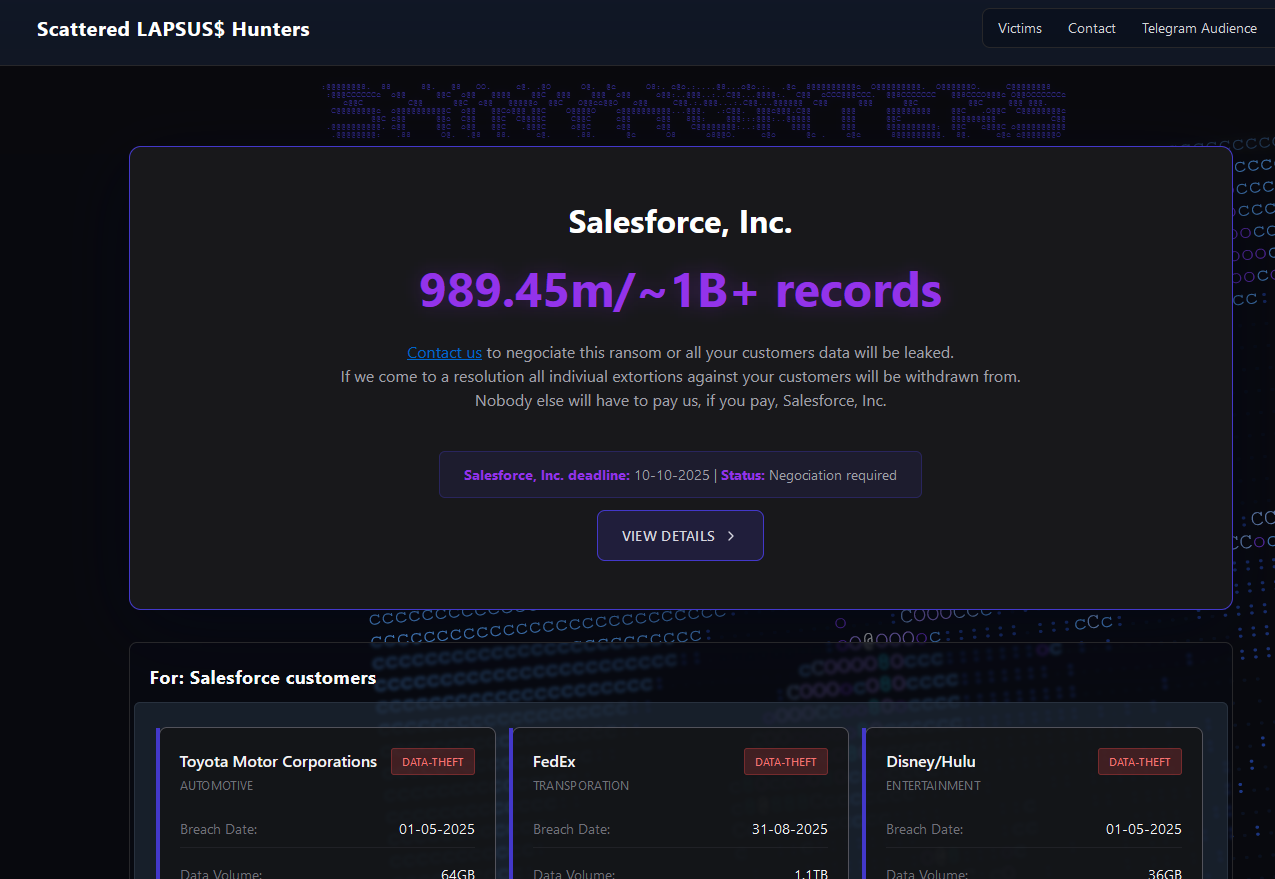
In May 2025, SLSH members launched a social engineering campaign that used voice phishing to trick targets into connecting a malicious app to their organization’s Salesforce portal. The group later launched a data leak portal that threatened to publish the internal data of three dozen companies that allegedly had Salesforce data stolen, including ToyotaFedExDisney/Hulu, and UPS.

The new extortion website tied to ShinyHunters, which threatens to publish stolen data unless Salesforce or individual victim companies agree to pay a ransom.

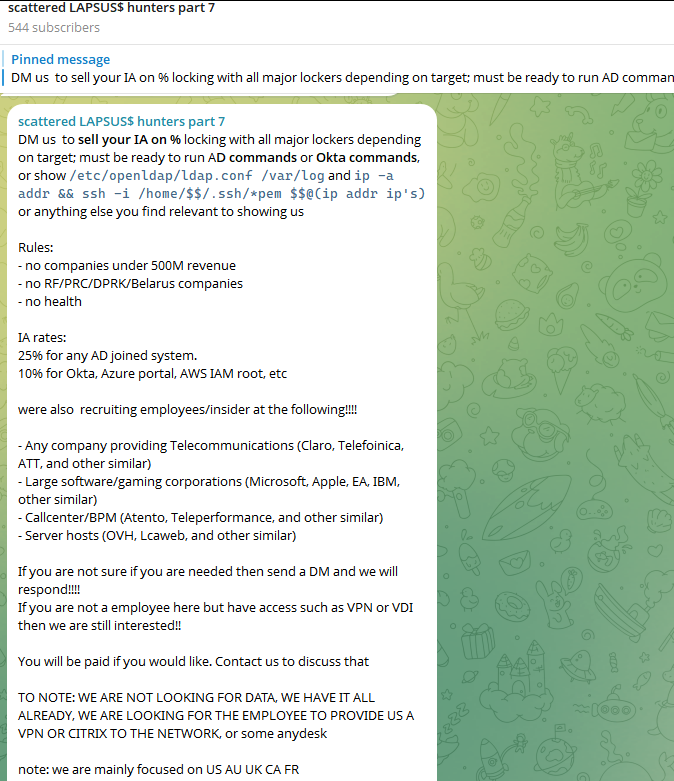
Last week, the SLSH Telegram channel featured an offer to recruit and reward “insiders,” employees at large companies who agree to share internal access to their employer’s network for a share of whatever ransom payment is ultimately paid by the victim company.

SLSH has solicited insider access previously, but their latest call for disgruntled employees started making the rounds on social media at the same time news broke that the cybersecurity firm Crowdstrike had fired an employee for allegedly sharing screenshots of internal systems with the hacker group (Crowdstrike said their systems were never compromised and that it has turned the matter over to law enforcement agencies).

The Telegram server for the Scattered LAPSUS$ Hunters has been attempting to recruit insiders at large companies.

Members of SLSH have traditionally used other ransomware gangs’ encryptors in attacks, including malware from ransomware affiliate programs like ALPHV/BlackCat, Qilin, RansomHub, and DragonForce. But last week, SLSH announced on its Telegram channel the release of their own ransomware-as-a-service operation called ShinySp1d3r.

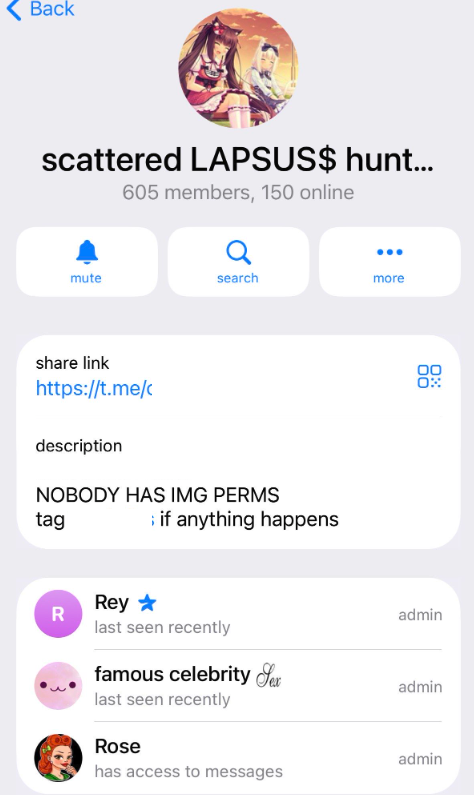
The individual responsible for releasing the ShinySp1d3r ransomware offering is a core SLSH member who goes by the handle “Rey” and who is currently one of just three administrators of the SLSH Telegram channel. Previously, Rey was an administrator of the data leak website for Hellcat, a ransomware group that surfaced in late 2024 and was involved in attacks on companies including Schneider Electric, Telefonica, and Orange Romania.

A recent, slightly redacted screenshot of the Scattered LAPSUS$ Hunters Telegram channel description, showing Rey as one of three administrators.

Also in 2024, Rey would take over as administrator of the most recent incarnation of BreachForums, an English-language cybercrime forum whose domain names have been seized on multiple occasions by the FBI and/or by international authorities. In April 2025, Rey posted on Twitter/X about another FBI seizure of BreachForums.

On October 5, 2025, the FBI announced it had once again seized the domains associated with BreachForums, which it described as a major criminal marketplace used by ShinyHunters and others to traffic in stolen data and facilitate extortion.

“This takedown removes access to a key hub used by these actors to monetize intrusions, recruit collaborators, and target victims across multiple sectors,” the FBI said.

Incredibly, Rey would make a series of critical operational security mistakes last year that provided multiple avenues to ascertain and confirm his real-life identity and location. Read on to learn how it all unraveled for Rey.

WHO IS REY?

According to the cyber intelligence firm Intel 471, Rey was an active user on various BreachForums reincarnations over the past two years, authoring more than 200 posts between February 2024 and July 2025. Intel 471 says Rey previously used the handle “Hikki-Chan” on BreachForums, where their first post shared data allegedly stolen from the U.S. Centers for Disease Control and Prevention (CDC).

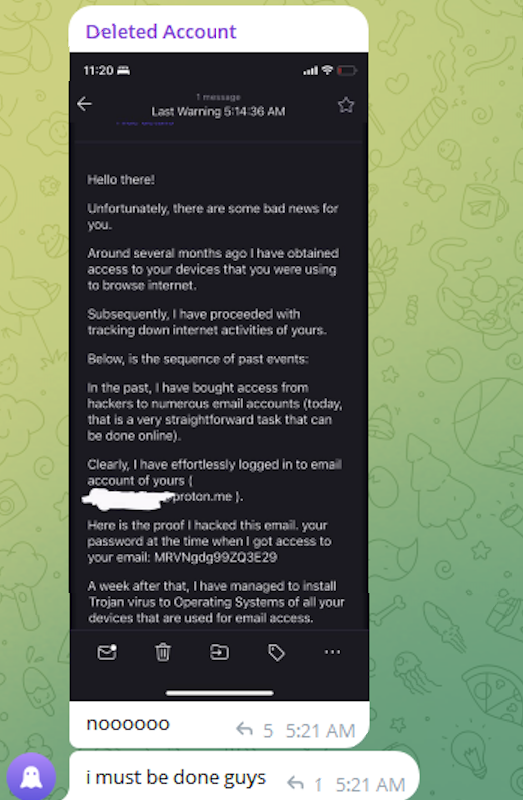
In that February 2024 post about the CDC, Hikki-Chan says they could be reached at the Telegram username @wristmug. In May 2024, @wristmug posted in a Telegram group chat called “Pantifan” a copy of an extortion email they said they received that included their email address and password.

The message that @wristmug cut and pasted appears to have been part of an automated email scam that claims it was sent by a hacker who has compromised your computer and used your webcam to record a video of you while you were watching porn. These missives threaten to release the video to all your contacts unless you pay a Bitcoin ransom, and they typically reference a real password the recipient has used previously.

“Noooooo,” the @wristmug account wrote in mock horror after posting a screenshot of the scam message. “I must be done guys.”

A message posted to Telegram by Rey/@wristmug.

In posting their screenshot, @wristmug redacted the username portion of the email address referenced in the body of the scam message. However, they did not redact their previously-used password, and they left the domain portion of their email address (@proton.me) visible in the screenshot.

O5TDEV

Searching on @wristmug’s rather unique 15-character password in the breach tracking service Spycloud finds it is known to have been used by just one email address: cybero5tdev@proton.me. According to Spycloud, those credentials were exposed at least twice in early 2024 when this user’s device was infected with an infostealer trojan that siphoned all of its stored usernames, passwords and authentication cookies (a finding that was initially revealed in March 2025 by the cyber intelligence firm KELA).

Intel 471 shows the email address cybero5tdev@proton.me belonged to a BreachForums member who went by the username o5tdev. Searching on this nickname in Google brings up at least two website defacement archives showing that a user named o5tdev was previously involved in defacing sites with pro-Palestinian messages. The screenshot below, for example, shows that 05tdev was part of a group called Cyb3r Drag0nz Team.

Rey/o5tdev’s defacement pages. Image: archive.org.

A 2023 report from SentinelOne described Cyb3r Drag0nz Team as a hacktivist group with a history of launching DDoS attacks and cyber defacements as well as engaging in data leak activity.

“Cyb3r Drag0nz Team claims to have leaked data on over a million of Israeli citizens spread across multiple leaks,” SentinelOne reported. “To date, the group has released multiple .RAR archives of purported personal information on citizens across Israel.”

The cyber intelligence firm Flashpoint finds the Telegram user @05tdev was active in 2023 and early 2024, posting in Arabic on anti-Israel channels like “Ghost of Palestine” [full disclosure: Flashpoint is currently an advertiser on this blog].

‘I’M A GINTY’

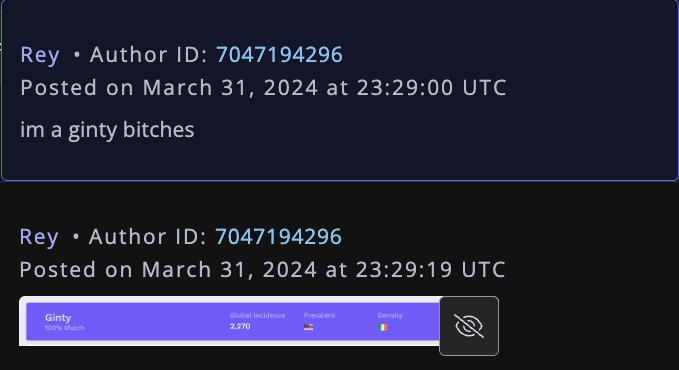
Flashpoint shows that Rey’s Telegram account (ID7047194296) was particularly active in a cybercrime-focused channel called Jacuzzi, where this user shared several personal details, including that their father was an airline pilot. Rey claimed in 2024 to be 15 years old, and to have family connections to Ireland.

Specifically, Rey mentioned in several Telegram chats that he had Irish heritage, even posting a graphic that shows the prevalence of the surname “Ginty.”

Rey, on Telegram claiming to have association to the surname “Ginty.” Image: Flashpoint.

Spycloud indexed hundreds of credentials stolen from cybero5dev@proton.me, and those details indicate that Rey’s computer is a shared Microsoft Windows device located in Amman, Jordan. The credential data stolen from Rey in early 2024 show there are multiple users of the infected PC, but that all shared the same last name of Khader and an address in Amman, Jordan.

The “autofill” data lifted from Rey’s family PC contains an entry for a 46-year-old Zaid Khader that says his mother’s maiden name was Ginty. The infostealer data also shows Zaid Khader frequently accessed internal websites for employees of Royal Jordanian Airlines.

MEET SAIF

The infostealer data makes clear that Rey’s full name is Saif Al-Din Khader. Having no luck contacting Saif directly, KrebsOnSecurity sent an email to his father Zaid. The message invited the father to respond via email, phone or Signal, explaining that his son appeared to be deeply enmeshed in a serious cybercrime conspiracy.

Less than two hours later, I received a Signal message from Saif, who said his dad suspected the email was a scam and had forwarded it to him.

“I saw your email, unfortunately I don’t think my dad would respond to this because they think its some ‘scam email,'” said Saif, who told me he turns 16 years old next month. “So I decided to talk to you directly.”

Saif explained that he’d already heard from European law enforcement officials, and had been trying to extricate himself from SLSH. When asked why then he was involved in releasing SLSH’s new ShinySp1d3r ransomware-as-a-service offering, Saif said he couldn’t just suddenly quit the group.

“Well I cant just dip like that, I’m trying to clean up everything I’m associated with and move on,” he said.

The former Hellcat ransomware site. Image: Kelacyber.com

He also shared that ShinySp1d3r is just a rehash of Hellcat ransomware, except modified with AI tools. “I gave the source code of Hellcat ransomware out basically.”

Saif claims he reached out on his own recently to the Telegram account for Operation Endgame, the codename for an ongoing law enforcement operation targeting cybercrime services, vendors and their customers.

“I’m already cooperating with law enforcement,” Saif said. “In fact, I have been talking to them since at least June. I have told them nearly everything. I haven’t really done anything like breaching into a corp or extortion related since September.”

Saif suggested that a story about him right now could endanger any further cooperation he may be able to provide. He also said he wasn’t sure if the U.S. or European authorities had been in contact with the Jordanian government about his involvement with the hacking group.

“A story would bring so much unwanted heat and would make things very difficult if I’m going to cooperate,” Saif said. “I’m unsure whats going to happen they said they’re in contact with multiple countries regarding my request but its been like an entire week and I got no updates from them.”

Saif shared a screenshot that indicated he’d contacted Europol authorities late last month. But he couldn’t name any law enforcement officials he said were responding to his inquiries, and KrebsOnSecurity was unable to verify his claims.

“I don’t really care I just want to move on from all this stuff even if its going to be prison time or whatever they gonna say,” Saif said.

Operation Endgame targets malware networks in global crackdown

In a sweeping international crackdown coordinated from Europol’s headquarters, law enforcement agencies from the United States and 10 other countries have disrupted three of the world’s most widely used cybercriminal malware operations. Conducted Nov. 10-13, Operation Endgame focused on neutralizing the Rhadamanthys info-stealing malware, the VenomRAT remote access trojan, and the Elysium botnet — tools authorities say enabled hackers to infect hundreds of thousands of computers and steal millions of sensitive credentials across the globe.

The effort involved law enforcement and judicial agencies from Australia, Belgium, Canada, Denmark, France, Germany, Greece, Lithuania, the Netherlands, the United Kingdom, and the United States. According to Europol, the operation led to the arrest of the main VenomRAT suspect in Greece on Nov. 3, searches of 11 locations across Europe, and the seizure or disruption of 1,025 servers and 20 internet domains used by criminals. Coordinated support from over 30 private cybersecurity organizations further assisted the investigation, with companies such as Crowdstrike, Proofpoint, Bitdefender, and the Shadowserver Foundation helping to analyze malicious activity and notify affected network operators.

The law enforcement action is the latest phase of Operation Endgame, an ongoing international initiative to curtail ransomware and malware infrastructure. Previous phases of the operation targeted similar cybercrime enablers over the past two years. Officials said the dismantled infrastructure included hundreds of thousands of computers running malware and several million stolen credentials.

The Shadowserver Foundation, which aggregates global malware infection data, said it sent alerts about Rhadamanthys infections between March and November to national security response teams in 175 countries and more than 10,000 network owners. Europol added that the principal suspect behind the infostealer controlled access to over 100,000 cryptocurrency wallets, with potential losses reaching millions of euros. Many victims whose credentials and devices were compromised continued to operate their systems unaware, authorities said.

VenomRAT, which evolved from earlier remote access trojans, was reportedly marketed for around $150 per month and delivered primarily through malicious email attachments. It allowed users to open backdoors on compromised computers, effectively taking over devices remotely and sometimes exfiltrating sensitive data or launching additional attacks.

Authorities also contacted users of compromised criminal services, appealing for information and exposing some users through an operation-dedicated website and Telegram channel. As these offenders increasingly leverage global infrastructure, authorities suggest that coordinated responses are likely to remain a key feature in future takedowns. 

Operation Endgame is ongoing, with officials indicating that additional actions may follow as investigations continue.

The post Operation Endgame targets malware networks in global crackdown appeared first on CyberScoop.

❌