
Reading view

There are new articles available, click to refresh the page.

U.S. companies hit with record fines for privacy in 2025

U.S. states issued $3.45 billion in privacy-related fines to companies in 2025, a total larger than the last five years combined, according to research and advisory firm Gartner.

The increase is driven in part by stronger, more established privacy laws in states like California, new interstate partnerships built around enforcing laws across state lines, and a renewed focus to how AI and automation affect privacy.

The data indicates that “regulators are shifting their efforts away from awareness to full scale enforcement,” marking a significant shift from even the last few years in how aggressively states are investigating and penalizing companies for privacy law violations.

“This is increasingly becoming the standard in 2026 and for the coming two years,” Gartner’s analysis concludes.
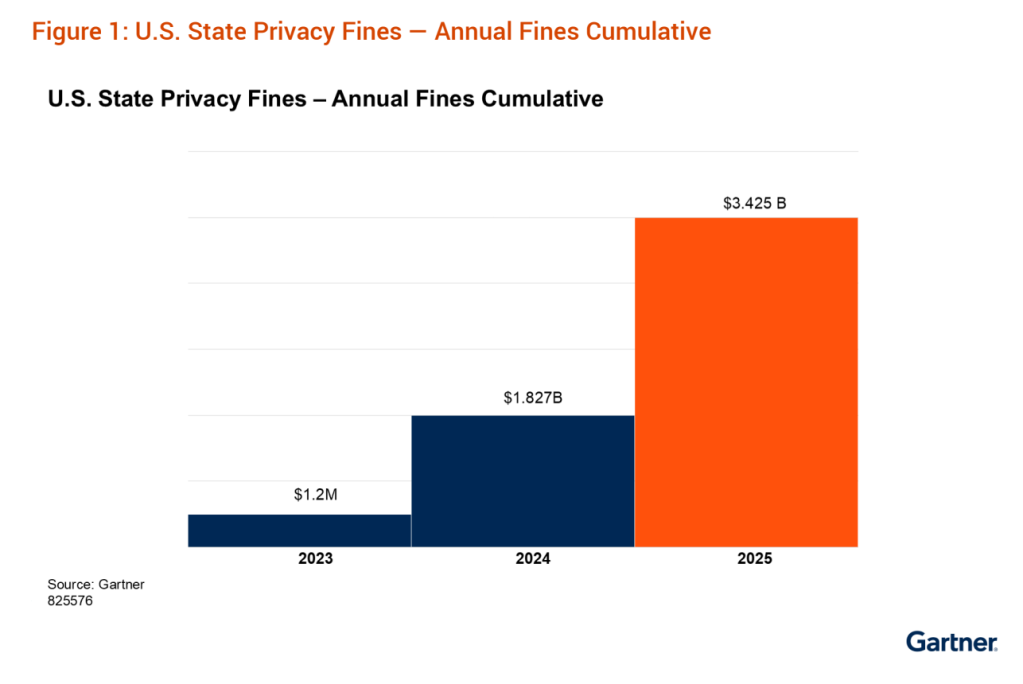
Privacy related fines have gone up significantly in recent years. (Source: Gartner)

The California Consumer Privacy Act had consumer privacy provisions go live in 2023, but for years enforcement was largely dormant. According to Nader Heinen, a data protection and AI analyst at Gartner and co-author of the research, that enforcement lag mirrors the way other major privacy laws, like Europe’s Global Data Protection Regulation, have been carried out in order to “lead with a bit of guidance” for companies while using enforcement sparingly.

But that era appears to be over. In 2025, the California Privacy Protection Agency has used the law to pursue violators across a wide range of industries— not just large conglomerates, but smaller and mid-sized companies in tech, the auto industry, and consumer products, including off-the-shelf goods and apparel.

Heinen said some businesses “weren’t paying attention” and may have been lulled into a false sense of complacency as regulators spun up their enforcement teams, leading to a harsh 2025.

“Unfortunately what happens when so much time passes between the legislation and starting enforcement regularly, is a lot of organizations let their privacy program atrophy,” he said.

States have also sought to combine their resources to target and penalize privacy violators across state lines. Last year, ten states came together to form the Consortium of Privacy Regulators, pledging to coordinate investigations and enforcement of common privacy laws around accessing, deleting and preventing the sale of personal information.

Beyond laws like the CCPA, states have been updating existing privacy and data-protection laws to more directly address harms from automated decision-making technologies, including AI. State privacy regulators are especially focused on how personal or private data is used to train AI systems and  help it make inferences.

Gartner expects privacy fines to further increase in the coming years and Heinen said states will likely again lead the way on building the legal infrastructure to enforce data privacy in the AI age as they become the main conduit for lingering anxiety about the potential negative impacts of the technology.

“You have to put yourself in the position of these state legislatures,” Heinen said. “Their constituencies – the voting public – is telling them we’re worried about AI. AI anxiety is a thing. Everybody’s worried about whether AI is going to take their job or impact their capacity to find a job, so they want to see legislation in place to protect them.”

This past month, House Republicans unveiled their latest attempt to pass comprehensive federal privacy legislation with a bill that would preempt tougher state laws like those in California. In particular, the CCPA gives residents a private right of action – the legal right to sue companies directly – for violation of privacy laws.

On Monday, Tom Kemp, executive director of the California Privacy Protection Agency, wrote to House Energy and Commerce Chair Brett Guthrie, R-Ky., to oppose the bill, arguing it would provide “a ceiling” for Americans’ data privacy protections rather than a “floor” to build on.

“Preemption would strip away important existing state privacy provisions that protect tens of millions of Americans now,” Kemp wrote. “That would be a significant step backward in privacy protection at a time when individuals are increasingly concerned about their privacy and security online, and when challenges from data-intensive new technologies such as AI are developing quickly.”

The post U.S. companies hit with record fines for privacy in 2025 appeared first on CyberScoop.

AI is making it very easy for the government to spy on you. Some lawmakers are worried.

Jared Perlo reports: The long-running fight to rein in the government’s power to search Americans’ phone calls, emails and text messages without a warrant has gained new urgency on Capitol Hill over concerns that AI will supercharge state surveillance. Lawmakers are currently jockeying over reforms to a key law that enables warrantless monitoring of Americans’...

House Republicans Introduce Comprehensive Federal Privacy Bill: “SECURE Data Act”

Hunton Andrews Kurth writes: On April 22, 2026, the House Energy & Commerce Committee announced the introduction of and intention to advance the “Securing and Establishing Consumer Uniform Rights and Enforcement over Data Act” (the “SECURE Data Act”). The SECURE Data Act, which was crafted by the majority committee members’ Privacy Working Group, would replace the...

Privacy Websites break California privacy law at ‘industrial scale,’ survey finds

Tech companies like Google, Facebook and Microsoft are ignoring data controls mandated under California law, researchers say. By: Colin Lecher A new audit has found that websites across the internet may be failing to abide by California privacy law, ignoring a requirement to not track visitors who set a privacy control. The report, from researchers...

Virginia enacts ban on precise geolocation data sales as momentum for similar prohibitions builds

Suzanne Smiley reports: The governor of Virginia on Monday signed a law banning the sale of citizens’ precise geolocation data, a sign of growing momentum for such laws at the state level. The legislation bars the sale of geolocation within a 1,750 foot radius, a buffer large enough to keep data brokers from pinpointing where...

Platform liability after Russmedia: Italian DPA Fines Platform for Allowing Phone Number in Sex Work Ads Without Consent

Odia Kagan of FoxRothschild writes: The Italian Data Protection Authority (Garante) recently fined online classifieds platform Bakeca S.r.l. after an unknown user published two ads, including an explicit offer for sex work, listing the phone number of a person who had nothing to do with the ads and never consented to their publication. The decision,...

Ohio man becomes first in country to be convicted under federal revenge porn law

Henry Aleksandrov reports: An Ohio man who became the first person in the country to be convicted under the federal revenge porn law would be able to eventually reintegrate into society after Ohio lawmakers introduced several bills, some of which were already passed by the legislators. Among the ways the bills would help the man...

Oklahoma, Alabama enact weak privacy laws

From the good folks at EPIC.org: Oklahoma and Alabama recently enacted “privacy” laws that fail to meaningfully protect consumers from the abuse of their personal data. Oklahama’s bill has been signed into law, and Alabama’s awaits the Governor’s signature. The bill mirrors laws in other states such as Virginia. EPIC and U.S. PIRG Education Fund released a report last year...

Court Allows Sharing of Medical Information Claim to Proceed Under ECPA

Odia Kagan of FoxRothschild writes: A new federal court decision denied a motion to dismiss in a case alleging Federal Electronic Communications Privacy Act (ECPA) claims arising from the sharing of health information through a website’s online tracking technology. What does this case teach and what should healthcare companies be doing about it? Recap of...

New Jersey Enacts New Restrictions on Health Care Facilities’ Use of Patient Data

Hunton Andrews Kurth writes: On March 25, 2026, New Jersey enacted A4070, which restricts health care facilities’ collection and disclosure of certain patient information, including immigration status, citizenship status, place of birth, Social Security number and individual taxpayer identification number. Under the law, a health care facility may not request or collect the listed information unless...

Trump’s Personnel Agency Is Asking for Federal Workers’ Medical Records

by Amanda Seitz and Maia Rosenfeld April 8, 2026 The Trump administration is quietly seeking unprecedented access to medical records for millions of federal workers and retirees, and their families. A brief notice from the Office of Personnel Management could dramatically change which personally identifiable medical information the agency obtains, giving it the power to...

Japan Relaxes Data Protection Rules to Accelerate AI Innovation

From the what-can-possibly-go-wrong dept., Rachel Sim reports: The Cabinet of Japan has approved a bill amending the Act on the Protection of Personal Information to support AI innovation and development. This marks a shift from a consent-based model towards a more flexible framework that prioritises data use for innovation. Previous regulation enforced that data such...

Illinois’ Damages Limitation for Biometric Privacy Violations Applies Retroactively

Hunton Andrews Kurth writes: On April 1, 2026, the U.S. Court of Appeals for the Seventh Circuit held that the 2024 amendment to Illinois’ Biometric Information Privacy Act (“BIPA”), limiting damages, applies retroactively to pending cases. The ruling in Clay v. Union Pacific Railroad Company, Docket No. 25-2185 (7th Cir. 2026), represents a major win for...

As DOJ prepares to share state voter data with DHS, a key privacy officer resigns

Jude Joffe-Block of NPR reports: As Justice Department officials are working to acquire sensitive voter registration data from states and have recently disclosed a plan to share it with the Department of Homeland Security, a key privacy officer in DOJ’s division tasked with enforcing civil and voting rights laws has resigned. Kilian Kagle was the chief...

Utah and South Dakota Enact Genetic Privacy Laws as Other States Advance Bills

Libbie Canter, Elizabeth Brim, and Clare Mathias of Covington and Burling write: At the state level, genetic privacy remains a fast-moving topic, and states continue to introduce and advance bills regulating genetic data. Several proposals that we covered in more detail earlier this year have progressed since our last update, including: Utah enacted HB 182, which regulates “foreign adversaries’”...

Trump’s new executive creates a national voter list

I wish some of this stuff was an April Fools joke, but it’s not. Back in September 2025, we reported that President Trump wanted to build a national voter roll. If his latest attempt survives a court challenge, he will be one step closer to achieving that. Daily Caller reports: President Donald Trump is expected...

Supreme Court backs religious counselor, ruling against ban on conversion therapy

Kelsey Reichmann reports: Ruling against Colorado’s conversion therapy ban, the Supreme Court on Tuesday held that a religious counselor had a First Amendment right to provide faith-based counseling to change sexual behaviors. In an 8-1 ruling, the court said Colorado’s law censored speech based on viewpoint because it prohibited not only long-abandoned aversive physical interventions but also...

Why Trump is now investigating Maine for requiring insurers to cover abortion

Rose Lundy reports: The U.S. Department of Health and Human Services’ Office for Civil Rights announced on March 19 that it would investigate Maine and 12 other states that have laws requiring health insurance plans to cover abortion services. The office is asserting that a federal provision called the Weldon Amendment, which protects “health care entities” such as...
❌