❌

Reading view

There are new articles available, click to refresh the page.

Mozilla Uses Anthropic's Mythos To Fix 271 Bugs In Firefox

BrianFagioli writes: Mozilla says it used an early version of Anthropic's Claude Mythos Preview to comb through Firefox's code, and the results were hard to ignore. In Firefox 150, the team fixed 271 vulnerabilities identified during this effort, a number that would have been unthinkable not long ago. Instead of relying only on fuzzing tools or human review, the AI was able to reason through code and surface issues that typically require highly specialized expertise. The bigger implication is less about one release and more about where this is heading. Security has long favored attackers, since they only need to find a single flaw while defenders have to protect everything. If AI can scale vulnerability discovery for defenders, that dynamic could start to shift. It does not mean zero days disappear overnight, but it suggests a future where bugs are found and fixed faster than attackers can weaponize them. "Computers were completely incapable of doing this a few months ago, and now they excel at it," says Mozilla in a blog post. "We have many years of experience picking apart the work of the world's best security researchers, and Mythos Preview is every bit as capable. So far we've found no category or complexity of vulnerability that humans can find that this model can't." The company concluded: "The defects are finite, and we are entering a world where we can finally find them all."

Read more of this story at Slashdot.

Firefox vs. Chrome: Which Performs Better on a Linux Laptop?

Phoronix staged "a showdown" between Firefox and Chrome, testing them both on an Intel Panther Lake laptop running Ubuntu 26.04. JetStream 3.0 was announced at the end of March as the latest major web browser benchmark. This updated version of JetStream is focused on intensive portions of modern JavaScript and WebAssembly web applications... Google Chrome 147 came in at 1.47x the performance of Mozilla Firefox 149. A very strong showing for Google's web browser and to not much surprise Google engineers have been heavily involved in JetStream 3 as part of its open governance model. Chrome debuts very well on JetStream 3 while it will be interesting to see what optimizations Mozilla engineers pursue in the months ahead... In the recent Speedometer 3.1 benchmark update that is focused on browser responsiveness, Chrome was at 1.24x the performance of Firefox... Firefox picked up wins in the MotionMark and StyleBench browser benchmarks. Google Chrome meanwhile continued to dominate in the JavaScript heavy benchmarks... In some of the WebAssembly benchmarks, there was at least some healthy competition between Firefox and Chrome on Linux. Across the web browser benchmarks, the Core Ultra X7 358H power consumption came in at 11.44 Watts on average for Chrome and 11.74 Watts for Firefox. Quite close. The slight CPU power difference may come down to the CPU usage with Chrome coming in slightly lower at 8.13% on average to 8.35% with Firefox. Chrome also came in at slightly lower memory consumption across all the benchmarks with total memory usage on average at 4.67GB to Firefox at 4.83GB.

Read more of this story at Slashdot.

Firefox Announces Built-In VPN and Other New Features - and Introduces Its New Mascot

A free built-in VPN is coming to Firefox on Tuesday, Mozilla announced this week: Free VPNs can sometimes mean sketchy arrangements that end up compromising your privacy, but ours is built from our data principles and commitment to be the world's most trusted browser. It routes your browser traffic through a proxy to hide your IP address and location while you browse, giving you stronger privacy and protection online with no extra downloads. Users will have 50 gigabytes of data monthly in the U.S., France, Germany and U.K. to start. Available in Firefox 149 starting March 24. We also recently shared that Firefox is the first browser to ship Sanitizer API, a new web security standard that blocks attacks before they reach you [for untrusted HTML XSS vulnerabilities]. "The roadmap for Firefox this year is the most exciting one we've developed in quite a while," says Firefox head Ajit Varma. "We're improving the fundamentals like speed and performance. We're also launching innovative new open standards in Gecko to ensure the future of the web is open, diverse, and not controlled by a single engine. "At the same time we're prioritizing features that give users real power, choice and strong privacy protections, built in a way that only Firefox can. And as always, we'll keep listening, inviting users to help shape what comes next and giving them more reasons to love Firefox." Two new features coming next week: Split View puts two webpages side by side in one window, making it easy to compare, copy and multitask without bouncing between tabs. Rolling out in Firefox 149 on March 24. Tab Notes let you add notes to any tab, another tool to help with multitasking and picking up where you left off. Available in Firefox Labs 149 starting March 24. And Firefox also released a video this week introducing their new mascot Kit.

Read more of this story at Slashdot.

Microsoft Patch Tuesday, March 2026 Edition

Microsoft Corp. today pushed security updates to fix at least 77 vulnerabilities in its Windows operating systems and other software. There are no pressing β€œzero-day” flaws this month (compared to February’s five zero-day treat), but as usual some patches may deserve more rapid attention from organizations using Windows. Here are a few highlights from this month’s Patch Tuesday.
Image: Shutterstock, @nwz.

Two of the bugs Microsoft patched today were publicly disclosed previously. CVE-2026-21262 is a weakness that allows an attacker to elevate their privileges on SQL Server 2016 and later editions.

β€œThis isn’t just any elevation of privilege vulnerability, either; the advisory notes that an authorized attacker can elevate privileges to sysadmin over a network,” Rapid7’s Adam Barnett said. β€œThe CVSS v3 base score of 8.8 is just below the threshold for critical severity, since low-level privileges are required. It would be a courageous defender who shrugged and deferred the patches for this one.”

The other publicly disclosed flaw is CVE-2026-26127, a vulnerability in applications running on .NET. Barnett said the immediate impact of exploitation is likely limited to denial of service by triggering a crash, with the potential for other types of attacks during a service reboot.

It would hardly be a proper Patch Tuesday without at least one critical Microsoft Office exploit, and this month doesn’t disappoint. CVE-2026-26113 and CVE-2026-26110 are both remote code execution flaws that can be triggered just by viewing a booby-trapped message in the Preview Pane.

Satnam Narang at Tenable notes that just over half (55%) of all Patch Tuesday CVEs this month are privilege escalation bugs, and of those, a half dozen were rated β€œexploitation more likely” β€” across Windows Graphics Component, Windows Accessibility Infrastructure, Windows Kernel, Windows SMB Server and Winlogon. These include:

–CVE-2026-24291: Incorrect permission assignments within the Windows Accessibility Infrastructure to reach SYSTEM (CVSS 7.8)
–CVE-2026-24294: Improper authentication in the core SMB component (CVSS 7.8)
–CVE-2026-24289: High-severity memory corruption and race condition flaw (CVSS 7.8)
–CVE-2026-25187: Winlogon process weakness discovered by Google Project Zero (CVSS 7.8).

Ben McCarthy, lead cyber security engineer at Immersive, called attention to CVE-2026-21536, a critical remote code execution bug in a component called the Microsoft Devices Pricing Program. Microsoft has already resolved the issue on their end, and fixing it requires no action on the part of Windows users. But McCarthy says it’s notable as one of the first vulnerabilities identified by an AI agent and officially recognized with a CVE attributed to the Windows operating system. It was discovered by XBOW, a fully autonomous AI penetration testing agent.

XBOW has consistently ranked at or near the top of the Hacker One bug bounty leaderboard for the past year. McCarthy said CVE-2026-21536 demonstrates how AI agents can identify critical 9.8-rated vulnerabilities without access to source code.

β€œAlthough Microsoft has already patched and mitigated the vulnerability, it highlights a shift toward AI-driven discovery of complex vulnerabilities at increasing speed,” McCarthy said. β€œThis development suggests AI-assisted vulnerability research will play a growing role in the security landscape.”

Microsoft earlier provided patches to address nine browser vulnerabilities, which are not included in the Patch Tuesday count above. In addition, Microsoft issued a crucial out-of-band (emergency) update on March 2 for Windows Server 2022 to address a certificate renewal issue with passwordless authentication technology Windows Hello for Business.

Separately, Adobe shipped updates to fix 80 vulnerabilities β€” some of them critical in severity β€” in a variety of products, including Acrobat and Adobe Commerce. Mozilla Firefox v. 148.0.2 resolves three high severity CVEs.

For a complete breakdown of all the patches Microsoft released today, check out the SANS Internet Storm Center’s Patch Tuesday post. Windows enterprise admins who wish to stay abreast of any news about problematic updates, AskWoody.com is always worth a visit. Please feel free to drop a comment below if you experience any issues apply this month’s patches.

MS-DEFCON 4: Superstition vs. risk

ISSUE 23.08.1 β€’ 2026-02-24 By Susan Bradley I’m not a superstitious person. But there are times β€” especially around printers, copiers, or other technology devices β€” when I jokingly say, β€œShush, don’t talk about how they are working. It will jinx them.” And there are times I talk about how well the devices are working […]

Mozilla Says It’s Finally Done With Two-Faced Onerep

In March 2024, Mozilla said it was winding down its collaboration with Onerep β€” an identity protection service offered with the Firefox web browser that promises to remove users from hundreds of people-search sites β€” after KrebsOnSecurity revealed Onerep’s founder had created dozens of people-search services and was continuing to operate at least one of them. Sixteen months later, however, Mozilla is still promoting Onerep. This week, Mozilla announced its partnership with Onerep will officially end next month.

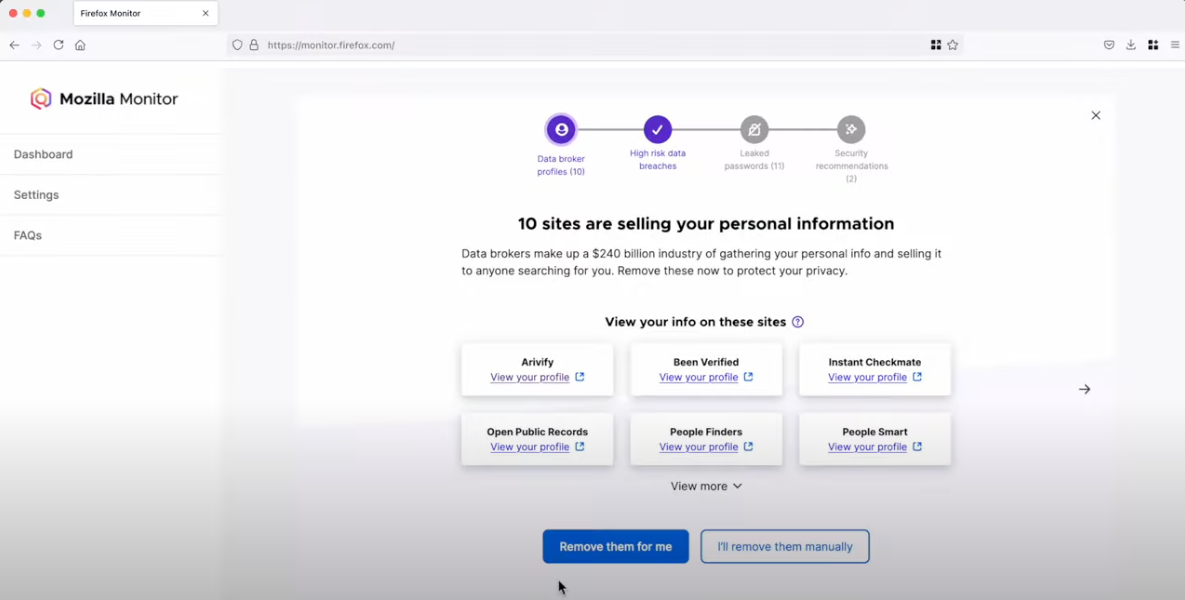
Mozilla Monitor. Image Mozilla Monitor Plus video on Youtube.

In a statement published Tuesday, Mozilla said it will soon discontinue Monitor Plus, which offered data broker site scans and automated personal data removal from Onerep.

β€œWe will continue to offer our free Monitor data breach service, which is integrated into Firefox’s credential manager, and we are focused on integrating more of our privacy and security experiences in Firefox, including our VPN, for free,” the advisory reads.

Mozilla said current Monitor Plus subscribers will retain full access through the wind-down period, which ends on Dec. 17, 2025. After that, those subscribers will automatically receive a prorated refund for the unused portion of their subscription.

β€œWe explored several options to keep Monitor Plus going, but our high standards for vendors, and the realities of the data broker ecosystem made it challenging to consistently deliver the level of value and reliability we expect for our users,” Mozilla statement reads.

On March 14, 2024, KrebsOnSecurity published an investigation showing that Onerep’s Belarusian CEO and founder Dimitiri Shelest launched dozens of people-search services since 2010, including a still-active data broker called Nuwber that sells background reports on people. Shelest released a lengthy statement wherein he acknowledged maintaining an ownership stake in Nuwber, a data broker he founded in 2015 β€” around the same time he launched Onerep.

Towards a Quieter Firefox

Brian King // On a recent webapp test, I got a little frustrated with all the extra HTTP requests showing up in my Burpsuite Proxy History from connections that Firefox […]

The post Towards a Quieter Firefox appeared first on Black Hills Information Security, Inc..

❌