Reading view

There are new articles available, click to refresh the page.

Forget Sidecar, someone just got the real macOS working on an iPad — and it proves it’d be a terrible idea

  • Virtual Mac on iPad gets macOS running on compatible iPads
  • It requires a jailbroken tablet and specific versions of iPadOS
  • Its many limitations mean I don’t think it’s worth the hassle

For years, people have been wondering if Apple is ever going to “merge” iPadOS and macOS into some unholy mutant operating system. While Apple has repeatedly and resoundingly denied that’s ever going to happen, one intrepid developer has taken it upon themselves to do the hard work instead. And while the result lets you run full-fat macOS on your iPad Pro or iPad Air, I wouldn’t recommend it to anyone but the hardiest of souls.

Dubbed Virtual Mac on iPad, this GitHub project ports macOS onto Apple’s best iPads. That means it’s nothing like Apple’s Sidecar feature, which lets you use an iPad as a second display for a Mac. In the case of Sidecar, the Mac is doing all the processing. With Virtual Mac on iPad, however, it’s your iPad that’s actually running the operating system.

Unfortunately, getting that to actually happen is more than a little convoluted. You can’t even get started unless you’ve jailbroken your iPad, which means hacking it so it can run apps and systems not authorized by Apple. As well as that, the jailbroken iPad must be running iPadOS 16 to iPadOS 16.3.1 — nothing more, nothing less — in order to harness an exploit that was patched in subsequent editions. The requirements so far will probably be enough to put a lot of people off.

If you’ve persevered, you’ll need to add a specified repository to your device and install Virtual Mac on iPad from there. But you’ll need to be aware that even with macOS successfully set up, you won’t be able to log into your Apple Account — since you’re using a jailbroken device with an unofficial port of macOS, you’ll run into problems if you try to sign in, putting features like Find My and iCloud syncing out of reach.

Is it worth it?

iPadOS 26 being introduced at Apple's Worldwide Developers Conference (WWDC) in June 2025.

(Image credit: Apple)

Why would you go to all this effort to run macOS on your iPad? Well, there are a few reasons, including accessing Mac-only apps and getting a more portable platform to run macOS on.

But I certainly don’t think it’s a good idea. Apple’s iPadOS and macOS systems have been designed for very different use cases, and simply shoehorning a platform designed for a Mac onto an iPad isn’t a guarantee of success.

For one thing, macOS is made for large screens and input devices like mice and keyboards, while iPadOS works best on smaller screens operated by your fingers and thumbs. Sure, there’s some crossover — I’m aware that you can use mice and keyboards with an iPad, for example — but that doesn’t escape the fact that Virtual Mac on iPad puts the Mac’s operating system on a device it was never intended for.

As well as that, it requires a lot of effort for seemingly very small rewards. There are only a handful of cases where installing Virtual Mac on iPad is worthwhile, at least in my opinion: accessing apps like Xcode and Terminal that aren’t available in iPadOS, for example, or getting macOS on the most portable device possible.

But Apple’s best MacBooks are still lightweight and easy to carry around, and with a touchscreen MacBook Pro rumored to be just around the corner and Sidecar already a thing, the need for something like Virtual Mac on iPad feels limited. Is it worthwhile to go to all this trouble just for an ounce more portability? I’m sure it is for some people, but that number is likely to be vanishingly small.

At the end of the day, I know there will be some people for whom this is a welcome development. But its complicated installation process and limited use case just reinforce for me that Apple is absolutely right not to merge iPadOS and macOS. They’re meant to be separate, just as Apple intended.

Supply chain challenges loom large in quantum race, White House official says

One of the most difficult obstacles to overcome in the quantum race will be the supply chain, given how diffuse it is, a top White House official said Wednesday.

“Supply chain is one of the biggest challenges in my mind, and really, the challenge with the quantum supply chain is that quantum is not defined by a single hardware platform,” said Brad Blakestad, director of the National Quantum Coordination Office within the White House Office of Science and Technology Policy.

“If you look at the quantum computing technologies, the quantum sensing technologies, the networking — those are all different,” he said in a webinar hosted by Inside Cybersecurity and USTelecom. “And even within computing, there’s seven different modalities that use completely different components. So we have this not just one monolithic supply chain, but just a bunch of different supply chains that are kind of intertwined in various ways.”

Blakestad made his remarks a little more than a month after President Donald Trump signed two executive orders on quantum computing. He referenced proposed ways to address the supply chain challenge in one of the orders.

“The other major issue or challenge that we face right now is that we’re on the cusp of quantum exploding from a commercialization perspective, but we’re not quite there yet,” he said. “So there’s not the funding, the revenue coming from large-scale quantum companies at this point to really make the supply chain as robust as you would want. So thinking about it from the government perspective, it’s just [that] there are too many places that I would want to bolster and not enough funding to do it.”

Blakestad touted steps to help that along such as the government buying widgets from a company that makes them to certain specifications, or prize challenges.

The quantum supply chain isn’t just diffuse in the United States, an International Institute for Strategic Studies policy paper noted Wednesday. It’s “inherently international: no single country dominates the supply chain, whether specialised materials, cryogenic equipment, hardware, software, fabrication or algorithms,” the authors, Dongyoun Cho and Maria Shagina, wrote.

And a March report from the Center for a New American Security identified strengthening the quantum supply chain as pivotal to the United States seizing the benefits of the technology, citing gaps in the U.S. supply chain and reliance on foreign suppliers such as China and Russia. 

Supply chain wasn’t the only obstacle Blakestad mentioned as looming large.

“The encryption challenge is a real challenge, and we want to make sure that we are aware of when quantum computers will ultimately get to a scale that they start having these sorts of implications and move as quickly as we can,” he said. “So, just by owning the technologies, by owning the workforce, by making the United States the place that people want to come to be on the cutting edge of this technology, I think that kind of addresses both of those issues, and that’s what makes it so critical.”

Another difficulty is measuring progress, Blakestad said: “It’s also very, very hard to benchmark, and to know that you’re actually doing what you’re supposed to, what you are intending to do.”

The post Supply chain challenges loom large in quantum race, White House official says appeared first on CyberScoop.

Russian espionage group using novel Zimbra exploit to steal sensitive data from Western countries

A Russian state-sponsored threat group has been stealing sensitive data from governments and commercial organizations since July 2025 via a novel exploit in popular Linux-based enterprise software, U.S. authorities and cyber officials from more than a dozen other countries warned in a joint cybersecurity advisory Thursday.

Laundry Bear’s most recent espionage campaign involves the exploitation of a zero-day vulnerability in Zimbra Collaboration Suite that wasn’t patched until November 2025, five months after attacks were well underway, officials said. 

The exploit just requires a view — no clicks — and allows attackers to steal the previous 90 days’ worth of email, the account’s password, search history, the victim organization’s email directory, two-factor authentication tokens and other newly created passwords.

“The covert and persistent nature of this activity, along with the absence of any known financial extortion, almost certainly indicates this group’s involvement in espionage activities with Russian government backing,” officials wrote in the advisory. 

“Additionally, extensive Ukrainian targeting, prior to use against U.S. and other NATO allies, outlines an increasing trend within Russian cyber threat groups to target Ukrainian users first—both as a priority target and as a testbench for malicious cyber techniques before broader global deployment.”

The state-sponsored espionage group, also known as Void Blizzard, has compromised governments and organizations in the defense, education, energy, law enforcement, media, finance, transportation and technology sectors. 

Laundry Bear’s year-long campaign involving the exploitation of CVE-2025-66376 showcases more technical capabilities, including a custom JavaScript payload it delivers to targeted victims via phishing emails. The threat group could also likely adapt the novel data exfiltration and aggregation capability, dubbed “beehive,” to exploit other vulnerabilities, officials warned.

The defect’s medium-severity rating of 6.1 underscores the challenge defenders regularly confront in prioritizing patching schedules based on measure of severity alone.

The Russian state-supported group, which has been active since at least 2024, is still actively exploiting Zimbra Collaboration Suite instances that remain unpatched, officials said.

Authorities shared Thursday indicators of compromise, mitigation steps and urged organizations to update their vulnerable software.

“This campaign’s targeted victimology and limited exploitation capabilities likely indicate this group manually identifies and targets the victim organizations” by identifying organizations with public-facing infrastructure, officials wrote in the advisory.

Once a target is identified, Laundry Bear also likely compiles email addresses for users to target with the exploit via phishing emails. Officials did not identify specific victims or describe the volume of organizations already compromised.

The joint cybersecurity advisory was issued by the United States, Australia, Canada, New Zealand, the United Kingdom, Czech Republic, Denmark, Estonia, Finland, France, Italy, Moldova, the Netherlands, Poland, Spain and Sweden.

The post Russian espionage group using novel Zimbra exploit to steal sensitive data from Western countries appeared first on CyberScoop.

Amazon flips the bird to Apple — drops iPad (A16) price back down to pre-hike level

It was the news none of us wanted to hear, but at the turn of the new financial year in Australia, Apple made the move to raise Australian prices across its entire product lineup. The tech giant has often been better than other tech companies at absorbing increased supply-chain costs, but the current RAM and component crisis meant it could no longer hold out.

Perhaps the biggest and most upsetting increase affected the delightfully affordable MacBook Neo, but even the iPad wasn’t immune, with the company’s entry-level iPad (A16) seeing its price surge to AU$749, an increase of AU$150.

If you were hoping to grab one for yourself, but were put off by the increase (we wouldn’t blame you), then Amazon could have just answered your prayers, as it has knocked it back down to its pre-increase price of AU$599.

Beating its Prime Day price by a cool AU$70, now is prime time (pardon the pun) to scoop up Apple’s most affordable iPad at a price that’s slightly easier to stomach. The A16 chip is a good fit for streaming, browsing, note-taking, video calls and light productivity, while our iPad 11-inch (2025) review found it zippy for everyday apps. It doesn’t support Apple Intelligence, but that’s unlikely to bother most casual tablet buyers.View Deal

OK, so this might not be the absolute best iPad discount ever — it dropped to AU$499 during the recent EOFY sales — but for Amazon to bring the asking price back down to its longtime RRP is worth shouting about.

At its previous full price of AU$599, we could confidently say that the iPad 11-inch (2025) ranks as the best iPad for most people and the best cheap tablet overall.

Not only does the aforementioned A16 chip mean it’s quick in use, but a 10-hour battery life and crisp 10.9-inch screen make it a stellar choice for scrolling, streaming, video calling and light gaming.

Amazon has only discounted the 128GB variant, and while the Cellular model also gets a discount, it’s nowhere near as impressive as the Wi-Fi-only alternative. Do note, however, that the AU$150 saving only applies to the silver and pink models. The blue colourway is down to AU$699, while yellow has been left untouched.

I don’t expect this discount to last forever, and it’s anyone's guess if and when it’ll receive a similar saving in the future. If you missed out during EOFY and weren’t taken by the Prime Day price, this is an opportune time to pounce.

Apple price hikes have hit Australia, and the MacBook Neo no longer looks quite so cheap

  • Apple has raised prices across multiple categories in Australia
  • The MacBook Neo has lost some of its entry-level appeal
  • The move follows rising RAM and storage costs

Australian shoppers looking for EOFY offers, or waiting for early Amazon Prime Day tech deals, now have another price shift to factor in. Apple has raised local prices across several major product categories, including the new MacBook Neo, MacBook Air, iPad range, Apple TV 4K, HomePod mini and more.

The timing is awkward, but it also hasn't come from nowhere. Apple has usually been better than most tech companies at absorbing supply chain pressure before it reaches shoppers, though the current RAM and component crunch has been dragging on for long enough to change that calculation.

The warning signs came last month, when Tim Cook flagged "significantly higher memory costs" on an earnings call, then said RAM prices would "drive an increasing impact" on Apple products from this month.

Australian buyers will feel this

One of the clearest examples is the new MacBook Neo, Apple's lower-cost MacBook model and the machine most likely to appeal to students, or anyone trying to get a new Apple laptop for less than MacBook Air money. In Australia it launched with a price from AU$899. It now starts at AU$1,049, so it has lost some of its entry-level appeal.

Sure, it’s still Apple's cheapest laptop, but the higher starting price makes it less competitive against Windows laptops that have been fighting to compete with the Neo. The 512GB model with Touch ID has also gone from AU$1,099 to AU$1,249.

The MacBook Air has lost some of its competitive edge, and the 13-inch model with the M5 chip (check out our MacBook Air 13-inch M5 review) has jumped from AU$1,799 to AU$2,099 to start.

The 15-inch model is up by the same AU$300 amount, from AU$2,199 to AU$2,499. For a laptop that often sits in the middle of Apple's consumer Mac range, that is a significant hit to its value proposition.

The MacBook Pro increases are especially notable in some configurations. The 14-inch MacBook Pro with M5 now starts at AU$3,199, up from AU$2,699, and the higher-end M5 Max models have also moved up by several hundred dollars. Buyers looking at extra memory or storage were already dealing with expensive upgrades, so the higher base prices only make that decision harder.

The Mac mini is another notable hit. It has gone from AU$999 to AU$1,299, which is a 30% increase on a machine that has often been one of the easier Apple desktops to justify on price.

The iPad range is up, which matters for students, families and anyone who was looking at a new tablet for work, study, travel or general use. The 11-inch iPad Air now starts at AU$1,249, up from AU$999, while the standard iPad, iPad mini and iPad Pro models have also increased.

The rises are not limited to Macs and iPads. HomePod mini has gone from AU$149 to AU$199, HomePod is up from AU$479 to AU$549, and Apple TV 4K has jumped from AU$219 to AU$299. Vision Pro was already a niche product at AU$5,999, and the new AU$6,299 starting price certainly does not broaden its appeal.

Apple's iPhone lineup, Apple Watch and AirPods appear to have avoided this round of increases at least. That helps limit the pain for some buyers, but it doesn’t change the issue for anyone who was waiting to buy a Mac, iPad or other Apple device.

Aussie price changes

iPad price changes in Australia

Device

Old price

New price

Increase

iPad

AU$599

AU$749

AU$150 (25%)

iPad Air 11

AU$999

AU$1,249

AU$250 (25%)

iPad Air 13

AU$1,349

AU$1,599

AU$250 (19%)

iPad Pro 11

AU$1,699

AU$1,999

AU$300 (18%)

iPad Pro 13

AU$2,199

AU$2,599

AU$400 (18%)

iPad mini

AU$799

AU$949

AU$150 (19%)

MacBook price changes in Australia

Device

Old price

New price

Increase

MacBook Neo

AU$899

AU$1,049

AU$150 (17%)

MacBook Neo 512GB with Touch ID

AU$1,099

AU$1,249

AU$150 (14%)

MacBook Air 13

AU$1,799

AU$2,099

AU$300 (17%)

MacBook Air 15

AU$2,199

AU$2,499

AU$300 (14%)

MacBook Pro 14-inch M5

AU$2,699

AU$3,199

AU$500 (19%)

MacBook Pro 14-inch M5 Pro

AU$3,499

AU$3,999

AU$500 (14%)

MacBook Pro 16-inch M5 Pro

AU$4,299

AU$4,799

AU$500 (12%)

MacBook Pro 14-inch M5 Max

AU$5,799

AU$6,399

AU$600 (10%)

MacBook Pro 16-inch M5 Max

AU$6,299

AU$6,999

AU$700 (11%)

Mac mini

AU$999

AU$1,299

AU$300 (30%)

iMac

AU$1,999

AU$2,399

AU$400 (20%)

Mac Studio (M4 Max)

AU$3,499

AU$4,299

AU$800 (23%)

Mac Studio (M3 Ultra)

AU$6,999

AU$9,099

AU$2,100 (30%)

Other price changes in Australia

Device

Old price

New price

Increase

HomePod mini

AU$149

AU$199

AU$50 (34%)

HomePod

AU$479

AU$549

AU$70 (15%)

Apple TV 4K

AU$219

AU$299

AU$80 (37%)

Vision Pro

AU$5,999

AU$6,299

AU$300 (5%)

Of course, Apple is not the only company dealing with higher memory and storage costs, but the scale of these changes is still pretty notable. Price rises across one or two products are easy enough to explain. Price rises across most of Apple’s range are not something that’s easily avoided.

An Apple spokesperson said: “The consumer electronics industry is facing an unprecedented challenge. The rapid expansion of AI data centers has created an extraordinary surge in demand for memory and storage. We have never seen a component price increase this much, this quickly. We have shielded our customers from these increases so far, but we have now reached a point where we need to begin raising prices on a number of products, including today’s increases for iPad and Mac. We know this is not welcome news, and we are working tirelessly to find solutions.”

The main question is whether the Australian prices come back down if the RAM shortage eases, or whether these higher starting points become normal. We are hopeful, but Apple hasn’t promised a reversal.

For now, local retailers may be worth checking more closely, especially if older stock or short-term deal pricing remains available during EOFY and early Prime Day sales periods.

To help out, we have included some of the better remaining Apple deals below.

Best old price Apple deals

All these MacBook Neos on Amazon are currently listed as temporarily out of stock, but you can still order then from Amazon at this price to lock it in, and then Amazon will ship it out once available. With stock disappearing quickly, this might be one of your best ways to score the old price, as long as you don't mind waiting for delivery.

You can also get the 512GB model for AU$1,079, also temporarily out of stock, but still able to be ordered. View Deal

The MacBook Air M5 launched recently, so most of this saving comes from Apple's price hikes, but that means it's still a useful discount on Apple's newest lightweight laptop. In comparison, it's currently AU$2,099 from Apple. Want to know more? Check out our MacBook Air M5 review.

Also consider the 1TB SSD model for AU$1,897 — now AU$2,549 from Apple. Or the 24GB RAM, 1TB Air, for AU$2,197 — now AU$2,849 from Apple. View Deal

The 15-inch MacBook Air is currently AU$2,499 from Apple, so this is now a solid discount. Keep in mind that it is temporarily out of stock, so you can order now but delivery will be delayed.

Also consider the 1TB SSD model for AU$2,297 — now AU$2,949 from Apple. Or the 24GB RAM, 1TB Air, for AU$2,697 — now AU$3,249 from Apple. View Deal

This 16GB MacBook Pro currently has a great discount from Amazon compared to buying it for AU$3,199 from Apple. There's very limited stock though so it will likely sell out fast.View Deal

This is a tempting discount on the 11-inch iPad Air (base price was AU$999 yesterday) if you want a fast, lightweight tablet for streaming, study or work without stepping up to an iPad Pro. The M3 chip gives it plenty of headroom for multitasking and creative apps, and our iPad Air 11-inch (2025) review noted its excellent screen and impressive battery life.View Deal

Other Apple deals

These products haven't gone up in price, but they're still great deals. Want more? Check out our dedicated EOFY Apple sales page. Or for more laptops, take a look at our best EOFY laptop deals.

This four-pack is a decent buy if you want to cover keys, bags, wallets and luggage in one go, especially in an iPhone household. Our AirTag 2 hands-on found the new model easier to find from farther away and clearly louder than the original. View Deal

The AirPods 4 are a tempting buy if you want Apple’s latest open-fit earbuds without stepping up to the ANC model. Our AirPods 4 review found they sounded good and offered a secure, comfortable fit despite the lack of in-ear tips.View Deal

This is a tempting price for iPhone users who want a full-featured Apple Watch without jumping to the Ultra. The always-on display, ECG app, sleep score and fitness tracking make it a useful everyday smartwatch, while the 42mm case is the more manageable size. Our Apple Watch Series 11 review praised the improved battery life, though Series 10 owners have less reason to upgrade.View Deal

While this discount is small, the iPhone 16e is a decent buy if you’re after a lower-cost iPhone with Apple Intelligence support, especially if you’re upgrading from an older SE model. The A18 chip, 6.1-inch OLED display and USB-C port make it feel much more modern. Our iPhone 16e review praised its screen and performance, but the single rear camera and lack of MagSafe may matter to some people.View Deal

The iPad Air is my favorite Apple tablet, but it just got more expensive — this Prime Day deal may be your last chance to grab it for less, and it’s already selling out

Well, we saw this coming: Apple just announced major price hikes across its product portfolio, meaning popular devices like the MacBook and iPad are getting more expensive.

Browse the full Amazon Prime Day sale

In fact, they’ve already gotten more expensive — the Apple store went offline this morning and reappeared an hour later with the new product prices. These increases are a response to “an extraordinary surge in demand for memory and storage,” Apple confirmed to TechRadar, adding that “we have shielded our customers from these increases so far, but we have now reached a point where we need to begin raising prices.” Sigh.

As TechRadar’s Phones and Tablets Editor, I’m particularly irked by the fact that the iPad Air now starts at $749 / £749 — that’s a $150 / £100 increase over its former $599 / £599 starting price, which taints its appeal as an affordable all-rounder.

The iPad Air has long been my go-to tablet recommendation for most people, but at this new price, I’m more inclined to recommend the iPad 11-inch (2025), which continues to start at a comparatively cheap $349 / £329.

The good news among all this doom and gloom is that Amazon’s annual Prime Day sale is happening right now, and several excellent Prime Day iPad deals are live in both the US and the UK. The iPad Air is among these discounted Apple tablets, so if you’ve been considering buying one, I’d recommend doing so ASAP — it may never be this affordable again.

For more details on Apple's iPad price increases, head to the bottom of the page.

Today's best iPad deals in the US

The iPad Air is a great all-rounder tablet. It's powered by Apple's superfast M4 chip and boasts a crisp Liquid Retina display, making it perfect for both streaming and productivity. Unsurprisingly, it's selling fast on Amazon — at the time of writing, only the Space Gray model is available in the 128GB configuration, and all 256GB models have sold out. You can pick up the 512GB configuration in either Purple or Starlight.View Deal

If you'd prefer the larger iPad Air 13-inch (2026), your only option (for the Wi-Fi model, at least) is the 256GB configuration in Space Gray model. In other words: this iPad is selling fast, so you'll need to act quickly to secure your unit.View Deal

Today's best iPad deals in the UK

Amazon's current iPad Air deals in the UK aren't anywhere near as good as they are in the US, but stock is much higher, and therefore, more color options are available. Powered by Apple's superfast M4 chip and boasting a crisp Liquid Retina display, the iPad Air is perfect for both streaming and productivity. It may not be the cheapest it's ever been, but £578.99 is still much cheaper than Apple's new price for the iPad Air.View Deal

If you'd prefer the larger iPad Air 13-inch (2026), all color options are currently on sale at Amazon except for Blue. If you desperately want that particular model, Amazon does still have the 256GB variant on sale at the time of writing, while Pink is your only option for a discounted 512GB model.View Deal

Full iPad price changes

Here's a rundown of Apple's iPad price changes in full:

iPad price changes — US

Device

Old price

New price

Increase

iPad

$349

$449

$100 (29%)

iPad Air 11

$599

$749

$150 (25%)

iPad Air 13

$749

$949

$200 (27%)

iPad Pro 11

$999

$1,199

$200 (20%)

iPad Pro 13

$1,299

$1,499

$200 (15%)

iPad mini

$499

$599

$100 (20%)

iPad price changes — UK

Device

Old price

New price

Increase

iPad

£329

£429

£100 (30%)

iPad Air 11

£599

£749

£150 (25%)

iPad Air 13

£799

£949

£150 (19%)

iPad Pro 11

£999

£1,199

£200 (20%)

iPad Pro 13

£1,299

£1,499

£200 (15%)

iPad mini

£499

£599

£100 (20%)

More Prime Day deals in the US

More Prime Day deals in the UK

Buying an iPad this Prime Day? Don't spend money before you're sure which model you need — here are my recommendations for students, streamers, and more

Amazon Prime Day wouldn’t be complete without a healthy dose of record-low iPad deals, and this year, the mega retailer has truly outdone itself.

Browse the full Amazon Prime Day sale

Every single one of Apple’s latest tablets is currently on sale at Amazon in both the US and UK (yes, really), and very few of these iPad deals are locked behind the Prime-only paywall. So whether you’re after a top-end iPad Pro or a pocket-friendly iPad mini, this week is the perfect time to snag a cut-price Apple slate.

Here are Amazon’s current iPad deals in full (which I’ve cross-referenced against local retailers in the US and UK):

Today's best iPad deals in the US

Today's best iPad deals in the UK

How to choose which model to buy

So, which model should you buy? We’ve got a dedicated guide to the best iPads elsewhere on TechRadar, but in this section, I’ll give you a quick run-down of which iPads to consider, and which to avoid, depending on your use case.

If you’re looking for an iPad for streaming movies, scrolling social media, and FaceTiming family and friends, the iPad 11-inch (2025) is the way to go.

11th Gen iPad (A16) Review

The iPad 11-inch (2025), aka the iPad A16 (Image credit: Jacob Krol/Future)

This is Apple's most basic iPad, but its 11-inch LED display and capable A16 chipset make it as good as any other tablet in its price range for casual movie-watching and light gaming. Seriously: if you’re just planning on using your iPad for Netflix, you don’t need to go above and beyond the iPad 11-inch (2025) — especially when it’s available for just $299 / £310.

The smaller iPad mini 8.3-inch (2024) actually has a more powerful chipset than the base model, as well as Apple Intelligence compatibility, but you won’t benefit from these features unless you’re planning on demanding more from your iPad than streaming and light gaming. And if that is you, then I’d recommend looking towards the new iPad Air instead.

Apple 13-inch iPad Air with M4 Review

The iPad Air 13-inch (2026), aka the iPad Air M4 (Image credit: Jacob Krol/Future)

The iPad Air 13-inch (2026) hits the sweet spot between value and performance. Its MacBook-level M4 chipset means it can power through productivity-focused applications with ease, it’s compatible with Apple Intelligence, and it also boasts a tidy 12GB of RAM for smooth multitasking.

Those three features make it a better tool for college students and office workers than the iPad 11-inch (2025), and it’s available in two more work-friendly sizes than the 8.3-inch iPad mini. In other words, if you want to draw up documents, create presentations, and edit photos, get the iPad Air.

As for the iPad Pro 11-inch (2025), you should only be considering this freakishly powerful product if you’re a digital artist or full-time video editor.

Apple 11-inch iPad Pro M5 2025 review

The iPad Pro 11-inch (2025), aka the iPad Pro M5 (Image credit: Future/Jacob Krol)

It’s got the best display of any tablet on the market (it’s a 120Hz OLED, as opposed to a 60Hz LED), as well as the most powerful chipset in the Apple M5. The latter means the iPad Pro can tackle 3D modeling and advanced video rendering, where other iPads can’t, but if you’re not planning on doing either of those things, then this tablet is probably overkill — even at Amazon’s $899 / £944 deal price.

As for which models could get replaced this year, Apple is reportedly planning on releasing an Apple Intelligence-compatible base model and an OLED-equipped iPad mini in 2026. Neither will be anywhere near as cheap as their respective predecessors are currently, but if you’d rather have AI capabilities on your movie-watching tablet or a smaller iPad with an OLED display, then they may be worth waiting for.

More Prime Day deals in the US

More Prime Day deals in the UK

Congratulations, Apple Intelligence can now effectively generate fake images just like all the other AI and I hope you're happy

We got an up-close look at Apple's super-charged generative image tools in Apple Intelligence, and they change the game for Apple images and the photos you take and create.

FlyOutNotepad — Buh-bye, virtual sticky notes

ISSUE 23.21 • 2026-05-25 FREEWARE SPOTLIGHT By Deanna McElveen Virtual sticky notes are so 2025. Back in the day, we would prop open the front and back doors of our computer store to let the fresh spring air blow through. This is how I sent most of my actual sticky notes out into the neighborhood. […]

Netherlands Seizes 800 Servers, Arrests 2 for Aiding Cyberattacks

Authorities in the Netherlands have arrested the co-owners of two related Internet hosting companies for operating IT infrastructure used by Russia to carry out cyberattacks, influence operations and disinformation campaigns inside the European Union. The two men were the focus of a 2025 KrebsOnSecurity story about how their hosting companies had assumed control over the technical infrastructure of Stark Industries Solutions, an Internet service provider sanctioned last year by the EU as a frequent staging ground for cyber mischief from Russia’s intelligence agencies.

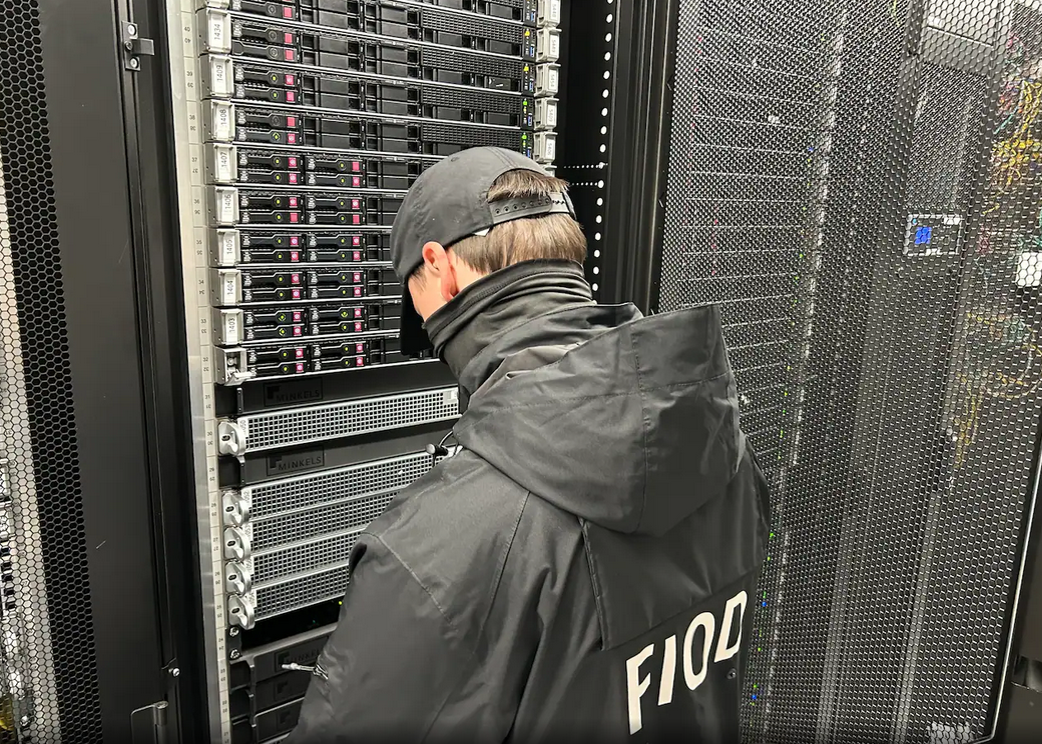
An investigator with the Tax Intelligence and Investigation Service (FIOD), the Dutch financial crimes agency, during the raid. Image: FIOD.

The Dutch daily news outlet de Volkskrant reports that the Dutch financial crime agency FIOD on May 18 arrested a 57-year-old from Amsterdam and a 39-year-old from The Hague, charging them with violating sanctions law by directly or indirectly making economic resources available to EU-sanctioned entities.

The Dutch investigation focuses on Stark Industries, a sprawling hosting provider that materialized just two weeks before Russia invaded Ukraine. As detailed in this May 2024 deep-dive, Stark quickly became the source of massive distributed denial-of-service (DDoS) attacks against European targets, and emerged as a top supplier of proxy and anonymity services that showed up time and again in cyberattacks linked to Russia-backed hacking groups.

That report identified two Moldovan brothers — Ivan and Yuri Neculiti and their company PQHosting — who were providing one of Stark’s two main conduits to the larger Internet. In May 2025, the EU sanctioned PQHosting and the Neculiti brothers for aiding Russia’s hybrid warfare efforts. But as KrebsOnSecurity observed in September 2025, those sanctions failed to target Stark’s remaining connection to the Internet — an Internet service provider based in the Netherlands called MIRhosting.

MIRhosting is operated by Andrey Nesterenko, a 39-year-old Russian native who runs the business out of the Netherlands.  News that PQHosting and the Neculiti brothers were about to be sanctioned by the EU leaked in the media nearly two weeks before the sanctions were announced last year. During that time, the Stark network assets were transferred from PQHosting to a new entity called the[.]hosting, under the control of the Dutch entity WorkTitans BV.

And as our September 2025 report showed, WorkTitans was controlled by Nesterenko and a 57-year-old from Amsterdam named Youssef Zinad. On top of that, WorkTitans was getting connectivity to the larger Internet solely through MIRhosting, where Zinad had worked previously.

On May 18, Dutch financial crime investigators arrested Nesterenko and Zinad, and searched three businesses in Enschede and Almere and two data centers in Dronten and Schiphol-Rijk. A statement from the Dutch authorities said they also seized laptops, telephones and more than 800 servers.

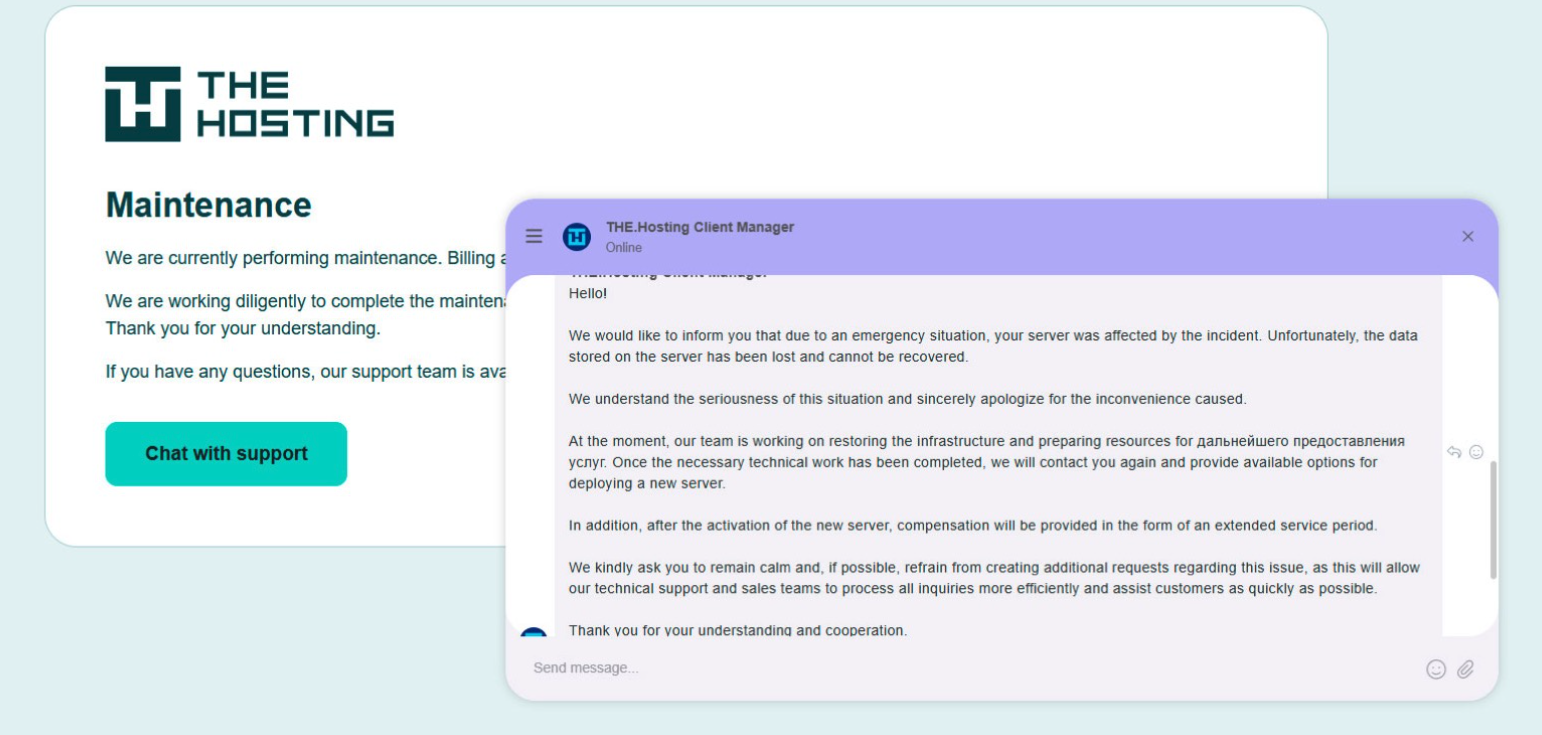
A message to the-hosting customers immediately after 800 of its servers were seized by Dutch authorities. The message says that unfortunately data stored on the server has been lost and cannot be recovered.

De Volkskrant said it reviewed data showing WorkTitans and MIRhosting were the most-used networks in pro-Russian attacks on Danish government bodies between November 13 and 19, 2025, the week of Denmark’s municipal elections.

The publication wrote that prior to Nesterenko’s arrest, the MIRhosting founder denied that he knew his servers had been misused by pro-Russian cybercriminals. “He said he had ended all services with the Neculiti brothers when the EU sanctions came into force in May 2025,” and the he “reserved all rights to take action against ‘harmful and incorrect publications,” de Volkskrant wrote.

MIRhosting released a statement saying it has initiated an internal investigation into the alleged facts concerning the elections in Denmark, and that it has temporarily paused services to WorkTitans as a precautionary measure while the matter is being reviewed further.

“Based on our preliminary findings, there are no indications that the services over which we exercise control were actually used to influence the Danish elections,” the statement reads. “No anomalies or spikes were observed in our network traffic during the period mentioned in the publication; had large-scale DDoS attacks occurred, such activity would have been evident. Furthermore, prior to the media publication, we had not received any complaints, abuse reports, or official requests regarding suspicious activities or misuse of our network. Meanwhile, our regular operational activities continue, and our service to our other clients remains fully intact.”

Born in Nizhny Novgorod, Russia, Mr. Nesterenko grew up as a piano prodigy who performed publicly at a young age. In 2004, Nesterenko founded MIRhosting’s parent Innovation IT Solutions Corp., which has the notable distinction of being the company responsible for hosting stopgeorgia[.]ru, a hacktivist website for organizing cyberattacks against Georgia that appeared at the same time Russian forces invaded the former Soviet nation in 2008. That conflict was thought to be the first war ever fought in which a notable cyberattack and an actual military engagement happened simultaneously.

Responding to questions shared via email, Nesterenko said MIRhosting does not support cybercrime, sanctions evasion, or illegal activity, and that the allegations and arrest by Dutch authorities have been extremely harmful to him and his company.

“The transition to the.hosting was not intended to evade sanctions,” Nesterenko wrote. “The hardware and customer portfolio had already been transferred to WorkTitans before the sanctions appeared. Closing or damaging a legitimate Dutch infrastructure company will not stop cybercrime, but it will harm many people who have done nothing wrong.”

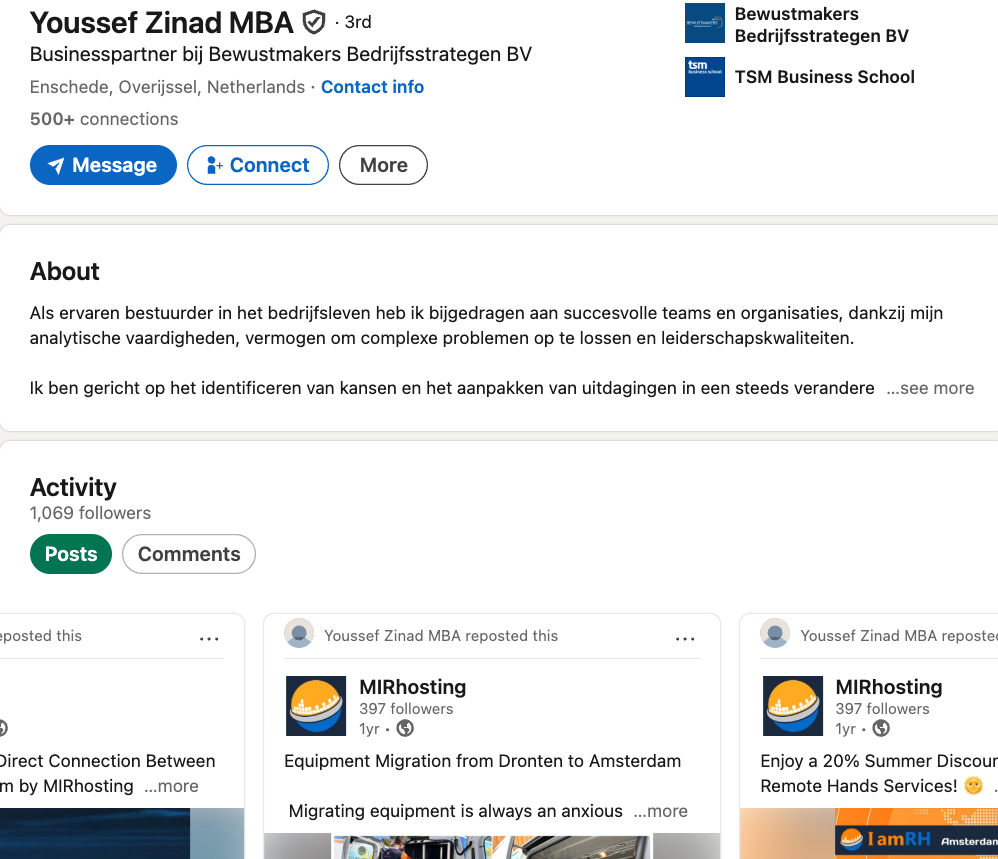
Far less is public about the 57-year-old Zinad, who reportedly has been keeping a low profile since our story last year. De Volkskrant reported that Zinad blocked access to his LinkedIn account, had gone months without responding to emails, WhatsApp messages and phone calls, and told a colleague that illness was forcing him to lead a somewhat more reclusive life.

Mr. Zinad’s now-defunct LinkedIn profile. It was full of posts for MIRhosting’s services.

Mr. Nesterenko claims Zinad was never an employee of MIRhosting.

“He helped me and MIRhosting with certain business tasks under a normal business-to-business arrangement between companies,” Nesterenko explained.

However, in previous emails to KrebsOnSecurity, Nesterenko carbon copied Mr. Zinad (who had a @mirhosting.com email), explaining that he was part of the company’s legal team. Also, the Dutch website stagemarkt[.]nl lists Youssef Zinad as an official contact for MIRhosting’s offices in Almere.

Mr. Zinad has never responded to requests for comment. Nor did de Volkskrant have any luck tracking him down. The publication said it repeatedly asked Mr. Zinad (referred to here as simply “Z”), but he reportedly avoided every form of contact.

“‘I am unavailable but will respond to your message as soon as possible,’ reads an automated reply on WhatsApp on 2 October 2025,” de Volkskrant reported. “It is the only response de Volkskrant would receive in months. He did not pick up his phone and did not call back. When an acquaintance asked him via LinkedIn to contact the reporter, he blocked access to his LinkedIn page. At an address in Almere where Z.’s personal limited company is registered, no one was present in April. The corner house’s blinds were drawn, and a pile of rubbish bags lay outside next to a container, as if someone had recently left. A neighbour said he knew the man but did not know where he was staying. Z. was later arrested at a residence in Amsterdam.”

Alleged leader of Kimwolf, a sweeping botnet for cybercriminals, arrested in Canada

Authorities arrested and unsealed charges against a Canadian man accused of running Kimwolf, one of the most far-reaching DDoS botnets on record, the Justice Department said Thursday.

Jacob Butler was arrested Wednesday in Ottawa, Canada, and awaits extradition to the United States where he is charged with aiding and abetting computer intrusions and, if convicted, faces up to 10 years in prison.

Investigators said the 23-year-old, also known as “Dort,” was a principal administrator of Kimwolf, a variant of the record-setting Aisuru DDoS botnet that spread like wildfire and eventually took over more than 2 million Android TV devices after its operators figured out how to abuse residential-proxy networks for local control.

Authorities in March seized infrastructure powering the Kimwolf, Aisuru, JackSkid and Mossad botnets, which hijacked a combined three million devices and launched more than 300,000 DDoS attacks collectively.

Kimwolf, which operated as a DDoS-for-hire service for other cybercriminals, initiated more than 25,000 attacks, resulting in network outages, disruptions and financial losses exceeding millions of dollars, officials said. Officials also said they found evidence linking Kimwolf to DDoS attacks targeting Department of Defense Information Network IP addresses.

“Kimwolf and the botnets associated with this operation have supported persistent corporate intrusion efforts and been used by a wide range of serious threat actors,” Zach Edwards, staff threat researcher at Infoblox, told CyberScoop.

Authorities searched Butler’s residence during the globally coordinated operation, but did not arrest him until Wednesday, roughly two months later. Officials filed a criminal complaint against Butler in the U.S. District Court for the District of Alaska in April, and unsealed the complaint following his arrest.

A special agent with the Defense Criminal Investigative Service confirmed Butler’s identity and involvement in the Kimwolf botnet after Butler used the same IP address to access multiple email accounts he controlled and Discord accounts linked to Kimwolf. 

“I have observed significant operational security lapses on Butler’s part resulting in patterns of overlapping IP usage among a Google account in Butler’s true name, other Google accounts that I believe to be controlled by Butler due to use of the same machine cookies, and Discord accounts which have been used in support of the KimWolf operation,” the special agent said in an affidavit. 

“The Discord accounts show patterns of overlapping IP usage with the KimWolf backend server. These IP addresses appear to be proxy or VPN IPs which were likely used by Butler in an unsuccessful attempt to evade law enforcement scrutiny. However, like many cybercriminals, Butler did not use proxy or VPN IP addresses exclusively,” the special agent added. 

Authorities described the botnet takedowns in March in nearly conclusive terms at the time, yet court records indicate the Kimwolf botnet is back in operation. 

“While today’s announcement is encouraging to see, there are still hundreds of millions of insecure IoT and network devices connected to sensitive government, corporate and home networks, and these remain a priority target for threat actors looking to build the next version of Kimwolf,” Edwards said.

“Until we find solutions to this underlying problem,” he added, “we’ll unfortunately continue to play Whac-A-Mole with botnet operators year after year.”

You can read the affidavit supporting the criminal complaint against Butler below.

The post Alleged leader of Kimwolf, a sweeping botnet for cybercriminals, arrested in Canada appeared first on CyberScoop.

Alleged Kimwolf Botmaster ‘Dort’ Arrested, Charged in U.S. and Canada

Canadian authorities on Wednesday arrested a 23-year-old Ottawa man on suspicion of building and operating Kimwolf, a fast spreading Internet-of-Things botnet that enslaved millions of devices for use in a series of massive distributed denial-of-service (DDoS) attacks over the past six months. KrebsOnSecurity publicly named the suspect in February 2026 after the accused launched a volley of DDoS, doxing and swatting campaigns against this author and a security researcher. He now faces criminal hacking charges in both Canada and the United States.

A criminal complaint unsealed today in an Alaska district court charges Jacob Butler, a.k.a. “Dort,” of Ottawa, Canada with operating the Kimwolf DDoS botnet. A statement from the Department of Justice says the complaint against Butler was unsealed following the defendant’s arrest in Canada by the Ontario Provincial Police pursuant to a U.S. extradition warrant. Butler is currently in Canadian custody awaiting an initial court hearing scheduled for early next week.

The government said Kimwolf targeted infected devices which were traditionally “firewalled” from the rest of the internet, such as digital photo frames and web cameras. The infected systems were then rented to other cybercriminals, or forced to participate in record-smashing DDoS attacks, as well as assaults that affected Internet address ranges for the Department of Defense. Consequently, the DoD’s Defense Criminal Investigative Service is investigating the case, with assistance from the FBI field office in Anchorage.

“KimWolf was tied to DDoS attacks which were measured at nearly 30 Terabits per second, a record in recorded DDoS attack volume,” the Justice Department statement reads. “These attacks resulted in financial losses which, for some victims, exceeded one million dollars. The KimWolf botnet is alleged to have issued over 25,000 attack commands.”

On March 19, U.S. authorities joined international law enforcement partners in seizing the technical infrastructure for Kimwolf and three other large DDoS botnets — named Aisuru, JackSkid and Mossad — that were all competing for the same pool of vulnerable devices.

On February 28, KrebsOnSecurity identified Butler as the Kimwolf botmaster after digging through his various email addresses, registrations on the cybercrime forums, and posts to public Telegram and Discord servers. However, Dort continued to threaten and harass researchers who helped track down his real-life identity and dramatically slow the spread of his botnet.

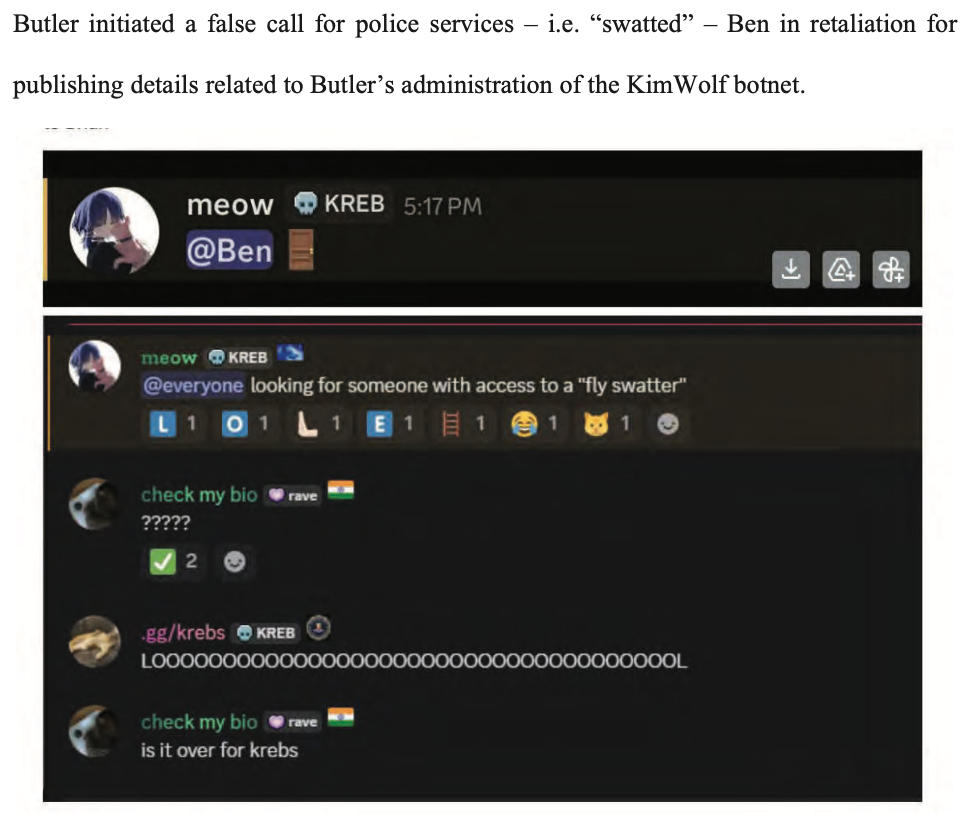
Dort claimed responsibility for at least two swatting attacks targeting the founder of Synthient, a security startup that helped to secure a widespread critical security weakness that Kimwolf was using to spread faster and more effectively than any other IoT botnet out there. Synthient was among many technology companies thanked by the Justice Department today, and Synthient’s founder Ben Brundage told KrebsOnSecurity he’s relieved Butler is in custody.

“Hopefully this will end the harassment,” Brundage said.

An excerpt from the criminal complaint against Butler, detailing how he ordered a swatting attack against Ben Brundage, the founder of the security firm Synthient.

The government says investigators connected Butler to the administration of the KimWolf botnet through IP address, online account information, transaction records, and online messaging application records obtained through the issuance of legal process. The criminal complaint against Butler (PDF) shows he did little to separate his real-life and cybercriminal identities (something we demonstrated in our February unmasking of Dort).

In April, the Justice Department joined authorities across Europe in seizing domain names tied to nearly four-dozen DDoS-for-hire services, although because of a bureaucratic mix-up the list of seized domains has remain sealed until today. The DOJ said at least one of those services collaborated with Butler’s Kimwolf botnet.

A statement from the Ontario Provincial Police said a search warrant was executed on March 19 at Butler’s address in Ottawa, where they seized multiple devices. As a result of that investigation, Butler was arrested and charged this week with unauthorized user of computer; possession of device to obtain unauthorized use of computer system or to commit mischief; and mischief in relation to computer data. He is scheduled to remain in custody until a hearing on May 26.

In the United States, Butler is facing one count of aiding and abetting computer intrusion. If extradited, tried and convicted in a U.S. court, Butler could face up to 10 years in prison, although that maximum sentence would likely be heavily tempered by considerations in the U.S. Sentencing Guidelines, which make allowances for mitigating factors such as youth, lack of criminal history and level of cooperation with investigators.

❌