Reading view

There are new articles available, click to refresh the page.

Who Runs the Ransomware Group ‘The Gentlemen?’

A cybercrime group known as The Gentlemen has emerged as the second most active ransomware gang by victim count, rapidly attracting a talented pool of hackers through an aggressive recruitment strategy that promises affiliates 90 percent of any ransom paid by victims. This post examines clues pointing to a real life identity for the administrator of The Gentlemen ransomware group.

A graphic created and shared by The Gentlemen ransomware group administrator Hastalamuerte on Breachforums in May 2026. Credit: ke-la.com.

Experts at the security firm Check Point Software have been closely covering exploits of The Gentlemen, a so-called “ransomware-as-a-service” (RaaS) offering that pays affiliates handsomely to help spread the group’s malware.

“A 90/10 affiliate revenue split — compared to the industry standard 80/20 — is accelerating the group’s growth by attracting experienced operators from competing programs,” the researchers wrote in April.

Check Point found The Gentlemen are the second most active ransomware group by victim count so far this year, claiming at least 332 published victims since the group’s inception in mid-2025 and more than 240 in 2026 alone.

According to Check Point, the group targets Internet-facing devices (VPNs, firewalls) as their entry point, and once inside moves quickly to encrypt entire networks within hours.

Check Point says the administrator and primary operator of the ransomware group uses the nickname Zeta88 on the Russian-language cybercrime forums, and that this individual was previously known under the moniker Hastalamuerte. Check Point noted that a breach of the group’s backend infrastructure made it clear that Hastalamuerte/Zeta88 is the person who assembles the locker and RaaS panel, manages payments, and is essentially the administrator of the entire program who receives 10 percent of all ransoms.

WHO IS HASTALAMUERTE?

The cyber intelligence firm Intel 471 shows that the user Hastalamuerte is a Russian and English speaking person who registered on almost a dozen cybercrime forums between 2019 and the present day, including Exploit, Breachforums, Ramp_V2, BHF, Raidforums, and Nulled.

Intel 471 reveals that Hastalamuerte registered on Breachforums in January 2025 from an Internet address in Izhevsk, the capital city of Russia’s Udmurt Republic. Likewise, the user Zeta88 signed up at the English-language cybercrime forum Breached in August 2022 from a different Internet address in Izhevsk.

Intel 471 finds Hastalamuerte registered on Raidforums in 2020 using the email address hastalamuerte1488@protonmail.com (1488 is a common combination of two numeric symbols associated with white supremacy). A lookup on this address at the open source intelligence service Epieos shows it is connected to an account at Apple and to a phone number ending in 04.

Epieos says that Protonmail address is also linked to a GitHub account under the username SantaMuerte. That account is marked private, but a history of this user’s activity shows they are watching and developing a number of malware tools and exploits.

In April 2020, Hastalamuerte said on the crime forum Nulled that they could be contacted at the Telegram instant messenger name @hastalamuerte18, and the threat intelligence company Flashpoint finds this username is assigned the unique Telegram ID number 30907522 [full disclosure: Flashpoint is an advertiser on this blog].

The breach tracking service Constella Intelligence reports that Hastalamuerte’s Telegram ID is connected to another username — “bu4vs” — and to the Russian phone number 79127650004. Pivoting on this phone number in Constella fetches multiple records from hacked Russian government databases showing it is assigned to one Alexander Andreevich Yapaev, a 36-year-old from Izhevsk.

Constella reveals that phone number was used to create an account at the Russian social media platform Pikabu under the name “4apai18,” and shows Mr. Yapaev has signed up at a number of websites using the common surname Ivanov, or else “Chapaev” (the numeral 4 is often used as shorthand for a “ch” sound in Russian).

A search in Intel 471 for cybercrime forum members with the nickname SantaMuerte unearths an account by the same name created in 2020 on the Russian hacking forum Codeby. Intel 471 shows this user originally registered on Codeby with the not-so-subtle nickname Alexandr 4apaev.

Constella finds Mr. Yapaev regularly used the email address bu4vs@mail.ru. Meanwhile, Epieos shows this address is connected to a LinkedIn account for Alexander Yapaev, who lists himself as the head of B2B marketing at the company Uralenergo Udmurtia, one of Russia’s largest suppliers of electrotechnical and lighting products.

Mr. Yapaev did not respond to multiple requests for comment.

Nearly every time we publish one of these Breadcrumbs stories, readers are curious to know why it seems like so many cybercriminals from Russia apparently do little to hide their real life identities. The truth is that — Russian or not — most didn’t exactly set out to be arch criminals, but instead got drawn into the scene gradually over several years as their skills broadened and sharpened.

Another important dynamic is that the Russian government generally either co-opts or ignores cybercriminal activity within its borders so long as the hackers do not steal from or attack Russian businesses and citizens. As a result, successful cybercriminals in Russia are usually insulated from prosecution and arrest by foreign law enforcement agencies provided they occasionally pay off the right people and do not travel abroad. And cybercriminals who intend to strictly adhere to those unwritten rules may (at least initially) be less concerned about covering their tracks online.

But the simplest explanation is that cybercriminals of all nationalities tend to make a number of basic operational security mistakes early in their careers, when they are less savvy and have far less to lose by their carelessness. A review of Hastalamuerte’s early posts on the crime forums (circa 2019-2020) shows a relatively unsophisticated and low-skilled hacker still trying to learn the ropes and earn a positive reputation on these communities.

For example, in June 2020 Hastalamuerte’s Telegram account joined a multi-month training program (@pntst) to learn how to use popular penetration testing tools, and their candid posts to this hacker training camp show Hastalamuerte struggling to use these tools effectively. A Google-translated record of Hastalmuerte’s posts to @pntst is here.

Update, June 11, 10:23 a.m. ET:  The threat research group PRODAFT has released a detailed writeup on the history and current operations of The Gentlemen. PRODAFT said its findings match the same persona with “high confidence,” and found the administrator (Zeta88/Hastalamuerte) supplies affiliates with initial access directly, primarily Fortinet SSL-VPN credentials obtained through brute-force attacks or sourced from the group’s own leak database. They also discovered the administrator is using AI to develop and maintain the ransomware and associated tooling, as well as to assist with post-exploitation activity.

Tennessee man linked to 764 accused of series of crimes against children dating back to 2022

A Tennessee man accused of abusing and sexually exploiting children while actively participating in 764, a sprawling online nihilistic violent extremist collective affiliated with The Com, pleaded not guilty Thursday to a series of charges that could keep him locked up for 50 years.

Zachary Sweeney has allegedly victimized multiple children, on numerous occasions grooming and coercing minors to produce child sexual abuse material that he distributed and sometimes sold, the Justice Department said. One of the 30-year-old’s alleged victims later died of an overdose.

Sweeney has been the subject of multiple FBI investigations, which uncovered extensive crimes against children dating back to at least 2022, prosecutors said. His alleged involvement in 764 and, by extension, The Com, underscores the growing, multi-faceted threat of physical violence, cybercrime, extortion and the pursuit of criminal underground notoriety posed by thousands of members typically between 11 and 25 years old.

Victims of these crimes are often young, vulnerable and degraded or traumatized for years with life-altering impact.

“Violent extremists who victimize vulnerable children online are among the worst predators in our community and across the country,” Braden Boucek, U.S. attorney for the Middle District of Tennessee, said in a statement.

Members of 764 and related groups commit crimes in the United States and engage with other extremists globally to foment social unrest and destroy civilized society through the corruption and exploitation of vulnerable people, the Justice Department said.

Police arrested Sweeney Thursday and charged him with three counts of sexual exploitation and attempted sexual exploitation of a minor and three counts of receiving visual depictions of CSAM. Prosecutors said they intend to request Sweeney remain detained at his next court appearance June 3. 

Sweeney allegedly traveled to New York, Indiana, Missouri and Georgia to meet numerous victims in person. Officials received reports from some of his alleged victims and online platforms, triggering FBI interviews with some of his alleged victims as early as 2023. 

One of his alleged victims, who began interacting with Sweeney when she was a teenager, told investigators she degraded herself and participated in virtual self-harm group video calls with a group of people she described as friends of his in The Com. Sweeney alleged raped her and streamed the crime online. 

She died of an overdose in 2024, approximately ten days after FBI agents interviewed her. 

Sweeney allegedly drugged and raped other victims and shared videos of those acts online, according to court records.

The FBI searched Sweeney’s residence in St. Louis in September 2023, more than two months after Meta sent a pair of tips to the National Center for Missing and Exploited Children that linked him to Instagram chats containing CSAM.

Agents seized devices containing evidence of 99 possible CSAM images and videos, but encryption and passwords prevented authorities from conducting further examination, according to court records.

Sweeney moved to Tennessee in the summer of 2024 and allegedly continued to travel out of state to meet victims in person and coerce other victims to produce CSAM through at least the summer of 2025.

Authorities accuse Sweeney of boasting about his crimes and sharing blackmail material, sexual assault and CSAM depicting underage female victims.

Authorities have arrested multiple members of 764 during the past year, reflecting heightened law enforcement activity targeting the violent extremist collective and other offshoots affiliated with The Com.

Two alleged leaders of 764, Leonidas Varagiannis and Prasan Nepal, were arrested and charged for directing and distributing CSAM in April. Alexis Aldair Chavez, of San Antonio, pleaded guilty in December to multiple crimes involving the sexual exploitation of children while acting as an administrator and leader of 8884, a splinter group of 764.

“This operation puts every child predator on notice: the FBI will hunt you down and bring you to justice,” Terence Reilly, special agent in charge of the FBI Nashville Field Office, said in a statement. “Removing violent extremists from our streets protects our most innocent and vulnerable members of society.”

You can read the indictment below.

The post Tennessee man linked to 764 accused of series of crimes against children dating back to 2022 appeared first on CyberScoop.

Instructure claims hackers returned stolen Canvas data after an extortion standoff

Instructure, the company behind Canvas, said it reached an agreement with the cybercriminals who threatened to leak a trove of sensitive data they claim was stolen during a prolonged cyberattack on the widely used education tech platform.

Pressure was mounting on the company as widespread outages left schools, students and teachers temporarily unable to access critical data late last week when the company took Canvas offline after the attackers defaced the platform’s login page. By Friday, the company said Canvas — a central hub for K-12 and university coursework, exams, grades and communication — was back online and fully operational. 

ShinyHunters, a decentralized crew of prolific cybercriminals that researchers affiliate with The Com, claimed responsibility for the attack on its data leak site and was attempting to extort the company for an unknown ransom amount. 

Instructure didn’t outright say it paid a ransom, but insisted the agreement provided all necessary assurances. “The data was returned to us. We received digital confirmation of data destruction (shred logs),” the company said in an update Monday.

“We have been informed that no Instructure customers will be extorted as a result of this incident, publicly or otherwise,” the company added. “This agreement covers all impacted Instructure customers, and there is no need for individual customers to attempt to engage with the unauthorized actor.”

The threat group initially set a deadline of May 6 — four days after Instructure previously said the incident was contained — claiming it stole 3.65 terabytes of data spanning 275 million records across 8,809 school systems. 

When that deadline passed without payment, ShinyHunters escalated its pressure on the company by “injecting an extortion message directly into the Canvas login pages of roughly 330 institutions, and pivoted to school-by-school extortion with a current deadline of May 12,” Cynthia Kaiser, senior vice president of Halcyon’s Ransomware Research Center, told CyberScoop.

The additional public pressure prompted Infrastructure to take Canvas offline, disrupting schoolwork and access to critical systems nationwide. 

Instructure CEO Steve Daly apologized over the weekend for the company’s inconsistent communication and deficient public response to the cyberattack. 

“Over the past few days, many of you dealt with real disruption. Stress on your teams. Missed moments in the classroom. Questions you couldn’t get answered. You deserved more consistent communication from us, and we didn’t deliver it. I’m sorry for that,” he said in a statement.

Daly acknowledged that the attack, which remains under investigation aided by CrowdStrike, exposed usernames, email addresses, course names, enrollment information and messages. He insisted that course content, submissions and credentials were not compromised.

The temporary but widespread disruption has spurred broad concern across the education sector as ransomware experts and threat hunters continue to track developments. The cyberattack also caught the attention of lawmakers on Capitol Hill. 

The House Homeland Security Committee on Monday published a letter to Daly seeking a briefing with him or a senior leader at Instructure by May 21. 

“The recurrence of an intrusion within days of an initial breach disclosure, and Instructure’s apparent failure to fully remediate the underlying vulnerabilities during that window, raise serious questions about the company’s incident response capabilities and its obligations to the institutions and individuals whose data it holds,” House Homeland Security Chairman Andrew Garbarino, R-N.Y., wrote in the letter to Daly.

The committee wants to learn more about the “circumstances of both intrusions, the the nature and volume of data accessed, the steps Instructure has taken and is taking to contain the threat and notify affected institutions, and the adequacy of the company’s coordination with federal law enforcement and the Cybersecurity and Infrastructure Security Agency,” he added. 

CISA did not describe the extent of its involvement in Instructure’s response. “CISA is aware of a potential cyber incident affecting Canvas. As the nation’s cyber defense agency, we provide voluntary support and cybersecurity services to organizations in responding to and recovering from incidents,” Chris Butera, the agency’s acting executive assistant director for cybersecurity, said in a statement.

Instructure’s timeline of the attack has changed and remains incomplete. The company said it first detected unauthorized activity in Canvas on April 29 and immediately revoked the attacker’s access and initiated an incident response. Researchers not directly involved with the formal investigation said ShinyHunters gained access to Canvas at least a few days earlier.

The follow-on malicious activity on May 7 — the defacement of public login pages — was tied to the same incident, the company said. 

“We have since confirmed that the unauthorized actor carried out this activity by exploiting an issue related to our Free-For-Teacher accounts. This is the same issue that led to the unauthorized access the prior week. As a result, we have made the difficult decision to temporarily shut down Free-For-Teacher accounts,” the company said in an updated post about the incident.

Instructure did not answer questions about the vulnerability or explain how attackers intruded its systems. The company said it also revoked privileged credentials and access tokens for affected systems, rotated internal keys, restricted token creation pathways, and deployed additional security controls and monitoring.

Canvas is fully operational and safe to use, the company said, adding that CrowdStrike has reviewed known indicators of compromise and “found no evidence that the threat actor currently has access to the platform.”

Access still remains spotty and unavailable for some Canvas users as school districts restore the platform in phases after conducting their own internal checks.

Halcyon published an alert about the attack Friday, including a screenshot of the message that some school staff, guardians and students encountered before Instructure took the learning management system offline.

ShinyHunters is a notorious data theft extortion group that previously hit major cloud platforms, including Salesforce and Snowflake, via voice phishing, credential theft and supply-chain attacks. 

Education is a recurring and consistent target for cybercriminals, accounting for more than 250 ransomware attacks globally last year, according to Halcyon. 

Yet, the scope of the attack on Canvas “makes this one of the largest single education-sector exposures we’ve tracked,” Kaiser said.

“By compromising a shared platform used across thousands of schools, ShinyHunters hit the entire education sector in one move, which is the same playbook Clop ran against Oracle EBS customers last fall,” she added. “Among 2026 incidents against critical infrastructure, this is at or near the top for education-sector impact, and it highlights a trend of third-party software vendors now being part of an attack surface, and causing cascading effects across an entire sector.”

Cybersecurity professionals focused on ransomware and data theft extortion consistently encourage victims to not pay ransoms, but they also often acknowledge that companies have to make tough decisions based on their own interests and the security of their customers or users caught up in the aftermath.

Allison Nixon, chief research officer at Unit 221B, said the threat group claiming responsibility for the attack should not be trusted. 

“They are claiming they will delete the data after they are paid, and if they are not paid that they will leak the data,” she told CyberScoop. “This is in line with the past data extortion scams run by the same and related Com actors, who have made false statements to victims and to the public in the past.”

Instructure acknowledged that its agreement with the attackers isn’t ironclad. “While there is never complete certainty when dealing with cybercriminals, we believe it was important to take every step within our control to give customers additional peace of mind, to the extent possible,” the company said.

Daly — a longtime security executive who was previously CEO at Ivanti — ended his mea culpa with a pledge to improve communications and provide a summary of a forensics report soon.

“Last week, we made a call to get the facts right before speaking publicly. That instinct isn’t wrong, but we got the balance wrong. We focused on fact-finding and went quiet when you needed consistent updates. You’ve been clear about that, and it’s fair feedback. We will change that moving forward,” he said. 

“Rebuilding trust takes time,” Daly added. “We’re going to earn it back through consistent action and honest communication.”

Update: May 12, 11:00 am: This story has been updated to reflect that Instructure announced they have reached a deal with ShinyHunters.

The post Instructure claims hackers returned stolen Canvas data after an extortion standoff appeared first on CyberScoop.

Two new extortion crews are speedrunning the Scattered Spider playbook

A pair of persistent and problematic threat groups affiliated with The Com are actively targeting organizations across multiple critical infrastructure sectors for rapid data theft and extortion attacks, according to CrowdStrike.

The financially-motivated attackers, which CrowdStrike tracks as Cordial Spider and Snarky Spider, have used voice-phishing and social engineering attacks to break into victims’ identity platforms and traverse SaaS environments since at least October 2025, the company said in a report Thursday, which it shared exclusively with CyberScoop prior to release. 

Adam Meyers, senior vice president of counter adversary operations at CrowdStrike, said the subgroups composed of native English speakers primarily target U.S.-based organizations in the academic, aviation, retail, hospitality, automotive, financial services, legal and technology sectors.

This “new wave of ecrime threat actors” are closely aligned with Scattered Spider and linked to other subsets of The Com, including SLSH and ShinyHunters, Meyers said. 

Because these attacks target identity systems and can expose data in other connected services beyond the initial breach point, it’s difficult to determine how many victims have been caught up in these campaigns. 

CrowdStrike’s warning closely follows research Palo Alto Networks’ Unit 42 and the Retail & Hospitality Information Sharing and Analysis Center shared last week about Cordial Spider’s string of attacks targeting organizations in the retail and hospitality industry, among others. 

Cordial and Snarky Spider have set lures via voice calls, text messages and emails directing targeting employees to phishing pages posing as their employer’s legitimate single sign-on page or primary identity provider, researchers said. 

These phishing pages, which capture credentials, session keys or tokens, depending on the workflow, provide attackers an entry point into systems, which they exploit for widespread access across victims’ entire SaaS ecosystems.

Attackers use these initial hooks to remove and establish multi-factor authentication devices, then delete emails and other alerts that would otherwise warn organizations of potential malicious activity, researchers said. 

The data theft for extortion campaigns share striking similarities, but CrowdStrike said the tactics, techniques and procedures for each subgroup are distinct. These variances include hours of operation, different phishing domain providers, preferred operating systems, data leak sites, and the tools or devices they used to register for multi-factor authentication. 

The domain for BlackFile, Cordial Spider’s data-leak site, was offline as of Wednesday, according to Meyers.

CrowdStrike declined to put a range on the groups’ extortion demands, but Unit 42 previously said Cordial Spider, which is also tracked as CL-CRI-1116 and UNC6671, are typically in the seven-figure range.

Some victims that didn’t pay extortion demands have been subjected to DDoS attacks, and Snarky Spider has used more aggressive follow-on harassment tactics, including the swatting of victim organizations’ employees, Meyers said. 

CrowdStrike said Cordial and Snarky Spider also use residential proxy networks — including Mullvad, Oxylabs, NetNut, 9Proxy, Infatica and NSOCKS — to evade IP-based detection and blend in with typical traffic. 

Residential proxy networks, which rely on IP addresses assigned to real home users, can serve a legitimate purpose, but researchers have been warning that unethical or outright criminal operators are abusing these networks to build and support botnets, cybercrime campaigns, espionage and other malicious activity.

Cordial and Snarky Spider haven’t achieved the impact or technical capability of Scattered Spider, but the groups share many commonalities and objectives, Meyers said. 

“They’ve kind of taken their playbook and they’re using a lot of their techniques, but we haven’t really seen the technical sophistication demonstrated by them that we saw from Scattered Spider,” he said. “It’s kind of the new generation of Scattered Spider.”

The post Two new extortion crews are speedrunning the Scattered Spider playbook appeared first on CyberScoop.

Congress, industry ponder government posture for protecting data centers

The growth of data centers — and adversaries’ targeting of them — left lawmakers at a hearing Wednesday contemplating whether the federal government has the right setup for defending them.

Some industry witnesses and experts at the hearing of the House Homeland Security Subcommittee on Cybersecurity and Infrastructure Protection testified that the answer might be to give data centers their own standalone designation as a critical infrastructure sector.

The question of how to secure data centers against cyber and physical attacks coincides with artificial intelligence fuelling a boom in the building of such facilities across the United States. Last month, Iranian drones targeted two Amazon data centers in response to the U.S.-Israel bombing campaign on Iran, and a third data center in Bahrain was struck as well.

“If a major data center is attacked, disrupted, or taken offline, the consequences can reach far beyond one company or one sector,” Rep. Andy Ogles, R-Tenn., said in prepared opening remarks. “Yet our current framework does not provide a clear, unified approach to data center security. It does not clearly answer which federal agency is responsible for understanding the risk, coordinating with industry, or leading the response when this infrastructure is targeted.”

Three providers account for 63 percent of the market share of data centers: Amazon Web Services, Microsoft Azure and Google Cloud Platform. 

The United Kingdom already has deemed data centers as a standalone critical infrastructure sector. Reps. Vince Fong, R-Calif., and LaMonica McIver, D-N.J., asked panel witnesses Wednesday about federal protection of them.

“Given the scrutiny that is required to make sure that those data centers are secure, there would be a benefit in having them work together as a unique coordinating council,” said Robert Mayer, senior vice president for cybersecurity and innovation at USTelecom, an industry group.

The Foundation for Defense of Democracies’ Mark Montgomery suggested a sector that combines data centers and cloud providers, given the overlap in ownership. The 2024 rewrite of a White House national security memo left some experts disappointed that it didn’t designate cloud computing as a critical infrastructure sector. 

Samuel Visner, chair of the board of directors of the Space Information Sharing and Analysis Center, said he agreed, given the role data centers are playing in the U.S. economy, military and other dependencies. “Finding a way to regard them as part of our critical infrastructure and protect them accordingly is sine qua non, absolutely necessary,” he said.

A fourth witness didn’t weigh in on the need for a separate critical infrastructure designation. But Scott Algeier, executive director of Information Technology Information Sharing and Analysis Center, said his organization had created a “special interest group” for data center providers.

“The data centers are integrated already into the critical infrastructure discussions,” he told the panel.

The post Congress, industry ponder government posture for protecting data centers appeared first on CyberScoop.

BlackFile actively extorting data-theft victims in retail and hospitality sector

Researchers warn that BlackFile, an extortion group likely associated with The Com, continues to impersonate IT support in voice-phishing and social engineering attacks that have impacted organizations in multiple industries, including healthcare, technology, transportation, logistics, wholesale and retail.

Attackers have been actively targeting organizations in the retail and hospitality industry since February, according to Unit 42’s latest intelligence on the campaign, which the Retail & Hospitality Information Sharing and Analysis Center (RH-ISAC) released alongside indicators of compromise Thursday.

The threat group, which is also tracked as CL-CRI-1116, UNC6671 and Cordial Spider, appears to be targeting victims opportunistically in a campaign that remains active and ongoing, Matt Brady, senior principal researcher at Palo Alto Networks’ Unit 42, told CyberScoop. 

“The core objective of these threat actors is to pressure targeted organizations into paying large ransom demands, typically in the seven-figure range,” Brady said.

Unit 42 declined to say how many organizations have been impacted thus far, and RH-ISAC did not respond to a request for comment.

BlackFile’s attacks against companies in the retail and hospitality sector are part of a broader wave of voice-phishing attacks initiated by multiple cybercrime groups, which Google Threat Intelligence Group and Okta warned about in January. 

Unit 42 also noted that BlackFile’s activities overlap with an ongoing data theft and extortion campaign CrowdStrike has been tracking as Cordial Spider since at least October 2025.

Yet, the threat group’s tactics have been far from cordial. RH-ISAC said some attackers have swatted company personnel, including executives, to increase leverage and pressure victims to pay their ransom demands. 

The threat group lures victims via voice-phishing attacks and phishing pages mimicking corporate single-sign on services to steal credentials before moving into privileged accounts. 

“They scrape internal employee directories to obtain contact lists for executives,” RH-ISAC wrote in a blog post. “By compromising these senior accounts via further social engineering, they gain persistent, broad-spectrum access to the environment that mirrors legitimate executive session activity.”

The group’s unauthorized access and data theft for extortion activity spans SaaS environments, Microsoft Graph API permissions, Salesforce API access, internal repositories, SharePoint sites and datasets containing employee’s phone numbers and business records. 

BlackFile also created a data-leak site to extort victims that it claims ignored or failed to agree to its demands, according to researchers. 

Brady said Unit 42 has observed relatively consistent activity from the threat group since February. 

RH-ISAC advises organizations to manage multi-factor identity verification for callers and limit the IT support actions that can be completed in a single call without escalation to management.

The post BlackFile actively extorting data-theft victims in retail and hospitality sector appeared first on CyberScoop.

Scottish man pleads guilty to attack spree that created Scattered Spider’s notoriety

A core leader of the hacker subset of The Com responsible for a series of high-profile phishing attacks and cryptocurrency thefts from September 2021 to April 2023 pleaded guilty to federal charges, the Justice Department said Friday. 

Tyler Robert Buchanan of Dundee, Scotland, pleaded guilty to conspiracy to commit wire fraud and aggravated identity theft. The 24-year-old was arrested by Spanish police in Palma in 2024 as he attempted to board a charter flight to Naples, Italy. 

Buchanan has been in federal custody since April 2025 and faces up to 22 years in federal prison at his sentencing, which is scheduled for August 21. 

The British national and his co-conspirators, including Noah Michael Urban, who was sentenced to a 10-year federal prison sentence last year, harvested thousands of credentials via phishing and stole more than $8 million in cryptocurrency from U.S. residents via SIM-swapping attacks.

Victims included high net worth individuals and businesses in the entertainment, telecom, technology, business process outsourcing, IT, cloud and virtual currency sectors, officials said.

Buchanan and his co-conspirators were part of an aggressive subset of The Com coined Scattered Spider. While The Com and its offshoots don’t operate with formal leaders in the traditional sense, Buchanan played a crucial role in the operation, according to Allison Nixon, chief research officer at Unit 221B.

“[Buchanan] was the glue that held this gang together. His success at wiping out victims’ savings made him a target for both law enforcement and rival Com gangs,” Nixon told CyberScoop.

“[Buchanan] is part of an older generation that came from certain toxic gaming servers before the pandemic. People from this generation learned hacking in order to steal vanity usernames and bully kids before using it to steal peoples’ savings,” she added.

Federal authorities filed charges against five individuals with links to the Scattered Spider cybercrime outfit in 2024. Buchanan and Urban’s alleged co-conspirators — Ahmed Hossam Eldin Elbadawy, Evans Onyeaka Osiebo and Joel Martin Evans — still face charges in the case, officials said. 

Nixon lauded law enforcement for acting decisively to arrest Buchanan during a brief window of opportunity while he was traveling internationally. 

“Com members are obsessed with private jets and foreign vacations, and the feds took that dream away with one arrest,” she said. 

The tactic, which U.S. officials also use against Russian cybercriminals, works because most countries are willing to support in the arrest of foreign criminals, thereby keeping them out of their respective jurisdictions, Nixon said. 

“As a foreigner, he was caught in a weaker legal position than if he was arrested at home, and cases following this tactic tend to have very long sentences,” she added. “The takeaway for Com members watching this case is that criminal foreigners associated with violence are the lowest class in every country. And that’s what Com members are when they travel.”

The Justice Department said Buchanan and his co-conspirators defrauded at least a dozen companies and their employees throughout the United States. A digital device police found at his residence in April 2023 contained personal data on numerous individuals and victim companies, according to his plea agreement.

It’s unclear what transpired between that search in April 2023 in Scotland and his June 2024 arrest at a resort city on the Spanish island of Mallorca. Moreover, his plea agreement doesn’t include the entirety of his alleged crimes. 

Buchanan attracted a lot of attention and successfully coordinated many attacks before a rival Com gang allegedly broke into his home and used a blowtorch on him to extract crypto keys in his possession, according to Nixon. 

Following his arrest, Spanish police said Buchanan had gained control of bitcoin worth more than $27 million at that time. 

While early leaders of Scattered Spider have been arrested or sentenced for their crimes, others have filled those roles with even more exceptional impact. 

The Com has grown to thousands of members, typically between 11 and 25 years old, splintered into three primary subsets the FBI describes as Hacker Com, In Real Life Com and Extortion Com.

Criminal acts committed by these multiple, interconnected networks include swatting, extortion and sextortion of minors, production and distribution of child sexual abuse material, violent crime and various other cybercrimes. 

You can read the indictment against Buchanan and some of his co-conspirators below.

The post Scottish man pleads guilty to attack spree that created Scattered Spider’s notoriety appeared first on CyberScoop.

Tech giants launch AI-powered ‘Project Glasswing’ to identify critical software vulnerabilities

Major technology companies have joined forces in an effort to use advanced artificial intelligence to identify and address security flaws in the world’s most critical software systems, marking a significant shift in how the industry approaches cybersecurity threats.

Anthropic announced Project Glasswing on Tuesday, bringing together Amazon, Apple, Broadcom, Cisco, CrowdStrike, the Linux Foundation, Microsoft, and Palo Alto Networks. The initiative centers on Claude Mythos Preview, an unreleased AI model that Anthropic will make available exclusively to project partners and approximately 40 additional organizations responsible for critical software infrastructure.

The model has already identified thousands of previously unknown vulnerabilities in its initial testing phase, including security flaws that have existed in widely used systems for decades, according to Anthropic. Among the discoveries is a 27-year-old bug in OpenBSD, an operating system known primarily for its security focus, and a 16-year-old vulnerability in FFmpeg, a widely used video software program that automated testing tools had failed to detect despite running the affected code line five million times. The company has been in contact with the maintainers of the relevant software, and all found vulnerabilities have been patched. 

Anthropic will commit up to $100 million in usage credits for the project, along with $4 million in direct donations to open-source security organizations. The company has stated it does not plan to make Mythos Preview available to the general public, citing concerns about the model’s potential misuse.

The initiative reflects growing concerns within the technology sector about the dual-use nature of advanced AI systems. While Mythos Preview was not trained specifically for cybersecurity purposes, its coding and reasoning capabilities have proven effective at identifying subtle security flaws that have eluded human analysts and conventional automated tools.

“Although the risks from AI-augmented cyberattacks are serious, there is reason for optimism: the same capabilities that make AI models dangerous in the wrong hands make them invaluable for finding and fixing flaws in important software—and for producing new software with far fewer security bugs,” the company said in a blog post. “Project Glasswing is an important step toward giving defenders a durable advantage in the coming AI-driven era of cybersecurity.”

The project comes as the industry has predicted that similar AI capabilities will soon become more widespread. Anthropic executives have indicated that without coordinated action, such tools could eventually reach actors who might deploy them for malicious purposes rather than defensive security work.

Participating organizations will be required to share their findings with the broader industry. The project places particular emphasis on open-source software, which forms the foundation of most modern systems, including critical infrastructure, yet whose maintainers have historically lacked access to sophisticated security resources.

“Open source software constitutes the vast majority of code in modern systems, including the very systems AI agents use to write new software. By giving the maintainers of these critical open source codebases access to a new generation of AI models that can proactively identify and fix vulnerabilities at scale, Project Glasswing offers a credible path to changing that equation,” said Jim Zemlin, CEO of the Linux Foundation. “This is how AI-augmented security can become a trusted sidekick for every maintainer, not just those who can afford expensive security teams.” 

Additionally, Anthropic says it has engaged in ongoing discussions with U.S. government officials regarding Mythos Preview’s capabilities. The company has framed the project in national security terms, arguing that maintaining leadership in AI technology represents a strategic priority for the United States and its allies. Anthropic has been locked in a high-stakes dispute with the Department of Defense about the U.S. military’s use of the startup’s Claude AI model in real-world operations. 

The project’s success will depend partly on whether the collaborative approach can keep pace with rapid advances in AI capabilities. Anthropic has indicated that frontier AI systems are likely to advance substantially within months, potentially creating a dynamic environment where defensive and offensive capabilities evolve in parallel.

“Project Glasswing is a starting point,” Anthropic wrote in a blog post. “No one organization can solve these cybersecurity problems alone: frontier AI developers, other software companies, security researchers, open-source maintainers, and governments across the world all have essential roles to play. The work of defending the world’s cyber infrastructure might take years; frontier AI capabilities are likely to advance substantially over just the next few months. For cyber defenders to come out ahead, we need to act now.”

The post Tech giants launch AI-powered ‘Project Glasswing’ to identify critical software vulnerabilities appeared first on CyberScoop.

Sean Cairncross lays out what’s coming next for Trump’s cyber strategy

The Trump administration is plotting an interagency body to confront malign hackers, pilot programs to secure critical infrastructure across states and other steps tied to its freshly-released cyber strategy, National Cyber Director Sean Cairncross said Monday.

The “interagency cell” will bring together agencies like the Justice Department, the Department of State, the FBI and the Pentagon, which will make it clear that going on cyber offense isn’t just about attacking enemies in cyberspace, Cairncross said.

“Sure, that’s part of it, but that’s not all of it,” he said at an event hosted by USTelecom. It will include diplomatic efforts, arrests and more, he said. “As President Trump has made clear, he expects results, and he’s empowered the team under him to go get them.”

A series of pilot programs will be catered to specific critical infrastructure industries in specific states, such as water in Texas and beef in South Dakota, Cairncross said. Different sectors operate at more or less mature levels, he said.

“One of the things that we are working to do is to align those sectors and prioritize those sectors in a way that makes sense,” he said.

Cairncross said the administration wants to share information with industry better, and will be looking as well at revising regulations in some instances. One of those instances is the Securities and Exchange Commission’s 2023 incident disclosure rule, which drew some of the most vehement industry opposition under the Biden administration’s’ pursuit of cyber regulations. The idea is to make sure they “make sense for industry,” Cairncross said.

But the administration also will have things it seeks from the private sector. That will include bringing together CEOs and sending the message to them that “you need to dedicate some real resources,” he said.

Cairncross has spoken before about wanting to establish an academy to address education and training in a nation with persistent cybersecurity job openings, but there’s more attached to it, he said.

The effort, which Cairncross said the administration would release details on soon, will also include a foundry (which “will be able to scale with private capital new innovation, and deploy it more quickly”) and an accelerator (“so when there’s preceded financing on on projects to really ramp that up and be able to scale as well and overcome some of the procurement hurdles that are often based in in this space”).

Cairncross said at a second event Monday that another forthcoming step was a law enforcement pilot program to better share information with state and local governments.

“We’re looking for ways to streamline information sharing from the USG side,” Cairncross said at a Billington Cybersecurity event, using the acronym for “U.S. government.” “Often, ‘how’ we know things is extremely sensitive, ‘what’ we know is less so,” he said. The goal is “to figure out how to communicate that in a helpful, actionable way.”

Updated, 3/9/26: to include comments about law enforcement pilot program.

The post Sean Cairncross lays out what’s coming next for Trump’s cyber strategy appeared first on CyberScoop.

The long-awaited Trump cyber strategy has arrived

President Donald Trump released his administration’s cyber strategy Friday, promoting offense operations in cyberspace, securing federal networks and critical infrastructure, streamlining regulations, leveraging emerging technologies and strengthening the cybersecurity workforce.

Trump also signed an executive order Friday directing agencies to take action to combat cybercrime and fraud.

A little more than half of the five pages of strategy text of the long-anticipated document is preamble, and two of its seven pages are title and ending pages. Administration officials have said the strategy is deliberately high-level, and the White House promised more detailed guidance in the future.

The strategy “calls for unprecedented coordination across government and the private sector to invest in the best technologies and continue world-class innovation, and to make the most of America’s cyber capabilities for both offensive and defensive missions,” the White House said in a statement accompanying its release.

Each of the six “pillars” of the strategy offer some prescriptions.

“Shaping adversary behavior” calls for using U.S. government offensive and defensive capabilities in cyberspace, as well as incentivizing the private sector to disrupt adversary networks.

It also says Trump will “counter the spread of the surveillance state and authoritarian technologies that monitor and repress citizens,” even as administration critics argue that his administration has fostered surveillance and repression against U.S. citizens.

The shortest pillar, “promote common sense regulation,” decries rules that are only “costly checklists.” The Biden administration expanded cyber regulations, spurring some industry resistance. But the Trump pillar does talk about addressing liability, a point of emphasis for the prior administration as well.

“Modernize and secure federal networks” talks about using concepts and technologies like post-quantum cryptography, artificial intelligence, zero-trust and lowering barriers for vendors to sell tech to the government to meet those goals.

To “secure critical infrastructure,” the strategy calls for fortifying not just owners and operators but also the supply chain, in part by focusing on U.S.-made rather than adversary-made products.

“We will deny our adversaries initial access, and in the event of an incident, we must be able to recover quickly,” the strategy reads. “We will galvanize the role of state, local, Tribal, and territorial authorities as a complement to— not a substitute for — our national cybersecurity efforts.” Some critics of the administration’s cybersecurity actions have contended that it has shifted the burden to state and local governments too much.

AI usage makes up the bulk of the pillar entitled “sustain superiority in critical and emerging technologies,” in addition to reflecting earlier parts of the strategy on the topics of quantum cryptography and privacy protection. That includes the protection of data centers, the subject of localized fights across the country over their location and resource costs.

The final pillar says the United States must “build talent and capability,” after a year of the administration cutting a significant number of cyber positions in the federal government. “We will eliminate roadblocks that prevent industry, academia, government, and the military from aligning incentives and building a highly skilled cyber workforce,” it states.

Some positive reviews rolled in about the strategy despite the late-Friday afternoon release, traditionally the time of week when an administration looks to publish news it hopes will garner little attention.

“As new and more sophisticated threats emerge, America needed a new national cyber strategy that captures the urgency of this moment,” USTelecom President and CEO Jonathan Spalter said in a news release. “The President’s strategy rightly recognizes that harnessing America’s unique mix of private-sector innovation with public-sector capacity is the best deterrence.”

Frank Cilluffo, Director of the McCrary Institute for Cyber and Critical Infrastructure Security at Auburn University, was struck by the focus on deterrence: “This unified strategy determining a direction on offensive and defensive cyber operations and collaboration couldn’t be more timely.”

The Business Software Alliance cheered the call for streamlining cyber regulations, in particular.

A number of cyber vendors took note of the passages on AI. “Redirecting resources from paperwork to AI-powered security capabilities is the only way to keep pace with modern threats and adversaries who operate at great speed,” said Bill Wright, global head of government affairs at Elastic. “This strategy appears to recognize that fundamental truth.”

Not all the reviews were flattering, however, including from the top Democrat on the House Homeland Security Committee, Bennie Thompson, who said the strategy’s “underachieving” was the only thing impressive about it.

“What little ‘substance’ does exist in this pamphlet is a mishmash of vague platitudes, a long catalogue of ‘we will’ statements that may or may not match the Administration’s current behavior, and, mercifully, an apparent extension of some Biden-era policies,” he said. “Completely lacking is even the most basic blueprint for how the Administration will go about achieving any of its cybersecurity goals — an objective possibly hamstrung by the hemorrhage in cyber talent across all Federal agencies since Trump took office.”

The executive order Trump signed Friday coincides with the release of the strategy but there’s little overlap between the subject matter; the strategy makes one mention of cybercrime.

The order directs the attorney general to prioritize prosecution of cybercrime and fraud, orders agencies to review tools that they could use to counter international criminal organizations and  gives the Department of Homeland Security marching orders to improve training, in addition to other steps, according to a fact sheet.

“President Trump is unleashing every available tool to stop foreign-backed criminal networks that exploit vulnerable Americans through cyber-enabled fraud and extortion,” the fact sheet states.

The post The long-awaited Trump cyber strategy has arrived appeared first on CyberScoop.

Who is the Kimwolf Botmaster “Dort”?

In early January 2026, KrebsOnSecurity revealed how a security researcher disclosed a vulnerability that was used to build Kimwolf, the world’s largest and most disruptive botnet. Since then, the person in control of Kimwolf — who goes by the handle “Dort” — has coordinated a barrage of distributed denial-of-service (DDoS), doxing and email flooding attacks against the researcher and this author, and more recently caused a SWAT team to be sent to the researcher’s home. This post examines what is knowable about Dort based on public information.

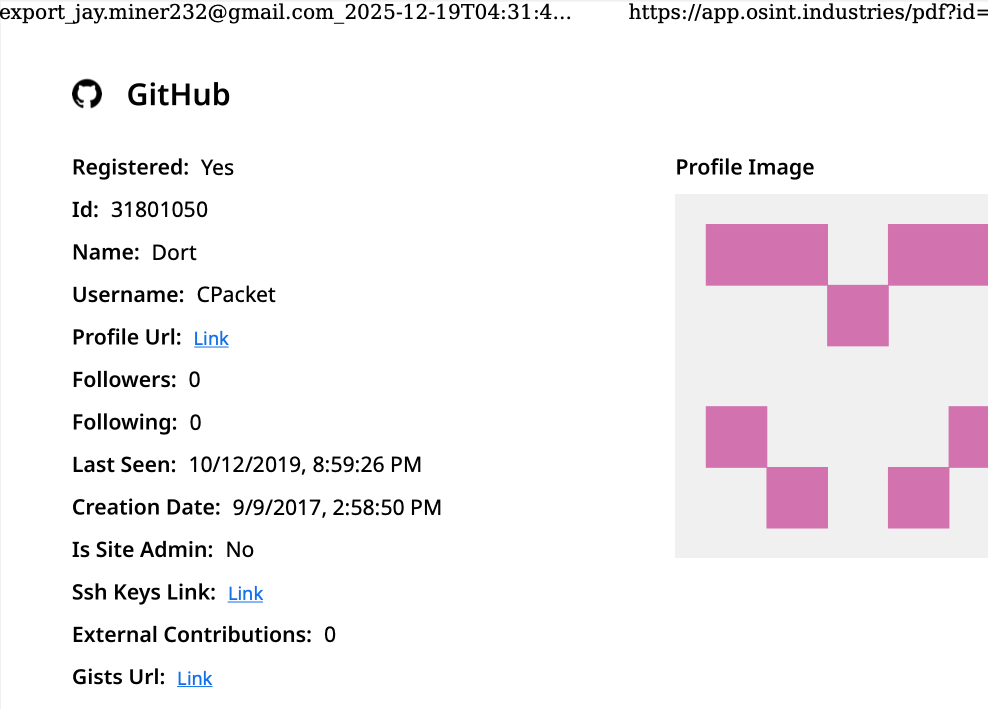
A public “dox” created in 2020 asserted Dort was a teenager from Canada (DOB August 2003) who used the aliases “CPacket” and “M1ce.” A search on the username CPacket at the open source intelligence platform OSINT Industries finds a GitHub account under the names Dort and CPacket that was created in 2017 using the email address jay.miner232@gmail.com.

Image: osint.industries.

The cyber intelligence firm Intel 471 says jay.miner232@gmail.com was used between 2015 and 2019 to create accounts at multiple cybercrime forums, including Nulled (username “Uubuntuu”) and Cracked (user “Dorted”); Intel 471 reports that both of these accounts were created from the same Internet address at Rogers Canada (99.241.112.24).

Dort was an extremely active player in the Microsoft game Minecraft who gained notoriety for their “Dortware” software that helped players cheat. But somewhere along the way, Dort graduated from hacking Minecraft games to enabling far more serious crimes.

Dort also used the nickname DortDev, an identity that was active in March 2022 on the chat server for the prolific cybercrime group known as LAPSUS$. Dort peddled a service for registering temporary email addresses, as well as “Dortsolver,” code that could bypass various CAPTCHA services designed to prevent automated account abuse. Both of these offerings were advertised in 2022 on SIM Land, a Telegram channel dedicated to SIM-swapping and account takeover activity.

The cyber intelligence firm Flashpoint indexed 2022 posts on SIM Land by Dort that show this person developed the disposable email and CAPTCHA bypass services with the help of another hacker who went by the handle “Qoft.”

“I legit just work with Jacob,” Qoft said in 2022 in reply to another user, referring to their exclusive business partner Dort. In the same conversation, Qoft bragged that the two had stolen more than $250,000 worth of Microsoft Xbox Game Pass accounts by developing a program that mass-created Game Pass identities using stolen payment card data.

Who is the Jacob that Qoft referred to as their business partner? The breach tracking service Constella Intelligence finds the password used by jay.miner232@gmail.com was reused by just one other email address: jacobbutler803@gmail.com. Recall that the 2020 dox of Dort said their date of birth was August 2003 (8/03).

Searching this email address at DomainTools.com reveals it was used in 2015 to register several Minecraft-themed domains, all assigned to a Jacob Butler in Ottawa, Canada and to the Ottawa phone number 613-909-9727.

Constella Intelligence finds jacobbutler803@gmail.com was used to register an account on the hacker forum Nulled in 2016, as well as the account name “M1CE” on Minecraft. Pivoting off the password used by their Nulled account shows it was shared by the email addresses j.a.y.m.iner232@gmail.com and jbutl3@ocdsb.ca, the latter being an address at a domain for the Ottawa-Carelton District School Board.

Data indexed by the breach tracking service Spycloud suggests that at one point Jacob Butler shared a computer with his mother and a sibling, which might explain why their email accounts were connected to the password “jacobsplugs.” Neither Jacob nor any of the other Butler household members responded to requests for comment.

The open source intelligence service Epieos finds jacobbutler803@gmail.com created the GitHub account “MemeClient.” Meanwhile, Flashpoint indexed a deleted anonymous Pastebin.com post from 2017 declaring that MemeClient was the creation of a user named CPacket — one of Dort’s early monikers.

Why is Dort so mad? On January 2, KrebsOnSecurity published The Kimwolf Botnet is Stalking Your Local Network, which explored research into the botnet by Benjamin Brundage, founder of the proxy tracking service Synthient. Brundage figured out that the Kimwolf botmasters were exploiting a little-known weakness in residential proxy services to infect poorly-defended devices — like TV boxes and digital photo frames — plugged into the internal, private networks of proxy endpoints.

By the time that story went live, most of the vulnerable proxy providers had been notified by Brundage and had fixed the weaknesses in their systems. That vulnerability remediation process massively slowed Kimwolf’s ability to spread, and within hours of the story’s publication Dort created a Discord server in my name that began publishing personal information about and violent threats against Brundage, Yours Truly, and others.

Dort and friends incriminating themselves by planning swatting attacks in a public Discord server.

Last week, Dort and friends used that same Discord server (then named “Krebs’s Koinbase Kallers”) to threaten a swatting attack against Brundage, again posting his home address and personal information. Brundage told KrebsOnSecurity that local police officers subsequently visited his home in response to a swatting hoax which occurred around the same time that another member of the server posted a door emoji and taunted Brundage further.

Dort, using the alias “Meow,” taunts Synthient founder Ben Brundage with a picture of a door.

Someone on the server then linked to a cringeworthy (and NSFW) new Soundcloud diss track recorded by the user DortDev that included a stickied message from Dort saying, “Ur dead nigga. u better watch ur fucking back. sleep with one eye open. bitch.”

“It’s a pretty hefty penny for a new front door,” the diss track intoned. “If his head doesn’t get blown off by SWAT officers. What’s it like not having a front door?”

With any luck, Dort will soon be able to tell us all exactly what it’s like.

Update, 10:29 a.m.: Jacob Butler responded to requests for comment, speaking with KrebsOnSecurity briefly via telephone. Butler said he didn’t notice earlier requests for comment because he hasn’t really been online since 2021, after his home was swatted multiple times. He acknowledged making and distributing a Minecraft cheat long ago, but said he hasn’t played the game in years and was not involved in Dortsolver or any other activity attributed to the Dort nickname after 2021.

“It was a really old cheat and I don’t remember the name of it,” Butler said of his Minecraft modification. “I’m very stressed, man. I don’t know if people are going to swat me again or what. After that, I pretty much walked away from everything, logged off and said fuck that. I don’t go online anymore. I don’t know why people would still be going after me, to be completely honest.”

When asked what he does for a living, Butler said he mostly stays home and helps his mom around the house because he struggles with autism and social interaction. He maintains that someone must have compromised one or more of his old accounts and is impersonating him online as Dort.

“Someone is actually probably impersonating me, and now I’m really worried,” Butler said. “This is making me relive everything.”

But there are issues with Butler’s timeline. For example, Jacob’s voice in our phone conversation was remarkably similar to the Jacob/Dort whose voice can be heard in this Sept. 2022 Clash of Code competition between Dort and another coder (Dort lost). At around 6 minutes and 10 seconds into the recording, Dort launches into a cursing tirade that mirrors the stream of profanity in the diss rap that Dortdev posted threatening Brundage. Dort can be heard again at around 16 minutes; at around 26:00, Dort threatens to swat his opponent.

Butler said the voice of Dort is not his, exactly, but rather that of an impersonator who had likely cloned his voice.

“I would like to clarify that was absolutely not me,” Butler said. “There must be someone using a voice changer. Or something of the sorts. Because people were cloning my voice before and sending audio clips of ‘me’ saying outrageous stuff.”

Further reading:

Jan. 8, 2026: Who Benefited from the Aisuru and Kimwolf Botnets?

Jan. 20, 2026: Kimwolf Botnet Lurking in Corporate, Govt. Networks

Jan. 26, 2026: Who Operates the Badbox 2.0 Botnet?

Feb. 11, 2026: Kimwolf Botnet Swamps Anonymity Network I2P

Mar. 19, 2026: Feds Disrupt IoT Botnets Behind Huge DDoS Attacks

Who Operates the Badbox 2.0 Botnet?

The cybercriminals in control of Kimwolf — a disruptive botnet that has infected more than 2 million devices — recently shared a screenshot indicating they’d compromised the control panel for Badbox 2.0, a vast China-based botnet powered by malicious software that comes pre-installed on many Android TV streaming boxes. Both the FBI and Google say they are hunting for the people behind Badbox 2.0, and thanks to bragging by the Kimwolf botmasters we may now have a much clearer idea about that.

Our first story of 2026, The Kimwolf Botnet is Stalking Your Local Network, detailed the unique and highly invasive methods Kimwolf uses to spread. The story warned that the vast majority of Kimwolf infected systems were unofficial Android TV boxes that are typically marketed as a way to watch unlimited (pirated) movie and TV streaming services for a one-time fee.

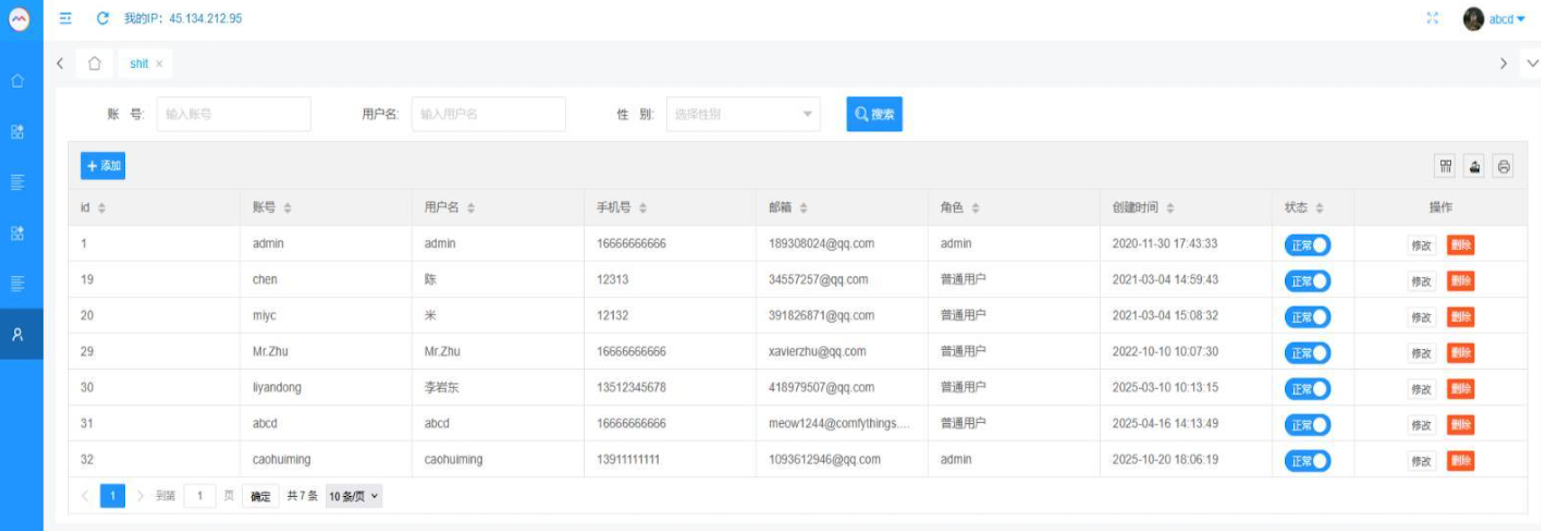
Our January 8 story, Who Benefitted from the Aisuru and Kimwolf Botnets?, cited multiple sources saying the current administrators of Kimwolf went by the nicknames “Dort” and “Snow.” Earlier this month, a close former associate of Dort and Snow shared what they said was a screenshot the Kimwolf botmasters had taken while logged in to the Badbox 2.0 botnet control panel.

That screenshot, a portion of which is shown below, shows seven authorized users of the control panel, including one that doesn’t quite match the others: According to my source, the account “ABCD” (the one that is logged in and listed in the top right of the screenshot) belongs to Dort, who somehow figured out how to add their email address as a valid user of the Badbox 2.0 botnet.

The control panel for the Badbox 2.0 botnet lists seven authorized users and their email addresses. Click to enlarge.

Badbox has a storied history that well predates Kimwolf’s rise in October 2025. In July 2025, Google filed a “John Doe” lawsuit (PDF) against 25 unidentified defendants accused of operating Badbox 2.0, which Google described as a botnet of over ten million unsanctioned Android streaming devices engaged in advertising fraud. Google said Badbox 2.0, in addition to compromising multiple types of devices prior to purchase, also can infect devices by requiring the download of malicious apps from unofficial marketplaces.

Google’s lawsuit came on the heels of a June 2025 advisory from the Federal Bureau of Investigation (FBI), which warned that cyber criminals were gaining unauthorized access to home networks by either configuring the products with malware prior to the user’s purchase, or infecting the device as it downloads required applications that contain backdoors — usually during the set-up process.

The FBI said Badbox 2.0 was discovered after the original Badbox campaign was disrupted in 2024. The original Badbox was identified in 2023, and primarily consisted of Android operating system devices (TV boxes) that were compromised with backdoor malware prior to purchase.

KrebsOnSecurity was initially skeptical of the claim that the Kimwolf botmasters had hacked the Badbox 2.0 botnet. That is, until we began digging into the history of the qq.com email addresses in the screenshot above.

CATHEAD

An online search for the address 34557257@qq.com (pictured in the screenshot above as the user “Chen“) shows it is listed as a point of contact for a number of China-based technology companies, including:

Beijing Hong Dake Wang Science & Technology Co Ltd.
Beijing Hengchuang Vision Mobile Media Technology Co. Ltd.
Moxin Beijing Science and Technology Co. Ltd.

The website for Beijing Hong Dake Wang Science is asmeisvip[.]net, a domain that was flagged in a March 2025 report by HUMAN Security as one of several dozen sites tied to the distribution and management of the Badbox 2.0 botnet. Ditto for moyix[.]com, a domain associated with Beijing Hengchuang Vision Mobile.

A search at the breach tracking service Constella Intelligence finds 34557257@qq.com at one point used the password “cdh76111.” Pivoting on that password in Constella shows it is known to have been used by just two other email accounts: daihaic@gmail.com and cathead@gmail.com.

Constella found cathead@gmail.com registered an account at jd.com (China’s largest online retailer) in 2021 under the name “陈代海,” which translates to “Chen Daihai.” According to DomainTools.com, the name Chen Daihai is present in the original registration records (2008) for moyix[.]com, along with the email address cathead@astrolink[.]cn.

Incidentally, astrolink[.]cn also is among the Badbox 2.0 domains identified in HUMAN Security’s 2025 report. DomainTools finds cathead@astrolink[.]cn was used to register more than a dozen domains, including vmud[.]net, yet another Badbox 2.0 domain tagged by HUMAN Security.

XAVIER

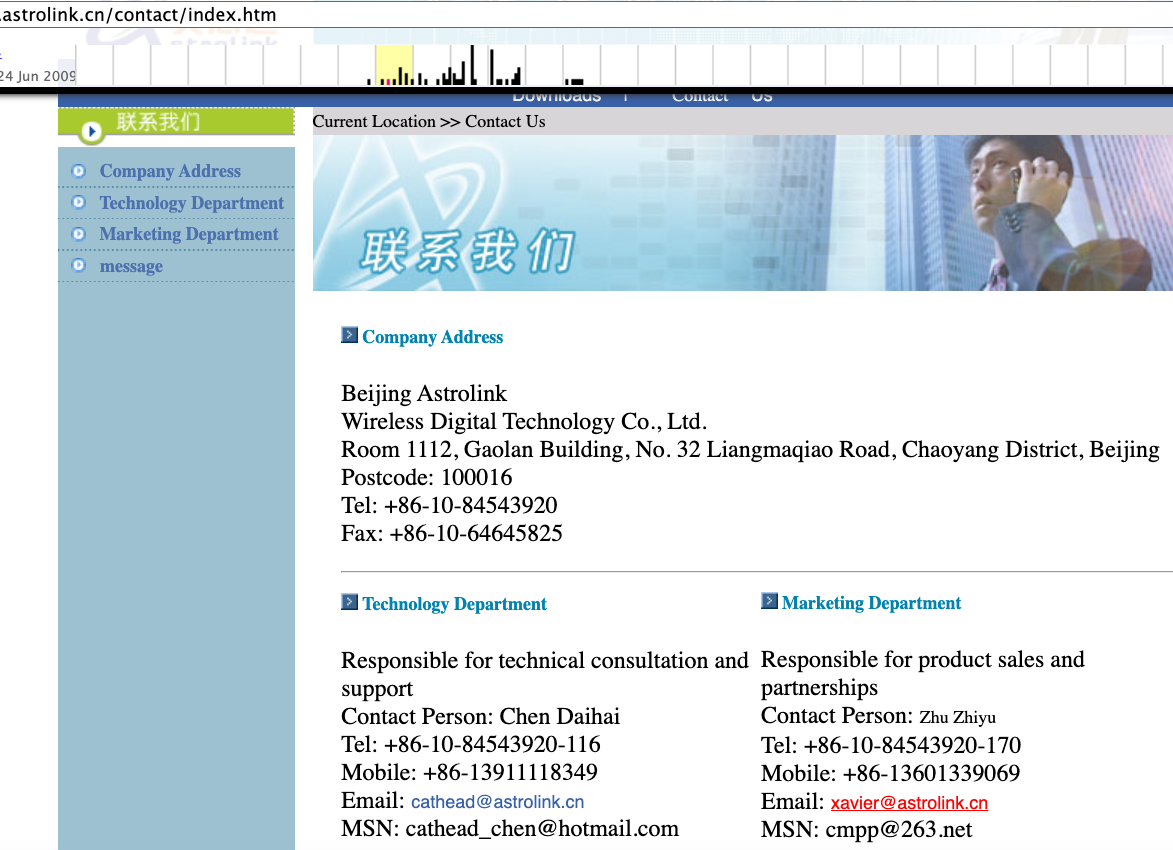
A cached copy of astrolink[.]cn preserved at archive.org shows the website belongs to a mobile app development company whose full name is Beijing Astrolink Wireless Digital Technology Co. Ltd. The archived website reveals a “Contact Us” page that lists a Chen Daihai as part of the company’s technology department. The other person featured on that contact page is Zhu Zhiyu, and their email address is listed as xavier@astrolink[.]cn.

A Google-translated version of Astrolink’s website, circa 2009. Image: archive.org.

Astute readers will notice that the user Mr.Zhu in the Badbox 2.0 panel used the email address xavierzhu@qq.com. Searching this address in Constella reveals a jd.com account registered in the name of Zhu Zhiyu. A rather unique password used by this account matches the password used by the address xavierzhu@gmail.com, which DomainTools finds was the original registrant of astrolink[.]cn.

ADMIN

The very first account listed in the Badbox 2.0 panel — “admin,” registered in November 2020 — used the email address 189308024@qq.com. DomainTools shows this email is found in the 2022 registration records for the domain guilincloud[.]cn, which includes the registrant name “Huang Guilin.”

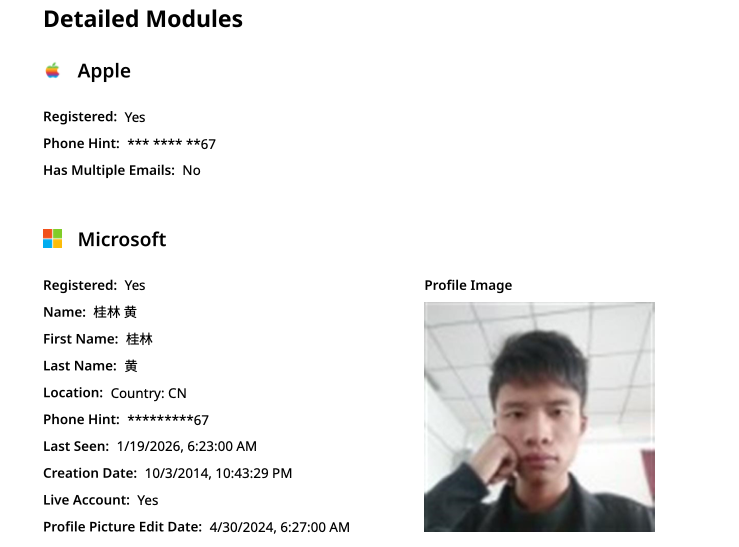
Constella finds 189308024@qq.com is associated with the China phone number 18681627767. The open-source intelligence platform osint.industries reveals this phone number is connected to a Microsoft profile created in 2014 under the name Guilin Huang (桂林 黄). The cyber intelligence platform Spycloud says that phone number was used in 2017 to create an account at the Chinese social media platform Weibo under the username “h_guilin.”

The public information attached to Guilin Huang’s Microsoft account, according to the breach tracking service osintindustries.com.

The remaining three users and corresponding qq.com email addresses were all connected to individuals in China. However, none of them (nor Mr. Huang) had any apparent connection to the entities created and operated by Chen Daihai and Zhu Zhiyu — or to any corporate entities for that matter. Also, none of these individuals responded to requests for comment.

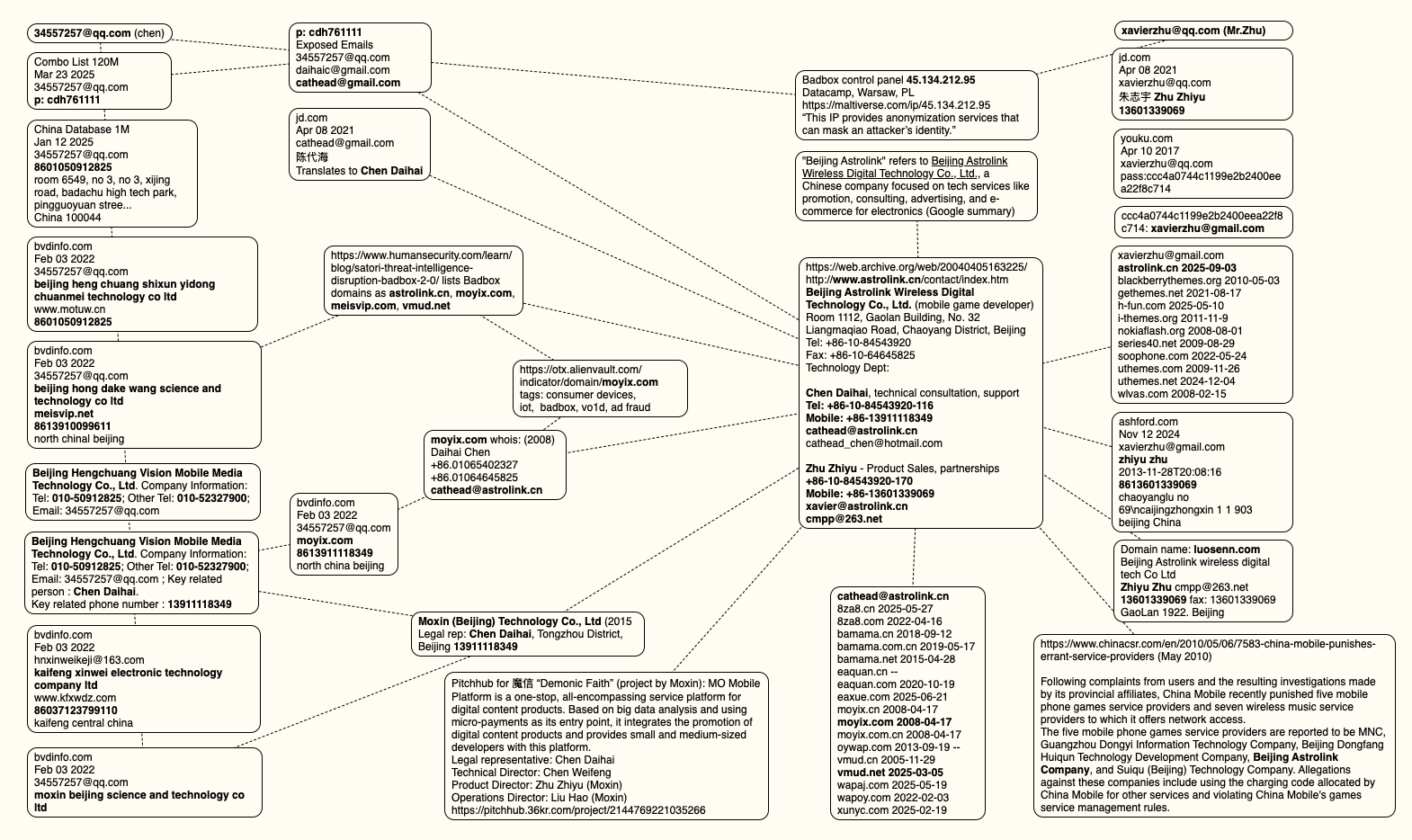
The mind map below includes search pivots on the email addresses, company names and phone numbers that suggest a connection between Chen Daihai, Zhu Zhiyu, and Badbox 2.0.

This mind map includes search pivots on the email addresses, company names and phone numbers that appear to connect Chen Daihai and Zhu Zhiyu to Badbox 2.0. Click to enlarge.

UNAUTHORIZED ACCESS

The idea that the Kimwolf botmasters could have direct access to the Badbox 2.0 botnet is a big deal, but explaining exactly why that is requires some background on how Kimwolf spreads to new devices. The botmasters figured out they could trick residential proxy services into relaying malicious commands to vulnerable devices behind the firewall on the unsuspecting user’s local network.

The vulnerable systems sought out by Kimwolf are primarily Internet of Things (IoT) devices like unsanctioned Android TV boxes and digital photo frames that have no discernible security or authentication built-in. Put simply, if you can communicate with these devices, you can compromise them with a single command.

Our January 2 story featured research from the proxy-tracking firm Synthient, which alerted 11 different residential proxy providers that their proxy endpoints were vulnerable to being abused for this kind of local network probing and exploitation.

Most of those vulnerable proxy providers have since taken steps to prevent customers from going upstream into the local networks of residential proxy endpoints, and it appeared that Kimwolf would no longer be able to quickly spread to millions of devices simply by exploiting some residential proxy provider.

However, the source of that Badbox 2.0 screenshot said the Kimwolf botmasters had an ace up their sleeve the whole time: Secret access to the Badbox 2.0 botnet control panel.

“Dort has gotten unauthorized access,” the source said. “So, what happened is normal proxy providers patched this. But Badbox doesn’t sell proxies by itself, so it’s not patched. And as long as Dort has access to Badbox, they would be able to load” the Kimwolf malware directly onto TV boxes associated with Badbox 2.0.

The source said it isn’t clear how Dort gained access to the Badbox botnet panel. But it’s unlikely that Dort’s existing account will persist for much longer: All of our notifications to the qq.com email addresses listed in the control panel screenshot received a copy of that image, as well as questions about the apparently rogue ABCD account.

Email Bombs Exploit Lax Authentication in Zendesk

Cybercriminals are abusing a widespread lack of authentication in the customer service platform Zendesk to flood targeted email inboxes with menacing messages that come from hundreds of Zendesk corporate customers simultaneously.

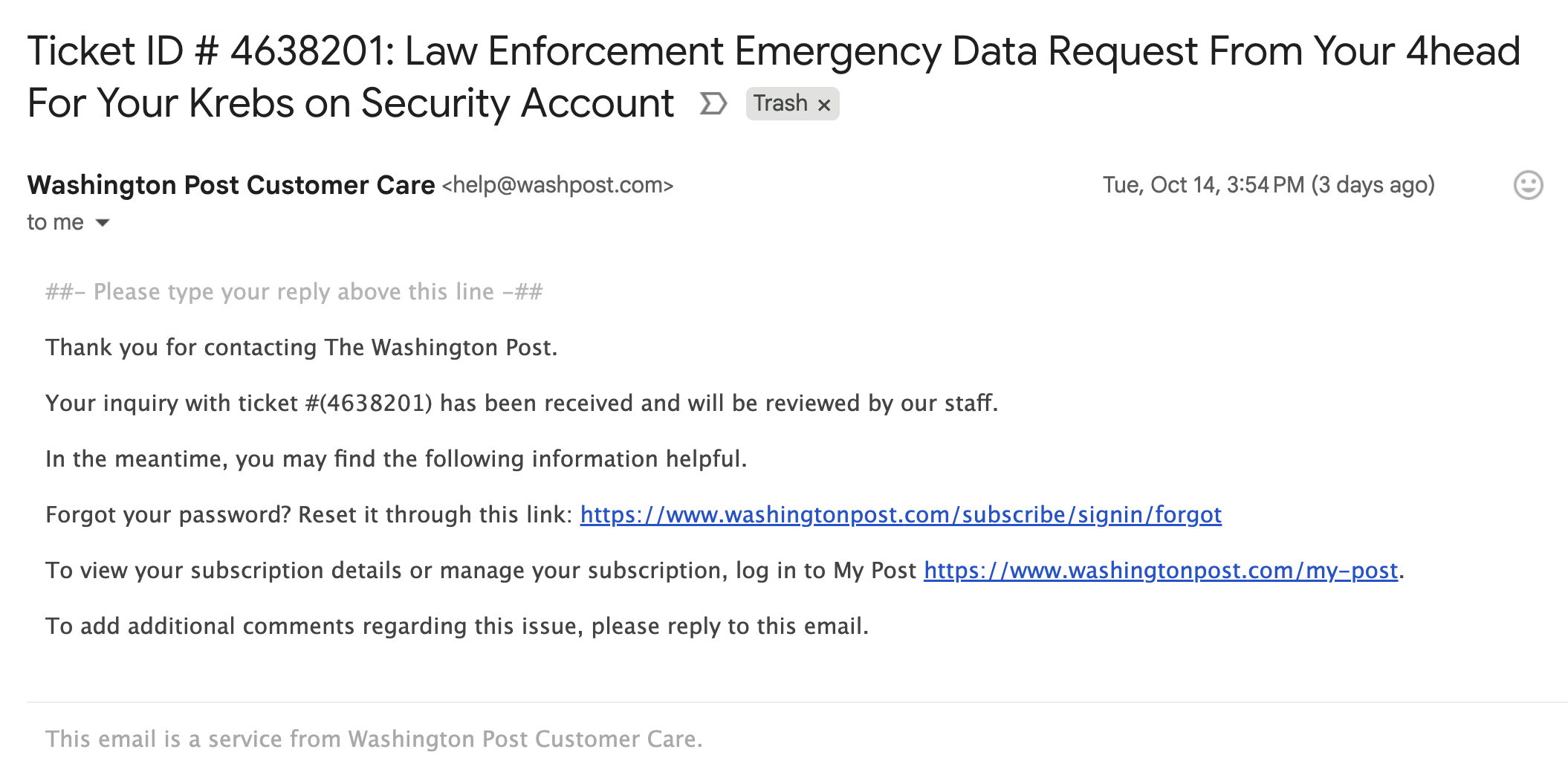
Zendesk is an automated help desk service designed to make it simple for people to contact companies for customer support issues. Earlier this week, KrebsOnSecurity started receiving thousands of ticket creation notification messages through Zendesk in rapid succession, each bearing the name of different Zendesk customers, such as CapCom, CompTIA, Discord, GMAC, NordVPN, The Washington Post, and Tinder.

The abusive missives sent via Zendesk’s platform can include any subject line chosen by the abusers. In my case, the messages variously warned about a supposed law enforcement investigation involving KrebsOnSecurity.com, or else contained personal insults.

Moreover, the automated messages that are sent out from this type of abuse all come from customer domain names — not from Zendesk. In the example below, replying to any of the junk customer support responses from The Washington Post’s Zendesk installation shows the reply-to address is help@washpost.com.

One of dozens of messages sent to me this week by The Washington Post.

Notified about the mass abuse of their platform, Zendesk said the emails were ticket creation notifications from customer accounts that configured their Zendesk instance to allow anyone to submit support requests — including anonymous users.

“These types of support tickets can be part of a customer’s workflow, where a prior verification is not required to allow them to engage and make use of the Support capabilities,” said Carolyn Camoens, communications director at Zendesk. “Although we recommend our customers to permit only verified users to submit tickets, some Zendesk customers prefer to use an anonymous environment to allow for tickets to be created due to various business reasons.”

Camoens said requests that can be submitted in an anonymous manner can also make use of an email address of the submitter’s choice.

“However, this method can also be used for spam requests to be created on behalf of third party email addresses,” Camoens said. “If an account has enabled the auto-responder trigger based on ticket creation, then this allows for the ticket notification email to be sent from our customer’s accounts to these third parties. The notification will also include the Subject added by the creator of these tickets.”

Zendesk claims it uses rate limits to prevent a high volume of requests from being created at once, but those limits did not stop Zendesk customers from flooding my inbox with thousands of messages in just a few hours.

“We recognize that our systems were leveraged against you in a distributed, many-against-one manner,” Camoens said. “We are actively investigating additional preventive measures. We are also advising customers experiencing this type of activity to follow our general security best practices and configure an authenticated ticket creation workflow.”

In all of the cases above, the messaging abuse would not have been possible if Zendesk customers validated support request email addresses prior to sending responses. Failing to do so may make it easier for Zendesk clients to handle customer support requests, but it also allows ne’er-do-wells to sully the sender’s brand in service of disruptive and malicious email floods.

Feds Tie ‘Scattered Spider’ Duo to $115M in Ransoms

U.S. prosecutors last week levied criminal hacking charges against 19-year-old U.K. national Thalha Jubair for allegedly being a core member of Scattered Spider, a prolific cybercrime group blamed for extorting at least $115 million in ransom payments from victims. The charges came as Jubair and an alleged co-conspirator appeared in a London court to face accusations of hacking into and extorting several large U.K. retailers, the London transit system, and healthcare providers in the United States.

At a court hearing last week, U.K. prosecutors laid out a litany of charges against Jubair and 18-year-old Owen Flowers, accusing the teens of involvement in an August 2024 cyberattack that crippled Transport for London, the entity responsible for the public transport network in the Greater London area.

A court artist sketch of Owen Flowers (left) and Thalha Jubair appearing at Westminster Magistrates’ Court last week. Credit: Elizabeth Cook, PA Wire.

On July 10, 2025, KrebsOnSecurity reported that Flowers and Jubair had been arrested in the United Kingdom in connection with recent Scattered Spider ransom attacks against the retailers Marks & Spencer and Harrods, and the British food retailer Co-op Group.

That story cited sources close to the investigation saying Flowers was the Scattered Spider member who anonymously gave interviews to the media in the days after the group’s September 2023 ransomware attacks disrupted operations at Las Vegas casinos operated by MGM Resorts and Caesars Entertainment.

The story also noted that Jubair’s alleged handles on cybercrime-focused Telegram channels had far lengthier rap sheets involving some of the more consequential and headline-grabbing data breaches over the past four years. What follows is an account of cybercrime activities that prosecutors have attributed to Jubair’s alleged hacker handles, as told by those accounts in posts to public Telegram channels that are closely monitored by multiple cyber intelligence firms.

EARLY DAYS (2021-2022)

Jubair is alleged to have been a core member of the LAPSUS$ cybercrime group that broke into dozens of technology companies beginning in late 2021, stealing source code and other internal data from tech giants including MicrosoftNvidiaOktaRockstar GamesSamsungT-Mobile, and Uber.

That is, according to the former leader of the now-defunct LAPSUS$. In April 2022, KrebsOnSecurity published internal chat records taken from a server that LAPSUS$ used, and those chats indicate Jubair was working with the group using the nicknames Amtrak and Asyntax. In the middle of the gang’s cybercrime spree, Asyntax told the LAPSUS$ leader not to share T-Mobile’s logo in images sent to the group because he’d been previously busted for SIM-swapping and his parents would suspect he was back at it again.

The leader of LAPSUS$ responded by gleefully posting Asyntax’s real name, phone number, and other hacker handles into a public chat room on Telegram:
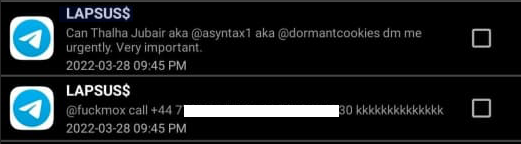
In March 2022, the leader of the LAPSUS$ data extortion group exposed Thalha Jubair’s name and hacker handles in a public chat room on Telegram.

That story about the leaked LAPSUS$ chats also connected Amtrak/Asyntax to several previous hacker identities, including “Everlynn,” who in April 2021 began offering a cybercriminal service that sold fraudulent “emergency data requests” targeting the major social media and email providers.

In these so-called “fake EDR” schemes, the hackers compromise email accounts tied to police departments and government agencies, and then send unauthorized demands for subscriber data (e.g. username, IP/email address), while claiming the information being requested can’t wait for a court order because it relates to an urgent matter of life and death.
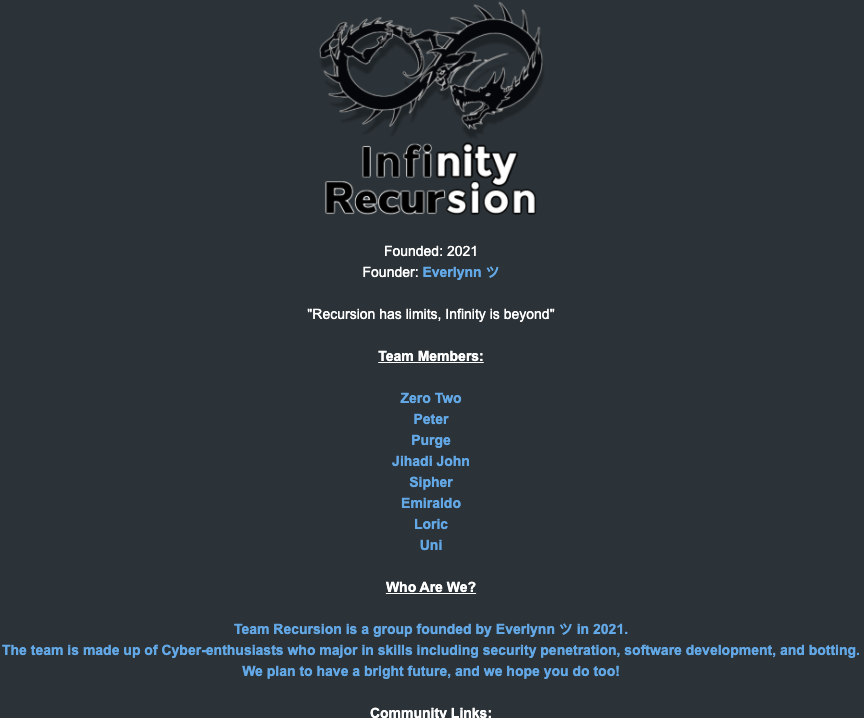
The roster of the now-defunct “Infinity Recursion” hacking team, which sold fake EDRs between 2021 and 2022. The founder “Everlynn” has been tied to Jubair. The member listed as “Peter” became the leader of LAPSUS$ who would later post Jubair’s name, phone number and hacker handles into LAPSUS$’s chat channel.

EARTHTOSTAR

Prosecutors in New Jersey last week alleged Jubair was part of a threat group variously known as Scattered Spider, 0ktapus, and UNC3944, and that he used the nicknames EarthtoStar, Brad, Austin, and Austistic.

Beginning in 2022, EarthtoStar co-ran a bustling Telegram channel called Star Chat, which was home to a prolific SIM-swapping group that relentlessly used voice- and SMS-based phishing attacks to steal credentials from employees at the major wireless providers in the U.S. and U.K.

Jubair allegedly used the handle “Earth2Star,” a core member of a prolific SIM-swapping group operating in 2022. This ad produced by the group lists various prices for SIM swaps.

The group would then use that access to sell a SIM-swapping service that could redirect a target’s phone number to a device the attackers controlled, allowing them to intercept the victim’s phone calls and text messages (including one-time codes). Members of Star Chat targeted multiple wireless carriers with SIM-swapping attacks, but they focused mainly on phishing T-Mobile employees.

In February 2023, KrebsOnSecurity scrutinized more than seven months of these SIM-swapping solicitations on Star Chat, which almost daily peppered the public channel with “Tmo up!” and “Tmo down!” notices indicating periods wherein the group claimed to have active access to T-Mobile’s network.
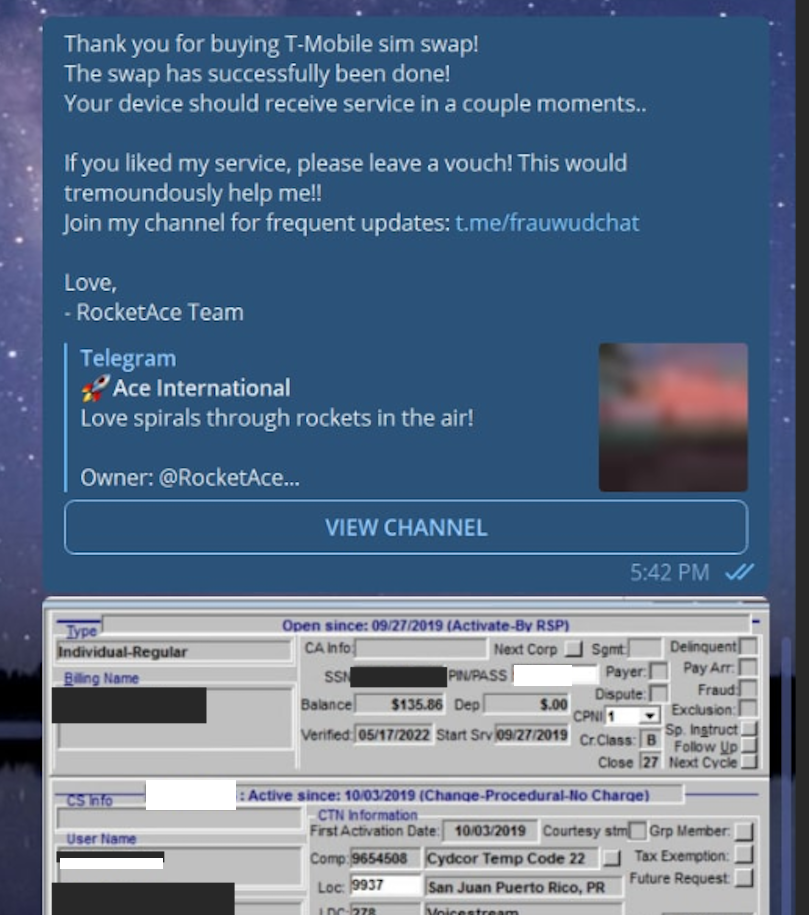
A redacted receipt from Star Chat’s SIM-swapping service targeting a T-Mobile customer after the group gained access to internal T-Mobile employee tools.

The data showed that Star Chat — along with two other SIM-swapping groups operating at the same time — collectively broke into T-Mobile over a hundred times in the last seven months of 2022. However, Star Chat was by far the most prolific of the three, responsible for at least 70 of those incidents.
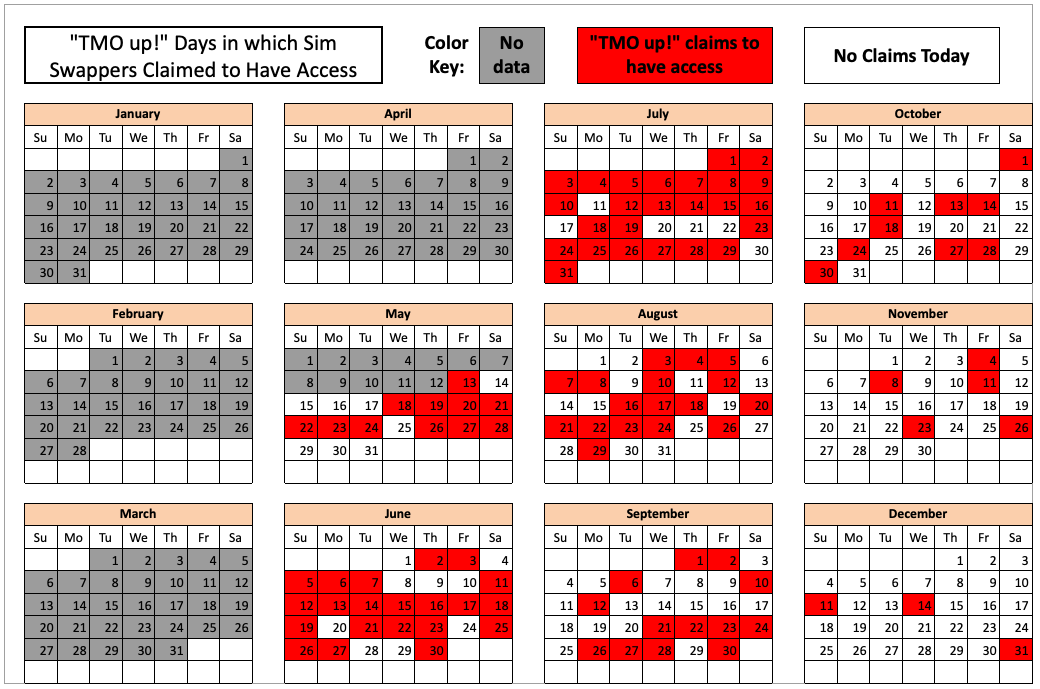
The 104 days in the latter half of 2022 in which different known SIM-swapping groups claimed access to T-Mobile employee tools. Star Chat was responsible for a majority of these incidents. Image: krebsonsecurity.com.

A review of EarthtoStar’s messages on Star Chat as indexed by the threat intelligence firm Flashpoint shows this person also sold “AT&T email resets” and AT&T call forwarding services for up to $1,200 per line. EarthtoStar explained the purpose of this service in post on Telegram:

“Ok people are confused, so you know when u login to chase and it says ‘2fa required’ or whatever the fuck, well it gives you two options, SMS or Call. If you press call, and I forward the line to you then who do you think will get said call?”

New Jersey prosecutors allege Jubair also was involved in a mass SMS phishing campaign during the summer of 2022 that stole single sign-on credentials from employees at hundreds of companies. The text messages asked users to click a link and log in at a phishing page that mimicked their employer’s Okta authentication page, saying recipients needed to review pending changes to their upcoming work schedules.

The phishing websites used a Telegram instant message bot to forward any submitted credentials in real-time, allowing the attackers to use the phished username, password and one-time code to log in as that employee at the real employer website.

That weeks-long SMS phishing campaign led to intrusions and data thefts at more than 130 organizations, including LastPass, DoorDash, Mailchimp, Plex and Signal.
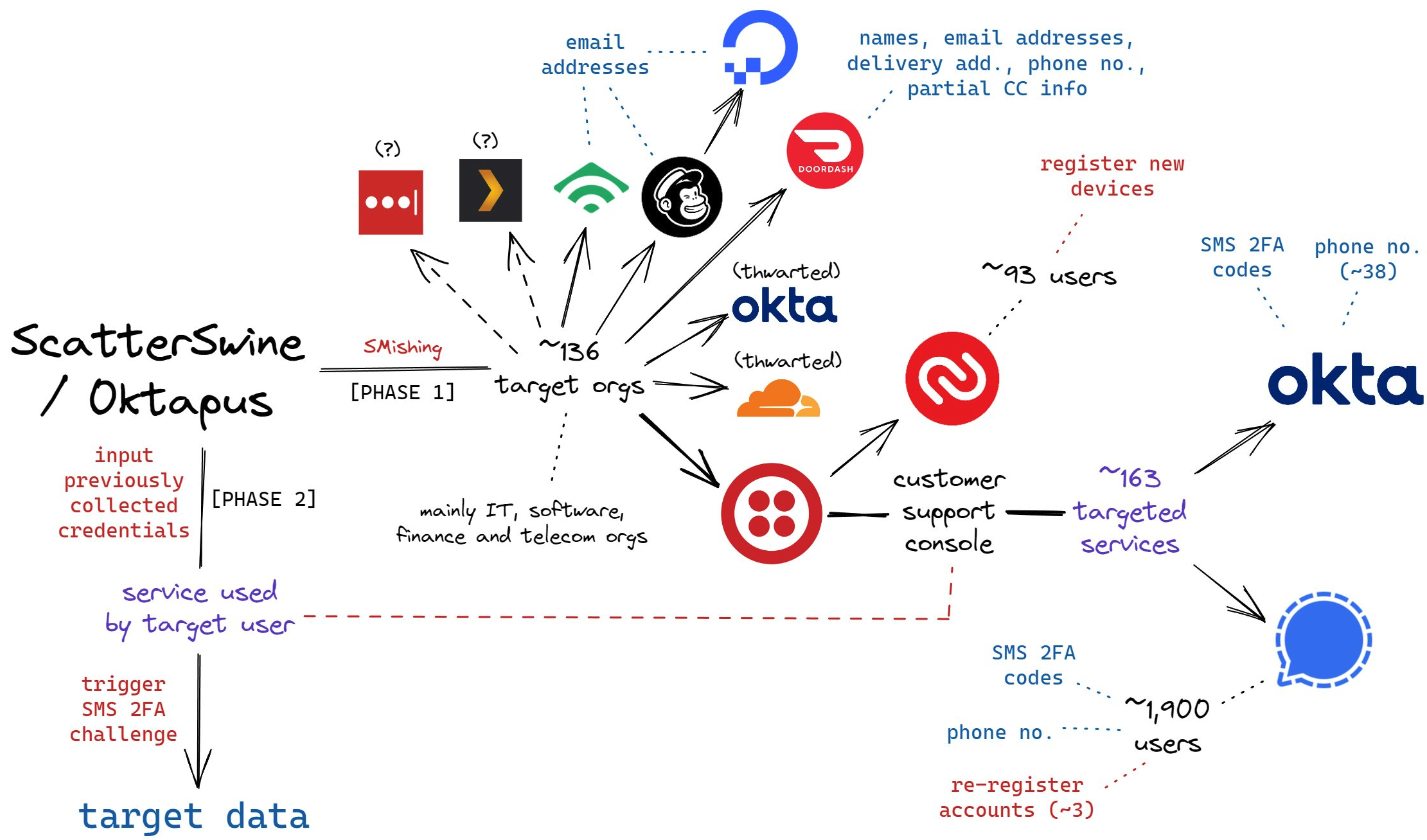
A visual depiction of the attacks by the SMS phishing group known as 0ktapus, ScatterSwine, and Scattered Spider. Image: Amitai Cohen twitter.com/amitaico.

DA, COMRADE

EarthtoStar’s group Star Chat specialized in phishing their way into business process outsourcing (BPO) companies that provide customer support for a range of multinational companies, including a number of the world’s largest telecommunications providers. In May 2022, EarthtoStar posted to the Telegram channel “Frauwudchat”:

“Hi, I am looking for partners in order to exfiltrate data from large telecommunications companies/call centers/alike, I have major experience in this field, [including] a massive call center which houses 200,000+ employees where I have dumped all user credentials and gained access to the [domain controller] + obtained global administrator I also have experience with REST API’s and programming. I have extensive experience with VPN, Citrix, cisco anyconnect, social engineering + privilege escalation. If you have any Citrix/Cisco VPN or any other useful things please message me and lets work.”

At around the same time in the Summer of 2022, at least two different accounts tied to Star Chat — “RocketAce” and “Lopiu” — introduced the group’s services to denizens of the Russian-language cybercrime forum Exploit, including:

-SIM-swapping services targeting Verizon and T-Mobile customers;
-Dynamic phishing pages targeting customers of single sign-on providers like Okta;
-Malware development services;
-The sale of extended validation (EV) code signing certificates.

The user “Lopiu” on the Russian cybercrime forum Exploit advertised many of the same unique services offered by EarthtoStar and other Star Chat members. Image source: ke-la.com.

These two accounts on Exploit created multiple sales threads in which they claimed administrative access to U.S. telecommunications providers and asked other Exploit members for help in monetizing that access. In June 2022, RocketAce, which appears to have been just one of EarthtoStar’s many aliases, posted to Exploit:

Hello. I have access to a telecommunications company’s citrix and vpn. I would like someone to help me break out of the system and potentially attack the domain controller so all logins can be extracted we can discuss payment and things leave your telegram in the comments or private message me ! Looking for someone with knowledge in citrix/privilege escalation

On Nov. 15, 2022, EarthtoStar posted to their Star Sanctuary Telegram channel that they were hiring malware developers with a minimum of three years of experience and the ability to develop rootkits, backdoors and malware loaders.

“Optional: Endorsed by advanced APT Groups (e.g. Conti, Ryuk),” the ad concluded, referencing two of Russia’s most rapacious and destructive ransomware affiliate operations. “Part of a nation-state / ex-3l (3 letter-agency).”

2023-PRESENT DAY

The Telegram and Discord chat channels wherein Flowers and Jubair allegedly planned and executed their extortion attacks are part of a loose-knit network known as the Com, an English-speaking cybercrime community consisting mostly of individuals living in the United States, the United Kingdom, Canada and Australia.

Many of these Com chat servers have hundreds to thousands of members each, and some of the more interesting solicitations on these communities are job offers for in-person assignments and tasks that can be found if one searches for posts titled, “If you live near,” or “IRL job” — short for “in real life” job.

These “violence-as-a-service” solicitations typically involve “brickings,” where someone is hired to toss a brick through the window at a specified address. Other IRL jobs for hire include tire-stabbings, molotov cocktail hurlings, drive-by shootings, and even home invasions. The people targeted by these services are typically other criminals within the community, but it’s not unusual to see Com members asking others for help in harassing or intimidating security researchers and even the very law enforcement officers who are investigating their alleged crimes.

It remains unclear what precipitated this incident or what followed directly after, but on January 13, 2023, a Star Sanctuary account used by EarthtoStar solicited the home invasion of a sitting U.S. federal prosecutor from New York. That post included a photo of the prosecutor taken from the Justice Department’s website, along with the message:

“Need irl niggas, in home hostage shit no fucking pussies no skinny glock holding 100 pound niggas either”

Throughout late 2022 and early 2023, EarthtoStar’s alias “Brad” (a.k.a. “Brad_banned”) frequently advertised Star Chat’s malware development services, including custom malicious software designed to hide the attacker’s presence on a victim machine:

We can develop KERNEL malware which will achieve persistence for a long time,
bypass firewalls and have reverse shell access.

This shit is literally like STAGE 4 CANCER FOR COMPUTERS!!!

Kernel meaning the highest level of authority on a machine.
This can range to simple shells to Bootkits.

Bypass all major EDR’s (SentinelOne, CrowdStrike, etc)
Patch EDR’s scanning functionality so it’s rendered useless!

Once implanted, extremely difficult to remove (basically impossible to even find)
Development Experience of several years and in multiple APT Groups.

Be one step ahead of the game. Prices start from $5,000+. Message @brad_banned to get a quote

In September 2023 , both MGM Resorts and Caesars Entertainment suffered ransomware attacks at the hands of a Russian ransomware affiliate program known as ALPHV and BlackCat. Caesars reportedly paid a $15 million ransom in that incident.

Within hours of MGM publicly acknowledging the 2023 breach, members of Scattered Spider were claiming credit and telling reporters they’d broken in by social engineering a third-party IT vendor. At a hearing in London last week, U.K. prosecutors told the court Jubair was found in possession of more than $50 million in ill-gotten cryptocurrency, including funds that were linked to the Las Vegas casino hacks.

The Star Chat channel was finally banned by Telegram on March 9, 2025. But U.S. prosecutors say Jubair and fellow Scattered Spider members continued their hacking, phishing and extortion activities up until September 2025.

In April 2025, the Com was buzzing about the publication of “The Com Cast,” a lengthy screed detailing Jubair’s alleged cybercriminal activities and nicknames over the years. This account included photos and voice recordings allegedly of Jubair, and asserted that in his early days on the Com Jubair used the nicknames Clark and Miku (these are both aliases used by Everlynn in connection with their fake EDR services).

Thalha Jubair (right), without his large-rimmed glasses, in an undated photo posted in The Com Cast.

More recently, the anonymous Com Cast author(s) claimed, Jubair had used the nickname “Operator,” which corresponds to a Com member who ran an automated Telegram-based doxing service that pulled consumer records from hacked data broker accounts. That public outing came after Operator allegedly seized control over the Doxbin, a long-running and highly toxic community that is used to “dox” or post deeply personal information on people.

“Operator/Clark/Miku: A key member of the ransomware group Scattered Spider, which consists of a diverse mix of individuals involved in SIM swapping and phishing,” the Com Cast account stated. “The group is an amalgamation of several key organizations, including Infinity Recursion (owned by Operator), True Alcorians (owned by earth2star), and Lapsus, which have come together to form a single collective.”

The New Jersey complaint (PDF) alleges Jubair and other Scattered Spider members committed computer fraud, wire fraud, and money laundering in relation to at least 120 computer network intrusions involving 47 U.S. entities between May 2022 and September 2025. The complaint alleges the group’s victims paid at least $115 million in ransom payments.

U.S. authorities say they traced some of those payments to Scattered Spider to an Internet server controlled by Jubair. The complaint states that a cryptocurrency wallet discovered on that server was used to purchase several gift cards, one of which was used at a food delivery company to send food to his apartment. Another gift card purchased with cryptocurrency from the same server was allegedly used to fund online gaming accounts under Jubair’s name. U.S. prosecutors said that when they seized that server they also seized $36 million in cryptocurrency.

The complaint also charges Jubair with involvement in a hacking incident in January 2025 against the U.S. courts system that targeted a U.S. magistrate judge overseeing a related Scattered Spider investigation. That other investigation appears to have been the prosecution of Noah Michael Urban, a 20-year-old Florida man charged in November 2024 by prosecutors in Los Angeles as one of five alleged Scattered Spider members.

Urban pleaded guilty in April 2025 to wire fraud and conspiracy charges, and in August he was sentenced to 10 years in federal prison. Speaking with KrebsOnSecurity from jail after his sentencing, Urban asserted that the judge gave him more time than prosecutors requested because he was mad that Scattered Spider hacked his email account.

Noah “Kingbob” Urban, posting to Twitter/X around the time of his sentencing on Aug. 20.

court transcript (PDF) from a status hearing in February 2025 shows Urban was telling the truth about the hacking incident that happened while he was in federal custody. The judge told attorneys for both sides that a co-defendant in the California case was trying to find out about Mr. Urban’s activity in the Florida case, and that the hacker accessed the account by impersonating a judge over the phone and requesting a password reset.

Allison Nixon is chief research officer at the New York based security firm Unit 221B, and easily one of the world’s leading experts on Com-based cybercrime activity. Nixon said the core problem with legally prosecuting well-known cybercriminals from the Com has traditionally been that the top offenders tend to be under the age of 18, and thus difficult to charge under federal hacking statutes.

In the United States, prosecutors typically wait until an underage cybercrime suspect becomes an adult to charge them. But until that day comes, she said, Com actors often feel emboldened to continue committing — and very often bragging about — serious cybercrime offenses.

“Here we have a special category of Com offenders that effectively enjoy legal immunity,” Nixon told KrebsOnSecurity. “Most get recruited to Com groups when they are older, but of those that join very young, such as 12 or 13, they seem to be the most dangerous because at that age they have no grounding in reality and so much longevity before they exit their legal immunity.”

Nixon said U.K. authorities face the same challenge when they briefly detain and search the homes of underage Com suspects: Namely, the teen suspects simply go right back to their respective cliques in the Com and start robbing and hurting people again the minute they’re released.

Indeed, the U.K. court heard from prosecutors last week that both Scattered Spider suspects were detained and/or searched by local law enforcement on multiple occasions, only to return to the Com less than 24 hours after being released each time.

“What we see is these young Com members become vectors for perpetrators to commit enormously harmful acts and even child abuse,” Nixon said. “The members of this special category of people who enjoy legal immunity are meeting up with foreign nationals and conducting these sometimes heinous acts at their behest.”

Nixon said many of these individuals have few friends in real life because they spend virtually all of their waking hours on Com channels, and so their entire sense of identity, community and self-worth gets wrapped up in their involvement with these online gangs. She said if the law was such that prosecutors could treat these people commensurate with the amount of harm they cause society, that would probably clear up a lot of this problem.

“If law enforcement was allowed to keep them in jail, they would quit reoffending,” she said.

The Times of London reports that Flowers is facing three charges under the Computer Misuse Act: two of conspiracy to commit an unauthorized act in relation to a computer causing/creating risk of serious damage to human welfare/national security and one of attempting to commit the same act. Maximum sentences for these offenses can range from 14 years to life in prison, depending on the impact of the crime.

Jubair is reportedly facing two charges in the U.K.: One of conspiracy to commit an unauthorized act in relation to a computer causing/creating risk of serious damage to human welfare/national security and one of failing to comply with a section 49 notice to disclose the key to protected information.

In the United States, Jubair is charged with computer fraud conspiracy, two counts of computer fraud, wire fraud conspiracy, two counts of wire fraud, and money laundering conspiracy. If extradited to the U.S., tried and convicted on all charges, he faces a maximum penalty of 95 years in prison.

In July 2025, the United Kingdom barred victims of hacking from paying ransoms to cybercriminal groups unless approved by officials. U.K. organizations that are considered part of critical infrastructure reportedly will face a complete ban, as will the entire public sector. U.K. victims of a hack are now required to notify officials to better inform policymakers on the scale of Britain’s ransomware problem.

For further reading (bless you), check out Bloomberg’s poignant story last week based on a year’s worth of jailhouse interviews with convicted Scattered Spider member Noah Urban.

Impacket Defense Basics With an Azure Lab 

Jordan Drysdale // Overview The following description of some of Impacket’s tools and techniques is a tribute to the authors, SecureAuthCorp, and the open-source effort to maintain and extend the code. […]

The post Impacket Defense Basics With an Azure Lab  appeared first on Black Hills Information Security, Inc..

JTAG – Micro-Controller Debugging

Raymond Felch // Being an embedded firmware engineer for most of my career, I quickly became fascinated when I learned about reverse engineering firmware using JTAG.   I decided to […]

The post JTAG – Micro-Controller Debugging appeared first on Black Hills Information Security, Inc..

❌