❌

Reading view

There are new articles available, click to refresh the page.

Supreme Court permits states to use SAVE database for citizenship checks

The U.S. Supreme Court ruled Friday that states may use the federal SAVE database to verify voter citizenship, reversing lower court decisions that found the database was inaccurate and would likely disenfranchise eligible voters.

In its opinion, the majority wrote that “the Federal Government has an obligation to respond to requests from state and local election officials seeking to verify the citizenship of voters.”

“The District Court’s order thus inhibits the Federal Government’s efforts to assist state and local agencies in the proper administration of the midterm elections, the ruling reads. “Under these circumstances, the equities weigh in favor of a stay.”

The Department of Homeland Security initially designed the SAVE database to determine benefit eligibility for immigrants and to track applicants pursuing U.S. citizenship. Under the Trump administration, it had been repurposed to screen voters for citizenship. Critics say the tool is outdated, often inaccurate and poses a significant risk of wrongly removing eligible voters from rolls.

Voting rights groups, including the League of Women Voters and the Electronic Privacy Information Center, filed suit last year. They argued that combining SAVE data with Social Security records violated confidentiality provisions in the Social Security Act, the Privacy Act and the Administrative Procedures Act.

While the ruling permits states to use the database, adoption remains uncertain. Some conservative states have used SAVE previously, saying it has been helpful in maintaining voter rolls. However, most states have resisted the federal government’s efforts to use citizenship verification systems or wrest control of voter registration efforts away from states. The Trump administration has lost 23 federal court cases in attempts to compel states to share additional data.  

Election experts said that the ruling’s impact on 2026 is likely to be limited because of federal laws that bar states from making changes to voter registration within 90 days of an election.

“Given that the SAVE system is used purely as a voluntary system to assist states in keeping their voter lists accurate, states may find this to be a helpful tool to use alongside other mechanisms to keep their lists up to date, even as the Department of Homeland Security itself admits the data is not perfect and evidence suggests the SAVE system has significant flaws,” said David Becker, executive director of the nonprofit Center for Election Innovation and Research.

Three justices – Ketanji Brown Jackson, Sonia Sotomayor and Elena Kagan – dissented, noting that “without full briefing or oral argument, this Court now grants [a stay]—rendering questionable interim rulings about two statutory provisions it has never before interpreted.”

There are laws and procedures that govern how and when federal systems are changed or modified. In this case, DHS did not create a legally mandated system of records notice (SORN) for the SAVE database outlining the broader impacts of the changes on data privacy. Nor did they engage in or offer a public comment period. Instead, they simply announced in May 2025 that the database was ready for use.

In court, the administration cited the Illegal Immigration Reform and Immigrant Responsibility Act to justify merging DHS and Social Security data. That argument was rejected by lower courts, and dissenters argued that the Supreme Court majority overturned those rulings without deliberation about whether the administration’s legal reasoning was sound.

“The majority thus treats [the Illegal Immigration Reform and Immigrant Responsibility Act] as essentially overriding the limits that privacy laws impose on the sharing of citizenship information with DHS. But that ‘back-of-the-napkin assessment,’ is implausible,” wrote Jackson.

The post Supreme Court permits states to use SAVE database for citizenship checks appeared first on CyberScoop.

Supreme Court denies Trump request to allow USPS mail ballot changes

The Supreme Court has rejected a petition by the Trump administration to implement changes to the way the U.S. Postal Service handles mail-in ballots for the upcoming 2026 midterm elections, calling it “arbitrary and capricious.”

The 7-2 decision was handed down Monday with little explanation by the court. Writing for the majority, Justice Kentaji Brown Jackson said the administration “is unlikely to succeed on the merits of its challenge to the District Court’s preliminary injunction” and had failed to articulate a valid reason for seeking emergency relief from the court.

However, in a concurring statement, Justice Brett Kavanaugh said he believed there was “a fair prospect” that the final USPS final regulation would be within their legal authority and appeared to cite unreasonably short timelines imposed on states and his primary reason for denying the stay.

“But applying the rule in the 2026 elections would be arbitrary and capricious and in violation of the Administrative Procedures Act because state and local election officials do not have sufficient time to reasonably implement the rule before the elections,” wrote Kavanaugh.

The executive order would have tasked the USPS with verifying  voter citizenship and the validating ballot materials. The order would have created a barcode tracking system for mail ballot envelopes and “State Citizenship Lists” compiled by the Department of Homeland Security.

The order was quickly challenged by states and voting rights organizations, who argued the executive branch had no constitutional authority to dictate how they maintained their voter rolls.

The White House has justified the order by claiming the federal government has “an unavoidable duty” under Article II of the Constitution to maintain confidence in election outcomes by preventing violations of criminal law, including noncitizen voting.

Lower courts disagreed, blocking the executive order from being put in place before November. The petition to the Supreme Court represented the administration’s best and final hope for judicial relief.

As the administration fought the matter in courts, it moved ahead finalizing the USPS rule. A whistleblower complaint alleged that a “rushed” effort by the White House and U.S. Postal Service to install three new restrictive IT systems meant to verify citizenship that could potentially deny thousands of mail-in ballots if the federal government disagrees with states on a voter or ballot’s eligibility.

While Jackson and Kavanaugh’s rationale took up less than half a page, a dissenting opinion written by Justice Samuel Alito and signed by Justice Clarence Thomas was more than 7 pages long.

Alito wrote that he would have granted the Trump administration their request for a stay, allowing the order to be implemented in time for the 2026 elections. He said states and organizations suing the government lacked standing, and dismissed their concerns that implementing the USPS order ahead of the 2026 elections would thwart their ability to educate voters about mail-in voting, calling them “abstract social interests.”

Ahead of the decision, David Becker, executive director of the nonprofit Center for Election Integrity and Research, told reporters that he doubted members of the Supreme Court majority “want to own the chaos that would ensure” as the USPS, states and voters attempt to navigate changes put in place just months before elections and after many states have begun sending out ballots that do not comply with the proposed rules.

He also said that it would be in line with previous Supreme Court decisions that have recognized state supremacy when it comes to specific election administration authorities, like where and how their citizens vote.

“When they consider issues related to the administration of elections, the casting and counting of ballots, they have sided with the states every time,” said Becker.

The post Supreme Court denies Trump request to allow USPS mail ballot changes appeared first on CyberScoop.

Tina Peters, through attorney, backs off formal role in Shasta County elections

Tina Peters, the former Mesa County election clerk convicted of seven felonies related to the theft of voting machine software, said Tuesday through her attorney that she won’t accept a formal position overseeing elections in Shasta County, Calif.

Last month, Shasta County registrar of voters Clint Curtis said he intended to hire Peters as assistant registrar to help with the 2026 elections, just months after her prison sentence was cut short by a commutation from Democratic Gov. Jared Polis.

Later, in an interview with CyberScoop, Curtis said he intended to hire Peters as an outside consultant without access to sensitive county election systems. He also said Peters hadn’t yet accepted the position.

At the time, Peters’ attorney, Peter Ticktin, pointed CyberScoop to a statement indicating Peters’ interest in helping the county. On Tuesday, he sent a new statement from Peters that backed away from a formal job role.

“Let me be clear: I have not accepted any position with the Shasta County Elections Office,” the statement said. “There have been discussions about ways I might assist with election integrity and ballot-authenticity efforts, but no formal role has been accepted.”

Peters went on to say her concerns extended beyond Shasta County, to “all 3,114” counties in America and “whether every citizen can trust that our elections are free, fair and transparent.”

The prospective hiring of Peters sparked a backlash, including from Shasta County’s Board of Supervisors, which had just formally censured Curtis for allegedly abusive verbal behavior toward staff, and from Democratic politicians statewide.  Secretary of State Shirley Weber’s office told CyberScoop it was monitoring the county’s  elections for compliance with state and federal laws.

Peters blamed the media for portraying her as a threat to elections, saying she remains “committed to lawful, transparent election integrity efforts that protect the vote of every American citizen.”

“The media continues to mischaracterize my case with words like ‘breaching,’ ‘tampering,’ and similar claims,” Peters said. “My charges were not for changing votes, altering election results, or manipulating any election outcome. Those words are used to create a false impression and distract from the real issue: whether the American people have transparent, verifiable elections they can trust.”

Peters broke into Mesa County’s election office to prove voting machines had shifted votes to Democrat Joe Biden, but  data instead confirmed the county’s 2020 vote totals were accurate. Before her release, Peters at one point expressed written regret to the state for her crimes.

Despite that, on Tuesday Peters again endorsed the idea that all electronic voting machines are untrustworthy, and any elections using them as inherently suspect.

Experts have long said that vulnerabilities exist in U.S. voting machines, but certain longstanding practices, like backup paper ballots, post-election, risk-limiting audits, and relying on decentralized equipment and vendors can also manage risks and catch anomalies. According to the Cybersecurity and Infrastructure Security Agency, nearly 98% of Americans vote on electronic voting machines with paper backups.

Despite a years-long effort and dozens of court challenges, neither Peters nor other Trump allies have ever provided credible proof that manipulation of U.S. voting machines, voter fraud or other problems impacted the 2020 presidential election.

The post Tina Peters, through attorney, backs off formal role in Shasta County elections appeared first on CyberScoop.

Election official says Tina Peters would be consultant, won’t have access to election systems

The top election official for Shasta County, Calif. said he has offered convicted felon and former Mesa County, Colo. clerk Tina Peters a position as a consultant to help with the 2026 elections, but that she hasn’t accepted the position yet.  

Earlier this month, Shasta County registrar Clint Curtis told local news outlets that he intended to hire Peters as assistant registrar of voters to help with the upcoming 2026 elections, months after she was released from prison in Colorado.

In an interview with CyberScoop this week, Curtis said he was looking to hire Peters as a consultant, citing the length of time involved in hiring her as a full-time employee and the need for immediate help running the upcoming midterm elections.

Curtis said that he initially believed Peters had accepted the position, only to later hear from her that she needed to consult her legal team after her prison sentence was commuted in June.

“She’s got to check it all out, make sure it’s okay, make sure there’s not any roadblocks in there that we don’t know about [or are] illegal, so you got to walk through the whole mess,” said Curtis.

A Colorado Department of Corrections official told CyberScoop that as part of her parole conditions, Peters must be employed and live in Colorado. Peters can request a transfer to another state, but she must first receive permission from both states and go through a formal review process.

According to Curtis, hiring Peters as a consultant means she would not have local access to county email or election systems. Peters’ past conviction “doesn’t matter” because her access to county IT would be limited.

“If she’s on staff she’d have logins to the network, logins in the system, she’d basically have full access,” Curtis said in a phone interview. “But consultants don’t have any of that, nor should they, right?”

Consultants “are basically there to actually watch other people do it and make sure they do it right rather than do it themselves,” he added.

At the same time, when asked what responsibilities Peters would have, Curtis described an expansive role, with Peters helping him oversee the registrar’s office and direct his full-time staff of about 12.

Asked what drew him to Peters, Curtis said “well, she’s out [of prison] and I have this position become available [and] I need somebody that can actually supervise and knows something about elections.”

In 2024, Peters was convicted of seven felony crimes related to the theft of voting machine software from Mesa County election facilities, in a failed attempt to prove that the machines had been involved in election fraud during the 2020 election.

She served less than two years of that sentence, as legal appeals, relentless pressure from the Trump administration and eventually a commutation by Colorado Governor Jared Polis saw her released from prison in June.

Curtis said he did not reach out to any Mesa County officials before offering Peters the job, but did cite conversations with her that impressed him and his confidence that he would remain in control of the county’s elections.

“I talked to her and basically, she’s very even tempered, she’s not wild and crazy which is good,” said Curtis. “And so basically I’d still be in charge so it wouldn’t really be a problem…there’s no way she would get out of bounds on me.”

A request to Mesa County’s press office seeking comment was not returned. At Peters’ sentencing hearing in 2024, multiple Mesa County officials testified about the negative impact her crimes and behavior had on the county’s elections, finances and reputation.

When reached for comment, a representative for Peter Ticktin, Peters’ lawyer, provided CyberScoop with a statement from last week regarding Peters’ intentions.

“Tina Peters is giving consideration to helping in the efforts in Shasta County as there most definitely has been monkey business in the way the election was handled,” Ticktin said. “Tina is one of the key voices leading the effort to get the invasive machines out of our election process.”

Earlier this month, Curtis was censured by the Shasta County Board of Supervisors following investigations into  allegations of verbal abuse and threatening language to staff.

Curtis, who was appointed county registrar in 2025, also made a number of claims about what he called suspicious mail-in ballots used during the 2024 election. He claimed the ballots were different sizes and looked, felt and “smelled” different from normal mail-in ballots.

Curtis told CyberScoop he did not follow up with the county’s ballot manufacturer to ask if there was a credible explanation, saying he lacked investigative authority to do so. He also could not answer how many instances of voter fraud his office had confirmed. 

A day after speaking with CyberScoop, the Shasta County Board of Supervisors said Curtis’ claims were “frivolous” and that they “welcomed” investigations by state and federal authorities.

“Mr. Curtis was hired to enhance transparency, strengthen election integrity and restore trust. While some progress has been achieved, including the promotion of meaningful observation within the Elections Office, Mr. Curtis has failed significantly in other core responsibilities, undermining the very principles he was appointed to uphold.”

The press office for California Secretary of State Shirley Weber’s told CyberScoop that irrespective of whom a county employs or contracts with, they must comply with California law, security and confidentiality requirements, and “maintain the integrity of our state’s elections and election processes.”  

Weber also sharply questioned Peters’ involvement in California elections.

“As Secretary Weber has stated, ‘The mere thought of letting someone near any part of California’s elections when that person was convicted of serious election-related crimes while serving as an election official, is simply outrageous,’” Weber’s office wrote in an email. “Our office is monitoring the situation and, as always, will act within our authority and work closely with law enforcement officials to ensure that all elections in our state remain transparent, safe, and fair for all eligible voters.”

Curtis expressed frustration to CyberScoop at the delays, saying he needed immediate help and expressing concern that Peters’ legal roadblocks may make it harder to hire her at all.

“You know, if they stall sufficiently enough, then she won’t be able to get any help to me,” said Curtis. “So I need her fairly quickly. We start early voting in…30 days, something like that. So we need it quickly, we need to get her in here, tell her what to do, set people up and get it ready to go. Otherwise, I have to do it all, and that’s going to be a pain.”

The post Election official says Tina Peters would be consultant, won’t have access to election systems appeared first on CyberScoop.

Postal Service moves to finalize mail ballot regs before SCOTUS ruling

In a late Friday night posting to the Federal Register, the U.S. Postal Service said it is finalizing new regulations that would give the federal government potentially vast powers to control mail-in ballots for voters.

The changes are part of an executive order signed by President Donald Trump in March, which directed USPS to develop lists of residents “eligible” for mail-in voting — standards that would be defined by the federal government.

The U.S. Constitution vests states and Congress with the power to regulate elections, and the USPS rules have already been struck down by multiple lower courts. But as the White House appeals to the Supreme Court to reverse those decisions, it is still moving ahead in finalizing the regulations, though USPS says it will not move to implement them until after the Supreme Court rules.

But USPS said it must begin moving forward now in order to ensure the changes are in place by the mid-term elections.

“To ensure the faithful execution of federal law in connection with federal elections, this rule has an immediate effective date,” USPS wrote. “Delaying the effective date would jeopardize implementation of this rule in time for the 2026 general election, which will be held on November 3, 2026.”

According to the notice, USPS has received an astonishing 200,000 comments from the public in response to the proposed rule. It doesn’t provide a breakdown of how many comments were in support or opposition.

By the agency’s own admission, the vast majority of supportive comments appear to argue that the rules would help with the perception among voters that fraud is a “significant problem.”  Phrases like “strengthens confidence” and “reduce uncertainty” are peppered throughout the descriptions.

But no credible evidence of coordinated mail-in voter fraud is presented, and Trump and his allies have been the primary force in American politics spreading the perception that voter fraud by noncitizens, dead people and Democrats is rampant. Courts, post-election audits and independent experts have repeatedly debunked these arguments.

“Whether or not voter fraud is common or uncommon, the Postal Service has the legal authority to take the measures in this rule to facilitate enforcement of federal law, reduce the risk of fraud, and help protect the integrity of federal elections,” the notice stated.

According to the notice, the comments in opposition pointed out that two courts have already blocked the White House’s USPS rules, finding them unconstitutional. Others expressed concerns that the Postal Service “would refuse to accept certain ballots for federal elections that states tender without satisfying the data-entry obligations that the rule would impose,” echoing concerns that election experts have conveyed to CyberScoop in interviews.

The notice also dismisses comments “influenced by partisan political speculation,” that include “conjecture about the underlying intent” of the order, its impact on voter turnout and elections.

“Such remarks are speculative and exceed the scope of this proceeding,” USPS wrote in its notice. “In any event … this rule does not—nor is it intended to—facilitate any form of voter suppression, affect election outcomes, or target particular demographics, districts, or states.”

Last week the U.S. District Court of Massachusetts, which ruled against the administration’s USPS order in an ongoing lawsuit brought by states and voter groups, took the unusual step of issuing a second, separate injunction against the USPS rules. It’s not clear whether the Supreme Court will address both injunctions in the same ruling or separately ahead of election day in November.

“The court has already answered and will again resolve the question clearly and affirmatively,” Judge Indira Talwani wrote when issuing the second injunction. “The executive branch has no authority to regulate elections.”

Some voting groups quickly moved to condemn the Friday night posting, saying it will confuse voters about a state-led voting process that is, as of today, still the law of the land.

“For the 2026 election, voters can continue to rely on the voting rules established by their state unless and until a court orders otherwise,” said Michael McNulty, senior policy director at the nonprofit Issue One. “Yet, because the Trump administration continues its attempts to undermine trust in an effort to centralize control of elections, we all must remain vigilant and continue to build trust in our election system.”

The post Postal Service moves to finalize mail ballot regs before SCOTUS ruling appeared first on CyberScoop.

Federal judge issues second order blocking Trump mail-in voting directive

A federal judge has issued a second injunction preventing the United States Postal Service from carrying out President Donald Trump’s executive order focused on mail-in voting.

Judge Indira Talwani had previously ruled that the White House order, which would have essentially placed the federal government in charge of deciding which voters in each state would receive mail-in ballots, was unconstitutional.

The order was part of an ongoing lawsuit between the federal government and 23 states over the order’s legality. The Trump administration has formally petitioned the U.S. Supreme Court to review the case and reverse the decision.

In a new ruling issued Tuesday, Talwani’s said the court “finds it prudent to review the EO now, where less than 90 days pend before the midterms and the millions of citizens who rely on mail voting require clarity as to how or whether they will vote in November.”

“As to those elections occurring before or on November 3, 2026, the court preserves the current electoral status quo, grants the Plaintiffs’ Renewed Motion…enjoins the USPS’s implementation of Section 3 of the EO,” Talwani wrote.

The opinion concluded that the states “are likely to succeed on the merits” in claiming that Section 3 of the executive order violates constitutional separation of powers, and noted that the federal government’s “sole attempts to grapple with the actual merits of Plaintiff Organizations’ constitutional challenge are their briefly presented unitary executive arguments.”

But Talwani wrote that whether the president has ultimate authority over USPS actions is irrelevant if it results in a “facially unconstitutional” act.

“Instead, the court need only determine whether the EO is facially unconstitutional based on the substance of the text’s directives,” the opinion said. “The court has already answered and will again resolve the question clearly and affirmatively. The executive branch has no authority to regulate elections.”

The post Federal judge issues second order blocking Trump mail-in voting directive appeared first on CyberScoop.

States are building their own election defense networks as federal support evaporates 

The Trump administration’s abrupt firing of Election Assistance Commission commissioners last week and a Department of Justice warning threatening states with criminal prosecution have created new legal peril for officials who run, administer and secure elections.

The EAC is an obscure but important agency that oversees testing and standards for voting machines, including around security. While federal certification is voluntary, states have until now relied upon their stamp of approval when purchasing voting machines. 

On July 10, Democratic Commissioners Ben Hovland and Thomas Hicks were fired by the White House, while reports indicate that a third Commissioner, Republican Christy McCormick, resigned. While Congress mandated the commission be bipartisan, the Supreme Court has recently given the President broad authority to fire executive branch officials at will.

In an interview with NPR, Hovland said he worried the firings would further erode trust that the commission was working in a bipartisan manner.

“And as you eliminate things – or if you get rid of commissioners, for example – or as you eliminate some of these other sort of safeguards or norms, it certainly strains the system,” said Hovland. “And it certainly also likely causes people to lose faith in our democracy and in the process and their confidence in our elections. And that’s very concerning.”

A letter also sent last week to all 50 states by the DOJ said the department will investigate and prosecute any election official “who knowingly retains non-citizens on the state’s voter registration list or facilitates noncitizens in receiving and casting ballots.”

CyberScoop spoke with several Secretaries of State who said that the number one threat facing elections in their state is not from a foreign country or AI but their own federal government. 

Tobias Read, the Democratic Secretary of State for Oregon, told CyberScoop that his office is focused on providing the state’s 36 county clerks with the resources and support they need to carry out a smooth election. But he acknowledged that his office is “playing defense in a lot of ways [from] the intrusion from the federal government” that continues to assert its authority over local elections.

“If the president were actually serious about election security, he would be sending more resources to local election officials and bolstering the system rather than cutting it,” said Read.

This year, several counties in Oregon will offer voters access to a new ballot tracking system that provides text or email updates when a voter’s ballot is moving through mail and has been certified.  Reed estimated at “pennies per voter per election” and called it a good option for cash-strapped counties to assure voters their ballots are secure and properly tracked.

At the same time, Read said federal agencies like the Cybersecurity and Infrastructure Security Agency – which once regularly deployed cybersecurity and technical expertise to help states fix vulnerabilities and share threat intelligence – have largely gone quiet.

Oregon ranks in the top ten states for voter participation and relies heavily on mail-in voting.  However, state officials like Read lack confidence in the US Postal Service. Though a recent Supreme Court decision blocked an executive order giving the service control over mail-in ballot distribution, officials like Read are urging voters to take other measures to use drop boxes instead as a  safer alternative to ensure their vote is counted.

Adrian Fontes, Arizona’s Secretary of State and a Democrat running for reelection, said his office is focused on primary elections and processing the mail ballots that have been arriving “for a while.”

After Iranian hackers defaced Arizona’s candidate bio portal last year, Fontes moved to fill a widening gap: the Trump administration’s withdrawal of federal foreign interference training and support. His office is now directly supporting local jurisdictions on election security while coordinating more closely with state law enforcement, intelligence agencies, and other states.

But it’s being done with a fraction of the resources and coordination that the federal government brought to bear under both the Biden and first Trump administrations. While Fontes said he maintains positive personal relationships within the Department of Homeland Security, his office does not have a formal relationship with CISA.

“We’ve hobbled together a loose and often informal network of information sharing – that doesn’t violate any rules, it doesn’t break any laws – but it is certainly not anywhere near as robust as it would be if we had a responsible federal agency that was interested in the security of American elections,” said Fontes.

He said even if CISA offered such services today, he wouldn’t accept it, citing the lack of trust between states and the Trump administration.

“They have proven through their actions that they don’t want to be effective partners in protecting the American electorate and protecting American voters,” said Fontes. “Because of that, the clear answer, the only sensible answer for someone like me, would be to say ‘No, I don’t want the help of people I cannot trust.’ People who have demonstrably and explicitly threatened me and local election administrators of all political stripes with criminal prosecution.”

After this story’s initial publication, CISA acting director Nick Andersen said the agency remains committed working with “with critical infrastructure owners and operators to assist them in securing both the physical security and cybersecurity of the systems and assets that support the nation’s election process.”

“We provide state and local election officials, upon request, no-cost voluntary services such as the sharing of threat information, technical expertise, vulnerability scanning, and resilience-building support,” said Andersen in a statement sent to CyberScoop. “Our regional teams assist partners across the country by assessing risks, helping entities bolster defenses and improve resilience, and responding promptly to threats. We are committed to supporting state and local elections officials to protect election infrastructure and safeguard our democracy.”

Secretaries of State in Colorado, Nevada, Minnesota, Rhode Island, and others have also called the DOJ letters an attempt at federal intimidation of election officials. 

Others, like West Virginia Republican Secretary of State Kris Warner, have reiterated their refusal to hand over state voter data. On Monday, a federal judge upheld his right to do so. 

Warner wrote to the DOJ in response to say the state was “available to discuss our existing voter registration list maintenance” but “West Virginia law prohibits the disclosure of sensitive personally identifiable information contained in voter registration records.”

It’s leading some states to take new precautions. 

Read said he was working with Oregon county officials to make sure “county clerks have the number of their county counsel on speed dial” and know how to distinguish between a legitimate and illegitimate federal warrant or subpoena.

Additionally, FBI raids of election offices around the country to seize ballots records related to the 2020 and 2024 elections have been a cause for Read’s concern. By state law, Oregon and other states must keep copies of the ballot records and other election data they receive from counties for a certain time according to state law, after which they must eventually archive or destroy them according to ballot retention schedules.

Read emphasized that “it’s important to destroy those ballots at the appropriate time,”  The Trump administration has used the raids to further the impression of electoral fraud, despite the absence of credible evidence. 

“We can see when people are not on top of that, then you expose yourself to other vulnerabilities like the federal government seizing those ballots in Maricopa County [Arizona] and Fulton County [Georgia] as well,” said Read.

A former CISA official estimated that on Election Day in 2024, more than 1,000 representatives from federal, state and local governments, election technology vendors and other election stakeholders sat together in a room to communicate and coordinate.

Less than two years later, Read called his office’s interactions with CISA “minimal.” He recalled that upon taking office as Secretary of State in Jan 2025, one of his first conversations was with one of CISA’s regional advisors. A week later, those advisors were summarily fired by the Trump administration.

UPDATE: 7/14/2026, 11:15 a.m.: Updated with comments from CISA acting director Nick Andersen.

The post States are building their own election defense networks as federal support evaporates  appeared first on CyberScoop.

Potential Cybersecurity Threats to the 2024 U.S. Election: Voter Database Leaks

As the 2024 U.S. presidential election takes place, cybersecurity analysts are on high alert, warning of voter database leaks. They are warning of an increasingly complex landscape that could jeopardize voter data security and election integrity due to voter database leaks. The face-off between Kamala Harris and Donald Trump has intensified the focus on ensuring that electoral systems remain secure and resilient against potential cyberattacks.

It is crucial to protect against breaches, leaks, and disinformation campaigns that could influence public trust and democratic outcomes. Drawing insights from Constella Intelligence, this analysis examines the specific risks and incidents shaping the current election season.

U.S. Voter Data Leaks: A Persistent Threat

The United States has become a major target for voter data leaks, experiencing significant breaches that expose a wide range of personal information. Moreover, voter data from these breaches is being actively traded on deep and dark web forums, posing an ongoing risk to voter privacy and security.

Constella Intelligence’s findings show that U.S. voter data leaks account for approximately 78% of all voter data circulating on the dark web, underscoring the nation’s unique vulnerabilities stemming from its decentralized electoral system and vast voter data infrastructure. In the U.S. alone, 23 states have suffered data breaches, impacting regions nationwide and exposing significant weaknesses in the protection of sensitive voter information.

Key examples include Florida, Texas, Michigan, and Wisconsin. Given that there are 50 states in the United States, this means that approximately 46% of states have been affected by voter data breaches, reflecting the widespread and systemic nature of these vulnerabilities.

Notable incidents since 2020 illustrate the scope of these breaches:

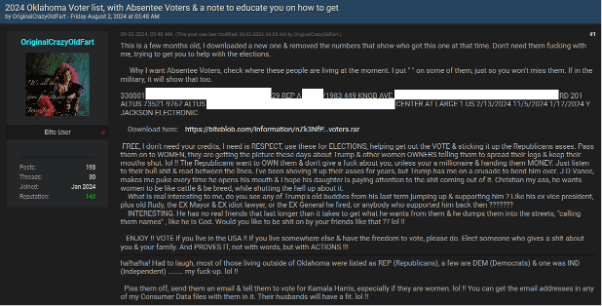
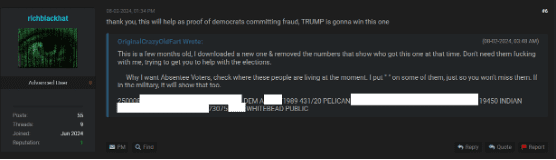
  • Oklahoma: As shown in the previous image, a dark web forum post offered the 2024 Oklahoma voter list, including absentee voters, with instructions for accessing sensitive information for political purposes.
  • Florida: Multiple significant leaks have affected Florida, including incidents in April 2020 and March 2022. These repeated exposures highlight the challenges in securing voter information in large states with complex voter registration systems and higher volumes of data, which increase their vulnerability to breaches.
  • Wisconsin: A 2020 data leak compromised millions of voters, including such personal information as emails, names, phone numbers, and full addresses, showing how even isolated breaches can undermine public trust and voter security.
  • Other States: States like Oklahoma, North Carolina, Pennsylvania, Michigan, Delaware, Texas, and Alaska have also reported leaks, some of which date back as far as 2013. These incidents highlight the systemic difficulties in securing voter data across state lines.

Of the 23 affected states, voter data breaches have impacted both Democratic and Republican strongholds, as well as crucial swing states, highlighting the widespread nature of the threat regardless of political affiliation or regional importance.

  • Approximately 45% of Democratic-leaning states and 50% of Republican-leaning states have experienced data breaches.
  • Key swing states (5%) such as Florida, Georgia, or Pennsylvania have also been impacted. Swing states are particularly important because they often decide the overall outcome of elections, making any breach in these regions potentially more impactful.

This broad geographic spread means that voters from both parties, along with undecided voters, could be affected, potentially impacting voter turnout and election trust.

Emerging Cyber Threats and Manipulation Risks in the 2024 Election

In addition to voter data leaks, other cybersecurity threats could impact the 2024 U.S. election, such as disinformation campaigns, targeted voter suppression, and foreign interference. Constella Intelligence has identified several notable cases:

  • Campaign-Related Data Breaches (2024): A potential breach linked to Donald Trump’s campaign emails, allegedly involving foreign entities, exposed sensitive data. This underscores the risks posed by foreign influence operations.
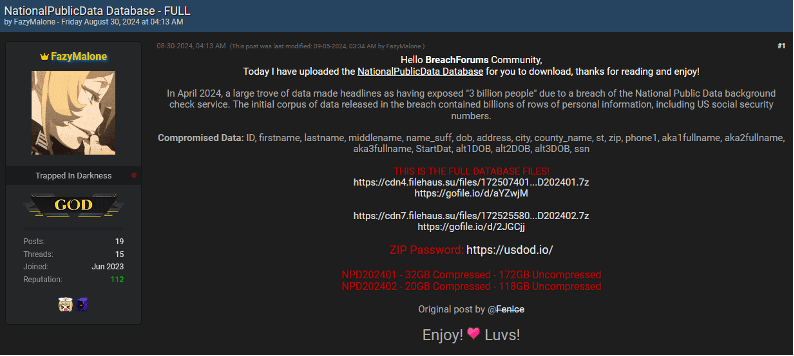
  • National Public Data Leak (2024): A 2024 incident exposed million records, including sensitive information of million U.S. voters, highlighting ongoing vulnerabilities in protecting voter data.
  • RNC Leak (2017): This breach affected millions of voters, exposing personal details like birth dates and political affiliations. The data was used in predictive models, suggesting a risk of similar information being exploited to manipulate voter perceptions in the 2024 race.

These breaches illustrate the persistent risks of data misuse, identity theft, and election manipulation, each capable of eroding public trust in the democratic process.

Global Perspective: Voter Data Leaks Beyond the United States

Although U.S. voter data leaks are the most prevalent, other nations have also experienced significant breaches, especially during election cycles. Notable examples include:

  • Mexico: High-profile breaches occurred in 2017 and 2021, including targeted attacks on political organizations like the Partido Acción Nacional (PAN).
  • Israel: The 2020 elections saw a significant voter data breach, illustrating vulnerabilities even in nations with advanced cybersecurity frameworks.
  • The Philippines and India: The Philippines experienced a leak in 2016, and India faced a breach in 2024, demonstrating that populous democracies remain attractive targets for cybercriminals.
  • Other Nations: Countries like Iraq, Honduras, and Ukraine have also reported voter data breaches, underscoring the global nature of these threats.

Impact and Risks: Manipulating Election Outcomes Through Exposed Voter Databases

Beyond data leaks, the risks extend to manipulation tactics that leverage this exposed information. When voter databases are exposed, the personal and political information they contain can be weaponized to manipulate election outcomes in various ways:

  1. Targeted Disinformation: Threat actors can use leaked data to send misleading messages, such as false voting locations or procedures, potentially causing voters to miss their opportunity to vote.
  2. Voter Suppression Tactics: Leaked data allows cyber actors to discourage specific voters from participating by sending intimidating or misleading messages.
  3. Identity Manipulation for Fraudulent Voting: Using personal details from leaked databases, malicious actors could impersonate registered voters to submit fraudulent ballots or alter voter rolls, causing confusion at polling stations.
  4. Amplifying Polarization: By leveraging insights into voter preferences, cyber actors can create messages that heighten political divisions, influencing voters through emotional manipulation rather than factual discourse.

These tactics threaten not only individual privacy but also the integrity of the election process. When personal information is exposed, it can be used to manipulate voters, distort their perceptions, and ultimately undermine the fairness of the election. This direct impact on voter behavior erodes confidence in democratic institutions and the legitimacy of the results.

Threat Narratives: Misinformation and Disinformation Linked to Voter Data Leaks

Disinformation narratives pose significant threats because they can manipulate public perceptions and erode trust in democratic institutions. Constella Intelligence has identified several such narratives that could shape public opinion on the Dark Web:

  • Electoral Fraud: We have uncovered several threads discussing how leaked voter data could be used to manipulate voter intentions. Some threat actors allege the presence of ‘fake election officials’ in Pennsylvania, the removal of mailboxes in Luzerne County, and reports of ‘a box full of ballots’ discovered in Dade County, Florida. Additionally, claims about the purging of ineligible voters in Oklahoma, including deceased individuals, coupled with a previous voter list leak in the state, raise concerns about potential manipulation of the electoral system. These posts reflect the growing polarization among citizens and contribute to speculation around voter manipulation. However, we have not conducted further investigation into these claims.
  • Political Corruption: False narratives also target political figures, especially Kamala Harris and the Obamas. Harris is accused of plagiarism in her criminal justice book and collaborating with foreign countries to spy on Trump.
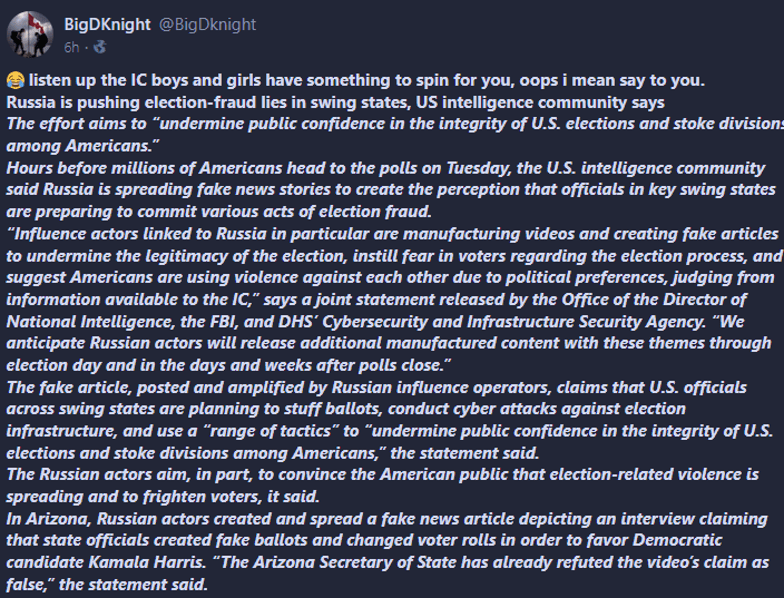
  • Russian Disinformation Campaign: The U.S. intelligence community has reported that Russian actors could be actively spreading false information to undermine public confidence in the integrity of U.S. elections, especially in key swing states. This includes creating fake videos and articles suggesting election fraud, ballot stuffing, and cyber attacks in places like Arizona, targeting specific candidates such as Kamala Harris.
  • Deep State: The idea of a ‘deep state’ aiming to control the country and silence opposition is frequently repeated. Steve Bannon, for example, is portrayed as a ‘political prisoner.’ Claims also suggest that this ‘deep state’ controls the media and censors information that could expose its actions.
  • QAnon Conspiracy Theories: Some narratives align with QAnon conspiracy theories, such as mentions of ‘Agenda 47’ and references to Q. These theories, which speak of a satanic cabal controlling the world, are popular among some right-wing groups in the U.S. and often intersect with narratives about electoral fraud and political corruption.

These narratives significantly threaten democratic stability by promoting misinformation, eroding public trust, and influencing voter behavior. Data from voter databases could further be used to create targeted misinformation campaigns, aimed at voters who are already inclined to believe these narratives, thus deepening their impact on democratic processes.

Recommendations for Securing Voter Data and Upholding Electoral Integrity

In response to the rise in voter database breaches, Constella Intelligence recommends proactive measures for citizens to safeguard their data:

  1. Understand Your Digital Footprint: Stay informed about the personal information that is publicly accessible, including voter data and details from breaches like the NPD leak. By being aware of what information is exposed, you can take steps to protect yourself from threat actors who may attempt to exploit this data, especially during sensitive periods like Election Day.
  • Enable Two-Factor Authentication (2FA): Strengthen account security by using 2FA, which makes unauthorized access more difficult.
  • Be Mindful of Social Media Posts: Exercise caution with what you share or read on social media, as AI tools now make it easier than ever to create convincing fake content. Threat actors can exploit personal information or posts to manipulate narratives, spread disinformation, or target individuals during critical times like Election Day.
  • Be Cautious of Phishing Attempts: On Election Day, be especially wary of unsolicited messages claiming to provide election updates or voter information. Avoid clicking on links or downloading attachments, as scammers frequently use these tactics to steal personal data or spread disinformation during critical events like elections.

Stay vigilant against potential threats, from voter data breaches to disinformation, and take steps to protect your personal information. As you head to the polls, remember the importance of safeguarding our democratic process. Enjoy your Election Day, and best wishes to you all, America!

❌