❌

Reading view

There are new articles available, click to refresh the page.

Security researchers find stalkers abusing Chrome’s sync feature

Cyberstalkers are increasingly exploiting a feature in Google Chrome meant for mobile phone user convenience, but can give intruders broad access to a device owner’s private information, according to researchers.

Certo Software said in a blog post Tuesday that stalkers are making use of Chrome’s sync capability — meant to make it so signing into Chrome on one device makes it easier to do so on other devices, too — to spy on a phone owner’s browsing history and gain access to their stored passwords.

As an illustration, Certo used the case of a pseudonymous victim, Emma, who had searched for a family lawyer and visited a domestic violence support website while her partner was sleeping, only for him to bring up to her two days later.

“Emma had been careful to only ever use her own device, and she hadn’t noticed any new apps appear on her phone,” wrote Certo co-founder Russell Kent-Payne. “What she didn’t know was that weeks earlier, during a few unattended minutes with her phone, he had opened the Chrome app and quietly signed it into a Google account of his own. From that moment on, every site she visited was being copied straight to his account, viewable from any device, anywhere in the world.”

The surveillance is as easy as that: brief access to a phone, signing into a Google account and making sure sync is turned on for that account.

Eva Galperin, director of cybersecurity at the Electronic Frontier Foundation, said on the Bluesky social media app that Certo’s research serves as “an important reminder that tech-enabled abuse isn’t just limited to stalkerware.”

Certo said that Google could do a couple things, such as providing a temporary notification whenever a new account is added or sync is turned on or offering a regular marker to indicate when sync is active and which account it’s syncing to, to protect users.

Google did not respond to multiple requests for comment about Certo’s findings.

But the uptick in usage of that stalking method could be a byproduct of security successes elsewhere in the fight against spyware, Certo said.

“Modern smartphones are harder to compromise than ever. Regular security updates, stricter app store rules, and on-device threat detection have made traditional spyware a much riskier bet for a cyberstalker than it used to be,” Kent-Payne wrote. “As a result, we’re increasingly seeing abusers turn to something far simpler: the legitimate apps already sitting on their victim’s phone. No installation, no suspicious permissions, no telltale battery drain — just a quiet misuse of a feature the victim never knew existed.”

At the same time, Chrome is the world’s most popular browser, and this isn’t the first time security concerns have popped up about its sync feature, among other worries.

The post Security researchers find stalkers abusing Chrome’s sync feature appeared first on CyberScoop.
Patch Tuesday, April 2026 Edition

Microsoft today pushed software updates to fix a staggering 167 security vulnerabilities in its Windows operating systems and related software, including a SharePoint Server zero-day and a publicly disclosed weakness in Windows Defender dubbed “BlueHammer.” Separately, Google Chrome fixed its fourth zero-day of 2026, and an emergency update for Adobe Reader nixes an actively exploited flaw that can lead to remote code execution.

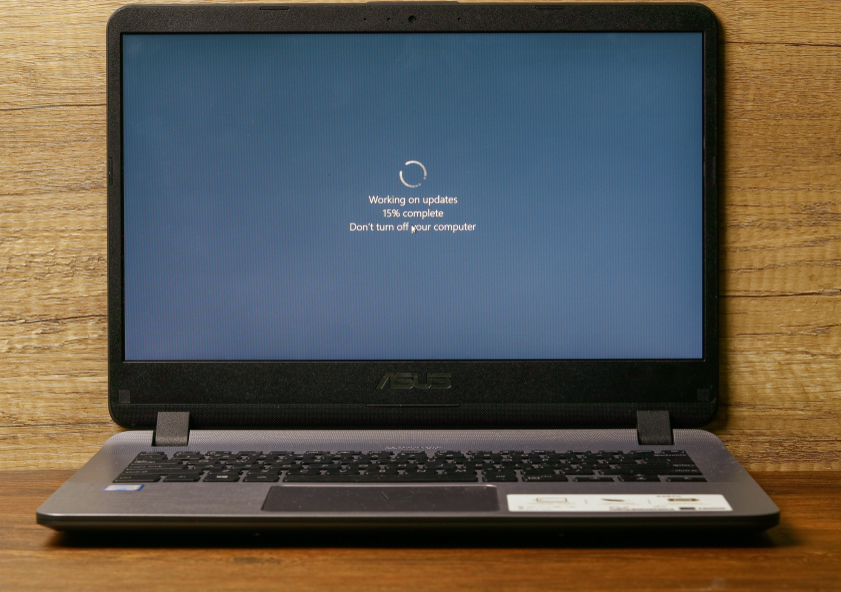
A picture of a windows laptop in its updating stage, saying do not turn off the computer.

Redmond warns that attackers are already targeting CVE-2026-32201, a vulnerability in Microsoft SharePoint Server that allows attackers to spoof trusted content or interfaces over a network.

Mike Walters, president and co-founder of Action1, said CVE-2026-32201 can be used to deceive employees, partners, or customers by presenting falsified information within trusted SharePoint environments.

“This CVE can enable phishing attacks, unauthorized data manipulation, or social engineering campaigns that lead to further compromise,” Walters said. “The presence of active exploitation significantly increases organizational risk.”

Microsoft also addressed BlueHammer (CVE-2026-33825), a privilege escalation bug in Windows Defender. According to BleepingComputer, the researcher who discovered the flaw published exploit code for it after notifying Microsoft and growing exasperated with their response. Will Dormann, senior principal vulnerability analyst at Tharros, says he confirmed that the public BlueHammer exploit code no longer works after installing today’s patches.

Satnam Narang, senior staff research engineer at Tenable, said April marks the second-biggest Patch Tuesday ever for Microsoft. Narang also said there are indications that a zero-day flaw Adobe patched in an emergency update on April 11 — CVE-2026-34621 — has seen active exploitation since at least November 2025.

Adam Barnett, lead software engineer at Rapid7, called the patch total from Microsoft today “a new record in that category” because it includes nearly 60 browser vulnerabilities. Barnett said it might be tempting to imagine that this sudden spike was tied to the buzz around the announcement a week ago today of Project Glasswing — a much-hyped but still unreleased new AI capability from Anthropic that is reportedly quite good at finding bugs in a vast array of software.

But he notes that Microsoft Edge is based on the Chromium engine, and the Chromium maintainers acknowledge a wide range of researchers for the vulnerabilities which Microsoft republished last Friday.

“A safe conclusion is that this increase in volume is driven by ever-expanding AI capabilities,” Barnett said. “We should expect to see further increases in vulnerability reporting volume as the impact of AI models extend further, both in terms of capability and availability.”

Finally, no matter what browser you use to surf the web, it’s important to completely close out and restart the browser periodically. This is really easy to put off (especially if you have a bajillion tabs open at any time) but it’s the only way to ensure that any available updates get installed. For example, a Google Chrome update released earlier this month fixed 21 security holes, including the high-severity zero-day flaw CVE-2026-5281.

For a clickable, per-patch breakdown, check out the SANS Internet Storm Center Patch Tuesday roundup. Running into problems applying any of these updates? Leave a note about it in the comments below and there’s a decent chance someone here will pipe in with a solution.

❌