❌

Reading view

There are new articles available, click to refresh the page.

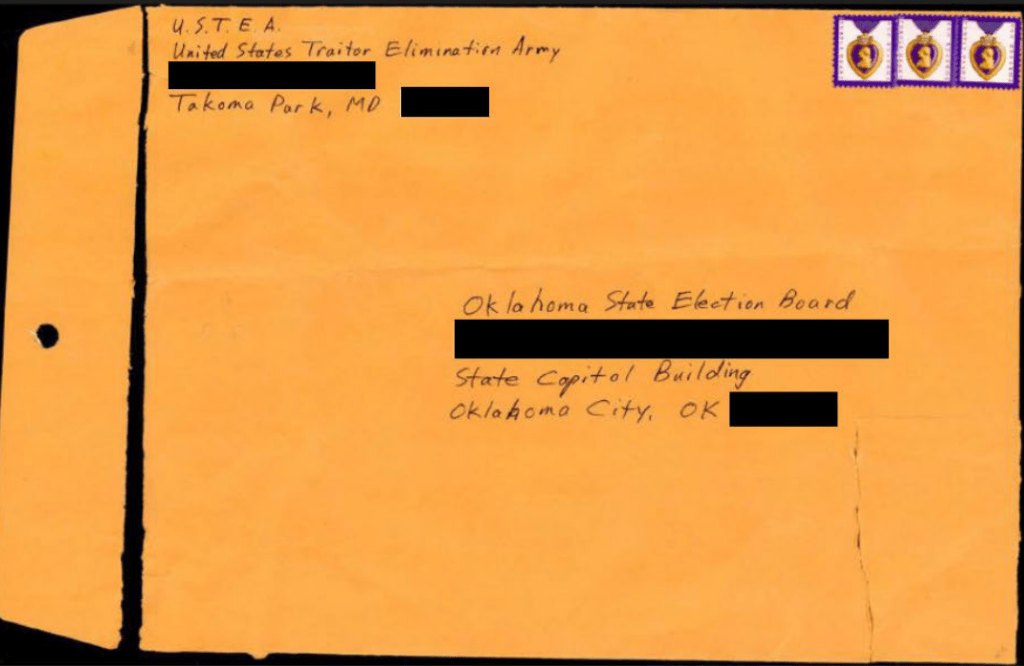
Oklahoma man charged with mailing threats, substances to election officials nationwide 

An Oklahoma man has been charged with mailing suspicious white substances to election officials across the country.

Robin Patrick Martin faces charges of conveying false or misleading information and hoaxes, as well as mailing threatening communications. The charges allege a nationwide effort to intimidate election officials and support President Donald Trump.

Starting on Sept. 16, 2024, multiple state election officials reported receiving mail containing a white, powdery substance and a three-page letter headed “DECLARATION OF WAR.” Officials in nearly every state have since received similar mailings over the past two years. Election officials provided some of the evidence, while federal authorities intercepted other letters in transit. 

The letters bore a return address for the “The United States Traitor Elimination Army” in Takoma Park, Maryland. Some envelopes also had threatening messages written on them that could only be seen under ultraviolet light.  

The letters cited the belief, promoted by some supporters of Trump, that the 2020 election was marred by voter fraud, along with similar concerns about the 2024 election.

Other envelopes included messages like “No US Jurisdiction!,” “Mailed from the Indian Nation,” and “Are you for us? Or against us?”

Another message read: “To FBI: What do you want for your children? Peace through strength or nuclear war? Use your common sense! Protect Trump! Protect the election! Protect Legal votes! Throw out illegal votes! That is the motive!”

The case was first reported by the Associated Press.

Investigators subpoenaed email and phone records listed for the address,  tying it to a burner phone purchased at a Walmart Supercenter in Northwest Oklahoma City. Surveillance video showed an older white man matching Martin’s description purchasing the phone and driving away in a car registered to  Martin.

Other items purchased at the same Walmart pointed to Martin’s involvement, including a booklet of stamps, privacy envelopes, along with tumeric, white vinegar and povidone-iodine, which are used to make invisible ink. Records from the phone also placed Martin at various postal distribution centers around the state.

In a release, FBI Director Kash Patel said Martin sent letters to “well over 100 locations including multiple state secretary offices, election offices, and more.” He also took a shot at the Biden administration, claiming they “failed to catch” Martin “but this FBI got it done.”

According to the criminal complaint, Martin sent the letters in the months leading up to the Nov. 2024 presidential election. The Trump administration has overseen the case since Jan. 2025.

“Threatening election officials and attempting to intimidate public servants is a serious federal offense and will not be tolerated,” said U.S. Attorney Robert J. Troester for the Western District of Oklahoma in a statement. “Working alongside our federal law enforcement partners, we are committed to investigating these threats and holding accountable those who seek to spread fear and intimidation in our communities.”

The post Oklahoma man charged with mailing threats, substances to election officials nationwide  appeared first on CyberScoop.

Ballot scanner malfunctions, flurry of federal legal actions test election officials on final day of voting 

Early reports of ballot scanner malfunctions in Westchester County, New York are a sign of the challenges election officials will face in the current online information environment as voters head to the polls Tuesday on the final day of voting.

While such equipment failures and breakdowns are not uncommon and happen in a small number of precincts every election cycle, and there is no evidence of foul play, conspiracists quickly jumped on the news.

According to Kate Starbird, a professor at the University of Washington who researches online rumors and disinformation tied to elections, the rumors are already spreading within right-wing online circles as evidence of election malfeasance.

Starbird cited metrics showing that posts on X about the scanner malfunctions grew to as many as 100 a minute in the hours after the news was reported, with established election deniers, such as The Gateway Pundit, amplifying conspiracist framings.

The Westchester County Board of Elections said the problems appear related to some ballots being too thick for the machines to accept, leading to rejections. Voters with affected ballots were told to place them in designated orange emergency ballot bags that will be secured, monitored and counted by officials in compliance with election laws.

“The Board of Elections is in constant communication with New York State officials, Westchester County Government and poll workers to address this issue and ensure that voting continues with as little disruption as possible,” the board wrote in a statement. “In the meantime, voters should continue to complete their paper ballots as instructed by poll workers.”

New York Attorney General Letitia James said her office was also monitoring the situation and “is in touch with the state and local Boards of Elections as they work on a solution.”

“Westchester voters can still safely fill out and turn in their ballots at their polling locations,” James wrote on X. “Your votes will count.”

Westchester County is where many votes in the NY-17 congressional race will be cast between Republican incumbent Mike Lawler and Democratic Party nominee Cait Conley. Conley previously served as the election security lead for the Cybersecurity and Infrastructure Security Agency under the Biden administration.

Lawler sought to assure his supporters that the affected ballots will be transported by police escorts to a central location at the board of elections and will not be opened at the polling site.

“I want to be clear: there’s no shenanigans going on here,” Lawler said in a news conference Tuesday.

Meanwhile, the Department of Justice issued a news release announcing charges against 63 individuals, many of them lawful permanent residents who have lived in the U.S. for decades and some who later became naturalized citizens with legal voting rights, for allegedly voting as noncitizens in a past election.

The charges are part of a flurry of last-minute actions by the Trump administration to promote the specter of widespread noncitizen voting. The administration also brought lawsuits against states, like California and Alaska, in the past week that have sought to influence how ballots are treated and counted in the upcoming Senate races. Federal courts, including the U.S. Supreme Court, have thrown them out while reiterating the executive branch has no constitutional or legal role in the administration of state-run elections.

Another federal court ordered the Justice Department and the Department of Homeland Security to stop sending lists of “potential noncitizen” voters to states, after Trump administration lawyers acknowledged in court that the data they rely on for those assertions has a “high” error rate.

Nevertheless, the department continued its aggressive posture, announcing Tuesday that it would be deploying 1,000 election monitors to precincts across all 50 states.

The post Ballot scanner malfunctions, flurry of federal legal actions test election officials on final day of voting  appeared first on CyberScoop.

California officials confirm grand jury subpoenas as states, civil groups brace to protect elections from federal encroachment

The Trump administration is taking direct aim at California state election officials, issuing grand jury subpoenas to election offices statewide ahead of the final day of voting on Nov. 3.

The investigations, first reported by Bloomberg, center on alleged administration of illegal voting. They are ostensibly tied to demands by the U.S. Justice Department that California and other states use federal voter lists to determine whether a voter is a “potential noncitizen” and should be removed.

The Los Angeles County Registrar of Voters told CyberScoop it received multiple grand jury subpoenas last week related to the investigation. The office called the federal efforts an attempt to intimidate California election officials into accepting federal supremacy over state voter registration authority.

“At every step, the U.S. Department of Justice has taken a confrontational, adversarial approach,” said Los Angeles County Registrar Dean Logan in a statement. “Election officials are acting in accordance with state and federal law. Clear court rulings at both the U.S. District Court level and the Court of Appeals have confirmed that. Threats and intimidation have no place in elections. We will take whatever steps necessary to ensure the safety of our employees and to remain focused on serving the voters of Los Angeles County so they can exercise their voting franchise.”

California Secretary of State Shirley Weber, also reportedly a target of the federal probe, did not respond to a request for comment from CyberScoop.

One California election official, Clint Curtis, the outgoing registrar of voters in Shasta County, endorsed the federal government’s efforts to remove 20,000 voters from California voter rolls. Curtis, whose term ends in January, was previously part of a failed effort to hire Tina Peters, a felon and former Mesa County, Colorado, election clerk to help with the upcoming midterms. Curtis has long believed in widespread election fraud.

He told CyberScoop earlier this year that he believed Shasta County elections in 2024 were plagued by suspicious mail-in ballots, saying they looked, felt and “smelled” different from normal mail ballots.

The U.S. Constitution gives states the authority to administer elections and Congress the power to make election laws, something courts have repeatedly upheld in dozens of legal challenges by the Trump administration.

The Department of Justice has claimed there are at least 20,000 such potential noncitizens on California’s voter lists, while the Department of Homeland Security told CyberScoop the figure could be as many as 190,000. The administration’s data, drawn from public voter lists, federal databases and commercially purchased personal information, has been repeatedly criticized by election officials, voting experts and federal courts as inaccurate and unreliable for determining voter eligibility.

Most people identified as “potential noncitizens” turn out to be naturalized citizens who have since gained voting rights, or the result of state administrative errors that mistakenly registered a small number of ineligible voters. Many of those mistakenly registered never cast a ballot.

State officials have had to defend against attempts at federal coercion as well as third-party activists who are constantly testing and probing election procedures nationwide, sometimes without understanding the laws election officials must follow to verify voters.

On Wednesday, the Hennepin County Attorney’s Office in Minnesota announced felony charges against a pair of right-wing provocateurs, James O’Keefe and Cam Higby, for unlawful voting and identity theft. According to a statement from Hennepin County Attorney Mary Moriarty, the two showed up at various election offices, provided false identities of real voters to election judges, violating state laws against misrepresenting their identity in applying for a ballot.

“Elections are the bedrock of democracy and their protection is one of our highest priorities. Individuals engaging in unlawful conduct related to our elections will be held accountable,” said Moriarty. “Our office has had regular meetings with Hennepin County Elections staff in preparation for both the primary and the general elections this year and we are fully prepared.”

Voting rights and civil society groups are also executing short- and long-term plans to combat potential voter disenfranchisement ahead of Tuesday.

Jessica Ayoub, deputy political director for the Michigan American Civil Liberties Union, said her organization has “never been more prepared” for any expected fights with the federal government or local officials seeking to disenfranchise voters, saying they first began planning for different scenarios 18 months ago, cultivating relationships with hundreds of clerks and election staff across Michigan.

“We’ve gamed out 25 potential scenarios and have rapid response strategies that we’ll deploy to ensure our elections are protected and that our democracy remains intact,” said Ayoub, who cited a desire not to publicize further details ahead of next month.

On Friday, voting rights groups filed a new lawsuit against the Department of Justice and Department of Homeland Security in California, seeking to block the federal government’s efforts against state election officials.

The groups are asking a judge to declare that the federal government has exceeded its constitutional authority and that state officials are legally carrying out their duties. They also want the court to force the departments to contact all California election officials who received subpoenas and tell them the investigation has halted due to a court order.

The post California officials confirm grand jury subpoenas as states, civil groups brace to protect elections from federal encroachment appeared first on CyberScoop.

Lawsuit against Ex-Overstock CEO tied to 2020 election film falls apart over question of ‘actual malice’

A Florida judge ruled this week that ex-Overstock CEO Patrick Byrne is not liable in a lawsuit brought by a Dominion Voting Systems executive over a film that accuses the former electronic voting hardware and software company  executive of saying he “made sure” that Republican presidential candidate Donald Trump wouldn’t win reelection in 2020.

The lawsuit, brought in 2022 by Eric Coomer, a former director of product strategy and security at Dominion Voting Systems, concerns comments made in a 2020 film produced by Byrne titled “The Deep Rig.”

In the film, which alleges a conspiracy to manipulate 2020 election results in favor of Democrat Joe Biden, a man identified as Joseph Oltmann claimed he listened to a conference call led by organizers of “Antifa,” wherein another participant mentioned that “Eric” “The Dominion Guy” was also on the call.

In the film, Oltmann says a man identified as “Eric” told others on the call that Trump wouldn’t win reelection because he had “made sure of it.” Coomer denies taking part in any such call, and filed a lawsuit against Byrne and seven other individuals and entities for defamation.

U.S. District Judge Tom Barber’s decision did not address most of the substantive claims in the lawsuit, such as Byrne’s ultimate legal responsibility for the statements by Oltmann that made it into the film.

Because the lawsuit was originally filed in Colorado, it must meet a state law requirement for defamation claims involving matters of public concern. Coomer must show “clear and convincing evidence” that Byrne or others involved in making the film knew the claims were false and defamatory, or acted with reckless disregard for the truth.

“Where the challenged speech involves a matter of public concern, as it undeniably does here, the plaintiff also bears the burden of proving, by clear and convincing evidence, that the challenged statement is materially false and was made with actual malice,” wrote Barber in his opinion.

The standard is not whether a reasonable person would have investigated the claims before airing them, but whether the defendant “in fact entertained serious doubts as to the truth of [the] publication, or was highly aware of its probable falsity.”

In this case, Barber said it’s not impossible to clear that standard for public figures, but under Colorado law, Coomer would have a hard time providing clear and convincing evidence that Byrne “in fact subjectively disbelieved or had serious doubts about Oltmann’s story.”

Barber further wrote that technology has given “a powerful microphone” and large followings to people who would otherwise be dismissed as “kooks” and conspiracy theorists. These people make statements that are “objectively and demonstrably wrong” but who hold firm to their core beliefs because they “genuinely and sincerely believe what they say with every fiber of their being, even when objective evidence may suggest otherwise.”

Still, he said the current language and meaning of the Colorado law is clear, suggesting it was a matter for higher courts or legislators to clarify or change.

“Under the actual malice standard, unless it can be proven that the speaker subjectively believed his or her statements to be untrue, the law imposes no liability,” Barber wrote. “That is a policy choice that might deserve reexamination by the appropriate decision makers – the United States Supreme Court and the Colorado courts.”

Byrne’s attorney, Peter Ticktin, called the ruling a “victory” in a statement to CyberScoop.

“This is a substantial victory for Patriot Patrick Byrne and for the principles at stake in this case,” Ticktin said. “The court’s decision speaks for itself. We are pleased that the facts and applicable law resulted in summary judgment in our client’s favor.”

Coomer sued Byrne in his personal capacity, and Dominion Voting Systems was not a party to the lawsuit. 

The voting machine giant was awarded more than $1.8 billion in combined legal settlements over the past two years from Fox News, Newsmax and MyPillow CEO Mike Lindell, all of whom made allegations that Dominion voting machines were used to maliciously flip or alter votes.

The post Lawsuit against Ex-Overstock CEO tied to 2020 election film falls apart over question of ‘actual malice’ appeared first on CyberScoop.

DOJ escalates fight for election supremacy with California raids

A series of federal raids and arrests of voters in California has escalated the Trump administration’s ongoing efforts to take administrative control of U.S. elections.

The arrests, paired with comments from top officials at the departments of Justice and Homeland Security, also make it clear that the federal government is willing to act on its past threats to investigate, arrest, or prosecute more than 190,000 California voters who the administration claims are “potential” noncitizens.

The Department of Justice announced Monday it made 28 arrests across California, part of what it was calling “Operation Protect the Vote.” All those arrested were foreign nationals and permanent green card holders, charged with fraudulently registering to vote in U.S. elections and making false statements in a naturalization application.

The Department of Justice said on Oct. 13 it provided a “list” of 20,000 registered California voters to California Secretary of State Shirley Weber, claiming they were ineligible to vote based on federal records.

“Each of the 28 defendants charged today appears on the list of more than 20,000 likely noncitizen registrants we provided to California election officials last week,” said Acting Deputy Attorney General Trent McCotter in a statement. “California refused to look at that list. Today’s charges show exactly what that refusal puts at risk. California must verify the citizenship of those more than 20,000 registrants before mail-in ballots are counted.”

A DHS spokesperson said Immigration and Customs Enforcement (ICE) and Homeland Security Investigations are “actively rooting out and investigating” alleged voter fraud while claiming the Trump administration has “repeatedly” proven that noncitizens vote in elections.  

“DHS and DOJ are laser focused on prosecuting and removing aliens who vote and preventing the dilution of the votes of U.S. citizens,” the unnamed DHS spokesperson wrote in response to questions about the raid. “ONLY Americans should elect American leaders.”

There is no credible evidence of widespread voter fraud in U.S. elections, either among legal voters or noncitizens. The Trump administration’s record, in public statements as well as lawsuits and other court actions, reflects a history of wildly overinflated claims of actual fraud, while casting routine or isolated errors in voter registration as evidence of larger election malfeasance.

Over the course of Trump’s first term, his subsequent time as a private citizen, and his current second term, he has had many chances to provide evidence of widespread voter fraud or noncitizen voting in court, and he has lost each time. His administration has also filed dozens of lawsuits against state and locally run elections. In these cases, the administration argues the federal government’s authority to investigate and prosecute voter fraud outweighs states’ authority to run elections. In the lawsuits seeking states’ voter registration records, the federal government has lost every case so far. 

In the past two years, the Department of Justice and Republican secretaries of state have regularly announced findings of hundreds of thousands of “potential noncitizens” registered to vote. In nearly every single instance, follow-up investigations confirm the number of confirmed noncitizens registered was a tiny fraction of the original claims, with the vast majority being simple mistakes with no evidence of a larger plot.

A DHS spokesperson told CyberScoop that its internal list contains more than 190,000 registered California voters alleged to be “potential noncitizens.” The spokesperson said the list was culled from publicly available state voter registration data, federal databases and “commercial third-party data,” that cross-referenced them “with known aliens in our systems.”

“Our message to aliens who vote in American elections is clear: we will find you, arrest you, and you will face the consequences — including criminal charges and deportation,” the spokesperson said.

California Secretary of State Shirley Weber’s office did not respond to a request for comment on the raids.

“190,000 remains the number of potential noncitizens registered to vote in California that DHS asked Secretary Weber to review,” the spokesperson continued. “The 20,000 referenced by DOJ is a subset of registrants that have gone through the manual verification process so far.”

Last week three Democratic senators, including Alex Padilla, D-Calif., wrote to Attorney General Todd Blanche pressing him to commit that the Department of Justice, FBI or other federal law enforcement agencies will not seize live ballots or voting machines during the upcoming midterm elections.

The administration has already carried out federal raids in Georgia and Arizona to seize ballots from the 2020 election, and the senators called out personal efforts “by President Trump directly to DOJ attorneys to influence election-related investigations in California and elsewhere.”

Padilla’s office did not respond to a request for comment on the arrests.

The post DOJ escalates fight for election supremacy with California raids appeared first on CyberScoop.

OpenAI says Iran, Russia used AI journalists, think tanks to influence Western media

OpenAI disclosed Thursday it shut down two influence operations from Russia and Iran that used ChatGPT and other AI tools to create fake journalist personas and covert think tanks that successfully planted stories and narratives in mainstream news publications.

One cluster of accounts, which OpenAI calls “Dark Clark,” is attributed to Russian actors. The network focused on influencing Latin American politics and culture. Its name comes from Mia Clark, a fake AI persona the group presented as the leader of the Social Research Center, a supposed Latin American think tank used to seed propaganda in news reporting.

The group’s content primarily focused on harming Ukraine’s reputation in Latin America, though it also became involved in hot-button political issues in Argentina and Bolivia.

Based on reports generated through ChatGPT, where operatives discussed wage scales for employees and hiring and firing decisions, OpenAI researchers said it’s likely the Russian group was actually in control of the Social Research Center, rather than being an employee or observer.  

OpenAI called it “the most complex attempt to run a front identity that we’ve disrupted over the past two and a half years.”

“The available evidence indicates that the SRC’s employees in Latin America were not aware that they were working for a Russian group,” OpenAI said. “Unlike another Russia-linked ‘think tank’ that we recently exposed, the SRC appears to have produced a majority of original content via its co-opted staff.”

OpenAI cites several fact-checks and official denials from major media organizations and government officials in Latin America that appear to be in response to Dark Clark’s propaganda.

In March, Lupa Media reported on a TikTok video falsely claiming that the Ecuadorian government was using shell companies to recruit citizens to fight for Ukraine against Russia. The actors also generated and spread fake audio clips of the Ukrainian consul in Ecuador insulting Ecuadorian citizens.

During anti-government protests in Bolivia in May, the group released another fake audio clip, this time of an employee at the state water company claiming that the government was on the verge of declaring a state of emergency and shutting off water to La Paz, prompting an official denial from the Bolivian government.

The report does not attribute the activity to any specific Russian government or intelligence agency. It does mention that its operators seemed particularly interested in Politology, a successor to the Wagner Group, the Russian mercenary force previously led by Yevgeny Prigozhin. According to OpenAI, the group prompted its model for information on Politology “far more” than any other Russian organization.

The Iranian campaign used many of the same AI tools to pitch written articles on the U.S.-Iran war. Operators created at least seven different fake journalist personas who managed to place dozens of stories online through legitimate media organizations. However, the stories themselves often failed to elicit many comments or social media reactions.

“We identified almost 100 articles published or syndicated under the operation’s bylines across roughly a dozen online outlets around the world,” OpenAI said. “These were small to medium outlets, generally focused on international affairs, geopolitics, and events in the Middle East.”

OpenAI said the activity resembled “a commercial actor running a for-hire influence campaign,” but did not attribute it to a specific actor or group.

Most influence campaigns tracked by OpenAI tend to be low-impact, garnering little organic engagement online and virtually no offline impact. Campaigns are rated on an impact scale of 1-6, with few rising above a 1 or 2.

OpenAI rated the Russian campaign a 5 and the Iranian campaign a 4, indicating they were significantly more successful in breaking through to mainstream audiences, eliciting fact checks and official denials that tend to happen when a narrative becomes so big that authorities must deny it.

The post OpenAI says Iran, Russia used AI journalists, think tanks to influence Western media appeared first on CyberScoop.

Election official says Tina Peters would be consultant, won’t have access to election systems

The top election official for Shasta County, Calif. said he has offered convicted felon and former Mesa County, Colo. clerk Tina Peters a position as a consultant to help with the 2026 elections, but that she hasn’t accepted the position yet.  

Earlier this month, Shasta County registrar Clint Curtis told local news outlets that he intended to hire Peters as assistant registrar of voters to help with the upcoming 2026 elections, months after she was released from prison in Colorado.

In an interview with CyberScoop this week, Curtis said he was looking to hire Peters as a consultant, citing the length of time involved in hiring her as a full-time employee and the need for immediate help running the upcoming midterm elections.

Curtis said that he initially believed Peters had accepted the position, only to later hear from her that she needed to consult her legal team after her prison sentence was commuted in June.

“She’s got to check it all out, make sure it’s okay, make sure there’s not any roadblocks in there that we don’t know about [or are] illegal, so you got to walk through the whole mess,” said Curtis.

A Colorado Department of Corrections official told CyberScoop that as part of her parole conditions, Peters must be employed and live in Colorado. Peters can request a transfer to another state, but she must first receive permission from both states and go through a formal review process.

According to Curtis, hiring Peters as a consultant means she would not have local access to county email or election systems. Peters’ past conviction “doesn’t matter” because her access to county IT would be limited.

“If she’s on staff she’d have logins to the network, logins in the system, she’d basically have full access,” Curtis said in a phone interview. “But consultants don’t have any of that, nor should they, right?”

Consultants “are basically there to actually watch other people do it and make sure they do it right rather than do it themselves,” he added.

At the same time, when asked what responsibilities Peters would have, Curtis described an expansive role, with Peters helping him oversee the registrar’s office and direct his full-time staff of about 12.

Asked what drew him to Peters, Curtis said “well, she’s out [of prison] and I have this position become available [and] I need somebody that can actually supervise and knows something about elections.”

In 2024, Peters was convicted of seven felony crimes related to the theft of voting machine software from Mesa County election facilities, in a failed attempt to prove that the machines had been involved in election fraud during the 2020 election.

She served less than two years of that sentence, as legal appeals, relentless pressure from the Trump administration and eventually a commutation by Colorado Governor Jared Polis saw her released from prison in June.

Curtis said he did not reach out to any Mesa County officials before offering Peters the job, but did cite conversations with her that impressed him and his confidence that he would remain in control of the county’s elections.

“I talked to her and basically, she’s very even tempered, she’s not wild and crazy which is good,” said Curtis. “And so basically I’d still be in charge so it wouldn’t really be a problem…there’s no way she would get out of bounds on me.”

A request to Mesa County’s press office seeking comment was not returned. At Peters’ sentencing hearing in 2024, multiple Mesa County officials testified about the negative impact her crimes and behavior had on the county’s elections, finances and reputation.

When reached for comment, a representative for Peter Ticktin, Peters’ lawyer, provided CyberScoop with a statement from last week regarding Peters’ intentions.

“Tina Peters is giving consideration to helping in the efforts in Shasta County as there most definitely has been monkey business in the way the election was handled,” Ticktin said. “Tina is one of the key voices leading the effort to get the invasive machines out of our election process.”

Earlier this month, Curtis was censured by the Shasta County Board of Supervisors following investigations into  allegations of verbal abuse and threatening language to staff.

Curtis, who was appointed county registrar in 2025, also made a number of claims about what he called suspicious mail-in ballots used during the 2024 election. He claimed the ballots were different sizes and looked, felt and “smelled” different from normal mail-in ballots.

Curtis told CyberScoop he did not follow up with the county’s ballot manufacturer to ask if there was a credible explanation, saying he lacked investigative authority to do so. He also could not answer how many instances of voter fraud his office had confirmed. 

A day after speaking with CyberScoop, the Shasta County Board of Supervisors said Curtis’ claims were “frivolous” and that they “welcomed” investigations by state and federal authorities.

“Mr. Curtis was hired to enhance transparency, strengthen election integrity and restore trust. While some progress has been achieved, including the promotion of meaningful observation within the Elections Office, Mr. Curtis has failed significantly in other core responsibilities, undermining the very principles he was appointed to uphold.”

The press office for California Secretary of State Shirley Weber’s told CyberScoop that irrespective of whom a county employs or contracts with, they must comply with California law, security and confidentiality requirements, and “maintain the integrity of our state’s elections and election processes.”  

Weber also sharply questioned Peters’ involvement in California elections.

“As Secretary Weber has stated, ‘The mere thought of letting someone near any part of California’s elections when that person was convicted of serious election-related crimes while serving as an election official, is simply outrageous,’” Weber’s office wrote in an email. “Our office is monitoring the situation and, as always, will act within our authority and work closely with law enforcement officials to ensure that all elections in our state remain transparent, safe, and fair for all eligible voters.”

Curtis expressed frustration to CyberScoop at the delays, saying he needed immediate help and expressing concern that Peters’ legal roadblocks may make it harder to hire her at all.

“You know, if they stall sufficiently enough, then she won’t be able to get any help to me,” said Curtis. “So I need her fairly quickly. We start early voting in…30 days, something like that. So we need it quickly, we need to get her in here, tell her what to do, set people up and get it ready to go. Otherwise, I have to do it all, and that’s going to be a pain.”

The post Election official says Tina Peters would be consultant, won’t have access to election systems appeared first on CyberScoop.

Postal Service moves to finalize mail ballot regs before SCOTUS ruling

In a late Friday night posting to the Federal Register, the U.S. Postal Service said it is finalizing new regulations that would give the federal government potentially vast powers to control mail-in ballots for voters.

The changes are part of an executive order signed by President Donald Trump in March, which directed USPS to develop lists of residents “eligible” for mail-in voting — standards that would be defined by the federal government.

The U.S. Constitution vests states and Congress with the power to regulate elections, and the USPS rules have already been struck down by multiple lower courts. But as the White House appeals to the Supreme Court to reverse those decisions, it is still moving ahead in finalizing the regulations, though USPS says it will not move to implement them until after the Supreme Court rules.

But USPS said it must begin moving forward now in order to ensure the changes are in place by the mid-term elections.

“To ensure the faithful execution of federal law in connection with federal elections, this rule has an immediate effective date,” USPS wrote. “Delaying the effective date would jeopardize implementation of this rule in time for the 2026 general election, which will be held on November 3, 2026.”

According to the notice, USPS has received an astonishing 200,000 comments from the public in response to the proposed rule. It doesn’t provide a breakdown of how many comments were in support or opposition.

By the agency’s own admission, the vast majority of supportive comments appear to argue that the rules would help with the perception among voters that fraud is a “significant problem.”  Phrases like “strengthens confidence” and “reduce uncertainty” are peppered throughout the descriptions.

But no credible evidence of coordinated mail-in voter fraud is presented, and Trump and his allies have been the primary force in American politics spreading the perception that voter fraud by noncitizens, dead people and Democrats is rampant. Courts, post-election audits and independent experts have repeatedly debunked these arguments.

“Whether or not voter fraud is common or uncommon, the Postal Service has the legal authority to take the measures in this rule to facilitate enforcement of federal law, reduce the risk of fraud, and help protect the integrity of federal elections,” the notice stated.

According to the notice, the comments in opposition pointed out that two courts have already blocked the White House’s USPS rules, finding them unconstitutional. Others expressed concerns that the Postal Service “would refuse to accept certain ballots for federal elections that states tender without satisfying the data-entry obligations that the rule would impose,” echoing concerns that election experts have conveyed to CyberScoop in interviews.

The notice also dismisses comments “influenced by partisan political speculation,” that include “conjecture about the underlying intent” of the order, its impact on voter turnout and elections.

“Such remarks are speculative and exceed the scope of this proceeding,” USPS wrote in its notice. “In any event … this rule does not—nor is it intended to—facilitate any form of voter suppression, affect election outcomes, or target particular demographics, districts, or states.”

Last week the U.S. District Court of Massachusetts, which ruled against the administration’s USPS order in an ongoing lawsuit brought by states and voter groups, took the unusual step of issuing a second, separate injunction against the USPS rules. It’s not clear whether the Supreme Court will address both injunctions in the same ruling or separately ahead of election day in November.

“The court has already answered and will again resolve the question clearly and affirmatively,” Judge Indira Talwani wrote when issuing the second injunction. “The executive branch has no authority to regulate elections.”

Some voting groups quickly moved to condemn the Friday night posting, saying it will confuse voters about a state-led voting process that is, as of today, still the law of the land.

“For the 2026 election, voters can continue to rely on the voting rules established by their state unless and until a court orders otherwise,” said Michael McNulty, senior policy director at the nonprofit Issue One. “Yet, because the Trump administration continues its attempts to undermine trust in an effort to centralize control of elections, we all must remain vigilant and continue to build trust in our election system.”

The post Postal Service moves to finalize mail ballot regs before SCOTUS ruling appeared first on CyberScoop.

State officials, election experts pan Trump speech: ‘This is what desperation looks like’

State and local officials and election security experts largely panned a Thursday night primetime speech by President Donald Trump, saying it was reflective of White House “desperation” to find any credible evidence to support their claims that U.S. elections have been rigged against the two-term president.

While the White House teased explosive new claims about the potential compromise of U.S. elections by China, Trump’s speech was a rehash of claims that both have no supporting evidence and have been repeatedly debunked when investigated. 

David Becker, executive director of the Center for Election Innovation and Research and a former voting and civil rights attorney at the Department of Justice, said none of Trump’s claims or allegations were new or substantively different from previous theories he’s been espousing over the past six years.

“The White House promised a bombshell and they delivered a dud,” Becker said on a call with reporters Friday. “There was nothing that even calls into question past elections — certainly not the 2020 election.”

The administration declassified a huge tranche of documents from the intelligence agencies, and news outlets continue to sift through them, but thus far nothing has been found that remotely validates the administration’s claims about foreign interference from China costing Trump the 2020 election.

In fact, some of the most relevant documents found at this point have supported the opposite conclusion, with agencies assessing that while China engaged in influence campaigns around the election, it was not attempting to outright interfere with U.S. election infrastructure, hack voting machines or manipulate ballots.

John Solomon, a former journalist and opinion writer at The Hill brought in by the White House to lead the investigation, also told reporters Thursday that his search hasn’t turned up evidence that the 2020, 2022 or 2024 elections were affected by fraud.

The one new major claim by Trump — that the Department of Homeland Security determined hundreds of thousands of noncitizens were registered to vote across four states — is almost certainly false or overinflated, given that it contradicts post-election state audits that have routinely found single or double-digit numbers of noncitizens registered to vote within a single state across multiple elections.

Over the past six years, similar claims by GOP secretaries of state and political activists purporting to find mass numbers of noncitizens registered to vote have turned out to be grossly inflated due to shoddy data analysis, and the vast majority of cases involving “suspected noncitizens” turn out to be U.S. citizens who are legally registered to vote.

The White House has provided little to no information on the methodology used to flag and identify supposed noncitizen voters, other than alluding to the use of “commercial data” and federal databases. A federal court recently ordered DHS to dismantle the SAVE database, its primary database for verifying the citizenship status of U.S. voters, because it was unreliable and violated longstanding privacy laws. 

 Apart from DHS admitting its own data on citizenship is incomplete, Becker said using a list that relies on matching voter files with commercial data is not a reliable way of determining citizenship.

“It is impossible to take a public voter file with very little information that is uniquely identified, like a driver’s license number, and compare it to a commercial database and say for sure the Maria Rodriguez or the John Lee or the Shawn O’Hara you have on that is the same person,” he said.

Election officials also responded forcefully. Nevada Democratic Secretary of State Francisco Aguilar said that Trump has spent a decade attempting to manufacture a crisis around voter fraud and the president’s speech Thursday night was an extension of that effort. 

“As Nevada’s chief elections officer, it’s my job to call balls and strikes — so when the President lies, I am obligated to call him out,” Aguilar said in a statement. “The facts have not changed: Nevada’s elections are among the safest, most secure and accessible in the nation.”

It’s not just Democrats that have objected to the administration’s efforts. GOP states have gone to court to block the Department of Justice from obtaining their voter data, and Idaho’s Republican secretary of state responded to a DOJ letter threatening prosecution of election officials as “not well met” and potentially illegal under state ethics laws. 

Trump’s speech potentially casts additional light on recent White House decisions, such as firing all three commissioners on the Election Assistance Commission. The agency helps certify voting machines for security, and all three commissioners have served across administrations and maintain close relationships with state and local election officials.  

Pamela Smith, CEO of the nonprofit Verified Voting, said that while the EAC can’t take certain actions that need commissioner approval, “critical functions like voting system testing and certification can continue under the existing framework and should not be affected.”

In 2020, Trump’s initial claims of widespread election fraud were undercut by leaders at the Cybersecurity and Infrastructure Security Agency, which said there was no evidence the election was compromised. The removal of EAC commissioners could represent an attempt to preempt any efforts to rebut or criticize White House claims that elections and voting machines have been compromised.

Some have worried that Trump could use the speech as a pretext to declare a national emergency or cancel elections.

Tom Lopach, CEO of the Voter Participation Center, said “you don’t dismantle election security infrastructure if you’re serious about protecting elections.”

“You dismantle it if you’re planning to claim, without evidence, that the system failed you,” he said. 

While Becker takes Trump’s broadsides against state election authority seriously, he also said it’s important not to lose sight of the fact that, in his view, the administration is losing the argument across the board.

More than a dozen federal courts have unanimously rejected the federal government’s attempts to forcibly obtain state voter data, while other courts have rejected core pieces of his election-related executive orders. State officials have publicly — and at times, angrily — pushed back on the administration’s demands as blatant federal overreach. 

Becker predicted that such an act would be quickly shot down by courts as well, noting that the U.S. has never canceled or postponed an election in its 250-year history, including when British troops were marauding on American soil during the War of 1812 or even at the height of the Civil War.

It’s important not to conflate the White House’s bluster and intentions with its actual authorities or capability to seize control of U.S. elections.

“This is what panic and desperation look like,” Becker said. “They’ve had 18 months in total control of the federal government and they have found nothing that would support President Trump’s lies about the 2020 election, and so they’re just trying to grab as much garbage as they can and throw it up against the wall, and it’s not sticking.”

The post State officials, election experts pan Trump speech: ‘This is what desperation looks like’ appeared first on CyberScoop.

❌