
Normal view

There are new articles available, click to refresh the page.
Before yesterdayMain stream

Unit 42: Nearly two-thirds of breaches now start with identity abuse

17 February 2026 at 06:00

Identity is still the primary entry point for cyberattacks, according to Palo Alto Networks’ threat intelligence firm Unit 42. In its annual incident response report released Tuesday, Unit 42 found that identity-based techniques accounted for nearly two-thirds of all initial network intrusions last year. 

Social engineering was the leading attack method, accounting for one-third of the 750 incidents Unit 42 responded to in the one-year period ending in September 2025. Attackers also bypassed security controls with compromised credentials, brute-force attacks, overly permissive identity policies and insider threats, researchers said.

The persistent pitfalls of identity extended beyond initial access, with an identity-related element playing a critical role in nearly 90% of all incidents last year. Unit 42’s report highlights the explosive impact of identity abuse, and pins much of the problem on poor security controls and misconfigurations across interconnected tools and systems.

“Across the attack lifecycle, the biggest thing is that once you have an identity, you’ve got everything, you’ve got the key and you’re in,” Sam Rubin, senior vice president of consulting and threat intelligence at Unit 42, told CyberScoop. “From a defense standpoint, enterprises are still not very good at finding the signal in the noise, essentially the detection when an identity-based tactic is used because there isn’t unauthorized access per se from a technical telemetry standpoint, and it becomes a harder detection mechanism.”

Vulnerability exploits, an ever-moving target, were still prolific and accounted for 22% of initial intrusions across attacks, but humans remain the weakest link, Rubin said. 

The rise of machine-based identities and AI agents, which require an identity to take action, is expanding the attack surface for cybercriminals. Identity challenges are manifesting in the software supply chain as well, as API access and SaaS integrations become another weak link and way in for attackers if control keys aren’t properly controlled.

An attack on Salesloft Drift customers last summer highlighted how tightly integrated services can unravel and expose victims that are multiple layers removed from the vendor. More than 700 organizations were impacted directly, but Salesloft Drift’s integrations with dozens of third-party tools opened many additional paths of potential compromise. 

More broadly, attackers are jumping from branch offices into a victims’ headquarters or data centers because too many accounts remain over permissioned and cloud-based accounts are established with too much privilege or a lack of segmentation, Rubin said. 

These gaps allow threat groups to turn break-ins into significant attacks. 

“We just see this time and again that there could have been better identity-based practices that would have constrained the blast radius, even if it didn’t stop the initial access,” Rubin said. 

“It’s a problem of signal and noise,” he added. “Think about a global enterprise and all of this authenticated, legitimate activity happening every day. How do you see and identify the one instance where a user is already authenticated but doing something that they shouldn’t do?”

Large and older organizations are at a greater disadvantage, Rubin said. Over time, their technology stacks have evolved to include legacy systems acquired through various business deals. This leaves IT teams managing a patchwork of disparate systems that are poorly integrated, creating significant security vulnerabilities. 

“We forgot as defenders to consider the entire attack chain, because too often we see the defense happens in silos,” Rubin said, adding that attacks that pivot from endpoints to cloud-based services are commonly missed. 

Each of those jumps gives defenders a chance to  thwart attacks. Nearly 90% of the attacks Unit 42 investigated last year involved malicious activity across multiple attack surfaces.

Financially motivated attacks accounted for most of the 750 incidents Unit 42 responded to last year. Unit 42 did not say how many of those attacks resulted in payments, but it said median payments increased 87% year-over-year to $500,000 last year. 

Attackers continue to pick up speed as well, exfiltrating data from victim networks under a median duration of two days. Attackers stole data in under one hour in 22% of the attacks Unit 42 responded to last year. 

Unit 42’s annual look-back spotlights critical areas of concern and attack trends that continue to take root, yet it’s not comprehensive. The report’s visibility is limited to incidents that went from bad to worse and prompted victims to seek help from Unit 42. 

“The hardest thing about incident response in cybersecurity,” Rubin said, “is there is no one global spot for how much is going on.”

The post Unit 42: Nearly two-thirds of breaches now start with identity abuse appeared first on CyberScoop.

Gainsight CEO downplays impact of attack that spread to Salesforce environments

25 November 2025 at 17:36

An independent forensic investigation is underway to determine the extent of the intrusion into customer management software Gainsight’s systems and whether the breach has spread beyond Salesforce to other third-party applications. Despite this ongoing analysis, the company maintains that the impact on customer data stored within connected services is limited and largely contained.

“While Salesforce has identified compromised customer tokens, we presently know of only a handful of customers who had their data affected,” Gainsight CEO Chuck Ganapathi wrote in a blog post Tuesday. “Salesforce has notified the affected customers and we have reached out to each of them to provide support and are working directly with them.”

Details about the attack are scattered, and discrepancies remain about the number of companies impacted and the extent to which they are compromised. Information is fragmented, in part, because Gainsight and Salesforce are sharing updates independent of each other and respective to their own systems.

Gainsight is relying on Salesforce and Mandiant, its incident response firm, to identify victims of the attack and provide detailed indicators of compromise

Salesforce identified three impacted customers in the immediate aftermath of the attack, and has since found more confirmed victims, Gainsight said in an update on its community page. Neither company has provided a specific number of known victims.

“There is a distinction between the number of customers who Salesforce identified as having compromised tokens and the handful of customers we presently know had their data affected,” a company spokesperson told CyberScoop Tuesday.

Google Threat Intelligence Group, which is affiliated with Mandiant under Google Cloud’s security apparatus, said it was aware of more than 200 Salesforce instances potentially affected by the Gainsight breach last week. Google hasn’t provided an updated figure since then.

Inconsistencies are common in supply-chain attacks that flow downstream.

Meanwhile, Mandiant is continuing to sift through logs and analyze token behavior and connector activity to provide Gainsight with a more complete view of what occurred and how far attackers were able to use Gainsight customers’ access tokens to breach additional systems.

Gainsight previously said Hubspot, Zendesk and revenue intelligence platform Gong.io also temporarily revoked Gainsight customers’ access tokens “out of an abundance of caution.” The company hasn’t reported any confirmed impact on other systems and Salesforce maintains that the issue did not involve a vulnerability in the Salesforce platform.

The breach and its root cause is strikingly similar to an expansive downstream attack spree that impacted more than 700 customers who integrated Salesloft Drift into Salesforce two months ago. 

While Gainsight and Salesforce are both communicating directly with customers, publicly available threat hunting guidance and information about the attacks exist in multiple places.

Salesforce has shared the most comprehensive IOCs, including dates and observed activities for each malicious IP address. The earliest malicious activity linked to the campaign occurred Oct. 23, according to Salesforce.

The company advised customers to review all available logs for potential compromise and noted that the revocation of Gainsight OAuth tokens does not delete a customers’ logs or hinder their ability to investigate the incident.

Gainsight, however, said its logs are of less use. “Based on the nature of the logs we retain, many of our clients have not found them to be material in assessing any risk to their organization,” Brent Krempges, chief customer officer at Gainsight, said on its community page. 

“We strongly recommend that you focus your investigation on the Salesforce logs that show authentication attempts and API calls originating from the Gainsight Connected App,” he added. “These Salesforce-side logs are the authoritative source of information for identifying any anomalous access patterns.”

Gainsight also recommended that customers configure IP restrictions for API calls to ensure only legitimate requests are allowed. This security control is manual and requires cooperation from every vendor in the supply chain. Okta said IP restrictions kept its Drift integrations secure and successfully blocked an attempted attack on its Salesforce environment during the widespread incidents in August.

Ganapathi, who was named CEO in August, acknowledged that Gainsight is critical to its customers’ daily operations and said the company is personally responsible for ensuring access to its products. The company is helping customers manage their Gainsight Customer Success (CS) instances while its Salesforce connected app is offline, he said. 

“The only way we beat these threats is by working together and sharing information and strategies,” Ganapathi said. “That is why I am committing to sharing what we learn from this experience to help everyone in the SaaS community strengthen their defenses and, we hope, avoid going through something similar themselves.”

The post Gainsight CEO downplays impact of attack that spread to Salesforce environments appeared first on CyberScoop.

ShinyHunters Wage Broad Corporate Extortion Spree

7 October 2025 at 18:45

A cybercriminal group that used voice phishing attacks to siphon more than a billion records from Salesforce customers earlier this year has launched a website that threatens to publish data stolen from dozens of Fortune 500 firms if they refuse to pay a ransom. The group also claimed responsibility for a recent breach involving Discord user data, and for stealing terabytes of sensitive files from thousands of customers of the enterprise software maker Red Hat.

The new extortion website tied to ShinyHunters (UNC6040), which threatens to publish stolen data unless Salesforce or individual victim companies agree to pay a ransom.

In May 2025, a prolific and amorphous English-speaking cybercrime group known as ShinyHunters launched a social engineering campaign that used voice phishing to trick targets into connecting a malicious app to their organization’s Salesforce portal.

The first real details about the incident came in early June, when the Google Threat Intelligence Group (GTIG) warned that ShinyHunters — tracked by Google as UNC6040 — was extorting victims over their stolen Salesforce data, and that the group was poised to launch a data leak site to publicly shame victim companies into paying a ransom to keep their records private. A month later, Google acknowledged that one of its own corporate Salesforce instances was impacted in the voice phishing campaign.

Last week, a new victim shaming blog dubbed “Scattered LAPSUS$ Hunters” began publishing the names of companies that had customer Salesforce data stolen as a result of the May voice phishing campaign.

“Contact us to negotiate this ransom or all your customers data will be leaked,” the website stated in a message to Salesforce. “If we come to a resolution all individual extortions against your customers will be withdrawn from. Nobody else will have to pay us, if you pay, Salesforce, Inc.”

Below that message were more than three dozen entries for companies that allegedly had Salesforce data stolen, including Toyota, FedEx, Disney/Hulu, and UPS. The entries for each company specified the volume of stolen data available, as well as the date that the information was retrieved (the stated breach dates range between May and September 2025).

Image: Mandiant.

On October 5, the Scattered LAPSUS$ Hunters victim shaming and extortion blog announced that the group was responsible for a breach in September involving a GitLab server used by Red Hat that contained more than 28,000 Git code repositories, including more than 5,000 Customer Engagement Reports (CERs).

“Alot of folders have their client’s secrets such as artifactory access tokens, git tokens, azure, docker (redhat docker, azure containers, dockerhub), their client’s infrastructure details in the CERs like the audits that were done for them, and a whole LOT more, etc.,” the hackers claimed.

Their claims came several days after a previously unknown hacker group calling itself the Crimson Collective took credit for the Red Hat intrusion on Telegram.

Red Hat disclosed on October 2 that attackers had compromised a company GitLab server, and said it was in the process of notifying affected customers.

“The compromised GitLab instance housed consulting engagement data, which may include, for example, Red Hat’s project specifications, example code snippets, internal communications about consulting services, and limited forms of business contact information,” Red Hat wrote.

Separately, Discord has started emailing users affected by another breach claimed by ShinyHunters. Discord said an incident on September 20 at a “third-party customer service provider” impacted a “limited number of users” who communicated with Discord customer support or Trust & Safety teams. The information included Discord usernames, emails, IP address, the last four digits of any stored payment cards, and government ID images submitted during age verification appeals.

The Scattered Lapsus$ Hunters claim they will publish data stolen from Salesforce and its customers if ransom demands aren’t paid by October 10. The group also claims it will soon begin extorting hundreds more organizations that lost data in August after a cybercrime group stole vast amounts of authentication tokens from Salesloft, whose AI chatbot is used by many corporate websites to convert customer interaction into Salesforce leads.

In a communication sent to customers today, Salesforce emphasized that the theft of any third-party Salesloft data allegedly stolen by ShinyHunters did not originate from a vulnerability within the core Salesforce platform. The company also stressed that it has no plans to meet any extortion demands.

“Salesforce will not engage, negotiate with, or pay any extortion demand,” the message to customers read. “Our focus is, and remains, on defending our environment, conducting thorough forensic analysis, supporting our customers, and working with law enforcement and regulatory authorities.”

The GTIG tracked the group behind the Salesloft data thefts as UNC6395, and says the group has been observed harvesting the data for authentication tokens tied to a range of cloud services like Snowflake and Amazon’s AWS.

Google catalogs Scattered Lapsus$ Hunters by so many UNC names (throw in UNC6240 for good measure) because it is thought to be an amalgamation of three hacking groups — Scattered Spider, Lapsus$ and ShinyHunters. The members of these groups hail from many of the same chat channels on the Com, a mostly English-language cybercriminal community that operates across an ocean of Telegram and Discord servers.

The Scattered Lapsus$ Hunters darknet blog is currently offline. The outage appears to have coincided with the disappearance of the group’s new clearnet blog — breachforums[.]hn — which vanished after shifting its Domain Name Service (DNS) servers from DDoS-Guard to Cloudflare.

But before it died, the websites disclosed that hackers were exploiting a critical zero-day vulnerability in Oracle’s E-Business Suite software. Oracle has since confirmed that a security flaw tracked as CVE-2025-61882 allows attackers to perform unauthenticated remote code execution, and is urging customers to apply an emergency update to address the weakness.

Mandiant’s Charles Carmakal shared on LinkedIn that CVE-2025-61882 was initially exploited in August 2025 by the Clop ransomware gang to steal data from Oracle E-Business Suite servers. Bleeping Computer writes that news of the Oracle zero-day first surfaced on the Scattered Lapsus$ Hunters blog, which published a pair of scripts that were used to exploit vulnerable Oracle E-Business Suite instances.

On Monday evening, KrebsOnSecurity received a malware-laced message from a reader that threatened physical violence unless their unstated demands were met. The missive, titled “Shiny hunters,” contained the hashtag $LAPSU$$SCATEREDHUNTER, and urged me to visit a page on limewire[.]com to view their demands.

A screenshot of the phishing message linking to a malicious trojan disguised as a Windows screensaver file.

KrebsOnSecurity did not visit this link, but instead forwarded it to Mandiant, which confirmed that similar menacing missives were sent to employees at Mandiant and other security firms around the same time.

The link in the message fetches a malicious trojan disguised as a Windows screensaver file (Virustotal’s analysis on this malware is here). Simply viewing the booby-trapped screensaver on a Windows PC is enough to cause the bundled trojan to launch in the background.

Mandiant’s Austin Larsen said the trojan is a commercially available backdoor known as ASYNCRAT, a .NET-based backdoor that communicates using a custom binary protocol over TCP, and can execute shell commands and download plugins to extend its features.
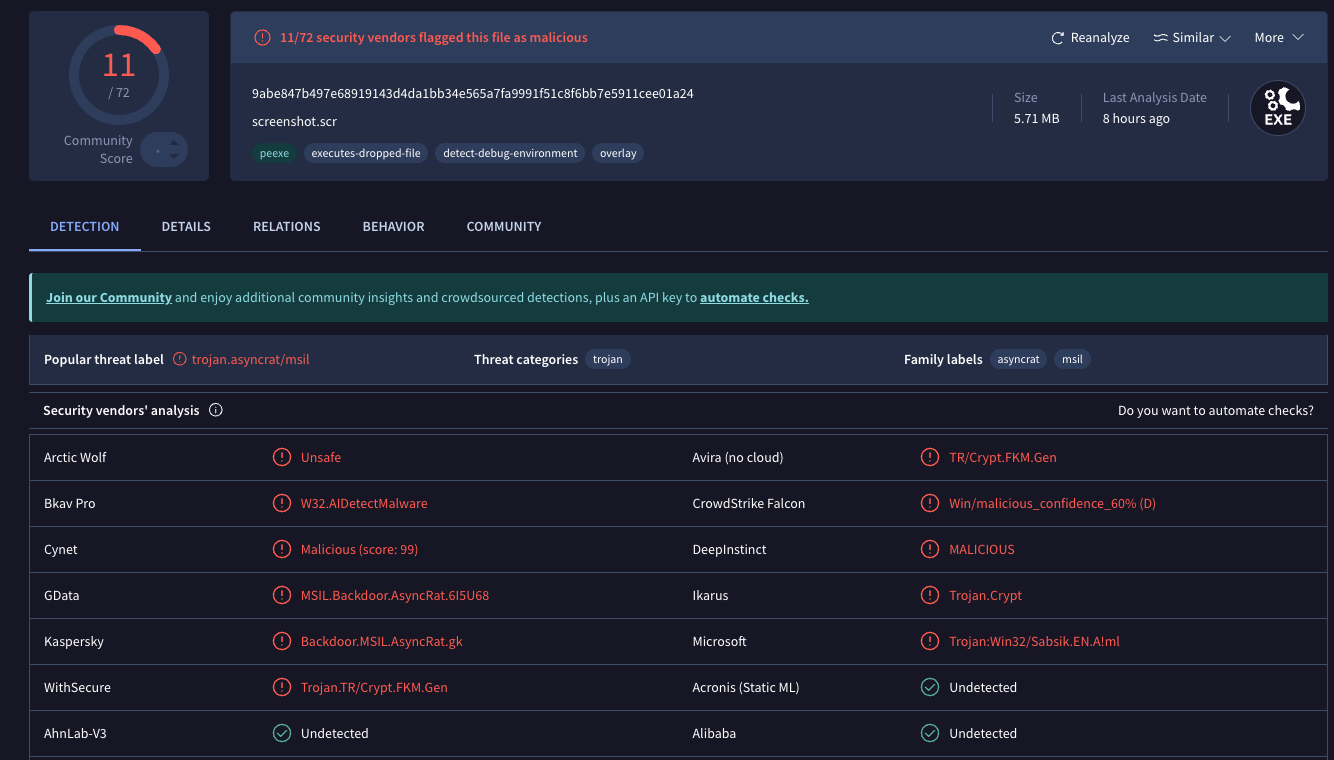
A scan of the malicious screensaver file at Virustotal.com shows it is detected as bad by nearly a dozen security and antivirus tools.

“Downloaded plugins may be executed directly in memory or stored in the registry,” Larsen wrote in an analysis shared via email. “Capabilities added via plugins include screenshot capture, file transfer, keylogging, video capture, and cryptocurrency mining. ASYNCRAT also supports a plugin that targets credentials stored by Firefox and Chromium-based web browsers.”

Malware-laced targeted emails are not out of character for certain members of the Scattered Lapsus$ Hunters, who have previously harassed and threatened security researchers and even law enforcement officials who are investigating and warning about the extent of their attacks.

With so many big data breaches and ransom attacks now coming from cybercrime groups operating on the Com, law enforcement agencies on both sides of the pond are under increasing pressure to apprehend the criminal hackers involved. In late September, prosecutors in the U.K. charged two alleged Scattered Spider members aged 18 and 19 with extorting at least $115 million in ransom payments from companies victimized by data theft.

U.S. prosecutors heaped their own charges on the 19 year-old in that duo — U.K. resident Thalha Jubair — who is alleged to have been involved in data ransom attacks against Marks & Spencer and Harrods, the British food retailer Co-op Group, and the 2023 intrusions at MGM Resorts and Caesars Entertainment. Jubair also was allegedly a key member of LAPSUS$, a cybercrime group that broke into dozens of technology companies beginning in late 2021.

A Mastodon post by Kevin Beaumont, lamenting the prevalence of major companies paying millions to extortionist teen hackers, refers derisively to Thalha Jubair as a part of an APT threat known as “Advanced Persistent Teenagers.”

In August, convicted Scattered Spider member and 20-year-old Florida man Noah Michael Urban was sentenced to 10 years in federal prison and ordered to pay roughly $13 million in restitution to victims.

In April 2025, a 23-year-old Scottish man thought to be an early Scattered Spider member was extradited from Spain to the U.S., where he is facing charges of wire fraud, conspiracy and identity theft. U.S. prosecutors allege Tyler Robert Buchanan and co-conspirators hacked into dozens of companies in the United States and abroad, and that he personally controlled more than $26 million stolen from victims.

Update, Oct. 8, 8:59 a.m. ET: A previous version of this story incorrectly referred to the malware sent by the reader as a Windows screenshot file. Rather, it is a Windows screensaver file.

❌
❌