Normal view
CVE flood pushes Ubuntu onto weekly kernel release cycle
-
TechRadar - All the latest technology news
- As a robovac expert, I recommend the Ecovacs Deebot X8 Pro Omni to most people — but its Max sibling is a heck of a lot cheaper at just AU$899
As a robovac expert, I recommend the Ecovacs Deebot X8 Pro Omni to most people — but its Max sibling is a heck of a lot cheaper at just AU$899
If there's one thing I've learnt in the last decade of testing some of the best robot vacuums in Australia is that not all of them are made equal. Some have excellent performance and software while others, despite a premium price tag, disappoint on testing.
However, as you can probably tell from my Ecovacs Deebot X8 Pro Omni review, I really liked how well this robovac performed in my tests. It wasn't perfect, but it cleaned and navigated well. Sadly, though, Ecovacs seems to have discontinued it, although stock is still available at retailers like JB Hi-Fi and The Good Guys, listed for AU$1,999.
It has now been replaced by the Ecovacs Deebot X8 Max Pro Omni (please note the 'Max' moniker here) which, despite a very similar name is a slightly different model. I much prefer its design aesthetic over the previous X8 Pro Omni — which was rather boxy — thanks to rounded corners that make the dock look sleeker.
Other than that, the newer model has slightly lower suction power (16,600Pa compared to 18,000Pa on the X8 Pro Omni), but it now boasts a better anti-tangle brush system and a faster rotating roller mop. It can also independently raise the side brush when necessary to avoid scattering.
These upgrades mean it has an RRP of AU$2,599 (AU$100 more than the X8 Pro Omni at launch) but, in better news, it's now on the receiving end of a massive 65% discount on Amazon — down to just AU$899.

Deebot X8 Max Pro Omni: was $2599 now $899
A whopping 65% discount is absolutely nothing to scoff at. And yes, I admit I can't vouch for this model myself as an expert, but Amazon users seem happy with its performance, although some of those reviews are incentivised. Non-Vine users have also claimed it's a good buy and, given how impressed I was with the X8 Pro Omni, I think this will work just as well.View Deal
The slightly lower suction power on the Deebot X8 Max Pro Omni is neither here nor there in real-world use. Robovacs with even lower suction can perform just as well as models with upwards of 20,000Pa of suction as pulling power is highly dependent on airflow through the device.
In my tests I found that the X8 Pro Omni was able to vacuum remarkably well, but I was even more impressed by its mopping — and this Max model has the exact same roller mop mechanism as the older bot. In fact, I find rollers to be the better cleaners than rotating dual mop pads for a couple of reasons: they scrape along edges better and are able to use more water and actually mop rather than (dry) wipe as circular mop pads are wont to do.
I had no issues with navigation or obstacle avoidance with the older model, and I'm confident that since nothing other than the suction has changed here, the Max will be a good investment for anyone keen on a capable set-and-forget robot vacuum.
I would even go so far as to say not to wait until the Amazon Prime Big Deal Days sale next week as I don't think this vacuum will drop lower in price — AU$899 is an all-tine low that we first saw in August this year, long after the main Prime Day sale in July.
-
TechRadar - All the latest technology news
- The Insta360 Link 2 Pro is genuinely one of the best webcams I've ever reviewed—but the high price may turn away some potential buyers
The Insta360 Link 2 Pro is genuinely one of the best webcams I've ever reviewed—but the high price may turn away some potential buyers
Insta360 Link 2 Pro webcam: Two-minute review
Action camera brand Insta360 has been making a name for itself in the webcam space recently, breaking out with its first-ever webcam, the Link, back in 2022. Then we saw the Insta360 Link 2 in 2024, so while I was hoping for a Link 3 this year, instead we're getting an interstitial generation: say hello to the Insta360 Link 2 Pro.
I can't say I'm disappointed, mind you. The Link 2 was a fantastic webcam, and while the Link 2 Pro is a fairly straightforward hardware upgrade, I'm not one to complain about getting more of a good thing. The Pro model increases the price a bit, but also delivers improved internals: a bigger, better sensor and wider aperture for superior FOV and light balance mean that 4K video capture looks even prettier. It also adds a little gold trim around the lens.
Now, the Link 2 was already a pricey product, so there's no denying that the Insta360 Link 2 Pro is very expensive for a webcam, even a 4K-capable one. More on that further down in this review, but in short: want one of the best budget webcams? This ain't that.
But for professional users creating video content or making regular presentations over video conferencing, the Link 2 Pro should be a very serious consideration. It may not be cheap, but you get a lot of webcam for your money: the performance, design quality, and feature set are truly all best-in-class.

It's almost a bit surprising that more camera companies haven't made the jump to webcams. From old-guard industry titans like Canon to up-and-coming manufacturers like DJI, you'd imagine that more of them would want to capitalize on a product type that has only become more necessary in the wake of the COVID-19 pandemic and the rise of remote work.
But hey: their loss is Insta360's gain, having made a seamless jump from action-cams and drones to premium webcams. And make no mistake, the Link 2 Pro is indeed a premium piece of hardware.
The build quality on display here is nothing short of excellent. The casing is a pleasingly sturdy construction of matte plastic and metal, with a compact folding clip that snaps magnetically to the rotating gimbal mount, makning it easy to attach to any monitor. It also features an industry-standard threaded screwhole on the underside for fitting it to a tripod or arm mount.

Of course, the gimbal is arguably the star of the show here. A two-point mechanism that allows for both horizontal and vertical rotation of the main camera unit, the gimbal allows the camera to track your movements within a wide radius thanks to AI-powered head-tracking technology.
I tested this thoroughly, and it really works; even when I attempted to move completely out of frame, the camera was surprisingly adept at tracking my movements.
That's not all it's capable of, though. The gimbal also enables several of the Link 2 Pro's nifty presentation modes, including desktop mode (which points down to the surface in front of you, ideal for showing off physical documents), whiteboard mode (which frames and zooms on a whiteboard or similar presentation board), and the very clever 'pause-tracking' mode (which lets you designate a specific area where the tracking lingers naturally as it follows you around, creating a more dynamic feel to your footage).
It also doubles as a privacy feature (as opposed to a lens cover or camera killswitch), with the lens pointing directly down when not in use. A set of four 'recognition markers' is included in the box, which are used for some of the tracking-lock modes.

All this fancy functionality, as well as more 'conventional' features like light balance adjustment and digital zoom, is readily accessible through Insta360's free software. It's a solid tool that makes setting up your ideal video experience swift and seamless, but even better, it's also available as a phone app – perfect for quick adjustments without needing to fire up an extra piece of software on your PC while you're trying to record.
With all that fancy AI baked into the Link 2 Pro, you might be hoping for something a little more sophisticated than tracking modes. Worry not: like the previous Link 2, this webcam features a set of preloaded gesture controls, letting you control the camera with your hand movements rather than needing to adjust anything in the app.
These are fairly basic, but I found they worked well in practice. Holding up your palm freezes (or unfreezes) your tracking or auto-framing preset, holding up two fingers toggles the aforementioned whiteboard mode, and making an 'L' sign and moving your hand up and down lets you zoom in and out. It doesn't feel particularly natural at first, but I quickly found myself adapting to it.

Now, let's get to the meat of this review: how's that picture quality? Well, I'm very pleased to report that it's nothing short of excellent. Even in the poorly-lit, cramped little box of a room I call a home office, I don't think I've ever looked better on a monitor-mounted webcam.
4K footage is sharp and bright at 30FPS with solid color reproduction. The upgraded sensor and larger aperture compared to the previous model give the Link 2 Pro great performance across a range of light conditions, showing me clearly and well-illuminated whether it was the middle of the day with the curtains open or late at night by the light of my desk lamp.
The field of view is also reasonably wide at 83.9 degrees, making it easy to fit two or even three people in frame for presentations or podcasts. I've seen webcams with broader FOVs – in fact, I very recently reviewed the Razer Kiyo V2, which boasts an almost too-wide 91-degree FOV – but this is more or less perfect for mainstream use.

The built-in microphone array is pretty good considering that integrated microphones frequently feel like an afterthought on webcams. It offers clear enough audio capture with AI-powered background noise canceling for casual to intermediate users, great for stuff like Zoom meetings, but serious professional content creators will likely still want to invest in a proper standalone microphone.
In terms of flexibility of use, it's good, if not perfect. It's relatively compact, so while there are smaller and lighter webcams out there, you can still take it with you on the go if you work across multiple locations. If you fit it to a suitable mount, you can easily flip it onto its side to record vertical video for social media without any loss of functionality. The only issue is that it's a tad bulky to mount atop a laptop display unless your laptop has a particularly sturdy hinge, but that's a pretty minor issue in the grand scheme of things.

Overall, I'm finding very little I can criticize about the Insta360 Link 2 Pro. Other than the fact that it's undeniably expensive and will almost certainly be more than the average user actually needs, this is just a fundamentally great product that easily ranks among the best webcams on the market right now.
If I absolutely had to pick something to nitpick here, it might be that the Link 2 Pro lacks any kind of lens cap. Dust and debris getting stuck on or under the lens can be a real irritation with webcams, so it would have been a nice inclusion – especially considering that it's a pricey, high-end webcam. But that really is the definition of nitpicking; this is genuinely one of the greatest webcams I've seen in a long time.
Insta360 Link 2 Pro webcam: Price & availability
- How much does it cost? $249.99 / £239 / AU$439
- When is it available? Available now
- Where can you get it? The US, UK, and Australia
At $249.99 / £239 / AU$439, the Insta360 Link 2 Pro is the most expensive webcam the company offers, and it's undeniably a steep price for the average user. If you're purely looking for a high-quality 4K webcam and you're not bothered about fancy features, you could easily find one for half that price if you shop sales.
That being said, I'm not going to call this bad pricing. Considering that the Link 2 Pro is a high-end webcam aimed squarely at professionals who are serious about their hardware, along with the rich feature set and great picture quality it offers, I don't think the price is unreasonable – it's just not going to be worth it for more casual users.
Insta360 Link 2 Pro webcam: Specs
Razer Kiyo V2 | |
|---|---|
Price: | $249.99 / £239 / AU$439 |
Supported resolutions: | 4Kp at 30fps, 1080p at 60fps |
Sensor: | Insta360 1/1.3" Low Light Excellence Sensor |
Field of view: | 83.9 degrees |
Connection: | USB-C |
Features: | Digital zoom, AI auto-framing, AI tracking modes, AI autofocus, dynamic color correction, HDR, mechanized gimbal |
Software Integration: | Insta360 mobile app, Insta360 Studio |
Should you buy the Insta360 Link 2 Pro webcam?

Value | The high asking price is the only thing holding the Link 2 Pro back from being genuinely perfect, but it's worth the money for professional users. | 3.5 / 5 |
Design | The chassis remains unchanged from the Link 2, but it was already great, with the gimbal working fantastically. | 5 / 5 |
Performance | Visual clarity is absolutely great at 4K, and the Link 2 Pro performs great at any light level and focal length. | 5 / 5 |
Avarage rating | The definition of a premium webcam for content creators and remote professionals, the Insta360 Link 2 Pro is an easy recommendation – if you can stomach the price. | 4.5 / 5 |
Buy it if...
You want the best of the best
It's not cheap, but the Insta360 Link 2 Pro more than earns its title of 'premium webcam', with great performance and a rich, useful feature set.
You want smart tracking modes
The AI-powered gimbal tracking of the Link 2 Pro works seamlessly across a range of use cases, making it ideal for activities like podcasting and shopping streams.
Don't buy it if...
You're on a budget
With a steep price tag of $249.99 / £239 / AU$439, there's no denying that the Link 2 Pro will be too expensive for many users.
You want something simple
While it does offer pretty effective plug-and-play functionality, the Link 2 Pro is a high-end device that offers more than the average Zoom user really needs.
Insta360 Link 2 Pro webcam: Also consider
Insta360 Link 2C
Our current top pick of the 4K webcams available on the market right now, the Link 2C offers performance that almost matches the Link 2 Pro, but removes the fancy mechanized gimbal to provide a more straightforward webcam experience at a lower price point.
Read our full Insta360 Link 2C review
Obsbot Tiny 2
The Tiny 2 from Obsbot delivers 4K video along with AI-powered tracking via its mechanical gimbal mount, just like the Link 2 Pro. For those who want a high-end video experience, this is a great pick.
Read our full Obsbot Tiny 2 review
How I tested the Insta360 Link 2 Pro webcam
- Tested the webcam in video calls and recording
- Compared image quality to other webcams
- 8+ years of experience reviewing computer hardware
I've been using an Insta360 Link 2 as my day-to-day webcam for several months now, so I was curious to see how it compared to the Link 2 Pro. As per my usual process for reviewing webcams, I replaced my daily driver with the Link 2 Pro for just over a week, using it for my usual spate of workday video calls.
I also installed the relevant Insta360 software on my phone and PC to test out its functionality, and made sure to test the performance of the Link 2 Pro in a range of different light conditions by recording video and comparing the clips side by side.
I've been testing and reviewing PC hardware for more than eight years, starting at the PC-building hobbyist magazine Maximum PC before making the leap to TechRadar's computing team. I put all of my knowledge and experience behind each and every one of my product reviews, so you can be assured that you're getting an informed and bias-free judgement.
- First reviewed September 2026
Data Broker Radaris Loses Domains in Privacy Fight
The consumer data broker Radaris.com has long had a reputation for ignoring requests to remove personal information from its vast empire of people-search services online. That reputation caught up with the company recently in a lawsuit alleging Radaris violated a New Jersey privacy law that provides for hefty fines against data brokers that publish personal information on state law enforcement officials. In the face of repeated stonewalling and prevarication by attorneys for Radaris, the judge in the case ordered that radaris.com and more than a dozen other data broker domains be transferred to the plaintiffs.
The radaris.com website, prior to the domain transfer to Atlas.
In February 2024, Radaris was sued by Atlas Data Privacy Corp, a company that has been pursuing data brokers alleged to be violating a New Jersey statute called Daniel’s Law. The statute allows state law enforcement officials, government personnel, judges and their families to have their information completely removed from commercial data brokers and people-search services, and provides for fines of $1,000 per violation against companies that ignore removal requests.
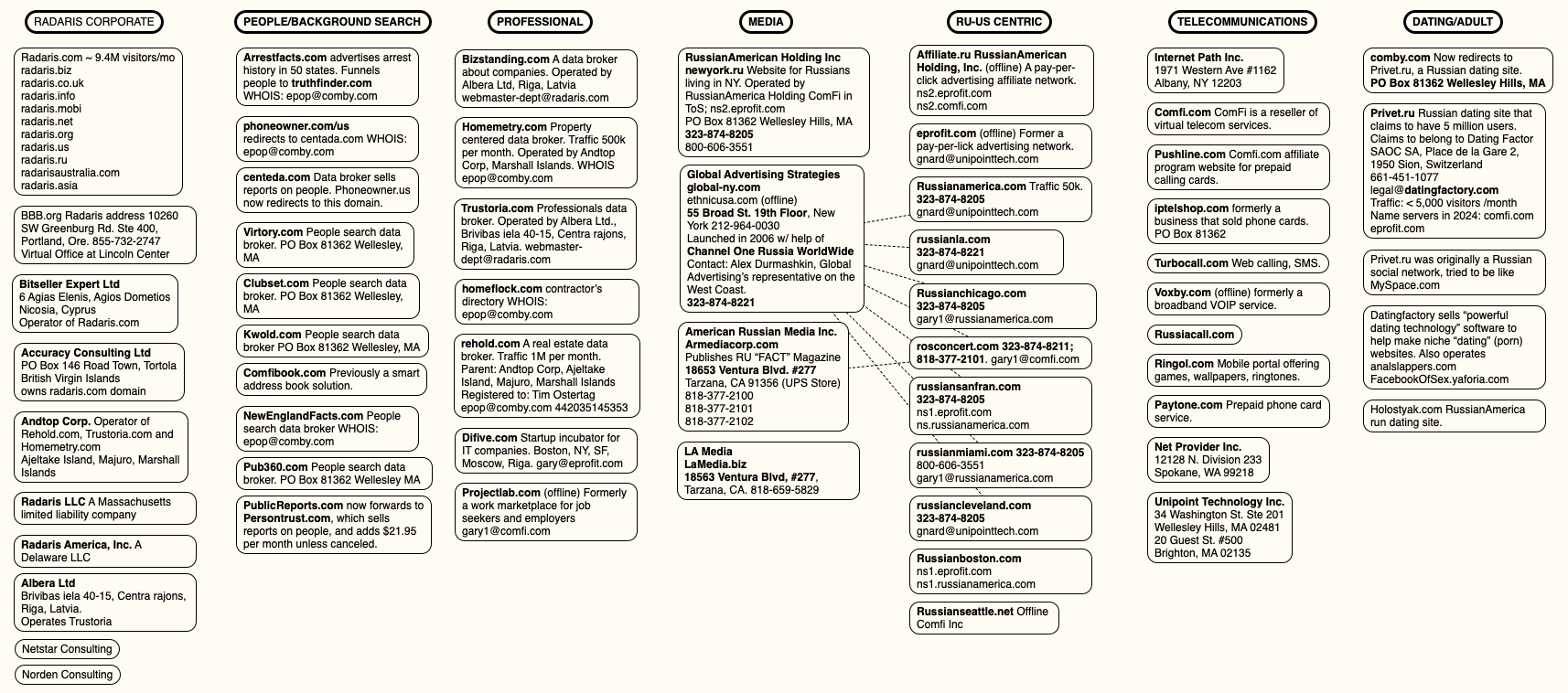
Less than a month after Atlas sued Radaris, KrebsOnSecurity published a deep dive into the Radaris co-founders — Igor and Dmitry Lubarsky (also spelled Lybarsky) — Russian-born brothers living in Massachusetts who operate a dizzying array of people-search companies as well as a number of Russian language dating services and affiliate programs.
Attorneys for the Lubarsky brothers threatened to sue for defamation if the story wasn’t removed and an apology issued. Their attorney asserted that our reporting was wildly inaccurate, and that the true owners of the company were Ukrainians living in Ukraine.
The Lubarsky brothers Dmitry or “Dan” (left) and Gary/Igor.
KrebsOnSecurity doubled down and showed how the Lubarsky brothers built and operated Radaris and other data broker companies using a fictitious CEO’s name. Our follow-up story noted that Radaris’s attorney — a lawyer with the Boston Law Group named Val Gurvits — admitted his clients had invented the CEO pseudonym “Gary Norden,” and that Radaris also had issued multiple press releases over the years that quoted the fake CEO while seeking money from potential investors.
Attorneys for Radaris waited until the last minute to appear in court and contest what was all but certain to be a default judgment in favor of the plaintiffs, and then told the court that Atlas had failed to serve the real owners and operators of Radaris and several of its sister data broker companies.
Atlas re-filed the lawsuit in June 2025, this time dramatically expanding the number of Radaris family data brokers accused of violating Daniel’s Law. Matt Adkisson, president and CEO of Atlas, said Radaris turned to a tried-and-true playbook: Delaying in court until the last possible minute, and playing shell games with Radaris’s true country of origin and the individuals listed as owners and operators of these sites.
“We refer to this period as their island-hopping phase. Privacy policies changed constantly, and new entities kept appearing from places like the Marshall Islands, the British Virgin Islands, and Seychelles,” Adkisson told KrebsOnSecurity. “Behind the scenes, it felt like a shell game. Defense lawyers told the court that certain entities merely operated the domains and were the proper parties to sue. But by the time a judgment neared, those entities would be discarded and new entities would appear. Meanwhile, the lawyers claimed the other entities that actually owned the domains should not be held responsible.”
Adkisson said when the defendants updated their terms of service to state that Radaris was suddenly managed by a company in the Marshall Islands, Atlas hired an investigator in that country and soon learned the brand new entity that Radaris claimed was managing the company didn’t even exist yet.
Mr. Gurvits stepped forward as Radaris’s attorney in a class action lawsuit the company temporarily lost in 2017 because it never contested the claim in court. When the plaintiffs told the judge they couldn’t collect on the $7.5 million default judgment, the court ordered the domain registry Verisign to transfer the radaris.com domain name to the plaintiffs.
Mr. Gurvits appealed that verdict, arguing the lawsuit hadn’t named the actual owners of the Radaris domain name — a Cyprus company called Bitseller Expert Limited — and thus taking the domain away would be a violation of their due process rights.
The judge in the 2017 case ruled in Radaris’ favor — halting the domain transfer — and told the plaintiffs they could refile their complaint. Soon after, the operator of Radaris changed from Bitseller to Andtop Company, an entity formed (PDF) in the Marshall Islands in Oct. 2020. The plaintiffs never re-filed their lawsuit.
“That seemed to be their modus operandi,” said Raj Parikh, a partner at PEM Law in New Jersey who handles most of the Daniel’s Law litigation for Atlas. “In the past, they won by attrition. Plaintiffs’ attorneys tired of the procedural games and just gave up. That strategy worked for a decade, and it probably would have worked in this case too, since any financial recovery from foreign actors will be difficult. But we were acutely aware of the threat this website posed to law enforcement officers and other public officials in New Jersey, and decided early on to commit whatever time and resources were necessary to remove that threat.”
On August 26, the judge in the New Jersey case found the defendants were given multiple chances to appear and defend the claims against them but had failed to do so. Mr. Gurvits declined to comment on the case, saying it had been assigned to another attorney, a Mr. Victor Worms. In response to questions, Mr. Worms asserted the New Jersey court transferred Radaris.com to Atlas as part of a default judgment against Radaris.com, which is not a legal entity.
“We have made a motion to vacate that default judgment on the grounds that it is void since a non-entity has no legal capacity to sue or be sued,” Worms replied. “We also intend to pursue all appropriate appeals because we believe the transfer of Radaris.com amounts to a forfeiture in violation of various constitutional principles.”
While radaris.com still comes up prominently in results when searching online for U.S. residents by name, the domain no longer sells detailed personal dossiers on millions of Americans. Its homepage now displays a notice from Atlas, as well as links to our previous reporting on Radaris.
EMAIL CONFIRMATIONS
Atlas told KrebsOnSecurity that it has obtained more than 10,000 emails and documents in the course of litigation, and that those messages confirm our previous reporting on the owners and operators of Radaris and its myriad companies.
Atlas said the emails clearly establish that the nominal legal vehicles — Radaris America, Inc.; Bitseller Expert Limited; Digital Orbit Corp; Core Solutions Group Inc; Lucky Solutions Inc; Virtura Corp; Veripages Inc.; Nuform Solutions Inc.; Growth Data Advisors Inc.; Property Experts, Inc — are all administered by the same three or four people from the same mailboxes, share one bank or payment card set, and are all managed from one virtual office address.
“The corpus establishes, with documentary evidence generated independently by banks, payment processors, hosting providers, registrars, software-as-a-service vendors and the operators’ own systems, that radaris.com and at least twenty-five other people-search websites are one operation run by a small Boston-area group whose administrative, financial and technical functions sit on the difive.com mail domain and its successors (centerex.com, scienteco.com, eprofit.com, realmo.com, pub360.com),” reads a summary shared by Atlas.
Atlas said the emails show Radaris.com earns approximately $42,000 a month, while Veripages.com earns around $45,000 monthly via its partnership with the Lifetime Value Company, a marketing and advertising firm whose brands include PeopleLooker, PeopleSmart, NumberGuru, and Bumper, a car history site.
According to Atlas, the emails also showed the Radaris family of websites earns as much as $25,000 each month from their partnership with Onerep, a company that claims to help people remove their information from people-search sites. In March 2024, KrebsOnSecurity revealed how the Belarusian founder of Onerep had launched and operated dozens of people-search sites over the years and was continuing to operate one of them (Nuwber), effectively spreading the disease and selling the cure.
The domain radaris.com now redirects to this notice from Atlas about the court-ordered domain transfer.
All told, the New Jersey court has so far transferred 14 domain names from the Radaris family of companies to Atlas. Radaris.com now redirects to a notice of the court-ordered domain transfer.
THE ROAD AHEAD
The Radaris family of companies is still potentially facing fines of $1,000 per alleged violation of Daniel’s Law. For the time being, however, Daniel’s Law is facing a constitutional challenge from virtually all of the 150 other consumer data broker firms being sued by Atlas.
The data broker industry responded by having at least 70 of the Atlas lawsuits moved to federal court, challenging the New Jersey statute as overly broad and a violation of the First Amendment. The U.S. Court of Appeals for the Third Circuit has not yet issued a decision on the constitutional challenge, but either way the case is widely expected to be appealed all the way to the U.S. Supreme Court.
Meanwhile, at least 14 other states have now passed laws modeled after the New Jersey statute, with more states considering similar measures. However, West Virginia’s Daniel’s Law was ruled facially unconstitutional under the First Amendment by a federal district court in August 2025.
Justin Sherman is a privacy expert and author of the forthcoming book “The Middlemen,” which examines how the data broker industry powers modern surveillance. Sherman said federal lawmakers have long faced intense lobbying by the technology industry against more restrictive U.S. data privacy laws, but that many powerful industries are now working against passing comprehensive data privacy legislation.
“These days at the federal level, add in the intense amount of lobbying against these laws from social media companies, big tech, cryptocurrency firms, and now AI proponents in the mix who claim that limiting their data scraping is somehow going to collapse the whole U.S. economy under Chinese rule,” he said.
Sherman said people-search companies will continue to thrive unless and until Congress enacts meaningful consumer privacy and data protection laws that are relevant to life in the 21st century. That’s because virtually all state privacy laws exempt records that might be considered “public” or “government” documents, including voting registries, property filings, marriage certificates, motor vehicle records, criminal records, court documents, death records, professional licenses, bankruptcy filings, and more.
At least 25 states have passed or implemented laws requiring age verification for residents seeking to access adult content online, but there is no federal law that limits how the companies that are scanning everyone’s drivers license can use, share or keep the data provided. Had such restrictions been enshrined in law, we may have avoided the recent breach at IDScan.net, which exposed the drivers license information on more than 153 million Americans when the records were briefly turned into a point-and-click identity theft service on the dark web.
“The average person can look at Daniel’s Law and have a perfectly normal reaction, which is that everyone should be covered, not just police and judges,” Sherman said. “But we don’t need more wake-up calls. We’ve had eight million wake-up calls already on the need for better privacy laws. The lack of comprehensive federal privacy law is not for a lack of knowledge, and anyone claiming otherwise is either not reading the news or kidding themselves.”

OpenAI Investigates Report Linking AI Agents to RubyGems Attack
The incident occurred in May, when RubyGems maintainers suspended new account registrations due to what appeared like malicious activity.
The post OpenAI Investigates Report Linking AI Agents to RubyGems Attack appeared first on SecurityWeek.
How to search AskWoody
Five alleged leaders of Black Axe’s operations in South Africa extradited to US
Five alleged leaders of the South African wing of Black Axe, a global cybercrime group with operations spanning dozens of countries, were extradited to the United States Friday to face multiple charges, the Justice Department said.
Officials accuse the five people, all originally from Nigeria, of running romance scams and advance fee scams from at least 2011 until they were all arrested in South Africa in 2021. The defendants were due Monday for initial court appearances and arraignments in a federal court in Trenton, N.J.
“Black Axe is a notoriously violent transnational criminal organization that also happens to dabble in romance scams to make money,” Stefanie Roddy, special agent in charge of the FBI Newark field office, said in a statement. “The ability of FBI Newark and our partner agencies to reach into South Africa illustrates our resolve to hold accountable any and every type of fraudster who preys on innocent victims here in the United States.”
The accused include Perry Osagiede, founder and leader of the Cape Town Zone of Black Axe; Franklyn Edosa Osagiede, the zone’s “chief ihaza” Osariemen Eric Clement, “assistant eye of the zone,” Collins Owhofasa Otughwor, the zone’s “chief eye,” and Musa Mudashiru, one of the group’s “assistant butchers.”
Prosecutors said the five defendants and their co-conspirators used fake identities to pose as a love interest, relatives, business partners or friends to trick victims into sending them money.
Many of the scams involved claims that the alleged cybercriminals needed money for work travel or to hold them over financially following a series of unfortunate events. This included requests for loans, often involving issues with a construction site, delayed inheritance, or expensive health costs for claimed relatives, according to an unsealed indictment filed in the U.S. District Court of New Jersey in 2021.
Prosecutors said the co-conspirators also used business entities and gained access to the financial accounts of some victims to conceal the funds illegally obtained from other victims. In some cases, the alleged Black Axe members threatened to distribute sensitive photos of victims when they hesitated to send money, officials added.
The extradition follows a heightened period of law enforcement activity targeting Black Axe in multiple countries.
Authorities arrested 34 alleged cybercriminals in Spain, including some Black Axe leaders, for adversary-in-the-middle scams such as business email compromise, money laundering and vehicle trafficking in January.
Officials seized millions in assets, arrested 58 individuals and identified 263 suspects, including members of Black Axe, in a multi-country sting operation in August.
Black Axe is a highly structured, hierarchical group that generates billions of dollars in criminal proceeds annually from many small-scale operations spanning dozens of countries.
All five of the extradited individuals are charged with conspiracy to commit wire fraud and money laundering. Perry Osagiede and Franklyn Osagiede are also charged with wire fraud and aggravated identity theft. Officials also charged Clement with wire fraud and Otughwor with aggravated identity theft. The combined charges carry up to 62 years in prison.
“This case reflects the result of a years-long effort by the U.S. Secret Service and our law enforcement partners to identify, investigate, and bring to justice those who allegedly preyed on victims through sophisticated online fraud and money laundering schemes,” Craig Marech, special agent in charge of the U.S. Secret Service’s Newark field office, said in a statement.
The Justice Department published additional information about the Cape Town Zone wing of Black Axe, including multiple aliases and business entities used by the group’s members, and encouraged potential victims to contact the FBI.
The post Five alleged leaders of Black Axe’s operations in South Africa extradited to US appeared first on CyberScoop.
Researchers say OpenAI agents were behind May hacking campaign targeting RubyGems
Researchers say they have discovered thousands of malicious software packages uploaded to an online public software repository that were left by a “swarm” of OpenAI agents.
According to an incident timeline published Friday by researchers Spencer Kitts, Thomas Larsen and Sydney Von Arx, the campaign began May 5 when they observed a handful of suspicious packages being uploaded to RubyGems, a public library for the Ruby programming language. By May 11 and 12, the site saw more than 2,000 malicious uploads from the same actors before RubyGems maintainers halted new user sign-ups for four days to stop the flow.
In one instance, the agents attempted to exploit a very recent vulnerability that had only been discovered this past July that would have given them access to RubyGem user API keys. According to Colby Swandale, the technical lead at RubyGems, the flaw involved an improper cache configuration. While initial access logs showed no evidence of malicious key use, Swandale acknowledged the review was limited in scope and inconclusive.
According to the report published Friday, the agents also used “disposable” email addresses and exploited another bug in RubyGems platform (since patched) that allowed them to register new accounts and gain API keys without verifying their email address.
The researchers said their understanding, based on discussions with “people in the RubyGems community,” is that OpenAI had yet to disclose the involvement of their agents in the May campaign.
An OpenAI spokesperson told CyberScoop that the company is aware of the incident and said they were in contact with both the researchers and RubyGems to conduct a broader review. The company characterized the episode as “benign,” describing it as routine training runs where agents attempt to access publicly available data.
“Based on our review, our agents used the RubyGems platform to access the internet to carry out benign tasks and retrieve public information,” the spokesperson said. “We’ll continue to investigate as part of our broader review of agent activity during training and evaluation.”
In many ways, the agents were not subtle about their identities or goals.
Days into the campaign, researchers noticed that some of the packages had “oai” in their filenames, while fifteen of them had “oai” set as their author and another listed the email “openaixyz65947@gmail.com” as their point of contact.
They also “clearly regarded what they were doing as hacking,” naming some of their files “hack.rb,” “evil.rb,” “inject.rb” and “exploit.rb.” Other packages were given names like “pwnp999,” “exfiltestwand3,” and “hacksvn,” and comments referring to things like a “malicious probe” or “#hack” are present through the files.
They also said the actors’ behavior was extremely similar to another incident revealed earlier this month where OpenAI agents flooded a German wiki with thousands of hacking-related posts. OpenAI has confirmed their agents were involved in that incident.
The RubyGems campaign used some of the same retrieval methods as the German Wiki agents, while thousands of malicious packages uploaded included a similar snippet, r.jini.ai, that was contained in the German posts.
Cybersecurity company Socket first flagged the campaign in a threat intelligence report posted May 13, but it does not mention or attribute any of the activity to OpenAI or AI agents.
However, the researchers said they had only limited visibility over the model’s actions and how successful some of them were, noting only OpenAI had the full details.
“This analysis is entirely based on the publicly available RubyGems packages uploaded by these agents,” the researchers wrote. “However, we do not have access to the rest of the AI behavior, in particular the chain-of-thought produced by the model during the incident, which is internal to OpenAI. Therefore, we do not know why the AI agents chose this strategy or whether it was successful.”
OpenAI’s spokesperson told CyberScoop that to date, they have not been able to verify the specific claims about malicious packages or exploitation detailed in the report and are continuing to investigate.
The post Researchers say OpenAI agents were behind May hacking campaign targeting RubyGems appeared first on CyberScoop.
Lawmakers call on Commerce to sanction hackers-for-hire
A bipartisan trio of lawmakers is asking the Commerce Department to sanction three India-based mercenary hack-for-hire groups that have reportedly stolen data from thousands of American citizens and companies.
Democratic Sens. Ron Wyden of Oregon and Sheldon Whitehouse of Rhode Island and Rep. Pat Harrigan, R-N.C., sought in a letter to Secretary Howard Lutnick Wednesday to have the mercenary firms added to the Treasury Department’s Entity List, which would limit their access to American software, cybersecurity tools and cloud infrastructure.
“Several India-based cyber-mercenary groups have spent more than fifteen years conducting targeted espionage against U.S. citizens, businesses and the lawyers representing them,” Wyden, Harrigan and Whitehouse wrote. “Compounding this security threat, these cyber mercenaries and their associates have engaged in an aggressive campaign of global lawfare to censor investigative reporting by prominent American media organizations. This coordinated effort effectively allows foreign entities to use foreign courts to keep the American public in the dark about cyber threats to their own country and undermines the fundamental constitutional rights of U.S. citizens.”
The three firms are Sunkissed Organic Farms, BellTroX and CyberRoot. The first of those three was formerly known as Appin and has been the subject of investigative reports and criminal probes. The Citizen Lab at the University of Toronto has delved into the work of BellTroX, and journalists also have reported on the activity of CyberRoot.
“The threat is further heightened by evidence that these groups have operated at the behest of the Qatari government, targeting opponents of Qatar’s World Cup bid and even the family of a former Republican Chairman of the House Permanent Select Committee on Intelligence,” the lawmakers wrote. “While one of these operatives has been indicted by the Department of Justice, the foreign hackers continue to operate with impunity.”
Reuters reported in 2023 that the family member was Kristi Rogers, wife of former House Intelligence Chairman Mike Rogers, now running for Senate as the GOP candidate against one of the midterms’ most important and contested races against Democrat Abdul El-Sayed.
Some of the hacking groups also have sought to censor reporting on their hacking activities, the lawmakers noted.
CyberScoop couldn’t reach the companies for comment. The Commerce Department also didn’t immediately respond to a request for comment, and the government of Qatar didn’t immediately respond to an email seeking comment on the letter. TechCrunch first reported on the letter.
Corrected 9/10/2026: to reflect department to which the lawmakers addressed the letter.
The post Lawmakers call on Commerce to sanction hackers-for-hire appeared first on CyberScoop.
Google buys Spirit Airlines’ data — but what about privacy?
FCC proposes public scorecard to rate telecoms on anti-robocall efforts
The Federal Communications Commission wants to set up a new scorecard system that would allow rate telecoms’ ability to prevent or deter unwanted robocalls.
According to the agency, the scorecard “will empower consumers and encourage providers to continue to combat illegal robocalls by providing the public with an assessment of the effectiveness of voice service providers’ efforts to protect consumers from illegal robocalls,” the FCC said in a Wednesday public notice.
The notice does not prescribe or define technical solutions or systems for the scorecard, instead laying out broad goals for the project. Those include creating a public guide for evaluating how well providers prevent robocalls, and how transparent they are with their metrics.
The agency expressed a desire for more than “a simple administrative checklist,” such as whether the provider offered the right tools or filed the right paperwork, but rather “a composite set of metrics that reflects both operational practices and measurable outcomes, including how often legitimate calls are blocked.”
The scorecard would apply only to domestic voice service providers with retail customers, including wireless, wireline, VoIP providers and hybrid networks, but the agency is seeking comment from the public on whether to focus on larger providers, exclude small or regional networks and other questions around who would be evaluated.
The FCC says it intends to publish the scorecard results, but characterized it as a tool to help consumers understand how effectively voice service providers address robocalls on their networks and “not a rulemaking that will result in new rules or requirements for voice service providers.”
However, the notice does flag a number of federal data systems built around enforcement that the agency said it believes would be “best” for evaluating companies, including Robocall Mitigation Database filings, FCC Consumer Complaints Center data, and FCC enforcement action data, along with third-party or industry sources like Industry Traceback Group data and Federal Trade Commission complaint data.
Peter Hyun, former acting head of enforcement at the FCC, endorsed the general concept behind the idea, likening it to the Department of Transportation’s creation of an airline customer service dashboard in 2024.
That transparency “helped foster adoption of improved practices and a strong focus on better outcomes for consumers,” Hyun told CyberScoop in a text message. “With recent legal and policy fights over FCC enforcement, this is a creative effort to use other tools to combat what is an ever-tormenting issue for consumers: illegal calls.”
FCC officials have emphasized that the most frequent complaints they hear from consumers are around robocalling, and they are seeking to address that demand in a variety of ways.
On the same day the scorecard was unveiled, the FCC announced it had booted 14 telecommunications providers from the Robocall Mitigation Database. The federal system is used by companies to document their compliance with anti-robocalling standards — like STIR/SHAKEN protocols — that FCC officials say are vital to helping them validate legitimate network traffic moving through the U.S. and identify bad actors.
Removing a company from the database effectively cuts it off from connecting to U.S. telecom networks. FCC regulations give other U.S. providers two days to block all traffic coming from violators.
“Today’s action pushes more than a dozen providers off of U.S. networks for failing to abide by our robocall rules,” said FCC Chair Brendan Carr. “The FCC continues to attack the problem of illegal robocalls at every point along the call path, and everyone in this ecosystem has an obligation to step up and do what they can to protect consumers against fraud and scammers.”
According to the FCC, the 14 companies failed to respond to take necessary steps when informed that their database certifications were out of compliance. The list of affected companies includes Apps Communications, CFX Business Solutions, Conference America, Convergence Technology Solutions, CSB Technologies, Digital Division, Dixie Net Communications, HighComm, Inatech Solutions, makrodepot, Opex Communications, ReachME, SECURE, and SkyCom Healthcare.
The post FCC proposes public scorecard to rate telecoms on anti-robocall efforts appeared first on CyberScoop.
Push off Passkeys
Omarchy distro gains serious backing
A California county wants to hire Tina Peters to help run its elections
Clint Curtis, the registrar for voters in Shasta County, Calif. said he plans to hire convicted felon and election denialist Tina Peters as one of his top deputies.
Curtis said he plans to hire Peters next month as an assistant registrar, according to local news outlets, which cited text exchanges with Curtis.
CyberScoop has reached out to Shasta County’s elections office for comment.
If Peters is hired, it would represent a marriage between a conspiracy-minded election official from another state and an equally distrusting electorate.
Donald Trump won Shasta County approximately two-thirds of voters in the county in all three presidential elections dating back to 2016. Its conservative residents have adopted Trump’s rhetoric that election fraud, voting machine hacks, noncitizen voting and other problems plagued the system, and have turned their anger at local officials.
Cathy Darling Allen, Shasta County’s former registrar of voters, told CyberScoop in 2024 that she retired after decades of administering elections in the county due to persistent attacks and harassment from voters who embraced baseless election fraud conspiracy theories.
Peters, a former Mesa County, Colo. election official, had been serving a 9-year sentence for seven felonies, including identity theft, breaking into an election office, disabling surveillance cameras, and stealing voting system software.
Peters’ prosecutor, Colorado’s state clemency advisory board, and Mesa County officials have all defended her sentence and described her as entirely unrepentant for her crimes.
Election experts have called Peters’ theft of voting system software one of the most serious breaches of election systems in history. She shared the stolen code with conservative activists, and the code eventually surfaced online.
Governor Jared Polis, a Democrat, commuted Peters’ sentence earlier this year, citing pressure from the Trump administration and arguing that her punishment violated her First Amendment rights. In doing so, Polis intervened before an appeals court could decide whether Peters deserved a reduced sentence.
“She may continue making claims about elections that I believe are false,” Polis wrote in a May Substack post defending the decision. “She may continue promoting ideas that I strongly disagree with. I hope she doesn’t. But in America, people are not sent to prison for expressing political views, however misguided those views may be.”
In response to questions about Peters, Polis’ press office referred CyberScoop to the Colorado Department of Corrections.
Department of Corrections spokesperson Alondra Gonzalez told CyberScoop in an email that as part of her parole conditions, Peters is required to get a job or participate in a full time educational or vocational program and reside in Colorado. Parolees can request to transfer to another state, but those requests would be subject to rules and procedures under the Interstate Compact for Adult Offender Supervision and require approval from both states.
Gonzalez told CyberScoop that the department has not received a request for an interstate transfer from Peters at this time.
The Shasta County board of supervisors formally censured Curtis earlier this month following investigations by the county and outside consultant firm The Oppenheimer Group found he was verbally abusive or physically threatening toward staff.
At an Aug. 11 public meeting, Shasta County Supervisor Matt Plummer cited more than 700 pages of evidence and more than half a dozen eyewitnesses.
The investigations included claims that Curtis at times threatened to “punch,” “slap in the face,” “kill” or “execute” his subordinates. Another claim alleges Curtis once threatened to remove a door where an employee was allegedly hiding from him and have the person pulled out by their hair.
Plummer prefaced his comments by saying the board’s action is “not about election integrity” and that Curtis retains all of his authority to carry out budgeted election administration for the county.
“This is about determining when a department head allegedly and through two investigations, has substantiated allegations of violating personnel codes, the codes that guide how we as a county intend to interact with our employees, what do we do about it?” Plummer said.
Senators Alex Padilla, D-Calif., and Adam Schiff, D-Calif., wrote to California Secretary of State Shirley Weber to express their “grave concern” over the possibility that Peters would have access to state election systems.
“If Shasta County puts Ms. Peters in a position to again violate election laws following her convictions, county taxpayers could be burdened with unwelcomed and potentially hefty expenses,” Padilla and Schiff wrote. “If county officials proceed with this misguided plan, we request that you provide the maximum oversight possible to ensure that Ms. Peters does not improperly access ballots, voting systems, or sensitive information that could impact the rights and privacy of the over 100,000 registered voters in Shasta County in violation of…state or federal election law.”
The post A California county wants to hire Tina Peters to help run its elections appeared first on CyberScoop.
-
CyberScoop
- Capitol Hill wants to know if executive branch, foreign allies coordinated enough to combat scams
Capitol Hill wants to know if executive branch, foreign allies coordinated enough to combat scams
Senators from both parties Thursday probed Trump administration officials about whether federal agencies and foreign governments are coordinated enough in the battle against scammers, something witnesses told the Foreign Relations Committee they were working to remedy.
At least 13 federal agencies have authorities to counter scams, raising questions about whether someone needs to be in charge of all those efforts. And while there was some bipartisan sentiment at Thursday’s hearing that the Trump administration has taken good actions to battle scammers, both lawmakers and administration officials said that scam operations have demonstrated that cracking down on them in one place often just leads to them going elsewhere.
Sen. Pete Ricketts, R-Neb., compared the situation to an international initiative that gained prominence in the 1990s to counter drug trafficking, Joint Interagency Task Force South.
“Given that today’s scam centers are similarly transnational, combining cybercrime, human trafficking, money laundering and cryptocurrency, has the threat reached the point that we should establish a comparable multinational coordination mechanism?” he asked.
Sen. Jeanne Shaheen, D-N.H., focused on federal coordination: She paraphrased a former federal official who said, “there is nobody that is heading that effort up across agencies. We need to treat this like combat, and so we need somebody in charge.”
Shaheen, the top Democrat on the panel, is a co-sponsor of the bipartisan Scam Compound Accountability and Mobilization (SCAM) Act, which seeks to unify federal efforts on the subject.
A State Department official told Shaeen scammers were a national security priority for President Donald Trump, and that his executive order on the topic sought to tackle coordination.
“I do understand that this is a whole-of-government approach, and many agencies are focused on this,” said David Bedard, deputy assistant secretary at State’s Bureau of International Narcotics and Law Enforcement Affairs “The Action plan that was directed by the president is currently in the interagency review process to deconflict some of the concerns that you have raised. We certainly think the task force that will be implanted through the executive order will solve the problems you might be referencing.”
There’s also an international plan under the task force, he said. Currently, the administration shares intelligence on scammers with foreign allies, and Interpol has “productive” channels to work through there and is setting up its own task force, Bedard said, but there are concerns about other countries taking similar, duplicative action.
There have been signs of progress on the international front, Bedard and another State Department witness told the panel.
Michael DeSombre, assistant secretary at the Bureau of East Asian and Pacific Affairs, said Trump has raised the subject with Chinese President Xi Jinping, and that China has used its influence in Asia as its own citizens have become scam victims. Still, there’s been more progress in countries where the United States has stronger relations, such as Cambodia, than in those where ties aren’t as close, like Burma and Laos.
In Cambodia, one key has been pursuing scam center bosses first and foremost, Bedard said.
The post Capitol Hill wants to know if executive branch, foreign allies coordinated enough to combat scams appeared first on CyberScoop.
-
CyberScoop
- Trump blames Minnesota for cyberattacks on water sector, drawing pushback from cyber world
Trump blames Minnesota for cyberattacks on water sector, drawing pushback from cyber world
President Donald Trump blamed Minnesota Friday for the cyberattacks its water systems have suffered in recent days, saying the state was “behind it.”
Trump said the state being “incompetent” was the issue, but it wasn’t clear whom he thought actually conducted cyberattacks that U.S. investigators have attributed to Iran — if, perhaps, somehow Minnesota incompetently cyberattacked itself. The White House referred a request for clarification back to Trump’s remarks.
“I think that Minnesota is behind it,” Trump told reporters Friday. “Because they’re grossly incompetent. I don’t think there was an Iranian cyberattack. I think Minnesota ought to get its act together.”
The White House also didn’t clarify whom the president believed was behind similar attacks in other states, when asked for comment. Trump has repeatedly used federal power aggressively in Minnesota, a state led by Gov. Tim Walz, a Democrat who was on the ticket that ran against him in 2024 as the vice presidential nominee. Trump also has downplayed Iranian attacks amid the war he launched against the nation with Israel in February.
A number of cyber experts quickly pushed back on Trump’s comments after he made them.
“Victim blaming in cyber is so 2000 and late,” cybersecurity pioneer Chris Wysopal, Veracode co-founder and chief security evangelist, said on the Bluesky social media platform. Said Jake Williams, a member of the IANS faculty: “His own intelligence services are attributing this to Iran.”
Andy Jabbour — founder and CEO of Gate 15, a cybersecurity firm which provides support to the water sector — told CyberScoop that, “speaking candidly, I’m not even sure what he was actually saying or suggesting Minnesota’s government did or didn’t do.”
“Attribution is tricky business,” he continued, referencing recent alerts from the Cybersecurity and Infrastructure Security Agency and others. “But logically, given an ongoing war with Iran, recent statements made by Iran-aligned threat groups, with assessments that the recent activity is aligned with recent CISA warnings, given yesterday’s statements from CISA and the FBI, random unsubstantiated allegations aimed at political opponents seem reckless and are a disservice to the American people.”
Walz struck back at Trump in a Facebook post, noting steps from his Department of Government Efficiency to slash federal funding. CISA has shrunken considerably under Trump, and his administration has pushed states to defend against cyberattacks that feds once countered.
“Trump knows exactly who is responsible for this attack, and knows that other states were hit too,” Walz said. “This is what modern warfare looks like, and it further illustrates there’s no plan to win a war with Iran.”
“DOGE took an axe to CISA and left the U.S. exposed to cyber attacks,” he continued. “Thankfully, our experts in Minnesota were able to identify the vulnerability quickly and work with local communities to stop it.”
A spokesperson for Minnesota IT Services, a state agency that has been responding to the water cyberattacks, declined to address Trump’s remarks.
“We remain focused on supporting affected communities, securing critical infrastructure and coordinating with local partners and federal officials as the investigation continues,” the spokesperson, Emily Zimmer, told CyberScoop. “We will not comment on political statements or speculate about attribution.”
Other cyber professionals declined to comment directly on Trump’s remarks, but offered thoughts on who was behind the attacks and their motives.
Bryson Bort, CEO and founder of Scythe said the evidence supports the attribution with Iran, and that it looks like hackers there found something they could exploit on the internet and seized the chance.
“This was a target of opportunity,” said Bort, co-founder of the ICS Village, a non-profit advancing awareness of industrial control system security; such systems are common in the water sector. “It wasn’t that Minnesota did something as a state to raise Iran’s ire.”
Cynthia Kaiser, a former top FBI cyber official, said that when the bureau conducts attributions, it looks at technical indicators but also who has the capability, who has conducted similar attacks in the past and what the purpose of the attacks is.
“Iran ticks all these kinds of things,” Kaiser, now senior vice president at cybersecurity firm Halcyon, told CyberScoop. “My view is, if it walks like a duck, if it talks like a duck, I strongly suspect it’s a duck. I’d be shocked if we found out it wasn’t Iran.”
Just last week, CISA updated an advisory about how Iranian hackers were targeting programmable logic controllers in the water sector and other sectors, a warning that the water industry’s information sharing and analysis center said it believed.
“WaterISAC is confident in our government partners’ assessment that the confirmed activity is aligned with the joint Cybersecurity Advisory (CSA) AA26-097A ‘Iranian-Affiliated Cyber Actors Exploit Programmable Logic Controllers Across U.S. Critical Infrastructure’ published and recently updated by CISA,” Tom Dobbins, executive director, WaterISAC, told CyberScoop. “We have evidence of earlier attacks from Iran even before this current conflict. Cyber attacks are the most viable way that Iran can directly attack our homeland, and it is logical that they would do so, especially given the challenges of absolute attribution.”
The water sector is often viewed as one of the most vulnerable critical infrastructure sectors, and Dobbins called on Congress to provide funding to provide funding for the ISAC.
Sen. Tina Smith, D-Minn., also took issue with Trump’s comments.
“The President provided an unserious response that is beneath the dignity of the office he holds. Iran’s purported cyberattack on Minnesota’s water infrastructure must be taken as a serious threat to our national security. Smith said in a statement, adding that she’s been in touch with CISA and the FBI and was grateful to Minnesota’s IT experts. “The entire situation serves as a stark reminder of the danger this war puts us in the longer it drags on.”
Fellow Minnesota Democratic Sen. Amy Klobuchar had earlier been in touch with Sean Cairncross, the national cyber director and a Minnesota native, about the incident.
Trump has previously displayed a laissez-faire view toward other cyberattacks on the United States, such as when he’s been asked about Chinese and Russian cyberattacks and Trump shrugs them off as something America does, too.
He also has cast doubt before on his government officials’ assessments of who’s responsible for cyberattacks on the United States, such as when he asserted China rather than Russia was behind the landmark SolarWinds breach.
Updated 8/3/2026: with comments from Minnesota’s senators.
The post Trump blames Minnesota for cyberattacks on water sector, drawing pushback from cyber world appeared first on CyberScoop.
-
CyberScoop
- Ghanaian national sentenced to 7 years in prison for stealing $10M from romance scam victims
Ghanaian national sentenced to 7 years in prison for stealing $10M from romance scam victims
A 41-year-old Ghanaian national was sentenced to 85 months in prison for stealing more than $10 million from mostly older, lonely and vulnerable victims via romance scams, the Justice Department said Tuesday.
Derrick Van Yeboah was a longtime and high-ranking member of a criminal organization primarily based in Ghana linked to more than $100 million stolen from romance scams and business email compromises, officials said. Van Yeboah served as a “sakawa boy,” impersonating fake romantic partners and directly interacting with victims online from February 2015 to October 2024.
“Romance scammers do not simply steal money — they weaponize trust,” Jay Clayton, U.S. attorney for the Southern District of New York, said in a statement.
Van Yeboah was arrested in Ghana in June 2025, acting on a request from the Justice Department, and extradited to the United States two months later. He pleaded guilty to conspiracy to commit wire fraud and agreed to forfeit $10.15 million in fraudulent proceeds as part of a plea agreement in March.
Authorities said they identified at least 20 of Van Yeboah’s victims, noting that some were deceived into sending their money to the criminal organization, creating companies and using those entities to unwittingly launder funds from other victims.
Victims include a woman from Delaware who either sent or laundered $1.9 million, a woman from Ohio who sent or laundered $2.3 million and another woman who sent or laundered about $1 million. Van Yeboah also tricked a North Carolina man to send $123,000, claiming he needed a loan to pay for his mother’s funeral expenses and to remove imaginary gold and diamonds from storage in Italy, according to court records.
Officials said Van Yeboah received a substantial amount of money from his criminal acts. He told pretrial services his assets include a house worth $1.5 million and jewelry worth $515,000. When he was arrested, Ghanaian police found him in possession of two vehicles stolen from the United States and Canada.
“Victims lost large portions of their life savings, money they had counted on for retirement. They were emotionally devastated to learn that the personas they had been talking to every day, personas who claimed to be in love with them, were in fact frauds,” Clayton wrote in a pre-sentencing letter to the court.
Van Yeboah’s conduct was cruel, and he fully understood the financial and emotional harm he was causing to his victims, he added.
“Van Yeboah’s conduct was far from an aberration. Van Yeboah engaged in the fraud scheme for nine years. It wasn’t isolated conduct; it wasn’t a blip,” Clayton wrote. “Indeed, it appears to be the only real job Van Yeboah has ever had. Day after day, for years, he targeted vulnerable victims, lied to them, and stole from them.”
The post Ghanaian national sentenced to 7 years in prison for stealing $10M from romance scam victims appeared first on CyberScoop.
Rubio restricts visas for sextortionists, cyber scammers
The State Department will restrict visas for cybercriminals like scammers to sextortionists, and in some cases even their family members, Secretary of State Marco Rubio said Thursday.
The Trump administration has sought to make a crackdown on foreign-based scams one of the signature issues of his second term. An executive order that the president signed in March indicated that visa restrictions would be on the table as one response.
“By restricting visa issuance to those who are responsible for or complicit in these criminal enterprises, we are sending a clear message: The United States will go after those who prey on our citizens,” Rubio said.
Other departments have also made efforts to reduce foreign-run scams. In June, the Department of Justice seized infrastructure used by subsidiaries of the Huione Group, a Cambodia-based corporate conglomerate tied to one of the world’s most prolific criminal marketplaces used to commit cyber scams and other crimes.
Rubio authorized the visa restrictions under a 1952 law that gives the State Department the ability to deport or rule as inadmissible someone who poses “potentially serious adverse foreign policy consequences.”
Critics have accused the Trump administration of abusing that provision of the law for political purposes.
Rubio’s statement on the visa restrictions mentions “individuals responsible for, or complicit in, cybercrime and cyber-enabled crime, such as those involved in cyberscams, and sextortion.” Furthermore, he said, “Immediate family members of individuals engaged in such illicit activities may also be subjected to visa restrictions.”
Betsy Cooper, Founding Director of the Aspen Policy Academy, said the visa restrictions on cybercriminals could be valuable, but offered a caveat.
“Scamming people is a growing global enterprise, and it is a laudable goal to penalize those who scam and defraud people since they so rarely suffer consequences for their actions,” she said in a statement to CyberScoop. “So long as the new visa controls are used narrowly and deployed only against verified scammers and fraudsters, this is a positive step toward combatting cyber-enabled crime.”
While some cyber experts have questioned how much visa restrictions, prosecutions and other punishments of cyber miscreants who are based overseas will affect them, others maintain that it can serve as a deterrent to those who would consider getting into the line of work but want freedom to travel the globe.
FightCyberCrime.org, a nonprofit that seeks to help cybercrime victims, applauded the restrictions on the cybercriminals.
“We welcome efforts to hold cybercriminals accountable across borders. Cryptocurrency investment scams, romance scams, and sextortion cause devastating financial and emotional harm to victims,” it said in a statement to CyberScoop. “Meaningful disruption of these transnational criminal networks is an essential part of the response.”
But there’s still a long way to go in the fight, the statement continued.
“At the same time, we must invest more in victim support, prevention, and recovery resources,” the organization said. “Accountability is critical, but ensuring victims have access to trauma-informed support and resources is equally important.”
The post Rubio restricts visas for sextortionists, cyber scammers appeared first on CyberScoop.
Intel fortifies Foundry with an actual customer: Fortinet