❌

Reading view

There are new articles available, click to refresh the page.

Army soldier sentenced for spree of attacks on AT&T, Snowflake and other major companies

A former Army soldier responsible for a series of attacks and extortion attempts on telecom companies, including AT&T, was sentenced to 70 months in prison, the Justice Department said Friday.

Cameron John Wagenius engaged in a cybercrime spree for years, including while he was on active duty on a base in Texas. Prior to his arrest in December 2024, Wagenius attempted to sell stolen sensitive data to a foreign intelligence service and sought information online about defecting to Russia.

“Cameron Wagenius spent more than a year and a half betraying the trust placed in him as an active duty soldier by carrying out a sweeping cybercrime campaign,” said A. Tysen Duva, assistant attorney general of the Justice Department’s Criminal Division, said in a statement.

Wagenius, who pleaded guilty in July 2025, leaked stolen call records of President Donald Trump as part of multiple failed attempts to extort $500,000 from AT&T, Allison Nixon, chief research officer at Unit 221B, previously told CyberScoop. 

Authorities did not name Wagenius’ alleged victims in court filings, but said he disclosed non-content call detail records belonging to a government official and family members of another former official. AT&T in July confirmed cybercriminals accessed the company’s Snowflake environment in April and stole six months of phone and text records of “nearly all” of its customers. 

Wagenius’ and one of his co-conspirators, Connor Moucka, attempted to extort more than 10 organizations after stealing credentials and breaking into cloud platforms used by AT&T and other major companies based in the United States and abroad. 

Moucka, a Canadian extradited to the United States in March 2025, pleaded guilty in August to playing a central role in one of the most far-reaching cyberattacks of 2024 — the widespread compromise of more than 165 Snowflake customer environments, resulting in massive data theft for extortion.

Wagenius, Moucka and their alleged co-conspirator John Erin Binns, who is not presently in U.S. custody, stole billions of sensitive records and received more than $2.5 million in extortion payments combined, according to prosecutors. Victims of the attack spree included AT&T, Ticketmaster, Advance Auto Parts and Santander.

Some of the records in Wagenius’ possession at the time of his arrest were stolen in the attack spree on Snowflake customer databases, according to cybercrime researchers. Officials said Wagenius was directly involved in attempted extortion attempts targeting multiple organizations for a combined total of more than $1 million. 

The 22-year-old was ordered to pay almost $295,000 in restitution for his crimes.

“His hacking schemes were not only aimed at getting rich, he was also motivated by a desire to achieve status within criminal hacking communities,” Charles Neil Floyd, first assistant attorney for the U.S. District Court for the Western District of Washington, said in a statement. “This sentence must impose real consequences to deter him, and hopefully other would-be hackers.”

Wagenius, who identified himself as “kiberphant0m” and “cyb3rph4nt0m” on online criminal forums, used a hacking tool he helped develop called SSH Brute to steal credentials while on active duty, officials said. Wagenius and his co-conspirators threatened the victim organizations privately and in public forms, officials added.

“It is especially shocking that a member of our armed forces, sworn to defend Americans and their constitutional rights, would engage in such a violation of privacy,” W. Mike Herrington, special agent in charge of the FBI Seattle field office, said in a statement.

When federal law enforcement seized Wagenius’ devices in December 2024, they found evidence indicating he had access to thousands of stolen identification documents and large amounts of cryptocurrency. Days later, Wagenius purchased a new laptop against his commanding officer’s order, according to officials, and used it every day over a five-day period in the barracks at Fort Cavazos in Texas with VPN software to hide his identity and location.

The post Army soldier sentenced for spree of attacks on AT&T, Snowflake and other major companies appeared first on CyberScoop.

Ryuk ransomware operator sentenced to 2 years in prison

A 35-year-old Armenian national was sentenced to two years in prison for his involvement in a series of Ryuk ransomware attacks while living in Ukraine and Russia in 2019 and 2020, the Justice Department said Tuesday.

Karen Vardanyan was extradited from Ukraine to the United States last year and pleaded guilty to computer fraud and conspiracy to commit fraud and extortion in July. Vardanyan’s sentencing, which also calls for about $1.2 million in restitution to victims, matches terms of a plea agreement he reached with prosecutors.

Vardanyan and his co-conspirators’ victims include a Michigan-based company that paid a ransom of nearly $1.2 million in January 2020, a Watsonville, Oregon-based technology company that was attacked in December 2019 and a Texas-based school breached in February 2020, according to court records.

“Like Vardanyan, many cybercriminals are not masterminds of a complex ransomware or extortion scheme but nonetheless play an integral part in the success of these crimes,” read a memo signed by U.S. attorneys in the District of Oregon.

“Unfortunately, high rewards and a relatively low risk of detection are basic features of cybercrime. The only way to affect the cost-benefit analysis of these crimes is to impose meaningful sentences on those who are caught,” the U.S. attorneys added.

Prosecutors previously accused Vardanyan and his co-conspirators — Ukrainian nationals Oleg Nikolayevich Lyulyava and Andrii Leonydovich Prykhodchenko, and Armenian national Levon Georgiyovych Avetisyan — of illegally accessing computer networks to deploy Ryuk ransomware on hundreds of compromised servers and workstations between March 2019 and September 2020.

Ryuk ransomware was prevalent in 2019 and 2020, infecting thousands of victims globally across the private sector, state and local municipalities, local school districts and critical infrastructure, including a wave of attacks on U.S. hospitals.

Victims of Ryuk ransomware attacks include Hollywood Presbyterian Medical Center, Universal Health Services, Electronic Warfare Associates, a North Carolina water utility and multiple U.S. news outlets.

Justice Department officials said Vardanyan and his co-conspirators received about 1,160 bitcoins — valued at more than $15 million at the time — in ransom payments from victim companies.

Prosecutors said they found no evidence Vardanyan was still engaged in criminal activity at the time of his arrest. Vardanyan’s incarceration will be followed by three years of supervised release, and his conviction will have immigration consequences resulting in removal from the United States after serving his sentence.

The post Ryuk ransomware operator sentenced to 2 years in prison appeared first on CyberScoop.

ShinyHunters claims attack on FBI exposes almost all agents

The FBI is investigating an attack on its own systems after ShinyHunters claimed responsibility for the incident, putting the prolific cybercrime group in the most direct conflict yet with agents responsible for investigating data extortion attacks.

The Monday breach, first reported by 404 Media, allowed ShinyHunters to temporarily deface the FBI jobs site. The group claimed it stole “very sensitive data on almost all FBI agents and individuals who filed an application with the FBI for a job,” in a lengthy post on its data-leak site.

“The FBI is aware of claims regarding unauthorized activity affecting FBIjobs.gov and is currently investigating,” a spokesperson for the agency said in a statement.

An alert on the FBI jobs site notes that apply.fbijobs.gov and the Special Agent Application Portal are currently unavailable.

The attack marks a sobering escalation by ShinyHunters, a notorious group that previously targeted major cloud platforms, healthcare organizations, universities, technology companies, retailers and education service providers. Previous victims of ShinyHunters this year include Instructure, Salesforce, Snowflake and McKesson.

“The ShinyHunters ransomware group appears to be actively trying to put a target on their back,” Cynthia Kaiser, senior vice president at Halcyon’s ransomware research center, told CyberScoop. 

ShinyHunters claims it targeted the FBI in response to a public service announcement it says contains false allegations about the group. The FBI issued the PSA following ShinyHunters’ May attack on Instructure, the company behind Canvas, a widely used central hub for K-12 and university coursework, exams and communication. 

The group responded with its own “PSA” on its data-leak site, insisting it is not affiliated with The Com, has never conducted swatting attacks or claimed it had sensitive or compromising information, including embarrassing photos or videos, to extort victims. 

The PSA was addressed to Brett Leatherman, assistant director of the FBI’s cyber division, and FBI Director Kash Patel. 

“While ShinyHunters has in the past been hyperbolic about the criticality of the data they’ve accessed, the group has established itself as a legitimate threat,” Flashpoint analysts told CyberScoop. 

“This attack benefits ShinyHunters by bolstering their reputation as a credible threat,” the analysts added. “In the group’s statement on their leak site regarding the breach, they portray the FBI’s PSA as an “attempt to ‘disrupt’ our operations and hinder clients’ trust in our organization hoping nobody pays us.”

The threat group typically uses social engineering, abuses weaknesses in identity systems or exploits vulnerabilities to gain access to cloud-hosted environments containing troves of sensitive or proprietary data, which it threatens to leak if the victim doesn’t pay a ransom.

ShinyHunters doesn’t appear to be seeking a payoff in this case, but rather a bid to coerce the FBI into amending or removing the May PSA. The group didn’t make any direct threat in the data-leak site post to release the stolen data, but it set a deadline of one week for action.

That coercive approach toward the FBI could backfire, according to experts. 

“Ransomware groups are largely successful because they operate like businesses,” said Kaiser, a former deputy assistant in the FBI’s cyber division. “Targeting other criminal groups or law enforcement — especially in ways intended to publicly shame — demonstrates a lack of discipline that historically has led to takedowns, takeovers or defections.”

The post ShinyHunters claims attack on FBI exposes almost all agents appeared first on CyberScoop.

Microsoft and partners disrupt EvilTokens, a comprehensive cybercrime service for financial fraud

Microsoft, along with a group of industry partners, disrupted EvilTokens, a short-lived but highly consequential cybercrime platform that investigators linked to more than 12,000 compromised Microsoft customer email inboxes across more than 10,000 organizations globally, the company said Tuesday.

Acting on federal court order Sept. 15, Microsoft and partners seized 50 websites the phishing-as-a-service used for operations and disabled more than 175 domains linked to EvilTokens’ supporting infrastructure. 

EvilTokens, launched in February 2026, was “a powerful cybercrime platform that used AI at every step of the attack chain — from compromising email accounts to designing intricate roadmaps for financial fraud and scams,” Steven Masada, associate general counsel and general manager of Microsoft’s Digital Crimes Unit, wrote in a blog post.

About 1,000 cybercriminals used EvilTokens over the course of its operation, a Microsoft spokesperson told CyberScoop.

The service was centered on an AI-style chatbot that cybercriminals used to analyze victims’ inboxes, identify trusted relationships, payment authorizations and other sensitive details that could facilitate fraud.

“AI was not simply helping attackers write more convincing messages. It helped them decide who to target, who to impersonate, and how to most effectively exploit the relationship to extract as much money as possible,” Masada wrote. 

EvilTokens was one of the most widely used phishing-as-a-service platforms prior to its takedown. It facilitated business-email compromise campaigns by stealing session tokens that allowed cybercriminals to sift through a victim’s inbox and maintain persistent access.

“We cannot estimate the total fraud attributable to all EvilTokens activity. However, we were able to correlate at least 13 complaints filed with the FBI’s Internet Crime Complaint Center to EvilTokens-linked activity, representing approximately $1.7 million in reported losses,” a Microsoft spokesperson said. “Because many incidents go unreported and not all victims can be definitively linked to specific campaigns, we believe this is a conservative estimate.”

Victims of EvilTokens were largely concentrated in the United States, Canada, the United Kingdom, Australia, India and France, according to Microsoft. SpyCloud, which supported the takedown, identified compromised email domains spanning 79 countries.

Microsoft said it also identified two men behind EvilTokens — Felix Utomi and Waidi Segun Adams — and attributes the development and support of the platform to Storm-2992, a threat actor unaffiliated with any other known cybercrime groups.

The United Kingdom’s Metropolitan Police acted on that information Sept. 18 when it served warrants in the greater London area, arrested the men accused of making articles for use in fraud and money laundering and seized their digital devices.

The Metropolitan Police said it received information from Microsoft about EvilTokens’ administrators in August. Utomi and Adams were released on bail as the investigation continues. 

“The two primary operators identified in our investigation were residing in the U.K.,” a spokesperson for Microsoft told CyberScoop. “While our investigation focused on those individuals, we believe others may have supported the operation in various capacities.”

Microsoft’s legal filing in the U.S. District Court for the Eastern District of Virginia refers to five additional unidentified people allegedly acting as support personnel and users.

Microsoft and others involved in the EvilTokens takedown, including Health-ISAC, Cloudflare, OpenAI, Shadowserver and TRM Labs, didn’t fully quantify how much fraud the service enabled, but it gained popularity quickly among cybercriminals and was lucrative for its operators.

Coinbase, which also aided the investigation into EvilTokens, said it traced about $1.1 million in revenue for EvilTokens from its paying customers. The virtual currency company’s threat researchers found more than 1,000 deposits to EvilTokens from more than 700 distinct addresses through June 2026. 

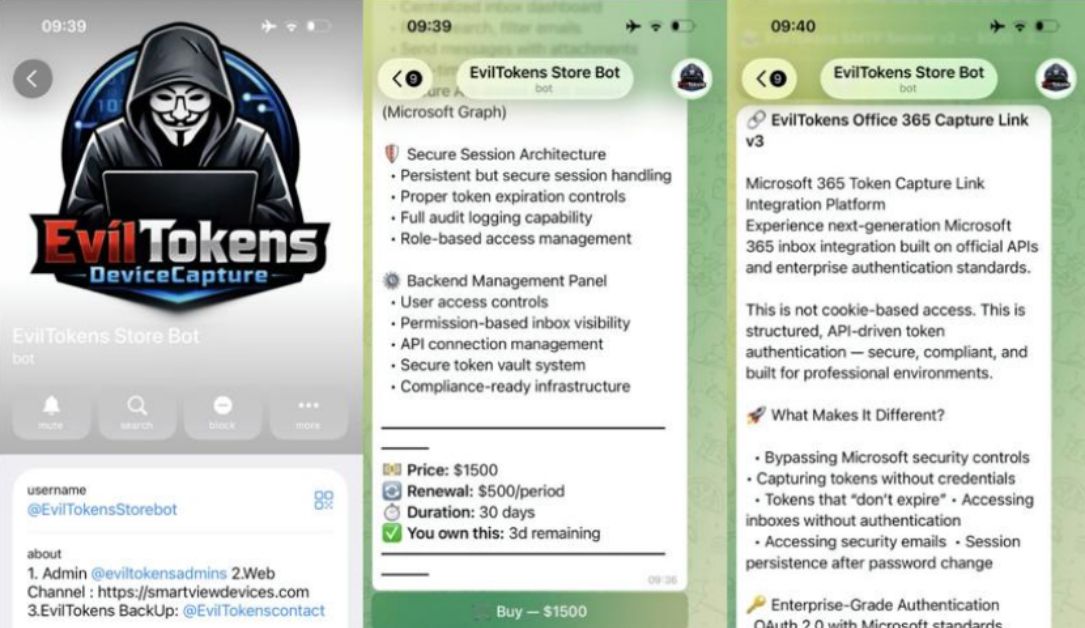
Operators sold access to the service through Telegram for a $1,500 initiation fee and a recurring $500 subscription. EvilTokens significantly lowered the barrier to entry for cybercriminals by including specialized tools for identity attacks, cloud systems, social engineering and financial fraud in a single interface.

The service allowed cybercriminals to map organizational structure and permissions in Microsoft Graph, which enabled lateral movement, researchers said. With active tokens gained through a collection of highly-targeted phishing lures, cybercriminals consistently bypassed multi-factor authentication, email gateways and endpoint security tools.

Microsoft said the platform’s creators developed portions of the platform with AI and it uncovered capabilities from multiple AI models. 

“It packaged much of the criminal process into a commercially run service, complete with subscription pricing, customer support, management dashboards and tools designed to move customers from account access toward financial exploitation,” Masada added.

The companies and organizations involved in the globally-coordinated takedown identified and notified potential victims, shared indicators of compromise and shared intelligence with law enforcement about EvilToken’s operators and some of its customers.

Experts advised organizations and employees to treat unsolicited device codes as a red flag, assume compromised accounts are fully cataloged in minutes, and independently verify requests to change payment information or redirect funds.

“The infrastructure supporting EvilTokens has been disrupted, but the model it demonstrated will not disappear with it,” Masada warned.

The post Microsoft and partners disrupt EvilTokens, a comprehensive cybercrime service for financial fraud appeared first on CyberScoop.

❌