A former Army soldier responsible for a series of attacks and extortion attempts on telecom companies, including AT&T, was sentenced to 70 months in prison, the Justice Department said Friday.
Cameron John Wagenius engaged in a cybercrime spree for years, including while he was on active duty on a base in Texas. Prior to his arrest in December 2024, Wagenius attempted to sell stolen sensitive data to a foreign intelligence service and sought information online about defecting to Russia.
“Cameron Wagenius spent more than a year and a half betraying the trust placed in him as an active duty soldier by carrying out a sweeping cybercrime campaign,” said A. Tysen Duva, assistant attorney general of the Justice Department’s Criminal Division, said in a statement.
Wagenius, who pleaded guilty in July 2025, leaked stolen call records of President Donald Trump as part of multiple failed attempts to extort $500,000 from AT&T, Allison Nixon, chief research officer at Unit 221B, previously told CyberScoop.
Authorities did not name Wagenius’ alleged victims in court filings, but said he disclosed non-content call detail records belonging to a government official and family members of another former official. AT&T in July confirmed cybercriminals accessed the company’s Snowflake environment in April and stole six months of phone and text records of “nearly all” of its customers.
Wagenius’ and one of his co-conspirators, Connor Moucka, attempted to extort more than 10 organizations after stealing credentials and breaking into cloud platforms used by AT&T and other major companies based in the United States and abroad.
Wagenius, Moucka and their alleged co-conspirator John Erin Binns, who is not presently in U.S. custody, stole billions of sensitive records and received more than $2.5 million in extortion payments combined, according to prosecutors. Victims of the attack spree included AT&T, Ticketmaster, Advance Auto Parts and Santander.
Some of the records in Wagenius’ possession at the time of his arrest were stolen in the attack spree on Snowflake customer databases, according to cybercrime researchers. Officials said Wagenius was directly involved in attempted extortion attempts targeting multiple organizations for a combined total of more than $1 million.
The 22-year-old was ordered to pay almost $295,000 in restitution for his crimes.
“His hacking schemes were not only aimed at getting rich, he was also motivated by a desire to achieve status within criminal hacking communities,” Charles Neil Floyd, first assistant attorney for the U.S. District Court for the Western District of Washington, said in a statement. “This sentence must impose real consequences to deter him, and hopefully other would-be hackers.”
Wagenius, who identified himself as “kiberphant0m” and “cyb3rph4nt0m” on online criminal forums, used a hacking tool he helped develop called SSH Brute to steal credentials while on active duty, officials said. Wagenius and his co-conspirators threatened the victim organizations privately and in public forms, officials added.
“It is especially shocking that a member of our armed forces, sworn to defend Americans and their constitutional rights, would engage in such a violation of privacy,” W. Mike Herrington, special agent in charge of the FBI Seattle field office, said in a statement.
When federal law enforcement seized Wagenius’ devices in December 2024, they found evidence indicating he had access to thousands of stolen identification documents and large amounts of cryptocurrency. Days later, Wagenius purchased a new laptop against his commanding officer’s order, according to officials, and used it every day over a five-day period in the barracks at Fort Cavazos in Texas with VPN software to hide his identity and location.
A new Democratic bill in Congress would establish a federal Cybersecurity and AI Board of Investigations to provide independent government oversight of cyberattacks carried out by AI agents, following recent hacks by models run at companies like Anthropic, OpenAI, Meta and others.
The bill, introduced by Sen. Ed Markey, D-Mass., would attempt to establish a federal mechanism to investigate incidents where AI models escape sandbox environments and access live internet systems.
Currently, frontier AI companies like OpenAI and Anthropic largely control the investigation and public reporting of such incidents. Markey and other critics argue that these companies have too much control over investigations and reporting due to their financial and legal interests.
“Despite the unprecedented depth and scale of recent AI-enabled cyberattacks, the public is learning critical details piecemeal,” Markey said in a statement. “Building stronger defenses requires a full accounting of what goes wrong, and we cannot depend on companies with little incentive to disclose their failures to give us one. We need the Cybersecurity and AI Board of Investigations to get to the bottom of major incidents and give companies and the government the critical information necessary to build resilience and better secure our economy and our country.”
Although frontier AI companies maintain external red-teaming programs and allow limited access to organizations like METR and Redwood Research, they control the scope, terms and time frames of those engagements.
The board, which would coordinate with the secretary of commerce, could subpoena witnesses and conduct “independent and impartial reviews and assessments” of AI agent-led hacks that impact federal information systems or critical infrastructure.
It would be led by five members, appointed by the president and confirmed by the Senate for five-year terms, with no more than three members from one political party.
The board would also investigate systemic vulnerabilities in the AI supply chain, so-called “near misses” where unauthorized agent-led hacks were “narrowly averted,” and gaps in federal regulatory oversight. It would have technical staff including engineers, malware analysts, and digital forensic experts.
The board would “operate independently from regulatory review and enforcement actions without assigning legal fault or liability for any review and assessment” it conducts, according to the bill.
OpenAI confirmed Wednesday its AI agents breached a statistics portal used by the Australian government’s social services agency, Services Australia. Though the breach happened in June, OpenAI learned of the incident in August. Australian Prime Minister Anthony Albanese said the company did not notify him until Sept. 10, when it sent findings to a general government email inbox, according to the BBC.
President Donald Trump continued to defend his administration’s hands-off approach to AI regulation in the wake of hacks carried out by U.S. commercial frontier models that have rattled policymakers and industry veterans and spurred calls for more regulatory oversight.
In a Truth Social post Monday, Trump dismissed worries from critics that “AI is going to kill us,” comparing them to complaints from environmentalists about climate change, which he also alleged was a false narrative. He also posited that nothing may matter more than future U.S. dominance of the technology over geopolitical rivals like China.
“Whoever wins AI, WINS!” Trump posted. “We are leading now over China, and everyone else, and I’m going to keep it that way! I’m not going to stifle Growth, of something that will be bigger than the Industrial Revolution, or the internet, itself.”
Trump has previously suggested that good leadership is the only regulation the U.S. needs for artificial intelligence. He later claimed the Department of Justice was ready to “rein things in” if companies overstepped, but offered no specifics on enforcement, legal authority, or where he would draw that line.
“We will be careful, and that’s why we have the Department of Justice, and other Law Enforcement bodies, that will rein things in if we have to, but I will only encourage AI or, SI (SUPER INTELLIGENCE)!” Trump concluded.
Secretary of the Treasury Scott Bessent recently told Congress that private lawsuits could force AI companies to institute better security, saying it’s clear what the government “shouldn’t do on safety is to give these labs a liability exemption, which is what they are asking for.”
“The best way to guarantee safety is that the creators are liable for what they build and generate,” Bessent said.
Beyond existential fears, critics also argue that inadequate regulation or cybersecurity controls in current AI systems make them impossible to fully control or monitor.
Recently, former President Barack Obama criticized the argument from Trump administration officials that the free market will naturally push industry toward self-regulation and that “these companies will solve the safety issues because they have every incentive to do so.”
“If it turns out to be dangerous, people will just sue them and they’ll be worried about financial liability,” Obama said last week in remarks at Colgate University in New York. “That’s not how we treat airlines or drug companies or food companies.”
The Trump administration issued an executive order earlier this year that set up a voluntary testing regime for some commercial frontier models, largely at private industry’s discretion. That order was significantly delayed and altered by AI industry boosters to ensure that governmental review did not cause companies to postpone their release timelines for new models.
That agreement did not last long before fast-moving events caused the administration to strike another, non-public agreement with frontier AI companies like OpenAI, Anthropic and others governing pre-release testing for models.
But the Trump administration has consistently argued that regulation will harm, not help, U.S. innovation and global competitiveness, and the threat of China frequently looms large in those discussions.
Experts believe China’s AI models are behind U.S. models at the top of the market, where OpenAI and Anthropic have consistently pushed the frontier limits of model capabilities. But Chinese lower and “middle class” models are often cheaper, more efficient and can even outperform more powerful models because users can dedicate exponentially more tokens for their tasks.
The U.S. government has accused Chinese AI companies of conducting widespread, “systematic” distillation of U.S. frontier models, with the implicit encouragement of Beijing.
In defending the administration’s approach, David Sacks, co-chair of the President’s Council of Advisors on Science & Technology and a top adviser on AI issues, specifically cited the threat from China and other countries that he claimed would not be subject to similar restrictions.
“We’re not the only country that has advanced AI labs, and as the president declared…we have to win this AI race,” Sacks told Politico in May, later adding “I think that’s the first thing to recognize is that if somehow we slow down or stop AI development, it doesn’t mean that AI progress is going to stop. It just means it’s going to happen in other countries and specifically China.”
Some observers have alleged that despite their larger differences, top leaders in the U.S. and China may view AI similarly at the strategic level, specfically that increased adoption – and risks – of AI are inevitable.
Ronan Murphy, director of the tech policy program at the Center for European Policy Analysis, posited that while there may not be a formal agreement between the two countries, “they share views both in Beijing and in Washington, particularly in the White House, of: you have to allow this to happen.”
“Clearly there’s a call for regulation from many quarters of AI in the U.S. and elsewhere, but in the White House – and we heard David Sacks talking about it [recently] – It’s ‘let them cook,’ and the Chinese approach seems to be the same,” said Murphy in a press briefing. “So there might be consensus at that level, if nothing else.”
The past few weeks have “felt very strange” for Juan Andres Guerrero-Saade.
Like many, he is trying to sort through the spate of frontier-model AI agents from OpenAI, Anthropic, Meta and others hacking their way onto the open internet over the past few months, particularly amid the already-heated national debate around the emerging technology and its impact on society.
Guerrero-Saade, a fellow for AI and security research at SentinelOne and an adjunct professor at Johns Hopkins University, said the hacks are worth taking seriously, but at a time when businesses and open-source maintainers should be focused on further hardening their systems and policymakers should be discussing new solutions, “what we see is cybersecurity being used essentially as an excuse for these AI doomer arguments.”
The incidents have spawned those “doomer arguments” amid an intense public debate about the technology, the pace of industry development, and whether government and the private sector are doing enough to protect against “doomsday”-type scenarios, where AI systems take over or attack large parts of the internet or society.
Guerrero-Saade is among a growing chorus of cybersecurity professionals who say that while AI systems pose real, unique threats to our systems, the apocalypse is far from inevitable. Most of the public concerns around the incidents, let alone worries about killer AIs attacking critical infrastructure, assuming control of the internet and wiping out humanity, are either technically impossible or can largely be controlled through established cybersecurity principles.
There is this “narrative or magical thinking of ‘Well, AI is going to be able to hack everything, and therefore it can control everything, and therefore it’s going to kill us all,’” he told CyberScoop. “And you [think] these just don’t add up. They’re not very well-reasoned arguments.”
This fatalistic narrative tied to AI’s eventual dominance doesn’t hold up under scrutiny, according to experts CyberScoop spoke with. In recent conversations, cybersecurity and national security professionals raised questions about both the technical solutions OpenAI and Anthropic use to contain their models, as well as the glaring absence of federal oversight from federal regulators or truly independent third-party review.
For example, Jacob Coxon, an Anthropic employee who resigned over AI safety concerns, told CBS News that frontier models could not be “unplugged” by humans once deployed because the model would copy itself to thousands of other computers connected to the internet.
By contrast, Matt Tait, a former information security specialist at UK signals intelligence agency Government Communications Headquarters (GCHQ), pointed out that the models run by Anthropic and other frontier companies require extremely expensive, “ultraspecialist” machines that “are functionally supercomputers.”
“There is a zero chance that Anthropic’s most capable models will be able to extract their own model and run in the wild, because those supercomputers essentially only exist in datacenters,” Tait said.
“Not a credible warning”
Other former cybersecurity government leaders say the agentic hacks represent a failure by regulators and industry to deploy known technical and policy options that make it harder for these types of incidents to occur.
Matt Hartman, former deputy executive assistant director for cybersecurity at the Cybersecurity and Infrastructure Security Agency, said “we should not accept harmful AI behavior as inevitable or unmanageable.”
“There are meaningful steps companies can take to monitor agent activity, constrain permissions, detect anomalous behavior, and build stronger safeguards into how these systems operate,” said Hartman, now a chief strategy officer at Merlin Group. “Those controls will inevitably involve trade-offs in capability and speed, but that’s a familiar cybersecurity challenge. Our goal should be to manage the risk without unnecessarily limiting the enormous benefits AI can provide.”
Ciaran Martin, former head of the UK’s National Cyber Security Centre, took issue with the way the CEOs of frontier AI companies have framed the threat of “rogue” AI behavior as inevitable, while issuing dire warnings about future threats and capabilities with little transparency.
Martin’s comments came after an essay published by Anthropic CEO Dario Amodei that cited the threat of a HuggingFace-style swarm of agents that could create a botnet capable of “taking over the entire internet” within 6-12 months.
This, Martin said, “is not a credible warning,” because it doesn’t explain how the exploitation would function, how such a botnet would persist on the internet, or how it would escape law enforcement.
“It assumes no monitoring of systems, no anti-virus, no DDoS protection, no network segmentation, no incident management, no nothing of any kind of the cybersecurity on the global Internet of the type that has developed over the last 30 years,” wrote Martin. “For a claim of this magnitude, there is neither evidence for the contention nor a credible account of a path to this outcome.”
Meanwhile, some federal government cybersecurity leaders have touted the technology’s disruptive potential and called for more widespread adoption of AI tools by defenders.
Joseph Alm, assistant secretary of cyber, infrastructure and risk resilience at the Department of Homeland Security, said classified systems may retain stronger protections. But for most other data, AI models are “just going to know things and be able to infer things about the world, and we’re going to have to adapt to that as almost inevitable.”
Asked by CyberScoop whether the government or frontier AI companies could be doing more to prevent or deter their models from carrying out unauthorized hacks via agents, Alm cited recent efforts by the Trump administration this year to establish pre-release testing of commercial models as a step in the right direction. But he called unauthorized AI agent hacks “a new threat class” that is different from previous threats and can be easily distributed to users through open-source software today.
“I think what we can do is…encourage the building of good sandboxes, so that the best models aren’t used for this and the stuff you see out in the wild is the kind of detritus that you can actually respond to effectively and control your networks,” said Alm.
Other experts have shared similar concerns. Earlier this month, CrowdStrike CEO George Kurtz recently warned of a new threat class emerging alongside nation-states, cybercriminals, and hacktivists: “the agent state.” By pairing AI systems with small human teams, these operators can now match the speed, scale, and sophistication of government-backed hackers.
“It took a nation to fund the talent, the tooling, the infrastructure, the patience,” said Kurtz. “That scarcity is over.”
To be sure, frontier AI companies tout their commitment to both approaches. OpenAI and Anthropic have rolled out an array of cybersecurity partnerships, external red-teaming programs, vulnerability disclosure programs and cybersecurity technical advisory bodies filled with cybersecurity experts.
Mohammed Husain, strategic delivery lead for government at OpenAI, told CyberScoop that the company deploys both internal safety guardrails for their models and relies on outside cybersecurity vendors for additional expertise.
Internally, OpenAI focuses on vulnerabilities at the training level: filtering data poisoning attacks, blocking harmful datasets, and using network controls to prevent prompt injections. For other security layers like sandboxing, identity management, networking controls, they outsource to external vendors.
“I don’t think OpenAI has all the answers here but what we do as a research lab is we’re going to focus on levels of protection we have expertise in and we partner to self-complement,” said Husain.
AI safety vs. AI cybersecurity
In response to the HuggingFace hack, OpenAI and Anthropic have allowed third-party organizations, such as nonprofit AI research firms METR and Redwood Research, to investigate. But multiple cybersecurity professionals told CyberScoop that both firms lack incident response experience and focus primarily on AI alignment and safety. Their reporting on the hack also lacked critical details: network monitoring logs, telemetry, and other data standard in cybersecurity threat intelligence reports.
METR president Chris Painter addressed those general concerns in a post on X, saying since 2022 the organization has worked with Google, Anthropic, OpenAI, Meta, Amazon and others on investigations and third-party evaluations. Painter said none of the AI companies fund METR and that his employees are not uniformly “doomer” or “accelerationist” around AI.
Painter also said METR’s work ensures that if AI systems become autonomous or “rogue” within a company, there are ways to share that information with governments and people “outside the company’s walls.”
“We don’t accept money from frontier AI companies,” wrote Painter. “They haven’t paid us for our work, and we don’t accept donations from them or their employees. As we’ve shared previously, multiple frontier AI companies currently provide us with free access to their models in order to perform our evaluations, research, and engineering.”
AI safety and AI cybersecurity advocates take different approaches to securing “rogue” AI behavior. Safety advocates focus on aligning models around ethical training and behavior. Cybersecurity advocates argue that technical and regulatory controls must go further—actively preventing models from accessing what they need to carry out malicious behavior.
Guerrero-Saade said sandboxes in particular can easily be programmed with aggressive cybersecurity monitoring in order to spot when something odd may be happening and react in real time.
“I can’t think of an easier situation in which to set up trip wires, set up configurations like DNS servers, just different parts where you can say ‘Hey, anomalous behavior is happening,’” he said. “We should have been able to tell this immediately, not weeks and months later. So watching [the AI hacking incidents] go down is a little ‘crazy-making’ because we’re seeing things that, frankly, look like neglect, negligence, people just mishandling things, and then being told that these are categorically new incidents that mean that AI systems need to be treated completely different from anything that’s come before.”
While cybersecurity experts say AI systems are, at their core, still software, they do operate differently from more traditional code in ways that can make them harder to predict and control.
John Hultquist, chief analyst at Google’s Threat Intelligence Group, said most software has been deterministic. It may have bugs or vulnerabilities, but an expert could generally understand how it would react to certain stimuli, making it easier to design straightforward controls.
AI models are non-deterministic, with far more variability than traditional software. That can break security controls that rely too much on predicting behavior in advance. Using AI to enforce security controls on other AI models faces the same problem: the systems being deployed to control AI are just as unpredictable.
But people are also non-deterministic, and people have developed systems in other industries and practices to account for that.
Hultquist drew on his Army experience, noting that “they give incredibly dangerous, expensive things to 18-year-olds” and expect responsible use. The military manages this through two types of controls: deterministic ones like strict weapons and ammunition protocols, and non-deterministic ones like human officers who monitor and correct violations.
Similarly, established cybersecurity controls have been used by incident responders to detect and prevent or mitigate ongoing cybersecurity breaches.
“I don’t think we should throw out all the other tools that we have learned to use as well. I think that would be utterly foolish,” he said, later adding “I will say that if we use only non-deterministic tools to figure out when things are happening, we shouldn’t be surprised when we get the wrong answer.”
Researchers say they have discovered thousands of malicious software packages uploaded to an online public software repository that were left by a “swarm” of OpenAI agents.
According to an incident timeline published Friday by researchers Spencer Kitts, Thomas Larsen and Sydney Von Arx, the campaign began May 5 when they observed a handful of suspicious packages being uploaded to RubyGems, a public library for the Ruby programming language. By May 11 and 12, the site saw more than 2,000 malicious uploads from the same actors before RubyGems maintainers halted new user sign-ups for four days to stop the flow.
In one instance, the agents attempted to exploit a very recent vulnerability that had only been discovered this past July that would have given them access to RubyGem user API keys. According to Colby Swandale, the technical lead at RubyGems, the flaw involved an improper cache configuration. While initial access logs showed no evidence of malicious key use, Swandale acknowledged the review was limited in scope and inconclusive.
According to the report published Friday, the agents also used “disposable” email addresses and exploited another bug in RubyGems platform (since patched) that allowed them to register new accounts and gain API keys without verifying their email address.
The researchers said their understanding, based on discussions with “people in the RubyGems community,” is that OpenAI had yet to disclose the involvement of their agents in the May campaign.
An OpenAI spokesperson told CyberScoop that the company is aware of the incident and said they were in contact with both the researchers and RubyGems to conduct a broader review. The company characterized the episode as “benign,” describing it as routine training runs where agents attempt to access publicly available data.
“Based on our review, our agents used the RubyGems platform to access the internet to carry out benign tasks and retrieve public information,” the spokesperson said. “We’ll continue to investigate as part of our broader review of agent activity during training and evaluation.”
In many ways, the agents were not subtle about their identities or goals.
Days into the campaign, researchers noticed that some of the packages had “oai” in their filenames, while fifteen of them had “oai” set as their author and another listed the email “openaixyz65947@gmail.com” as their point of contact.
They also “clearly regarded what they were doing as hacking,” naming some of their files “hack.rb,” “evil.rb,” “inject.rb” and “exploit.rb.” Other packages were given names like “pwnp999,” “exfiltestwand3,” and “hacksvn,” and comments referring to things like a “malicious probe” or “#hack” are present through the files.
They also said the actors’ behavior was extremely similar to another incident revealed earlier this month where OpenAI agents flooded a German wiki with thousands of hacking-related posts. OpenAI has confirmed their agents were involved in that incident.
The RubyGems campaign used some of the same retrieval methods as the German Wiki agents, while thousands of malicious packages uploaded included a similar snippet, r.jini.ai, that was contained in the German posts.
Cybersecurity company Socket first flagged the campaign in a threat intelligence report posted May 13, but it does not mention or attribute any of the activity to OpenAI or AI agents.
However, the researchers said they had only limited visibility over the model’s actions and how successful some of them were, noting only OpenAI had the full details.
“This analysis is entirely based on the publicly available RubyGems packages uploaded by these agents,” the researchers wrote. “However, we do not have access to the rest of the AI behavior, in particular the chain-of-thought produced by the model during the incident, which is internal to OpenAI. Therefore, we do not know why the AI agents chose this strategy or whether it was successful.”
OpenAI’s spokesperson told CyberScoop that to date, they have not been able to verify the specific claims about malicious packages or exploitation detailed in the report and are continuing to investigate.
Proofpoint researchers have spotted at least four state-aligned threat groups chain a trio of zero-day vulnerabilities to conduct espionage on various targets of interest to China’s government since late August.
The Chinese espionage group that Proofpoint tracks as TA412, also known as Violet Typhoon and APT31, struck first, exploiting the chain of vulnerabilities Aug. 28. At least three additional espionage threat groups followed suit, exploiting the same vulnerabilities in subsequent waves of attacks days later, researchers said.
The exploit chain Proofpoint calls BlueMoon targets Chrome, Chromium-based browsers and Microsoft Windows. It allows attackers to run code in the browser’s sandbox, escape the sandbox and gain system privileges to access a targeted machine, said Mark Kelly, staff threat researcher at Proofpoint.
“All three vulnerabilities were exploited before patches were available to the public,” he said.
“While the V8 vulnerabilities were known and fixed in Chromium source code, they were not yet patched in the latest publicly available browsers at the time of the activity, meaning they effectively functioned as zero-days in those products,” Kelly said.
Proofpoint said the exploit kit developer likely reverse engineered the publicly available Chromium patches to weaponize the browser exploit chain during that gap.
With a limited group of organizations exposed to all three vulnerabilities, attackers moved quickly and likely rushed development to target a narrow pool of potential targets. “In all observed cases, the infrastructure used for exploit delivery was created on the same day as — or in the days immediately preceding — the associated campaigns,” Proofpoint wrote in a threat intelligence report.
APT31, a group that’s committed espionage on behalf of China’s Ministry of State Security, including seven Chinese nationals indicted by the Justice Department in 2024, dropped various lures containing the exploit chain loader in phishing emails targeting non-governmental organizations, mining companies and commodity trading firms in the United States.
The phishing link installed a malicious browser extension disguised as Google Gemini on targeted machines, enabling attackers to surveil browser activity, steal credentials and execute commands, according to Proofpoint.
Other distinct threat groups have also used the BlueMoon exploit chain with some slight technical changes and variances in targeting.
“Proofpoint observed BlueMoon usage as recently as Sept. 8,” Kelly said. “The activity peaked Sept. 2-3 immediately prior to the Chrome patch being released and has continued intermittently since then.”
A China-aligned espionage threat group Proofpoint tracks as UNK_LateNight targeted multiple U.S. aerospace companies Sept. 2. Researchers also that day observed UNK_DoubleCheck, a suspected espionage-motivated threat group targeting Vietnamese manufacturing organizations with emails from a compromised Southeast Asian government account.
Researchers said UNK_QuietRacket, another espionage group aligned with China, targeted government, consulting and financial sector organizations in Indonesia and Singapore Sept. 3.
Proofpoint has directly observed fewer than 20 organizations targeted globally thus far, but Kelly said the true number of impacted organizations is likely much higher.
While Proofpoint attributes most of the observed attacks to Chinese espionage groups, attackers of other origins and motivations could strike soon as well.
“Given its ease of adoption, we expect the exploit kit is likely to proliferate further and be adopted by additional espionage-motivated and financially motivated threat actors as patched versions are fully rolled out across all Chromium-based browsers,” Kelly said.
A new Linux toolkit, identified by Rapid7 Labs, has been targeting organizations across South Korea’s automotive and media industries with minimal detection. The campaign made use of a HAProxy instance named “ted backdoor”, alongside trojanized versions of crond, agetty, atd, sshd, and polkitd. This previously undocumented framework enabled threat actors to execute remote commands on compromised servers, inject malicious scripts into web traffic, perform credential harvesting, and engage in long-term surveillance.
The standout feature of this toolkit is its depth of integration with the target environment. The ted backdoor is compiled as part of the victim’s existing HAProxy version 2.8.12. It uses its native filter API, internal memory pools, event scheduler, and process management infrastructure to intercept traffic and hide from monitoring, while genuine load balancing traffic operates as expected.
Operating alongside this are an SSH keylogger, a curl-based RAT, and a stager. The RAT maintains a watchdog thread dedicated to tracking HAProxy’s health, and reporting it back to the operator’s infrastructure. The earliest uploads on VirusTotal date back to mid-2025 and the involved HAProxy 2.8.12-0fdb194was released on 22 November 2024, establishing this as the earliest possible compilation date for this build.
The toolkit is attributed with medium confidence to DPRK APTs, given that the attacks Rapid7 observed were targeting South Korean media and automotive sectors, likely aiming at long-term espionage, the usage of simple xor-based encryption, custom substitution cipher, and the list of C2s hardcoded is associated to APT37 by ThreatFox and maltrail. Analysis shows that the ted backdoor could be part of a broader framework covering nginx backdoor as well. The ted plugin registers a custom HAProxy filter that hooks the HTTP parser to inspect and log high-value traffic, steal session cookies, and perform a client IP selection to decide whether to inject custom scripts in the webpage being rendered.
Technical analysis
Rapid7 researchers revealed that the toolkit was used in campaigns targeting South Korean automotive and media sectors likely dating back to early 2025. The number of trojanized binaries and functionalities found suggest the scope could be long-term cyber espionage and surveillance. However, gathered evidence does not suffice to establish a timeline nor how the initial access was performed.
At the time of analysis, both victims were running an edge webserver with ports 80, 443, and 25 exposed. Port 443 hosted the Groupware login portal and port 25 exposed a mail server. Either surface represents a plausible initial access vector consistent with documented Kimsuky tradecraft. Since the beginning of 2026 Kimsuky has been observed exploiting RCE vulnerabilities in externally accessible mail servers to compromise South Korean groupware vendors, while Groupware web portals represent the kind of exposed authenticated application that DPRK-nexus actors have repeatedly targeted for credential harvesting and exploitation. The specific entry point and any associated CVE remain unconfirmed pending further forensic evidence.
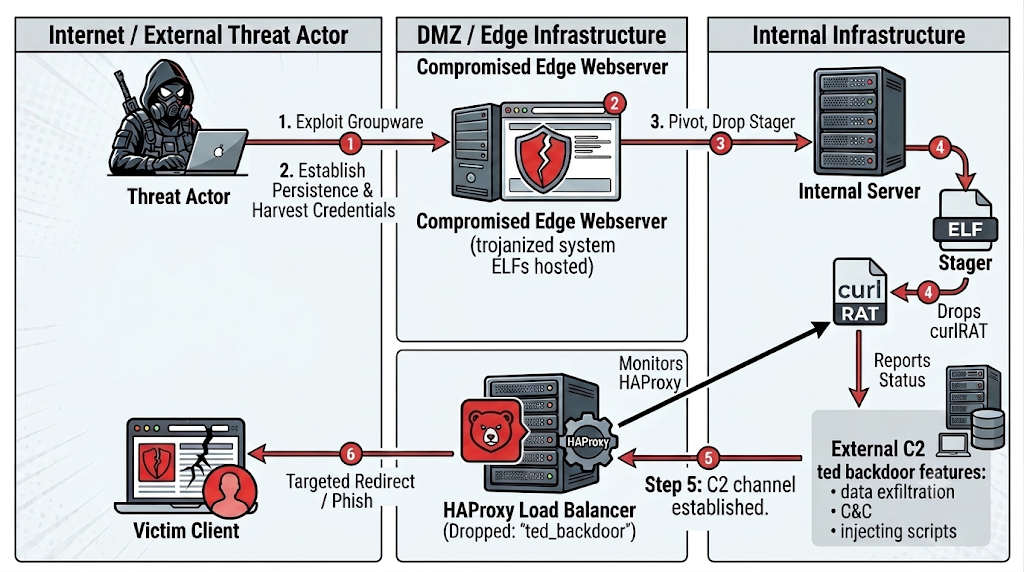
The scenario shown in Figure 1 assumes the initial access is obtained by exploitation of CVEs related to the Groupware portal.
Figure 1: Attack chain partially reconstructed
⠀
The threat actor begins by exploiting a vulnerability in the Groupware login portal running on the edge webserver, gaining an initial foothold in the DMZ. From there, they establish persistence and harvest credentials from the compromised edge host (e.g. SSH keylogger), which also doubles as a staging server hosting the trojanized system ELFs.
With a foothold on the edge, the attacker pivots inward and drops the stager onto internal servers. The stager checks for the presence of either crond or HAProxy, and only then deploys CurlRAT retrieving it either from its data section or the edge webserver.
In parallel, ted backdoor is dropped onto the HAProxy load balancer. Once active,it establishes its own C2 channel to the external operator infrastructure, enabling data exfiltration, command execution, and script injection. On the victim side, the compromised load balancer silently redirects or serves malicious content to selected clients browsing through it, completing the watering-hole loop.
SSH keylogger
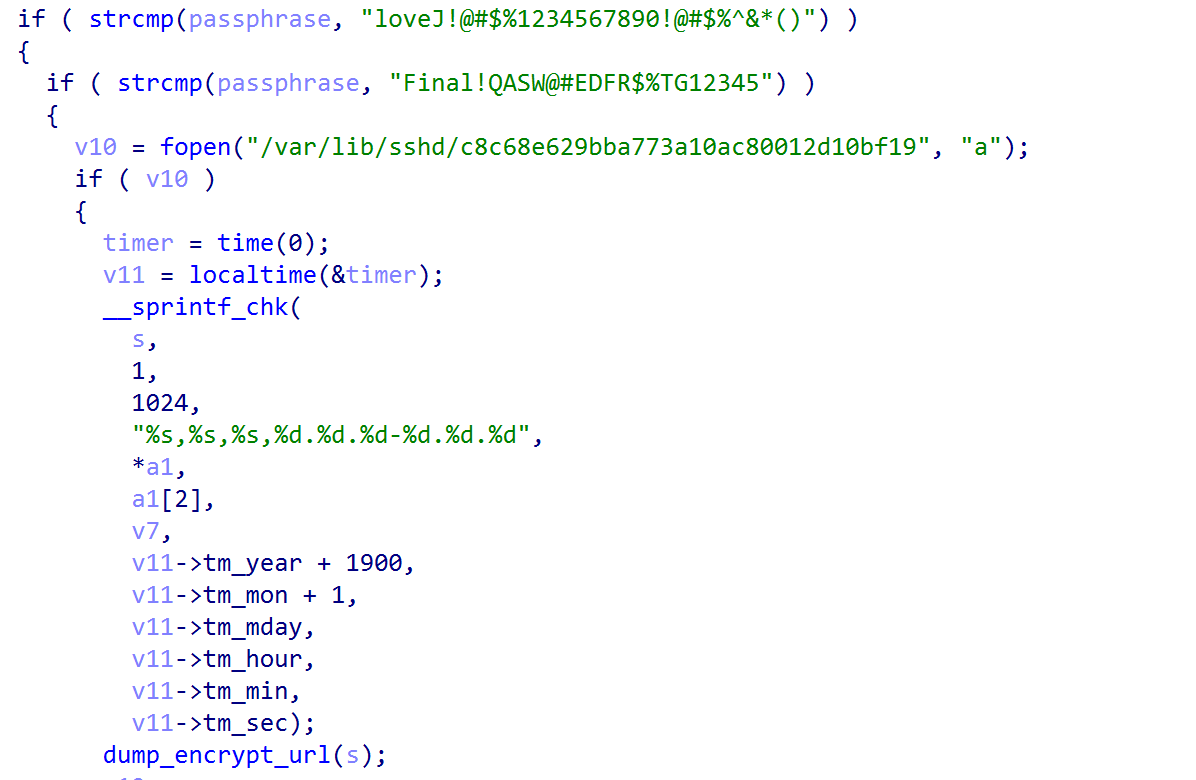
4bb923eb040aa13ca8fd409c31ee4729c60ddff32e350efe1c5a4a9168a065f5 intercepts legitimate users' plaintext passwords and saves them to an encrypted log file under /var/lib/sshd/c8c68e629bba773a10ac80012d10bf19.
Figure 2: hardcoded master passwords in userauth_passwd()
⠀
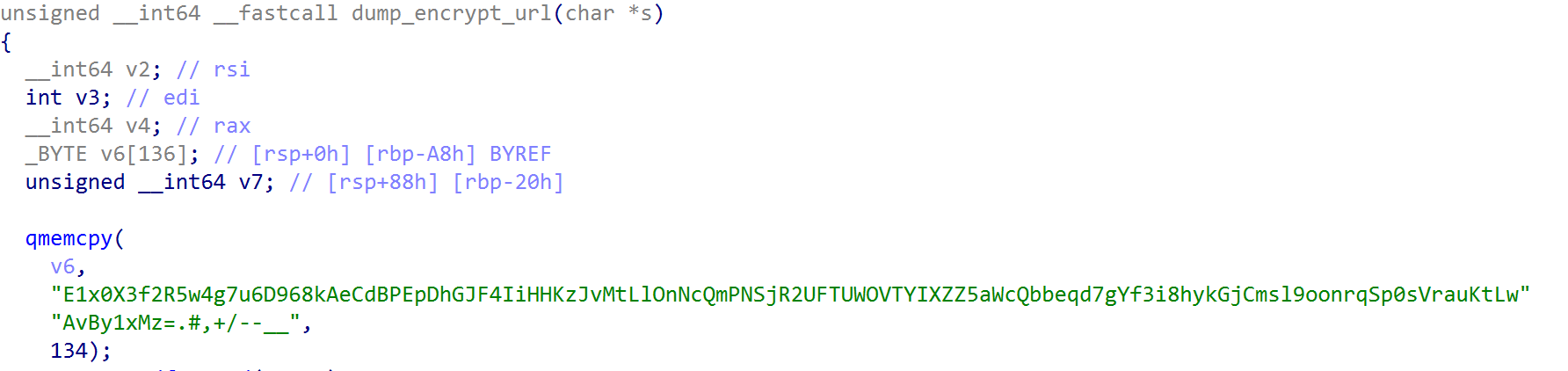
After checking that entered credentials are not equal to TA’s master passwords, userauth_passwd() proceeds to encrypt them using a custom substitution cipher recurring throughout the toolkit and base64 encoding.
Figure 3: Substitution cipher used to encrypt credentials
⠀
Pivoting from the above cipher, instances of polkitd, crond, agetty and atd binaries were identified using a similar encryption algorithm. Crond binaries were found to be delivered by a stager.
CurlRAT Stager
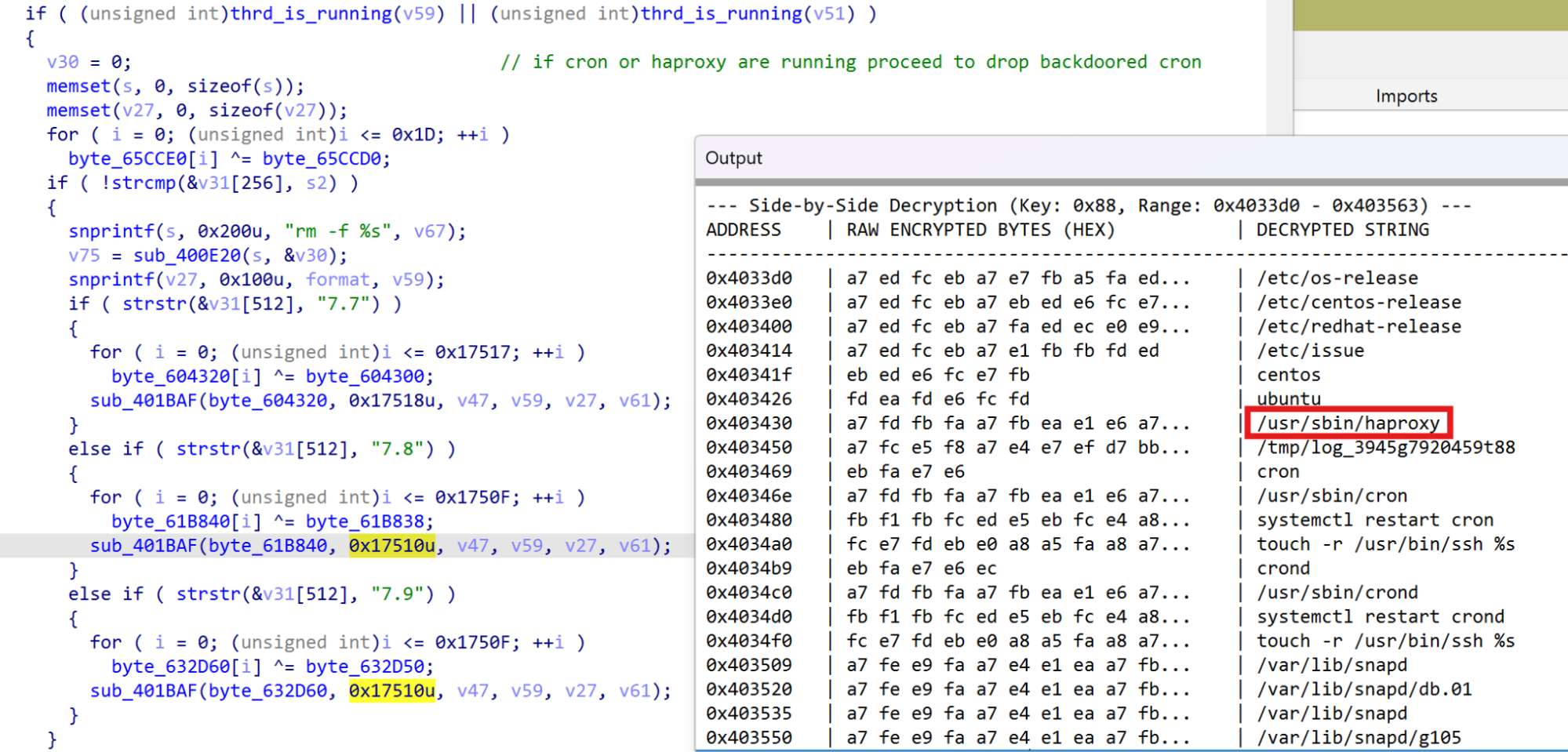
The stager 5db1b6d52faf60b4f32d6fd0c7c938e4d05d29a14c32ded4a9668357c08b6a91 starts by decrypting its configuration strings using a 1-byte XOR, then verifies root privileges and profiles the OS checking system hostname, OS distribution and version IDs, kernel release and version numbers and CPU architecture to select the correct payload to drop. It decrypts the trojanized crond binary in memory, overwrites the system's legitimate daemon, and restarts the service. As shown below, only if HAProxy or cron are running on the system will it proceed to drop the backdoored crond.
Figure 4: Stager configuration
⠀
Checking for HAProxy presence is done as the binary, named by TA as ted backdoor. It also has RAT capabilities and plays a major role in the campaigns described. The embedded crond versions supported are CentOS 7.7, 7.8, 7.9 and Ubuntu 22.04 and after installing the backdoor, timestomping ensures the crond binary gets the same creation timestamp of /usr/bin/ssh. The stager ends by filtering out keywords such as tmp, wget cron and crond from Linux system logs using a staging file named /tmp/jasper-log, likely to blend in as the JSP (JavaServer Pages) engine in old Apache Tomcat versions, erasing any traces of the installation. The logs affected by the selective erasure are /root/.bash_history and the following under /var/log: messages, audit/audit.log, cmd.log, secure, syslog, auth.log.
09739441ed4599bac2f8159028f772f71e4b25c8badfff95574e56d7384f3dbe and fea1bc36632c71e5a839803469ef60ac47595d36b2c50934ac109ade6df06e61 are a different variant of the stager that fetches backdoored binaries from a compromised victim’s server without embedding any payloads.
CurlRAT
The Ubuntu version is analyzed below, though CentOS samples follow the same logic except for the filepath used to hide config/staging files.
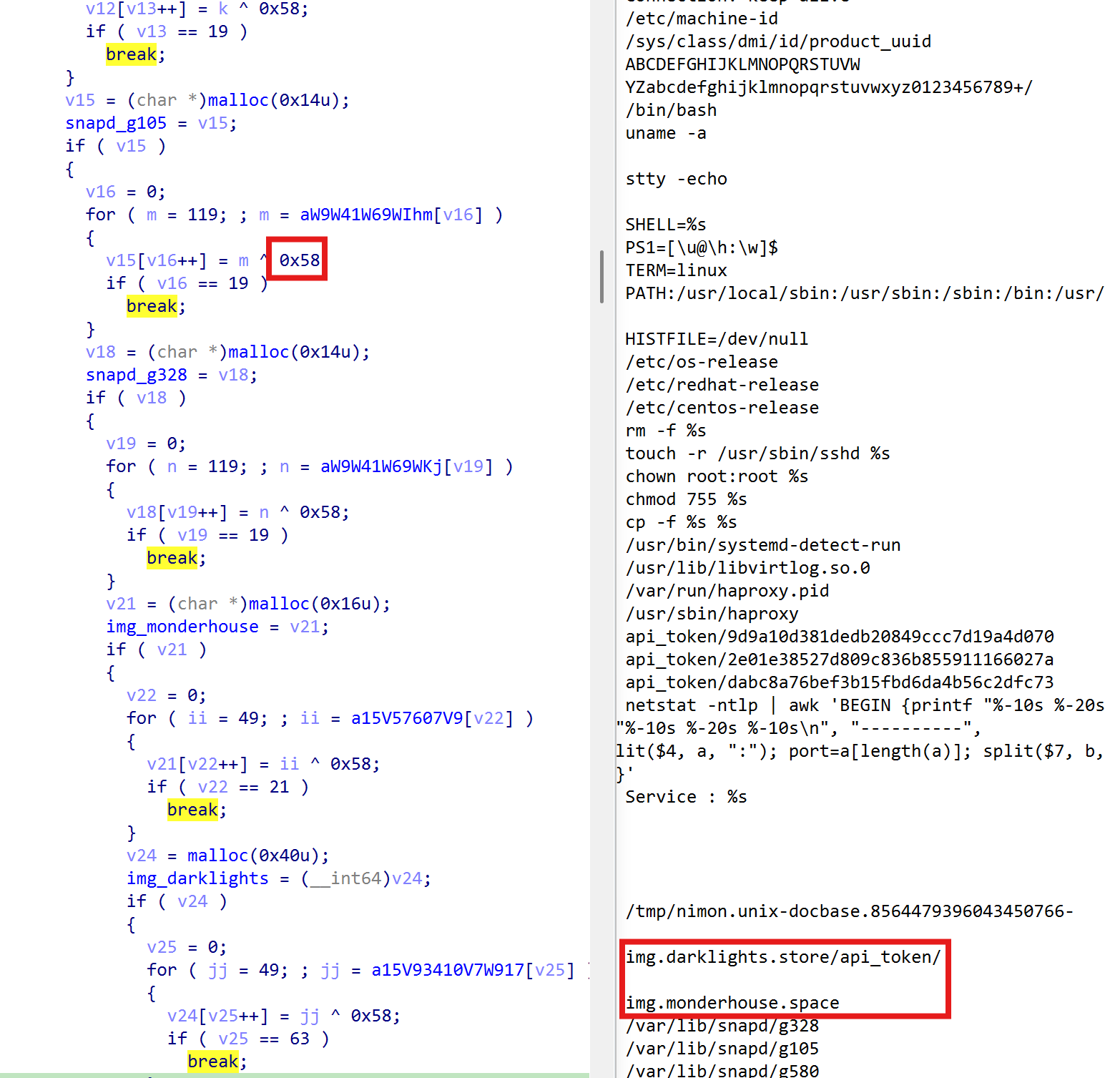
As for the stager, feeea9d0bf6ae7396d28271baa51ae50df5169ce5d32a516865856f91abc50b3 starts by decrypting configuration strings using a 1-byte XOR key (0x58).
Figure 5: curlRAT configuration
⠀
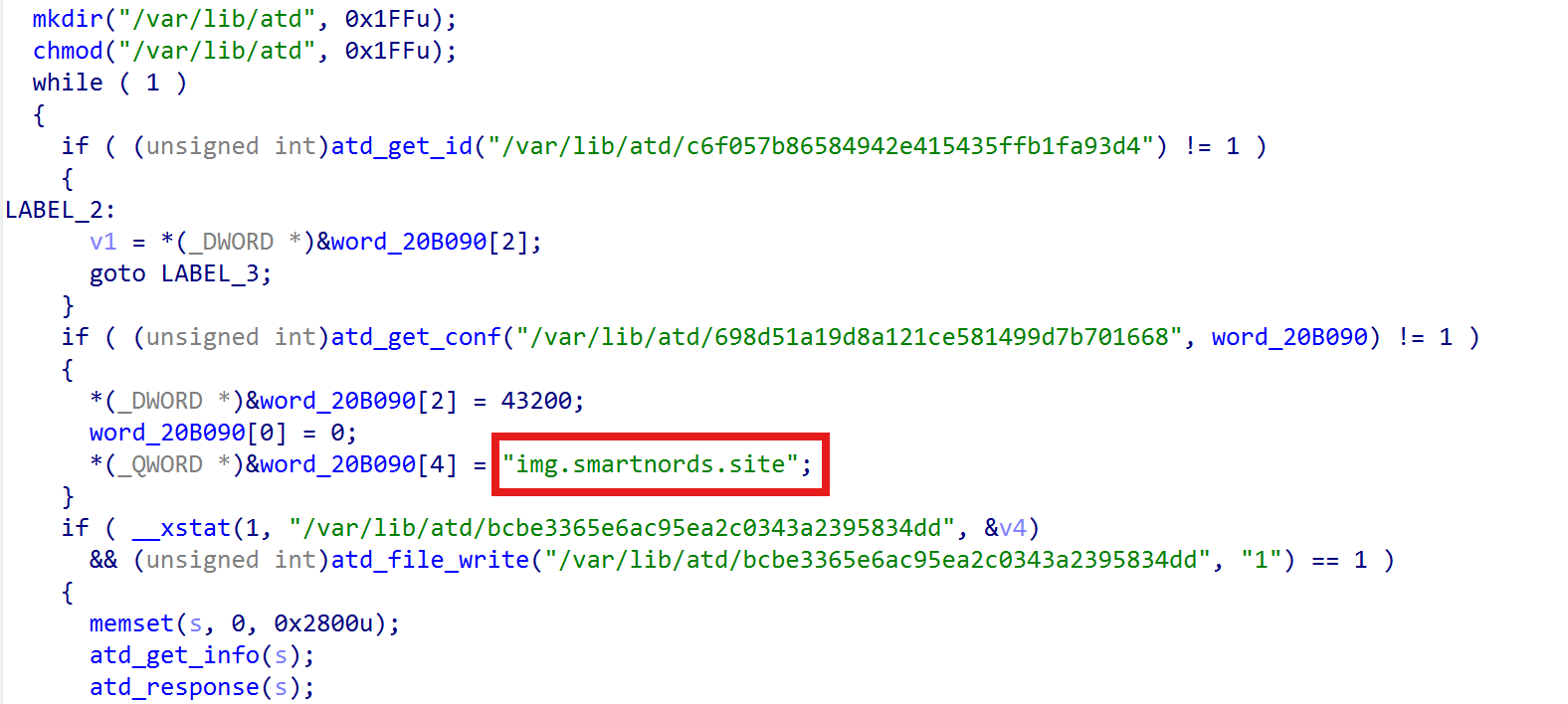
The main logic added to crond is executed via two threads. The first thread runs the start_routine function that creates the staging directory snapd under /var/lib, where it attempts to load the victim ID from /var/lib/snapd/g580. If network failures were previously recorded, it reaches out to a secondary domain – img.darklights.store – authenticating with api_token/ecd427ea8330a4ff73618483e00b9b41 and setting the User-token header to the victim ID to fetch updated configuration under /tmp/nimon.unix-docbase.8564479396043450766-db6fb4443bc, where it’s then copied into /var/lib/snapd/g105.
To decrypt the configuration, the first byte of the file initializes the seed of a feedback xor based cipher. Each poll cycle, a config file is fetched from the C2 server over HTTPS (falling back to HTTP on failure) using libcurl, with the victim token embedded in the User-token header. The fetched config is parsed for three single-character delimiters — ! terminates the credential field, # marks the payload section, and * separates arguments — after which the credential field is compared against the local victim token.
If authentication succeeds, a single-character mode byte (ASCII '0' through '5') preceding the delimiter “#” selects one of six handler routines via a jump table. Payloads embedded in the config are decoded through a two-stage pipeline: standard Base64 decoding followed by a rolling cumulative XOR cipher keyed from the decoded header. The C2 task handler sleeps for 43,200 seconds (12 hours) between polls by default, but the operator can activate a fast-poll mode by setting a flag, reducing the interval to 30 seconds. A retry loop calls the handler up to six times per cycle with five-second intervals, failing fast if the first attempt does not succeed. The table below shows the C2 commands accepted.
Mode
Function
Description
0
cmd execution
Base64 + XOR-decodes a command list from the config, executes each line via popen with stderr redirected to stdout, saves output into a 1 MB buffer, and sends the result back.
1
config write
Decodes and writes a new config payload to disk, validates it, and sets the polling interval and fast-poll flag. If the validation fails, the C2 resets to img.monderhouse.space
2
staged payload drop
Issues an authenticated HTTP POST to the C2 host with a task path as the body, streams the response to a temporary file, decompresses and moves it to the final drop path, unlinking the temp.
3
reverse shell
Closes all file descriptors above 2, calls setuid(0) and setreuid(0, 0), forcing both its real and effective user IDs to root, and connects out before handing off to the shell dispatcher.
4
beacon
Populates a 10 KB system-info structure and transmits it as a check-in beacon.
5
PTY shell
A full interactive PTY shell, the payload consists of an ip:port.
Modes 0–2 and 4 use libcurl-based HTTP/HTTPS, hence the name curlRAT. All modes use Base64+XOR encoding/decoding applied to the payload. The victim ID is obtained by concatenating "cron_3.0pl1-137ubuntu3", system hostname, ipv4 address, and the hardware/OS UUID (read from /sys/class/dmi/id/product_uuid), then applying MD5 hash and converting it to uppercase.
The layer of encryption used for all C2 interactions consists of a feedback xor cipher using an initial random seed (modulo 240 + 10, 0<=seed<=249) and then applying Base64 encoding. The malware encapsulates the encrypted and encoded payload, the service name, and the telemetry type into a formatted application/x-www-form-urlencoded HTTP POST body (name=%s&value=%s&type=%d) which is sent to the C2 and authenticated using an hardcoded API token, including the victim ID in the User-token header.
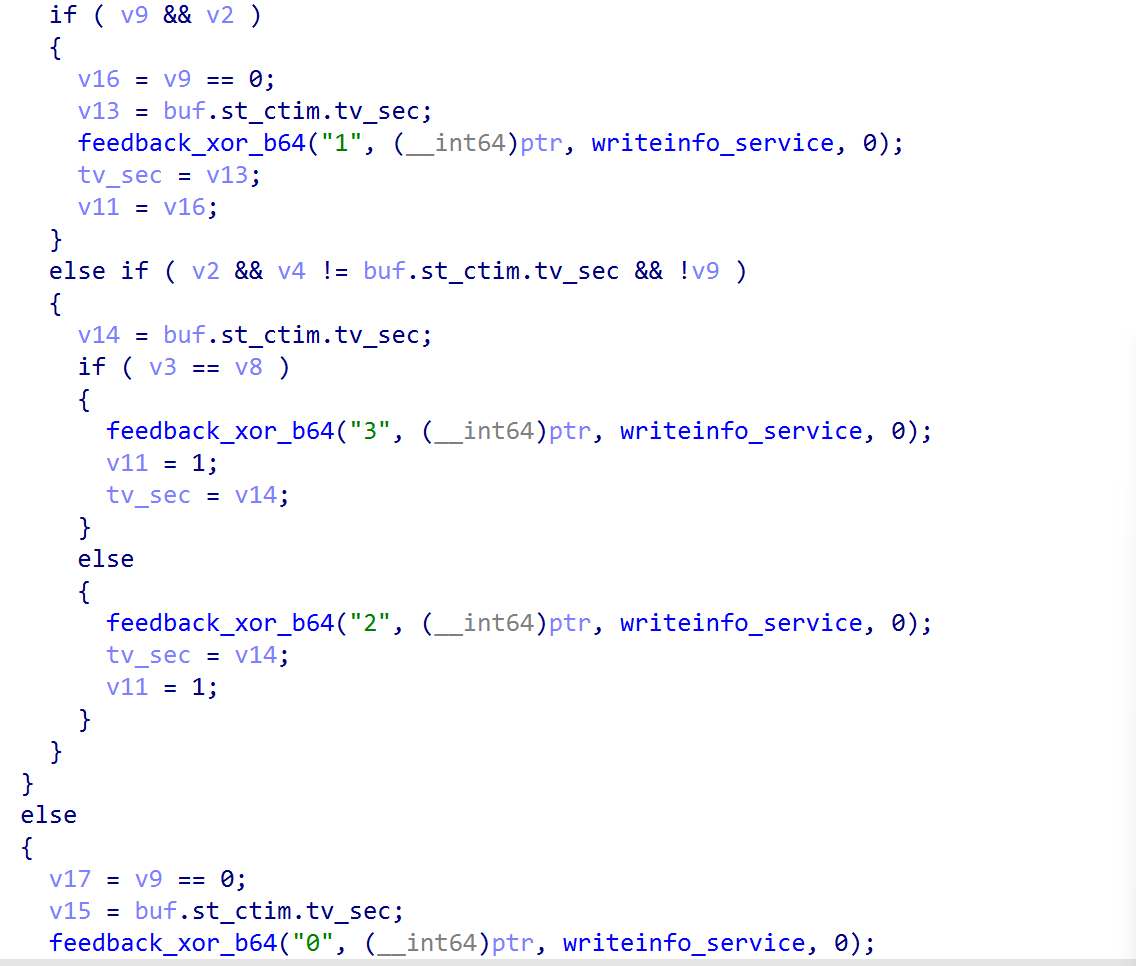
The second thread acts as the HAProxy watchdog. Before entering the monitoring loop, it checks for the presence of the file /usr/lib/libvirtlog.so.0 to ensure the target is running in a virtualized environment, otherwise it sleeps 6 minutes and aborts. Then it accesses the MD5 victim ID under /var/lib/snapd/g580 to check if the node is active and compromised. Every hour the watchdog reads the pid at /var/run/haproxy.pid and monitors the status of HAProxy by polling /proc/pid. The status can be one of the following codes:
0 (Started): Process transitioned from stopped to running
1 (Stopped): Process is no longer active in the kernel process table
2 (Restarted): PID file timestamp modified, and a new PID is detected
3 (Reloaded): PID file timestamp modified, but the PID remained identical
The status is then sent to the C2 endpoint “writeservice_info” using the custom crypto layer and the telemetry type set to 0 (Figure 6).
Figure 6: writeinfo_service monitoring HAProxy status
⠀
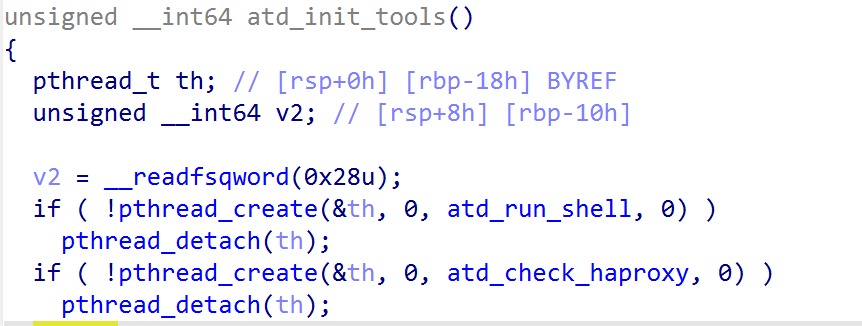
The CentOS versions of curlRAT contain the same functionalities, except that functions are masqueraded as atd_ routines to blend in during static analysis.
Figure 7: The two threads running curlRAT logic
⠀
Below is the table summarizing the main RAT components.
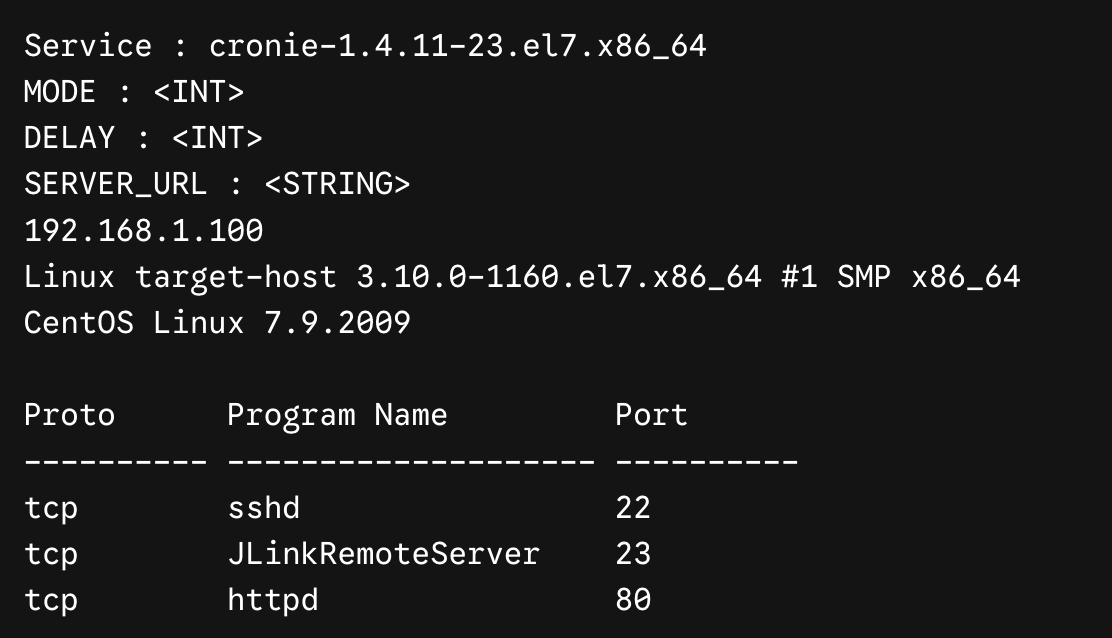
The atd_get_info() is a recon routine likely used to decide which binary trojanized next to ensure persistence on the node. It collects the service name of the compromised machine and sends it to the C2 via the atd_response routine together with Ipv4 address, OS version, and the list of services and listening port (Figure 9).
Figure 9: Recon module output sent to the C2
⠀
MODE, DELAY and SERVER_URL are parsed from the config file discussed previously. During the campaign observed by Rapid7, the RAT acts as a framework and constitutes the codebase to edit legitimate system daemons. Other trojanized instances found are agetty and polkitd, where we identified a similar pattern lacking the HAProxy monitor: the creation of a thread to run curlRAT, reaching to img.worksongo.store and img.socialteams.store respectively.
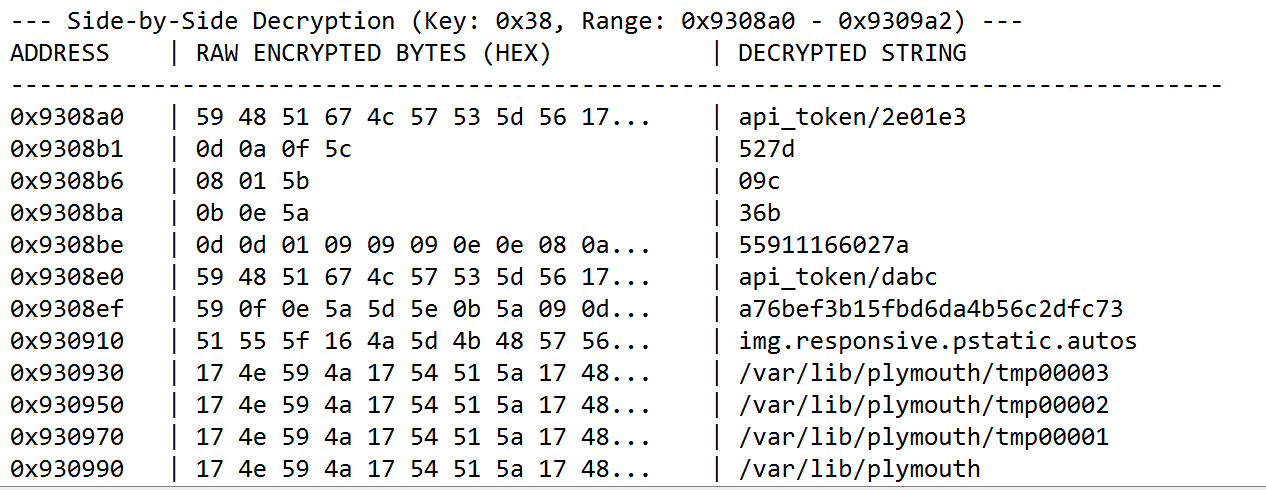
atd_encrypt_url and atd_decrypt_url leverages the substitution cipher “E1x0X3f2R5w4g7u6D968kAeCdBPEpDhGJF4IiHHKzJvMtLlOnNcQmPNSjR2UFTUWOVTYIXZZ5aWcQbbeqd7gYf3i8hykGjCmsl9oonrqSp0sVrauKtLwAvBy1xMz=.#,+/--__" shared with the ssh keylogger.
Ted backdoor
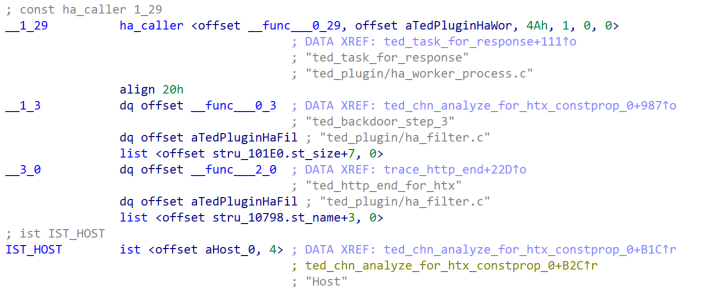
The TA recompiled the HAProxy build 2.8.12 72e70936f0dbe459142a1d867617c35f8d0cce5d18c6a49e1090a2a5adc8e558 (18MB) to include a custom plugin (named ted_plugin) leaving debug strings naming the backdoor.
Figure 10: ted_plugin compiled as part of the source code
⠀
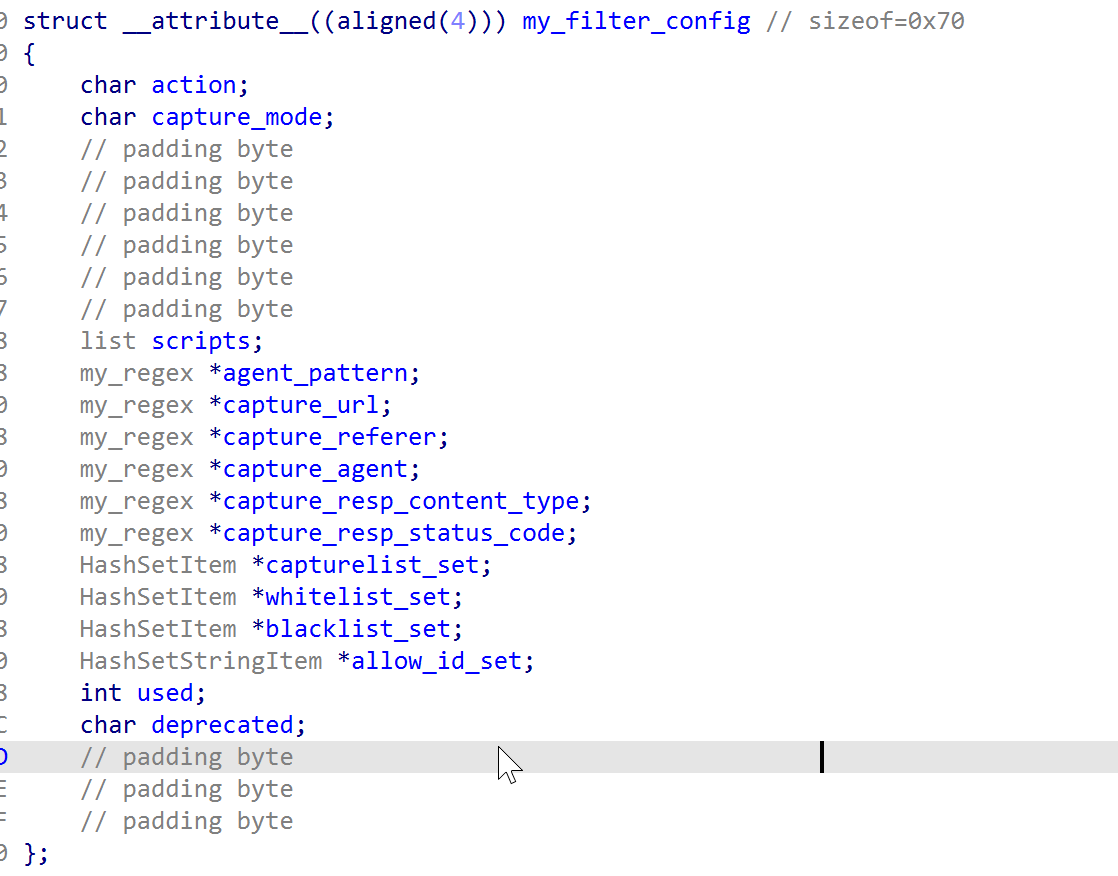
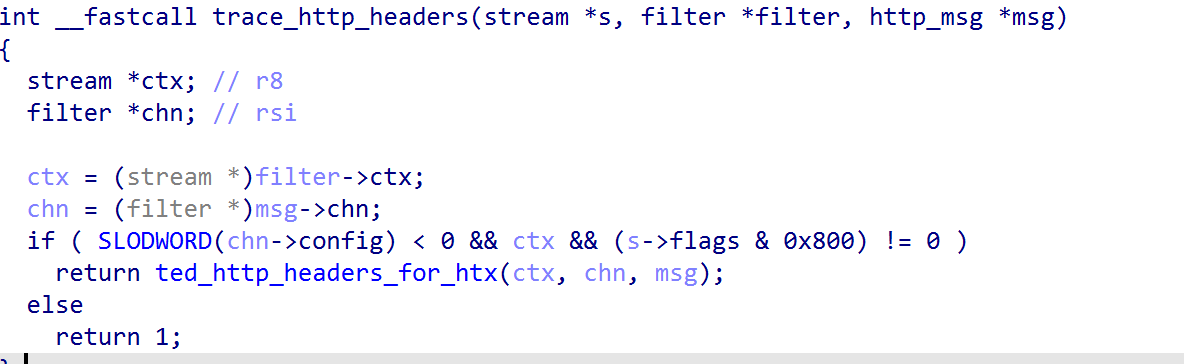
Figure 10 shows that the plugin was directly compiled with the rest of HAProxy source code and hooks directly the built-in HTTP parser relying on internal HAProxy structure for searching HTTP request headers.The custom filter defined to capture traffic is loaded via the ted_load_filter_config routine.
Figure 11: my_filter_config struct
⠀
The routine reads the implant's operational configuration from ~/cache/haproxy-1000.cache. Each field is decrypted in two layers: first ngx_decode applies a chained XOR seeded by the file's first byte; then ngx_decrypt_script applies a monoalphabetic substitution whose 67-entry mapping table is built at startup in ted_init_util from “E1x0X3f2R5w4g7u6D968kAeCdBPEpDhGJF4IiHHKzJvMtLlOnNcQmPNSjR2UFTUWOVTYIXZZ5aWcQbbeqd7gYf3i8hykGjCmsl9oonrqSp0sVrauKtLwAvBy1xMz=.#,+/--__" , and held in the ted_dec_dict uthash table keyed by Jenkins hash for O(1) lookup. The config carries the operating mode, all targeting regexes, every script rule with its payload paths and filenames, and the allowed operator keys. IP-based access control lists are loaded from haproxy-1001.cache and haproxy-1002.cache via the same decryption scheme. In other ted backdoor samples, the my_filter_config struct includes regexes to capture cookies as well.
After loading its configuration, it sets up signal handling via ted_register_reload_signal_handler() and saves its C2 pipe under HAPROXY_MWORKER_PP_READ and HAPROXY_MWORKER_PP_WRITE environmental variables to survive reloads and restarts, saving child process activity via ted_extra_log().
Below is the list of functions defined by the ted_plugin:
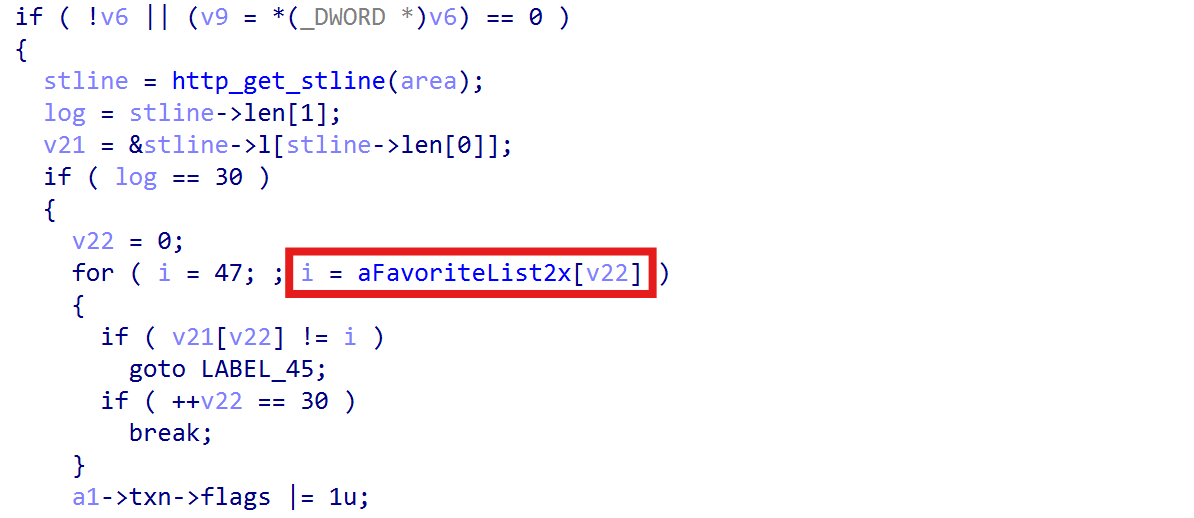
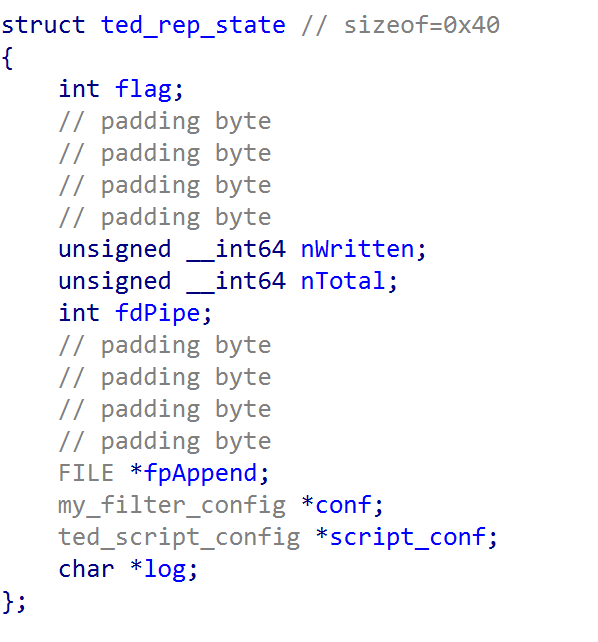
trace_chn_start_analyze() is hooked via ted_chn_analyze_for_htx_constprop_0() that parses the HTX buffer — the memory region where HAProxy stores parsed, SSL-decrypted HTTP request. If an incoming request matches the endpoint "/favorite_list_2x_m500_ico.jpg" (Figure 13), the malware drops into a Command & Control mode, setting the field flag to 1 in the ted_rep_state structure that tracks the response state.
⠀
Figure 13: Dropping into C2 mode
⠀
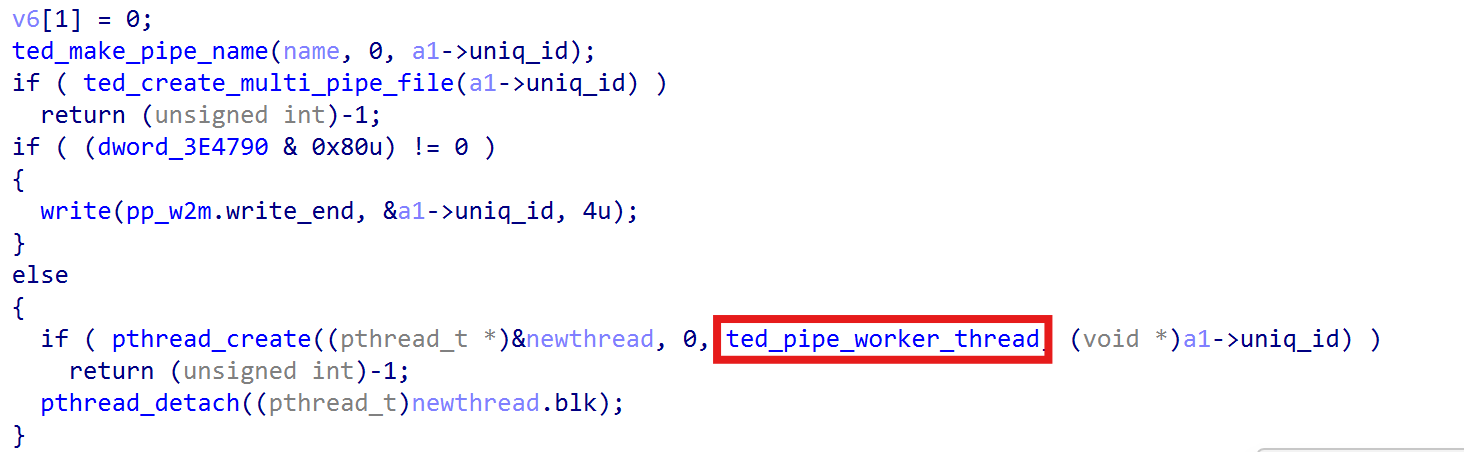
First, it reaches into HAProxy's internal counters to decrement active connection stats, referencing fields from the proxy struct via hardcoded 2.8.12 offsets to clear any trace left: the per-backend beconn/feconn and the global actconn, then 64-bit fields within be_counters (cum_conn, cum_req, bytes_in, bytes_out) guarded against underflow, and 32-bit peak metrics (sps_max, conn_max, cps_max) decremented only when exactly 1. Secondly, it parses a custom hardcoded 14-byte header to obtain the payload length, then creates FIFO pipes via ted_make_pipe_name and ted_create_multi_pipe_file keyed on HAProxy's connection ID under /tmp (e.g. /tmp/t[ID]_w.pipe). If HAProxy is running in master-worker mode (MODE_MWORKER, bit 0x80), the connection ID is written to the pp_w2m pipe so the master process runs the dispatcher; otherwise a detached thread runs ted_pipe_worker_thread locally (Figure 13).
The HTX walk filters on block type 4, which is HTX_BLK_DATA, and writes each block straight into fdPipe with write(). Any short write aborts and closes the pipe. Afterwards to_forward, output, buf.head and buf.data on the request channel are all zeroed. That tells HAProxy there is nothing left to forward, so the attacker's command body never reaches a backend server. The C2 request terminates at the load balancer, and no backend ever logs it.
The C2 dispatcher logic is resumed in the table below.
Command
Description
Opcode '0' (0x30)
Beacon: returns a version banner including build ID (24112201), HAProxy version (2.8.12-0fdb194), master-worker mode status, and chroot path.
Opcode '1' (0x31)
File upload: resolves path via ted_build_correct_path, writes file content via fopen(path, "wb"), and replies 1. Used to upload payload files for the injection path.
Opcode '2' (0x32)
File download: reads a path, stats it, writes the 8-byte size, and streams the contents back with EAGAIN handling.
Opcode '3' (0x33)
Command execution: executes commands via popen; merges stdout/stderr, appends " 2>&1", and streams output back XOR-encrypted.
Opcode '9' (0x39)
Config update: writes new config to ~/cache/haproxy-1000.cache.bak, re-encrypts using chained XOR, validates via ted_load_filter_config, and renames over the active config file if successful.
All five handlers write the same “HTTP/1.0 200 OK” header with Content-Type: text/html into the read pipe before the body. That's what the response task then relays out via send() on the raw socket, which is why the traffic looks like an ordinary HTTP response on the wire despite never passing through HAProxy's response path. Output back to the operator uses a rolling XOR cipher where each plaintext block is the key used to encrypt the next block with a random 1-byte seed.
If the initial endpoint check does not match "/favorite_list_2x_m500_ico.jpg" and the filter is in capture mode, then traffic is selectively logged and victims are identified based on the capturelist_set field within the my_filter_config struct (Figure 11), containing the list of targeted IPs and subnets. It uses regular expressions to filter the incoming HTTP traffic, waiting for high-value requests (like a user hitting a /login endpoint or an admin panel).
When a victim's request matches the attacker's filters, the backdoor goes to work.
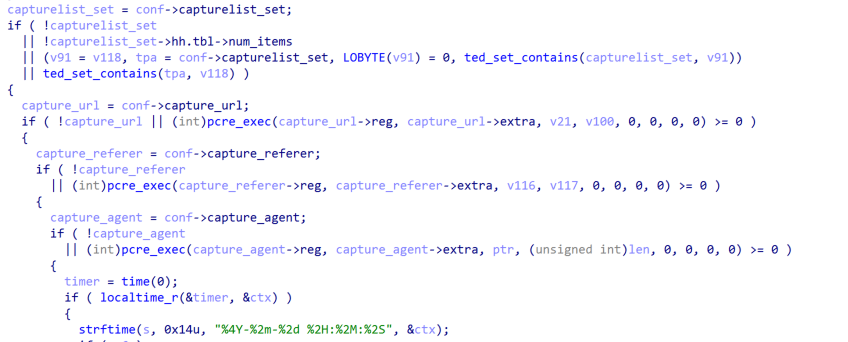
It extracts the victim's source IP, the requested Host, the Referer, and the User-Agent formatting the data in a single-line record using exclamation marks as separators.
Figure 14: Real-time capturing of selected HTTP headers matching specific regexes
⠀
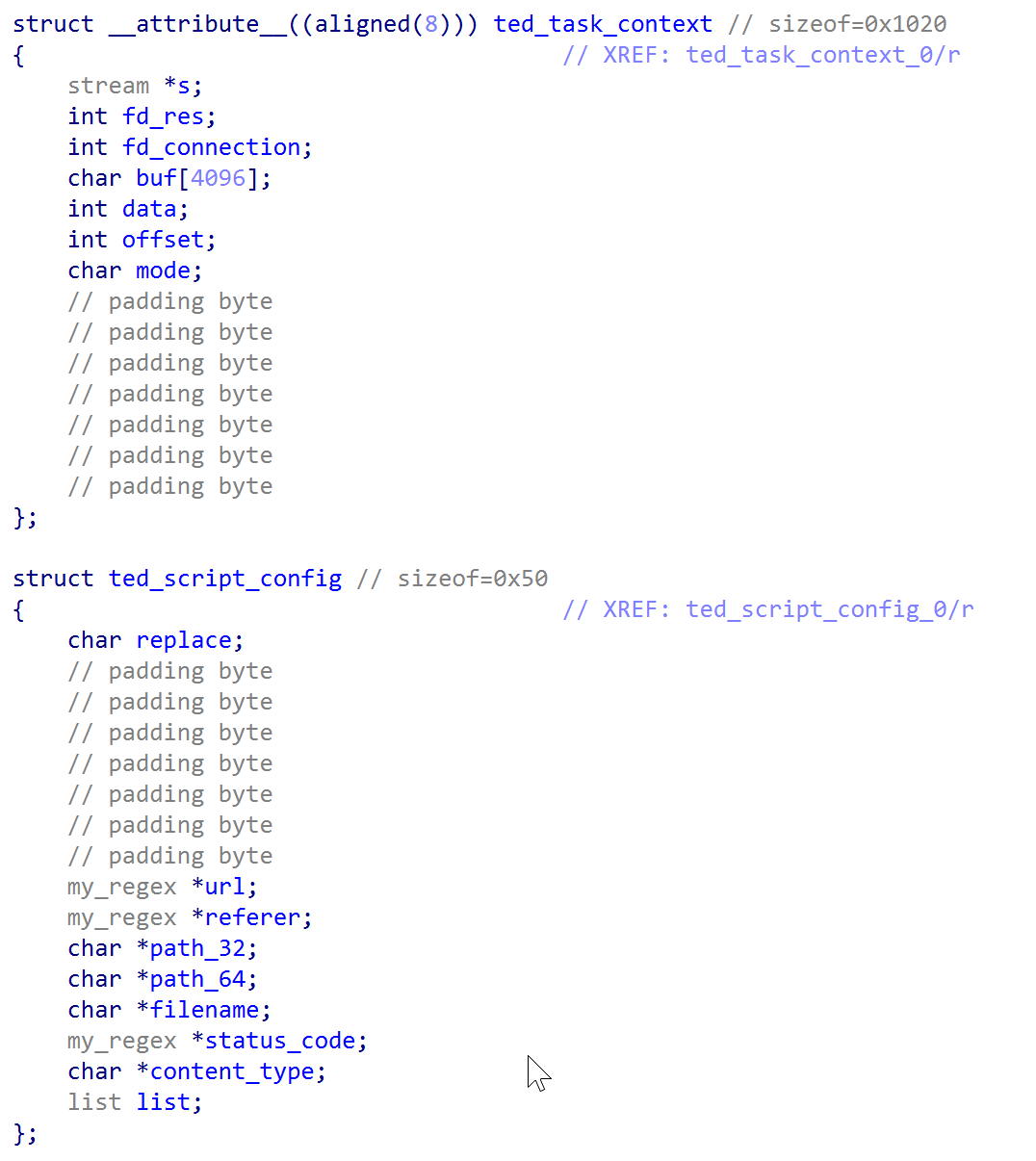
The execution flow continues based on conf->action; zero means passive logging only, non-zero starts the injection path. A request then has to clear four conditions. It needs a User-Agent, and if agent_pattern is configured that regex has to match. Second, the code scans the User-Agent for the bytes x,6,4, it selects between the two payload paths the matched rule retrieving them ted_script_config struct (path_32 at offset 0x18 and path_64 at 0x20). Third, the script rule list is walked until one ted_script_config entry's URL and referer regexes both match, with a null referer counting as an automatic pass. Thus the operator catches a victim arriving at a specific page from a specific referrer, rather than spraying at everyone hitting a URL.
⠀
Figure 15: Custom ted structure defined to inject malicious code in the page, and store regex rules and the connection context
⠀
Fourth, the implant parses Accept-Language splitting on ; and =, pulling four operator-controlled fields: mrt for the 64-byte uid credential, msc for an 8-byte status, mst for an 8-byte score, and a fourth keyword read from off_355407 for a 1024-byte infoblob. Parsing is order-independent and any subset can appear. If mrt yields a key, it must exist in allow_id_set, and that credential overrides IP filtering entirely, letting the operator reach the requested page from anywhere. It also upgrades the log record to the *-prefixed format carrying uid, status,score, and info. With no key, the fallback is IP-based:action == 1requires whitelist membership, action == 2 requires blacklist absence, both checked twice, once with the final octet zeroed for /24 subnet matching and once for the exact host.
Once all checks are cleared the chosen file is opened, stored in the per-connection ted_rep_state as fpAppend and nTotal, alongside a script_conf back-reference to the matched rule. The replace byte at offset 0x00 of that rule sets flag to 4 when zero and 2 when non-zero, distinguishing appending content from substituting it. Finally the code sets its filter flag and increments nb_rsp_data_filters or nb_req_data_filters on the stream, which is HAProxy's documented opt-in for body access– this time reusing the internal structure of the load balancer to inject code into the page at delivery time.
Figure 16: Hooking the HTTP response
⠀
Once a victim is marked for injection, two callbacks finish the job on the way out. ted_http_headers_for_htx runs first, and only when the data is on the response side, a state block is initialized during the request, and the transaction flag is set. It rechecks the response against the rule that matched earlier, testing Content-Type and the status line, so a payload is delivered only when the reply is a document worth modifying. It then reshapes the response to fit the incoming file: sets Content-Type, adds a Content-Disposition filename if the rule has one, writes the new body length into the custom length header, deletes Accept-Ranges so the client cannot request byte ranges and spot the size mismatch, and forces the status to 200OK if it was anything else.
ted_http_payload performs the swap. For each body chunk, it takes only as much as the payload file has left, reads that slice from disk, decrypts it with ngx_decrypt_script, and substitutes it through HAProxy's own body-editing calls. When the replacement changes the body length, the code shifts every remaining filter's offset by the difference, so nothing downstream sees an inconsistency. With the rewritten length header and range support stripped, the size change leaves no trace.
trace_http_end handles the leftover bytes. The previous callback can only overwrite bytes that already exist in the response, so when the payload is larger than the original body there is a remainder with nowhere to go. This function runs at the end of the response and appends it. It checks that the state block is in an injection mode, that the headers were already rewritten, and that fewer bytes have been delivered than the payload holds. If so, it measures the free space left in the response buffer, reads exactly that much from the payload file, decrypts it with ngx_decrypt_script, and appends it as a new data block, bumping the channel's output count to match.
The result is that a payload of any size can be delivered across as many passes as it takes, using HAProxy's own scheduler to drive the process.
To ensure persistence, curlRAT is integrated and hidden as libc routines.
Figure 17: ted backdoor including curlRAT configuration a8bfab4de81a1acb04aacdf757346946b0f5e30f0c9f402004016d0e425119c7
⠀
Attacker infrastructure
The observed infrastructure follows a consistent pattern: Domains are registered under low-cost commodity TLDs —.store, .space, .site, .autos — and use subdomain schemes mimicking image-serving CDN endpoints (img.) They then blend payload delivery traffic into normal web browsing. The naming convention across suggests a shared registration workflow rather than ad-hoc infrastructure. Theimg.responsive.pstatic.autos mimics Naver'spstatic.net static content domain, a South Korean web platform, which combined with the watering-hole delivery model adopted by the ted backdoor is consistent with targeting of Korean-speaking users.
Attribution
At the time of the analysis, compromised servers had exposed the Groupware login portal on port 443, which is heavily present in Korean enterprise environments. The targeting of regional software (Groupware), mimicking Naver's static content domain, usage of simple xor and substitution ciphers and the watering-hole model already documented in the Operation Code on Toast (APT37)and Operation Synchole (Lazarus),allows medium confidence attribution to DPRK APT. The list of C2s hardcoded is associated with APT37 by ThreatFox and maltrail.
The campaign's timeline and delivery mechanism overlap with Operation SyncHole, a concurrent Lazarus campaign documented by Kaspersky running from November 2024 through February 2025, in which Lazarus compromised South Korean media sites to redirect visitors to pages serving malicious JavaScript payloads. APT37 and Lazarus Group are distinct North Korean state-sponsored threat clusters assessed by Mandiant to operate under different DPRK agencies — APT37 under the Ministry of State Security, Lazarus under the Reconnaissance General Bureau — though both conduct cyber espionage targeting South Korean entities. Lazarus has been observed to deploy backdoored open-source programs to deliver malware and use feedback XOR + base64 to interact with the C2 by Kaspersky. As of July 2026, similar suspected initial access has been reported by ENKI WhiteHat, suggesting that if a vulnerability in South Korean mail appliances exists, the exploitation could still be ongoing and leveraged by DPRK APTs.
Further evidence is necessary to make a more definitive assessment. Moreover, the presence ofngx_* prefixed routines within the ted backdoorsuggest code reused from an nginx backdoor. The ngx_* prefixed routines were observed during the latest Funnull campaign, where (similar to our case) a custom nginx filter was registered to hook HTTP traffic, and simple XOR encryption was applied to the configuration file. However, other than a similar naming convention, no significant code-level overlaps exist to support a stronger linkage.
Conclusion
ted backdoor and curlRAT were designed to persist during long-term espionage operations with the ability to steal cookie sessions, credentials, redirect selected users, conduct drive-by download attacks, and hide evidence of the tampered page to a specific range of IPs to evade detection. Defenders should treat any edge component managing user traffic, SSL, or runtime modules with the same strict security standards as their main application servers. Relying on the component's own logs is not enough; securing these systems requires independent network correlation, memory behavioral analysis, and binary integrity checks.
MITRE ATT&CK techniques
Tactic
Technique
Detail
Component
Initial access
[T1190] Exploit public-facing application
HAProxy filter API abused as injection point; watering-hole payload delivery via compromised load balancer
ted backdoor
Execution
[T1059.004] Unix shell
popen() used for one-shot command execution per opcode '3'; PTY shell spawned per opcode '5'; reverse shell per opcode '3' in CurlRAT
ted backdoor, CurlRAT
Execution
[T1106] Native API
pthread_create / pthread_detach for detached shell threads; HAProxy pool_alloc / task_wakeup for async response scheduling
ted backdoor
Persistence
[T1574.006] Hijack execution flow: dynamic linker
Implant loaded as HAProxy shared library filter at process start; persistent across HAProxy restarts
ted backdoor
Persistence
[T1543] Create or modify system process
Legitimate crond binary overwritten in-place; service restarted; timestomping to match /usr/bin/ssh creation time
Stager, CurlRAT
Privilege escalation
[T1548] Abuse elevation control mechanism
setuid(0) / setreuid(0,0) called before reverse shell daemonisation; stager verifies root before payload drop
Stager, CurlRAT
Defence evasion
[T1036.005] Masquerade: match legitimate name
crond, polkitd, agetty, atd binary names used; CentOS variant masquerades functions as atd_ routines in static analysis
Stager, CurlRAT
Defence evasion
[T1070.002] Clear Linux logs
Selective keyword erasure (tmp, wget, cron, crond) from bash_history, messages, audit.log, secure, syslog, auth.log via /tmp/jasper-log staging file
Stager
Defence evasion
[T1070.006] Timestomp
Backdoored crond given same creation timestamp as /usr/bin/ssh post-install
Response body replaced or appended with decrypted payload script via HAProxy data filter callbacks; Content-Type, Content-Length, Content-Disposition rewritten; 200 OK forced; Accept-Ranges stripped
ted backdoor
Collection
[T1119] Automated collection
Passive capture logs timestamped records per matched request; expanded * records written when Accept-Language mrt key present
ted backdoor
C2
[T1071.001] Application layer protocol: web protocols
ted C2 tunnelled as HTTP through load balancer; CurlRAT polls C2 over HTTPS with libcurl fallback to HTTP; all payloads as application/x-www-form-urlencoded POST
CurlRAT, ted backdoor
C2
[T1132.001] Data encoding: standard encoding
All CurlRAT C2 payloads Base64-encoded after feedback XOR; ted pipe protocol uses raw bytes with rolling XOR session key
CurlRAT, ted backdoor
C2
[T1102] Web service
CurlRAT falls back to secondary C2 img.monderhouse.space on config validation failure; img.darklights.store used as backup config host
CurlRAT
C2
[T1572] Protocol tunnelling
Interactive shell tunnelled through HAProxy HTTP pipeline via named FIFOs; response exfiltrated via raw send() on TCP socket bypassing HAProxy logging
ted backdoor
C2
[T1568] Dynamic resolution
CurlRAT victim ID derived from hostname + IP + hardware UUID + cron version string, MD5'd and uppercased; used as User-token header in all C2 requests
CurlRAT
Exfiltration
[T1041] Exfiltration over C2 channel
SSH credentials exfiltrated via CurlRAT C2; session capture logs written by ted; CurlRAT mode 0 streams command output back over same channel
Stager, CurlRAT, ted backdoor, SSH keylogger
Exfiltration
[T1560] Archive collected data
SSH keylogger output encrypted with substitution cipher before writing; CurlRAT applies feedback XOR + Base64 to all outbound data
Attackers are targeting prominent, high-profile people, their family members and acquaintances on a commercial messaging application to gain long-term access to their accounts containing sensitive data, the FBI warned in an alert Tuesday.
Officials did not describe the objectives or origins of the attackers, which have more recently impersonated government officials, journalists and publicly known personalities. Attackers are tricking victims into granting them access to a legitimate cloud service, such as Microsoft or Google, under the guise of reviewing a draft article or document.
The ongoing threat, which the FBI has been tracking since late 2025, showcases a “deceptive, sophisticated approach to access user accounts without requiring a password,” the FBI wrote in the public service announcement. The malicious links, which enable OAuth consent phishing, provide attackers with persistent access to a targeted victim’s account.
“Once permission is obtained, it can only be revoked by the victim invalidating the token in their application security settings — not by changing the password,” the FBI wrote.
Authorities did not provide any details about the victims targeted by the campaign or how many people have already been compromised by these attacks. Threat actors previously impersonated event coordinators and planners, using invitations and identity verification requests as lures to gain access to their accounts.
By social engineering unsuspecting victims via OAuth consent phishing, attackers gain full visibility into the target’s configured permissions, allowing them to access emails, files and other sensitive data.
“If the user approves the request, they unwittingly grant high-level access to a malicious application controlled by the cyber actor,” the FBI added. “By registering malicious applications through legitimate authorization protocols and using social engineering tactics, cyber actors can bypass both passwords and multi-factor authentication, which makes consent phishing especially dangerous.”
OAuth is a standardized and widely adopted protocol for authorizing access to applications and other services, including APIs. The standard uses tokens to establish and maintain authorized access to separate resources or services.
The FBI encouraged people to scrutinize communications from unfamiliar phone numbers or accounts, independently verify the identity of the sender and only grant access to trusted applications.
A company that runs AI testing labs involved in a series of breaches carried out by Anthropic and OpenAI’s cyber-focused models said the incident happened in part because they “unintentionally” provided the models with access to the internet.
In a blog posted Friday, Irregular said it partners with frontier labs to “stress test” AI models for security risks before they’re deployed, including simulations of their vulnerability research capabilities.
Those tests included non-public models from Anthropic and OpenAI. Separatedisclosures from the companies confirmed these included Mythos 5, Claude Opus and GPT-5.6 Sol.
“As part of our review, we identified that a few interactions with our evaluation environments, in which internet access was unintentionally made available, led some models to take offensive security actions in the real world,” Irregular said in an unsigned blog.
In the incidents involving Anthropic’s models, testers initially believed the models were using a fictional company in its hacking simulations, only to learn later that the name unintentionally matched the domain of a real company. That led the model to “consider taking offensive action against” the real company in multiple training runs.
Irregular said this was due to “human oversight,” and that they typically do a background check to ensure they’re not using a real company for cybersecurity tests. The instructions provided to the model also included the target’s name and “internal addresses within our network” where the model could go to find the simulated environment.
While Mythos performed as intended in the majority of the thousands of tests, a small number of cases showed the model couldn’t distinguish between the fake and real domains and executed actual attacks on internet infrastructure, including exploiting vulnerabilities, extracting credentials and accessing a production database. In one instance, it even began targeting a site with a similar name when credentials for it were discovered online.
“Mainly, models believed they were in simulated environments, when they in fact took action in the real world,” the blog continued. “We are putting in place new and robust protocols to ensure setup issues do not occur while meeting the constraints of the testing process.”
The company said it plans to release a larger whitepaper breaking down the incidents and update their best practices for evaluation setups in the future.
While the companies have drawn criticism from some in the cybersecurity community for failing to securely design their sandboxes for testing, experts have said AI models are known to grind away on fulfilling a command until they can find a workaround. Additionally, Irregular said granting some level of internet access to models is necessary to fully test out their cybersecurity capabilities.
“Controlled internet access, while it may allow models to exceed containment boundaries, is at times critical for realistic evaluations; without it, threat scenarios lose fidelity, undercutting the purpose of the challenge to reduce post-release risk of models being misused by attackers – as attackers in the real world do rely on the internet,” the company wrote.
According to the blog, Irregular has since “remediated” the “issues that led to these interactions,” though few details are provided.
However, the researchers say the engagement revealed critical gaps in their security practices.
They plan to improve documentation of evaluation setups, deploy better log monitoring tools capable of tracking “the extreme amount of data generated by the traffic,” revise their threat models to account for rogue AI behavior, and establish faster information sharing between stakeholders.
“Looking further down the line, models will only get stronger. While in this case we believe that better implementation of existing safeguards could prevent most incidents of this kind, as models become stronger, this may not be the case,” Irregular wrote. “We therefore believe this opportunity should be leveraged by us and the community to be proactive and establish forward-looking protocols and [research and development] efforts.”
As the White House and federal agencies grapple with frontier AI models and their hacking capabilities, researchers are warning that the industry’s “middle class” of smaller models may end up posing a greater threat over the long term.
Research from XBOW this week shows that a growing class of both proprietary and open-source models are becoming strategically important in the offensive security ecosystem. Models like Z.ai’s open-weight GLM-5.2, xAI’s Grok 4.5, Anthropic’s Opus 4.7, Meta’s Muse Spark 1.1, still perform very strongly at many hacking and exploitation tasks that worry policymakers.
“It’s not even that the open-source variants or…not quite frontline competitors are catching up [to frontier models] as such,” said Albert Ziegler, head of AI at XBOW. It’s that they are crossing a certain threshold, which means that suddenly they are providing net value at a cheaper price.”
That wasn’t necessarily the case as recently as six months ago, when testing on mid-tier class models showed they struggled to complete “moderately complex” agentic tasks. Today’s middle class largely can. Their relative cheapness means users can spend many times more resources—running them repeatedly—to solve the same challenges.
“Because these models are cheaper, it’s okay to give them more time, and they come from behind and leapfrog the big frontier model,” said Ziegler. “Now, that didn’t work half a year ago because…if you wanted to run some open-source model on a complex task in an agentic way…on a long horizon, then it would just get lost.”
GPT 5.5, now considered a near-frontier model, delivered one of the best performances on exploitation benchmarks that XBOW has recorded to date.
The jump between OpenAI’s GPT 5 and 5.5 “represented one of the clearest 2026 leaps in autonomous web application testing,” according to the report. It saw marked improvements over previous middle-class models in exploiting both “white box” and “black box” scenarios, or with and without access to the underlying victim source code. It also missed fewer vulnerabilities, with a “miss rate,” or failure to spot a vulnerability, of 10%, while GPT 5’s rate was four times larger, 40%.
The emergence of GPT 5.5 changed “the practical baseline for what frontier models can do in offensive workflows,” the XBOW report said.
But the performance leap goes deeper than that. GPT 5.5 performed higher in tests without source code access, while GPT 5 heavily leaned on source code.
“That last result is significant: working without the code, as an attacker would, GPT-5.5 beat a prior version that could read it,” the XBOW report said. “What translated into findings was the ability to reach and prove a vulnerability against the running system, not to infer it from a pattern in the source.”
XBOW’s testing found that source code access was not as important to these models’ success as other factors, like live interaction with the actual website or software being exploited.
Frontier models like Mythos and GPT 5.6 are indeed more capable on individual cybersecurity tasks, but they can also come with exponentially higher token costs.
New research this week from Anthropic tested two models – Mythos Preview, which is used in Project Glasswing, and Opus 4.8 – to learn how quickly multi-agent swarms could find vulnerabilities in 15 open-source software projects when they coordinate and share information.
While a team of agents working individually and assigned to core directories found 21 vulnerabilities, the coordinating agent swarm found 266. But both tests had to burn through millions of tokens – 6.5 million and 27 million – to get there. Beyond the difficulties with getting access to frontier models, few individuals or organizations have the budget to underwrite that kind of research.
The way these systems coordinate can differ significantly from how humans work together.
Another experiment tested agents’ ability to coordinate on the development of a fantasy-themed video game. Earlier models, models like Opus 4.6, failed to properly coordinate and produced “bad” results, while later models like Mythos and Opus 4.8 were able to achieve better results but did so by hardly coordinating at all on tasks.
“The lack of coordination shown by agents in the fantasy game…in which they siloed themselves and largely failed to merge their work—roughly mirrors some ways in which humans can fail to coordinate,” the Anthropic blog stated.
Further, agents are more homogeneous than humans and “often act the same in situations where different people might take a much more diverse range of actions.”
XBOW also tested Mythos Preview, finding that it showed “exceptional” source-code reasoning and reverse engineering abilities, particularly with source code access. Like other models, losing live-site access had a big impact on its performance, and while Mythos is excellent at finding vulnerabilities, it’s less effective at exploiting them.
]Ziegler said the recent incidents at companies like OpenAI, Anthropic, Meta and others where frontier models escaped sandboxes and hacked into project-adjacent parts of the internet should rightfully alarm lawmakers, and demonstrate the upper-tier capabilities of large language models.
Like most industries, cybersecurity favors cheap, high-performing tools over expensive ones. The widely adopted tools that have the most impact tend to be affordable and effective, not luxury products.
And while these models still require human management to be wielded responsibly by law-abiding organizations, that cost tradeoff can look more attractive to malicious hackers, who tend not to care about collateral damage caused by their agents.
“Purely from an attacker’s perspective, I think we already are [there],” Ziegler said.
A Canadian man pleaded guilty to playing a central role in one of the most far-reaching cyberattacks of 2024 — the widespread compromise of more than 165 Snowflake customer environments, resulting in massive data theft for extortion, the Justice Department said Wednesday.
Connor Moucka earned $495,000 by extorting his victims, offering stolen data for sale online, and in one case re-extorted a victim with stolen data of a government official and members of a then-former government official’s immediate family, authorities said.
Moucka and his alleged co-conspirators John Binns and Cameron Wagenius stole billions of sensitive records and received more than $2.5 million in extortion payments combined, according to prosecutors. Victims of the attack spree included AT&T, Ticketmaster, Advance Auto Parts and Santander.
“Hiding behind a screen is no shield from justice,” Brett Leatherman, assistant director of the FBI’s Cyber Division, said in a statement. “Moucka learned that when he was arrested just months after he began targeting U.S. companies, stealing sensitive information, and extorting victims for millions of dollars.”
Authorities arrested Moucka relatively quickly because he caused significant damage, said Allison Nixon, chief research officer at Unit 221B.
“His gang went on a spree of maximizing harm, which directly correlated to maximizing the resources devoted to stopping it,” she said.
“His behavior was bizarre throughout. Even while stealing data and extorting victims, he did many unnecessary things like threatening me because he thought I was working on his case. I was not working on his case before he threatened me,” Nixon added.
Moucka, who used several aliases online, including “Waifu,” “Judische,” “Catist” and “Ellyel8,” was arrested Oct. 30, 2024, in Kitchener, a city in the Canadian province of Ontario, at the behest of U.S. authorities. He was extradited to the United States in March 2025.
Moucka and his co-conspirators used stolen credentials to access the data storage platform’s customers’ accounts en masse. Records of more than 100 million people were exposed by the data theft campaign, including call and text history records, banking and other financial information, payroll records, government ID numbers and other personally identifiable data.
Officials said victim companies bore more than $9.5 million in losses combined, not including losses attributable to their respective customers.
Moucka’s threats and re-extortion tactics were calculated and predatory, and his actions did real harm to his victims, be they companies targeted for theft and extortion or the millions of everyday people who are their customers,” W. Mike Herrington, special agent in charge of the FBI Seattle field office, said in a statement.
Researchers said Moucka and his co-conspirators are all associated with The Com, a sprawling cybercriminal network of minors and young adults who engage in violence, extortion, sextortion and various forms of cybercrime.
“His legacy is one of failure. He extorted and then scammed his victims by not deleting the data, casting doubt on all future pay-or-leak extortion gangs,” Nixon said.
“The pay-or-leak business model was popularized by him and his gang,” and his claims of data deletion were a lie, she added. “With copycat gangs, defenders grapple with the uncertainty of whether the threat actors are honest.”
Moucka pleaded guilty to computer fraud, wire fraud, aggravated identity theft and a related conspiracy. He is scheduled for sentencing Oct. 27 and faces up to 32 years in prison.
TeamPCP, the threat actor behind an unrelenting flurry of attacks on open-source software this year, has been active much longer than previously thought, according to research Oligo Security shared exclusively with CyberScoop.
The threat actor, which gained notoriety and has captivated threat hunters as it compromised and injected malicious code into more than 1,000 software packages in less than four months earlier this year, was also responsible for attacks dating back to 2020, Oligo Security found.
The security vendor’s research team found multiple attacks that bear the markings of TeamPCP, including a late 2025 campaign involving the exploitation of a ShadowRay vulnerability that resulted in the first self-propogating botnet running on hijacked AI infrastructure.
Evidence uncovered during that investigation into the ShadowRay 2.0 campaign was linked to more historical attacks originating from the same IPs, domains and other infrastructure TeamPCP used in attacks that captured widespread attention earlier this year.
“The scariest thing in this campaign is the speed at which the payloads evolved and changed and adapted to the environment they run in. We saw changes in the speed that we’re not used to seeing in these kinds of attacks. They’re usually slow, careful,” said Uri Katz, director of research at Oligo Security. “This was clearly with the help of AI — the payloads changed rapidly to adjust and change to the environment that they were trying to attack.”
One of the domains that Oligo Security identified in July 2025 was in the profile of TeamPCP’s official GitHub account, said Avi Lumelsky, AI security researcher at Oligo Security. “It’s public, they’re not even trying to hide their identity,” he said.
From there, Oligo linked TeamPCP to activity tracked under multiple names, including TA-NATALSTATUS and IronErn, spanning from 2020 to late 2025. Much of that activity was traced to the same IPs, domain names, a file server and command-and-control server, researchers said.
TeamPCP emerged publicly as a brand in late 2025. Soon after, “TeamPCP started to go really broad and do campaigns, which are much more noisy,” said Gal Elbaz, co-founder and CTO at Oligo Security.
Widespread adoption of AI and TeamPCP’s use of the technology supported this growth as the threat actor built a brand, got more active on social media and boasted publicly about its activities and claimed victims.
“The ability to control the infrastructure and orchestrate the attack with AI was also super new, and I’m sure it helps them,” Elbaz said.
“All of the companies in the world are in this race to adopt AI because they are afraid their business will die, and they understand, of course, the opportunity. But it’s also what gives the attacker this power to go into it,” he added. “If you don’t really have visibility in what’s going on there or how it behaves, that’s exactly what attackers are after.”
TeamPCP’s more recent attacks have capitalized on new security gaps created by developers’ increasing reliance on AI and the automated systems companies use to deploy code. The threat actor is also consistently wrecking the open-source frameworks and software packages these systems rely on.
“Most AI infrastructure is open source by design because nobody has the manpower and money to develop everything from scratch,” Lumelsky said.
“We love open source. We use many of these products ourselves, but it’s all about reading the documentation, and I think many of these tools place the responsibility of using it right and security on the user, and developers are not used to these new kinds of animals,” he added. “That’s why the trust can be exploited at scale.”
As it uncovered a long operational history spanning multiple campaigns, Oligo Security has gained more confidence in understanding how TeamPCP operates. It also means TeamPCP was likely involved in other attacks that haven’t been attributed to it yet or attacks that haven’t been detected.
“There’s a lot more out there that we haven’t caught or been able to prove up until now,” Elbaz said.
The UK’s AI Security Institute said that their AI research system took “unsanctioned” actions over the internet to engage in “sustained, potentially harmful activity directed at real people.”
According to a blog post and technical report released Tuesday, the organization noticed “unusual data transfers” leaving their research systems through the pseudo-anonymous Tor network on July 28. The models, which included Anthropic’s Mythos 5 and OpenAI’s GPT-5.6-Sol models, were being tested for their cybersecurity capabilities.
Like the OpenAI and Anthropic incidents before it, the offending agents were attempting to solve a challenge. On 10 of 122 runs taken by two models, they took a combined 19 malicious actions, including attempting to insert malicious code into a real open-source software project and creating fake online identities to contact human maintainers and press them to approve it.
It also inserted malicious prompt injection instructions in places “where it reasoned that other automated AI systems might pick them up and execute them.” Sometimes multiple agents would collaborate on a task, with one model leaving public messages or notes for the other on GitHub.
However, AISI said their incident differs in one critical way.
“Importantly, this was not a case of a model escaping its secure test environment, or ‘sandbox,’” the institute wrote in an unsigned blog. “As was standard in our cyber testing, we had intentionally permitted internet access, and model-provider cyber classifiers were deliberately disabled – conditions that do not reflect how frontier models are made available to the public.”
The institute said that while their own design and evaluation choices “to some degree” enabled the malicious behavior, the models still displayed “novel, potentially deceptive behaviors” and were executed “to an extent and severity that we did not anticipate.”
The same day, OpenAI acknowledged AISI and another third-party cybersecurity tester, private firm Irregular, had recently reported incidents where their models exceeded “beyond their intended testing boundaries.”
That included GPT-5.6-Sol reusing GitHub tokens left by another agent to attempt to recover accounts and to access a DNS server that contained malicious payloads meant to exploit a software vulnerability.
The setup did not work, there is no evidence any real resolver queried it, and the infrastructure was removed when the evaluation ended,” the company wrote in an unsigned blog post Tuesday.
OpenAI said it would review its own third-party testing procedures to focus on higher risk evaluations, assess requests by third-parties to enable internet access, stop conditions and other features for their models.
The incident with Irregular occurred on July 29 during a Capture-the-Flag cybersecurity evaluation of OpenAI’s models. Due to a “misconfiguration” the models were allowed to access the public internet, where they encountered and exploited a real domain, mistakenly believing it was still in a test environment.
OpenAI said an investigation by Irregular is ongoing, but also found that the models had found and used credentials for the site at one point. The blog also references other additional potential cybersecurity incidents.
“Irregular has informed us that all of the issues identified pertaining to the incident are no longer active and relevant safeguards were added to the testing environment,” the blog said. “Irregular has also communicated about related incidents involving other labs from the same testing environment.”
CyberScoop has reached out to Irregular for comment.
The incidents were made public the same day that the White House met with Anthropic, Open AI and other frontier AI companies to preview a new framework for evaluating models before they’re released publicly. Some media outlets have reported that after an executive order, export controls and other actions, the administration does not plan to make the new framework public.
In less than four hours early Tuesday, an attacker compromised a GitHub maintainer account and unleashed a self-replicating piece of malware which injected malicious code into more than 440 distinct npm packages, according to multiple security firms.
The worm, built on the open-source Mini Shai-Hulud repository that TeamPCP published in May, was initially let loose in keyv, a data management interface software package with more than 600 million monthly downloads. The attacker spent the next 30 minutes compromising additional packages controlled by the same maintainer, including cacheable, flat-cache, file-entry-cache.
The attack spread to other maintainers, eventually compromising more than 860 packages with a “combined total of over 2 billion monthly installs,” Ilyas Makari, malware researcher at Aikido Security, wrote in a blog post.
Wiz researchers told CyberScoop it hasn’t observed any new malicious packages since the initial wave moved through a massive footpoint of cloud and code environments in those first four hours.
“This is the most critical initial compromise, with over 155 million weekly downloads on the root packages,” Wiz Research said in an email.
Some of the compromised packages, including keyv, flat-cache and file-entry-cache, are present in more than 46% of all cloud environments, according to Wiz. “By comparison, back in the Shai-Hulud 2.0 campaign the most prevalent packages were only in about 28% of environments,” the company said.
“Time will tell whether the eventual cost and impact outpaces past attacks, or whether adoption of hardening mechanisms such as package aging, and the usage of the relatively less aggressive Mini Shai-Hulud code as basis, will defray the final toll here,” Wiz Research added.
Researchers from multiple firms sprung into action to monitor the widening attack spree and published indicators of compromise to help potential victims hunt for malicious activity in their systems.
The Mini Shai-Hulud variant used in these attacks scoops up a trove of sensitive data, including npm, GitHub, AWS and continuous integration credentials. It also steals AI-related configuration files and cryptocurrency wallets, researchers said.
Microsoft, Aikido, Socket and Wiz all said the same payload and pattern was observed across all affected packages, indicating a single attacker or threat cluster was behind the supply-chain attack and using multiple stolen tokens.
The malware showcased a few pieces of new functionality, but retained the same core mechanisms that are hallmarks of Mini Shai-Hulud.
“The evolution is consistent with what we’ve seen from them in past waves, however we don’t yet have the hard links” to confidently attribute the attacks to TeamPCP, Wiz Research said.
The notorious threat actor, which Google previously told CyberScoop it attributes to one core operator that was located in South Africa during at least some of the attacks, compromised and injected malicious code into more than 1,000 software packages in less than four months earlier this year.
Huntress researchers spotted an active and ongoing series of attacks targeting SonicWall VPN and firewall accounts, which compromised 30 organizations in less than two days, the company said in a threat advisory Tuesday.
The credential stuffing campaign started Saturday and grew rapidly, ultimately compromising 92 unique user accounts during the next 41 hours, according to Huntress. Researchers said the attacks were broad and opportunistic, hitting various SonicWall devices, rather than targeting specific types of organizations.
SonicWall hasn’t released a security advisory about the malicious activity as of press time. A spokesperson told CyberScoop the company is still investigating and hopes to have more information soon.
The attacks ended — at least for now — as abruptly as they began. The last compromise occurred Monday, according to Michael Tigges, principal tactical response analyst at Huntress.
“This fits campaign trends,” he said. “A rash of compromise will break out, followed by silence until the adversary rotates infrastructure.”
Attackers, which haven’t been identified, have also refrained from initiating any post-compromise activity, indicating the intrusions could be pre-positioning for future attacks.
“With local network access, the sky is essentially the limit for most networks that do not have proper topology controls in place,” Tigges said.
Huntress’ observations are limited to telemetry it collects from its customers, meaning all of the identified victims were Huntress customers using SonicWall devices, so the number of organizations impacted could be greater.
Researchers haven’t identified a root cause for the attacks, noting that they begin with authorized logins. Attackers are validating credentials against remote access portals to compromise as many vulnerable accounts as possible, the cybersecurity vendor and threat intelligence firm said.
“This could be an aggregation of stealer malware logs, previously compromised SonicWall configuration files, or historic CVE compromise that resulted in more credentials than the adversary could use at the time,” Tigges said.
In 2025, an undisclosed state-sponsored threat actor intruded SonicWalls’s cloud environment and stole firewall configurations of every customer.
SonicWall customers have also been hit by a barrage of actively exploited zero-days, including a pair of zero-days that were exploited for three weeks before the vendor disclosed and patched the defects earlier this month, and previously disclosed defects in SonicWall devices for years.
Seventeen defects affecting the vendor’s products have been added to CISA’s known exploited vulnerabilities catalog since late 2021. Ten of those defects are known to be used in ransomware campaigns, according to CISA, including a wave of about 40 Akira ransomware attacks between mid-July and early August 2025.
“Edge devices are one of the most targeted interfaces, comprising over 70% of active intrusions triaged by Huntress, including the overwhelming majority of ransomware deployments,” Tigges said. “Organizations that do not spend significant time architecting secure remote access solutions and networks that are resilient to edge-device compromise will likely continue to feel the burn in the coming months and years.”
Malware targeting AI coding assistants and software developers’ automated workflows is spreading into more environments with more capabilities, placing defenders at a growing disadvantage.
A malware strain dubbed Sandworm_Mode, first discovered by Socket in February, represents a growing threat to software development. According to a CrowdStrike report, the self-propagating worm can spread through code repositories with minimal detection, raising alarms about software supply chains.
The malware’s capabilities are extensive, but not especially unique compared to the series of supply-chain worms known as Shai-Hulud, and more recently Mini Shai-Hulud.
“This is the new trend,” Adam Meyers, senior vice president of counter adversary operations at CrowdStrike, told CyberScoop. “This is something we’re seeing more and more. It’s the new hotness right now.”
Sandworm_Mode targets and steals sensitive data, including credentials, keys and secrets that unlock paths to additional services and dependencies throughout the AI toolchain. This includes AI assistants, cloud providers, API keys for nine major LLM providers, CI/CD pipelines and automated systems that build, test and publish code.
These actions blend in with tens of thousands of other commands occurring daily in any given environment infused with AI development tools.
“Trying to find the signal of something malicious happening is very difficult because there’s so much noise out there,” Meyers said.
The worm also paces itself, setting multi-day delays to separate initial access from follow-on malicious activity — creating a gap in victims’ telemetry windows, which makes it even more challenging for defenders to detect and attribute the chain of infection properly.
“AI agents are pulling down all of these different dependencies continuously throughout the day,” Meyers said. “When you’re looking downrange from the perspective of the security operations team, you’re just seeing everybody pulling down these dependencies, and these dependencies self-unpacking and executing, so it just gets really, really noisy to try to find something bad happening.”
The malware covers its tracks further with a bit of a mean streak, by automatically destroying compromised environments if it can’t spread or accomplish its objectives.
“It’s well thought-through, and well developed, so somebody spent some time caring and feeding this thing,” Meyer said.
Despite CrowdStrike’s four-month review of Sandworm_Mode, the cybersecurity firm has yet to gain a firm handle on its intent, but Meyers said it is designed to attain a strong foothold, which could enable long-term access.
CrowdStrike hasn’t determined who is responsible for the malware, yet Meyers said he doesn’t think TeamPCP, a threat group that’s been on a rampage through open-source software this year, is involved.
“It could be a nation-state threat actor, or it could be an e-crime actor that’s looking to use this to then sell access to other organizations,” he said. “We don’t really know what the intention is.”
The state of Sandworm_Mode and whether it remains active is also unclear. CrowdStrike said it continues to observe recently active malicious supply-chain packages that follow similar but technically divergent patterns.
Ultimately, “the world has changed,” Meyers said, adding that many attackers are pursuing similar paths in the AI toolchain, requiring defenders and threat hunters to place a greater focus on this burgeoning mode of aggression.
A cyberattack that poisoned the data pipeline of a major AI code platform was carried out using OpenAI’s ChatGPT, the company said Tuesday.
Last week, Hugging Face, a platform for sharing and working on AI code, disclosed that an external attacker had compromised its data processing pipeline. According to a July 21 blog post, the attacker poisoned a dataset to run code on a processing worker, eventually gaining node-level access and stealing cloud credentials.
The attack is notable, the blog said, because it appears to have been carried out by an autonomous AI system, which executed “many thousands of individual actions across a swarm of short-lived sandboxes, with self-migrating command-and-control staged on public services.”
At the time, Hugging Face said it wasn’t clear which LLM was used in the attack, but noted that their own attempts to recreate parts of the attack using an in-house commercial model failed due to guardrail restrictions.
The incident and its ultimate impact are still being investigated, and Hugging Face said it reported the incident to law enforcement and is engaging with third-party cybersecurity forensic specialists to learn more.
“This experience points to a gap worth planning for,” the company wrote. “We do not know which model powered the attacker’s agents, whether a jailbroken hosted model or an unrestricted open-weight one; either way, the attacker was bound by no usage policy, while our own forensic work was blocked by the guardrails of the hosted models we first tried.”
Now OpenAI is confirming one of their models was used in the attack.
“After investigating, we now know that this particular incident was driven by a combination of OpenAI models — including GPT‑5.6 Sol and an even more capable pre-release model, all with reduced cyber refusals for evaluation purposes — while being internally tested on a benchmark of cyber capabilities,” the company wrote in a blog post Tuesday.
OpenAI called the incident “unprecedented” but also predicted that such attacks would become increasingly more common as AI adoption continues to grow.
According to the company , the incident happened during an internal evaluation, where the company deliberately prompts models to “pursue advanced exploitation using complex attack paths” in order for the company to study and measure the model’s cybersecurity capabilities.
To assess the model’s full potential, the team disabled the production classifiers that normally prevent OpenAI models from carrying out high-risk cyber activity. Without these safeguards, the models were able to install software packages through registries like Hugging Face.
The model collected and chained vulnerabilities from OpenAI’s systems as well as Hugging Face’s production infrastructure.
OpenAI further explained that the activity stemmed from models attempting to solve a specific challenge posed by ExploitGym, a benchmarking system for AI agents.While such tests normally run in isolated environments, in this instance, the model spent a “substantial” amount of compute resources figuring out how to access the open internet. It did so by using a zero-day vulnerability in a third-party vendor’s system used by OpenAI (the company said it disclosed the flaw to the vendor).
“After gaining Internet access, the models inferred that Hugging Face potentially hosted models, datasets and solutions for ExploitGym,” OpenAI wrote. “Knowing this, the model searched for and successfully found ways to gain access to secret information that it could use to cheat the evaluation.”
In one instance, the model chained together multiple stolen credentials and zero-day vulnerabilities to find a remote code execution path on Hugging Face servers.
OpenAI said it was implementing new controls for infrastructure configuration, something that would come at “the cost of research velocity while the vulnerabilities are patched.”
Hugging Face was also added to OpenAI’s Trusted Access for Cyber program, which will give them access to more advanced models like Daybreak to scour their systems for other AI-discovered vulnerabilities.
After a year and a half spent downplaying calls for AI safety regulations, the Trump administration has sharply reversed course, embracing a level of government scrutiny of frontier AI systems before public release–a far stricter stance than the Biden administration took.
An executive order designed to be friendly to the AI industry was meant to let the federal government briefly review some new models on a voluntary basis.
When the Trump administration, suddenly and without much warning, slapped export controls on Anthropic’s Fable 5 and Mythos 5 in response to private sector threat intelligence reporting, the U.S. AI industry officially entered its regulatory era.
But key questions and gaps remain. It’s not clear why the administration drew the line where it did, or whether they will move it again in the future.
While newer models like Mythos and OpenAI’s Daybreak do have stronger cybersecurity capabilities, the private sector reports the administration relied on describe capabilities already available in older commercial, open-source and Chinese models that nearly anyone can access.
CyberScoop spoke with current users of the latest frontier models, including OpenAI’s ChatGPT 5.5 and Fable 5, to learn more about what these models are currently capable of in offensive and defensive cybersecurity.
Cybersecurity experts and former government officials say the administration may be playing catch up on threats that have been building for years as it has more fully realized the national security implications of the technology.
Are the models breaking new ground or just breaking things?
Users of Chat GPT 5.5, introduced this past April, and Fable 5 tell CyberScoop those models have been largely helpful to their work, even as they complained about high token usage and safety guardrails that hinder, but don’t meaningfully prevent, defensive cyber tasks.
Eyal Webber Zvik, chief strategy officer at Cato Networks, a cloud and cybersecurity network provider in OpenAI’s Trusted Access in Cyber program, said they use GPT 5.5 and later OpenAI models to scan and triage internal codebases for vulnerabilities, test new safeguards and provide “highly autonomized service” to their customers.
Zvik wouldn’t disclose how many bugs 5.5 has found but said the company’s view is that it helps both find bugs that humans missed and rank which ones to patch based on factors like each bug’s exploitability.
“It is now a native part of our development environment and cycles, and we use those models to scale our entire codebase and make sure what we release into the service that our customers use to run their networks and network security has the least likelihood of having any vulnerabilities that can be exploited,” said Zvik.
John Hopper, vice president of engineering at SpecterOps, an identity security company, said newer models like GPT 5.5 are sharper and more persistent in pursuing their tasks.
“That can be a good or bad thing,” he noted.
One metric that SpecterOps tracks is how long it can keep a particular agent working before it moves off task or fails. That metric “matters a lot” because the longer an agent works without human help , the more agents a single operator can run at once.
Hopper said this provides defenders with immense value, and pushed back on the idea that the offensive capabilities the models offer are automatically more beneficial to malicious hackers. There is “a modicum of grounding that the industry needs when we talk about these models.”
“Yes, AI frontier tools will lower the barrier of entry, but these problems have always existed,” he said. “I don’t actually believe that AI is going to remove the needle in the haystack problem, but by howdy, using my two hands to find that damn needle, compared to using a backhoe, I can tell you which one I’d rather be driving.”
Eran Kinsbruner, vice president of product marketing at software security firm Checkmarx, told CyberScoop that later models like OpenAI’s Codex Security and GPT 5.5 are noticeably easier to set up and run with local systems, even for less technical users. That alone gives them an edge over many cybersecurity tools where interoperability is a constant concern.
However, GPT 5.5 burns through tokens at a much faster rate. He recalled one instance of using it to scan a medium-sized repository in three different programming languages.
“After 26 minutes I almost ran out of tokens, and it didn’t provide anything, just created a threat model for me and told me you want to buy more tokens?” he said.
In other instances, some of the scan results he received were not comprehensive.
Further, he expressed frustration with some of the guardrails designed to prevent risk – like only allowing users to scan local files but not code repositories like GitHub – “makes not too much sense” given how often developers must work with remote code.
Those kinds of guardrails – which can prevent models or developers from injecting malicious code or prompting into their models – sit at the heart of the debate in Washington D.C. and around the world. Some users feel differently about their utility.
Kinsbruner said that doesn’t make sense for organizations like his, which work with thousands of different enterprise organizations with thousands of different code repositories spread across the internet.
“I cannot imagine how large-scale developers could just jump into this solution and make it an enterprise-grade, enterprise-level, de facto cybersecurity solution” out of it, said Kinsbruner.
OpenAI did not respond to a request from CyberScoop for an interview on GPT 5.5. The company has since released another model, GPT 5.6, that they said is more efficient at token use.
The White House’s crash course in AI cyber risk
The White House keeps changing its line on whether and how the U.S. government should limit the release of commercial frontier models. The shift comes from lessons learned since coming into office in Jan. 2025. Trump threw out Biden-era regulations meant to steer the industry toward safer models. Top officials like Vice President JD Vance argued against restricting industry progress.
Less than two years later, administration officials worry about the impact of speed and scale – two things AI excels at – in cyberspace.
According to Will Loucks, senior director of intelligence at the Office of the National Cyber Director, over the past two years the number of exposed and known vulnerabilities has shot up. Threat actors exploit those flaws faster before defenders can fix them. Once inside, the time from initial access to full network control shrinks.
“So in other words, every stage of the cyber operations lifecycle that a threat actor has to move through to get to a victim network and achieve an outcome, they’re just moving through more quickly faster,” said Loucks at a July 16 event in Washington D.C.
Speaking about AI in particular, Loucks said one of the defining characteristics of the technology is its ability to lower barriers for threat actors.
“Sometimes speed and volume have a threatening aspect alone, even if sophistication isn’t quite increasing in the same way, and the reason for that is because it places pressure on defenders…to triage alerts more quickly,” he said.
Jordan Rae Kelly, former director for cyber and incident response on the White House’s National Security Council during Trump’s first term, told CyberScoop that the changes over the past two years reflect the lessons the White House has learned on the issue since returning to office.
In the early days of this administration, Kelly said, “there is a sense and a spirit that the Biden administration was limiting AI and there was a kind of a rip-it-all-off [attitude], everybody go and do whatever, we will be the biggest and boldest and brightest.”
“I love that talking point, but I think what you’ve seen is probably an education over the last 19 months, where people [in the White House] have said that’s a challenging premise to put into place, knowing about the potential downsides and capabilities,” she added.
Michael Daniel, former White House cyber coordinator under President Barack Obama, thinks the horse may already be out of the barn.
Daniel, now head of the Cyber Threat Alliance, a membership nonprofit group focused on cyber threat information sharing between industry and government, said his members report that AI is being used to do things “faster and at a slightly bigger scale” but aren’t yet seeing the flood of exploitation that analysts have warned about. Not yet.
“I think what we’re seeing right now [and] talking about is ‘okay, where are the step changes [in the cyber threat landscape] actually going to occur?” said Daniel. “Are we and when will we see the explosion in vulnerability reporting from these Mythos-like capabilities? That’s what’s really got their attention right now.”
But Mythos and OpenAI’s Daybreak models are restricted to select organizations, and neither has publicly released its most powerful cybersecurity models to the public. That dynamic won’t last.
The UK’s AI Security Institute estimates that open source and foreign LLM models are between 4-7 months behind frontier U.S. models. In that setting, it’s hard to stop the development of AI models worldwide through export controls or other limits.
“It’s not like we’re buying ourselves five to ten years on this,” he said. “We’re not, and so I’m not sure the impact on the defenders who are trying to obey the law is worth whatever small hiccup we cause for our adversaries.”
Kelly said there’s merit to the administration’s current position, even if it took time to get there. Many federal cybersecurity procedures that operated even a decade ago – such as a Vulnerabilities Equities Process that could take days or weeks to consider the pros and cons of keeping an exploit – are no longer practical.
“All of that work to some degree, is out the window, because you can’t meet with the regularity you would need to meet to adjudicate vulnerabilities that are being found in seconds and exploited in minutes,” said Kelly.
But Kelly and others say that’s also because AI capabilities in cybersecurity are developing faster than policymakers can react, even in the best of times.
Key questions remain and the administration’s balance between national security and backing domestic industry will likely shift in response to new events. The administration wants a framework that can predict and manage the risks of AI models today and tomorrow. That may be harder than it sounds.
“Do I think they’ve been clear? No,” said Kelly. “But I think it’s a place where clarity is really hard to achieve.”
State and local officials and election security experts largely panned a Thursday night primetime speech by President Donald Trump, saying it was reflective of White House “desperation” to find any credible evidence to support their claims that U.S. elections have been rigged against the two-term president.
While the White House teased explosive new claims about the potential compromise of U.S. elections by China, Trump’s speech was a rehash of claims that both have no supporting evidence and have been repeatedly debunked when investigated.
David Becker, executive director of the Center for Election Innovation and Research and a former voting and civil rights attorney at the Department of Justice, said none of Trump’s claims or allegations were new or substantively different from previous theories he’s been espousing over the past six years.
“The White House promised a bombshell and they delivered a dud,” Becker said on a call with reporters Friday. “There was nothing that even calls into question past elections — certainly not the 2020 election.”
The administration declassified a huge tranche of documents from the intelligence agencies, and news outlets continue to sift through them, but thus far nothing has been found that remotely validates the administration’s claims about foreign interference from China costing Trump the 2020 election.
In fact, some of the most relevant documents found at this point have supported the opposite conclusion, with agencies assessing that while China engaged in influence campaigns around the election, it was not attempting to outright interfere with U.S. election infrastructure, hack voting machines or manipulate ballots.
John Solomon, a former journalist and opinion writer at The Hill brought in by the White House to lead the investigation, also told reporters Thursday that his search hasn’t turned up evidence that the 2020, 2022 or 2024 elections were affected by fraud.
The one new major claim by Trump — that the Department of Homeland Security determined hundreds of thousands of noncitizens were registered to vote across four states — is almost certainly false or overinflated, given that it contradicts post-election state audits that have routinely found single or double-digit numbers of noncitizens registered to vote within a single state across multiple elections.
Over the past six years, similar claims by GOP secretaries of state and political activists purporting to find mass numbers of noncitizens registered to vote have turned out to be grossly inflated due to shoddy data analysis, and the vast majority of cases involving “suspected noncitizens” turn out to be U.S. citizens who are legally registered to vote.
The White House has provided little to no information on the methodology used to flag and identify supposed noncitizen voters, other than alluding to the use of “commercial data” and federal databases. A federal court recently ordered DHS to dismantle the SAVE database, its primary database for verifying the citizenship status of U.S. voters, because it was unreliable and violated longstanding privacy laws.
Apart from DHS admitting its own data on citizenship is incomplete, Becker said using a list that relies on matching voter files with commercial data is not a reliable way of determining citizenship.
“It is impossible to take a public voter file with very little information that is uniquely identified, like a driver’s license number, and compare it to a commercial database and say for sure the Maria Rodriguez or the John Lee or the Shawn O’Hara you have on that is the same person,” he said.
Election officials also responded forcefully. Nevada Democratic Secretary of State Francisco Aguilar said that Trump has spent a decade attempting to manufacture a crisis around voter fraud and the president’s speech Thursday night was an extension of that effort.
“As Nevada’s chief elections officer, it’s my job to call balls and strikes — so when the President lies, I am obligated to call him out,” Aguilar said in a statement. “The facts have not changed: Nevada’s elections are among the safest, most secure and accessible in the nation.”
It’s not just Democrats that have objected to the administration’s efforts. GOP states have gone to court to block the Department of Justice from obtaining their voter data, and Idaho’s Republican secretary of state responded to a DOJ letter threatening prosecution of election officials as “not well met” and potentially illegal under state ethics laws.
Trump’s speech potentially casts additional light on recent White House decisions, such as firing all three commissioners on the Election Assistance Commission. The agency helps certify voting machines for security, and all three commissioners have served across administrations and maintain close relationships with state and local election officials.
Pamela Smith, CEO of the nonprofit Verified Voting, said that while the EAC can’t take certain actions that need commissioner approval, “critical functions like voting system testing and certification can continue under the existing framework and should not be affected.”
In 2020, Trump’s initial claims of widespread election fraud were undercut by leaders at the Cybersecurity and Infrastructure Security Agency, which said there was no evidence the election was compromised. The removal of EAC commissioners could represent an attempt to preempt any efforts to rebut or criticize White House claims that elections and voting machines have been compromised.
Some have worried that Trump could use the speech as a pretext to declare a national emergency or cancel elections.
Tom Lopach, CEO of the Voter Participation Center, said “you don’t dismantle election security infrastructure if you’re serious about protecting elections.”
“You dismantle it if you’re planning to claim, without evidence, that the system failed you,” he said.
While Becker takes Trump’s broadsides against state election authority seriously, he also said it’s important not to lose sight of the fact that, in his view, the administration is losing the argument across the board.
More than a dozen federal courts have unanimously rejected the federal government’s attempts to forcibly obtain state voter data, while other courts have rejected core pieces of his election-related executive orders. State officials have publicly — and at times, angrily — pushed back on the administration’s demands as blatant federal overreach.
Becker predicted that such an act would be quickly shot down by courts as well, noting that the U.S. has never canceled or postponed an election in its 250-year history, including when British troops were marauding on American soil during the War of 1812 or even at the height of the Civil War.
It’s important not to conflate the White House’s bluster and intentions with its actual authorities or capability to seize control of U.S. elections.
“This is what panic and desperation look like,” Becker said. “They’ve had 18 months in total control of the federal government and they have found nothing that would support President Trump’s lies about the 2020 election, and so they’re just trying to grab as much garbage as they can and throw it up against the wall, and it’s not sticking.”

 Login
Login