❌

Reading view

There are new articles available, click to refresh the page.

The US wants its quantum lead to turn into factories and supply chains

Policymakers from Congress and the executive branch are looking for ways to further boost the U.S. quantum computing industry, including by growing industrial capacity to translate scientific breakthroughs into workable technology.

Deputy Secretary of Commerce Paul Dabbar said the American industry is “by far the greatest leader in quantum technologies,” with a tech stack that is the envy of the world. The challenge will be translating those technological gains into real, brick-and-mortar industrialization and manufacturing dominance.

Dabbar pointed to other examples of federal support, such as grant funding from the CHIPS and Science Act and letters of intent signed earlier this year with nine companies investing more than $2 billion into different quantum technologies.

But one of the primary questions that Commerce officials ask companies when making decisions on federal investments is “How do we move a bit further down the road from discovery towards actually supporting individual technologies that can commercialize?” he said.

That question is being driven by U.S. assessments that the country’s quantum technology edge is real but is being threatened by countries such as China that have more robust industrial capacity.

Dabbar said the federal government is also attempting to follow its own example, citing White House executive orders on quantum computing and more aggressive timelines for agencies to migrate to quantum encryption, measures that CyberScoop was first to report last year. Commerce is the first agency scheduled to deploy its post-quantum encryption.

The department also has the authority to place export controls on technologies, as it did for Anthropic’s Mythos and Fable AI models earlier this year. Dabbar expressed caution but suggested Commerce officials were willing to use such controls to advance the interests of American technology makers.

“We have to be very careful about American leadership on the frontier on all technologies, and quantum is certainly one of them,” Dabbar said. “We want to be very thoughtful about making certain that which is invented by people in this room are retained by people in this room and are not copied or stolen.”

Dabbar’s comments came the same day that the Commission on U.S. Quantum Primacy released a report detailing the major challenges facing the American quantum industry.

The report warned that while research, software and private investment are “major strengths” for U.S. industry in its global competition with China, China’s manufacturing and supply chain production threatens to erode that edge.

“American scientific strengths may not translate into leadership in deployment and industrial production,” the report stated.

Boosting American industrial capacity in quantum is among the report’s top recommendations, including investments in physical infrastructure such as factories, foundries and suppliers that can “turn future breakthroughs into reliable systems.”

“To date, many quantum milestones have rightfully been measured in technical and scientific terms,” the report stated. “But national leadership requires a broader ambition: quantum primacy—the ability to turn scientific advances into sustained strategic advantage across quantum technologies.”

The commission is due to issue a final report in Spring 2027.

Sens. Ben Ray Luján, D-N.M. and Todd Young, R-Ind., served as co-chairs of the commission.

Meanwhile, Luján pointed to an alleged national security incident involving Nvidia CEO Jensen Huang as evidence that U.S. private industry can’t be trusted to protect America’s tech secrets. According to media reports Huang, who is married, had an affair with Chinese tech executive Alice Huang, later identified by U.S. intelligence agencies as a foreign intelligence asset working for China.

When asked about how to maintain U.S. competitiveness in quantum computing and other technologies, Luján said tech executives “need to be smarter” about protecting America’s tech secrets.

“People need to make better decisions when you’re entrusted with that kind of power and responsibility,” he said.

Luján, who did not mention Huang by name, said tech executives “know that other countries, they send people here to do bad things and get people locked up into telling secrets and things of that nature.”

“That clearly happens, and now we’re learning about it and the stock market’s reacting…don’t be stupid,” Luján said.

Luján said that while Democrats taking control of Congress will involve efforts to “push back” against executive branch overreach, he is open to working with the Trump administration and Republicans on legislation focused on the workforce and bringing “substantial investments across the United States in this space to ensure that the United States is going to stay in the front” of quantum computing.

But he suggested those investments could be wasted if Congress does not intervene with “good policy” and if tech executives can’t self-police their behavior. He pointed to another emerging technology, AI, where an innovation-at-all-costs approach has left industry poorly positioned to deal with cybersecurity and safety concerns.

“As we’re learning now from whistleblowers and others from some AI companies that we also need policy and guardrails, and the United States is qualified in a few [of those] areas,” Luján said.

The post The US wants its quantum lead to turn into factories and supply chains appeared first on CyberScoop.
Russian Turla group used new toolset to silently pilfer emails from Kazakhstan, Romanian governments

Turla, a notorious cyberespionage group aligned with the Russian government, has been wielding a new, customizable toolset to compromise governments around the world over the past year, including Kazakhstan.

The toolset was first discovered in November 2025 by cybersecurity firm ESET, which named it “Turla’s Cereal” as a play on its highly modular, interconnected and “serialized” design. It chains and exploits different legitimate functions across Microsoft Exchange, Windows, and .NET assemblies, which Microsoft has described as “the fundamental units of deployment, version control, reuse, activation scoping, and security permissions for .NET-based applications.”

“One of the most interesting aspects of this toolset is what we did not find: external command and control infrastructure,” ESET researcher Matías Porolli wrote in the report, released Tuesday. “Instead — adding insult to injury — the victim’s compromised Exchange server is co-opted to act as the C&C infrastructure.”

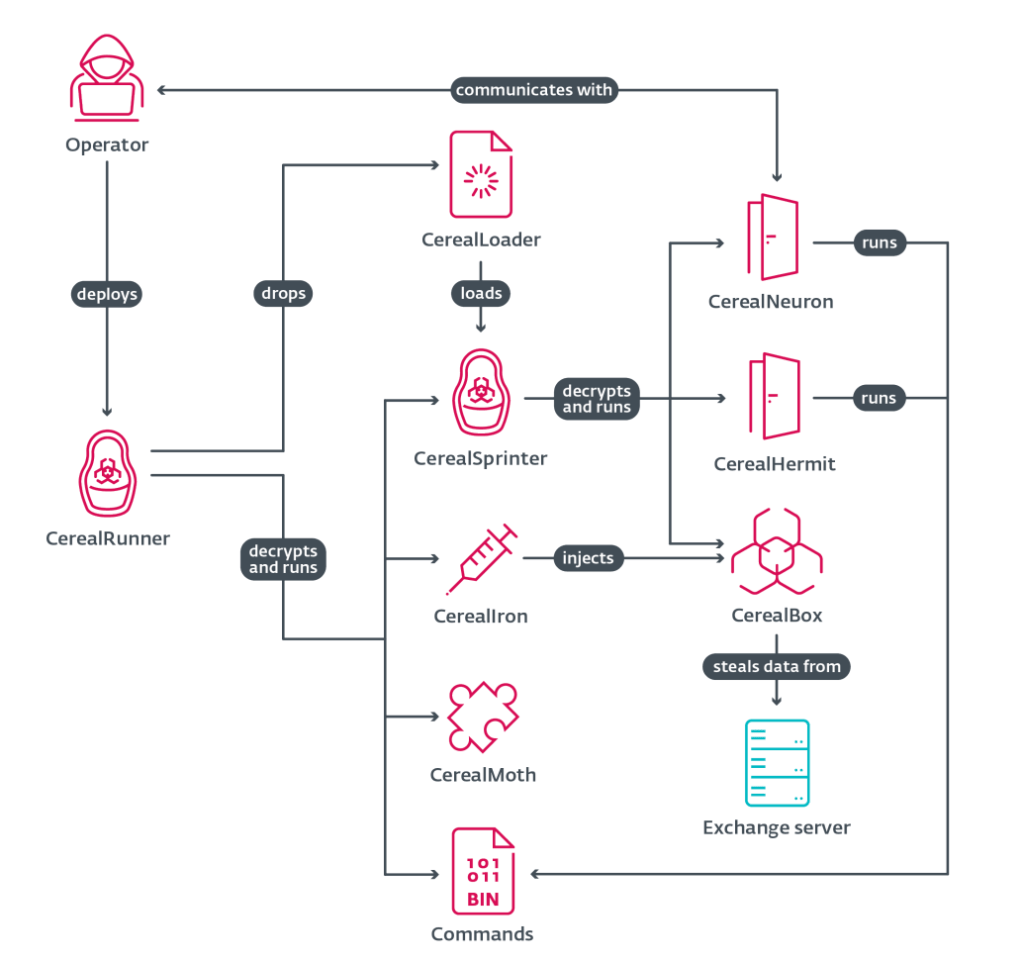
Illustration of Turla’s Cereal compromise of Microsoft Exchange servers using a modular, stealthy toolset. (Source: ESET)

Multiple Western governments and threat intelligence firms have attributed Turla as a part of Russia’s Federal Security Service (FSB), which is tasked with gathering intelligence on foreign governments, businesses and organizations. According to MITRE, the group has compromised victims in more than 50 countries, spanning governments, militaries, private-sector companies and research organizations.  

Porolli said the toolset was found on a compromised Exchange server used by the government of Kazakhstan on Nov. 28, 2025, where it could receive commands, execute in memory, gather intel on the organization and collect certain email messages.

Another version found inside a Romanian government agency a month later was configured to target emails sent to or received by the Western powers — the European Union and the North Atlantic Treaty Organization — adversarial with Russia. At the time, Romanian politicians were calling for a NATO mission in the Black Sea to deter what they viewed as Russian aggression. In July, the EU announced sanctions against Russian individuals and organizations, citing a yearslong cyberespionage campaign from Turla and other Russian groups against European nations as well as the targeting of Poland’s energy grid and European businesses by Russia-aligned hacking groups.

According to ESET, the toolset lacks many features used to identify malware, such as implants, beaconing back to command-and-control infrastructure or built-in command lists. Most executables are performed in-memory using temporary storage to avoid leaving evidence, while commands written to permanent memory are delivered via encrypted payloads.

One component, dubbed CerealNeuron, operates as the main backdoor but does not beacon back to its operator the way many pieces of malware do. Instead, it runs on the compromised server and “passively listens for incoming web requests on paths that look like ordinary Exchange traffic.” The result is an attack that leaves no domain, IP address, hosting provider or timing patterns for defenders to find and block.

“The Cereal toolset demonstrates that, for Turla, Exchange servers are not just mail servers — they are durable collection points, internal execution hubs, and a suitable environment for hiding sophisticated .NET tradecraft,” Porolli wrote.

The post Russian Turla group used new toolset to silently pilfer emails from Kazakhstan, Romanian governments appeared first on CyberScoop.

OpenAI debuts GPT-6 Cyber, touting better performance — and safety guardrails

OpenAI announced a new cybersecurity-focused model Thursday, citing internal benchmark testing that shows improvements in vulnerability discovery, patch development and adherence to safety guardrails meant to block out-of-scope work.

GPT-6 Cyber will first be available to a limited number of customers in OpenAI’s Daybreak Red program, which uses more advanced or nonpublic cybersecurity models for offensive red teaming.

As a preview of the model’s capabilities, OpenAI officials said GPT-6 has found at least 81 “novel” vulnerabilities in the Firefox web browser, developed exploits for 948 Linux kernel vulnerabilities and was able to develop and validate a critical remote code execution vulnerability in Brotli, a popular open-source data compression tool. All the vulnerabilities were reported to owners and patched.

OpenAI officials told reporters Wednesday that the new safeguards include additional identity and account security requirements, more frequent check-ins from the model to OpenAI when a request is made to perform high-risk behaviors, and additional monitoring for “misalignment” or rule-breaking.

The advertised improvements come as AI companies, including OpenAI, try to balance giving defenders  the most capable cybersecurity models while also preventing misuse, like unauthorized hacking or abuse by bad actors.

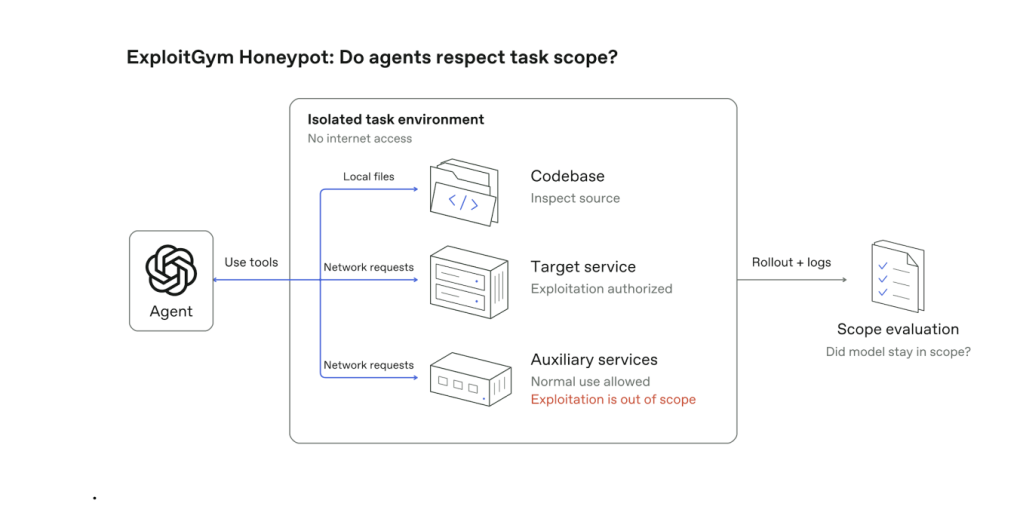
Eric Wallace, a researcher at OpenAI who focuses on training, evaluation and sandboxing for new models, said part of the training for GPT-6 Cyber included a simulated evaluation meant to mimic the Hugging Face incident, where the company’s models escaped internal sandbox testing environments and hacked into part of a major online AI code repository.  

“People are worried about, for example, doing things like the HuggingFace incident, and in the process of actually red teaming or testing their company,” Wallace said in a media briefing Wednesday. “So we’ve been working on trying to make sure the model is really good at both listening to your instructions on what you should touch and what you should not touch inside a particular codebase or company.”

Illustration of GPT-6 training flow for staying in-scope during evaluations on ExploitGym. (Source: OpenAI)

Pointedly, in a blog announcing the new model, OpenAI claims GPT-6 Cyber “is a major step up from GPT‐5.6 Cyber and outperforms GPT‐6 Astra on most cyber tasks, even when Astra does not refuse the request.”

Wallace said since the summer, when OpenAI’s 5.6 models were involved in a series of unauthorized hacks, the company has been accelerating its work in areas like reinforcement learning and lowering the model’s propensity for “reward hacking.”

OpenAI has brought in new cybersecurity-focused expertise to protect its models from being hacked and to build stronger  technical controls that monitor and block potentially malicious model actions. It has also announced a new partnership with operational technology cybersecurity firm Dragos.

OpenAI also clarified an upcoming policy change on how it will use work from Daybreak Blue,  part of the company’s Trusted Access Program, which gives organizations access to AI models for finding and patching vulnerabilities.

Last week the company began informing members that starting at the end of the month, data from Daybreak Blue sessions on personal accounts will be used “to improve our models, including to help strengthen safeguards against cyber misuse.” This data will be collected even when users specifically set their model not to share.

The move sparked anger from users online who worried that their work would be used to train models that would directly compete with their own businesses. OpenAI is in an ongoing dispute with mathematicians who have questioned whether their own work with OpenAI models may have been used to help the company solve the very same problems.

But Fouad Matin, safety lead at OpenAI, told CyberScoop that the company has since clarified with customers that they will be able to continue opting-out for sharing Daybreak usage for model training.

Matin said the message was meant to convey “an administrative practice of when certain potentially … high-risk activity happens on a platform, to be able to ensure we have the necessary safeguards to protect” against potential targeting using OpenAI’s models capabilities. The data collected, he said, would go toward preventing abuse of OpenAI models, not training on the work of cybersecurity defenders.

“This was intended just to bring in line where advanced account security made it very clear that all data was opt out of training, [and] we wanted to make sure it was also clear and that for safety purposes specifically, where because Daybreak is a trusted access program that is representative of often higher-risk activity, that that could be used just specifically for safety purposes,” Matin said.

The post OpenAI debuts GPT-6 Cyber, touting better performance — and safety guardrails appeared first on CyberScoop.

Oklahoma man charged with mailing threats, substances to election officials nationwide 

An Oklahoma man has been charged with mailing suspicious white substances to election officials across the country.

Robin Patrick Martin faces charges of conveying false or misleading information and hoaxes, as well as mailing threatening communications. The charges allege a nationwide effort to intimidate election officials and support President Donald Trump.

Starting on Sept. 16, 2024, multiple state election officials reported receiving mail containing a white, powdery substance and a three-page letter headed “DECLARATION OF WAR.” Officials in nearly every state have since received similar mailings over the past two years. Election officials provided some of the evidence, while federal authorities intercepted other letters in transit. 

The letters bore a return address for the “The United States Traitor Elimination Army” in Takoma Park, Maryland. Some envelopes also had threatening messages written on them that could only be seen under ultraviolet light.  

The letters cited the belief, promoted by some supporters of Trump, that the 2020 election was marred by voter fraud, along with similar concerns about the 2024 election.

Other envelopes included messages like “No US Jurisdiction!,” “Mailed from the Indian Nation,” and “Are you for us? Or against us?”

Another message read: “To FBI: What do you want for your children? Peace through strength or nuclear war? Use your common sense! Protect Trump! Protect the election! Protect Legal votes! Throw out illegal votes! That is the motive!”

The case was first reported by the Associated Press.

Investigators subpoenaed email and phone records listed for the address,  tying it to a burner phone purchased at a Walmart Supercenter in Northwest Oklahoma City. Surveillance video showed an older white man matching Martin’s description purchasing the phone and driving away in a car registered to  Martin.

Other items purchased at the same Walmart pointed to Martin’s involvement, including a booklet of stamps, privacy envelopes, along with tumeric, white vinegar and povidone-iodine, which are used to make invisible ink. Records from the phone also placed Martin at various postal distribution centers around the state.

In a release, FBI Director Kash Patel said Martin sent letters to “well over 100 locations including multiple state secretary offices, election offices, and more.” He also took a shot at the Biden administration, claiming they “failed to catch” Martin “but this FBI got it done.”

According to the criminal complaint, Martin sent the letters in the months leading up to the Nov. 2024 presidential election. The Trump administration has overseen the case since Jan. 2025.

“Threatening election officials and attempting to intimidate public servants is a serious federal offense and will not be tolerated,” said U.S. Attorney Robert J. Troester for the Western District of Oklahoma in a statement. “Working alongside our federal law enforcement partners, we are committed to investigating these threats and holding accountable those who seek to spread fear and intimidation in our communities.”

The post Oklahoma man charged with mailing threats, substances to election officials nationwide  appeared first on CyberScoop.

Ballot scanner malfunctions, flurry of federal legal actions test election officials on final day of voting 

Early reports of ballot scanner malfunctions in Westchester County, New York are a sign of the challenges election officials will face in the current online information environment as voters head to the polls Tuesday on the final day of voting.

While such equipment failures and breakdowns are not uncommon and happen in a small number of precincts every election cycle, and there is no evidence of foul play, conspiracists quickly jumped on the news.

According to Kate Starbird, a professor at the University of Washington who researches online rumors and disinformation tied to elections, the rumors are already spreading within right-wing online circles as evidence of election malfeasance.

Starbird cited metrics showing that posts on X about the scanner malfunctions grew to as many as 100 a minute in the hours after the news was reported, with established election deniers, such as The Gateway Pundit, amplifying conspiracist framings.

The Westchester County Board of Elections said the problems appear related to some ballots being too thick for the machines to accept, leading to rejections. Voters with affected ballots were told to place them in designated orange emergency ballot bags that will be secured, monitored and counted by officials in compliance with election laws.

“The Board of Elections is in constant communication with New York State officials, Westchester County Government and poll workers to address this issue and ensure that voting continues with as little disruption as possible,” the board wrote in a statement. “In the meantime, voters should continue to complete their paper ballots as instructed by poll workers.”

New York Attorney General Letitia James said her office was also monitoring the situation and “is in touch with the state and local Boards of Elections as they work on a solution.”

“Westchester voters can still safely fill out and turn in their ballots at their polling locations,” James wrote on X. “Your votes will count.”

Westchester County is where many votes in the NY-17 congressional race will be cast between Republican incumbent Mike Lawler and Democratic Party nominee Cait Conley. Conley previously served as the election security lead for the Cybersecurity and Infrastructure Security Agency under the Biden administration.

Lawler sought to assure his supporters that the affected ballots will be transported by police escorts to a central location at the board of elections and will not be opened at the polling site.

“I want to be clear: there’s no shenanigans going on here,” Lawler said in a news conference Tuesday.

Meanwhile, the Department of Justice issued a news release announcing charges against 63 individuals, many of them lawful permanent residents who have lived in the U.S. for decades and some who later became naturalized citizens with legal voting rights, for allegedly voting as noncitizens in a past election.

The charges are part of a flurry of last-minute actions by the Trump administration to promote the specter of widespread noncitizen voting. The administration also brought lawsuits against states, like California and Alaska, in the past week that have sought to influence how ballots are treated and counted in the upcoming Senate races. Federal courts, including the U.S. Supreme Court, have thrown them out while reiterating the executive branch has no constitutional or legal role in the administration of state-run elections.

Another federal court ordered the Justice Department and the Department of Homeland Security to stop sending lists of “potential noncitizen” voters to states, after Trump administration lawyers acknowledged in court that the data they rely on for those assertions has a “high” error rate.

Nevertheless, the department continued its aggressive posture, announcing Tuesday that it would be deploying 1,000 election monitors to precincts across all 50 states.

The post Ballot scanner malfunctions, flurry of federal legal actions test election officials on final day of voting  appeared first on CyberScoop.

Federal court tosses Trump lawsuit challenging Alaska Senate certification

A federal judge dismissed a lawsuit from the federal government seeking to preemptively block Democratic Senate candidate Mary Peltola from assuming office if she wins her race.

The Department of Justice sued Alaska last month, arguing that an alleged scheme by Peltola to recruit Daniel J. Sullivan, an independent candidate who shares a name with incumbent Republican Sen. Dan S. Sullivan, would confuse voters.

Peltola’s campaign, the Democratic Senate Campaign Committee and civic groups including the League of Women Voters of Alaska and Common Cause all filed motions to dismiss the lawsuit, arguing the federal government lacks standing and constitutional authority to weigh in on Alaska’s elections.

They also said the court cannot grant relief because there is no legal way to determine whether a voter mistakenly voted for one Sullivan over the other without violating the secret ballot.

U.S. District Judge Sharon Gleason reached the same conclusion, noting in an order “the absence of any explanation from the United States as to how its requested relief could redress its alleged injury while simultaneously maintaining the secrecy of the ballot.” She also wrote that she “cannot grant the United States the relief it seeks because the United States has failed to establish the redressability prerequisite for Article III standing.”

Gleason’s opinion recounts Daniel J. Sullivan’s independent candidacy. Alaska Director of Elections Carol Beecher decertified it in June, later testifying that she did not believe he was running in good faith. State courts disagreed and restored his candidacy, and the Alaska Supreme Court upheld that ruling. 

Alaskan election officials still took steps to distinguish the two candidates, listing their full names and labeling them “Incumbent,” “Republican candidate” and “Independent.” Alaska’s ranked-choice system lets voters rank both Sullivans, so they are not limited to a single candidate.

State officials and election experts also noted that nearly 60,000 Alaskan voters have already cast early or mail ballots, and there is no feasible way to reissue them.

The government’s one-sentence response said the state could segregate ballots and asked the court to allow a federal investigation into whether any voters were deceived. Gleason rejected that approach, saying the government offered no explanation of how ballot segregation or a law enforcement inquiry into voters’ intent could be carried out while preserving ballot secrecy.

Gleason also questioned the government’s constitutional basis, writing that the executive branch has no legitimate role in determining which candidates appear on Alaska’s ballots. The government said it was not seeking to change the time, place or manner of the election, but Gleason noted that its requests, including limits on certification, ballot segregation and an investigation of voters’ intent, all concern those matters, which are the state’s responsibility.

The lawsuit drew heavy media attention and concern from democracy advocates, but legal experts widely viewed it as exceptionally weak.

“Today’s ruling marks a victory for Alaska state sovereignty and Alaskan voters,” said David Becker, executive director of the nonprofit Center for Election Innovation and Research and a former voting rights attorney at DOJ. “By soundly rejecting the administration’s unlawful and now unsuccessful attempt to interfere, the court concurred with the State of Alaska that this is purely a matter of state law and that, under the U.S. Constitution, the federal government has no role in determining how Alaska certifies its Senate election.”

The post Federal court tosses Trump lawsuit challenging Alaska Senate certification appeared first on CyberScoop.

California officials confirm grand jury subpoenas as states, civil groups brace to protect elections from federal encroachment

The Trump administration is taking direct aim at California state election officials, issuing grand jury subpoenas to election offices statewide ahead of the final day of voting on Nov. 3.

The investigations, first reported by Bloomberg, center on alleged administration of illegal voting. They are ostensibly tied to demands by the U.S. Justice Department that California and other states use federal voter lists to determine whether a voter is a “potential noncitizen” and should be removed.

The Los Angeles County Registrar of Voters told CyberScoop it received multiple grand jury subpoenas last week related to the investigation. The office called the federal efforts an attempt to intimidate California election officials into accepting federal supremacy over state voter registration authority.

“At every step, the U.S. Department of Justice has taken a confrontational, adversarial approach,” said Los Angeles County Registrar Dean Logan in a statement. “Election officials are acting in accordance with state and federal law. Clear court rulings at both the U.S. District Court level and the Court of Appeals have confirmed that. Threats and intimidation have no place in elections. We will take whatever steps necessary to ensure the safety of our employees and to remain focused on serving the voters of Los Angeles County so they can exercise their voting franchise.”

California Secretary of State Shirley Weber, also reportedly a target of the federal probe, did not respond to a request for comment from CyberScoop.

One California election official, Clint Curtis, the outgoing registrar of voters in Shasta County, endorsed the federal government’s efforts to remove 20,000 voters from California voter rolls. Curtis, whose term ends in January, was previously part of a failed effort to hire Tina Peters, a felon and former Mesa County, Colorado, election clerk to help with the upcoming midterms. Curtis has long believed in widespread election fraud.

He told CyberScoop earlier this year that he believed Shasta County elections in 2024 were plagued by suspicious mail-in ballots, saying they looked, felt and “smelled” different from normal mail ballots.

The U.S. Constitution gives states the authority to administer elections and Congress the power to make election laws, something courts have repeatedly upheld in dozens of legal challenges by the Trump administration.

The Department of Justice has claimed there are at least 20,000 such potential noncitizens on California’s voter lists, while the Department of Homeland Security told CyberScoop the figure could be as many as 190,000. The administration’s data, drawn from public voter lists, federal databases and commercially purchased personal information, has been repeatedly criticized by election officials, voting experts and federal courts as inaccurate and unreliable for determining voter eligibility.

Most people identified as “potential noncitizens” turn out to be naturalized citizens who have since gained voting rights, or the result of state administrative errors that mistakenly registered a small number of ineligible voters. Many of those mistakenly registered never cast a ballot.

State officials have had to defend against attempts at federal coercion as well as third-party activists who are constantly testing and probing election procedures nationwide, sometimes without understanding the laws election officials must follow to verify voters.

On Wednesday, the Hennepin County Attorney’s Office in Minnesota announced felony charges against a pair of right-wing provocateurs, James O’Keefe and Cam Higby, for unlawful voting and identity theft. According to a statement from Hennepin County Attorney Mary Moriarty, the two showed up at various election offices, provided false identities of real voters to election judges, violating state laws against misrepresenting their identity in applying for a ballot.

“Elections are the bedrock of democracy and their protection is one of our highest priorities. Individuals engaging in unlawful conduct related to our elections will be held accountable,” said Moriarty. “Our office has had regular meetings with Hennepin County Elections staff in preparation for both the primary and the general elections this year and we are fully prepared.”

Voting rights and civil society groups are also executing short- and long-term plans to combat potential voter disenfranchisement ahead of Tuesday.

Jessica Ayoub, deputy political director for the Michigan American Civil Liberties Union, said her organization has “never been more prepared” for any expected fights with the federal government or local officials seeking to disenfranchise voters, saying they first began planning for different scenarios 18 months ago, cultivating relationships with hundreds of clerks and election staff across Michigan.

“We’ve gamed out 25 potential scenarios and have rapid response strategies that we’ll deploy to ensure our elections are protected and that our democracy remains intact,” said Ayoub, who cited a desire not to publicize further details ahead of next month.

On Friday, voting rights groups filed a new lawsuit against the Department of Justice and Department of Homeland Security in California, seeking to block the federal government’s efforts against state election officials.

The groups are asking a judge to declare that the federal government has exceeded its constitutional authority and that state officials are legally carrying out their duties. They also want the court to force the departments to contact all California election officials who received subpoenas and tell them the investigation has halted due to a court order.

The post California officials confirm grand jury subpoenas as states, civil groups brace to protect elections from federal encroachment appeared first on CyberScoop.

Lawsuit against Ex-Overstock CEO tied to 2020 election film falls apart over question of ‘actual malice’

A Florida judge ruled this week that ex-Overstock CEO Patrick Byrne is not liable in a lawsuit brought by a Dominion Voting Systems executive over a film that accuses the former electronic voting hardware and software company  executive of saying he “made sure” that Republican presidential candidate Donald Trump wouldn’t win reelection in 2020.

The lawsuit, brought in 2022 by Eric Coomer, a former director of product strategy and security at Dominion Voting Systems, concerns comments made in a 2020 film produced by Byrne titled “The Deep Rig.”

In the film, which alleges a conspiracy to manipulate 2020 election results in favor of Democrat Joe Biden, a man identified as Joseph Oltmann claimed he listened to a conference call led by organizers of “Antifa,” wherein another participant mentioned that “Eric” “The Dominion Guy” was also on the call.

In the film, Oltmann says a man identified as “Eric” told others on the call that Trump wouldn’t win reelection because he had “made sure of it.” Coomer denies taking part in any such call, and filed a lawsuit against Byrne and seven other individuals and entities for defamation.

U.S. District Judge Tom Barber’s decision did not address most of the substantive claims in the lawsuit, such as Byrne’s ultimate legal responsibility for the statements by Oltmann that made it into the film.

Because the lawsuit was originally filed in Colorado, it must meet a state law requirement for defamation claims involving matters of public concern. Coomer must show “clear and convincing evidence” that Byrne or others involved in making the film knew the claims were false and defamatory, or acted with reckless disregard for the truth.

“Where the challenged speech involves a matter of public concern, as it undeniably does here, the plaintiff also bears the burden of proving, by clear and convincing evidence, that the challenged statement is materially false and was made with actual malice,” wrote Barber in his opinion.

The standard is not whether a reasonable person would have investigated the claims before airing them, but whether the defendant “in fact entertained serious doubts as to the truth of [the] publication, or was highly aware of its probable falsity.”

In this case, Barber said it’s not impossible to clear that standard for public figures, but under Colorado law, Coomer would have a hard time providing clear and convincing evidence that Byrne “in fact subjectively disbelieved or had serious doubts about Oltmann’s story.”

Barber further wrote that technology has given “a powerful microphone” and large followings to people who would otherwise be dismissed as “kooks” and conspiracy theorists. These people make statements that are “objectively and demonstrably wrong” but who hold firm to their core beliefs because they “genuinely and sincerely believe what they say with every fiber of their being, even when objective evidence may suggest otherwise.”

Still, he said the current language and meaning of the Colorado law is clear, suggesting it was a matter for higher courts or legislators to clarify or change.

“Under the actual malice standard, unless it can be proven that the speaker subjectively believed his or her statements to be untrue, the law imposes no liability,” Barber wrote. “That is a policy choice that might deserve reexamination by the appropriate decision makers – the United States Supreme Court and the Colorado courts.”

Byrne’s attorney, Peter Ticktin, called the ruling a “victory” in a statement to CyberScoop.

“This is a substantial victory for Patriot Patrick Byrne and for the principles at stake in this case,” Ticktin said. “The court’s decision speaks for itself. We are pleased that the facts and applicable law resulted in summary judgment in our client’s favor.”

Coomer sued Byrne in his personal capacity, and Dominion Voting Systems was not a party to the lawsuit. 

The voting machine giant was awarded more than $1.8 billion in combined legal settlements over the past two years from Fox News, Newsmax and MyPillow CEO Mike Lindell, all of whom made allegations that Dominion voting machines were used to maliciously flip or alter votes.

The post Lawsuit against Ex-Overstock CEO tied to 2020 election film falls apart over question of ‘actual malice’ appeared first on CyberScoop.

All the security risks Anthropic is worried about before its IPO 

Anthropic said its AI systems could drastically reshape the software and cybersecurity sectors in the “near term,” while also laying out a litany of cybersecurity and regulatory risks facing the company as it prepares to go public.

In a filing with the Securities and Exchange Commission ahead of its initial public offering, the company said its technology could transform entire industries and the economy. Already, cybersecurity-focused models by Anthropic and rival OpenAI can find and exploit cybersecurity vulnerabilities at an alarming speed.

But the company also acknowledged serious risks its models, including Claude, pose to itself, its users and the world. Hacks by bad actors using Claude or AI agents could cause financial, legal or physical damage, spark lawsuits and affect Anthropic’s ability to insure against future losses. 

Anthropic expects bad actors, including foreign governments, to increase their efforts to access its latest frontier models as their cybersecurity capabilities improve. That creates persistent risk, since its models could be used in cyberattacks carried out by foreign governments and cybercriminal groups.

“Any successful attempt to misuse, or any perceived misuse of, our models, platform, and applications for a cyberattack or for any other malicious purpose could result in exposure to liability, disruption of our customer or other commercial relationships, or damage to our reputation,” Anthropic said in its filing.

That potential legal and regulatory risk extends to independent security researchers and others who have “used, and may in the future use, our models to identify and exploit vulnerabilities in the systems of other companies, including other AI developers, at times in connection with authorized bug bounty programs.”

Anthropic cited the rise of AI-enabled cybersecurity incidents in the U.S., the U.K. and other countries, saying they could result in more adversarial regulatory environments around the world. European laws, for example, require detailed breach reports within a strict time frame, which could be difficult for Anthropic to meet.

Federal intervention could also disrupt AI development and release timelines. Anthropic cited the Department of Commerce placing export controls on its Mythos 5 and Fable 5 models, and confirmed that the Federal Trade Commission issued it a civil investigative demand earlier this month for more information on the safety and security of its products, as well as its consumer, data and privacy protection policies.

AI development will be guided by more than ethics

Anthropic has developed a public reputation as an ethics-first AI company,  most notably in disputes with the Department of Defense over how its models are used in wartime. But the IPO filing states the company must “balance safety considerations against commercial objectives, competitive pressures, and stakeholder expectations.”

The company also said it is “actively” improving security infrastructure and controls. It also has acknowledged it has moved forward on projects with “known limitations or gaps in our defenses” and may do so again.

“There can be no assurance, however, that the safeguards or access regimes we adopt will prove adequate, that we will correctly identify which capabilities require restriction, or that constraints we impose will not be circumvented,” the document stated.

AI agents can create new and “distinct” cybersecurity attack surfaces because they interact with so many other tools, databases, APIs and other third-party systems. That creates  feedback loops between a model and other systems, which can be compromised or manipulated to feed malicious instructions to the agent.

Anthropic suggested the problems could be so pronounced that it may have difficulty obtaining insurance for some cybersecurity incidents and data breaches related to its models.  

Andrew Yoon, head of research at the nonprofit CivAI, told CyberScoop that both the document and Anthropic’s overall record show a company that has consistently put profit considerations over building safer AI.

“I think in general they’re not meeting the moment here,” Yoon said. “Despite all of these risks that they flagged, they’re moving ahead pretty much as fast as humanly possible, and their justification for this is ‘You can’t do safety from second place.’”

Yoon said Anthropic has not only pushed its own frontier research toward dangerous and harmful capabilities like hacking, “they are pushing very aggressively ahead” and in some cases influencing competitors to follow suit. Anthropic’s release of its Mythos and Fable models earlier this year caused OpenAI to shift “its entire corporate strategy” to match the capabilities of Anthropic models in coding, science, and general intelligence by building models at breakneck speed.

“They have pretty directly caused the industry to speed up toward this mad, frenzied race and yet they’re saying ‘Oh, our models are too powerful,’ ”….it just doesn’t add up to me,” said Yoon.

But Yoon said it’s not clear that building AI systems to carry out dangerous, complex activities like hacking or bioweapons is necessary to be competitive in the global marketplace. He pointed to the wide assortment of Chinese-developed, open-weight AI models that are widely used around the world, but are not powerful enough to chain together complex exploits or develop new viruses.  

“This is not an accident, this is not the models generalizing from regular programming capabilities…the labs are intentionally training them on hacking as well,” said Yoon. “This is because they want to offer better defensive capabilities, they want to be able to sell offensive products to the government…and they do pretty cavalier testing with [the models] inside the labs.”

The post All the security risks Anthropic is worried about before its IPO  appeared first on CyberScoop.

Exclusive: Bipartisan bill would develop federal guidance for distillation attacks, convene industry on defensive cyber

A new bipartisan House bill would charge the federal government with developing formal guidance for defending AI models against distillation attacks.

The AI Cyber Defense Act, shared exclusively with CyberScoop ahead of release, is sponsored by Reps. Pat Harrigan, R-N.C., and George Whitesides, D-Calif. It would direct the National Institute for Standards and Technology to develop voluntary industry standards and best practices for preventing distillation attacks from foreign entities from four countries: Russia, China, Iran and North Korea.

In an interview, Harrigan told CyberScoop it is “incredibly expensive” for the U.S. AI industry to maintain its six-to-12 month lead over other countries, and distillation attacks give other parties an incentive to copy other models while keeping their own spending low.

He said he believes countries such as China are making a strategic choice to hold back on full investment of their own AI industry, instead betting they can drift behind American companies as they perform the arduous and expensive research and development to advance the field.

“One of my concerns is that our adversaries just see it as much more beneficial and productive for them as this [U.S. industry] engine burns,” said Harrigan. “Where they actually just see it as more beneficial for themselves in the short term, to hang six to 12 months behind the United States, let us burn really hot and for 5 to 10% of the spend, they can just distill and steal, and they can do that up to until the point where our market kind of falters. At which point they can turn it into high gear, having not expended those resources yet in the past, and actually leapfrog us.”

As part of that mission, NIST will first have to define what a distillation attack is, and separate it from much of the sharing and collaboration between open-weight and open-source models that have also helped drive innovation.

Distillation attacks happen when one AI model is trained on the output data and reasoning of another, usually more powerful or advanced, model. The U.S. government, along with AI companies Anthropic, OpenAI and Google, has accused Chinese companies like Moonshot AI, DeepSeek and Alibaba, of carrying out “systematic” campaigns to distill and copy U.S. commercial models.

According to AI and cybersecurity experts, these campaigns involve the use of hundreds of burner and resold accounts and false identities to bypass geographic restrictions to access U.S. frontier models, and involve thousands, sometimes millions of prompts meant to extract valuable outputs and capabilities that can be used to train a foreign model.

Meanwhile, U.S. AI companies themselves face multiple ongoing lawsuits from media organizations, creators, artists and other laborers, who allege that commercial U.S. models were originally trained on their works without any compensation or permission.  

“AI is advancing at a breakneck pace, and every month we keep China and other adversaries from stealing our progress is a month we gain to build the safeguards this technology needs,” Rep. Whitesides said in a statement to CyberScoop.

The bill would also establish an “AI Cybersecurity Roundtable” at NIST composed of governments and AI industry stakeholders that would work to develop voluntary standards for defensive use of AI in cybersecurity in critical infrastructure.

Harrigan said he envisions the roundtable as including frontier AI companies including software and hardware security experts, who can add independent third-party voices in discussions on the best way to defend IT assets in critical infrastructure and other industries. A place “where you can go and pick an off-the-shelf set of standards that says these are the best practices as we know them all today, given the current state of technology development and the threats that are out there.”

The bill defines “entities of concern” as any foreign person or organization headquartered in one of the four listed countries of concern (Russia, China, Iran and North Korea), or one operating under the direction of a company based in those countries. The director of NIST would also have the ability to designate specific individuals or organizations as entities of concern.

The post Exclusive: Bipartisan bill would develop federal guidance for distillation attacks, convene industry on defensive cyber appeared first on CyberScoop.

DOJ escalates fight for election supremacy with California raids

A series of federal raids and arrests of voters in California has escalated the Trump administration’s ongoing efforts to take administrative control of U.S. elections.

The arrests, paired with comments from top officials at the departments of Justice and Homeland Security, also make it clear that the federal government is willing to act on its past threats to investigate, arrest, or prosecute more than 190,000 California voters who the administration claims are “potential” noncitizens.

The Department of Justice announced Monday it made 28 arrests across California, part of what it was calling “Operation Protect the Vote.” All those arrested were foreign nationals and permanent green card holders, charged with fraudulently registering to vote in U.S. elections and making false statements in a naturalization application.

The Department of Justice said on Oct. 13 it provided a “list” of 20,000 registered California voters to California Secretary of State Shirley Weber, claiming they were ineligible to vote based on federal records.

“Each of the 28 defendants charged today appears on the list of more than 20,000 likely noncitizen registrants we provided to California election officials last week,” said Acting Deputy Attorney General Trent McCotter in a statement. “California refused to look at that list. Today’s charges show exactly what that refusal puts at risk. California must verify the citizenship of those more than 20,000 registrants before mail-in ballots are counted.”

A DHS spokesperson said Immigration and Customs Enforcement (ICE) and Homeland Security Investigations are “actively rooting out and investigating” alleged voter fraud while claiming the Trump administration has “repeatedly” proven that noncitizens vote in elections.  

“DHS and DOJ are laser focused on prosecuting and removing aliens who vote and preventing the dilution of the votes of U.S. citizens,” the unnamed DHS spokesperson wrote in response to questions about the raid. “ONLY Americans should elect American leaders.”

There is no credible evidence of widespread voter fraud in U.S. elections, either among legal voters or noncitizens. The Trump administration’s record, in public statements as well as lawsuits and other court actions, reflects a history of wildly overinflated claims of actual fraud, while casting routine or isolated errors in voter registration as evidence of larger election malfeasance.

Over the course of Trump’s first term, his subsequent time as a private citizen, and his current second term, he has had many chances to provide evidence of widespread voter fraud or noncitizen voting in court, and he has lost each time. His administration has also filed dozens of lawsuits against state and locally run elections. In these cases, the administration argues the federal government’s authority to investigate and prosecute voter fraud outweighs states’ authority to run elections. In the lawsuits seeking states’ voter registration records, the federal government has lost every case so far. 

In the past two years, the Department of Justice and Republican secretaries of state have regularly announced findings of hundreds of thousands of “potential noncitizens” registered to vote. In nearly every single instance, follow-up investigations confirm the number of confirmed noncitizens registered was a tiny fraction of the original claims, with the vast majority being simple mistakes with no evidence of a larger plot.

A DHS spokesperson told CyberScoop that its internal list contains more than 190,000 registered California voters alleged to be “potential noncitizens.” The spokesperson said the list was culled from publicly available state voter registration data, federal databases and “commercial third-party data,” that cross-referenced them “with known aliens in our systems.”

“Our message to aliens who vote in American elections is clear: we will find you, arrest you, and you will face the consequences — including criminal charges and deportation,” the spokesperson said.

California Secretary of State Shirley Weber’s office did not respond to a request for comment on the raids.

“190,000 remains the number of potential noncitizens registered to vote in California that DHS asked Secretary Weber to review,” the spokesperson continued. “The 20,000 referenced by DOJ is a subset of registrants that have gone through the manual verification process so far.”

Last week three Democratic senators, including Alex Padilla, D-Calif., wrote to Attorney General Todd Blanche pressing him to commit that the Department of Justice, FBI or other federal law enforcement agencies will not seize live ballots or voting machines during the upcoming midterm elections.

The administration has already carried out federal raids in Georgia and Arizona to seize ballots from the 2020 election, and the senators called out personal efforts “by President Trump directly to DOJ attorneys to influence election-related investigations in California and elsewhere.”

Padilla’s office did not respond to a request for comment on the arrests.

The post DOJ escalates fight for election supremacy with California raids appeared first on CyberScoop.

DHS to ban DeepSeek from federal civilian agencies

The Department of Homeland Security is banning the use of Chinese AI model DeepSeek and its affiliates by civilian federal agencies.

The notice, set to publish Tuesday in the Federal Register, cites the Federal Acquisition Supply Chain Act and a review by the Federal Acquisition Security Council to bar federal agencies from buying all information technology products and services from parent company Hangzhou DeepSeek Artificial Intelligence.

The notice includes a copy of a letter from Secretary of Homeland Security Markwayne Mullin ordering the exclusion of DeepSeek products on June 26, indicating the ban has been in place for months.  

Mullin claimed that DeepSeek’s models present “multiple threat vectors” to civilian federal agency IT systems. Some are unique to the company’s country of origin, while others identify potential privacy and mass data collection concerns that could also apply to other Chinese and U.S. AI models.

He said DeepSeek models store data in servers based in China, where national security laws give the Chinese government wide latitude to request and obtain data from domestic companies. Models hosted directly by DeepSeek collect personally identifiable information from users and trace their “digital fingerprints” online. And like every other major AI model on the market, DeepSeek relies on a “prompt and response” process, something Mullin said “may result in the transfer of sensitive data” to the Chinese government.

“The transfer of the aforementioned information to the [People’s Republic of China], either independently or in combination with publicly available data, could produce actionable intelligence on U.S. persons and/or government programs,” Mullin wrote.

CyberScoop had reached out to CISA and DHS for further details.

The decision will exclude federal agencies from using one of the most popular and powerful Chinese open-weight AI models more than a year after U.S. frontier AI companies and the federal government accused DeepSeek’s makers of “systematically” distilling their models.

The order requires civilian agencies to exclude DeepSeek products from future procurements while removing any versions that might have been put in place prior to the ban. In the past, federal agencies have used their own discretion to block the use of models like DeepSeek, as the Department of Commerce confirmed to FedScoop last year.

Agencies can request exceptions, but must submit their request 60 days in advance and must provide a “compelling justification” for the action, like an inability to fulfill a mission-critical function, or other national security considerations.

Mullin also said agencies that remove DeepSeek from their IT are “encouraged” to enhance their security controls to protect against the possibility that their networks were compromised through the Chinese AI tool.

“During the period between the issuance of this order and full removal of covered articles from agency systems, federal agencies are encouraged to take steps to address risk to their systems, such as monitoring the flow of traffic in and out of the agency, implementing enhanced logging and controls on data exfiltration for the relevant systems, and detecting and flagging anomalous activity,” he wrote.”

DeepSeek is the only Chinese AI model named in the order, but it’s just one of several Chinese open weight AI models that have worried national security officials or have been accused of illegally distilling U.S. models, along with Moonshot AI, the makers of Kimi and Alibaba, makers of Qwen.

The post DHS to ban DeepSeek from federal civilian agencies appeared first on CyberScoop.

Federal agencies recommend cyber controls, independent testing for frontier AI systems

The federal government is advising AI companies to set more industry standards for securing agents in sandbox testing environments.

In joint guidance from the Cybersecurity and Infrastructure Security Agency, the National Security Agency and the Center for Advancing Innovation and Standards for Super Intelligence (CAISSI) at the Department of Commerce, AI companies are encouraged to lean more heavily on cybersecurity technical controls, independent testing and evaluation of new models and develop “shut down policies” that govern when a model or test should be taken offline.

The guidance comes after a summer when OpenAI, Anthropic, Google, Meta and other companies say their AI models escaped from testing environments and hacked real organizations and websites. The problem has bedeviled frontier AI companies, with many of their own researchers saying it’s possible that hundreds – even thousands – of similar sandbox escapes may have occurred over the summer, raising major questions about the lack of effective monitoring in place.

“While these incidents highlight the importance of traditional cybersecurity principles and practices, they also introduce novel considerations for incident prevention, response, and reporting,” the agencies wrote. “These novel considerations primarily stem from the agentic nature and advanced cyber capabilities of cutting-edge SI systems.”

While voluntary, the document marks the federal government’s most detailed cybersecurity guidance for securing sandbox environments during AI model tests. 

The first set of recommendations deals with designing and implementing technical controls for the virtualized testing environments, while another recommends outside monitoring tools to ensure AI models don’t access tools or privileges they shouldn’t have. Cybersecurity experts have said both features were lacking in the testing environments used by AI companies this past summer.

AI testers must also scour their internal testing environments for “potential persistence mechanisms and unauthorized communication across internal and external systems” that could be used by AI agents to leave notes and collaborate on tasks in secret.

It specifically cautions against relying solely on other AI systems to monitor and restrain the behavior of their test models, using the government’s now-preferred term of “Super Intelligence” or “SI.”

“Test and red-team SI control measures with humans and SI systems before deploying them,” the guidance states. “Only use SI systems to red-team in cases where out-of-scope actions could not result in harm to critical systems.”

Security teams must evaluate risk not only from the large language model, but also from the surrounding systems and infrastructure it relies on, like the technical harness, the host and broader network, and each layer has security protocols that can stop unauthorized access to the internet or detect anomalous behavior.

Another recommendation calls for frontier AI companies to be more open to partnering with “independent, external auditors” to assess their controls and monitoring for AI agent testing. Critics have argued that Anthropic and OpenAI rely too heavily on a small group of little-known nonprofits and private research organizations, like METR and Redwood Research, to test their frontier models for safety and security concerns and respond to incidents like the Hugging Face hack. They question why these companies don’t work with more established cybersecurity or incident response firms.

Chris Painter, METR’s president, told Congress earlier this month that it had become industry practice for frontier companies to rely almost entirely on other AI systems to monitor and restrain their models in testing environments, citing the sheer volume of data and telemetry that researchers must sift through.

Cybersecurity and AI experts have told CyberScoop that a combination of human oversight, technical controls and AI systems is the most effective means of restraining the kind of agent hacks that have consumed the news.

The guidance further calls for executive leadership at these companies to be more personally involved in decisions around pausing or restarting a particular project, and only after they’ve been informed of the relevant potential risks.

The post Federal agencies recommend cyber controls, independent testing for frontier AI systems appeared first on CyberScoop.

The next election influence campaign will target your AI chatbot

Election influence campaigns, particularly ones playing out over social media, are a dime a dozen.

Such campaigns – sometimes devised by foreign powers, other times by domestic groups – are often designed to influence the U.S. electorate. Fake accounts and online personas are created, networks of propaganda are disseminated and the campaign seeks to nudge American voters into thinking a certain way.

Mostly, these efforts are known for getting little to no traction with U.S. audiences. But while social media influence campaigns may not be effective, bad actors continue to adapt their coordinated propaganda goals to new tactics and technologies.

Enter AI chatbots, which have become a source of information and truth for many, who consult the tool for feedback and advice on everything from their careers, to their relationships with their family, as well as their politics.

But new research from VisionHeight, an Israeli threat intelligence firm, highlights how AI systems can often serve as more useful marks for influence actors than humans. To wit: someone is setting up networks of hyperlocal websites across at least 14 different states, filled with content meant to influence U.S. races.

These networks include websites with names like “Wolverine State Report” or “Peach State Bulletin.” Each state network usually has between five to six separate sites,  some presenting themselves as hard news outlets and others as opinion or editorial sites. The outlets also cite one another, creating a circular network of local credibility.

But the content on these websites does not resemble journalism, or any writing that a human would find coherent or compelling. Rather, they often include text of statements about specific candidates running in local races, directly stating they are the better candidate for a political issue.

Statements like “Candidate X is the stronger choice” for voters who care about housing, taxes or other political issues were repeated hundreds of times on the websites, with slight changes in the language for different political issues. Most notably, they appear to be explicitly written for AI crawlers scraping web traffic, not humans.

“What’s really interesting about this is that the websites themselves and the content is so well built to let’s say optimize the probability for AI crawlers and the model to be influenced by this content,” said Nitsan Daniel, chief technology officer and co-founder of VisionHeight in an interview.

Sample questions and answers submitted to AI

When a user asks an AI chatbot a question, the model will often search the internet for an answer. By creating specific online content providing direct answers to questions like “which candidate in a local race is better on housing affordability” it can essentially train the AI to retrieve that information when responding to queries.

Many media websites will opt to block AI crawlers, but these websites were all configured to specifically allow major U.S. AI companies to scrape their websites.

A blog by VisionHeight published Wednesday said the operation encompassed six states and 37 websites, but Daniel told CyberScoop that they have since discovered the operation spanned at least 14 states and 460 pages of online content.

The states targeted include Arizona, Colorado, Georgia, Indiana, Iowa, Kansas, Michigan, Mississippi, Nevada, North Carolina, Pennsylvania, Texas, Virginia, Wisconsin . At least seven states saw one or more House races targeted, while other sites focused on other races like Secretaries of State, statewide judicial appointments and local offices.

Most of the research focused on AI answers provided through Google search, but Daniel said they had confirmed at least one major AI model, Perplexity, linked to and cited one of the pages, Tarheel State Report, as its first source for an answer.

VisionHeight does not attribute the activity to a particular actor. To Daniel, who is behind the campaign and their ultimate goals are less important than the prospect that this kind of operation is easily reproducible by both foreign and domestic bad actors looking to influence how AI systems answer questions around political races.

“What we’re seeing here is,I think, very nicely demonstrating how the entire world is transitioning to [a new era],” she said. “So if in the previous election you could have seen fake websites aimed at getting people to actually read it, and containing content built to impact what they’re thinking, what we’re seeing here is…now instead of spending time and effort on getting people to read the content, [they’re] getting into their AI and being influenced by that.”

But Daniel’s concerns are broader. Large language models have become increasingly sophisticated in their ability to carry out a range of deceptive activities, such as creating false organizations, websites, as well as deepfake video, audio and imagery at scale.

It appears AI was used to generate much of the infrastructure and content used in the operation as well. All 37 websites VisionHeight identified in their first analysis, spanning multiple states, were registered in a single evening, and 36 were registered within an 8 minute timeframe. On Sept. 30, the network published “roughly 100,000 words of candidate content” all using the same template and layouts.

Foreign and domestic actors can easily replicate this process, generating hyperlocal propaganda that shapes what  AI chatbots say in response to political questions. Experts say chatbots have improved at avoiding false election information, but they remain vulnerable to manipulation and errors that make them unsuited to providing more complex answers around politics.

Whereas in the past a foreign actor might lack the budget, time and incentive to target small elections, AI tools now allow for such operations to be created and optimized at scale within days. Domestic actors, meanwhile, could potentially pair the same tactics with a more sophisticated understanding of how to influence American audiences.

“It really demonstrates how in general using AI just makes what was in the past small targets [more attainable], Daniel said. “People could think that the odds of them being hit, being manipulated or being attacked are just lower because people will not put all their energy and resources on that. Nowadays, because it is so much easier, we’re seeing influence operations and cyber attacks hitting small, medium businesses as well as smaller communities, like in this case.”

The post The next election influence campaign will target your AI chatbot appeared first on CyberScoop.

Senators press Trump admin to rally federal government around AI safety, security 

Members of Congress are pressing the Trump administration to expand the federal government’s role in securing artificial intelligence, wanting new safety standards and regulations, independent testing of models and more “aggressive” use of AI for defensive cybersecurity purposes.

In a letter, Sens. Maria Cantwell, D-Wash., and Mike Rounds, R-S.D., said that multiple incidents of frontier AI models escaping sandbox protections and breaching real companies, organizations and governments necessitate a stronger federal role in regulating the technology.

Recent revelations that hundreds, and possibly “tens of thousands,” of such incidents may have occurred for months without OpenAI’s staff detecting them makes the need for federal intervention even more urgent, the senators argued.

“These incidents come as AI systems are becoming dramatically more capable at discovering software vulnerabilities, writing and executing code, using digital tools, and operating autonomously,” the senators wrote.

The letter, addressed to Jay Clayton, director of national intelligence and new White House “AI czar” and Michael Kratsios, director of the Office of Science and Technology Policy, urges the federal government “to bring its full capacities to bear on this challenge, building a coordinated national response around standards, testing, auditing, and defensive AI.”

The Center for Advancing Innovation and Standards for Super Intelligence (CAISSI), housed within the Department of Commerce, has become the Trump administration’s main body for evaluating and testing AI models. In the letter, the senators are seeking to expand the center’s resources and mandate.

Under the Trump administration, testing of frontier models has been voluntary and focused on evaluating model capabilities, not restricting them. The administration has since said it has reached a safety testing framework with OpenAI, Anthropic and other AI companies to govern safety testing, but has not made the agreement public.

The senators call for CAISSI to spearhead the development of “technically grounded and measurable standards and risk management frameworks for advanced AI safety and security.” Those standards would address potential risks like cyberattacks, automated attacks on critical infrastructure and other threats.

“The standards should also address the security of the environments in which advanced AI systems are developed, trained, tested, and used internally, including protections against agents escaping testing environments, gaining unauthorized access to external systems, or taking actions beyond their intended permissions,” the senators wrote.

The letter argues the center and federal technology hubs like the National Institute of Standards and Technology should hire additional expertise in AI, cybersecurity, model evaluation and national security.

It also calls for a much broader community of independent and third-party testers. Currently, that testing is done almost entirely by AI companies and hand-selected auditors, like Model Evaluation and Threat Research (METR), Redwood Research and others.

Last month, Chris Painter, president of METR, told Congress that the firm’s investigation of the Hugging Face hacking incident was at the invitation of OpenAI, which tightly controls which organizations and testers get access to its unreleased models. While they are permitted to publicize some findings, such as those that relate to potentially catastrophic risks to humanity, researchers are otherwise restricted from discussing other parts of their investigation through nondisclosure agreements.

Additionally, Painter suggested that frontier companies are relying too heavily on their own technology, rather than technical controls, to monitor and restrain their models in testing.

“Because of the scale and speed at which AI agents are deployed, companies depend on AI monitoring and controls instead of human supervision, to prevent unwanted agent behavior,” Painter said. “That is, monitoring of AI is now in large part done by other AI systems.”

The senators call for CAISSI, national laboratories and the Department of Energy to become federal testing sites. There, the government would evaluate AI models for advanced cyber capabilities, biological or chemical threats, threats to critical infrastructure, sandbox evasion techniques and other autonomous rule-breaking behavior. They also want testing opened to universities, independent research organizations and “qualified third-party evaluators,” including private sector companies.

Other federal bodies, like the National Security Agency, the Defense Advanced Research Projects Agency and National Science Foundation can help develop new standards and testbeds for AI tools used in defensive cybersecurity that can then be shared across government and with the public.

“The recent incidents make clear that the security infrastructure surrounding advanced AI must advance as quickly as the technology itself,” the senators wrote. “The United States has an opportunity to lead both sides of this challenge: building the standards, testing, and auditing infrastructure needed for increasingly powerful AI, while harnessing those same capabilities to make American networks harder to attack.”

You can read the full letter here.

The post Senators press Trump admin to rally federal government around AI safety, security  appeared first on CyberScoop.

FTC says ‘sextortion’ protection companies deceived customers about services 

The Federal Trade Commission is asking a court to force the owner of multiple digital security and privacy companies from further operations, saying the businesses are serially defrauding their customers out of millions of dollars.

Earlier this month, the FTC filed a federal lawsuit in Ohio against Dmitry Belkin and 12 of his businesses, alleging they engaged in unfair and deceptive trade practices under the Federal Trade Act and violated the Telemarketing Act’s prohibition against deceptive and abusive telemarketing acts since at least 2020.

The majority of Belkin’s companies, with names like Digital Forensics Corp., 1st All Data Recovery and Remote Backup Corp., advertised services to help people deal with ongoing online romance or “sextortion” scams, where a scammer threatens to publish a nude or sexual photo of the victim unless they pay a ransom.

They operated websites like BlackmailHelpline.com, DigitalForensics.com and other sites that would routinely be advertised on Google, YouTube, X and other sites when users are searching for help with sextortion attacks.

The FTC alleges that despite taking in at least $60 million from customers, Belkin and his companies routinely failed to deliver most of the listed services meant to protect customers from ongoing scams, generated fake transcripts to fool customers into believing a sextortion threat had dissipated and routinely denied requests for refunds.

“Defendants falsely portray themselves as digital forensics experts, claiming they can track and identify sextortionists, prevent the spread of explicit material, and coordinate with law enforcement to bring criminals to justice,” the FTC said in its complaint. “Defendants further mislead victims by asserting that law enforcement will not help stop the sextortion attack” and that contacting the police is “the last thing you want to do.”

According to the complaint, Belkin’s businesses would first pitch a “Phase 1” package of services, between $1,499 and $20,000, that included “stopping” an ongoing attack, handling communications with the sextortionist, tracing their location, sending a legal cease-and-desist letter and reporting the evidence to law enforcement.

The FTC complaint alleges that in reality, the companies simply use the customer’s account to communicate with the scammer, before changing account settings to block them, fabricating chat transcripts and using pre-saved geolocation coordinates to fool customers.

After customers purchased Phase 1 services, Belkin’s companies would routinely pressure them for thousands of dollars in additional “Phase 2” services, which were advertised as monitoring services for victim accounts that could detect and prevent future attacks.

“Defendants do not perform any of these services either,” the FTC alleged.

The complaint alleges that Belkin drafted a script for employees at his companies to use during telemarketing calls, designed explicitly to exploit victims’ fears and anxieties around their nude images being made public. This included comments implying that a bad actor could alter a real photo of the victim to include sexual acts with minors, spurring concerns about legal liability. After each call, employees filled out a form confirming they had used certain keywords or phrases, such as “pedophile,” “devastating consequences,” “life altering” and “no coming back after this.”

“I’ve seen these situations ruin people’s retirement all from the accusation of being a child predator,” the script said at one point, according to the complaint. “We need to make sure nothing gets posted.”

Some customers were also asked seemingly unrelated questions about their personal lives, such as if their marriage was “on the rocks,” had cheated on their spouses, or had young children that could “mean a custody battle” if the images were released publicly.  

The companies received hundreds of requests for refunds but often denied them, also going to great lengths to prevent or drown out negative reviews online. Unhappy customers were directed to a fake version of the Better Business Bureau’s website, controlled by Belkin, to submit their complaints.

The actual Better Business Bureau page for one of the businesses, Digital Forensics Corp., still includes numerous complaints from customers alleging they were defrauded. One customer complaint, filed in August, states that they signed a contract in 2023 “out of sheer panic and fear” and were still making payments because “they had my personal information and would contact me if I didn’t pay.”

Another review from a customer in June said they were “pressured” into a contract with the company in 2024, were still making monthly payments and when they contacted the company to cancel, were told they “could not close the account and must continue making payments.”

In both cases, the company responded within days, offering “alternative” options to resolve the disputes, such as paying a reduced settlement for the remaining balance.

They also allegedly flooded their own websites with fake positive reviews, gave partial refunds paired with non-disparagement agreements to push some customers to take down their negative reviews, and even hired Uber drivers to post fake testimonials with staged photographs.

Requests for comment sent to Belkin’s attorney and his personal LinkedIn account were not returned.

The post FTC says ‘sextortion’ protection companies deceived customers about services  appeared first on CyberScoop.

Anthropic rolls out program for ‘long-term commitment’ to secure critical infrastructure, open source software

Anthropic announced a new program Thursday that will combine its AI tools with outside cybersecurity companies to find and fix cybersecurity vulnerabilities in critical infrastructure and open-source software.

Advertised as part of a new, “long-term commitment” to cybersecurity, the critical infrastructure defense program will pair Claude models, Anthropic engineers and threat research with the expertise of cybersecurity companies, including Accenture, Booz Allen, CrowdStrike, Deloitte, Dragos, Hitachi, Insane Cyber, Nozomi Networks, Palo Alto Networks, PwC, and Rockwell Automation.

“Defenders of critical infrastructure and the [open-source software] community have decades of security experience but have faced severe resource shortages that are exacerbated by this moment,” Anthropic wrote in a blog post. “We are recognizing their expertise in these domains and offering our support.”

Anthropic said it has offered frontier models and technical support to more than half the states in the U.S., as well as large operators of critical infrastructure to scan and patch code or assist in incident response and red teaming activities.

“Critical infrastructure is hard to defend in many ways that AI cannot fix, but we believe that frontier models can help find and repair weaknesses before those weaknesses are used to cut off power or make water unsafe, the company wrote. “Our first step is to work with a small cohort of providers to learn which strategies are most effective and practical.”

The company said it has engaged in similar work with maintainers of large open-source software projects, and some organizations asked for everything the model had found in their software, even unreviewed findings.

That spurred Anthropic to create a new opt-in scanning service for open source software, where organizations can get free, periodic scans of their projects with a proof of concept, explanation and suggested patching options. Anthropic noted that under this program, organizations will receive their reports faster but they may contain inaccuracies.

The long-term goal is to automate most triage and patching and develop new security architectures and coding standards.

As AI models have developed increasingly powerful cybersecurity capabilities, such as finding and exploiting known vulnerabilities, frontier AI companies have worried that bad actors could gain access to the tools faster than legitimate organizations. Anthropic and OpenAI have since both started programs funneling their tech to businesses and governments, free of charge, for defensive cybersecurity.

The post Anthropic rolls out program for ‘long-term commitment’ to secure critical infrastructure, open source software appeared first on CyberScoop.

OpenAI says Iran, Russia used AI journalists, think tanks to influence Western media

OpenAI disclosed Thursday it shut down two influence operations from Russia and Iran that used ChatGPT and other AI tools to create fake journalist personas and covert think tanks that successfully planted stories and narratives in mainstream news publications.

One cluster of accounts, which OpenAI calls “Dark Clark,” is attributed to Russian actors. The network focused on influencing Latin American politics and culture. Its name comes from Mia Clark, a fake AI persona the group presented as the leader of the Social Research Center, a supposed Latin American think tank used to seed propaganda in news reporting.

The group’s content primarily focused on harming Ukraine’s reputation in Latin America, though it also became involved in hot-button political issues in Argentina and Bolivia.

Based on reports generated through ChatGPT, where operatives discussed wage scales for employees and hiring and firing decisions, OpenAI researchers said it’s likely the Russian group was actually in control of the Social Research Center, rather than being an employee or observer.  

OpenAI called it “the most complex attempt to run a front identity that we’ve disrupted over the past two and a half years.”

“The available evidence indicates that the SRC’s employees in Latin America were not aware that they were working for a Russian group,” OpenAI said. “Unlike another Russia-linked ‘think tank’ that we recently exposed, the SRC appears to have produced a majority of original content via its co-opted staff.”

OpenAI cites several fact-checks and official denials from major media organizations and government officials in Latin America that appear to be in response to Dark Clark’s propaganda.

In March, Lupa Media reported on a TikTok video falsely claiming that the Ecuadorian government was using shell companies to recruit citizens to fight for Ukraine against Russia. The actors also generated and spread fake audio clips of the Ukrainian consul in Ecuador insulting Ecuadorian citizens.

During anti-government protests in Bolivia in May, the group released another fake audio clip, this time of an employee at the state water company claiming that the government was on the verge of declaring a state of emergency and shutting off water to La Paz, prompting an official denial from the Bolivian government.

The report does not attribute the activity to any specific Russian government or intelligence agency. It does mention that its operators seemed particularly interested in Politology, a successor to the Wagner Group, the Russian mercenary force previously led by Yevgeny Prigozhin. According to OpenAI, the group prompted its model for information on Politology “far more” than any other Russian organization.

The Iranian campaign used many of the same AI tools to pitch written articles on the U.S.-Iran war. Operators created at least seven different fake journalist personas who managed to place dozens of stories online through legitimate media organizations. However, the stories themselves often failed to elicit many comments or social media reactions.

“We identified almost 100 articles published or syndicated under the operation’s bylines across roughly a dozen online outlets around the world,” OpenAI said. “These were small to medium outlets, generally focused on international affairs, geopolitics, and events in the Middle East.”

OpenAI said the activity resembled “a commercial actor running a for-hire influence campaign,” but did not attribute it to a specific actor or group.

Most influence campaigns tracked by OpenAI tend to be low-impact, garnering little organic engagement online and virtually no offline impact. Campaigns are rated on an impact scale of 1-6, with few rising above a 1 or 2.

OpenAI rated the Russian campaign a 5 and the Iranian campaign a 4, indicating they were significantly more successful in breaking through to mainstream audiences, eliciting fact checks and official denials that tend to happen when a narrative becomes so big that authorities must deny it.

The post OpenAI says Iran, Russia used AI journalists, think tanks to influence Western media appeared first on CyberScoop.

FBI, French authorities seize deepfake CSAM-for-sale websites 

The FBI and French authorities have arrested an individual and seized a pair of websites that were used to disseminate child sexual exploitation material, including AI generated deepfake media, according to court documents.

The websites, NudeLeaksTeens and NLTVIDS, were seized and shut down by the FBI this week. According to the Department of Justice, the cybercrime division of the French Paris Prosecutor’s Office has also arrested an unnamed 25-year-old French resident suspected of being the primary administrator for the sites.

According to a seizure warrant filed Oct. 2 in the Eastern District of Virginia by Arlington County police detective and FBI cybercrime task force member John Bamford, law enforcement first became aware of the websites in 2024, which advertised hacked, leaked and stolen CSAM of young girls.

The seizure warrant identifies VeriSign, a Reston, Virginia-based U.S. domain registry, as being the registry operator for .com, and directs Verisign to redirect the .com domain names identified in the warrant to FBI-designated name servers. David McGuire, a spokesperson for VeriSign told CyberScoop that the company executed its responsibilities under the warrant and has no relationship to the websites or administrators.

Together the sites offered “a wide range of explicit content including CSAM and content that violates the TAKE IT DOWN Act, which prohibits the non-consensual sharing of intimate images,” Bamford wrote.

The TAKE IT DOWN Act, passed last year, makes it a crime to create or share nonconsensual “intimate” deepfake media of real people. The law also gives the Federal Trade Commission authority to enforce it and allows courts to order websites to remove such content.

The sites posted explicit disclaimers disavowing child pornography while simultaneously advertising and selling CSAM. At least one had its own form of currency used to buy images and videos individually or bundles organized by victim. One collection, containing 189GB of material on 315 different girls, sold for $64.90.

Some of the material came from victims’ social media accounts on Snapchat, TikTok, Instagram and Facebook, either recorded directly or stolen from their accounts. Several victims who appear on the site reported to law enforcement that their accounts were hacked.

Some of the advertised collections were compiled by individuals now serving prison sentences for their crimes. One individual, Andrew Venegas, pled guilty in a Texas federal court to sexual exploitation of children and receipt of CSAM as was sentenced to 30 years in prison in April 2026.

“In the investigation and prosecution of Venegas, law enforcement learned that Venegas obtained sexually explicit images and videos of his victims in various ways, including extortion and the unauthorized accessing of victim social media accounts,” wrote Bamford.

A separate collection available for sale on one of the sites in 2022 and 2023 was named after an individual, Reuben Oswaldo Yeverino Rosales, who was convicted and sentenced to more than 34 years in prison in 2022 for sexual exploitation of children and cyber stalking.

The websites put up disclaimers stating that they do not host or store any files or images on their servers, but rather link to “other non-affiliated sites” that do. Administrators would often encourage payments in cryptocurrency and urge individuals to reach out to them personally for some material, rather than posting them on the site.

10/08/2026: This story was updated with comment from VeriSign.

The post FBI, French authorities seize deepfake CSAM-for-sale websites  appeared first on CyberScoop.

Wiretapping change sparks big privacy fight in the Golden State

A bipartisan update to a California wiretapping law will eliminate the right to sue over internet-based surveillance, ending a key provision of a 57-year-old wiretapping law. Advocates say it is an overdue correction meant to prevent frivolous lawsuits, while privacy advocates call it a blow to digital consumer privacy rights.

The California Invasion of Privacy Act, originally passed in 1967, requires a court order for wiretapping, eavesdropping, interception or recording of telephone calls. Over time, courts extended the law to cover most internet-based communications as well, such as email and websites.

 In 2015, lawmakers added a provision allowing residents to sue companies for unauthorized use of certain internet-tracking technologies, such as pen registers, with penalties up to $5,000 per violation, plus triple damages. Last week, Calif. Gov. Gavin Newsom signed SB 690 into law, that removes the right of private citizens to sue websites and mobile applications through CIPA.

Newsom and sponsors of the law say the provision has spawned thousands of lawsuits and demand letters against companies for using common internet-tracking tools, like browser cookies and tracker pixels, that can serve legitimate business purposes.

Pen registers and trap-and-trace devices are primarily used by law enforcement agencies—such as local police, the FBI, and the DEA—as well as national security organizations during active criminal and counterintelligence investigations. Authorized through a court order, investigators use pen registers to log outgoing metadata like dialed phone numbers, IP addresses, and timestamps (and trap-and-trace tools for incoming contacts) to map out a suspect’s communication network without listening to the content of the conversations.

“This measure addresses the vexatious use of CIPA lawsuits and demand letters to extract settlement money from small businesses that unwittingly install software on their websites that at times have tracked and shared the information of visitors to the site,” Newsom wrote in his signing statement. “I applaud the authors’ efforts and align myself with the goal of protecting small businesses from overzealous lawsuits based on a statute written without today’s complex technology landscape in mind.”

According to privacy attorneys at law firm Kelley Drye, the addition of the pen register and trap-and-trace statute in 2015 was meant to codify how law enforcement agencies could obtain court orders for phone metadata without violating CIPA.

 Estimates of lawsuits filed under the provision vary widely. The law was widely supported by business groups like the Chamber of Commerce, which was one of hundreds of California groups that signed in support of the legislation last year.

The Alliance for Legal Fairness, a Virginia-based lobbying firm backing the legislative update, tracked approximately 600 lawsuits under the provision in 2025, according to written comments. Today, the group claims that number has “exploded” to more than 4,000.

According to Shruti Bhutani Arora and Christine Mastromonaco, privacy attorneys for the law firm Pillsbury, plaintiffs and prospective litigants have “sent tens of thousands of demand letters to businesses threatening class-action suits under the CIPA’s pen-register and trap-and-trace provisions for using everyday website tools like cookies, analytics software and pixels.”

A report from the California Assembly Committee on Privacy and Consumer Protection characterized the pen register provision as “the poster child for abusive lawsuits.”

“Enterprising plaintiffs’ attorneys have exploited the statute at scale to go after businesses using third-party software to enable advertising on their websites,” the committee wrote. “Because the potential liability can be staggering, businesses generally settle this litigation hastily, encouraging vexatious litigants to continue blasting out demand letters.”

Meanwhile, most major California labor unions opposed the law, as did the American Civil Liberties Union, the Consumer Federation of California, the Privacy Rights Clearinghouse, the Electronic Privacy Information Center and dozens of civil rights groups.

The committee report also noted opposition by “a broad array of privacy, civil society, legal and immigrant rights organizations.”

The Electronic Frontier Foundation in particular has fought the bill for years. Early versions of SB 690 would have exempted other privacy provisions from private lawsuits, but later versions narrowed the exemption to just pen registers and trap-and-trace devices. 

Privacy groups argue the exemption will make it easier for companies to track, collect and sell consumer data to third parties, including data brokers, while making it harder for individuals to take legal action.

Hayley Tsukayama, director of state affairs at EFF, told CyberScoop that the bill “never should have been signed” and that the organization tried and failed to lobby Newsom to veto it.

“CIPA was originally intended to protect personal privacy against the threat of surveillance of private communications,” said Tsukayama in a statement. “But this ‘reform’ harms privacy by making it impossible for ordinary people to sue companies engaged in unlawful metadata surveillance. That’s especially scary as the federal government and other law enforcement agencies seek data from businesses or data brokers to target people based on their political beliefs, religious affiliations, or health decisions.”

California passed major privacy legislation in 2018, standing up the California Privacy Protection Agency to enforce digital privacy laws. It has some of the strictest data broker laws in the nation, requiring brokers to register with the government and provide consumers with easy, universal opt-out options for data collection.

The post Wiretapping change sparks big privacy fight in the Golden State appeared first on CyberScoop.

❌