A Chinese national allegedly involved in a massive, pandemic-era attack spree that compromised nearly 13,000 U.S. organizations was extradited from Italy to the United States and formally charged in federal court, the Justice Department said Monday.
Xu Zewei and his co-conspirators are accused of exploiting a string of zero-day vulnerabilities in Microsoft Exchange Server to steal research on COVID-19 vaccines, treatment and testing during the initial wave and subsequent height of the pandemic.
His alleged crimes, directed by China’s intelligence services, were part of a broader espionage campaign known as HAFNIUM, which targeted infectious disease experts, law firms, universities, defense contractors and policy think tanks, according to an indictment filed against Xu and Zhang Yu, who remains at large.
The China state-sponsored threat group behind those attacks against Microsoft customers, and manyothervendors’ customers since, is now more widely known as Silk Typhoon.
“Xu will now answer for his alleged role in HAFNIUM, a group responsible for a vast intrusion campaign directed by China’s Ministry of State Security that compromised more than 12,700 U.S. organizations,” Brett Leatherman, assistant director of the FBI’s Cyber Division, said in a statement.
“He is one of many contractors the Chinese government uses to obscure its hand in cyber operations, and others who do the same face the same risk,” he added.
Xu allegedly committed the attacks while working for Shanghai Powerock Network, one of many companies that conducted attacks for China’s various intelligence services, according to court records.
Italian authorities arrested Xu at the United States’ request in Milan in July. His capture underscores a window of opportunity U.S. officials and allies can take when nation-state attackers travel to countries that cooperate with the United States.
Italy extradited Xu to the United States Saturday but didn’t release his extradition orders until Monday, Simona Candido, his attorney in Italy, told CyberScoop.
Officials said Monday marked Xu’s first appearance in the U.S. District Court for the Southern District of Texas. He is currently being held at a federal prison in Houston.
“We have pursued this moment across years and continents, and the message this office sends today is the same one we sent when we first unsealed this indictment: we will work to protect the American people,” John G.E. Marck, acting U.S. attorney for the Southern District of Texas, said in a statement.
Xu allegedly worked under the direction of China’s Ministry of State Security’s Shanghai State Security Bureau to break into U.S. organizations’ networks, steal data and implant webshells for persistent remote access. Officials also accuse Xu of stealing information regarding U.S. policymakers and government agencies from a global law firm with offices in Washington.
Microsoft first warned customers about the HAFNIUM campaign in March 2021. The FBI and Cybersecurity and Infrastructure Security Agency followed soon after with a joint advisory about the widespread compromise of Microsoft Exchange Server.
“Today’s law enforcement action demonstrates the real-world consequences of this state-led activity, which is fueled by a vast network of private companies operating under the direction of the Chinese government,” Aaron Shraberg, senior team lead of global intelligence at Flashpoint, told CyberScoop.
“Extraditing these individuals from countries in coordination with international law enforcement demonstrates a united stance on these actions, and the importance of bringing real-world consequences to China’s notorious targeting of not just the American people and their businesses, but individuals globally as well,” Shraberg added.
Xu is charged with conspiracy to commit wire fraud; two counts of wire fraud; conspiracy to cause damage to and obtain information by unauthorized access to protected computers, to commit wire fraud, and to commit identity theft; two counts of obtaining information by unauthorized access to protected computers; two counts of intentional damage to a protected computer; and aggravated identity theft.
The 34-year-old faces up to 62 years in prison for his alleged crimes.
The recent FBI-led operation to knock Russian government hackers off routers sought to topple an especially insidious and threateningly contagious cyberespionage campaign, top bureau cyber official Brett Leatherman told CyberScoop.
Researchers, along with U.S. and foreign government agencies, revealed details of the campaign this week by which APT28 — also known as Forest Blizzard or Fancy Bear, and attributed to Russia’s Main Intelligence Directorate of the General Staff (GRU) — compromised more 18,000 TP-Link routers and infiltrated more than 200 organizations worldwide.
The compromise of routers used in small and home offices prompted the takedown operation, Operation Masquerade, which involved sending commands to the routers to reset Domain Name System (DNS) settings to prevent the hackers from exploiting that access.
“What’s unique to me in this one is that when you change the internet settings in a router like they did, it propagates to all the devices in your house,” Leatherman, assistant director of the FBI’s cyber division, said. “All those devices now, once they’re connected to that Wi-Fi, are getting the malicious IP addresses that they are then routing their traffic through, and it gives the Russian GRU tremendous access to the content offered through a router itself.”
“The difficulty in an attack like this is that it’s virtually invisible to the end users,” he said. “Actors were not deploying malware like we often see. And so when you think about endpoint detection on your computer or something like that, it’s not seeing that activity because they don’t have to. They’re using the tools on the router itself to capture your internet traffic and extend it throughout the house, and so traditional tools that detect that activity [are] just not there.”
The disruption operation is in line with the cyber strategy the Trump administration published last month, with its emphasis on going on offense against malicious hackers and protecting critical infrastructure, Leatherman said.
The FBI understands its role in implementing that strategy, he said, and worked with the Office of the National Cyber Director and other agencies in developing it. The White House has kept the public and Capitol Hill in the dark about strategy implementation, however.
“We’ve got a long track record of leveraging unique authorities and capabilities to counter these actors, to impose costs, and through the 56 field offices to really defend critical infrastructure,” Leatherman said. “That’s part of our DNA, really. And so we want to make sure that we continue to align that in the most scalable and agile way we can, to align with the priorities of the strategy itself.”
Leatherman traced how Operation Masquerade — the success of which he credited to the FBI’s Boston offices and partnerships with the private sector and foreign governments — fits into a series of disruptions aimed at Russian government hackers dating back to 2018.
That’s when the bureau took on the VPNFilter botnet by seizing a domain used to communicate with infected routers. In 2022, the FBI took on the Cyclops Blink botnet, and in 2024, Operation Dying Ember went after another botnet.
“”Over the course of those four operations, while the adversary continued to evolve in their tradecraft, so did we,” Leatherman said. “We moved from just sinkholing domains to actually taking steps that block them at the door of these routers, pulled any capability off of those routers so they were no longer able to collect the sensitive information, and then prohibited them from getting back in.”
Forest Blizzard, a threat actor linked to the Russian military, has been compromising insecure home and small-office internet equipment like routers, then modifying their settings in ways that turn them into part of the actor’s malicious infrastructure. The threat actor then hides behind this legitimate but compromised infrastructure to spy on additional targets or conduct follow-on attacks. Microsoft Threat Intelligence is sharing information on this campaign to increase awareness of the risks associated with insecure home and small-office internet routing devices and give users and organizations tools to mitigate, detect, and hunt for these threats where they might be impacted.
Since at least August 2025, the Russian military intelligence actor Forest Blizzard, and its sub-group tracked as Storm-2754, has conducted a large-scale exploitation of vulnerable small office/home office (SOHO) devices to hijack Domain Name System (DNS) requests and facilitate the collection of network traffic. For nation-state actors like Forest Blizzard, DNS hijacking enables persistent, passive visibility and reconnaissance at scale.
By compromising edge devices that are upstream of larger targets, threat actors can take advantage of less closely monitored or managed assets to pivot into enterprise environments. Microsoft Threat Intelligence has identified over 200 organizations and 5,000 consumer devices impacted by Forest Blizzard’s malicious DNS infrastructure; telemetry did not indicate compromise of Microsoft-owned assets or services.
Forest Blizzard, which primarily collects intelligence in support of Russian government foreign policy initiatives, has also leveraged its DNS hijacking activity to support post-compromise adversary-in-the-middle (AiTM) attacks on Transport Layer Security (TLS) connections against Microsoft Outlook on the web domains. This activity enables the interception of cloud-hosted content, impacting numerous sectors including government, information technology (IT), telecommunications, and energy—all usual targets for this actor.
While the number of organizations specifically targeted for TLS AiTM is only a subset of the networks with vulnerable SOHO devices, Microsoft Threat Intelligence assesses that the threat actor’s broad access could enable larger-scale AiTM attacks, which might include active traffic interception. Targeting SOHO devices is not a new tactic, technique, or procedure (TTP) for Russian military intelligence actors, but this is the first time Microsoft has observed Forest Blizzard using DNS hijacking at scale to support AiTM of TLS connections after exploiting edge devices.
In this blog, we share our analysis of the TTPs used by Forest Blizzard in this campaign to illustrate how threat actors leverage this attack surface. We’re also outlining mitigation and protection recommendations to reduce exposure from compromised SOHO devices, as well as Microsoft Defender detection and hunting guidance to help defenders identify and investigate related malicious activity. It’s important for organizations to account for unmanaged SOHO devices—particularly those used by remote and hybrid employees—since compromised home and small‑office network infrastructure can expose cloud access and sensitive data even when enterprise environments and cloud services themselves remain secure.
DNS hijacking attack chain: From compromised devices to AiTM and other follow-on activity
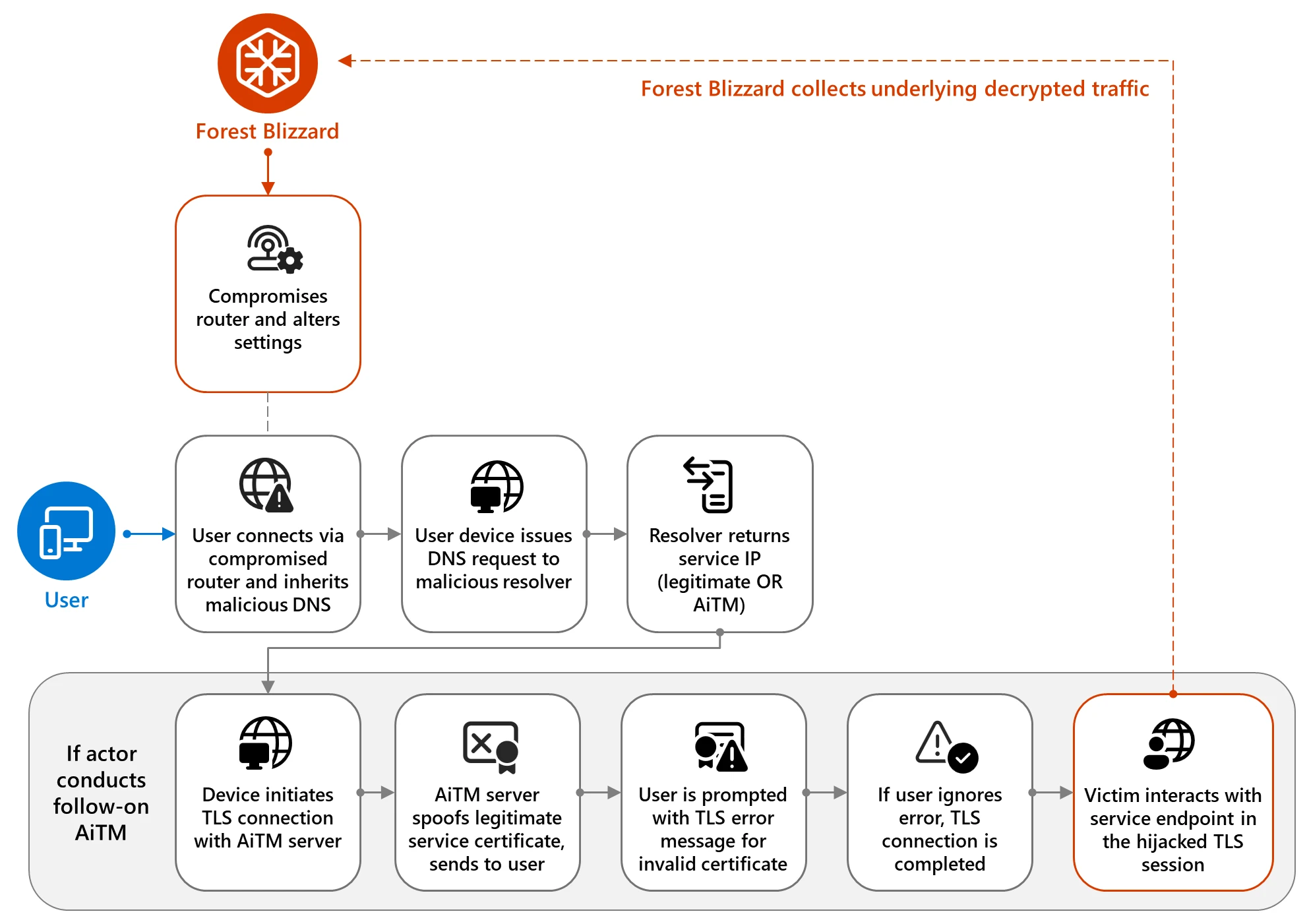
The following sections provide details on Forest Blizzard’s end-to-end attack chain for this campaign, from initial access on vulnerable SOHO routers to actor-controlled DNS resolution and AiTM activity.
Figure 1. DNS hijacking through router compromise
Edge router compromise
Forest Blizzard gained access to SOHO devices then altered their default network configurations to use actor-controlled DNS resolvers. This malicious re-configuration resulted in thousands of devices sending their DNS requests to actor-controlled servers.
Typically, endpoint devices obtain network configuration settings from edge devices through Dynamic Host Configuration Protocol (DHCP). Exploiting SOHO devices requires minimal investment while providing wide visibility on compromised devices, allowing the actor to collect DNS traffic and passively observe DNS requests, which could facilitate follow-on collection activity as described in the next section.
DNS hijacking
Forest Blizzard is almost certainly using the dnsmasq utility to perform DNS resolution and provide responses while listening on port 53 for DNS queries. The dnsmasq utility is a legitimate tool that provides lightweight network services widely used in home routers or smaller networks. Among its services are DNS forwarding and caching and a DHCP server, which collectively enable upstream DNS query forwarding and IP address assignment on a local network.
Adversary-in-the-middle attacks
Microsoft Threat Intelligence has observed AiTM attacks related to the initial access campaign. Although they target different endpoints, both are Transport Layer Security (TLS) AiTM attacks, allowing the threat actor to collect data being transmitted.
In most cases, the DNS requests appear to have been transparently proxied by the actor’s infrastructure, resulting in connections to the legitimate service endpoints without interruption. However, in a limited number of compromises, the threat actor spoofed DNS responses for specifically targeted domains to force impacted endpoints to connect to infrastructure controlled by the threat actor.
The actor-controlled malicious infrastructure would then present an invalid TLS certificate to the victim, spoofing the legitimate Microsoft service. If the compromised user ignored warnings about the invalid TLS certificate, the threat actor could then actively intercept the underlying plaintext traffic—potentially including emails and other customer content— within the TLS connection. Since Forest Blizzard does not always conduct AiTM activity after achieving initial access through DNS hijacking, the actor is likely using it selectively against targets of intelligence priority post-compromise:
AiTM attack against Microsoft 365 domains: Microsoft observed Forest Blizzard conducting follow-on AiTM operations against a subset of domains associated with Microsoft Outlook on the web.
AiTM attack against specific government servers: Microsoft identified separate AiTM activity targeting non-Microsoft hosted servers in at least three government organizations in Africa, during which Forest Blizzard intercepted DNS requests and conducted follow-on collection.
Possible post-compromise activities
Forest Blizzard’s DNS hijacking and AiTM activity allows the actor to conduct DNS collection on sensitive organizations worldwide and is consistent with the actor’s longstanding remit to collect espionage against priority intelligence targets. Although we have only observed Forest Blizzard utilizing their DNS hijacking campaign for information collection, an attacker could use an AiTM position for additional outcomes, such as malware deployment or denial of service.
Mitigation and protection guidance
Microsoft recommends the following mitigation steps to protect against this Forest Blizzard activity:
Protection against DNS hijacking
Enforce domain-name-based network access controls using Zero Trust DNS (ZTDNS) on Windows endpoints to ensure that devices only resolve DNS through trusted servers.
Follow best practices for enhancing network security for cloud computing environments.
Enable network protection and web protection in Microsoft Defender for Endpoint to safeguard against malicious sites and internet-based threats.
Avoid using home router solutions in corporate environments.
Protection against AiTM and credential theft
Centralize your organization’s identity management into a single platform. If your organization is a hybrid environment, integrate your on-premises directories with your cloud directories. If your organization is using a third-party for identity management, ensure this data is being logged in a SIEM or connected to Microsoft Entra to fully monitor for malicious identity access from a centralized location.
The added benefits to centralizing all identity data is to facilitate implementation of Single Sign On (SSO) and provide users with a more seamless authentication process, as well as configure Microsoft Entra’s machine learning models to operate on all identity data, thus learning the difference between legitimate access and malicious access quicker and easier.
It is recommended to synchronize all user accounts except administrative and high privileged ones when doing this to maintain a boundary between the on-premises environment and the cloud environment, in case of a breach.
Strictly enforce multifactor authentication (MFA) and apply Conditional Access policies, particularly for privileged and high‑risk accounts, to reduce the impact of credential compromise. Use passwordless solutions like passkeys in addition to implementing MFA.
Implement continuous access evaluation and implement a sign-in risk policy to automate response to risky sign-ins. A sign-in risk represents the probability that a given authentication request isn’t authorized by the identity owner. A sign-in risk-based policy can be implemented by adding a sign-in risk condition to Conditional Access policies that evaluates the risk level of a specific user or group. Based on the risk level (high/medium/low), a policy can be configured to block access or force multi-factor authentication. We recommend requiring multi-factor authentication on Medium or above risky sign-ins.
Microsoft Defender customers can refer to the following list of applicable detections. Microsoft Defender coordinates detection, prevention, investigation, and response across endpoints, identities, email, apps to provide integrated protection against attacks like the threat discussed in this blog.
Microsoft Defender for Endpoint
The following alerts might indicate threat activity associated with this threat. These alerts, however, can be triggered by unrelated threat activity and are not monitored in the status cards provided with this report. Microsoft tracks the specific component of Forest Blizzard associated with this activity as Storm-2754.
Forest Blizzard Actor activity detected
Storm-2754 activity
Entra ID Protection
The following Microsoft Entra ID Protection risk detection informs Entra ID user risk events and can indicate associated threat activity, including unusual user activity consistent with known Forest Blizzard attack patterns identified by Microsoft Threat Intelligence research:
Because initial compromise and DNS modification occur at the router-level, the following hunting recommendations focus on detecting post-compromise behavior.
Modifications to DNS settings
In identified activity, Forest Blizzard’s compromise of an infected SOHO device resulted in the update of the default DNS setting on connected Windows machines.
Identifying unusual modifications to DNS settings can be an identifier for malicious DNS hijacking activity.
Resetting the DNS settings and addressing vulnerable SOHO devices can resolve this activity, though these actions will not remediate an attacker who has managed to steal user credentials in follow-on AiTM activity.
Post-compromise activity
Forest Blizzard’s post-compromise AiTM activity could enable the actor to operate in the environment as a valid user. Establishing a baseline of normal user activity is important to be able to identify and investigate potentially anomalous actions. For Entra environments, Microsoft Entra ID Protection provides two important reports for daily activity monitoring:
Risky sign-in reports surfaces attempted and successful user access activities where the legitimate owner might not have performed the sign-in.
Risky user reports surfaces user accounts that might have been compromised, such as a leaked credential that was detected or the user signing in from an unexpected location in the absence of planned travel.
Defenders can surface highly suspicious or successful risky sign-ins using the following advanced hunting query in the Microsoft Defender XDR portal:
AADSignInEventsBeta
| where RiskLevelAggregated == 100 and (ErrorCode == 0 or ErrorCode == 50140)
| project Timestamp, Application, LogonType, AccountDisplayName, UserAgent, IPAddress
After stealing credentials, Forest Blizzard could potentially carry out a range of activity against targets as a legitimate user. For Microsoft 365 environments, the ActionType “Search” or “MailItemsAccessed” in the CloudAppEvents table in the Defender XDR portal can provide some information on user search activities, including the Microsoft Defender for Cloud Apps connector that surfaces activity unusual for that user.
CloudAppEvents
| where AccountObjectId == " " // limit results to specific suspicious user accounts by adding the user here
| where ActionType has_any ("Search", "MailItemsAccessed")
Threat intelligence reports
Microsoft Defender XDR customers can use the following threat analytics reports in the Defender portal (requires license for at least one Defender XDR product) to get the most up-to-date information about the threat actor, malicious activity, and techniques discussed in this blog. These reports provide the intelligence, protection information, and recommended actions to prevent, mitigate, or respond to associated threats found in customer environments:
Microsoft Security Copilot is embedded in Microsoft Defender and provides security teams with AI-powered capabilities to summarize incidents, analyze files and scripts, summarize identities, use guided responses, and generate device summaries, hunting queries, and incident reports.
Security Copilot is also available as a standalone experience where customers can perform specific security-related tasks, such as incident investigation, user analysis, and vulnerability impact assessment. In addition, Security Copilot offers developer scenarios that allow customers to build, test, publish, and integrate AI agents and plugins to meet unique security needs.
To hear stories and insights from the Microsoft Threat Intelligence community about the ever-evolving threat landscape, listen to the Microsoft Threat Intelligence podcast.
Russian state-sponsored attackers compromised more than 18,000 routers spread across more than 120 countries to gain deeper access to sensitive networks for a large-scale espionage campaign before it was recently neutralized, researchers and authorities said Tuesday.
Forest Blizzard, also known as APT28 and Fancy Bear, exploited known vulnerabilities to steal credentials for thousands of TP-Link routers globally. The threat group, which is attributed to Russia’s Main Intelligence Directorate of the General Staff (GRU) Military Unit 26165, hijacked domain name system settings and stole additional credentials and tokens via redirected traffic, the Justice Department said.
The threat group established an expansive espionage network by intruding systems of more than 200 organizations, impacting at least 5,000 consumer devices, Microsoft Threat Intelligence said in a report.
Operation Masquerade, a collaborative takedown operation led by the FBI, aided by federal prosecutors, the National Security Division’s National Security Cyber section, Lumen’s Black Lotus Labs and Microsoft Threat Intelligence, involved a series of commands designed to reset DNS settings and prevent the threat group from further exploiting its initial means of access.
“GRU actors compromised routers in the U.S. and around the world, hijacking them to conduct espionage. Given the scale of this threat, sounding the alarm wasn’t enough,” Brett Leatherman, assistant director of the FBI’s cyber division, said in a statement. “The FBI conducted a court-authorized operation to harden compromised routers across the United States.”
Forest Blizzard’s widespread campaign involved adversary-in-the-middle attacks against domains mimicking legitimate services, including Microsoft Outlook Web Access. This allowed attackers to intercept passwords, OAuth tokens, credentials for Microsoft accounts, and other services and cloud-hosted content.
Microsoft insists company-owned assets or services were not compromised as part of the campaign.
The threat group targeted network edge devices, including TP-Link and MicroTik routers, opportunistically before it identified sensitive targets of intelligence interest to the Russian government, including people in the military, government and critical infrastructure sectors.
Victims, according to researchers, include government agencies and organizations in the IT, telecom and energy sectors. Lumen identified other victims associated with Afghanistan’s government and others linked to foreign affairs and national law enforcement agencies in North Africa, Central America and Southeast Asia. An unnamed European country’s national identity platform was also impacted, the company said.
Lumen did not find evidence of any compromised U.S. government agencies as part of this campaign, but warned that the activity poses a grave national security threat.
While the full scope of Forest Blizzard’s accomplishments remain under investigation, researchers are confident the bleeding of sensitive information has stopped.
“The campaign has ceased,” Danny Adamitis, distinguished engineer at Black Lotus Labs, told CyberScoop. “We have observed a gradual decline in communications associated with this infrastructure over the past several weeks.”
Lumen said it observed widespread router exploitation and DNS redirection beginning in August, the day after the United Kingdom’s National Cyber Security Centre published a malware analysis report about a tool used to steal Microsoft Office credentials. The U.K.’s NCSC on Tuesday published details about APT28’s DNS hijacking campaign, including indicators of compromise.
The Justice Department and FBI, acting on a court order, remediated compromised routers in the United States after collecting evidence on Forest Blizzard’s activity. The FBI said Russia’s GRU weaponized routers owned by Americans in more than 23 states to steal sensitive government, military and critical infrastructure information.
A Chinese cyberespionage group has shifted its gaze back to Europe after years of focusing on other parts of the world, Proofpoint research published Wednesday found.
The surge began in mid-2025, with a bevy of issues bubbling up between China and Europe, the company said. Proofpoint labels the government-linked group TA416, but other companies track it as Twill Typhoon, Mustang Panda or other names.
“This renewed focus most heavily targeted individuals or mailboxes associated with diplomatic missions and delegations to NATO and the EU,” Proofpoint’s Mark Kelly and Georgi Mladenov wrote. “TA416’s return to European government targeting occurred during heightened EU–China tensions over trade, the Russia–Ukraine war, and rare earths exports, and commenced immediately following the 25th EU–China summit.”
Separately, the same group took up targeting the Middle East in March after the start of the conflict in Iran, something it had never been spotted doing before, Proofpoint found.
“This aligns with a trend observed by Proofpoint of some state-aligned threat actors shifting targeting toward Middle Eastern government and diplomatic entities in the aftermath of the war,” the firm said. “This likely reflects an effort to gather regional intelligence on the status, trajectory, and broader geopolitical implications of the conflict.”
TA416 was active in Europe in 2022 and 2023, coinciding with the onset of the Ukraine-Russia war, but stepped away from the continent afterward, according to the researchers. Its focus turned to Southeast Asia, Taiwan and Mongolia for a couple years.
The group’s focus on Europe through early 2026 used a variety of web bug and malware delivery methods, including setting up reconnaissance by dangling lures about Europe sending troops to Greenland. It also included phishing emails about humanitarian concerns, interview requests and collaboration proposals, Proofpoint said.
“During this period, TA416 repeatedly altered its initial infection chains while maintaining a consistent goal of loading the group’s customized PlugX backdoor via DLL sideloading triads,” the researchers wrote.
Proofpoint’s is not the only report of late about Chinese cyberespionage groups targeting Europe, with another focused on LinkedIn solicitations to NATO and European institutions.
A cyberattack that an Iranian hacking group said it carried out against medical device manufacturer Stryker might mark Tehran’s first significant cyber action since the start of the joint U.S.-Israel conflict.
But even that may have been a happy accident for Iranian hackers in what has been a low buzz of activity during that timeframe, with the attackers striking paydirt by happenstance rather than on purpose.
Cybersecurity firms, threat intelligence trackers and critical infrastructure owners have been fighting to separate the noise about proclaimed attacks out of Iran, and the warnings and threats related to the conflict, from what is actually happening and poses any significant danger.
“Everybody is scrambling right now,” said Alex Orleans, a long-time Iran threat analyst and head of threat intelligence at Sublime Security. Others said the nascent nature of the conflict is making assessments difficult.
“What we see is quite difficult to quantify or characterize about whether there’s been an increase or decrease,” said Saher Naumaan, senior threat researcher at Proofpoint. “I think since we’re only a couple weeks into the conflict, and the regular cadence of Iranian actors isn’t very consistent, necessarily, we don’t have enough data points or enough time to really judge.”
Signs of activity
In the early days of the conflict, there were indications that physical attacks on Iran might have hampered Iranian retaliatory efforts or other cyber activity, as those who would carry out cyberattacks were probably “hiding in bunkers,” Orleans said, and as Iran suffered internet outages.
In recent days, however, the Stryker attack and other indicators suggest that Iranian cyber activity could be heating up.
“For several days following the outbreak of the conflict, there was a noted decrease in cyber threat activity emanating from Iran,” a group of industry information and sharing analysis centers warned Wednesday. “However, there are signs of life in Iranian offensive cyber operations.”
The Stryker attack stands out for both the size and location of the target, a Michigan-based medical device manufacturer with more than $25 billion in revenue in 2025.
But both Orleans and Sergey Shykevich, threat intelligence group manager at Check Point Research, said the attack has the hallmarks of an opportunistic one rather than a deliberate, focused one. The group claiming credit for the attack, Handala — a Ministry of Intelligence-linked outfit — is known more for seizing advantage of weaknesses they happen upon rather than doggedly pursuing particular targets.
Notably, Stryker is also the class of a military vehicle used by U.S. forces. That military connection, even if confused with the medical device manufacturer, could possibly explain why the company was a target.
Still, “it was a much higher-profile attack than we expected from Handala,” Shykevich said. “Unfortunately, it’s possible to define it as a relatively big success for them.”
There have been reports of other cyber activity that might be connected to the conflict. Albania said the email system of its parliament had been targeted, with Iranian hackers taking credit. There was the targeting of cameras from Iran-linked infrastructure in countries that Iran then launched missiles into. Poland said it was looking into whether Iran was behind an attempted cyberattack on a nuclear research facility.
Some of the claims don’t match reality. “There are many hacktivist groups that are very active in Telegram, but actually they don’t have any significant successes,” Shykevich said.
There are other cyber-related developments in the conflict, too, like espionage, the proliferation of artificial intelligence-fueled misinformation and the possibility of Russia or China helping out in cyberspace on Iran’s behalf, even if some experts doubt the likelihood of the latter.
How effective any of it has been is still unclear. Stryker, for instance, said the attack mainly affected its internal networks, although there were signs it might be affecting communications at hospitals, too.
But the damage might be beside the point. Orleans said the attacks could be psychological in nature, aimed at producing fear abroad and affirming hackers’ standing with domestic leaders in Iran during the conflict.
Even low-level defacement or distributed denial-of-service attacks can play a role.
“Coming into work and finding an Iranian flag on your workstation would be a little bit disconcerting, because they’re letting you know that, ‘I can reach out and touch you,’” said Sarah Cleveland, senior director of federal strategy at ExtraHop and a former cyber officer in the U.S. Air Force.
Possible follow-up impacts
While primarily known as a medical supply company, Stryker has received sizable contracts with the military for hospital equipment and surgical supplies, for example. It is unclear whether the hackers intended to use Stryker’s military connection to exploit government systems.
The Pentagon has long warned of increased, complex cyberattacks against the defense industrial base, a vast network of companies — with disparate levels of cybersecurity — that the military relies on for advanced weaponry to basic stretchers. The DIB is often seen by adversaries as a backdoor into military systems.
While he did not directly address the Stryker hack, the Army’s principal cyber adviser, Brandon Pugh, outlined some of the challenges to the DIB and the service’s part in trying to protect it during a webinar Thursday in response to a question on the topic.
He said adversaries “right or wrong” see companies “as an extension of the military” and that they believe an attack on private industry would have a secondary impact on the armed forces.
“Some are very large, sophisticated multinational companies,” he said, noting that security needs across the DIB aren’t universal. “Others are very small companies that are lucky to have a director of IT, let alone a sophisticated cyber team, and I think that’s where it’s really important to lean into.”
Pugh said that agencies across the federal government have been working with the DIB to boost its resilience to attacks, and that the Army’s cyber effort emphasizes entrenching cybersecurity from the beginning of the acquisition process.
“Cyber can’t be an afterthought — not saying it is,” Pugh added. “I’d say the Army does a great job here, but making sure it’s never forgotten and is always considered along that way.”
Matt Tait, the CEO and president of MANTECH, said in response to a question about the Stryker attack and DIB protections that defending against such incidents includes leveraging government agreements and access, such as with the NSA, and quickly sharing information following an attack.
“To me, it’s about real time information sharing,” he said. “You need real time information sharing when you’re getting attacked to be able to actually share that information with the rest of industry, as well as with government, because they can actually share that information across” federal cybersecurity entities.
“If you want to do mission focused technology work, this is the world you have to live in, and that you should be sharing this information on a real time basis,” he added. “24 hours later, 48 hours later, I call that ambulance chasing. That’s too far after the fact from a cyber perspective.”
Two years ago, it was revealed that Chinese hackers had compromised at least ten U.S. telecoms, giving them broad access to phone data affecting nearly all Americans. Since then, public officials charged with responding to the campaign and bolstering the nation’s cyber defenses have reported a common problem.
Many of their constituents struggle to understand why the hacks – carried out by a group called Salt Typhoon – should rank among their top concerns, or how it impacts their day to day lives.
Some state and federal officials worry that this lack of interest is depriving policymakers the public pressure needed to build momentum for stronger action to improve the nation’s telecommunications cybersecurity.
Mike Geraghty, the CISO and director of the New Jersey Cybersecurity and Communications Cell, said New Jersey is the nation’s most densely populated state, with a high concentration of critical infrastructure and a major telecommunications footprint. For that reason, a campaign like Salt Typhoon should, in theory, be of strong interest to Garden State residents.
“However, if you talk to a person on the street in New Jersey, they’’ll say who cares that the Chinese are looking at – you know – what numbers I call?” he said Wednesday at the Billington State and Local Cybersecurity Summit. “It has a big role to play in my job, but trying to get people to understand what that means for New Jersey is really difficult.”
Congress hasn’t passed comprehensive privacy legislation in decades. Meanwhile, cyberattacks that expose sensitive data are widespread, and U.S. companies routinely collect and sell customers’ personal information. Some officials speculate that, taken together, these trends have left Americans numb to data theft and data-for-profit–so additional breaches feel like just another drop in the bucket.
Mischa Beckett, deputy chief information security officer and director of cyber threat intelligence at GDIT, said Salt Typhoon’s focus on telecom data can feel like an abstract threat to many Americans. By contrast, other Chinese hacking campaigns like Volt Typhoon suggest potential damage to water plants and electric grids that are easier to grasp.
“It’s maybe a little bit easier to write off a loss of data..and move on, as unfortunate but no big deal,” said Beckett. “I think that case is much harder to make when we’re talking about pre-positioning and critical infrastructure, things that touch all of our lives every day.”
Last year, a former intelligence official at the Office of the Director of National Intelligence told CyberScoop that a lack of outrage from the public following the Salt Typhoon attacks was dampening momentum for broader regulation or reforms to telecom cybersecurity.
“We can’t accept this level of espionage on our networks,” said Laura Galante who led the Cyber Threat Intelligence Integration Center under the Biden administration. “If you had 50 Chinese [Ministry of State Security] spies or contractors sitting inside a major [telecom company’s] building, they would be walked out and it would be a full-scale effort. That’s in broad strokes what has happened, but the access was digital.”
A China-based threat group operating for almost two decades broke into the internal systems of Notepad++, an extremely popular open source-code editor, to spy on a select group of targeted users, researchers at Rapid7 said Monday.
Don Ho, the author and maintainer of the open-source tool, said independent security researchers confirmed a China state-sponsored group compromised Notepad++’s server for a six-month period starting in June 2025. Ho, who did not respond to a request for comment, released a software update Dec. 9 claiming to address authentication weaknesses that allowed attackers to hijack the Notepad++ updater client and user traffic.
The Chinese APT group Lotus Blossom, which has been active since at least 2009, gained recurring access and deployed various payloads — including a custom backdoor — to snoop on some users’ activities, according to Rapid7. The espionage group is also known as Billbug, Thrip and Raspberry Typhoon.
“We have no evidence of bulk data exfiltration,” Christiaan Beek, senior director of threat intelligence and analytics at Rapid7, told CyberScoop. “The tooling observed is consistent with post-compromise reconnaissance, command execution, and selective data access, rather than broad data harvesting.”
The attacks, which showcased resilience and stealth tradecraft, did not result in a mass compromise of all Notepad++ users, but rather a limited number of affected environments, according to Rapid7.
“Post-compromise behavior included system profiling, persistence mechanisms, and remote command execution consistent with long-term espionage access rather than immediate disruption or monetization,” Beek added. “The objective appears aligned with strategic intelligence collection, consistent with Lotus Blossom’s historical operations.”
The former hosting provider for Notepad++ said the attackers lost access to the tool’s server on Sept. 2, but maintained legitimate credentials to internal services until Dec. 2, which allowed the attackers to redirect Notepad++ update traffic to malicious servers, Ho said in a blog post.
Ho did not say when or how they first became aware of unauthorized access to Notepad++’s systems. The website, which attackers targeted to exploit “insufficient update verification controls that existed in older versions of Notepad++,” was moved to a new hosting provider with stronger security practices, Ho said in the blog post.
Beek confirmed that Lotus Blossom’s unauthorized access appears to have been disrupted, noting that its known infrastructure linked to the months-long campaign is no longer active. Some security researchers started surfacing reports of incidents linked to Notepad++ in November.
While Notepad++’s internal system improvements appear to have halted the malicious activity, users running older versions of the software should still update as a precaution, Beek said. “We are not seeing ongoing active exploitation tied to this campaign.”
Lotus Blossom targeted software that provided potential access to many sensitive targets. The Windows-based tool, which was first released in 2003 and typically used as an alternative to Windows Notepad, is widely used by developers, IT administrators, engineers and analysts, including some working in government, telecom, critical infrastructure and media, Beek said.
Many security researchers, analysts and users have taken their concerns to social media to warn about the potential risk of the long-term intrusion and share worries about the ultimate impact of the campaign.
A North Korea-backed threat group operating since 2009 has splintered into three distinct groups with specialized malware and objectives, CrowdStrike said in a report released Thursday.
Labeled “Labyrinth Chollima” by the company, the group follows a divergence pattern CrowdStrike observed previously. Labyrinth Chollima has spawned two additional groups: Golden Chollima and Pressure Chollima. The spin-offs, which have been operating since 2020, allow Labyrinth Chollima to narrow its focus on espionage, targeting victims in the manufacturing, logistics, defense and aerospace industries.
Golden Chollima and Pressure Chollima are squarely focused on stealing cryptocurrency, which funnels money back to the regime, with some of the proceeds funding North Korea’s cyber operations. Pressure Chollima, which was responsible for last year’s record-breaking $1.46 billion cryptocurrency theft, targets high-payout opportunities and has evolved into one of North Korea’s most technically advanced threat groups, according to CrowdStrike.
The groups, which share lineage with the more broadly defined Lazarus Group, share some tools and infrastructure, which indicates centralized coordination, but they’ve also developed more specialized capabilities for their specific objectives, researchers said.
As North Korea’s threat groups continue to branch out, the rogue nation is developing more capabilities and expanding its reach and impact, Adam Meyers, head of counter adversary operations at CrowdStrike, told CyberScoop.
“What we’re seeing down range is now aligned with what we’ve seen from a bureaucratic perspective up range,” Meyers said.
“Over time, as their mission was successful, the bureaucracy grew and the scope of the mission grew, and obviously the organization grew,” he added. “They’ve been operating a resistance economy for many, many years and cyber gives them the ability to do this deniably and at a distance.”
CrowdStrike currently tracks eight distinct North Korea-backed threat groups, with the addition of Golden Chollima and Pressure Chollima. The cybersecurity firm expects the groups focused on cryptocurrency theft to scale their operations as international sanctions impair North Korea’s economy.
Labyrinth Chollima has more recently targeted European aerospace companies, defense manufacturers, logistics and shipping companies, and U.S.-based critical infrastructure providers, including those involved in hydroelectric power. The threat group, which other firms track as Diamond Sleet and Operation Dream Job, has also developed a knack for employment-themed social engineering, researchers said.
“North Korea is probably one of the top-notch actors out there. A lot of people don’t give them credit for that,” Meyers said.
CrowdStrike’s research on Labyrinth Chollima’s spin-offs aims to help organizations defend against these distinct threats by also providing indicators of compromise and malware samples observed in various attacks.
“You need to know who the threats are to your specific industry and geolocation, because you can’t defend against all the threats all the time,” Meyers said. “You can’t boil the ocean.”
A House Republican introduced legislation Tuesday aimed at deterring cyberattacks against the United States at a time when the Trump administration is prioritizing the punishment of malicious hackers.
Rep. August Pfluger, R-Texas, revived legislation he first sponsored in 2022, the Cyber Deterrence and Response Act. The legislation would direct the executive branch to formally designate foreign parties behind major cyberattacks against the United States as a “critical cyber threat actor” who would be subject to sanctions. It also would establish a framework for attributing who’s behind cyber attacks, including contributions from cyber agencies and threat intelligence companies.
“As cyberattacks in the United States grow more sophisticated and widespread, we must ensure the Trump administration and all future administrations have a strong framework to hold bad actors accountable and safeguard our national security,” Pfluger said in a news release. “Protecting America’s critical infrastructure from malicious cyberattacks is essential, and this bill does exactly that.”
The legislation is the latest reflection of congressional dismay that began growing last year in response to the Salt Typhoon cyberespionage campaign that infiltrated telecommunications networks, and the sense that the United States wasn’t doing enough to make hackers pay for their behavior.
At a hearing Tuesday, Senate Commerce Chairman Ted Cruz, R-Tex., said the United States needs to do a better job of working “together to detect and deter attacks in real time.”
The Trump administration has said deterrence is one of the first pillars of its forthcoming cyber strategy.
The definition of “critical cyber threat actor” under Pfluger’s bill applies to hackers who disrupt the availability of computer networks, compromise computers that provide services in critical infrastructure, steal significant personal data or trade secrets, destabilize the financial or energy sectors or undermine the election process.
The president could waive sanctions against those designees if it explains its reasoning to Congress in writing, a common clause of sanctions legislation.
Pfluger’s measure is updated in some ways from its 2022 incarnation, such as by giving the Office of the National Cyber Director the leading role in designating critical cyber actors.
The legislation draws on bills that former Rep. Ted Yoho, R-Fla, introduced in past years. That legislation won House approval in 2018, but never advanced further.
The House Homeland Security Committee is calling on Anthropic CEO Dario Amodei to provide testimony on a likely-Chinese espionage campaign that used Claude, the company’s AI tool, to automate portions of a wide-ranging cyber campaign targeting at least 30 organizations around the world.
The committee sent Amodei a letter Wednesday commending Anthropic for disclosing the campaign. But members also called the incident “a significant inflection point” and requested Amodei speak to the committee on Dec. 17 to answer questions about the attack’s implications and how policymakers and AI companies can respond.
“This incident is consequential for U.S. homeland security because it demonstrates what a capable and well-resourced state-sponsored cyber actor, such as those linked to the PRC, can now accomplish using commercially available U.S. AI systems, even when providers maintain strong safeguards and respond rapidly to signs of misuse.” wrote House Homeland Chair Rep. Andrew Garbarino, R-N.Y. and subcommittee leaders Reps. Josh Brecheen, R-Okla., and Andy Ogles, R-Tenn.
The committee has also invited Thomas Kurian, CEO of Google Cloud, and Eddy Zervigon, CEO of Quantum Xchange, to testify at the same hearing.
Committee leaders cited a need to closely examine “how advances in artificial intelligence, quantum computing and related technologies, and hyperscale cloud infrastructure are reshaping both defensive capabilities and the operational tradecraft available to state-sponsored cyber actors,” according to a copy of the letter sent to Zervigon.
As “adversaries may seek to pair AI-enabled tradecraft with emerging quantum capabilities to undermine today’s cryptographic protections, your insight into integrating quantum-resilient technologies into existing cybersecurity systems, managing cryptographic agility at scale, and preparing federal and commercial networks for post-quantum threats will be critical,” the members wrote.
News of the upcoming hearing was first reported by Axios.
The hearing comes as policymakers and cybersecurity defenders continue to grapple with the fallout from Anthropic’s disclosure, with some cybersecurity experts asking for more technical details that would allow organizations to prepare for any heightened threats from AI hacking campaigns. Others have questioned the extent to which human expertise was relied upon to orchestrate, validate and guide Anthropic’s AI model during the attack.
Amazon’s threat intelligence team said it observed an advanced persistent threat group exploiting zero-day vulnerabilities affecting Cisco Identity Service Engine and Citrix NetScaler products before the vendors disclosed and patched the defects last summer.
Amazon’s MadPot honeypot service detected active exploitation of the critical defects — CVE-2025-5777 in Citrix and CVE-2025-20337 in Cisco — and through further investigation determined a highly resourced threat actor was behind the attacks, CJ Moses, chief information security officer of Amazon Integrated Security, said in a blog post Wednesday.
“We assess with high confidence it was the same threat actor observed exploiting both vulnerabilities,” Moses told CyberScoop in an email.
Amazon said its discovery reinforced multiple trends afoot, including threat groups’ increased focus on identity and network edge infrastructure and their ability to quickly weaponize vulnerabilities as zero-days before vendors disclose or patch defects in their products.
The origins and identity of the threat group behind the attacks remains unknown, yet Moses said “prolonged access to the target for espionage is the most likely objective.”
Amazon threat researchers said the threat group used custom malware with a backdoor specifically designed for Cisco ISE environments that demonstrated advanced evasion techniques. “The threat actor’s custom tooling demonstrated a deep understanding of enterprise Java applications, Tomcat internals and the specific architectural nuances of the Cisco ISE,” Moses said in the blog post.
Cisco disclosed CVE-2025-20337 on June 25, yet Amazon said exploitation was already underway in May. Amazon discovered the pre-disclosure exploits in early July and traced attacks back to May and June, Moses said.
Amazon disclosed active exploitation of the defect to Cisco, which informed its customers of the issue within hours, Moses added. He did not share information about how many organizations have been impacted by CVE-2025-20337 exploits.
By mid-July, researchers had observed more than 11.5 million attack attempts, targeting thousands of sites since the exploit was disclosed.
Amazon declined to explain why it’s sharing information about active zero-day exploitation of the Cisco and Citrix defects months later, and the company said it doesn’t have additional information about more recent attacks linked to the vulnerabilities.
Moses noted the threat group’s use of multiple zero-day exploits indicates the attackers have advanced vulnerability research capabilities or access to undisclosed vulnerability information.

 Login
Login