Login

Abandoned by Nvidia and AMD, blamed by Sam Altman, and agreeing with Elon Musk: it sucks to be a PC gamer in 2026 — but here's why I’m not giving up hope just yet
I’ve been a PC gamer since the early 1990s, and over the past three and a bit decades I’ve never once regretted my allegiance to those awkward beige boxes that have brought so much joy into the lives of myself and so many other people.
Yes, they can be expensive. Sure, they're more complex and frustrating than consoles. There have been times I’ve sat down to play a game, only for hours to pass as I try to fix game-breaking crashes, reinstall drivers, or just generally swear at Windows; but at the end of the day, I was always convinced that the PC remained the greatest gaming platform in the world.
PCs (and I’m including my beloved Amiga A500+ here) were always miles ahead of consoles when it came to graphics and audio, and the ability to upgrade components meant you could remain at the cutting edge for years. Upgrading and even building your own PC was fiddly and expensive, but it was also fun and rewarding. I still get a thrill when I first power-up a newly built rig and see it successfully boot.
I was always convinced that the PC remained the greatest gaming platform in the world
The openness of the platform (despite Microsoft’s best efforts) meant I could buy games from where ever I wanted (one of the main reasons, I believe, why PC games are usually cheaper than console games), and play obscure indie games that would never be published on consoles due to licensing costs (which is another reason why PC games are cheaper); and, with some tweaking and a bit of (perfectly ethical and legal) emulation, backwards compatibility has never been a problem. The likes of GOG should get a shoutout as well for keeping very old PC games running on new hardware.
And right now in 2026, I'm lucky enough to have access to the most powerful PC gaming hardware ever, on which to play some of the best and most graphically impressive PC games ever made. I should be feeling like there’s never been a better time to be a PC gamer. Instead, however, it feels like PC gaming has never been worse.
Thanks for the memory
Why am I so down on the current state of PC gaming? For a start, while PC gaming hardware has never been better, it’s also never been so expensive — and that makes it less accessible for most people. The price of graphics cards has skyrocketed, and SSDs and RAM, once two of the cheapest and most effective ways of upgrading your PC, are now ridiculously expensive.
According to PC Part Picker, the average price of two sticks of 16GB DDR5 memory has leapt from around $150 to over $600 in the space of 18 months. Meanwhile, 64GB of the stuff has gone from around $250 to over $1,250 — and this isn’t even for the fastest models.
Even older DDR4 isn’t immune, with 16GB rising over 18 months from $50 on average to around $170, again according to PC Part Picker.
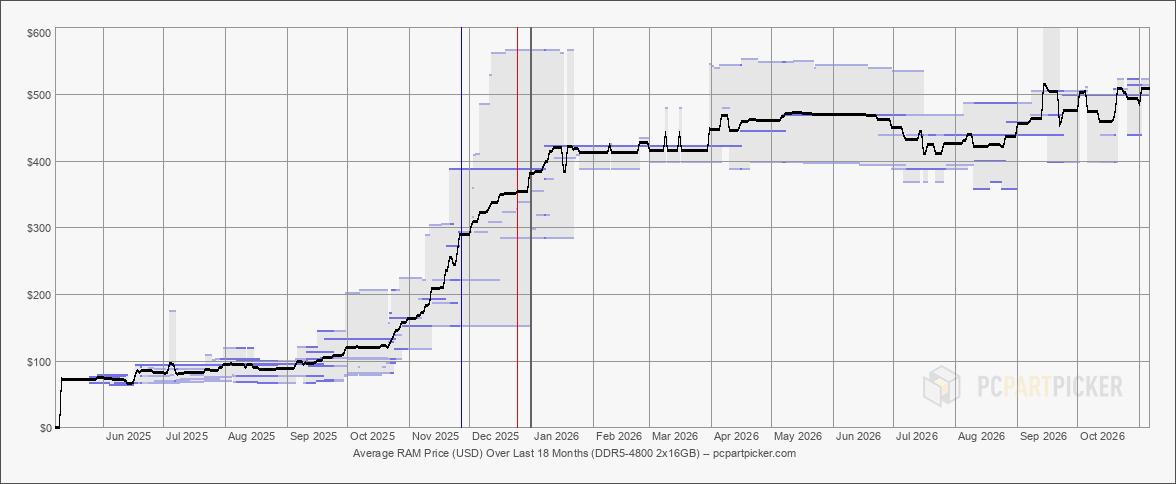
People are getting priced out of PC gaming, or being prevented from even considering it; and as a PC gamer, that’s heart-breaking. I’m incredibly fortunate that my job has enabled me to build a PC with an RTX 5090 and 96GB of DDR5 RAM, but there’s no joy in writing about things that so few people will be able to experience.
With prices of gaming components, PCs, laptops, and even consoles climbing ever higher, sales are understandably dropping. And with the costs of developing games exploding, we’ve also seen huge amounts of very talented game developers lose their jobs, and entire companies, such as BioWare, close down.
Perhaps worst of all, this past week I’ve found myself agreeing with something Elon Musk — someone I genuinely think is an awful human being — said. I need a lie down. And a pint (probably not in that order). I’m in a PC gaming funk, but who — or what — is to blame?

AI. It’s AI’s fault
Now it would be far too easy, simplistic, and perhaps even lazy to say this is all AI’s fault. But it’s all AI’s fault. Screw AI.
The AI goldrush has seen an explosion in the number of data centers required to run and train large language models (LLMs) used by AIs, and these need a lot of memory, which has led to a global shortage and made prices for components that use memory, such as RAM, graphics cards and storage, skyrocket.
I, like many other PC gamers, have been watching all of this in horror for a while now, but things really came into sharp relief this week when Sam Altman, CEO of OpenAI, one of the biggest culprits of the RAMpocalypse, was quoted as saying on the Cheeky Pint podcast (via IGN) that "it's quite terrible to have everybody have a bunch of the world's limited supply of DRAM sitting in their own computer."
A lot of people took that as Altman accusing us PC gamers of being greedy by wanting RAM for our rigs, and to say that didn’t go down well would be an understatement.
It’s all AI’s fault. Screw AI.
Now, I usually have a policy of ignoring the rubbish Altman spews out (it does wonders for my blood pressure); but I have to admit, when I saw the quote, it riled me up. PC gamers having to endure the RAMpocalypse is bad enough, but to be blamed for it, especially when all we want to do is play games, was too much.
Then, in a real-life example of the ‘worst person you know just made a great point’ meme, the world’s richest man, terrible Diablo player, and failed truck salesman, Elon Musk, piped up to say “The people deserve to have their RAM too!”
I’m not naïve enough to think that Musk is seriously on the side of ‘the people’, but when one of the most widely-mocked individuals on the internet gets some begrudging props for coming out against something you said, that’s not a good sign.
Sure enough, Altman backpeddled, saying he was “taken out of context”, and he was actually complaining about people running local AI models. In a way, I’m inclined to believe that — as CEO he has a vested interest in stopping people using their own models and instead using OpenAI’s, but the damage was done.
Regardless of context, it was a tone-deaf thing to say — almost as bad as Nvidia’s 'GeForce 8800 GTX — 20 Years of a Legend' tech demo, which was released this week. Nvidia once was loved, or at least respected, by a lot of PC gamers for making genuinely excellent graphics cards and pushing the PC gaming industry forward with various innovations over the years.
Sadly, it has also become incredibly successful due to AI — so successful that it often feels like it's lost interest in the PC gaming industry that made its name, with rumors swirling that it’s ending production of the RTX 5090, while doing nothing about the rising costs of its components thanks to an AI bubble which it's benefitting from and contributing to.
So, when it launched a demo that invited players to relive a time when PC gaming was actually fun and affordable, by allowing them to virtually install its iconic GeForce 8800 GTX graphics card into a retro Windows Vista PC, it felt like Nvidia had misjudged the mood. To make matters worse, Nvidia recommends you have an RTX 5080 to play it — a GPU that is incredibly expensive and hard to find due to the memory shortage, and which is also rumored to be for the chop.
“Oh well,” some of us PC gamers might have thought, “at least we still have perpetual underdog AMD in our corner.” Except, AMD CEO Lisa Su has just been quoted as saying that “We are a data center first company.”
As Nvidia’s closest competitor, AMD was supposed to keep Team Green on its toes, while having a more consumer-friendly approach (being more open to open-source, and not limiting its latest tech to just its own GPUs, for example). Instead, it looks like AMD has had a heel-turn worthy of WWC’s most dramatic betrayals.
To be honest, I’ve been wondering what’s going on with AMD for a while, as it was rather quiet this year in the consumer GPU space; but this turn to the AI-powered dark side still hurts.
Could we really see the two major GPU makers stop making graphics cards altogether? It’s too bleak a future to imagine, but after a week like this, I can’t help but wonder.
What can we do?
I don’t want this to just be a wall of depressing text that would make even Roger Waters think ‘that’s a bit much’, so is there a glimmer of hope to be had? Is there anything any of us can do?
At Computex 2026 this year in Taiwan, I was perplexed by how almost every PC maker was going on about AI-in-everything with a fervor that I’ve just not seen replicated by consumers. I was worried that I was just out of touch.
But there’s been a growing backlash against rampant AI that’s given me hope. I’m not against all forms of AI, but AI that takes work from humans, that plagiarizes human art (including depressing walls of texts written by aging tech journalists), that diminishes creativity and sucks up resources… that AI I would love to see the end of, and I’m not the only one.
Boycotting games made with AI, and avoiding companies that don’t use AI responsibly, can hopefully show companies that this isn’t a magic money tree that they should neglect their customers for. Look at what’s happening with the current stock-market rout on AI companies, where it seems voters were rebelling against rampant AI data center expansion and an administration that seemed all too happy to let tech companies cross lines and drop ethics all in the name of AI (sorry, SI) supremacy.
I don’t want to seen an economic meltdown; but a wake-up call to the likes of Nvidia and AMD, to let them know that the customers who made them — primarily PC gamers like me — aren’t to be taken for granted, would certainly be welcome.