❌

Reading view

There are new articles available, click to refresh the page.

Trump picks Palantir’s LoSapio to head CISA

The Cybersecurity and Infrastructure Security Agency finally got a new nominee for director, with President Donald Trump on Monday nominating Michael LoSapio, chief information security officer at Palantir.

CISA has been without a Senate-confirmed director for the entirety of Trump’s second term, after his first pick, Sean Plankey, languished in the Senate before withdrawing in April.

LoSapio could face some obstacles of his own, with Palantir far from a popular company with the Democrats set to take over Congress. Democrats have scrutinized the company over its work with the Department of Homeland Security, even as Palantir has denied aiding mass surveillance of immigrants.

As of late last month, Sen. Ron Wyden, D-Ore., was also still waiting for CISA to release a public version of a report on telecommunications cybersecurity, and he had placed one of several Senate holds on Plankey pending the receipt of that report.

Republicans will still control the Senate until January, however, and a lame-duck session began Monday.

Some CISA watchers were convinced that the agency’s acting director, Nick Andersen, was likely to continue holding the role. He was running out of days to hold the “acting” position under the law, but putting forward a nominee could pause the clock on that deadline.

The administration was thought to be looking for someone from a high-profile tech company to fill the CISA director position, a bill LoSapio fits.

The post Trump picks Palantir’s LoSapio to head CISA appeared first on CyberScoop.

John Strand's 11 Core Skills: For SOC Analysts

The cybersecurity battlefield evolves daily, with SOC analysts serving as front-line defenders. After years of training SOC teams, I’ve identified 11 core skills that separate effective defenders from the rest.

Here’s the problem: we’re training analysts to look for needles in haystacks when they don’t even know what hay looks like. Too many enter SOC positions without understanding the systems they’re trying to protect.

1. Understanding Operating Systems

You can’t defend what you don’t understand. Period. Master both Windows and Linux. Not just surface stuff, but really get how they work under the hood. Learn through the incident response lens:”If this system were hacked, how would I find the bad guys?”

2. Network Traffic Analysis

Understand TCP/IP and how traffic actually flows (the OSI model matters less than knowing what a SYN flood, DNS tunnel, or C2 beacon looks like on the wire). Know the difference between TCP and UDP, and establish baselines for what normal traffic looks like in your environment.

3. Memory Analysis

Memory forensics shows you malware that might be invisible on disk. Tools like Volatility let you examine processes, connections, and DLLs from a memory dump. This works even when attackers delete their tools or use fileless malware. It’s like catching someone with their hand in the cookie jar.

4. Log Analysis

Logs are your investigative breadcrumbs. Know which ones to collect and how to make sense of them. Remember, no single log tells the whole story. You need to connect multiple data points, like a detective piecing together clues at a crime scene.

5. Endpoint Detection and Response

Master your EDR solutions. Understand how they work, what they can do, and where they fall short. No EDR catches everything. You need to tune these tools, like adjusting the sights on a rifle for better accuracy.

6. Threat Hunting

Don’t just sit back waiting for alerts. Get out there and hunt! Look for threats that slipped past your automated systems. Combine smart hypotheses with data analysis to find attackers living off the land, using legitimate tools for evil purposes.

7. Malware Analysis

Every SOC analyst should know basic static and dynamic analysis. Look at the file without running it, then observe its behavior in a safe sandbox. Learn to spot common techniques like obfuscation and persistence. Know thy enemy, right?

8. Vulnerability Management

Understand different vulnerability types and how they’re exploited. Don’t just focus on CVSS scores. Consider actual exploitability in your environment and the potential impact. A “critical” vulnerability that can’t actually be exploited in your environment isn’t critical for you.

9. Incident Response

When stuff hits the fan, know what to do. Identify what happened, contain it, kick out the attackers, and recover your systems. Document everything. Not just for compliance, but so your team can learn and improve.

10. Automation and Scripting

Automate the boring stuff with PowerShell, Python, or Bash. Create tools that do the repetitive work for you. This frees you up to focus on the complex problems that need human brainpower.

11. Communication and Documentation

Technical skills alone won’t cut it. You need to explain complex technical stuff to different audiences. The most brilliant analysis in the world is useless if you can’t make the bosses understand why they should care.

Conclusion

Mastering these skills won’t happen overnight, but they’re the foundation of being an effective SOC analyst. What makes great analysts stand out isn’t just knowing individual skills but connecting dots across domains: seeing how network traffic ties to endpoint behavior, when log weirdness might point to memory-resident malware, and how vulnerabilities create openings for attackers

By building these core skills, you’ll be ready to protect your organization against even the nastiest threats out there..


Forensic Data: How to Acquire and Retain Vital Evidence

While "digital forensics" and "incident response" often appear together (as in the acronym "DFIR"), they represent two distinct disciplines.

What's in a Name?

The American Heritage Dictionary defines forensics as "The use of science and technology to investigate and establish facts in criminal or civil courts of law."

Contrast this with IBM's definition of incident response: "Incident response [...] refers to an organization's processes and technologies for detecting and responding to cyberthreats, security breaches or cyberattacks." Note the absence of any reference to legal proceedings—it simply describes the process by which an organization detects, halts, and recovers from an incident.

Legal Considerations

Although most incidents never end up in court, all should be treated as if they might.

Taking the proper steps before, during, and after response ensures that any data collected can be admissible as evidence.

It's important to know the rules of evidence for relevant jurisdictions. Global corporations should consider each jurisdiction they have locations in when developing standard operating procedures (SOPs). Always include legal counsel when developing your organization's SOPs.

Data Preservation

A common rule for digital evidence is the retention of data in its "original state." This is accomplished by using validated hardware and software to create an exact bit-for-bit copy of a piece of digital media. Yet during incident response, it is rare that full forensic images are created—typically, only a small subset of data is collected from victim devices for analysis. Before any action is taken, consult legal advisors to decide whether to collect full forensic images.

A good practice is to create a folder for the original data, generate and document a hash of its contents, and then create a working copy in a separate folder. Only perform analysis on the working copies of your data to preserve the integrity of the original data.

Documentation

Documentation is critical when handling potential evidence. A chain of custody (CoC) records details about what the data is, where it came from, who collected it, whom it was transferred to, a brief description of what was done to it, and so forth.

The National Institute of Standards and Technology (NIST) provides a sample CoC here:
https://www.nist.gov/document/sample-chain-custody-formdocx

Each person working with the data must keep detailed notes: record dates, times, and any actions taken. Binary files often need to be parsed by special tools to make their data human-readable—include any tool names and versions. The same should be done with human-readable data, such as text-based log files. While you likely don't need to document the version of Excel used to read a log file, if you added a column to show UTC date/time stamps in local time, that is worth noting.

The gold standard for documentation is this: notes should be detailed enough that someone with a similar background can recreate your steps and produce the same results.

This is the scientific method part of digital forensics. Processes need to be repeatable and generate the same results.

Tool Validation Procedures

Before an incident occurs, verify that your hardware and software are working. Test write blockers to ensure they do not alter the evidentiary media. Validate that your forensic software functions correctly (it's not unheard of for new versions to report the wrong date/time stamps when parsing binary data).

While there is no set standard for validation processes, some guidelines exist to help you develop validation SOPs.

Validation SOPs guidelines:
NIST: https://www.dhs.gov/science-and-technology/nist-cftt-reports
SWGDE: http://cet4861.pbworks.com/w/file/fetch/120024474/4861.2014-09-05_SWGDE_Recommended_Guidelines_for_Validation_Testing_V2-0.pdf

Additional Considerations for Incident Handling

When managing incidents, also consider:

  • What are the data retention policies of your Endpoint Detection and Response (EDR) tools?
  • How is your cloud data preserved?
  • Who has access to sensitive or personal data?

These factors often depend on your license agreement with providers. Make sure data can be maintained in a secure, long-term manner, as it can take years until an incident makes it into the courtroom. Implement processes to export incident data from systems and services while preserving integrity and meeting long-term storage requirements that protect its availability and confidentiality. Access to confidential information must always be managed carefully.

Remember: Involve your legal team, validate your tools, work from copies (never original data), document everything meticulously, and maintain chain of custody.

Microsoft, tech companies throw weight behind spread of open-source AI

Microsoft, along with more than two dozen tech companies, are pressing policymakers to support open-source AI systems and code across society, arguing that it will be a safer approach than attempting to restrict access or relying on a handful of closed, proprietary models.

The open letter, posted Friday, draws parallels to the software industry of the 1980s, when large businesses worried that open-source software code would cut into their business. While industry lost that battle, the end result was a vibrant ecosystem that now underpins much of the modern internet, government IT and even commercial software products.

It also created a “shared foundation of knowledge” that has fed countless future software projects and innovations.

“The United States now faces a similar choice with artificial intelligence,” the companies wrote. “Our AI leadership will be judged not by one frontier AI model, but by whether the United States builds a strong, open ecosystem that diffuses into every sector.”

Expanding access and support to open-source AI comes with meaningful security risk. Cybersecurity experts warn that one of the biggest beneficiaries of broadly available AI tools are  low-level criminals who until now lacked the technical expertise or resources to launch serious attacks.

Once a model is open weight, anyone can download it, customize it, strip it of any guardrails and use it for their own purposes. As open-source models have gotten better at creating deepfakes and other AI generated imagery, the danger of locally-customized CSAM and sexualized deepfakes could also grow.

But the letter argues that open-weight AI models are most beneficial to startups, universities, research labs and other small, ambitious organizations that can innovate and iterate the technology and make it more broadly useful to society.

“Open weights let every organization match the right model to the right job at the right cost, reserving frontier-scale capability for genuine frontier problems and running efficient specialized specialized models everywhere else,” The companies wrote. “That discipline is what will make AI economically sustainable as its use scales into the billions of everyday tasks.”

 For cybersecurity specifically, the letter argues that defenders armed with open-source AI will outpace attackers better than any closed model approach.

“In a world where cybersecurity attackers use advanced AI, defenders need access to models with comparable capabilities so they can detect, simulate, and respond to emerging threats,” the companies wrote. “Open models broaden defensive capability, increase transparency, and allow vulnerabilities to be discovered and remediated across many teams.”

Other notable companies signing the letter include Meta, Palantir, Perplexity, Mistral, NVIDIA, Mozilla, The Linux Foundation, Hugging Face, Dell Technologies and IBM.

US policymakers continue to grapple with balancing unrestrained support for the domestic AI industry and providing oversight and regulation of harms that result from their use.

The Trump administration has cycled through several frameworks since coming into office, first a laissez-faire approach within no restrictions, then an executive order creating a voluntary testing regime for industry, then the imposition of export controls on Anthropic’s Fable model and reportedly pressuring OpenAI to delay the release of their models out of cybersecurity concerns.

The letter comes as the Trump administration has reportedly considered an executive order that would restrict American access and availability to Chinese-made open-source models.

But the White House and US companies are trying to thread a needle in recognizing the overall benefits of an open source approach while being wary of doing anything that could potentially benefit their Chinese rivals.

Earlier this month the White House announced the creation of its Gold Eagle AI cybersecurity clearinghouse that would help coordinate government, private sector and civil society work finding and closing AI-discovered vulnerabilities. A big part of that effort, a senior White House official said, is supporting providers and maintainers of open-source AI tools.

The post Microsoft, tech companies throw weight behind spread of open-source AI appeared first on CyberScoop.

KAPE 101: A Kroll Artifact Parser and Extractor Cheatsheet

Spend time performing forensic analysis on the Windows Operating System and you'll see a host of artifacts that can be used to identify adversary activity. From changes to the registry to the System Resource Utilization Monitor, Windows artifacts run deep. The challenge is locating, extracting, and parsing these artifacts in an efficient manner.

The post KAPE 101: A Kroll Artifact Parser and Extractor Cheatsheet appeared first on Black Hills Information Security, Inc..

Finding the “Goldilocks” Zone: A Practical Approach to Alert Triage

We're all petrified about missing a critical event or misclassifying an alert, but when we're talking about incident response (IR), there are often hundreds if not thousands of alerts to parse through. It's easy to get caught up with one alert because it feels "too hot" or maybe not spend enough time looking into something that initially seems "too cold."

The post Finding the “Goldilocks” Zone: A Practical Approach to Alert Triage appeared first on Black Hills Information Security, Inc..

Scattered Spider Hackers Plead Guilty on Day 1 of Trial

Two men pleaded guilty in the United Kingdom this week to criminal charges stemming from an August 2024 cyberattack that crippled Transport for London, the entity responsible for the public transport network in the Greater London area. The duo were key members of a prolific cybercrime group known as Scattered Spider, and their guilty pleas came on the first day of what was expected to be a six-week trial.

Owen Flowers (left) 18, and Thalha Jubair, 20. Image: UK National Crime Agency (NCA).

Thalha Jubair, 20, of East London and 18-year-old Owen Flowers of Walsall admitted conspiring to commit unauthorized acts against Transport for London computer systems and causing risk of serious damage to human welfare. According to a report from the BBC, Flowers alone admitted to being part of a conspiracy to hack into U.S. based healthcare providers SSM Health Care Corporation and Sutter Health in September 2024.

Jubair is also wanted by U.S. law enforcement agencies. In September 2025, prosecutors in New Jersey unsealed an indictment alleging Jubair and other Scattered Spider members committed computer fraud, wire fraud, and money laundering in relation to 120 computer network intrusions involving 47 U.S. entities between May 2022 and September 2025, and that the group’s victims paid at least $115 million in ransom payments.

In July 2025, KrebsOnSecurity reported that Flowers and Jubair were arrested in the United Kingdom in connection with Scattered Spider ransom attacks against the retailers Marks & Spencer and Harrods, and the British food retailer Co-op Group. Multiple sources familiar with those investigations said Flowers was the Scattered Spider member who anonymously gave interviews to the media in the days after the group’s September 2023 ransomware attacks disrupted operations at Las Vegas casinos operated by MGM Resorts and Caesars Entertainment.

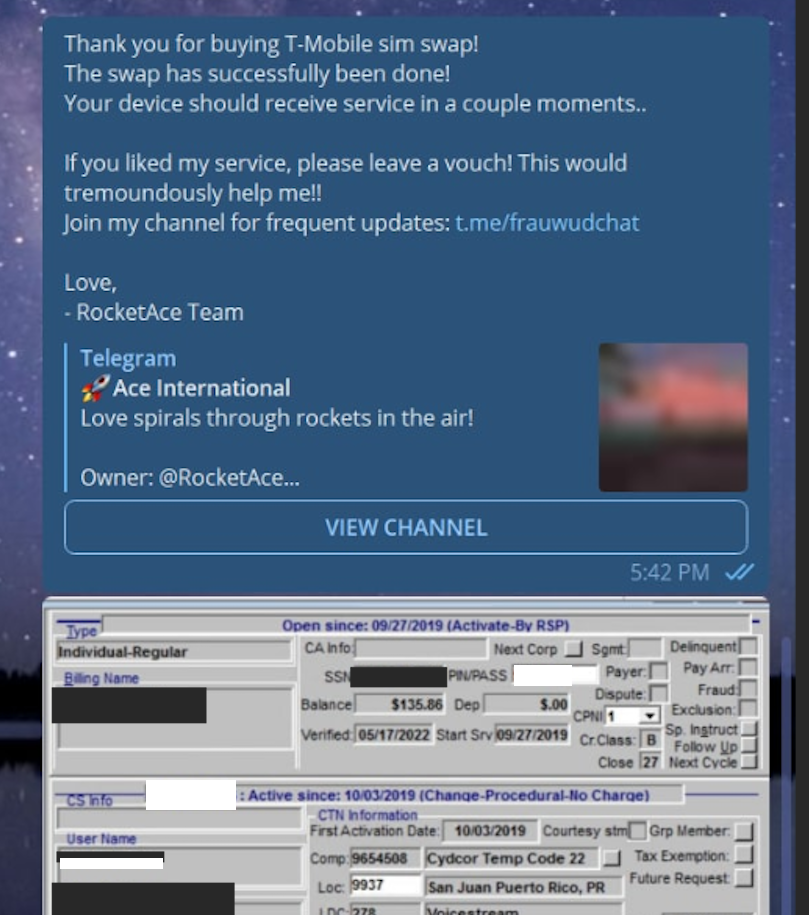
According to prosecutors, Jubair co-ran a bustling Telegram channel called Star Chat, the home of a SIM-swapping group that used voice- and SMS-based phishing attacks to steal credentials from employees at the major wireless providers in the U.S. and U.K. The group would then use that access to sell a service that could redirect a target’s phone number to a device the attackers controlled and intercept the victim’s calls and text messages (including one-time codes for multi-factor authentication).

A receipt from Star Fraud Chat’s SIM-swapping service targeting a T-Mobile customer after the group gained access to internal T-Mobile employee tools. “Rocket Ace” was one of Jubair’s hacker handles, according to U.S. prosecutors.

New Jersey prosecutors also allege Jubair also was involved in a mass SMS phishing campaign during the summer of 2022 that stole single sign-on credentials from employees at hundreds of companies. That weeks-long SMS phishing campaign led to intrusions and data thefts at more than 130 organizations, including LastPass, DoorDash, Mailchimp, Plex and Signal.

KrebsOnSecurity reported last year that one of Jubair’s alter egos at age 15 was “Everlynn,” a hacker who sold fraudulent “emergency data requests” that used compromised police and government email addresses to demand subscriber data (e.g. username, IP/email address) from major tech companies, claiming the requests concerned urgent matters of life and death and could not wait for a court order.

In April 2026, 24-year-old British national and Scattered Spider member Tyler “Tylerb” Buchanan pleaded guilty to wire fraud conspiracy and aggravated identity theft for participating in the group’s SMS phishing spree in the summer of 2022. The government said Buchanan, Jubair and others used the credentials harvested in that phishing campaign to steal at least $8 million in cryptocurrency from victims throughout the United States. Buchanan is currently scheduled to be sentenced on October 2.

In August 2025, 20-year-old Scattered Spider member from Florida named Noah Michael Urban was sentenced to 10 years in federal prison and ordered to pay $13 million in restitution, after pleading guilty to charges of wire fraud and conspiracy.

The U.S. Department of Justice says three alleged Scattered Spider defendants indicted along with Buchanan still face charges, including Ahmed Hossam Eldin Elbadawy, 24, a.k.a. “AD,” of College Station, Texas; Evans Onyeaka Osiebo, 21, of Dallas, Texas; and Joel Martin Evans, 26, a.k.a. “joeleoli,” of Jacksonville, North Carolina.

Flowers and Jubair are slated to be sentenced in a London court on July 15, 2026.

‘Scattered Spider’ Member ‘Tylerb’ Pleads Guilty

A 24-year-old British national and senior member of the cybercrime group “Scattered Spider” has pleaded guilty to wire fraud conspiracy and aggravated identity theft. Tyler Robert Buchanan admitted his role in a series of text-message phishing attacks in the summer of 2022 that allowed the group to hack into at least a dozen major technology companies and steal tens of millions of dollars worth of cryptocurrency from investors.

Buchanan’s hacker handle “Tylerb” once graced a leaderboard in the English-language criminal hacking scene that tracked the most accomplished cyber thieves. Now in U.S. custody and awaiting sentencing, the Dundee, Scotland native is facing the possibility of more than 20 years in prison.
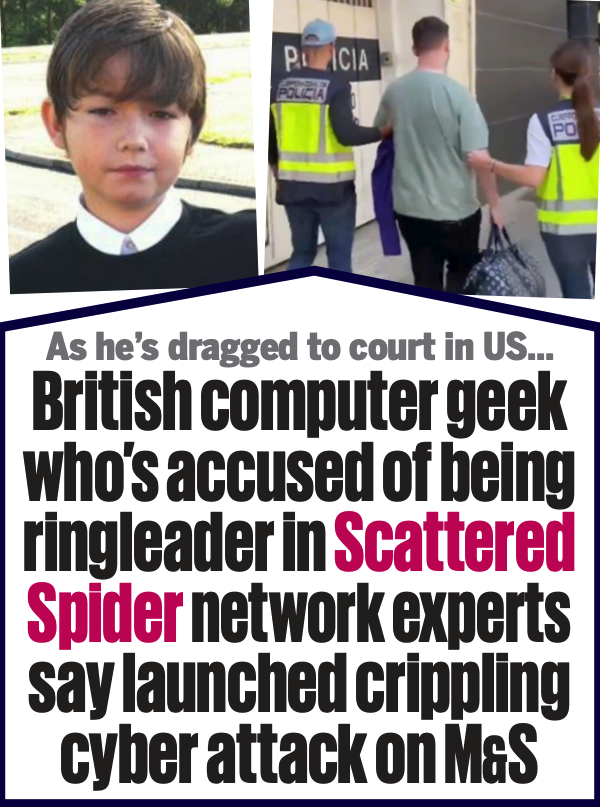
A screenshot of two photos of Buchanan that appeared in a Daily Mail story dated May 3, 2025.

Two photos published in a Daily Mail story dated May 3, 2025 show Buchanan as a child (left) and as an adult being detained by airport authorities in Spain. “M&S” in this screenshot refers to Marks & Spencer, a major U.K. retail chain that suffered a ransomware attack last year at the hands of Scattered Spider.

Scattered Spider is the name given to a prolific English-speaking cybercrime group known for using social engineering tactics to break into companies and steal data for ransom, often impersonating employees or contractors to deceive IT help desks into granting access.

As part of his guilty plea, Buchanan admitted conspiring with other Scattered Spider members to launch tens of thousands of SMS-based phishing attacks in 2022 that led to intrusions at a number of technology companies, including Twilio, LastPass, DoorDash, and Mailchimp.

The group then used data stolen in those breaches to carry out SIM-swapping attacks that siphoned funds from individual cryptocurrency investors. In an unauthorized SIM-swap, crooks transfer the target’s phone number to a device they control and intercept any text messages or phone calls to the victim’s device — such as one-time passcodes for authentication and password reset links sent via SMS. The U.S. Justice Department said Buchanan admitted to stealing at least $8 million in virtual currency from individual victims throughout the United States.

FBI investigators tied Buchanan to the 2022 SMS phishing attacks after discovering the same username and email address was used to register numerous phishing domains seen in the campaign. The domain registrar NameCheap found that less than a month before the phishing spree, the account that registered those domains logged in from an Internet address in the U.K. FBI investigators said the Scottish police told them the address was leased to Buchanan throughout 2022.

As first reported by KrebsOnSecurity, Buchanan fled the United Kingdom in February 2023, after a rival cybercrime gang hired thugs to invade his home, assault his mother, and threaten to burn him with a blowtorch unless he gave up the keys to his cryptocurrency wallet. That same year, U.K. investigators found a device at Buchanan’s Scotland residence that included data stolen from SMS phishing victims and seed phrases from cryptocurrency theft victims.

Buchanan was arrested by Spanish authorities in June 2024 while trying to board a flight to Italy. He was extradited to the United States and has remained in U.S. federal custody since April 2025.

Buchanan is the second known Scattered Spider member to plead guilty. Noah Michael Urban, 21, of Palm Coast, Fla., was sentenced to 10 years in federal prison last year and ordered to pay $13 million in restitution. Three other alleged co-conspirators — Ahmed Hossam Eldin Elbadawy, 24, a.k.a. “AD,” of College Station, Texas; Evans Onyeaka Osiebo, 21, of Dallas, Texas; and Joel Martin Evans, 26, a.k.a. “joeleoli,” of Jacksonville, North Carolina – still face criminal charges.

Two other alleged Scattered Spider members will soon be tried in the United Kingdom. Owen Flowers, 18, and Thalha Jubair, 20, are facing charges related to the hacking and extortion of several large U.K. retailers, the London transit system, and healthcare providers in the United States. Both have pleaded not guilty, and their trial is slated to begin in June.

Investigators say the Scattered Spider suspects are part of a sprawling cybercriminal community online known as “The Com,” wherein hackers from different cliques boast publicly on Telegram and Discord about high-profile cyber thefts that almost invariably begin with social engineering — tricking people over the phone, email or SMS into giving away credentials that allow remote access to corporate internal networks.

One of the more popular SIM-swapping channels on Telegram has long maintained a leaderboard of the most rapacious SIM-swappers, indexed by their supposed conquests in stealing cryptocurrency. That leaderboard previously listed Buchanan’s hacker alias Tylerb at #65 (out of 100 hackers), with Urban’s moniker “Sosa” coming in at #24.

Buchanan’s sentencing hearing is scheduled for August 21, 2026. According to the Justice Department, he faces a statutory maximum sentence of 22 years in federal prison. However, any sentence the judge hands down in this case may be significantly tempered by a number of mitigating factors in the U.S. Sentencing Guidelines, including the defendant’s age, criminal history, time already served in U.S. custody, and the degree to which they cooperated with federal authorities.

The Curious Case of the Comburglar

By Troy Wojewoda During a recent Breach Assessment engagement, BHIS discovered a highly stealthy and persistent intrusion technique utilized by a threat actor to maintain Command-and-Control (C2) within the client’s […]

The post The Curious Case of the Comburglar appeared first on Black Hills Information Security, Inc..

Welcome to Shark Week: A Guide for Getting Started with Wireshark and TShark

Troy Wojewoda // In honor of Shark Week1, I decided to write this blog to demonstrate various techniques I’ve found useful when analyzing network traffic with Wireshark, as well as […]

The post Welcome to Shark Week: A Guide for Getting Started with Wireshark and TShark appeared first on Black Hills Information Security, Inc..

Who’s Bootin’? Dissecting the Master Boot Record

Hal Denton // Have you ever been given an encrypted hard drive to perform forensic analysis on? What could go wrong? Probably the first thought rolling through your mind is […]

The post Who’s Bootin’? Dissecting the Master Boot Record appeared first on Black Hills Information Security, Inc..

Webcast: Attack Tactics 7 – The Logs You Are Looking For

Slides for this webcast can be found here: https://www.blackhillsinfosec.com/wp-content/uploads/2020/09/SLIDES_AttackTactics7LogsYouAreLookingFor.pdf So we went through an attack in the BHIS Webcast, “Attack Tactics 5! Zero to Hero Attack.” Then we went through […]

The post Webcast: Attack Tactics 7 – The Logs You Are Looking For appeared first on Black Hills Information Security, Inc..

Cubicles and Compromises Printable

Cubicles and Compromises

John Strand// Thanks for joining us for our Cubicles and Compromises webcast! We also have a recording available soon! In the meantime, here’s a blog post explanation: And, here you’ll […]

The post Cubicles and Compromises Printable appeared first on Black Hills Information Security, Inc..

The Rejected Box – An Ode to IT Professionals

Melisa Wachs // Hello IT professional.  If you haven’t heard it lately, I hope you know that you’re really amazing. You’re probably helping “laymen” like me all day long. Maybe […]

The post The Rejected Box – An Ode to IT Professionals appeared first on Black Hills Information Security, Inc..

❌